Blog Archives
Logan (2017)
 The Wolverine solo films have not been good movies. The 2008 first film was widely lambasted and while it made its money it was an obvious artistic misfire. The second film, The Wolverine, directed by James Mangold was an improvement even though it had its silly moments and fell apart with a contrived final confrontation. The Wolverine movies were definitely the lesser, unworthy sidekick to the X-Men franchise, and this was a franchise that recently suffered from the near abysmal Apocalypse. Mangold returns for another Wolverine sequel but I was cautious. And then the cheerfully profane Deadpool broke box-office records and gave the Fox execs the latitude needed for a darker, bloodier, and more adult movie that’s more interested in character regrets than toy tie-ins. Thank goodness for the success of Deadpool because Logan is the X-Men movie, and in particular the Wolverine movie, I’ve been waiting for since the mutants burst onto the big screen some seventeen years ago. It is everything you could want in a Wolverine movie.
In the year 2029, mutants have become all but extinct. Logan (Jackman) is keeping a low profile as a limo driver and taking care of an ailing Charles Xavier (Patrick Stewart) south of the border. Xavier is losing his mind and a danger to others with his out-of-control psychic powers that need to be drugged. Caliban (Stephen Merchant) is also helping, a light-sensitive mutant with the ability to innately track people across the globe. Logan is ailing because his healing power is dwindling and he can’t keep up with the steady poison of his adamantium bones. A scared Mexican nurse tries to convince Logan to help out the little girl in her care, Laura (Dafne Keen, feral and a better non-verbal actor). She’s an angry, violent child and built from the DNA of Logan. She too has unbreakably sharp claws and a healing ability. Bounty hunter Pierce (Boyd Holbrook) is trying to recapture the runaway merchandise/science experiment, capturing Caliban and torturing him to track his prey. Logan goes on the run with Xavier and they try to make sense of what to do with Laura, a.k.a. X-23. They’re headed north to Eden, a hypothetical refuge for mutants to sneak over into freedom in Canada, and along the way are deadly hunters who aren’t afraid of leaving behind a trail of bodies to get their girl back.
 It feels like it shouldn’t haven taken Jackman’s reported final outing for the execs to realize that a guy with freaking knives attached to his hands might be a concept that would work in the more grisly, more adult territory an R-rating creatively affords. It’s about time this man got to fully use his claws, and it was a joyous explosion of violence and gore built up for fans such as myself for a long time coming. It feels like Fox has been planning for this event as well, as if they stationed a production lackey to devise all sorts of grotesquely fun ways that Wolverine might skewer his competition in bloody beauty (“Finally, your preparation will not be in vain, Ronald”). There’s one scene in particular where a bunch of armed henchmen are psychically frozen in place and Logan struggles to move past each, and we get to anticipate just how each one will be viciously stabbed. For a series that has shied away from overly gory violence, Logan certainly celebrates its new opportunities with bloody glee. The fact that the first word spoken is an f-bomb and there’s a gratuitous moment of drunken sorority girl boob flashing is like the producers trying to directly communicate to the millions of ticket buyers and saying, “Hey, we’re sorry it took so long. Hope it was worth the wait.” Oh dear reader, it was worth the wait.
It’s not just the action that’s invigorating but the emotional core of the film is deeper and more compelling and ruminative than ever before, and finally these great actors are given material to deliver great performances worthy of their talent. Stewart and Jackman have never been bad in their respective roles even if and when the movies have been. They just have never been called upon for much more than genre heroics, anguish, and pained moral dilemmas. With Logan, both actors are finally given meaty material that affords nuance and ambiguity, and they are excellent. Charles Xavier is losing his battle with Alzheimer’s and ALS, which is a major concern when his mind is considered a weapon of mass destruction by the government. He’s going through his own end of life deliberations (“You’re waiting for me to die,” he groans at Logan) and it brings out a far different Xavier than we’ve ever seen, even with the youthful cockiness from James McAvoy. This is a cranky, defiant, and doddering Xavier, someone who is barely outpacing his sense of grief, guilt, and depression. There’s a tragic back-story we only get a glimpse of but it’s suitably devastating for a man who has devoted his life to others. He’s looking for a few last moments of grace and looking to hold onto something by journey’s end.
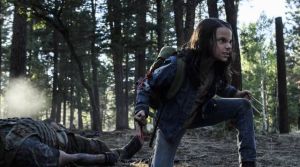 Thanks to his healing ability and the star wattage of Jackman, there was little fear that anything serious would ever befall Wolverine in his many previous film appearances. Sure bad things happened to him and he lost plenty of female love interests, but you never feared that he wouldn’t be able to ultimately handle himself. That’s not the case in Logan, which opens with a Wolverine who has clearly lost more than a step or two. He’s tired, rundown, and his adamantium skeleton is slowly poisoning his body. His healing powers are slowing down and he’s not as berserker fast and agile as he used to be. For once there’s an uncertainty attached to the character and a vulnerability. This turn greatly increases the intensity of the fight sequences and the greater stakes of the drama. The comparisons of the samurai were rife in The Wolverine and now the comparisons to the aging, lone gunslinger are ever-present in Logan. He’s drawn into a conflict that he was not seeking and he’s found a little bit of his remaining humanity and compassion to do right in the face of overwhelming odds and near certain destruction. There’s a subtle moment that the film doesn’t even dwell on that stuck with me. It’s after an accident, and in the thick of confusion, Logan is trying to save his mentor but he’s also worried that Xavier will think he betrayed him. “It wasn’t me,” he repeats over and over, not wanting this man to suffer more. It’s a small moment that doesn’t get much attention and yet it really spoke of their relationship and the depth of feeling during these fraught final days. This is the first Wolverine movie that feels like the characters matter as human beings just as much as purveyors of punching and kicking (now with gruesome slashing at no extra cost). Jackman showcases more than his impressive physique this go-round; he delivers a wounded performance that’s built upon generations of scars that he’s been ignoring. It’s the serious character examination we’ve been waiting for.
I also want to single out Merchant (Extras) who gives a performance I never would have anticipated from the awkwardly comedic beanpole. He even gets a badass moment and I never would have thought Stephen Merchant would ever have a badass moment in life.
Mangold’s film plays as a love letter to Western cinema and uses the genre trappings in ways to further comment on the characters and their plight. This is a bleak movie. It’s not a dystopia. In fact it resembles our own world pretty closely with a few technological additions; automated machines and trucks, the common knowledge that mutants have been wiped out like the measles. Knowing that it’s reportedly the end for Stewart and Jackman playing these characters, I was anticipating the film to strike an elegiac chord. His past and legacy are catching up with Logan. He becomes an unlikely guardian to Laura and explores a fatherhood dynamic that was never afforded to him before. The unlikely partnership, and it is a partnership as she’s a pint-sized chip off the block of her tempestuous father, blossoms along a cross-country road trip for a paradise that may or may not exist, while desperadoes and powerful black hat villains are out to impose their will upon the weak. This is explored in a leisurely pit stop with a working class family (welcome back, Eriq La Sale) that welcomes Logan and his posse into their home. We get a small respite and learn about greedy landowners trying to pressure them into giving up the family farm. It’s completely reminiscent of something you might see in a classic Western of old, just transported to a new setting. There’s even an extended bit where Laura watches 1953’s Shane on TV, and when those final words come back in expected yet clunky fashion, I’d be lying if they didn’t push the right emotions at the right time.
 But when it comes to action, Logan more than satisfies. The action is cleanly orchestrated by Mangold in fluid takes that allow the audience to readily engage. The film doesn’t go overboard on the Grand Guignol and lose sight of the key aspects of great action sequences. There’s a refreshing variety of the action and combat, and the action is framed tightly to the characters and their goals. It makes for an exhilarating viewing. If there is anything I would cite as a detriment for an otherwise incredible sendoff, I think the movie peaks too soon action-wise. The emotional climax is definitely where it ought to be (tears will be shed whether you like it or not) but the third act action doesn’t have quite the pop. Also, while Holbrook (Narcos) is an entertaining and slyly charismatic heavy, the villains in the movie are kept relatively vague as is their overall plan. The vacuum of villainy is kept more one-dimensional, which is fine as it allows more complexity and character moments to be doled out to our heroes, but it is a noticeable missing element.
One of the best attributes I cited from last year’s Captain America: Civil War is that the full weight of the character histories was felt, giving real emotional stakes to all the explosions and moralizing. When our characters went toe-to-toe, we felt a dozen films’ worth of setup that made the conflict matter. Logan carries that same emotional weight. We’ve been watching Wolverine and Professor Xavier for almost two decades and across nine films. These characters have gotten old, tired, and they carry their years like taciturn gunslingers looking for solitude and trying to justify the regrets of their lives. It’s a surprisingly emotional, serious, and altogether mature final chapter, one that provides just as many enjoyable character moments and stretches of ruminative silence as it does jolts of gritty, dirty, hard-charging action and bloody violence. It’s as much a character study as it is a superhero movie or Western. I cannot imagine this story as a watered down, PG-13 neutered version of what I saw on screen. This is a movie for adults and it pays great justice to the characters and the demands of the audience. The final image is note-perfect and can speak volumes about the ultimate legacy of Wolverine and by extension Xavier and his school for gifted youngsters. Logan is the second-best X-Men movie (First Class still rules the roost) and a thoughtful and poignant finish that left me dizzy with happiness, emotionally drained, and extremely satisfied as a longtime fan.
Nate’s Grade: A-
Share this:

Jackie (2016)
 Jackie (Natalie Portman) is still reeling from the loss of her husband, President Kennedy (Caspar Phillipson). In the weeks that followed the assassination in 1963, her life was a whirlwind of change. She was leaving the White House while another administration took control of her husband’s office and agenda. She was leaving a life of glamour and privilege and it all came to a halt. Bobby Kennedy (Peter Sarsgaard) is worried about the Kennedy policies getting lost as well as his own potential presidential prospects. Lyndon Johnson (John Carrol Lynch) is worried about asserting his own control. While trying to work through her grief, Jackie must protect her husband’s legacy among all the well-wishers, political vultures, and craven opportunists.
We’re left with an immersive, impressionistic look at America’s most famous first lady since it’s hard to distinguish the layers of performance from the woman herself. She was used to adopting the façade of what the public expected of her, how her husband’s friends looks at her with desire and dismissiveness, and the differences between her private life and her public persona. It’s a fascinating glimpse into the interior space of a famous woman that so many people think they know well because of her glamour and television appearances, but do they really? Her identity is in free fall. She gave up everything for this man and now he is gone and her cherished position is gone. It’s said each first lady leaves her stamp on the office, and now Ladybird Johnson is already itching to undo that stamp, erasing Jackie’s presence and supplanting it. Will these last few days define her and will they define her husband? While dealing with raw grief, Jackie also takes the position of being the first to protect her husband’s legacy. While planning the particulars of the funeral march and exact burial site, she’s really framing his place in the greater annuls of history, tragically cut short and questionably memorable. His life has been taken from her and now the only thing she can do is protect his place in history. The funeral details and conflicts they consign the new Johnson administration to are interesting, as is Jackie’s simmering disdain for the Johnsons, but it’s more than just placation; Jackie has an underrated knack for theatrical optics. The country is in mourning, just like its (former) first lady, and she offers a spectacle as an outlet. Some term it vanity and even Jackie admits that many aspects were for her, for her grief, for her rage at the world and her doubters, for her wounded soul searching for meaning. She wanted the American public to see her in mourning but she wanted just as much to see them in mourning too.
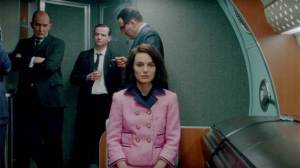 Eschewing the standard cradle-to-grave biopic, as well the noveau approach of using one clarifying moment to better examine and sum up the person (see: Selma, Steve Jobs), Noah Oppenheim’s script is a triptych, a hypnotic exploration that zips along non-linear but thematically-tethered memories. It’s a more interesting approach because we’re not locked into a linear progression of plot events, though the immediate aftermath and her interview with the Newsweek reporter (Billy Crudup) serve as the directional compass. It also provides a clever conceit for meta-textual levels. We have scenes that lay as direct conflict with the public Jackie and the private Jackie, and we have scenes that lay into the different levels of performance, from her show model tour of the White House furnishings and fixings to putting on the brave face to speak to her children. Director Pablo Larraine (No, Neruda) shoots the movie in a style reminiscent of its 1960s time period, with a film stock that blends the difference between documentary and recreation, further adding another stylistic level to the proceedings. The various threads of connectivity are so much more interesting to dissect with this storytelling approach and it makes the movie a much deeper and more contemplative experience to unpack.
There’s a scene in the middle of Jackie that stood out to me. During a night of drinking, Jackie puts on the record for the Broadway production of Camelot and wanders the large empty spaces of the people’s house. For my younger readers, the Kennedy administration was dubbed by many as “Camelot,” first coined by Jackie, out of a sense of its idealism, youth, and inspirational promise to change the world into a nobler place. It’s practically a mythical time and the real people get lost amidst the romantic spectacle. Nowadays, our presidents can often be the same mythical figures as the kings of old, figureheads whose humanity and details we iron out and soften as we eulogize and entomb them. The music echoes through the different chambers but there’s no one to hear it, no one to enjoy it, the vast emptiness communicating much of Jackie’s anguish. “There will be great presidents again but there will never be another Camelot,” she says. That moment is left as a passing memory, a picture of nostalgia that will only have its realism dampen in time as it becomes enshrined in American myth making. Amidst all her privilege and esteem, there is an existential sense of loss for Jackie and the nation as a whole into the turbulent 60s.
The other rich aspect is that we are watching a woman process her grief in real-time and it can often put a lump in your throat. I challenge anyone not to feel an outpouring of empathy when Jackie has to explain to her two very young children why daddy isn’t coming back from Dallas, having to explain something horrendous to those so innocent. In some scenes it feels like Jackie is numb to the world around her, focused on the little things as an escape from her horrible reality and its trauma. We do get a recreation of that fateful day in Dallas twice. The first is the immediate aftermath with Jackie bloodied and protected by the Secret Service, keeping her at a distance from us too in the audience. The next is a closer view inside the car as we’re with Jackie when the awful event happens, and the sudden shock of gore is still a disturbing gut-punch no matter how much you anticipate the moment. We watch her crazed instincts trying to collect the pieces of her beautiful and broken husband, stressing she was trying to keep everything together, figuratively and literally. The scene plays out longer and it serves as an emotional climax to the film, a frank reminder that for everything people believe they know about this woman, at heart, for all her riches and fame and privilege, she is simply a human being trying to make sense of death. It’s this final moment in the car that reminds us.
 This is an acting showcase and Portman (Black Swan) excels, delivering the best female performance I’ve seen this year at the movies. It’s an Oscar bait dream role and she nails it. She goes beyond mere imitation though Portman does an excellent job of that. Thanks to critic/blogger Jeffrey Wells for this great quote about the imitable real-life Jackie from author Tom Wolfe’s novel, The Right Stuff: “She had a certain Southern smile, which she had perhaps picked up at Foxcroft School, in Virginia, and her quiet voice, which came through her teeth, as revealed by the smile. She barely moved her lower jaw when she talked. The words seemed to slip between her teeth like exceedingly small slippery pearls.” Portman stunned me early with her exquisite recreation of Jackie and then she stunned me moments later with the depth of emotion she was able to convey in the scene where she stares into the Air Force One mirror, dabbing her husband’s blood from her face as her eyes are swollen with tears. Lorraine favors plenty of exacting close-ups to watch the array of emotions play across her face. She has moments of strength, moments of pettiness, moments of heart-tugging lows and weakness, and Portman is always fascinating, holding your attention rapt as you study her study. It’s a mesmerizing performance and one that deserves to earn Portman her second gold statue.
Jackie is a movie that has stayed with me for days after I’ve seen it. The exceptional and empathetic work by Portman is the first thing I recall, and then the thematic and symbolic relevance of the storylines as they fold on top of one another, providing a hypnotic and immersive portrait of a very famous woman who sought and spurned the spotlight. As far as I’m concerned this is the definitive film presentation of Jackie and Portman’s searing performance is the dazzling standard that won’t be beat. You walk away having additional appreciation for this woman but also further curiosity. The movie doesn’t expressly state who she is as a human being, providing a range of personas, some that conflict with one another, and allows you to put it all together for your interpretation. It’s a bold gambit and a fitting gesture for a woman defined by others’ perceptions.
Nate’s Grade: A-
Share this:

Dom Hemingway (2014)
 Undeservingly lost in the shuffle, Dom Hemingway is a brash and wildly entertaining dark crime comedy. Jude Law is a sheer force of nature as the title character, a charismatic and garrulous criminal with no shortness of ego or volume. He’s just getting out of a 12-year jail sentence and taking stock of his life. His wife is dead, his grown-up daughter (Game of Thrones’ Emilia Clarke) hates him for his absence, and his bosses are ready to reward him for his long silence. The only person who could screw things is up is Dom, and he does, as he’s prone to impulsive fits, shouting matches, and oversized bravado. This is really a series of comic vignettes and vulgar monologues, but the writing by Richard Shepard (The Matador) is slyly hilarious, leaving me in stitches throughout (“I am not burying your body today! I didn’t bring the right shoes for it.”). The comic voice here is assured and finely attuned to the broad wavelengths the characters. It’s not exactly he colorful, cartoon criminal universe of early Guy Ritchie films, but there’s a definitely heightened atmosphere here that blends well with the manic nature of Dom. Law is bouncing off the walls; you may have to wash the spittle off your TV. But he’s compelling from his first minute onscreen to his last. The third act squeezes in a degree of emotions though by then we’ve been enjoying the depravity too much to switch focus. I don’t think the work has been put in to make Dom a three-dimensional character, but that won’t stop Dom’s film from being a blast of entertainment with swagger to spare.
Nate’s Grade: A-


You must be logged in to post a comment.