Blog Archives
The Ninth Gate (2000) [Review Re-View]
 Originally released March 10, 2000:
The latest from old school horror pioneer Roman Polanski is a dark and brooding thriller that is… very long and brooding. What begins with noir charm and decadence grows thin by the movie’s over-bloated running time – giving new definition to the term “tedium.” The visuals are grim and noirish, but hang forever. Half of the movie is seeing Johnny Depp walk from Point A to Point B; and then the other half is watching him light up a cigarette usually already with drink safely in hand. Depp plays a librarian that doesn’t play by all the rules, or something or other. He’s set out to authenticate the last three books of a Satanic worshiper only to discover they lead to a path of devilish power. By the time Ninth Gate reaches its climax at an Eyes Wide Shut-style group gathering the audience has already hopelessly lost feeling in their ass. The vague ending is a cop-out after what the viewer is forced to go through to finally find out the secrets of these special 15th century books/doorstops. When it’s not carelessly lingering The Ninth Gate has some interest to it, but too often than not, it just rolls ahead forgetful of the audience that paid to come see it.
Nate’s Grade: C-
——————————————————
WRITER REFLECTIONS 20 YEARS LATER

Times sure have changed for famous director Roman Polanski. He’s been filming movies entirely in Europe for years since he fled the United States to escape prosecution for rape charges. He even won an Academy Award in 2002 for The Pianist, though he wasn’t present to accept naturally. However, in a post-Me Too realm of improved scrutiny over the bad habits of bad men with power and influence, Polanski hasn’t had a movie with notable names since 2012’s Carnage. He’s made a few foreign-language films since but his sphere seems notably smaller, more confined, and more shut off from the industry and actors and moneymen that want to work with the famous director. They’ve even attempted to get him extradited back to the U.S. again. All of this cannot help but color re-watching The Ninth Gate, especially when it already plays upon memories of Polanski’s own Rosemary’s Baby. I wondered if this movie might actually be better twenty years later, and for a while I was feeling like my young film critic self was perhaps a little too quick to judgment. However, upon recent viewing, this is still a long and boring misfire.
 The premise is slightly intriguing until you realize what it exactly entails. Johnny Depp’s character, Dean Corso, is a rare book evaluator and unscrupulous profiteer. He’s been hired by wealthy magnate Boris Balkin (Frank Langella) to authenticate a book reportedly co-written by the Devil himself and, if real, has the ability to summon Old Scratch to boot. Hey, we got something there for an intriguing horror movie that delves into the occult. And for perhaps the first act, The Ninth Gate works well enough to establish its mood and its central conflict. Then it just kept going. And kept going. And that’s when you realize that much of this movie involves one man traveling to different chateaus and other European estates to simply look at books. There are three copies of this rare Devil-penned tome, so Dean Corso is traveling to at least two different locales simply to compare and contrast books. I don’t think I’m fully articulating just how boring this can get. Imagine a significant other sitting beside you and deep in thought with a dense textbook. Imagine watching them read and make the occasional verbal noise. That is The Ninth Gate. Watching people read is boring, especially when it’s done repeatedly. There are MULTIPLE scenes of simply watching Depp look over a book while music plays. Film is a visual medium, and reading is inherently an internal function unless adjusted in context. It’s not like he’s deliberating over whether to send a text to a special someone, what the personal correspondence means to his concept of his family, it’s a man compare old books for a job. It’s not like he’s obsessed over this book for years or is a true believer of its power.
Some of this might even be permissible if the stodgy 133-minute film wasn’t so tediously repetitive (spoilers to follow). Corso is paid to authenticate the book but every person he encounters that knows a little about this book ends up dead. The book dealer he has stash the book? Dead. The old man with the second copy who says he’ll never sell his book not even if his life depended on it? Dead. The old lady expert with the third copy who despises Boris Balkin? Dead. By the time that wheelchair-bound woman is found to be repeatedly running into a wall, and upon further inspection has her tongue hanging out her mouth in an unintentionally goofy sight, the plot structure of The Ninth Gate has entered farce. Dean Corso doesn’t seem terribly alarmed by any of this or observant of an obvious pattern of events. He has several run-ins with goons and a mysterious blonde woman (Emmanuelle Seigner) that follows his every move. He seems comically oblivious to the danger all around him. Part of this is the repetitive plot structure where over an hour of the movie follows Depp going to a place, discovering one minor addition of information, finding that person dead, being chased, then repeating. It takes over an hour simply to note that there are minute differences in the engravings in the three copies of the devilish book. Then it simply shifts into a game of who can capture all the copies, which it should have been from the start, and would have introduced a very necessary sense of urgency from a prosaic script. Another reason for that general turgid feeling is that Depp seems to be sleepwalking through this performance absent emotion. Even Polanski himself complained.
 This is a movie about a special book that can unleash the powers of the Devil, so why is the finished film so boring and frustrating to sit through? It has rival cults and business tycoons fending for ownership over that power. At least it does in theory. The fact that there are competing interests should have been a substantially larger element of the movie. Once Lena Olin’s rich widow character sleeps with Dean Corso to get the first copy back, she disappears from the narrative until the very end, where she’s dispatched without any intervention from her assembled cult of would-be Satanists. Seriously they just stand by and watch a guy strangle her to death and jump at the word “Boo!” They were never a threat even if they were responsible for one part of the mysterious stalkers. The other stalker, our ever-present blonde, will literally float at times and come to kung-fu kicking rescue, which made me snort out loud. It just comes across so goofy. Her identity is clearly in a supernatural answer but the movie never fully explains who she is, what her real motivations are, her allegiances, and even what the ending is supposed to mean. After 133 minutes, it’s egregious that Polanski doesn’t provide a conclusion that feels even fleetingly conclusive. The whole movie is a mystery that moves with irritatingly incremental steps that leads to one big shrug.
I can see the appeal of the idea of this story but I don’t see the appeal of making The Ninth Gate as is, beside visiting some fabulous locations in Portugal and Spain. Why get an actor of Depp’s caliber if he’s going to read on camera and not worry about his encroaching danger? Why does this movie need 133 minutes to set up a plot that could have done it in 100? I think Polanski was eager to revisit the old school horror of his early works and didn’t sweat the details. Mysterious castles of old. Dangerous strangers. Cults. The Devil. Book authentication. Okay, maybe not that last part. I suppose one could charitably say Polanski is trying to establish an unsettling mood with patient-yet-paranoid camerawork and a story that feels unhurried. It feels to me like Polanski doesn’t know what movie he wants to make and is in no rush to get there. The most overtly horror moments fall into self-parody. That’s really where the movie errs for me. It takes great horror story elements and says instead of running with cults and the Devil, what if we focused more on the slow authentication of dusty old books? Not their power or meaning or value to devious men and women, but on whether they are real. That would be like finding a treasure map and then trying to make sure the ink was authentic for its era rather than, you know, hunting for treasure.
My original review twenty years ago is a bit harsh and angry, though I can understand why especially after such an anticlimactic ending. I would say the movie is more than watching Depp walk from Point A to point B, though to be sure that is heavily represented onscreen. I might even slightly raise my letter grade but the criticisms still stand as stated. Even twenty years later, with a fresh set of eyes, The Ninth Gate is a disappointing story that says too little and takes too long to do so.
Re-View Grade: C
Share this:

The Wretched (2020)

Very reminiscent of Fright Night, this movie feels like a lost relic to 80s coming-of-age movies and horror-next-door thrillers, and it’s generally great. We follow a teenager who is staying with his father over the summer; he’s also recovering after a drug-related accident. He’s convinced that his neighbor is really a witch who kills children and then fiendishly erases the memory of those children from the families she has inserted herself into. Nobody will believe him, especially with his past drug abuse, so he takes it upon himself to investigate the strange goings on, Rear Window-style, and potentially save lives once the witch is forced to jump into a new host and terrorize a new family. The Wretched is barely 90 minutes long and is splendidly plotted with every scene being meaningful, advancing the plot, shading characters and conflicts, heightening the stakes and suspense. The new-kid-in-town and young crush story elements work as well as the creepy horror. Overall, it’s a very fun movie that can switch modes when needed, being funny or sincere or spooky, and it does each with great finesse and execution. Writer-directors Brett and Drew Pierce (Deadheads) have a great affection for their characters as well as their material. It shows in the level of thought they give even small details, finding clever ways to serve payoffs as well as work emotional investment into a briskly told tale. There’s a very late twist that I should have seen coming but made me want to start clapping, and it works entirely within the carefully set-up rules of the supernatural monster and supplies an organic elevation to the stakes. I only wish the movie had given me even more. The Wretched is a charming throwback and proof positive that you don’t need to reinvent the wheel to make a good horror movie, just keep to a vision and see through the story to best serve and elevate that vision. It’s well worth your 90 minutes and I predict a bright future for the Pierce brothers.
Nate’s Grade: B+
Share this:

Gretel & Hansel (2020)
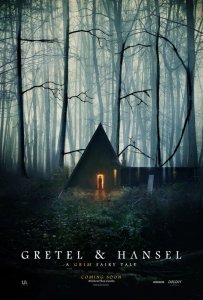 I feel bad for select audiences that went into Gretel & Hansel expecting a cheap thriller because what they really get is an atmospheric art movie that, even at a mere 80 minutes, moves at a very placid pace. Director Osgood “Oz” Perkins (The Blackcoat’s Daughter) takes the bones of the classic Grimm fairy tale and presents it as a feminist retelling of outcasts coming into their own feminine power and the costs of giving over to that power. The titular siblings are cast out by their mother after Gretel refuses to be a maid for a creepy older man very interested in hr “maidenhood.” They stumble upon the dwelling of an older outcast and she supplies plenty of food, but where exactly is it coming from? Gretel experiences strange dreams that portend to a witchy power of her own making, but she’s scared about what she may become and what may befall her brother, who the older woman deems Gretel’s “poison.” The story is a bit strained but the movie is visually luscious to watch. The photography and production design are exceptional and greatly lend the movie a transporting atmosphere that, coupled with its stodgy pacing, creates the sensation of experiencing a waking dream. The camera uses a lot of stark wide angles and centered compositions to heighten a sense of unreality. My favorite moments were the older Witch (Alice Krige, the Borg Queen from Star Trek: First Contact) was coaching Gretel on her inherent power and the sacrifices necessary for her to achieve her potential. She advises “trusting the darkness,” which sounds ominous enough. Because of the general familiarity with the fairy tale, the movie gets more leeway to fill its time with fantasy diversions and a slow build of horror revealing the disturbing process of how the feasts of food become prepared. It almost feels like the movie is reaching a breaking point with how lagging that pacing is, but then it generally gets back on track with a new revelation or complication. Gretel & Hansel is an enjoyably moody, stylish, equally beautiful and unsettling movie that’s heavy on grim and light on plot.
Nate’s Grade: B
Share this:

Among Them (2019)
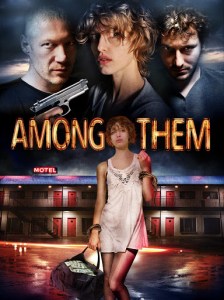
Among Them was described in its advertising as “Tarantino meets Bad Times at the El Royale,” and ignoring the fact that Bad Times is itself a colorful Tarantino-styled homage, what I was really reminded of was Waiting for Godot. For those unfamiliar with Samuel Beckett’s existential play, it follows two gentlemen who do nothing much more than waiting for a man named Godot who never shows up. They get involved in philosophical discussions, and many have intuited that Godot is a representation of God, to Beckett’s dismay, but it’s really a two-act play that involves a whole lot of waiting and the question over why. This is the extent of Among Them’s 90-minute total – a lot of waiting and a lot of questions over why bother.
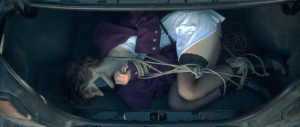
Two bank robbers, Mick (Dan Liebman) and Harry (Jonathan Thomson), are hiding out in a motel room off the coast. Their bank heist has gone wrong and they’re awaiting the proper papers to escape overseas under new identities. They also discover a woman, bound and gagged, inside the trunk of their getaway car assigned to them from their bosses. Syd (Evalena Marie) could be a liability and they need to make sure she doesn’t get them caught.
The problem with the screenplay by director Kevin James Barry (Serena and the Ratts) and co-star Marie (Dark Haul) is that it has conflated being vague with the idea of being mysterious. There’s far too little going on in this story and far too little that makes much sense. Our criminal duo is following instructions to lie low at a motel. That’s it. They don’t really know who they’re working for, what those plans might include, and so they wait for some unknown source to finally give them their new passports to escape from the police. Being kept in the dark with your characters can be a benefit for storytelling because you are forced to think things through at the character’s level, which works nicely for paranoia thrillers and mysteries. However, when you don’t put in the necessary work, it just makes the story feel unfinished and pointlessly protracted.
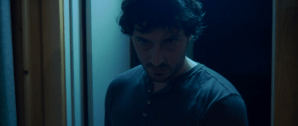
I can clearly see the Tarantino elements that the filmmakers attach to Among Them, the bank robbers hiding after a job gone wrong, the kidnapped character becoming part of the team, the motel that might not be all that it appears to be, but these are just elements. What’s desperately missing from Among Them is the intricate plotting and superb characterization one comes to expect from a QT joint. If we’re going to be stuck with these characters in a confined setting, then we need either intriguing developments or engaging personalities that draw us in. Well, considering the story involves characters just waiting around a motel room and seeing weird ghostly visions, plot development isn’t going to be the winner. This is really where Among Them creates an artistic ceiling for itself with its bland characters who we’re stuck hanging around with. Neither Mick nor Harry are charismatic, interesting, or even that dangerous. There aren’t even that many differences between them. If you’re keeping characters cooped up, it would be smart to have some sort of interpersonal conflict that threatens to boil over and ruin things. Think about From Dusk ‘til Dawn and Tarantino’s character and his creepy fixation on an underage hostage, or the different agendas in Bad Times. Just because the characters are seemingly losing their minds doesn’t replace dynamic and necessary characterization.
This brings me to the character of Syd, whom I do not understand at all. She’s discovered in the trunk of a car that was designated for our bank robbers. You would naturally think this woman either means something important enough to be captured or presents an intriguing enigma. This is another consequence of keeping everything so overwhelmingly vague. The characters don’t seem too bothered to learn more about her and why she was placed in the trunk of their car, which just seems like a criminal lack of curiosity on their part. Even worse, Syd doesn’t seem too interested herself why she ended up in somebody’s trunk. I figured she would want to run away at the first opportunity, but she doesn’t, and instead just hangs around with the guys, eagerly volunteering to help on their “spy missions.” If her perspective was going to be off kilter, then this could have opened up the character more, making her a wildcard who could take things too far, perhaps provide a dangerous threat to the characters achieving their goal, something. The fact that a bound stranger is gifted to them and they don’t have to thwart her from escaping feels bizarrely wasted. Why even bother with this scenario if nothing is to be done with it after twenty minutes?
Among Them fills its meandering runtime with unexplained supernatural imagery and dream sequences, which don’t so much convey the unique emotional trauma of the characters as it does serve up conventional spooky imagery and pad the running time. I held on waiting to see if there would be a viable explanation for everything, and I was left waiting unfulfilled, much like the main characters. I think the filmmakers were trying to get the audience to doubt what they watched, and show the characters are descending into madness, but it also doesn’t quite work. There isn’t an escalation for them. They don’t seem more unbound as things progress. These eerie visions don’t lead them to make drastic choices, though the movie comes close. Therefore, it just feels like a supernatural presence is messing around with people in a vague and unsatisfying manner because it, too, must be bored. It feels like weird things are happening to goose up a narrative that doesn’t have enough conflict or engaging characters.

From a production standpoint, Among Them looks relatively solid for a low-budget thriller. Having a limited location works for an indie production and the director seems to use every part of his space to keep things from getting visually dull. The acting is overall decent with the standout being Marie as a frightened victim who becomes the most interesting character among the three. Another actor worthy of note is Michael Reed (Chupacabra Territory) as the creepy motel clerk who is, from the get-go, clearly hiding something nefarious about his intentions.
Among Them is a fairly pedestrian thriller that had potential to be something more but is trapped by a stunning lack of imagination and intrigue. There are questions to be had and mysteries to be uncovered, but the subsequent supernatural twists and turns amount to distractions. The screenplay is absent memorable characters with complexity, conflict, and even colorful personalities to make spending all this free time with them something other than a chore. I never really knew what was happening and the characters didn’t seem too eager to find out either. Among Them is more a listless experience than a painful one, a tale that doesn’t ever seem to get started despite some surefire story elements just sitting there. If you’ve ever wanted to watch a disappointing 90s indie crime version of Waiting for Godot, then Among Them is chief among them.
Nate’s Grade: D+
Share this:

Fantasy Island (2020)
 I wasn’t expecting to become a defender of Blumhouse’s much-reviled remake of 1970s TV staple, Fantasy Island (it currently has a 7% fresh rating on Rotten Tomatoes) but this year has been defined by surprises. I’m not going to say that this is a good movie but turning a cheesy TV drama into a horror thriller that might as well take place on the magical island from Lost, I have to admit that’s a daring approach and it almost works. Michael Pena is miscast as a villainous Mr. Roarke who invites a group of strangers to a beatific island resort to have their fantasies come true be they hedonistic (wild parties with sexy guys and gals) or vengeance (Lucy Hale getting even against a high school bully) or regret (Maggie Q saying yes to a proposal and starting a new life). At first the fantasies seem too good to be true and then the darker reality comes forward, forcing many characters on the run. I was very happy that the filmmakers, the same creative team behind the equally-reviled Truth or Dare, present the proceedings as being clearly supernatural and stick with it. I was expecting some hackneyed explanation of how it was all a show, or a simulation, or some kind of televised event for the rich to gamble upon, but the movie stays supernatural to the end as if it is the Lost island with its weird secrets. Because of that scenario, even when the rules of the island and the final scheme comes to light as to whose fantasy all of this pertains to, it’s a forgivable level of convolution. There were moments I even had fun, mostly just seeing how crazy and far away from the source material everything can get. It felt like if someone was ordered to remake The Love Boat and came up with Ghost Ship. It’s just fun how different it can go. I didn’t care for any of the characters outside of Maggie Q, who gets the best acting showcase as a woman with many regrets who is trying to ignore her misgivings. Hale seems to be playing a character ported from the Spring Breakers universe (what a dreadful thought). Michael Rooker (Guardians of the Galaxy) appears as a grizzled veteran of the island. Even when things aren’t working, like black-eyed zombies or much of the comedy, I wasn’t ever bored. How crazy would things get next? How would they tie this all together? Fantasy Island is not the horrible experience critics claimed earlier this year. It’s not a great movie but it works as silly escapism, and during a time of pandemic-initiated quarantine, a little silly escapism might just be what you need for a couple of hours.
Nate’s Grade: C+
Share this:

Brahms: The Boy II (2020)
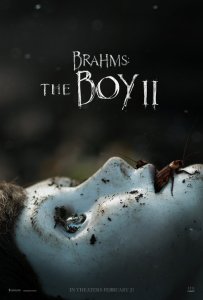 I mostly enjoyed the creepy thrills of 2016’s The Boy, where a young woman is hired by a wealthy old couple to watch their son who just happens to be a doll named Brahms who may or may not be alive. It built an atmosphere with patience until the very end where it definitively revealed the doll was not alive at all. Zoom ahead several years and now we have the awkwardly titled Brahms: The Boy II (why? why is the sequel status slated for the subtitle?) and it completely negates the previous movie. Surprise, that doll that was only a doll in the first movie is now a real supernatural presence who infects others and can move on its own. I don’t consider this a significant spoiler merely because returning director William Brent Bell (The Devil Inside) tips his hand so early into the movie’s 86 minutes. Because you know the doll is definitely alive now the rest of the movie becomes a tedious game of waiting for the adults to finally catch on, which makes the viewer impatient and also saps the dread out of scenes. This is the first movie I can recall where a person screams in front of a stationary doll and it’s treated like a jump scare. Katie Holmes (Logan Lucky) does her best as the matriarch of a family suffering some serious psychological trauma after being the victims of a home invasion. She and her husband see the Brahms doll as a working conduit for their son to better process his trauma. He’s even begun talking again, and also supposedly drawing very murderous pictures and saying how Brahms is angry. There’s an interesting story somewhere in here about a family using a creepy doll as an unorthodox means of PTSD therapy, but The Boy II is just such a lackluster horror movie. We know the doll is alive yet all the things we’re supposed to worry about are absent the doll’s immediate vicinity. Even as it gets more and more blatant, including a finale that reveals what Brahms looks like behind his mask (did you even think there was a “behind”?), the movie fails to make you care about anything that’s happening. It’s sluggish, silly, and stale. Even if you were a marginal fan of the first one, I would advise skipping Brahms. I wonder if there will be a The Boy III that completely undoes the sequel, the Rise of Skywalker to The Boy II‘s Last Jedi. Never thought I’d write that sentence.
Nate’s Grade: C-
Share this:

Countdown (2019)

I have history with Countdown. Nothing personally with this movie written and directed by Justin Dec but because of the concept, a killer countdown ticking down to a specific person’s ultimate demise. In 2015, a screenwriting pal of mine Joe Marino and I were developing a TV series pitch for… a mystery involving a website counting down to the specific second of specific people’s deaths. We even called it… “Countdown.” Our pitch, which we presented to a producer and, as far as I know, never got further than that, would have opened bigger and bigger, starting with a mysterious slasher killer on a college campus that opens up to, eventually, a self-aware machine arranging life-and-death judgements and manipulating technology to see it through. I still have the pitch document and, if I do say so, it’s not bad. I don’t hold any suspicion with Dec and the filmmakers behind this version of Countdown. Anyone can independently come up with the same high-concept premise, it’s just funny to me the similarities between the two. It’s also unfortunate because, after having seen this 2019 Countdown, that there won’t be any other versions of this worthwhile premise.
Quinn Harris (Elizabeth Lail) is a nurse who is still coming to terms with her mother’s tragic death, her feelings of guilt over the accident that caused it, and being harassed by her boss (Peter Facinelli). Her younger sister downloads a new cool app that predicts when a user will die. It’s only a countdown timer and some people get ninety years and others get three days. Quinn tries deleting the app, even buying a new phone, but it cannot be stopped, and she’s now having strange visions and meeting up with other users who fear the app’s threats are very real.

There’s a reason Countdown almost kind of works. The premise has power. It’s a modern mash-up of The Ring and Final Destination, with a technological trap that curses the user like The Ring and then as the seconds tick closer it becomes a paranoid guessing game of what could befall the victim, much like the sneaky appeal of the Destination movies. This is all evident in the film’s opening eight-minute prologue, which is actually, genuinely a good watch. Had Countdown merely consisted of this opening segment, it could have been an enjoyable short film. It establishes its premise, some degree of rules, then simmers in the dread, and produces a few solid creepy moments and a clever conclusion that signals what Plan A had been for the victim’s demise. It’s got enough punch and dread that I could see it performing well on a fest circuit.
The problem comes when the movie tries to arrange a reasonable explanation for all the supernatural spookery. The mystery of the unknown, a haunted app, is going to be better than uncovering the secrets behind the app and its “terms of agreement.” The mystery behind the app is less interesting to watch than the question of how a character is going to die, which is why this would work better in a smaller time frame like as a short where it plays its trick once. The killer app cites breach in agreement terms if users “alter their acceptance of fate.” It’s legally vague but could basically apply to any time any person cancels plans (an introvert’s worst nightmare come true). This is a silly notion because why is a magical phone app so particular about plans? Then there’s the moment where we get the specs on the data for this app and it’s… bigger than expected (“Like a whole season of Game of Thrones on your phone”). I guess that’s slightly unexpected but who cares? It’s little things like this that start to break down the internal logic of the movie’s menace and Countdown was better off when it didn’t have to support a feature.
The movie starts to crack when it tosses in subplots to fulfill a feature-length running time. Again, this premise could sustain a movie (and even a series) but when the conclusion is simply that the app is demonic and uses divine evil powers, then any sense of mystery about the particulars around it feels like jogging in place. What does it matter when the app can justify any action, counter action, or outlandish scenario because of its demonic nature? Our characters gang together with the belief they can somehow break the curse if they beat the counter by one second, but why would they have any sense this could work and with a supernatural presence that can just change the rules? When you’re dealing with, you know, evil demons, they’re not trustworthy. This explanation means that whatever happens can change at any time just because. It makes it feel like all of the untangled mysteries and the determination to beat the system through some assumed understanding of agreed-upon rules as unsatisfying detours.
The most egregious subplot happens to be a very serious case of sexual harassment and assault by Quinn’s boss. This feels entirely out of place for “scary phone app” movie, and it very much feels grafted on by some studio executive who thought they would make their movie more relevant with the changing times. Like some exec said, “Hey, throw in some of that Me Too stuff. That will show we care. Bring in the women. It’s a very real problem.” I understand that the filmmakers wanted to present a villain who could be conquered in the place of an unknowably powerful demonic entity. It feels monumentally tacky to awkwardly cram in a real story of sexual assault as a questionable means of making the film more topical.
I think there’s an interesting story potential of people, knowing the exact second of their death, using it as a motivator good and bad. Perhaps it motivates them to quit their job and finally tackle a long list of personal goals, ask that one girl out, write that novel as some sort of legacy. Or perhaps it motivates them to live a life free of consequences and to take vengeance against others knowing full well their remaining years have been cut short. There could be an entire group of people who view themselves almost as spiritual warriors who have been blessed with foresight so they run roughshod over society’s rules. There could be lots of interesting sociological and psychological areas this degree of foreknowledge could provide, so it feels a little reductive to simply have it be a demonic curse that nobody thinks much more about.
After appearing on numerous Worst of the Year lists, a countdown in its own right, I was expecting Countdown to be an awful, intelligence-insulting experience. I didn’t hate this. In fact, I think it’s rather competently directed with some effectively eerie moments for a PG-13 horror movie. I enjoyed the TWO comic relief characters, a sarcastic and unscrupulous phone salesman (Tom Segura) and a nerdy priest who is eager to help (P.J. Byrne). I thought the opening eight minutes could have served as a complete short film that would have gotten attention. The film even presents some interesting ideas and complications with its premise. It’s not a good movie, especially with its lackluster conclusions to a lackluster mystery, but it’s not really a bad movie either. It’s 85 minutes of a killer premise but lacking necessary development to keep the interest level high, which is why the jump scares with grabby, clammy demon hands pop up. Countdown isn’t bad as much as it’s more disappointing, a premise that could have been so much more.
Nate’s Grade: C
Share this:

Frozen II (2019)

While it’s become somewhat fashionable to call Frozen overrated, I still think it’s a great movie with an even better soundtrack, songs that I can instantly think of and hear them immediately in my head. I figured Disney would be very careful about a Frozen sequel out of a tactic understanding that they didn’t want to damage their brand. It was six years ago so I figured they hatched a sequel worthy of the big screen and legacy of their billion-dollar hit, but what I received with Frozen II was more akin to a direct-to-DVD sequel that is meant to jump start an afternoon cartoon series called Elsa’s Magical Friends. Prepare for mediocrity, folks, and start dialing back those expectations. The story revolves around Elsa (voiced by Idina Menzel) discovering her past, traveling to a magical land, meeting magical tribes of creatures, and helping to unite a divided people. The sloppiness of the storytelling is staggering. The plot is filled with exposition and the world building is clunky and unclear, designed more to move things along and set up cute creatures ready for holiday merchandise. The characters arcs are nebulous, in the case of Elsa considering she’s never longed to discover a past, and resoundingly lightweight in the case of everyone else; Kristoff (Jonathan Groff) is worried about having the perfect proposal (yawn), and Anna (Kristen Bell) wants to support her sister but also doesn’t want her to march off into danger needlessly (yeah, and…?). Olaf (Josh Gad), the magic snowman, remarks about the nature of change, but by the very end of the movie nothing has really changed, and that’s even after a gigantic potential sacrifice that Anna makes by her lonesome. I felt some emotional pull for the characters but that was because of the holdover of my feelings for them and less because of the situations they found themselves in with this sequel. And let’s get to the songs, which are shockingly forgettable. I was forgetting them even in the middle of them being performed. There’s no “Let It Go,” but there’s also nothing as low as the troll song, but what we’re left with are milquetoast ballads and tunes low on hum-worthy melodies. The best song might actually be a jokey power ballad along the lines of Bryan Adams where Kristoff sings his woes. That’s right, a Kristoff song is maybe the best track in this movie. That feels like a pretty big indication something went wrong. It felt like the kind of quality you’d expect from a direct-to-DVD sequel’s array of new songs. Frozen II feels so bizarrely perfunctory and routine, absent a cohesive theme holding everything together and providing a firm landscape to direct the characters, and going through the motions. It’s not a story that adds greater depth to this world. If you’re expecting something along the lines of quality from the first Frozen, it’s better to simply let those feelings go. And what’s the deal with Elsa’s neck on the poster? It’s far far too long.
Nate’s Grade: B-
Share this:

Doctor Sleep (2019)
 Mike Flanagan has taken the mantle from Frank Darabont and become the best film adapter of Stephen King’s stories. Doctor Sleep is a sequel to The Shining but it’s a sequel to Kubrick’s movie version, which King notoriously hated for its alterations. We follow an adult Danny Torrance (Ewan McGregor) as he struggles with addiction in the wake of his family’s tragedy linked to the Overlook Hotel. He starts a new life for himself as a hospice worker, aiding the elderly into a peaceful demise (where he earns the titular nickname), and he takes it upon himself to mentor a young girl, Abra (Kyliegh Curran), who has the same “shining” powers that he has. Trouble is others are looking for these same gifted few, namely Rose the Hat (Rebecca Ferguson) and her gang of traveling undead mutant vampire people feeding off the “steam” or life force of the super-powered they kill. They’re after Abra and her abilities so Danny must rescue her and eventually head back to the source of all his nightmares. This is a relatively solid sequel that has enough intrigue and suspense to cover over the dull parts. It takes too long to get going and then finishes things up too quickly, especially with a climax at the reawakened Overlook that is beginning to hit a groove with nasty ghostly suspense. It felt like I was watching Stephen King’s X-Men with his assortment of super powered people banding together and tracking each other down. The gypsy-like caravan of villains are pretty disposable and lacking strong personality or menace. Ferguson (Mission: Impossible – Fallout) is fun to watch even if she doesn’t feel that threatening. The rules and limitations feel vaguely defined and refined. The nods to the original Shining are selective and bring their own degree of power, as does seeing different actors portray these famous characters in flashback. Flanagan has reverence for both King’s source material and the beloved 1980 film, and bridging the two is a source of enjoyment. The characterization overall is pretty slack and there aren’t much in the way of genuine scares. It’s creepy, it’s occasionally atmospheric, and it’s also really long and drawn out, clocking in at 151 minutes, which is even longer than Kubrick’s movie. It’s an epilogue that gets by on the emotional investment and resolution it provides for Danny while setting up a larger universe of super “shining” psychics. If you don’t care about one, there’s at least some degree of the other to prove entertaining albeit also being underdeveloped. Doctor Sleep (a wasted title) is a workable balance between two masters of horror.
Nate’s Grade: B
Share this:

Night Work (2019)
 As I’ve been making a concerted effort to provide thoughtful film reviews for local Ohio projects, I’ve had to acknowledge my potential bias in several circumstances, having personal or professional connections to those behind and in front of the camera. Well, when it comes to the genre comedy Night Work, this is the most biased I may ever get for a project not carrying my name. Writer/director Kyle Rayburn cast a good friend of mine, Valerie Gilbert, in a key supporting role, and I was so inspired with her character’s unique situation that I went and wrote a 9-part rom-com Web series called The Spirit Inside Me exploring that dynamic in the context of a different genre. Gilbert co-starred in my production, served as my co-creator, and Kyle not only gave us his blessing for our own independent project, he offered constant encouragement and assistance, opening his home to us to film one of the episodes (our lead actress threatened to kidnap his sweetheart of a dog). If it wasn’t for Kyle’s creativity, and later his generosity, there would be no Spirit Inside Me, and I’m very grateful for that outcome (look for the first batch of Spirit episodes in late 2019?). Now I get to review the man’s finished film that he made throughout the fall of 2018 in central Ohio and instead of just blaring, “It’s awesome, go see it,” I feel like I can better serve the filmmakers by providing as objective and professional a review as I can especially for a fun movie that deserves to be seen on the festival circuit and later on home video release.
It’s a world of monsters and men living side-by-side. The Night Work team operate as a for-hire crew to bust some ghosts, keep some creepy crawlies in line, and handle the many supernatural beasties hassling the common folk. Frank Rooker (Scott Wood) is the grizzled, hard-drinking, punch-first-ask-questions-later partner with a tragic past. His young daughter Elizabeth was possessed by a spirit and she has been missing for years. Mysterious clues start to emerge pointing toward Elizabeth being alive, and Frank enlists the help of his magic-oriented, irritable Night Work partner Chase Hardy (Virgil Schnell) and Val (Gilbert), a strong-armed bartender who offers handjobs for a fee (she’s also shares her body with a lesbian samurai). Together, this motley crew will shake down creeps and fakes to find out what really happened to Elizabeth.
 The fact that Rayburn and his company of first-time filmmakers threw themselves into the mix unabated and holding to their ambition to tell a funky indie version of True Blood meets Men in Black is impressive. They could have gone an introspective mumblecore route, or a teens-lost-in-the-woods genre slasher, but instead they went with a micro-budgeted fantasy/horror buddy film replete with monsters, vampires, and assorted lesbian samurai possessions. Given the budget, inexperience, and ambitions, I take my hat off to the entire Night Work cast and crew not just for going for broke with a twisted, silly comic vision but also seeing it through.
First and foremost, Night Work is a fun movie that seems to be bristling with weirdness and ideas. There are offhand statements that make me curious about additional stories within this universe of humans and the everyday supernatural. It feels like every scene has so much storytelling potential just around the edges, which may be one of the reasons I took a character concept on the peripheral (love story between two people in one body) and creatively ran with it, writing a whole project devoted simply to exploring that very concept. Each time we’re introduced to a new character with a special power or predicament, the world feels richer and more alive and lived in. That sense permeates the film and provides an enjoyment level no matter the scene. You’ll find something to smile about or to be intrigued over in just about every moment, and that’s because Rayburn and his collaborators have certainly given thought to this unusual world. I enjoyed that characters will make references we don’t fully comprehend (“I thought it was gonna be another Baton Rouge”) but point toward more lived-in experiences to unpack. This is a highly amusing and inherently interesting world open for deeper exploration, possibly in linked sequels, and I think that’s a strong necessity for any storyteller creating a setting different than our own.
Night Work is also a funny movie, borrowing from the likes of Sam Raimi and Kevin Smith. There’s a crude, juvenile humor to the movie, and even when characters are confronted with terrifying monsters and the unknown, they meet it with a devilish glee. If the movie could be condensed into a single expression it would be a mirthful smirk. I laughed out loud at a child getting punched in the face. There’s a playful camaraderie between the various players where they always seem on the cusp of cracking a joke. Rather than be annoying, it keeps things light even when we’re dealing with some pretty spooky stuff, allowing Night Work to maintain a ball-busting comedic tone. It’s the film’s way of telling its audience to enjoy the ride, soak up the characters, and not to be too troubled by the rest, even if there are certain implications that might be more troublesome like a diet of male phalluses. I laughed at several points but smiled even more consistently. Night Work didn’t quite have the budget to achieve affecting horror, so it dives headlong into slapstick, banter, and spunky mischievousness. This works well because clever doesn’t need a dollar amount, only a strong writer and a clearly articulated vision.
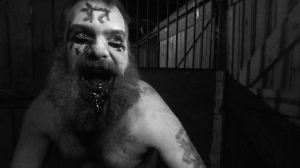 The performers are just as enjoyable as the funny banter they’re given. Scott Wood is so damn charismatic that it feels like he simply is Frank Rooker. His line readings have such spit and shine to them that the man can find jokes that I didn’t even know were in the lines; he discovers them with his sozzled, sarcastic nonchalance. He’s a presence that kept drawing me toward him and he serves as a terrific anchor for a movie. Wood needs more film work. His onscreen partner, Virgil Schnell, plays the straight man role growing more exasperated. They have a winning chemistry and, mysteriously, if you close your eyes and listen, Schnell’s voice sounds shockingly identical to Keegan Michael-Key. Gilbert (Pinheads, and, ahem, The Spirit Inside Me) is a welcomed addition and is cheerful and wry no matter what gets thrown at her. I wished she was in the movie even more. Gracie Hayes-Plazolles makes a strong impression as a late character who jostles back and forth between innocence and wickedness and has great fun playing those contrasts.
Because of its micro-budget nature, there are certain aspects of filmmaking you simply have to be charitable over as long as they don’t blunt the overall impact of the intent. There’s not much in the way of a sound mix or advanced lighting or set dressing, and I didn’t care, because this is a movie carried by the colorful characters, weird world, and spirited performances. The fact that Gilbert is splayed with what appears to be a blast of light from God (from an open car trunk in reality) doesn’t matter as much as the excellence with how she delivers an incredulous F-bomb after getting spat in the face as part of a protective ritual. The content of ideas, and the energy and commitment, overcome most of the production shortcomings and can provide their own homespun sense of lo-fi charm. There’s a later sequence where an entire conversation and fight inside a bar occurs through the use of silent movie-style inter-titles. I’m certain it was shot and/or edited this way from the realities of not being able to record good sound in a working bar at the time. However, it’s an unexpected and memorable moment that shows a silly and adaptable side at the ready.
With all that being said, there are some limitations that do affect the overall execution of Night Work and limit where the storytelling can go. For starters, this is a very heavily expositional movie. Going into a new world with monsters and magic requires a degree of expected world building which requires an expected degree of explanation. The trick is to make it seem as natural as possible and match it to the action on screen. Night Work follows a film noir-esque storyline where we follow our heroes from spot to spot, shaking down characters, following trails, picking up clues, and this also lends itself to monologues and interrogations. With Night Work, unfortunately there are too many moments of characters just talking and talking and unloading information about the world, its history, its differences, and it can feel like we just left one scene of characters talking to the audience and entered another scene of characters talking to the audience. Again, some of this is unavoidable, but the mission is to make exposition as invisible as possible and judiciously integrated, showing and not telling. It feels a bit like reading the game manual rather than playing the game. Some of this could have been mitigated by pairing it more through action, making the exposition more fluid. Instead of a character unloading information on what something does, we see it. Instead of learning what monsters exist, we see them, maybe even sitting pretty at a bar. I circle back to Men in Black and how it was able to slowly pull back and reveal more of its droll world and how it operated as needed.
 The pacing can be strained at times and my theory is because of the effort to get the final product over the finish line of an 80-minute feature running time. Some scenes and shots feel like they go on longer than necessary to convey information or mood, and there are multiple scenes of watching people drive set to soundtrack music or watching people walk down the street, sometimes sped up, set to soundtrack music. It’s different later when we watch Frank and Chase slowly creep through an abandoned building because there’s tension and mystery, anticipation, but watching people drive while listening to music feels like mood setting at best and filler at worst. You can get away with some of this to establish a sense of style and place, but if you choose this route too often, it starts to feel like there just wasn’t enough material available.
Then this makes me think about what could have been added, namely more visual or demonstrative elements and general coverage. Val’s samurai ghost demands some form of visual insert to pair with her recounting of being visited in her dreams. Even if it was brief glimpses, something to show them “together.” Otherwise, this aspect only exists as a theoretical, with the exception of some Japanese words espoused (does the ghost assist with the handjobs?). The same goes with the tragic backstory with Frank’s family. We’re treated to a small moment of his daughter becoming possessed, but the rest is delivered via extended voice over while Frank trundles around his home. Moments that could be ten seconds are stretched to two minutes, to cover for the voice over, to cover for the running time, or simply because there weren’t other editing options. Rarely will sequences feel like there are more than two to three angles to select from, and this isn’t a problem by itself except when it comes to some edits. Without inserts or tighter shots (I can only recall a mere handful of close-ups) there aren’t opportunities to wipe clean edits, so occasionally the same shot will awkwardly dissolve to a different take of the same shot. It’s moments like that where the amateurism, which I find as a general badge of honor for the project, can become an unwanted interference.
 Night Work is a fun, ribald little movie that has its own sense of charm, from its budgetary limitations to the expansive possibilities of its strange world. As soon as it was drawing to a close, with some life-changing circumstances and reunions, I was thinking, “Man, I almost wish that movie was starting right now.” It’s a great, drama-heavy starting point for a movie, and I’d be lying if part of me didn’t wish Night Work began at that point rather than ended there. However, what we do get with Night Work feels like the first step in a larger universe of monsters and mishaps, one I hope Rayburn’s promised next project, Satanic Soccer Mom from Ohio, will synch up with, further exploring the outer edges of this dark and demented playing field. The actors are committed and highly amusing with a special commendation for Wood’s efforts. Rayburn and his entire team, populated with friends, family, and amateur craftsmen, have aimed high and mostly hit their entertainment targets, using limitations mostly to their benefit. This is a charming movie with a strong sense of itself and the desire to entertain in a broad, goofy style. Even with adjusted expectations, there should be something for fans of genre cinema, unconventional comedies, and monsters to dig into. Night Work feels like a promising beginning, both for the filmmakers and its world. Rayburn did it, he made a movie on his own, and now with one movie under his belt, I hope he keeps cranking out more genre comedies happy to be genre comedies.
Nate’s Grade: B-


You must be logged in to post a comment.