Blog Archives
Black Adam (2022)
 Dwayne “The Rock” Johnson has been eyeing a superhero costume for over eight years. He’s been attached to a Black Adam project since 2014. The character is best known in DC comics as a villain for Shazam, although the mythology and rules of that universe get some revisions under this new vehicle. Johnson plays a Middle Eastern godlike figure who shuns being a selfless champion of the little people. If you’re an easy sell for superhero movies, there’s enough visual bravura and smash-em-ups to at least sate your appetite for CGI fisticuffs. By the lowered standards of the DCU, this is a thoroughly average movie. It has a certain childlike Saturday morning cartoon appeal that doesn’t try too hard to be taken seriously and goes about its business with a workmanlike degree of efficiency. The action is easy to follow and the obsessive slow-mo style feel like comics splash pages come to vivid life. I liked the warm, golden color palate and Mid-East setting as distinguishing features. There is an audience for Black Adam, I am certain, but it’s also getting harder to just accept average superhero movies given the glut of superhero cinema. The hero’s journey of this would-be villain becoming more a grumpy antihero is rote and predictable, including a really lame villain to make Black Adam look less bad in comparison. I didn’t care about big CGI demon goon fighting for control of a magic throne. The character arc is supposed to be about agency and responsibility, but it gets reduced down to a morally simplistic “I guess I won’t kill all the bad guys all the time” re-evaluation. The plotting and structure is also misshapen; the entire first half of the movie feels like the second half of some earlier movie we missed out on. The fighting can also get annoyingly repetitious. The Justice Society has two major members, Pierce Brosnan as Dr. Fate and Aldis Hodge as Hawkman, and the rest are afterthoughts, as if the producers leveraged including more big screen debuts in case the central character wasn’t enough of a draw. Anyway, the Justice Society and Black Adam go through half a dozen fights and I just got bored by their bickering. The premise of a Middle Eastern superhero, a champion for the Muslim world, would be a radical idea worth exploring the geopolitical ramifications, especially the fears this could raise in conservative and twitchy Western societies that this could be seen as akin to a superhero arms race. That direction might veer away from the intent of the character but that’s also the far more interesting story. Still, it’s The Rock as a superhero, and his enormous charisma can carry even an ordinary action movie to greater heights.
Nate’s Grade: B-
Share this:

Satanic Soccer Mom from Ohio (2022)
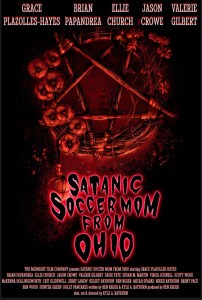
When you have a catchy title like Satanic Soccer Mom from Ohio, you know you have to deliver the goods. This gleefully schlocky suburban satire horror comedy (how many more adjectives you want?) is the follow-up from director/co-writer Kyle Rayburn, an unabashed genre enthusiast. I was granted an advance copy to review this new Ohio-made indie and I’ll try to remain as objective as possible, dear reader, despite the fact that Kyle is one of the nicest men on Earth and even allowed me to film an episode of my rom-com Web series in his own home. Satanic Soccer Mom from Ohio is more low-key than you may be expecting. Its chill vibes and relaxed, ironic humor are more indicative of a stoner hangout movie than something with demon figures and threats of damnation. I think plenty of viewers could latch onto the fun, weird wavelength of an undemanding silly comedy, although there are places I wish Satanic Soccer Mom had gone even further with its spirited sense of creativity.
Annie (Gracie Hayes-Plazolles) is trying to hold it all together in suburban Ohio. Her husband won the lottery and then vanished, and her suburban community is awash in gossip and speculation about what has happened to him. Annie is trying to raise her two kids alone, keep ahead of adult responsibilities like bills and soccer practice shuttling, and holding back from snapping at the clucking hens of the neighborhood, the Karens, lead by chief Karen Green (Valerie Gilbert). It all changes when she accidentally summons a horned demon, Balthazar (Brian Papandrea), who is willing to grant her three wishes at a price, as per proper Faustian bargains.
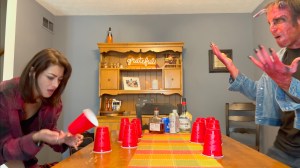
There is a breezy charm to Satanic Soccer Mom from Ohio, a casual, shoulder-shrugging amiability that invites you not to think too hard about the proceedings and just have fun, and if you can connect on that wavelength, then the meandering nature can also be part of that unexpected charm. It’s easy to see the works of Kevin Smith as a reference for Rayburn, but I was also reminded of the hangout cinema of Richard Linklater, where you adjust to the rhythms of characters and their daily lives and interactive camaraderie. Of course, nobody had their boobs literally fall off in Linklater’s world (though there’s still time yet), but it’s that same relaxed tone and feeling that permeates Satanic Soccer Mom. There’s something most amusing about populating your movie with fantastic creatures but keeping a deadpan sense of mundane reality. It’s one of the reasons I enjoyed the short-lived Adult Swim series Your Pretty Face is Going to Hell, a workplace sitcom set in an office literally in hell. If done well, the surprising triviality of the fantastic setup provides its own sly sense of humor. I enjoyed that the movie didn’t have apocalyptic stakes but instead illuminated conflicts very relatable to many: getting over a painful relationship, struggling to juggle the responsibilities of adulthood, fitting in but also knowing when to push back and assert your independence. Having the duplicitous neighborhood Karens be a bigger pain for Annie than an actual demon is a fun reversal. Same as Annie wasting her magically granted wish on ordinary adult requests, like a never-ending cup of iced coffee. The unblinking, roll-with-the-punches attitude of the characters made the movie entertaining even when little was going on from a plot standpoint, and that’s a big boon for an 80-minute indie.
I consider Satanic Soccer Mom from Ohio to be a silly buddy film, and it improves greatly once Balthazar becomes entwined in Annie’s domestic drama. This is also because Papandrea (Feaster Sunday) is the funniest performer in the movie. I loved the bickering dynamic between Annie and her demonic little helper. They reminded me of squabbling siblings, cemented even further during a contentious and competitive game of Mario Kart. This is also the key character dynamic for the movie, the ordinary in conflict with the extraordinary, the protagonist suffering and the relief with the strings attached. The movie is never better when these two are sharing the screen. Plazolles-Hayes (Night Work) has a spunky Parker Posey energy to her, an incredulity to her wide-eyed stares and eyebrow arches that feels earned. She’s the straight woman in a series of crazy developments, and Plazolles-Hayes doesn’t get lost in the craziness. Papandrea is a natural hell-raiser, a mischievous performer who makes the most of his material and elevates it with a grinning desperation that makes it all funnier, like a failing comic on stage. Balthazar is also highly engaging when he’s pretending to be a “normal human,” and his obvious, schticky delivery and mannerisms reminded me of Vincent D’Onofrio’s physical performance in Men in Black. I can still recall the moment he was trying to quickly hide from Annie’s children and just lifted whatever objects were near to badly obscure him (“What are you… four?” Annie berates him). The casual shade Papandrea imbues the line, “Okay… sinner,” is simply award-winning comedy. It’s also a diverting commentary that Annie gets along better with a demon than most humans, though I’m sure there are many among us who could relate. It endears Annie to the audience and proves how unflappable she is despite her troubles, worldly and other-wordly.
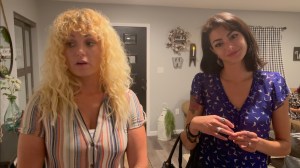
I also want to mention a few other performances that made the most with their screen time. Gilbert (Straitjacket) is so amusingly self-satisfied without becoming a full-blown suburbanite caricature of “Midwest nice.” I especially enjoyed the few moments she dropped the act and revealed the curdled reality behind her sweet-smiling facade. Virgil Schnell (Night Work) is hilarious with how transparently desperate he is to be with another woman, even willing to whip off his shirt to help a woman clean up a slight dab of spilled wine. Ellie Church (Harvest Lake, Jessie’s Super Normal Regular Average Day) is well-acquainted with low-budget horror and provides a welcomed sense of easy-going camaraderie for Annie as her lone friend in town.
As one of those who previously watched Rayburn’s first film foray, 2019’s Men in Black-meets-True Blood caper, Night Work, I can see definite growth as a filmmaker. Both movies were made on shoestring budgets (only $5,000 total) and filmed primarily on a iPhone camera, though the low-budget look isn’t a big point of detraction for either movie. You can’t judge a small indie movie made for $5000 and filmed on the weekends by the same technical standards of bigger movies. You have to accept some tech shortcomings, like the absence of dynamic lighting or polished audio or complex camerawork. There’s very little visual coverage in Satanic Soccer Mom, many scenes composed of a closed shot-reverse shot circuit of edit choices, but it took me out of the movie only sparingly. The rough-around-the-edges DIY aesthetic can provide its own micro-budget charm too, and Rayburn and co-writer Ben Reger (Night Work) are aware enough to write around technical limitations and emphasize ideas and quirky character interactions. He even has a character joke in narration, “That’s what we could afford to show you.” Rayburn is also smart to cast well and get out of the way of his actors. The ensemble feel like they’re gelling on the same comedic wavelength, which is harder to do than most would think, and thus each performer feels in concert no matter the wild turns. The makeup effects for Balthazar are stylish and effective on a budget, and his whole denim jacket and button-heavy attire and punk rock attitude reminded me favorably of Viv from the short-lived but brilliant British comedy TV series The Young Ones, formative to my own burgeoning sense of humor.
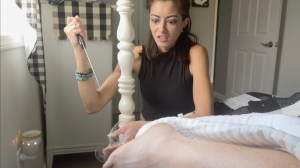
However, even with the emphasis on the ideas, there are enough moments that left me wanting more. I can understand some viewers feeling cold to its blase tone with its fantastical characters. Some viewers will not be able to get over the fact that a woman has a demon wish-granting service and the creativity only goes so far, mellowing in shallow waters for its own good vibes. With all the wish-granting, reality-altering possibilities that a demon represents, it can be something of a letdown for the wishes to be so mundane and minute. One of Annie’s wishes is for her (minor spoiler warnings) to be able to go out in town and pretend to be someone else, so she magically transforms into a different actress (Nickii Rayburn, the director’s wife, so good husband points there) for one raucous night. I can understand that this wish gets at Annie’s distaste for the oppressive negativity of her town, but couldn’t she just have gone to a different bar in a different town where nobody would know her? She could also just wish for the idiots in town to forget about her. It’s the same for why Annie even chooses to hang out with the Karens if she despises their company so much. I understand why the scene exists from a plot standpoint, as another contrast between Annie and the suburbanites she doesn’t fit in with, but then why even bother spending time with these women? There are engaging character aspects with Annie that feel only briefly touched upon, chief among them her complicated feelings about being abandoned by her husband. There’s a nice moment where Balthazar confirms her suspicions and Plazolles-Hayes gets to emote, finally able to process a key point of grief, and it’s one of the few genuine dramatic moments of the movie. However, without prolonged comedy set pieces, the movie would have benefited with more scenes like this for balance. The movie coasts a bit too long without a larger plot direction, so it can feel very scene-to-scene. Then the end includes multiple deus ex machinas, which can make the preceding problems feel too slight.
While I chuckled throughout, the comedy felt too subdued and too easily satisfied creatively. I’m surprised, given the premise, that there aren’t really comedy set pieces. I suppose there’s one, Annie and her pal getting stoned and attending craft night with the Karens, but that’s it. Much of the humor is ribald banter, so much will rest upon the quality of the dialogue writing. It helps having such sharp contrasts for conflict. I laughed throughout but kept wanting the movie to go further, to build off its gags and complications and peculiar turns. One of the dunder-headed Karens flippantly remarks about what could have happened to Annie’s husband, saying, “become a horse man,” and this would have made a fine opportunity to have her continue this weird fantasy tangent, accidentally revealing her own strange sexual kinks, something to separate her from the herd and then shame her back into social submission. That could have been a running gag. Or Bathazar’s one runty horn being a source of insecurity, something he has to defend (“I’ll have you know, plenty of lady demons have referred to my horns as ‘more than adequate.’”). There’s a truly wonderful random gag about the Karens raising money for “Saxophones for the Homeless,” and I was pleading for a visual representation of this concept, with a homeless man shrugging at the useless gift. I often wish there were comedy scenes and jokes that pushed beyond the first idea, taking one joke and finding a deeper, more belly laugh-inducing bit rather than settling for a passing chuckle. I’m talking about scenes where Annie gets stoned and giggles, or the inclusion of a record scratch sound effect to really ensure that a punchline landed and was meant to be unexpected. I wish Rayburn and Reger demonstrated as much confidence with all their jokes as they do their final gag involving an angel and the selected color of her wings (it’s definitely a memorable exit).
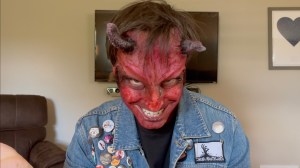
Two movies in and Rayburn is starting to establish a penchant for establishing weird and wild worlds with goofy, profane characters, rich in crude banter and crazy ideas, but worlds that I wish to explore further. Satanic Soccer Mom from Ohio is an amusing and charming movie, especially if one can gel with its overall amiable tone and forgive the inevitable technical shortcomings. I’m far more forgiving of tech issues than I am with narrative and comedy shortcomings, because those are strictly on the creative brain trust fully developing their story potential and exploring the possibilities of their funny. It’s hard not to feel like Satanic Soccer Mom is a solid first draft of a story and could have benefited from a few more passes and polishes to really punch up the comedy and better explore the character dynamics. That stuff isn’t budget dependent. Again, it’s easy to feel the passion everyone had for this project and especially the good times. We need movies that can provide that level of entertainment, no matter their flaws, and Satanic Soccer Mom from Ohio is likely going to be the most feel-good buddy movie ever with this title.
Nate’s Grade: B-
Share this:

The Black Phone (2022)
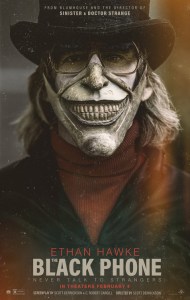 This is the movie that director Scott Derrickson made after departing Marvel over “creative differences” with the Doctor Strange sequel, differences I feel like I can agree with. Based upon Joe Hill’s short story, The Black Phone is a return to Derrickson’s horror roots, along with regular screenwriting collaborator C. Robert Cargill, and you can feel the director’s reflexes resetting. It’s like three movies in one, not all of them needed or entirely coherent. It’s about generational trauma and abuse, a survival thriller about escaping a psychotic serial killer, and a little kid trying to hone her nascent psychic powers. The stuff with Ethan Hawke as “The Grabber,” a kidnapper of children who imprisons them in a locked basement dwelling with a broken black phone attached to the wall, is great, and Hawke is fascinating and unsettling. Each mask he wears seems to come with a slightly different persona attached, so with each appearance we get another sliver of who this disturbed man may have been. The story of survival is made even more intriguing when our protagonist, young Finney (Mason Thames), learns that the past victims can communicate with him through the mysterious black phone. The scene-to-scene learning and plotting is fun and efficient and requires Finney to be a little bit of a detective, exploring his dank surroundings and the failed escape attempts of the other kids to utilize for his own hopeful plan. The ghost kids also have limited memory of their experiences, which is smart so that he isn’t given a clear advantage without limitations. The parts that drag are where Finney’s little sister tries to convince the skeptical police officials that her dreams are real and can help find her missing brother. There is one hilarious moment where she prays to Jesus for guidance and then profanely expresses her disappointment, but otherwise it feels like a Stephen King stereotype leftover (Hill is his son; apple meet tree) that doesn’t amount to much besides padding the running time. It doesn’t even lead to big breakthroughs for Finney to be rescued. As a small-scale creepy contained thriller, The Black Phone is an engaging survival story with a supernatural twist that works as well as it does. It doesn’t have much more depth or meaningful characterization, it’s really just about a kid using the power of neighborhood ghosts to escape a crazy man, and that’s enough at least for a passably entertaining 100 minutes.
Nate’s Grade: B
Share this:

The Northman (2022)
 Consider writer/director Robert Eggers’ bloody Viking revenge movie as a companion piece to 2021’s The Green Knight. Both movies take mythical, supernatural-aided tales of heroics and medieval masculinity and feed into the spectacle while also cleaving the legend to make way for a sense of humanity. We follow Amleth (Alexander Skatsgard) who is a displaced prince who has sworn to kill his treacherous uncle and rescue his mother (Nicole Kidman). It’s a tale so old that it inspired Shakespeare’s Hamlet, though that play could have benefited from a climax involving two hulking naked men dueling to the death atop an exploding volcano. The Northman reminds me a lot of Mel Gibson’s Apocalypto, a movie I described back in the day as “an art film for jocks.” It’s immersive and impressive down to the exact detail, and it doesn’t shirk on the blood and combat. It’s also unmistakably the work of Eggers, a very precise and idiosyncratic indie director whose prior movies felt like stylistic dares. The camerawork is often long with single takes, making all the visual arrangements and coordination that much more impressive. It’s staggering that a studio provided Eggers with $90 million to go make his version of Conan the Barbarian. At a lugubrious 140 minutes, there’s enough sticky carnage to satiate fans of brutish medieval action movies, but I appreciated how Eggers keeps his story purposely streamlined and simplistic until a few keen reveals force the audience and protagonist to re-examine the assumptions and fleeting honor of vengeance in this harsh, unfair environment of men out-killing one another. It’s a movie that provides the red meat and then makes you question whether you might want to go vegan. There’s more that can be unpacked but I wish Eggers had cut back at points. This is a slow movie, which does contribute to its mood and atmosphere, but I also wish Eggers had gotten to some of his plot points with a bit more haste and vigor. The Northman is transporting and bold and also more than a bit bloated. You could laugh at some of its over-the-top machismo but I feel like Eggers is inviting criticism of that very machismo, so enjoy the movie on one level where it indulges all the Old World violence, and then enjoy it on another level where it subverts and castigates the same Old World violence. Or you could just watch for the glistening muscles, famous faces, bad accents, bad wigs, guttural score, and weird imagery.
Nate’s Grade: B
Share this:

X (2022)/ Choose or Die (2022)
 Horror is likely the most forgiving genre out there for being derivative. Just about every modern horror movie wears its many influences, even the recent trend of elevated horror movies that are trying to say Big Things with equal amounts of arty style and bloodshed. There’s only so many monsters that can chase so many teenagers. Ti West (House of the Devil) is a director I haven’t fully enjoyed, though I would say X is his most accomplished film to date for me. It’s clearly going for a Texas Chainsaw Massacre vibe and docu-drama aesthetic. It’s set in 1979 and we follow a ragtag film crew trying to make “a good dirty movie.” They’ve rented a guest house in the middle of nowhere Texas as their film site because who knows. The octogenarian couple who owns the farm property doesn’t seem to approve of these young folk, and the old lady ends up becoming the slasher killer that mows down the randy young adults. Turns out the old lady has her own urges that the old husband is no longer physically able to satisfy, so she seeks out solace one way or another with the newcomers, whether that be through her sexual satisfaction or through violence. To West’s credit, he has given more attention to his characters. These people are not going to be confused with three-dimensional figures but there’s enough character shading that made me more interested in spending time with them and a little more rueful that most of them will probably die horribly soon enough (Chekhov’s alligator). The slow burn is not wasted time or dawdling, and there are some very well-executed squirm-worthy moments of discomfort. I don’t think X quite works on that elevated horror level of late; it’s mostly a slasher movie with a dollop more complexity and style. The real reason to appreciate X is from the dual performances from actress Mia Goth (Suspiria), the first as a stripper-turned-ingenue that sees pornography as a path of possible self-actualization, but she’s also secretly the killer old lady under piles and piles of makeup. Her wild performances, including scenes where she is facing off against herself, makes the movie far more interesting. Goth goes for broke. I don’t think the X is as fun as it thinks it is, nor is it as thoughtful as it thinks it is, and I don’t know if I care about a prequel that was shot back-to-back that illuminates the killer old lady’s younger life. Is this character really that interesting to warrant her own movie? As a horror movie, it’s disturbing and bloody and surprising in equal measure even as it doesn’t do much with re-configuring the many conventions of its genre.
 Netflix’s Choose or Die is one of those spooky horror movies that wants the audience to play its deadly games alongside the unfortunate characters, much like Saw and Would You Rather?, and I typically enjoy these kinds of movies and thinking what options or strategies I would undergo if I was in their place. The structure is pretty straight forward, with a young woman (Iola Evans) and her programmer friend (Asa Butterfield) coming across a cursed old school text-based computer video game that forces its users to make awful choices. The game turns itself on every 24 hours, so there’s a natural delivery of set pieces, each increasing in its personal stakes. There’s the amateur investigation of the history of this 80s video game and uncovering the possible owner who might be benefiting from all this cruelty and sadism. This is a movie built around its set pieces and they start strong. When the protagonist sees the game in action, with a poor diner worker force-feeding herself broken pieces of glass, it’s truly horrifying and the sound design makes it so much worse. The movie isn’t s gory as it could have been and implies a lot more than it shows. The problem with Choose or Die is that there are too many leaps in logic and characters doing silly things just for the sake of the plot. There needs to be an established system of rules or else everything will feel arbitrary, and eventually that is what dooms Choose or Die. Even while we get more of an explanation behind the makers of the game and their occult connections it never feels like we’re better positioned to beat the game. I will say the final act, the Boss Battle, is where the movie cranks things up and gets really intense and darkly humorous. There’s a showdown that involves a key concept of self-harm that plays out in moderately clever, bizarre, and surprising ways, and this splashy, silly finish made me wish the rest of the movie could have lived in this tonal space. I found the overall sound design to be very annoying as it cranked up the volume on lots of glitchy electronic noises that just made me want to turn it off. There are some good ideas here, like the criticisms of being too nostalgic to the past, and of misogynist men believing nobody else is deserving of being the hero of their story, but this is a movie that lives or dies on its killer set pieces, and those just fall flat after its unsettling first level. Watching someone vomit VHS tape is not scary. Watching people move their bodies like they have no control over them will inherently look goofy. Choose or Die wouldn’t be the worst choice of a movie to kill 85 minutes but it’s certainly not much more than the sum of its parts, and even those are overly derivative and been done better by its predecessors.
Nate’s Grades:
X: C+
Choose or Die: C
Share this:

Turning Red (2022)
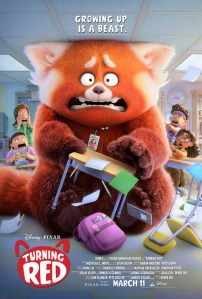 It’s fair to start to wonder whether Disney has some kind of grudge against Pixar at this time. The last three Pixar movies have been pulled from theatrical release and made exclusively available as part of their streaming war chest with Disney Plus. You can blame COVID for Soul being pulled, and the theatrical market was still recovering by the time Luca was scheduled to be released during the middle of summer 2021, but this didn’t stop Disney from releasing both of its own in-house animated efforts to theaters. Both Raya and the Last Dragon and Encanto played in theaters in 2021 and both under-performed at the box-office, which is clearly not close to where it was pre-pandemic. No animated movie has earned over $100 million at the U.S. box-office since COVID, and maybe that’s the reason that Turning Red has become the third Pixar movie to go directly to streaming. There are rumors that this trend has been demoralizing for Pixar employees, and explanations by Disney brass that these movies move valuable subscribers to their service, but I guess we’ll see when the Buzz Lightyear movie comes out summer 2022. Regardless, Turning Red is a high quality movie that made me feel warm and fuzzy all over.
 Meilin Lee (voiced by Rosalie Chiang) is a 12-year-old student trying to live her best life in Toronto circa 2002. That means she’s one way with her friends and one way with her domineering mother, Ming (Sandra Oh). Mei is an overachieving student, devoted daughter to her family’s business caring for a Chinese temple honoring their ancestors and red pandas, and a fangirl in the extreme for the popular boy band, 4-Town (even though there are five members). Mei’s mother does not approve of her devotion to this band, or the influence of her friends, and doesn’t understand the new person her daughter is turning into. However, Mei also happens to turn into a giant red panda whenever she feels any strong emotion. She has to keep herself in check, which is hard to do with mean students, an embarrassing mother, and the prospect of scrounging up enough money so she and her three besties can see their favorite boy band live.
I had to consider what about Turning Red worked for me and what about Luca did not. They’re both relatively smaller scale movies about characters who transform into fantastical creatures, who have to hide their secret, deal with parental disapproval, and come of age while pushing their personal boundaries and re-examining who they are and what they felt was important. There are several points of comparison but I found Luca to be broadly lackluster and low in stakes. With Turning Red, I found the movie to be much more engaging and poignant. So what’s the difference where one feels shallow and the other feels personal and resonant? I think the difference is that Turning Red’s relationships feel more realized and complex. The mother-daughter dynamic is fraught with tension, as trying to live up to the standards of the prior generation is often a surefire way to disappointment. That stuff is relatable, and the drama is potent, but the movie doesn’t lose sight of the generational love underneath all the headaches. Both movies are in essence about growing up and finding your identity, relishing different parts of you that stand out as unique, and coming to terms with differences in perception, but I felt with Turning Red that the film embraced these themes, integrated them better, and also built a sturdier foundation of enriched character relationships.
 The animation is irrepressibly gorgeous but I really enjoyed the added style of Turning Red. It had a more tactile physical presence that reminded me of the Aardman models (Wallace and Gromit, Chicken Run). The color balance also emphasized bright colors that popped with subdued hues as a background. I especially enjoyed playful little touches from anime that emphasized the overly dramatic nature of the personal stakes, like when Mei is sweating over whether her mom will find her notebook filled with pictures of a crush that she felt compelled to draw. There’s a definite energy to this movie that’s missing from plenty of other Pixar movies. It follows the perspective of its heroine, so it’s joyfully excitable and goofy at points and definitely over-the-top, like when she’s calling out her besties and we flash to a rotating mountain they’re all triumphantly scaling. It’s adopted her perspective in a way that makes the movie feel more personable, and I appreciated Mei’s character even more. Special credit should go to whoever was in charge of designing the fur textures for the red panda. When she fully panda’s out, Mei resembles a wonderfully realized version of a Totoro-styled demigod.
It was the third act where Turning Red went from amusing to surprisingly poignant for me. The central conflict is between Mei trying to be herself and the version her mother thinks she should be, which is naturally more deferential and devoted to the family at the expense of independence. This isn’t the first story to explore the difference between traditional families and their children becoming more influenced by Western pop-culture. It’s also not the first story about finding your voice and making a stand, or about parents coming to terms with the realization that their little kid isn’t so little any more. That’s fine. The supernatural elements are also pretty straightforward to follow and in service of the central relationships and metaphors. It’s the personal details that make this movie feel specific to its voice while still being accessible and relatable. It’s easy to cringe when Mei’s mother shares Mei’s private drawings with her fleeting crush. While many of us might not have been diehard fans of a boy band, we all had some phase where we felt more mature, more grown up, and dramatically different because of what this interest meant for us. I found myself battling genuine tears by the end. The end comes down to a conflict between mother and daughter, itself an echo of past conflicts, of overbearing generations being less flexible. It’s also ultimately about acceptance, but the idea that the aspects about yourself that you feel embarrassed or insecure about do not need to be expunged from your identity I think is a worthwhile message about growing up. It’s not about shedding parts of yourself, killing off things you dislike. It’s more about transformation and acceptance of self.
 Turning Red is a briskly paced comedy with a precise, charismatic lead character letting us in on the pressures of her world and of being a teenage girl in the early twentieth century. It’s colorful and frenetic at points but feels completely in keeping with the personality of our plucky protagonist. The combination of puberty and monster transformation has been a ripe area for films especially in the realm of horror. This also might be the horniest Pixar movie to date, and a climactic confrontation involves shaking one’s butt, as they kids are wont to do in leisure. It’s got the substance I felt was missing with Luca and the simplified and streamlined world building that I felt could have improved Soul. In short, Turning Red isn’t top-tier Pixar but it’s an irresistible urban fantasy that has plenty of heart and whimsy to enchant audiences no matter the age.
Nate’s Grade: B+
Share this:

Encanto (2021)
 2021 has been quite a year for Lin-Manuel Miranda who has provided the musical accompaniment to three movies, Vivo, In the Heights, and now Encanto, Disney’s latest animated musical (Miranda also has the live-action Little Mermaid, though that’s 2023). It would be unfair to expect a generation-defining Hamilton-esque masterpiece every time Miranda sets pen to paper; I’d happily settle for even a lesser Moana, as far as quality goes (to be fair, Moana is also brilliant). With Encanto, the musical numbers have interesting tone/melody shifts and the hip-hop syncopation we’re used to from Miranda’s style, but none of them will be able to be hummed by the end credits. They evaporate from memory pretty quickly. They seem on par with Vivo and less than In the Heights. With that being said, I found the remainder of Encanto to be quite charming and emotionally resonant. It’s set in Columbia and follows a magic home to a magic family where at a certain age the children are blessed with a unique magic power with a ceremony and celebration. Except for Mirabel (voiced by Stephanie Beatriz) who was denied a power and is looked at with skepticism by her Abuela, who insists on sticking to their family traditions no matter if her children and grandchildren chafe from her expectations. This is a much more insular and contained musical, almost taking place entirely on the family grounds. Its great quest is much more about repairing family relationships and actually listening to another person rather than making assumptions about their life because of their status. Because of this story design, it leads to plenty of catharsis and reconciliation, and it made me blubber like a baby at points. I bought into the emotional stakes of the family, of Mirabel feeling like an outsider, and the pressure to conform. I enjoyed that near everyone in this extended family gets a chance to share their own perspective. The story felt very empathetic to its supporting players while still remembering to be entertaining and funny. The conclusion feels a bit rushed, with happy endings being doled out rather hastily, but quite satisfying. I found Encanto to be colorful, rich in feeling and theme, and delightful to experience. Also, the animated short with the raccoons beforehand hit me hard too.
Nate’s Grade: B+
Share this:

Petite Maman (2021)
 There are two things to know about the deeply heartfelt new French movie, Petite Maman. The first is that it’s the follow-up by Celine Sciamma, the writer and director of one of 2019’s absolute best movies, the sumptuously romantic, Portrait of a Lady on Fire. That was reason enough to watch this relatively short movie. The next is a twist that I’ll save for the body of this review but that makes this childhood examination on loss, grief, and the future far more compelling and emotionally striking. It’s further proof to me that Sciamma is one of the best filmmakers out there and that her devotion to story and human emotion is paramount; just as I was enveloped in the romantic swell of Portrait, I was charmed and enchanted by this wholesome movie that’s so winsome that you could watch with the whole family, that is, if you can convince children to watch a 75-minute French drama with you, and if so, congrats.
Nelly (Joséphine Sanz) is mourning the recent loss of her grandmother. She and her mother and father have camped to grandma’s old home to pack it up. Everyone is sad and one day Nelly’s mother leaves without warning. She doesn’t know when mom is coming back. In the meantime, Nelly makes a friend with a neighbor girl, Marion (Gabrielle Sanz). She’s living with her mother and nervous about an upcoming operation to fix a genetic malady. However, in the meantime, these two little girls find solace in playing with one another, building a fort in the woods, and creating role play scenarios that allow each to hone their acting skills. Over the course of a few days, Nelly learns to understand her family more while learning to say goodbye on her own terms.
 I’ll save the spoilers for the next paragraph because I feel like they are unavoidable to truly get at what makes this movie special. One non-spoiler merit of this movie is how persuasively it is told from the perspective of childhood. Our little eight-year-old heroine is the protagonist, and we see the world from her understanding. That doesn’t mean the movie ever leans on narration or a reality-bending imaginative framework; it’s simply told with the understanding of what it’s like to be a child with questions and emotions that you don’t quite know how to handle. There’s a beguiling innocence with the movie that makes it so wholesome and sweet. As an adult, it’s not too difficult to remember your understanding of the world as a child, let alone family relationships, especially in the aftermath of bereavement. Nelly is forlorn because she didn’t know her last exchange with her grandmother would be their final interaction, and that ache is relatable no matter the age. Nobody knows when their last interaction with a loved one could be, so it’s easy to feel that same lament that more wasn’t made to achieve a better sense of closure. There’s a sweet moment between Nelly and her mother where they role play what that final exchange could have been, and all Nelly wishes is to say goodbye one more time but with more forceful feelings behind the words, and it was a moment so pure and innocent. The entire movie is like this moment, a lingering earnest sensation that is universal and expertly delicate.
Here comes the spoilers, so dear reader be aware if you still want to remain as pure as this movie, although I would argue knowing this spoiler ahead of time will improve your movie-going experience by giving you a necessary part of the puzzle. Petite Maman translates to “Little Mother” and it’s more than simply little kids pretending to be adults. It turns out that Marion is actually the eight-year-old version of Nelly’s mother, and her house they retreat to after playing in the woods is an older version of Nelly’s grandmother’s home. There are clues early, like the same distinct wallpaper and interior design of the house, but you might be able to dismiss that as maybe there are just similar houses being built in this neighborhood. After a while, though, you start to realize there’s more going on here, and the movie doesn’t treat you like an idiot. Nelly flat out tells Marion that she is her child from a future. From there, the movie becomes a fully felt inter-generational bonding experience, where daughter gets to talk to her mother on her own level, answer questions for her curious young mother, and they talk about dealing with sadness as they know it. When Marion asks if Nelly was planned, she says yes, and Marion says, “That makes sense. I can’t stop thinking about you already,” and tears come to my eyes even typing the words. This twist brings so much more meaning to everyday activities; instead of Nelly staying one last night to make pancakes with her new friend, now it’s Nelly having only one more opportunity to bond with her mother when they’re both at the same age, saying goodbye while telling her how much she loves her, not knowing if when they part that she may even see her adult mother again. Wow, that is so much going on. Nelly even gets another shot to find that closure with her grandmother.
 The two young actresses are twin sisters, and both are terrific. Given the gentle nature of the movie, neither is given any great moment where they tearfully break down, shout their feelings, or chew the scenery in general. These feel like real kids dealing with real emotions under some unique circumstances. Each of the Sanz sisters is a delight and realistically subdued and not just poor actors incapable of effectively showing emotion. When Nelly and Marion are play acting a scene, with one pretending to be an investigator interrogating the other as a suspect, they both have a twinkle to them as they admire each other’s acting ability, saying they should become an actress. It’s a nice moment for each of the Sanz sisters because they’re living their own dreams in the scene.
Petite Maman is a special movie and one that doesn’t feel like a frame is wasted. Even at only 75 minutes in length, its compassion and sweetness are eminently felt and appreciated. My only regret is that we could have had more time together with these two and to develop even more, but it almost seems like its own commentary on life and our relationships itself. We always are left wanting more, never knowing when one last hug or joke will be the last, and so savor the human experiences we have, the cherished memories earned, the gamut of emotions shared, and enjoy what we have.
Nate’s Grade: A-
Share this:

The Tragedy of Macbeth (2021)
 At this point, William Shakespeare’s tragedy of witchy regicide has been adapted into over 30 movies, most recently in 2015 with Michael Fassbender and Marion Cotilard, so with any new Macbeth the question arises: what will this one offer? The pedigree behind this 2021 film is mesmerizing: Denzel Washington, Frances McDormand, and director Joel Coen. That’s enough reason to see another rendition of the Bard, although the best acting comes from a surprise, theater vet Kathryn Hunter who portrays all the witches as one person (plus more). She’s captivating and haunting and the highlight of the movie. This is the most, for lack of a better term, ordinary film in Coen’s quirky career and his first without brother/collaborator Ethan. It finds a dreamy middle ground between film and theater, utilizing imposing and stark sound stages and striking chiaroscuro black and white photography to feel otherworldly. The eerie, shifting imagery and alien presentation makes the movie feel like a transporting dream oiled by the lugubriousness of Shakespeare’s brilliant words. This version also demonstrates some of the more violent actions typically reserved for offstage implications (poor Macduff son). This Macbeth is also shockingly fast-paced, barely clocking in at 105 minutes, about half of the running time for the unabridged stage play. The acting is uniformly good but I was slightly let down by the leads. I guess I was expecting more indulgence in the sheer thespian feast and was surprised they made more of a tiny meal of things. If you’re familiar with the source material, there should be enough here to appeal to you, though I still hold the Patrick Stewart BBC production as the best film adaptation yet. Go into The Tragedy of Macbeth expecting good, not transcendentally great, and lean back and enjoy the aural pleasures of theater.
Nate’s Grade: B
Share this:

Ghostbusters: Afterlife (2021)
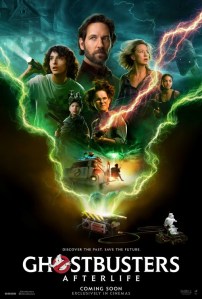
As I stated in my review for the 2016 Ghostbusters, allow me to wax nostalgic and explain my own private history with the franchise: “Growing up in the 80s, other kids had Transformers, or G.I. Joe, or He-Man, but I was a Ghostbusters kid. I fell in love with the 1984 original movie, slept below the poster for most of my childhood, and obsessively collected all of the action figures and toys, watched with glee the animated TV series, and hold the world and its characters in a special personal place.” This franchise means something to me. I think about the hours I spent playing in this world and my imagination and my own stories illustrated with marker and crayon, and it makes me extremely happy as well as reminds me how I fell in love with weird storytelling and macabre, ironic humor. I’ve been waiting for more Ghostbusters movies for my adult life. The 2016 movie was fine, I wasn’t enraged by it in the slightest, but it didn’t scratch that itch. While replicating some of the same plot beats, the 2016 movie was not reverent to its source material. Now the 2021 Ghostbusters, delayed over a year and a half from COVID, goes completely in the other direction. Ghostbusters: Afterlife is reverent to a fault, and while it has been met with mixed reviews and complaints of overdosing on slavish fan nostalgia, I found it to be a charming and fun family adventure that left me laughing, cheering, and even crying.
Egon Spangler (Harold Ramis, R.I.P.), original Ghostbuster, is dead, killed by a malevolent spirit. His estranged adult daughter, Callie (Carrie Coon), and her two teen children, Trevor (Finn Wolfhard) and Phoebe (Mackenna Grace), are shocked to learn of his death and their unexpected inheritance: a dirt farm in small-town nowheresville Oklahoma. They don’t know much about their grandfather and the kids are not exactly excited about relocating to a secluded mining town. Phoebe starts discovering weird pieces of technology hidden in the old house of her grandfather’s. A presence seems to be reaching out and trying to get the family to understand their real legacy. It appears that Gozer the Gozerian was not fully defeated on top of that New York City skyscraper in 1984, and Phoebe and her family must learn about the past in order to make sure we all have a future.
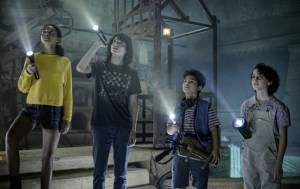
I can understand the charges of Afterlife being too nostalgic, but I don’t understand the charges of it being so enamored with its past that it poses a disservice to the movie standing on its own. This movie is intended at its very DNA to live within the shadow of the original films. The director and co-writer, Jason Reitman, is the son of the original films’ director, Ivan. It’s going to be reverent but that’s not an automatic bad thing. Whereas the 2016 reboot shrugged at past convention and went completely comedic, this edition takes the opposite approach, hugging onto the lore and past of Ghostbusters with heartfelt affection. If you’re a fan of the franchise, this adoring approach will likely be more favorable, not that the 2016 film is wrong for eschewing the established canon of the franchise and trying something new. If Afterlife had been a completely original story set in a Ghostbusters universe, I would have happily accepted that. However, just because something is outwardly nostalgic, or taps into fan service, does not mean it is destined to be an exclusive retread that only satisfies the hardcore base. I didn’t need the gratuitous Easter eggs of passing shots of a twinkie or Crunch bar, but they’re blink-and-you’ll-miss-them moments that don’t really relate to anything of consequence, so I can excuse them. Afterlife is similar to The Force Awakens in that it uses familiar plot beats to mirror events of its predecessors to ease back fans and new members to the fanclub, most especially in Act Three where Gozer’s demonic pooches are unleashed. I can understand many chaffing at this, but I feel that Afterlife does enough to justify its own creative existence even in facsimile rather than as some insular, facile, fan-stroking cash-grab.
This is, by far, the most dramatic of the Ghostbusters movies, a series that has existed in the realm of comedy. The prior movies were never spooky on adult terms, but they reached back into a primal, childlike curiosity and anxiousness over the unknown that made them creepy when they wanted to be. I don’t understand the umbrage some have expressed over Afterlife being more of a drama. First, the comedy is present throughout the movie with the characters making specific and wry observations that feel fitting for their situation. The humor is not as forced as the loping line-a-rama improv jazz riffs of Paul Feig’s 2016 film. I think this universe can sustain different kinds of stories being told, and I think that drama is perfectly acceptable as long as it’s earned, just like the comedy or horror elements. The central premise involves an estranged family coming to know the secret life of an absentee relative who abandoned them, so the more they learn about his Ghostbusting past and responsibilities, the closer they come to uncovering a clearer picture of who this man really was as well as their connections to him. Reitman and co-screenwriter Gil Kenan (Monster House) have smartly connected the investigation of the past into the development of personal relationships. We in the audience know the significance of the Ecto One and the ghost traps, but the new characters do not. We await them to understand the knowledge we already attain, but the movie doesn’t play this as characters dawdling. Each discovery unlocks new potential for the characters to shape who they choose to be, and each one gets them closer to their grandfather and reshaping their conception of the man who they wrongfully believed abandoned them for folly.
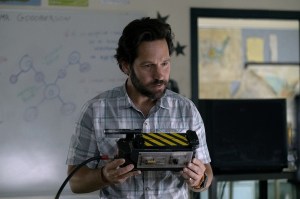
This all leads to a climax that had me genuinely in tears. I won’t exactly spoil it but Afterlife’s conclusion is less concerned with beating the Big Bad Gozer yet again and saving the universe. Reitman and company have smartly placed the real climax as an emotional catharsis; it’s more in keeping with Field of Dreams than some huge Marvel apocalyptic showdown. The ending is personal, emotional, and reaches into our universal desire for closure, for having that one last moment with a beloved who we no longer have any moments left to share, Reitman is clearly missing Ramis, a close family friend and inspiration who died in 2014, and this is his own way of processing his personal grief, offering an emotional output for the fans to share in, and allowing a grieving character/surrogate to find that needed release. It serves as a fitting conclusion and a special end note for any Ghostbusters fan who has held this franchise close to their heart for several decades, especially if shared with a paternal figure who may be gone.
The film also successfully channels a childhood perspective of awkward and awesome. It’s hard to create a story where a group of precocious adolescents discover strange things cooking in their sleepy small town without suggesting Stephen King and Stranger Things, but this isn’t necessarily a total negative. The earlier movies were always from a more cynical adult perspective. Yes, there were characters like Ray (Dan Ackroyd) and Egon who were true believers, but they were often set up for easy laughs. The tone of the series was mostly tied to the irony of the character of Peter Venkman (Bill Murray) that looked at the supernatural with droll detachment. This is the first Ghostbusters entry where the primary perspective is from children, and there’s something hopeful and heartfelt about a younger point of view with the supernatural material. These kids are excited and eager to learn more about the somethings strange in their neighborhood. It becomes endearing to ride along with them as they get to jump into the action. I loved the concept of a sidecar gunner seat for the Ecto One and how it felt like a childhood dream coming true. But it’s more than fan service because it serves as a point of progression for Phoebe’s sense of self, of embracing her scientific interests and roots, and taking charge in the face of unknown danger. It’s a coming out of sorts. When the kids are driving through (the always empty?) town and chasing a runaway ghost, wrecking storefronts from the boom of the proton pack, it’s a blast for them and us.

This is Reitman’s most commercial and mainstream film of his Oscar-nominated career. It’s interesting to me that this indie darling, who was on such a hot streak in the late 2000s, hit some speed bumps with the critical misfires of 2013’s Labor Day, 2014’s Men, Women, and Children, and 2018’s The Front Runner, so the next movie is a retreat to a big-budget franchise film. Reitman doesn’t necessarily have the best feel for large-scale spectacle, but he knows intimate character dramas and guides his actors well. Grace (Gifted, Haunting of Hill House) is wonderful as our plucky lead. Unfortunately for Wolfhard (It, Stranger Things), his dull character has nothing to do but pine for a local girl, scoff at his family, and then fix up the old ghostbustin’ mobile. Paul Rudd (Ant-Man) is as charming as ever as the school science teacher, especially as he nerds out over interacting with the Ghostbusters paraphernalia like an excitable fanboy living out his childhood dream. I wish Coon (The Leftovers) had more to do, but that’s my primary complaint in any movie where Carrie Coon is a supporting actress. Her chemistry with Rudd is strong and they could have done so much more together as adults trying to make sense of madness. They could have eliminated Wolfhard’s mopey older brother character entirely and given us more time with the goofy adults too. One feels like there is some secret contract where anything relating to 80s nostalgia requires the hiring of Wolfhard on hand.
Ghostbusters: Afterlife will not be the best movie of 2021. There are areas that could have been improved and streamlined and better developed. However, Ghostbusters: Afterlife will most assuredly be my favorite film experience of 2021. It’s a heart-warming continuation for fans with enough wit and whimsy to charm while owning its obvious and intended connections to the original. I may not be the most objective source on this particular matter, but I know what I like, and this movie had moments of pure happiness that just shot right through to my dopamine center. We’ll see if this movie can restart the dormant franchise, and strike more on its own, but even if this lone 2021 entry is all that we eventually get, I’m happy I got to experience this magic once again. I can’t wait to see it again with my dad.
Nate’s Grade: B+


You must be logged in to post a comment.