Blog Archives
Talk to Me (2023)
 If you were at a party and were told that if you shake hands with a severed hand you could allow a ghost or spirit or whatever into your body, would you agree to this? I may be naive but I think most free-thinking adults would pass on this opportunity, but then again people are chasing all sorts of dangers as distractions or coping mechanisms, so perhaps I’m dead wrong. Now, if you present this same question to teenagers, I’m positive of different results. This is the kickoff for Talk to Me, the new hit horror movie of the summer. Mia (Sophia Wilde) discovers that this magic hand can allow her to see and talk with her mother, who killed herself about a year prior. How far will she go to reach out to her mother and what consequences is she willing to bear?
Reminiscent of Smile, the small horror hit from last year, Talk to Me is a small-scale horror thriller that might not have much extended thematic commentary but it knows how to goose an audience and ratchet up your sense of dread and compiling unease. The premise is gloriously straightforward and creepy from the start, allowing a possibly malevolent spirit to inhabit your body as a thrill. There are plenty of places to go with this premise, as flirting with the “other side” has been a staple of horror movies, just as much as teenagers making bad decisions. It’s a possession movie by way of an addiction metaphor, finding a new and impossible to replicate high, and this too as a vehicle for our protagonist to try and obliterate her grief. The characters feel downright euphoric afterwards, having communed with someone or something, and it certainly makes for fun spectator viewing. The vulnerability of losing control, and especially to a power that you have little understanding of, is a potent direction for the story. Naturally, once we’ve established “safe parameters,” we must then break them and suffer the consequences, and Talk to Me does a truly excellent job of making you feel that omnipresent trepidation. This is a creepy movie that makes fine use of practical effects and an engaged sound design. It’s nothing new from a technical standpoint but it’s yet another example of someone knowing what to do with their tools to create an affecting and uncomfortable atmosphere of uncertainty. It’s more a well-engineered thrill ride, much like my assessment of Smile, but when it’s this well done, you’re just happy to have a conductor who is operating on such a high level of execution.
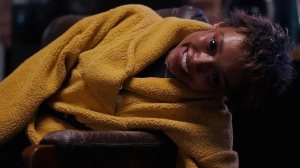 There isn’t much in the way of commentary with the movie besides some fleeting criticisms of transforming personal pain and discomfort into a spectator brand. The movie doesn’t have much to say on this front other than teenagers are predisposed to make bad decisions, and giving them cell phones, social media, and a magically cursed totem might be a damning combination. The different characters treat the possessions like a party, everyone with their phone ready to record the crazy and unexpected results, many of which they cannot fully understand. There’s something there about messing with forces beyond your control and feeling protected, possibly even nigh invincible, because you’re a bystander and not a direct participant, that holding a screen in front of your face somehow stops you from being complicit in the activity. The movie utilizes the severed hand as more of a plot device than a starting point for intriguing dimensions of social commentary. Thanks to how well executed the movie is, I forgave the oversight.
I wish the movie had explored some of its intriguing avenues a little further, but one area I’m glad we didn’t need to delve into was the origin of the severed hand. Many of these curse movies push the protagonist to investigate the mysterious origins of the Evil Thing and try to find the beginning of the chain of death and destruction, such as The Ring, Smile, and It Follows. There may be a fascinating story behind this totem but I’m more than comfortable just accepting it on its own vague terms as our catalyst for unrest. I don’t require its unholy backstory. This devotes more of the 90 minutes to focusing on the characters and their emotional turmoil, which allows the grief metaphors to really simmer. It also makes for an intriguing dilemma because Mia has been granted access to her deceased mother through these very unusual circumstances. She misses her dearly and is willing to break rules to continue that connection, which puts others at risk and brings about lingering consequences. Once mom is back, it becomes an ongoing game of whether or not this could be her real mother or something malevolent manipulating her. I found this storyline to be more compelling than a series of clues connecting to more clues to reveal the history of the severed hand, likely learning about a litany of prior owners who have experienced tragedy and ruin. This centered the movie more as an extension of our main character’s grief and the limits and risks she was willing to meet in order to find closure.
 The directors have been a mainstay on YouTube for a decade as the popular RackaRacka channel, and the Australian twin brothers Danny and Michael Philippou make a seamless transition into big screen horror. They don’t overload their movie with stylistic distractions, and the editing is very confident and patient to better build a sense of dread. It’s that atmosphere that proves to be the best element of Talk to Me, as the second half pushes the audience to question what we’re seeing and whether it’s reality or hallucination (also like Smile). When there are stylistic flourishes, it’s almost like its own form of a jump scare, a break from the normal. The opening house party sequence is filmed like one continuous tracking shot and it succeeds in building your unease and anticipation that some very bad things will be happening soon enough. I was especially impressed by the ending, which I won’t spoil in any significant sense, except to say that it’s a fitting and humbling conclusion that also provides a nicely morbid reversal.
If you’re in the mood for a spooky spine-tingler that delivers the goods with a streamlined story and extra emphasis on its protagonist’s fraying emotional state, then Talk to Me is for you. It’s nothing revolutionary but it is creepy and quite effective and evidence that the filmmakers have been taking careful notes about what makes horror stories and movies succeed. Sequels and prequels are likely inevitable, though I don’t know if the premise supports an extended universe of lore and complications, but I’m willing to be wrong. Go ahead. Take hold.
Nate’s Grade: B
Share this:

Gray Matter (2023)

As a lifelong film fan, I’ve always been fascinated with the trials and tribulations of the many seasons of Project Greenlight. It began in 2001 as a contest shepherded by Matt Damon, Ben Affleck, and irritable producer Chris Moore to select the best submitted script and turn it into a movie. The process would also be documented at every stage by TV cameras for an HBO documentary series, but this is an organization defined by its chaos and mistakes, which make for spellbinding schadenfreude television and rather disappointing movies. Each season tried to retool. Season one winner Peter Jones was more a writer than a director and not fully ready when he was thrust to also direct his winning script, so season two had separate submissions to select a winning writer and a winning director to pair. Season three realized that the coming-of-age indies of the first two seasons (Stolen Summer, The Battle of Shaker Heights) didn’t exactly ignite the box-office, so the intent was a more commercial genre script, which ended up becoming the monster siege thriller, Feast. Season four, coming nearly ten years later, decided that the commercial script needed to come from a more trusted and studio-backed source rather than amateurs. That source: Pete Jones, now having become a co-writer to some Farrelly Brothers comedies. That season only sought to select a director, having now completely ditched the screenwriting aspect from the start of the contest, but the winning director ditched the approved script to make a middling comedy feature of his own short film (The Leisure Class). Now, many years later, HBO Max (or now just… Max, because somebody thinks “HBO” lacks brand value) has rebooted Project Greenlight, again, and has another more commercially-minded script to serve the eventual directing winner, this time among a team of ten female finalists. So after twenty years and five movies, what has Project Greenlight proven? Good TV doesn’t mean good movies.
Gray Matter will forever be known as “the Project Greenlight movie,” and if it wasn’t for that series, we wouldn’t be seeing this movie because it’s so generic and underwritten, which, having spent the day binging through the new Greenlight season, are the same problems that all the many producers were complaining about with the script. Well, you folks picked this script, right?

Aurora (Mia Isaac) is a 16-year-old who just wants to feel like a normal teenager. Her mom, Ayla (Jessica Frances Dukes), is afraid she won’t be able to defend herself in this scary world. They’re a mother-daughter psionic duo, exhibiting mind powers. After a tragedy away from home, Aurora finds herself in a weird complex run by Derek (Garret Dillahunt), a mysterious authority figure who says he’s trying to find all the psionics he can to help them better understand their unique abilities. Aurora suspects her captors don’t really have her best interest at heart.
That plot description above sounds like a hundred other YA-tinged stories, from The Darkest Minds to Firestarter to the X-Men TV show The Gifted, which also co-starred Dillahunt. It’s a fine starting point but the story and characters need to find ways to better personalize this formula, and that’s where Gray Matter falters. It’s all too surface-level, from the mother-daughter relationship, to the determination of Ayla, to the self-actualization of our teen. It’s not that you’ve seen it before, it’s that you’ve seen it before much better in so many other stories.
The story pieces are present that can be developed for a more engaging and character-centric sci-fi drama. There is potential here. I think more could be made about Ayla’s past connections to this psionic complex, but instead of being offered to co-chair it as an administrator, it would have been more interesting if she had been younger, a pregnant teen, and her unborn baby was the course of great speculation for the facility, especially being the child of two psionics. This would add an extra layer of urgency why Ayla felt she had to leave as well as why Aurora would be more coveted than other psionics. It could also easily explain why Aurora would be more powerful than any other psionic. It would also personalize the sacrifice of Ayla as well as her paranoia about the lengths they will be hunted. We needed more time with Ayla as a character because once the daughter gets kidnapped around the Act One break, she’s seen more in flashback and fantasy sequences than reality. If this is going to be the emotional core of the movie, then we need to flesh out the mother and the scenes between them. As demonstrated in the movie, Aurora is here to push her daughter, tell her she isn’t ready, then restrict her but also not really restrict her, as Aurora seems to sneak out every night to meet boys. If this woman is so paranoid, why is she alternating between being a strict gatekeeper and a free-range parent? It didn’t make sense. She’s keeping her child out of school and the public and constantly moving, but hey, go ahead and fraternize with these teenagers supposedly behind my back?
It’s also a shame that our protagonist is such a boring blank. The puberty/super power allegory has been prevalent for decades, but for a movie that literally spends so much of its time inside the mind of its main character, she’s unfortunately too underdeveloped and unexplored. She’s just kind of present for too many of her scenes rather than an active participant. This is partly from the nature of the script, where Aurora has to learn about her powers and the history of psionics, but why does the first act of the movie resort to repeating this exposition? We have one scene where mom is explaining powers and what’s at stake, and then twenty minutes later we have another scene of Derek explaining powers and what’s at stake. The biggest problem with Gray Matter is that its central character feels like an afterthought of a simple yet empty empowerment message. It’s about a young woman coming into her own power, externally and internally, but it’s also expressed under such generic terms. What do we know about Aurora? She wants a “normal life” but what does this constitute? Does she resent her mother’s rules? Has she rebelled in the past? What really animates her? What is her sense of purpose? I don’t know, which diminishes all the sequences of her running in terror, and that dominates the middle hour. I wish the script had started with her sneaking out, hanging out with these kids who consider her “that weird homeschool girl,” and then when things go wrong we have to learn with what we see rather than sitting through multiple people trying to explain the world and rules. It would be a better shock when things go wrong, and the added time would allow more breathing room to try and flesh out Aurora before she’s defined by her powers.

Another aspect that needed further re-examination was the nature of the psionic powers. The plot needed to better define the rules of these powers, which are quite varied. We begin with the powers mostly being telekinetic, the ability to move things with one’s mind. Then it jumps into telepathy, the ability to speak through one’s mind, then read the minds of others, then project mental structures, then working all the way to teleportation. There is a good scene where Derek is impressed by Aurora’s ability to hide her thoughts with a false setting construct, and I enjoyed him pointing out the giveaway details, like a character reading a book that is only ever the same page. That was a smart scene that better visualized the powers. However, the characters talk too broadly about the powers in sweeping proclamations. I think the movie could have improved had the story ditched more of the powers and settled down on one, with Aurora having the ability to manifest more than one power being a sign of her extraordinary identity.
As a low-budget genre movie, Gray Matter looks like a professional movie and has good actors doing their best. Debut director Meko Winbush has made a genre movie that looks practically indistinguishable from other disposable Hollywood genre thrillers, and maybe on a sliding scale, feeling and looking like a generic sci-fi thriller might be a success in the history of Project Greenlight. But I doubt all the many people who lent their labor and names to this project were hoping for it to be on par with a forgettable streaming entity eventually crushed by a library of content. Winbush presents enough visual polish that could lead her to future work, something that has also plagued many of the director winners from seasons past (Jason Mann, the season four winner, has one feature credit after The Leisure Class, serving as DP to a 2019 Slovenian movie). It’s hard to feel what exactly people could get passionate about with Gray Matter, and they just waited for a rewrite to supply all the missing emotional engagement and introspection and fun that was absent. Once again, the finished film ends up being a disappointing season finale to a train wreck of reality TV.
Nate’s Grade: C
Share this:

The Little Mermaid (2023)

With every new Disney live-action remake, and we’re not slowing down any time soon folks, I feel like I need to stipulate two reservations I have, so, dear reader, here is my boilerplate. First, I believe that simply because a film is animated does not mean it is missing something or somehow inferior to a live-action movie. Animation is a showcase of imagination and ingenuity and visual decadence, and often the live-action interpretations of this only serve to dilute and downgrade the quality of those presentations. I can’t believe the recently announced live-action Moana will add anything more magical or visually beautiful than the 2016 animated original. Second, the closer these original animated movies are to the present, the less likely that Disney will be to change things up. The core audience will be demanding fidelity to the source material, and thus we usually just get an inferior version of the same story with minimal alterations. Occasionally, Disney can really surprise with some of these live-action remakes; I adored Pete’s Dragon, was charmed by Cinderella, and will defend Tim Burton’s unfairly maligned Dumbo.
Now we reach The Little Mermaid, whose 1989 release began the much-heralded resurgence of Disney animation through the 1990s. I re-watched the original a couple years ago and found it still quite ebullient and compelling, but I was shocked at how short it was (only 80 minutes long) and how brisk much of its third act felt. With a few more old-fashioned wrinkles to iron out like gender roles and the prominence of securing a man, I felt there was actual room where a modern remake could actually improve upon the original. Having seen the live-action Little Mermaid, I can say that it falls into a middle zone where it can’t quite escape the shadow of its predecessor but it exhibits plenty of its own winning qualities to cheer audiences and fans of the original.

Ariel (Halle Bailey, not to be confused with Halle Berry) is a teenage mermaid and the youngest daughter of King Triton (Javier Bardem), the ruler of the seas. She longs to be part of the surface world, the world of man, and she’s willing to sacrifice her voice to her malevolent Aunt Ursula (Melissa McCarthy) for a pair of legs. She has three days to secure true love’s kiss, likely from Prince Eric (Jonah Hauer-King), but she can’t recall what she needs to do as part of Ursula’s spell. Her friends Sebastian (Daveed Diggs) the crab, Scuttle (Awkwafina) the gannet, and Flounder (Jacob Temblay) the fish must help protect and guide the new Ariel-with-legs.
Let’s start with the positive attributes that separate this Little Mermaid, and chief among them is the fantastic lead performance from Bailey (one half of the singing sisters Chloe x Halle). This is a star-making turn from this young woman who completely makes the role her own. She has a natural grace, curiosity, and charm to her Ariel, and when she gets her chance to belt the big musical numbers, she delivers a stirring rendition. I got tingles during different parts of “Part of Your World.” A good half of the movie takes place after her Faustian bargain, so Bailey is acting without her voice and she still is able to communicate so much through her physical performance as well as her facial expressions. The filmmakers decide to give Ariel several new songs through the guise of internal monologues where she can express all that she is feeling and thinking during her fish-out-of-water adjustments. I think it’s a smart move and while none of these new songs are particularly memorable, giving Bailey more opportunity to flex her own voice, both literally and thematically to express her character’s perspective, is a good creative choice.

I also was pleased that much of the added time, which amounts to almost a full hour of material, is devoted to fleshing out Eric and the development of the romance with Ariel. Rather than simply being a handsome himbo, this Eric is an adopted son of his island nation, and he feels more at home aboard a ship than in any royal ceremony. There’s a direct parallel with Ariel and Eric rejecting their predetermined roles under the pressure of royal expectations. This Eric even gets his own version of a “Part of Your World” ditty about dreaming for something more, especially after his chance encounter with a mermaid set his world afire. It’s not a particularly great song, as none of the new additions are on par with the Oscar-winning originals, and some of the lyrics made my wife physically cringe next to me in the theater (“Strange as a dream/ Real as the sea/ If you can hear me now/ Come set me free”). There is added time where the romance feels much more organic as we witness Ariel and Eric get to know one another and watch one another come alive and share their interests. The added curse of Ariel forgetting her end goal of true love’s kiss is an intelligent way to make the romantic feelings between them feel more believable and less the byproduct of her urgency and the manipulation of her friends. The added rom-com moments give more credence to their romance and it better reflects on both members.
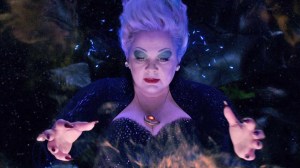
McCarthy (Thunder Force) acquits herself very well as the villainous sea witch. She puts her own spin on Pat Carrol’s famous vocal performance from the original, making her Ursula the seething also-ran waiting on the sidelines and nursing old grudges. The added back-story makes Ursula Ariel’s aunt now, which adds an extra degree of menace to their transactional bargain. I was also reminded how little Ursula is in this movie until it counts, so to justify her continuing presence, we have a few check-ins where she basically monologues her thoughts on the action. It feels like padding but I didn’t mind because I got to spend more time with McCarthy.
And now, dear reader, let’s go through some of the adaptation changes that aren’t quite as charming or beneficial. The colorful realm of the sea feels rather limited in this rendition. The vastness of the ocean and its mermaid kingdom feels strangely contained, and that’s a result of the reality of filming on a large empty set as well as the cost of extensive special effects. This is another case where the beauty and imagination of animation proves incomparable. The differing versions of “Under the Sea” really magnify this. Along those lines, making Ariel’s aquatic friends photo realistic robs them of the personality and expression they exuded in the animated movie, and it also drags them into an uncomfortable uncanny valley. Stop robbing characters of expression for the sake of added biological “realism.” It’s a bad trade. Stop it, Disney. Watching a photo realistic Flounder flop around on dry land while he tries to cheer Ariel on with his expressionless might-as-well-be-dead fish eye is not as whimsical as it should be. The original voice of Sebastian, Samuel E. Wright, has a small cameo as a fisherman, and it’s nice to hear his familiar voice again, especially knowing the actor sadly passed away in May 2021.
I’ve already discussed the new songs by Lin-Manuel Miranda being mostly agreeable but unremarkable, but there is one new track that stands out for all the wrong reasons. Being a Miranda musical, it’s not unexpected for the inclusion of a new hip-hop-infused song, especially with his Tony-winning Hamilton co-star in the movie. What is surprising is that Daveed Diggs doesn’t get the bulk of the new rap song but instead it’s Awkwafina, and her voice at these levels of gravely intensity feels like an aural assault. I was wincing throughout the song “Scuttlebutt” and kept wondering why Diggs wasn’t the star considering he handled the most linguistically complex flows in Hamilton. I even enjoy Awkwafina as a vocal artist but this song is painful to endure.
The 2023 live-action Little Mermaid has enough positive additions that fans of the 1989 original will likely enjoy while still checking the boxes of their own nostalgia requirements. Bailey is sensational and the added time for the romance to be more organic and believable, with some extra fleshing out supporting characters like the Queen and Grimsby also allowing the world to feel more textured and less archetypal. The visuals aren’t as murky as I feared but the magical world of this hidden undersea realm definitely feels lacking. The pacing is a bit sluggish too, as we don’t even get our deal with Ursula until an hour into the movie, and the added songs fail to compete with the classics even with the artistic prowess of Miranda. I don’t know if it needed to be this long, and I certainly don’t care for the photo realism approach, but I was smiling throughout the movie and found it charming. Consider this mid-tier Disney live-action scale, a remake with enough of its own to swim with the weight of expectations.
Nate’s Grade: B
Share this:

Dungeons & Dragons: Honor Among Thieves (2023)
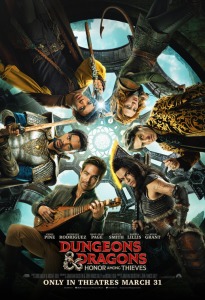 As required for every film critic before discussing the new Dungeons and Dragons movie, subtitled Honor Among Thieves, I must tell you my personal history with the seminal tabletop game. Well, I don’t think D&D is for me. Many of my friends are heavily involved in D&D, several as the quest-fashioning dungeon masters, and I’ve even sat in for a few games, but there’s something about the group improv experience that I never feel comfortable while playing, like my mind just runs into imagination roadblocks trying to come up with options in a near limitless space. Plus I think character creation is one of my lesser storytelling skills; I typically build characters more out of plot and concept and theme. Also, the demanding time commitment to play a game that can take possibly months or years to conclude makes me hesitant. I already think Monopoly lasts too long and has a habit of ruining friendships (if I was ever paid to write a Monopoly movie, that would be my starting point, not bringing to life Mr. Moneybags).
Anyway, D&D has had something of a cultural renaissance the last decade, reaching new levels of wider acceptance partly thanks to its prominent placement in Stranger Things. Pretty good for an ever-evolving 50-year-old game system that was at one point blamed for luring impressionable youth into the ways of Satanism and insanity (see the ridiculous 1982 movie Mazes and Monsters starring a young Tom Hanks as a student who cannot distinguish between reality and the game world to murderous effect). It’s such a substantial fantasy property that it was only a matter of time for movies to follow. There was an abysmal D&D movie from 2000 co-starring Thora Birch and a go-for-broke Jeremy Irons that isn’t worth your time. I wasn’t excited for a new Dungeons and Dragons movie until I saw that its directors and co-writers were Jonathan Goldstein and John Francis Daley. I was a big fan of 2018’s Game Night, their last directing effort, and they’ve been a dependable comedic writing duo. It was with them that I placed my faith and that faith was fully rewarded when my wife and I watched Honor Among Thieves and had a delightful time. This is a wildly fun D&D movie for every viewer.
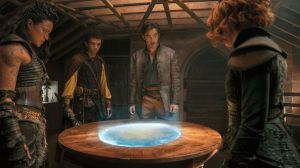 In the world of owl bears and sorcerers, Edgin (Chris Pine) and his trusted partner, Holga (Michelle Rodriguez), are looking to settle the score. They’ve broken out of prison and are trying to gather their old team back together but everyone has a grudge. Forge (Hugh Grant) has betrayed the group for power and especially riches, serving as the city’s reigning lord. He’s recommissioned a gathering of games and sport, drawing crowds back to the city, and with games comes betting and with betting come large sums of money from the rich. Edgin plans to rob from the treasure hold for the games and with that score he can regain his daughter and possibly reclaim a magical totem that can bring his dearly departed wife back.
I have no prior understanding of anything relating to the world and lore of D&D, and I found it to be extremely accessible and engaging. That’s because Goldstein and Daley have put the emphasis of their movie not on its lore or history or locations but on its characters. I appreciate that here is a major work of IP for a studio that is attempting to tell one very good and accessible story for the masses rather than set up a cinematic universe and ready it for possible sequel bait. Get the movie right and have that make me desire more movies rather than establishing a world that has potential but otherwise goes unfulfilled. The very concept of Honor Among Thieves helps to keep things light-hearted and moving. My pal Ben Bailey and I have been clamoring for years for a heist movie set within a fantasy world. It was ready-made to satisfy with the genre structure of heists, and putting a team together that rolls with unexpected adversity, and the cleverness of incorporating fantasy abilities and elements into heist genre familiarities. Thankfully, Goldstein and Daley realized how entertainingly plentiful this combo can prove.
The fun characters are what help to make the movie so enchanting. Rather than settling on a subsection of class representation (one dwarf, one elf, one wizard, etc.), the characters are more about what they bring to the team and what motivates them for character arcs. We have a shapeshifter (Sophia Lillis) who is trying to protect the kingdom’s encroachment on her kind. We have a shaky wizard (Justice Smith) who is battling for his own self-confidence and respect. Nobody feels like a token appointment. Even characters that would seem like a D&D player’s dream, a powerful paladin played by the dashing Rege-Jean Page (Bridgerton), are given more purpose. He serves as a contrast to our hero’s journey back to respectability, and the character is so noble and serious that it’s yet another shade of comedy to explore. His obliviousness to irony and sarcasm reminded me of the very literal-minded Drax (Guardians of the Galaxy). This is a character that would appear in standard fantasy epics, and yet he’s played for laughs just through sheer juxtaposition without ever mocking the reality of this world. At no point will characters condescend to their reality, saying self-aware critiques like, “Well that’s a very inconvenient and stupid place to put a castle,” etc. There is a cameo where the gag is that this person is much smaller. The appearance is played for goofy laughs and yet it’s also shocking in its emotional sincerity. If you removed the size differential, this would be a dramatic and eventful scene (I did enjoy the unspoken preference of this individual when it comes to a romantic partner). The movie is very funny and very skilled at being funny without reliance upon meta genre riffs.
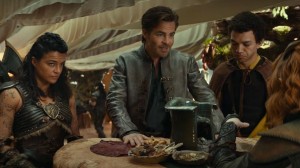 Elevating an already great movie, Pine (Don’t Worry Darling) is robustly charming as a bard/secret agent. He secured my loyalty within two minutes of the movie when he gave up on his prison knitting project and said, summarily, “I’m just gonna make a mitten. Who am I trying to impress?” Pine has long been one of our most effortlessly charming leading men, and playing a rakish heist leader who also sings will only magnify the man’s innate appeal to the masses. He works even better alongside Rodriguez (any Fast and Furious movie after 6) who becomes the real physical presence. This is a career-best performance with Rodriguez sliding right into exactly the comedy wavelength she’s needed for – the gruff and cynical worldview of the weary warrior. They make for a great bantering lead duo.
The set pieces are also tailored to the character arcs while still being memorable and entertaining. This is a movie that doesn’t get complacent over its 134 minutes. Each sequence must stand out, whether it’s because of creative and intuitive fight choreography that makes keen use of geography and circumstance, or a graveyard Q&A with very constrained magical rules to follow that leads to a lot of digging to find the right corpse with the right information, or escaping from an obese dragon (with its “widdle wings”) that resembles a chonky cat, or a dangerous trip through a maze that abruptly reconfigures itself, or a prison escape that doesn’t quite go as you expect, nor at the characters expect. Every scene has a purpose. Every magical item has a specific use, and every set piece sets itself apart visually and from a story standpoint.
Goldstein and Daley have excelled as writers, but they’re also proving to be visually adept directors. With the emphasis on characters, it’s not CGI spectacle for spectacle’s sake. There’s a pleasing physicality to this world. The budget is in the $150-million range, which is quite a show of confidence for the directors, but the emphasis is on what best elevates the moment. There’s a thrilling escape performed as a tracking shot with a zooming camera tracing the escape of our shapeshifter from harm, and there’s fantastic visual inventiveness with a magic portal and its application for the film’s equivalent of a rollicking stagecoach robbery. There’s a noted intention here with the shots and scenes and visual arrangements, so Honor Among Thieves feels like a studio film with vision.
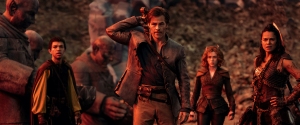 Allow me to take one very fleeting moment to digress just how much care Goldstein and Daley put into even the smallest of details. After we’ve met the last core member of our crew, he confidently leans backwards and falls into a pit leading to an underground cavern. The rest of the crew creep toward the opening and stare down below with trepidation. Simon then says, “I’m going last.” We then cut to the group at the bottom of the cavern. It’s such a small detail, but the previous scene ends on a character-appropriate punchline for Simon reconfirming his squeamishness, but then by transitioning to the entire collected crew together, we know he was last and so we’re ready to move forward. Again, it’s a small detail but it’s a microscopic example that proves, to me, how much thought and care the directors have given.
As a novice to the famous role-playing world, I found Dungeons & Dragons: Honor Among Thieves to be an exhilarating and highly entertaining fantasy adventure where fun is the chief priority. It’s not at the expense of great characters, good humor, and satisfying payoffs with well-developed setups strewn throughout. It’s a reminder how enjoyable and escapist blockbusters can be when you have the right artists using the expansive box of paints. It’s great for all ages and families too. I don’t have any personal connection to this sword-and-sorcery universe but now I want many more adventures if this is kind of quality they’re offering.
Nate’s Grade: A-
Share this:

Winnie the Pooh: Blood and Honey (2023)
 The surprise horror movie Winnie the Pooh: Blood and Honey is likely a preview of what’s to come when well-known stories and characters fall under the public domain. However, the cheerful Pooh that most people recall is from the Disney animated shorts and films which began in 1966 and still fall under current copyright laws. So if you were gonna make a killer Pooh bear, he better resemble author A.A. Milne’s original creation and not the Disney version or else you’ll incur the wrath of the many lawyers of the Mouse House. In writer/director Rhys Frake-Waterfield’s version, Pooh and Piglet are on a killing spree after their dear Christopher Robin (Nikolai Leon) grows up and abandons them (they ate poor Eeyore). However, most of the movie is about thick-bodied malevolent men in masks preying upon young British women who are regularly in their underwear or bathing suits. To say this movie is creatively lacking is an understatement. Blood and Honey isn’t just a bad B-movie, it gives a bad name to enjoyably bad B-movies.
The only reason this movie exists is for the novelty of its existence, so that younger horror fans, and those with a healthy appreciation of irony and bad movies, can say, “I watched a killer Winnie the Pooh movie.” No other thought was given to this entire enterprise after that first one. The intellectual property fell into the public domain and now the filmmakers are scooping it up for a cheap and easy, “Well, I haven’t ever seen [wholesome or kid-friendly character] behave like that,” and “that” being blood-thirsty and cannibalistic. I am not against the very idea of this movie, but Frake-Waterfield puts no subversive connections to anything happening. It’s just a low-rent slasher movie with British coeds being knocked off by a guy in a bear mask and a guy in a pig mask. The characters could have been renamed as anything and the movie would have had the same impact. For that matter, the masks could have been swapped with, oh let’s say, a mask of Presidents Richard Nixon and Gerald Ford. Then we could come up with some half-baked explanation of Nixon and Ford reawakening from the dead and seeking to kill the youth vote to better ensure Republican candidates win elections. It would make just as much sense as anything else. The characters of Pooh and Piglet are not in any way reflected upon or given distinct personality or any connections to their non-killer interpretations. In the opening narration, we’re told that the vengeful animals of the 100 Acre Wood swore to conveniently never speak again and to revert back to their base nature. Fine, but then why is Winnie the Pooh still wearing human clothes? Why are they using tools? Why are they walking on two legs (four legs good, two legs bad)? And, most inexplicably, when did Pooh learn how to drive a car? There’s an onscreen kill where Piglet positions a captured woman in the path of a car tire, and it seems torturously convoluted for “killer animals reverted to being animals.” The entire enterprise lacks any subversive connection to the characters and story it’s intending to upend, and the whole movie feels creatively void.
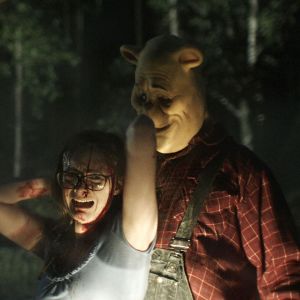 Here’s another example of how little thought was put into this movie beyond getting it to completion. The main character has a past trauma of being molested by a man who was stalking her and broke into her home. For our own edification, this scene is played visually for us, with the intruder taking their time to slowly pull down the strap of our sleeping protagonist’s shirt. So we have a past trauma and the character is now experiencing a new trauma, so from a writing standpoint, you would expect this horrible situation would be a way for the character to exorcise her trauma in a very extreme circumstance and there would even be a parallel for her to triumph over as a rudimentary character arc. It would, at the very least, provide a story justification for why our main character has endured her suffering, so as to work through that as her arc. Well, none of that seems to matter, nor are there any pertinent parallels, and so her past of having a creep break into her home, hover over her asleep, and touch her body was just prurient exploitation. Look, I understand the horror genre is built upon its tried-and-true exploitation elements, boobs and blood and the like. That’s what the audience for a killer Pooh movie comes to expect. I understand why Pooh is ripping the top off one woman before slamming her head into a meat grinder, though it still made me feel icky and sad, but that’s my central response. I did a lot of exasperated sighing and shaking of my head throughout the bloated 80 minutes of movie. After a slightly eerie and decently animated opening, this movie is creatively bankrupt on all fronts.
Winnie the Pooh and Piglet and the rest of the population of the 100 Acre Wood are products of Christopher Robin’s imagination, so him leaving them is more him moving on from his childhood enchantments rather than abandoning his friends. I guess this movie’s version chooses for them to have really existed, which raises some questions over what these creatures were doing before they ever met Christopher Robin. Were they animals and then Christopher Robin’s love and attention magically transformed them into anthropomorphic creatures? If so, then this little boy’s imagination has an amazing power to tap into. Although, to be fair, Disney itself made a 2018 movie with an adult Christopher Robin (Ewen McGregor) who was being followed by the stubborn animals of the 100 Acre Wood who sought him out to remind him about the power of friendships and belief that, I assume, he seemed to have lost track of as a jaded adult.
 Taking a look at the larger filmography of Frake-Waterfield, a devious pattern starts to emerge. The movies are built on title and concept, and there sure are a lot to choose from. As a producer, he has 21 movies released all since 2021 and another 14 in the works, including a sequel to Blood and Honey. Here, dear reader, are some of the titles of the past and future Frake-Waterfield productions: Dinosaur Hotel, The Legend of Jack and Jill, Spider in the Attic, Easter Killing, Wrath of Van Helsing, Croc!, Kingdom of the Dinosaurs, Curse of Jack Frost, The Killing Tree (about a murderous Christmas tree), Firenado, Monsternado, Bambi: The Reckoning, Mary Had a Little Lamb, Peter Pan’s Neverland Nightmare, Crocodile Swarm, Dinosaur Prison, and Snake Hotel. It almost plays out like a B-movie Mad Libs exercise. Take an animal people fear (snakes, crocodiles, dinosaurs) add a place (hotels especially, though is Snake Hotel a lodging intended for people who love snakes or for the snakes themselves?) and, when in doubt, swipe some public domain IP that has an innocent or more wholesome reputation and switch it up (Steamboat Willie but as a sex trafficker?). I’m not against schlocky low-budget horror movies that are acutely aware of their schlock. The killer Christmas tree movie actually seems ridiculous enough to be fun. Except, having seen Blood and Honey, I’m dubious that any of these will actually take advantage of their goofy concepts.
Even if you were turning into Blood and Honey for the ironic yuks, there’s nothing to really laugh at here. This is a bad movie rather than an enjoyably bad movie. It’s a movie that only exists because somebody thought enough people would be curious to watch a killer Winnie the Pooh movie. That’s the reason I tuned in, but from the second minute onward, there’s no reason to bother watching the remaining mess. Just imagine a low-rent slasher film with unimaginative kills, boring characters, a lack of any subversive connections or reframing of its source material, and an ending that doesn’t so much conclude but simply give up for a sequel, and you’ll have replicated Blood and Honey. As one saving grace, I will say that the movie has more polished cinematography than most of its low-budget ilk. The startling lack of imagination of everything else is depressing, as is the fact that this movie has earned over four million at the global box-office, hoodwinking enough rubberneckers looking for a good bad time. The problem is that Winnie the Pooh: Blood and Honey is only a bad bad time.
Nate’s Grade: D-
Share this:

The King’s Daughter (2022)
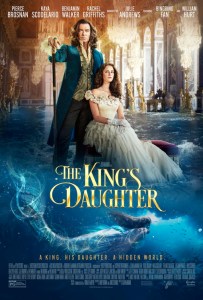
Originally filmed in 2014, The King’s Daughter is a curiosity as it’s been on the shelf for almost eight years. As another critic quipped, in the ensuring years, star Kaya Scodelario has been in an entire trilogy of Maze Runner movies. I don’t know what this Chinese-by-way-of-French production was going for as we follow the court of King Louis XIV, played by Pierce Brosnan in an astounding array of outlandishly bad costumes and terrible wigs. He resembles a Vegas magician set back in time. Anyway, he calls to court the young Marie-Josephine (Scodelario) who has been raised by nuns since she was dropped off as a baby. If you can’t already see where this is going, then I can’t help you. But wait because there’s also a mermaid (Bingbing Fan, who in the years since this movie possibly served time in China’s prison for tax evasion) in the basement being held captive because Louis thinks eating her heart will be the key to him becoming immortal. So, yeah, what is this? It’s striving for a fairy tale/storybook sort of feeling but it’s a plot that will only work with the youngest of children. The characters are simplistic and boring, and once the mermaid is introduced it becomes like a costume drama version of Free Willy. Even with being on the shelf for eight years, the finished film still feels rushed, and the special effects for the mute mermaid are a colorful mess. Fun fact #1: the director is responsible for 4 Baby Genius sequels. Fun fact #2: this will be the late William Hurt’s last movie to his career. The King’s Daughter is a movie that makes you ask, “What were they thinking?” quite a lot, and the best decision was to withhold it from mass viewing for eight years.
Nate’s Grade: D+
Share this:

Violent Night (2022)

The movie might feel like a late night joke, but Violent Night is everything you could ask for with its Santa-meets-Die Hard concept as a bloody, junky fun bit of Christmas good tidings. I’ve noticed that 2022 is a year marked by highly violent, pulpy, well choreographed action-comedies such as The Princess and Bullet Train, and I think if you like any one of them, then you’d happily enjoy the others. For Violent Night, the movie smartly lays out its rules and limits and obstacles, and then allows the mayhem. Santa (David Harbour) is an alcoholic nihilist losing faith in the meaning of Christmas, and then through the events of one Christmas night, he’ll re-emerge as the Santa we deserve and need. The movie isn’t overly winky about its outlandish premise with the exception of some ironic catch-phrases that Santa has to drop for maximum attitude. The fights between Santa and the criminal crew are entertaining, well shot and choreographed, and make clever use of supernatural touches, like Santa’s magic portal presents bag and his list that can supply key details on any human. There is a sweet dynamic between Santa and a little girl named Trudy, who chats with Santa through a walkie talkie thanks to the power of belief. She’s the heart of the movie and helps motivate Santa to do better and save her family. The supporting characters are pretty stock and unremarkable but the draw of this movie is Harbour (Stranger Things) and the silly pomposity of its violence. It’s a gory, glory good time.
Nate’s Grade: B
Share this:

Black Panther: Wakanda Forever (2022)
 It’s hard to talk about Black Panther: Wakanda Forever without first discussing its missing whole, namely Chadwick Boseman. It was a shock when Boseman died during the summer of 2020 of terminal cancer, which he had kept hidden except for a small number of close confidants. I remember hearing the news and being in disbelief, figuring this must be another celebrity death hoax, but then the terrible news was confirmed. It’s one of those celebrity deaths that you remember when you found out, mostly I think because here was an actor in his prime and headlining Oscar-nominated movies and precedent-setting blockbusters. It felt too soon to be gone. It felt wrong. It’s that grief that the characters of Wakanda Forever are also wrestling over. Reflecting real life, the sequel to 2018’s hit Marvel Cinematic Universe (MCU) entry elects to have T’Challa (Boseman) pass away in the movie as well, off screen, and from a cause more human than super, dying from a disease. The movie is knowingly channeling our grief for the loss of Boseman into a story about characters also mourning the loss of this good man. This loss hangs over the entire movie and provides it more gravitas and emotional depth it would have had otherwise. Wakanda Forever is a suitably exciting and expansive sequel, especially following the empowering cultural model writer/director Ryan Coogler followed with the first film, but it’s hard not to feel the loss of Boseman, both in presence and in storytelling.
We open with Shuri (Letitia Wright) diligently trying to save her brother’s life only to be out of time. The nation of Wakanda is in full mourning, losing their champion and king. In the wake of this loss, the outside world sees opportunity. Having come out of hiding, Wakanda is being pressured to share its valuable vibranium mineral resources with other nations, and some are eager to take them by force if necessary. This has inadvertently created a gold rush for vibranium, and the C.I.A. has discovered traces of the rare mineral on the ocean floor. This undersea incursion has provoked a heretofore unknown underwater community into action. Namor (Tenoch Huerta) is a super-powered mere mutant, able to fly with tiny wings on his heels, and able to breathe under the sea just like the inhabitants of Talochan. Namor has declared war on the surface world and seeks Wakanda to be an ally, and if not that, then their first conquest.
This is a movie dominated by the women of Wakanda, and they bring the fury. Everyone is processing the loss of T’Challa in different ways. Shuri is rededicating herself to her scientific research, as she blames her brother’s death on her inability to solve his ailment in time. T’Challa’s mother, Ramonda (Angela Bassett), has been appointed leader of Wakanda and must represent her nation’s interests while still grieving for her son. Nakia (Lupita Nyong’o) has retreated from the larger world of spycraft to open a school in Haiti. Okoye (Danai Gurira) is supposed to be the chief security officer for Wakanda, and she busies herself with new threats and armor rather than dwell on being unable to save her king. Each character feels the weight of the loss and opens up reflections of grief, as each knew T’Challa on a different level: mother, sister, lover, protector. The attention that Coogler allows for their and our grief allows the movie to work on a communal cathartic level (I teared up a few times myself). Wright (Death on the Nile) has some heavyweight emotional moments, and the movie is structured around her path of healing as well as the wayward detour of vengeance and hate. It’s a conclusion that hits upon the expected spectacle of superhero action but hinges upon, foremost, an emotional arc.
Coogler is two-for-two when it comes to creating dynamic, engaging villains who have strong perspectives that cause the heroes to better reflect upon their own roles. Killmonger (Michael B. Jordan) is one of the MCU’s best villains, and I think it’s interesting that the first Black Panther ends with the hero realizing the villain’s perspective is right and adjusts from there. With Wakanda Forever, we get Namor protecting his people, and his reasoning sounds a lot like the Wakandan leaders who wished to remain separate from the larger world in the earlier film. The background for Namor is completely rewritten by Coogler and co-writer Joe Robert Cole and for the better. They’ve invigorated the character by attaching a rich Mesoamerican culture to Namor’s people and history. We have another hidden world of minorities that are super-powered and developed beyond the reach of colonialism. The flashback for Namor, dating back to the sixteenth century, is startlingly effective, establishing his strange origins, the great change for his tribe to being sea-dwelling, and what happens when he returns to the surface world to honor his late mother’s funeral wish. When he returns, the Spanish have built plantations and have captured the indigenous into being their chattel. Namor sees this exploitation in the name of a foreign God and swears off the surface world. This cultural angle imbues the character’s focal point but it’s also just plain neat to watch an ancient Mesoamerican culture given the big screen superhero treatment with reverence and awe. By providing a compelling villain, it also makes the emotional stakes more compelling. We’ll likely side with the women of Wakanda, but you might also be rooting for Namor too. I also think it’s fun that the underwater Atlantean prince character for DC and Marvel is portrayed by a Mexican-American actor and a Polynesian actor. 
Where the movie doesn’t work as well is with its introduction of Riri Williams (Dominique Thorn, Judas and the Black Messiah) who is the human McGuffin. She’s a brilliant engineer who accidentally discovers a vibranium detection device, but why does nabbing her matter to Namor? With the device already created, the proverbial horse has left the barn. Kidnapping the inventor after her technology has already been utilized seems too late. There’s no real reason she could not be replaced with an inanimate flash drive except that this establishes the character up for her 2023 Disney Plus TV series. It’s this larger corporate portfolio push that I’ve always worried about with each new MCU edition, now 39 in total, that they will be forced to set up future movies and shows at the detriment of telling a focused and satisfying movie. The MCU movies I’ve generally liked the least are the ones that fall under this pressure the most, like Age of Ultron, Iron Man 2, and Multiverse of Madness. I found the character of Riri Williams to be fun, but her inclusion always seemed like a distraction to the larger story. I’m sure you can make thematic connections, a young brilliant black woman finding solace in Wakanda, but if you were looking to trim down an already overlong movie, I think Riri is the easiest to eliminate.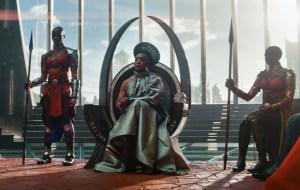
With Black Panther: Wakanda Forever, Phase Four of the MCU has officially closed and Phase Five will begin shortly with Ant-Man 3 in February, 2023. In the wake of the conclusion of the multi-phase Infinity series and 2019’s Endgame, this phase felt dominated by closure and exploration. The Disney Plus series provided little conclusive offshoots for many of the original Avengers characters. It’s also been a period of experimentation, with Marvel broadening its tone and scope from martial arts movies, spy thrillers, romantic epics, and familiarizing audiences to the concept of the multiverse with good movies (Spider-Man: No Way Home) and not-so good movies (Doctor Strange 2). And of course Wakanda Forever is the biggest edition yet on fulfilling a sense of closure, though it had never been intended to be before Boseman’s passing. It’s a sturdy sequel with a palpable emotional undercurrent and an engaging villain to boot. I called 2018’s Black Panther as agreeable, mid-tier Marvel entertainment, and I’d say the same for its sequel. However, with Boseman’s passing, it’s naturally elevated. Wakanda Forever is long and overstuffed but also emotional and engrossing and satisfying.
Nate’s Grade: B+
Share this:

Smile (2022)
 Smile was not initially intended for a theatrical release. The $17 million-budgeted horror thriller had been intended as a streaming exclusive for Paramount Plus, but after the movie tested so well, its parent company thought why not try a theatrical run? They even hired real actors to creepy stand still grinning outside Good Morning America or behind home plate for baseball playoffs. Then the movie made over $200 million worldwide and possibly began its own franchise. Not bad. After having finally watched Smile, I can understand why it became a word-of-mouth sensation. It’s thoroughly unnerving and a horror film that just knows its fundamentals.
Dr. Rose Cutter (Sosie Bacon) is a clinical psychologist with her own trauma. As a child, she discovered her own mentally ill mother’s body after she had overdosed on pills, and this has spurned Rose to try and help others suffering from depression and mental illness as a career. She encounters one very frantic young woman, Laura (Caitlin Stasey), who fears she is in danger. She says she keeps seeing… smiling people, people that aren’t there, and she was told today was her last day to live. Sure enough, the woman struggles and then stands, eerily smiling, and casually slices her own throat in front of Rose. While she tries to shake off the disturbing burst of violence, Rose is starting to see Laura again, smiling that same eerie smile, and this propels Rose to investigate the origins of this curse that leads each victim to take their own life.
 There isn’t much in the way of deeper themes or social commentary here, though I suppose you could find some pieces about how we stigmatize mental illness or that the curse has to be spread through witnesses of trauma. Smile isn’t an example of elevated horror and instead it’s just a well-constructed, well-developed horror movie that knows what to do to properly get under your skin. The premise reminded me of the indie breakout in 2014, It Follows, where there is a curse with very specific rules for passing it along, and new chains can be created or broken depending upon the duplicity of the person (see also: The Ring). I liked thinking of the curse as a puzzle, and my wife was able to jump to a conclusion before the movie as far as how to possibly break the curse, going against the assumptions of Rose and her ex-boyfriend police detective, Joel (Kyle Gallner). Much of the second half of the movie is this discovery period, untangling the longer history of the curse, implicit with this is that each new occurrence involved a violent suicide and an observer. I suppose maybe there is some theme possibly attempted about the shared nature of trauma, how it unpredictably spills out before us and is tricky to be cleanly contained. After establishing the pattern with the curse, now it’s time for our protagonist to wonder if she can beat the odds. I appreciate that writer/director Parker Finn provides plausibility to make her efforts credible. My issue with the latter part of It Follows was why the beleaguered teens would have thought that they could electrocute an invisible phantom and kill it when it was otherwise unfazed by bullets.
As a straightforward horror thriller, Smile knows what it takes to make you squirm and jump. It taps into something universal: smiling, without careful context, is often very creepy. It’s not a world-breaking observation and yet its simplicity is part of what makes it all so effective. Very often, the movie will anticipate the audience’s dread, feeling out that something is about to go off the rails or a jump scare might be approaching, and it will deliver in a different direction. Much like James Wan’s Conjuring movies, the film also has a firm handle on setups and payoffs, establishing a situation and then letting the audience simmer in dread. There was one moment where Rose was instructed to turn around and look behind her by a voice that no longer seemed so helpful, and the drawn-out response was deliciously squirm-inducing. There was another moment that I knew a jump scare was coming, it was literally walking towards Rose, and I kept thinking, “Okay, here comes the startle,” and then the movie brought it but in a way that still surprised and elated me. Given the nature of the curse messing with its victim’s mind, you might start to anticipate what Rose sees and hears is not to be trusted, and there are a few fake-outs too many. Thankfully, the movie doesn’t just rest on one spooky trick. There’s a children’s birthday party that manages to tie a few plot elements together in a masterfully traumatizing manner. When Smile does start revealing more about the design of its monster, that’s when my wife started averting her eyes more often and muttering “No no no” to herself. Some of the imagery is prime nightmare fuel, and I applaud Finn’s innate ability to scare the hell out of an audience.
 Some action movies and horror flicks are best described as thrill rides, an experience that exhilarates and delights and doesn’t offer much more by the end than the experience, and that’s perfectly acceptable. Not every movie has to be one with deeper meanings or breaking the mold in a way that no filmmaker has ever achieved before. Sometimes just having a good time from a well-constructed thrill ride is sufficient for a fun and diverting viewing. Smile is that film, a horror/thriller that is cleverly focused and developed to garner every goosebump. I will also say that I incorrectly thought that this movie was PG-13, and that was quickly disproven by the intensity and disturbing nature of its violence. I can’t say why I always thought that this was a PG-13 movie, maybe because of its instant box-office success, but it definitely doesn’t soft pedal its intense atmosphere and disquieting nature. It takes a lot to scare me, and Smile made me sit on the edge of my seat and perfectly dread the next moment, that is, when I wasn’t averting my eyes like my wife and trying to forget its nightmarish imagery.
Nate’s Grade: B+
Share this:

Black Adam (2022)
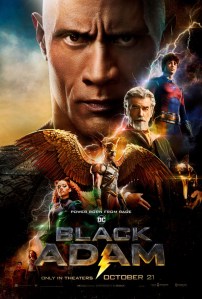 Dwayne “The Rock” Johnson has been eyeing a superhero costume for over eight years. He’s been attached to a Black Adam project since 2014. The character is best known in DC comics as a villain for Shazam, although the mythology and rules of that universe get some revisions under this new vehicle. Johnson plays a Middle Eastern godlike figure who shuns being a selfless champion of the little people. If you’re an easy sell for superhero movies, there’s enough visual bravura and smash-em-ups to at least sate your appetite for CGI fisticuffs. By the lowered standards of the DCU, this is a thoroughly average movie. It has a certain childlike Saturday morning cartoon appeal that doesn’t try too hard to be taken seriously and goes about its business with a workmanlike degree of efficiency. The action is easy to follow and the obsessive slow-mo style feel like comics splash pages come to vivid life. I liked the warm, golden color palate and Mid-East setting as distinguishing features. There is an audience for Black Adam, I am certain, but it’s also getting harder to just accept average superhero movies given the glut of superhero cinema. The hero’s journey of this would-be villain becoming more a grumpy antihero is rote and predictable, including a really lame villain to make Black Adam look less bad in comparison. I didn’t care about big CGI demon goon fighting for control of a magic throne. The character arc is supposed to be about agency and responsibility, but it gets reduced down to a morally simplistic “I guess I won’t kill all the bad guys all the time” re-evaluation. The plotting and structure is also misshapen; the entire first half of the movie feels like the second half of some earlier movie we missed out on. The fighting can also get annoyingly repetitious. The Justice Society has two major members, Pierce Brosnan as Dr. Fate and Aldis Hodge as Hawkman, and the rest are afterthoughts, as if the producers leveraged including more big screen debuts in case the central character wasn’t enough of a draw. Anyway, the Justice Society and Black Adam go through half a dozen fights and I just got bored by their bickering. The premise of a Middle Eastern superhero, a champion for the Muslim world, would be a radical idea worth exploring the geopolitical ramifications, especially the fears this could raise in conservative and twitchy Western societies that this could be seen as akin to a superhero arms race. That direction might veer away from the intent of the character but that’s also the far more interesting story. Still, it’s The Rock as a superhero, and his enormous charisma can carry even an ordinary action movie to greater heights.
Nate’s Grade: B-


 nathanzoebl
You must be logged in to post a comment.