Blog Archives
Wolrd’s Greatest Dad (2009)
 The name Bobcat Goldthwait doesn’t exactly make you think accomplished filmmaker. Goldthwait is best known for his screechy, nervous voice utilized in animated features and the hallowed Police Academy series. But he’s also a writer and a director. His first effort was 1991’s Shakes the Clown, starring Bill Murray as an inept bank-robbing clown. Then he wrote and directed a 2006 movie called Sleeping Dogs Lie that centered on the romantic foibles of a woman who, on a whim, once gave her dog oral pleasure. I can’t see Hollywood touching that one with a ten-foot pole. These sort of unconventional, risky artistic concepts might prepare you for Goldthwait’s newest black comedy, the ironically titled World’s Greatest Dad.
Lance Clayton (Robin Williams) is an underappreciated man. His teenage son, Kyle (Daryl Sabara), hates him. He cannot find anyone interested in published his many manuscripts. His colleagues think little of him, students don’t attend his poetry class, and his quasi-girlfriend, Claire (Alexie Gilmore) is showing more interest in Mike (Henry Simmons), the new hunky, successful English teacher that got a story published in the New Yorker on his first try. Then everything changes. Lance comes home to find his son dead of auto-erotic asphyxiation. He rearranges the body and writes a suicide note, attempting to spare his son from being mocked in death. But then the school hacks into the police system and prints Kyle’s suicide note. The entire school is awash in grief and discovers what an insightful, troubled young man Kyle was. They all want to know everything they can about Kyle, and suddenly Lance has found an outlet for his writing.
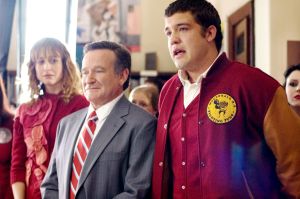 The movie satirizes grief culture with sharp acuity. Kyle’s classmates all react with horror and look back with extreme rose-colored glasses. Suddenly their fallen peer has transformed from the kid nobody liked into the wounded soul that touched all their lives. Bullies reexamine their behavior, girls that never would have given him the time of day now immortalize Kyle, and the faculty that wanted to expel him now wishes to rename the library in his lasting memory. This warm, fuzzy gauze of grief is Goldthwait’s target. He is satirizing how people turn tragedy into hypocritical attitude shifts. He ridicules the easy revision of history under the guise of collective sympathy. Not every youth is necessarily taken before their time. Not everyone was going to grow up to contribute selflessly to society, making the world a better place to live. Not every youth is deserving of canonization. Some people are just jerks from beginning to end, and Goldthwait proposes we do a disservice when we whitewash reality in the name of kindness and good taste. The only person who can see through this wave of hypocrisy is Kyle’s only friend, Andrew (Evan Martin), who doesn’t remember his crabby buddy being deep, articulate, or remotely smart.
Goldthwait’s screenplay is seriously dark and twisted but it’s also routinely hilarious, notably utilizing a deranged sense of irony. Lance uses his own son’s death as the vessel to become a respected writer. He uses his own dead son as his literary pen name. For once in his life, Lance now has an insatiable and adoring audience for his writings, and to top it all off they won’t dare be critical. Lance is manufacturing his son’s legacy and gaining unbeknownst critical praise. That’s fairly dark and fairly amusing stuff. It’s also funny that Kyle’s death has a greater positive effect on the community than Kyle being alive. The school rallies together and students use the death to justify personal growth. The fake journal of Kyle’s touches and enlightens, which further pumps up Lance’s ballooning ego and sense of purpose. At one point, a talk show host raises the question of whether it’s better to be a good person or thought of as a good person, and this gets to the heart of Lance’s dilemma. His actions are morally questionable. What started as an effort to protect his son’s dignity has morphed into personal gain. Is the world a better place because of this false rendering of Kyle? Is the lie better than the ugly truth? Is the lie justifiable? I honestly never expected to be confronted with tricky ethical questions while watching a movie made by Bobcat Goldthwait.
This is the best work Robin Williams has done in years, which I understand might not be saying much considering his recent slate of brain-dead family comedies. He hasn’t shown this much restraint, and talent, since his 2002 World Tour of Evil that included One Hour Photo and the masterful Insomnia. Williams drops every pretense of his well-known manic funnyman shtick and plays an actually subdued character. Lance is beaten down by the disappointments of his job and fatherhood. Williams effectively coveys the exhaustion of a man who repeatedly fails to connect with his brat of a boy. He doesn’t know what to do; the kid is practically a sullen stranger in his own house. Williams endures such slights and misfortunes with deadpan humor and sarcasm and the audience actually vaguely sympathizes with him through much, if not all, of the second half. Williams is mostly reactive and can come across like a calculated straight man to Goldthwait’s cracked-out script. You feel for the guy when he can capitalize on his son’s death and you practically want him to get away with it all.
Sabara has grown up considerably since being the chubby little tyke in the Spy Kids movies. It’s amazing how much you will detest his character. This kid is perverted, repugnant, obstinate, and just plain idiotic. He hates music (“All music? You hate all music?”), he hates movies, and he dislikes pretty much everything other than extreme pornographic fetishes. Kyle is a nightmarish child with no redeeming value. He had to be in order for the satire to work.
 World’s Greatest Dad is a misanthropic hoot of a movie but that doesn’t mean it is without flaws. Goldthwait has yet to prove any particular style or vision behind the camera. His direction isn’t a distraction by any means but it mostly just presents the story in an unobtrusive fashion. He also has the annoying habit of using music selections as a storytelling crutch. He?s prone to using several songs that describe the onscreen drama to a literal level. For a script as biting and clever, it’s disappointing that Goldthwait feels the need to use songs to spell out his implicit drama. This being satire, by nature the characters are mostly going to be thin. The classmates are little more than a cross sectional representation of high school stereotypes, ready to slide in for a joke. Other side characters are weak due to being underwritten or dropped. Claire is a shallow love interest flitting from suitor to suitor, offering little more than a conquest. Mike works as a foil to Lance but then is completely forgotten about in the second half. There’s one interesting scene where Mike, Lance, and the principal are all golfing and the roles are reversed, Lance is the confidant and respected colleague and Mike is jockeying for approval. But that’s pretty much the last you’ll ever see his character in a meaningful way other than taking up space in the background.
In the end, World’s Greatest Dad is not a comedy that will leave your sides aching or seams in need of stitching. It’s dark and disturbing but unlike the earlier Observe and Report, this movie actually provides an entry point for empathy. It’s provocative and twisted but it never pushes the audience out of the story. The intriguing setup is explored with careful consideration. The characters manufacture a false love for a kid that was all but ignored, and everyone is worthy of scorn to some degree. Even Lance is worthy of derision considering he’s exploiting sympathy to find the success that has eluded him his entire life. But Williams’ performance and Goldthwait’s sharp screenplay keep the film grounded amidst its satirical targets. Most surprising of all, there’s a a sweetness that emerges from this film’s black core. Lance regains a sense of humanity and purpose, and so do we due to his journey. Golthwait has come up with an unusual, morbid, and cynical comedy that manages to be somewhat life affirming by its final reel. I can’t believe I?m saying this, but I believe Bobcat Goldthwait is establishing himself as a strong comedic voice in the world of film. I eagerly await the next movie by the guy who did all the funny voices in Police Academy.
Nate’s Grade: A-
Share this:

The Invention of Lying (2009)
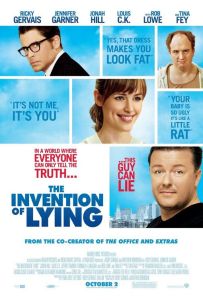 Imagine a world where people could only tell the truth. Sounds scarier than anything in horror movies today.
Mark (Gervais) is trying to romance Anna (Jennifer Garner) but even the waiter tells him she’s out of his league. She tells him upfront that she finds him unattractive and he will never have any hope of having sex with her. She’s more interested in Mark’s snide but handsome co-worker, Brad (Rob Lowe), who she feels is a better genetic match. Mark is about to be fired from his job, writing historical screenplays about the 13th century, and his secretary (Tina Fey) delights in telling him that she loathed every minute they spent together. This is a world without a filter. Until one day Mark goes to take out money from the bank, and something inside his brain switches. His balance is $300 but he asks for $800, and the bank teller apologizes for the computer error and gets Mark his full $800. He explains to his barfly friend Greg (Louis C.K.) that he said something that wasn’t. Nobody understands. “I’m a black Eskimo,” Mark says. Everybody takes him at his word. Mark is the only human on earth who has the ability to tell a lie, which he uses to his great advantage whether it be gambling, getting out of a traffic ticket, or unearthing a “lost” historical chapter about ninjas and aliens that makes for a stirring “non-fiction” film. Mark can’t even explain what he’s done, since the world lacks even a word for “lie.”
Gervais and co-writer Matthew Robinson concoct some interesting and inspired ideas of what a world bereft of lying would be like. Naturally, advertising would be completely different if people had to tell the truth, the whole truth, and nothing but the truth; imagine prescription drug ads that only said, “This is a placebo. Your penis won’t ever grow bigger.” The slogan for Coca-Cola is, “It’s very famous,” and the slogan featured for its rival, Pepsi, is, “When you can’t have Coke.” No one has any concept of fiction, of people pretending to play parts, so movies only consist of an older man sitting comfortably and reading a historical account with some minor dramatic inflection. Movies have become book reports. The sign in front of a retirement center says, “A Sad Place for Hopeless Old People,” and a motel sign reads, “A Cheap Place to Have Intercourse with a Near Stranger.” However, I’m puzzled by how forcefully open every person is. Just because you can only speak the truth doesn’t mean you have to be talking constantly. I understand Gervais’ point about the need for lies to protect people’s feelings, but just because you think someone looks fat doesn’t mean you have to blurt it out. When Mark greets Anna at the door for their date she reveals, “You’re early. I was just masturbating.” It’s funny, sure, but did she feel compelled to link the two statements? It seems in this world, everyone is incapable of keeping their mouths shut.
 The premise of the movie is terrific, and I’m honestly shocked no one has thought of it before. But the premise wears a little thin after the first 30 minutes of people speaking with no filter. You begin to expect outrageous comments that will be hurtful and blunt, and because you expect them it takes away the shock value and lessens the humor. But then The Invention of Lying takes a sharp right turn at about minute forty and becomes a radical and subversive and much funnier movie. Mark is comforting his dying mother (Fionnula Flanagan) who is afraid of leaving existence. She’s afraid of a cold nothingness. So Mark explains to her that there is an afterlife, a world beyond our own, where everybody gets to be around their loved ones in a mansion, and there’s no pain. She closes her eyes and dies in peace with this new knowledge. The doctors and nurses are amazed and beg to know more. Mark has created the idea of religion and God! He’s mobbed by people and camera crews demanding him to explain what he knows. Mark then works up the courage to establish a system of 10 rules to follow, which he tapes onto old pizza boxes. He then addresses his flock and has to explain the complicated minutia of religion, with hilarious questioning from the acolytes. Mark explains that there is a “man in the sky” who watches everything we do and is responsible for everything that happens. “Does that mean the Man in the Sky gave my sister cancer?” someone asks. Mark tries to explain the nature of a loving, all-powerful deity who willingly allows bad things to still happen. “Screw the Man in the Sky,” someone yells, “He’s going to kill us all. We need to fight back!” You try explaining the nature of the unknown to people.
It’s at this point that the movie transforms into a biting satire on belief and belief. I was cackling but I noticed that my theater seemed to get awfully quiet the longer the religious satire went on. I almost spat out my drink when I saw a spinning newspaper headline that said, “Man in the Sky Continues to Give Children AIDS.” It’s offensive but completely within the bounds of religious questioning. Gervais and Robinson aren’t ridiculing religious belief; in fact they seem to prove that it has a definite place of significance within society and can be beneficial psychologically. The satire isn’t savage and still manages to play with the amiable, fable-like nature of the story. Gervais isn’t laying out an argument that believing in an unforeseen deity is stupid. The movie isn’t condescending or hectoring, like Bill Maher’s anti-religion documentary Religulous, but it does take some slyly subversive swipes at the nature of faith and its reliance upon the unproven.
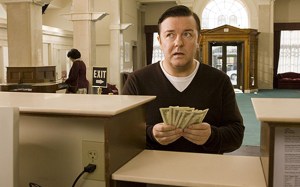 The Invention of Lying suffers from trying to be a romantic comedy. Too much of its conflict is spent on whether the chubby guy can get the pretty girl. The movie gets a tad sentimental for dealing in bitter-truths, and Gervais and Robinson steer the film to the ultimate romantic comedy setting: objecting at a wedding. I wouldn’t have minded the rom-com asides if they didn’t feel like they kept striking the same chord. Mark wants to be in a relationship with Anna. She points out that he’s fat, has a snub nose, and not a good genetic match. He persists. She points out that he?s fat, has a snub nose, and not a good genetic match. This goes on and on until the inevitable break at the end. Mark, and especially Gervais, is an appealing guy, self-effacing and witty, even downright cute at turns, but when Anna keeps repeating the same looks-first mantra, it makes her seem increasingly shallow and him seem like a glutton for punishment. Garner is a fabulous comedic actress and packs a lot more emotion into her character than I would have expected given the conceit.
Ricky Gervais is catching fire as of late, and it seems that America is finally waking up to the charms and brilliance of this squat comedian. He created The Office, the standard for squirm-based comedy, and appeared in the underrated supernatural comedy Ghost Town last fall. Gervais shows the necessity of lies in our world, from sparing hurt feelings to making mass-market entertainment. The world needs dishonesty. When The Invention of Lying is on-target, it is a hilarious, almost brilliant, comedy, with its best gags saved for taking on “the Man in the Sky.” It’s too bad then that the entire movie doesn’t live up to these flashes of comedic brilliance. Still, the movie is sweet enough and ends on a satisfying level, even if The Invention of Lying begins as one movie and ends as another. Gervais is an appealing lead, though he doesn’t prove much in the way of a director, and he has some real dramatic acting chops too, nicely put to use during his mother’s deathbed scene. I hope more Americans wake up to this man’s charms. Gervais continues to show audiences the sharp wit that has made him one of the world’s foremost funnymen.
Nate’s Grade: B+
Share this:

War Inc. (2008)
 What is the point of this movie? I think I get it, at least get what they were going for. The military industrial complex is bad and can mislead countries into needless conflict just for corporate profits at the expense of human life. Sure, got that, then what the hell is with the storyline of a Eurasian popstar (Hilary Duff) who has daddy issues? War Inc. is a farce but it doesn’t have much of string to connect it all. It’s all so scattershot, from lampooning politicians and corporations to squeezing in contrived romance and peculiar and almost nonsensical flashbacks with a fast-talking Ben Kingsley who sounds like he’s doing an impression of Foghorn Leghorn. This movie feels like a collection of discarded scenes that someone pasted together. The movie’s cynicism is almost repellent, and this is coming from a self-described cynic. It isn’t the cynicism that bothers me but it’s the lack of any bigger point. The satiric targets are all cheap and easy, which would be acceptable if the movie did more with the material. War Inc. is remarkably tone deaf when it comes to satire. The Duff sequences are superfluous and are begging to be scandalous, which then undercuts the movie’s potshots about exploiting teenagers for sex. The movie just utterly collapses from the inside out by the end. The most memorable and headline-grabbing moment of War Inc. is when Duff drops a scorpion down her shorts. Does that sound like an enviable creative highpoint?
Nate’s Grade: C-
Share this:

Tropic Thunder (2008)
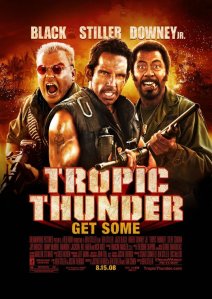 Ben Stiller has been kicking around the idea for Tropic Thunder for nearly 20 years. It took a lot of time to get the script in fighting shape, but the time was well worth it. Tropic Thunder is tasteless and occasionally appalling but it is also wickedly, deliriously funny.
Set inside modern-day Vietnam, Hollywood is filming another epic war movie but this one’s in trouble. It’s over budget, behind schedule, and the first-time director (Steve Coogan) can’t control his actors. Tugg Speedman (Stiller) is a fading action star looking for another hit. Jeff Portnoy (Jack Black) is a crass comedian who’s after some real acting credibility. He’s also addicted to heroin and worries that people will only ever see him as a funny man who farts. Kirk Lazarus (Robert Downey Jr.) is a five-time Oscar-winning actor who, thanks to makeup and a lot of hubris, is playing the film’s African-American sergeant. Alpa Chino (Brandon T. Jackson) is a rapper breaking into acting and is steamed that the Hollywood producers gave the sizeable black role to a white guy.
The director is at his wit’s end and being bullied by producers back in America. He is advised by “Four Leaf” Tayback (Nick Nolte), the Vietnam vet whose story the film is based upon. Tayback says to get real emotion and real fear that the actors should be stranded in the jungle without their precious handlers and demands. So the director takes Speedman, Portnoy, Lazarus, Alpa, and newcomer Kevin Sandusky (Jay Baruchel) in a helicopter and out into the wild. Trouble is, the actors have been left in the middle of an actual drug war, except they think it’s all apart of the script.
 Tropic Thunder is all things to all comedies. It could be tagged as being a bit incoherent but that’s because the movie has so much going on. It’s a sharp satire of Hollywood moviemaking and the raging egos of actors, it’s a send-up of Vietnam war movies and their bloody clichés, it’s a fairly worthwhile action film, and it’s a stupendously politically incorrect comedy with plenty of crude humor mixed side-by-side with genuine wit. It’s a comedy that has the potential to leave you aching from slapstick humor one second and biting satire the next. This feels like a complete comedy and not merely a series of sketches. Every character has an arc, some great moments, and each actor brings something different and something wonderful to the fray. This is clearly Stiller’s greatest achievement as a director.
The focus of Tropic Thunder is all over the place, and no one is safe from Stiller and his co-writers Etan Cohen and actor Justin Theroux. This is a brutal insider satire that plays it broad and loud. There are great jokes that ridicule the pomposity of the entire movie industry and the pitfalls of celebrity as a whole. I loved the jabs at celebrities going overseas and adopting children like they’re souvenirs. The movie has caught flak from disability groups that are mad about the movie’s liberal use of the term “retard.” I don’t want to say these people are missing the point of satire, or the fact that an R-rated comedy should offend on some level, but the joke is clearly on Hollywood and how movies exploit those with mental handicaps under the guise of telling their harrowing and inspiring stories. Movies have long been chronicling the adventurous lives of those with disabilities, which also has the side effect of making these people seem less like, well, just people. In the film, Speedman stared in a movie called “Simple Jack” about a mentally challenged boy who thinks he can talk with animals. Then the character has to pop up later in the film, complete with hysterical dialogue that blows apart just how exploitative these movies are (“I’ll see you in my head movies, but this is one head movie that makes my eyes rain”). It’s performed in just the right tone to make you laugh at the industry and the individual and not because of any disability.
The way the film establishes character back-story is genius. Tropic Thunder introduces all four major characters through fake commercials and trailers, like Grindhouse. The trailers are hilarious and a great way to kick off the movie. Stiller stars in a sinking action franchise where the world keeps being overtaken by fire (“Now, the one man who saved the world five straight times — will have to do it again”). The action franchise’s idea is to just reverse the scenario and, as sequels do, make everything bigger. Black’s trailer revolves around an obese family of super flatulent idiots all played by Black. The sequence is constant farting but it’s so over-the-top and pumped with contempt for lame-brained Hollywood comedies. The best trailer is the one that gives us Downey Jr.’s character, the esteemed Kirk Lazarus. Set in an Augustine monastery around the Middle Ages, Downey plays a monk who finds that he must conceal his inflamed passions for another man of the cloth (a figure I won’t spoil). Think of it as a 12th century Brokeback Mountain, and Stiller and company know exactly where to hammer Hollywood: the go-go eye stares, the hesitant naughtiness, and the ridiculous marketing angles – the title is inexplicably Satan’s Alley. The opening collection of fake trailers serves as perfect comedy bon mots for the feast that is to follow. They whet your appetite and may be the greatest opening 10 minutes of any comedy in memory.
 Downey Jr. gives an unforgettable performance comprised of sheer brilliant comedic bliss. I loved every second he was onscreen and I fully expect the man to get an Oscar nomination for his work here. Now, the role of a Method actor playing a black actor naturally presents a tightrope that needs to be walked just the right manner to maintain a satiric tone that doesn’t turn ugly. Let me state clearly that blackface is never funny. It is repugnant and Hollywood has a rather depressing history with the unsavory practice (Gene Kelly and even Bing Crosby sadly did it). Tropic Thunder is not a Stepin Fetchit-style minstrel show where Downey makes eye-rolling racist stereotypes. The joke is not that Downey is playing a black man, the joke is that he is such an arrogant and egotistical actor that he thinks he can play anyone. Besides, Jackson chides him throughout the film for his unorthodox portrayal, which tells you where the filmmakers stand. Downey elevates every scene he steps into and gives a performance, like the film, that is densely layered with comedy. He never breaks character even when the cameras aren’t filming and even when he’s alone. He’s two steps removed; channeling a performance as a heralded Australian actor playing his idea of a 1970s black male. When Alpa derogatorily drops the N-word, Lazarus slaps him and then begins a speech with, “For over 400 years they have been using that word to keep us down,” and ends it reciting the lyrics to the theme song from The Jefferson’s. In that span of time, Downey takes you along on every stop in the dense, hilarious mind of Lazarus.
While the rest of the actors don’t ascend to Downey’s heights (years ago this would have doubled as a drug reference), the ensemble of Tropic Thunder works together smoothly and they help make the film so much more enjoyable. Black is great when he’s trying to be seen as a “serious” actor when they are filming. I love his rushed and hushed line deliveries. But he’s even funnier after going through the wringer of heroin withdrawal. A sight gag involving Black digging through his speedo had me in stitches. Stiller is playing his usual dimwitted blowhard but propels the plot forward. He knows exactly how to oversell for laughs, like when he’s being riddled with bullets in dramatic slow-mo or when he’s playing Simple Jack. Baruchel is a nice counter foil to the uncheck bravado and craziness of the other actors. Jackson has fun voicing his mounting vexation with Lazarus. Coogan and Nolte provide good small moments, and Danny McBride steals his scenes as a pyrotechnic special effects expert that wants to “make Mother Nature piss her pants.”
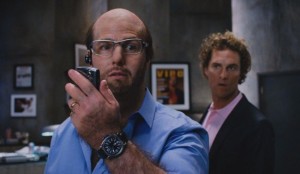 By now you’ve likely heard all about Tom Cruise’s small role in the movie as an irate, bald, fat, extremely hairy studio executive. It’s nice and amusing but I could have done with something different. Downey is unrecognizable in both physical appearance and through his speech; he fully inhabits a character that fully inhabits characters. Cruise, on the other hand, is instantly recognizable even with glasses, a paunch, and a shiny dome. It’s Tom Cruise playing a profane asshole but the joke wears thin. Cruise either needed to do something different or just be seen less, including his hip hop dance moves. And yet, Tropic Thunder has a running joke about Hollywood taking its beautiful A-listers and thinking that, through the power of makeup and superficial physicality, they can play any role. We’ve had a streak of Best Actress Oscar winners that have won accolades by stripping away their beauty and packing on the pounds (check out Charlize Theron in Monster). It seems like even the pretty girls are getting the ugly girl roles now; what’s a homely actress to do nowadays? So, in a way, Tropic Thunder is making fun of this line of thinking, that fat suits and some makeup are the great equalizer, but then it has Tom Cruise more or less falling into the same trap. He puts on a fat suit, a bald cap, but it’s still him and you hear Tom Cruise in every utterance. Maybe it would have been funnier if Cruise were playing a parody of himself since he is a studio executive at United Artists.
Tropic Thunder is a wildly funny movie that takes no prisoners when it comes to its sprawling satire. Stiller and company cut down the self-absorbed lifestyle and mentality inside the film industry and insecure actors. The film really shares the spotlight and each actor provides something different and welcome, and there isn’t a weak link in the bunch. Downey Jr. gives a brilliant comedic performance that will be long remembered. The movie is rude, crude, stupid, smart, and all over the place thanks to such a broad comic canvass. It took many years for Stiller to finally get Tropic Thunder off the ground but the wait was worth it. This is a rare comedy that eels loose, hits hard, and may warrant multiple viewings just to catch all the jokes-within-jokes. This is a movie with plenty on its mind, perhaps too much, but I wish more comedies were as well executed and skillful in their gags about gas passing.
Nate’s Grade: A
Share this:

WALL-E (2008)
 At this point, is there anything Pixar can’t do? They’ve explored the secret life of toys, what’s under the sea, the pains of rearing a family of super heroes, and of course a rat that dreams of becoming a chef. Seriously, anyone that can make that last one not only work but one of the most sparkling, imaginative, enchanting, and poignant films of the year deserves every accolade in the book. Pixar’s newest film, WALL-E, is certainly its most ambitious and potentially its most rewarding yet.
The year is 2700 and the planet Earth has long been left behind by mankind. Humans have exhausted their resources and left behind a planet that looks like one never-ending landfill. Skyscrapers are being built out of garbage cubes. The Waste Allocation Load Lifter – Earth class (WALL-E) robots have been left to toil away and clean up mankind’s mess. There is but one WALL-E robot left and it leads a solitary life of routine. It gets up, it compacts trash into cubes, and it assembles those cubes into eventual giant structures. Then one day a probe lands called EVE. This floating capsule-like robot is easily frustrated and quick on the trigger and WALL-E falls completely in love with his unexpected new companion. The two become close and then EVE is taken away unexpectedly. WALL-E hitches a ride on the ship that collects his beloved and journeys through space to save her.
 I was having reservations citing certain words of praise but this film deserves every ounce of praise; WALL-E is a masterpiece. This is a beautiful story told in a beautiful way in a beautiful looking movie. I imagine kids will be tickled by the funny robots but I really believe that this film will play much better for adults, and when was the last time a mainstream, American family film did that? Most “family” films are an excuse to do something lowbrow and cynical to make a quick buck, like the atrociously cringe-worthy trailer I saw for Beverly Hills Chihuahua (seriously, a civilization of singing/rapping Taco Bell dogs?). Pixar, and God bless them, are proving with each new release that family films need not be brain-killing hours. That reliable Pixar quality touch is never more present than with WALL-E. If you told me that a film that takes place on a trash-filled Earth, with minimal dialogue, and a romance between two robots would be the most thrilling, moving, and wonderful film of 2008, I would have scoffed.
Writer/director Andrew Stanton (Finding Nemo) relies on a universal visual storytelling language to tell the bulk of his tale. WALL-E plays like a gloriously enjoyable silent movie where body language and physicality advance the storyline and provide surprising depth; ignoring brief TV clips of Fred Willard and Hello Dolly, the movie doesn’t have actual dialogue until the 45-minute mark. And it is fantastic. The character of WALL-E is immediately empathetic and the audience will see slivers of themselves inside this independent robot that finds another reason for being. It’s a simple love story told in simple strokes, but it just so happens that Stanton has provided great emotional heft to those strokes. The film has such a huge and vibrant heart. More is said in indecipherable robot bleeps than in much of the tripe Hollywood calls dialogue. Watching WALL-E court EVE, a bit unsuccessfully at first, begins as cute, moves into being adorable, and ends up being greatly touching and flirting with the profound. How many other movies, let alone romances, end with the long-desired climax of two characters merely holding hands? This movie is a delight from beginning to end and a classic example of the power of expert storytelling.
When the film transitions into space is when the potent environmental message, and subversive satire, emerge. Beforehand we have witnessed the awe-inspiring landscape of Earth littered with garbage and empty shopping centers. Humans left the Earth to wait for the robots to do all the work and make the planet hospitable for life once again. For the last 700 years humans have been living in a heavy-duty luxury spaceship. Humans have grown to be fat, lazy, and completely self-involved; people only communicate with others through video screens, even when the other person is inches away. The movie also manages to satirize consumer culture, and in the future one corporate behemoth essentially dictates life’s choices; I found it highly amusing that the former president of the future (a live-action Willard) is also the CEO of the super corporate conglomerate. Business and government have merged completely. The social commentary isn’t as merciless as Mike Judge’s Idiocracy, nor is the environmental message subtle in the slightest, but the satire is sharp enough and blunt that some viewers might be offended, and I think that is genius.
Being a Pixar film, naturally WALL-E is resplendent to look at. The animation is superb and the imagination on display seems limitless. This is one of those films I’m certain I could watch again and again and find something new every time. I don’t really need to say much more about the visuals because they are breathtaking to behold (Roger Deakins, by the far the greatest living cinematographer, was even consulted to help with the look of the film. How awesome is that?).
 And yet even though WALL-E is primarily a love story the film also manages to be greatly exciting and equally funny. Stanton’s screenplay nimbly assembles characters and reintroduces them at key points to push his story onward. I loved that WALL-E is introduced to all sorts of unique robots on the mankind’s space ship and that he even stumbles into, more or less, a group of malfunctioning robots that come to his aid (think the Island of Misfit toys). Stanton manages to reconnect his storytelling threads so that every moment in this movie matters. The last third of the film is a back and forth cat-and-mouse struggle that manages to pump up suspense in smart ways. Stanton lays out his scenario for action and then builds organic complications. I am deeply satisfied when a filmmaker has a firm command of action that they can setup a situation, establish the rules, and then naturally construct obstacles and surprises that feel natural and germane to the story. Pixar has always been able to craft exciting action scenes that felt fully realized and WALL-E is no different.
If there is but one minor quibble I have with this near-perfect film, it is the missed opportunity to explore the mortality of robots. While WALL-E is going through his day-to-day duties he passes by older versions of other WALL-E models. The movie could have pushed just a little harder with the concept that this tiny robot is going to live to collect trash and then die like all the rest, becoming another piece of forgotten garbage. I think if Stanton had only explored this idea a little more it would have made his robo-love story even richer considering that both robots are going against their programming because they have found something that completely changed their world — love. The idea of mortality was explored to excellent effect in 1999’s Toy Story 2, so perhaps the Pixar folk didn’t want to fall into a philosophical repeat.
WALL-E is a wonderful love story, a heartfelt and immensely charming character piece, and a thrilling sci-fi tale that soars to broad heights of imagination. It’s timeless while still being rather timely thanks to its environmental message. Moments after the movie was over I wanted to see it again. I think I’ll feel the same way after the second viewing and the third. This is a phenomenal movie that will stand the test of time as one of the greats.
Nate’s Grade: A
Share this:

Southland Tales (2007)
 Richard Kelly is a talented writer/director who scored big with his first film, modern cult classic Donnie Darko. I was in love with the ominous yet inspired Darko from the moment I saw it, which, not to toot my own horn, was February 2002, way before the cult got started. I have been eagerly anticipating Southland Tales, Kelly’s writing/directing follow-up, even after its notorious 2006 Cannes Film Festival reception where critics readily cited terms like “indulgent,” “bloated,” “messy,” and, “disaster.” My love of Darko shielded me from such negative affronts, and so I watched Southland Tales undaunted and with as open a mind as possible. The regrettable truth is that even after Kelly shaved off a half-hour from the Cannes version, Southland Tales is every bit a mess as had been advertised; however, it is occasionally worthwhile and subversively ambitious.
Kelly begins his massive yarn with a nuclear attack on Abilene, Texas in 2005. America is plunged into World War III and fights, simultaneously, Iran, Syria, Afghanistan, and North Korea, while the conflict with Iraq continues. The Internet is now in control of the government, who passes sweeping security measures, chief among them IdentiCorp. This government arm uses thousands of trained cameras to keep watch over the lives of ordinary citizens, including when they duck into public bathroom stalls. Violent neo-Marxist groups have placed cells around the country, ready and willing to strike to destroy the last vestiges of American capitalism.
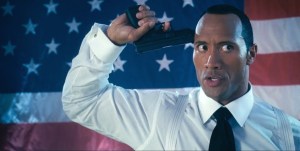 Fuel resources have almost run dry and the world looks to scientist Baron Von Westphalen (Wallace Shawn, hamming it up and having a good time) for a solution. The Baron has devised a substance known as Fluid Karma, which works under the properties of the churning oceans and will produce a radius of power. Fluid Karma also works as a powerful hallucinogenic drug and the Baron tested it on wounded Iraqi vets like Pilot Abilene (Justin Timberlake). Coldly narrating the film, Abilene stands guard outside the Baron’s laboratory and also peddles the drug on the side.
It is the summer of 2008 and the presidential election is months away. The Republican candidate, Senator Bobby Frost (Holmes Osborne), is in crisis mode. His spoiled daughter (Mandy Moore) is frantic because her husband, actor Boxer Santaros (Dwayne “The Rock” Johnson), has vanished. He’s awakened in the California desert with amnesia and shacked up with porn star Krysta Now (Sarah Michelle Gellar); the duo has written a prophetic screenplay called “The Power.” Krysta and a pair of tattoo babes (Nora Dunn) plan to blackmail the Frost campaign with video of Boxer frolicking with the adult movie star. They want the campaign to endorse Proposition 69, which would rescind the encroachments on civil liberties by the U.S. government.
A group of neo-Marxists, led by pint-sized Zora Carmichaels (Cheri Oteri), have kidnapped a police officer, Roland Taverner, and are using his twin brother Ronald (both played by Seann William Scott) to frame the police and Boxer. And I haven’t even begun to talk about Senator Frost’s wife (Miranda Richardson), the president of Japan having his hand lopped off in a loony sequence, the frequent inverting of T.S. Elitot’s quote about the way the world ends, a commercial where two cars literally have sex, and a rip in the space-time continuum that people are putting monkeys inside.
Extraordinarily messy and scattershot, Southland Tales has 1000 ideas rolling around inside without much traction. It’s as if Kelly thought he was never going to get the chance to make another movie again so he crammed every thought and topic he ever had into one 144-minute cross-pollinated jumble. The movie veers wildly and chaotically from political satire, to crude comedy, to sci-fi head-trip, all the way to Busby Berkley musical. There’s a little of everything here but few of the dispirited elements mesh and the film runs a good two hours before any sort of overall context becomes remotely approachable. One second the movie is satirizing a Big Brother control state and the loss of American civil liberties, and in the next second a character is threatening to kill herself unless Boxer allows her to orally pleasure him. You got, among other things, zeppelins, global deceleration, perpetual motion machines, Zelda Rubenstein, drugs, holes in time, twins, a murderous Jon Lovitz, ice cream trucks that house military-grade weapons, blackmail, Kevin Smith in a ZZ Top beard and no legs, reality TV, the American national anthem cut together with an ATM robbery, Biblical Revelation quotes courtesy of Timberlake, and, why not, the end of the world. What does it all mean? I have no idea but I credit Kelly for his ambition.
 Plenty of stuff happens for a solid two hours but little to nothing feels like it amounts to anything, and several subplots just get dropped. There are long stretches where I cannot explain even “what’s happening” from a literal description. This sprawling, magnificently self-indulgent meditative opus consists too much of side characters running into each other and having vague, pseudo-intellectual conversations that go nowhere. There are a lot of nonsensical speed bumps in this narrative. Sometimes the screen is just nothing but a series of newscasts overloading the audience with details on the reality of this alternative America; it’s filler. The conclusion is rather frustratingly abrupt; after slogging through two-plus hours of oblique questions it finally seems like we may reach some tentative answers, and then Kelly pulls the pin on his grenade and collapses his tale. Krysta tells Boxer in a moment of clarity, “It had to end this way.” Really? It did? This way?
The movie feels like a giant garage sale with scattered treasures hard to find but buried beneath loads of kitsch. Kelly clearly has bitten off more than he can chew and yet there is a bizarre undeniable power to some moments here. Roland (or is it Ronald) Taverner watches his mirror reflection a step behind; it’s unsettling and eerie and very cool. Timberlake has a drug-induced dance number where his scarred (both physically and mentally) Iraq veteran character is covered in blood, drinks beer, and lip synchs to the Killers’ song “All the Things I’ve Done,” which has the pertinent lyrics, “I’ve got soul but I’m not a solider,” and “You gotta help me out.” All the while, leggy dancing girls in blonde bobs strut and coo around him. It’s weird and tangential to the plot but it has a certain draw to it. The conclusion featuring the Taverner twins seeking forgiveness even generates some redemptive quality. Religious questioning and the philosophy of souls occupying the same realm plays a heavy part and gives the film an approachable reflection that tickles the brain, even if Timecop, sort of, visited the same ground, albeit secular, first (you’ll kind of understand when you see the movie). Southland Tales is grasping at profound and relevant messages, and yet some images achieve this easily, like a toy soldier crawling on the L.A. streets or a tank with Hustler stamped across its side for product placement. These simple images are able to transcend Kelly’s pop manifesto.
 None of the actors really equip themselves well with the outrageousness. Scott comes off the best but that’s because his character(s) is/are the only figure(s) the audience is given a chance to emotionally connect with. The Rock, listed for the first time simply as Dwayne Johnson, is an actor that I genuinely like and think has tremendous comic ability, as evidenced by 2003’s The Rundown. With this film, however, he comes across too constantly bewildered and shifty, like he really needs to pee and cannot find a bathroom. Gellar is woefully miscast and I think she knows it given her leaden performance. Southland Tales is the kind of film where every role, even the two-bit nothing parts, is played by a known face, be it Christopher Lambert, John Larroquette, Curtis “Booger” Armstrong, Will Sasso, and a horde of Saturday Night Live alums.
Kelly’s previous film succeeded partially because an audience was able to relate and care about the central characters, which is not the case with the comically broad Southland Tales. Kelly seems to work best when he has some restraint, be it financially or artistically; the director’s cut of Donnie Darko explained far too much and took some of the magic out of interpreting the movie on your own terms. Southland Tales runs wildly in the opposite direction and is a giant mess unseen in Hollywood for some time, though for the doomsayers comparing Southland Tales to studio-killing, self-indulgent, era-defining Heaven’s Gate, may I argue that Oliver Stone’s Alexander was far more self-indulgent, longer, wackier, and duller. Due to its unpredictable nature, you can never say Southland Tales is boring.
Southland Tales the movie begins as Chapter Four of Kelly’s saga, the first three chapters being made into comic books, and really, when I think about it, a comic book is the right medium for this material. The confines of narrative film are too daunting for Kelly’s overloaded imagination. Southland Tales is oblique, incoherent, strange, and unfocused but not without merit. I doubt Kelly will ever be given the same artistic legroom to create another picture like this, so perhaps Southland Tales has helped to reign in Kelly’s filmmaking. A reigned-in Kelly is where he does his best work, and I look forward to Kelly’s remake of Richard Matheson’s story, “The Box,” presumably with no dance numbers and sexually active motor vehicles.
Nate’s Grade: C
Share this:

The Simpsons Movie (2007)
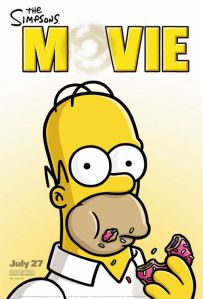 No movie has carried the burden of expectations quite like what befalls The Simpsons Movie. The animated TV satire has become a cultural phenomenon in its 18 seasons on the air. The Simpsons is a unique comedy with something for everyone; sharp cultural and political satire, slapstick, sincere family values, crass jokes, witty pop-culture zingers, and sly sight gags that take the eighteenth viewing to fully capture. In fact, I can only slightly explain the significance the show has had on my own life. For starters, it has influenced my sense of humor and writing, but the show also pretty much takes up full-time residence in my brain. I have told people for years that I believe 85% of my grey matter is filled with movie trivia and Simpsons quotes. There isn’t an experience in life that cannot be linked by an appropriate Simpsons quote (“Every time I learn something new it pushes something old out of my brain.”). I can quote episodes like some people can quote Bible verse. To many, The Simpsons is like a modern Bible for comedy.
With that said, the long-in-development movie version of our favorite yellow-skinned Springfield family is now in theaters. The loose plot of the film follows a typical Homer screw-up. He’s adopted a pet pig and disposed of its waste in the endangered Springfield Lake. The environmental calamity causes the EPA, led by a duplicitous department head (Albert Brooks), to place a dome over the town of Springfield. It doesn’t take long for the town to figure out it was Homer that doomed them, so the Simpsons family flees to Alaska to start anew before they learn that the government has plans to fully wipe Springfield off the map.
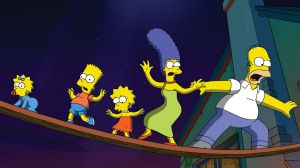 I suppose expectations will create a different prism for each person to view the film. The Simpsons TV show has never been terribly rude, and when it comes to satire it jabs more than eviscerates; in reality, the show has a terribly large heart and treads in moral and ethical dilemmas. It’s been more sweet than sour. Some fans might be hoping for the same transformation that South Park took when it hit the big screen in 1999. South Park made the leap with a brilliant movie that seemed to stretch the scope of what the show could do; it was more than a bigger and longer version of the TV show, it was an exceptional and blistering and hilarious satire that also was the most damn infectious musical of the decade. The Simpsons Movie doesn’t take full advantage of the opportunities a movie offers, though we do have a handful of non-network appropriate items like Marge uttering a blasphemy and Bart going the full yellow Monty. The Simpsons Movie doesn’t push the series into something too vulgar or unfamiliar. The movie feels like three episodes strung together. Whether or not that’s good enough for your entertainment dollar will be questionable. For me, having a feature-length version of my favorite TV show that’s written by the “Golden Age” writers is enough to guarantee at least two viewings.
The Simpsons Movie is easy to enjoy. The 11, count ’em 11, former show writers know exactly what makes the series work and how to stay true to the core of the show. There is some great lampooning of elected officials, including President Schwarzenegger declaring he “was elected to lead, not to read.” There are plenty of solid moments from the great plethora of supporting characters, like Ralph’s reaction to seeing a naked Bart, Mr. Burns remarking that for once the rich white man has the power, Cletus the Slack-Jawed Yokel idiot-proofing a safety measure, and Kent Brockman describing the environmental disaster as so serious, “it has its own theme music.” The Simpsons has such a large cast of memorable characters that it’s only fair that some will grumble that their favorites didn’t get more screen time (more Ralph and Mr. Burns, please), but the beauty of The Simpsons is that every person has their own set of favorites. The guest appearances by Tom Hanks and Green Day are well incorporated and fun. Albert Brooks has a long involvement with the show and is fantastically droll as always.
 However, ignoring my fan-coated bliss, the movie is not a comedy home run. The film does seem to lose some comedic momentum when it spends time on action. The emotional interludes feel a bit awkward but they still hit hard for me because I’ve followed these characters since I was 7 years old. The subplot involving Bart looking for a better father figure in Flanders has been done before and better like when Bart got a Big Brother to spite his father (“Simpsons did it!”). That’s the trouble with 400 episodes; there’s little material the show hasn’t already covered. The family excursion to Alaska never really feels like it fits with the plot, but then again the TV show always takes unexpected diversions. The Simpsons Movie is consistently funny, always amusing, fairly clever, but rarely will anything prompt uncontrollable laughter. It’s a bit of an easygoing good time, but will that be enough for the die-hard fans who are hoping the movie will contend with the pinnacles of all human artistic creation?
I think The Simpsons will go on forever. It’s a handful of seasons away from breaking Gunsmoke‘s record as the longest-running prime time TV show (20 years). The big screen version is an entertaining and amiable version of the show. That’s good enough for me. I just pray that a sequel takes less time to hit the theaters.
Nate’s Grade: B+
Share this:

Thank You for Smoking (2006)
 As soon as I saw a trailer for Thank You for Smoking I was in love. I found the book for cheap and read it with months to spare before the film reached my local theater. Admittedly, my expectations were high because the book was wonderful, and Thank You for Smoking as a movie is equally wonderful and a very good film adaptation.
This is a wickedly funny satire that skewers all sides in the political debate about Big Tobacco, and the film doesn’t take a stand, which is refreshing. It has a firm grip on its humor and gleefully gives its finger to political correctness. There?s a lunch group called the M.O.D. (Merchants of Death) squad where reps for Alcohol, Firearms, and Tobacco, of course, argue over whose product is harder to spin. It’s likely the snort-because-you-can’t-believe-they-said-that movie of the year. The tar-black humor in Thank You for Smoking rolls off so casually. This is a comedy that respects the intelligence of its audience and doesn’t dumb down its barbs or its satire. Aaron Eckhart was born to play the role of Nick Naylor, tobacco’s master spin artist and public charlatan. Naylor is conniving, slippery, and yet immensely likable not in spite of these traits but because of them. Eckhart is downright charming and you can see how he could dupe a nation, even if he’s only doing it for the challenge. Thank You for Smoking has one of the finest assembled casts in a long time, and every member fires on all cylinders. This is a film brimming with confidence and it’s evident with every frame. You almost might feel guilty for wanting to capture a contact buzz from how polished, assured and witty the flick is.
I never thought I’d say so but it sure looks like adapter/director Jason Reitman has a far more promising future right now than his dad, Ivan. Jason, the son, keeps the movie brisk, packed with characters, subplots, jokes, and a visual whimsy. This is a terrific adaptation of a terrific book, and Reitman really hones in on the mechanics of debate and lobbyist practices with aplomb. A scene where Nick teaches his adoring son the tricks of debate with ice cream is outstanding. Thank You for Smoking crackles with dialogue to die for, like Nick’s boss BR (J.K. Simmons) saying, “We sell cigarettes. They’re cool, and addictive, and available — the job is practically done for us.” My only complaints with the film, besides that it’s too short at just 90 minutes, is the manufactured danger seems a bit too slight and too easily overcome. Nick quite simply vanquishes whatever threat his reporter sex buddy Heather (Katie Holmes) posed. Otherwise, Thank You for Smoking is a superb movie all around and there’s no reason you shouldn’t see it. Take the hit.
Nate’s Grade: A
Share this:

Team America: World Police (2004)
 The MPAA is mad, plain and simple. It’s an organization intended to rate movies so our wee ones don’t stumble into something not intended for their virgin eyes. They also have a long history of haggling with filmmakers over ratings and the necessary cuts to ensure a commercial rating. And, in their eyes, puppet sex was deemed too indecent. You see, the MPAA initially gave the all-puppet action movie Team America: World Police, the new film from South Park creators Trey Parker and Matt Stone, an NC-17 for an extended scene of two marionettes engaging in enough sexual positions to make a G.I Joe blush. However, we’re talking about puppets, people! Puppets! They’re not even anatomically correct. Does anyone find it crazy that a governing board says watching two dolls bang together in “simulated sex” (is there any other kind with puppets?) is inappropriate for all ages under 17? Surely, if the MPAA is to be eventually reformed, this will be Exhibit A.
 Team America is an elite team that fights terrorists and police the globe in red, white, and blue helicopters, jets, and flying limos (the team logo is a bald eagle with the earth in its beak). The team leader Spottswoode recruits Broadway actor Gary, star of the musical Lease (key song: “Everyone has AIDS”), because they need someone to pretend to be a terrorist and flush out their secret plan. Gary is reluctant at first but agrees to join the team.
Team America flies to Paris and Cairo to battle terrorists. They snuff the terrorists, but world monuments like the Eiffel Tower and Sphinx get lost among the collateral damage. Things look promising for Team America, and Gary expresses feelings for Lisa, a blonde psychologist haunted by the loss of a teammate and a lover.
Terrorists strike the Panama Canal in retaliation, and a group of celebrities led by Alec Baldwin condemn Team America. Michael Moore, with hotdog in each hand, protests outside Team America’s headquarters. In these moments of disarray, we learn the true source of the Weapons of Mass Destruction and brains behind the attacks is North Korean dictator Kim Jon Il, who has a plan for “9/11 times 2,358.”
While not reaching the satiric highs of the South Park movie, Team America is a political movie that lambastes both sides of the coin. This has been a very heavy year for political films, from leftist documentaries like Fahrenheit 9/11, The Hunting of a President and Going Upriver: The Long War of John Kerry, to more subtle jabs at the current administration (the very Cheney-like VP of The Day After Tomorrow), to more obvious indictments (the stuttering, axiom-loving dumbbell candidate in John Sayles’ Silver City). So in a year bursting to the seams with political screeds, it’s quite refreshing to have a movie that lampoons both the Right and the Left.
Team America satirizes the arrogant, shoot first ask later, cavalier foreign policy America has been accused of (“We’re going to bring democracy to you if it kills you.”). The film also criticizes Hollywood celebrities who feel that their uninformed, unsolicited opinions are germane to the political process. In the end, it’s the celebrities who get the worst of the beating (Matt Damon appears to be, um, challenged). Parker and Stone shrewdly satirize pretentiousness and ego, no matter which side it falls upon. They lose their focus as the film enters its final gory act, instead resorting to garish ways of killing puppets.
 Team America has a good one-two combination with its political punch, but where it really shines is the knockout it delivers to bombastic Jerry Bruckheimer action films. This is a delirious send-up of a wide array of action movie clichés, including team members and their secret crushes as well as their hidden traumas. Characters will fight or die in slow-motion for dramatic effect. Characters will all have some special talent that will come into play at an important moment. Kim Jon Il has a typical villain lair, including large shark tanks and trap doors. When a character dies in the opening sequence he mutters the line, “I feel so… cold[.” Hilarious! There’s even an entire training montage set to a song called, “Montage” (sample lyric: “Show a lot of things happening at once, remind everyone of what’s going on!/ And with every shot show just a little improvement – to show it all would take too long!/ That’s called a montage!/ MONTAGE!/ Even Rocky had a montage!/ MONTAGE! “). There’s also a love song all about Pearl Harbor sucking as a movie.
Like all the other films by Parker and Stone, Team America is a robust musical. The songs aren’t as sharp as the ditties from the South Park movie, but they’re still quite amusing. The Team America theme is a rousing anthem called “America, Fuck Yeah!” which is a perfect example of the film’s simultaneous mixture of the profane and the brilliant. Later in the film, when Team America is taking a public backlash, there’s a somber remix of the theme that’s even funnier.
Some things are just funnier because of the limitations of puppets. Watching two marionettes try to fight is hilarious, because they really do nothing but kick their legs and limply slap each other. Before Team America, I never realized how funny it was just to watch marionettes walk. They’re so awkward and jumpy, that just seeing them step from side to side can put a smile on your face. When the music of Kill Bill comes onscreen, and the puppets walk in slow dramatic fashion, it’s even more absurd and funny.
 Parker and Stone also have fun with self-awareness, like when they take Gary on a tour of the sights of Washington D.C. and he stands next to an actual tombstone at Arlington National Cemetery. There’s also a Matrix parody that actually comes off as fresh. There’s a giddiness to watching puppets swear, fight, vomit, stagger drunk, and even do the nasty. It’s a gimmick that doesn’t get old.
This is also one terrific looking movie. The sets are massively intricate and the photography by Bill Pope (who did shoot the Matrix films) bathes the proceedings in beautiful mixtures of light and dark. There may be moments you forget that what you’re watching are miniatures. It is filmed to look like a typical action movie. The music is a spot-on parody of action films, with its heaviness on flutes when the villain is around, to the foreign lady mournfully singing during scenes of tragedy. There’s fantastic craft and detail worked into Team America that I can unequivocally say Team America: World Police is the best looking, R-rated all-marionette musical action movie… ever.
Team America may be the funniest film of the year. There are some moments of drag, and sometimes less profanity would make certain punch lines better (unfunny homophobic jokes like the acronym F.A.G.), but the movie is a comedy that’s pee-your-pants funny. Team America is definitely not for kids (what kind of irresponsible parent assumes “puppets = for kids” and ignores an R-rating?). Because of the equal opportunity satire, this may end up being a movie that conservatives and liberals both claim to be their own. For fans of erudite satire, crude humor, and puppet sex, Team America will be a blast. Make sure to stay throughout the end credits to hear a special closing song not in the film.
Nate’s Grade: B
Share this:

Starsky & Hutch (2004)
 The big screen adaptation of yet another 1970s television show has about one joke in it that the 70s were funny. So after scene after scene of people with funny hair, in funny clothes, and talking funny, Starsky and Hutch doesn’t so much coast as it skids to a flat, lifeless halt. Ben Stiller and Owen Wilson are an amiable duo and Vince Vaughn makes a credible cocaine creep, but director Todd Phillips (Road Trip) is left to unsuccessfully hammer his film with sight gags. Scenes and jokes will stretch on much longer than their recommended shelf life. Will Ferrell makes a welcomed cameo to give the film its only moment of juice. Snoop is wasted. You may laugh at all this but the Beastie Boys did it better with their “Sabotage” video and that was ten friggin’ years ago.
Nate’s Grade: C


You must be logged in to post a comment.