Blog Archives
The Boy and the Heron (2023)
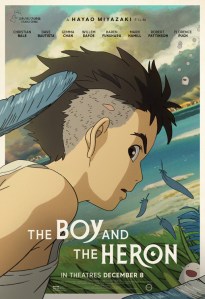 It’s been over ten years since renowned animation legend Hiyao Miyazaki graced the silver screen with what was believed to be his last film yet the retirement didn’t kick, for the benefit of all of us. I’ve resisted watching 2013’s The Wind Rises simply because of the melancholy of it supposedly being his final film. The man is in his 80s and still hand draws much of his storyboards, so if indeed this is the last Miyazaki movie we ever get, it ties thematically with many of the concepts and interests of this man’s storied career that it feels like a fitting capper. It’s his most autobiographical, following 12-year-old Mahito as he relocates to the country after surviving the firebombing of Tokyo during World War II. Unfortunately, he lost his mother in the bombing, and now his father is remarrying his mother’s younger sister, who looks near identical to Mahito’s mother. On the grounds of his new home, the boy discovers a strange overgrown tower with a door that leads to another world, and it’s within this world that a creepy scary bird promises Mohito can find his mother again. The Boy and the Heron is an imaginative and transporting fantasy with some major themes around the edges about grief and acceptance and environmental disaster, but it’s the haphazard structure and poor pacing that hold it back for me. Simply, it’s too long to get going and then too short to conclude. We don’t exit to the hidden fantasy world until almost halfway through, and the time in the regular world is stretched out, especially without going into further detail about our protagonist, who is kept very opaque. The discovery of the new world and learning its strange mostly bird creatures and rules and conflicts is where the movie really gets interesting, especially once the menacing heron becomes a squat man serving as our reluctant guide. It feels like there’s going to be some heavy revelations forthcoming, especially with the supposed duplicate nature of Mohito’s mothers, but it all comes down to an aged Man Behind the Curtain with a reveal straight out of Willy Wonka and the Chocolate Factory. We take too long to get to that intriguing fantasy world, and then once we’re there it feels a little too surface-level in design for a world on the cusp of dying. Then it’s a mad scramble to leave, and while the culminating decision feels earned in its wisdom, it also feels like the movie has simply run out of ideas. The Boy and the Heron is beautifully animated; the world feels like it’s undulating before your eyes, and there are numerous moments that allow it to breathe. However, it feels like maybe we could have gotten started sooner and finished a little later. Even mid-level Miyazaki is better than most, so The Boy and the Heron is still a worthwhile animated fantasy even if it doesn’t reach masterpiece status from a master storyteller. At least now I can finally watch The Wind Rises, so there’s that too.
Nate’s Grade: B
Share this:

Big Fish (2003) [Review Re-View]

Originally released December 25, 2003:
Premise: Estranged son Will (Billy Crudup) travels back home in an effort to know his ailing father Edward Bloom (Albert Finney; Ewan McGregor as the younger version). Will hopes to learn the truth behind a man who spent a lifetime spinning extravagant tall tales.
Results: Despite a shaky first half, Big Fish becomes a surprisingly elegant romance matched by director Tim Burtion’’s visual whimsy. McGregor’’s shining big-grinned optimism is charming. Not to be confused with the similar but too mawkish Forrest Gump, Burton’’s father-son meditation will have you quite choked up at its moving climax. Fair warning to those with father issues, you may want to steer clear from Big Fish. You know who you are.
Nate’’s Grade: B+
——————————————————
WRITER REFLECTIONS 20 YEARS LATER

Tim Burton has never really made a movie like Big Fish before or in the twenty years since. He’s made movies that are aimed at children, like the Disney live-action remakes for Dumbo and Alice in Wonderland, and he’s made animated movies that are more wholesome while still holding to the man’s creepy-cute aesthetic, but he’s never made a movie so unabashedly sentimental as 2003’s Big Fish. Many of his stories involve alienation and outcasts and outsiders and characters accepting themselves, their unique oddities, and their unconventional families. This movie was different. It was based on the 1998 novel by Daniel Wallace and primarily concerns the relationship between fathers and sons as the paterfamilias is nearing his end, a not unfamiliar plot structure for treacle and tears. It’s about a smooth-talking man of legendary tall tales about his life and his exasperated son trying to find real answers. That’s the movie. It’s purposely small even though the tales are tall. There’s nothing larger than simply resolving the strained relationship between father (Albert Finney) and son (Billy Crudup). It’s the most intimate movie of Burton’s career while still finding a place for his fantastical visual whimsy, as the outlet for Edward Bloom’s (Finney as the dying version, Ewan McGregor as the younger version) fantastical tales of adventure. It’s a movie elevated by Burton’s signature style and it’s one that still, in 2023, had me choking up and tears streaming down my face by the conclusion.
This is an episodic movie by design and it does hamper some of the emotional investment, until that whammy of a culmination. Because we know the younger Edward Bloom is exaggerating his life’s travails for entertainment, and perhaps a dash of pride to heighten his deeds, it makes the many sequences of young Edward and his escapades feel a bit fleeting, as if we’re trying to find the larger meaning hidden within the fables and the fabulous. The ultimate point is that the entertaining diversions and exaggerations are who Edward Bloom is, and ultimately trying to discern truth from legend loses sight of the appeal of this charming man and his wild tales. I can understand this while also slightly disagreeing with the conclusion. It’s a little pat to say, well, the point of all these extravagant stories is simply that they were entertaining, never mind about finding a buried meaning or truth. It’s like saying, “Hey, just enjoy the ride.” The point is to fall in love with the storyteller and see the storytelling itself as its own act of love, which I don’t think works until the very end of the movie. Until then, it’s a transitory series of adventures, from wartime to the circus to aggressively persistent courtships and hidden magical towns, each reflective of the indomitable spirit and cheery optimism of our chief yarn-spinner.

In that way, it’s easy for the viewer to adopt the same perspective as Will (Crudup), and that may be the hidden genius of screenwriter John August (Go), or I may be projecting. Our plight is the same as the son: we’re trying to discover what is actually real about the real man. It’s easy to feel his exasperation as he wants something genuine from this man and only keeps getting the same old tales and stories, and everyone else is smiling broadly and happy to just accept the man on his own terms. That’s where Will’s character arc goes, finally accepting his father on his terms, which means playing along with his rules. It’s a level of empathy and acceptance rolled together, but it’s also like two hours of a character going, “My dad might be a liar and I’m curious who he is,” and then in the end going, “My dad might be a liar but I guess that’s who he is.” It doesn’t feel like the grand epiphany that the movie thinks it is, even with Danny Elfman’s Oscar-nominated score trying to stir every doldrum of your heart (Elfman has only been nominated four times in his storied career, also for Good Will Hunting, Milk, Men in Black). So for much of the movie’s running time I’m pleasantly entertained but a little frustrated that the movie doesn’t seem to be digging closer into the man garnering all this unwavering attention.
However, it’s at the very end where Big Fish really transcends its limitations to become something deeply moving and powerful. As I re-watched, I’m twenty years older, and likewise my own father is twenty years older, and moments like this have more potency to me. It’s about the son accepting his father on the same terms he fought so hard to circumvent, and so the ending becomes a beautiful exchange of the storyteller inviting someone else to finish his story’s ending. It’s surprisingly profound when you boil it down to its essentials, and that may be why I had tears dripping down my face as the adult son narrates one last fantastic tale of helping his father escape from the hospital, dart through traffic in his classic car, and arrive for a farewell with all the many friends he’s made through his many decades of laughter and camaraderie. Edward then transforms into the fish, becoming the very symbol of his “fish tales,” and lives on through the stories and memories of others, simply but effectively communicated with the mourners engaged in retelling Edward Bloom’s escapades through engaged pantomime. It’s one of the most clear-cut examples for me of a perfectly good movie really hitting another level in the end.
Big Fish began a long collaboration between Burton and August, who has become such a prolific Hollywood scribe that he’s likely had his hand on just about every script in town. August would later be trusted to write Charlie and the Chocolate Factory, Corpse Bride, Frankenweenie, and Dark Shadows; that’s five Burton projects in nine years. For those keeping track, this was only the second Helena Bonham Carter appearance in a Burton movie, the first being the misbegotten 2001 Planet of the Apes remake. It’s also fun to watch Marion Cotillard (Inception) in her first American movie as Will’s pregnant wife.

Big Fish also has a strange unintended legacy regarding someone else who connected with it. It was the last film seen by the famous playwright and monologist Spalding Gray, an enormously compelling storyteller who, much like Edward Bloom, favored the oral tradition. He suffered through depression most of his life, which was amplified after a severe car accident and multiple surgeries to recuperate in the early 2000s. On January 10, 2004, he took his children to see Big Fish and the next day was declared missing. His body was found in the East River in New York City and it’s believed Gray took his own life leaping from the Staten Island Ferry. His wife, Kathleen Russo, told New York Magazine in 2008 that Gray had cried throughout the movie and she concluded, “I think it gave him permission to die.” It’s unfair to blame the movie for a suicidal man’s decision-making, but I think it’s interesting that the emotional closure onscreen was so powerfully felt that Gray may have felt a personal level of closure as well.
My original 2003 review was so minimal, one of five or six short capsule reviews I wrote together as end-of-the-year awards contenders (same with the upcoming Cold Mountain re-watch), so I wanted to add more thoughts to the subject. My opinion feels relatively the same twenty years later though the ending had even more power as a 41-year-old than at twenty-one. I’ll keep my review the same for relatively the same reasons, though I hope Burton returns back to telling another Big Fish kind of detour (2014’s Big Eyes was not that).
Re-View Grade: B+
Share this:

Barbie (2023)
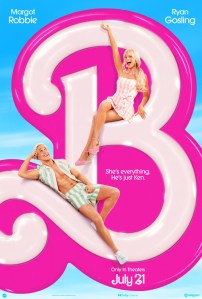
Who would have guessed a movie based upon a ubiquitous doll that dates back to the 1950s would become not just a cultural force and reclamation project but also the biggest moviegoing event of the year, as well as the highest-grossing movie in Warner Brothers’ history, even outpacing The Boy Who Lived? In 2023, it turns out we are all, every one, a Barbie girl living in a Barbie world. I came to this experience late, wondering if writer/director Greta Gerwig’s movie could live up to the lavish hype, the fawning praise, the hilarious offenses that many fragile males have levied against it. It couldn’t possibly be that good, could it? I saw it with three generations of women in my family, something I will privilege, and I must say, it is that good. Barbie is one of the best movies of the year and a shining example of what vision and passion can do to elevate any story. There’s so many ways this movie could have just been cheap corporate slop and instead it becomes an existential yet deeply personal treatise on life and death.
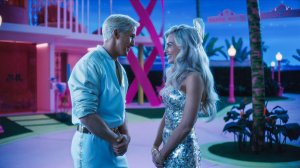
In the world of Barbies, women rule and the men are just afterthoughts. In this creation myth, the Kens were meant to compliment the Barbies. We watch “Stereotypical Barbie” (Margot Robbie) go through her daily routine of fun, frivolity, and nightly dance parties with all her best gal pals (no boys, er Kens, allowed). Then one day, this blonde Barbie started walking differently, started seeing the world differently, and started wondering about dying. Was there something wrong? Her human owner, in the real world, was in trouble, so Barbie sets off on an adventure to find her human owner and save the day, with help from her boyfriend, Ken (Ryan Gosling). Except for these two, the real world is very different from what they were expecting.

It’s easy to see how this movie could have been a mediocre fish-out-of-water comedy, with Barbie clashing in our modern-day world with its modern-day views of fashion, body image, and what skinny, buxom dolls represent to generations of young impressionable children. It’s clear to see what the scrapped version could have been when Amy Schumer was attached to star. What really impressed me with Barbie, beyond its delightful and inspired production values, is how ambitious and well-realized this movie is at every turn. It could have settled for easy jokes about Barbie and Ken not fitting in, not understanding human relationships and sex, and that stuff is there and it’s quite funny, but Gerwig and co-writer Noah Baumbach want to do so much more. This is a studio blockbuster, based upon a decades-long popular toy, that wants to do more with its platform. It aims higher, and in just about every measure, Barbie admirably succeeds. As a comedy, it had me howling with laughter, enough so that my response was providing another level of entertainment for my wife. There are jokes that are so specific, so beautifully targeted, that when they detonated, I was in awe and appreciation, (a reference to the literal definition of fascism and a Snyder Cut throwaway reference were perfectly attuned to my comedy sensibilities, thank you, Greta). As a frothy and fun fantasy, the movie has excellently crafted sets and costumes and retro visual aesthetics, making the movie a pink-accentuated sensory bombardment. But as a satire is where Barbie really becomes special.
Again, it would be easy for Barbie to learn lessons about body diversity and positivity and likely be browbeaten into what a good feminist is supposed to be, that the real world is a harder place for women than she previously thought. All of that is there, along with a consistent and entertaining critique of the faults of patriarchal society, but Barbie isn’t some reductive, man-hating screed to indoctrinate women into thinking they don’t need men (men are already very good at convincing women they don’t need men). This is a treatise on the power of inclusion and how this benefits society, both for men and for women. In Barbie Land, it’s a matriarchal society where girls rule and boys drool, but it’s a fantasy world reminiscent of a caste system, where the Kens will always be lesser afterthoughts because, well, they’re not Barbies, they’re just Kens. They are excluded in their own world. That’s why Gosling’s Ken is so excited by the real world, where the status quo is flipped, where the world is run by men, as he now sees this as an opportunity that has been denied to him. He wants to recreate his own version of the patriarchy not because he thinks women are inferior but because he just wants to be in power and respected, so he’s replicating his misguided understanding of what men in power are like, which naturally involves lots of horses. In the real world, Ken admonishes a suit-wearing corporate executive that they aren’t doing patriarchy right, to which the man winks and says, “We’re just better about hiding it.” The final act isn’t about “bringing down the patriarchy,” it’s about making a more inclusive world where people don’t have to feel marginalized and stuck and resentful.

Besides its social satire, there are other areas where Barbie goes deeper in surprising and affecting ways. There are more than a few applause-worthy moments explaining the perspective of women, particularly a monologue that is destined to be an audition piece for the rest of time, and it all works and is cutting without being too didactic. Gerwig even gets in a few jabs about corporate culture (“Are there any actual women in this boardroom?” “I’m a man with no power, does that make me a woman?”) and Mattel as an organization becomes another force of antagonism spearheaded by hapless buffoonish men (of course you get Will Ferrell to play the Mattel CEO). The biggest surprise is how emotional and deep the movie can become. There will be plenty that tear up just having a big Hollywood movie recognize their day-to-day emotional toil of being a woman in modern society. For me, the questions over what to do with the life we have flirted with some surprising existential contemplation, as Barbie is reminded at several points that death is a reality and yet would she want to move to the human world? An emotional highlight occurs when Stereotypical Barbie is speaking with the equivalent of her creator, and Billie Eilish’s tender-to-the-point-of-breaking song “What Was I Made For” lilts onto the soundtrack, and the sincerity of this sequence, topped with insert home video footage from the production cast and crew, really hit home how much more this movie is going for then bringing different dolls to life. It’s not just jokes about crotch-less creatures and weird feet, it’s about how we can live and why we do so, what inspires us. It’s a big studio summer release that flirts with the profundity and brevity of life.
There is one actor who deserves their own special recognition and that is Gosling (The Nice Guys), who so rarely gets to showcase his sharp comedy skills with the dour, serious, insular roles he gravitates to. Gosling is so committed to his role that he is operating on another plane of excellence, hitting sly jokes within jokes and selling every wonderfully stupid moment with Ken. This man isn’t afraid to look silly, he fully courts it, embraces it at every opportunity, and yet his performance doesn’t detract from Robbie but only makes them both shine brighter. He reminded me of Tommy Wiseau at points. His hilarious ballad “I’m Just Ken,” which segues into a wild West Side Story-style dance battle that is peak peacocking, is a phenomenal run of inspired silliness (the storming of the Malibu beach had me rolling), yet also connected to the character’s co-dependent arc and dissatisfaction with himself (when feeling down, just quote: “I’m just Ken, and I’m enough, and I’m great at doing stuff”). Ken has to learn to think of himself outside his combined definition with Barbie, and they both need to spend time discovering who they really are rather than who they think they’re supposed to be before considering forming attachments. I would not be surprised if Gosling earns a Best Supporting Actor nomination. It was the role he was born to play: insecure accessory doofus.
Gerwig has launched to mega-stardom with just three directing efforts (four if you count her co-directing effort in 2008 with Nights and Weekends, back in her early mumblecore breakout days). Already this woman has been nominated for Best Director, one of only seven ever, and she now owns the highest grossing movie of the year as well as in studio history. She’s proven herself with her 2017 coming-of-age semi-autobiographical Lady Bird, richly realized and achingly felt, with an established literary classic that is a foundation to generations, and had been adapted a dozen ways for the cinema, and yet she found ways to make her 2019 Little Women modern and personal, and now, on her biggest stage, being handled corporate IP that would be perfectly fine with just selling more toys, she has made a movie for the moment, something that compelled audiences back to theaters in droves, that will become a staple for a generation of film lovers. With just three movies, Gerwig has established herself in a league of her own as a director. Anyone who can turn the Barbie movie into a hilarious, poignant, and meaningful meditation on our times, on the relationships between mothers and daughters, and on life itself is a talent that deserves every creative latitude to achieve her vision. The voice and vision behind this, even to the smallest detail, is so impressive and fully committed and well developed and fabulous. Barbie is one of the best movies of the year and proof that studio blockbusters can indeed be more.
Nate’s Grade: A
Share this:

Nimona (2023)
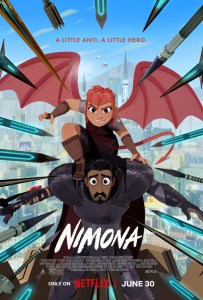
Based on the graphic novel by ND Stevenson (She-Ra), itself a web comic from 2012-2014, Nimona was developed by Blue Sky Animation Studios and originally scheduled to be released in 2020, and then Disney bought Fox, shut down Blue Sky, and pushed back against the gay content of Nimona before just canceling it altogether in 2021, and then Netflix came in and saved the project and released it, gay and all, during the last day of Pride Month. It’s been a long, protracted journey for Nimona to get to your screen and, reader, it was worth it. The movie is a rambunctious and revisionist fairy tale that is both subversive and deeply sincere, enough so that an emotional confrontation of accepting someone on their own terms elicited genuine tears on my part (for those keeping record, that’s three straight animated movies in the month of June that caused me to cry). Nimona (voiced superbly by Chloe Grace Moretz) is a high-energy prankster in a fantasy world melding Medieval culture with future technology. She befriends a fellow outsider, Ballister (voiced by Riz Ahmed), after the kingdom views him as a wanted villain. Together, they try and clear Ballister’s name by finding the real killer, and maybe they can wreck some stuff too just for fun. The cell-shaded style, a familiar aesthetic in the realm of video games, adds a bright and slickly appealing quality to the animation, and the frenetic pace and anarchic humor keep the movie bristling with entertainment, while the emotional core (vulnerable outcasts finding community) sneaks up on you and delivers a more resonating climactic finish than simply vanquishing a baddie. The ending even has rich thematic notes of The Iron Giant, which is never a bad influence. The queer content is also treated without sensationalism and treated as any other aspect of human compassion. The heart and message are just as impressive as the visuals and the humor. Nimona is a funny all-ages adventure that deserves its big screen moment after its long gestation.
Nate’s Grade: B
Share this:

Elemental (2023)
 The joke is how Pixar has taken its storytelling motif of examining The Secret Life Of [Blank] and showing what happens in our world when we just aren’t paying attention. We’ve had toys with emotions, bugs with emotions, fish with emotion, cars with emotion, robots with emotion, rats with emotion, and even emotions with emotions, so why not break things down to their basics and give the elements of carbon-based life their own emotions too?
In Element City, Ember (voiced by Leah Lewis) belongs to the fire community living on the outskirts of town, as the big city wasn’t built for their kind. The earth people, and water people, and air people go about their business while the fire people form their own thriving offshoot. Her father and mother came across the sea to give their baby a new life, and the family shop will pass over to Ember’s management when her traditionalist father thinks she’s ready. Her whole life has been about serving her family and trying to live up to their hopes and dreams. This gets more complicated when Wade (voiced by Mamoudou Athie), a water person and a health inspector, has to report her family’s shop for code violations. They work together to save the shop and also learn from one another’s cultures and differing perspectives, and then this unexpected friendship becomes an even more unexpected romance, but can elements so different stay together?
 I was pleasantly surprised at how enjoyable Elemental is to experience and how wondrous its visual presentation is to watch. It is a certifiable treat for the eyes, with so many dazzling colors and quirky but easily readable character designs. There’s a mixture of hand-drawn animation used as Spider-Verse-style accents that provides a pleasing element that allows the images to pop even more. I was never bored looking at a single second of this movie, and even with my theater’s 3-D presentation, the glasses didn’t darken the screen and lessen my overall enjoyment. By existing within a fantasy universe, it allows for every scene and every location to better inform you about this new world and its rules and highlights (fire baby carriages that are barbecue grills). This is a bright, colorful, and supremely enchanting movie to watch because, at least visually, it feels very well developed as far as its world building and atmosphere. What would a community of fire people tend to look like? What would their jobs be? What would their celebrations be like? Their heritage from the Old Country? Naturally, with any fantasy universe, you can nit-pick it to death with questions, such as why do people even bother wearing clothes in this world? What part of the exposed fire or water is observed as obscene? How exactly do these different communities have their offspring? What does air exactly eat for food?
Where Elemental really takes off is with its charming and affecting romance. It’s been a while since romance was at the forefront for a Pixar movie, since 2008’s WALL-E (a.k.a. the greatest Pixar movie). Now there are themes and resonance that go beyond the romance and also enrich it, like Ember’s personal conflict of being a first-generation immigrant daughter and upholding the traditions and wishes of her family at the expense of her personal desires, but the core of this movie is on the burgeoning feelings between Ember and Wade. The movie begins with them butting heads as two elements seemingly in conflict but it doesn’t exactly follow an enemies-to-lovers path. She runs hot and explosive with trying to keep things under control whereas he is deeply empathetic of others and wants to help them become their best selves. He accepts who he is, and the movie doesn’t equate his full-bodied embrace of big feelings as some point of weakness. It brings about laughs from exaggeration, the streaming rivers that burst forth from his eyes upon crying, but it’s his compassion and acceptance that challenges Ember for the better and helps her assert her sense of self. They’re good together, and Wade helps serve as a guide to the wider world for Ember as she’s been isolated her whole life. Their interactions are cute and heartwarming and elevated by pleasant vocal performances. I was drawn into their story and cared about their well-being, enough that I don’t mind sharing that I shed some water myself by the end (I guess this could also make some people mistake that I peed my pants, and I assure you that was not the case, dear reader).
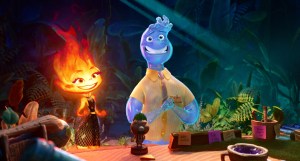 While the core relationships are poignant and winning, the world building and metaphorical allegories feel half-finished and a tad confusing. The movie also goes surprisingly soft exploring its miscegenation metaphor of two elements being forbidden to mix romantically. This universe has four communities of living elements, though air is represented as clouds and those are, literally, water vapor, and the xenophobia and discrimination that the fire people endure feels like a direct parallel to a disadvantaged minority group. However, this isn’t explored in any satisfying depth. We’re told that fire people aren’t really wanted in the city, and the city isn’t really built for them, which is typified by a rail line that splashes water discharge. There’s a lot more that could have gone into this including a more elaborate examination of the harm of red-lining and restricting the economic mobility of one group for bigoted reasons (I know, I can already hear people scolding me for even asking for such socio-political commentary in a family film). However, this metaphor gets a little murky when you take into account the literal danger that living fire exudes. Yes, you can drown, and you can get crushed under earth, but these creatures aren’t walking incendiary devices. This doesn’t translate directly to people, and thus applying class metaphors to actual races can be circumspect. Ember’s worry is that she’ll explode if she gets too angry, and this causes literal physical destruction around her. You can say it’s meant to represent when hurt, angry people lash out that they can inadvertently harm others, but not everyone can incinerate a block because they lose their temper. This kind of undercuts the lesson on misplaced fear.
Also, so much of the external story consists of bad public planning and everyone’s lackadaisical attitude toward fixing this infrastructure miscue. Again, if the larger point was a society that is actively hostile to the fire people, then the ignorant city planning that actively harms a disenfranchised group of people makes sense, but without that larger underlying conflict, it all seems so strangely forgotten. Much of this conflict is on the structure of a wall against a coming buildup of water, something possibly deadly to the fire community, so you would think this community would be a lot more concerned about this looming conflict. You might think that others would organize to provide better safeguards or maybe they would get the city’s attention. That this threat goes unreported and is played at such low stakes makes it all feel forced and manufactured. If the characters don’t seem to think it’s a big deal, then who are we to worry as well? And I can hear some of you trying to branch this out into, say, a metaphor for larger problems that go ignored, like climate change or societal inequalities, but that’s giving Elemental too much credit.
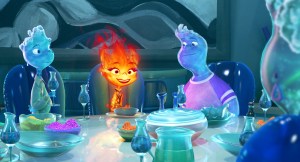 Elemental reminds me of 2020’s Onward, coincidentally one of the last movies I saw in theaters before the pandemic shutdown. I was worried that the core story looked weak but it was actually the world-building that was a bit hazy and under-developed and the emotional core was strong and authentic. It’s the same with Elemental, and while I can quibble about its dropped potential and misshapen world, it has a strong foundation that matters more. The relationships between Wade and Ember and Ember and her family are what makes the movie work and ultimately what made me smile and tear up. It’s an emotional nourishment that makes the movie feel satisfying and worthwhile no matter the lingering questions for this bizarre world. It’s also one of Pixar’s best looking movies, fully deserving of being seen on a large screen for added impact. Elemental has the right DNA for a charming and enjoyable family film for everyone.
Nate’s Grade: B
Share this:

The Little Mermaid (2023)

With every new Disney live-action remake, and we’re not slowing down any time soon folks, I feel like I need to stipulate two reservations I have, so, dear reader, here is my boilerplate. First, I believe that simply because a film is animated does not mean it is missing something or somehow inferior to a live-action movie. Animation is a showcase of imagination and ingenuity and visual decadence, and often the live-action interpretations of this only serve to dilute and downgrade the quality of those presentations. I can’t believe the recently announced live-action Moana will add anything more magical or visually beautiful than the 2016 animated original. Second, the closer these original animated movies are to the present, the less likely that Disney will be to change things up. The core audience will be demanding fidelity to the source material, and thus we usually just get an inferior version of the same story with minimal alterations. Occasionally, Disney can really surprise with some of these live-action remakes; I adored Pete’s Dragon, was charmed by Cinderella, and will defend Tim Burton’s unfairly maligned Dumbo.
Now we reach The Little Mermaid, whose 1989 release began the much-heralded resurgence of Disney animation through the 1990s. I re-watched the original a couple years ago and found it still quite ebullient and compelling, but I was shocked at how short it was (only 80 minutes long) and how brisk much of its third act felt. With a few more old-fashioned wrinkles to iron out like gender roles and the prominence of securing a man, I felt there was actual room where a modern remake could actually improve upon the original. Having seen the live-action Little Mermaid, I can say that it falls into a middle zone where it can’t quite escape the shadow of its predecessor but it exhibits plenty of its own winning qualities to cheer audiences and fans of the original.
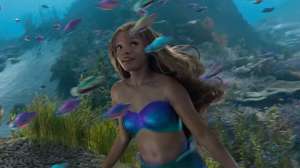
Ariel (Halle Bailey, not to be confused with Halle Berry) is a teenage mermaid and the youngest daughter of King Triton (Javier Bardem), the ruler of the seas. She longs to be part of the surface world, the world of man, and she’s willing to sacrifice her voice to her malevolent Aunt Ursula (Melissa McCarthy) for a pair of legs. She has three days to secure true love’s kiss, likely from Prince Eric (Jonah Hauer-King), but she can’t recall what she needs to do as part of Ursula’s spell. Her friends Sebastian (Daveed Diggs) the crab, Scuttle (Awkwafina) the gannet, and Flounder (Jacob Temblay) the fish must help protect and guide the new Ariel-with-legs.
Let’s start with the positive attributes that separate this Little Mermaid, and chief among them is the fantastic lead performance from Bailey (one half of the singing sisters Chloe x Halle). This is a star-making turn from this young woman who completely makes the role her own. She has a natural grace, curiosity, and charm to her Ariel, and when she gets her chance to belt the big musical numbers, she delivers a stirring rendition. I got tingles during different parts of “Part of Your World.” A good half of the movie takes place after her Faustian bargain, so Bailey is acting without her voice and she still is able to communicate so much through her physical performance as well as her facial expressions. The filmmakers decide to give Ariel several new songs through the guise of internal monologues where she can express all that she is feeling and thinking during her fish-out-of-water adjustments. I think it’s a smart move and while none of these new songs are particularly memorable, giving Bailey more opportunity to flex her own voice, both literally and thematically to express her character’s perspective, is a good creative choice.

I also was pleased that much of the added time, which amounts to almost a full hour of material, is devoted to fleshing out Eric and the development of the romance with Ariel. Rather than simply being a handsome himbo, this Eric is an adopted son of his island nation, and he feels more at home aboard a ship than in any royal ceremony. There’s a direct parallel with Ariel and Eric rejecting their predetermined roles under the pressure of royal expectations. This Eric even gets his own version of a “Part of Your World” ditty about dreaming for something more, especially after his chance encounter with a mermaid set his world afire. It’s not a particularly great song, as none of the new additions are on par with the Oscar-winning originals, and some of the lyrics made my wife physically cringe next to me in the theater (“Strange as a dream/ Real as the sea/ If you can hear me now/ Come set me free”). There is added time where the romance feels much more organic as we witness Ariel and Eric get to know one another and watch one another come alive and share their interests. The added curse of Ariel forgetting her end goal of true love’s kiss is an intelligent way to make the romantic feelings between them feel more believable and less the byproduct of her urgency and the manipulation of her friends. The added rom-com moments give more credence to their romance and it better reflects on both members.
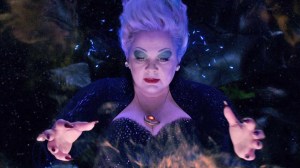
McCarthy (Thunder Force) acquits herself very well as the villainous sea witch. She puts her own spin on Pat Carrol’s famous vocal performance from the original, making her Ursula the seething also-ran waiting on the sidelines and nursing old grudges. The added back-story makes Ursula Ariel’s aunt now, which adds an extra degree of menace to their transactional bargain. I was also reminded how little Ursula is in this movie until it counts, so to justify her continuing presence, we have a few check-ins where she basically monologues her thoughts on the action. It feels like padding but I didn’t mind because I got to spend more time with McCarthy.
And now, dear reader, let’s go through some of the adaptation changes that aren’t quite as charming or beneficial. The colorful realm of the sea feels rather limited in this rendition. The vastness of the ocean and its mermaid kingdom feels strangely contained, and that’s a result of the reality of filming on a large empty set as well as the cost of extensive special effects. This is another case where the beauty and imagination of animation proves incomparable. The differing versions of “Under the Sea” really magnify this. Along those lines, making Ariel’s aquatic friends photo realistic robs them of the personality and expression they exuded in the animated movie, and it also drags them into an uncomfortable uncanny valley. Stop robbing characters of expression for the sake of added biological “realism.” It’s a bad trade. Stop it, Disney. Watching a photo realistic Flounder flop around on dry land while he tries to cheer Ariel on with his expressionless might-as-well-be-dead fish eye is not as whimsical as it should be. The original voice of Sebastian, Samuel E. Wright, has a small cameo as a fisherman, and it’s nice to hear his familiar voice again, especially knowing the actor sadly passed away in May 2021.
I’ve already discussed the new songs by Lin-Manuel Miranda being mostly agreeable but unremarkable, but there is one new track that stands out for all the wrong reasons. Being a Miranda musical, it’s not unexpected for the inclusion of a new hip-hop-infused song, especially with his Tony-winning Hamilton co-star in the movie. What is surprising is that Daveed Diggs doesn’t get the bulk of the new rap song but instead it’s Awkwafina, and her voice at these levels of gravely intensity feels like an aural assault. I was wincing throughout the song “Scuttlebutt” and kept wondering why Diggs wasn’t the star considering he handled the most linguistically complex flows in Hamilton. I even enjoy Awkwafina as a vocal artist but this song is painful to endure.
The 2023 live-action Little Mermaid has enough positive additions that fans of the 1989 original will likely enjoy while still checking the boxes of their own nostalgia requirements. Bailey is sensational and the added time for the romance to be more organic and believable, with some extra fleshing out supporting characters like the Queen and Grimsby also allowing the world to feel more textured and less archetypal. The visuals aren’t as murky as I feared but the magical world of this hidden undersea realm definitely feels lacking. The pacing is a bit sluggish too, as we don’t even get our deal with Ursula until an hour into the movie, and the added songs fail to compete with the classics even with the artistic prowess of Miranda. I don’t know if it needed to be this long, and I certainly don’t care for the photo realism approach, but I was smiling throughout the movie and found it charming. Consider this mid-tier Disney live-action scale, a remake with enough of its own to swim with the weight of expectations.
Nate’s Grade: B
Share this:

The Super Mario Bros. Movie (2023)
 Colorful and eminently pleasant, The Super Mario Bros. Movie is about everything you would expect from an Illumination project. To begin with, there’s not a lot of story in the 30-plus years of Mario video games, so it’s not surprising that the story is kept relatively familiar with characters each inhabiting simple motivation (Mario wants to impress his dad, Luigi wants to be brave, Peach wants to protect her people, Bowser wants to be accepted by his unrequited love). Much of the movie is establishing a new location and giving some moment of fan service before moving on, like an extensive Mario Kart Rainbow Road sequence or Mario meeting Donkey Kong. It feels like the risk-averse creative process started with a list of characters, levels, and references and then how to squeeze them in. This is a movie kept at a kiddie level, which is fine even for adults to enjoy, but it means there is a lowered ceiling of ambition (so… many…. needle-drop song selections…). Much of the movie is fleeting and fine, with highlights including Jack Black’s performance as the love-struck Bowser, the training sequences making use of the bizarre physics and accoutrements of the Mushroom Kingdom, and a delightfully nihilistic little blue star with a cheery child’s voice. The movie is earnest to the point of being a little corny, which might be refreshing for parents and children used to a recent slate of overly glib kid’s movies trying to act smarter than they are. This movie is cute and harmless and a sugar rush to be forgotten after it wears off. Now re-watch the 1993 version that attempted to take the same source material and make a parallel world Blade Runner with Dennis Hopper as King Koopa. There’s also one hundred percent less Chris Pratt.
Nate’s Grade: B-
Share this:

Peter Pan & Wendy (2023)
 I’m not a big fan of the Peter Pan story. I think it has some meaty themes but the world of Neverland was never that interesting and I always found the characters to be more annoying and flimsy than enchanting and diverting. It also doesn’t help that there have been dozens and dozens of Pan adaptations; by existing in the public domain, one is guaranteed every few years, like 2015’s disastrous Pan by director Joe Wright (Cyrano) and 2020’s Wendy, the long-awaited follow-up from director Benh Zeitlin (Beasts of the Southern Wild). The only aspect that had me even remotely intrigued in Disney’s new live-action version was the creative team behind it. Director/co-writer David Lowery is better known for sumptuous and deeply humanist indies like The Green Knight and Ain’t Them Body Saints, plus having Rooney Mara eat an entire pie for ten minutes of A Ghost Story (thus fulfilling my requirement to mention this baffling moment whenever the opportunity arises). He also happened to make the 2016 live-action remake for Pete’s Dragon, which was soulful and heartwarming and excellent. It’s in fact my favorite of all the recent Disney remakes and proof of what great artists can do when given enough creative latitude, from the parent studio as well as general audiences and their expectations. I think the overriding Disney demands won out, as Peter Pan & Wendy is a rather bland update that every so often gives a glimpse of a more introspective, thoughtful, and possibly better Pan.
You probably know the story already, as we follow the Darling children from their home in London all the way to the magical fantasy island of Neverland thanks to immortal child and would-be lovable scamp, Peter Pan (Alexander Molony). The kids can forever be kids on adventures with the fellow Lost Boys, battling against pirates led by Captain Hook (Jude Law). Except Wendy (Ever Anderson) starts to wonder whether growing up might be a necessity.
 Considering the original Disney animated movie was released in the 1950s, there have been more than a few updates to modernize this tale, which have predictably riled the easily triggered culture warriors always looking for their next outrage. The offensive minority representation has obviously been altered, with actual indigenous actors portraying indigenous roles (no Rooney Mara as Tiger Lily in this go-round), and we have a brown-skinned Peter and Tinkerbell (Yara Shahidi), and the Lost Boys includes girls too in a throwaway explanation that’s entirely credible. Wendy also gets more empowered and has much more influence in the end events. I cannot understand the mentality of anyone that gets this upset over the skin color of fictional characters when it doesn’t alter the story. Who cares what the race of the actress playing Tinkerbell is, she’s a fairy. Why can’t there be darker-skinned fairies, hobbits, and mermaids? There are some exceptions; if Superman was played by a black actor, the world would view this overpowered alien in a completely different light, and that demands to be explored. However, most stories in a fantasy or sci-fi setting are not dependent on specific ethnicity, so why care? Of course, when the Tinkerbell character is such a waste, used solely for wordless reaction shots, it doesn’t matter what the race of the actress is when the character is this inconsequential.
One change I did like was bringing more of a personal fidelity between Peter and Captain Hook, beginning as close friends before falling out. The role of Hook has usually been modeled as an analogue for the Darling’s disapproving father and played by the same actor for the obvious parallels (in this iteration, Alan Tudyk). With Lowery’s version, Hook began as simply James, a Lost Boy who was Peter’s BFF until James started to miss his mother. This cherishing of the past rather than out-rightly rejecting it caused a wedge between the two friends, and James returned home only to eventually return back to Neverland as a grown man. I don’t know if the adult James was seeking out the comfort of his old friend and the familiar or if he was seeking out Peter for the sake of vengeance, blaming him for the years of time he lost and missing the death of his mother. Perhaps Peter’s harsh rejection of his grieving friend sent him into a tailspin. This painful past, when it starts to break through the cracks of family spectacle, can be captivating. Characters who are unable to articulate their loss but they feel it, as if there’s something just below the surface that they know isn’t right in all these redundant clashes. Can these characters even die? There are several that come back from certain demise. There are exchanges where Peter and Hook feel like they’re on auto-pilot, mechanically giving into the demands of a universe keeping its players in tidy and conforming roles. There’s a slight danger when the movie hits these little bumps, like characters becoming aware of more than what they’re used to. It’s like they’re breaking free of the Matrix to briefly realize how they’re being manipulated by fate before succumbing back to it.
 These occasional philosophical glimpses are what kept me going, hoping that somehow the movie would rise above its familiarity into something different and more exciting. I don’t mean adult or darker, though there are clear horror routes one could take with the story of Peter Pan. Pete’s Dragon wasn’t a particularly complex story by any means but it channeled a clear and heartfelt tone and vision, and was executed at a high level to be appealing to all ages. I was hoping for something the same here, but the muck of the Peter Pan expectations ultimately gets the best of Lowery and his team. I liked the idea that Wendy may not be the first Wendy to be lured to Neverland to be the house mother for these wayward children. I liked the idea that Peter Pan could be the real villain of this realm, holding children hostage more or less through their rejection of growing up, and how resentful and remorseful that can make someone when they are cut out of their former life. I liked the idea of James/Hook possibly maybe even being a distant relative of the Darlings and what that could do for their relationship and perspectives meeting. I liked the idea of characters falling into patterns but not able to comprehend why they’re being manipulated. There’s a more penetrating movie here just on the peripheral and it pokes through but only occasionally. It’s frustrating to watch because it feels like uncovering artifacts of an older, more arresting screenplay that has, over the course of numerous rewrites and studio intervention, been diluted. The Peter Pan movie we get in 2023 is fine with some diverting visuals, but it’s a shadow of what could have been had Lowery been allowed to explore more of his creative impulses.
The movie is not without its charms and beauty, and for 106 minutes you can watch it without investing too much of your emotions. Law (Fantastic Beasts) is easily the best part of the movie, really enjoying the snarl of his over-the-top villain but finding opportunities for nuance to showcase his lingering vulnerabilities. Hook comes across like a bigger kid hurt and lashing out, and there’s tragedy to that that Law is able to tap while also playing into the foppish and slapstick comedy. I adored Jim Gaffigan (Linoleum) as Smee and was amused that he becomes the moral center for the pirates, speaking out when he fears they’re crossing a line. The natural scenery has a luscious storybook quality to it, and the mossy ruins made me think of Lowery’s Green Knight and its many visual pleasures. I enjoyed the presentation and physics of a below deck sword fight while the ship is rotating in the air. It made me think of Inception’s famous gravity-defying hallway fight, in a good way. I enjoyed how active the cinematography was, swooping and swirling with the energy of a child radically at play, and the montages of characters feeling the full power of happy memories had a downright ethereal quality of demonstrating a fuller life.
 If you’re hungry for a live-action Peter Pan movie, then try the 2003 version with a deliciously maniacal Jason Isaacs (Mass) as Captain Hook. If you’re looking for a Peter Pan that goes beyond the bounds of the same old story, try Steven Spielberg’s Hook, a touchstone of many Millennial childhoods. Or check out the 1922 silent era Peter Pan. There is no shortage of Pan adaptations to choose from, so there’s a Pan for every occasion, and I’m sure there will be fans of this new live-action update as well. I found it a little too bland. It’s certainly better than the recent Pinocchio, but that itself is not reason enough to watch this. Peter Pan & Wendy offers too little to distinguish it from its predecessors, so it becomes yet another Pan adaptation that fails to fully take flight.
Nate’s Grade: C+
Share this:

Dungeons & Dragons: Honor Among Thieves (2023)
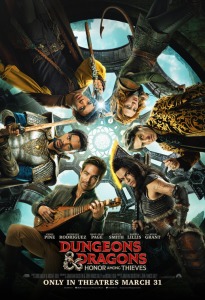 As required for every film critic before discussing the new Dungeons and Dragons movie, subtitled Honor Among Thieves, I must tell you my personal history with the seminal tabletop game. Well, I don’t think D&D is for me. Many of my friends are heavily involved in D&D, several as the quest-fashioning dungeon masters, and I’ve even sat in for a few games, but there’s something about the group improv experience that I never feel comfortable while playing, like my mind just runs into imagination roadblocks trying to come up with options in a near limitless space. Plus I think character creation is one of my lesser storytelling skills; I typically build characters more out of plot and concept and theme. Also, the demanding time commitment to play a game that can take possibly months or years to conclude makes me hesitant. I already think Monopoly lasts too long and has a habit of ruining friendships (if I was ever paid to write a Monopoly movie, that would be my starting point, not bringing to life Mr. Moneybags).
Anyway, D&D has had something of a cultural renaissance the last decade, reaching new levels of wider acceptance partly thanks to its prominent placement in Stranger Things. Pretty good for an ever-evolving 50-year-old game system that was at one point blamed for luring impressionable youth into the ways of Satanism and insanity (see the ridiculous 1982 movie Mazes and Monsters starring a young Tom Hanks as a student who cannot distinguish between reality and the game world to murderous effect). It’s such a substantial fantasy property that it was only a matter of time for movies to follow. There was an abysmal D&D movie from 2000 co-starring Thora Birch and a go-for-broke Jeremy Irons that isn’t worth your time. I wasn’t excited for a new Dungeons and Dragons movie until I saw that its directors and co-writers were Jonathan Goldstein and John Francis Daley. I was a big fan of 2018’s Game Night, their last directing effort, and they’ve been a dependable comedic writing duo. It was with them that I placed my faith and that faith was fully rewarded when my wife and I watched Honor Among Thieves and had a delightful time. This is a wildly fun D&D movie for every viewer.
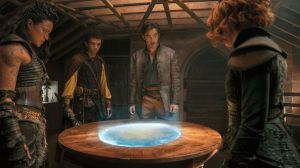 In the world of owl bears and sorcerers, Edgin (Chris Pine) and his trusted partner, Holga (Michelle Rodriguez), are looking to settle the score. They’ve broken out of prison and are trying to gather their old team back together but everyone has a grudge. Forge (Hugh Grant) has betrayed the group for power and especially riches, serving as the city’s reigning lord. He’s recommissioned a gathering of games and sport, drawing crowds back to the city, and with games comes betting and with betting come large sums of money from the rich. Edgin plans to rob from the treasure hold for the games and with that score he can regain his daughter and possibly reclaim a magical totem that can bring his dearly departed wife back.
I have no prior understanding of anything relating to the world and lore of D&D, and I found it to be extremely accessible and engaging. That’s because Goldstein and Daley have put the emphasis of their movie not on its lore or history or locations but on its characters. I appreciate that here is a major work of IP for a studio that is attempting to tell one very good and accessible story for the masses rather than set up a cinematic universe and ready it for possible sequel bait. Get the movie right and have that make me desire more movies rather than establishing a world that has potential but otherwise goes unfulfilled. The very concept of Honor Among Thieves helps to keep things light-hearted and moving. My pal Ben Bailey and I have been clamoring for years for a heist movie set within a fantasy world. It was ready-made to satisfy with the genre structure of heists, and putting a team together that rolls with unexpected adversity, and the cleverness of incorporating fantasy abilities and elements into heist genre familiarities. Thankfully, Goldstein and Daley realized how entertainingly plentiful this combo can prove.
The fun characters are what help to make the movie so enchanting. Rather than settling on a subsection of class representation (one dwarf, one elf, one wizard, etc.), the characters are more about what they bring to the team and what motivates them for character arcs. We have a shapeshifter (Sophia Lillis) who is trying to protect the kingdom’s encroachment on her kind. We have a shaky wizard (Justice Smith) who is battling for his own self-confidence and respect. Nobody feels like a token appointment. Even characters that would seem like a D&D player’s dream, a powerful paladin played by the dashing Rege-Jean Page (Bridgerton), are given more purpose. He serves as a contrast to our hero’s journey back to respectability, and the character is so noble and serious that it’s yet another shade of comedy to explore. His obliviousness to irony and sarcasm reminded me of the very literal-minded Drax (Guardians of the Galaxy). This is a character that would appear in standard fantasy epics, and yet he’s played for laughs just through sheer juxtaposition without ever mocking the reality of this world. At no point will characters condescend to their reality, saying self-aware critiques like, “Well that’s a very inconvenient and stupid place to put a castle,” etc. There is a cameo where the gag is that this person is much smaller. The appearance is played for goofy laughs and yet it’s also shocking in its emotional sincerity. If you removed the size differential, this would be a dramatic and eventful scene (I did enjoy the unspoken preference of this individual when it comes to a romantic partner). The movie is very funny and very skilled at being funny without reliance upon meta genre riffs.
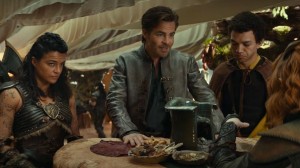 Elevating an already great movie, Pine (Don’t Worry Darling) is robustly charming as a bard/secret agent. He secured my loyalty within two minutes of the movie when he gave up on his prison knitting project and said, summarily, “I’m just gonna make a mitten. Who am I trying to impress?” Pine has long been one of our most effortlessly charming leading men, and playing a rakish heist leader who also sings will only magnify the man’s innate appeal to the masses. He works even better alongside Rodriguez (any Fast and Furious movie after 6) who becomes the real physical presence. This is a career-best performance with Rodriguez sliding right into exactly the comedy wavelength she’s needed for – the gruff and cynical worldview of the weary warrior. They make for a great bantering lead duo.
The set pieces are also tailored to the character arcs while still being memorable and entertaining. This is a movie that doesn’t get complacent over its 134 minutes. Each sequence must stand out, whether it’s because of creative and intuitive fight choreography that makes keen use of geography and circumstance, or a graveyard Q&A with very constrained magical rules to follow that leads to a lot of digging to find the right corpse with the right information, or escaping from an obese dragon (with its “widdle wings”) that resembles a chonky cat, or a dangerous trip through a maze that abruptly reconfigures itself, or a prison escape that doesn’t quite go as you expect, nor at the characters expect. Every scene has a purpose. Every magical item has a specific use, and every set piece sets itself apart visually and from a story standpoint.
Goldstein and Daley have excelled as writers, but they’re also proving to be visually adept directors. With the emphasis on characters, it’s not CGI spectacle for spectacle’s sake. There’s a pleasing physicality to this world. The budget is in the $150-million range, which is quite a show of confidence for the directors, but the emphasis is on what best elevates the moment. There’s a thrilling escape performed as a tracking shot with a zooming camera tracing the escape of our shapeshifter from harm, and there’s fantastic visual inventiveness with a magic portal and its application for the film’s equivalent of a rollicking stagecoach robbery. There’s a noted intention here with the shots and scenes and visual arrangements, so Honor Among Thieves feels like a studio film with vision.
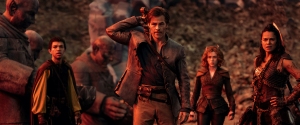 Allow me to take one very fleeting moment to digress just how much care Goldstein and Daley put into even the smallest of details. After we’ve met the last core member of our crew, he confidently leans backwards and falls into a pit leading to an underground cavern. The rest of the crew creep toward the opening and stare down below with trepidation. Simon then says, “I’m going last.” We then cut to the group at the bottom of the cavern. It’s such a small detail, but the previous scene ends on a character-appropriate punchline for Simon reconfirming his squeamishness, but then by transitioning to the entire collected crew together, we know he was last and so we’re ready to move forward. Again, it’s a small detail but it’s a microscopic example that proves, to me, how much thought and care the directors have given.
As a novice to the famous role-playing world, I found Dungeons & Dragons: Honor Among Thieves to be an exhilarating and highly entertaining fantasy adventure where fun is the chief priority. It’s not at the expense of great characters, good humor, and satisfying payoffs with well-developed setups strewn throughout. It’s a reminder how enjoyable and escapist blockbusters can be when you have the right artists using the expansive box of paints. It’s great for all ages and families too. I don’t have any personal connection to this sword-and-sorcery universe but now I want many more adventures if this is kind of quality they’re offering.
Nate’s Grade: A-
Share this:

Shazam! Fury of the Gods (2023)
 I enjoyed 2019’s Shazam! because it felt like a breath of fresh air, a lighter story compared to the relentless gloom and doom of the DCU. It was more a silly Big-style body swap movie than a super hero romp, tapping into childhood wish fulfillment of getting to transform not just as an adult but as a super-powered adult on a whim. It was funny, sweet, and different. The 2023 sequel, Shazam! Fury of the Gods, feels like the definition of a sequel for the sake of a sequel. It is thoroughly mediocre and lacking the charm and heart of the original. I’ll try and deduce why this super-charged sequel feels so lacking and why the fun feels so forced.
Billy Batson (Asher Angel) can turn into Shazam (Zachary Levi) by uttering the magic name, and now his foster family share his same super abilities. They’re trying to adjust back to “normal life” when the Daughters of Atlas, Hespera (Helen Mirren) and Kalypso (Luicy Lui), arrive with a vengeance. Turns out Shazam’s powers were stolen from the Greek gods, and now they want them back, and if they don’t reclaim their power, the gods will destroy the world of man.
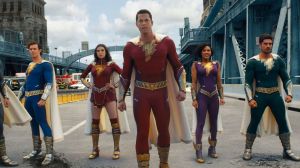 I think one of the most lacking elements of Fury of the Gods is that it loses its core appeal. The first movie was about a child fulfilling their adult dreams and leaping into maturity before their time. Levi (Apollo 10 1/2) was goofy and enjoyable in his broadly comical fish-out-of-water portrayal as a kid in an adult’s body. Now, the growing pains of being an adult, and a superhero, have been eclipsed. In fact, the amount of time we spend with Billy is pretty sparing. It’s all Shazam all the time, and this hurts presenting a worthwhile contrast between the mythic and the recognizably human. You forget the initial dynamic of this kid pretending to be an adult and what advantages this affords. At this point, being an adult is the same as being Billy Batson, who is approaching 18 and will age out of the foster system. This reality creates an existential crisis for Billy, as he’s afraid his family will move on so he’s eager to keep them together all the time, trying to maintain control. It’s about fear of change; however, I never fully understood why Billy was so worried. He’s already found a home with a loving mother, father, and extended clan of siblings, so why does aging out matter? He’s not going to be removed from his home. His siblings also aren’t talking about shipping out to the different corners of the world to begin careers or higher education. It’s a forced conflict to make the character uneasy about growing up. If the first movie was about a kid coming to terms with himself and letting others in, then this movie is all about a kid worrying his relationships will arbitrarily evaporate. This anxiety over losing something meaningful could have been an interesting storyline, but it’s all so contrived, and the whole body swap dynamic, the selling point of the first film, feels strangely absent.
Likewise, the villains have questionable motivation and character development. The movie begins with cloaked and masked figures wreaking havoc in a museum, and then it makes a big deal that these figures happen to be… women (also middle-aged and older at that). The opening is meant to be surprising in a way that feels out of date (what… g-g-girls can be powerful too?). It’s a strange point considering we’ve already had Wonder Woman. This same easily-satisfied, lowest common denominator plotting is disappointingly prevalent. These powerful gods want their father’s powers back but they already seem pretty powerful, so the movie lacks a fitting explanation of why these extra powers are worth all this effort. I suppose there’s a general revenge and righting of wrongs but the characters don’t play their parts too scorned. They’re more annoyed and tired, which doesn’t make for the most compelling villains. Another Daughter of Atlas has the power to mix and match the world like a volatile Rubix cube, but what is this power? It’s virtual obstacle-making but it feels arbitrary too in the world of superpowers. The ultimate scheme to conquer the world is as flimsy as the reasons it’s ultimately defeated.
 Let me dissect that part for a few words, the solutions to overcoming our vengeful gods. They raise an army of mythical creatures to destroy Philadelphia and it’s Ray Harryhausen character designs with cyclops and unicorns and the like. The way to reach through to the monsters and bring them on your side is to offer them a gift of “ambrosia,” some tasteful bounty that they can’t help but fall in love with. So what is the solution to this? One of the kids literally drops a handful of Skittles onto the street and the unicorn happily snarfs them down. Yes, through the power of Skittles-brand candy the heroes are able to save the day. There’s even a moment where the kid is riding the unicorns into battle and screams, “Taste the rainbow,” before the movie cheekily cuts her off before she can unleash an added “MF-er.” What is this? I’m usually agnostic on product placement in movies; characters have to eat and drink, etc. But when it’s egregiously transparent and played as the key to victory against all odds, that’s a bit much. If the joke is that contemporary food is a blast of flavor that nobody would have been prepared for thousands of years ago with their palettes, then any modern food could have worked. It didn’t have to be a brand-name candy with its brand-name slogan screamed in battle. This is but the first of several contrived and unsatisfying deus ex machina solutions that erase consequences.
Even with returning director David F. Sandberg (Lights Out), the enterprise feels like an empty retread relying too much on rote spectacle and missing the heart and perspective of its predecessor. There is an action sequence atop a collapsing suspension bridge and the song “Holding Out for a Hero” plays, and then we have a character comment on it, and it all seems like a desperate attempt to add some energy or style or fun to the sequence that is absent. The action relies on a lot of watching characters zip pedestrians to safety, but it’s the end result we see, not the whoosh and flurry of the arduous mission. The whole sequence feels like it’s going through the motions, as much of the movie does, falling back on a formula of superhero blockbuster autopilot. The CGI army of villains, the face-offs between characters shooting magic beams at one another, the overly quippy and tiresome dialogue and mugging cranked up to overdrive, the world-saving stakes feeling so minor. I was longing for some of the ’80s Amblin tone of the original, which got surprisingly dark. With Fury of the Gods, everything feels so safe and settled, with the stakes feeling inauthentic and the action reinforcing this with effects sequences that feel like Saturday morning cartoon filler.
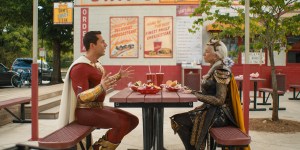 There’s a strange question with the family powers. The extended brothers and sisters can utter “Shazam” and turn into adult alter egos, but the character of Mary (Grace Caroline Currey, Fall) now transforms into a super suited version of herself with slightly different hair. In 2019, she transformed into actress Michelle Borth (Hawaii 5-0). Mary is the oldest sibling, and we’ve undergone a time jump of years to account for the ages of the kid actors, so does this mean that as the kids get older they will just turn into versions of themselves? Does this mean that the Zachary Levi-persona is set to expire once Billy turns legally an adult at 18? The implications of this casting choice made me question the very reality of the Shazam universe’s mechanics.
I can see certain audiences enjoying the slapstick and gee-whiz goofiness of Shazam! Fury of the Gods, and I have no doubt that the people making the movie wanted to tap into that childlike wonder of magic and myth. The problem is that this feels like the most inessential of the dozen DCU movies, going through the motions rather than exploring cogent and potent drama. Just take the character of Pedro (Jovan Armand) who is unhappy with his larger body and transforms into a handsome, slim, musclebound version of himself as a fantasy. That’s an interesting psychological exploration for the character, on top of his own self acceptance on a whole other front. Or take the sidekick from the first movie, Freddy (Jack Dylan Grazer), and his Romeo and Juliet-esque romance of a super-powered being from the other side of the conflict. There’s some drama there as well as his understanding of who the good and bad guys can be. Or simply take the perspectives of the parents trying to raise a household of kids who can transform at whim and what worries and joys this can offer. There’s material here to be finely explored, fun dynamics going beyond just repeating the Big-style body swap hi-jinks. Unfortunately, this is a sequel that feels like what made the original special has been replaced by blockbuster status quo.
Nate’s Grade: C


You must be logged in to post a comment.