Blog Archives
The Drama (2026)
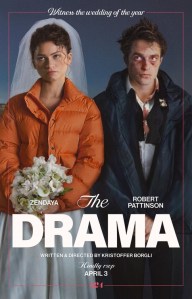 A provocative cringe-comedy with some pointed questions about how well you can ever truly know a person, what we can forgive, and the challenges to confront our pasts. The Drama is about an engaged couple, Emma and Charles (Zendaya, Robert Pattinson), preparing for their big day. During a night of drinking with their maid of honor and best man, who happen to be married, the couples confess the worst thing they’ve ever done. Everyone is laughing until Emma reveals (I’m going to spoil her secret because: 1) it’s early in Act One of the film, 2) it’s essential to better understand the movie’s drama, 3) people deserve to know who otherwise would have no interest because of it) that as a teenage victim of bullying she had planned a mass shooting that she never went through with after a peer died in a different shooting. Charles is trying to square his view of Emma before and after this revelation, scrambling for context and rationalization while haunted by questions over whether these thoughts might resurface. I’m glad that writer/director Kristoffer Borgli (Dream Scenario) didn’t just assign Emma some feat of sexual exploration that made Charles feel emasculated and insecure. That would be too easy and expected. The mass shooting plot is so much more to reckon with, complicated by the fact that Emma declined to make it happen and even became a fierce advocate against gun violence, finding a community in her school that she lacked before. There’s not much in the way of larger commentary specifically relating to mass shootings or gun culture in America, which is a shame. Dream Scenario had some fantastic satire and commentary relating to celebrity, cancel culture, and ownership of identity. Most of The Drama is an awkward comedy of people trying to pretend everything is normal. It can make for great squirm-inducing giggles, like a couples photography session that never loosens up, or Charles trying to come up with analogies to explain his plight but having to keep adding additional context to get people to see things the way he wants. The end is a spectacular combination of misunderstandings and secrets coming to a head. Perhaps most surprising is that The Drama is measured not by human darkness and the capability of harm or self-delusion but in our capacity for hope and empathy. The concept of radical empathy is discussed, about accepting people for who they are and not who you wish they were, and Borgli challenges the viewer to reckon with our own judgements, biases, and limitations. Are we more than merely our worst moments? The Drama thinks so, and so do I.
Nate’s Grade: B+
Share this:

Kinds of Kindness (2024)
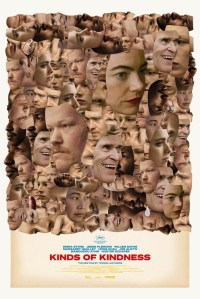 Yorgos Lanthimos might be one of the strangest filmmakers ever to fall into favor with the Oscars. Hot off the critical and commercial success of 2023’s Poor Things, we have a new Lanthimos joint not even six months later. This is a collaboration between his Greek co-writer from The Lobster and The Killing of a Sacred Deer, arguably the less “mainstream” Lanthimos movies. This movie is an anthology of three stories with the same actors playing different roles in each story. The problem is that I didn’t engage with any of the stories and found them long, meandering, and poorly paced. That Lanthimos specialty is a cracked-mirror version of the world, mixing the bizarre as if it were mundane, and it’s a trying tonal tightrope for most thespians to excel within that space. There just isn’t enough here, and each new story feels like starting over rather than fulfilling a conclusion. The prior Lanthimos movies had an interesting premise or turn of events that could sustain a whole movie; Kinds of Kindness doesn’t have stories that can sustain three vignettes. I can take weird, alienating, and challenging Lanthimos, as I’ve been a fan ever since his Dogtooth debut, but this is easily his weakest movie yet. The actors all do credible work having distaff conversations in, what appears like, people’s palatial homes and doctor offices. It’s hard to glean a larger theme, point of view, or even general entertainment value with this dull entry. It feels like Lanthimos and his collaborators had a couple free weekends, the use of some rich friends’ homes, and said, “Well, we’ll make it an anthology because then we don’t have to compose a full movie.” Instead of one disappointing movie, now you get three. Kinds of Kindness is, worst of all, mostly forgettable, and given Lanthimos’ track record, that really is the biggest sin possible.
Nate’s Grade: C
Share this:

Elemental (2023)
 The joke is how Pixar has taken its storytelling motif of examining The Secret Life Of [Blank] and showing what happens in our world when we just aren’t paying attention. We’ve had toys with emotions, bugs with emotions, fish with emotion, cars with emotion, robots with emotion, rats with emotion, and even emotions with emotions, so why not break things down to their basics and give the elements of carbon-based life their own emotions too?
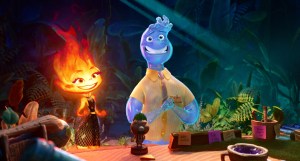
In Element City, Ember (voiced by Leah Lewis) belongs to the fire community living on the outskirts of town, as the big city wasn’t built for their kind. The earth people, and water people, and air people go about their business while the fire people form their own thriving offshoot. Her father and mother came across the sea to give their baby a new life, and the family shop will pass over to Ember’s management when her traditionalist father thinks she’s ready. Her whole life has been about serving her family and trying to live up to their hopes and dreams. This gets more complicated when Wade (voiced by Mamoudou Athie), a water person and a health inspector, has to report her family’s shop for code violations. They work together to save the shop and also learn from one another’s cultures and differing perspectives, and then this unexpected friendship becomes an even more unexpected romance, but can elements so different stay together?
 I was pleasantly surprised at how enjoyable Elemental is to experience and how wondrous its visual presentation is to watch. It is a certifiable treat for the eyes, with so many dazzling colors and quirky but easily readable character designs. There’s a mixture of hand-drawn animation used as Spider-Verse-style accents that provides a pleasing element that allows the images to pop even more. I was never bored looking at a single second of this movie, and even with my theater’s 3-D presentation, the glasses didn’t darken the screen and lessen my overall enjoyment. By existing within a fantasy universe, it allows for every scene and every location to better inform you about this new world and its rules and highlights (fire baby carriages that are barbecue grills). This is a bright, colorful, and supremely enchanting movie to watch because, at least visually, it feels very well developed as far as its world building and atmosphere. What would a community of fire people tend to look like? What would their jobs be? What would their celebrations be like? Their heritage from the Old Country? Naturally, with any fantasy universe, you can nit-pick it to death with questions, such as why do people even bother wearing clothes in this world? What part of the exposed fire or water is observed as obscene? How exactly do these different communities have their offspring? What does air exactly eat for food?
Where Elemental really takes off is with its charming and affecting romance. It’s been a while since romance was at the forefront for a Pixar movie, since 2008’s WALL-E (a.k.a. the greatest Pixar movie). Now there are themes and resonance that go beyond the romance and also enrich it, like Ember’s personal conflict of being a first-generation immigrant daughter and upholding the traditions and wishes of her family at the expense of her personal desires, but the core of this movie is on the burgeoning feelings between Ember and Wade. The movie begins with them butting heads as two elements seemingly in conflict but it doesn’t exactly follow an enemies-to-lovers path. She runs hot and explosive with trying to keep things under control whereas he is deeply empathetic of others and wants to help them become their best selves. He accepts who he is, and the movie doesn’t equate his full-bodied embrace of big feelings as some point of weakness. It brings about laughs from exaggeration, the streaming rivers that burst forth from his eyes upon crying, but it’s his compassion and acceptance that challenges Ember for the better and helps her assert her sense of self. They’re good together, and Wade helps serve as a guide to the wider world for Ember as she’s been isolated her whole life. Their interactions are cute and heartwarming and elevated by pleasant vocal performances. I was drawn into their story and cared about their well-being, enough that I don’t mind sharing that I shed some water myself by the end (I guess this could also make some people mistake that I peed my pants, and I assure you that was not the case, dear reader).
 While the core relationships are poignant and winning, the world building and metaphorical allegories feel half-finished and a tad confusing. The movie also goes surprisingly soft exploring its miscegenation metaphor of two elements being forbidden to mix romantically. This universe has four communities of living elements, though air is represented as clouds and those are, literally, water vapor, and the xenophobia and discrimination that the fire people endure feels like a direct parallel to a disadvantaged minority group. However, this isn’t explored in any satisfying depth. We’re told that fire people aren’t really wanted in the city, and the city isn’t really built for them, which is typified by a rail line that splashes water discharge. There’s a lot more that could have gone into this including a more elaborate examination of the harm of red-lining and restricting the economic mobility of one group for bigoted reasons (I know, I can already hear people scolding me for even asking for such socio-political commentary in a family film). However, this metaphor gets a little murky when you take into account the literal danger that living fire exudes. Yes, you can drown, and you can get crushed under earth, but these creatures aren’t walking incendiary devices. This doesn’t translate directly to people, and thus applying class metaphors to actual races can be circumspect. Ember’s worry is that she’ll explode if she gets too angry, and this causes literal physical destruction around her. You can say it’s meant to represent when hurt, angry people lash out that they can inadvertently harm others, but not everyone can incinerate a block because they lose their temper. This kind of undercuts the lesson on misplaced fear.
Also, so much of the external story consists of bad public planning and everyone’s lackadaisical attitude toward fixing this infrastructure miscue. Again, if the larger point was a society that is actively hostile to the fire people, then the ignorant city planning that actively harms a disenfranchised group of people makes sense, but without that larger underlying conflict, it all seems so strangely forgotten. Much of this conflict is on the structure of a wall against a coming buildup of water, something possibly deadly to the fire community, so you would think this community would be a lot more concerned about this looming conflict. You might think that others would organize to provide better safeguards or maybe they would get the city’s attention. That this threat goes unreported and is played at such low stakes makes it all feel forced and manufactured. If the characters don’t seem to think it’s a big deal, then who are we to worry as well? And I can hear some of you trying to branch this out into, say, a metaphor for larger problems that go ignored, like climate change or societal inequalities, but that’s giving Elemental too much credit.
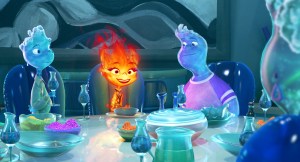 Elemental reminds me of 2020’s Onward, coincidentally one of the last movies I saw in theaters before the pandemic shutdown. I was worried that the core story looked weak but it was actually the world-building that was a bit hazy and under-developed and the emotional core was strong and authentic. It’s the same with Elemental, and while I can quibble about its dropped potential and misshapen world, it has a strong foundation that matters more. The relationships between Wade and Ember and Ember and her family are what makes the movie work and ultimately what made me smile and tear up. It’s an emotional nourishment that makes the movie feel satisfying and worthwhile no matter the lingering questions for this bizarre world. It’s also one of Pixar’s best looking movies, fully deserving of being seen on a large screen for added impact. Elemental has the right DNA for a charming and enjoyable family film for everyone.
Nate’s Grade: B
Share this:

Jurassic World: Dominion (2022)
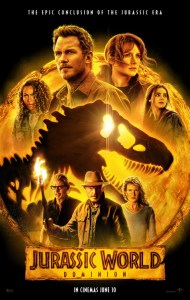 Jurassic World: Dominion has received, by far, the worst reviews and reception of the six-film franchise that has taught us the valuable life lesson that dinosaurs will eat people. Director Colin Trevorrow (Jurassic World) is back though he remained a screenwriter for the entire World trilogy along with Derek Connolly (Safety Not Guaranteed). It’s also bringing the band back together by including Sam Neill, Laura Dern, and Jeff Goldblum as their beloved original trilogy characters (there’s also B.D. Wong, again, if that does anything for ya). I’ve delayed seeing the movie because of my own sense of caution and resignation. Is it as bad as feared?
It’s years after dinosaurs have become reintegrated into the human world. Owen (Chris Pratt) and Claire (Bryce Dallas Howard) are living out West together with the clone girl from 2018’s Fallen Kingdom. He’s lassoing wild dinos and she’s breaking them out of illegal testing sites. The BioSyn CEO (modeled after Apple’s Tim Cook, here played by Campbell Scott) has big plans for… world domination? It’s actually unclear besides general profit. The evil businessman hires kidnappers to abscond with the little clone girl, the baby dinosaur to Blue, America’s favorite family-friendly raptor, and for good measure, he’s also unleashing swarms of killer locusts. Owen and Claire are hopping the world to find their missing family (Owen promises the raptor he will return her baby) and uncover yet another evil scheme from an evil rich person.
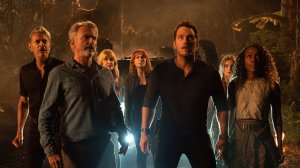 There is a lot going on with Jurassic World: Dominion and yet so little is happening, at least from an intellectual standpoint. This feels like three different movies inartly slammed together and it is overstuffed with subplots all competing for screen time, so every few minutes feels like a possible off-ramp for another episode of what the opening concept portends. The concept of a world where humans are forced to co-exist with dinosaurs is a genuinely exciting starting point, and it’s a Jurassic movie I would want to see, and I do… for a montage to open and close the movie. It’s a shame that the most interesting part of this movie, the global acclimation of creatures of an older millennium rejoining our ecosystem, is kept as literal background. I suppose by the end nature just took care of itself. Instead, the majority of the movie is split between two less engaging stories: giant locusts and a rich guy’s private dino enclosure. Yes, dear reader, you read that correctly. After five movies of dinosaurs in parks, where we begin with dinosaurs in the real world, it’s back to spending time in another glorified dino park, and would you believe that something goes wrong at this park too? Why even bother setting up an exciting premise if it’s abandoned so completely? The movie we do get is a lesson in diminished returns and accepting disappointment. This feels more like a giant locust movie for half, about a villainous corporation weaponizing genetically modified plagues to kill their competitors’ stock. It’s certainly something that seems plausible for a massive corporation, but what is this doing in my Jurassic World movie? Why did we need another blankly evil CEO, this time the guy who appeared in one scene in Jurassic Park, as if that mattered? Why do we need more extraneous characters taking away oxygen from the legacy characters returning especially when they seem too similar to the already established characters? Why should I care about three dinosaurs fighting at the end like I’m personally invested in any of these creatures? My sadness manifested watching this franchise descend into even more farcical dumb blockbuster nonsense.
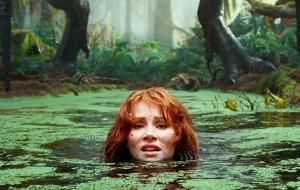
The best part of this movie might actually be its most ridiculous. There’s a mid-movie set piece where our heroes infiltrate an underground dinosaur fighting ring in Malta. That’s cool, and we’re introduced into new secondary villains we can enjoy get their just desserts once the dinosaurs inevitably get set loose. The lead trafficking lady says the raptors have been trained to kill anything that she shines a laser pointer on, which was also introduced in the last film. She targets Claire and then it becomes a foot chase between Claire and a determined raptor. It’s a silly excuse for a chase but it has an extra sense of urgency. It’s also completely ridiculous and ridiculously fun. Claire transforms immediately into Jason Bourne and is leaping from rooftop to rooftop and crashing through windows. Owen is riding a motorcycle through the narrow streets while being chased himself. It’s all action movie pablum and it works for what it is in the moment. Treverrow’s action set pieces have some moments that pop, especially Claire cautiously slipping into a pond to escape a supposedly blind dinosaur. There are even dinosaurs with feathers now. Alas, the movie can only work as dumb fun for so long before it just becomes infinitely more of the latter.
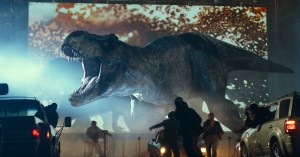 There are so many moments on repeat here that Dominion feels like it’s stitched together like another genetically modified dinosaur clumsily patched with parts of the franchise’s past. Oh, and you better believe we’re going three movies in a row with a new genetically-modified super monster to better sell toys (at least this one isn’t stated as being part raptor). The appeal of this movie, besides the concept abandoned above that I mentioned, is the old characters coming back together, even though Goldblum and Neill each headlined a Jurassic sequel. This action is also a tacit condemnation of the investment in the new trilogy’s main characters. I doubt anyone is going to say, “Wait, Owen Grady and Claire Dearing are back for another movie? Count me in.” I bet most people didn’t even remember either of their names. But if we’re bringing back important characters of franchise past, let’s give them something important to do. They get into danger and scrapes but it’s also always with a wink and a nod that is grating. Goldblum gets to wave his arms around to distract like he did in Jurassic Park. Dern gets to cuddle a triceratops like she did in Jurassic Park. Even Neill features in a dangerous teetering automobile like he did in Jurassic Park. The contrivances to get them all in the movie were already there, but then you give them little to do other than go through the motions of their past (I will always demand more Goldblum time). There are certain dinosaurs reappearing to hit that nostalgia button. It’s the poison-spewing dinos, the ones that blinded and killed Nedry (Wayne Knight), and they’re back, except they can also have their mouth grabbed shut in the most unintentionally hilarious moment. Why even bring back an evil CEO barely mentioned in 1993? Do we need that strained connection for a role recast because the original actor is in jail for assaulting a minor? It’s an excellent example of losing track of the appeal of nostalgia by metric volume.
As far as I’m concerned, that little clone girl, a.k.a. Maisie (Isabella Sermon), is responsible for all the pain and suffering in the world because of deadly dinosaurs. At the end of Fallen Kingdom, this little kid single-handedly rescues the dinosaurs from extinction because, as she said, “They’re alive, like me.” I guess her reasoning is they weren’t supposed to exist, but they do, so we should value life. The problem with that occurs when that creature also happens to be a predator. I would have loved Dominion to explain why Maisie is living in an isolated cabin is because she’s the world’s most wanted person, as mobs of victims blame her for their loved ones dying at the hands, feet, and claws of dinosaur mayhem. The world is in chaos because of this little kid’s rash decision. This cloned girl storyline was the worst part of Fallen Kingdom and now she gets to be the worst part of Dominion as well. Her entire presence is once again as a plot device. I guess she served a purpose as her realization over her identity lead to her decision to save the poor dinosaurs, but here she’s a literal savior cure with legs. Apparently, the reason why the big bad corporation kidnaps her, along with baby Blue, is because her DNA is the key to eradicating genetic disorders. Fortunately, you only need some blood or saliva for a DNA sample and kidnapping seems like overkill. You could have just asked her nicely for a sample, fellas.

Why would this gesture work on other dinosaurs?
However, the dumbest aspect of this requires some sticky spoilers discussion, so you have been warned. Maisie was the grandchild of Benjamin Lockwood (James Cromwell), a retcon character to elbow in another rich co-founder of Jurassic Park that we just never heard about until the fifth movie. Except she was really his daughter but as a clone. Well now we get even more retconning because Maisie’s mom, herself, gave birth to her… self. The adult Maisie impregnated herself with her own clone (because this was the easiest way to have a child?) but she’s also genetically modified her DNA to exclude a terminal disorder killing the adult Maisie. If adult Maisie wanted to save others from having her genetic disorder, why not publicize this valuable information? Why not tell her colleagues? Why leave her clone as the lone evidence? This new info makes me kind of hate the adult Maisie. She brought her clone into the world and made her a target. This seems cruel and unnecessary. It also doesn’t make sense for a person supposedly valuing life or the larger scientific community or even her own child. I’ll say it: she’s a bad mom.
The wild swings and retcons reminded me of what happened with the newer Star Wars trilogy. In 2015, both The Force Awakens and Jurassic World are released to massive success and kickoff reboots of their respective franchises. Both of the movies purposely leaned onto nostalgia for their originals, even repeating similar plot beats and reminders to trigger positive association. Then both directors, J.J. Abrams and Treverrow, left the franchise and the second movies, 2017’s The Last Jedi and Fallen Kingdom, took big swings, tried to be something different from the mold, and were met with divisive responses from the larger fanbase. I appreciate both of these movies attempting to do something different with something so entrenched in formula. Then for the concluding movie, both franchises had the original director return to essentially retcon the retcons, to bring the movies back to what was familiar and ultimately dull. It’s even more interesting when you take into account that Treverrow left the Jurassic series to spend a year of his life developing Episode 9 before being fired and hastily replaced with Abrams.
 I remember the meta-commentary in Jurassic World about modern audiences becoming jaded and complacent to scientific wonders mirroring movie audiences becoming blasé to what used to marvel us in the realm of special effects extravaganzas. As it leaned into its considerable nostalgia, it was doing so in a thinly veiled satirical criticism of, “Is this what you want?” Now all the meta-commentary and irony have been stripped clean and it’s simply a big, dumb, lumbering beast awaiting its own creative extinction as it meets an end. The franchise is still a colossal moneymaker and Dominion has a chance of topping one billion in box-office, so there will be more adventures cannibalizing the past for inevitably diminished returns, and then we’ll get the special reappearances of, like, Jake Johnson’s character or Guy at Computer #4 to the celebration of few if any. None of the Jurassic movies have ever come close to capturing that certain magic from the first movie but they have all been, in some way, serviceably entertaining even at their worst. Dominion is the worst of the franchise and feels devoid of passion and awe and curiosity. To paraphrase a clever man, the studio execs were too busy thinking about whether they could and less busy worrying about whether they should. I guess you could shut off your brain and possibly enjoy it but that’s admitting defeat. Jurassic World: Dominion makes dinosaurs dull and that’s a disservice of imagination.
Nate’s Grade: D+
Share this:

The Front Runner (2018)
 In 1987, former Colorado senator and governor Gary Hart (Hugh Jackman) was the leading Democrat in primary polling and a sure bet to take on George H.W. Bush for the White House. In three weeks time, his campaign was in tatters and he folded. It all stems from a supposed affair he was conducting with Donna Rice (Sara Paxton). They deny anything but Gary acts like he has something to hide, evading the media’s questions about his marriage and his past history with infidelity. Enough time has passed in the political landscape to take a deeper dive into Gary Hart’s disintegration in the spotlight, and the moment serves a tipping point for changing media coverage. Journalists talk about the “old days” where candidate infidelity and ailments were just ignored as a gentleman’s agreement of sorts between the gatekeepers, but should they have? While a candidate’s marital relations are significantly less important than policy and governance, they do reflect character and what he or she (but, let’s face it, mostly he) acts with authority. Strangely, The Front Runner wants to paint the hungry journalists digging into Hart’s past as the real enemy, going above and beyond the bounds of ethics for crass sensationalism. This is directed and co-written by Jason Reitman (Tully, Up in the Air), a shrewd storyteller with a knack for human drama, which makes the “both sides are bad” equivocation all the more curious. Jackman is strong and has several scenes of righteous speeches talking about how he didn’t sign away his privacy, except when you run for president, you kind of do, and the American public deserve to know if their leaders abuse power. The movie favors long takes with a wide supporting cast of players that speak like they stepped out of an Aaron Sorkin workshop (an exchange celebrating the “integrity” of news anchors wearing bad suits feels ripped right from Sorkin’s unguarded typewriter). The film is nicely sympathetic to the “other woman” in this scenario and treats her like a human being with dimension. The PR recovery and shady deeds of Hart’s team reminded me of Chappaquiddick, which placed unfavorable scrutiny on Ted Kennedy and his team of political spin masters after his deadly car accident. It all makes for an entertaining movie with solid performances and interesting character shading, but its perspective is too wobbly, trying to lay the blame on everyone it can find.
Nate’s Grade: B


You must be logged in to post a comment.