Blog Archives
Drive My Car (2021)
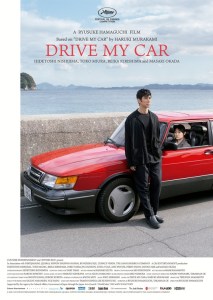 Here comes my shocking cinematic admission that lowers my standing with my critical brethren: I don’t see what the big fuss is with Drive My Car. The three-hour Japanese movie has bewitched most critics, won several Best Film of the Year designations, and was nominated for four Oscars including Best Picture, something only ten or so films have achieved in the Academy’s history. It’s a guaranteed winner for Best International Film, something only one other Japanese film has earned, and no, not anything from legendary Akira Kurosawa. All this is a protracted way of saying this is a very well regarded movie across the globe… and I just couldn’t get into it. Part of this is that the length is overly indulgent and meandering. The three hours feel far too leisurely, and structurally, the entire opening 45 minutes could have been cut and begun with our grieving actor/theater professional restarting his life two years after the sudden death of his wife. Everything you would need to know in that pre-credit beginning is covered later in the movie, which made me wonder why not leave some of the elements as mysteries to be filled in later such as the character’s complicated relationship to his unfaithful wife, what he knew or didn’t know, who is the voice on the tape he’s listening to running lines for the Chekov play Uncle Vanya in his car, and his personal connection to the leading man in the play he’s directing. A whole hour of this movie might be listening to actors say lines from Uncle Vanya, or just hear lines from Uncle Vanya, and then applying the 1898 Russian play to these modern characters and their lives. It’s clever but this kind of stuff works better as subtext. With Drive My Car, it’s the text, the literal text of the story for long portions, and that comes across as frustrating because it’s setting up characters, having them read a famous play, and then telling the audience, “Well, you find the connections.” Again, this works as layered subtext and metaphor in addition to a compelling story, but so much of Drive My Car is at this level of artistic interpretation. Did we need a dozen subdued scenes of them practicing the play in order for the ending to have its impact? That’s the power of art, a tool we can use to relate our fears, hopes, and identities with, sympathizing with the struggles and triumphs of people from other times and places. The core of this movie, for me, was the relationship between the main character and his younger driver assigned to him by the university. This character unfortunately doesn’t get her due until much later. Drive My Car has some beautiful moments, like a graceful family dinner, like the trip to the garbage site in Hiroshima, like a backseat monologue about, what else, decoding a story for meaning as it applies to character insight. This isn’t a bad movie. I can certainly appreciate the big swings at big ideas about grief, the human condition, and the reflective power of art. It’s just structured in a way that doesn’t allow those core elements to shine. Eliminate many scenes of play rehearsals, eliminate many scenes of driving, and even eliminate the opening 45 minutes, and you have a better paced, better emphasized human drama, at least to my mind. There are plenty of people who have fallen in love with all three hours, but I found myself more listless than lovelorn. I really wanted to like Drive My Car better but I found too much of it to be meandering, redundant, and frustratingly cold and opaque. In the end, after three dragging hours, I could at least say, yes, that woman certainly did drive that man’s car.
Nate’s Grade: B-
Share this:

Straitjacket (2021)
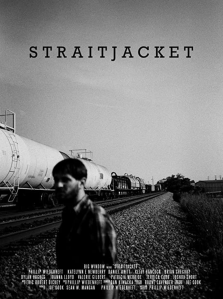 I genuinely forgot that I had supported Straitjacket, a new Ohio-made indie thriller filmed in the Dayton area several years hence. I know some people involved in the production and remember seeing a teaser trailer years ago asking for further editing donations. I could not remember if I had actually donated to its post-production costs and sure enough, in the end credits, there is my name under the thanks section for financial assistance. We’ll see if writer/director/co-star/editor Phillip Wiedenheft feels like listing my name was a mistake after this review. Straitjacket is a moderately successful thriller that entertains as long as it keeps things unbalanced.
The first thing we know about Wolf (Wiedenheft) is that he’s getting wasted in the woods. He awakens the next morning and loads a rifle and shoots at glass bottles. Except his shot goes beyond the bottle. He hears screaming and discovers his shot hit an old man walking through the woods. The man’s granddaughter, Lola (KateLynn Newberry), chases after Wolf, who hops into his car and drives away. Wolf is desperate to escape but he doesn’t have enough money for a plane ticket. He also might have left behind more than a few incriminating items in the woods after he quickly ran off. Wolf tries to take refuge with his dealer, the few family and friends who may still speak to him, while Lola languishes in despair and wonders if she can find the killer.
 Straitjacket owes a creative debt to the films of writer/director Jeremy Saulnier (Green Room, Hold the Dark), the man who worked nervy tension to a breaking point in his elegantly constructed indie thrillers (I immediately re-watched Green Room following this movie too). The tone and visual palate of this movie reminds me plenty of 2013’s Blue Ruin, a superb movie that follows a bearded vagrant on the run after an act of vengeance places a target on his head. It’s a revenge story stripped to the bone and free from the bombastic spectacle of bigger movies exploiting the same territory. The hero in that film, a drifter, wasn’t particularly skilled at killing, or defending himself, and was clumsy and all-too human as he brought a maelstrom of pain onto his life. It’s easy to make these same connections with Straitjacket, where it almost literally begins with a literal bang, a very easy to follow starting point stripped of exposition. Before the five-minute mark, our main character has killed someone in an accident and is now on the run. There’s a pleasingly frantic nature to the plotting, going from one desperate gamble to another, trying to figure out a possible escape as well as covering up his culpability. Wolf, just like the protagonist of Blue Ruin, is not particularly excelled when it comes to crime. He screws up. He has to correct his mistakes. He gets into debt to people who hold leverage over him. He has to scrounge up money in order to secure the things he needs to flee. The screenplay connects the dots in a way that doesn’t feel overly contrived even when the final act involves the ironic crossing of paths of all the necessary characters. That is a common occurrence in tragedy, the nature of inescapable fate and so we allow it, and Straitjacket is a tragedy disguised as a runaway thriller. If anything, it’s about people trying to escape from their mental and physical pain.
At the half-hour mark, the narrative switches perspectives, and we now see things from the victim’s point of view. In the hours before the fatal accident, we see Lola and her grandfather going about their day before he is taken permanently from this Earth. They discuss her process of recovering from addiction and share a small but heartfelt moment planting a tree mingled with the ashes of loved ones, Lola’s mother and grandmother (I think?). The old man says Lola is the only family he has left and he doesn’t want to come out here and plant another tree. Just with that line, with that moment, the filmmakers have managed to say everything they need to say in a meaningful and character-centric fashion. From there, much of the next half hour is Lola trying to make sense of her sudden loss. I thought perhaps the narrative had flipped and we were going to follow Lola as she tracked down Wolf and enact her own vengeance, but the movie doesn’t really do that either. She stumbles upon him again just because he returns to the scene of the crime and she recognizes his car, but her agency stops at calling for help from an ex. That’s disappointing because she could have been the right participant for the audience to root for.
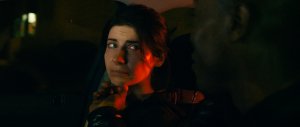 And therein lies one of the issues holding back Straitjacket from real gut-churning dramatic greatness, the fact that you don’t really root for any character to achieve his or her goal. While streamlining the narrative has made the plot relatively tight and quick to start, we also don’t really get much in the way of fleshing out Wolf as a person. We know he’s self-destructive, we know he’s struggling, and a caravan of interactions with minor supporting players fill us in on the myriad ways he is disappointing others (he has a son he never sees, he’s stolen from family before, he’s gotten into trouble with his dealer, etc.). He’s just sort of a screw-up but we aren’t given redeeming qualities, we aren’t given moments that allow a personality to shine through, where we can see his hopes, maybe a glimmer of his time and who he was before his addictions. He’s less a character and more a walking Tragic Symbol with antsy legs. The same with Lola. She’s suffering, she’s hurting, she wants to find her grandfather’s killer and bring them to justice. But does she do anything to actively achieve this? Not really. She lucks into attending the same drug house that Wolf does, and this sets up a finale that tries to have it both ways, ultimately ending on redemption and closure but not quite managing the catharsis of either. That’s because the limited characterization made the later emotional investment limited as well.
Take a look at Blue Ruin for comparison on how it could have been done effectively. It’s established why the main character’s life has been in shambles, he finds the person responsible for murdering his parents, takes his clumsy vengeance, and the rest of the movie is him outrunning the mounting and bloody repercussions. That movie works because the act of violence that kicks off the scramble is eventually revealed to be justifiable from the character’s perspective (his own sister, whom he initially hides with, congratulates him). He’s also the underdog as the forces coming after him are armed, dangerous, and larger, so then the movie becomes how this one man can use his few resources and lead time to outsmart his eventual attackers. It becomes naturally engaging because the odds are stacked against him and every time he surprises or beats them back is another victory and satisfying to watch. Straitjacket doesn’t afford similar satisfaction for a viewer. That’s the difference between a thriller and a tragedy, not that Blue Ruin was absent its own stark sense of tragedy as revenge was deemed ultimately as self-harm. There isn’t that push with Straitjacket. Lola isn’t actively looking for her culprit, and her path toward vengeance isn’t taking a toll. Sure, you could argue it’s what causes her to consider relapsing back to addictions but even that struggle is kept very generalized.
 When the movie attempts to connect to larger social and political issues, it feels more grasping than edifying. Both of the main characters are struggling with drug addictions, and there’s even passing reference to the opioid crisis happening nationwide, but the drug problems are more scant characterization than anything thematic. I suppose one could be generous and talk about people being haunted by their past mistakes, enthralled to addiction, and working to become better people in control of their own lives, but that’s a generic plot foundation that any nominal drug addiction movie traffics within. Likewise, the Army vet who is coping with his PTSD through drug addiction seems like it has the potential to make larger statements, but even this aspect of the movie is curiously underplayed. I thought the filmmakers would tie more trauma together with the past and present for Wolf, even indulging in certain triggering sounds or images. I suppose Straitjacket’s title is meant to reference the bind that these characters find themselves in due to drugs and other socioeconomic circumstances (no one literally wears a straitjacket). I just thought the movie would have more to say than drug addiction is rough.
I also think it was a mistake for Wiedenheft to have played Wolf. I don’t know if this decision was born out of necessity of keeping the crew small and moving, not having to contort around another actor’s schedule when the writer/director could just step in, or if this was a part that Wiedenheft really wanted to portray. I assume it’s more the former than the latter. In that case, this might be why Wiedenheft the writer kept things minimal on Wiedenheft the actor. There are a few challenging scenes to play, like drug highs and the lows of desperation, but the performance is much more reactive and kept at a distance. Maybe he’s meant to be more a cypher, a stand-in for countless others struggling with the cost of addiction, but if this was the case I figure more attention and specifics would have been placed thematically.
The acting shortcomings of Wiedenheft are more noticeable when compared to his co-lead. Newberry is a familiar face in the realm of Ohio-made indies (The Curse of Lilith Ratchet, Dark Iris, The Wager) and gets the big emotional moments. Newberry sells the grief and shock with ease. A notable standout is JoAnna Lloyd (Brimstone Saint) as a park ranger. She’s only in the movie for two brief scenes but she leaves a favorable impression as a woman struggling to even compute the tragic events that she is now meant to serve as an authority for. Her loss of words, awkward articulation, and sense of bewilderment trying to comfort another is deftly played.
 From a technical standpoint, Straitjacket is marvelous and impressive, and the level of its professional presentation in no way betrays the fact that the movie’s budget was only $15,000. The cinematography is extremely polished and moody, again reminding me of how Sauliner uses his sleek images and compositions to make even unnerving anxiety appear oddly beautiful. There’s a clear and clean visual talent here. I can see how a thriller would be appealing for this artist. When things are on edge and in movement, that’s when Wiedenheft is at his best as a director. It’s when things slow down that we start to see faults with the limited characterization and themes. Still, this is one Ohio-made indie that doesn’t feel like it’s stretching to a breaking point simply to get to a feature-length running time. There feels like even more could have been explored, maybe a third character perspective to open things up even more and examine the long ripples one devastating mistake can have on many lives. It’s tragedy served up as chase movie, but when things slow down that’s when you’ll notice how Straitjacket could have used more knots to tie itself into an even more tantalizing and emotionally grueling film experience.
Nate’s Grade: B-
Share this:

The Batman (2022)
 Matt Reeves is a director who has found a way to inject soul into blockbuster movie-making, notably shepherding the last two films of the revived Planet of the Apes series. Who would have guessed at the turn of the twenty-first century that the two co-creators of Felicity would go on to helm such monumental properties like Star Wars and Batman? Reeves has reliably proven himself on increasingly bigger stages, and that’s why I held out hope that yet another Batman reboot would be worth the effort under his care. Let’s face it, dear reader, we’re probably never going to be more than three or four years removed from some kind of Batman movie, whether a continuation or another reboot. If we are going back to the Bat basics, I trust giving the franchise over to exciting artists like Reeves. I was hoping for a Ben Affleck-directed Batman after he slipped into the cowl in 2014, but it was not to be even though he was the best part of the Zack Snyder run. After multiple production delays, we now have The Batman, and it’s the next big box-office hope for desperate movie theaters until the oasis of summer releases (some are even charging a heftier ticket price, so consider it a blockbuster tax). As a slick comic book spectacle, The Batman is a three-course meal that could have sensibly pushed away earlier. You’ll feel satisfied, full, a little addled, but if dank serial killer thrillers are your thing, you’ll definitely be hungry for more even after nearly three hours of Reeves’ deep danky dive.
Gotham City is on the verge of a new mayoral election, and it’s also on the verge of a killing spree. A masked man identifying himself as the Riddler (Paul Dano) is targeting the elites of the city with cryptic notes addressed specifically toward “The Batman” (Robert Pattinson), the newfound vigilante trying to instill fear in the hearts of would-be criminals. The key ends up being Selena Kyle (Zoe Kravtiz), a waitress at Gotham’s grungy club that also happens to be a popular market for the big crime bosses. Batman enlists the help of Selena to put together the clues to predict the Riddler’s next target and to uncover decades of corruption infesting the city.
 The Batman exists in a specific cinematic universe far more in common with the rain-soaked, gritty serial killer thrillers of David Fincher than anything from the previous DC movie universe. This is a pulpy, stylized movie that feels akin to Seven or Zodiac, and not just in its protracted length. It’s a methodical movie that takes its sweet time dwelling in the decrepit details. The plot is very similar to the serial killer formula of finding that first alarming murder and clue, leading to the next, learning more from each additional target to try and discern a pattern of connectivity, and finally learning that the grand scheme goes deeper than imagined, and is usually personal. It’s more based as a detective procedural than any previous Batman incarnation, including missions where the Dark Knight goes undercover or enlists others to gather intel for his investigation. If you’re the kind of person that’s been dreaming of the quote-unquote world’s greatest detective to do more sleuthing and less typing at magic computers, then your time has come. This is a very dark and very serious movie, though it doesn’t feel too suffocating. Fun can still be had but on its own terms, satisfaction from building momentum, seeing how this world incorporates familiar faces and Batman elements, and deepening the lore of this city’s complicated history. Nobody is going to be making any “I gotta get me one of these” quips. It’s hard to even remember a time Batman had nipples on his chest plate and a Bat credit card.
This is also the first Batman where I can vividly feel the anger resonating from its title character. In this new timeline, we’ve thankfully skipped the origin period (and even more thankfully skipped watching Bruce’s parents die on screen for the sixteenth time or so), and we’re now two years into Batman being Batman. He’s still figuring things out but his effect is evident. Reeves has a terrific introduction of various acts of crime across the city and cross-cutting the criminals staring at the Bat signal in the sky and then nervously looking at a corridor of shadow, fearful that the caped crusader could emerge at any moment. When he does finally arrive, this Batman walks with such heavy plodding steps for dramatic effect (and reminiscent of some Goth club kid). This version of Batman relishes delivering pain. He wallops his opponents with abandon, and the intensity of the physical performance from Pattinson really impresses. This is Batman as a rampaging bull, leaning into fights, and also carelessly blase about enduring damage. You will watch Batman get shot dozens of times and he just keeps fighting, so overcome in the moment with the drive of his own violent vigor. Bruce Wayne hasn’t exactly been portrayed as a stable and well-adjusted man in the other movies, but this is the first Batman that made me a little scared about what he might do to others and how cavalier he was taking all this damage.
 On that note, Pattinson proves himself more than capable of shouldering the weight of the franchise. Upon news of the former Twilight star’s casting, fan reaction across the Internet was apoplectic and rotten, ignoring the fact that Pattinson has gone the 90s Johnny Depp route and purposely leveraged his good looks to work with an eclectic group of filmmakers and odd roles (see Good Time, The Lighthouse, and The Rover). Pattinson has become a very interesting young actor, and it’s funny to me that ten years after the release of the final Twilight, we have one half of the undead couple playing Batman and the other half nominated for Best Actress for portraying Princess Diana. I would say they’ve proven themselves as legit thespians. Anyway, the Batman franchise has a long history of negative fan reaction to casting, from Affleck to Heath Ledger to even Michael Keaton, that is then rescinded upon seeing the movie, and I expect the same to occur for Pattinson. He actually plays Bruce Wayne something like an atrophied vampire, barely keeping the visage because the costume is the real him. Although, if this is a Batman who prioritizes the night, I think if I was a criminal, I would just start planning on committing all my many crimes during daylight hours (strictly keeping to banking hours).
The supporting cast is as deep and as talented as the Nolan films. Several villainous characters are in their early stages of our conceptions. Kravitz (Kimi) is the real breakout star. While she cannot supplant Michelle Pfeiffer as the top Catwoman, Kravitz makes the role her own. Selena is more a socially conscious antihero trying to fight back against bad men in power abusing that power. Her own goal aligns with Batman’s, and the two become intertwined allies with a clear romantic frisson emerging. This is a Catwoman I would like to see again. Dano (Swiss Army Man) is effortlessly creepy as the morally righteous and unhinged Riddler, more akin to Zodiac or Jigsaw than Jim Carrey’s wacky version. He’s menacing and the tricks he does with his voice are unnerving, except, however, when his voice hits higher pitches and then he sounds like a whiny child needing to go to his room. Colin Farrel (The Gentlemen) is nearly unrecognizable under pounds of makeup that make him resemble a disfigured Richard Kind (one wonders why the movie didn’t just hire Richard Kind himself) and he’s having a ball. Jeffrey Wright (Westworld) has a weary gravitas as a younger Jim Gordon, the only ally on the police force for Batman. Andy Serkis is a welcome presence as the dutiful Alfred, the last familial bond Bruce has, though he spends most of the time off-screen probably due to Serkis directing 2021’s Venom 2.
 Reeves might not have the signature Gothic opulence of a Burton, the visual flair of a Snyder, or the zeitgeist-tapping instincts of a Nolan, but he is a supremely talented big screen stylist. There is a deeply felt tactile nature to this movie, from the streets to the alleys to the homes. It feels wonderfully alive and especially dirty. The entire movie feels like it has a visual pal over it, favoring burnt orange, and the cinematography by Greig Fraser (Dune) is ornate and often mesmerizing, begging you to just immerse yourself in the details and compositions. The influence of Fincher is all over this movie, but there are far worse auteurs to model after than the man who elevated serial killer thrillers to high art. I appreciate how Reeves stages many of his bouts of action, including one sequence of Batman taking out a group of gunmen glimpsed only from the staccato flashes of muzzle fire. Reeves is a first-class showman when it comes to introductions. I mentioned Batman’s introduction, but Reeves also delivers splashy entrances for Catwoman, the Riddler, and even the Batmobile, which comes to monstrous life like a kaiju being awakened. The explosive car chase with that marauding muscle car is the action high-point. The movie is further elevated by Michael Giacchino’s pounding musical score. It’s not an instantly iconic Danny Elfman theme but it is stirring in how thunderous it announces itself.
I wasn’t feeling the length of the movie until its third hour, and that’s where my friend Eric Muller cites that The Batman is suffering from a Return of the King-level of false endings. Just when you think it’s wrapping up, there’s something else, and just when you think it’s now finally coming to a close, it’s got another sequence and attached resolution. It’s during this final third hour that I feel like the movie could have been trimmed back. While it ends on a high note and brings characters to the end of their arcs in a clear fashion, part of me really feels like a bleaker ending would have been appropriate for the rest of the movie we had. I won’t specify for the sake of spoilers but you’ll know it when it happens, and it could have ended on a note of the villain more or less winning the larger war on their own terms. It has such a power to it, tying elements together that had been carefully kept as background for so long as to be forgotten only to bring them back to assert the full power of an insidious virus. I think the movie would have been a more fitting ending on this dreary note, with our heroes having lost, but of course the studio wouldn’t want its $200 tentpole to end with its main star bested by pessimism. Again, this is merely my own personal preference, but after two-plus hours of rainy gloom and doom, it feels more fitting to end on a dour note (also akin to Seven or Zodiac) than on inspiring triumph.
 This is also perhaps one of the most disturbing PG-13 movies. I might caution parents about taking younger children to watch. The mood of this movie is very dark and somber and the details of the Riddler’s acts of terror can be very horrific to contemplate. There are also intense moments like listening to a woman being strangled to death, twice. It all started making me think maybe Reeves and company could have pulled back and left more to the imagination. I’m not saying the movie’s tone is inappropriate for the material, it just occasionally luxuriates in the grimy details and pitched terror and trauma of its victims that can be unsettling and unnecessary.
Even with the heaviest expectations from the hardest of fans, The Batman is an unqualified success. It’s not in the same category of Nolan’s best but the ambition and execution place Reeves only just outside that hallowed sphere of blockbuster showmanship. It also hurts that The Batman lacks an exciting anchor that can break through the pop-culture clutter, like a dynamic and ultimately Oscar-winning performance from Heath Ledger or Joaquin Phoenix. It almost feels like a Batman miniseries that you might want to continue tuning into (Reeves is developing a few Batman-related projects for HBO Max). Overall, The Batman is an exciting and intelligent blockbuster with style, mood, and a clear sense of purpose. Reeves remains an excellent caretaker of any pop-culture property and proves big movies can still have souls.
Nate’s Grade: B+
Share this:

Crossroads (2002) [Review Re-View]
 Originally released February 15, 2002:
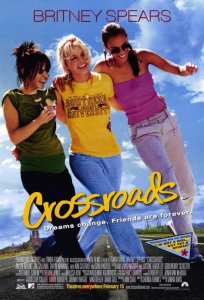
When informed that her feature film debut was receiving shrieks of laughter during advanced screenings for critics, Britney Spears said she was glad because she never likes the same films the critics do. Well Ms. Not That Innocent, the truth hurts; you’re not a girl, not yet an actress. Crossroads is really the filmic adventures of Britney Spears and her ever-present navel. The navel should get second billing, but alas, we do not live in a society of equality for navels.
The film opens up with three 10-year-old best friends burying a box of wishes and dreams and promising to be bestest friends forever and ever. They make a pact to come back and dig up the box on the night of their high school graduation. Flash to the present and the word “bestest” isn’t what it used to be. Lucy (Britney Spears) has become the virginal nerd preparing to give her speech as valedictorian. Kit (Zoe Saldana) has become the haughty popular snob, obsessed over getting married ever since she got her first Bridal Barbie. Mimi (Taryn Manning) is pregnant and become the trailer trash girl that everyone sees fit to remind her of. Despite their growth apart they all do come together to reopen their box of dreams. Mimi informs the others that she plans to head to California to audition for a record deal in an open contest. Kit decides to use this opportunity to check up on her boyfriend at UCLA who has been strangely evasive. Lucy complains that by having her nose in a book her entire high school experience she never got to go to a football game or even “hang out.” Somewhere a small violin is playing. She decides to jump at this chance and possibly see her mother in Arizona, who ran out on Lucy and her father (Dan Akroyd) when she was only three. The wheels of their adventure are provided by guitar-playing mystery Ben (Anson Mount). He pilots them on their travels to the Pacific coast, though the girls think he might have killed someone, but oh well.
 Crossroads is filled to the brim with every imaginable road trip cliché. The girls “open up” after getting drunk, have a scuffle in a bar, reap in the sights of nature, and perhaps create some sparks of romance with their hunky heartthrob of a driver. The car also inevitably breaks down and the girls have to find a way to scrape some quick cash together. They enter in a karaoke contest and Britney proceeds to sing Joan Jett’s “I Love Rock and Roll” with her two gal pals providing backup. But no, this isn’t the last time you’ll hear Ms. Brit sing. In an effort to pad as well as become a showcase for its star, Crossroads gives us many scenes of the girls just singing to the radio. Besides Jett, Shania Twain’s “Man I Feel Like a Woman” and Sheryl Crow’s “If It Makes You Happy” are also on the chopping block. You’ll also be accosted by the movie’s single “Not a Girl, Not Yet a Woman” several times, including one scene where Poet Britney is asked to share her poem and it ends up being the song’s lyrics.
Saldana (Center Stage) is not given much, as the attention is always centered on Britney, so she merely comes off like a token conceited character. Only Taryn Manning (crazy/beautiful) comes away with a little dignity. She gives Mimi a lot more heart than should be there and shows some honest reflections for her character. She also, coincidentally enough, looks like a dead ringer for Joan Jett with her black bangs.
Crossroads is nothing but a star vanity project for Spears, with some not-so-subliminal Pepsi product placement here and there. This was not a script looking for a lead; this was something Britney’s management team suited for her, and Crossroads is perfectly suited for Britney. It allows for many ogling periods of booty shaking. The majority of the film’s drama doesn’t even concern her, and when she does have to act, her scenes are cut short to help her when the real drama unfolds. The movie’s true intentions are revealed when Britney is shown in her pink underwear twice in the first 15 minutes.
 Crossroads moves along on gratuitous skin shots of Spears half-naked body every 20 minutes until it reaches its torture chamber of a final act. In this very melodramatic period we get abandonment, date rape, infidelity, and even a miscarriage in one of the film’s most shameless plot devices. Of course none of these horrors matter, especially a psychologically damaging miscarriage, because Britney has to get to her BIG audition in order to perform, yep you guessed it, “I’m Not a Girl, Not Yet a Woman.” She also has to wear what looks like kitchen drapes while she sings.
You’ll walk out of the theater wondering many things. Why does Britney wear pink in EVERY single scene she’s in? There’s even one scene where she changes from a pink top to another pink top and is FOLDING a third pink top into a suitcase. Are we to believe that Akroyd and Spears share some kind of genetics? In what high school would Britney be considered a nerd?
Hopefully Crossroads will be the pop princess’ last foray into film, but I strongly doubt this is the last we’ve seen of Britney Spears. Crossroads is a terrible girl-power trip. Only Spears’ target demographic will enjoy this melodramatic mess. Truly, the two largest groups that will see this film are adolescent girls and creepy older men who fawn after adolescent girls. Crossroads is exactly everything you’d expect.
Nate’s Grade: F
——————————————————
WRITER REFLECTIONS 20 YEARS LATER

I’ve been waiting for this mea culpa for twenty years. In 2002, I saw Britney Spears’ movie debut, Crossroads, opening weekend with some friends with the chief purpose of seeing how bad it would be and tearing it to shreds for my collegiate newspaper. I graded it an F and sharpened my knives to eviscerate the star vanity project and everything it supposedly represented, eventually declaring it the worst film of 2002. Many years later, I have to wonder just exactly what was I so upset about with a middling road trip drama? What made this movie more deserving of a critical take-down than any other movie of that year? Had Spears not been its star, I doubt I would have expelled as much vitriol. So then the big question becomes, what did Britney Spears do to deserve so much ire from the 19-year-old version of myself? After some further reflection, I think I have some answers, and I’m glad I’ve had some significant growing up since then. I think it comes down to a personal animus blinding me as a critic, and this is something I’ve tried to push through and shed as I’ve gotten older and hopefully more experienced at evaluating art.
Flashback to the mid-to-late 1990s, and it was a golden time for fans of alternative rock, such as myself, bands that were cutting edge, audacious, and reaping the commercial rewards as well. MTV was filled with bizarre and exciting music videos from eclectic artists that were given an elevated platform. I grew my sense of self through my burgeoning musical taste, enveloping myself in the sounds of the Smashing Pumpkins, Radiohead, Tori Amos, and many more. And then the pop infusion began in 1997 with Hanson and really exploded with the emergence of the boy band craze and young pop stars like Spears and Christina Aguilera and others. Suddenly the music I was accustomed to, the music that to me was built on artistic integrity and depth, was being pushed aside for music that felt shallow and inferior, driven by exploiting the clean-cut physical beauty of the performers as compensation for substance. My younger self felt irritated that the music I considered to be genuine and revelatory was supplanted by bubblegum pop ditties. In my sophomore year of high school, for a Canterbury Tales group assignment, I co-wrote an epic quest for a strange band of characters to go to a Hanson concert and kill the three mop-headed brothers (I also had the collective pre-teen audience rise up and retaliate, killing our band of heroes). Looking back, there’s nothing new about any of this. Music has gone through many spells where pretty pop stars have coasted because of their looks and sex appeal. For whatever reasons, it felt personable, like an attack, and that is such a misplaced assessment on the winds of popularity.
 I’ve tried to eliminate anything that feels like a personal attack from my film criticism, because at the end of the day it’s just a movie, and whether or not it works for me, and it may work for others, it’s still only a movie. It’s not like the filmmakers personally robbed me of anything other than my time, and as my friends will often chide me, I chose to watch these movies I knew would be almost certainly dubious entertainment options. I’ve re-read several past film reviews and winced as I found myself resorting to low blows or critiques about body appearance. My review of 2008’s The Hottie and the Nottie (for the record: not a good movie) was a glorified take-down of Paris Hilton and everything she supposedly represented, a prized vapidity. I deleted heavy portions of it, especially those shaming Hilton for her promiscuity. It made me ashamed. As I’ve grown, I’ve tried to focus solely on the art and story of each movie. If the performance was weak, it’s just a reflection of a bad performance and not a bad person deserving of some sort of misplaced score-settling by yet another angry random guy on the Internet.
That brings me back to the star of Crossroads, Britney Spears, who in the ensuing decades had the culture rally to her back as well as re-evaluate the treatment of the paparazzi-heavy targets of the 2000s. She was celebrated for her sexuality and demonized for it as well, again not exactly new in the realm of media. After so many years under the harsh scrutiny of the public spotlight, in 2007, Spears shaved her head, attacked a paparazzi car, and checked in for much-needed mental help, and in doing so essentially signed her life away for the next 14 years to her father, who had the final say over her finances and tour commitments and even whether or not Spears could have an IUD removed. She was finally released from her conservatorship after a groundswell of public support in 2021. She’s released many more albums, had a long-standing residency in Las Vegas, and has even talked about turning her struggle for agency into a big screen movie.
 Crossroads is an odd concoction because of how many people went on to have robust careers. Chief among them is the credited screenwriter Shonda Rhimes who would become one of the preeminent TV power producers of the twenty-first century with Grey’s Anatomy, Scandal, and Bridgerton. Fans of Rhimes’ adult soaps might find recognizable traces of her plotting with the overly melodramatic third act of Crossroads. This was also one of the earliest movies for Zoe Saldana, an integral part of THREE high-profile, highly successful sci-fi series, Avatar (where she has blue skin), Guardians of the Galaxy (where she has green skin), and the J.J. Abrams’ Star Trek (natural skin). She was also in the first Pirates of the Caribbean just a year after Crossroads. Then there’s Taryn Manning who found memorable parts in 8 Mile, Hustle and Flow, before redefining her career as the memorable, and dental-deficient, Pensatucky on Orange is the New Black. Anson Mount would later go on to prominence in TV series like Hell on Wheels and Star Trek Discovery (less so Marvel’s Inhumans). Apparently many of the other actors in Crossroads agreed to sign on just to meet Spears, like Dan Akroyd, Kim Catrall, and Justin Long. Even Mount was hesitant until the urging of none other than Robert DeNiro, who read lines with Mount from the Crossroads script during their downtime on 2002’s City by the Sea (DeNiro reed Britney’s lines, which makes me wonder what he could have done in the lead).
Reading back over my original 2002 review, I actually think most if not all the criticisms of the movie still land. The movie is rife with road trip cliches. The third act is indeed a torture chamber that really tilts the drama into overdrive, though smartly places the workload on the abilities of Saldana and Manning. There is definitely an unsettling preoccupation with Spears’ sexuality with the film. I wrote, “The movie’s true intentions are revealed when Britney is shown in her pink underwear twice in the first 15 minutes,” and I can’t disagree. It’s an uncomfortable watch at points, not because anything on screen is so salacious or ribald (Spears in fact insisted on her character’s use of profanity to be stricken to maintain her image) but because of what it thinks its audience wants. I suppose there were thousands of teenage girls looking to someone famous like Britney Spears for inspiration, and the lesson of waiting until you feel comfortable with a partner, and it’s your choice, is worthy, but the primacy emphasis on Spears’ body feels wrong.
My concluding line in my review was meant to summarize my stance, indicating that Crossroads is “exactly what you expect it to be,” and in 2002 I guess that meant the worst of the worst. In 2022, that just means a familiar, formulaic road trip movie with lots of melodrama. Yes, it’s a star vehicle for Spears’ acting career and there are many opportunities for singing, but that doesn’t make it any worse than any other mediocre drama aimed at a teenage demographic. And in 2022, I can say that I appreciate the pop music of the 90s. There were some real top-notch ear worms there and they still stand up to this day, easily hum-able when they reappear on radio. Spears and her ilk did not get the full credit they deserve during their reign. Crossroads is, to excuse a forced metaphor, a sort of crossroads for myself as a critic, something I’ve tried to improve upon as I got older. Movies are good and bad. Their intentions might even be noble or prurient or purely driven by money, but they’re still only movies and not personal attacks. I’m sorry Ms. Spears for unfairly maligning you, your acting ability, and your movie. Crossroads is easily not the worst movie of 2002. It’s merely mediocre at best and undeserving of antipathy.
Re-View Grade: C
Share this:

Shut In (2022)
 It’s easy to see the appeal of contained thrillers from a production standpoint, but I’ve always found them to be a fun, crafty thought exercise that I’ve often enjoyed playing along. I’ll rename them “survival thrillers” because I think that’s truer to what they encounter, whether it’s in a small, contained environment or whether they are simply a victim of unique circumstances. I enjoy watching a character analyze and attack a problem and find workable solutions. There’s a natural vehicle for satisfaction there, whether it’s Matt Damon learning how to farm on Mars, or Ryan Reynolds being buried alive in a coffin, or a group of teenagers stuck on a ski lift. It’s a fun scenario to try and solve, especially in the relative comfort of your own home. Given their success and general low-cost nature, it was only a matter of time before these kinds of thrillers would dominate indie direct-to-streaming cinema. I guess then I shouldn’t be that surprised the Christian movie market would want in too. Shut In is the first original film distributed by The Daily Wire, the subscription run by conservative political wunderkind Ben “debate me!” Shapiro. Shut In began as a 2019 Black List script, the list of the most liked unproduced screenplays, and at one point Jason Bateman was going to direct. From there, it’s now Ben Shapiro’s Godsploitation thriller, and it has its own virtues and sins.
Jessica Nash (Rainey Qualley) is doing her best with some of the worst circumstances. She’s got two young children, one still an infant, and scraping by for money. She’s a recovering meth addict and has inherited her grandmother’s home that she’s looking to sell. As she’s cleaning up the premises, she accidentally locks herself inside a pantry. Making matters worse is that her meth-addict ex-boyfriend Rob (Jake Horrowitz) and his no-good pedophile pal Sammy (Vincent Gallo) come around looking for a score. Jessica must use her wits, strength, and fortitude to escape the pantry, keep the dangerous men away from her children, and also reject the temptation of indulging in drugs as an escape for her mounting troubles.
 From the vantage point of a survival thriller, Shut In makes more under its circumstances that I would have assumed but also, strangely, less with the personal stakes. Whenever developing a problem-solution story structure, you need to make sure the dots connect and there’s a natural progression of events. You’re stuck in a room, now what? Jessica benefits because she has a helper on the outside; however, that person is only a young child, and therefore unreliable and unable to firmly grasp multi-step instructions. This also allowed me to channel the main character’s frustrations as well, especially when she was asking her kid to find things like tools to better claw away at the door and floor. This gives her an outlet but another challenge as well because the child becomes a point of vulnerability. When Sammy comes back into the picture, his presence is immediately the priority, and Jessica needs to neutralize him or make sure he cannot reach her daughter on the other side of the door. Screenwriter Melanie Toast seems to understand that the predicament she devises runs into natural end points, so she throws in extra escalations, which then become the next challenge. It’s self-aware scripting, but it also runs the risk of the challenges feeling not as challenging and the movie feeling more episodic.
The most confounding plot point was how underplayed the drug addiction angle is. It’s part of her overall tragic past, and the movie hints about past sexual trauma as well to further haunt our lead’s dark “before time,” but we don’t ever really feel her trouble with staying clean. It’s more like the drugs represent her former life, the one with her ex who is still in the thrall of meth. We could have used maybe even a monologue of Jessica talking about the pull of drugs, how important they were to her before, and how she never liked the persons he was, perhaps the shame she feels for the things she had down previously for drugs, and her intent at redemption, all to the audience of the child she’s meaning to do better by. There’s an entire character arc worth of detail that can be unleashed to really provide better depth. When her ex tosses his three grams of meth into the pantry, it’s meant to be a significant temptation, but the movie never really plays this as a sufficient challenge. It would be as if the guy just tossed in a small packet of laundry powder for how much personal attention it’s given. There was a short moment where it looks like, with all hope lost, that Jessica might succumb, but for the far, far majority of the running time, this drug temptation is underplayed. If this Jessica wasn’t going to struggle over using drugs again, why not just have her toss them down the sink? It’s a curious mitigated plot point for something that seems more significant than presented.
 This is also directed by D.J. Caruso, a man who was making big-budget Hollywood action movies in the early 2010s like Eagle Eye and I Am Number Four. This is likely the lowest budget Caruso has ever worked with, but he doesn’t make the movie feel visually dull. There’s way too much imagery with apples though, including apples rotting at their core (you get it?) and eventually Jessica peeling the brown from an apple and saying the rest is still plenty good (you get it?). It feels like the apple was a lazy visual symbol meant to appeal to its, presumably, more Christian-affiliated target audience (“You see, the apple… means… temptation”). The tension can be finely attuned especially when we’re trapped in the pantry with Jessica and having to rely upon the sound design to understand the looming threats. I wish Caruso had pulled back at more points. Later, Sammy holds Jessica’s kid hostage with a knife to her little throat, promising to kill her, while everyone is screaming so loudly that it almost feels like we’ve landed in farce. The exploitation thriller elements feel in conflict with the lighter Christian elements. The God parts feel almost tacked on, especially when Jessica doesn’t reveal anything about her own faith. Looking at a hanging cross and deciding not to do drugs does not count as sufficient integration.
This is also Vincent Gallo’s first film role in ten years. for a period in the late 1990s, Gallo was the toast of the indie film scene and then he burnt through all that collective good will (also credit The Brown Bunny making people question those earlier accolades). I’ll credit Gallo acting like a believable creep and a snarling threat. He’s the best actor in the movie, and he delivers enough in this do-nothing part that makes me wish he would act more often. Qualley (sister to Margaret Qualley, also the daughter of Andie MacDowell) is fine, though her Southern accent seems to get the better of her at parts. Her performance is more physical than emotional.
 Shut In is a small movie likely intended for a small audience while it drafts off the genre formula of larger, more polished survival thrillers. It goes through stretches where it relatively works, stripped down to its bare genre essentials, and then moments where I wish more was going on viscerally and intellectually. That’s where the movie needed to open up its protagonist more substantially, give more consideration to her internal struggles rather than keeping everything strictly externalized. Her drug addiction and the immediate proximity of drugs needed to be much more a trial of will. If you’re stuck with characters in a confined space, you need to either use that time to make the character more intriguing and compelling or keep the obstacles coming. Shut In transitions with new obstacles to overcome, but it still doesn’t feel like enough for this 89-minute movie. It’s an acceptable genre entry but had more potential with its lead character and with its thrills. It settles too often, and there’s nothing godly about settling when you could have been an even mightier movie.
Nate’s Grade: C+
Share this:

They/Them/Us (2022)
 Jon Sherman has been a film professor at Kenyon College in Ohio since 2010. He has sought to build up the Columbus, Ohio film community and has often guest lectured at various film screenings held in central Ohio. Sherman has some personal experience with Hollywood, writing and directing his 1996 breakout indie rom-com Breathing Room (starring Dan Futterman!), and then given an even bigger stage with the 2002 rom-com I’m with Lucy (with Monica Potter!). He may be an academic but that filmmaking itch never really goes away, and so that brings us to another Sherman rom-com, 2022’s They/Them/Us, which is available to be viewed nationally through digital release. It’s a charming, offbeat romance with a sweet sensibility and an unexpected kink.
Charlie (Joey Slotnick) is a middle-aged man starting his life over. He’s re-entered the dating scene after a recent divorce, he splits custody of his two teenage children with their mother, and the only job he could find as a film professor is at a conservative Christian university. Lisa (Amy Hargreaves) is a woman in her forties, a successful artist with full custody of her two children, one of whom has recently identified as non-binary (preferring “they/them” pronouns, hence the title). They meet online, have their first date, and are immediately smitten, enough so that Lisa bends her rules about not getting too attached too soon. Charlie and Lisa decide to combine their clans into one modern blended family, and the reunification is a messy and awkward process.
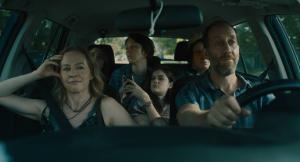 Given Sherman’s background as a film professor, you would hope that if anyone, when given the opportunity to make a feature film, could rise to the occasion, it should be somebody whose career rests upon the analysis of what makes movies work best. They/Them/Us succeeds as a relatively light-hearted rom-com and family drama with several nice moments. It’s hard to quantify, but you know better writing when you witness it, how characters interact and how witty the exchanges are and how much characterization they impart. Typically, a lesser writer will overstay their welcome or begin a scene before the importance. This can also be done to add unique character details, but often it’s a writer not knowing when to start and when to leave, a trait I’ve experienced so many times with Ohio-made indies. With Sherman’s scene writing, everything is to the point and moving, imparting the most important info or character detail, then chugging along. Early on, we establish Charlie as a man struggling to parent two surly teenagers and find someone special online. The fact that in the opening seconds he seems to be messaging two women who have BDSM kinks in their profile should be telling. After Charlie admonishes Danny for smoking pot in his house, he snatches the kid’s bong and runs upstairs, pacing and unsure of what to do next as his breathing calms and he focuses his attention to the bong in hand. Cut to Charlie smoking the bong to relax. It’s a quick, smart detail that demonstrates Charlie’s uncertainty on how to be the stable authority figure with his own dismissive children.
They/Them/Us is also a charming and sex positive romance between two middle-aged divorcees, a subject that rarely gets such big screen attention. The movie touches upon the challenges of modern dating when you’re not just dating a single individual but a person with attachments, about starting over later and finding a new life that will make appropriate space for you. Selecting a common dinner option can be its own minefield. It’s a perspective worthy of more attention by Hollywood. Beyond that angle, the movie is also surprisingly kinky for a “family comedy.” While unrated, They/Them/Us still exists in a more PG-13-friendly universe so it’s rather gentle when it explores the BDSM urges of Lisa. The movie is refreshingly free of judgements though has more than a few grand jokes drawn from Charlie’s squeamishness. He tries to throw himself into a more aggressive role, and Lisa asks him to pull her hair harder, and he says, “I’m sorry, I can’t. I’m a feminist.” I laughed out loud at that one. Another time, Charlie is attempting to spank Lisa and he keeps hesitating, finally admitting that it keeps bringing up unwanted and uncomfortable memories of spanking his unruly son as a child, something he still feels guilty over. In time, Charlie seeks out advice and instruction on how to be a better BDSM participant, and his educational process is a bit obvious, with more than a few easy gags (no pun intended), but it’s still one borne from a desire to better understand and fulfill his partner. It’s a sweet romance.
 Slotnick (Twister, The Marvelous Mrs. Maisel) has been a staple of TV and movies for decades, a reliable “that guy” with overly neurotic tendencies. He’s a terrific put-upon dad and his age has only added more authenticity to Charlie’s harried struggle. He’s got a warmth to him that is easily conveyed during his brighter, kinder moments, and he’s also got a wellspring of awkward, cringe-inducing comedy as a middle-aged dad trying too hard to connect with a brood of teenagers and often flailing. When he’s genuinely happy, Slotnick genuinely wins you over. I think the vague details about Charlie’s dismissal from his previous professor job are a mistake. We’re told by his ex-wife, who inexplicably is still trying to get him back for the sake of the children, that a coed sent Charlie inappropriate texts. That topic is way too big not to clarify, and it’s also strange that Sherman and co-writer and partner Melissa Vogley Woods never come back to this as a conflict with his new relationship. It also seems like a natural point of conflict for keeping his new position at the Christian college and yet it’s glossed over (the resolution over that is laughably too tidy and convenient but keeping with the low stakes).
Hargreaves (13 Reasons Why, Homeland) is very enjoyable as the more experienced and confident half of this blended relationship. Lisa knows what she likes and is not ashamed, and she’s patient with Charlie as he attempts to reach her on her level. Hargreaves has a fun spirit to her that doesn’t veer into exploitation. It would be easy for Sherman to just write her as a fetish object for Charlie, but Lisa comes across as a real woman with her own desires and doubts and questions. There’s a scene where Lisa and Charlie are talking after their less-than-stellar first date with the combined family unit, and Lisa’s children are impatiently waiting by the locked car. “Come one, mom,” they whine. “You have the keys.” In mid-sentence, Hargreaves just hurls the car keys to her children and then continues her conversation with Charlie without missing a beat. It’s a defiant, petulant, lovely moment that keys the audience into her devotion to Charlie and her own character. I adored it.
Lexie Bean, as Maddie, and Jack Steiner as Danny, are both acting breakthroughs. Both of the actors are so natural and with a great poise and presence. Steiner has minimal acting experience but could easily headline a movie with the sly charisma and comic timing he displays. He even finds a way to enliven one of the least funny segments in comedies, the drug trip. Bean has notable, obvious talent that I regret that They/Them/Us doesn’t draw more upon.
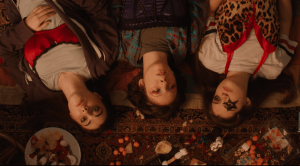 There is one significant critique I do have with They/Them/Us and that’s that this all feels like a far better fit for a television series than as a single film. Rare do I come across a story engine that seems like it has the output to keep going, but that’s what we have here. There are three significant storylines that all would have benefited with far more time and development that a wider field of narrative writing would afford: 1) at its core, this is a story about a blended family and all the troubles and revelations and connections that come from two established families suddenly sharing spaces and lives, 2) Charlie working at a conservative Christian university and having to awkwardly pose as devout while hiding his true feelings, and 3) it’s a BDSM rom-com.
Taken as a whole, it’s easy to see how those storylines could form the backbone of a series-long narrative. Charlie’s facade at work could get more and more complex to carry on, and as his secret gets discovered, more desperate. He could also experiment more with wanting to become sexually adventurous for his partner. There could even be the question over whether he was having an affair when he was really just getting one-on-one instruction with a helpful dominatrix to educate himself. That might sound like a generic sitcom contrivance, but the script makes plenty of these kinds of conflicts and too-easy resolutions. When Maddie refuses to eat, Charlie sits with them, and within literal seconds Maddie is confessing a teacher is deliberately misgendering them and it hurts. Charlie’s solution is to get donuts, and it’s during his exchange with the drive-thru intercom that he makes a heartfelt stand about Maddie being non-binary and preferred pronouns, and then it’s like we’ve wrapped up that conflict in a bow. It’s so absurdly quick, and these characters have not had a conversation together before this, that we’ve seen, so its resolution feels so abrupt as to be arbitrary. That’s where a TV series would allow these characters and their inter-family drama to really take shape. An entire episode could be devoted to Charlie trying, and awkwardly failing, to bond with Maddie, finding a small triumph at the end that would feel better earned. This goes especially in the last twenty minutes when Danny’s drug problems get way too serious for the film’s tone. For most of its running time, They/Them/Her has such a low-stakes sense about all of its family drama, keeping things light and loose. It can’t quite make that leap to melodrama that encapsulates the end of the movie, a transition that doesn’t feel properly established.
 When you’re dealing with human relationships, and with the battleground that a blended family would present, then squeezing everything into a measly 90 minutes feels like a disservice. At one point, Charlie and Lisa ask if they’re rushing things, going too fast, and they agree to move in together at the twenty-minute mark, but it’s almost like an admission to the audience about the movie. Everything is moving just too fast. We need the time to slow down, to really luxuriate in the awkwardness and unexpected connections, and the kind of narrative berths where each character can feel more fleshed out and less defined by a single note of distinction (the Non-Binary child, the Drug Problem child, the Sarcastic child, the Blame Shifter, etc.). I still enjoyed these characters and their interactions, but I would have enjoyed them even more with a larger scope to appreciate the depth and eccentricities of each person.
They/Them/Us is a rather wholesome movie that doesn’t feel like it’s talking down to its audience, judging its characters punitively, or overly sugar-coating their personal dilemmas. It’s not a particularly challenging movie but Sherman and his cohorts know what kind of movie they want to make. It’s technically proficient, assuredly low-budget but still professional in presentation. I often enjoyed the musical score by David Carbonara (Mad Men – what a get this guy was). While some subplots and conflicts are so swiftly and conveniently handled, the core of this charming movie remains its fractious, funny, and all too human relationships. When my biggest complaint stems from wanting more, more of these people, more of their adjustments and misunderstandings and triumphs, and more comic possibilities from a larger time frame of stories, then you’ve done something right with your 90 minutes of movie and clearly not everyone can accomplish even that.
Nate’s Grade: B
Share this:

CODA (2021)
 Ruby Rossi (Emilia Jones) falls under the category of CODA, a Child Of a Deaf Adult. Her mother (Marlee Matlin) and father (Tony Kotsur) and her older brother (Daniel Durant) are all deaf, and she is the only member of her household with the ability to hear. She’s balancing working for her family on their fishing trawler, maintaining good grades in school, and possibly pursuing scholarships to enroll at a music and fine arts college for singing. Ruby’s music teacher agrees to train her because he believes in her potential, but Ruby has to worry that her dream is something that cannot be shared with the people she loves most, and how would they all get on without her?
The framework of CODA is familiar to anyone who has watched a coming-of-age story or family drama, but it’s the conviction and strength of character and sheer force of empathy that makes this movie a standout film for 2021. It’s based upon a 2014 French film, The Family Beller, and follows many of the same beats from other sentimental family dramas about sticking out in your family and society, chasing your dream, often in conflict with your family’s expectations, gaining that sense of inner strength and resolve, and mending differences in perspective with hard-fought and well-earned wisdom. It’s familiar, but that doesn’t mean under the right set of hands that it cannot still be resonant and emotionally gratifying. I do not hold the familiar formula against CODA, even as the family’s goal and her personal goal come into direct conflict in sometimes forced manners. That’s because the movie does an excellent job of establishing these people as characters, establishing the family dynamic as fraught but loving, and establishing a conflict that is direct and clear as far a major point of separation.
 Ruby isn’t just the only member of her family who can hear, she’s also their vital lifeline to the outside world. She’s looked upon as the family interpreter, a position they cannot afford to pay for someone else’s services so the duties and responsibilities fall upon her. That’s so much pressure to bear for one teenage girl, knowing that she’s the link between her family’s poverty-treading existence and possibly breaking free into a larger hearing community. She feels ostracized and awkward within her own family and outside of her own family. To the rest of the school, she’s that “deaf family girl,” and it’s remarked that when she began high school she had an accent reminiscent of what deaf people can sound like, a point that her peers cruelly imitate. She worries she will forever be defined by her family’s disability even if she doesn’t share it. However, within her family, she feels ostracized because she’s different. She wonders if her mother wishes that she too were deaf, and during a heartfelt late-night talk, mom actually admits that upon her daughter’s birth she did feel disappointment when Ruby had hearing. While she knows sign language and has grown up with these loving figures, she’ll still always be the one who’s different, the one who hears the insults her family cannot.
The film does a remarkable effort about contextualizing Ruby’s fears and frustrations of being held captive in two different worlds, neither feeling fully accepted or whole, and that’s why her embarking on a personal dream that her family can never fully appreciate feels so significant. Part of Ruby might feel that singing is selfish, especially if it means limiting her family’s upward mobility by eliminating their unpaid interpreter, but it’s the thing that makes her most happy, a special gift that her family will be excluded from. There’s a wonderful moment toward the end of the movie where Ruby’s father asks her to sing to him, and he puts his hands along her shoulders and neck to feel the vibrations, and his awed and tear-stricken face is so moving, as he so desperately wants to indulge too in the beauty of his daughter’s voice. While occasionally the film goes overboard pounding these two conflicting paths into forced collision (family vs. self), the movie is personal with its big problems and personal with its big triumphs, making it transcend the trappings of formula.
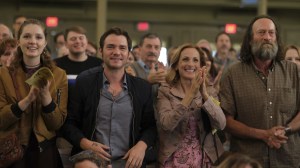 Writer/director Sian Heder got her start on Orange is the New Black, and that TV series’ hallmark has been its enormous sense of empathy for its diverse characters. This is evident in Heder’s screenplay and her observational, detail-rich simple storytelling that immerses you in this world, so even while you recognize more familiar made-for-TV plot turns, the genuine authenticity makes the movie feel like its own unique story. Heder’s direction is delicate and places the attention squarely on her performers. There is one stylistic move late in the film when Ruby’s family comes to her choir recital in support. They look around for cues when to applaud, and their minds wander as they sign about other menial topics like grocery lists, and you understand why once Heder drops you into their perspective. For a minute, the sound disappears, and you’re left studying facial expressions for cues like them. While we can imagine being deaf, it’s another matter to experience it and try and understand.
The acting is another laudable merit for CODA. I personally want three Oscar nominations for this clan, Jones (Locke & Key) for Best Actress, Matlin (Children of a Lesser God) for Best Supporting Actress, and Kotsur (Wild Prairie Rose) for Best Supporting Actor. Over the course of nine months, Jones learned American Sign Language and how to sing, which is surprising because I would have said she has a natural talent with singing. Her performance, as well as Matlin and Kotsur, feel so real, so nuanced, and so natural, like we’ve plucked these people from real life and given them this platform. It’s the best credit you can give an actor, when they seemingly disappear into the character, and the character feels like a fully breathing, flesh-and-blood person. Even the small supporting roles are well cast, well acted, and contribute to the overall authenticity of the movie. Unlike the 2014 French original movie, all of the deaf members of the family are portrayed by actual deaf actors as well.
CODA was a sensation at the 2021 Sundance Film Festival, with Apple Films buying the rights for $25 million dollars, and it’s easy to see why because it’s such a satisfying, enriching crowd-pleaser and legit tear-jerker. There were several points that had me tearing up, and then fully crying, because I was so emotionally engaged with the family, their struggles, and their triumphs and outpouring of love. You might be able to see where the movie is headed because its template is familiar and formulaic, but it’s the execution, the attention to detail, and the level of observational attention that elevates CODA and makes it so winning and so heartwarming.
Nate’s Grade: A
Share this:

Nightmare Alley (2021)
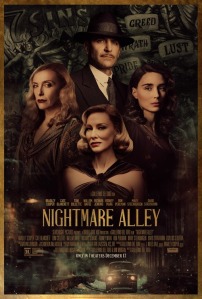 I’ve now watched both versions of Nightmare Alley, the 1947 movie and the 2021 Guillermo del Toro remake, and I guess I just shrug at both. Based upon the 1946 novel by Lindsay Gresham, we follow an ambitious yet troubled man, Stanton (Bradley Cooper), who finds refuge in a traveling carnival, mentors as a phony mentalist, and then uses his skills of manipulation to fleece the rich and privileged while possibly losing his own soul in the process. I kept watching this 150-minute movie and waiting for it to get better, to hit another level, and I had to keep asking, “Why isn’t this playing better for me?” It’s del Toro, an early twentieth-century freak show, a dashing of film noir, and a star-studded cast (Cate Blanchett, Willem Dafoe, Rooney Mara, Toni Collette, David Strathairn), and all those enticing elements should coalesce into something special and dark and adult and transporting, like del Toro’s 2017 Best Picture-winning Shape of Water. However, for me it just feels so turgid and overly melodramatic. I wish the movie had stayed with the traveling carnival and the colorful weirdos that it ditches halfway through. I think it’s because the movie plays to your exact expectations. You expect it to be beautifully composed, and it is, with a flair for the grotesque, a del Toro specialty, and the beats of its film noir-heavy story with femme fatale and double crosses comes across so predictably but minus substantial depth to compensate. I kept waiting for the themes to deepen, to be a better reflection of ourselves, but it’s one man’s circular downfall that doesn’t play too tragic because he’s already an unrepentant scoundrel. Cooper also just seems too old for the part, especially when everyone refers to him as a “young chap.” You might not see a better looking movie from 2021. The cinematography, production design, costumes, and stylish panache that del Toro trades in are all present and glorious to behold. I just wish I could get more from Nightmare Alley besides an admiration for its framing and less about what is happening to the characters within such doting artistry.
Nate’s Grade: B-
Share this:

The Count of Monte Cristo (2002) [Review Re-View]
 Originally released January 25, 2002:
Call it swash without the buckle. While The Count of Monte Cristo does an adequate job of telling the Alexander Dumas story (heavily editing chapters and making the leads friends in this version) the whole experience feels very rote. The sword fighting scenes are nowhere what they were billed as and the direction is surprisingly lackluster. Only the actors allow this film to arise mediocrity particularly with a devious turn from Guy Pierce (Memento). Kevin Reynolds (Robin Hood: Prince of Thieves) directed this film and proves he doesn’t need Kevin Costner to screw something up. Somewhere Costner is laughing. Actually, somewhere Costner is likely crying in his beer wondering what happened to him. “I was the king of the cinema…”
Nate’s Grade: C+
——————————————————
WRITER REFLECTIONS 20 YEARS LATER

I think 2002 is going to be my potential apology tour year when it comes to reviewing my initial film criticism of twenty years hence. The Count of Monte Cristo is my first entry for the new year and I already cringe re-reading my initial review. I think some of my early film reviews went overboard on snark, trying to establish a cool, chipper-than-thou attitude, but this was the early 2000s writing default for many. It was better to make quips, take some cheap shots, and sprinkle in some actual film criticism on top, and it’s a style of writing I’ve tried to grow out of as I’ve aged. I began writing film criticism back in 1999 as a means of expressing myself and showcasing my cinephile knowledge, and in many ways it was like learning to crack a puzzle, why a movie worked or didn’t work and what decisions lead to this eventual outcome. In some ways, early on, it was showing off and exploring my evolving writerly abilities, and sometimes that meant prioritizing cleverness over sincerity. I know I’m going to be reliving this with Crossroads but I’m reminded already with my first movie re-examination for the year 2002. So, to the filmmakers of The Count of Monte Cristo, on behalf of my then-19-year-old self, I apologize. Your movie is actually pretty good and, strangely, even makes some deviations from the book for the better.
Based upon the famous novel by Alexander Dumas (1802-1870), it’s a classic tale of vengeance and it’s plenty fun to watch because it feels like a movie that is giving you so many different turns at once. It’s almost structured like 30-minute episodes, and while being deemed “episodic” is usually regarded as a negative for a film story, I think this is an improvement. The beginning segment establishes how Edmond Dantes (Jim Caviezel) gets into trouble, and he might just be the biggest idiot in the world. The opening features him and his best pal, Fernand Mondego (Guy Pearce), seeking assistance for their ailing ship captain on the island of Elba during the time of Napoleon’s exile. Edmond agrees to deliver a letter from the deposed emperor to “an old friend” of his and then Edmond gets charged with treason in France. His shocked, incredulous response is absolutely hilarious (“What? Napoleon… USED me? I’m starting to rethink my whole appraisal of this man who tried to conquer the European continent.”). There’s a conspiracy by a government official to cover up his father being a Napoleon loyalist, the intended recipient of the letter, but it almost feels like Edmond deserves to be in jail for being this naively stupid. The first half hour sets up the villains, Edmond’s BFF betraying him to covet Edmond’s attractive wife, and the starting point for vengeance to be had. It’s economical storytelling and works well, and each thirty minutes feels like they are defined by a “very special guest star” who comes and goes.

The next thirty minutes explores Edmond’s life and routines in prison, lorded over by a cruel warden (Michael Wincott), and where he finds his mentor and salvation with an old priest, Abbe Faria (Richard Harris). Again, screenwriter Jay Wolpet efficiently establishes the routine, the passage of time, the means of how Edmond might escape, and his growing relationship and tutelage under a new unexpected friend. It’s kind of funny to watch old man Richard Harris (Gladiator) teach the considerably younger Caviezel how to sword fight, especially knowing that Harris would pass away later in 2002 at the age of 72. He needs the training because our first impression of this man is not favorable. Once Fernand betrays him, Edmond engages in what might be the most pathetic excuse for sword fighting I have ever seen. I know the classic character arc of starting inexperienced and weak and coming into experience and strength needs to be laid out, but man this guy just sucks. He runs around like a lame animal, crashing into furniture, meekly pushing glasses off a table and flopping like a soccer player trying to score a penalty card. However, the crucible of vengeance will temper this man into a dashing fighting machine. The prison segment establishes rules, develops a central antagonistic and mentor relationship, develops a prison break, and then provides Edmond with his first victory, first villain to topple, and shows his new cunning.
The next thirty minutes is almost a buddy movie between Edmond and Jacopo (Luis Guzman), the “best knife fighter in the world,” a smuggler whose life Edmond saves before joining the gang. Together they seek out the island of Monte Cristo, find a bountiful fortune thanks to Faria’s confiscated treasure map, and then Edmond reinvents himself as a mysterious count. He makes quite a flamboyant entrance, almost like a dapper nineteenth-century Great Gatsby, flaunting his extravagance and theatricality to make his mark with the upper social classes. His calculated social graces reminded me of any number of costume drama series that are predicated on operating within a rigid system of social manners and expectations. It’s about establishing his new reputation and working his way back into a position that he can tear apart whatever advantages Fernand has gotten used to. His former friend has married his wife, though he flaunts his infidelity, and he also is raising a son, Albert (Henry Cavill), that may or may not belong to Edmond. It’s through this son that Edmond sees his way back into the good graces of this family, staging a kidnapping and his rescue that gives him the standing he needs. Naturally, Edmond’s wife recognizes her former husband instantly, though he tries to deny her claims. This segment establishes the new normal, Edmond’s traps being set, and then it heads into its fitting climax.

Much of these plot points are from Dumas’ original novel, which is so tailor-made to make for an engaging adventure with a thirst for blood. It’s such a sturdy structure that provides satisfaction, as revenge stories often will; they are so easy to root for because it’s so utterly primal. There’s a reason there is an entire sub-genre of exploitation films is nothing but revenge (and yes, sadly, too often including rape as the inciting wrong to be avenged). It’s an easy hook for an audience to get onboard and root for. Wolpert’s adaptation makes some smart changes to better transform the story for the visual medium. By making Edmond and Fernand friends, it does make the betrayal feel even more bitter. Also, the means of vengeance is simply more engaging here. In the novel, Fernand’s bad deeds are exposed publicly and he’s humiliated and kills himself. He’s not even the final villain that Edmond gets vengeance upon. The 2002 movie improves a classic novel and makes the ending feel even more climactic. Watching a villain like Fernand just slink away would not be as satisfying as a finale (that’s not even the story’s finale). Wolpert, who is also credited with the screen story for the Pirates of the Caribbean franchise, died very recently as of this writing, on January 3, 2022.
Director Kevin Reynolds was two movies removed from 1995’s Waterworld, an expensive post-apocalyptic action movie set mainly at sea, and a movie that does not deserve its disastrous reputation. It’s a pretty fun sci-fi action movie with a great Denis Hopper villain and plenty of splashy, big screen spectacle. It was turned into a longstanding and well-received Universal Studios stunt show if it’s any consolation. Reynolds hasn’t really made much of a career after the long shadow of a supposed costly flop (only two movies since Monte Cristo), but if Renny Harlin, he of the also super expensive, studio-killing flop Cutthroat Island, can continue churning out genre dreck, why can’t Reynolds? The man has a natural feel for big screen spectacle, and with 1991’s Robin Hood: Prince of Thieves, he’s proven that he can capture traditional settings and make them feel in keeping with modern tastes, and he can capture futuristic settings while making them feel grounded.
I’m sorry, Mr. Reynolds, because you did not “screw something up” with this movie (fun fact: Reynolds was the screenwriter for Red Dawn). However fair or unfair, the man is defined by his relationship to Kevin Costner, most recently with the 2012 Hatfield and McCoys miniseries and beginning with 1985’s Fandango, which began as a student film that Costner lost out on a role for. None other than Steven Spielberg recruited Reynolds to make a feature version of his short.

It’s strange to go back to The Count of Monte Cristo because of Caviezel’s god and martyr complex. I’m speaking of his 2004 portrayal of Jesus in Mel Gibson’s biblically successful Passion of the Christ, but he’s gone even further now, fully adopting the QAnon conspiracy of a cabal of liberal elites harvesting the blood of children, possibly while trafficked in Wayfair furniture, for Satanic rituals. His persecution complex was already alive years ago, saying he was made a “pariah” in Hollywood after Passion of the Christ, despite its international success, and ignoring the fact he starred in a TV series on CBS that ran for five seasons. I guess that’s what he means when he stars in QAnon-related biopics that nobody wants to release (Sound of Freedom is slated to have been released in January 2022, but I cannot find any evidence this has happened). It’s just sad to recall an actor before they so thoroughly declared themselves to be dangerous and/or crazy, but I’m sure to those who knew him, these uncomfortable impulses and proclivities and conspiracy leanings were already there.
The best reason to watch The Count of Monte Cristo is the supporting cast. Pearce is delightfully wicked and enjoying himself. Harris has such weathered gravitas to him. Guzman is hilarious and his modern acting approach just does not fit with the overall vibe of the movie, but that disconnect is part of his amusement. Even Cavill is fun to watch, especially since he was only 18 years old at the time (Dagmara Dominczyk, who plays his mother, is only seven years older). You’ll see the early indications of the swagger and presence that will define him as a square-jawed leading man. The Count of Monte Cristo is a well made, exciting, and satisfying revenge thriller, as well as a smart adaptation of a classic work of literature that actively finds ways to improve upon it, insofar as a big screen movie. I’m sorry I was so snide twenty years ago (the Costner jab was an unnecessary cheap shot). It’s certainly swash, with the buckle, and deserves a better grade and better appraisal after all these years apart.
Re-View Grade: B
Share this:

The Worst Person in the World (2021)
 Joachim Trier is a filmmaker that dazzled me with his debut feature Reprise, which I placed as my number three film of 2008. The Norwegian filmmaker has amassed a small collection of quirky, introspective, bohemian dramas exploring the growing pains of being young in Oslo. His movies tend to be deeply empathetic and refreshingly free of judgment, which then allows the audience to empathize with the characters even when they are failing or floundering in life and in love. In some ways, Trier’s open approach to building character over time reminds me of Richard Linklater, and it’s easy to find a loose thematic connection between Reprise, 2011’s Oslo, August 31st, and now this new movie, besides the same actors he returns to again and again. It’s more a humanist spirit that pervades the films, capturing life’s moments, big and small, that formatively alter who we are. The Worst Person in the World is a pretty straightforward character study of an impulsive, indecisive woman trying to live her life and having a challenging time of things.
Julie (Renate Reninsve) is a conundrum of a character. She’s far from the titular worst person in the world but she’s certainly flawed, a young woman in Oslo turning thirty without a clue about what she wants from life. She drifts from one job to another, one academic pursuit to another, and one man to another, growing restless whenever stability seems to be materializing. She’s the kind of person who is always looking ahead but unsure of where ahead even lies. At first her boyfriend Aksel (Anders Danielsen Lie) seems alluring, a successful underground cartoonist known for his boundary-pushing work. But the man is fifteen years her senior and more eager to start a family than Julie is. Then one night she crashes a wedding and meets Eivind (Herbert Nordrum), a carefree barista, and they hit it off while trying not to cheat on their respective others. Julie keeps thinking about this other man, her other possibilities, and wonders what if.
 Each of the twelve segments feels like a new version of herself Julie is trying on, feeling out the edges to see if it fits well. With each segment, we can learn a little bit more about her in different contexts. The format makes the moments feel like formative memories more than just scenes driving the story forward to the next. Often there are great leaps of time in between, and some segments are relatively short, like a few minutes. Some of them are comical, some of them are heavily sexual and/or sensual, and many of them are unrepentant for Julie. Then as the movie continues the chapters get longer, becoming more reflective and remorseful. Every now and then, Trier’s sense of style, something more explicitly pronounced in his earlier films, will seize the moment to better illustrate the internal life of Julie. When she’s making a significant choice to leave her current boyfriend, time literally stands still as she runs through streets and frozen pedestrians to leap into the arms of her new lover. When Julie is tripping on magic mushrooms, the depths of the world dip, and she’s in rapid free fall away from that same lover. My favorite stylistic flourish is when Julie is reflecting upon what she has accomplished by age 30 and how this compares to her mother, grandmother, and so on, going back to her deceased great-great-great grandmother, who died before getting to thirty as the average life expectancy of her era was tragically only 35 years old.
I think Julie represents a certain generational “buyer’s remorse/FOMO,” a restless spirit that is always thinking about what she doesn’t have as opposed to what she does have. This is evident in what we see in her romantic relationships. Each of the two suitors that Julie bounces between offers different experiences, one more akin to her carefree and aimless sensibility, and the other more focused, certain, and forward-looking. As she settles into a routine with one man, her restless nature kicks back in, and she starts thinking about what the other has to offer. It’s a constant push-and-pull that will sabotage any potential long-term romantic relationship. This leads to Julie making rash decisions, never really allowing herself to get comfortable, and hurting the people she cares about, even professes to love, and yet she’s far from hateable. She may even be relatable for some.
 During the more morose final act, this is where the movie slows down and Julie perhaps realizes that settling down is not the same thing as settling. I say “perhaps” because I don’t know by the end if Julie has really changed as a person through these dozen chapters. I’d like to think so, hopeful that our experiences and challenges reset our nascent thinking and broaden our perception. By the end, Aksel has had some very dramatic and negative turns, forcing him to re-evaluate his limited time on this planet and his personal actions, always looking ahead when he wishes he had more appreciated the moment. He says he doesn’t want to live on through his art and would rather simply live in his apartment. It’s all too little by the time it comes to a finite end. He wishes he and Julie had never broken up, that they had raised children, and he simply had more time with the person he knew was the love of his life.
For Julie, this somber final stretch allows her to contemplate her own naivete and what drives her away from others, that no matter what career path she takes, what man she chooses to shack up with, what goal she prioritizes, that little will change unless she focuses on resolving her own internal issues and hangups first (if you guessed emotionally distant father, congrats and collect your prize). She’s so scared of missing out on something better, of being denied her true self, but in pursuing this aim at all costs, she’s missing out on other experiences that can be just as rewarding and fulfilling. Making a choice does not mean you are burdened with the unmet possibilities of the myriad of choices you did not make. It’s about committing to a person, a vision, a possible version of yourself, and giving it a real chance.
Much of this hinges on the shoulders of the lead actress, and Reinsve shows why she earned a Best Actress award at the Cannes Film Festival. Reinsve had a small supporting part in Trier’s Oslo, August 31st but is best known as a Norwegian theater star, and here she makes quite a lead film debut for herself. Looking like a dead ringer for a Nordic Dakota Johnson, Reinsve gets to showcase an impressive variety of emotions as a constantly evolving, self-sabotaging individual. At every point, she feels like a genuine human being, even as she’s losing interest in her current situation or lover, and even when she’s struggling you can appreciate how committed Reinsve is to being as honest and messy as Julie turns out to be. Another standout is Danielsen Lie (a constant in Trier’s films) who gets the biggest emotional arc and has the saddest moments. Aksel’s late epiphanies will hit but the character’s troublesome nature might blunt the depth.
 I’m undecided whether the twelve-chapter (plus prologue and epilogue) structure of the narrative actually helps or hinders the impression of Julie. Some of these moments feel far less important than others, or examine a hobby or side-step that Julie takes before abandoning again. There’s a certain frustration that’s going to be inherent in watching a serial quitter. You might even yell at the screen to pick something, taking on the silent yet exhausted expression of Julie’s mother whenever she mentions her next life direction. The addition of an off-screen narrator that drops in and out for some wry commentary seems like something Trier should have committed to more to provide some observational distance with the on-screen antics or ditched entirely. The concluding epilogue is open-ended enough to allow the viewer to be pessimistic or optimistic; has Julie learned about herself enough to settle on a career and allow herself to be happy? Can she ever be happy? It’s enough to keep the viewer guessing, which is appropriate for the ambiguity of the characterization, but it misses out on feeling like an ending. It’s more a pause at this juncture of Julie’s life, and maybe that was the design all along. It’s not a journey of one continuous climb to self-actualization but a series of starts and stops and unfortunate missteps.
Julie is far from what The Worst Person in the World might lead you to believe. She’s confused and struggling and searching for what will eventually click, some sense of herself that rings true that finally gets her to stop and enjoy her present rather than fretting about what she may be missing. Ultimately, only focusing on what you do not have will never allow you to appreciate what you do, but life and learning is a process and everyone comes to these realizations from a different path, if they ever come to it. Trier’s movie is a little meandering, a little lopsided in structure, and I don’t quite know if the pathos is earned by the overly somber conclusion. It is another observational, funny, and occasionally melancholy tale from Trier, a filmmaker who still has deep feelings for his characters and their all-too human foibles.
Nate’s Grade: B


You must be logged in to post a comment.