Blog Archives
Good Luck to You, Leo Grande (2022)/ Cha Cha Real Smooth (2022)
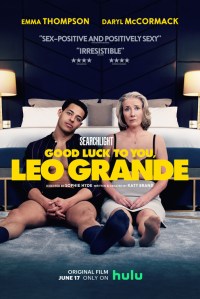 I was taken immediately and repeatedly by the many charms and intriguing personal details of Good Luck to You, Leo Grande (hence referred to as Leo Grande for the sake of my typing). This little indie played at the 2022 Sundance film festival and is primarily two people in one hotel room talking for the entirety of its 97-minute run time, and oh how early I was enraptured. This is a small-scale but laser-focused character-driven drama with edges of comedy and romance. It’s sex positive, very mature and tasteful given its subject matter, and the general awkwardness of watching two strangers combat sexual and personal hang-ups and vulnerabilities melted away thanks to the deftly superior acting, writing, and directing of those involved.
Emma Thompson plays Nancy Stokes (not her real name), a retired school teacher who worked for a parochial institution and taught Christian religion. Her husband has died and she reveals that, over the course of their thirty years together, she has never truly known physical pleasure. She seeks to change that by hiring a professional sex worker, Leo Grande (not his real name), played by Daryl McCormack. We will chart Nancy’s sexual awakening over four intimate encounters.
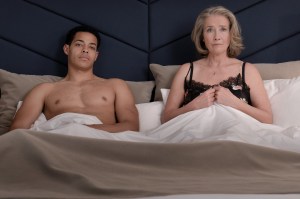 What stood out immediately to me was how well developed the story unfolds at such a natural pace. I’ve watched more than a few indies that simply don’t know what to do with their premise, that feel like they’re biding time to get to feature-length, and some that are likewise constrained to single or minimal locations but fail to secure the most essential need: providing a reason for the audience to care. Whether a movie takes place in one room or a hundred rooms, you have to make the time spent meaningful whether through compelling characters or a story that keeps you engaged and waiting for more. You need to connect to the characters or be intrigued by the revelations to come, and Leo Grande does both immediately. Its setup is rife with drama and conflict, two people navigating their relationship to physical intimacy, two people who have never met until now for a transactional evening. There are obvious, natural personal conflicts to be explored here, with the novice out of their depth in many senses. There are also plenty of intriguing possibilities, because as these two get to know one another so too are we getting to know each and getting glimpses of who each of them are outside of this room. Both people are putting on fronts of some sorts, trying to settle into a performance of who they could be, and peeling away the layers of this subterfuge becomes even more intimate and engaging. Writer Katy Brand, known for outrageous British sketch comedy, skillfully maps out the story so that each conversational stop, detour, and ramp-up feels organically composed. It takes a great writer to keep your attention from a movie about two people talking, and Brand is that good. The contrast between our characters and intimacy, from forced to unlocked, keep us glued intently.
I also think there’s an interesting generational character study here, though the film doesn’t ever make any grand pronouncements about the symbolic representation of its heroine. Nancy is over 60 and at a point where she’s used to compliments with the added qualifier of “for her age.” When she discusses her sexual history with her husband, it’s almost like a confession that she’s been unable to get off her chest for decades, an acknowledgement of her disappointment and longing. Her husband was the kind of man who would lie in bed, roll on top, and then a minute later roll off, mission accomplished (no wonder this woman has never experienced an orgasm). Talking through this embarrassment, it brings Nancy to tears, realizing she’s lived so much of her life without accessing physical pleasure, a joyful repose that so many others seem to revel in. This bold step, hiring a sex worker online, is her making a leap outside of her comfort zone, and the subsequent return engagements give her new opportunities that have eclipsed her for so long.
 In essence, this is woman who feels like she’s playing catch-up. Her character is from a generation where women didn’t make as much of a fuss about reciprocal pleasure. Her view of her aging body is one of general shame. She will repeatedly say she has no idea what she’s doing. Nancy feels like she’s been missing out for so long and wants what has been denied to her. However, she also has her own personal sexual hang-ups she’s pushing through, with decades of religious upbringing and enforcing moral codes with her students and their wardrobe choices. All of it adds up as far as her view on sex and her body. Leo asks her if she just wanted sex why not find a man in a pub and go from there, and she curtly says she doesn’t want an old man, an old man that will simply be another version of her husband, another disappointment in a lifetime of unrealized intimacy; she decidedly wants a young man. She’s indulging in her desire and a young man best represents a promise of sexual fulfillment (and she definitely doesn’t have any teacher/student fantasy, she will let you know). I think there are many more Nancy’s in the world, older women who soldiered through their lives, carrying the burdens of others while sacrificing their own pleasure, and are now at point in their lives where they are hearing more about body positivity, about female pleasure, and about being worthy of physical intimacy on their own terms and desires. Nancy is a character having a delayed sexual re-awakening; in her confession with Leo, she details her first impulse of desire when she was 17, a feeling that she hasn’t experienced as surely for the decades hence. While being a unique and well-rounded character, Nancy also serves as a representative of an older generation and perspective coming into conflict and revelation with a modern sense of intimacy and self.
Leo Grande is a smooth and charming man but one who doesn’t feel oily or like he’s obnoxiously masculine. With McCormack’s kind eyes and soothing Irish balm of a voice, it’s easy to see how this man could set others at ease. But then you also have to remember that Leo Grande is not who this man really is; it’s a character he’s playing, and as Nancy opens herself up to this man, she’s looking for him to do the same, for them to share something more special than a simple client-professional relationship. The more that Nancy pushes and pries, the more that Leo himself is pushed outside his own comfort zone. Leo is willing to talk about some things, like his frayed relationship with his mother, a point of unity with Nancy and her adult children, and his cover story of being away and working on an oil rig, an outlandish excuse that makes Nancy and eventually Leo break into laughter. By the nature of this character dynamic, Leo must be the more confident and assured participant to better contrast with Nancy’s personal and cultural insecurities. He’s the pro and she’s the novice. However, that doesn’t mean emotionally he’s as self-assured and without regret. Listening to these two characters bounce off one another and come in and out of intimate contact is fully entertaining.
I hope that Thompson (Cruella) gets nominated for an Oscar for her portrayal. She’s in just about every second of the movie and so much of it hinges upon her baring herself, physically and emotionally, to this man and us, the tacit observers. It’s a performance of radical self-love in so far as Nancy is reclaiming her body as a point of pride rather than as one of shame. In some ways, she’s shedding her past sins, easy judgement on the mores of others and their bodies. Thompson goes through such a wide range of emotion and gets to play so many different revealing sides to this woman putting herself in a most unfamiliar position. It’s Nancy coming to terms with her own disappointments, misgivings, and hypocrisy, and Thompson is splendid at every moment. She gives so much life to this character without sacrificing her complexity or occasional coldness. By the end, when her character hits her arc’s climax, it feels like a journey fully earned.
 Another 2022 Sundance indie, this recipient of the Audience Award and a plum Apple Plus streaming spotlight, feels less smooth despite its title. Cha Cha Real Smooth is from writer/director/star Cooper Raiff, the twenty-five-year-old up-and-coming filmmaker best known for 2020’s Shithouse, a talky and introspective movie about older teens trying to gravitate with the adult world they feel ill-equipped to handle. While I found some promise with Raiff’s naturalistic dialogue, I found the lead characters to be too dull to really care about. Enter Cha Cha (which will also, henceforth, be how I refer to the title) which benefits from deploying more recognizable rom-com and indie movie plot mechanics. Working from a more familiar movie template, it actually helps Raiff better temper his writing and focus his story. While I enjoyed the movie overall, I would say it still has not won me over to the charms of Raiff just yet.
Raiff plays Andrew, a recent college grad who is still very much trying to figure out his life. He knows he doesn’t like his mother’s (Leslie Mann) new husband (Brad Garrett). He also doesn’t like his job working at a mall food court. He’s also not happy that his ex-girlfriend broke things off before leaving for Barcelona. He’s struggling to plan his “what comes next” when he stumbles into a job being a “party starter” after his enthusiastic chaperoning of a local bar mitzvah. Soon the neighbors are all seeking Andrew’s party-starting ability to make their next bar or bot mitzvah a fun time. Andrew becomes attached to a thirty-something single mom, Domino (Dakota Johnson), and he autistic teen, Lola (Vanessa Burghardt), he persuades onto the dance floor to loosen up. Domino is intrigued by the younger man and asks him to babysit Lola, especially since the two have bonded and earned a trust. Andrew doesn’t know whether Domino is feeling the same level of attraction but someone who would not be happy is her fiancé, Joseph (Raul Castillo).
 You spend a lot of time with Raiff as the lead, so your ultimate determination on Cha Cha will hinge on your perception of Andrew and as Raiff as a performer. He’s got an easy smile and his enthusiasm can be endearing at points, like he’s incapable of being still in thought. I found the scenes where he encourages little kids to be cute and easy to enjoy. He’s an infectious presence when he’s dealing with children. However, when Andrew is dealing with adults or people his own age, he seems to be out of his depths with arrested development. He’s rude and pissy with his stepfather for no real discernible reason given. He’s fairly thick-headed about romantic ideals about following his girlfriend to Spain, who declines his grand offer. Andrew’s uncertainty about charting his own path is a familiar story, and Raiff takes advantage of the overall coming-of-age blanket of tropes. The problem is that too many of them feel easily discarded. The only characters that seem to matter in Cha Cha are Andrew and Domino. Even Andrew’s younger brother (Evan Assante), who loves his big brother so much that he is constantly asking for advice on romancing a girl he likes, and the kid even cries at the prospect of his brother moving out of his room, is just another underwritten foil like Andrew’s mother, always supportive, and stepfather, always wary, and friend-with-benefits girl, always… there? These characters are meant to be reflections of our main character, serving to make him look charming or sincere or naïve or deluded but always serving Andrew. This can work in screenwriting but it helps if the characters don’t feel so obviously cultivated to make our hero look good.
I did find the central will-they-won’t-they relationship between Andrew and Domino to actually be entertaining. Much of this helps from Johnson sliding into a role that definitely fits her skill set. The role doesn’t even seem too different from her struggling thirty-something mother in The Lost Daughter. In the last few years, I have grown as a fan of Johnson with strong supporting turns in Bad Times at the El Royale, Peanut Butter Falcon, and as a dying mother in Our Friend. In each one of these roles, there is an inherent melancholy to her that she so effectively radiates. She has certainly broken free from the long shadow of the Fifty Shades franchise. Much of Domino feels from the point of view of a young man projecting onto her, and I think that is also Raiff’s larger thematic point. In Shithouse, a significant plot development is when Raiff’s central character has a different interpretation of a sexual encounter. He bombards the young woman with eager texts and is carried away with making an attachment, whereas she did not view their college hookup on the same terms. Although, this hard wisdom is undercut at the end of Shithouse by this same lady relenting and saying, “Yeah, okay, I’ll be your girlfriend.” To Andrew, Domino is a wounded soul looking for a rescue and he’s her dutiful man in shining armor. From his perspective, she is crying out for kind attention and support that he feels is being neglected. The learning curve for Andrew is that Domino can distinguish between a person who excites her and a person she can see herself settling down with. Their age discrepancy is never really addressed until the very end, though Johnson herself is only 32 years old, which doesn’t seem like an insurmountable gap though Domino’s age is kept purposely vague. I would have preferred the movie being told from her perspective as she had the most interesting role. Johnson and Raiff have an easy-going chemistry, with his overeager charmer meshing with her subdued, glassy-eyed, taking-it-all-in openness. She makes him feel a little more excited, but ultimately, that may not be as important as other more practical concerns.
 This leads to what seems like the lesson of Cha Cha, because for a movie that seems to operate on a powerful level of irony-free sincerity, the big life lesson it seems to impart is that becoming an adult is one about accepting compromise and disappointment. Sure, that’s an important lesson, to adapt as well as process personal reflections, but with Raiff’s movie, Domino’s lesson seems to be she’s accepted that her fiancé doesn’t make her feel all the things that young Andrew does but he will provide stability for her and her daughter and that means more at this point. I cannot say whether the movie is asserting that Dakota’s reasons are mature and something Andrew will come to understand in time when he gets a little older or whether we’re supposed to see her as someone willfully forgoing her personal happiness to settle for something less and that, to Raiff, is what adulthood means, settling for less. The way that writer/director Raiff could have shore his thematic intentions would be with the supporting characters, seeing this larger nugget of wisdom reflected in his own mother’s relationship with the stepdad who Andrew could attempt to understand better rather than view with contempt. This is where underwriting the supporting characters can also undermine the artistic aims of your movie. It appears like Raif, at 22, is saying that growing up means essentially giving up on some level, which is a strangely pessimistic lesson for a movie that trades in such earnestness and sunny go-go positivity.
I sound more negative with Cha Cha Real Smooth than I’m intending. It’s a relatively breezy movie to watch with fun exchanges, solid jokes, and characters that I found amusing and some of them even engaging. It has its charms and sweetness and I can completely understand falling under Raiff’s spell. This is definitely a step in the right direction for Raiff as a filmmaker after his 2020 debut, and I think he’s going to continue to grow and tell these personal, highly verbose little indie dramas with big feelings where whomever Cooper Raiff portrays learns some life lesson, likely from his interaction with the person of the opposite sex he desires. As such, every Raiff movie from here on out seems likely to rest upon your feelings about him. With Cha Cha, the sequences between Andrew and Domino or Lola were my favorite, so the film mostly worked.
Good Luck to You, Leo Grande and Cha Cha Real Smooth are both fine examples of indie filmmaking supporting distinct voices adding their stamp on the larger contours of the romantic comedy genre. Leo Grande is a grand example of character writing and it’s even poignant and a little sexy. It’s extremely tasteful and nuanced and even empowering for an entire movie about two strangers meeting in a hotel room for sex. Cha Cha is a fun and formulaic coming-of-age movie and with Dakota Johnson hitting her stride with a winning character with pools of depth. There are some writing and thematic shortcomings but it’s still a charming experience. Both movies can definitely brighten your mood and generate their share of smiles for 100 minutes.
Nate’s Grades:
Good Luck to You, Leo Grande: A-
Cha Cha Real Smooth: B-
Share this:

Father of the Bride (2022)
 Those familiar with the 1991 Steve Martin movie, or the 1950 original with Spencer Tracy, or even the 1949 novel by Edward Streeter, who was born in 1891, will understand that Father of the Bride is an old story that can still be relatable with new wrinkles and details. The core elements of the story, about the stress and chaos of wedding planning, or the pressure and patience of family, are still present with this new version where Andy Garcia and Gloria Estefan star as the parents of the bride (Adria Arjona). Garcia is a first-generation Cuban-American, a successful Floridian architect about celebrating old traditions, and a bridezilla of epic proportions terrorizing every soul in Miami. He is an awful person, holding to outdated and cringe-inducing misogyny and at several points making demands that because he is the father of the bride, he will be dictating exactly how his daughter’s wedding will proceed no matter the objections from the bride. Even when the groom’s wealthy Mexican family comes into the picture, neutralizing his power of the purse, Garcia’s bad dad just gets even more pushy and prissy. Ultimately, of course, he sees the error of his ways, the opulent wedding is nixed for something more spur of the moment combining traditions old and new, and everyone seems to get along by the end as one big happy family. I liked the added subplot of Garcia and Estefan hiding the fact that they are getting a divorce, which provides farcical potential. However, some of the subplots feel lightly developed, especially the other daughter being tasked with making all the bridal dresses for her sister. She wants to be a designer but cannot get a break, and yet the final reveal of the wedding gown is absent any drama, taking away from the relationship between the two sisters. Same with a friend who may or may not be queer and vibing for the bride’s sister. It’s strange that the two daughters get underdeveloped when they’re so essential to the wedding, and especially considering the movie is practically two hours long. I wish the filmmakers had trimmed some of the redundant “Andy Garcia is awful” moments and given more time to other supporting players. Father of the Bride is a chuckler of a movie, never netting bigger laughs but providing a few chuckles and smiles here and there. It’s a pleasant movie to watch, though I don’t think Garcia’s tyrannical father has earned his epiphany and forgiveness by the end. Given a Hispanic spin, the personal details and cultural authenticity allows an old story to feel fresh or at least fresher.
Nate’s Grade: B-
Share this:

Downton Abbey: A New Era (2022)
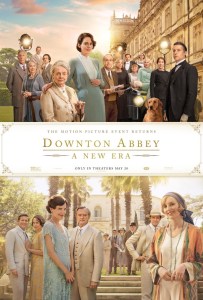 I have only watched the first movie, released in 2019, and know precious little about this widely successful BBC television series detailing the rich aristocrats and their plucky servants, so take my assessment with a whole serving tray of salt. The first Downton Abbey movie served as an epilogue for the series, providing extra resolution to several characters and coupling up others to provide a happy ending. Then it was wildly successful (a worldwide gross of almost $200 million) and so creator/writer Julian Fellowes (Gosford Park) got to come upon with yet another epilogue, this time finding even more happy endings and couplings for the those left out from the first cinematic victory lap. As someone new to this world, I was amused by its understated wit, puffery and pomp, and class conscious dramatics, plus it had a killer cast, most notably Maggie Smith as the tart-tongued Dowager Countess. The second cinematic offering is mostly more of the same, splitting the cast in two locations. One half are inspecting a picturesque villa in the south of France left to the Dowager, to the buttoned-up surprise of her son who questions what relationship his mother had with the former owner. The other half are stationed at the Downton estate while a Hollywood film crew decamps to make a movie. The inclusion of the movie-within-a-movie allows for some dishy moments, starstruck characters, and opportunities for a few Downton residents to make their mark in the pictures. These scenes are fun and provide some interesting conflict as the production has to quickly adapt from being a silent movie to one of them newfound all-the-rage talkies (with a lead actress better suited without sound). It’s a fluffy side story but allows many characters to shine. While the movie is mostly low-key and charming, much like its first big screen effort, by the end there might be some real tears, especially if you’ve been with these characters from the start. If you’re a Downton fan, you’ll eat this all up. I did have two questions that lingered: 1) where is this baby that was the entire story line for Edith in the first movie?, and 2) where in the world is Lady Mary’s husband (Matthew Goode) by the end when he should definitely be in attendance? My pitch for Downtown Abbey 3: Stiff Upper Lip begins with Lady Mary divorcing her racecar-obsessed hubby and moving to Hollywood for a new adventure.
Nate’s Grade: B
Share this:

The Other Side of Darkness (2022)
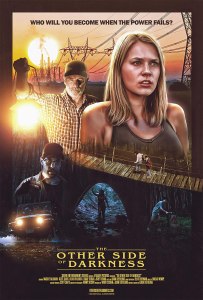 Adam Deierling is a native Ohioan who spent ten years in the hustle and bustle of the L.A. film scene before relocating back to the Buckeye State in 2008. He has since focused on wedding videography and short films and spoken that his goal was to get a professional feature film off the ground locally, an admirable goal, and he wanted to create a family-friendly adventure film that could inspire others. That result is The Other Side of Darkness, written and directed by Deierling and filmed entirely in Ohio and West Virginia. Unfortunately, the movie doesn’t know what to do with its major plot elements and feels a bit too lost by its own creative indecision.
Taylor Jo (Maggie Callahan), a.k.a. TJ is turning sixteen soon and eager to leave her small Ohio town. She works in her foster father’s auto shop and hates it and the direction of her life. Then one day she gets a mysterious note in the mail with a key that leads to an old Jeep. Turns out, the Jeep belonged to her biological mother and the note is from her still-living grandfather, Jack (Scott C. Davis). She hops in her new car, her best friend Hannah (Olivia Billings) and her cute brother Patrick (Drake Tobias) come along for the ride, and they head out to meet gramps. However, he might not be all that he seems, and a looming threat emerges that might cause the power system to go down, and then who can these beleaguered teens trust in these troubled times?
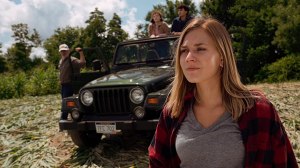 The Other Side of Darkness is like several different scripts stitched together, none of them richly developed or integrated to the other, which makes for an unfulfilling and tedious experience. Each of the half hours feels like a different movie. The first 30 minutes establishes the small-town life for TJ and her desire to escape, especially her predator of a foster parent. Then the next 30 minutes is about TJ and her friends going on a road trip to West Virginia to meet her biological grandpa and for TJ to learn more about her departed mother. Then the next 30 minutes is a mystery of whether or not the grandparent is who he says he is and discovering the terrain. Then the final 30 minutes is an action thriller to thwart homegrown terrorists. Each of these sections goes on far longer than it needs to, each of them presents very little sustained character development, and each of them feels adrift when compared to the other section. In the barest sense, these sections have a tenuous cause-effect relationship; however, the difference is whether the narrative feels like it’s actually building from scene-to-scene or just biding its time. I don’t know why we need a full half-hour to establish how awful TJ’s life is, especially throwing in the topic of sexual molestation, a serious subject that feels shoddily mishandled. The hook of this movie is the idea of our power system falling. Even the tagline says, “Who will you become when the power fails?” Well fear not, dear reader, because, spoiler alert, you’ll never have to wonder because the power grid doesn’t go down at all. The marketing sure looks like it’s going to be about people surviving in a world without power, with society possibly breaking down, but in reality, it’s about stopping two yokels from blowing up their local power station. That’s right, it’s not some far-reaching conspiracy that would trigger the crumbling of America’s interconnected infrastructure like the downfall of the Death Star. Nope. So, even if they blew up this lone power station, the power company would just come out and restore power. For a movie literally called The Other Side of Darkness and playing up a powerless world of survival, the actual employment of these big plot elements is strangely myopic and half-hearted.
Perhaps the title is in reference to the personal journey of our protagonist and her self-discovery, and I’ll humor this charitable interpretation and explain why this still doesn’t work. TJ’s story feels like it should have the right material to be engaging and even inspiring. The first part of the movie establishes her attitude, her plight, and eventually her escape via mysterious family member. This sets us off on her to discover her birth family and perhaps a little more of herself. When she meets her grandfather, he has one teary-eyed monologue, and then the rest feels like everyone is just dithering around and waiting for instructions on what to do. Grandpa gives TJ taped recordings her mother made with the intention of her daughter to one day listen. I don’t understand why this plot element was not explored far more in depth. This is her direct line of communication with her mother, her ability to hear her voice, listen to her singing, and emotionally connect with a woman who has long since departed her life. I also don’t understand why TJ isn’t interrogating her grandfather non-stop about her mother and father, or even simply bonding with dear old grandad and he her. It feels like right after everyone establishes their identities, the characters are just aimlessly hanging around loitering. In one early scene, it looks like Hannah and her brother are asleep on the couch behind TJ as she talks to grandad for the first time. I was mistaken because Hannah then moves, so she’s not asleep but she looks transparently bored (I’m sorry this family reunion couldn’t be more exciting for you). The writing for the characters keeps their conversations very surface-level. Every person is flat-out telling each other what they feel, who they are, what their personal journeys constitute. It’s a clunky, inauthentic manner of speaking that shows the writer’s too obvious hand.
 Another factor that keeps me emotionally distant from the movie is how little it makes use of its near two-hour running time. There are long stretches that resemble a glorified car commercial. TJ, Hannah, and her brother go riding along and the music rises in celebratory volume and then things just keep going from there. With the drone shots of the car passing along a dusty trail, the interior shots of the characters laughing and smiling maniacally, and the attached camera angles to show the wheels flying across the muddy roads, all you’d need is to slap “Life is a Highway” and some ad copy at the bottom and it would be indistinguishable from any glossy car commercial. Why does this bother me? It’s because the movie is unmistakably filling time, dragging out its plot with extended sequences of transportation. There are numerous sequences of people walking from Point A to Point B, especially trouncing through the woods, and rather than see one sequence of a character walking to establish distance, we get four or five. This is all at the expense of storytelling and character, and that’s what I chafe at. Let’s take as another example the best friend character Hannah. In the first 30 minutes, the film establishes her as TJ’s only friend and a supportive outlet, enough so that she agrees to come along when TJ wants to track her out-of-state grandfather. Hannah and her brother spend what appears to be days away from home and I kept wondering what their parents would be doing, whether they would be calling the police, especially since Hannah cannot get cell service. This plot point bothered me for two reasons: 1) why can’t Hannah just travel in the car to reach an area where she has service, and 2) why does Hannah even need to be here at all? At least her brother becomes an underdeveloped romantic interest for TJ. Hannah’s role is inconsequential. And, again, all of these dawdling decisions are at the expense of the dramatic potential of the plot, of a granddaughter learning about her mother and bonding with her grandfather for the first time. Once the movie reunites its characters, it feels so shiftless and waiting for delayed instruction.
From a technical standpoint, The Other Side of Darkness is low-budget but has a nice sheen of professionalism for a $15,000 budget. I have seen movies with ten to twenty times that budget that don’t look as good as this. The cinematography by co-producer Vinny Sisson is crisp and with satisfying visual compositions. The acting is generally competent. Nobody will astound but nobody took me out of the movie with a bad performance. I thought Davis (Chosen, Between the Walls) has a warm and weathered presence that improved the role. Callahan reminded me of Britt Robertson (Tomorrowland, I Still Believe). Billings reminded me of Sarah Yarkin (2022’s Texas Chainsaw Massacre). I can only imagine what these people could have done with a superior screenplay that allowed them the material and space to really dive into their character dilemmas with nuance and emotional authenticity. The one technical aspect that needed some curtailing is the overzealous musical score by Niklas Wempe. The score is everywhere and never subtle; it is loud, in your face, and trumpeting what is happening onscreen, pushing moments into unintended levels of farce, like people walking through the woods now feel like they must be running for their lives when the reality of the circumstances is nowhere near as urgent. The musical score is so intrusive and old fashioned that it reminded me of 1940s moviemaking.
 At almost two hours long, The Other Side of Darkness is a frustrating viewing experience. It’s not the movie it advertises itself as delivering. Just looking at that poster, you might surmise a post-social breakdown thriller like The Trigger Effect, or maybe even a nostalgic 80s adventure like The Goonies. You would be let down by either genre expectation. Sadly, the movie cannot live up to its own dramatic premise of a family reunion between grandfather and granddaughter sharing their common link, a deceased loved one they can relive with the other. It’s bizarre to watch a movie with such potent storytelling elements and seeming so indifferent to them or confused what should be done. This feels like a first draft of a screenplay, where characters are just expositing their direct feelings and desires, unencumbered by subtext. Too often the movie just has its characters milling about, and at two hours in length this is inexcusable. The power outage thriller concept feels almost entirely tacked on to provide more of a marketable angle. It’s shockingly underdeveloped and relatively unimportant in the film’s grand scheme of human drama. Often with first-time filmmakers also dabbling in their screenwriting, I find the stories that would have sufficed as short films expanded into feature-length but not given the attention for the adaptation to succeed. The Other Side of Darkness proves that Deierling has the technical chops to make the most with a micro-budget. I just hope his next feature takes more time to really establish what it wants to be and how best to develop and achieve these goals. The Other Side of Darkness is a little too much in the dark.
Nate’s Grade: C-
Share this:

Fantastic Beasts: The Secrets of Dumbledore (2022)
 If ever a film franchise looked to be in decline, I submit to you, the Fantastic Beasts movies. Begun in 2016 as a presumed five-part series, Harry Potter author J.K. Rowling was the one writing the screenplays this time and going back to 1920s America. Fantastic Beasts and Where to Find Them, chronicling bashful magical animal caretaker Newt Scamander (Eddie Redmayne), made $800 million worldwide. In the years since, Rowling has burned through much of her good will with transphobic comments, Johnny Depp has been replaced as series villain Grindelwald by Mads Mikkelsen, and 2018’s Crimes of Grindelwald made $150 million less than its predecessor. Now with COVID transforming the box-office, the question remains whether the Wizarding World franchise (as Warner Brothers has been calling the Harry Potter universe) can survive without its Boy Who Lived. The third film, Fantastic Beasts: The Secrets of Dumbledore, finds young(er) Dumbledore (Jude Law) confronting his old foe –- franchise fatigue.
It’s hard for me to fathom anyone, even the most ardent of Harry Potter fans, watching this movie and exclaiming, “I can’t wait for two more of these!” The Secrets of Dumbledore feels more like a regular episode of an ongoing TV series than a story that demanded to be told as a big screen adventure, something that meaningfully reassembles the key characters and moves the larger wizarding world story forward. By the end of the movie, Wizard Hitler still looks like Wizard Hitler. The end. The last movie set the stage for a looming wizard-vs-wizard civil war that would push the magic world to choose its sides. That’s why it’s so bizarre to then go right into a weird election conspiracy with a weird magic deer creature. This is a fantasy world with crazy characters and weird rules and I can’t adequately explain why this whole plot point with a magic deer wrings so silly and ridiculous for me. It’s like if we replaced our electoral system with letting the groundhog choose the president on Groundhog Day. Why bother with democratic elections when we can just have a pure magical creature provide its endorsement? The big scheme for Grindelwald to rig the election at any costs, which has a bizarre 2020 Donald Trump political parallel that also makes me dislike the plot more. The entire movie is hinging on this little creature making its opinion known, so why not guard it better if it’s so integral to their foundation of wizarding governance (warning: animal cruelty early)? This plot line does not work for me, and it feels clumsy both in contemporary political parallels as well as an effort to find reason to continue inserting Newt Scamander into these movies. The franchise began as a light distraction with a goofy zookeeper for magical creatures. Now it’s become a political thriller about the fate of the world against Wizard Hitler. It’s a bit different tonally, and perhaps it’s time to let Newt tend to his animals off-screen, much like what has happened to Tina Goldstein (Katherine Waterston), the co-lead of the other movies, casually “staying home.”
 This is also the first Fantastic Beasts movie where Rowling is sharing screenplay credit, with Steve Kloves, the man who adapted all but one of the Harry Potter movies. It feels like another act of trying to salvage this franchise. I’ve read plenty of critics claiming that this movie corrects the screenwriting miscues of the past films, and to this I do not agree. Reaching out for help from an industry veteran used to adapting Rowling’s imagination is a smart move, but the movie still suffers like the previous Fantastic Beast movie from a plot overburdened with incident and less on substance, willfully obtuse and convoluted in its plotting. Since Grindelwald gains the power to see into the future, a power that is woefully underutilized, the only way to disguise Dumbledore’s plot to uncover election fraud is through sheer confusion. They have to make things purposely confusing and hard to follow on purpose, dear reader. A purposely convoluted and confusing movie is the only way they can beat the bad guy. It’s like Kloves is speaking directly to the audience and admitting defeat at keeping anything clear. I went to brush up by reading the Wikipedia summary for this review and even that made me tired. A wizard heist is a great setup, but Secrets of Dumbledore cannot live up to that potential. The set pieces don’t lean into what a wizard heist could bestow. There’s one memorable sequence where Newt and his brother must escape from a crustacean prison by literal crab-walking. It’s the only light in an otherwise dismal, overwhelmingly grey movie. It all feels less transporting and more plodding.
What even are the “secrets of Dumbledore”? If it’s that he’s gay, well at least the movie finally has the temerity to finally say that Dumbledore and Grindelwald were more than just really special friends who decided to wear vials of each other’s blood as necklaces. The movie unequivocally confirms that they were lovers, had a relationship, and yet it’s all also contained in a prologue flashback that can easily be cut for foreign markets that would object. So congrats, Warner Brothers, for going far enough to at least say Dumbledore and Grindelwald were boyfriends at one point. However, this secret has been publicly known since Rowling outed Dumbledore in the late 2000s, so that’s not it. I guess we’re carrying over the revelation at the end of 2018 that Credence (Ezra Miller) is a Dumbledore, except that it’s revealed he’s the son of Dumbledore’s brother, meaning the big reveal in 2018 was… Dumbledore had a nephew? This character has even less screen time than the other two movies and it feels like the filmmakers are actively trying to work him back to the sidelines (perhaps Miller’s penchant for legal trouble accelerating matters). This all seems pretty minor, and I suspect the filmmakers are ret-conning a direction they thought would be pivotal and have since changed their minds. That’s all I can gather as what might constitute a “secret of Dumbledore,” although allow me to posit a different theory why the third movie has this subtitle. This is a franchise that has been leaking cultural cache and fan interest, and so the producers say, “Nobody knows a Newt or a Grindelwald. They know Dumbledore. They care about Dumbledore. That’s the title.” It’s about rescuing a flagging franchise with the only character that reaches forward to Harry Potter.
 It’s also a little strange that the movie doesn’t even comment that Grindelwald’s appearance has changed. This is made more confusing because of that prologue flashback where Grindelwald had the face of Mikkelsen, so I guess he just chose to hang as Depp for a while. Even a passing reference to this being his “preferred form” would have sufficed. It was established that the big bad wizard could alter his visage, but we shouldn’t just go movie-by-movie with a brand-new actor (really the third actor in three films) as the main antagonist without even the barest of references for the audience. I guess it’s just all assumed.
I think this franchise also needs a break from David Yates as its visual steward, the same director of the last two Beasts films and the last four Potter movies. This is the dankest, most greyed out blockbuster movie I can recall. Yates’ muted color palate and somber handling of the material has begun to drain the fun and magic from this universe for me. I said 2020’s Ammonite was “all grey skies, grey pebbles, grey shores, grey bonnets, grey leggings, grey carts, grey houses, grey this, grey that, irrepressible grey.” This movie is the Ammonite of studio blockbusters (it’s not quite Zack Snyder’s Justice League, where color is not allowed to exist by force of law). The last time someone else directed a Wizarding World picture was 2005’s Goblet of Fire. Yates has served his time, although considering he’s only helmed one non-Potter movie in the same ensuing years (2016’s The Legend of Tarzan), maybe he’s just as reluctant to walk away from this universe.
My personal interest in this franchise has been decreasing with each additional movie, and at this point I’d be content if the planned fourth and fifth movies stayed purely theoretical. Fantastic Beasts: The Secrets of Dumbledore feels, front to back, like a filler movie, a story that is rambling and haphazard (but on purpose!) and a franchise that has outgrown its initial parameters and is struggling to explain why these adventures are persisting and what the overall appeal would be. If you’re happy to just step back into this special world one last time, then you’ll at least walk away satisfied. I still enjoy Dan Fogler as Jacob Kowalksi, the Muggle pulled into the crazy world, the character that should have been the protagonist of the series. Mikkelsen is an upgrade for any franchise. I liked Jessica Williams (Booksmart) and her posh British accent. The special effects are solid if a bit twitchy. I just don’t see the driving force to continue this series, and Warner Brothers as of this writing has not greenlit either of the two proposed sequels to close Fantastic Beasts out, so we may end as a trilogy after all. If that’s the case, what will the legacy be for Fantastic Beasts? It feels like a franchise that started in one direction and was quickly course corrected to another, leeching the initial charm and light-hearted energy. Just like The Matrix universe, I think there are more creative stories that can be told here, but maybe it’s time to allow some fresh voices into the creative process. Maybe it’s time for Rowling to gracefully open her storytelling sandbox for others to dabble within. In many ways, it feels like the fan community and even the movies themselves have simply grown beyond Rowling.
Nate’s Grade: C+
Share this:

The Northman (2022)
 Consider writer/director Robert Eggers’ bloody Viking revenge movie as a companion piece to 2021’s The Green Knight. Both movies take mythical, supernatural-aided tales of heroics and medieval masculinity and feed into the spectacle while also cleaving the legend to make way for a sense of humanity. We follow Amleth (Alexander Skatsgard) who is a displaced prince who has sworn to kill his treacherous uncle and rescue his mother (Nicole Kidman). It’s a tale so old that it inspired Shakespeare’s Hamlet, though that play could have benefited from a climax involving two hulking naked men dueling to the death atop an exploding volcano. The Northman reminds me a lot of Mel Gibson’s Apocalypto, a movie I described back in the day as “an art film for jocks.” It’s immersive and impressive down to the exact detail, and it doesn’t shirk on the blood and combat. It’s also unmistakably the work of Eggers, a very precise and idiosyncratic indie director whose prior movies felt like stylistic dares. The camerawork is often long with single takes, making all the visual arrangements and coordination that much more impressive. It’s staggering that a studio provided Eggers with $90 million to go make his version of Conan the Barbarian. At a lugubrious 140 minutes, there’s enough sticky carnage to satiate fans of brutish medieval action movies, but I appreciated how Eggers keeps his story purposely streamlined and simplistic until a few keen reveals force the audience and protagonist to re-examine the assumptions and fleeting honor of vengeance in this harsh, unfair environment of men out-killing one another. It’s a movie that provides the red meat and then makes you question whether you might want to go vegan. There’s more that can be unpacked but I wish Eggers had cut back at points. This is a slow movie, which does contribute to its mood and atmosphere, but I also wish Eggers had gotten to some of his plot points with a bit more haste and vigor. The Northman is transporting and bold and also more than a bit bloated. You could laugh at some of its over-the-top machismo but I feel like Eggers is inviting criticism of that very machismo, so enjoy the movie on one level where it indulges all the Old World violence, and then enjoy it on another level where it subverts and castigates the same Old World violence. Or you could just watch for the glistening muscles, famous faces, bad accents, bad wigs, guttural score, and weird imagery.
Nate’s Grade: B
Share this:

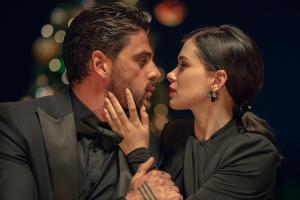
365 Days: This Day (2022)
 At this point, every viewer turning into 365 Days: This Day is doing so for very specific reasons: either for an erotic charge or morbid curiosity to see how bad this bad franchise can sink. The original film was a pandemic breakout for Netflix in 2020, reigning supreme as their number one movie for over a month internationally. It’s based on Polish writer Barbara Bialowas’ trilogy of best-selling erotic novels, clearly inspired from the successful Fifty Shades of Grey series, itself inspired from the Twilight series, the gift that keeps on giving. The first 365 Days got its name from its lead character being held captive by a mafia scion who just knew that this woman would fall in love with him during the time it took the Earth to revolve around the sun. This obviously problematic dynamic led many viewers to detest the movie and its depiction of romance where consent is definitely a concern, not that it would be the first Stockholm syndrome romance in cinema history. 365 Days was a hit explicitly for its explicit and off-putting aggressive sex scenes. Now that we have two sequels prepped, the question remains whether it can still maintain its performance or whether the franchise suffers from diminished returns. Simply put, this sequel isn’t as problematic as the first movie but it’s just as boring and possibly more pointless.
At the end of the first film, Laura (Anna-Maria Sieklucka) survived her tunnel attack but lost her pregnancy. She hasn’t told her jailer/boyfriend/now-husband Massimo (Michael Morrone) about the baby. They wed, they honeymoon, and she begins to resent feeling like a caged woman (oh lady, I thought that was what won you over?) and then she sees Massimo having sex with his ex-girlfriend. She runs away with Nacho (Simone Susinna), a hunky gardener with even more tattoos than Massimo. The new man whisks her away to his beachfront abode and says he only wants to protect her. Masismo is flummoxed trying to find the absentee Laura while a rival crime family schemes to take her out and make a move while Massimo is so torn and distracted.
 The first thing you’ll realize very early on in 365 Days: This Day is that there simply is not enough material here to cover almost two hours of running time. This movie is starched beyond the breaking point, and I’m not even making a pun here. There are twenty-two songs credited to this movie, and when a song plays, it’s not like some needle drop that only plays for a few seconds to impart a very specific impression. These songs are like full renditions. That’s why the movie often feels like a collection of music videos and luxury resort commercials. We’ll watch Laura and Massimo frolic on the beach, go horseback riding, and slinking into a bubble bath, all inter-cut together. If you just cut to an R&B group occasionally singing to the camera, it would all feel complete. Sometimes we are mere seconds between songs. Just as one is ending, another begins, and after 40 minutes of this, I began to question whether this was a deliberate creative decision by the filmmakers to limit the number of scenes relying upon the actors speaking. This is a blessing because both Sieklucka and Morrone have difficulty making the pseudo-smoldering dialogue sound right through broken English. There are lines like, “I can’t calm down, I’m Polish!” and Laura referring to her bedroom activities as “a sex.” The literal second line of dialogue is a reference to the bride not wearing any underwear. I think there might be 200 words spoken in this entire movie and a high percentage of them will make you groan or roll your eyes.
I have to devote an entire section to discussing the golf scene. You see, on their luxurious honeymoon, Massimo and Laura spend some time on the links but their kinky foreplay doesn’t take a break. She lays on the green, spreads her legs, and his grips his golf club (do you get it? do you get it?) and then literally putts a white ball across the green and between her open legs (do you get it? do you get it?). As it was happening onscreen, I joked to my girlfriend that it would follow this route, and sure enough, the filmmakers could not resist. It is the comedy high-point of the movie.
 It’s not like all these songs are soundtracking sequences of arched backs and heavy thrusting. There are even more music montages for luxury porn than for the soft-core porn. We watch Laura and her friend shop in luxury. We watch them drive in luxury. We watch them walk along the luxurious beach. We watch them jet ski in luxury. We watch them dine in luxury. This is why the majority of the first half of the movie feels like the raw footage from a commercial shoot for a getaway vacation. It’s padding upon padding because the characters of Massimo and Laura are wafer-thin. I was trying to even come up with adjectives to describe either lover, let alone full sentences, and my efforts sounded like a second grader trying to bluff their way through a book report. These characters are so boring that the movie won’t allow them to have any drawn out conversations because then the jig would be up. Even when Massimo confesses to having a brother he never toward Laura, this moment isn’t given extended time for her to interrogate. It’s off to the next shopping or driving montage with sun-dappled cinematography. This is also why the filmmakers have inserted a second couple for us to watch their own blossoming romance, but even this gets resolved so quickly with Massimo’s buddy proposing to Laura’s best pal Olga while they’re all still at the same honeymoon location. They’re supposed to be a distraction and they can’t keep our attention because it’s more characters without defining characteristics beyond their body parts.
The sex is put on hold for half of the movie (with the exception of an occasional frisky dream filling the gap, no pun intended) and 365 Days: This Day becomes a ridiculous soap opera. To fully detail the depths this movie resorts to I’ll need to go into spoilers, if that’s really a concern for you, like this movie is being watched for its storyline. The turning point of the film is when Laura catches Massimo fornicating with his ex BUT WAIT because that wasn’t Massimo but… his coke-addicted, twitchy identical twin brother, Adriano (Morrone is actually far more enjoyable in this dual part). He and the ex are scheming to drive Laura and Massimo apart and then kill them both. They’re being paid by the rival crime family that Nacho belongs to, being the son of the competing mafia boss. This overcooked drama reaches such absurdist heights that it ends on a Mexican standoff with the villains being gunned down, Laura getting shot badly in her abdomen, Massimo finally finding out about his lost child, and a question over where Nacho’s loyalty lies, possibly eliminating Massimo so he can have Laura to himself once and for all. This is like three seasons of soap opera storytelling crammed for the very end of what had otherwise been a ploddingly paced movie lacking needed plot events. Even this sequence is stretched thin by the inane cross-cutting from Laura in danger with Adriano to Massimo and Nacho walking down hallways in excessive slow-motion. I laughed out loud as we jumped from overcooked drama to languidly paced hall walking. The movie has the audacity to end on a cliffhanger, which I suppose also happened with the first movie. If you’re dying to find out what happens to these people in Part Three, I just feel sorry for you.
 While the sequel is less problematic over consent than 365 Days, it’s also more boring and tediously forced to draw out the weakest, basest of stories that was never meant to be more than a wish-fulfillment appeal to people’s baser impulses. I don’t want to shame anyone that finds this movie sexy or stimulating. Good for you; attraction is uniquely personal and your found yours. However, this series is making me re-evaluate the Fifty Shades of Grey movies, none of which were good but man at least they were better than this. All of this makes me think the next franchise, inspired by the international streaming success of 365 Days, will be even worse to make me re-evaluate the artistic accomplishment of this very boring, very dumb movie. It is a spiral that will never end and only make us sadder.
Nate’s Grade: D
Share this:

Death on the Nile (2022)
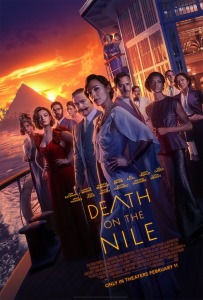 I am admittedly not the world’s biggest Agatha Christie fan, so once again reader, as you did with my review of 2017’s Murder on the Orient Express remake, take my critique with caution, especially if you are a fan of the illustrious author’s many drawing room murder mysteries. Kenneth Branagh returns as director and as the world’s greatest detective, Hercule Poirot, with arguably the world’s greatest mustache (as I said in 2017, it appears like his mustache has grown its own mustache). Death on the Nile takes the murder-on-mode-of-transport formula and leaves us with a gaggle of red herrings and suspects to ponder until the inevitable big conclusion where our smartypants detective reveals everything we had no real chance of properly guessing no matter the clues. Again, these kinds of impossible-to-solve mysteries are not for me, but I know others still find antiquated pleasures with them (Christie was the best-selling author of the twentieth century after all). What I don’t find as pleasing, and I’m sure even ardent whodunit fans would agree, is how cheaply this whole production looks. The budget was almost twice as much as Orient Express but it’s really a chintzy-looking cruise ship with one of the most obvious green screens for a big budget film. It takes away from the grandeur quite a bit, especially knowing the original 1978 movie was shot on location in Egypt. Another aspect that didn’t work for me was the added back-story for Poirot, including the explanation for why he grew his preposterous mustache. Did we need a mustache origin story? Did I need an attempt to better humanize this fastidious detective? If you were a fan of the overly serious and stately Orient Express, and of Christie in general, I’m sure there’s enough to recommend a new Death on the Nile. Branagh clearly has passion for this character and as a steward of this cherished material. However, for me, it took too long to get the movie really rolling, the characters were too lackluster, and there are too many tonally bizarre and uncomfortable moments, like Gal Gadot quoting Cleopatra while being, I guess, dry humped by Armie Hammer against an Egyptian relic. As Poirot’s mustache, which will be given top-billing in the third film, would say, “Yikes.”
Nate’s Grade: C
Share this:

Deep Water (2022)
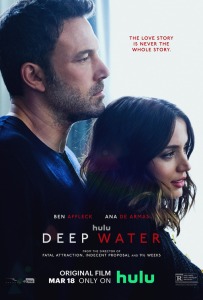 Whatever happened to the steamy Hollywood erotic thriller? This adult genre used to dominate theaters, especially during the 1980s and 90s (Basic Instinct was the highest grossing movie of 1992). With the rise of the Internet and a plethora of personal options, many people don’t feel like they need to go to the movies in order to feel some heat. I’m sure more international movies are picking up this American slack, but there has been a real dearth of the erotic thriller (I’ll theorize why later) and this corresponds with the absence of director Adrian Lyne, one of the kings of the erotic drama. Lyne is responsible for Fatal Attraction, Nine and a Half Weeks, Indecent Proposal, Flashdance, and 2002’s Unfaithful, which happened to be the director’s last movie. Yes, it’s been twenty whole years since Lyne made another movie, and his newest is mining the territory of old, but Deep Water sure does feel dated and not worth the extended wait.
Melinda (Ana de Armas) and Vic (Ben Affleck) have a special understanding with their marriage. She sleeps with other men while he allows it and feels jealous about it. Vic jokes about killing one of his wife’s former lovers, and when the man winds up dead, he becomes the police’s first suspect.
 I have a theory why these movies have become less and less over the ensuing years, and it mainly comes down to the fact that it’s hard to do well. Erotic thrillers are easy to fall into camp, or being overwrought, and they skirt the line between exploitation and enjoyably trashy. It’s meant to be tantalizing but that usually just amounts to repurposing the same familiar male gaze compositions. There gets to be a same-y feel to many of them, enough that there was an erotic thriller spoof in the 1990s, the decade where just about every genre got its spoof movie. It feels like the same ogling of feminine beauty we’ve been getting for decades, the same heavy breathing, the same blue-tinted lighting, the same lip biting, the same arched backs, etc. It’s also a delicate line between arty eroticism and smut (see: Fifty Shades franchise), and that can also be very personally subjective.
Beyond that, I think this subgenre has also suffered in the light of the recent MeToo movement, wherein Hollywood has, reportedly, taken a closer look at its depiction of women. That doesn’t mean things are magically better today, but it does speak to the general culture becoming more conscious of sexual harassment and problematic portrayals, and the erotic thriller genre is built upon the bedrock of dangerous, sexy, experimental, loose women as problematic. I’m not saying these movies can’t be enjoyed on some level, but I think most audiences find them more sleazy than steamy, and I think the heavy male gaze and gratuitous nature of a majority of the movies, as well as the substandard scripting, lead to that dismal conclusion.
With all that being said, Deep Water mostly flounders because it’s just so contrived and boring. This is one of those movies where characters continually make dumb or aggravating decisions because the plot requires them to. I routinely said, “Why is [Character X] doing [stupid thing]?” and there was never a really supportive answer. The very premise of the movie is flawed. Vic and Melinda have an open marriage and apparently the whole town knows this, but this open relationship is built upon placating Melinda. She doesn’t want to have any intimacy with her husband and seeks out the company of other men. Vic is less an understanding party and more a jealous husband, proving this decision to be one-sided. Vic isn’t helping his wife find her next lover, he’s stewing in the corner and glowering at the newest man. As a starting point for a relationship drama, this is fine, but the screenplay has to offer a valid reason why this character would agree to these terms. What is keeping this marriage alive while he suffers in stern silence? The answer is even less. Vic agrees to let his wife sleep with other men so they won’t get divorced. That’s it. Is this the nineteenth century? Would being divorced be so scandalous? This is preposterous reasoning for prolonging this character’s obvious discomfort and turmoil.
 The other question, never answered, is why Vic would want to keep Melinda. Of course de Armas (No Time to Die) is an attractive woman, and everyone in this movie’s comically absurd small universe seems to be infatuated with her, but for what reason? At no point in the film’s 110 minutes does Melinda come across as charming, or intriguing, or even remotely interesting. That’s because she’s not a real character here but a trophy, a prize for men to covet. She’s also clearly understanding what torment she is causing her husband or she is the most oblivious person on the planet, which could also be true because the characterization on display isn’t exactly human. She seems to enjoy teasing her husband and cutting off their attempts at physical intimacy, which then leads to sad bike rides or angry bike rides. Look, there is a comical amount of bicycle usage in this movie, including one car chase that had me laughing out loud. Regardless, Melinda is portrayed as a lousy human being but, even more criminal, she is a boring character. In short, it’s a mystery why Affleck’s glum character would continue his marriage to this awful person.
Another frustrating choice is its lopsided structure. The first half is rather boring and repetitive, as we watch man after man come into the picture only to be scared off by Vic, who gloats that he killed one of Melinda’s last lovers. First off, this character has actually gone missing, so why would any character, no matter how self-destructive they can be, publicly joke about this on multiple occasions, enough so that every member of this gossipy community can recollect? It’s revealed later that this character is indeed found dead, and Vic becomes an immediate suspect because of course he would be, even without his “bad joke.” The problem is that the movie spends far too long playing this silly game of whether or not Vic is the killer when only two possible outcomes can emerge. Either he is the killer and we’ve been wasting time leading to an obvious conclusion, or he is not the killer and not enough work has been put in to present an alternate scenario that could be credible. The movie makes a definite choice in that matter (I’ll detail in a spoiler paragraph below) and I couldn’t help thinking it was the wrong choice. The question over Vic’s culpability is not enough to sustain this movie.
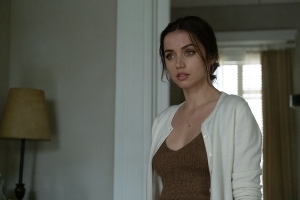 And now let’s delve into spoilers, so if you wish to remain pure and virtuous, well you should skip this movie entirely, but you can also skip to the next paragraph. The question over whether Vic is guilty can be a bit confusing because there are flashes throughout the first half that you cannot determine whether they are Vic imagining killing these suitors or Vic remembering killing these suitors. The police force of this town must be the worst because Vic is a terrible murderer. Yes, dear reader, he really is killing all of his wife’s lovers, which would seem to obviously implicate him as far as what these men all have in common. He’s also bad at leaving behind evidence and hiding corpses in shallow bodies of water (the title is its own joke). If this was the eventual reveal, the movie spends far too much time getting here without any significant doubt beforehand. There are no alternate suspects presented. If it was going to be Vic the entire time, this is a turn that’s best to be revealed as the Act One break, not late in Act Three. This doesn’t work as a final reveal but more as an early development, and then we would follow the character as he bumbles his way through covering up his crimes, only getting into bigger and bigger trouble. Then it becomes more of a farce, but it at least has a more pleasing plot structure of watching a character try and get out of their own danger rather than the audience being ignorant.
So is there a real reason to dive into Deep Water? Not really, even if you’re a fan of the woe begotten genre of erotic thrillers. It exists in one of those hilariously bourgeoisie universes where everyone is having these unrealistic house parties where dopey rich people canoodle all the time, white win in hand, and snipe at one another like it’s catty Regency England. What are Lil’ Rel and Tracy Letts doing here? The characters are just flat-out dull and frustrating to watch, and not even in a somewhat fun sexual tension kind of way. Affleck and de Armas carried on a relationship after this movie but you’d be hard-pressed to wonder why over the course of 110 minutes of exasperated edging. The structure of this movie is all wrong, which makes it feel so boring, and contrived, and repetitive, and if you’re looking for something smoldering or sexy, well it’s the same old same old, and even that is in shocking short supply. Deep Water works best as a movie to yell at in confusion. It’s also further proof about why the erotic thriller is mostly an artifact of the past and why it should likely remain so. There is nothing deep about this movie.
Nate’s Grade: C-
Share this:

Windfall (2022)
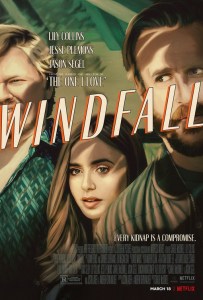 When is a 90-minute movie egregiously too long? When it’s like Windfall and lacking plot and direction and tone to justify all those minutes. The scaled-down production follows three characters confined to the grounds of one location. Nobody (Jason Segel) is trespassing and living on a fancy estate, complete with orange grove, but when the rich owners, CEO (Jessie Plemons) and Wife (Lily Collins), come home and find the mysterious man, he holds them hostage. From there, you would think the movie might be a comedy of errors, a social satire, and it’s not really. Or maybe you would think it’s a taught thriller with each side trying to manipulate the other, and it’s not really. It’s not really a comedy and not really a thriller, so its laughs are minimal, its thrills are trifling, and it comes down to spending too much time with characters that lack the depth to justify the investment. This movie is strictly kept at parable level, so the characters are meant as ciphers, hence the generic title names. These people are not that interesting to spend this much time with. The movie feels like an anecdote stretched beyond the breaking point and by writers I respect (Seven‘s Andrew Kevin Walker and Charlie McDowell, the writer/director of 2014’s The One I Love). That beguiling little indie movie also revolved around one luxury vacation home and a feuding couple but it had an intelligent sci-fi twist that kept things focused on characters and creative ingenuity. There is no such turn with Windfall. It’s all kept so frustratingly obvious, so the movie just feels plodding and meandering, like we’re simply waiting with the characters for things to end too. The insights are too few. The burst of violence at the end as climax feels unearned and too little too late to raise the stakes. Mostly, Windfall is a hostage drama that doesn’t want to be a hostage drama, a social satire that doesn’t want to be a social satire, a thriller that doesn’t want to be a thriller, and a movie that doesn’t have a consistent tone or direction or entertainment value.
Nate’s Grade: C


You must be logged in to post a comment.