Blog Archives
The Hunger Games: The Ballad of Songbirds & Snakes (2023)
 Who exactly was watching The Hunger Games and thought to themselves, I wonder if this evil old fascist dictator played by Donald Sutherland was ever young and sexy and in love? Well fear not, whomever you are, because 2023 gave us the adaptation of The Ballad of Songbirds & Snakes, the far too long adaptation of Suzanne Collins’ prequel book, thus granting the studio more material to grind into products. I guess we should all be grateful that this wasn’t stretched into two movies like the original plan. Taking place 60 years prior to the events of the first movie, young Coriolanus Snow (Tom Blyth) is trying to financially secure his family’s safety in the Capitol, and he’s also mentoring one of the district combatant’s in the tenth annual Hunger Games death match. His charge is District 12’s Lucy Gray Baird (Rachel Zegler), a feisty Romani-esque young woman who uses song as her vehicle for rebellion, and young Snow has to coach her to victory if he has any hope of righting his family’s lost standing. Fortunately, the Hunger Games behind-the-scenes coordination and development is interesting, and filled with top-level actors living it up in these outsized roles (Viola Davis, you national treasure). The deadly games themselves are confined to one dilapidated arena and are visually engaging even in such a limited space. Unfortunately, the would-be Romeo and Juliet romance between Snow and Lucy Gray is far less engaging, and young Snow proves to be a handsome bore. There was potential here in exploring the origin of a monster but the villainy seems awfully contrived to push him along on an arc, with several drastic personal decisions absent believable development. We’re talking big character leaps here, the kind that I can’t even really explain except, “Well, I guess he just had it in him the whole time.” The hazy rationalization and rushed development reminded me of Anakin Skywalker’s underwhelming descent into the dark side. Songbirds & Snakes is only really going to work for the diehard fans of the franchise asking for a little more time in this dystopian universe and daydreaming about the washboard abs and baby blue eyes of their favorite older fascist.
Nate’s Grade: C+
Share this:

Dune: Part Two (2024)
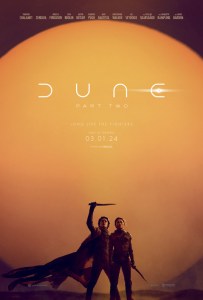 I wasn’t fully taken with the first Dune movie when it arrived in 2021. It was visually sweeping, with dense world building and careful development of characters and themes, but then it just hit the pause button without any certainty there would be a conclusion. Thankfully, director Denis Villanueuve was able to complete his vision, and what a spectacular science fiction landscape this man has fashioned, visually resplendent but also with a story that deepens and improves on all the promise and setup from 2021. The triumphant of Paul (Timothee Chalamet) becoming a hero and avenging his father from their betrayers is tempered by the tragedy of Paul, becoming the false messiah that will bring about mass genocide. The movie doesn’t hold back in its criticisms of its hero while also providing complexity that makes us root for him but uneasily dread what might become. The narrative structure is easy to follow with Paul ingratiating himself with the native culture, rising to power and influence, and organizing a resistance against the well-funded imperial overlords of Arakis. This is the kind of sumptuous, big screen spectacle with intelligence that is so rare in the Hollywood system, and Villaneuve once again shows his ability to perform artful blockbusters that put him in a rarefied class with hew others. After the first Dune, I was hopeful but a little wary. After the second Dune, I feel like all of my concerns were wiped away.
Nate’s Grade: A-
Share this:

The Idea of You/ Turtles All the Way Down (2024)

The Idea of You is the kind of movie that Hollywood used to crank out, a romantic drama star vehicle based upon a popular novel and with a skilled director, and now it forgoes any theatrical run and ends up as another option on a streaming channel. The Idea of You follows a 40-year-old divorced single mom played by Anne Hathaway who also happens to run an L.A. art gallery and has a meet-cute with a handsome boy band member (Nicholas Galitzine, Purple Hearts) at the Coachella music festival (oh the magic lives of people never having to worry about bills in rom-coms). they hit it off, and the rest of the movie is whether or not they can make a romance work. There’s a 15-year age gap that she feels very self-conscious about as an older woman (“older” by Hollywood standards). She’s this formerly normal woman who wants to date one of the most famous music stars in the world who isn’t always available, but most of the problems and conflicts stem from the perceived issues of the age gap. It’s a charming romance that’s more dramatic than it is comedic, and Hathaway is quite good as our lead plucked from obscurity. Though the many scenes of our smitten boy band member making googly eyes at Hathaway as he reminds her how attractive she is, and as she bashfully demurs, are a little much (it’s Anne Hathaway, notorious horrible-looking human specimen, right?). As a core romance, the movie works well under the guidance of director and co-writer Michael Showalter (The Big Sick), and it’s more adult than I was expecting. It’s rated R for language and it’s also more sensual, but it’s also more adult as in looking at the ramifications of this relationship in a mature perspective, from the terrors of paparazzi imposition to her daughter being harassed at school. The portrayal is thus more engaging and engrossing and feels above the more flippant and flimsy romances that would settle for far less. Though be warned: there are several sequences of singing and serenading which might cause you to shrink awkwardly inward on your couch. Surprisingly thoughtful, and relatively romantic, The Idea of You is a charming reminder of the appeal of comforting tales of love blossoming in unexpected places and pretty people allowing themselves the choice to be happy.
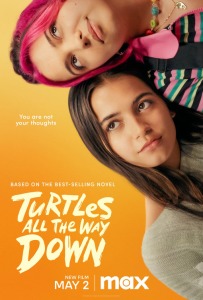
Based on best-selling YA author John Green’s 2017 novel, Turtles All the Way Down is a very accessible and very affecting glimpse at living with mental illness, obsessive compulsive disorder, and intrusive thoughts. Aza (Isabela Merced) has an overwhelming inner monologue that sabotages her daily life in high school and carries her along anxious thought diversions, constantly relating to some illness growing inside her that she needs to cleanse. This is the crux of the story, along with her relationship with her super eager best friend. There’s a romantic side plot where she helps out a rich classmate whose billionaire dad has gone missing, which feels like a plot device to necessitate the two characters spending time together. The standout aspect of this adaptation by writer/director Hannah Marks (Don’t Make Me Go) is its unsparing and honest yet hopeful depiction of mental health and intrusive thoughts. Merced (Dora and the Lost City of Gold, Madame Web) is excellent and deeply empathetic as this woman held hostage by her wayward thoughts and impulses. It’s a performance that goes beyond easy depictions of aloof detachment or exaggerated histrionics, shedding any acting techniques that are too mannered or attention-seeking. Marks’ direction helps reflect Aza’s troubled mind with rapid insert edits and voice over to communicate the intrusive thoughts and maelstrom of spiraling negative emotions. If you’re a fan of Green’s popular novels, or YA-themed literature, or even just honest attempts to empathize with teens in turmoil, then Turtles All the Way Down is worth battling through any negative thoughts to finish and relish the journey.
Nate’s Grades:
The Idea of You: B
Turtles All the Way Down: B+
Share this:

Rebel Moon – Part Two: The Scargiver (2024)
 Back in December, Zack Snyder offered his very Snyder-y holiday take on big-budget space operas with Rebel Moon, a project that began as his Star Wars pitch that was turned down. It was what you would expect from a Snyder movie: big, loud, silly yet played completely serious, and drained of all vibrant color. Rebel Moon Part One was on my worst of 2023 list and I felt was a waste of two hours. I was not looking forward to the concluding Part Two. I was worried it would be two more hours of the same, and now having seen Part Two, a.k.a. The Scargiver, the edgy nickname of our lead rebel Kora (Sofia Boutella) fighting the good fight against the Evil Empire, I can now say that the Rebel Moon duology is now a dreary waste of four of your waking hours.
Saying Scargiver might be minimally better than Child of Fire (did you remember that was the subtitle for Part One? Don’t lie to me, dear reader, you know you didn’t) is a nominal victory. There’s more action and a clearer sense of climax, with our underdogs planning their guerrilla war against the overpowering forces approaching (we’re basically watching the training of a Vietcong-like insurgency) and then pulling off their unexpected victory. The problem is that we’re still stuck with all the same characters from Part One, few of which will prove to be emotionally engaging or intriguing. We’ve assembled our fighting force thanks to the events of Part One, but far too many of them are interchangeable and punishingly free of personality besides the default character creation setting of “stoic badass.” There’s one lady who has laser swords so at least that sets her apart. When it comes to attitude, personality, perspective, and even skill level, these characters are awash, which makes the action falter when it comes to any sort of meaningful emotional involvement. The bare bones story is so plain with broadly drawn good versus evil characters from its obvious cultural influences. The fact that it’s derivative is not itself a major fault, it’s the fact that it does so little with these familiar pieces that the movie feels like it’s trying to skate by on your familiarity. After four hours, it’s clear to me that Snyder and his co-writers composed this not as a living, breathing universe with its own lore and history and intrigue, but as a story where he could have used the Star Wars universe to fill in the gaps.
 Snyder can be a first-class visual stylist but his sense of fluid and engaging action stops at “cool images,” like living splash pages from comic books. Like Part One, there is no sense of weight to these action sequences. Things are just happening, and then in the next shot things are just happening. Occasionally there will be a sliver of relation, but whether it’s 60 minutes or 6 minutes, the effect is still the same. The action feels like it’s all happening in a vacuum, and the momentum we feel the upstarts are gaining is hampered. We went through the trouble of explaining their counter-offensives, so why does so much of it feel like it’s just watching a jumbled, ashen group of characters fire guns? This is best epitomized by Jimmy the robot (voiced by Anthony Hopkins) who has gone rogue from his programming and sits out much of the action for reasons entirely unknown. Then he arrives, takes down a few evil tanks, and I guess decides to sit back out. If this is our fighting force, what exactly has it amounted to? This makes the entire movie, and its predecessor, a frustrating viewing even for forgiving action fans. Things blow up good, and there are a few impressive visual orchestrations, but it’s so fleeting and slim.
Over the course of two two-hour movies, totaling four hours, with the promise (threat?) of more, it’s clear that what we really had here was perhaps one underdeveloped movie at best that has been unfortunately spread out over two (and counting) movies of time. Part One was entirely about assembling the team of rugged defenders, and this could have served as the first 45 minutes of the overall movie, with the events of Part Two filling in the rest. With Scargiver, the defenders don’t even start training the villagers until 40 minutes into the movie and the big battle doesn’t kick in until a full hour. Structurally, this doesn’t feel like we’re using our time wisely, and this is best evidenced by the fact that after AN ENTIRE MOVIE of character back-story, Snyder still stops the action to have his characters sit around and share their sad back-stories. Did these characters just not talk at all to each other after initially gathering person-by-person? Tarak (Staz Nair) still hasn’t put a shirt on. I felt like yelling at my TV as the character took turns, and another 15 minutes, for each member to share their tortured back-story again but with different visuals. I was almost worried that right before the battle another character would say, “Wait, before it all really goes down, I need to share, yet again, more of my back-story.” It’s not like these extra glimpses give us new understanding or even meaningfully differentiate their characters; they’re all just victims of an abusive space government that imposes its terrible will most forcefully.
 There is one tragic back-story that does separate itself from the pack, notably because it literally separates itself from the pack and is told well before our group share. Kora explains her part in the assassination of the royal family, securing the military coup that left the Evil Empire extra evil, and I guess the guy named Balisarius as supreme leader (oh how this man must have been teased for his name as a schoolchild, which might be his own tragic back-story that we’ll get three helpings of with an eventual Part Three). This betrayal is personal and stands out, with Kora being the one to shoot the little princess, a girl who, in her dying breath, says she forgives Kora. That’s rough. This is actually a good sequence from a character standpoint as it establishes Kora’s accountability and guilt convincingly. However, Snyder makes some baffling creative choices that blunt the impact of this sequence. During the assassination, the musical score favors a string quartet, which is an emotionally plaintive choice. However, the music is actually diegetic to the scene, meaning it’s coming live from the room. There is literally a string quartet of musicians playing in the room while the royal family is betrayed and slaughtered. These guys are really dedicated to their art to keep playing throughout, and I assume they must also be part of the conspiracy or else big bad Balisarus (snicker) would kill them too. You might as well have them also start stabbing the royal family with their bows. It’s details like this that trip up Snyder, a man beholden to images and ideas but lacking the finesse to make them work.
An issue I had with this conflict was the disparity in scale between the forces, mainly my nagging question of why put together a ragtag group of space adventurers to defend this town if the Evil Empire could just nuke the planet from space? Well Snyder attempts to answer this early with Part Two, and the answer appears to be… grain. This community theorizes that the empire needs their grain yield so badly that they wouldn’t do anything to damage it, so their plan is to harvest all their wheat, turn it into grain, and then use the grain like human shields, hiding behind the valuable resource as cover and distributing it across the village. This is beyond silly. First, this isn’t like an entire planet harvesting grain, it’s one little village on the outskirts. It’s not like we’ve seen a giant warehouse that goes for miles and miles stockpiled with thousands if not millions of deposits of this food. Also, we’re talking grain here (stay tuned for my exclusive Rebel Moon-related podcast called “Talkin’ Grain”). It’s not like we’re talking about some super rare mineral or substance that is only found on this one planet, something linked toward like the power source for an ultimate weapon or space travel. We’re talking about grain here. Grain. You think this Evil Empire won’t nuke the planet because they’re worried they won’t get enough grain, the same crop that can be harvested on multitudes of other planets? How about they just kill everyone and then repopulate the planet with robots to harvest the precious grain? Or how about this simple village make some upgrades as we’re in a future world with space travel and artificial intelligence but people are still harvesting wheat by hand like they’re the Amish. Regardless, I hope you love slow-mo montages of grain harvesting because that’s what you’re getting for the first 40 minutes, as if Snyder is rubbing your face in his silly non-answer.
 In the conclusion to Rebel Moon Part Two, once the dust has settled, and long since that grain has been harvested, the last five minutes sets up a would-be Part Three, informing us that an unresolved storyline is next up on the docket. The characters gang up for their next adventure, and you’re expected to be chomping at the bit for this continuation. I openly sighed. Every movie feels like a tease for the next adventure, and it seems to promise that this one will be the real one you’ve been waiting for, but it feels like franchise bait-and-switch. It’s more than incomplete or lazy storytelling, it’s a scheme to leverage interest in a world and series that deserves little. The universe of Rebel Moon is not interesting. The characters of Rebel Moon are not interesting. The visuals of Rebel Moon are fine, though some of the costume choices again can rip you right out of the reality of this universe (a guy fighting in blue jean overalls?!). In short, not enough has been established, developed, or even paid off to make Rebel Moon an interesting and satisfying movie, let alone two, let alone three, let alone however many Snyder wants to leech out of Netflix. I would say Part Two is better because at least it provides an ending but it doesn’t even do that, merely an intentional passing of the baton to the next movie, and round and round we go. Rebel Moon is a living poster stretched to its breaking point. Leave this shallow universe behind.
Nate’s Grade: C-
Share this:

Civil War (2024)
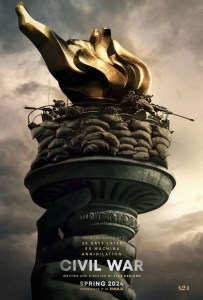 In writer/director Alex Garland’s Civil War, the United States has broken after a third-term president (Nick Offerman) has disbanded the FBI, attacked his own citizens, and used the power of the government to remain in office. The forces of California and Texas have joined an unlikely alliance to depose the American president. With this conflict escalating, we follow a group of journalists, primarily prize-winning war photographer Lee (Kirsten Dunst) and her would-be protege Jessie (Priscilla’s Cailee Spaeny), as they drive from New York down to D.C. with the intention of getting one more interview with the president before it all comes to a bloody end.
Civil War is Garland’s (Ex Machina, Men) attempt to evoke the ethos of journalists who stress merely trying to depict the world rather than question it. It’s a movie really about shared trauma, as these characters are plunged into a world where your neighbor might be stringing up men at the car wash. Garland’s sound design does him major credit at being able to keep his audience unsettled, not just in the melange of gunfire and explosions but also the absence of sound. After one close explosion, the sound drops completely for over a minute. During key parts of the frantic action, the movie will cut to the black and white images of our photographers, providing an immediate reprieve to contemplate as a depiction of what is taking place. Garland’s movie keeps things on a realistic level and is really less of a movie about an America on the brink than a story of journalists going about their dangerous job. It just so happens that instead of it being Afghanistan or Syria or other more familiar war zones that it’s the United States. As a simplified, point-A-to-point B war zone road trip, the movie works well enough, unless, that is, you’re expecting anything more than the quasi-objective documentation of terrible acts.
 However, that same ethos of centrist non-engagement also kept me struggling to really invest in the movie. I kept waiting for… simply more to happen, for insightful exchanges with our characters, for harrowing moments really crystallizing the state of this nation, for clues that gave a clearer picture of the larger conflicts and how the United States got to this point. For anyone expecting much from Offerman’s presidential character, he’s literally in the movie for, at best, two minutes. The far majority of the movie follows along on this road trip with these undeveloped characters taking pictures of occasionally upsetting and occasionally mundane events, although the totality of these events fails to add up to a clearer picture or more coherent social commentary. I just kept waiting for the characters to get more compelling, along with the conflict, and it just didn’t. I think we were following the wrong characters, people who are trying to stay objective and above it all, because then they’re just stand-ins for a camera and a microphone. We know Lee is a celebrated war photographer, and we get snippets of her past worldwide skirmishes, but what else do we know about her? What else do we know about Jessie, besides she’s an aspiring photographer who idolizes Lee? Does a mentorship relationship form? Not really. Does a rivalry form? Not really. The characters are just there, opaque, acting essentially no more than a stand-in for the audience. Now there’s a deeper conversation to be had about the ethics of embedded journalism, of documenting horror rather than intervening, or turning tragedy into digestible art for the masses. What are the ethics of non-intervention and holding to one’s moral objectivity in the face of the most objectionable? However, this is not the movie interested in having that conversation.
 The world of this civil war felt strangely unaffected. Hotels are going about their business, WiFi is carrying on, local shops are carrying on their discounts. I understand that part of this is meant to be surreal, the juxtaposition of a nation going about business as usual, even though these are unusual circumstances, but it makes the movie feel less significant, and the cavalier attitude of the characters continually betraying the stakes of the drama. If it’s just another assignment, how bad can it be? It makes Civil War feel like there’s hardly much of a civil war going on, which begs the question why even tackle this concept if this is it? If you have a movie about an American civil war but pussyfoot around on the why, forgo making the impact felt, and have the majority of the characters shrug it all off, then why are you even going through this story? The apolitical nature makes it so that many viewers will project their own perspectives and prejudices to fill out the unspoken history. It’s an interesting artistic decision but also one that nagged at me as a “both sides are bad” declaration to the middle to tell us that polarization is the real enemy.
There are a few sudden jolts and unsettling moments in the movie, but watching Civil War feels like I’m only watching 45% of a movie that will never be filled in. By that I don’t mean I need every point spoon-fed to my stupid plebeian brain, but I needed a movie where the time added up to something more substantial than “people do bad things during war.” I kept mentally going back to The Purge franchise, a concept that asked what people might do if they had a brief window of lawless freedom, and what that says about us as a society when the rules are put on hold. That is a franchise that embraces its genre roots and premise but finds ways to make its concept a reflection of our troubled times, and while it’s blunt commentary, when we have Nazis marching in the streets, maybe blunt times call for blunt commentary. Civil War feels so timid to say anything really that might be relevant to our current anxious and fractious political climate. Civil War was disappointing to the point that I was longing for the clarity and conviction of The Purge franchise.
 There are so many different versions of this story and concept that can prove compelling, so it’s all the more mystifying for me why Garland wanted to pick this version. Imagine a grueling Downfall-style drama about the last hours inside the White House of a three-term fascistic president who turned on his own people and enacted a bloody civil war, and imagine watching those closest to him reconcile with their own culpability as well as the resignation of the end coming for all of them and what they have done. Or even imagine a similar version about being behind enemy lines and looking for safe harbor, not knowing which American could be trustworthy and which might ultimately be a defector (as Jesse Plemons so ominously says in the movie’s intense high point, “Okay, but what kind of American are you?”). There’s a little known indie war movie from 2017 called Bushwick, starring Brittany Snow and Dave Bautista, that has a similar premise, following a military invasion of Brooklyn (Texas allies with the Southern states to attack the big cities, though they didn’t expect so much push-back from the locals). This is a better version of the similar modern civil war premise, with characters that are more compelling, a conflict that keeps upending our sense of safety, and some gutsy filmmaking choices, not all of them successful (the ending is too bleak and mean and deserved a ray of hope). There are myriad ways to tell this story and make it engaging and though-provoking, and Garland inexplicably chose this dull option. You could do worse than Civil War, but with such tantalizing dramatic potential, you could do better.
Nate’s Grade: C+
Share this:

Late Night with the Devil (2024)/ Immaculate (2024)
 Late Nigh with the Devil is an intriguing novelty, a found footage item of 1970s late night talk show fame reportedly documenting the last show of Night Owls, a talk show hosted by a man who recently lost his wife to cancer and is also slipping in the ratings and losing his traction in the industry. So Jack Delroy (David Dastmalchian, best known as Polka Dot Man in 2021’s The Suicide Squad) gets the great idea to hold an exorcism live on stage or his big spooky Halloween show. What could go wrong, right? The movie is dedicated to upholding the style and awkward tone of 1970s talk show, and its commitment is by far its most interesting aspect to the found footage sub-genre. I wouldn’t classify the movie as necessarily scary, but it held my attention and I appreciated the corny little nuances of recreating an older form of television and comedy schtick, with a growing sense of foreboding as things start to get progressively worse and Jack pressures his new girlfriend, an occult writer, to bring out her possessed pupil. It takes a little long to get going, and the overall conspiracy of Jack’s connection to an Ilumminati-esque showbiz cult feels so tangential to be important, but I was objectively impressed with the overall recreation of an archaic form of TV. The conclusion, once all chaos is finally unleashed, breaks the rules of the found footage setup but at that point it’s welcomed and things can get a little more weird and visually audacious. Late Night with the Devil works more as a late-night curiosity than a boo-style horror thriller. I appreciated the committed efforts and artistry, as well as the game actors and some wicked gross-out makeup prosthetics, more than the overall movie.
 Nuns in Distress has long been a horror genre staple, as the mixture of Catholic imagery and overwrought religious themes proves an unbeatable mix with classic exploitation elements, the depraved and the sanctity. To this we have Immaculate with rising starlet Sydney Sweeney (HBO’s Euphoria) as an American nun traveling to a remote Italian convent and becoming an unwitting victim in a sinister ploy to gestate a new potential messiah. While very serious and broody in presentation, Immaculate is a pretty by-the-numbers mystery that goes to its most obvious route and becomes an overextended hostage thriller for Sweeney. The movie is at its best when it gets crazy, and that includes Sweeney, when she’s allowed to be all-out histrionic. For too long, the movie is too somber and simmering, which works best if the mystery is at least involving and surprising or we build to a great gonzo finish. I wish the movie was more wild. The ending is the best part of Immaculate, where Sweeney is pushed to the point of intense madness, while splattered in blood as per genre rules, and is forced to make extreme and personal choices. In that regard, perhaps Immaculate best operates on a metaphorical level about the horrors of pregnancy, more forced birth from oppressive leaders, and restricting women’s autonomy in a post-Roe v. Wade world. It’s a long wait to that worthwhile finale, and you might get restless from your unholy wait.
Nate’s Grades:
Late Night with the Devil: B-
Immaculate: C
Share this:

Scoop (2024)
 It’s like a British Bombshell, a behind-the-scenes account of the media attempting to hold key political and public figures to account for gross sexual imposition. With the Netflix drama Scoop, it just so happens to be Prince Andrew (Rufus Sewell), interviewed by BBC TV journalist Emily Maitlis (Gillian Anderson) in 2019 and scrutinized heavily for his close ties to former friend Jeffrey Epstein. The first half of the movie is about the wheeling and dealing behind the scenes to garner the high-profile interview, to convince Andrew he can clear his name after his connections to Epstein resurfaced. The second half of the movie is pretty much just the interview, which is indeed interesting to watch for the inherent drama, but after a while, I wondered what this movie was adding that I otherwise couldn’t gain from simply watching the actual 2019 BBC interview? There aren’t really scintillating details or clever scheming to guarantee the interview or outfox its news rivals, and the newsroom personalities, lead by Billie Piper (Doctor Who), are hard-working and tireless stock types that don’t leave much of a distinct impression even after the time together. It’s really a plainly presented dramatized version of the infamous interview, the one where Andrew was professing his innocence against his Epstein accuser with his bizarre argument that he has a condition where his body doesn’t sweat. Anderson is great, and Sewell is terrific as he melds into this figure of complacent arrogance and self-delusion (the makeup is also quite impressive). Still, if you’re really interested in gaining further insight, you might be better off looking elsewhere, or just watching the original interview. Consider this a bonus epilogue to Netflix’s The Crown for any die-hard royal aficionados.
Nate’s Grade: B-
Share this:

Love Lies Bleeding (2024)
 With 2019’s Saint Maud, writer/director Rose Glass made her mark in the realm of religious horror, but it wasn’t just a high caliber boo-movie, it was an artistic statement on isolation, on obsession, and with stunning visuals to make the movie stand out even more. Next up, Glass has set her sights on a similar tale of isolation and obsession, in the realm of film noir.
In 1989, Lou (Kristen Stewart) works as the manager of a small gym in the American Southwest. She spots Jackie (Katy O’Brian) passing through on her way to a bodybuilding competition in Las Vegas. Together, the two women form a passionate relationship and are transfixed over one another, but in order to keep the good times rolling, each will be required to commit more desperate acts, including body removal and keeping secrets from Lou’s estranged father, Lou Senior (Ed Harris), a shooting range owner who operates as a cartel gun runner.
 Love Lies Bleeding powers along like a runaway locomotive, a genre picture awash in the lurid and sundry language of film noir with a queer twist, until it goes completely off the rails by its conclusion, a pile-up of tones and ideas that’s practically admirable even if it doesn’t come together. Until that final act, what we’re given is a contemporary film noir escapade following desperate and obsessive people get completely well over their heads into danger. Reminiscent of the Wachowski’s Bound, we have a film noir that lets the ladies have all the fun playing into the tropes of the sultry femme fatales, and in this movie, both the lead characters are their own femme fatales and ingenues. Lou is the one who pushes steroid use onto Jackie, who resists at first and wants to go about building her body the old-fashioned way. Lou is also the one with the shady past and connections that come calling back at the worst time. Once fully hooked on her diet of steroids, Jackie becomes increasingly more unpredictable and desperate, leaving Lou to try and clean up their accumulating messes. They both use the other, they both enable the other, and they both project what they want onto the other even after their collective screw-ups. It’s a self-destructive partnership but neither can see through the haze of desire. They see one another as an escape, when really it’s an unraveling of self (though I suppose one could argue “living your best self,” already a subjective claim, could include being a genuine garbage human). In a way, this is a relationship that’s all rampant desire and unfulfilled consumption, and it leaves both parties always wanting more. It’s a bad romance with bad people doing bad things badly, and if that isn’t a tidy summation of most film noir, then I don’t know what is.
For the first hour, I was right onboard with the movie and its grimy atmosphere. The plot has a clear acceleration point, though the first twenty minutes is also given to some cheap “who-slept-with-who-before-they-knew-who” drama that I was instantly ready to put behind. However, once the climactic death hangs over our two lovers, there’s an immediate sense of danger that makes every scene evoke the gnawing desperation of our characters. The screenplay by Maud and Weronika Tofilska has such a deliberate cause-effect construction, and no film noir would be complete without the loose ends the characters would have to fret over. What also helps to elevate the immersion is the electric chemistry between Stewart (Spencer) and O’Brian (The Mandalorian), who worked previously in the world of women’s body building and clearly felt a kinship with this role, and she is also a born movie star. The two women are great together, enough so that the audience might start believing that these two lost souls are actually good for one another. We too might get seduced by the possibility that everything will turn out for the better, when we all know that’s not how film noir goes. I will say there are some gutsy decisions toward the end that will test audiences with their loyalty to our couple, but most felt completely in character even if their lingering impact is for you to reel back, hold your breath, and then heavily sigh.
 It would also be impossible to discuss the movie without discussing just how overwhelmingly carnal it can be. I recently reviewed Drive-Away Dolls and noted how horny this lesbian sex comedy road trip was, though to me it felt empty and exploitative. With Love Lies Bleeding, the desire of these two women, and their mutual fulfillment, serves as another drug for them to mainline and then abuse. There is a hanger to the film’s gaze that is effective without feeling overly leering. The body building aspect puts a more natural fixation on lingering on the muscles and curves of human forms, and how Jackie is intending to transform herself into a fantasy version. The sexual content begins to ebb as soon as the murder content ramps up.
Unfortunately, for a movie that gets by on some big artistic chances, not all of them work, and most of the miscues hamper the final thirty minutes. In the final act, Jackie abandons Lou and goes off on her own to her Las Vegas bodybuilding competition, and at that point it’s like she’s in a completely different kind of movie. Hers is a movie about drug addiction and hitting a wall, as she has some very public freakouts and hallucinations. Although from there, Love Lies Bleeding indulges in some peculiar imagery that emphasizes the extreme bulging muscles of Jackie like she was the Hulk. While the movie never presents these flights of fancy as magic realism meant to be taken literally, the sheer goofiness of these moments and imagery can hamper moments, especially during a climactic showdown that feels more like someone’s kinky dream. Ultimately, I don’t think the characters of Lou or Jackie are that interesting. Lou’s criminal past was deserving of more attention far earlier, and Jackie is so narrowly-focused that every scene with her after a certain point is only going to reinforce the same obsessive drive and perspective. Like other genres, film noir works with archetypes, and Love Lies Bleeding isn’t re-inventing the genre, merely giving it a very specific sapphic spin, set amidst the haze of the go-go 1980s.
Rose Glass is a hell of an intriguing filmmaker after two very different movies in two very different genres, both of which have been defined for decades by male filmmakers. This woman is a natural filmmaker with clear vision, and even through the bumps, you know you’re in good hands here with a storyteller that’s going to take you places. The cinematography is fluid and grimy to the point where you may feel the need to take a shower afterwards. Everything seems coated with dirt and sweat. The synth-heavy musical score accommodates rather than overwhelms. The performances are strong throughout, and the screenplay choices, while not always working out, are bold and in-character. Love Lies Bleeding provides just about everything you could want from a lesbian bodybuilder film noir thriller, a movie that recognizes the sizzle of its genre elements and makes grand, scuzzy use. At this point, we should all be paying attention to whatever Glass wants to do next as a filmmaker. It might not be perfect, it might not even work, but it will certainly demand our attention and time.
Nate’s Grade: B
Share this:

Jersey Girl (2004) [Review Re-View]

Originally released March 25, 2004:
Writer/director Kevin Smith (Dogma) takes a stab at family friendly territory with the story of Ollie Trinke (Ben Affleck), a music publicist who must give up the glamour of the big city to realize the realities of single fatherhood. Despite brief J. Lo involvement, Jersey Girl is by no means Gigli 2: Electric Boogaloo. Alternating between edgy humor and sweet family melodrama, Smith shows a growing sense of maturity. Liv Tyler stars as Maya, a liberated video store clerk and Ollie’’s real love interest. Tyler and Affleck have terrific chemistry and their scenes together are a playful highlight. The real star of Jersey Girl is nine-year-old Raquel Castro, who plays Ollie’’s daughter. Castro is delightful and her cherubic smile can light up the screen. Smith deals heavily with familiar clichés (how many films recently end with some parent rushing to their child’’s theatrical production?), but at least they seem to be clichés and elements that Smith feels are worth something. Much cute kiddie stuff can be expected, but the strength of Jersey Girl is the earnest appeal of the characters. Some sequences are laugh-out-loud funny (like Affleck discovering his daughter and a neighbor boy engaging in “the time-honored game of “doctor””), but there are just as many small character beats that could have you feeling some emotion. A late exchange between Ollie and his father (George Carlin) is heartwarming, as is the final image of the movie, a father and daughter embracing and swaying to music. Jersey Girl proves to be a sweetly enjoyable date movie from one of the most unlikely sources.
Nate’s Grade: B
——————————————————
WRITER REFLECTIONS 20 YEARS LATER

When I started putting together my list of 2004 movies to re-watch for this year’s slate, my wife was not pregnant. We had been trying for a year and experienced some heartbreaking setbacks, but now, as I write my review of Jersey Girl, my reality is that my wife is indeed pregnant, and we’re expecting a baby this October and very excited. As you can expect, I’m also nervous. Now this movie about the changes of fatherhood has significantly more meaning for me personally.
In 2004, I was but a 22-year-old soon-to-be college graduate but also a devotee of writer/director Kevin Smith since my teenage years of discovering movies in the oh-so-exciting go-go decade of 1990s independent film. This was supposed to be Smith’s career pivot, as he’d reportedly closed the book on his View Askew universe of crude comedies and stoner hi-jinks with 2001’s Jay and Silent Bob Strikes Back. Smith had become a parent in 1999 and, naturally, this altered the kinds of stories he wanted to tell. Although this didn’t last too long. In 2004, America was sick of Bennifer 1.0 and Jersey Girl was the second movie in less than a year pairing real-life couple Ben Affleck and Jennifer Lopez. The stink from 2003’s Gigli, and the tabloid overexposure, had tamped down the country’s demand for more Bennifer, so Miramax removed all publicity of Lopez from the movie, pushed the release date back half a year, and even publicly revealed that Lopez’s character dies in childbirth in the first ten minutes. Even with its relatively modest budget for a studio film, Jersey Girl under-performed, critics lambasted it, and Smith returned to his vulgar adult comedy playground with 2006’s Clerks II, the sequel to where it all began. With the occasional stop into horror, Smith has stayed in his own insular world and only gotten more insular with sequels to his early comedies for his ever-shrinking fandom.
 More so than any other movie, Jersey Girl is the outlier, the oddity, the path not taken. Watching it again in 2024, I’m more forgiving of this outlier even if it proves harder to love. Much of this is likely my own relatability with the main character’s plight, a New York City workaholic publicist Ollie Trinkie (Affleck) who loses everything in a short window of time, namely his high-profile city job and his wife Gertrude (Lopez). Now he’s back living with his father Bart (George Carlin) in New Jersey and raising a little girl Gertie (Raquel Castro) on his own. It’s not a revolutionary film concept, a selfish adult takes on the responsibility of another and changes their perception of themself and the world. In a way, it likely happens to every new parent, or I would hope, a paradigm shift of perspective. The insights that Jersey Girl offers about parenthood and priorities are nothing new but that doesn’t mean they are bad or not worthwhile. Without the context of Smith’s tonal pivot, Jersey Girl would likely be forgotten, more than it already has been to history. It’s Smith’s spin on the family movie cliches we’ve seen before, and that means there’s a limit to how much further he can take the overly familiar.
It’s a little deflating to watch an artist known for his imagination and vocabulary utilizing the building blocks of maudlin family movies for his new story. Even with a different storyteller, they are still the same recognizable pieces seen before in hundreds of other feel-good movies about parents learning that children are more important than that big meeting or promotion. Of course reducing everything down in life is reductive, and maybe that big meeting could allow the parent to be more present for their kid, provide a better life being neglected, but whenever you set up the climactic choice between family and career, family always wins. Maybe David Wain (They Came Together) is the kind of subversive genre artist who could send up these age-old cliches and end with the workaholic parent choosing their selfish career. Regardless, the movie’s strengths are its sincerity rather than ironic detachment. It would be hard to make this kind of movie from a cynical smart-alecky approach, and Jersey Girl reveals what any View Askew fan has long known, that deep down at heart Smith is a big softie. It’s more apparent nowadays with Smith’s recent output of increasingly sentimental movies about relationships, as well as Smith’s copious social media posts showcasing his torrent of tears in response to a movie or TV show (as a man who frequently cries from movies and TV, this is no affront to me). Smith wanted to tell a personal story of his own life changes through the familiar family movie vehicle, and while it doesn’t entirely stretch beyond its copious influences, it’s still singing true to Smith’s sincerity.
 This is far from the disaster many have made it out to be in the past twenty years. Lopez is really good in her brief opening appearance with a natural radiant charm that makes you mourn her absence just like Ollie. Liv Tyler (Armageddon reunion) shows up midway through as Maya, a sexually progressive video store clerk who becomes the next love interest for our widower. When she discovers, to Ollie’s embarrassment, that he hasn’t had sex for seven years, the entire time after his wife’s passing, she takes it upon herself to help the guy out with some charitable casual sex. The scene is funny and finally makes use of a setup Smith has taken time with prior, Gertie not flushing the toilet after use (something I can already regrettably relate to raising children). When his daughter comes home early, Ollie and Maya hide in the shower, and it appears they have gotten away with it, except Gertie finally remembers to flush the toilet, sending a burst of hot water that causes Maya to screech and reveal their half-naked tryst. From there, little Gertie sits them both down, reminiscent of what Ollie did with her and a friend when he caught them playing “doctor,” and she squares her gaze and intones, very maturely: “What are your intentions with my father?” Even the big climactic event, the children’s musical performance the parent can’t miss lest they break their child’s heart, gets a little edge when Gertie and her family perform the throat-slitting/pie-making number from Sweeney Todd. There’s a terrific exchange between Ollie and Will Smith all about the changing dynamic of fatherhood, what they do for their kids, and how rewarding it proves, and having Smith be your ace-in-the-hole is great.
It would be neglectful of me to forget the postscript that, nearly twenty years after the demise of their engagement, that Affleck and Lopez reunited and married in 2022. We’re in the current realm of Bennifer 2.0 (unless your version of Bennifer 2.0 was when he married Jennifer Garner, but I’ll let you decide if this era is 2.0 or 3.0) and Lopez has released a companion documentary to her 2024 visual album (a.k.a. collection of music videos) that features her relationship with Affleck, and it’s called The Greatest Love Story Never Told, and it’s gotten good reviews. Also of note, Castro grew up into a budding pop idol and appeared on The Voice and Empire.
 There are things that work here, enough that Jersey Girl might honestly age better than the majority of Smith’s rude and crude comedies (see: re-reviews for Dogma and Strike Back, and Reboot). It will never garner the love of Smith’s more successful movies, but it doesn’t deserve any reputation as a forgotten stepchild among Smith’s oeuvre, especially when you consider the man also has Yoga Hosiers on that resume. In 2004, I referred to Jersey Girl as a “sweetly enjoyable date movie,” and this still stands twenty years later. I’m a little softer in several ways and more forgiving as an adult cinephile, and more welcome to genuine acts of sincerity, so the winning moments of the movie still hit their mark for me. I write this as my wife is still in her first trimester, and while the due date seems so far away I know it will rush by, and then I, like Ollie, will be juggling my life as I knew it with my life as I now know it (you better believe the scene where he loses his spouse in childbirth hit me harder as a new intrusive nightmare to occupy my mind). Jersey Girl isn’t anything new or special, but it was special for Smith, and he finds ways to make you understand what that means for him, and what it might mean for you. I’ll take that.
Re-View Grade: B-
Share this:

Damsel (2024)
 After a decade of having a creative partner who literally has compiled over 4,000 pitches for possible movie and TV concepts, it was inevitable that Hollywood would eventually get close to some of them. This has happened before a few times, again given the significant library of my friend’s imagination, but never has it gotten as close as Damsel, Netflix’s new action fantasy film flipping the script of the shrinking violet being sacrificed to the clutches of a monster. In my friend’s pitch, the young girl is presented to a dragon with the implication that this regular offering will spare her small town from angry dragon fire. Just as she’s waiting to be eaten, the dragon undoes her bindings and they talk, because the dragon can talk, and he’s very curious why these people keep leaving him young girls every so many years. The revelation is that the dragon is not savage but intelligent, and the two bond, forming a partnership where she brings the dragon back to her community and shows them the error of their long-standing prejudices. Of course it all gets bigger from there, with warring kingdoms wanting to harness the last dragon to capture this unparalleled weapon of mass destruction. There was even a budding romance between the dragon and the young woman, with the possibility of the dragon turning into a human Beauty and the Beast-style. The title: Damsel. While my friend’s Damsel and Netflix’s Damsel have some core similarities, they do tell different stories built upon the same premise of the virgin sacrifice and the killer creature being more than what they seem.
Unfortunately, Netflix’s version is too narrow to be fully satisfying with its fairy tale script flip. We have Millie Bobby Brown as our titular damsel, Elodie, a woman trying to do well for her family, notably her father (Ray Winstone), stepmother (Angela Bassett), and younger sister. The young prince needs a bride, and the Queen (Robin Wright) isn’t too shy to still turn up her nose at her new in-laws that she sees as merely a means to an end, nothing more. Of course it’s revealed that this end is as “human sacrifice” to a dragon that has reportedly stalked the kingdom for centuries. Elodie is thrown down a vast canyon into the lair of an angry dragon (voiced by the unmistakable Shohreh Aghdashloo). From there, Elodie must use her wits to survive the dragon, escape above ground, and save her younger sister from being doomed to a similar fate.
 The premise is so strong, upending ages-old tropes of the female sacrifice and the monstrous creature, as even with Netflix’s Damsel the dragon is a victim of historical slander. There’s so many places you can go with this, especially building upon the dynamic of the two of these discarded outcasts banding together to push back against the cruelty of society. However, that’s not the movie Netflix’s Damsel becomes. It sort of is, at the very end in resolution, with a latent promise of possible further adventures, but it’s mostly a locked-in survival thriller.
I was not expecting the majority of Damsel to be Elodie’s basic survival once she’s been hurled into the pit by her recently dearly beloved (just following orders from mom, he says). It works, but it feels very constrained creatively. Now, I am generally a fan of these kinds of stories, the step-by-step survival tales where we are thinking alongside the plucky protagonist. I find them fun and follow a satisfying structure of amassing payoffs. It’s naturally enjoyable to watch a character tackle problems and succeed. However, it’s also vital that the audience understands the problem to know the challenge. In a fantasy setting, this requires more time to establish new rules and circumstances. Here we have a few sequences like when Elodie discovers bio-luminescent slugs and uses them as a light source for exploring her captivity (bonus: their sticky slime is healing). The timeline is relatively short, maybe a day at most, so it’s not like Elodie has to think about long-term survival; it’s much more immediate about escaping from the wrath of the predator. Just finding a safe hiding spot is enough. It’s engaging but by limiting the focus to an almost real-time survival cat-and-mouse game, it caps the movie’s creative possibility. I was far more interested in the prospect of eventually moving beyond the initial amity between Elodie and the dragon, where they could share their royal rage together. I kept waiting for this initial battle to give way into a different level of understanding, something to deepen and alter this relationship, but this doesn’t arrive until the very resolution of an hour after Elodie first hides from the fearsome dragon.
While I was never bored by watching Elodie think how to get over a crevasse, or how to navigate a treacherous pass, I was reminded of 2022’s The Princess, a spirited and gleefully violent feminist romp with a similar starting point of a damsel taking matters into her own hands and fighting for her freedom. With that film, the upturned premise was simple, but each new floor down the tower revealed something about our heroine, each new challenge was different and relied upon a different skill or tactic. Unfortunately, that movie was “deleted” from the Disney/Fox/Hulu library for tax purposes, though you can still rent or purchase it on Amazon but, as of now, no physical media exists. This is an excellent example of a movie with a limited scope that knows how to play to the limitations of story while still revealing character through action. While that movie lost some momentum and clarity when the princess was kicked out of her tower imprisonment, I found much to celebrate with the movie’s ingenuity and spirit. With Netflix’s Damsel, I was getting antsy to leave the cave and move things along. The twist about the true nature of the dragon, and her past with the legendary royal hero, should be obvious to most.
 Let it be said that this is where Brown (Enola Holmes) graduated to being a steely and capable adult actress. She’s the star of the movie and has to command our attention and hold it for long stretches on her own. Brown throws herself into the physicality of the role with a relish that only makes her eventual triumph feel that much more worthy. The side characters don’t amount to much but have reliably winning actors to draw our attention. Aghdashloo (The Expanse) is a wonderful scene companion even with only a smoky voice. Wright (Wonder Woman) is haughty to the point of thin-lipped camp. Although this is a criminal under-utilization of the talents of Bassett (Black Panther: Wakanda Forever), who plays the concerned stepmother. That’s what happens when most of your movie is about one girl in a cave. The other characters are confined to the opening and closing of your survival thriller.
I suppose I’m being cheeky by referring to the movie as “Netflix’s Damsel” considering there isn’t any other version out there. I’m not accusing Netflix or screenwriter Dan Mazeau (Wrath of the Titans, Fast X) of ripping off my friend; it’s more an example of parallel thinking playing around with old fantasy tropes and giving them a new spin for modern times. I mostly enjoyed Netflix’s Damsel but couldn’t help but wonder what might have been, not just with my friend’s competing take on the material but with the story possibilities not taken here thanks to its limited scope. As a survival thriller in a fantasy setting, it works. There was just more that could have been, and while I should judge the movie that exists rather than the movie that could have been, Netflix’s Damsel is a fantasy action vehicle that swings its sword ably but had so much more potential to slay.
Nate’s Grade: B-


You must be logged in to post a comment.