Blog Archives
Oppenheimer (2023)
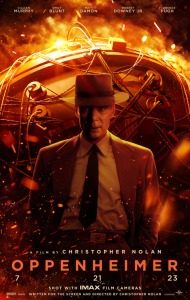
I finally did it. I watched all three hours of Christopher Nolan’s Oppenheimer, one half of the biggest movie-going event of 2023, and arguably the most smarty-pants movie to ever gross a billion dollars. It was a critical darling all year long, sailed through its awards season, and racked up seven Academy Awards including Best Picture and Best Director for Nolan, a coronation for one of Hollywood’s biggest artists whose name alone is each new project’s biggest selling point. I’ve had friends falling over themselves with rapturous praise, and I’m sure you have too, dear reader, so the danger becomes raising your expectations to a level that no movie could ever meet. As I watched all 180 lugubrious minutes of this somber contemplation of man’s hubris, I kept thinking, “All right, this is good, but is it all-time-amazing good?” I can’t fully board the Oppenheimer hype train, and while I respect the movie and its exceptional artistry, I also question some of the key creative decision-making that made this movie exactly what it is, bladder-busting length and all.
As per Nolan’s non-linear preferences, we’re bouncing back and forth between different timelines. The main story follows Robert Oppenheimer (Cillian Murphy) as an upstart theoretical physicist creating his own academic foothold and then being courted to join the Manhattan Project to beat the Nazis in the formation of a nuclear bomb. The other timeline concerns the Senate approval hearing for Lewis Strauss (Robert Downey Jr.), the former head of the Atomic Energy Commission (AEC) with a checkered history with Oppenheimer after the war. A third timeline, serving as a connecting point, involves Oppenheimer undergoing a closed-door questioning over the approval of his security clearance, which brings to light his life of choices and conundrums.
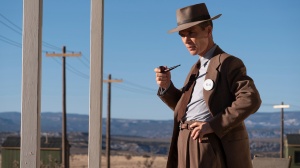
If I was going to be my most glib, I would characterize Oppenheimer in summary as, “Man creates bomb. Man is then sad.” There’s much more to it, obviously, and Nolan is at his most giddy when he’s diving into the heavy minutia of how the project came about, the many brilliant minds working in tandem, and sometimes in conflict, to usher in a new era of science and energy. Of course it also has radical implications for the world outside of academic theory. The world will never be the same because of Oppenheimer dramatically upgrading man’s self-destructive power. The accessible cautionary tale reminds me of a Patton Oswalt stand-up line: “We’re science: all about ‘coulda,’ not about ‘shoulda.’” Oh the folly of man and how it endures.
For the first two hours, the focus is the secretive Manhattan Project out in the New Mexico desert and its myriad logistical challenges, all with the urgency of being in a race with the Nazis who already have a head start (their break is Hitler’s antisemitism pushing out brilliant Jewish minds). That urgency to beat Hitler is a key motivator that allows many of the more hand-wringing members to absolve those pesky worries; Oppenheimer says their mission is to create the bomb and not to determine who or when it is used. That’s true, but it’s also convenient moral relativism, essentially saying America needs to do bad things so that the Germans don’t do worse things, a line of adversarial thinking that hasn’t gone away, only the name of the next competitor adjusts. This portion of the movie works because it adopts a similarly streamlined focus of smart people working together against a tight deadline. Looking at it as a problem needing to surmount allows for an engaging ensemble drama complete with satisfying steps toward solutions and breakthroughs. It makes you root for the all-star team and excitedly follow different elements relating to nuclear fusion and fission that you would have had no real bearing before Nolan’s intellectual epic. For those two galloping hours, the movie plays almost like a brainy heist team trying to pull together the ultimate job.
It’s the time afterwards where Oppenheimer expands upon the lasting consequences where the movie finds its real meaning as well as loses me as a viewer. The legacy of the bomb is one that modern audiences are going to be readily familiar with 80 years after the events that precipitated their arrival, and they haven’t exactly been shelved or become the world war deterrent hoped for. As one of Oppenheimer’s physicists says, a big bomb only works until someone creates a bigger bomb, and then the arms race starts all over again fighting for incremental supremacy when it comes to whether one’s military might could destroy the world ten times or twelve times over. When Oppenheimer begins having reservations of what he has brought into this world is when his character starts becoming more dynamic, but it’s also too late. He can’t undo what he’s done, the world isn’t going back to a safer existence before nuclear arms, so his tears and fears come as short shrift. There’s a scene where Oppenheimer’s wife, Kitty (Emily Blunt), castigates him and says, “You don’t get to commit the sin and then make all of us to feel sorry for you when there are consequences.” Now this is in reference to a different personal failing of our protagonist, but the message resonates; however, I don’t know if this is Nolan’s grand takeaway. The movie in scope and ambition wants to set up this man as a tragic figure that gave birth to our modern world, but like President Truman says, it’s not about who created the bomb but who uses it. Oppenheimer is treated like a harbinger of regret, but I don’t think the story has enough to merit this examination, which is why Oppenheimer peters out after the bomb’s immediate aftermath.
It reminded me of an Oscar favorite from 2015, Adam McKay’s The Big Short, a true-ish account of real people profiting off the worldwide financial meltdown from 2008. It fools you into taking on the perspective of its main characters who present themselves as underdogs, keepers of a secret knowledge that they are trying to benefit from before an impending deadline. Likewise, the conclusion also makes you question whether you should have been rooting for this scheme all along since it was predicated on the economy crashing; these guys got their money but how many lives were irrevocably ruined to make their big score? With The Big Short, the movie-ness of its telling is part of McKay’s trickery, to ingratiate you in this clandestine financial world and to treat it like a heist or a con, and then to reckon whether you should have ever been rooting for such an adventure. Oppenheimer has a similar effect, lulling you with its admitted entertainment factor and beat-the-deadline structure. Once the mission is over, once the heroes have “won,” now the game doesn’t seem as fun or as justifiable. Except Oppenheimer could have achieved this effect with a judicious resolution rather than an entire third hour of movie shuffled throughout the other two like a mismatched deck of cards.
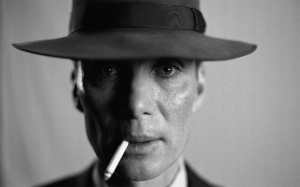
The last hour of the movie features a security clearance interrogation and a Senate confirmation hearing, neither of which have appealing stakes for an audience. After we watch the creation of a bomb, do we really care whether or not this one testy guy gets approved for a cabinet-level position or whether Oppenheimer might get his security clearance back? I understand that these stakes are meaningful for the characters, both essentially on trial for their lives and connections, but Nolan hasn’t made them as necessary for the audience. They’re really systems for exposition and re-examination, to play around with time like it was having a conversation with itself. It’s a neat effect when juggled smoothly, like when Past Oppenheimer is being interviewed by a steely and suspicious military intelligence office (Casey Affleck) while Future Oppenheimer laments to his project superior (Matt Damon) and then Even More Future Oppenheimer regrets his lack of candor to the review board. The shifty wheels-within-wheels nature of it all can be astounding when it’s all firing in alignment, but it can also feel like Nolan having a one-sided conversation with himself too often. It’s another reminder of the layers of narrative trickery and obfuscation that have become staples of a Christopher Nolan movie (I don’t think he could tell a knock-knock joke without making it at least nonlinear). The opposition to Oppenheimer is summarized by Strauss but I would argue the man didn’t need a public witch hunt to rectify what he’s done.
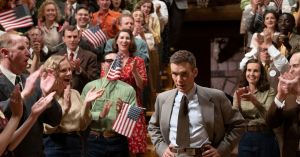
Lest I sound too harsh on Nolan’s latest, there are some virtuoso sequences that are spellbinding with technical artists working to their highest degree of artistry. The speech Oppenheimer gives to his Los Alamos colleagues is a horrifying lurch into a jingoistic pep rally, like he’s the big game coach trying to rally the team. The way the thundering stomps on the bleachers echo the rhythms of a locomotive in motion, driving forward at an alarming rate of acceleration, and then how Nolan drops the background sound so all we hear is Oppenheimer’s disoriented speech while the boisterous applause is muted, it’s all masterful to play with our sense of dread and remorse. This is who this man has become, and his good intentions of scientific discovery will be rendered into easily transmutable us-versus-them fear mongering politics. The ending imagery of Oppenheimer envisioning the world on fire is the exact right ending and hits with the full disquieting force of those three hours. The meeting with Harry Truman (Gary Oldman) is splendid for how undercutting it plays. Kitty’s interview at the hearing is the kind of counter-punching we’ve been waiting for and is an appreciated payoff for an otherwise underwritten character stuck in the Concerned Wife Back at Home role. The best parts are when Oppenheimer and Leslie Groves (Damon) are working in tandem to put together their team and location, as that’s when the movie feels like a well orchestrated buddy movie I didn’t know I wanted. The sterling cinematography, musical score, editing, all of the technical achievements, many of which won Oscars, are sumptuously glorious and immeasurably add to Nolan’s big screen vision.
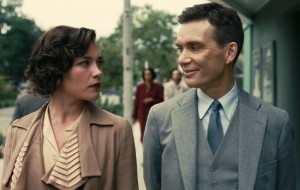
I think I may understand why the subject of sex is something Nolan has conspicuously avoided before. Much has been made about the sex scenes and nudity in Oppenheimer, which seem to be the crux of Florence Pugh’s performance as Jean Tatlock, Oppenheimer’s communist mistress through the years. The moment of Oppenheimer sitting during his hearing about his sexual tryst with an avowed communist leads to him imagining himself in the nude, exposed and vulnerable to these prying eyes and their judgment. Then Kitty imagines seeing Pugh atop her husband in his hearing seat, staring directly at her, and this sequence communicated both of their internal states well and felt justified. It’s the origin of the famous “I am become death” quote where the movie enters an unexpected level of cringe for a movie this serious. I was not prepared for this, so mild spoilers ahead if you care about such things, curious reader. We’re dropped into a sex scene between Oppenheimer and Jean where she takes a break to peruse his library shelves. She’s impressed that he has a Hindu text and pins it against her naked chest and slides atop Oppenheimer once again, requesting he read it to her rather than summarize it. “I am become death,” he utters, as he reads the Hindu Book of the Dead off Pugh’s breasts while they continue to have sex. Yikes. A big ball of yikes. If this is what’s in store, please go back to a sexless universe of men haunted by their lost women.
It’s easy to be swept away by all the ambition of Nolan’s Oppenheimer, a Great Man of History biopic that I think could have been better by being more judiciously critical of its subject. It’s a thoroughly well-acted movie where part of the fun is seeing known and lesser known name actors populate what would have been, like, Crew Member #8 roles for the sake of being part of this movie (Rami Malek as glorified clipboard-holder). Oppenheimer takes some wild swings, many of them paying off tremendously and also a few that made me scratch my head or reel back. It’s a demonstrably good movie with top-level craft, but I can’t quite shake my misgivings that enough of the movie could have been lost to history as well.
Nate’s Grade: B
Share this:

Eternal Sunshine of the Spotless Mind (2004) [Review Re-View]

Originally released March 19, 2004:
No other movie this year captured the possibility of film like Michel Gondry and Charlie Kaufman’s enigmatic collaboration. Eternal Sunshine was a mind-bending philosophical excursion that also ended up being one of the most nakedly realistic romances of all time. Joel (Jim Carrey restrained) embarks on having his memories erased involving the painful breakup of Clementine (Kate Winslet, wonderful), an impulsive woman whose vibrant hair changes as much as her moods. As Joel revisits his memories, they fade and die. He starts to fall in love with her all over again and tries to have the process stop. This labyrinth of a movie gets so many details right, from the weird physics of dreams to the small, tender moments of love and relationships. I see something new and marvelous every time I watch Eternal Sunshine, and the fact that it’s caught on with audiences (it was nominated for Favorite Movie by the People’s friggin’ Choice Awards) reaffirms its insights into memory and love. I never would have thought we’d get the perfect romance for the new millennium from Kaufman. This is a beautiful, dizzingly complex, elegant romance caked in visual grandeur, and it will be just as special in 5 years as it will be in 50, that is if monkeys don’t evolve and take over by then (it will happen).
Nate’s Grade: A
——————————————————
WRITER REFLECTIONS 20 YEARS LATER

“How happy is the blameless vestal’s lot!
The world forgetting, by the world forgot:
Eternal sunshine of the spotless mind!
Each prayer accepted, and each wish resigned;”
-Alexander Pope, Eloisa to Abelard (1717)
“Go ahead and break my heart, that’s fine
So unkind
Eternal sunshine of the spotless mind
Oh, love is blind
Why am I missin’ you tonight?
Was it all a lie?”
-Kelly Clarkson, Mine (2023)
This one was always going to be special. Eternal Sunshine of the Spotless Mind is not just one of my favorite movies, it’s one of those movies that occupies the place of Important Formative Art. It’s a movie that connected with me but it’s also one that profoundly affected me and changed me, that inspired me in my own creative ventures. With its elevated place in my memory, I’ll also admit that there was some mild trepidation about returning to it and having it not measure up to the impact it had all those twenty years ago. It’s impossible to recreate that first experience or to chase after it, but you hope that the art we consider great still has resonance over time. This happened before when I revisited 2000’s Requiem for a Dream, a movie that gobsmacked me in my youth, had such innate power and fascination, and had lessened over the decades. It was still good art but it wasn’t quite the same, and there’s a little tinge of disappointment that lingers.

When I saw the movie for the first time it was at a promotional screening. I was a senior in college and had dyed my hair bright red for the second time. After marveling over my first encounter with 1999’s Run Lola Run, I was determined to have hair like the titular Lola. My parents were hesitant and set parameters, like certain grade achievements, and I met them all. Afterwards they had nothing left to quibble so I dyed my hair red, as well as other colors, my sophomore year and then again my senior year. At the screening, a publicist for the studio asked if I wanted to compete for a prize. I demurred but then she came back and asked again, and sensing something to my advantage, I accepted. It turns out the pre-show contest was a Clementine (Kate Winslet) look alike contest and my only competition was a teen girl with one light swath of blue hair. The audience voted and I won in a landslide and was given a gift basket of official Eternal Sunshine merchandise that included the CD soundtrack and a bright orange hooded sweatshirt modeled after the one Clem wears in the movie. That sweatshirt quickly became one of my favorite items of clothing, something special that nobody else had from a movie I adored. I wore it everywhere and it became a comfort and a confidence builder. Back during my initial courtship with my wife, in the winter months of 2020, she held onto the orange hoodie as a memento to wear and think of me during our time apart. She said it even smelled like me, which was a comfort. It had meaning for us, and we cherished it. I had to marry her, of course, to ensure I’d eventually get the sweatshirt back in my possession (I kid).
The lessons of Eternal Sunshine run deep for me. On the surface it’s a breakup movie about an impulsive woman, Clem, deciding to erase her memories of her now ex-boyfriend Joel (Jim Carrey). Out of spite, he elects to have the same procedure, and from there we jump in and out of Joel’s head as a subconscious avatar experiences their relationship but in reverse. It’s the bad memories, the hurt and ache of a relationship nearing or past its end, but as each memory degrades and Joel goes further into the past, he discovers that there are actually plenty of enjoyable memories through those good times, the elation and discovery, the connections and development of love, that he doesn’t want to lose. He tries to fight against the procedure but it becomes a losing battle, and so he gets to ride shotgun in his cerebellum as this woman vanishes from his life. What began out of spite and heartache ends in mourning and self-reflection.
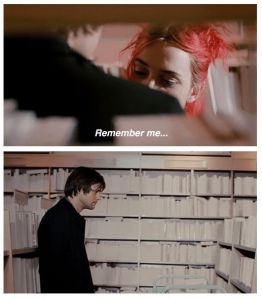
At its heart, the movie is asking us to reflect upon the importance of our personal experiences and how they shape us into the people that we are. This includes the ones that cause us pain and regret. The human experience is not one wholly given to happiness, unfortunately, but there are lessons to be had in the scars and pain of our individual pasts. I’m not saying that every point of discomfort or pain is worthwhile, as there are many victims who would say otherwise, but we are the sum total of our experiences, good and bad. With enough distance, wisdom can be gained, and perhaps those events that felt so raw and unending and terrible eventually put us on the path of becoming the person you are today. Now, of course, maybe you don’t like the person you are now, but that doesn’t mean you’re also a prisoner to your past and doomed to dwell in misery.
After my divorce from my previous wife in 2012, I wrote a sci-fi screenplay following some of the same themes from Eternal Sunshine. It was about two dueling time travelers trying to outsmart one another, one hired to ensure a romantic couple never got together and one hired to make sure that they had. The characters represented different viewpoints, one arguing that people are the total of their experiences and the other arguing people should be capable of choosing what experiences they want ultimately as formative. Naturally, through twists and turns, the one time traveler learns a lesson about “living in the now,” to stop literally living in the past and trying to correct other people’s perceived mistakes, and that our experiences, and our heartache, can be valuable in putting us into position to being the people we want or living the lives we seek. It shouldn’t be too hard to see that I was working through my own feelings with this creative venture. It got some attention within the industry and I dearly hope one day it can be made into a real movie. It’s one of my favorite stories I’ve ever written and I’m quite proud of it. It wouldn’t exist without Eternal Sunshine making its mark on me all those years ago.
It’s an amazing collaboration between director Michel Gondry and the brilliant mind of Charlie Kaufman. The whimsical, hardscrabble DIY-style of Gondry’s visuals masterfully keeps the viewer on our toes, as Joel’s memories begin vanishing and collapsing upon one another in visually inventive and memorable ways. There’s moments like Joel, after finding Clem once she’s erased her memory of him, and he storms off while row after row of lights shuts off, dooming this memory to the inky void. There’s one moment where he’s walking through a street and with every camera pan more details from the store exteriors vanish. A similar moment occurs through a store aisle where all the paperbacks become blank covers. It’s a consistent visual inventiveness to communicate the fraying memories and mind of Joel, which becomes its own playground that allows us to better understand him. The score by Jon Brion (Magnolia) is also a significant addition, constantly finding unique and chirpy sounds to provide a sense of earned melancholy. By experiencing their relationship backwards, it allows us to have a sense of discovery about the relationship. This is also aided by Kaufman’s sleight-of-hand structure, with the opening sequence misleadingly the beginning of their relationship when it’s actually their second first time meeting one another. The pointed details of relationships, both on the rise and decline, feel so achingly authentic, and the characters have more depth than they might appear on the surface. Joel is far more than a hopeless romantic. Clem is far more than some Manic Pixie Dream Girl, a term coined for 2005’s Elizabethtown. She tells Joel that she’s not some concept, she’s not here to complete his life and add excitement; she’s just a messed up girl looking for her own peace of mind and she doesn’t promise to be the answer for any wounded romantic soul.

The very end is such a unique combination of feelings. After Mary (Kirsten Dunst) discovers that she’s previously had her memories of an affair with her boss erased, she takes it upon herself to mail every client their files so that they too know the truth. Joel and Clem must suffer listening to their recorded interviews where they are viciously attacking one another, like Clem declaring Joel to be insufferably boring who puts her on edge, and Joel accuses her of using sex to get people to like her. Both are hurt by the accusations, both shake them off as being inaccurate, and yet it really is them saying these things, recorded proof about the ruination of their relationship. Would getting together be doomed to eventually repeat these same complaints? Clem walks off and Joel chases after her and tells her not to go. Teary-eyed, she warns that she’ll grow bored of him and resentful because that’s what she does, and she’ll become insufferable to him. And then Joel says, “Okay,” an acceptance that perhaps they may repeat their previous doomed path, maybe it’s inevitable, but maybe it also isn’t, and it’s worth it to try all the same. Maybe we’re not destined to repeat our same mistakes. Then it ends on a shot of our couple frolicing in the snow, the descending white beginning to blot out the screen, serving as a blank slate. It’s simultaneously a hopeful and pessimistic ending, a beautifully nuanced conclusion to a movie exploring the human condition.
Winslet received an Oscar nomination for her sprightly performance, and deservedly so, but it’s Carrey that really surprises. He had already begun to stretch his dramatic acting muscles before in the 1998 masterpiece The Truman Show and the far-from-masterpiece 2001 film The Majestic. He’s so restrained in this movie, perfectly capturing the awkwardness and passive aggressive irritability of the character, a man who views his life as too ordinary to be worth sharing. Clem begs him to share himself since she’s an open book but he’s more mercurial. She wants to get to know him better but to Joel there’s a question of whether or not he has anything worthwhile getting to know. Carrey sheds all his natural charisma to really bring this character to life. It’s one of his best performances because he’s truly devoted to playing a character, not aggressively obnoxious Method devotion like in 1999’s Man on the Moon.
Eternal Sunshine of the Spotless Mind is a messy, enlightening, profound, playful, poignant, and mesmerizing movie. A perfect collaboration between artists with unique creative perspectives. I see something new every time I watch it, and it’s already changed my life in different ways. I used to see myself as Joel when I was younger, but then I grew to see him as self-pitying and someone who too often sets himself up for failure by being too guarded and insular. It’s a reminder that our cherished relationships remain that way by allowing ourselves to be vulnerable and open. We are all capable and deserving of love.
Re-View Grade: A
Share this:

The Passion of the Christ (2004) [Review Re-View]

Originally released February 25, 2004:
The Passion of the Christ is a retelling of the last 12 hours of Jesus Christ’s life (perhaps you’ve heard of him?). In these final hours we witness his betrayal at the hands of Judas, his trial by Jewish leaders, his sentencing by Pontius Pilate, his subsequent whippings and torture and finally his crucifixion. Throughout the film Jesus is tempted by Satan, who is pictured as a pasty figure in a black hood (kind of resembling Jeremy Irons from The Time Machine if anyone can remember). The Passion spares no expense to stage the most authentic portrayal of what Jesus of Nazareth endured in his final 12 hours of life.
For all the hullabaloo about being the most controversial film in years (and forgive me for even using the term “hullabaloo”), I can’t help but feel a smidgen of disappointment about the final product. The Passion is aptly passionate and full of striking images, beautiful photography and production values, and stirring performances all set to a rousing score. But what makes The Passion disappointing to me is the characters. You see, Mel Gibson’s epic does not devote any time to fleshing out the central characters. They are merely ciphers and the audience is expected to plug their feelings and opinions into these walking, bleeding symbols to give them life. Now, you could argue this is what religion is all about, but as far as a movie’s story goes it is weak. The Passion turns into a well-meaning and slick spectacle where character is not an issue. And as a spectacle The Passion is first-rate; the production is amazing and the violence is graphic and gasp-inducing. Do I think the majority of people will leave the theater moved and satisfied? Yes I do. But I can’t stop this nagging concern that The Passion was devoid of character and tried covering it up with enough violence to possibly twist its message into a Sunday school snuff film.

For my money, the best Biblical film is Martin Scorsese’s 1987 The Last Temptation of Christ (also a film mired in controversy). Last Temptation, unlike Gibson’s spectacle, was all about Jesus as a character and not simply as a physical martyr. Scorsese’s film dealt with a Christ consumed by doubt and fear and the frailties of being human. But the best part is the final 20 minutes when Jesus is tempted, by Satan, to step down from the cross and live out a normal life. Jesus walks away from the cross, marries Mary Magdalene, fathers children (this is where the controversy stemmed from but they were married) and dies at an old age. Jesus is then confronted by his aging apostles who chastise him for not living up to what he was supposed to do to save mankind. Jesus wakes up from the illusion and fulfills his mission and dies on the cross. Now, with the story of Last Temptation an audience has a greater appreciation for the sacrifice of Jesus because they witness his fears and they witness the normal life he forgoes to die for man’s sins. There is a sense of gravity about what Jesus is sacrificing.
With The Passion Gibson figures if he can build a sense of grand sacrifice by gruesomely portraying the tortures Jesus endured. Even if it is Jesus, and this may sound blasphemous, torturing a character to create sympathy and likeability is the weakest writing trick you can do. Yes Jesus suffered a lot, yes we should all be horrified and grateful, and yes people will likely be moved at the unrelenting violence he endured, but in regards to telling a story, I cannot feel as much for characters whose only characterization is their suffering. Sure, The Passion flashes back to some happier moments of Jesus’ life, which I like to call the Jesus Greatest Hits collection, but the movie does not show us who Jesus was, what he felt (beyond agonizing pain) or the turmoil he went through in finally deciding to give up his own life for people that despised him. The Passion is not about character but about spectacle.
So let’s talk about the violence now, shall we? Gibson’s camera lovingly lingers on the gut-churning, harrowing, merciless level of violence. But this is his only message. It’s like Gibson is standing behind the camera and saying to the audience, “You see what Jesus suffered? Do you feel bad now? FLAY HIM MORE! How about now?” What was only three sentences of description in the Gospels takes up ten minutes of flogging screen time. Mad Mel has the urge to scourge. After an insane amount of time spent watching Jesus get flayed and beaten the violence starts to not just kill whatever spiritual message Gibson may have had in mind, but the violence becomes the message. The Passion does give an audience a fair understanding of the physical torture Jesus was subjected to, but the movie does not display Christ as fully human, enjoying life and love, or fully divine. The only thing The Passion shows us about Jesus is that the son of God sure knew how to take a whuppin’. For Gibson, the violence is the message and the point is to witness what Jesus endured. Some would call that sadistic.

The actors all do a fine job and it’s impressive that everyones’ lines is in two dead languages (Latin and Aramaic, though for the life of me I can’t tell them apart). But the acting is limited because of the nature of the film. Had there been more moments of character the acting would come across better. As it stands, the acting in The Passion is relegated to looks of anguish or looks of horror, interspersed with weeping. Monica Bellucci (The Matrix sequels) really has nothing to do as Mary Magdalene but run around in the background a lot. Jim Caviezel (Frequency, Angel Eyes) gives everything he has in the mighty big shoes he tries to fill. It’s too bad that his Jesus spends most of the screen time being beaten, which kind of hampers his acting range.
Now let’s address the anti-Semitic concerns. The Passion does portray a handful of Jewish religious leaders as instigators for Jesus’ eventual crucifixion, but there are also Jewish leaders who denounce their actions and just as many people bemoaning the torture of Jesus as there are calling for it. Who really comes off looking bad are the Romans. Excluding the efforts to make Pilate look apprehensive, the Roman soldiers are always seen kicking, punching, whipping, spitting on Jesus and laughing manically with their yellow teeth.
And like I said before, most people will be extremely satisfied with the film because it’s hard to find a person who doesn’t have an opinion on Jesus. Gibson is counting on audiences to walk in and fill in the holes of the character so that The Passion is more affecting. Gibson’s film is worthy spectacle, and despite the vacuum of character I did get choked up four separate times, mostly involving Jesus and his mother. The Passion is a well-made and well-intentioned film that will hit the right notes for many. I just wish there were more to it than spectacle. I really do.
Nate’s Grade: C
——————————————————
WRITER REFLECTIONS 20 YEARS LATER

In 2004, Mel Gibson made an R-rated foreign film that was two hours of savage brutality against Jesus, and it wound up being one of the biggest box-office hits of the decade and forged a trail for other Hollywood execs to chase after a “faith-based audience.” It could be said that this grisly movie gave the people what they wanted, and apparently what they wanted was to watch their messiah suffer physical feats that should have killed any mortal five times over. Twenty years later, The Passion of the Christ is still a curiosity, a movie with so much technical quality and devotion to a specific purpose, but that purpose is so narrow: make people feel bad. If you were being charitable, you could argue that the sacrifice of Jesus is felt stronger when every whipping, beating, scourging, and blood-letting is endured from the audience. Except I don’t believe this, because that assumes that more time spent on visual carnage equals more appreciation earned, as if our empathy has an equation. The emphasis on the death of Jesus feels like a telling insight into certain elements within mainstream American religious culture, where the focus is on violence and loss and less so the resurrection of Jesus, wherein the man conquers death and preaches forgiveness of sin for all mankind. It’s the preoccupation with grievance and brutish power over the helping of others different and less fortunate from ourselves. I’m not going to say the hard-core fans of The Passion of the Christ are valuing the wrong spiritual ideals, but it was this Jesus guy who did say everyone should love thy neighbor as thyself.

This is going to be a rarity for my twenty-year re-review series, but I agree almost one hundred percent with everything I wrote in 2004. I can’t really improve upon that analysis and my explanation for the faults of the movie and its spiritual shortcomings. Some of these lines are still terrific: “…Twist its message into a Sunday school snuff film,” “The only thing The Passion shows us about the Son of God is that he sure knew how to take a whippin’,” and, “Mad Mel has the urge to scourge.” More time is spent obsessing over the blood of Jesus than any of his words. I’m still debating the exact legacy of this movie besides as a harbinger of a wider Christian marketplace as well as Jim Caviezel’s own god complex. Gibson only directed two other movies after, 2006’s Apocalypto and 2016’s Hacksaw Ridge. His personal failings also became hard for many to ignore after his anti-semetic drunken ramblings and allegations of abuse, relegating him chiefly to direct-to-streaming (13 films from 2020-2023). In many ways, The Passion of the Christ represents Gibson at his height of powers within Hollywood, and it was accomplished outside the studio system who thought he was crazy, though he proved them right for different reasons.
Some strange Passion facts lost to history. 1) This movie actually killed a viewer. During the crucifixion scene, a man suffered a fatal heart attack and later died. Sure, the man’s genetics and life-style choices are more likely at fault here, but had this man not seen Gibson’s movie he might have survived or at least been in a better capacity to deal with his eventual heart attack symptoms. 2) Gibson attempted to re-edit the movie for a PG-13 theatrical re-release in 2005, trimming five minutes of some of the more gruesome violence, yet the MPAA still said the movie was keeping its R-rating. 3) During filming, Caviezel was literally struck by lightning. 4) A sequel has been in development for almost twenty years, confirmed by Gibson’s Braveheart screenwriter Randall Wallace in 2016. In 2023, Gibson revealed he has multiple versions of the sequel script in the works, including one that visits hell. Caveizel has predicted the possible sequel would be the “biggest film in history,” but this is the same guy who declared Donald Trump as the modern-day Noah, so maybe let’s not regard this guy too credibly with his opinions.

The challenge with any on-screen depiction of Jesus is fleshing him out as man and god. Only focusing on one obscures the complexity of characterization, denying filmgoers a more engaging examination of the key figure of Christianity. I’d still advise everyone to watch Martin Scorsese’s The Last Temptation of Christ for all the important elements that The Passion of the Christ lacks. This is a movie designed only for brutal spectacle and nothing more, and it’s just as tedious and empty now as it was twenty years ago. Apparently, Scorsese feels like he still has more to say on the subject and is planning another Jesus movie based on a 2016 book by Shūsaku Endō, the same author of the source material for Silence. While I would maintain that Scorsese has already made the greatest movie about Jesus, as well as the greatest movie about the exploration and challenge of reckoning with faith (2016’s Silence), who am I to deny one of our living legends another bite from the apple? It’ll certainly be more spiritually meaningful than watching an execution of Jesus for two miserable hours designed as enlightenment.
Re-Review Grade: C-
Share this:

Night Swim (2024)
 It feels like the genesis of Night Swim was somebody saying, “We need a new way to do a haunted house movie so… what if…?” and then just pointed to different parts of the home and questioned whether it could be haunted. What I’m saying is we were probably a coin flip away from a terrifying tale of a haunted barbecue grill (working title: Dead Meat). A haunted pool would naturally lead to the question, “Well, why don’t you stay out of the pool?” and, well, we don’t really have an answer, so the pool can’t do too much because it’s immobile. There’s a possibility here with some spirit linked to the pool water seeking sacrifices and offering rewards in return, but this is downplayed so much and eventually forgotten during the muddied reasoning that concludes this confusing movie. I don’t think the film can even stick to its own rules. It needs to be either goofier, fully embracing its ridiculous premise of a haunted swimming pool, or going even darker and deeper with its back-story and rules and how this corrupts the new family, not because of some evil possession but from the simple wish-granting opportunity of feeding this monster for personal gain. There’s a way to make this concept work, specifically bringing the revelation earlier and dealing with the devil’s bargain implications and moral relativism. Alas, instead we get a movie about a husband being possessed by evil spring spirits and literally playing a game of Marco Polo with his children and, upon stalking them, pounces by ominously shouting, “You’re supposed to say ‘Polo’!” Just keep swimming, folks.
Nate’s Grade: C
Share this:

Anatomy of a Fall (2023)

I was so looking forward to watching the French drama Anatomy of a Fall, nominated for five Oscars including Best Picture and Best Director for Justine Triet, that I had to track down the publicity department for Neon Studios and hound them to finally get my annual Neon screener box-set for critics. It took several weeks, and email chains, but thankfully the good folks at Neon supplied me with their screener box, like Christmas morning for a film critic. The surprise Oscar nominations only made me more eager to finally watch this movie. As Anatomy of a Fall played, and the criminal case became ever more complicated, shedding further light upon the characters and their stormy marriage, I found myself sitting closer and closer to my TV, finally sitting on the floor right in front of it. Part of this can be explained by trying to better read the subtitles, though truthfully half of the movie is in English, but the real reason was that I became absorbed, waiting anxiously to see where it could go next, what twist and turn would further reassess our fragile understanding of the events, the people, and the possible circumstances. The original screenplay is so thoroughly engaging, and with supremely talented acting and clever directing, that I knew I was in good hands to ensure my investment of 140 minutes wouldn’t be wasted.
Popular novelist Sandra Voyter (Sandra Huller) is talking with a female reporter about her process as they lounge in her home. They’re drinking, laughing, and then the loud sounds of a steel drum start echoing from upstairs, thanks to Sandra’s husband, Samuel (Samuel Maleski), who puts the song on repeat. He’s passive aggressively sabotaging the interview, and Sandra bids goodbye to the interviewer. Hours later Samuel is found on the ground outside with blood seeping from a head wound. The attic window is open, the same attic he was remodeling before presumably falling to his death. Did he take his own life or was foul play involved? Did Sandra actually kill her husband?

At its core, the movie is an anatomy of a criminal investigation, a prosecution and the personal defense, but it’s really an anatomy of people and the versions of themselves that they selectively present to others and themselves. It’s an old maxim that you can never know what’s going on inside a marriage, or really any relationship, as the inner reality is far more complex than what is easy to digest and categorize by the public. It’s not new to hide aspects of ourselves from wider scrutiny and consumption. It also isn’t new for a larger public profile to invite speculation from online busybodies who think they are entitled to know more. The mystery about whether or not Sandra is guilty or a cruel victim of suspicious circumstance is a question that Triet values, but clearly she values other more personal mysteries more, chiefly the mystery of our understanding of people and why they may choose to do inexplicable acts. How close can we ever really know a person? The upending of her life pushes Sandra to re-examine her own marriage in such a high stakes crucible that can determine whether or not she spends the rest of her life in jail. Under those extreme circumstances, the bigger question isn’t how someone may have committed murder, or taken their life, but the unexamined why of it all that nibbles away at Sandra as well as our collective consciousness as viewers. To me, that’s a more compelling and worthwhile mystery to explore than whether or not it was a murder or suicide (there is a wild theory finding some traction online blaming the death on the family dog).
I don’t feel it’s a significant spoiler to prepare the viewer to know that Triet keeps to ambiguity to the bitter end, refusing to specify what actually happened to Samuel. It’s ultimately up to the viewer to determine whether they think Sandra is guilty or innocent, and there’s enough room to have a debate with your friends and Francophile colleagues. I’ll profess that I found myself on the Team Sandra bandwagon and fully believed she was being railroaded by the French judicial system and press. The righteous anger I felt on behalf of this woman rose to volcanic levels, as it felt like much of the French prosecution’s line of questioning and theorizing was mired in blatant eye-rolling misogyny and conjecture. They insist that because Sandra is bisexual that she must have been flirting with her female interviewer on the day of Samuel’s death, because that’s how it works for bisexuals, obviously, to only be able to size every person they meet, no matter whatever anodyne circumstances, as some possible or inevitable sexual conquest. As an outsider to the French judicial system, I was intrigued just by how the trials are conducted, which seems far less formal despite the wigs and robes, where the accused can interrupt anytime to deliver speeches and question experts. I also appreciated how much attention Sandra’s family friend and defense attorney puts into helping her shape her image, to the press, to the court, to the judge, down to her perspective of her marriage to her vocabulary choices. Rather than be a reflection of Sandra as coolly calculated, I viewed it as learning to prepare for the dangers ahead. It reminded me of Gone Girl with the media-savvy lawyer coaching his high-profile client through their trouble.
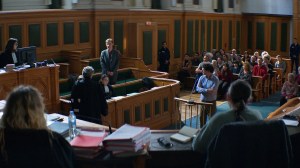
Of course, there are larger implications with this prosecution. Sandra isn’t just on trial for suspicion of killing her husband to clear the way for her next lover, she’s the victim of all the ways that women are judged and found guilty by society. Sandra is a successful novelist, the top provider, and her husband isn’t, and it eats away at him, festering resentment that she is somehow stifling his own creative dreams. Is she giving him space or being distant? Is she doing enough or too little? Is she a supportive spouse or selfish? Is she a good mom or a bad mom? Is she allowed an independent life or should she be fully devoted to the titles of mom and wife? It’s the struggle to fit into everyone’s impossible and conflicting definition of what makes an acceptable woman and mother, and it’s infuriating to watch (think America Ferrera’s Barbie speech but as a movie). It’s also an indication of the cultural true crime obsession and turning people’s complicated identities and nuanced relationships into easy-to-digest fodder for morbid entertainment. It’s not like there’s some grand speech that positions Sandra as the martyr for all of embattled womanhood, but through her trial and media scrutiny, these social issues are projected onto her like a case study.
As much as I loved Lily Gladstone and Emma Stone in their respective performances in 2023, at this point I’d gladly give the Best Actress Oscar to Huller (The Zone of Interest). First off, she delivers a tremendous performance in three separate languages, as her character is a native German who marries a Frenchman and then they agree to speak in English as their linguistic “middle ground,” a language that isn’t native to either of them. Huller slips into her character seamlessly and it’s thrilling to watch her assert herself, press against the bad faith assumptions of others. One of the highlights of the movie is the most extended flashback where we witness the simmering resentment of this marriage come fully to force, and while it’s unclear whether this moment, as the other occasional flashbacks, is meant to be conveyed as Sandra’s subjective memory or objective reality, it serves as a mini-climax for the story. It’s here where Sandra pushes back against her husband’s self-pitying criticisms and projections. It’s a well-written, highly satisfying “Amen, sister” moment, and Huller crushes it and him. There were moments where I was in awe of Huller that I had to simply whistle to myself and remark how this woman is really good at acting. With such juicy material and layers to sift through, Huller astounds.

Another actor worth celebrating is Milo Machado-Graner (Waiting for Bojangles) as the couple’s only child Daniel, a young boy who is partially blind because of an earlier accident from Samuel’s negligence and the one who discovers his dad’s body. This kid becomes our entry point into the history of this marriage but it also turns on his perceptions of his parents, as Sandra is worried over the course of the trial that Daniel will learn aspects of their marriage that she was trying to shield from him, and he may never be able to see his father and mother the same way again. It’s a rude awakening for him, and key parts of the trial rest upon a child’s shaky memory, adding intense pressure onto a hurting little boy. There’s a key flashback that will change the direction of the case, but again Triet doesn’t specify whether this is Daniel’s memory, Daniel’s distorted memory looking for answers whereupon there might not be any, or the objective reality of what happened and what was said. Machado-Graner delivers a performance that is built upon such fragility that my heart sank for him. It’s a far more natural performance free of histrionics and easy exaggerations, making the response to such trying events all the more devastating.
Anatomy of a Fall was not selected by its home country for consideration for the Academy’s Best International Film competition despite winning the Palme D’Or, the top prize, at the prestigious Cannes Film Festival. Not to take anything away from 2023’s The Taste of Things, a French drama I’ve heard only fabulous responses, but clearly they picked the wrong contender and lost a winnable race. Do you know the last time France won the Oscar for Best Foreign/International Film? You have to go all the way back to 1991’s Indochine, a movie about the history of France’s colonial occupation of Vietnam. For a nation known for its rich history of cinema, it’s now been over thirty years since one of their own movies won the top international prize at the Academy. Oh well, there’s always next year, France. It’s truly befuddling because Anatomy of a Fall is such an easily accessible movie that draws you in and reveals itself with more tantalizing questions. It has supremely accomplished acting, directing, and writing. Anatomy of a Fall is a spellbinding, twisty movie and one of the absolute best films of 2023, in any language.
Nate’s Grade: A
Share this:

It Lives Inside (2023)
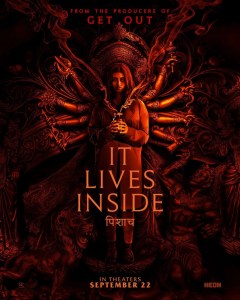 It’s a horror movie as examination on assimilation from an Indian-American standpoint and giving a different culture its own big screen boogeyman. It Lives Inside is about Samidha, a teenage Indian-American girl trying to fit in her suburban high school, which often involves her downplaying or abandoning her cultural roots and practices. She’s all but abandoned her childhood friend Tamira as an impediment to her social acceptance by the cool Caucasian kids. She then feels even more guilt when her friend goes missing and might be possessed by a demon of Hindu lore that feeds off negative energy (no wonder it’s targeting high school girls). This is the latest movie that uses the vehicle of horror to examine more personal themes, bringing a specific culture into the forefront and allowing wider audiences to learn from the horrors of trying to fit in when you feel different and ashamed for being different. As Samidha searches for her missing friend, she’s also forced to seek out help from her disapproving and more conservative mother, a woman steeped in her heritage. Where the movie left me wanting was in the exploration of its specific mythology as well as the development of the divide between mother and first-generation daughter. That’s the core of what can make this movie special, and yet what we get are more scenes of jump scare PG-13 terror and canoodling. It’s not a terribly scary movie, though the eventual creature design has some nicely unsettling angles. There’s one moment of hair floating that really unnerved me, but most of the movie falls on generic atmosphere effects. There are so many sequences of one high school English teacher working alone in the school (where is anyone else? Does this woman do nothing else?) and running through corridors as lights flicker and sinister sounds linger. By the end, It Lives Inside is an acceptable horror movie that would have benefited from spending more of its time on the perosnal elements that would have made it stand out rather than fit in with the horror crowd.
Nate’s Grade: B-
Share this:

The Iron Claw (2023)
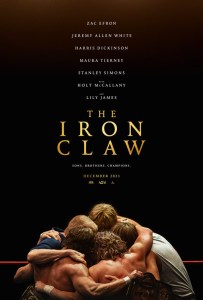 The true story of a wrestling family that was beset by so much tragedy it might as well be a lost Shakespearean drama. The Iron Claw follows the Von Erich brothers, lead by oldest brother Kevin (Zac Efron). They’re all competing for their father’s approval, the same man who gives them updated son rankings at the breakfast table. Kevin and his three brothers (Jeremy Allen White, Harris Dickinson, Stanley Simons) are living out their old man’s dream of being a professional wrestler of significant renown, and the appeal of the brothers is as a fighting family of wrestlers rather than as single entities. In essence, they don’t seem to matter unless as a collective. This leads to plenty of misguided attempts to curry favor with their toxic parent and a pile-up of tragedies that would be absurd if it wasn’t actually true. The issue for me was that I didn’t see the other brothers as fully dimensional characters, and side stories like Kevin’s romantic escapades felt lacking as illumination. It felt for much of its running time like a good movie but one going about its business with a little too much expediency. I was interested but felt like the brothers were more reflections on Kevin than their own separate characters. However, the film’s last twenty minutes are by far the best part and finally find a way to elevate the drama as well as better personalize it through Kevin’s grief and survivor’s guilt. “It’s okay dad, we’ll be your brothers,” spoken with the innocent yearning of a child, pretty much broke me and caused me to sob. If you’re a fan of 1980s professional wrestling, or meaty dramas about the suffering of strong men from strong men, I’m here to assure you that it’s okay to cry here. The Iron Claw is a fine drama that comes together by its end for an off-the-ropes wallop, and the lingering sadness is one that will be hard to shake for hours.
Nate’s Grade: B
Share this:

The Butterfly Effect (2004) [Review Re-View]
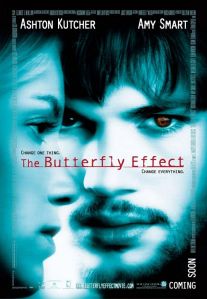 Originally released January 23, 2004:
Notice: I found Ashton Kutcher, star of The Butterfly Effect, on a trip to buy dog food, and cordially asked him to write a review. This is what he sent me. It’’s totally him. I wouldn’’t make this stuff up. That would be dumb.
“So, like, this Nate guy asked me to do a review of my new awesomest movie, The Butterfly Effect. Dude, like anyone needs a review for the most awesomest movie ever. I mean, like, the term ‘awesomest movie ever’ should say, like, everything. The only thing possibly more awesome than The Butterfly Effect would be trucker hats …… or two chicks totally making out. And I only said ‘possibly more awesome,’ which doesn’’t mean it is more awesome, because, dude, like I said before, The Butterfly Effect is the most awesomest thing ever. You can’t dispute that. Don’t even try. I’m awesome!
Like, the story goes like this, man. I play this guy, like I know big stretch there, but he’s not the most awesome guy ever, which is what you’d be thinking since it’s the most awesomest movie ever. But no, he’s like this kid who blacks out and has this wickedly twisted childhood where he stars in his neighbor’s kiddie porn, has his dog set on fire, and, like, his dad is all crazy, or, like I like to say, insane in the ole’ membrane. Ha, I totally made that up right now. I’m awesome!
So, you’re like saying, ‘Dude, that movie sounds less than awesome. Yes, sir, I am having definite doubts about the awesomeness of this movie. Like, do I need to go to the movies to, like, feel bad? I got my parents to do that for me. That and school.’ Hey man, I’m there, I know what you feel. ‘Cause right when you are like, ‘Dude, when is Demi gonna’ show up playing his mom?’ I find these old journals of mine and, dude, use them to travel back in time. I know, the awesomeness has returned. And I use the journals to go back and try and punk time, man. I try and make things better and change the future but I like totally just make it worse. I know, double punk’d, man! I try and fix the life of this hot girl in the movie (she showed her boobs in that Road Trip movie, did you see that? That part where she shows her boobs, oh man … It is awesome) but things don’’t work out. Like she becomes a crack ho at one point. Dude, total punk’d. I’m awesome!
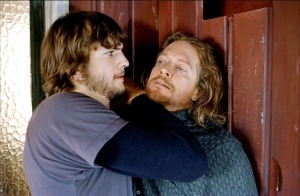 I should be taken as a serious actor. I didn’t hit my head on something and I grew a beard, what more do people need to know I got the goods? I mean, I don’t want to keep saying it but …… beard. C’mon! When actors want to be taken seriously they, like, grow beards. That’s why all those people in movies before 1970 (I know, it surprised me too that there were older movies) got awards and stuff. Beards, dude. Beards. When Billy Dee Shakespeare, like, invented acting, he totally imagined dudes, and chicks too, with beards. That’s why girls can’t be taken as serious actors, ‘cause they can’t grow beards. Ha. I’m awesome!
So, like, if you ever wondered what it would be like to see me, Ashton Kutcher, the most awesome man alive …who ever lived, no… the most awesome human being …-the most awesome thing …- ever, as a frat boy, or like, some poor dude with no arms, then you should see my new movie, The Butterfly Effect. After all, it is the most awesomest thing ever. That’s awesome. So, like, you people reading (is that what school is for?) should go see my movie. I’ll tell you why in two words: beard.”
Nate’s Grade: C+
——————————————————
WRITER REFLECTIONS 20 YEARS LATER
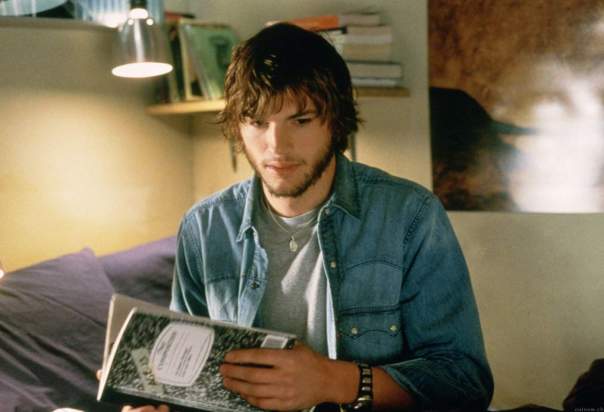
It’s hard to remember but there was a time where Ashton Kutcher was the king of the early 2000s universe. He had parlayed his excitable supporting character on a late 90s network sitcom into a successful movie career top-lining wild comedies, and he had also found success as a producer, bringing new life to the hidden camera prank TV show with his eponymous Punk’d where many of his celebrity friends would be victimized for the lols. The man even single handedly made goofy trucker hats a fashion mainstay. I know we haven’t seen much of the Kutch in a while, as he’s settled into his non-profit charities and being a family man, ceding the spotlight to his wife and former sitcom girlfriend, Mila Kunis. The Kutcher brand was stronger than ever at the time of The Butterfly Effect, enough so that Kutcher signing on as an executive producer was what finally got this widely read industry script to finally get made. You must view The Butterfly Effect as a point not just in Kutcher’s career but also in millennial edge-lord culture, the concept that anything dark is therefore compelling, and the more twisted the better. Re-watching the movie twenty years later, I wanted to laugh out loud at so many points because The Butterfly Effect is so serious while being so silly as it plumbs every depth of misery, both for its characters as well as any potential audience members still keeping track of the messy metaphysics.
Kutcher plays the adult version of Evan, a kid who has had quite a challenging upbringing to put it mildly. Mom (Melora Walters) is doing her best while Evan’s father is locked away in a mental asylum, and she’s worried her child might have inherited dad’s instability. He blacks out for extended periods and is found holding a knife or having drawn a horrible massacre at school, and even worse neighborhood tragedies (oh, I’ll get to all of them). A psychiatrist advises him to start journaling as a therapeutic means, and so he does, and when adult Evan reads his childhood journals, the words become blurry and he’s able to travel back in time to those exact moments. With this great power, adult Evan tries to right the wrongs of his life and those around him, but as all time travel stories are destined to discover, there are cruel unintended consequences to endure.
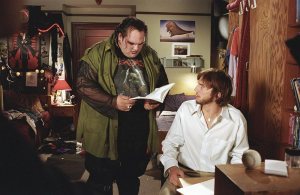 Watching this movie is like watching a checklist of events that producers thought would be dark and grisly and So Messed Up, but this movie is so self-serious that it could be a parody of what a moody teenager would think of as a “mature movie.” Let me just list some of the content the movie covers: the drunken dad next door (Eric Stoltz) is a pedophile who records his daughter and son and Evan in child porn, the kids put a firecracker in a mailbox that blows up killing a mother and her baby, an angry kid kidnaps Evan’s dog and ties him in a bag and literally sets the bag on fire killing the animal, lots of violence against young children including murder, attempted suicide, disturbing behavior in children including traumatic self-harm at school, prison rape, multiple mental asylums, disfigurement and disability, prostitution and addiction, and in the original ending, the one I re-watched, a fetus literally strangling itself with its own umbilical cord rather than being born. Wow. Just… wow. This movie is only two hours and it crams enough sundry melodrama and grimdark grist to fill out a month of the grimiest soap opera ever. Because of the sheer amount of disturbing content, every new provocative addition makes the movie’s tone teeter further and further into unintended self-parody. Once you’re starting to process the homegrown child pornographer, the movie throws animal cruelty at you, and so on. It’s not enough that Evan had a bad childhood of trauma, but does he have to experience all the traumas?
Much of the movie follows Evan’s morose quest to improve the life of his unrequited love, Kayleigh (Amy Smart as the adult version). He runs into her after several years apart and merely bringing up the past with her pedophile father filming the two of them propels her to kill herself off-screen. She’s literally introduced in one scene and then in the next she’s dead, and it’s all Evan’s fault, so says her angry brother via the answering machine clunkily informing us. Evan goes back and stops her dad from molesting her, so now dad only molests her brother Tommy instead, who Evan kills as an adult defending himself. He travels back in time and now her brother is dead and she’s become a heroin-addicted hooker and that won’t do. He travels back again and manages to improve the lives of Kayleigh, Tommy, and their friend Lenny, except in this timeline Lenny and Kayeligh are the romantic couple and Evan has no arms, having lost them in the childhood mailbox explosion. He travels back again and this time Kayleigh gets blown up as a child. Ultimately Evan concludes he cannot save her and have everything he wants, so he makes some form of sacrifice by the end; in the theatrical cut, young Evan upsets her so she chooses to live with her mother rather than her pedophile father, and in the director’s cut, he ensures Kayleigh will never meet him by killing himself in the womb (his mother reveals she’s had multiple miscarriages, leaving the impression other future siblings have done the same). I appreciate how the filmmakers have streamlined their convoluted time travel tale into a simple task of trying to get the girl, but it also becomes so overwrought that I wanted to shake my head and sigh.
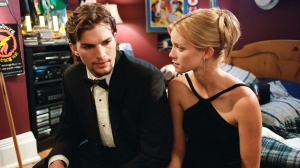 These characters are put through an emotional and often physical grinder, so it’s hard not to feel sorry for them. I long felt the film’s contempt for Kayleigh ever since young Evan (a young Logan Lerman) tells her, “You don’t even know how beautiful you are,” like she’s so stupid to see the obviousness of his compliment. I think dark comedy is the best way to read the movie, laughing along the way as Evan fails time and again to improve the lives of everyone through his space-time interventions. He can save this kid but doom his mother to lung cancer. He can save this person but is locked away in prison. It’s a no-win scenario for Evan, so he decides it’s better if he was never born, negating all the possible good he’s done in his life, including maybe being a force that could keep Kayleight from living with her dad. Maybe not having that friend and an advocate push her into that decision doomed her to a life of molestation, so way to go Evan.
I kind of loathe the time travel method in this movie but at least it provides a limitation that works within the universe of The Butterfly Effect. He can only travel reading his journals, which means he’s stuck in whatever nightmare timeline he’s responsible for unless he can recapture some part of his childhood scribblings. Reading them aloud is also an unexpected source of dark comedy because it makes me question how forthcoming a child of trauma would be about writing down his experiences in simplistic shorthand (“So today Kaleigh wasn’t feeling so good. Her face blew up. I was sad”). I did like that this inherited disorder provides more mystery to his family line, a source of material not covered in either of the Butterfly Effect direct-to-DVD sequels unrelated to Evan’s troubled story. This is perhaps the second worst method of time travel I’ve found in the movies after 1980’s Somewhere in Time where Christopher Reeve uses the power of positive thinking to convince himself he’s in 1912, and lo and behold he shall be.
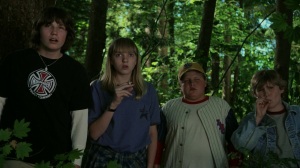 Watching this movie is like revisiting a Goth phase you had as a brooding teenager but have since considered a point of embarrassment (not that being Gothic is something to be ashamed of, simply that it was an overzealous step in asserting a misguided sense of what being a mature adult meant, generally disaffected and cynical and edgy for its own attention). The Butterfly Effect is an endless improv game of “yes and” where the proceedings only get worse. My original review in 2004 was one of my more unconventional reviews, and I just wanted to adopt my perception of the “Kutcher brand” persona of the era and make a bunch of dumb jokes, several of which I’m not too ashamed to admit still made me chuckle (“two words: beard.”). I’d lower my grade a tad but there is still a car-crash fascination of watching a movie try so transparently hard to be so twisted.
Re-View Grade: C
Share this:

American Fiction (2023)
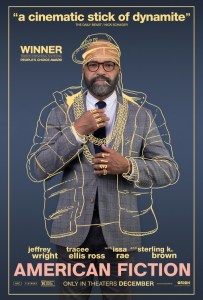
Cord Jefferson’s hilarious, inflammatory, and insightful comic fable can be boiled down to the question of what exactly does it mean to be a “black writer” in this day and age? According to the main character, English professor and middling writer Thelonious “Monk” Ellison (Jeffrey Wright), he would pointedly argue that he is a black writer and thus his novels, never ones to climb a best-seller chart, should qualify as black literature. The publishing industry seems to think differently. Their conception of a “Black story” is one defined through poverty, guns, drugs, gang violence, degradation, and all sorts of depressing stereotypes of socioeconomic disadvantage. If there are stories of triumph, they will usually be relegated to the same familiar settings of struggle: slavery, the Civil Rights era, and modern ghettos. A simple slice-of-life about a middle-class family isn’t necessarily seen with the same level of acceptance. With American Fiction, Jefferson and Monk push through, trying to exploit a system of exploitation at its own game, and the results are biting and hilarious and a condemnation of the low expectations that can govern the supposedly open-minded values of others when it comes to celebrating authentic minority stories.

The movie really takes off once Monk decides to, as a sarcastic lark, give the publishing world what it seems to crave, a novel (My Pafology) that plays into every urban stereotype. He adopts a nome de plume, “Stagg R. Leigh,” and riffs that he’s currently a fugitive from the law. The intention was to make fun of the limited black literary stories that he despises, and yet the incendiary manuscript becomes a hot commodity. They’re already talking about turning it into a movie. Monk is aghast but the money is very appealing, so he puts his moral superiority aside to see how far he’s willing to pander if the check is right. His alter ego is deemed more authentic and compelling when he doesn’t even exist and is only a combination of the same worn-out and destructive stereotypes. It becomes an ongoing game for Monk to see where exactly a line can be drawn. He actively tries to make his manuscript objectively worse, and at every step it only seems to have the opposite reaction among white editors and agents and producers salivating to celebrate it. There’s a very telling scene where Monk is part of a literary award body scouring through manuscripts for potential worthy award-winners. He and another prominent black author (Issa Rae), the best-selling author of We’s Lives in Da Ghetto, are critical of My Pafology and its adherence to harmful stereotypes, but the white liberals won’t hear it and want to reward it. “It’s really important that we listen and uplift black voices,” one of them says obliviously. Of course, if they knew the truth that the author was really an upper middle-class East Coast academic, there wouldn’t be the same rush to elevate this “brave and inspiring” story of the streets. To Monk’s ire and chagrin, there is no bottom when it comes to the appetite for degrading stories that neatly fit into a pre-existing mold.
Jefferson’s screenplay, based upon the 2001 novel Erasure by Percival Everett, is bristling with biting intelligence. This extends beyond the identity crisis of Monk in the world of publishing to his personal life, and the time spent with his fractured family is just as illuminating as the time spent in publishing. Monk’s need for money is driven less from his own desire to live large and more about caring for his ailing mother who needs to be placed in a costly assisted living home as she plunges further into dementia. His shared moments with his mother can be heartbreaking as well as informative. His relationship with his brother, Clifford (Sterling K. Brown), who is embracing his black sheep status as a now openly gay middle-aged man, is a regular point of reflection for both characters who feel their identities are in free fall. Their conversations about being accepted as you fully are help reinforce the major themes mirrored through Monk’s publishing odyssey with his alter ego. The Hollywood satire is best encapsulated by Adam Brody’s shallow movie producer, a good white liberal who is sold on the project after he perceives that Monk leaves their meeting after hearing police sirens. His every appearance is a gift. Not everything in Jefferson’s adaptation feels as exceptionally well integrated. I don’t think the romantic subplot quite works but Jefferson is smart enough to frame that as possibly the larger point, an offshoot that presents an alternative of happiness for our bitter protagonist that he will inevitably decline.

This is also a deserving showcase for Wright (Westworld, The Batman), one of our best character actors who rarely gets the plaudits he deserves. He’s a brilliant actor when it comes to consternation and exasperation, and his unexpected journey of discovery and success allows him to assess how much he’s willing to go along with a deceptive narrative in a ludicrous industry of perception. Wright’s performance is equal parts amusement, like a conman who can’t believe he keeps getting away with his ruse, and head-shaking anger at being marginalized unless he erases the complicated, unique parts of himself.
I also want to celebrate the very ending of American Fiction that goes even harder on industry satire. Jefferson gets extra meta and presents a series of possible endings for Monk’s story, from Monk’s preferred ending that leans more ambiguous and open-ended, to the Hollywood happy ending and other versions, each their own condemnation on the studio system and the larger demands of mass audiences for tidy endings. It’s a level of comic bravado that American Fiction hasn’t really fully channeled until that moment and its absence makes this conclusion, a choose your own adventure of bad endings, hit even harder. He’s been saving his full satirical might until the very end and it was worth it.
Who exactly gets to qualify what constitutes the black experience? Certainly not I, a 41-year-old white guy writing on the Internet. Even though the source material is over twenty years old, the struggles of identity and acceptance and the lens of which we subject others’ experiences through are still relevant in an increasingly hostile cultural environment for different attempts at diversity. American Fiction is hilarious and smart and produces as many thought-provoking questions as solid belly laughs. It’s a cutting satire but with characters that are compelling beyond their connection to larger satirical points. This is more than a message movie, and it’s a statement debut film for Jefferson as a filmmaker and primarily as a storyteller. Jefferson began as a journalist and has worked on several critically-acclaimed TV shows, winning an Emmy for an extraordinary episode of HBO’s Watchmen. He is a talent, and American Fiction is proof that he has a voice and the confidence to carry it through into one of the best films of 2023.
Nate’s Grade: A-
Share this:

Killers of the Flower Moon (2023)
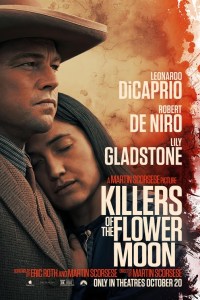
Killers of the Flower Moon has the banner of an Important Movie, telling a story many history books have overlooked for too long, an American tragedy built upon one of America’s original sins with the indigenous peoples, and tying a direct line to not only how we live now as well as how we choose to remember the past. The true story behind the murder of the Osage Nation natives in the 1920s is an urgent story that gets to the heart of greed and the human capacity for evil, and Martin Scorsese’s three-and-a-half-hour movie is somber and mournful and appropriately devastating. But I’m also wondering why I wasn’t as enchanted with it as a movie-going experience. Should I feel movie critic guilt for finding the movie merely good but not transcendentally great?
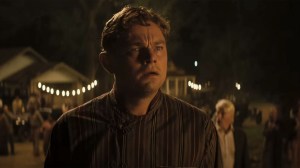
The whole of Killers of the Flower Moon is bleak, which is naturally much of the point. It’s difficult to retell the history of Native Americans in this country, or before there was a “this country,” without making use of lots of synonyms for the word “bleak.” The first hour presents the Native Americans as being legally incapable of greater agency; the murders are consistent, sloppy, and obvious, but the fact that no investigation was triggered for years in an acknowledgement that, simply put, the government just didn’t care about dead Indians. Oh, I hear you saying, but weren’t these Osage different? They had so much money from their oil rights that the local economy exploded with vultures offering common services for egregiously inflated prices to take advantage of people unaccustomed to having money and options. Even with a surge of riches, the Osage didn’t have an elevation in status. They were still looked upon as interlopers in the way of powerful white men getting that money, and there’s nothing these greedy people won’t do to get that money, especially with a system of justice of little accountability for dead minorities. One of the more galling scenes is when the town coroners are questioned over their unusual protocols, like chopping a corpse into tiny pieces so it could not be re-examined by other professionals. The whole town is in on this vile scheme, every doting neighbor can be guilty through complicity or complacency. Death after death, they all know what’s really going on; it’s plain as day, but nobody outside of the Osage feels the burning outrage, and that’s the point of the first half of the movie, to give the audience the same sense of anger and futility.
The majority of the lengthy movie follows our villains plotting their very obvious conspiracy, with Leonardo DiCaprio badly clenching his jaw in every scene as Ernest Burkhart, a WWI-veteran who comes home, becomes a cabbie, and marries Mollie (Lily Gladstone), one of the rich local Osage women. The question for the rest of the movie is whether or not his love for her is genuine or perhaps she is just a means to an end. He’s the lead of the movie and a total dope, a man who unironically proclaims repeatedly, “I love me some money!” Seems hard to read this guy, right? He’s an idiot, and again this might be the point, that this sort of small-thinking man could be the hinge on this entire conspiracy, which results in a lot of Mollie’s family members dying under increasingly mysterious circumstances to consolidate their inheritance. It’s a frustrating and spiritually exhausting experience to watch all these poor characters get murdered, again, so casually and transparently. One of them is staged as a would-be suicide except he’s shot through the back of the head and the gun wasn’t left at the scene. Eventually, the FBI does finally (finally!) arrive in town at the two-hour mark, but by then, I’ve been watching two hours of people dying without a legal stir.

This perspective is best embodied through Mollie, beautifully played by Gladstone (Certain Women, First Cow). When we first meet her, she’s a forward woman who can assert herself and what she wants. Then it all goes downhill after marrying Ernest. She loses damn near every family member she has and is forced to rely upon her husband for support, the same idiot bungling his way through arranging the deaths of her family members. She’s a personal stand-in for the Osage Nation as a whole, as we watch what they have whittled down and bled dry, watching the weight of all this suffering deteriorate their spirits and dignity. This is Mollie, our avatar for tragedy. She’s literally bedridden for a solid hour, and I dearly missed Gladstone’s presence. Since we’ve been aware of the bad deeds of the bad men from the start, much of Killers of the Flower Moon becomes a waiting game of when Mollie is hopefully going to wise up or at least suspect what is happening to her and her family. When will she see Ernest as a more nefarious force in her life, the kind of person you don’t want to solely trust with the responsibility of delivering your life-saving intravenous medicine. It adds to the overall frustrations of watching. Gladstone’s performance rises above whatever limitations her character is stricken with. First off, it’s a powerful performance of immense sorrow; having to watch her pained reaction to overhearing her sister’s skull sawed open for a disrespectful public autopsy is just sickening. The movie lives off this woman’s response to unfathomable trauma on repeat. When she is bedridden and lost in a medical fog, she still manages to communicate her wariness and suspicion through these extra layers of obfuscation.
Robert DeNiro, appearing in his eleventh Scorsese movie, is terrifying as a kindly cattle baron who fashions himself as the best friend of the Osage, preferring to refer to them by their indigenous names and warmly speaking their language. He’s also a monster, a stand-in for American big business and the blood-stained hands of capitalism without morals and oversight. The dramatic core of the movie, besides how far will this go before consequences will at long last germinate, is how can such self-styled men of God commit such heinous acts? How can people justify and equivocate over their own cruel crimes? This question is epitomized in Ernest and his direct connection to Mollie, but it’s also epitomized through DeNiro’s character, William Hale. We have two characters fulfilling the same thematic purpose, which might be the point, but it makes for a redundant narrative experience. DeNiro’s character is so much more interesting than Ernest too, with the full cognitive dissonance of being an avowed man of the people and true ally to the Osage while he’s plotting their demise. DeNiro holds to this homespun, Foghorn Leghorn accent throughout, and I can’t recall him ever raising his voice. It’s a performance where the lasting terror comes through its friendly disconnect. It’s a more impressive performance than watching DiCaprio grimace and mumble through three and a half hours.

Some chastise Killers of the Flower Moon for choosing to tell its story from the perspective of its white perpetrators. I understand from a narrative standpoint and an overall larger thematic point why this was done. Scorsese clearly thinks of his own limits of being the one to tell this story, appearing as a cameo in the coda to provide commentary on how the American morbid desire for true crime and historical atrocities will lead to yesterday’s outrages becoming today’s distilled and de-contextualized “content.” The problem is the movie already feels frustrating as is while we wait for there to finally be some accounting for the ongoing injustices, and centering the entire perspective on only the Osage would magnify this frustration with even less elucidation on the depths of what was happening. Scorsese strips away a lot of the stylistic flourishes and even the electric pacing and editing that we come to expect from his filmography. This is a slow, ponderous movie. It’s meant to provoke outrage. It’s also designed to frustrate, and I suppose I can admire that while also impatiently shifting in my seat and wondering how many of these 206 minutes could have been lost. I feel like a philistine for looking at a $200-million Scorsese movie, while this man is in the late stages of his career and clearly thinking of this reality, and asking, “Hey, can you give me maybe less movie?”
If you haven’t noticed, dear reader, I am a critic in conflict. Killers of the Flower Moon has fantastic production values, strong acting, and the importance of staging history as it was rather than how it may be remembered, especially over events long ignored by history. I even admire the choices that are deliberate that make the movie feel less like easily consumed entertainment. It’s a movie that I feel compelled to see a second time before I settle on my eventual rating (a seven-hour commitment). It’s a sad movie, a bleak movie, a challenging movie, a meaningful movie, and an Important Movie about Important Things. It’s also long, frustrating in structure and execution, and occasionally redundant with its characterization and plotting, giving the impression that things have been stretched beyond breaking. Again, maybe that’s the larger thematic point, but then again I might just be stuck in a rabbit hole of excuses to find some justification for my less-than-ecstatic reaction to Killers of the Flower Moon, a movie of strident artistic vision that can also feel like you’re eating your vegetables for three nonplussed hours.
Nate’s Grade: B


You must be logged in to post a comment.