Blog Archives
Dom Hemingway (2014)
 Undeservingly lost in the shuffle, Dom Hemingway is a brash and wildly entertaining dark crime comedy. Jude Law is a sheer force of nature as the title character, a charismatic and garrulous criminal with no shortness of ego or volume. He’s just getting out of a 12-year jail sentence and taking stock of his life. His wife is dead, his grown-up daughter (Game of Thrones’ Emilia Clarke) hates him for his absence, and his bosses are ready to reward him for his long silence. The only person who could screw things is up is Dom, and he does, as he’s prone to impulsive fits, shouting matches, and oversized bravado. This is really a series of comic vignettes and vulgar monologues, but the writing by Richard Shepard (The Matador) is slyly hilarious, leaving me in stitches throughout (“I am not burying your body today! I didn’t bring the right shoes for it.”). The comic voice here is assured and finely attuned to the broad wavelengths the characters. It’s not exactly he colorful, cartoon criminal universe of early Guy Ritchie films, but there’s a definitely heightened atmosphere here that blends well with the manic nature of Dom. Law is bouncing off the walls; you may have to wash the spittle off your TV. But he’s compelling from his first minute onscreen to his last. The third act squeezes in a degree of emotions though by then we’ve been enjoying the depravity too much to switch focus. I don’t think the work has been put in to make Dom a three-dimensional character, but that won’t stop Dom’s film from being a blast of entertainment with swagger to spare.
Nate’s Grade: A-
Share this:

Birdman or (The Unexpected Virtue of Ignorance) (2014)
 Expecting a comedy from Mexican director Alejandro Gonzalez Inarritu would have preposterous. The man was known for his cinema verite of suffering, notably Babel, 21 Grams, Biutiful, and his best film, Amores Perros, roughly translated to Love’s a Bitch. Perhaps there isn’t much of a shift going from tragedy to comedy. Inarritu’s newest film, Birdman or (The Unexpected Virtue of Ignorance), has been wowing critics and audiences alike, building deafening awards buzz for its cast, Iarritu, and the superb cinematography, but will it fly with mainstream audiences? This may be one of the weirdest Oscar front-runners in some time.
Riggan (Michael Keaton) is an actor best known for playing the superhero Birdman in the early 1990s and walking away from the franchise. He’s still haunted by that role (sometimes literally) and struggling to prove himself as an artist. He’s brokered all his money into directing, adapting, and starring in a theatrical version of Raymond Carver’s short story, “What We Talk About When We Talk About Love.” The show is in previews and about to open its run on Broadway but it’s already got a rash of problems. The leading man needs to be replaced immediately. The supposed savior is famous actor Mike (Edward Norton), an undeniably talented but temperamental actor who pushes buttons to find some fleeting semblance of “truth.” Mike’s girlfriend, Lesley (Naomi Watts), is growing tired of his antics and desperate for her own long-delayed big break. Laura (Andrea Riseborough) is Riggan’s “girlfriend” and co-star and may be pregnant. Sam (Emma Stone), Riggan’s personal assistant and also his detached daughter, is fresh from rehab, and spiteful against her neglectful dad. Toss in Riggan’s best friend/manager/play producer (Zach Galifianakis), Riggan’s ex-wife (Amy Ryan), and a feared theater critic (Lindsay Duncan) who is determined to kill Riggan’s show to send a message to the rest of Hollywood polluting the integrity of the theat-tah. Oh, and throughout all this, Riggan hears an ominous voice that alternating encourages him and humiliates him.
 It’s an industry satire, a bizarre comedy, a father/daughter drama, an examination on identity and the complicated pulls of affection and admiration, and a stunning virtuoso technical achievement. As a movie, Birdman is hard to pin down or categorize. It’s a movie that you definitely need to experience on your own rather than have described (don’t stop reading, come back…), and that is a reason enough to see the film, a rare aspect among modern movies. It’s an artistically offbeat movie and yet it ultimately is about one has been actor looking back on his career and coming to terms with his own impact with pop-culture, art, and his family. It’s about a man struggling to find his place in his own life, beset at all odds by doubters and traitors and obstructionists. The refreshing aspect about Riggan is that he’s a has-been but not a sad sack; he’s fighting from the beginning, sometimes pathetically and sometimes in vain, but the man is always fighting to regain his dignity, to reclaim his life’s narrative, and to fight for his legacy. Riggan, after all, set the stage for the modern superhero industry that currently dominates Hollywood bean counters. He was too just soon, and the parallels with Keaton (Batman) are superficially interesting but there’s more of an original character here than a reflection of the actor playing him. He’s neurotic, egotistical, hungry, and fighting for respect, like many actors, and the film flirts with the façades people inhabit. Many of the characters are emotionally needy, desperate for validation wherever they can find it.
Another strength of the film is that it finds a moment for each of its talented ensemble players to shine, chief among them Keaton. The actor hasn’t had a showcase like this in some time and he is a terrific guiding force to hold the entire story together. Whether it’s marching in his tighty whities or working through his complicated degrees of neuroses, Keaton is alive in a way that is electrifying. We see several highs and lows over the course of two hours, some moments making us cheer on Riggan and others making us wince, but he comes across more like a person than just the butt of a joke. It’s also just fun to watch him adopt different acting styles when he steps on stage, including one early on where he’s purposely too stilted. It’s so comforting to watch Norton (The Grand Budapest Hotel) get to be great again, not just good but great. Early on, you see the appeal of Mike, his allure, and Norton keeps pushing the audience, as well as the characters, back and forth with his wealth of talent. Stone (Amazing Spider-Man 2) spends most of the film as the sulky daughter but she gets to uncork one awesomely angry monologue against her loser dad. The thawing father/daughter relationship ends up supplying the film with its only degree of heart. Watts (The Impossible) is comically frazzled for the majority of her time but gets a memorable character beat where she breaks down in tears, realizing her dream of “making it” might never materialize. Riseborough (Oblivion) also has moments where he sadness and vulnerability cut deep. The supporting characters aren’t terribly deep but they all have a moment to standout.
It’s a decidedly offbeat film that dips into the surreal though never dives completely inside. The movie is rather ambiguous about whether or not the fantastical flourishes are a result of Riggan being mentally ill, or at the least overtaxed with stress. Is there really a Birdman or is it a voice in his head, a manifestation of his ego or a ghost to remind him of the past when he was a star? Does Riggan really have the powers he seems to believe he does, including the ability to make objects move with his mind? Innaritu playfully keeps the audience guessing, treating the bizarre in an offhand manner reminiscent of magic realism. The bizarre embellishments blend smoothly with the film’s darkly comic tone. It’s a funny movie but one that you laugh at between clenched teeth.
 Is it all the unblinking camerawork a gimmick? I don’t think so. While the story can engage with its weirdness and surreal unpredictability, the long tracking shots bring a heightened reality to the unreal, they bring a larger sense of awe to the proceedings, watching to see the magic trick pulled off to the end. If anything, it’s an extra thrill to the script and greatly compounds the artistic audaciousness of the film, but I think it also channels the live-wire energy of theater, of watching actors have to walk that tightrope of performance and blocking, weaving together to pull off the ensemble. It makes the film medium feel more like live theater. Thematically I think the style also connects to the anxious mentality of Riggan. In the end, I don’t truly care that much whether it’s a gimmick or not (though I vote it is not) because the camerawork is rapturous. Made to resemble an entire two-hour tracking shot, it is a joyous thrill to watch these technical wizards do their thing, to watch the best in the business perform a visual magic trick over the duration of two hours. Even if you don’t care for the overall movie you can at least be entertained by the imaginative and thoroughly accomplished cinematography by Emmanuel Lubezki, fresh from his Oscar for Gravity and who should be clearing shelf space for the next bushel of awards he’s destined to win with this film. It’s an intoxicating experience to behold, though the film is structured into 10-minute or so chunks for feasibility. If you want to watch a real cinematic magic trick, check out the film Russian Ark, which is an entire movie, performed in one uncut single tracking shot.
I’m still wrestling with the debate over whether Birdman is an artistically ambitious romp or a truly great movie. Much like the characters in the film, I’m wrestling with whether I have confused my admiration with adoration. It’s a movie that I feel compelled to see a second time, and maybe a third, just to get a handle on my overall thoughts and feelings. That may be a sign that Birdman is a film for the ages, or maybe it’s just a sign that it’s not as approachable and denied a higher level of greatness by its obtuseness. Inarritu’s surreal showbiz satire is plenty entertaining, darkly comic, and a technical marvel thanks to the brilliant camerawork. The percussion-heavy musical score is another clever choice, naturally adding more urgency and anxiety to the proceedings. Birdman is a strange and beguiling movie, one that deserves to be seen, needs to be experienced, and stays with you rolling around in your brain. That sounds like a winner to me.
Nate’s Grade: A
Share this:

The Wolf of Wall Street (2013)
 Martin Scorsese. The greatest living filmmaker on the planet. Enough said. When his latest, The Wolf of Wall Street, was pushed back due to an editing crunch, the rumor mill started as it normally does. Are there problems? Is it any good? Will it be forgotten this late into the awards season? While I can’t speak for the Academy, but for me The Wolf of Wall Street just about blows every competing movie out of the water this season. It’s brash, exhilarating, uproarious, mesmerizing, and just about every other adjective you can fetch from a dictionary. This is first-class filmmaking from a master, and consider Wolf of Wall Street the white-collar companion piece to Scorsese’s gangster masterpiece, Goodfellas. It’s that good, folks.
Based on his memoirs, Jordan Belfort (Leonardo DiCaprio) rises on Wall Street from a rookie stock trader to the king of his own empire. From the late 80s to the 90s, Jordan assembles a cutthroat team that knowingly sells lousy stocks to gullible investors and stuffing their pockets with hefty commissions. “Better there money was with me. I knew how to spend it better,” he admits. His closest friend and business partner, Donnie Azoff (Jonah Hill), literally quits his job to work for Jordan after spying one of his pay stubs. The guys start their own firm, specializing in high-pressure sales and on penny stock commissions. From there, they expand and expand until they’re making their own noise on Wall Street. The trading floor more closely resembles a frathouse party, complete with chimp, strippers, marching bands in their underwear, midget tossing, and other objectionable behavior. Jordan easily succumbs to the sex and drugs of the high-finance world of money, leaving his plain wife for Naomi (Margot Robbie), a gorgeous underwear model. He’s got a giant estate, a huge yacht, his own helicopter, and more money than he can spend. He’s also got the attention of the FBI and Agent Patrick Denham (Kyle Chandler). With the feds circling in, Jordan has to take extra steps to keep the good times rolling.
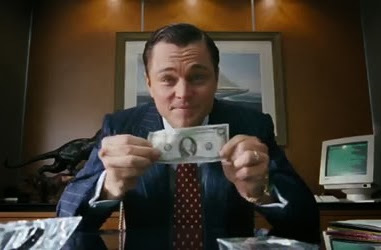 With a running time exactly one minute shy of three hours, it’s easy to call The Wolf of Wall Street self-indulgent and excessive, except that’s exactly the point. The movie is an orgy of unchecked male ego, a perverse bacchanal of Earthly pleasures that Caligula might blushingly admire. They are literally two orgies depicted in the movie and plenty of thrust-heavy sexual congress (I counted eight walkouts in my theater, most of them the little old lady variety). Here is a tilt-o-wheel of madness. These people were living like there was no tomorrow, had more money than they knew what to possibly do with, and would figuratively dance while Rome burns (in this instance, the stability of the U.S. economy). What’s important is to communicate that these individuals were having the time of their lives. It wasn’t just the hedonistic pleasures and the mountains of drugs; it was the power, the uninhibited embrace of a life available via poorly regulated capitalism. Many of those brokers in Jordan’s company were people from ordinary backgrounds. Their self-made success (that wasn’t so much earned as swindled) is a point of pride that fills them with purpose. They are seizing their full potential. There is no doubt in my mind that every broker in this movie would do it all again in a heartbeat. There is no remorse on display anywhere. The only remorse is having the ride unceremoniously end. “Was it obscene? Yeah it was obscene. In the normal world,” Jordan narrates. “And who wants to live there?”
I won’t say that there aren’t scenes and moments that could have been trimmed, but I was enjoying myself way too much to care about the bloat. This is the fastest three hours you’ll ever experience in your life. There’s some fat, yes, but man does this picture just move along like a freight train. The screenplay by Terence Winter (creator of HBO’s Boardwalk Empire) is impeccably drawn. The movie just courses with energy and watching it is often an exhilarating rush, communicating the highs the characters are undergoing. The supporting players are used to great effect to punctuate the comedy moment to moment. I loved Rob Reiner’s exasperated and profane performance as Jordan’s father. Naturally the bad behavior is entertaining in how absurd and over-the-top it can get, but one key sequence ranks up there with the finest sequences Scorsese has ever put to film. It’s the “Lemon” sequence, named after a legendarily potent batch of Quaaludes. It is a sequence of pure movie bliss, brilliantly edited and staged, as Jordan is placed in a precarious position when the drugs kick in, and his comic floundering is riotous. Winter and Scorsese have taken what, in other hands, could have been a modern American tragedy and decided to portray it as a darkly comic fantasia. I laughed long and hard throughout the movie. There are numerous scenes I can think back on and start laughing again. The ridiculous nature of moments, like discussing the logistics of tossing midgets at a dart board (“This is their gift”) is to be expected, but it’s the overall degenerate lifestyle these clowns chase after with impunity that kept me laughing.
I’ve read cantankerous critiques of the film, chastising Scorsese for celebrating the lavish lifestyle and excessive hedonism of his characters. I could not disagree with this appraisal more. The error is assuming that witnessing Jordan behaving badly is akin to celebrating it, as if adopting the perspective of our lead is the same as excusing his actions. Scorsese makes it clear early, and often, that Jordan Belfort is not a good person. Hopefully you don’t need him hitting his wife for this point to stick. This guy is fleecing people out of their life savings, living high off the fat of the land, and openly admitting to the camera how deeply illegal his activities are. But you’re under his spell, much like his brokers that worship him with unflinching zeal. Jordan, especially as portrayed by DiCaprio, is a volcano of energy and single-minded determination. He whips his troops up like a religious revival, manipulating you with every tactic in his employ. Early on, he’s defrauding ordinary middle-class and low-income clients, but because we’re all addicted to the adrenaline rush of the sale, of the con, we push this troubling reality from our minds. When he moves onto wealthier clients, we adopt a similar attitude of Teresa, Jordan’s first wife, mainly that these people can afford the losses and therefore get what they deserve from a silver-tongued shyster. It’s the audience that proves to have a selective memory because we’re drawn to Jordan’s charisma, expertise, and talent, so we ignore the pesky details of who gets stuck with the bill. Don’t pin that on Scorsese. He makes it abundantly clear that Jordan is a bad man, and the depths of his greed is but the tip of the iceberg when it comes to Wall Street. Jordan’s firm was a tiny player. Think of what horror stories Goldman Sachs or Lehman Brothers would offer if ever exposed.
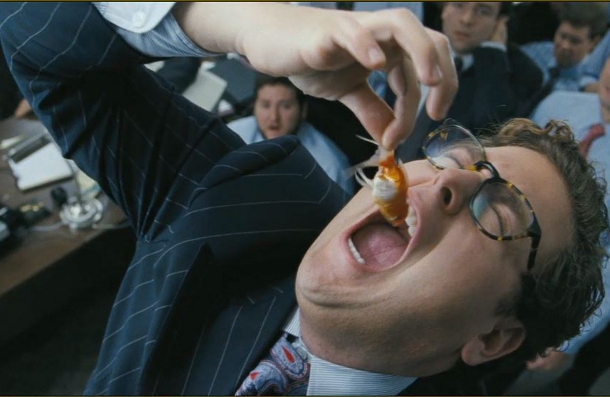 This is my favorite Scorsese film since Goodfellas, and they have plenty of similarities. It makes sense because these men of finance take their cues from movie gangsters, styling themselves as tough guys. At one point, brokers hold a guy over a building to intimidate him. There’s also certainly as much cocaine as there may have been in Scarface. But like that classic of the gangster cinema, Scorsese propels us into the hidden world of the financial institution run amok, allowing us a backstage pass to the people profiting from wrecking the economy. It’s a fascinating perspective that confirms some of our worst fears about stockbrokers. It’s a misogynistic boys club and the few women that do participate have to play by their hyper masculine, juvenile rules. These are people that find any number of ways to skirt the law, rip off their clients, and live in luxury until they can find another sucker. It’s a system built for the entertainment of the few on the backs of the many, and it’s just as relevant today as it was in the 90s. With Jordan’s inside knowledge, we’re educated on the many corrupt ways of Wall Street.
Marking the fifth collaboration with Scorsese, this may be the finest DiCaprio (The Great Gatsby) performance yet. The man sheds his vanity, easily fitting into the shark that is Jordan Belfort. He’s ruthless in one moment and completely inept in another, at the whim of his vices. DiCaprio taps into Jordan’s leadership qualities with the dynamite sales speeches, but he also shows what an insecure man he is at heart. He’s got a taste for the good life and is reinventing himself, including trading up in wives to attain that proverbial American Dream. He’s living empty pleasure to empty pleasure and he doesn’t care. DiCaprio acts as our ringmaster through his own circus, and you’ll be delighted and horrified by his actions (and also his peculiar, bird-like dance moves). There’s not a bad performance in the whole cast, and this is one huge cast. Hill (This is the End) is a becoming more and more credible as a dramatic actor, though he excels at the blustery outrageousness as Jordan’s number two. He’s a treat. Robbie (About Time) nails her New Yawk accent but more importantly nails the portrayal of a trophy wife who recognizes and eventually resents her lifestyle. And oh does she just exude sexual heat.
I want to focus on the very end of the film, so there will be some mild spoilers in this paragraph but nothing I feel that would ruin the viewing experience. You have been warned, spoiler phobes. As expected, Jordan eventually winds up in jail for his felonious misdeeds. Ordinarily this would be the end of our traditional law-and-order morality tales; the bad guys are locked away to pay for their crimes. Jordan tells us how nervous he was on his first day of prison, that is, until he remembered one very important fact: he’s rich. White-collar prison is not the same as other penitentiaries, and we see Jordan loftily playing tennis. His sentence is only three years as well, which seems like an insult given the thousands of lives he may have instrumentally ruined. But that’s the ultimate condemnation in the end: the system is rigged for people like Jordan, people with money. In the end, he wins. He goes to prison, his family life is torn asunder, and his personal relationships are strained, but the guy wins. He continues his speaking engagements motivating everyday saps how, with his cherished expertise, they too can rake in wealth. The final shot of the movie tells me everything I need to know. It’s a slight pan out to the crowd in attendance of Jordan’s speaking session. We see the collection of faces, each person hanging onto Jordan’s every word, each filled with idolatry. They want to be him. Despite everything, the bad behavior, the crimes, the waste, they all want to be him, and that’s why people like Jordan will always succeed, will always prevail, will always have the last laugh. There will always be a healthy supply of suckers that want to believe whatever nonsense he’s peddling. That’s the point. He won.
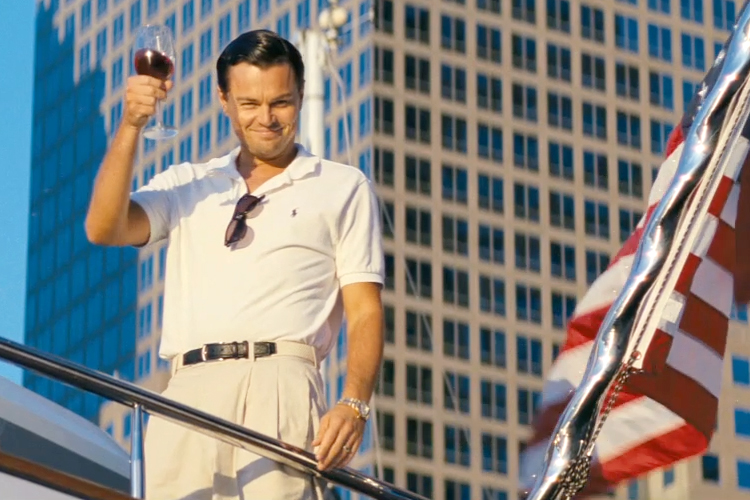 Recently I watched the very good crime caper American Hustle and noted that its director looked to be fashioning a loving Martin Scorsese homage. Well, after watching The Wolf of Wall Street twice (not back to back, mind you; I’m not nuts) I can say that there is no Scorsese like the source. This is vintage Scorsese. This is brilliant filmmaking, a bold movie that practically sings, it flies by with exhilarating force and acumen, daring you to keep watching. The fact that 71-year-old Scorsese could make a movie this highly energetic, this debased, this brash, this borderline indecent, and this awesomely entertaining is encouraging. It’s even more hilarious to me that older Academy members at a recent screening of the film accosted Scorsese, essentially being termed a “debauched scoundrel.” That’s got to count as some badge of honor. Yes, at three hours the movie can get long but it’s never dull or taxing. The propulsive narrative, the hilarious humor, the shrewd characterization, the wanton excess, the filmmaking bravado that hums, it all coalesces into a disturbing and disturbingly enjoyable condemnation of greed and our inherent celebration of this lifestyle. There is not one aspect of this movie that falls flat. The Wolf of Wall Street is an invigorating piece of cinema. The choice of music, the swinging cinematography, the wide ensemble of actors, the feverish editing, it all comes beautifully together to form a whole that surpasses everything else in cinema this year. Dig in.
Nate’s Grade: A
Share this:

August: Osage County (2013)
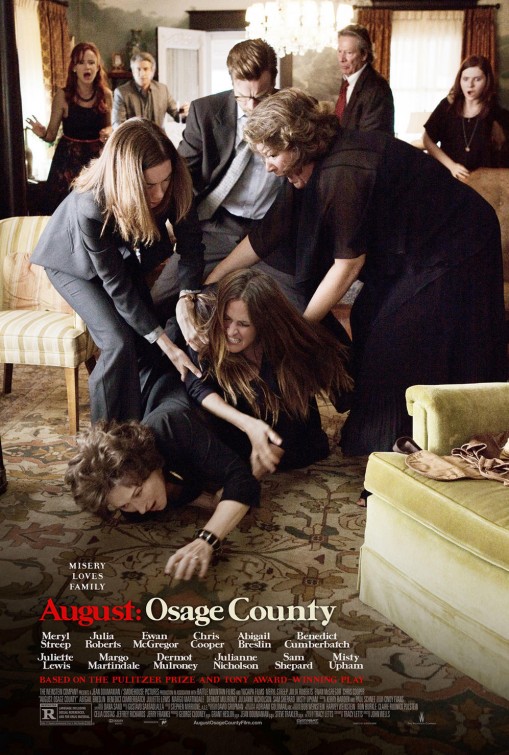 This holiday season, the movie with the most acting, by far, is likely to be August: Osage County, the adaptation of Tracy Letts’ Tony award-winning play. It’s a large dysfunctional family getting back together and opening old wounds, so, you know, the most relatable Christmas movie for some. It’s easy to see what attracted such A-list talent to this project because these characters are actor catnip; each is overflowing with drama, secrets, revelations, anger, and it’s all channeled through Letts’ barbed sense of humor and wickedly skillful dialogue. With Meryl Streep as the pill-popping matriarch, Julia Roberts as her resentful daughter, and a host of other inter-generational conflicts and secrets, you may feel exhausted by the end of its 130-minute running time (the stage play was 3.5 hours, respectively). The emotional confrontations feel like grueling pugilist matches, the melodrama kept at a fever pitch, but the film is never boring. Streep is her usual astonishing self and the deep ensemble gives each actor something to chew over. This is the best Roberts has been in years, and she’s not afraid to get nasty (“Eat your fish!”). Just when you think the story might soften, Letts unleashes another body blow, allowing no uncertainty that this is a family doomed. The story also provides insights into tracking the path of cruelty through the family tree, limb by limb. August: Osage County is stridently funny but also punishing in its no-holds-barred approach to family drama. If you’re looking for a movie that makes your family seem normal and even-tempered, this may be it.
Nate’s Grade: B
Share this:

Violet & Daisy (2013)
 It’s not often that I say this but… what the hell did I just watch? I know it’s a movie called Violet & Daisy, written and directed by Geoffrey Fletcher, the man who won a screenwriting Oscar for adapting Precious. But what is this? It is some meta commentary on film violence? A twisted fairy tale? A dark comedy? Whatever it is, I know for certain that it was not very good or entertaining.
Violet (Alexis Bledel) and Daisy (Saoirse Ronan) are teenagers who also work as hired assassins by their boss, Russ (Danny Trejo). Their next assignment has a personal angle: Michael (James Gandolfini) stole a large sum of money from Russ. The gals hide out in Michael’s apartment only to fall asleep. When they wake up, Michael is sitting there, accepting his fate, begging the girls to complete their job. He’s dying from terminal cancer, estranged from his daughter, and hoping to exit this world on his own terms. Over the course of one long afternoon, the gals run into rival gangs, a trained sniper, police, neighbors, and all sorts of other plot contrivances to delay the death of Michael.
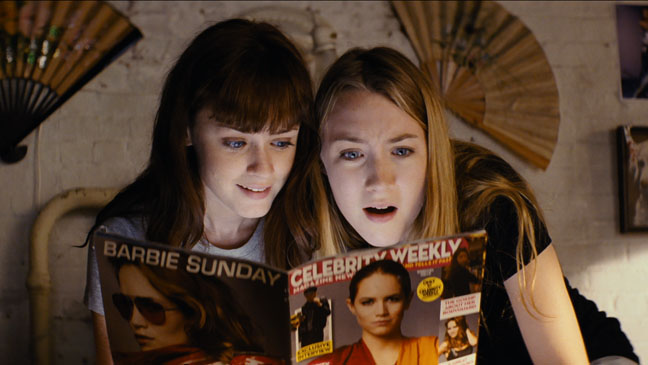 If you’re like me, with similar expectations when it comes to your moviegoing experiences, you’ll be left scratching your head and fumbling for some kind of rationale why people decided to make a film like Violet & Daisy. It feels instantly dated, relying upon the hook of young teen girls with big guns, you know, the same model that has translated to many a successful video game. More so than that, the aspiration, or at least direct inspiration, appears to be a Tarantino-knock-off. Not ripping off Tarantino, as many did in the mid-to-late 90s, but ripping off a poor Tarantino knock-off, like Two Days in the Valley or, the more adept comparison, The Big Hit. There is so much crap in this movie that exists merely because somebody thought it would look cool. Violet and Daisy open the movie dressed as pizza-delivering nuns (is this a fetish I am unaware of?) and open fire on a gang of criminals. But before their fateful gunfight, you better believe it, they have an innocuous conversation about something small, you know, like Jules and Vincent. Why are they dressed as nuns, let alone nuns delivering pizza? It doesn’t matter. This is a movie that doesn’t exist in a universe minutely close to our own. Everything about this film feels painfully and artificial. You know what previous job Violet and Daisy had? They worked at the “doll hospital,” a literal ward for dolls. The decisions of this movie are driven purely by a stylized self-indulgent whimsy. Once you realize this, and you will, the movie becomes even more of a chore to finish.
Then there’s the bizarre and sometimes uncomfortable infantilization of the female lead characters. These ladies do not act like adults; they don’t even act like teenagers. Even though they’re both over 18 years old, their behavior more closely resembles that of a flighty seven-year-old. Their speaking patterns are often in an annoying and partially creepy baby coo. They play paddy cake after successful hits. They ride tricycles. They chew bubblegum and blow bubbles during hits. They get excited about new Barbie Sunday dresses, and this is their real motivation for taking assassination jobs. Yes, to buy dresses. Then there’s their game, the Internal Bleeding Dance, where they hop up and down on the chests of their dying victims, blood spurting out of their mouths, the girls giggling, as if they were bouncing on a bed at a slumber party. These women aren’t remotely actual characters; they are masturbatory quirky hipster fodder, the ironically detached, sexy baby doll killer approximation. Except there is never any commentary at work. The depiction of Violet and Daisy as petite killers never approaches anything meaningful. They are killers because it’s cool. They talk like lobotomized film noir archetypes because it’s cool. This is quirk run amok, quirk with a gun and no purpose. I’m trying hard to ignore the obvious sexual kink undercurrents of the whole enterprise.
 Even with all these flaws, perhaps Violet & Daisy could have been morbidly interesting, except that the circuitous plot twiddles its thumbs, padding out a half-baked story. This is a movie that takes its time and seems to go nowhere. Once the girls meet Michael, the plot has to come up with numerously lame excuses to delay Michael’s execution. I kid you not, there are THREE instances where the girls run out of bullets and have to stop and walk back to the hardware store to go buy ammo. This happens. This is a thing that keeps the plot moving. It’s like as soon as the main characters get into a room together, Fletcher has to struggle to come up with reasons why his narrative should still exist. So we get a second group that Michael stole from because this guy has an even bigger death wish. This second group of spurned bad guys is on their way. If Fletcher was going this route, he might as well gone whole-hog imitating Smokin’ Aces and just had numerous crews all fighting over taking out this schlub first. It feels like Fletcher is making up the story as he goes, taking us on relatively pointless nonlinear interludes to pad the running time. The film, like Tarantino, breaks up the story into a series on onscreen chapters, though one of these only lasts like a minute. Then there’s a loopy dream sequence. The narrative is so stagnant that whatever interest you may have had will long be gone. By the time the movie actually does end, at about 80 minutes, it has long felt creatively exhausted, totally gassed. Fletcher throws out all the stops to get across that finish line.
Even though it was filmed way back in 2010, it’s hard to escape the morbid irony of Gandolfini (Enough Said) playing a character discussing his own inevitable death. He’s the best actor in the film, offering a paternal warmth that goes wasted amidst all the stylistic nonsense. Our other two featured players, Bledel (TV’s Gilmore Girls) and Ronan (The Host), have a sprightly chemistry together that works. I just wish all three actors had something to do rather than strike artificial poses and quip.
After enduring The Paperboy, and “enduring” is indeed the correct term, I was certain that the messy, tonally uneven, sometimes garish flights of fancy in Precious were due to director Lee Daniels. After enduring, and again “enduring” is the correct term, Violet & Daisy, I’m starting to think that Fletcher is deserves equal credit. Violet & Daisy is a curious exercise in twee indie hipness, suffused with quirk standing in place for characters, story, meaning, etc. It feels like the development stopped once the core concept of teen girl assassins was concocted. The off-putting childish nature of the adult girls, juxtaposed with the baby doll sexuality of the film, makes for an uncomfortable watch. To call the film bad taste is too easy. Whether this is a bizarre dark comedy, a whacko modern fairy tale, or whatever term you want to apply to justify the artificial excesses and emptiness, Violet & Daisy is a contrived mess that labors to fill out a basic feature running time, often doubling back and delaying. There isn’t a story here, more just an incongruent, irregular style. If you’re content with a knockoff of a Tarantino knockoff, with an extra dose of whimsy, then enjoy Violet & Daisy and you can dance your cares away atop bleeding bodies.
Nate’s Grade: D+
Share this:

The Family (2013)
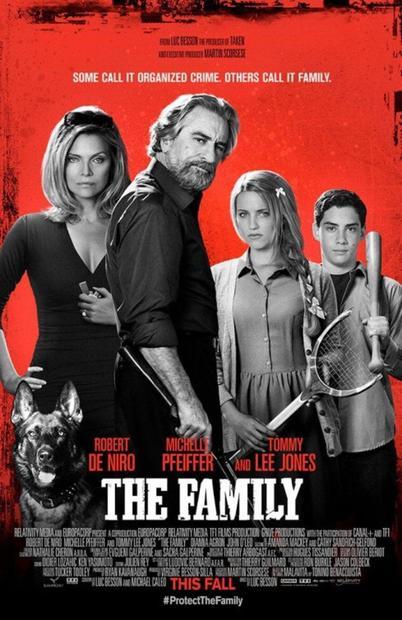 The most impressive thing I can credit The Family, an otherwise adequate action-comedy with identity issues, is that it makes each member of its titular family worth watching. Robert De Niro is the patriarch of a family on the run from the Mob, who used to serve as De Niro’s chief employer. They’re hiding in Normandy, France, and trying to blend in, with very mixed results. I was worried that everything was going to be too obvious, but the movie does a fine job of rounding out its cast, giving each family member a personality, flaws, and a reason you want to keep tabs with them. I enjoyed the son’s single-minded manipulation of his school, able to suss out everyone’s needs and how to turn alliances. De Niro starts writing his memoirs as a therapeutic exercise, but really nothing comes from this obvious plot catalyst. The nagging problem that dogs the movie is an inconsistent tone. The violence can be rather brutal and much of it is meant to be silly, but it doesn’t come across that way. In fact, most of the film’s laughs are tied up in over-the-top, and often, bloody violence. But the movie isn’t dark enough to work as a twisted comedy, holding back to become something of an uneven mob cartoon with plenty of hoary Italian stereotypes. As a result, when the third act is all bloody mayhem, it feels like The Family is three half-baked movies badly stitched together. I laughed enough and was passably entertained but The Family is too dark to work as a lark, too juvenile to be substantial, and too predictable by half.
Nate’s Grade: C+
Share this:

Kick-Ass 2 (2013)
 It’s hard for me to discuss Kick-Ass 2 without sounding like a hypocrite. I enjoyed the first film’s visceral thrills, style, and satire of superhero tropes. The sequel gives me more of the same except not nearly as well polished, and in typical sequel mentality, it goes bigger, expanding the world and the height of the sick puppy violence. Kick-Ass (Aaron Taylor-Johnson) and Hit Girl (Chloe Grace-Moritz) are trying to live ordinary lives but keep feeling the need to don their suits and fight crime. Kick-Ass joins a ragtag team of other costumed vigilantes to battle a super villain team, lead by the former Red Mist (Christopher Mintz-Plasse). For long stretches, the movie seems like an unwanted Heathers knockoff as Hit Girl attempts to fit in at high school. She has some particularly nasty vengeance against a popular bully, and if there is a line, it may have been crossed here. I don’t know what it says about me, but I guess I’m fine with a pint-sized kid slicing up bad guys and cursing like a sailor, but making a woman simultaneously vomit and defecate herself, watching both projectile streams spray out her ends, is too much for me. This is a darker, cruel, and mean-spirited feel with the material, and writer/director Jeff Wadlow fails to compensate for the lack of creativity this go-round (I miss you Matthew Vaughn). The humor is still lively, but the plot is predictable at every step, the characters behave in ways that don’t make sense, and the action sequences are poorly filmed, leading to an anticlimactic ending that simply peters out. Kick-Ass 2 won’t be knocking anyone out.
Nate’s Grade: C+
Share this:

You’re Next (2013)
 There has been a notable rise in home invasion thrillers in recent years but I am doubtful we’ve hit the crest just yet (this may also be hope speaking since I co-wrote one). Perhaps in an age of real-life anxiety on the news, the invasion of our personal sanctuary strikes an even more horrific chord. Whether you argue the upswing began with Panic Room, or Funny Games, or even the old Audrey Hepburn feature Wait Until Dark, the message is universal: nobody likes having their stuff messed with. This year we’ve already had The Purge make a splash at the box-office, and I’m sure Lionsgate is hopeful that their indie horror flick, You’re Next, which has been reaping great buzz along the festival circuit for years now, will make a similar splash. For me, You’re Next checked every box I would want in an effective horror film: good thrills, good humor, and a good ending. That adds up to one hell of a good time at the movies.
Crispian (AJ Bowen) is traveling all the way upstate for a family reunion at his parent’s palatial mansion in the woods. He’s also going to introduce his new girlfriend, Erin (Charni Vinson), an Australian graduate student that used to work as his teaching assistant at his college. Crispian’s rich family includes his excitable younger sister, his obnoxious older brother, his youngest detached brother, everyone’s boyfriend and girlfriend, and mom and dad. In between a lively family discussion/argument at the dinner table, arrows start flying through their window. Three mean wearing ominous animals masks are stalking outside, armed, and with every intent to kill everyone inside. The masked killers leave ominous messages painted in blood, noting, “You’re next” (I know they’re senseless murderers, but points for using the correct form of “you’re”). Erin snaps into survival mode and assembles a system of defenses but there are more threats than anyone imagined.
 To take nothing away from the artistic merits of You’re Next, the biggest selling point, and its greatest attribute, is that it knows how to properly work over an audience. While nowhere near the genre deconstruction that was last year’s Cabin in the Woods, nor as clever, here is a movie that knows it’s a horror movie, knows you’ve seen these movies before, and knows what you’re looking for as an audience member. And once the killing starts, the movie also gains a delightfully macabre sense of humor, an impish darkness that will leave you chuckling. I heartily recommend seeing this movie in a packed theater because the collective response will add to your enjoyment, or at least it did mine. Never have I experienced a movie where the audience cheered the plugging in of an ordinary kitchen appliance with such reckless enthusiasm. Thanks to director Adam Wingard and screenwriter Simon Barrett, the movie packs great payoffs in its second half, as our prototypical Final Girl outflanks her attackers. There are enough twists and turns to keep things interesting and the pacing swift. Once those arrows pop, this thing just flies by, moving at a speed that keeps you satiated with scares, thrills, and humor. In essence, You’re Next knows how to have fun with an audience, and for whatever reason, with the glut of dank home invasion horror thrillers, this is a surprise. With all the family trauma and killing, watching their loved ones cruelly slip away in horrific fashion, it’s worth praise that Wingard and Barrett find a happy tonal middle-ground that doesn’t blunt the horror or the comedy. The laughs don’t feel out of place with the screams. They make this work. And there are some really sick laughs to be had too.
My only familiarity with Wingard is from his involvement in the horror anthology series V/H/S and The ABCs of Death. It’s also somewhat entertaining to note that all three movies, both V/H/S and its sequel, have been released before You’re Next, a film that was completed two years prior. His anthology segments didn’t point to the same level of promise on full display with You’re Next. Wingard does a great job of orienting his audience to the geography of the play area, so to speak, while juggling different simultaneous threats and maintain a sense of clarity. He knows when to hold back, and he knows when the audience needs a peak of something gruesome. Initially, with the animal masks and the attack on the wealthy, I thought the film was gearing up for a dose of environmental social commentary, as if the killers were extreme defenders of Mother Nature. I’m actually relieved that the film never picks up any ham-handed political subtext.
 As a horror movie, it’s far more effective than most genre deconstructions that will undercut the terror for the chance at a good joke. Even Cabin in the Woods was like this. Again, You’re Next can be riotously funny, especially in the last act, but it can also, and often is, quite suspenseful as well. Once the game get sunder way, you start playing along as well, guessing which of our participants will indeed be next. They place themselves in precarious positions often, especially early, which makes it all the more suspenseful, because you’re suspecting anything can happen at any time. You’re lying in wait, and Wingard does an excellent job of drawing out that tension to a peak level before hitting the horror or gore. There are some gruesomely bloody moments in the film but it doesn’t lovingly linger on the deconstruction of the human body. And just when it seems like the number of housemates fighting for their lives has gotten so low that the thrills would have to be successfully all wrung out, You’re Next supplies a twist that changes gears, introducing a new threat and a new level of dramatic tension. When Erin assembles an ax to smash into the skull of whoever opens the front door, you’re eagerly waiting for that Chekov’s gun to fire (Can we rename it Chekov’s Ax to the Face?). The fact that the movie is almost designed as a Home Alone for demented adults is ingenious.
The acting is a bit hit or miss but the standout, by far, is Vinson (Step Up 3D). She’s our lead heroine, yes, but she takes charge in a way usually reserved for men in these types of movies. She has all sorts of crafty experience with wilderness survival and setting up traps, plus she is able to marshal the family from a bunch of WASPs screaming their guts out into something of a fighting force. And plus, Vinson just has an awesome screen presence to her. It’s a great role for her but credit the actress for knocking it out, giving the audience a strong, extremely capable, and empathetic hero. It’s satisfying to watch the masked killers be outfoxed by their prey. Many of the actors in the film are filmmakers themselves (Joe Swanberg, Ti West, Amy Seimetz), and they’ve collaborated on numerous projects, including other lo-fi horror features, the new Splat Pack if you will.
If you’re looking for a fun horror movie with a dark sense of humor, then You’re Next should be next on your list. It’s savvy, scary, and knows how to goose an audience at just the right moments. Wingard and Barrett know how to give an audience what they want without pandering, and that’s what elevates You’re Next from its peers. This is a horror film that can scare you one minute, make you laugh uncomfortably the next, and then ultimate leave you cheering the vengeful dismemberment of human life with kitchen appliances. It is a more than effectively put together horror thriller from beginning to end.
Nate’s Grade: B+
Share this:

Pain & Gain (2013)
 I think the audience for Pain and Gain is going to know exactly who they are, and I count myself amongst that number. The latest from director Michael Bay, often treated tantamount to Satan in many critical circles, has the based-on-a-true-story hook but really it’s the big stars, stylish violence, peculiar criminal antics, and overall overflowing machismo of the picture that will draw its audience. I knew after one watch of the trailer that I wanted to see it, though I was somewhat ashamed of the level of my interest (don’t want to taint your critical credentials with too much sympathy for the devil, after all). Pain and Gain is a trashy and entertaining jaunt, just as I hoped it would be, but it overstays its welcome and may leave you fatigued and possibly dejected (so… a typical Michael Bay movie? Still got it).
In 1995, three Miami, Florida goons enacted one of the most bizarre and sordid criminal schemes, a story that could supply a tabloid with enough juicy exposes for a year. Daniel Lugo (Mark Wahlberg) and his co-worker Adrian Doorbal (Anthony Mackie) are personal trainers at Sun Gym. Their days consist of pumping iron and hitting on ladies. One of Lugo’s clients is Victor Kershaw (Tony Shalhoub), a wealthy businessman with a nasty temper. Lugo and Doorbal, with the help of an ex-con and ex-junkie (Dwayne “The Rock” Johnson), kidnap Kershaw, hold him hostage for weeks, torture him, and eventually get him to sign over his assets to them. Afterwards they try to stage his “accidental” death, though like most things, it does not go according to plan. Penniless and broken, Kershaw seeks out help from a retired private eye, ED DuBois (Ed Harris), to provide validation for his case. The Miami police are laughing off his claims. Kershaw is concerned that the Sun Gym gang will strike again when their lavish lifestyle dips, and he’s right. Lugo and company get into even more trouble and the body count rises.
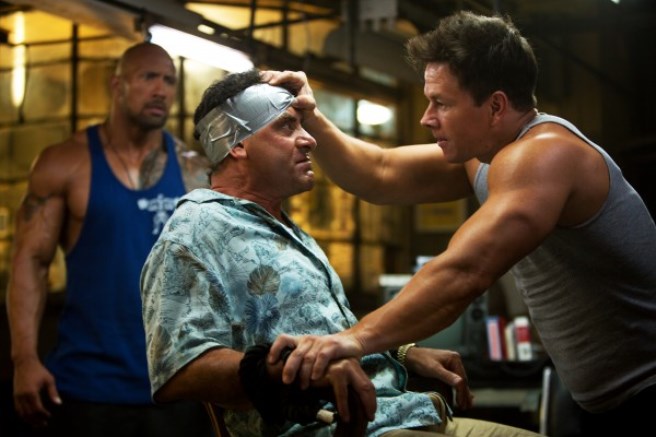 The results on screen are often entertaining in an over-the-top fashion, sustaining a rubbernecking captivation much like a horrendous car wreck. You just have to see how much crazier this thing gets, all the while muttering to yourself, “This was a true story?” It even gets to the point where the movie will remind you, via onscreen text as a man barbecues a batch of severed hands, that yes this is still a true story. Naturally there have been fictional inventions, character composites, and some details have been dropped to fit into the confines of a film narrative, but online research shows me that most of the larger plot beats are accurate, thus making the film even more compelling and disturbing. When the film is on, it feels manically alive with intrigue and absurdity. The problem is that it cannot keep this manic tone alive forever especially when actual innocent bodies start piling up (more on that later). There’s a certain uncomfortable tonal incongruity as the film develops and the comedy picks up a distasteful resonance. I love a well-executed dark comedy but just because something is macabre or unexpected does not automatically make it funny. Still, the movie has enough high-energy antisocial antics to keep you planted in your seat, laughing through bafflement.
Pain and Gain isn’t subtle in the slightest and yet it’s easily the most nuanced film of Bay’s career. Of course there are still the sleek cars, sexy babes, emphasis on style, and wanton destruction that are hallmarks of the man’s career, but the perspective is given a satirical prism, dropping us into the deluded, sub-American Psycho perspective of Lugo, a man with a very cracked view of the American Dream. The moral message reminds me of Marge Gunderson’s concluding musing in Fargo, telling a captured criminal, “There’s more to life than a little money, you know.” There’s some slight social commentary on wealth and the dirty tricks of capitalism, but really it’s the narcissistic delusions of a jacked-up criminal who believes he can succeed because he’s “seen a lot of movies.” You may even find yourself sympathizing with some of these knuckleheads, that is, until things get way out of hand. The screenplay by Christopher Markus and Stephen McFeely (Captain America: The First Avenger) is briskly paced and packed with bizarre details and even jumps into six different characters for voice over (Wahlberg, Johnson, Mackie, Shalhoub, Harris, and Bar Paly). For some characters it works as a great insight into their twisted logic but for others it’s just an easy set up for ridicule. The juvenile humor (did we really need a visual pubic hair joke?), candy-coated film palate, and sugar-rush, roid-rage plotting feel like a suitable match for the talents of the bombastic Bay.
The last thirty minutes of the movie will test your sensibilities of good taste. I’m all for having unlikable central characters just as long as the writer makes them interesting (what good is likeable but boring, the “friend zone” of characterization?). Some of movie history’s most fascinating characters have been scumbags and psychos. However, with that being said, I need my unlikeable characters to at least progress. When I’m stuck with a bad dude who keeps making the same bad mistakes, it can grow tiresome, and that’s where Pain and Gain ultimately lost me. Bay can’t quite keep up the charade of ironic bemusement forever, and a saggy second half starts to tread water, forcing the characters to act even more outlandish and inept. Did we need The Rock losing his big toe and then inexplicably giving it to a dog? It feels like the movie is filling time until the accidental murders come into being, raising the stakes. For a movie that’s 130 minutes, there should not be any need to fill time. During that long sad stretch, you start to feel disquiet, like the movie has lost its sense of perspective and the jokes have gotten too mean, too ugly, too outlandish. It doesn’t feel funny any more, and maybe that’s ultimately the point, but by the end Pain and Gain has soured. It overstays its welcome and then some.
 Its tone and connection to the real world raises an interesting and thorny question over whether something like this is appropriate. Should a story that involved the murders of innocent people end up becoming an over-the-top, stylized, lavishly glamorized Hollywood crime comedy? It has been over 15 years since the events of the Sun Gym gang, but is there a statue of limitations on good taste? Are we eventually destined for a vulgar film tackling the poor lives of the victims of 9/11? The answer is almost certain. What is off limits, or more pressingly, should anything be off limits to a comedic narrative? Is anyone really furious with Trey Parker and Matt Stone over their first film, Cannibal the Musical, transforming nineteenth century murder into song and dance? I doubt it, and yet there was something very off-putting about 2011’s 30 Minutes or Less, an unfunny comedy based around the true story of a pizza guy strapped with a bomb and ordered to rob a bank. The guy was blown to bits in real life (ha ha?). I guess I, as well as audiences, would have been more forgiving if the movie had been funny. I’m sure there would be fewer objections if Bay’s film had been more of a sober, contemplative drama on the sad acts of a bunch of desperate criminals, but with all the hyperbolic elements, machismo, and so-crazy-it-must-be-true plot turns, how could you turn this story into a serious drama? Not from the perspective of the nitwit criminals, at least. I don’t think the movie is ever positioning these guys as anti-heroes or excuses their excess.
Wahlberg (Ted) broke out as an actor thanks to a similar role as a wannabe star whose ambitions exceeded his grasp, and the man does dumb as good as just about anyone in Hollywood. It’s a specific kind of dumb, the angry, arrogant, pissy, self-involved kind of dumb that makes it acceptable to ridicule his character to no end. Johnson (G.I. Joe: Retaliation) gets to explore some interesting range as an actor, pacing around the demons of his character before just going hog-wild with the excess. Mackie (Gangster Squad) is arguable the most sympathetic of the group but also with the most to lose. Compared to his peers, he’s practically mild-mannered even though he takes injections into his penis. Shalhoub (TV’s Monk) is amusingly apoplectic and just enough of a jerk that you excuse his misfortune, at least for a little while. Ken Jeong (The Hangover) and Israeli model-turned-actor Bar Paly give the exact performances you would expect them to deliver. The best actor in the whole movie, though truth be told there isn’t a stinker in the bunch, is Emily Rutherford (Elizabethtown, TV’s The New Adventures of Old Christine) who plays Dubois’ wife. She has this calming, down-to-earth presence that seems to bring a small sense of peace to the madcap antics. She doesn’t have a lot of screen time but you’ll wish she had lots more.
Perhaps I’m being unfair to a movie that clearly isn’t intending to be anything but naughty, tacky, and gleefully excessive. In a way Pain and Gain reminds me of Tony Scott’s Domino, loosely based upon a true story but crushed to death by narrative kabuki and Scott’s characteristic excess. If I wanted to defend the much maligned Michael Bay, I’d argue what the real difference is between his excess and the excess of the more critically lauded Scott? Bay doesn’t have a slate of movies to his credit the likes of Top Gun, Crimson Tide, or True Romance. But isn’t flashy, artistic excess all the same when in the name of empty storytelling? Domino is also an apt comparison because it’s ultimately tiresome and far overstays its welcome, losing its audience with an endless array of odd sidesteps and moronic, deviant characters. While Pain and Gain has enough quirk and style to justify consideration, you may not respect yourself once it’s over.
Nate’s Grade: C+
Share this:

Spring Breakers (2013)
 Harmony Korine is the kind of filmmaker who I typically avoid. I haven’t liked a single one of the movies the man has written or directed. This list includes Kids, Julien Donkey-Boy, Trash Humpers, and the detestable 1997 film, Gummo, possibly one of my most hated films. The man has become an expert on depicting juvenile delinquents and the excesses of youthful folly, so I wasn’t surprised that his latest writing/directing effort, Spring Breakers, followed suit. I was surprised at the names he was able to attract to the film. Former Disney Channel starlets Selena Gomez and Vanessa Hudgens, as well as ABC Family’s Ashley Benson, join Rachel Korine as a foursome of gals who long for the pleasures of a spring break getaway. They scrimp and save for months, plus also rob a restaurant, and take their sojourn to the sunny beaches of Florida. The girls run afoul of the law and are bailed out by rapper and wannabe gangster Alien (James Franco). Living large, and with handy access to a plethora of weapons, the girls get involved in the crosshairs of a turf war, but they won’t let anything bring down their good times.
When you break it down to its trashy molecular core, Spring Breakers is like an exploitation film as directed by Terrence Malick. Allow me to explain, dear reader. Much like that hallowed art house filmmaker, the plot in Spring Breakers is really a wispy, abstract concept, and the film is prone to repetition and redundancy, a triptych for the senses. There’s plenty of overlapping dialogue that circles back and repeats itself, images that bleed into one another, and a plot that generally takes its cues from MC Skat Kat, namely moving two steps forward and then two steps back (is this reference too dated?). The rote dialogue, when not indifferently profane and nonsensical, is usually variations on, “Spring Break. Spring Break forever.” I’ve just given you about a fifth of the entire movie’s dialogue. It may have just been my theater’s sound system, but I found much of the dialogue hard to hear and decipher. Perhaps it was Korine admitting that the things his characters say weren’t worth straining to hear. As expected, this can get rather frustrating to sit through. It’s not so much a movie as an experience meant to wash over the audience. Hence the nonstop dubstep score, provided by Skrillex, and the crashing imagery of tawny exposed flesh, gyrating bodies, neon lighting, fellating gun barrels, and excessive inebriation, all meant to bring the spring break experience to the consumer, that is, if most people’s spring breaks involved lots of illegal activity. If Malick’s movies are meant to serve as religious experiences, then consider Spring Breakers to be the equivalent of ingesting GHB.
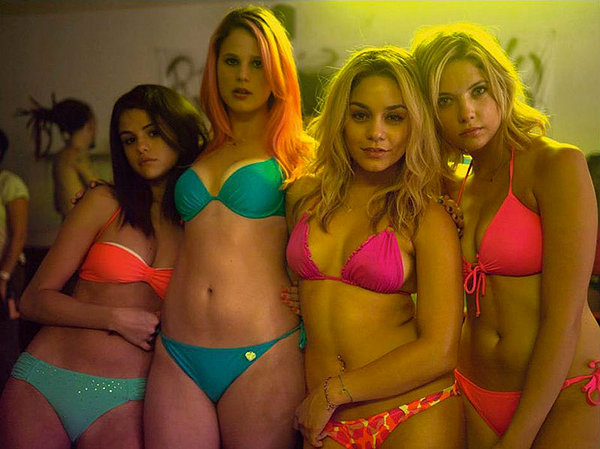 Let’s talk about that paucity of characterization. Besides Faith (Gomez), a name a bit too on-the-nose for this sort of enterprise, there is zero I can say about ANY of the other three girls. They are completely interchangeable. They have no defining characteristics beyond their simple geographic placement within the camera frame. That’s it. When Faith ditches the movie at the halfway mark, having the good sense to realize her supposed friends might not be the best influence, I wanted to go with her. I didn’t want to be left with these vacuous and annoying characters. It’s pretty clear the contempt that Korine has for his own female characters, constantly serving them up for ridicule. It makes the whole movie even less appealing. We’re not supposed to like our heroines but it gets uncomfortable when the director seems to be constantly shaming them, rubbing our faces in how awful they are as people. With an absence of characters you care about, and a plot that feels like it keeps circling back, there’s precious little to hold onto before you become anesthetized to Korine’s exploitative navel-gazing.
After Oz the Great and Powerful I didn’t think I would utter these words, but thank God for the presence of James Franco. The man is so fully committed to his gonzo portrayal of a white trash wannabe gangster that you are downright thankful when he takes over the movie halfway in. At least we don’t have to spend as much time with our empty-headed trio of ladies. Franco, perfecting an ominous drawl, is a cartoon of misplaced machismo, living the “gangsta” life he’s seen parroted in pop culture (he has Scarface running on a constant loop on his TVs). He provides a jolt of energy to the movie, a second wind, and thankfully pushes the girls into greater conflict than part-to-party binges. He brings a real sense of danger to the film, and the descent into a criminal path couldn’t have come soon enough for me. It’s such an enjoyably whacked-out performance that I wouldn’t be surprised if Franco may even be considered for some Best Supporting Actor nominations.
There’s something just so tiring and depressing about watching people trying to chase a hedonistic high rather than, you know, live their lives. In this warped sense of thinking, the all-encompassing term of “partying” is meant to be the divine state of being and anything else falls by the wayside of significance. I understand the movie is exposing a shallow and empty way of life but it can still be tiring to watch nonstop. You become numb to the onscreen antics. You become numb to the free-flowing spirits, profanity, and gratuitous nudity (there were literally six topless ladies onscreen before a word was spoken). Watching Spring Breakers, you have two options: give yourself over to the trance-like, self-destructive youthful fever-dream or sit solemnly, objectively observing how the outrageous become routine, and become dead inside.
As much as it pains me to admit, being a non-fan of Korine’s movies, there are a few moments in the movie that are actually surprisingly effective. The first is a hasty robbery of a small restaurant. We stay in the passenger seat of the slow-moving car as it spins around the building, and in the background we see the escalation of events, the girls smashing breakables and terrorizing the few patrons. It’s one of the few visual decisions that felt, and here’s a word you won’t find anywhere else in relation to this movie, artistically restrained. There’s also plenty of forced irony in the movie where a character’s positive words will be counterbalanced by a visual contrast. Faith phones her grandmother and talks about her great time, even promising next year that she wants to take dear old granny along with her. Meanwhile, as the words play out, which will happen again at several redundant points, we see the girls engaging in behavior that would most likely not be granny-approved. Even if forced, and often redundant, it’s still effective, as is Korine’s hypnotic visual sensibilities. If nothing else, Spring Breakers is a good-looking movie with many pleasing visuals.
 I think I understand why my critical peers have lavished as much praise upon Korine’s bacchanalia. They see a satire of this empty, nihilistic, party-all-the-time, damn-the-consequences lifestyle, the idiocy of youthful hedonism. The problem is that there’s only a handful of moments in Spring Breakers where I felt that Korine actually achieved satire, one of them being a montage of robberies set to a Britney Spears song (beforehand we saw girls holding guns by the barrel and dancing in a circle). Those moments that struck me as satire were few and far between, because what I mostly left with was just another exploitation film. If this were meant to be satirical, the girls would not get away with it all in the end. Korine may intend to stand back in some ironic judgment of his own movie, providing himself an excuse for the lackluster plotting and characters. Here’s the point: even if it was done intentionally, it still makes for a lackluster plot and characters. Saying, “I meant that all along,” is not an excuse when the rest of the film fails to live up to your stated satirical intents.
Allow me a moment to talk about the somewhat disconcerting treatment of, for lack of a better description, the sluttiest of our gals, Cotty, played by Rachel Korine. When I saw the last name of Korine I thought, “Is that the director’s daughter?” Harmony Korine has been in the film industry for almost 20 years, so it was a possibility, and oh what a disturbing thought that was. Some cursory research proved that Rachel Korine was in fact Harmony’s wife; there’s a thirteen-year age difference. It’s still uncomfortable that Korine would slot his own wife to portray one of the titular spring breakers, the only one from our posse who goes nude onscreen too (sorry skeevy Disney Channel and ABC Family fans). So when he’s slut shaming these girls, mocking them with contempt, directing their gratuitous exploitation, he’s also including his own wife in this distasteful characterization, making sure the camera has multiple opportunities to take in her exposed flesh. It’s like he’s serving up his own wife to the gods of spring break (a.k.a. young male ticket-buyers), and it just seems icky.
When Spring Breakers came to a merciful close, the college-aged guy behind me remarked, “That’s the weirdest movie I’ve ever seen.” I replied, “Then you haven’t seen a lot of movies, have you?” Korine’s abstract, aimless salute to self-indulgence is a depressing experience that celebrates the worst in human beings, but weird it is not. I’m just tired of Korine’s schtick. He presents trashy characters, prods us to ridicule them, and then gives them a lot of empty space to do dumb things for an hour and half, ultimately going nowhere and accomplishing little. It just so happens that Spring Breakers, his most commercial and accessible film, has attractive, nominally famous actresses partaking in the nastiness this time. I suppose there will be some appeal to a small swath of filmgoers to see former squeaky-clean Disney Channel gals cutting loose, behaving badly, and playing against (manufactured) type. For me, the very casting of these ladies was another sign of Korine’s artistically bare ambitions. If he wanted to hold up the entire escapist spring break pleasure-seeking lifestyle for satire, then he needed to push harder. What’s on the screen is rarely satire. Instead, it’s just another careless exploitation film, replete with moronic characters we don’t care about and a plot that would be charitably described as, well, a plot. Even Franco’s calculated weirdness cannot save this film. Spring Breakers is a trip best avoided.
Nate’s Grade: C-


You must be logged in to post a comment.