Blog Archives
Nurse Betty (2000) [Review Re-View]
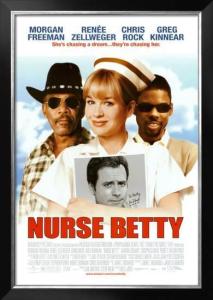 Released September 8, 2000:
Can a fairy tale have a dark undertone below all the bubbly whimsy? Hell, the Grimm tales were barbaric before they became homogenized, sanitized, and finally Disneytized. Nurse Betty presents a modern day fairy tale with the strike of reality always below it — the strike of darkness and disappointment. Fairy tales are an escape from this, but what if one creates her own fairy tale and chooses to believe in it over the drab reality she presides in?
Neil LaBute, the director of the incessantly dark In the Company of Men and Your Friends and Neighbors, collects together a whimsical modern day fable with a top-notch cast. Yes, to those fans of earlier LaBute offeriengs his name doesn’t seem synonymous with whimsical comedy – but in this flick LaBute cuts his teeth in the mainstream and earns his stripes if ever.
Baby-voiced and rosy-cheeked Renee Zellweger plays our heroine in diner worker and soap opera fanatic Betty. Betty finds solace from her life featuring a sleazy spouse, played with marvelous flair by Aaron Eckhart, in her favorite soap opera. When her louche of a hubby isn’t wiping his hands on the kitchen curtains or banging his secretary he tries proposing drug deals for shady characters. A recent drug peddling snafu sets him up to an ominous encounter with hitmen team Morgan Freeman and Chris Rock. Through a jarring scene of violence Betty’s husband is left brutally murdered and the only witness is Betty herself. The event causes Betty to slip into a fractured psychological state where she believes the world of her soap opera is alive and real with herself a vital character. She hops in one of her dead hubby’s used cars and drives off toward California to meet the doctor/soap star of her dreams in Greg Kinnear.
 Morgan Freeman and Chris Rock mistake Betty for a criminal mastermind and believe her to have taken the drugs and run. They embark on their own mad dash to capture her and finish the job they were paid to complete. Along the way Betty encounters many people that are at first confused but ultimately charmed by this delusional dame. Through a series of events she meets up with the eternally smarmy Kinnear and begins to learn what happens when a fantasy is corrupted by the disappointment of reality. Allison Janey has a small part as a network executive that shines strong, and Crispin “McFly” Glovin is just nice to see in a film again. He doesn’t seem to age though. Maybe he has that Dick Clark disease.
The flow of Betty is well paced and a smart mix between drama, whimsy, and dark humor. Overlooking some sudden bursts of violence bookend the film it comes across as a sweet yet intelligent satire and fable. Betty is looking for her Prince Charming but will later learn that she doesn’t need one, that she is the fairy tale happy ending inside her.
The acting of Nurse Betty is never in danger of flat-lining. Zelwegger is a lovable and good-natured heroine. Freeman is a strong and deceptively hilarious actor along side a caustic yet down-to-earth Rock. And I make an outgoing question if there is an actor alive out there that can do smarm better than Kinnear — I think not.
Nurse Betty is a wonderful surprise. Check into your local theater, take one showing, and call me in the morning. You’ll be glad you did.
Nate’s Grade: A-
——————————————————
WRITER REFLECTIONS 20 YEARS LATER
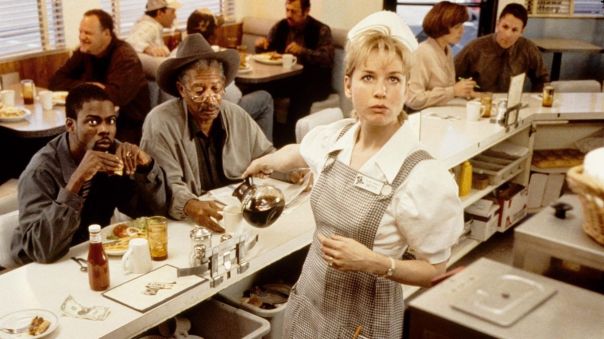
I was high on Nurse Betty in 2000 declaring it a modern-day fable with a darker undercurrent equivalent to that of the Grimms and their mixture of the everyday and extraordinary. In reality, Nurse Betty couldn’t feel more like a holdover of the 1990s indie scene where it might have been an unwritten rule that after Pulp Fiction every indie film had to have a subplot involving quippy hitmen (consider it the equivalent of every 1980s comedy having a mafia subplot for some unexplained reason). It feels engineered from a different era, and because of this, I’m sad to say that Nurse Betty hasn’t aged as well as I hoped. It’s not a bad movie but it feels more dated and peculiar, both in design and also unintentionally with its mishmashing tones that were more enticing twenty years ago.
The premise of Nurse Betty sounds like two movies smashed together. The movie is almost split evenly among its two storylines. We have Betty (Renee Zellweger) as the put-upon wife in Kansas dreaming of a better life, and maybe a better husband, who then has a mental breakdown and travels cross-country believing she’s in a real-life soap opera. Following suit is a pair of hitmen (Morgan Freeman, Chris Rock) who bicker and track her down, having their own cross-country road trip and getting on each other’s nerves. The problem with the screenplay by John C. Richards and James Flamberg is that these two competing stories could have existed on their own and probably would have been the better for it. It’s revealed late in the movie that Rock is the son of Freeman, and by that time of the reveal it doesn’t do much other than serve as a hasty attempt at a twist ending and to better push the fatalism of Freeman’s character, Charlie. However, if we knew from early on that this was a father-son hit team, think of the fun family squabbles and opportunities to present character development through these unique circumstances. It’s a father trying to train his son in his many years honed killing targets and not questioning why. You could tell a really quirky, compelling, and engaging family story through this dark comedy vehicle. Instead, the father-son hitmen are simply playing catch-up with Betty. Charlie becomes substantially less interesting the more obsessed with Betty he becomes because his character change is never really explained. Even he is unable to articulate why this one woman has entranced him. He stops being the scary, proud, and imposing figure who killed Betty’s husband and becomes a doddering, foolishly love-struck old man that loses his edge. Again, that arc could work but the screenplay essentially nullifies him as a threat and as a multi-dimensional character. If both of these dangerous men had driven off into their own movie, they and we would have better benefited.
 The Betty half is the more entertaining portion because it’s more unpredictable and because Betty is, at her heart, a sweet human being who is looking for her dream. It doesn’t take much to emotionally identify with her mistreated character who seeks an outlet for her life’s disappointments. Her mental break produces a sizeable degree of nervous laughter whenever she encounters someone new who is taking her at literal face value. Should we be laughing at her? Should we be pitying her? Should we be worrying about her having reality crush her hopes? The movie doesn’t seem to be holding up Betty for cheap mockery, which is a relief considering the quantity of her mental illness and trauma leading her into increasingly comical scenarios. The baffled misunderstandings can supply amusement but it’s more waiting to see how Betty responds to adversity and waiting for reality to hit with crushing force, eventually snapping her back. It’s waiting for the realization, but until then you can enjoy Betty’s blissful delusion like a sitcom character being hit over the head and thinking they’re somebody new. The movie takes on a new level of entertainment when she meets the man of her desires, Dr. David (Greg Kinnear), actually the actor George in real-life, and he doesn’t reject her but becomes fascinated with her. He’s impressed by her level of commitment to Method acting, so he assumes, and is curious how far she can keep things going. Betty also seems to bring back George’s passion for acting, which has waned over years of playing the same over-the-top plot machinations of daytime television. That’s such a better storytelling choice than having her dream man push her away immediately for being outwardly crazy.
The winning feature of Nurse Betty is the relentless positivity and daffy, perky performance of Zellweger as our dream-seeker. She always has a smile and go-get-‘em attitude that makes her compelling to watch and also easy to root for, whether or not she ever comes out of her mental break. Her sunny demeanor in the face of medical horror and confused authority figures is reliably charming. Zellweger never plays like the joke should be on Betty. Often it boomerangs, like when her L.A. roommate wants to dash Betty’s dream by introducing her to the real George, but instead of disaster they walk off to spend the rest of the fancy soiree together. Zellweger is the best reason to step into Nurse Betty and her portrayal of mental illness is not meant for ridicule. After Nurse Betty, Zellweger went on a tear, getting three Oscar nominations in three years, and a win for 2003’s Cold Mountain, before disappearing from Hollywood to re-emerge with a different face.
The jumbled tones proved more amusing to me twenty years ago but now they feel sloppy and poorly integrated, hence why it feels like two separate movies inelegantly melded together. The violence can be jarring and too serious for a movie that also attempts goofball whimsy. It feels like Nurse Betty was assembled with all the loose, leftover bits of irony from the 90s indie scene. It’s a bit of a hodgepodge movie that feels like it was green-lit based upon as many of its discordant elements all appearing under the name of one movie. Soap operas. Housewives. Mental illness! Road trips! Hitmen! Oh my! The soap opera jokes and industry satire feel pretty dated and must have been stale even by the time the film was released twenty years ago. There are points watching Nurse Betty where you feel like it went shopping for its quirk and bought it whole sale.
 Director Neil LaBute was a fascinating choice considering his prior work writing and directing very misanthropic small-scale ensemble dramas like 1997’s In the Company of Men where two toxic men set out to ruin an innocent deaf woman to punish the female gender they feel has done them wrong. This seemed like an odd fit but was a preview to LaBute’s attempts at being a journeyman mid-range director, helming the stunningly bad 2006’s Wicker Man remake as well as completely forgettable studio fare like Lakeview Terrace and the Death at a Funeral remake. LaBute has since found a home writing and directing in television, including writing 15 episodes of the SyFy Channel series, Van Helsing, which well and truly confounded me to learn. The man who was responsible for dark, David Mamet-esque plays about the searing depths of human depravity and toxic masculinity was writing low-budget vampire cable television. To be fair I haven’t watched a single episode so perhaps his prior writing experiences really added something to the tale of Vanessa Helsing kicking ass in a vampire-dominated future. Actually, I take it all back because that sounds like a fun show.
Nurse Betty is a dark comedy that surprises as often as it may frustrate, spinning two different stories on a collision course that would have benefited from a trial separation. It’s one of the first re-review films that has lost some of its magic for me. In 2000, this movie felt a lot more daring and hipper and I gave it credit for the inclusion of so many off-kilter elements. Nowadays, I need more from a movie than simply including unexpected elements. It has to make the most of them, incorporate them in meaningful and challenging ways, and justify their tonal integration. Reading over my original review twenty years ago, I cringe about how uncritical it proves to be. I clearly enjoyed the movie but couldn’t say much more than bad puns and obvious allusions (did you know fairy tales could be, get this, dark and unnerving?). This is not one of my finer film reviews and I won’t cut my 18-year-old self any slack because I’ve been impressed by the insights and writing style of my younger me before. I will hold my past self to higher standards, thank me.
Re-Review Grade: B-
Share this:

The Babysitter: Killer Queen (2020)
 I very much enjoyed 2017’s The Babysitter from the very start. The characters had such vitality to them, Samara Weaving (Ready or Not) gave a star-making performance, and it was a wild ride while also having an emotional core with the relationship between the babysitter and her charge, a designated Satanic sacrifice. It was silly, clever, but also satisfying with its character dynamics, and it proved successful for Netflix so they felt, well, why not do it all again? The Babysitter sequel, subtitled Killer Queen, has a strong whiff of desperation trying to awkwardly rekindle the good times. The original writer, Brian Duffield, is not here as a writer but returning director McG is one of the credited writers, which made me wary. Sequel-itis plagues the story as our surviving teen Cole (Judah Lewis) gets into ANOTHER tight spot with ANOTHER group of Satanists looking to sacrifice him to make their dreams come true, and it also happens to also include the SAME supporting villains from the first movie. Even the cheeky onscreen titles go, “Again?!” Why must these killer Satanists only obsessed with this one specific kid as a sacrifice? Diversify your options, folks. It all feels more of the same but just not as good, not as memorable, and not as entertaining. It’s a low-investment movie, something where your ceiling of demands is already pretty generous, so if you enjoy comically over-the-top gore then there are a few moments that might make this sequel palatable. It’s a movie with a “so what?” attitude, adopting a flippant nihilism that makes the attempts at drama a little more forced and inauthentic when they occur, not that the comedy is much better outside the splatterhouse violence. The ending is also rather anticlimactic because it simultaneously involves a deus ex machina while also finding a way to be derivative of another very memorable ending of another Samara Weaving movie. I didn’t think a sequel was needed, and I wasn’t expecting much from a sequel, and I got about what I was expecting. The Babysitter: Killer Queen is a fast-paced and amenable work of cinematic junk food, a genre movie that might have enough genre elements to prove tasty, but by hewing so close to the original, Killer Queen feels more imitation than imagination, and it’s clearly inferior to the original.
Nate’s Grade: C+
Share this:

Becky (2020)
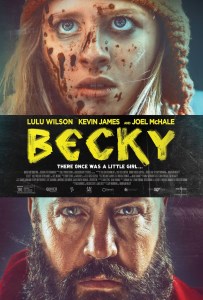 Imagine if Home Alone was more intense and populated with neo Nazis, and you’ll get a feel for Becky, a jubilantly gory, highly stylized indie thriller that might be as off-putting as it is entertaining. Kevin James, yes Paul Blart himself, gives an about-face turn as the leader of a group of Nazis that recently broke out of prison. With his bushy beard. swastika tattoos, and intensely quiet monologues, the stunt casting works out well, and James can be truly menacing. His band of goons are terrorizing a blended family in search for a macguffin of which just happens to be in possession of Becky (Lulu Wilson), an adolescent hellion they will soon reckon with. She knows the terrain of the family cabin and the woods and goes about picking off the bad guys one-by-one in fiendishly bloody, wildly over-the-top panache. That’s the real appeal of the movie, the various ways our pint-sized heroine takes down the Nazis. Directors Cary Munion and Jonathan Milott (Cooties, Bushwick) infuse plenty of visual style into their thrills, amplifying the intensity further, like a pounding camera edits and a walkie talkie confrontation between hero and villain where a series of pans makes it feel like they’re face-to-face. The film can be unsparingly brutal and hard to watch at times, walking a line between being darkly comic to simply being gross. Becky herself comes across like a brat and, as the killings continue, gleefully sociopathic. She’s still hurting from her mother’s death, she doesn’t want to have to save her soon-to-be stepmom and brother, but she’ll do it if it means killing more Nazis. One big tough Nazi has a crisis of conscience and demonstrates, at least onscreen, more depth than Becky. It’s all a bit too nihilistic by the end for my tastes. Becky ultimately is a movie about killing Nazis gory good and looking good doing so. If that’s enough for you, give it a watch.
Nate’s Grade: B-
Share this:

Downhill (2020)/ Force Majeure (2014)
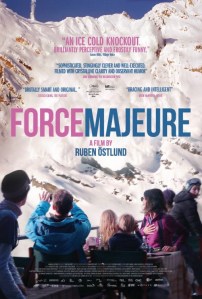
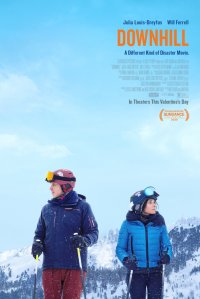 I’ve been meaning to watch 2014’s Force Majeure for some time but it was one of those movies that just fell behind and got trapped by the ever-increasing backlog of “to see” films. Then I discovered that there was to be an American remake by the Oscar-winning writing team behind The Descendants and I decided now would be a good time to go back to Force Majeure. But I purposely chose not to watch the Swedish original until after having watched the American remake, Downhill, to delay prejudicing myself. Both movies have value as cringe comedies prodding fragile masculinity, though the Swedish import runs more with the cascading consequences and the English remake plays more broadly with its big stars.
Both movies follow families on skiing vacations where the father (Johannes Kuhnke as Tomas, Will Ferrell as Pete) abandon their wives (Lisa Loven Kongdli as Ebba, Julia Louis-Dreyfus as Billie) and children when an approaching avalanche looks to be imminently deadly. It proves to be harmless but the scare it created was very real, and the damage to this family is also very real. In their dire moment of need, as death looked increasingly possible, this family watched its patriarch run away to save himself (and not before grabbing his phone). The father denies running away, finding his own slippery slope of excuses to pretend and convince his family that everything is still the same.
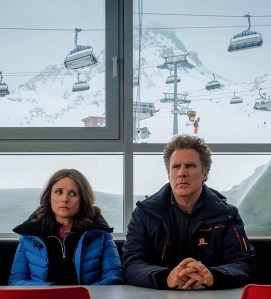 Downhill takes the very specific tone of the Swedish original by writer/director Ruben Ostlund (The Square) and plays it safer and more broadly. There’s an added context of the ski lodge being a couple’s resort with the idea of horny and available alternatives just a slope away for fun. The movie is practically throwing a more traditionally “manly” and virile romantic candidate at Billie and it’s so obvious and immediate that it reminded me of the sexy yoga instructor from 2009’s Couples Retreat, another movie that involved a holiday retreat with two camps, one more family-friendly and another more hedonistic. It feels too convenient and crass to immediately present our heroine with prime cheating options and have her question her own fidelity. In Force Majeure, one of the best and most awkward moments occurs when Tomas tries to portray himself as an equal victim to his own shortcomings as a man. He lists several faults, including infidelity, that don’t phase his wife, which implies she is well aware of this man’s flaws. It’s such a pathetic moment of emotional manipulation that incredulous laughter is the only natural response, and the movie makes the viewer stay in that uncomfortable squirm. Tomas lays on the floor wailing like a child, which then triggers his children to come out and lay upon their weeping father and then admonish their mother to follow their supportive lead. It’s a hilarious moment and borne from the organic developments tied to character relationships. In Downhill, by contrast, we get stuff like the sexy ski instructor and a really horny, handsy lodge lady (Miranda Otto, in thick accent).
That’s not to say the remake doesn’t find effective ways to make the most of its American infusion. There’s a scene where Pete and Billie are complaining to the ski lodge staff because someone must account for their perceived injury. The moment doesn’t go as they hoped and the security head (Game of Thrones’ Kristofer Hivju) refuses to apologize or admit any wrong. He points out all the warnings that the American couple somehow missed, and this only causes Billie to grow in her impotent agitation. It’s a moment that plays to the ugly American stereotype of self-absorption and the insistence to be heard. This scene would not have worked with the Force Majeure characters at all. Billie is a more interesting character and given more ambiguity and flaws than Ebba, who is often the perplexed voice of the audience. There are adaptation changes and new jokes that work for Downhill but more often it doesn’t explore the comic avenues open to it (hashtag jokes… really?). The best jokes are frequently holdovers.
Something I enjoyed exclusively about Force Majeure was how it widened its scope to include the contagious nature of questioning masculine assumptions. The supporting characters have more significance than in Downhill. Tomas’ friend, Mats (Game of Thrones’ Kristofer Hivju), begins as an awkward lifeline trying to offer meager supportive explanations to his beleaguered friend’s cowardice (“You ran away so that you could come back and dig everyone out, right?”) and then he too is negatively affected. His much younger girlfriend begins to look at him differently and with suspicion, wondering if he too would disappoint when under a similar life-threatening scenario. She questions whether it’s simply a generational divide and an older generation (Mats) just doesn’t feel as brave and selfless. This eats away at Mats and wreaks havoc with his relationship. You too might consider how well you really know your loved ones and how you might respond as well. It’s such a wonderful what-if scenario to apply to one’s self. This contagious nature of doubt makes the story feel that much more interesting when one man’s failings can spiral outward and ensnare others. This deepened the dark comedy and provided interesting and complimentary side characters. With Downhill, we don’t really get any other characters on the same level of consideration as our main couple, Pete and Billie.
 The children actually play a bigger role in Downhill as the relationship between the sons and their father is on the brink. They see him decidedly different and Pete spends time trying to regain their favor and trust and, naturally, failing. With Force Majeure, the children are kept on the sidelines and they’re more worried that mom and dad may be doomed to a divorce rather than being upset or disappointed with their father. Downhill clearly aligns the sons with their mother and has Billie call upon them to provide corroborating testimony to her account in one deliciously awkward extended moment. It’s one area where Downhill bests its source material but again that’s because it also dramatically scales down the importance of supporting adults.
Ferrell (Holmes & Watson) and Louis-Dreyfus (Veep) are such an enjoyable comedy pairing and work together smoothly for Downhill’s broader aims. The Swedish actors are far more subdued, understated, and dry, dissolving into playing mundane, regular folk. You’re not going to get that with Ferrell especially. His big screen buffoon tendencies play well for Pete’s blustery self-deluded narcissism, but he lacks the bite for the destructive self-pity that emboldened Kuhnke. Ferrell’s performance is more restrained than you might assume but he still doesn’t feel like the right fit for the character and where he needs to go. He never stops being seen as Ferrell. Louis-Dreyfus is such a pro and is able to navigate the bleaker comedy with great precision. Her shaken monologue retelling the avalanche incident and pausing on “… to die, I guess” had me rolling.
Downhill is over 30 minutes shorter and yet it feels stretched thin, circling the same comic points, which can make the film feel frustratingly smaller in scope and ambition. The endings are different and come across a similar message over never knowing how a person may respond in the middle of danger. Force Majeure concludes with a scenario that allows its wounded males to save some honor and the women to question their own responses, a paradigm shift of gender expectations. The triumphant recapturing of masculinity builds to its own satirical breaking point, ready to laugh at Tomas feeling like a ridiculous John Wane-style cowboy. In contrast, the American ending doesn’t feel as rich or as earned as its predecessor.
 Downhill is an accessible and funny remake that has some smart deviations from its source material to deliver its own version, and sometimes it feels like the filmmakers want to make a much more mainstream comedy. The tonal identity issues sap the comedic and dramatic momentum of the story, which can make the overall film frustrating and unsatisfying at times while you wait for it to settle. Then its 85 minutes are over and it’s done. Force Majeure, on the other hand, is the most confident, strident, and awkward viewing, not to mention longer viewing at two hours in length. It’s actually too long and with a few segments that could be trimmed or removed entirely (drone flying, the first set of friends, getting lost in a snowy fog). There’s even a running joke where the gag is simply that the ski lifts and moving sidewalks are just super slow. The movie takes its understated, dry comic sensibility even to its relaxed sense of pacing. Both movies are funny and emphasize different aspects of the premise of the consequences of cowardice. I likely would have enjoyed Downhill less had I seen Force Majeure first but it’s still a decent American remake for something that was so calculating and exact in tone, a laugh-out-loud comedy that doesn’t play like a comedy. Still, co-writers/directors Jim Rash and Nat Faxon (The Way Way Back) have enough skill and polished instinct that even a less sophisticated, more obvious version of Force Majeure is still entertaining enough. It might lack some of the edge of the original but Downhill is an agreeable comedy of disagreeable decisions.
Nate’s Grades:
Force Majeure: B+
Downhill: B-
Share this:

Birds of Prey (2020)
 Not really a Birds of Prey movie, not really a Suicide Squad sequel (see you in 2021), this is really more of a Harley Quinn solo spinoff that’s fun, colorful, bonkers, edgy, and a smile-inducing delight… when Margot Robbie is onscreen as Harley. Robbie is a charming, hyperactive live wire that commands your attention, and giving her the reigns of the storytelling, quite literally in some Deadpool-esque meta storytelling tweaks, is the best decision the filmmakers make. I enjoyed the frivolity, visuals, and narrative trickery, but I noticed something whenever Harley took a powder off screen. None of the other supporting characters are that interesting. I don’t know anything about Cassandra Cain (Ella Jay Bosco), the plot device that everyone is after because of the prized diamond she swallowed. She’s more attitude than person. There’s also Black Canary (Jurnee Smollett-Bell) who doesn’t do much and has a super power she doesn’t use until the end. Renee Montoya (Rosie Perez) provides the police angle and references to cop movie cliches (a hat on a hat). Huntress (Mary Elizabeth-Winstead) is almost a self-parody as the young girl growing up to be an elite assassin to avenger her murdered family and the movie treats her like an also-ran. The only other person of interest is the villain, Roman Sionis a.k.a. Black Mask (Ewan McGregor), because the performance is campy while also being menacing. Birds of Prey suffers absent Robbie because its additional pieces cannot carry the movie on their own. The vacuum of charisma is too noticeable. The fight choreography is impressive and with plenty of longer takes to fully appreciate the cool moves. I enjoyed how every action sequence was different from the last and director Cathy Yan makes excellent use of her environments; a police lock-up is a fantastic place for an action scene with all the evidence/props to utilize. A romp inside a fun house also keeps things fresh even though the goons never bring guns to their big fight. Birds of Prey works very hard with quirk and narrative shuffling, and it feels like a decided attempt to dazzle as well as distract, because there’s not much to this movie. It’s style and personality over substance, and that’s fine, but it does make the second half feel a bit like coming down from a sugar rush. I know there will be plenty that celebrate a group of strong women taking ownership of their own stories and fighting together against toxic men. I know there will be plenty of my friends that love this movie. For me, it was an enjoyable experience that made me realize just how much I enjoy Robbie as an actress, as this character, and when given extra room to roam with an R-rating. Birds of Prey is the kind of tasty junk food you just crave from the cinema every now and then, but without Robbie it’s decidedly less flavorful.
Nate’s Grade: B
Share this:

Parasite (2019)
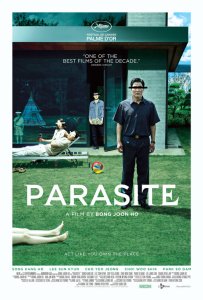 Parasite is the latest from award-winning South Korean filmmaker Bong Joon-ho (Snowpiercer, The Host, Okja) and it won the prestigious Palm D’or at the Cannes Film Festival. The filmmaker has never settled down in any genre and often goes for broke when it comes to embracing whatever genre he is dabbling in and then subverting, accelerating, and broadening that territory to show an audience what a master can do with these storytelling parameters. No movie under Bong Joon-ho’s guidance is ever limited by its genre. Needless to say, I’ve been highly anticipating Parasite, even more so since the critics started bandying about terms like “masterpiece.” Simply put, Parasite is a miraculous movie.
We follow the Kim family who live in a scummy basement apartment on a filthy street known for public urination. They scam free wi-fi off their neighbor and badly fold pizza boxes for little money. They’re barely hanging by on the outer edges of society when opportunity comes knocking. A rich family, the Parks, is in need of a new English tutor for their teenage daughter, and Ki-woo Kim (Choi Woo-sik) has the connection. He will pose as a college-educated English teacher, recommended from his friend, the departing tutor. He gets the job and sees further opportunity, eventually scheming to get each member of his family hired; sister Ki-jung Kim (Park So-dam) as an art therapist for the Park’s troubled son, father Ki-taek Kim (Song Kang-ho) as the personal driver to the family, and mother Shung-sook Kim (Jang Hye-jin) as the housekeeper and personal assistant for the family. The Kim family gains further leverage as they worm their way inside this house, but there are secrets that will force them to readjust how far they are willing to go to service this bourgeois family and keep their good lies rolling.
 Parasite just unfurls with such natural ease, building and developing outward, building its characters, their problems and deceptions, and then, like that, it effortlessly turns gears toward another tone, and you weren’t even aware it was happening until after the fact. Bong Joon-ho’s film is so exact and impeccable and calculated that the pieces are move in tandem like a well-oiled machine. The synchronicity is so amazing that I often had to acknowledge how effectively the movie had surprised or satisfied me. There isn’t a wasted moment in the 130 minutes here, which begins as a fun con game between one family of shady grifters working their way inside a rich family’s trust. From there, the movie gets even darker, more mysterious, outlandish, and even more mournful and delightful. There are moments of slapstick comedy that had me howling, divine sequences of tension that felt ready to explode, and regular emotional punches to the system that reminded you that despite everything these are still people capable of great suffering and great feeling. Parasite is a rare movie that works on near every level, each facet of filmmaking operating at such precision that it blends together to create a masterwork of tone and tenor that is universally accessible, brimming with menace and glee.
There’s a simple pleasure to be had watching a con artist at play, so there’s even more amusement when we’re watching a family of con artists all spinning lies in tandem. The process of escalation is so clean and believable in the world’s universe, with the first family member using their position of influence to manipulative the family into hiring the next family member, even if that means scheming to get rid of the Park family servant already occupying that desired position. The Park family matriarch is all about personal recommendations and using a tight circle of trust; however, the Kim family exploits the obvious loophole of what if the initial link in that chain is untrustworthy him or herself? Initially I thought the movie was going to be watching this one family worm their way into the lives of the rich and powerful and take over, and while that is true to a certain extent, the movie is thankfully even more than that. Still, the con aspect alone is highly entertaining and so naturally plotted, with each new addition feeling organic from the last. There are natural complications that provide new challenges for the family of con artists to maintain their shifting covers and having to think on their feet, and there isn’t a moment relating to these antics where Parasite is not completely compelling and darkly funny even as it veers into extremes.
 If you’re thinking that the Kim family is the obvious target of the movie’s parasitic titular allusion, slow down, my friend. While the Kim family is more obvious about their deceptions, the Park family too is filled with the deception of civility, kindness, and graciousness. At first, we laugh at them because of a general naivete that allows the Kims to flourish. As the Kims successfully roust different servants, they are routinely dismissed without much thought. Some of these people have been with the family for years and otherwise have spotless records, but all it takes is one whiff of impropriety and the Parks are already scrambling to cut them loose, usually very unceremoniously and immediately, with the misplaced idea that this will somehow be the “nice” and “respectful” way of handling a dismissal. They’re so quick to turn on people they feel are disloyal or incompetent, but really, it’s the disloyal aspect, that they can be manipulated so easily by the Kim family’s suggestions and assertions. Never once do Mr. and Mrs. Park ask for their servants’ side of the story; they accept the accusations with minimal evidence are gung-ho about removing their formally trusted help as if they have been waiting for these moments.
The movie becomes a parable of exploitation and the consequences of avarice, and I’m going to do my best to dance around some significant spoilers that reshape the film in its second half. At one point the Kims have all made themselves at home in the luxury of the Park estate while the family is away on a camping trip. It’s carefree wish fulfillment, lapping in the excess, and then over a drunken family dinner, Mrs. Kim says that if she had this kind of money that she would be as nice as Mrs. Park (appears). For her, money is like an iron and irons out all the problems of life, and as a family that has constantly been hustling for their next dollar, to be free of cares and worries would be the ultimate luxury. However, there is naturally more to this estate and the Park family, and the movie takes some dark turns into a battle over status and how far people will go to protect what they feel belongs to them. This is acted out in very personal ways and also in larger metaphorical waves, which adds to the overall class warfare satire. What starts off as a spiky little con comedy becomes something deeper and more challenging, expanding its targets to indict everyone jockeying for position in a system that seems corrupted to a fault.
 Even as the Kim family is scheming and conniving, there are still moments that remind you that they aren’t these smooth, amoral con men of the movies and are real human beings with real feelings and real insecurities. There’s one moment Mr. Kim overhears his boss casually talking about him, and it’s very complimentary except for one admission. Apparently, Mr. Kim has an odor to him that the rich man finds to be rather unpleasant (he describes it like an old radish). No matter the suits he puts on, no matter the politeness and charm he manifests, no matter his skills when it comes to being a dutiful driver, no matter the gaps that Mr. Kim feels he is surpassing, there will always be something innate to him that stops him from being accepted and integrated in this cherished, cordoned-off land of the rich. His very smell is offensive to the noses of the rich, and this is something so personal, so nasty, that it genuinely wounds the man and we feel for him. Bong Joon-ho asks his audience to embrace all sorts of uncomfortable positions, taking characters you found despicable and asking to see them as real human beings capable of great loss and shame. It stops the movie from feeling like it’s treading into cartoon territory even as its violence and physical comedy ramps up in the second half. It never loses a sense of its soul.
Ki-woo Kim asks his father, after several setbacks, what their plan is next, how they will persevere against the latest setback. Mr. Kim answers that his trick is to never have a plan, because plans will inevitably fail. This is a nice character moment but also an insight into a perspective that leads to what I would argue is the emotional climax of the movie, where Ki-woo pledges to save someone through an elaborate and years-in-the-making plan. In that moment, is he rejecting his father’s philosophy and driving forward on what will be at minimum years of hard work to reach his goal, which is motivated through reclamation and salvation rather than personal gain? Or is the very fact that he is committing such an elaborate plan an act of folly he knows will never materialize because that is the nature of plans? I love that the film leaves you, the viewer, to determine whether this assertion is optimistic or pessimistic and how that paints the film’s message.
 From a technical standpoint, the movie is another showcase of how Bong Joon-ho is brilliant at visually communicating his wonderful stories. The editing is so tightly precise to maximize tension and comedy, and sometimes both simultaneously. The photography is gorgeously composed with the use of space in the frame excellently communicating character relationships. The geography of the home is nicely utilized to ratchet up the tension of escaping around corners and hiding around furniture. There are moments that just made me want to applaud the filmmakers for their top-level craft.
Parasite is an effortlessly impressive movie that blends tones, insights, and entertainment to create one of the more unique and pleasing film experiences of the year. Bong Joon-ho once again shown himself to be a masterclass filmmaker who can tackle just about any subject and any genre and make it sing. I’d advise to avoid specific spoilers to maintain the surprise factor; however, this movie is so well executed, so astonishingly developed with precision and attention given to each of the characters and their individual whims and problems, that even knowing every single plot beat in this movie will not diminish the enjoyment factor. That’s because Parasite is a rare movie that is so sumptuously put together, so seamlessly calibrated, that to watch the movie is to simply sit in awe of how talented the filmmakers are at weaving their tale. Parasite is definitely one of the best films of 2019 and worth tracking down where able.
Nate’s Grade: A
Share this:

Ready or Not (2019)
 Ready or Not is like the twisted lovechild of the home invasion thriller You’re Next and the meta-horror funhouse that is Cabin in the Woods, and it’s a total blast. This is no game.
Grace (Samara Weaving) is marrying into a rich family of socialites, famous for their family’s history with board games. Grace’s husband is reluctant about his bride joining the family he had walked away from for years. There is one big tradition: every new member of the family has to play a game upon their wedding night, dating back to the great grandfather who founded the family company through a chance encounter. Grace pulls a random card that says hide and seek, and that’s the game they must play. She’s bemused at being enlisted into a child’s game but little does she know that the family is arming themselves to find and murder her. They fear that if they cannot kill her before dawn, they will all be doomed thanks to an old curse.
 The movie is entertaining from beginning to glorious ending thanks to finely developing its unorthodox premise and staying consistent tonally, whether it’s dark humor or tension. This is a very funny movie. In fact, I laughed more and harder during this film than I have with movies sold as comedies. It’s not afraid to spin its macabre premise for fun, but it impressively doesn’t lose sight of character and scenario along the way. That means that the screenwriters are deriving their humor from the absurdity of their situations and finding organic wellsprings of comic relief. The humor doesn’t detract from the danger of the moment while also enlivening the rest of the movie. The incredulity of the situation leads to some wonderfully ironic moments, like one relative studying YouTube videos for how to operate a crossbow, someone looking up on Google whether or not deals with the devil are real, and a running gag of the estate’s maids meeting horrible accidental deaths. And then there’s the ending, which finds a wonderful way to essentially have its cake and eat it too. I won’t spoil it but the ending to Ready or Not is a fist-pumping, cheering, clapping, highly memorable closer, and one of the best endings in years. It’s one of those endings you can’t wait to talk about with others.
All of the various family members have little notes to play and character beats that provide a more realized glimpse into their histories and the family dynamics than I would have anticipated. It made me feel like the filmmakers had given great consideration to even the smallest of details in what is, at its core, a murderous version of a children’s game. There’s the wife to Adam Brody’s character who is all-in on whatever it takes to maintain this family because she hints at what kind of horrible life predated her new life here. Then there’s the patriarch of the family who is all about ceremony and staying true to the rules until he has to experience the smallest challenge and wants to use whatever cheats he can at his disposal, arguing that great grandfather would use security cameras too if he could and why should they be penalized for simply playing the game in a more technologically advanced era. He’s just another rich douchebag who drops his pretenses the moment something isn’t handed to him. The characters are varied so that you can never feel relief when anyone is in a room, and that even includes the children, who seem destined to become new participants in this cycle.
 Even with its tongue-in-cheek humor and premise, there is a lot of clever thinking put into Ready or Not. There are plenty of setups that connect to later payoffs, including that amazing finish. The screenplay by Guy Busick and Ryan Murphy thinks things through step-by-step so that it’s always ahead of the audience. If any of us found ourselves in this scenario, we would likely try and escape as quickly as possible to an outside refuge. They provide an explanation for that hurdle. Then when Grace finds a way out, the screenplay finds a logical yet clever way to curtail that escape. There is a gruesome sequence where Grace suffers a specific injury and then has to pull herself out of a bad situation, and the movie sets up a gnarly out that connects to that injury, and I sat with baited breath just waiting for the puzzle pieces to connect, and Ready or Not has several moments like this. It’s a fun movie because while it doesn’t take itself that seriously it’s very serious about its storytelling and structure.
Weaving deserved to be an A-list actress after her star-making performance in Netflix’s The Babysitter. This woman is so magnetic and so great at roles that require a tightrope of tone; she sizzled as the darkly advantageous yet lovable babysitter in that other movie, and with Ready of Not she’s our increasingly baffled heroine just trying to make sense of the insanity. The audience gravitates toward Grace pretty quickly as a grounded woman who seems genuine about her desire to have the family that she never formed as a foster child. There’s a latent tenacity that emerges from Grace as she pushes herself through one survival scenario after another. Unlike the similarly themed You’re Next, Grace is not some secret badass raised by crafty survivalists. She’s a normal person thrust into a very abnormal situation, and her responses stay reasonable and formidable when called upon. She is our center for the fun and she makes a winning heroine, and Weaving is so good at the heavy moments, the gross moments, the sly moments, that she deserves to have great material handed to her because she is ready, Hollywood.
Ready or Not is a sneaky, nasty, delightfully dark little movie that left me hooting, hollering, squirming, and grinning with satisfaction. It’s a late summer surprise that delivers everything I was hoping for and has great, delicious fun with its humor and violence. It’s smartly paced, smartly structured, with supporting characters that leave a mark as well as thematic questions over culpability and group think. This is the kind of movie I wish Hollywood was making more of, with screenwriters that can take a premise and write the best possible version of that and with the best possible ending. Any misgivings I have for this movie are small quibbles, like maybe more specific payoffs linked to onscreen deaths, but even that would detract from later events and payoffs, so even my quibbles can be excused. Ready or Not deserves to be seen with a raucous crowd that will appreciate it to its full extent. I look forward to the Twister-heavy sequel.
Nate’s Grade: A
Share this:

Happy Death Day 2U (2019)
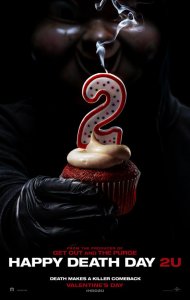 On one hand I can admire the “who gives a damn?” ethic behind the sequel to Happy Death Day, a fun time loop of slasher cinema tropes. The original had some darkly comic edges but mostly played its premise straight in the realm of horror. The sequel doesn’t play anything straight. It’s completely bonkers and looking to turn anything into a joke. This provides a charming carefree sense of bravado; however, if you were a fan of the first film, it also might rub you the wrong way and seem overly flippant and messy. We get a science fiction explanation involving parallel universes as to why the time loops are happening, and now our heroine Tree (Jessica Rothe) is stuck in a parallel version of her looped day. The film sidesteps a Back to the Future 2 sense of repetition but doesn’t stray too far from the outlines of the original Happy Death Day, just with a few new surprises. The big question is whether Tree will return to her home dimension or stay as a tourist in this new dimension, a world where her mother is still alive but her boyfriend is with somebody else. As should be obvious, this hard choice isn’t really that hard considering that she could always still get with the would-be boyfriend again. There are some comedic sequences that borderline on farcical sitcom, like a montage of suicide set to Paramore’s “Hard Times” and a woman faking being a bumbling blind student, and too many of the plot complications feel artificial and random, especially the delays to return to the home dimension. The world can often feel constrained as well, like this bustling campus only comprises the same eight faces (and their bushy eyebrows). My biggest gripe is that the first act is completely superfluous and it presented a more compelling mystery, a student from a future trying to kill their past self to avert a crisis. That’s way more interesting than another dopey killer in the baby mask. Still, the movie never pretends to be anything other than a fun couple of hours with sprightly visual comedy and a terrific anchor in Rothe, a comic stalwart. Happy Death Day 2U gets more ridiculous as it goes and I hope it just keeps digging further, never finding its bottom.
Nate’s Grade: B-
Share this:

The Favourite (2018)
 As soon as I saw the name Yorgos Lanthimos attached to the royal costume drama The Favourite I knew it would be one of my most anticipated films of 2018. I’m not naturally a sucker for these kinds of movies without some interesting new angle (Mary Queen of Scotts, we’ll meet soon), but Lanthimos has quickly become one of my favorite (favourite?) voices in cinema, rivaling perhaps even the esteemed Charlie Kaufman. His movies are so wonderfully weird and tonally distinct. A Lanthimos joint, if you will, is two hours of surprises and expanding the surreal with assured foresight. He’s earned such a highly regarded reputation as far as I’m concerned that I’ll see any movie with his name attached in any creative capacity. The Favourite is a different kind of costume drama.
In the early 18th century, Queen Anne (Olivia Colman) is leading her country through a protracted conflict with the French that is weighing heavily on everyone. Lady Sarah Marlborough (Rachel Weisz) is the Queen’s childhood friend, close confidant, and secret lover. She’s also perhaps the real power behind the throne, directly influencing the Queen to enact her own bullish policies. Harley (Nicholas Hoult), leader of a parliament, is worried about the country going bankrupt from the military expenditures. Enter Abigail (Emma Stone), a cousin to Sarah and someone seeking to save her once proud family’s name. She rises through the ranks and becomes a rival for the Queen’s affections and a threat for Sarah to maintain her position of power in the court and with the Queen.
 What distinguishes a Lanthimos experience is the development and commitment to a distinct vision and the sheer unpredictability. You really never know where the man’s films will go next. One minute you’re following a man struggle to find a romantic partner, and the next they’re talking about turning people into lobsters. One minute you’re watching a family deal with a creepy stalker, and the next people are debating which family member should be killed in the darkest family game night ever enabled. Even though Lanthimos did not write The Favoruite, it still feels of his unique, deadpan, darkly comic worlds and his fingertips are all over it. The story is already playing fast and loose with the history (it’s pretty unlikely Queen Anne was a lesbian, despite the centuries of character assassination from Sarah) so its curiosity where it might go next is electric, especially when it shows some bite. This is a movie that’s not afraid to be dark, where characters can behave badly, testing our sympathy and allegiance as they fight for supremacy. I love how unapologetic the characters are in their pursuits. They will scheme and manipulate to whatever extent works and demonstrate abuse of power for power’s sake (poor bunny). “Favor is a breeze the shifts direction all the time,” says Harley. “Then in an instant you’re back sleeping with a bunch of scabrous whores.” The ensuring two hours of palace intrigue and political gamesmanship is given a sordid boost from the historical deviations, making the political more personal and even more intriguing. I cackled often throughout with the amazingly witty one-liners and curt insults as well as the wonky asides and tonal juxtaposition. It’s a funny movie for offbeat audiences who enjoy offbeat humor.
This is a costume drama that is radical amongst the stuffy world of prim and proper Oscar bait involving kings and queens and the ostentatious royal courts. I’d say it reminds me of Stanley Kubrick’s Barry Lyndon and how it broke from the long film tradition of costume dramas, but I’ve never watched Barry Lyndon, my lone Kubrick omission (what, do you have three hours to spare?). Lanthimos has an anachronistic visual style that allows The Favourite to feel modern and different as it plays in familiar terrain. What other Oscar drama can you expect to see a modern dance-off in the queen’s court? The visuals make use of very stylized deep photography with the use of fish-eyed lenses and a locked camera position even while panning and moving. It’s not exactly the colorful, punk rock aesthetic of Sofia Coppola’s Marie Antoinette but it gives the film a dreamlike, odd sensibility. It’s a nice visual pairing that achieves the same effect as the screenplay by Deborah Davis and Tom McNamara; it piques your interest, drawing you closer with each moment.
 Lanthimos requires a very specifically attuned ironic wavelength that comes across as purposely deadpan, muted to better make the bizarre as the mundane. It’s a type of acting that can be very restrictive unless an actor can tap into that specific rhythm. The three women that top line The Favourite are each terrific. Colman (taking over Queen Elizabeth from Claire Foy in Netflix’s The Crown) is the standout as the temperamental monarch. Her favor is the prize and at some level she knows that people are playing games with her. It’s hard to know what degree of self-awareness Queen Anne is capable of considering she is beset by maladies both physical and mental (she really did lose 17 children in her lifetime, a dozen of them miscarriages). Because of all of this, the unpredictable nature of the Queen matches the unpredictable nature of the film, and one second she can be childish and defiant, the next playful and warm-hearted, the next manipulative and pushy, the next easily cowed and embarrassed. It’s a performance that has definite comic high-points as she howls at her servants and confuses her confidants, but there are layers to the character that Colman digs into. Sure she can be volcanic in rage or extremely funny when giving into the Queen’s whims, but it’s the degrees of sadness and vulnerability that creep through that round out the performance and person.
Weisz (Disobedience) has already starred in one kooky Lanthimos film (The Lobster) and easily slips into those peculiar comic rhythms again like a nicely fitting dress. Hers is the “fall” of the rise-and-fall tale, so she begins self-satisfied and ends humbled, except under Weisz she is never truly humbled. Her spirit does not break regardless of her unfortunate circumstances, including at one point being held hostage at a brothel. Even when she knows she must write a gracious letter she can’t help herself, composing drafts that keep veering into profane insults. Weisz is deliciously deadpan and never abandons the confines of that narrow acting range required for a pristine Lanthimos performance. Stone (La La Land) is the freshest face of the troupe as the underestimated young companion who rises through the ranks thanks to her cunning. Stone adopts a solid British accent, which is helpful, but her intonations are perfectly suited for Lanthimos. There are small, stranger moments where the character is breaking the facade with the audience to reveal an eager peculiarity, an imitation of a monster that’s random, or the most delightfully dismissive “yeah, sure” snort in the history of film. Stone is a versatile talent with comic bonafides, so it’s fun and satisfying to see her expand her already impressive, Oscar-winning range.
 This is a movie that does not work without a distinct vision, sure handed direction, and pitch-perfect acting, all seamlessly working in tandem to create such a finely crafted dark comedy that can go in many perversely entertaining directions at a moment’s notice. Lanthimos and his cadre of award-worthy actresses have great, prankish fun playing dress up in their fancy locations and making a costume drama with a dash of anarchic farce. The Favourite doesn’t quite rise to the top of my own list of Lanthimos favorites (I’d probably rank it a noble third) but it’s still a razor-sharp, sardonic, unpredictable, and wonderfully, vibrantly weird movie worth celebrating.
Nate’s Grade: A
Share this:

The Ballad of Buster Scruggs (2018)
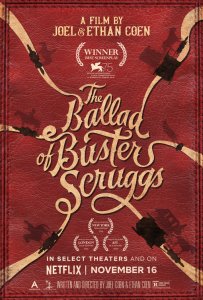 Netflix might just be the best pasture yet for brothers Joel and Ethan Coen. The Oscar-winning filmmakers were reportedly creating a Western series for the online streaming giant but that has turned into an anthology film, The Ballad of Buster Scruggs. The Coens’ love of the beautiful, the bizarre, the bucolic and the brazen are on full display with their six-part anthology movie that serves as reminder of what wonderfully unique cinematic voices they are. The Ballad of Buster Scruggs is uneven, as most anthology films tend to by design, but it reaches that vintage Coen sweet spot of absurdity and profundity.
The best segment is also the one that kicks things off, the titular adventures of Buster Scruggs, a singing Gene Autry-style cowboy who manages to get into all sorts of scrapes. The tonal balancing act on this one is pure Coen, at once inviting an audience to nostalgically recall the Westerns of old while kicking you in the teeth with dark, hilariously violent turns that veer into inspired slapstick. There is a delightful absurdity to the segment thanks to the cheerful sociopath nature of Buster Scruggs, the fastest gun in the West that’s eager to show off at a moment’s notice. He’s a typical Coen creation, a wicked wordsmith finding himself into heaps of trouble, but through his quick wits and sudden bursts of violence, he’s able to rouse an entire saloon full of witnesses to his murder into a swinging, carousing group following him in song. I laughed long and hard throughout much of this segment. I was hooked and wanted to see where it would go next and how depraved it might get. Tim Blake Nelson (O Bother Where Art Thou) is wonderful as Buster Scruggs and perfectly finds the exact wavelength needed for the Coen’s brand of funny and peculiar. He’s like a combo Daffy Duck and Bugs Bunny breaking the fourth wall to let the audience in on his merry bravado. The segment ends in a fitting fashion, another song that manages to be hilarious and strangely poignant at the same time. The Coens allow the scene to linger into a full-on duet of metaphysical proportions. I could have watched an entire series following Buster Scruggs but it may have been wise to cut things short and not to overstay its novelty.
 The other best segments take very different tonal destinations. “All Gold Canyon” is a slower and more leisurely segment, following Tom Waits as a prospector who systematically works the land in search of a hidden trove of gold he nicknames “Mr. Pocket.” The step-by-step process has a lyrical nature to it, and it reminded me of the opening of There Will Be Blood where we follow Daniel Plainview’s initial success at unearthing the beginning of his fortune. Waits is fantastic and truly deserving of Oscar consideration as the prospector. He’s hardscrabble and resilient, and there’s a late moment where he’s narrating a near escape from death where he’s tearfully thankful, possibly losing himself in the moment, and so grateful that it made me tear up myself. The segment ebbs and flows on the strength of the visual storytelling and Waits. It’s a lovely short with a few hidden punches, which is also another fine way to describe the other best segment, “The Gal Who Got Rattled.” It stars Zoe Kazan (The Big Sick) as a woman making her way to Oregon with a wagon train. She’s heading west for a new life, one she was not prepared for and only doing so at the urging of her pushy brother who dies shortly into the journey. Now she’s on her own and struggling to find her own place in the larger world. There’s a very sweet and hopeful romance between her and Billy Knapp (Bill Heck), one of the wagon train leaders who is thinking of settling down. It’s also a segment that slows down, accounting for the longest running time of the six. It goes to great care to establish the rhythms of life on the road, where many people walked the thousands of miles across the plains. The budding courtship is at a realistic simmer, something with more promise than heat. It’s such an involving story that its downturn of an ending almost feels criminal, albeit even if the tragic setups were well placed. Both of these segments take a break from the signature irony of the Coens and sincerely round out their characters and personal journeys and the dangers that await them.
 The remaining three segments aren’t bad by any stretch (I’d rate each from fine to mostly good) but they don’t get close to the entertainment and artistic majesty of the others. The second segment, “Near Algodones,” has some fun moments as James Franco is an inept bank robber who seems to go from bad situation to new bad situation, getting out through miraculous means until his luck runs out. The interaction with a kooky Stephen Root is a highlight but the segment feels more like a series of ideas than any sort of story. Even for an anthology movie, the segment feels too episodic for its own good. The third segment, “Meal Ticket,” is about a traveling sideshow in small dusty towns in the middle of winter. Liam Neeson plays the owner and the main act is a thespian (Henry Melling, best known as Dudley Dursely in the Harry Potter films) with no arms and no legs. The thespian character says nothing else but his prepared oratory. It makes him a bit harder to try and understand internally. I was also confused by their relationship. Are they father/son? Business partners? It’s also the most repetitious short, by nature, with the monologues and stops bleeding into one another, giving the impression of the thankless and hard life of a performer trying to eek out a living. It’s a bit too oblique. The final segment, “The Mortal Remains,” is like an Agatha Christie chamber play. We listen to five characters engage in a philosophical and contentious debate inside a speeding stagecoach that will not slow down. It’s an actors showcase with very specifically written characters, the Coens sharp ear for local color coming through. The conversation takes on a symbolism of passing over to judgment in the afterlife, or maybe it doesn’t and I’m trying to read more into things. You may start to tune out the incessant chatter as I did. It’s a perfunctory finish for the movie.
 Being a Coen brothers’ film, the technical merits are mesmerizing. The cinematography by Bruno Delbonnel (Amelie, Inside Llewyn Davis) is sumptuous and often stunning. The use of light and color is a gorgeous tapestry, and some of the visual arrangements could be copied into ready-made scenic postcards, in particular “Meal Ticket” and “All Gold Canyon.” The isolation, hostility, warmth, majesty of the setting is expertly communicated to the viewer. The production design and costuming are consummate as well. The musical score by longtime collaborator Carter Burwell is classic in its use of melancholy strings and motifs. It’s a glorious looking movie made with master craft care.
Before its release, the Coens had talked about how hard it was to make their kind of movies within the traditional studio system, even with their 30 years of hits and classics. Netflix is desperately hungry for prestige content, so it looks like a suitable match. I’d happily welcome more Coen brothers’ movies like The Ballad of Buster Scruggs, a goofy Western that’s equally heart wrenching as it is heart-warming, neither shying away from the cruelty and indifference of the harsh setting nor neglecting to take in its splendor. Just give them whatever money they need Netflix to keep these sort of movies a comin’.
Nate’s Grade: B+


You must be logged in to post a comment.