Blog Archives
BlackkKlansman (2018)/ Sorry to Bother You (2018)
 Two African-American filmmakers, one making his debut and another in his fourth decade of popular storytelling, have produced two of the most uncompromising, entertaining, provocative, and exacting and relevant movies of this year. Boots Riley’s absurdly comic indie Sorry to Bother You was a festival smash, and Spike Lee’s BlackkKlansman is being positioned as a summer breakout. Audiences have often looked to the movies as an escape from the woes of our world, and when the news is non-stop catastrophic woe, that’s even more apparent. However, both of these movies, while enormously entertaining and charged with fresh relevancy, are a reminder of the very social ills many may actively try to avoid. Both films, and their respective filmmakers, make cases why ignorance is a privilege we cannot afford. Also, did I mention that the movies are outstanding, daring, and hilarious?
It’s the early 1970s, and Ron Stallworth (John David Washington) is the first black officer on the Colorado Springs police force. He wants to be a detective and taken seriously, and one day he calls the leader of the local chapter of the Ku Klux Klan pretending to be a white nationalist. He builds a relationship over the phone with the Klan but he can’t meet them in person. Enter fellow officer Flip Zimmerman (Adam Driver) who stands in as the public Ron Stallworth, avowed white supremacist. Problem is Flip is Jewish, a group the Klan isn’t much more favorable with. The two officers must work together to gather enough actionable evidence to stop the Klan before they kill.
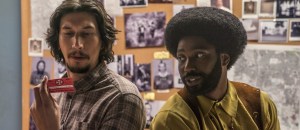 This is Lee’s best film since 2000’s Bamboozled and he feels jolted awake by the material. He doesn’t shy away from the film’s relevance and potent power but also knows how to faithfully execute the suspense sequences and police procedural aspects of the story by Charlie Wachtel, David Rabinowitz, Kevin Willmott, and Lee himself, based upon Stallworth’s book. The story alone is the film’s greatest selling point. It feels like a bizarre recreation of that Dave Chapelle sketch about the blind, and black, Klansman. It’s a story inviting irony and bafflement, and it’s ribald and funny for long stretches, buoyed by Washington’s charismatic and forceful performance (close your eyes and he sounds just like his dad, Denzel). The story is so fascinating that you just want to see where it goes. Stallworth is fighting for respect in a still-racist police force, and he’s pushing Zimmerman to feel more invested in their operation from his own maligned status. “I never thought much about being Jewish,” he shares with Ron, “But I’ve been thinking a lot about it recently.” Theirs is a partnership we root for, and each new accomplishment bonds them together and increases their credibility with a wary police chief. It’s a movie that has a steady supply of payoffs and complications, leaving you satisfied by the end but also more than a bit rattled at the uneasy connections to contemporary news.
This is a character-driven suspense film that does so much so well, drawing in thrills and laughs without making either feel cheaper by their inclusion. This is an undercover operation so every scene with the Klan has the electric uncertainty of whether or not Flip will be caught and our heroes doomed. Because you have two Ron Stallworths, we already have a complicated ruse to keep up (though why Flip couldn’t simply also be the voice on the phone is likely just how it happened in real life). Each new piece of information, each new meeting, takes our characters deeper into the Klan infrastructure, including a guided visit from none other than Grand Wizard (a.k.a. head honcho) David Duke (Topher Grace in an outstanding performance). The risk escalates from being caught to thwarting a planned bombing that could kill innocent minority protestors. The movie does a great job of finding new ways to remind you what is at stake, and while the Klansman are set up to be laughed at and ridiculed, they are still seen as dangerous. They still have the direct intent to physically harm others, not just harass and intimidate.
 Because of the undercover operation, you’d be right to assume that Stallworth’s personal life and blossoming romance with a collegiate activist, Patrice (Laura Harrier), would be the least interesting part of the movie. It’s not poorly written or acted by any means. She serves as a reminder of Stallworth’s split loyalties, working for the police, which many in his community see as a tool of oppression from racists with a badge (and we too see this in action). He is always hiding some part of himself, be it his racial identity, his personal affiliation, or even what he really feels about his corrupt colleagues. Even with her, he cannot relax completely. It shows the more personal side of the Stallworth character and provides something real for him to lose, especially once the local Klan targets Patrice. I understand the role she serves in the larger story but I’d lying if I wasn’t eager to get out of every one of her scenes and back into the action. That’s the problem when you have one superior storyline; the others begin to feel like filler you’d rather leave behind to get back to the good stuff.
BlackkKlansman also can’t help itself with the political parallels to our troublesome 45th president, but I loved every one of them. A superior officer warns Stallworth about his dealings with Duke, specifically that he might make good on the promise to retire as Grand Wizard and go for political office. “Come on, America would never elect a man like David Duke as president,” he says with thinly veiled incredulity. The characters might as well turn and wink to the camera and say, “We’re talking about Trump,” but I laughed all the same. At one Klan dinner, the participants chant, “America first,” which is a Trumpian campaign slogan, if you didn’t know dear reader, derived from the Klan (Trump’s own father was arrested attending a 1927 Klan rally). These parallels are destined to turn off some viewers, though I think the subject matter and Lee’s name should be enough to know exactly what kind of movie you’re electing to watch. Nobody goes to a Lars von Trier film expecting to be uplifted about the state of humanity.
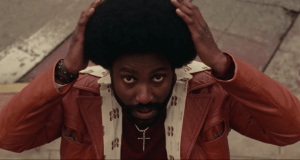 It’s at its very end where the film reminds you just how sadly relevant it still is today (minor spoilers but I don’t think they will ruin anything for you). While Stallworth has bested the local chapter of the KKK, there’s another late night with a sudden alarming noise, Stallworth on his guard, and a cross is burning out in the distance. Just because our characters have foiled a band of racists doesn’t mean racism has been eradicated. Instead, as the film suggests, it evolves, and Lee concludes with an impactful montage of news footage of the Charlottesville white supremacist rally and President Trump contorting to find fault on “both sides” when clearly one side was murderous and racist. You even see real-life David Duke on the premises spewing his re-branded style of hate. The evolution of white supremacy demagoguery has become political, and it has found cover under the guise of a president eager to stoke racial resentments and divisions to his advantage. He’s normalized the abhorrent behavior and given it mainstream cover. It’s a powerful and lasting conclusion (much in the same way as the montage of Hollywood’s harmful depiction of black people in Bamboozled — including the Klan hero worship in Birth of a Nation, also featured here prominently) that should remind people that the threats of racism and Nazis and the KKK are not a thing of the past. It is very much a staple of the present, and how much it is allowed to remain a staple is up to the moral outrage of voters.
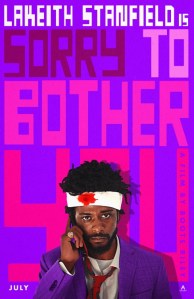 Sorry to Bother You is also sharply cutting and topical about being black in America. In present-day Oakland, Cassius “Cash” Green (Lakeith Stanfield) is struggling to make ends meet, move out of his uncle’s garage, and do right by his girlfriend and performance artist, Detroit (Tessa Thompson). He gets a job at a telemarketer and discovers a new talent when he turns on his “white voice” (voiced by David Cross) and becomes a power caller, crushing his competition. He moves his way up the chain, losing touch with his base of working-class friends looking to strike to unionize. Once at the top, Cash draws the attention of the CEO, Steve Lift (Armie Hammer), who has big plans for a man with Cash’s gifts and seeming flexibility when it comes to corporate moral relativism.
Sorry to Bother You is a wild, hilarious movie bursting with things to say with its shotgun approach to satire, or as my pal Ben Bailey termed, a blunderbuss approach, messy and all over the place and, sometimes, maybe missing its intended mark. I thought the movie was simply going to be about the modern-day struggles of being black and poor in America, and the movie covers those aspects with aplomb. It’s also sized up ample room to satirize consumer culture, labor exploitation and worker rights, male and female relationships, art and media, cultural appropriation, and even memes. Because of all the topics, the movie could run the danger of feeling unfocused, but thanks to the remarkably assured vision and handling of writer/director Boots Riley, it all feels connected by its unique voice operating at a risky but exhilarating level.
 There are a lot of bizarre dips into the absurd that had me howling and on the edge of my seat wondering where we would go next. The most popular TV show is just watching a person get the stuffing beaten out of them, and it adopts a pretty simplistic name to go along with this transparency. A very Google or Amazon-esque company is offering “lifetime jobs” for employees to live in their factories and have all their cares taken for by a corporate slaver, I mean kindly overlord. There’s an art show that consists of hurling cell phones at a woman’s body. There’s a corporate video with a female caveman narrator where she is, 1) stop-motion animated, and, 2) topless the entire time, complete with animated swinging breasts. There’s an ongoing thread that seems to trace the life cycle of a meme. A woman throws a Coke can at Cash in protest. She gets plucked form obscurity, gains a talk show, gets an endorsement from Coke and her own video complete with dramatic re-enactment and chirpy jingle, and Cash getting hit becomes its own Halloween costume for white people. There are throwaway lines in this movie that any other major comedy would die for. This is a movie that is impossible to fall asleep to because every moment could be different and you won’t want to miss one of them.
There are moments that strike beyond the immediacy of the onscreen absurdity. One of those moments was when Cash was invited to join the big corporate after party. He’s out of his element, surrounded by rich, relatively young privileged white people. They assume, being black, that Cash will instinctively know how to rap, and they insist that he perform a free-style rap for the assorted group. This ignorant assumption is just the start for Riley, because Cash gets up there and struggles to perform, barely able to scrap together the most elementary of rhyme, and the illusion has become dashed with the crowd. He notices they’re losing their interest with him, so in a desperate ploy, he just shouts two words over and over into the microphone with enthusiasm: the N-word and a profanity. He does this for like a minute, and the crowd of privileged white people shouts it back at him, seemingly lying in wait for some tacit permission by “popular music” for them to likewise use the N-word. It was an indictment that went beyond that scene. Another is ultimately what happens to the big bad corporation by the film’s end. It literally made me guffaw because it felt completely in place with the tone of the movie.
 All of this zany and funny stuff would feel passing if there weren’t at least some characters worth our time. Cash is an engaging young man trying to get his life on track. He discovers he has a gift when it comes to coding, to blending into a white-majority community in a comfortable and acceptable manner. It’s a survival technique many African-Americans have had to perfect on a daily basis, and soon to be featured in the upcoming adaptation of the best-selling YA novel, The Hate U Give. Even amidst its more bizarre moments and asides, the movie is about a black man trying to get by with limited opportunities in a society that too often devalues him.
Stanfield (Get Out) has been a strong acting presence for some time, first in the remarkably powerful Short Term 12 and most recently on Donald Glover’s Atlanta. He grabs your attention and Stanfield has a gift for comedy, particularly a nervous energy that draws you closer rather than pushing you away. His character goes on the rise-and-fall path, so we still need to be pulling for him to turn away from his newfound egotism, and Stanfield keeps us rooted. Thompson (Thor: Ragnarok) is Cash’s conscience and her wardrobe and accessories are amazing, from her declarative “The Future is Female Ejaculation” T-shirt to her large earring messages. Hammer (Call Me By Your Name) is confidently smooth and sleazy as a coked-out, venal CEO that is so blasé about his wrongdoing that it doesn’t even register for him as wrong. I appreciated that even with all the wackiness of this cracked-mirror version of our universe, Riley puts in the time and effort to make the characters count rather than be expendable to the satirical aims.
Now, there is a significant turn in the third act that veers the movie into territory that will test how far audiences are willing to go along with Riley’s raucous ride. I won’t spoil what happens but for several of my friends it was simply a bridge too far. For a select few, they even said this turn ruined the movie for them. It worked for me because it felt like an escalation in the dastardly labor practices of the corporation and was finally a visceral reminder of their cruelty. Beforehand, Cash has been making moral compromises to keep his ascending career, excusing the after effects of his success even when it’s selling weapons to foreign countries. That stuff is over the phone, part of his coded performance, and easier to keep out of mind. This escalation finally is too much to pretend to ignore. It’s too much to excuse his own culpability working for the enemy. It’s what pushes Cash back to his circle of friends he had left behind for the corporate ladder, it’s the thing that politically activates him, and it’s what pushes him to make a difference. I can understand, given the somewhat goofy nature of the plot turn, that several viewers will feel like Riley gave up his artistic high ground to self-indulgence. However, I would counter that the line between self-indulgence and an assured vision can be tenuous. The movie is so alive, so vibrant, and so weird, so having another weird detour felt agreeable.
 BlackkKlansman and Sorry to Bother You are each unique and fun but with larger messages to say about the black experience and other fissures within our volatile society. You’ll be thoroughly entertained by either film and you’ll walk away with something to ponder and discuss with friends and family and maybe that one racist uncle at Thanksgiving, the one who uses the term “false flag operation” a little too liberally. BlackkKlansman tells a fascinating, comic, and thrilling story about racism of the past, drawing parallels to the trials of today, in particular under the era of Trump. Sorry to Bother You has many targets, many points, and much to say, exploding with thoughts and cracked comedy. Riley is holding up a mirror to the shortcomings and inanities of our own society and the ease we can all feel to turn a blind eye to the difficult realities of systemic racism, capitalism, and worker rights. Lee is a known firebrand and his polemic doesn’t shy from its political relevancy, but it tells a highly engaging story first and foremost, with top acting performances from its cast. In a summer of studios afraid to take chances, here are two excellent movies that take crazy chances and provide bountiful rewards.
Nate’s Grades:
BlackkKlansman: A-
Sorry to Bother You: A-
Share this:

Tag (2018)
 Tag is based on the true story of a group of grown men who continue to play a highly competitive game of tag for 30 years. There are even real clips of the real men before the end credits, raising the hope for a potential documentary on the subject. The Hollywood version is a sprightly ensemble comedy that’s not afraid to go silly or dark in its pursuit of laughs. Given the nature of its premise, there is a lot of slapstick to behold, but it was cleverly staged, routinely netting some big laughs from me. This is a definitely adults-only R-rated venture and the movie proudly wears this identity on its sleeve, finding strange and exciting comic detours that can walk a fine tonal line, like an ongoing bit about miscarriages that had me wincing as much as I was laughing. The main characters are all relatively familiar types; Ed Helms is the high-strung dweeb, Jake Johnson is a sarcastic stoner, Jon Hamm is a smarmy exec, Hannibal Buress is as laconic as his standup persona. There are a string of supporting characters (often female) that add very little, including a rekindled love triangle with Rashida Jones, a journalist who tags along on the game and adds nothing, and Isla Fisher as the grating, always-yelling, intense wife to Helms. Surprisingly, the funniest member of the movie is Jeremy Renner, an actor who heretofore had never shown much comic ability in movies. He’s a formidable opponent, and every time he went into his Sherlock Holmes-styled voice over detailing the steps and mistakes of his friends, I loved it. Also, strangely, Renner’s arms are actually CGI arms since he broke them days into filming. You would never be able to tell. I appreciated that Tag is directed as a comedy even during its action set pieces. It looks at action through the lens of comedy and taps into the absurdity. Overall, Tag is a fun, rambunctious comedy with some dark impulses yet it still finds room for sentiment that doesn’t feel entirely out of place. 2018 is shaping up to be the year of the hearty, enjoyable R-rated comedy with Tag joining the ranks of Blockers and Game Night. Catch it while you can if the prospect of men behaving like overgrown children appeals.
Nate’s Grade: B
Share this:

Deadpool 2 (2018)

It took the leaked release of the Deadpool test footage, and the ensuing enthusiastic fan response, before Fox finally decided to invest in a big screen, R-rated superhero movie. The result was 2016’s Deadpool, a huge smash and proof that a lucrative audience will turn out for more adult-oriented, outrageous, grisly versions of comic book movies. Because of Deadpool, we finally got an R-rated Logan that proved to be an outstanding swan song for Hugh Jackman’s iconic hero. Now Deadpool is getting the spotlight he has earned with a big, splashy summer release, but with success come expectations. Can it live up to the ever-increasing hype? In short: if you were a fan of the original, you’ll be happy enough, because Deadpool 2 isn’t much more than the sum of its zany parts.
Wade Wilson a.k.a. Deadpool (Ryan Reynolds) is killing bad guys for hire and considering starting a family with the love of his life, Vanessa (Morena Baccarin). Trouble emerges when Cable (Josh Brolin) travels from the future to kill a rebellious, troubled young mutant teenager, Russell (Julian Dennison), who will one day grow up to be a monstrous villain. Deadpool reaches out for help and forms an elite squad of determined heroes, notably the luck-assisted Domino (Zazie Beetz). Can Deadpool save the kid, save the day, save the future, and save himself from incessant fourth wall breaks?
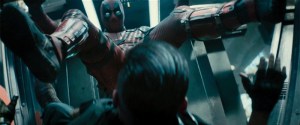
I was worried that a Deadpool sequel would fall into some of the same detractions that a Guardians of the Galaxy sequel did, and this is still applicable. Deadpool, much like the original 2014 Guardians film, was a breath of fresh air and a far looser, weirder, funkier super hero movie with a nose-thumbing, prankish attitude. We didn’t know what to expect from a Deadpool movie and now we do, and with that knowledge comes an anticipated formula of checklists to adhere to, and so any resulting sequel will invariably feel less fresh. It happened with Guardians of the Galaxy vol. 2 so to compensate James Gunn concentrated on fleshing out secondary characters into people you might shed a tear over. Deadpool 2 doesn’t bother because Deadpool 2 doesn’t take anything really seriously. That’s one of the hallmarks of the series and also one of the aspects that holds it back. There can never be a sense of stakes with a gleeful, fourth wall-breaking cartoon of a character who bounces back like Wile E. Coyote. The sequel introduces a sense of stakes with a startling turn in the first ten minutes of the movie, but by the end, even that will be corrected so that the Deadpool universe returns to stasis. The limitation of the Deadpool universe is that nothing feels meaningful or even ambitious. The movie wants to be a cheeky, transgressive good time and it achieves this single goal.
The appeal of Deadpool 2 is still its comedic voice and unpredictability. The laughs will be frequent and there are some subversive and unexpected directions that fully take advantage of the R-rating and the anarchic, nasty comic spirit of the franchise. The formation of the X-Force team and how their first big mission plays out had me howling with laughter. The meta humor commenting on the nature of super hero movies, as well as the film industry in general, begins with the very opening image (a nod to another successful R-rated super hero movie of last year) until the very last moment where Deadpool goes back in time to prevent some stinging cinematic grievances (there is no post-end credit scene, so you can skedaddle early). This is clearly the role Reynolds feels a spiritual kinship with, and his caddish, charming, persistent persona makes the perfect conduit for the film’s vulgar insanity. Whether it’s spitting insults, splashing in over-the-top violence, or making odd observations about the similarities between the songs from Frozen and Yentl, Deadpool 2 is first and foremost a bloody, depraved meta comedy.

Director David Leitch (Atomic Blonde) steps in for the departing original film’s director, Tim Miller, and continues his hot streak of stylish, action thrillers. Leitch has shown a propensity for staging intense action sequences to best showcase intricate choreography. With Deadpool 2, the most exciting moments are when the camera and editing allows the audience to fully appreciate the creativity of the choreography and stunt team. A shot of Cable leaping over the speeding caravan about to smash into him brings on a well-earned wow. Coming from that bruising world, I’m continually impressed with how Leitch approaches his action and finds organic points to develop and complicate matters. The prison caravan attack is the action peak with well-constructed, parallel lines of activity to follow and collaborate upon. It’s our first taste of Deadpool and X-Force versus the might of Cable. The characters enter the fray at different points and get separated from the runaway caravan, which keeps the momentum going. While the comedy is prioritized, Deadpool 2 can still unleash enough exciting, silly, and satisfying action.
The biggest additions to the sequel are an adversary and an ally, and both leave a favorable impression while still making you wish that Deadpool 2 had done more with them. Brolin (Avengers: Infinity War) bulked up considerably to play the gruff cyborg from the future, and his super serious, macho straight man provides a terrific comic foil for Deadpool, much like the stuffy Colossus in the first film. Brolin’s character is a capable fighter with a pretty streamlined back-story (shades of Looper abound) but it’s hard not to feel a little disappointment with how he’s ultimately utilized. He’s a great asset that feels put away for too long. Zazie Beetz (TV’s Atlanta) has a fun introduction especially as it relates to her mutant power, great luck. Deadpool scoffs at this as a power, and “being deeply un-cinematic,” but Domino proves otherwise as she’s able to dodge split-second danger in grand, complicated, Final Destination-like circumstances. Every time she’s onscreen, Domino brings a curiosity quality to the movie, and it’s usually something imaginative and fun. Beetz has an innate spunky energy, which makes it sad when the movie often asks her to be dour and dismissive. It’s taking such a lively character and constricting what makes her amusing and unique.

The biggest thing holding back the film, besides a general sense of “more of the same” or its inherent lack of stakes, is that the entire storyline is built around saving a mutant teen…. and I kind of hated the kid. My first impression was not good and it didn’t get much better from there. Part of it may be that Russell is meant to be an angry, obnoxious teenager, and maybe part of it is the generally grating performance from Dennison (Hunt for the Wilder People), but I could not care about this kid. Unfortunately, a lot of thematic emphasis is placed on saving the soul of this one annoying, wayward teenager. He’s supposed to be a point of redemption for Deadpool and a promise to be fulfilled, but my pal Ben Bailey came up with an instantly better revision. Instead of introducing this new teen character who will one day grow up into a super villain that slaughters Cable’s future family, why not have it be Negasonic Teenage Warhead (Brianna Hildebrand)? We already have an investment in her character and it would provide a better, more personal sense of stakes for the story. Plus, Hildebrand (Tragedy Girls) is actually a good actress.
If you were one of the many fans who enjoyed the irreverent antics of the first Deadpool, then you’ll enjoy Deadpool 2 as it’s more or less the same movie with a slightly limited freshness date. These movies are fun, funny, and ridiculous, but they’re also good for little else than a wicked good time, and that’s okay. There isn’t much ambition to be anything more than an irreverent satire on super heroes with edgy humor and explosive violence. The running theme of the sequel questions what Deadpool has to keep on going, and he’s told it’s one very specific F-word: “family.” I think it’s a different F-word, namely “franchise.” Fox (Disney?) will need the services of the merc with the mouth for an extended engagement as long as audiences do not tire of the same studio brand of naughtiness reheated with a few different ingredients added per revisit.
Nate’s Grade: B
Share this:

Game Night (2018)
 Very funny and surprisingly satisfying, Game Night is a comedy thriller that further cements my appreciation for the comedic prowess of writer/directors John Francis Daley and Jonathan Goldstein (Spider-Man: Homecoming, Horrible Bosses). The premise about a group of couples on a wild “game night” they don’t know is real seems like it could go wrong in so many different ways, chiefly being unable to sustain its premise. Fortunately, the film is filled with strong characters who are each given a moment to shine. Jason Bateman and a loose Rachel McAdams are fun as our lead couple, and they’re even better when they’re bouncing off one another, but the real star of the movie is a hilarious Jesse Plemons (Hostiles) as a creepily intense neighbor. Plemons will hold onto certain jokes, taking something that was funny and pushing it into an even funnier, more awkward place. The comic set pieces are well developed and clever, set up earlier and allowed to go in unexpected directions to better complicate matters. While the movie is clearly a riff on David Fincher’s The Game, with some sly visual nods to Fincher’s signature style, the jokes don’t get lost when the action heats up. A good action-comedy makes sure that the action or suspense sequences are still constructed through the prism of comedy. I was laughing often and surprisingly hard throughout the whole movie. Game Night is a wickedly fun movie that has plenty of rewards and enjoyable surprises.
Nate’s Grade: B+
Share this:

Tragedy Girls (2017)
 I wanted to enjoy Tragedy Girls. I really did. There’s a good starting point with a story about two self-involved teenagers who turn to murder to raise their social media profiles. I like the lead actresses, Alexandra Shipp and Deadpool’s Brianna Hildebrand, and the film has a quirky sense of style by co-writer/director Tyler MacIntyre. The opening is even great where Hildebrand purposely lures a lover to his sacrificial death in order to trap a familiar slasher film-styled villain. Where it all goes wrong is that Tragedy Girls doesn’t have enough substance or commentary to outweigh its arch nihilism. The message is very flimsy (millennials are shallow, social media is harmful) and the film wants you to revel in the girls’ violent, gory murders but also be repelled by them. It’s a sisterhood of slaying. There are some interesting story ideas that don’t feel better attended. The girls are clumsy at their murders and luck into some absurd Final Destination-worthy kills, but the film doesn’t embrace this concept and makes them untouchable. They kidnap a local serial killer in the opening and demand he train them, but the guy refuses and is shoved to the side for almost the entire movie, stranding another interesting possibility. The high school characters are thinly designed and unworthy of their demises, though that’s also the point. Tragedy Girls doesn’t earn its candy-colored nihilism. It ultimately left a bad taste in my mouth and I found it off-putting and empty. It thumbs its nose with prickly devil-may-care attitude but without anything to really say.
Nate’s Grade: C-
Share this:

Mom and Dad (2018)
 The appeal of the indie thriller Mom and Dad is its frenetic, gonzo, absurdist spirit that accelerates into delicious dark comedy with a maniacal glee seldom seen in movies. The nature of the movie and its bloody violence will put off many viewers; however, if you have a healthy appetite for the bizarre and tonally incongruous, then Mom and Dad will serve as a thrilling and hilarious treat.
The Ryan family, father Brett (Nicolas Cage), mother Kendall (Selma Blair), teen daughter Carly (Ann Winters), and young son Josh (Zackary Arthur), are a typical suburban family with their share of secrets and antipathy. It’s a normal day until it isn’t. While at school, a mob of parents forms to collect their children. A rumor of a terrorist strike has circulated widely. But when the parents get close to their children they viciously harm them. It seems someone or something has flipped that parental instinct to protect one’s child at all costs. Now the urge is to kill one’s young. Carly and her friends escape the school mob and have to survive their homicidal parental units.
 I didn’t realize it while watching but it became obvious in hindsight that this was the fodder of one of the debased, juvenile, and altogether hyperactive minds from the Crank movies, a series best described as debased, juvenile, and hyperactive. Brain Taylor takes a Twilight Zone premise and shoots it full of adrenaline and mescaline and whatever else was lying around on the ground. The action gets going in a relatively efficient fashion, establishing our family unit, and then setting them up for a collision course. From the 45-minute mark onward, it becomes more a self-contained thriller inside the family home, pitting our kids against their homicidal elders. It reminded me a tad of Don’t Breathe in its ability to set up a playing field and have its characters find organic ways to get into trouble, escape it, and get into worse trouble. It’s a series of moving pieces that feel elegantly arranged on the playing field. It keeps the movie barreling forward while still finding room for surprises and payoffs, including a glorious late Act Three payoff that I had long ago forgotten about its setup. It’s not quite dues ex machina because there’s more to come after, but it made me so happy.
This is a movie that strangles the concept of tone, and yet it decidedly knows what points to hit up the darker comedy, what moments need more drawn out suspense, and what moments can straddle the difference. The build-up of dread can be beautifully applied and then turned for laughs. Take for instance a moment when a teen girl comes home and notices an open blender with margarita mix, implying her mother is home. Just as a signifier of terror, it’s kind of fun, but then she leans closer and reaches into the open blender, her hand picking the blades. We’re leaning in, waiting for the blender to turn on all of a sudden, and then… she walks away, and the moment passes. Then we laugh to ourselves about how something so ordinary was turned around to be menacing. Taylor finds other little moments like this to assure the audience he’s thought through the premise and found ways to properly develop it to its potential. I was covering my face at parts in tense anticipation and I was cackling to myself at other times.
Cage (Snowden) is one of the few actors that seems to get exponentially more compelling to watch the nuttier he acts, and his crackpot zeal can elevate bad movies into something approaching unintended hilarity, like 2006’s woeful Wicker Man remake. There are few actors that go for broke regardless of how silly they eventually come across. In the wrong hands, this is an attribute that can betray Cage’s efforts and sink a movie. In the right hands, like Taylor’s, it provides the spark of madness needed to push a movie into another level of irascibility. Cage finds humor in the strangest of places, and it’s not a derisive sort of humor but more a genuine delighted bafflement at the character. If you love crazy Cage, you’ll have plenty to love in Mom and Dad.
 Blair (Hellboy 2) is the more restrained parent while still getting scenes to cut loose. She’s having terrific fun getting to play bad. When she’s teamed with Cage, they form a darkly funny couple bonding over their shared intent for murder. It becomes an oddball romantic comedy in the darkest sense. Blair also impresses in her scenes of dramatic response. She’s one of the last parental figures to succumb to the hysteria, so we get to witness her process the shock and confusion of the day. There’s a great scene where she’s present in a hospital birthing room. Blair scrambles to save the newborn and try to understand what is happening, and it’s a personal kind of fear and betrayal that registers.
One of the more surprising aspects of Mom and Dad was how it’s able to build the parents as characters in clever and genuinely sincere ways. This is a crazy movie, and that’s its main appeal, but it can also find room to take things seriously. Taylor will momentarily pause the action to insert choice flashbacks that are enjoyable little asides, monologues that provide texture to the world and the characters. The flashback relating to a pool table’s demise opens up an entire analysis of a rocky marriage, a middle-aged man raging against his life’s mediocrity and the faded glory and promise of his youth, and the despair of losing your sense of self through parenthood. It builds and builds and allows the actors to unload. It doesn’t serve as significant a narrative point as other character-based flashbacks setting up ironic convergences. It’s just Brett and Kendall being able to voice their insecurities and disappointments. It’s about this point where the movie positions both as unswayable evil forces, so giving them a chance to come across like genuine human beings before they’re kill-crazy cartoons is unexpected and effective.
I know I’m having a great time with a movie when the worst thing about it is the last few seconds. Mom and Dad just sort of ends. It almost feels like there was some kind of editing accident and you may turn and say, “Wait, is that it?” I didn’t want Mom and Dad to end. This is a raucous dark comedy with an anarchic spirit but a strong sense of pacing, tone, and structure, layering in surprises and escalations dutifully while still finding equitable space to better shade the characters. If you’re looking for a risky dark comedy that will make you feel a tad crazier for watching, give Mom and Dad a whirl. This is the kind of movie you might hate yourself for loving.
Nate’s Grade: B+
Share this:

I, Tonya (2017)
 Back in 1994, popular culture was rabidly obsessed with figure skating thanks to Tonya Harding (Margot Robbie), the “bad girl” who was accused of coordinating an attack on her skating rival, Nancy Kerrigan. Tonya’s skuzzy husband, Jeff Gillooly (Sebastian Stan), had hired a friend to “intimidate” Kerrigan, and the end result was a broken knee and the world-famous outcry of, “Why?!” I, Tonya takes a look at the players of this media circus and lets them tell their own stories in their own words.
I,Tonya feels brazenly like a Scorsese movie populated with kooky Coen brothers characters. Director Craig Gillespie (Lars and the Real Girl) cribs from the best and uses all those propulsive camera moves, voice over leading to fourth-wall-breaking, and music needle drops to draw an audience into this crackling crime story. The biggest decision made by screenwriter Steven Rogers (P.S. I Love You) is the dueling perspectives of Tonya and Jeff being given equal treatment. They both sit for a series of on-camera interviews and will even interrupt the flashbacks to object. Jeff will recount a time Tonya chased him around with a loaded shotgun, and then Tonya will turn to the camera and argue that this moment never happened. I, Tonya doesn’t tell you who to believe and who to doubt. The account will purposely contradict one another, often demonizing the other party and painting themselves as a larger victim of fate. The movie is steadily entertaining as it mixes moments of light and dark. Tonya breaking the fourth wall to talk about her domestic abuse is another way of showing just his disassociated she’s become to a life of abuse. It turns fourth wall break into coping mechanism. I was laughing at the buffoonery of Jeff’s goons and moved by the relentless torment of Tonya. It’s a story that’s worth revisiting and is given an invigorating sheen of inept crime thriller. Gillespie goes a little too hard with the Scorsese speed ramp zooms and quantity of literal song selections, but it doesn’t detract from the film’s overall entertainment impact.
 This is a film about reassessing preconceived notions about who the characters are, what the story exactly is, and where the truth lies amidst all the madness. Tonya scoffs, “There is no such thing as truth,” as if she were channeling the forty-fifth president of the United States of America. This becomes a foundational thesis of the movie as we’re presented with conflicting personal accounts where characters will break the fourth wall to criticize the validity of what they are doing or saying. All of these conflicting accounts force the audience to constantly reconsider what we are seeing and being told. We have to consistently think about the source and how there might be bias at play. As expected, Tonya and Jeff’s differing versions of events paint the other as more knowingly duplicitous. Tonya flat-out accuses Jeff of years of physical abuse, the kind of relationship Tonya’s vicious mother had primed her for. LaVona Golden (Allison Janney) would say all of her cruel hostility was valuable in an ends-justify-the-means crucible. Through fighting to earn the approval of an abusive authority figure, Tonya became one of the greatest figure skaters in the world, the first to achieve the vaulted triple axle. LaVona shouts that “nice” doesn’t get you anything in this world (her own mother was nice and LaVona became a waitress). People throughout I, Tonya are reshaping worldviews, angling for sympathy, and spinning history for personal advantage. Everyone wants to be a victim, a martyr, or at least the person who was right in the end. By the end, you don’t know what exactly to believe and whose truth is closest.
This was a media scandal that the public gladly gobbled up every new morsel, bringing out the knives to carve up a villain served up on the Olympic stage, but I, Tonya is a very empathetic portrayal that still doesn’t take the edge off of its title heroine. She grew up poor and scrappy and had to make her own costumes for her skating performances. From a technical standpoint, Tonya Harding could out skate anyone, but she didn’t fit into the cookie cutter beauty pageant image of what a wholesome girl should represent. The same bias against her, the trailer trash girl who couldn’t catch a break, was still dragging her down even when her skating was superior to her competitors. It definitely helps to paint a sympathetic portrayal for the woman, and that’s even before the years of abusive relationships, and a husband she may have returned to in order to appear more “wholesome family.” It’s easy to castigate Tonya Harding as a villain, but it’s even harder to see the person inside the caricature that was sold for mass media consumption.
The use of humor has to be very delicate because of all the controversial material. We have naturally offbeat characters doing incredibly stupid things, and then we have a husband repeatedly hitting his wife. This seesaw of tone means that the comedy needs to be precise or else it will undercut the drama or, worse, cross into gross mitigation of abuse. LaVona is a popular source for verbal abuse, and it’s meant to be shocking, but at no point do I think the film trivializes the conditions of Tonya’s childhood for ironic comic fodder. It’s presenting an abnormal treatment of an abnormal upbringing, and the later detours with “The Incident” are highlighting the naturally cracked criminals. These people were not good at what they were doing and were easily caught. The nimwits-try-their-hands-at-crime subgenre is ripe for laughter, in particular Shawn Eckhardt (Paul Walter Hauser) and his self-professed masterful skills at counter terrorism planning. The Tonya Harding scandal is so inherently sensational and with so many bizarre, colorful characters that to treat it without its penchant of natural humor would be a disservice. Crazy people doing dumb things are going to tend to have some humor value. Where the film falls short is in the realm of media satire. There are a few tasty morsels sprinkled throughout, like LaVona forcing reporters to stand behind a rope line if they wanted to snap her picture, but overall the media satire feels flat. Bobby Cannavale (Spy) feels completely wasted as a Hard Copy reporter/exposition device. He offers few insights and fewer colorful anecdotes. The most pointed the film gets with media commentary is when Tonya looks directly into the camera and accuses each person of being her abuser. It’s a stark turn that stops the action cold, and the audience has to think about their own tacit approval through media consumption. By rewarding this coverage and the easily packaged version of events, have we all played a part in Tonya’s suffering and shame?
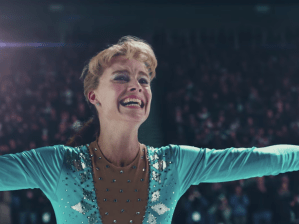 Robbie (Suicide Squad) is sensational in the role, eliciting so much emotion that it can instill whiplash. One moment you’re impressed by the depth of her vulnerability and the next you’re whistling at her hard-as-nails persona and sheer tenacity. It’s an unapologetic performance that goes dark places and serious places, but Robbie doesn’t stoop to pander. Tonya wants your empathy but she doesn’t want your pity, and she sure as hell isn’t going to pretend to be somebody she’s not. The tricky part is the question over who is Tonya Harding. With Robbie, she’s a profane firebrand who is impatient with a world that refuses to accept her and her talents. The scene where Tonya is stripped of ever competing again in professional figure skating is a dazzling piece of acting on Robbie’s part. Tonya has sacrificed much of her own life for this sport, and by her own admission she doesn’t know how to do anything else. To see it all go away with the pound of a gavel, she pleads for jail instead as a more humane punishment. This feels like Robbie marking her grand entrance into the next acting echelon in Hollywood.
The supporting roles nicely serve their purpose, with Janney (The Girl on the Train) being the obvious standout. Her hellish mother is overpowering in every sense. Janney is abrasive and fierce and a crutch for the screenplay when it needs something shocking. I do not doubt the voracity of what the Tonya and other participants have said about LaVona, but the filmmakers don’t know when to leave enough alone. There are insights to be had through LaVona’s relationship with her daughter but it’s too often one-note. She’s the angry older woman berating people for shock, comedy, or a transition.
I, Tonya might change your mind about Tonya Harding. She’s definitely unrepentant in the movie while at the same time asking you to view her with an empathy that was lacking during the parade of 1990s tabloids. She’s an abuse survivor who had to claw for every advantage she could earn. You might not like her, or maybe you’ll grow to appreciate her, but you will understand her better. Robbie is outstanding, Janney is highly memorable and perfectly cast, and the direction provides plenty of jolts, from electric camerawork to the energetic propulsion through its diverging viewpoints. The dark comedy works, the serious drama works, and the domestic violence is not trivialized with so many ironic winks. I, Tonya is an unflinching expose that forces you to question the validity of everything. It’s a movie that dares you to question your perceptions while you’re keenly watching. Perhaps twenty years later, Tonya Harding will get whatever she is due.
Nate’s Grade: B+
Share this:

Three Billboards Outside Ebbing, Missouri (2017)
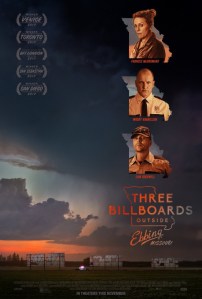 Mildred (Frances McDormand) is a divorced single mother working in the small town gift shop of the small town of Ebbing, Missouri. It’s also been seven months since her teenage daughter was raped, murdered, and set on fire. She rents out three billboards on a rarely used side road to advertise her frustrations with the slow pace of law enforcement. The billboards say, “Raped while dying,” “Seven months and no arrests,” “How come, Chief Willoughby?” The chief (Woody Harrelson) tries to pacify the grieving mother while keeping his loyal officers in check from retaliation. Deputy Dixon (Sam Rockwell) is trying to apply pressure to get the billboards removed by any means. The small town loves their sheriff and turns on Mildred, which suits her just fine. The more people that disagree with her the more it helps fuel her sense of righteous indignation. Mildred engages in an escalating series of battles with the police and town that might just make justice impossible.
Three Billboards Outside Ebbing, Missouri feels like a Coen brothers’ movie played straight, and it’s borderline brilliant in its depiction of homespun characters allowed tremendous emotional latitude. These are people with complex depth who are allowed the power to be contradictory. They can be vicious one moment and kind the next, wise one moment and impulsive and self-destructive the next, capable of great acts of mercy and cruelty. This achieves two things: 1) making the characters feel far more convincingly drawn, and 2) making the characters consistently surprising. This is a messy movie but I don’t mean that as any intended insult. It’s messy in scope, messy in tone, and yet it thrums with the messy feelings and messy complications of human tragedy. What happened to Mildred’s daughter is utterly horrifying and her rage is righteous; however, that doesn’t sanctify her. She makes mistakes, pushes people away, and can be cruel even to her own family. I was expecting Harrelson’s police chief to be a sort of villain, either incompetent or conniving, willfully ignoring the murder investigation. This is not the case at all and he is full of integrity and rightfully beloved in his community. As happens in many criminal cases, the trail of evidence just ran cold, but Mildred would prefer every male in the city, state, and even the country be blood tested to find a culprit. Her demands are fundamentally unreasonable and Willoughby points out the many civil rights protections in possible violation. Just because Mildred has been wronged does not make her the hero, and just because Willoughby is the face of local law enforcement does not make him the enemy. They are people with much more in common than they would ever admit. The awful circumstances of the plot have pit them against one another in an escalating tit-for-tat that serves as projection for Mildred’s blinding fury against a world that would rob her of her daughter.
 The dichotomy of sweetness and terror is best exemplified in the transformation of Mildred and Dixon, one of the most satisfying and engrossing film experiences of the year. Thanks to writer/director Martin McDonagh’s deft handling, these two characters start at opposite ends and grow before our eyes. Mildred tests the limits of her resolve and anger and makes costly mistakes. Dixon begins as the screw-up with a badge (hat he literally misplaces) rumored to have tortured a black prisoner in jail. He seems like the dim-witted poster boy for unchecked masculine privilege. He feels like an enforcer of the corruption we (wrongfully) assume is at work in this small town. As Mildred descends into darker decisions, Dixon ascends and chases a redemptive arc, which is amazing considering the damning behavior he engages in at the halfway mark. These two characters start as adversaries and develop into begrudging allies in a completely organic way that doesn’t blunt either character. That transformation is thrilling to watch and terrifically satisfying on its own terms. By the very end of the movie, I was ready and willing to watch its hypothetical sequel setup, especially if it meant I got to spend more time with these carefully crafted people.
McDonagh’s film juggles many tones, effortlessly switching from laugh-out-loud comedy to crushing drama and back again. I was genuinely surprised how many times I laughed and how hard I was laughing. During my second theatrical viewing, there was an old woman in the back who was quite vocal in her bafflement about how anyone could be laughing. And if you were told the specifics of the plot and its heavy subject matter, I would tend to agree. McDonagh has a preternatural feel for how to find humor in the most unlikely of places. The humor dissipates as the film marches into its second half, a natural byproduct of having to raise the dramatic stakes and make things feel serious. This is the first grounded drama in McDonagh’s filmography (In Bruges, Seven Psychopaths). He doesn’t shortchange the impact of his drama by weaving in more heightened comedic moments. The characters feel realistically developed and portrayed and are allowed to exist in moral grey areas. There’s a minor character played by Peter Dinklage who is positioned as a romantic option and a bit of a fool, but by the end you feel degrees of sympathy even for him. Even this most minor of supporting characters (not a comment on Dinklage’s stature) has earned your emotions. That’s great storytelling but it’s also tremendous execution from the director. Another sure sign of McDonagh’s command for tone is that he undercuts his story’s moment of triumph. I’ll dance around spoilers but Three Billboards looks to end in a way where several characters would claim a hard-won victory, and McDonagh casually strips that away. Even though this is a movie, and even though there are moments of broad, irony-laced comedy, the complexities and disappointments of real life emerge. Even to the very end, Three Billboards doesn’t follow the expected rules of How These Things Go.
 The excellent acting gives further life to these tremendous characters. McDormand (Fargo) is radiating with ferocious resentment and indignation. Her character is a walking missile that just needs to be pointed in the right direction. Her stares alone could cause you to shrivel. McDormand hasn’t been given a character this good in years. She opens up the full reserve of her deep acting reservoir, able to flit from great vulnerability to intense repulsion. She has plenty of big moments where she gets to tell off the disapproving townspeople and media members. It’s ready made for easy laughs, but McDormand is so good that she shades those moments with subtler emotional nuance. You get the laugh and you also get further character insight. It’s a performance of such assured strength that I imagine you’ll be hearing her name often during the awards season. Rockwell (The Way, Way Back) has also never been better. He has to play a similarly deep array of emotions, from idiot comedy to heroic dramatics, and at every point Rockwell is stunning. He makes every joke twice as funny. When Dixon becomes a larger focus of the story is when he undergoes more intensive introspection. He goes from buffoon to three-dimensional character. Harrelson (War for the Planet of the Apes) also delivers a worthy performance as a proud yet wounded man who is trying to do right against a world of pressures and self-doubt.
Three Billboards is an impressive, absorbing, searing film gifted with some of the best-developed characters in 2017. The portrayal of the characters is so complex and given startling life from such amazingly talented actors. You’ll watch three of the best performances of the year right here. You get a really strong sense of just how life has been irrevocably altered from this heinous crime, not just with Mildred but also for the town as a whole. Things cannot go back to being the way they were. The characters you like can make you wince. The characters you don’t like you might find yourself pulling for. Thanks to the complexity and nuance, the film delivers a raft of surprises, both pleasant and painful. These people feel closer to real human beings. McDonagh’s brilliant handling of tone and theme is a remarkable work of vision, cohesion, and execution. This is a darkly comic movie that can make you bust out laughing and an affecting human drama that can make you cry. It takes you on a journey that feels authentic and wildly entertaining. Three Billboards Outside Ebbing, Missouri (which should have simply been called Three Billboards) subverts typical Hollywood clichés by making sure, even during its wilder flights of comic fancy, that everything is grounded with the characters first and foremost.
Nate’s Grade: A
Share this:

I Love You, Daddy (2017)
 After years of rumors, highly influential comedian and television guru Louis C.K. has admitted that the sexual allegations against him are indeed true. Several women recently came forward in a New York Times article citing C.K. as asking them to watch him masturbate, forcing women to watch him masturbate, or masturbating over the phone with an unsuspecting woman. Right now in the new climate of Hollywood, it appears that C.K.’s comedy career is at a standstill if not legitimately over. And strangely amidst all this was the planned release of a little movie he wrote, directed and stars in called I Love You, Daddy, about a famous Hollywood director with rumors of sexual indecency. The movie has been pulled from release but not before screeners were sent to critics. I don’t know when the general public will get its chance to watch I Love You, Daddy, but allow me to attempt to digest my thoughts on the film and any possible deeper value (there will be spoilers but isn’t that why you’re reading anyway?).
Glen (Louis C.K.) is a successful TV writer and producer. He’s starting another show and Grace (Rose Byrne), a pregnant film actress, is interested in a starring role and perhaps in Glen himself. His 17-year-old daughter China (Chloe Grace Moritz) takes an interest in a much older director, Leslie Goodwin (John Malkovich), with a troubled past. Glen idolizes Leslie Goodwin but isn’t comfortable with the interest he’s shown in his underage daughter.
 It’s impossible to resist the urge to psychoanalyze the film especially considering it’s otherwise a fairly mediocre button-pushing comedy. The biggest question that comes to mind is why exactly did C.K. bring this movie into existence? He hasn’t directed a film since 2002’s blaxploitation parody Pootie Tang. It didn’t even come into being until this past June, when C.K. funded it himself and shot it over the course of a few weeks. What about this story was begging to be brought to life, especially with C.K. as its voice? He didn’t have to make this. He brought this into the world. Given the controversial subject matter, C.K. must have known that the film would at minimum reignite the long-standing rumors of his own sexual transgressions. So why would he make I Love You, Daddy? This is where the dime-store psychiatry comes in handy, because after viewing the finished film, it feels deeply confessional from its author. It feels like C.K. is unburdening himself. I cannot say whether it was conscious or subconscious, but this is a work of art where C.K. is showing who he is and hoping that you won’t realize.
This is very much C.K.’s riff on Woody Allen movies and Woody Allen’s own troubled history of sexual impropriety; it’s an ode to Allen and a commentary on Allen (C.K. had a supporting role in Allen’s Blue Jasmine in 2013). It’s filmed in black and white and even follows a similar plot setup from Manhattan, where Allen romances a 17-year-old Mariel Hemingway. It’s about our moral indignation giving way to compromise once our own heroes are affected or whether or not our own lives can be benefited. The stilted nature of human interaction among a privileged set of New Yorkers is reminiscent of Allen’s windows into the world of elites. It’s an approach that C.K. doesn’t wear well, especially coming from his much more organic and surreal television series. The movie is trying to find a deeper understanding in the Woody Allen-avatar but never really does. I grew tired of most of the conversations between flat characters that were poorly formed as mouthpieces for C.K.’s one-liners and discussion points (and an N-word joke for good measure). Leslie is an enigma simply meant to challenge Glen on his preconceived ideas. Leslie isn’t so much a character as a stand-in for Woody Allen as stand-in for C.K.’s own fears of hypocrisy and inadequacy. And that begets further examination below.
 In retrospect, looking for the analysis, there are moments that come across as obvious. C.K. has generally played a thinly veiled version of himself in his starring vehicles. Here he’s a highly regarded television writer and producer who seems to keep making new highly regarded television series. There are too many moments and lines for this movie not to feel like C.K. is confessing or mitigating his misdeeds. One of China’s friends, a fellow teen girl, makes the tidy rationalization that everyone is a pervert so what should it all matter? Sexuality may be a complicated mosaic but that doesn’t excuse relationships with underage minors and masturbating in front of women against their will. Glen says that people should not judge others based upon rumors and that no one can ever truly know what goes on in another person’s private life. There’s a moment late in the film where Glen is irritated and bellows an angry apology with the literal words, “I’m sorry to all women. I want all women to know I apologize for being me!” I almost stopped my screener just to listen to this line again. In the end, Glen has a fall from grace and loses his credibility in the industry. He’s told by his producing partner, “So you were a great man and now you’re not.” And the last moment we share with Glen before the time jump that reveals his fall from grace? It’s with China’s “everyone’s a pervert” friend and after she confesses that she once had a crush on Glen when she was younger and that she finds older men sexy. After a few seconds, he slightly lurches toward her like he’s going to attempt to kiss her and she recoils backwards. Glen interprets the moment very wrong and tries to make an unwanted move on a much younger woman. Yikes.
There’s also a supporting character that twice visually mimes masturbating in public. Yeah, C.K. literally included that gag twice. For a solid twenty minutes I didn’t know if Charlie Day’s character was real of a Tyler Durden-esque figment of Glen’s outré imagination. Day plays an actor with a close relationship with Glen. He’s not like any other character and seems to speak as Glen’s uncontrolled sense of id, urging him into bad decisions. During one of those furious masturbatory pantomimes (not a phrase one gets to write often in film criticism, let alone the plural) Day’s character is listening to Grace on speakerphone. This is literally the same kind of deviant act that C.K. perpetrated on a woman detailed in The New York Times expose. It’s gobsmacking, as if Bill Cosby wrote a best friend character that would drug women at a party he hosted, and Cosby wrote this after the rape allegations already gained traction. Double yikes.
 As a film, I Love You, Daddy feels rushed and incomplete. The editing is really choppy and speaks to a limited amount of camera setups and shooting time. Locations are fairly nondescript and the entire thing takes on a stagy feel that also permeates the acting. C.K.’s television work has revolved around a very observational, natural style of acting and a style that absorbs silence as part of its repertoire of techniques. I Love You, Daddy feels so stilted and unrealistic and it’s somewhat jarring for fans of C.K.’s series. The actors all do acceptable work with their parts but the characters are pretty thin. You feel a lack of energy throughout the film that saps performances of vitality. There’s a method to the reasoning on presenting China as an empty character until the very end, which speaks to Glen’s lack of understanding of who his daughter is as a person. The overall storytelling is pretty mundane, especially for C.K. and the topic. He seems to open conversations on topics he believes don’t have easy answers, like age of consent laws, statutory rape, and judging other people based upon their reputations, and then steps away. The film wants to be provocative but fails to fashion a follow-through to connect. There aren’t nearly enough nuances to achieve C.K.’s vision as saboteur of social mores.
It feels like C.K. might have anticipated having to come forward and accept the totality of his prior bad behavior, and maybe he felt I Love You, Daddy was his artistic stab at controlling the reckoning he knew would eventually arrive. I would only recommend this movie as a curiosity to the most ardent fans of C.K. comedy. I Love You, Daddy delivers a few chuckles but it’s mostly a mediocre and overlong Woody Allen throwback companion piece. It’s harder to separate the art from the artist when that artist has complete ownership over the vision. As of this writing, I can still watch Kevin Spacey acting performances and enjoy them for what they are, mostly because he is one component of a larger artistic whole. In C.K.’s case, he writes, directs, stars, and it’s his complete imprint upon the material. I consider 2016’s Horace and Pete to be of nigh unparalleled brilliance that I wouldn’t hesitate to call it a modern American theatrical masterpiece that could sit beside Eugene O’Neill. So much of C.K.’s material was based around his brutal sense of self-loathing and now the audience might feel that same sensation if they sit down and watch I Love You, Daddy. Unless you want to do like I did and unpack the film as a psychological exercise of a man crying out, there’s no real reason to watch this except as the possible final capstone on C.K.’s public career.
Nate’s Grade: C
Share this:

The Killing of a Sacred Deer (2017)
 Greek filmmaker Yorgos Lanthimos might just be the most perversely ingenious creative mind working in movies today. After Dogtooth and The Lobster, I will see anything that has this man’s name attached to it, especially as a writer/director. Lanthimos’ latest, The Killing of a Sacred Deer, is a challenging revenge thriller, a macabre comedy, a morality play, and a generally uncomfortable watch that is just as alienating as it is totally brilliant.
Steven Murphy (Colin Farrell) is a heart surgeon with a loving family that includes his wife, Anna (Nicole Kidman), teen daughter Kim (Tomorrowland’s Raffrey Cassidy), and young song Bob (Sunny Suljic). Then there’s Martin (Barry Keoghan), the lonely son of a patient who died on Steven’s operating table. He won’t leave Steven alone and doesn’t understand boundaries, even trying to hook up Steven with his lonely mother (Alicia Silverstone, yep you read that right). Martin even takes an interest in Kim. However, once Steven’s son falls victim of a mysterious illness and becomes paralyzed, Martin makes his true intentions clear. He’s poisoned all three of the Murphy family members and they are destined to die slowly unless Steven kills one of them. He has to choose which family member’s life to take with his own hands, or else they all die.
 It’s hard for me to think of whom exactly to recommend this movie to because it is so intentionally off-putting. It’s intended to make you awkwardly squirm and question what you are watching. This will not be a fun watch by most accounts unless you’re a very select person who has a dark sense of humor and an appreciation for something different. Lanthimos seems to be purposely testing his audience’s endurance from the start. We open on several seconds of black to test our patience and then an extended close-up of real open-heart surgery. My pal Ben Bailey had to shield his face from the screen. From there, the movie defies your expectations at most turns and digs further into its depths of darkness. This is one of those movies where you wonder whether it will go “there” and it most assuredly goes there and beyond. One minute you’ll be cringing, the next you’ll be cackling, and the next you’ll be deeply unsettled, and then maybe back to laughing if you’re like me. Much like Lanthimos’ other movies, his deadpan sense of comedy is his prescription for an absurd world. It’s a movie where you have to actively work to adjust to its bizarre wavelength, but if you can, there are rewards aplenty. I can’t stop thinking about it.
Unlike The Lobster, this doesn’t exist in a completely parallel universe but more of a cracked, heightened version of our own. Lanthimos’ breakout film, 2009’s Dogtooth, dropped the audience into a strange world and expected us to catch up. This is similar. The flatly comic conversations become a sort of absurdist poetry. Everyday moments can be given one extra strange beat and become hilarious. Scene to scene, I didn’t know what would happen. The movie allows its story to properly breathe while finding room for its characters to discover intriguing diversions and insights, like Martin’s recollection of how he and his father eat spaghetti the same way. There’s an unusual sexual kink that involves giving oneself completely to another that makes more than one appearance, enough to question the connection between them. The very geneses of that kink I think alligns with a character’s god complex, but that’s my working interpretation. It made me rethink about the aberrant concepts of sexuality in Dogtooth, a.k.a. the nightmare result of helicopter parenting. The handling of pubescent sexuality, and the idea of incorrectly applying information learned from other settings, is just one more tool to make the audience uneasy. Killing of a Sacred Deer exists in a closer approximation of our world in order for there to be a better sense of stakes. Somebody is going to die, and if Steven cannot choose then everyone will die. This isn’t a fantasy world but a real family being terrorized by a demented and vengeful stalker. This gangly teenager is more terrifying and determined than just about any standard slasher villain.
 This is a modern-day Greek tragedy literally inspired by an ancient one. Prior to the Trojan War, Agamemnon was hunting and killed one of the sacred deer belonging to Artemis. The angry goddess stranded Agamemnon’s ships and demanded a sacrifice in order for the winds to return. He had to choose one of his family members to kill, and Iphigenia got the short end of that one. Euripides’ classic work gets a fresh retooling and Lanthimos is not one to merely stand on ceremony. He smartly develops his premise and takes it in organic directions that feel believable even given the ludicrous circumstances. That is Lanthimos’ gift as a storyteller, being able to make the ludicrous feel genuine. After the half-hour mark, where Martin comes clean, the movie really takes off. Does Steven tell his family and how much? Does he take matters into his own hands to convince Martin to stop? Is he actually culpable for the death of Martin’s father? Once the reality becomes clear and people starting getting increasingly sick, the movie becomes even direr. Steven is given the unenviable position to choose life and death, though he frequently shucks responsibility and only continues to make matters worse. Once his family comes to terms with the reality of Martin’s threat, they each try different methods to argue their personal favor to dear old dad. They vie to be father’s favorite or, at least, not his most expendable loved one. It’s a richly macabre jockeying that had me laughing and then cackling from the plain absurdity. Lanthimos presents a tragedy and forces the audience to simmer and contemplate it, but he doesn’t put his characters on hold either. They are adapting and have their own agendas, mostly doing whatever they can to campaign for their lives at the expense of their family (Vin Diesel’s Fast and Furious character would loath this movie with a sleeveless fury).
The end deserves its own mention but fear not dear reader I won’t spoil it. It’s a sequence that had me literally biting my own hand in anxiety. I was pushing myself backwards in my chair, trying to instinctively escape the moment. It’s the culmination of the movie and feels entirely in keeping with Lanthimos’ twisted vision and the depiction of Steven as a weak man. There’s a strange sense of inevitability to it all that marks the best tragedies. I don’t know if I’ll sit through a more intense, uncomfortable few minutes in 2017, and yes I’ve seen, and appreciate, Darren Aronofsky’s mother! of difficult 2017 sits.
As much as this is a thriller it also feels just as much a satire of overwrought Hollywood thrillers. The killer isn’t some shadowy evil genius. He’s just a very determined teenager in your neighborhood. There are several moments that are difficult to describe but I know Lanthimos is doing them on purpose as a critique of thrillers. At the end, a character shakes a generous heaping of ketchup onto a plate of French fries, and we’re meant to get the lazy metaphor of the sloshing ketchup as spilled blood. However, under Lanthimos’ heavy direction, the shot holds longer, the accompanying soundtrack becomes an operatic crescendo, and the whole thing turns comic. Lanthimos has to know what he’s doing here, commenting on the lazy symbolism of dread in overwrought thrillers. There’s another instance where Martin has severely bitten into Steven’s arm. Martin’s apologetic and promises to make it right and then proceeds to bite a chunk of flesh out of his own arm and spit it onto the floor as an offering. That would have been creepy enough but then Lanthimos goes one step further. “Get it, it’s a metaphor,” Martin explains. It’s one in a series of moments where Lanthimos goes a step further into pointed genre satire. It’s possible I’m reading too much into the rationale behind some of these oddities but I don’t really think so. It seems too knowing, too intentional.
 The Killing of a Sacred Deer is a movie that invites discussion, analysis, and just a general debriefing in the “what the hell did I just watch?” vein. This is a movie experience that calls upon the full range of human emotions, and sometimes in the same moment. Lanthimos’ modern Greek tragedy serves up a self-aware critique of its own genre, as he puts his personal stamp on the serial killer thriller. This is also an alienating film that doesn’t try to be accessible for a wider audience. It almost feels like Andy Kaufman doing an experiment replicating Stanley Kubrick (and it was filmed in Cincinnati). Even if you loved Lathimos’ most high profile work, The Lobster, I don’t know if you’d feel the same way about Killing of a Sacred Deer. It wears its off-putting and moody nature as a badge of honor. I found it equally ridiculous and compelling, reflective and over-the-top, sardonic and serious. Dear reader, I have no idea what you’ll think of this thing. If you’re game for a demanding and unique filmgoing experience and don’t mind being pushed in painfully awkward places, then drop into the stunning world of Lanthimos’ purely twisted imagination. Killing of a Sacred Deer just gets better the more I dissect it, finding new meaning and connections. If you can handle its burdens of discomfort, The Killing of a Sacred Deer is one of the most memorable films of the year and also one of the best.
Nate’s Grade: A-


You must be logged in to post a comment.