Blog Archives
The New Mutants (2020)
 The story behind The New Mutants is decidedly more interesting than the movie itself, the last of the twenty-year span of Fox X-Men movies. There was a three-year gap in between trailers for this movie, an adaptation of a Marvel comics series and fronted by co-writer and director Josh Boone (The Fault in Our Stars). It was originally supposed to come out in 2017, and then it was delayed with the rumors that Fox wanted to push for a more prevalent horror angle. There were rumors of extensive re-shoots, possibly half the movie, and then the Disney merger effectively froze the post-production process, and then the rumors were that the film was removing all the elements to tie it into the X-Men universe, to stand on its own. Apparently, all of this speculation and the talk of re-shoots was a lot of hot air and the finished film is what was originally back in 2017, before the X-Universe imploded with the great Disney takeover. Because of the many years of delays and gestating rumors, The New Mutants became a strange artifact of another time and fans began anticipating how bad it might be and whether they might ever really see it. Finally released at long last, The New Mutants is only aggressively mediocre and thoroughly boring.
Danielle Moonstar (Blu Hunt) wakes up in a strange asylum. She’s the only survivor from her reservation where something powerful and supernatural attacked. The medical facility is run by Dr. Reyes (Alice Braga) and secluded in the country. It’s also kept under a force field until the mutant patients make breakthroughs on their paths to processing their trauma and controlling their volatile powers. Rahne Sinclair (Maisie Williams) is from Scotland and was hunted as a demon by religious extremists. Illyana Rasputin (Ana Taylor-Joy) was terrorized by Slenderman-like intruders as a young girl. Roberto de Costa (Henry Zaga) accidentally burned his girlfriend alive. Sam Guthrie (Charlie Heaton) lost control in his town’s coal mine and is responsible for several deaths, including his hard-working father. Together, they uncover the sinister forces keeping them trapped and confront a powerful menace from the past to gain their freedom.
 Even with years of curiosity and anticipation, once it got started, I found myself nodding off during The New Mutants. This is because the script by Boone and Knate Lee (Kidnap) is predicated on predictability. Of course, you know exactly what will be revealed about this so-called helpful medical facility. Of course, you know who will be revealed to be part of that conspiracy. So then we wait for the obvious plot turns and bide our time for close to an hour with each mutant experiencing their own It-style scary encounter with a trauma of their past. Since we have four additional supporting players, each contributes a PG-13 studio spooky set piece until we reach our most obvious reveal about who is responsible for their worst nightmares coming to violent fruition. Seriously, just having read the above, I guarantee that the majority of you can figure out all the spoilers I’m dancing around. This is the kind of movie that quotes the “two wolves” metaphor (“Inside every person are two wolves…”) though the internal animal is changed into bears to align more with Danielle’s native culture. Makes me wonder if every person has two of different animals fighting for dominance within them (“Inside every person are two really irritable ducks…”). This metaphor is hammered home multiple times so you better believe it’s going to relate to our final climax. Normally, I would cite this as smart screenwriting, layering in setups and connecting theme to a personal confrontation. The showdown though is so goofy and the final villain free of personality, because ultimately the final villain is a symbol, an idea, and that is too vague and prone to basic platitudes on fear and responsibility.
The characters are also a major flaw for The New Mutants. It feels like somebody was trying to follow a formula of popular teen movies and sticks with the stereotypical stock roles but gave it a slightly modern twist. Our lead character is indigenous. There’s a chaste lesbian romance. There’s a level of diversity here even if fans of the comics also have expressed insult at possible white-washing of a Brazilian comic character’s ethnicity. At its core, the characters are still the same high school cliche roles: the Mean Girl (Illyana), the Outcast (Rahne), the Tomboy (Danielle), the Jock (Roberto), the Poor White Trash (Sam). It’s not too difficult to imagine The Breakfast Club faces being reapplied into these familiar roles onscreen. They even have a cheesy “cutting loose” montage when their authority figure is away that might remind you of that John Hughes classic. Worse, the characters just aren’t that interesting, each defined by their past that figuratively and then quite literally haunts them. This leads to some intriguing moments of them reliving horror but no sequence makes any character more interesting. The fears don’t provide further insight. Illyana might be the most annoying character of the group. She’s immediately pushy, malicious, racist, and her combination of powers just doesn’t make any sort of sense (teleportation and a disappearing arm sword, huh?). The boys are boring but Danielle is just as boring as our lead. The only character with a spark of possibility is Rahne and her push against religious harassment. If you’re going to be trapped in a contained thriller with a group of super-powered teens, could they not be more interesting than this sullen lot of underdeveloped high school cliches?
 For a movie that was supposed to be something different, it’s the flashes of horror that made me wish the extensive Fox re-shoots had been real. As a mystery or an action movie, The New Mutants isn’t going to be able to compare to the highlights of its fabled franchise. The action at the end feels rushed and sloppy. However, it could have found a tidy place for itself as a more adult horror movie within the broader X-Men fold. The spooky set pieces don’t have much to them because they’re meant as passing torment, reminders of negative feelings rather than extended sequences. They can be eerie and made me wish we could dwell further with this. A horror movie in a confined space with teenagers with powers they didn’t fully understand or couldn’t control, I can see the possibilities there aplenty. That’s what makes it all the more disappointing how predictable Boone and the filmmakers go with their one-off genre riff. The creepy Slenderman creature design is actually good, though I don’t really know if they are real in this world or a figment of Illyana’s childhood imagination. I don’t really know much about the rules of The New Mutants, so when it takes its turns, I was mostly shrugging and saying to myself, “Well, okay then.” Why do these super powered and angst-ridden teenagers never attempt to overthrow the one woman who patrols this otherwise empty facility? I watched Roberto repeatedly wash a giant soup vat in the empty kitchen when he could have been plotting escape. Who is consuming that much soup on a regular basis between the six of these people?
In short, The New Mutants was not worth its unceremonious three-year wait. It’s a middling super hero movie with flashes of potential, especially when it could have been something so different and new than any of the previous X-Men flicks. The movie is so easily predictable that I’m shocked more effort wasn’t put into its scary set pieces to better compensate. There are more twisted accents in the movie than genuine twists and genuine scares (your ears may bleed). It’s barely 85 minutes long and you feel like it’s gasping for breath by even that modest run. It never quite feels like the concept of a horror movie set with super heroes was ever really well imagined. If this is the actual preferred version Josh Boone always had in mind, it still manages to feel incomplete and underwhelming in execution. It’s not exactly a good comic book movie, or a good horror movie, or even a good movie. Thus ends The X-Men. Rest in peace.
Nate’s Grade: C
Share this:

X-Men (2000) [Review Re-View]
 Released July 14, 2000:
Take a storied franchise that has long been the backbone of Marvel comics and develop it into a feature film where the last superhero movie was the purple-spandex-in-the-jungle The Phantom and you’re just asking for trouble. A nation of fans is breathing down the neck of the film crew nitpicking every fine detail. Studio execs want the film done as fast as possible and under budget regardless of the numbers of effects needed. Despite what would seem like a cataclysmic set-up, X-Men proves that Hollywood can occasionally take a comic book and get it right. For the most part.
X-Men is basically the pilot for a movie franchise. It sets up characters, conflicts, origins, but periodically forgets its audience. Numerous people are introduced and then given a grocery list sized amount of dialogue to read. Some even have atrocious John Watters-like wigs they are forced to wear. It’s a good thing then that the film centers mainly around Wolverine (Hugh Jackman), Rogue (Anna Paquin) and Magneto (Ian McKellen), the three most interesting characters.
 Often times the action in X-Men is surprisingly lackluster and contained. The battle royale finale atop the Statue of Liberty might induce more than a few eye rolls. I can’t help but hope that with all the groundwork laid out with this film that the eventual sequel will be more efficient with its action set pieces.
For the most part the dialogue in X-Men is passable and it even has a few rally snazzy sound bites. However, there is that ONE line delivered by Ms. Berry (“You know what happens when a toad gets struck by lightening? The same thing that happens to everything else.”) that is groan-worthy and destined to be notorious.
It may sound like I’m coming down hard on X-Men, but for a comic adaptation it got a whole hell lot more right than wrong. I want to congratulate director Bryan Singer (The Usual Suspects) for the amount of pressure he had looming over his head and what he pulled through with. X-Men is no campy nipple-plate festival but an attempt at possibly serious drama with tortured characters. The whole mutant/racism metaphor may be a little bludgeoned at times but for the most part is handled very well. The best aspect X-Men has is its patience. The film is in no rush and takes its time even if it is only like an hour and 40-some minutes. Still, it’s a welcome change in the summer action.
 Singer’s direction is smooth and well executed. The casting of the movie is near perfection with some minor exceptions. Stewart and McKellen were born to play their dueling think tank leaders. Jackman is an exciting breakout in a role that was supposed to be occupied by Dougray Scott (thank you MI:-2 delays). I look forward to more from this actor. And does anyone know when young Oscar recipient Anna Paquin became so attractive? Someone buy this casting director a fine steak dinner.
X-Men may have its flaws, one of which is an absolute mundane score, but the film is one of the better summer entries into the world of explosions and noise. I just hope the sequel(s) will be a tad better.
Nate’s Grade: B
——————————————————
WRITER REFLECTIONS 20 YEARS LATER

It’s hard not to understate just how eventful the first X-Men movie was back in 2000. Beforehand, the public’s conception of super heroes was that they were kids’ stuff, fed by recent duds like Batman and Robin and Steel. Then came X-Men and it changed everything. There wouldn’t be a Spider-Man without X-Men. There wouldn’t be a Marvel Cinematic Universe (MCU), arguably the defining cultural franchise of the twenty-first century, without X-Men. It was an immediate hit with audiences and would go onto spawn two sequels, four prequels, three direct spinoffs, and two indirect spinoffs (Deadpool) over the course of 19 years. It’s a franchise that has made over $6 billion dollars worldwide and will soon be intermingled into that MCU, re-imagined with new actors filling out the famous names for the first time in decades. I can recall the importance of the X-Men in my own maturation and love of comics. I grew up adoring the animated series in the early 90s, and this began my relationship with the Marvel universe. I have boxes filled with old comics and I even started one of my own in my junior high school years (it’s unfinished and about 160 pages). I fondly recall seeing X-Men opening weekend with my pal Kevin Lowe and both of us just being relieved. A big studio had done it justice. They got it right.
Twenty years later, one must remember how different X-Men was with the super hero landscape. The more grounded, more political, and more reverent take on splash pages and spandex was in direct contrast with the cheesier, dumber, and more slapstick-heavy comics movies. Sure, you’d have your occasional hit like Blade, but the vampire genre inoculated it from larger scrutiny as a “comic book venture.” Director Bryan Singer wanted to make a brooding, serious version of the X-Men, a fact bolstered by his opening a summer super hero blockbuster with a Holocaust flashback. The mutant metaphor inherent in the X-universe has always lent itself to broad social commentary, easy to apply to any disadvantaged and targeted group for simply being different. It had men and women, and aliens and robots and more, doing amazing feats of derring-do, but it also featured these same characters fighting for equality with a public that increasingly feared and despised them for their gifts. Singer recognized this greater political allegorical relevancy and wanted his foray into blockbusters to be more meaningful than another disposable punch-em-up to consume mass quantities of popcorn. The X-Men franchise might not have ever been as successful without Singer’s early vision, and of course, many years later upon its demise, the producers might wish differently given the director’s righteous career reckoning.
 But let’s talk about the movie first before we get into the controversy of the man in the director’s chair. I haven’t watched the original really since the superior X-2 came out in 2003, and I was amazed at how patient and assured the movie plays. For a super hero action movie, there really isn’t that much action until the final act. There are confrontations and what I would call “action beats” but nothing lasting longer than a minute in conflict. In its place is a patient movie that takes its time to establish its world, its ideological counterpoints, and its characters and their relationships. We have two entry point characters with Wolverine (High Jackman) and Rogue (Anna Paquin) being hunted and taken in by Charles Xavier (Patrick Stewart). Even though the final movie is barely longer than 100 minutes, it doesn’t feel rushed in its pacing. It has a lot to do in establishing a new world but by grounding it with a scared runaway and a lonely drifter followed by trouble, the movie taps into Western archetypes to act as a helpful surrogate guideline. Fortunately, screenwriter David Hayter (and un-credited writers Ed Solomon, John Logan, Christopher McQuarrie and a heavily rewritten Joss Whedon) anchors us with the most interesting characters who have the most to fear and rebel. Wolverine and Rogue are an excellent pair and Jackman and Paquin have a real nurturing onscreen connection that provides an emotional investment. By taking its time to set up characters and their internal conflicts, X-Men makes a wide audience care about what’s to come.
When it does transition to action, you can see the beginnings of something great tempered with the growing pains of staking out new territory. The special effects are still relatively good, especially Rogue’s life-draining powers on the human body. That’s another thing the screenplay does well is finding ways to demonstrate and then incorporate every mutant’s special ability. We learn about Wolverine’s metallic claws through him being antagonized, and his healing ability from going headfirst through a windshield after Rogue admonishes him about wearing his seat belt. Later Rogue uses her powers to tap in Wolverine’s healing ability to save herself, setting up the Act Three climax where she is the key to Magneto’s (Ian McKellen) evolutionary-charged scheme. One more note on that (I apologize for the deluge of digressions) because Magneto’s big evil scheme is really about empathy. He plots to turn the world’s leaders into fellow mutants so they can understand the plight of a subjugated minority class, and yes, sure, some of them will not survive the genetic re-calibration, like the prejudiced firebrand Senator Kelly (Bruce Davison), but it’s not like Magneto wants them all dead. He wants them to understand (at least until the next sequel where he welcomes an opportunity to kill all non-mutant humans). Thanks to Singer, the movie has plenty of dynamic visual compositions and a few wow-moments to pack a trailer. I was reminded what an excellent visual artist Singer can be as he stages his scenes. The placement of figures, the depth of focus, the fluidity of his camera movements. He was certainly one indie darling ready for a bigger stage, at least in an artistic sense and not necessarily a personal one.
 It’s impossible to think of any other actor than Jackman as Wolverine but it almost never happened. Dougray Scott was in place but because of Mission: Impossible 2 delays which themselves were previously affected by Eyes Wide Shut delays, the role had to be recast already weeks into filming. Jackman entered the picture per a suggestion from Russell Crowe, to our collective pop-culture elation. Jackman is rugged, rebellious, funny, gruff, secretly warm-hearted yet clearly still the enjoyable F-You anti-hero, and watching him inhabit what, in comics lore, was a short, stout, hairy Canadian grump is a reminder that you can still recognize star-making performances when you see them. He fully inhabits the character and brings him to startling life. Jackman would become indispensable to the X-Men franchise and earn three spinoff movies, culminating in 2017’s R-rated and Oscar-nominated neo-Western, Logan. It’s only a matter of time before the MCU reboots this character because he, like Batman, is simply too valuable an IP to keep on the sidelines. It feels like heresy to consider another actor in this role, much like it will if anyone other than Robert Downey Jr. steps into the role of Tony Stark/Iron Man. This is a role defined by its signature actor where possible early choices now seem offensively wrong (like Tom Selleck as Indiana Jones, or Christopher Walken as Harrison Ford, or John Travolta as Forrest Gump).
The ensemble was extremely well cast with Oscar-winners and nominees past (Paquin, McKellen) and future (Halle Berry, Jackman). Stewart (Star Trek: The Next Generation) was born to play Professor X, enough so that when he first viewed X-Men comics he said, “What am I doing on this cover?” McKellen brings a gravitas to his villainous role as well as a smirky flair that makes him hard to hate. He had his shooting schedule re-arranged to accommodate the Lord of the Rings shoot in early 2000. Most people can only hope for one generational, pop-culture defining role, and McKellen had two after the age of 60. Paquin was making her transition from child-actor to adult, which was further solidified with HBO’s bloody and steamy vampire series, True Blood. Marsden was filling out his fledgling leading man potential, though he’s always been more appealing to me as a charming comedic actor (27 Dresses, Enchanted). Supermodel Rebecca Romijn (Femme Fatale) made a favorable impression as the shape-shifting Mystique thanks to low expectations and a costume made of 100 scales covering her nearly nude body that took nine hours to apply. The only real miss for me was Berry (Monster’s Ball) because I always envisioned Angela Basset (Black Panther) as my Storm. This is also the only X-Men where Berry adopts her character’s Kenyan accent.
 Looking back over 19 years of movies, the wonky timelines of the X-Men world begin to break apart if given even cursory contemplation. Given what happens in the prequels set in the 1970s and 80s, including Apocalypse (Oscar Isaac) launching all of the world’s nuclear missiles, it certainly seems like the worldwide perception of mutants would be more pronounced. Then there’s characters being alive, like Mystique, when she dies in the 1990s in the last X-Men film, 2019’s Dark Phoenix. The back-story of Jean Grey (first Famke Janssen, later Sophie Turner) and her Phoenix powers got two big screen showcases that also happen to be two of the worst movies. The biggest issue was the prequels arbitrarily following a movie-a-decade model, hopping from the Cuban Missile Crisis in 2011’s X-Men: First Class to the 1990s three films later. That means that somehow within less than ten years that Michael Fassbender (12 Years a Slave) and James McAvoy (Split) were going to resemble old men McKellen and Stewart. Do they get exposed to radiation? The conclusion of X-Men: Days of Future Past was meant to rewrite the timeline miscues, erasing the bad X-Men movies at that point from existence (2006’s Last Stand and 2009’s first solo Wolverine). Instead, the producers then followed with two more of the worst films of the franchise. You tried.
And now it’s time we discuss the controversy that has followed Singer for decades from film set to film set. There have been uncomfortable rumors and allegations that have surfaced ever since 1998’s Apt Pupil when Singer filmed a high school shower scene and insisted two underage actors be physically naked during the onset filming. Seems pretty questionable, right? This was eventually settled out of court, as were other allegations of abuse. According to a revealing Hollywood Reporter article, the teen who played Pyro, Alex Burton, was personally flown from L.A. to the Toronto X-Men set. This is quite bizarre considering he doesn’t have any lines and the part is a glorified cameo. Burton said he was held hostage by Singer and his wealthy friends for months and was repeatedly raped. Singer has been out as a gay man in Hollywood early into his career, and he would host regular all-male parties that reportedly descended into lurid bacchanals. Ironically, his status as a prominent and out gay director in the industry might have afforded him an aura of perceived protection, the idea that any journalist snooping too closely would be accused of homophobia or a double standard. It wasn’t just Singer but also the company he kept. Several associates of Singer have been accused of sexual abuse and against underage men that have led to undisclosed settlements.
 These allegations of abuse continued when Singer rejoined the X-universe again in 2014’s Days of Future Past but he weathered it out, and then again during the filming of 2018’s Bohemian Rhapsody, and this time he wouldn’t be able to weather it out. He was fired with a month left to film and Dexter Fletcher (Rocketman) was brought onboard to finish directing the eventual Oscar-winning and shockingly successful Queen blockbuster (nobody seemed to cite Singer by name in their acceptance speeches). Singer also built a reputation of showing up to his sets extremely late, sometimes impaired, and for sudden and unknown disappearances. It’s amazing that with all of this chronic misbehavior he was still getting big studio offers, but the man kept producing hits, including the long-running TV show House, and so his shady behavior was overlooked until, finally, it wouldn’t be in a post-Me Too world. Even after he was attached for a Red Sonja remake for a time until another round of accusations made him too radioactive for the time being. I would not be surprised if in a few years some production company happily offers him another project. Singer seems like a new test subject as far as what can be forgiven for the hitmakers.
So, what do we as viewers do with this damning profile of Singer? It’s become a regular habit now of re-examining an artist’s legacy in light of new or old allegations of wrongdoing. I personally have no interest in ever listening to a Bill Cosby comedy album again or watching any of his many heralded TV shows. I feel different listening to Michael Jackson’s music now. I wince when I watch Kevin Spacey in performances now and try to only see the character instead (Spacey won his first Oscar for 1995’s Usual Suspects, directed by… Bryan Singer). Can you watch the early X-Men films, or the later sequels, and still enjoy them knowing that Singer has been repeatedly accused of sexual misconduct including against minors? I have no answer. This is a deeply personal call for every person. I have too much personal attachment to 1999’s American Beauty to cast it aside, and that’s a movie that prominently features Spacey lusting after an underage girl. I’ll never look at the film the same but I cannot discard the whole. X-Men might mean too much to too many to disregard as well.
Looking back on my original review in 2000, I’m genuinely a little stunned because it’s almost word-for-word my assessment upon re-watching in 2020. It does feel more like a pilot to a franchise, laying the groundwork for the world and character relationships. The action is surprisingly contained. The “toad struck by lightning” dialogue line did become notorious. The casting was marvelous. The score was weak, greatly improved by the addition of John Ottman as editor and composer in the sequel (that Nightcrawler assassination attempt scene is a matserclass of editing and shot design). I even note the patience. I even think my original grade is fair. The original X-Men is a perfectly good movie but it led the way for great movies to come.
Re-View Grade: B
Share this:

The Old Guard (2020)
 What do you do with an action movie where the action is actually the least interesting part? The new Netflix film, The Old Guard, is based on a comic book series by Greg Rucka (Whiteout) about a mercenary squad staffed with immortals through the ages. Lead by Charlie Theron, whose character Andy traces back to at least the Medieval period, leads the team and sees promise in their newest recruit, Nile (Kiki Layne, If Beale Street Could Talk), a U.S. soldier who is shocked to discover she can come back to life. It’s through this new recruit that we get an introduction to the hidden world of immortals and their hidden history, and it’s these flashbacks that I found the most entertaining aspect of the entire two-hour movie. Watching Theron swing a Viking battle axe is a lot more fun than watching her stalk corridors with a gun. There’s also some great little moments that show an attention to developing the characters and their psychology. Andy has a centuries-old love that was trapped in a suit of armor and thrown into the sea. Besides the fact that drowning is horrifying, imagine dying, then reviving, and then drowning again and again, every few minutes, for an eternity. Wow that is a new level of horrifying. Each of the characters has an interesting history and some degree of dimension, and it’s these soul-searching conversations that I enjoyed the most as they discuss the costs of living forever. However, it’s not quite forever, because immortal heroes have an obvious problem about holding stakes, so at some point the immortals will lose their healing ability, though they don’t know when. It’s something, but it feels more arbitrary, and the super smarmy pharma CEO villain (Harry Melling) is a non-starter as a threat. The action sequences almost feel like a chore, like the filmmakers are checking boxes instead of using them to advance the plot in meaningful and exciting ways. The action isn’t bad but just mundane, lacking memorable set pieces or engaging complications. Even their use of taking punishment is under-utilized in the design. Simply put, a movie with this kind of premise and with Theron as your lead should be more exciting. I loved Mad Max: Fury Road. I loved watching Theron lay waste to goons and gangsters in 2017’s Atomic Blonde, a movie built around her physical capabilities and smartly constructed action set pieces. However, the action we get with The Old Guard lacks the same transformative ability and fight choreography. It’s just thoroughly fine, at best, and I kept wondering if they were saving themselves for a big finish. Sorry to disappoint, it’s just more office hallways with limited gunplay. The energy level is lacking and the music choice throughout the film affects this as well, with the same kind of downer tracks playing again and again. I would rather have spent these two hours listening to the immortal stories around a campfire.
Nate’s Grade: C
Share this:

The Last Days of American Crime (2020)
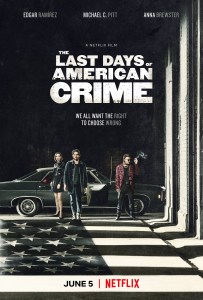 Even by relaxed standards which we judge widely-available Netflix movies during a time of quarantine, The Last Days of American Crime is a staggering waste of 150 minutes. It’s based on a 2009 graphic novel series and even by the sliding scale of shut-your-brain-off action movies, it’s numbing, dreadfully dull, incoherent, and stitched together with hoary genre clichés and little creative forethought. It’s rare that I come across a movie that seems so willfully ignorant to explore the implications of its own premise.
In the near future, the U.S. government is in the final stages of implementing the American Peace Initiative (API), a special radio signal that stops crime in its tracks. It acts as a brain blocker on anything illegal, stopping the user from being able to follow through. Graham Bricke (Edgar Ramirez) finds out the hard way when his bank robbery crew become some of the first test subjects. American citizens are desperate to flee to Canada before the API goes live. Bricke gets seduced by computer hacker Shelby Dupree (Anna Brewster) to pull off one big score. The government is readying to destroy a billion dollars in currency before going digital, and Shelby’s fiancé, Kevin Cash (Michael Pitt), has the connection to pull off the heist of the century.
 Firstly, there is not nearly enough material here to justify the gargantuan Avengers-esque running time. You could realistically slice down a whole hour and not impact its middling entertainment value or clarity. While I was watching it didn’t even feel like a movie, more like a series designed to be binge watched, where the plotting becomes much more slack because the filmmakers anticipate their show will be digested in quick succession and that they have earned patience. It irritates me in television and it certainly irritated me here as well. Don’t blithely assume that your audience has infinite patience when you haven’t given them a proper story to properly engage with. Just about every scene could be trimmed down and some of them go on punishingly long, especially scenes where people are getting shot. There’s one late scene that goes on for what feels like five minutes of just watching two characters get shot. It’s so gratuitous, like much else in the movie, that it borders into unintentional anti-comedy.
As for the action, director Oliver Megaton (Taken 2 and 3) delivers very little of note. There’s a car chase here, a shootout there, but no set piece that actually develops or proves that memorable. It’s all just disposable noise that amounts to little, not even fleeting, escapist entertainment. This is a heist movie where the actual heist planning is ignored. The most enjoyable part of a heist movie is the intricate planning and then execution of that plan, combating the unforeseen complications and overcoming for triumph. If your entire movie is centered on a big heist, don’t treat that like it’s another meaningless plot element. I cannot believe the filmmakers failed to realize that if the viewer doesn’t know what the dangers, problems, and scheme of the upcoming heist will be, then everything feels arbitrary and unsatisfying, and it does so here. The actual heist, pulled off around the 90-minute mark, is not worth the buildup and lack of accessibility. It’s just another haphazard action set piece, not the culmination of planning and an important payoff for carefully manufactured setups. If you’re tuning in for fun action, you’ll be sorely disappointed to find there’s more time spent torturing people onscreen than there is for sustained and exciting action.
The awful characters we’re left to spend 150 minutes with are hardly worth that investment. Everyone is kept strictly as stock archetypes, and even when the screenplay tries to develop them, it follows a strictly predictable path to minimal results. Oh, someone has a family member in custody and is being pressured to snitch? Oh, our silent-and-seemingly-conflicted protagonist wants to avenge his dead brother because he cares and stuff? Oh, our oddball criminal scion wants to make a big name for himself outside of his father’s shadow? The fact the movie spends so much time with these characters while giving them so little dimension, little personality, and little to do is another indictment on the bloated pacing. If we’re spending this much time with our criminal rogues, the least you can do is make them interesting and dramatic and colorful. The protagonist’s name is Graham Bricke, which sounds so boring that it must have been generated by an A.I. The femme fatale super hacker lady is really here just to look sad or sexy, here to deliver three uncomfortable sex scenes including a near rape as well. The other notable female roles in this movie include News Anchor, Lesbian 1 and Lesbian 2, Female Tweeker, and Female Cop. Hooray for depth.
 There are two characters that had a chance of being interesting but are so mishandled. The first is Kevin Cash, our wannabe gangster. Pitt (HBO’s Boardwalk Empire) brings a much-needed dose of energy and theatrics, like he’s trying everything in his power to desperately hold your flagging attention. Even his pathetic overcompensating nature is tiresome. A scene where he, his father, and his younger stepmother (another fine example of female character representation in the movie) shriek and bicker at one another is just embarrassing and misplaced comic relief. He’s boring. The only other potential was with Sharlto Copley (District 9) as a disgraced police officer. We spend plenty of time with him early in the movie, establishing his outsider status, perhaps some regret, and hoping that his position of authority will be better explored as he wrestles with whether the police force is worthy of its state-decreed exemptions to the API. Nope. He just becomes another dude in the final act that could have been replaced by anyone else. It would be like devoting so much time to Henchman #12 and his personal crisis of self in a Bond movie only to watch the lug unceremoniously die in a final action rush. Was that worth the time spent?
Its Purge-like premise sounds intriguing and worthy of exploration until, that is, you really think about how silly it all is. So a magic radio signal is going to inhibit your brain from committing known wrongs, but does that mean that the radio signal will have to blare constantly in order to have a lasting effect, otherwise its enforcement will be limited? What happens to sociopaths who don’t even register right from wrong? They will be able to move and act without abandon. Then there’s the day-to-day corruption, graft, greed from all pillars of society, politicians and Wall Street and officials that exploit their positions for illegal gains. Seriously, if this radio signal inhibits the fruition of illegal acts, would Wall Street just shut down? Would the factory owners who knowingly skirt worker safety for profits be able to operate? Would criminal defense attorneys be able to operate or would they use the ethical justification that everyone, no matter how heinous, deserves legal representation? If you think about a capitalist society, it’s built upon people behaving not so nicely, so would all facets of the economy grind to a screeching halt?
There is one aspect of this world building, even with what the meager story has established, that could be interesting to explore, and that’s the exceptions to this new order. Police officers are getting implants that make them immune to the effects of API, though in a world where a radio wave eliminates criminal acts, do you still need a police force to protect and serve? Regardless, this special class of exception is deserving of further exploration, a socially relevant angle to tap into the inherent advantages offered to the top one percent who don’t think the rules apply to them. In fact, if Last Days of American Crime was going to run with its silly premise as is, and during the pre-activation countdown timeline, they should have presented a story about those who are given the state-sanctioned privilege to act with impunity. Let’s watch the elite get their special exemption chips and plan for the New World where they maintain their vaunted privileges. It would at least make the movie socially relevant as well as a better development of its sci-fi premise.
 Watch, dear reader, as I present you two better scenarios with this silly premise. The first is the most obvious and that’s life AFTER the implication of the AFI, presenting life under a new fascist order and a group of revolutionaries trying to thwart the radio waves. Imagine a group not plotting to pull off a bank heist but ridding their community of the AFI and giving them autonomy over their minds and bodies again? There’s an ever-present hostility that forces the characters to keep their thoughts on safe topics, having to communicate with subterfuge to not set off their brain jailers. It would be like a dystopian version of that classic Twilight Zone episode where little Bill Mumy where everyone had to think “good thoughts” or else he would magically banish them to the cornfield. That’s interesting, that’s genuine conflict, that’s characters under great duress trying to escape a fascist nightmare without tipping off the invisible sensors in their own minds that could trigger. There’s a larger goal of freeing their fellow citizens from this tyranny as well. That’s already one hundred times better than simply trying to steal money before the clock strikes zero. If it was only ever going to be “one big last score” then why even bother with the mind-control antics? It could have been anything at all.
However, if you wanted something more low-key, you could take a different path with the idea of the bucket list before the API goes live. Think of two teenagers who don’t have the means to escape and feel like they haven’t fully lived and a whole lifetime of rebellion and adventures they had been dreaming towards will now be snuffed out. The screenplay already floats the idea of a criminal bucket list but why not run with that idea as the core of your movie? Two teenagers making the most of their time together over the course of one long crazy night of cutting loose, testing their boundaries, and acting out the best ways they know how, learning about each other and the depth of their friendship before their minds will not fully be their own. It takes the teenager coming-of-age model, feeling like a stranger in your own body, and gives it a PG-13-Purge twist, with the distant tragedy of the looming tyranny ahead to up the stakes. Even that development would be better than “one last score,” and these are just two ideas I’ve come up with while writing this film review. Think what could be accomplished if a professional screenwriter spent weeks fleshing out a better version.
Alas, the version of The Last Days of American Crime we do receive is powerfully plodding, incoherent, empty and arbitrary, and definitely not worth your precious 150 minutes. With the current state of the world where thousands of U.S. citizens are protesting in the streets over a militarized police state and wanton brutality, it makes Last Days look even more phony and ill-conceived as entertainment. It doesn’t examine the implications of its own fascist police state, it only uses it as a pointless backdrop for an arbitrarily plotted “last score” heist before it all just falls apart, spent of imagination and intent.
Nate’s Grade: D+
Share this:

Extraction (2020)
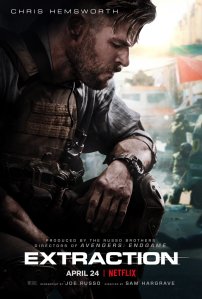 The new Netflix action movie Extraction is based on a graphic novel, co-authored by the Russo brothers, starring Thor himself Chris Hemsworth, and directed by longtime stunt choreographer Sam Hargrave. It has quite a pedigree, and after the wild success of the John Wick series, I’m genuinely excited to see what kind of action stuntmen-turned-directors can unleash. The best thing Extraction has going for it is its brutal, fluid, and immersive action sequences, including an extended sequence meant to convey a single take of relentless intensity. Unfortunately, that’s about the only thing this movie has going for it. The plot is very formulaic, with Hemsworth being brought in to retrieve a high-value target and then being betrayed, having to go on the run to protect the son of an imprisoned Indian mob boss. Hemsworth’s character is also haunted from personal tragedy and reluctant to get back into the fight, yet this final stand could allow him a late attempt at redemption for a lifetime of bloodshed. What I’ve just described could be a hundred other movies, minus the particulars of the Indian mob boss. The characters never really pop, even Hemsworth. The kid he’s tasked with saving never seems to get a moment to shine, to present a personality, or even a sense of growth or toughness. He might as well be a low-grade A.I. in a video game escort mission. The relationships don’t seem to matter. When it’s pumping, the action has an immediate appeal and Hemsworth acquits himself nicely with the more complicated fight choreography and stunts. As I kept watching, something didn’t quite feel right, and then it came to me. This movie doesn’t work from a tone standpoint. The John Wick-style action, glorifying in the fun and gory nature of slick violence done smoothly, conflicts with the setting and wider story of Extraction, namely the poverty-drenched streets of Bangladesh with child assassins thrown into duty by villainous gang leaders. It feels like you dropped John Wick into the searing reality of City of God, and the two styles of violence, and their larger social implications, do not really mix without uncomfortable consequences. It doesn’t help that so many of the characters just seem blank and replaceable. If you can ignore those misgivings, Extraction can offer some enticing thrills and above-average fight choreography.
Nate’s Grade: B-
Share this:

Bloodshot (2020)

Bloodshot is the kind of junky sci-fi action movie you might have seen in the 90s before The Matrix, the kind of thing that an X-Files episode would have covered, probably with a better sense of storytelling. Based on a Valiant comic book, and reportedly the first step in a hopeful Valiant Cinematic Universe (oh boy), Vin Diesel stars as dead soldier given new life thanks to tiny nanites living in his blood that magically repair his body, making him nigh invincible. He gets vengeance on the man who killed his wife or so he believes, as Diesel’s memory is wiped after every successful kill and re-implanted with new memories of a new identity of his wife’s murderer. The movie plays this as a big twist even though it was central in the trailer and advertising, and despite the fact that it seems too convoluted a path for a science project in the billions, it’s pretty predictable. That’s the problem with Bloodshot is that it’s a two-hour action movie that feels like it’s going through the motions, built upon the spare parts of other better movies, and heading in one direction that’s too telegraphed. The action is over-edited and under developed, with first-time director Dave Wilson (an esteemed director of video game cut scenes and promo trailers) getting lost in the “cool stuff” of his world, little gizmos and side characters rounding out Diesel’s super-powered teammates and later opponents. You can feel that certain visual compositions are here just to look cool for a trailer. I was looking for the super-powered action sequences to be a major source of fun with this one and they left me shrugging. There’s one CGI-heavy fight scene down 50 stories of elevator shaft that has some moments to it, but as a whole Bloodshoot feels bloodless with its excitement. The appearance of Diesel being rebuilt by the wispy nanites reminded me of Apocalypse’s weird sand powers in X-Men: Apocalypse. Having its main character essentially be invulnerable takes the stakes out of his fights, which means even more thinking needs to go into the action design to maximize this effect. The final confrontation between Diesel and his tormentor (Guy Pearce, making a home for himself as this kind of character) has a clean and clever resolution I appreciated, but it was a long slog to get to something clever in construction and execution here. If you’re looking for a pretty straightforward action movie that you won’t have to burden much thought with, you could do worse than Bloodshot. This also has Eiza Gonzalez in another movie where she plays a CGI-augmented version of herself (Alita: Battle Angel, Welcome to Marwen), so there’s that too. At this rate, I don’t think we’re going to be getting that Valiant Cinematic Universe if this is the inauspicious kickoff.
Nate’s Grade: C
Share this:

Birds of Prey (2020)
 Not really a Birds of Prey movie, not really a Suicide Squad sequel (see you in 2021), this is really more of a Harley Quinn solo spinoff that’s fun, colorful, bonkers, edgy, and a smile-inducing delight… when Margot Robbie is onscreen as Harley. Robbie is a charming, hyperactive live wire that commands your attention, and giving her the reigns of the storytelling, quite literally in some Deadpool-esque meta storytelling tweaks, is the best decision the filmmakers make. I enjoyed the frivolity, visuals, and narrative trickery, but I noticed something whenever Harley took a powder off screen. None of the other supporting characters are that interesting. I don’t know anything about Cassandra Cain (Ella Jay Bosco), the plot device that everyone is after because of the prized diamond she swallowed. She’s more attitude than person. There’s also Black Canary (Jurnee Smollett-Bell) who doesn’t do much and has a super power she doesn’t use until the end. Renee Montoya (Rosie Perez) provides the police angle and references to cop movie cliches (a hat on a hat). Huntress (Mary Elizabeth-Winstead) is almost a self-parody as the young girl growing up to be an elite assassin to avenger her murdered family and the movie treats her like an also-ran. The only other person of interest is the villain, Roman Sionis a.k.a. Black Mask (Ewan McGregor), because the performance is campy while also being menacing. Birds of Prey suffers absent Robbie because its additional pieces cannot carry the movie on their own. The vacuum of charisma is too noticeable. The fight choreography is impressive and with plenty of longer takes to fully appreciate the cool moves. I enjoyed how every action sequence was different from the last and director Cathy Yan makes excellent use of her environments; a police lock-up is a fantastic place for an action scene with all the evidence/props to utilize. A romp inside a fun house also keeps things fresh even though the goons never bring guns to their big fight. Birds of Prey works very hard with quirk and narrative shuffling, and it feels like a decided attempt to dazzle as well as distract, because there’s not much to this movie. It’s style and personality over substance, and that’s fine, but it does make the second half feel a bit like coming down from a sugar rush. I know there will be plenty that celebrate a group of strong women taking ownership of their own stories and fighting together against toxic men. I know there will be plenty of my friends that love this movie. For me, it was an enjoyable experience that made me realize just how much I enjoy Robbie as an actress, as this character, and when given extra room to roam with an R-rating. Birds of Prey is the kind of tasty junk food you just crave from the cinema every now and then, but without Robbie it’s decidedly less flavorful.
Nate’s Grade: B
Share this:

Jay and Silent Bob Reboot (2019)
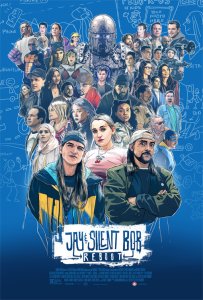 Jay and Silent Bob Reboot is strictly made for writer/director Kevin Smith’s fanbase, so does trying to play outside this cultivated audience even matter? Honestly, there’s no way this is going to be anyone’s first Smith movie, so it’s already running on an assumed sense of familiarity with the characters and stories of old, which is often a perquisite to enjoying many of the jokes (more on this later). It’s been 25 years since Clerks originally debuted and showcased Smith’s ribald and shrewd sense of dialogue-driven, pop-culture-drenched humor. He’s created his own little sphere with a fervent fanbase, so does he need to strive for a larger audience with any forthcoming movies or does he simply exclusively serve the existing crowd?
Jay (Jason Mewes) and his hetero life-mate Silent Bob (Smith) are out for vengeance once again. Hollywood is rebooting the old Bluntman and Chronic superhero movie from 2001, this time in a dark and edgy direction, and since Jay and Silent Bob are the inspirations for those characters, even their likenesses and names now belong to the studio. The stoner duo, older and not so much wiser, chart a cross-country trip to California to attend ChronicCon and thwart the filming of the new movie, directed by none other than Kevin Smith (himself). Along the way, Jay and Bob discover that Jay’s old flame, Justice (Shannon Elizabeth), had a daughter, Millennium “Milly” Falcon (Harley Quinn Smith) and Jay is the father. Milly forces Jay and Bob to escort her and her group of friends to ChronicCon and Jay struggles with holding back his real connection to her.
 One of my major complaints with 2016’s Yoga Hosers (still the worst film of his career) was that it felt like it was made for his daughter, her friends, and there was no point of access for anyone else. It felt like a higher-budget home movie that just happened to get a theatrical release. Jay and Silent Bob Reboot feels somewhat similar, reaching back to the 2001 comedy that itself was reaching back on a half-decade of inter-connected Smithian characters. There is a certain degree of frantic self-cannibalism here but if the fans are happy then does Smith need to branch out? This is a question that every fan will have to answer personally. At this point, do they want new stories in the same style of the old or do they just want new moments with the aging characters of old to provide an ever-extending coda to their fictional lives?
I certainly enjoyed myself but I could not escape the fact at how eager and stale much of the comedy felt. Smith has never been one to hinge on set pieces and more on character interactions, usually profane conversations with the occasional slapstick element. This is one reason why the original Jay and Silent Bob Strikes Back suffers in comparison to his more character-driven comedies. Alas, the intended comedy set pieces in Reboot come across very flat. A lustful fantasy sequence never seems to take off into outrageousness. A drug trip sequence begins in a promising and specific angle and then stalls. The final act has a surprise villain that comes from nowhere, feels incredibly dated, and delivers few jokes beyond a badly over-the-top accent and its sheer bizarre randomness. There’s a scene where the characters stumble across a KKK rally. The escape is too juvenile and arbitrary. A courtroom scene has promise when Justin Long appears as a litigation attorney for both sides but the joke doesn’t go further, capping out merely at the revelation of the idea. This is indicative of much of Reboot where the jokes appear but are routinely easy to digest and surface-level, seldom deepening or expanding. There’s a character played by Fred Armison who makes a second appearance, leading you to believe he will become a running gag that will get even more desperate and unhinged with each new appearance as he seeks vengeance. He’s never seen again after that second time. There are other moments that feel like setups for larger comedic payoffs but they never arrive. The actual clip of the Bluntman and Chronic film, modeled after Zack Snyder’s Batman v. Superman, is almost absent any jokes or satire. There are fourth-wall breaks that are too obvious to be funny as they rest on recognition alone. There’s a running joke where Silent Bob furiously taps away at a smart phone to then turn around and showcase a single emoji. It’s cute the first time, but then this happens like six more times. Strangely it feels like Smith’s sense of humor has been turned off for painfully long durations on this trip down memory lane. The structure is so heavily reminiscent of Jay and Silent Bob Strike Back that there are moments that repeat step-for-step joke patterns but without new context, meaning the joke is practically the repetition itself.
 The problem with comedy is that familiarity can breed boredom, and during the funny stretches, I found myself growing restless with Reboot as we transitioned from stop to stop among the familiar faces. I enjoyed seeing the different characters again but many of them had no reason to be involved except in a general “we’re bringing the band back together” camaraderie. It’s nice to see Jason Lee again but if he doesn’t have any strong jokes, why use him in this way? Let me dig further with Lee to illustrate the problem at heart with Reboot. Jay and Silent Bob visit Brodie (Lee) at his comic book shop, which happens to be at the mall now. He complains that nobody comes to the mall any longer and he has to worry about the “mallrats,” and then he clarifies, he’s talking about actual rodents invading the space, and he throws a shoe off screen. I challenge anyone to find that joke amusing beyond a so-bad-it’s-fun dad joke reclamation. I kept waiting for Smith to rip open some satirical jabs on pop culture since 2006’s Clerks II. In the ensuing years, Star Wars and Marvel have taken over and geek culture and comic books rule the roost. Surely a man who made his name on these topics would have something to say about this moment of over saturation, let alone Hollywood’s narrow insistence on cash-grab remakes. I kept waiting for the Smith of old to have some biting remarks or trenchant commentary. Milly’s diverse group of friends (including a Muslim woman named “Jihad”) is referred to like it’s a satirical swipe at reboots, but there isn’t a joke there unless the joke is, “Ha ha, everyone has to be woke these days,” which is clunky and doesn’t feel like Smith’s point of view. There are several moments where I felt like the humor was trying too hard or not hard enough. As a result, I chuckled with a sense of familiarity but the new material failed to gain much traction.
I do want to single out one new addition that I found to be hysterical, and that is Chris Hemsworth as a hologram version of himself at a convention. The Thor actor has opened up an exciting career path in comedy as highlighted by 2017’s Ragnarok, but just watching his natural self-effacing charm as he riffs about the dos and don’ts of acceptable behavior with his hologram is yet another reminder that this man is so skilled at hitting all the jokes given to him.
 Where the movie succeeds best is as an unexpected and heartfelt father/daughter vehicle, with Jay getting a long-delayed chance to mature. It’s weird to say that a movie with Jay and Silent Bob in starring roles would succeed on its dramatic elements, but that’s because it feels like this is the territory that Smith genuinely has the most interest in exploring. The concept of Jay circling fatherhood and its responsibilities is a momentous turn for a character that has previously been regarded as a cartoon. His growing relationship with Milly is the source of the movie’s best scenes and the two actors have an enjoyable and combative chemistry, surely aided by the fact that Mewes has known Harley Quinn Smith her entire existence. This change agent leads to some unexpected bursts of paternal guidance from Jay, which presents an amusing contrast. There’s a clever through line of the difference between a reboot and a remake, and Smith takes this concept and brilliantly repackages it into a poignant metaphor about parenthood in a concluding monologue. Smith’s position as a father has softened him up a bit but it’s also informed his worldview and he’s become very unabashedly sentimental, and when he puts in the right amount of attention, it works. There’s an end credit clip with the late Stan Lee where Smith is playing a potential Reboot scene with Stan the Man, and it’s so sweet to watch the genuine affection both men have for one another. I’m raising the entire grade for this movie simply for a wonderful extended return of Ben Affleck’s Holden McNeil character, the creator of Bluntman and Chronic. We get a new ending for 1997’s Chasing Amy that touches upon all the major characters and allows them to be wise and compassionate. It’s a well-written epilogue that allows the characters to open up on weightier topics beyond the standard “dick and fart” jokes that are expected from a Smith comedy vehicle. It’s during this sequence where the movie is allowed to settle and say something, and it hits big time.
The highly verbose filmmaker has been a favorite of mine since I discovered a VHS copy of Clerks in the late 90s. I will always have a special place reserved for the man and see any of his movies, even if I’m discovering that maybe some of the appeal is starting to fade. I don’t know if we’re ever going to get a Kevin Smith movie that is intended for wide appeal again. Up next is Clerks 3, which the released plot synopsis reveals is essentially the characters of Clerks making Clerks in the convenience store, which just sounds overpoweringly meta-textual. He’s working within the confines of a narrow band and he seems content with that reality. I had the great fortune to attend the traveling road show for this film and saw Smith and Mewes in person where they introduced Reboot and answered several questions afterwards. Even though it was after midnight (on a school night!) I was happy I stayed because it was easy to once again get caught up in just how effortlessly Smith can be as a storyteller, as he spins his engaging personal yarns that you don’t want to end. As a storyteller, I’ll always be front and center for this gregarious and generous man. As a filmmaker, I’ll always be thankful for his impact he had on my fledgling ideas of indie cinema and comedy, even if that means an inevitable parting of ways as he charts a well-trod familiar path. Jay and Silent Bob Reboot is made strictly for the fans, and if you count yourself among that throng, you’ll likely find enough to justify a viewing, though it may also be one of diminished returns.
Nate’s Grade: C+
Share this:

Joker (2019)
 There has been a lot of discussion over Joker, a new dark R-rated spinoff unrelated to other comic book movies and directed by the man who gave the world The Hangover films. Director/co-writer Todd Phillips desired to tell a character-driven drama that explored how Batman’s most notorious villain, and perhaps the most widely known villain of all pop culture, became exactly the clown he is. Some people said the Joker didn’t need a back-story, others said that Phillips had no place dabbling into the realm of superhero cinema, and there were plenty of others who expressed unease that the movie might inadvertently serve as an inspiration for disaffected loners looking for encouragement to make others feel their pain and suffering. After all those think pieces and cultural hand-wringing, Joker, as the actual movie, isn’t quite the transgressive experience that others feared and that the movie very much wants you to believe.
Arthur Fleck (Joaquin Phoenix) is a quiet, pathetic man who is being ground down by the forces in his life. He has a unique medical condition that causes him to break out in hysterical laughter when he’s nervous or upset, which only makes others feel nervous and upset. It’s hard for him to keep his job as a for-hire clown and his therapy and medicine are being eliminated thanks to budget cuts. He cares for his elderly mother (Frances Conroy), crushes on an attractive neighbor (Zazie Beetz), and dreams of being a stand-up comic who will one day grace the set of his favorite late-night talk show host, Murray Franklin (Robert De Niro). Arthur’s life changes from one night of extreme violence and how it shapes his concept of himself and society. He’s tired of feeling bad for who he is and he’s going to realize his true potential on the biggest stage.
 There’s something, excuse the modern parlance, quite “edgelord” about the film and its artistic approach. It’s very eager to be dangerous, edgy, disturbing, and there are certainly extended moments where it achieves these goals, notably thanks to Phoenix’s performance. However, I was cognizant of how eager the film was to be gritty, and dark, and different, to the point that it felt like the whole enterprise wasn’t just trying too hard to be different but wanted you to know it was trying. After a while, you just have to shrug and say, “Hey, movie, I get it.” This guy’s life ain’t too hot. The first 45 minutes could probably be condensed in half. The first two acts feel redundant as they establish the many trials and tribulations of this man on the edge of a broken society that has abandoned him. Because of this, Joker can be an entertaining experiment in solo superhero stories but there is a critical absence of depth that keeps the film from going beyond a stellar lead performance. It’s a Martin Scorsese hodgepodge, a cover song for a famous villain.
This is the kind of movie where subtlety is rarely used, which increases the sensation that it’s trying too hard because it seems like it’s saying all of its points with exclamation marks. Even in the opening minutes, while Arthur is applying his clownish makeup, we hear a voice over narration from a TV newscaster who is essentially screaming to the audience all of the important social contexts for the setting (Things are bad! People are mean! The economy is bad! People are getting desperate! What has the world come to?!). There’s a fantasy experience where the characters are just openly explaining their desires. The visual metaphors are pretty simple, like the idea of hiding behind a mask (don’t we all wear masks, man?) and the intimidating set of stairs ascending to Arthur’s apartment that he must climb. So many supporting characters act like mouthpieces for larger collective groups, like a paid therapist who tells Arthur that the people with money don’t care about her or Arthur, the little people caught in the machinery of runaway capitalism, or Thomas Wayne as the callous and cold business elite who seems disdainful about any sort of empathy for others that challenge his responsibility to a larger society. De Niro’s talk show host feels like an amalgamation of a lot of different themes, like daddy issues, the media, but also the representation of ridicule as comedy and mass entertainment. There aren’t so much supporting characters as there are ideas, and in a weird way this could have worked, as if each figure represents some different level of psychosis for Arthur, almost as if it was repeating the 2003 movie Identity and everyone really is a reflection of Arthur’s damaged personality. The inclusion of Beetz (Deadpool 2) is more a plot device meant to humanize Arthur, but the entire premise feels like it’s missing development to make it believable, and ultimately this is the point of her character but it’s a long wait for a reveal for a character that is superfluous at her core. It’s the kind of movie that thinks we need to yet again see the definitive formative act of every Batman movie.
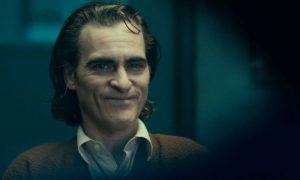 The movie does pick up a momentum when Arthur starts to get set on his way toward becoming the clown prince of crime. When the Joker gets his first taste of violence, in self-defense, the clown vigilante becomes a symbol for a reactionary contingent of Gotham’s lower classes. The groundswell of support provides a welcomed sense of community for a man who has been secluded for his idiosyncrasies, but it’s a celebration of a loss of morality, and so to fully embrace this tide of supporters he must give away the last of vestiges of his soul. This downfall allows for the movie to feel like it’s finally committed to something, where the setups are finally starting to coalesce around a character who is now driving his story rather than being the recipient of misfortune. The violence becomes more shocking and Arthur stops caring about hiding who he really is, and that’s when the movie becomes the full force it had been promising. I was tapping nervously throughout the final thirty minutes because I was anticipating bad things for anybody on screen. Phillips can use this anxious anticipation for unexpected comedy too, like where a character was trapped due to their unique circumstances and whether they too were in mortal peril. I wish Phillips had pulled back because there’s a perfect visual to conclude his movie, that brings the entire self-actualization and loss of morality full circle, and yet the movie gives us another two-minute coda.
Joker certainly feels like Phillips’ version of a Scorsese movie, for better and for worse. If you’re going to imitate anyone, it might as well be one of the greatest living filmmakers whose crime dramas have reshaped the very language of the movies and how we view violent crooks. The go-to response I’ve seen is that Joker is a combination of Taxi Driver and The King of Comedy. I’ll readily agree with the Taxi Driver comparisons. It’s everywhere. We have a disaffected loner who is turning sour on an increasingly hostile and unstable society he views as beyond repair. Even the shot selections, camera movements, and 1970s era set design evoke that influence. The King of Comedy is more a facile comparison, as Arthur is a disturbed man trying his luck at standup comedy, failing, and becoming more unhinged. The real reason reviewers seem to be making this connection is the inclusion of Robert De Niro, and it feels like that is the only reason he’s actually involved, to ping back to King of Comedy. The idea of a stiff actor like De Niro being a glib talk show host, even in the 1970s, seems like a bad fit. The other real film influence I don’t see getting as much recognition is Network. This is a tale of one man tapping into a vent of anger and starting a movement that ripples out beyond them into something uncontrollable.
 Phillips is best known for his comedy work but I could feel his leaning to do a straight genre picture. In other reviews, I’ve cited Phillips’ keen eye for noir-flavored visuals (think of the car traveling across the desert as seen through the reflection of sunglasses in The Hangover). He had the chops to tell a straight genre crime thriller, so it’s not surprising that Joker is a slickly made, unsettling, and effective movie when it counts. This is a grimy-looking New York City, I mean Gotham City, where the garbage piles high (another not so subtle visual metaphor) and the city feels like a maze all its own crushing our main character. The cinematography is great with several strong moments that amplify the mood of unrest and distaste. The crafty costumes by Mark Bridges (Phantom Thread) lend to the overall authenticity of the period. The cello-heavy score by Hidur Guonadottir (HBO’s Chernobyl) is very evocative and ominously conveys the turmoil bubbling below the surface in a manner that doesn’t feel like pandering. This is a good-looking production made by talented technicians and Phillips has enough skill to pull it all together, even if that aim is really to recreate a style of another filmmaker and the time and place of his films.
I’ve purposely saved the best for last, and that’s Phoenix as the titular character. He is mesmerizing as a broken man trying to find his place in society and flailing wildly. His uncontrollable cackling is so unsettling that when he broke into laughing fits, I could feel myself getting more and more unnerved. At first it was the awkward sympathy of watching a man struggle to get through his disability, trying to compose himself, and embarrassed for the discomfort he was projecting. The very sound of the cackling trying to be contained, as a friend and co-worker Jason credited, watching the laughter catch in his throat, it had such an immediate, almost physical reaction in me. Later in the movie, I cringed because it made me worry what was going to happen next because I know it’s a precursor to bad feelings. When he’s becoming more comfortable with his impulses and dark thoughts, you notice the cackling starts to ebb away. There’s a small moment that I loved where after he flees from his first murder he runs into a bathroom, and once his breathing calms, it’s almost like his body is commanded by some spiritual serenity as he begins to dance. Phillips allows the scene to breathe and play out, to invite the audience to join. This little motif probably appears a few too many times, but it’s a beautiful little moment of physicality that expresses the chaos becoming harmony within a man. Phoenix lost 50 pounds for the role and his gaunt, haunted frame reminds you how much of a shell of a human being this character feels like. He even tells his therapist that he questioned whether he was even a person or not. Phoenix burrows deep into the character and unleashes a committed intensity that is impressively communicated through his sad, reedy, sing-songy voice, his slippery stances and body language, and the madness that seems to resonate from his bulging eyes. Even when the movie is repeating its steps and tricks, it’s Phoenix that constantly gives back to the audience. It’s a performance certainly worthy of Oscar attention and plaudits, though in my mind it’s still a step or two below the instantly iconic, and Oscar-winning, performance from Heath Ledger.
 Joker is a movie and should not be held responsible for the actions of others and what they may read from the film. I don’t sense Phillips and his team condoning their protagonist’s lawless actions, and the violence is often undercut so that it feels more disturbing than triumphant and exhilarating. When Arthur does get his first kill, the audience has likely been silently rooting for him to fight back, to punish the wrongdoers, but the movie draws out the scene in a manner that’s akin to a wounded animal panicking as it scrambles for its life and a cold execution. It’s not meant to be cool. Phoenix’s performance elevates the entire enterprise and will unnerve as much as it ensnares. It’s not a subtle movie at all, and it hugs the works of Scorsese a little too closely, both in tone as well as visual symmetry. It’s trying very hard to be nihilistic, edgy, and provocative (this isn’t your “normal comic book movie” it wants to scream with every frame). Arthur just wanted to make people laugh, the movie tells us, but the joke was on him after all (subtlety). If anyone is inspired from this movie, I hope it’s to seek out other Scorsese movies.
Nate’s Grade: B
Share this:

The Kitchen (2019)
 Mob movies are culturally beloved. I could watch Goodfellas every time I see it on TV. We know these movies, we know this lifestyle, in so much as it’s been demonstrated in our art. A feminine perspective is often the dame, the moll, the panicked wife who worries her husband will never come home and see his bratty kids again. Rarely in mob movies are there roles for women that can be considered three-dimensional. Even Diane Keaton gets shortchanged in The Godfather series. In comes Oscar-nominated Straight Outta Compton screenwriter Andrea Berlof, tackling her directorial debut and adapting a graphic novel about three mob wives fighting the system. It’s about time this under-represented perspective in some of our favorite movies got its due spotlight. It’s too bad then that The Kitchen finds ways to still leave the women behind where it counts.
Set in the Hell’s Kitchen neighborhood of New York City in the late 70s, three mobsters get arrested one evening by the FBI and sent to prison. Their wives are now left alone to raise their families, struggle for employment, and to not be forgotten with the new pecking order of those mobsters left behind. Ruby (Tiffany Haddish) and Kathy (Melissa McCarthy) think they should take over their husband’s rackets while their men are indisposed. Claire (Elisabeth Moss) is more worried about what will happen when her abusive husband comes back from prison. The three women work together to make a stake at their own claim, butting heads against the existing power structure of dismissive men who don’t think organized crime is any place for a woman.
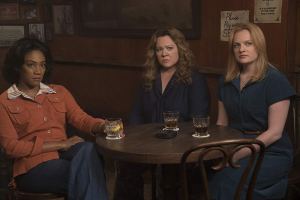 The Kitchen has such potential but it’s too often running off the fumes of other mob movies. Beyond the obvious similarities with last year’s more refined and polished Widows, this is a movie that gobbles its mafia movie clichés like a heaping helping of pasta (more clichés!). The characters aren’t terribly well defined and the story oddly moves in starts and stops, with moments either feeling too long or too short, and especially abruptly transposed, using montage to hurdle through what should have been needed onscreen development. People rightfully complained about the final season of Game of Thrones skipping over needed steps along a character’s journey to get to its intended destination, and The Kitchen is deserving of the same charge. We want to see these women in charge and others afraid, except the movie doesn’t show me any reason why these women would rise in power and what sets them apart from their steely competition. I get that they’re underestimated and they are determined, and that works in a general sense, but by the half-hour mark they’re already successful mobster entrepreneurs and I’m unsure how. Even after their rise, there is little that seems to deter them. Every new obstacle is comically taken care of in such casual fashion that you never worry for their well-being. It feels like Berloff wants to skip through all the hard work and just get to the enjoyable desserts or a life of crime, but moving up the ladder is an essential part of any power struggle story. As a result of the sloppy plotting and pacing, there is an over-reliance on clichés to stand in place, relying upon the audience’s warm understanding of the genre territory and what to expect to relieve the movie from having to do more work. It’s all telling and hardly any show.
The characters are kept as archetypes as well, at least 2/3 of the leads. Both McCarthy and Haddish seem miscast for their roles. Both are splendid comic actresses and have dramatic capabilities beyond what they get credit for, but they seem to rely upon comic instincts to get through their underwritten scenes, which further hampers the lack of tension. Each actress gets one solid scene to open up their character but it’s just so little. Ruby has a sit down where her mom credits beating the “soft” out of her daughter for Ruby’s success. That little glimpse into her past and her fraught relationship with her mother served as a tantalizing hint at what could be explored further with the Ruby character. The same with the fact that she’s a black woman who married into a very rigid Irish-American family set in their prejudices. There’s such dramatic potential to be had there. Alas, she’s tasked with being a hardass and that’s all The Kitchen asks of Haddish, treating her more as symbol than person. For McCarthy, there’s a late scene where another character tries to soft-peddle her involvement in crime, saying she did what she had to for her children, and Kathy corrects, saying, no, she did it all for her. She was tired of being a deferential doormat and wanted to feel important. That degree of self-empowerment through selfishness could be a fascinating character angle to explore, but we don’t get that. She clarifies the lens for us to view her with but by that point it’s far too late. The film is top-heavy with underwritten women and that’s a shame.
 The most interesting character by far is Moss’ abused wife-turned-budding killer. Claire is the one starting at the lowest point and the one who takes to the life of crime as means of salvation. These characters are doing some pretty heinous acts but with Claire I felt the most empathy for her plight, bullied by her husband and feeling trapped, more worried about the impending release and her return to being the scared woman cowering in the corner again. She doesn’t want to go back to that life and I believed every moment of Moss blurting out her despair and desperation. That’s why her relationship with another oddball killer played by Domhnall Gleeson (The Last Jedi) was what I cared about most in the movie. You watch them grow together, him mentoring her on how to cut up a body and dispose of it down river, and you watch how each of these two people finds something missing in the other. They may not even be good for one another, enabling their darker impulses and past a point of no return, but it’s the only evolving relationship we were given an entry point to empathize with fully. This segment is also criminally underwritten but it’s clearly where the focal point of the movie should have been. This was the perspective the movie should have been locked into and the character’s journey we follow through every step.
The Kitchen isn’t a bad movie at all. The production design and period appropriate costumes are to die for. There’s always going to be a visceral enjoyment watching the underdogs move ahead and topple their doubters and competition. The ensemble doesn’t have a bad actor in the bunch. Bill Camp (Molly’s Game) shows up with a real sense of veiled menace as a Brooklyn mobster both irritated and impressed by the ladies’ advancement. The soundtrack is packed with Scorsese-riff-approved tunes, including three instances of Fleetwood Mac. There are pleasures to be had. It’s just that the ingredients to a better movie were all there, plain as day. If you’re a fan of mob movies in general, you may find enough to satisfy with The Kitchen, which has its moments but ultimately feels too much like an under-cooked dish you’ve had one too many times before (metaphors!).
Nate’s Grade: C+


You must be logged in to post a comment.