Author Archives: natezoebl
Pacific Rim (2013)
 Pacific Rim is director Guillermo del Toro’s (Hellboy, Pan’s Labyrinth) giddy ode to the great monster movies of his youth, and if you’re fond of men in suits and large-scale cardboard destruction, then this movie is definitely for you. The word “awesome” seems too inadequate to describe the rock ‘em sock ‘em action of this picture. This is likely the most realistic and serious this concept will ever be realized, with a gargantuan budget and some top-notch special effects. del Toro, already something of a god in fanboy circles, will get his chiseled bust alongside Joss Whedon. Pacific Rim is a transporting blockbuster that doesn’t pull its punches, at least when it’s dealing with robots fighting monsters. If this is why del Toro dropped out of directing The Hobbit then I think it’s a good trade off.
In the near future, a rift opens at the bottom of the Pacific Ocean that opens a gateway to another dimension. Through this portal, giant horrifying monsters the size of skyscrapers appear to wreck havoc on coastal cities. The monsters, known as kaiju, take a whole lot of work to go down. “To battle monsters, we had to make monsters, “ say a character in the prologue. The world unifies and responds with a program where two people pilot giant mechanical robots known as jaegers (yes college kids, you read that right). These pilots are psychically linked via a process known as the Drift; they work in tandem, sharing one mind. Raleigh (Charlie Hunnam) is a former jeager pilot recovering from the loss of his co-pilot/older brother in battle. Stacker Pentecost (Idris Elba) recruits him back to the final days of the jaeger program, a defense that has fallen out of favor with world leaders once the kaiju started winning again. Stationed in Hong Kong, Raleigh is looking for a new co-pilot and by all accounts it seems Pentecost’s diminutive assistant, Mako Mori (Rinko Kikuchi), is the best candidate, though Pentecost won’t allow it. Add some wacky scientists (Charlie Day, Burn Gorman) and an underground monster parts trader (Ron Perlman). The last days of the beleaguered jaeger program are all that stand between mankind and annihilation from giant beasts.
 It’s undeniable how well Pacific Rim taps into your inner ten-year-old, the kid who crashed his toys together imagining larger-than-life battles. Truthfully, if I were ten years old, I’d likely declare Pacific Rim the greatest movie of all time, that is, until I saw one with boobs in it. Conceptually, this feels like just about every anime brought to life, and fans of anime, as well as monster movies in general, should be in heaven. It’s so much fun to watch but it also doesn’t get lost in the cacophony of special effects like many modern blockbusters. del Toro has a wonderful way of showcasing his action without losing track of the scale or the destruction. Unlike Man of Steel, we have city-wide devastation that feels like devastation. Giant monsters are a state of life for the world and so is the day-to-day anxiety that one’s coastal existence is about to be in ruins. The movie doesn’t get bogged down in post-9/11 solemnity, but at the same time I appreciated that del Toro makes his violence feel significant and the loss feel real.
The action onscreen is often exciting and screenwriter Travis Beacham (Iron Man 3) employs a nice system of escalating the stakes by applying a category system to the kaiju, rating them on a 1-5 scale. It provides a natural progression of opponents. Plus, besides the inherent excitement with the premise, Beacham and del Toro drop us into the middle of this story, years after the jaegers have fallen out of favor as a means of defense, thus providing another hook – underdogs. Our heroes don’t just control giant fighting robots, they are also underdogs and have to prove their mettle to dismissive authority figures. I was hooked.
del Toro has always been a man who can create living, breathing worlds that you just want to explore, and Pacific Rim is the same. I loved immersing myself in the minutia of this world, learning the different fighting techniques of the robot designs, the cultures that harvest the kaiju bodies (there are monster groupies as well), the rock-star status of the jaeger pilots, and most of all, the Drift. Psychically linking the pilots is an ingenious way to add to the emotional investment of what are otherwise fairly clichéd character types. They have to be in synch mentally, which requires a whole other level of trust and connection. The tragic back-story of Raleigh is given even more weight knowing that not only was he witness to his brother getting eaten alive by a giant scary monster, he was psychically linked and felt his brother’s overwhelming fear and pain. That would definitely shake me. The Drift also provides a unique way to include back-story without feeling like forced exposition. Seeing Mako’s horrifying childhood survival account is quite affecting, but it works even better knowing this is also a chance for Raleigh to understand and bond with her. That sequence, Mako as a child, is stunning, staying with her pint-sized perspective as she tries to outrun a ferocious monster bearing down on her. It slows things down and allows the true terror of the situation to seep in. Beacham and del Toro have put a great amount of thought with how this world operates, and it’s appreciated as seemingly every detail adds to a richer big picture.
Naturally, the special effects are just about every positive accolade you can put together. It’s a CGI heavy film that doesn’t look like a cartoon; something Michael Bay’s Transformers have difficulty overcoming. The robot designs aren’t overly busy. In fact, the main robot reminds me a lot of Metroid’s Samus suit (anybody?). The monsters are all a bit too similar in design though. They all start to bend together making it hard to differentiate them from one another, especially when they’re supposed to be getting bigger and badder. Part of my lukewarm reception with the monster designs, besides from del Toro’s sterling past reputation when it comes to creature designs, is that so many of the epic fight scenes happen with some level of visual obfuscation. They fight at night, they fight in the rain, they fight in the fog, they fight underwater, but rarely will they fight in a setting where you can clearly focus on the fighters. This very well could be a budgetary decision, allowing less work for visual effects artists so they can cover the scope of del Toro’s imagination. Still, it’s hard for me to compose an argument that a $200 million-dollar movie needed just a bit more money to properly show off the goods.
 When it’s not wrecking havoc onscreen, the story can drag and you’ll notice how thin the characters are developed. It’s another reluctant hotshot and learning to get over a personal tragedy, trusting a new co-pilot, and taking stern advice from a begrudging father figure. That doesn’t mean they don’t work within the framework of the story; Hunnam (TV’s Sons of Anarchy) is solid if unspectacular, Elba (Thor, TV’s Luther) is the universe’s most authoritative badass, Day (Horrible Bosses) and Gorman (The Dark Knight Rises) provide a nice array of comic relief, and Kikuchi (Babel, The Brothers Bloom) makes for a formidable upstart hero. The character roles are familiar and thinly sketched but they come together in a satisfying manner, each contributing to the mission, and each finding a moment to make you care. When the fate of the world is at stake, it’s hard not to feel some investment in our ragtag assembly of heroes. With that being said, you will still feel drag in the middle, waiting for the next attack and for our heroes to suit up and do what they do best. The extended second act involves denying Raleigh and Mako the opportunity to do what we all know they need to do – man a jaeger. It can get restless as we keep getting roadblocks to something that seems inevitable. It’s akin to waiting too long for John Reid to accept his outlaw status in The Lone Ranger. I will give Beacham and del Toro extra credit for not leaving themselves open for an immediate sequel. Also, do stay through the credits for a nice treat.
I can easily recommend Pacific Rim with minor reservations, and if giant fightin’ robots and monsters is your thing, then the reservations won’t even matter when you get a movie this entertaining, fun, and skilled at providing the gee-whiz factor. I wish all summer movies were this fun. I was squealing with glee watching a giant robot drag a cargo ship across the streets of Hong Kong, gearing up to beat down a huge monster. The movie is packed with little moments like that. As with other del Toro productions, the world feels nicely realized, lived in, and sprawling with detail, even if the monsters all start looking the same (monster racism?). The plot does suffer a bit when it refocuses on the humans, but then again what plot wouldn’t suffer when it takes you away from giant robots fighting aliens? Pacific Rim isn’t the first of its kind. Besides the anime, Godzilla, and even Power Rangers influences that spring to mind, there have been numerous movies that follow a similar premise of Giant Thing A squaring off against Giant Thing B. What sets Pacific Rim apart is del Toro’s innate ability to channel your childlike glee at the concept, turning something monstrous into something fun while still giving respect to the weight of the moment. This is not a dumb action movie. del Toro’s sprawling artistic sensibility takes on summer blockbuster filmmaking and shows you how it can be done right for optimal effect without making your brain hurt. Now I need round two.
Nate’s Grade: B+
Share this:

The Purge (2013)
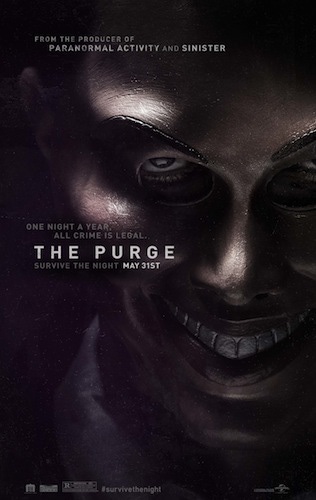 Sci-fi cautionary tales have been an outstanding way to provide commentary for contemporary anxiety. Rod Serling, Charles Beaumont, and the recently departed Richard Matheson were masters of this. A movie can make you think as speculative fiction while still following a thriller/horror blueprint to entertain the masses. And so writer/director James DeMonaco (Assault on Precinct 13, The Negotiator) wades into these waters with The Purge, a home invasion thriller that has a premise that, on the surface, might make you scoff. In 2022, the United States has practically solved unemployment and crime thanks to a nifty little holiday known as the Purge. Every year, for a twelve-hour window, law is rescinded and so are emergency services like police and firefighters. For those 12 hours, good American men and women are allowed to engage in just about every sort of crime up to and including murder. It’s designed for people to release all their aggression and darker impulses, thus allowing for a safer, happier 364 and a half days a year.
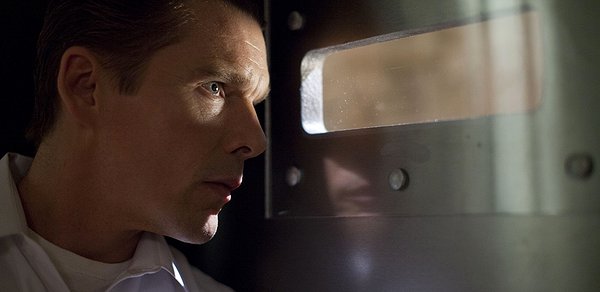
James Sandin (Ethan Hawke) is the top salesman when it comes to hardcore home security systems, the kind with the thick metal doors over your windows and doors. He lives in one of those finely protected homes with his wife, Mary (Lena Headey), and children, Max (Max Burkholder) and Zoey (Adelaide Kaine). They’re prepared for a long night behind barricades. Then a wounded black man (Edwin Hodge) runs through the cushy neighbor, crying desperately for help. Charlie offers him refuge inside the Sandin abode. Shortly after, a group of masked vigilantes, led by a lad who looks like Patrick Bateman, knock on the Sandin home. The bloody ma is their “bait,” and these angry folk demand he be returned to them, or else they will be coming in and sparing no one.
 This high-concept thriller is a well-crafted suspense piece, with several well-developed sequences that squeeze out tension. The premise involves some mighty suspension of disbelief but you’d be surprised how easy it is to accept and move on. The kids provide dissenting voices, mostly Charlie, and we get a lean history of the Purge and all the information we need to go forward, at least for this night. I liked how it’s become a common passing greeting to say “Stay safe” to people on the day before the Purge. Little details like that make the world feel more thought out. I like that engaging in the Purge is thought of as one’s patriotic duty. There are some tantalizing moments of dread as well, like a neighbor sharpening his killing tools outdoors. But really the movie comes down to its suspense, broken up into a series of different goals. James wants to protect his family and return the “bait,” but first he needs to find him and subdue him. Charlie wants to save him and get to him first. It’s your standard people-groping-in-the-dark kind of picture, but when given a strong sense of urgency and some good actors, it can be plenty suspenseful. DeMonaco does a fine job of making sure his story doesn’t get too confusing, tasking the audience with keeping track of too many participants. So when we have Zoey’s bad boyfriend (Tony Oller), he’s dealt with before the manhunt begins. When the home invasion kicks in, the manhunt is over. When it looks like Zoey is heading straight for the stranger, it’s a storyline that culminates very quickly. There’s a good sense of clarity throughout The Purge, which aids the effectiveness of the thrills.
For the first half of the movie, things snap together well enough that you just accept the premise and its implications, forgoing the nitpicks that wait. It isn’t until the third act where you start to disengage from the film and pick it apart. As a cautionary tale, it has some interesting ideas about class warfare; the main villain is right out of Ayn Rand’s Objectivist playbook. But the ideas and moral commentary fade as the movie becomes more a standard, albeit effective, suspense thriller. I really appreciated the argument that unemployment is so low because the Purge takes care of the sick, homeless, and poor and disadvantaged, those chiefly who cannot defend themselves and are easily targeted. It’s an eerie extreme that doesn’t feel too many steps removed from the last presidential election where Republican primary debate audiences cheered the hypothetical death of the poor. But then the nitpicks do come and once they do it’s like a rushing tide that cannot be stopped. Why do people have stockpiles of guns but no bulletproof vests and gear? Why wait for the bad guys to get in when you and your armed, well-defended family in your home fortress can preemptively strike? Why would you order the Sandin family to return your “bait” and then turn off their power? Doesn’t that make it much harder? Why would killing your girlfriend’s father win her over? Do you think she’s really still going to be your girlfriend after that? How big is this house that people get lost in it constantly? Who hides under the bed in this day and age? And, when hiding from intruders who wish to kill you, why in the world would you keep your flashlight on?
It’s late in this last act that the film tries to go one step too far. The home invasion commences, the struggles are pretty dandy to watch with some creepy imagery, and then DeMonaco has to go beyond that, introducing a secondary set of antagonists that at once feel obvious and poorly set up. The family asks, befuddled, why these new antagonists are doing what they’re doing, but they, and you, will not get a straight answer. It’s really designed to be shocking and little else, and so it feels tacked on and unnecessary. The last ten minutes of the film fumble the momentum of the movie. It’s a stumble at the finish line and leaves some lingering doubt as you assess the effectiveness of the whole movie.
 So the premise begs the question: what would you do with a lawless 12-hour window? I think most human beings would be too timid to embrace their animal side. Morals and ethics factor in, naturally, but really I think it’s just good old fear, the fear that anyone else can snuff you out with impunity, and engaging in the Purge also makes you a target. I think most people would probably try and engage in heists, but then the bank would be crawling with twenty different heist teams squabbling over who gets the loot. The banks would also surely increase their security astronomically.
The premise, while intriguing, also permeates with scads of ambiguity. Purge hours are from 7 PM to 7 AM, but what if you’re in the midst of committing a crime and go over the window? To use the bank robbery example, what if you get the money but fail to leave the bank by 7 AM, or even have? At that point, are you considered a criminal? Does the money go back to being counted as stolen goods or if it was pilfered during Purge hours it doesn’t count? Then there are the psychological ramifications of said Purge. If your neighbor raped your wife, Scott-free, you cannot tell me that vengeance isn’t going to play a key part in next year’s Purge. Seeing that face every day, acting “neighborly” while knowing what happened, plotting, waiting, and while the rapist neighbor prepares for the attack as well. Actually, that sounds like a pretty decent sequel (you can have that one for free, Blumhouse). How much Purge-related violence is just retaliatory vengeance? How do people stay in this country? If I as rich and could afford a super pricy security system, perhaps I’d rather take a weekend getaway to Canada instead. Or just stay for good.
The Purge is an effective little thriller until it isn’t, which thankfully only unravels in the concluding ten minutes or so. Until then, DeMonaco gooses his film with enough scares and thrills to justify a sitting, leaving an audience mostly satisfied until they exit and start to pick the film’s nature apart. I would have liked a bit more moral inquiry, political commentary, and some headier looks into these New Founding Fathers running the country, but I was satisfied with the suspense thriller I got. It’s modest, proficient, and well developed with its suspense, so I can’t be too picky. Then again, with this premise, The Purge could have been a lot more than what it is, a lot more disturbing and a lot more contemplative. But I’ll settle for effective and call it a day.
Nate’s Grade: B-
Share this:

Hansel & Gretel: Witch Hunters (2013)
 You’d think a movie where Grimm characters Hansel and Gretel turn into gun-wielding, wisecracking witch hunting mercenaries would at the very least keep your attention. How could a premise like that manage to be boring? Well writer/director Tommy Wirkola (Dead Snow) miraculously found a way. Jeremy Renner and Gemma Arteton are the brother and sister of the title and they act like a 1980s buddy cop duo transplanted into a historical fantasy realm, complete with their comically large and complicated weaponry. Too often the film settle on such a lazy tone lacking irony or cleverness, settling for lame genre quips and a rote story filled with poorly developed villains. An action movie set in a fairy tale world is a great premise, and Hansel and Gretel seem like a perfectly capable pair of leads with their back-story. It’s a shame that this movie feels like it never went beyond a surface-level once-over when it came to developing its imagination. The action sequences are ineptly staged and ineptly edited, which kept me from feeling any longed after thrills or entertainment. It ends on a much better note with an all-out witch assault but by that point the movie has already worn out its welcome. Hansel & Gretel: Witch Hunters, produced by Will Ferrell and Adam McKay, is another case of a great idea not given enough development to separate itself from the din of lame action.
Nate’s Grade: C-
Share this:

The Lone Ranger (2013)
 With the director, star, and writers from Disney’s original Pirates of the Caribbean trilogy, you’d likely expect The Lone Ranger simply to be Pirates in the West, and it pretty much is, for better and worse. The pieces don’t nearly come together as well, and the characters aren’t anywhere close either, but I was mostly pleased with the finished results after coming to terms with the flaws of the execution. This is a semi-supernatural reinvention of the Lone Ranger and Tonto, prankish and proudly peculiar.
In 1869 Texas, John Reid (Armie Hammer) is the new district attorney for a small outpost along the railway run by tycoon, Mr. Cole (Tom Wilkinson). John’s brother (James Badge Dale) is the sheriff and the more accepted hero. This all goes awry when the nefarious criminal Butch Cavendish (William Fichtner) kills the sheriff, his posse, and leaves John for dead. He’s brought back thanks to Tonto (Johnny Depp), a Native American with his own quirks. Together, the duo struggle with the idea of justice versus vengeance and taking responsibility.
Thanks to screenwriters Justin Haythe, Ted Elliot, and Terry Rossio, it still follows the summer movie blockbuster blueprint while maintaining its own sense of self. I enjoyed the 1933 framing device and the sense of commentary it added to the legend of Wild West tall tales. Many of these story elements will be painfully familiar, from the unrequited love interest that needs saving, her plucky son, to even the villainous railroad baron, but the film finds ways to keep all these formula figures at least integrated and satisfying, doling out payoffs to several storylines. More so, the film just has a wild sense of fun to it, enlivened by Verbinski’s exuberant feel for action. When he gets things going, the man has a touch for inventive action orchestration akin to Steven Spielberg. He is a director who knows how to add scale and scope to action and make it felt. The movie feels constantly alive and full of surprises, stepping outside itself for some non-linear asides, adding bizarre examples of nature undone (In the words of Nicolas Cage: do not touch the bunny), and a heavy dose of magic realism. It’s just too funky and weird not to be interesting even when it threatens to be boring. Disney put crazy money into something this crazy, folks, reportedly $200 million.
 There are serious problems here much as there were in the Pirates sequels, notably a lingering sense of bloat. At 149 minutes, there could have been a lot of cuts. The saggy middle seems to almost derail all momentum, as Reid and Tonto stumble about the desert, filling in a majority of Tonto’s tragic back-story. Most of the supporting characters are chiefly underwritten. I pity the great Ruth Wilson, so nerve-fryingly awesome on the BBC’s Luther as an enthralling sociopath, and here she’s basically Love Interest/Single Mom for Reid. At least she does a decent job with her Texas twang. There’s plenty of overindulgence all around, and I won’t even entertain the argument that its handling of Native American displacement, while not as clumsily racist as feared, was anything other than schlocky. There are also three villains of different stripes that need to be juggled. There are a lot of storylines and characters to keep active and the movie just cannot keep up. The tone can be somewhat jarring as it dances around dark comedy, earnest sentimentality, tragic drama, and cavalier heroism. It feels like the movie never settles down, which can keep an audience from being fully engaged, fully invested. It hurts even more when the characters are nowhere near as charismatic as Captain Jack Sparrow.
Perhaps I’m being overly generous after coming from Man of Steel, and perhaps, nefariously, Man of Steel is still going on, locking me forever in some sort of parallel mobius strip where I’ll never be able to leave, but I greatly enjoyed the action sequences in Lone Ranger. Verbinski is one of the most talented visual filmmakers working today but, more importantly, he knows how to orchestrate large-scale action sequences in a way that they matter. Yes, like most things in The Lone Ranger, they can go on a bit too long, but here the situations develop naturally with organic complications, the sequences move the plot forward, and they escalate in excitement. The concluding twenty minutes involves a sumptuous dual train chase that keeps shifting and changing, going from atop to parallel trains, to cars being dislodged, people jumping from one to the other, all racing toward a bridge triggered with explosives. It’s a thing of beauty, this final action sequence, and Verbinski’s shot compositions allow things to play out so artfully while the audience still maintains its sense of orientation. It’s a finale that feels exhilarating, and the playful whimsy and sense of danger that the movie had been flirting with before comes together, enough for you to wish the whole movie had tonally coalesced with the skill shown toward the end. As an action fan, I was lapping it up, and the playful non-linear jumps, as well as the satisfying ends to some satisfying villains (Fichtner is terrific), left me grinning and hopping with excitement. A strong finish went a long way toward improving my opinion on the film and minimizing my misgivings.
Who is this dark, weird, somewhat clunky movie really appealing to? The Lone Ranger had its cultural peak back in the 1950s and thus the people actually excited for a Lone Ranger movie must be slim. And those people are probably going to be turned off by something as jokey and unfaithful to the source material as this movie. It does utilize the Ranger’s theme song, the William Tell Overture, but saves it for the end. What about kids? The movie is released under the Disney imprimatur and has the stamp of “from the creators of Pirates of the Caribbean.” Everybody loved the first movie and the sequels were also huge global hits, but this movie is even darker and somewhat grisly. There’s a moment when Cavendish literally cuts open a dude’s chest and eats his heart (mostly off-screen and implied mine you, but still). I can already hear the parental uproar. And while it’s somewhat implied that Cavendish and his men are cannibals, this storyline is never really touched upon again. Did we need the heart-eating scene to fully communicate how nasty our villain is? The true audience for the big-screen Lone Ranger may very well only be the mega fans of 2011’s Rango, Vernibski’s Oscar-winning foray into animation. If you like a somewhat weird, somewhat anarchic, tonally uneven movie with personality and eye candy, then perhaps Lone Ranger is for you. Problem is that this potential audience is going to be meager, but it does include me.
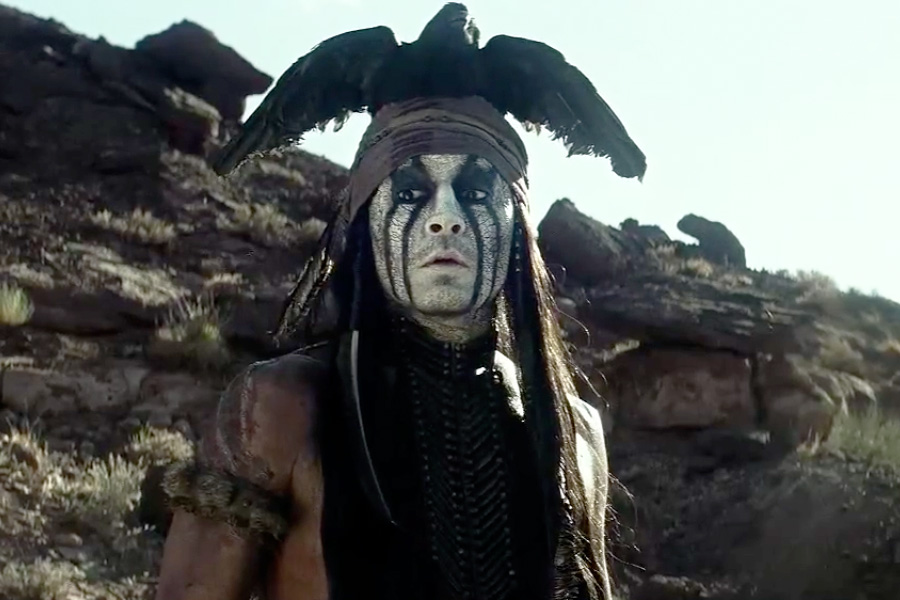 I know there are many people out there experiencing stage four Depp fatigue, and I can’t blame them. His penchant for peculiar character construction can get somewhat tiresome if the movie doesn’t have more going on. In something like Alice in Wonderland, a movie I didn’t even like, at least his weirdness fit with the weird world unlike, say, Dark Shadows, a movie best forgotten by everyone involved. Here his Tonto is as head scratching as he is humorous. And is there an inherent awkwardness having a white actor, in this day and age, playing a Native American? According to the Internet, Depp has said he “probably” has some Cherokee ancestors because he’s from Kentucky. The funny (awful?) thing is that Tonto is often in white face with his special face painting (red face in white face?). I just don’t think he can apply the same bug-eyed, swishy, eccentric sensibility to every character and call it a day. Just when you think he’s gotten away from starring in every movie with Helena Bonham Carter, surprise, here she is. And it’s not even a Tim Burton movie, people! Tonto is seen less as side kick and more of a co-lead if not the real star, and part of that is the bankability of Depp as a box-office draw, part of that is Depp as an executive producer on the project, and part of that is just because the kooky Tonto is just far more interesting than the straight-laced Reid. Hammer (Mirror, Mirror) has the jaw line, the look, and an engaging yet square appeal to him, and if anyone saw The Social Network you know the handsome lad can act. Too often he ends up being a minor foil to Tonto; it takes him far too much hemming and hawing before he accepts his masked outlaw status. As a result, he’s something of a bland fuss bucket.
Disney’s big-budget reworking of The Lone Ranger will probably be held up as the prime example, in a non-Michael Bay summer, of everything wrong with studio filmmaking, the punching bag for blockbusters. Some may even invoke a comparison to another costly Disney endeavor, last year’s flop, John Carter. There are plenty of faults the movie exhibits, namely an extended sense of bloat and an uneven tone, but I’d be lying if I said I was obsessed with the faults by its spectacular end. The movie does enough right, and enough semi-right with enough style and verve, that I left my screening feeling giddy and satisfied. It might be too dark, too glib, too weird, or too self-indulgent, but those are all reasons that made me like this movie even more. There’s a character with a wooden leg that doubles as a rifle, and not only that but one of our villains, a cavalryman, has a clear fetish for prosthetic legs. And this is a Disney film! I can’t help but love the spirit at large. Thanks to a fine supporting cast, Verbinski’s high wire visual stylings, and some strange sensibilities, not to mention a grand finish, The Lone Ranger is as entertaining in what it does right as with what it does wrong.
Nate’s Grade: B
Share this:

White House Down (2013)
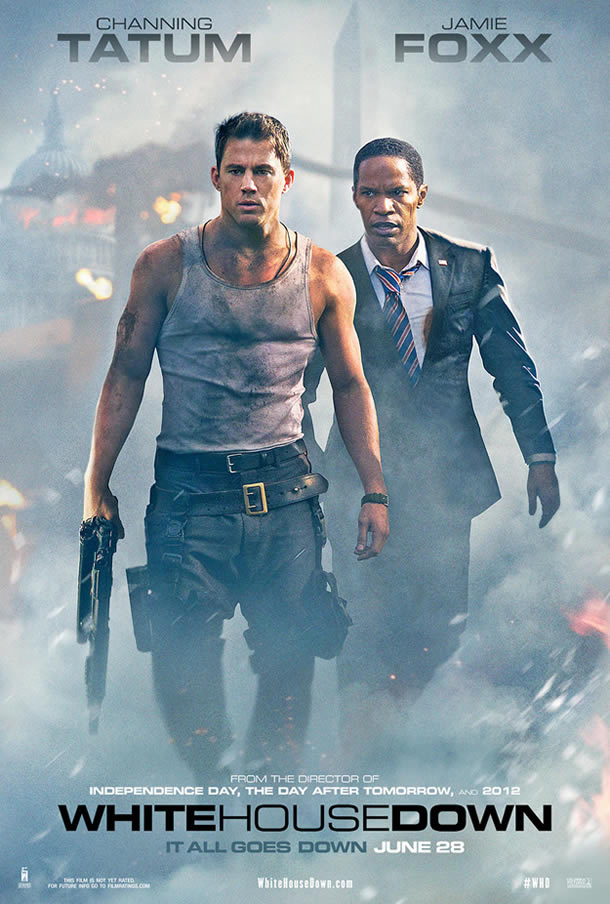 Director Roland Emmerich, the maestro of the dumb fun blockbuster, is never going to get the credit he deserves but the man is something of a mad genius when it comes to putting together spectacle-rich, low-calorie but still satisfying summer entertainment. Take White House Down, the second of 2013’s Die-Hard-in-the-White-House movies. It’s really more of a buddy film contained to that famous structure. It’s not a smart blockbuster by any means but it makes up for any and all flaws with its sheer overpowering sense of fun. Stuff gets blown up real good, the action is brisk, and there are satisfying payoffs for story elements that felt like they were, at first glance, merely thrown together. You may walk away surprised at how much you’re enjoying the comedic interplay between Secret Service agent Channing Tatum and president Jamie Foxx. Plus it’s fun to see the president in on the action instead of merely as a hostage, like the earlier Olympus Has Fallen. In direct comparison, I’d have to say White House Down is the better of the two movies, both in payoff and action. It’s nice to have a movie that’s just fun to watch, that goes about its blockbuster business with precision, supplying a few decent twists, and giving us heroes worth rooting for and action sequences that are well developed and that matter no matter how ridiculous. Emmerich movies are blissfully free of self-serious malarkey, though his weakest hit, 2004’s Day After Tomorrow, got a bit preachy. His movies know what they are and know the demands of an audience. What I needed this summer was a movie designed to make me cheer the impossible. White House Down is a romp.
Nate’s Grade: B+
Share this:

World War Z (2013)
 No movie this summer has had such a dark cloud of bad buzz like Brad Pitt’s World War Z. Based upon Max Brooks’ 2006 novel, it’s a global zombie action adventure that Pitt, as producer, has developed for years. He hired director Marc Forster (Finding Neverland, Monster’s Ball) and after a very protracted shoot, according to reports, neither was on speaking terms. A Vanity Fair article highlights the fascinating challenges World War Z endured, the biggest being a third act that, while filmed, did not work. The movie’s release date was pushed back twice, from summer 2012 to December 2012 to finally summer 2013. That sort of talk usually raises critic hackles, anticipating a bomb that all parties are trying their best to salvage some investment. It’s something of a small miracle then that the finished film actually kind of sort of mostly works. It still feels lacking and under developed but World War Z is not the fiasco many had feared.
Gerry Lane (Brad Pitt) is an ex U.N. inspector pulled back into the field to do nothing less than possibly save humanity from the undead. The world is under siege by a new sort of pandemic, one that reanimates the dead. Gerry and his family barely escape Philadelphia alive and find refuge on a U.S. aircraft carrier offshore. Gerry bids his family goodbye and zips around the globe looking for Patient Zero. If he can crack the mystery of how it all began perhaps mankind can develop a cure.
 For fans of the book, it’s best to come to terms with the fact that the only thing World War Z has in common with its source material is the fact that there are zombies. There is one reference to Israel’s response to zombie rumors, but that’s it. Believe me, I know the book is excellent but allow me to play devil’s advocate here. Would a strict adaptation of Brooks’ book work as a movie? Perhaps, but it takes place years after the titular World War Z. I understand the producers’ wishes to set the movie in the middle of the crises, adding urgency and an immediate sense of suspense. Once you go that route, there are certain limitations to your storytelling. Unless you were going to go the Crash-style ensemble route, you’re going to need a central character/hero to tie it all together, and that too limits your storytelling options. Gerry can hop around the globe but we’re still only following one man’s personal experiences. While in the air, we see in the distance below a mushroom cloud rising. Who detonated an atomic bomb and why? We never know, and it’s that sort of in-the-moment fog of war madness that helps the movie operate. I enjoyed watching the small moments of society breaking down. Factoring in all that, I’d say that the big-screen edition of Brooks’ book is a passable starter, an appetizer that gets you hungry for more.
This movie is one of the first global-scale zombie outbreak films I can recall. Usually the zombie subgenre is told in confined spaces, remote locations, intimate settings. Danny Boyle had some larger London set pieces with 28 Days Later but that was still a film about dark corridors and small places. The scale of World War Z is what sets it apart. There is a degree of fascination watching the world come apart, and watching it fall apart in so many places adds to that. Gerry hops from one hotspot to the next in his quest and we watch as each new location goes to hell. It gives a greater sense to the dire threat out there. In the information age, and with Gerry’s U.N. connections, he can get global reports, and to learn that nowhere is safe helps maximize the pandemic threat and sense of urgency. I didn’t even mind Forster’s decision to present the teeming armies of the undead like there were a swarm of bees, rolling and tumbling over one another, forming formidable human pyramids. It’s a fairly spooky image and relates back to the nature-undone alchemy that makes zombies tick, plus it gives an extra sinister edge to the zombies. High-walled structures are not the sanctuaries we might have assumed. The true terror afforded by zombies, beyond the fact that the monster is us, is its inevitability; it doesn’t matter what you do, they will get you. There are more of them, and they don’t require food, water, sleep, and have only one goal. Adding to that sense of doom I think is a good move, and the raging sea of human bodies also helps Forster keep the PG-13 rating the studio dictated. I didn’t really miss the blood/gore, though one sequence where Gerry slices off a soldier’s infected arm seems a bit too clean and precise.
I criticized Forster’s skills directing action after 2008’s deeply disappointing Bond misfire, Quantum of Solace. The man showed no real feel for action sequences. Perhaps the man found a greater appeal to World War Z because there are some genuinely thrilling action and suspense sequences here and Forster deserves credit. The Israel sequence degenerates at a horrifying speed, and I loved the touch of caged passageways being erected through streets as a last-second defense from falling zombies. The initial stop in South Korea is at night and in the rain, thwarting Gerry and his team from seeing too far into the distance. It makes for a rather suspenseful sequence that makes good use of darkness and cover. The zombie actors in this movie deserve some recognition. They really get into all their clicks and clacks and add some creepy authenticity to the proceedings. Then there’s the airplane attack, zombies on a plane, that is all over the film’s advertising blitz. It’s a rather entertaining sequence, though one can’t help but provide some class subtext when the first class passengers barricade themselves while the coach passengers are torn apart. I still think Forster would be more at home with smaller dramas but he shows much more prowess for larger material.
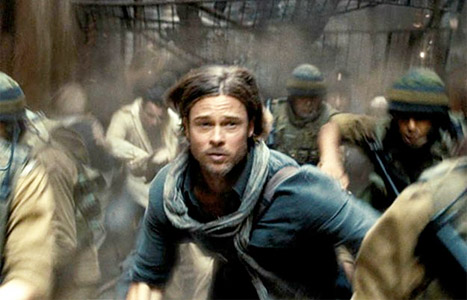 The reshot third act, thanks to added writers Damon Lindelof (TV’s Lost, Prometheus) and his pal Drew Goddard (The Cabin in the Woods), drastically scales down the scope of the pandemic. After two acts of all-out global chaos, we retreat back to the zombie film roots: a small, secluded place. The third act is almost like its own little separate movie. Partly because it’s something different, more horror/suspense than action, as well as being in the confined space, but also because Lindelof and Goddard do a fine job of structuring this concluding chapter. When Gerry gets to a World Health Organization outpost in Wales, he has a simple goal: get from one end of a lab to another. Oh, there are zombies all over the lab. Its narrative simplicity, as well as the clear focus, is a satisfying way to close out a movie that was sort of all over the place. Forster seems to really enjoy the suspense setups that he gets to have fun with in the third act, things like ducking around corners, avoiding zombie detection. The very end provides a ray of hope for humanity… until you fully think out what the consequences are for that hope (the first line of defense shall be hookers). Anyway, it sets up a sequel where mankind can begin fighting back. How do I know this? None other than Gerry’s closing lines are: “This is only the beginning. This war isn’t over.” A bit of hope on Pitt’s part as well there.
And yet with the world falling apart and Pitt our savior, I found myself from the outset very emotionally unengaged with the film. Pitt’s performance is perfectly suited for the material. It’s just the whole family man angle that doesn’t work. I understand it gives Gerry some personal stakes in doing his job but wouldn’t, I don’t know, saving the world be enough when it comes to motivation? It’s your standard reluctant hero’s tale, but the family stuff just kept dragging down Gerry’s character. To begin with, a man looking like Brad Pitt who voluntarily makes pancakes for his kids every morning… sounds like the stuff of fantasies for many. However, it almost keeps him away from his mission, the greater good, and there’s actually a sequence in South Korea where his family literally endangers Gerry’s life by making a phone call. Then the movie keeps cutting back to their existence on an aircraft carrier like I have equal interest in this storyline. One storyline involves Gerry flying the world over and escaping zombies. The other storyline involves whether Karin and the kids will be kicked off the ship. Which would you rather spend time with an as audience member? I didn’t really care about Gerry’s sad wife, played by Mireille Enos from the sad TV show The Killing. I had more invested in the Israeli soldier (Daniella Kerteesz) Gerry teams up with. My father even wanted them to run off together by the end and ditch Karin. I won’t even speak to the awkward storyline where Gerry’s family unofficially adopts a Hispanic kid after his parents die. If only those poor souls had listened to the knowledgeable white man who they took care of.
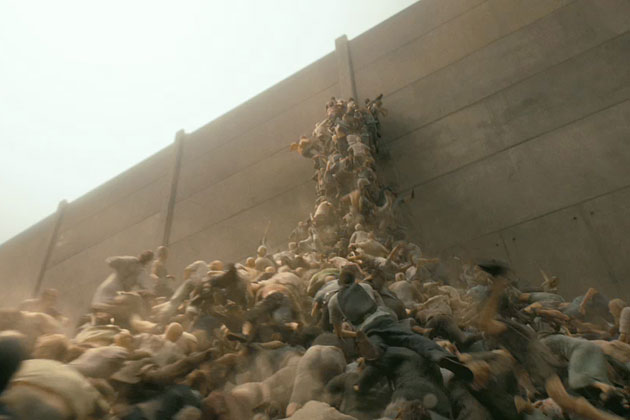 The big-screen version of World War Z bears little resemblance to the book of the same name, and that’s okay. Some adjustments are necessary in adapting, like bringing the actions of the story into the present, centering on a major character. As a book fan, I was somewhat disappointed in the unfulfilled potential presented, but as a movie fan I’m more disappointed by the film’s overall execution. There’s a lot of money in this production, the most expensive zombie film of all time, and a lot of talent on both sides of the camera. And yet after even pulling off a mostly effective ending, World War Z is more middling than it ever should be. Brad Pitt is saving the world from zombies; that should be enough, but it’s not. The movie shows flashes of intelligence, of socio-politico commentary, of something greater, but those moments are fleeting and ground down to make way for a mass-appeal action blockbuster. There’s nothing wrong with those sorts of movies (Roland Emmerich does them exceptionally well), but World War Z doesn’t have the brain-headed flair to pull it off. It’s thrilling, in spurts, interesting, in spurts, and entertaining, in spurts, but it fails to coalesce into something truly worthwhile. My allegiance to the book, as well as zombies in general, guarantees I’ll be there for more if World War Z spawns sequels. Hopefully there will be more because there are so many great stories from the book yet to be told (namely, everything).
Nate’s Grade: B-
Share this:

Before Midnight (2013)
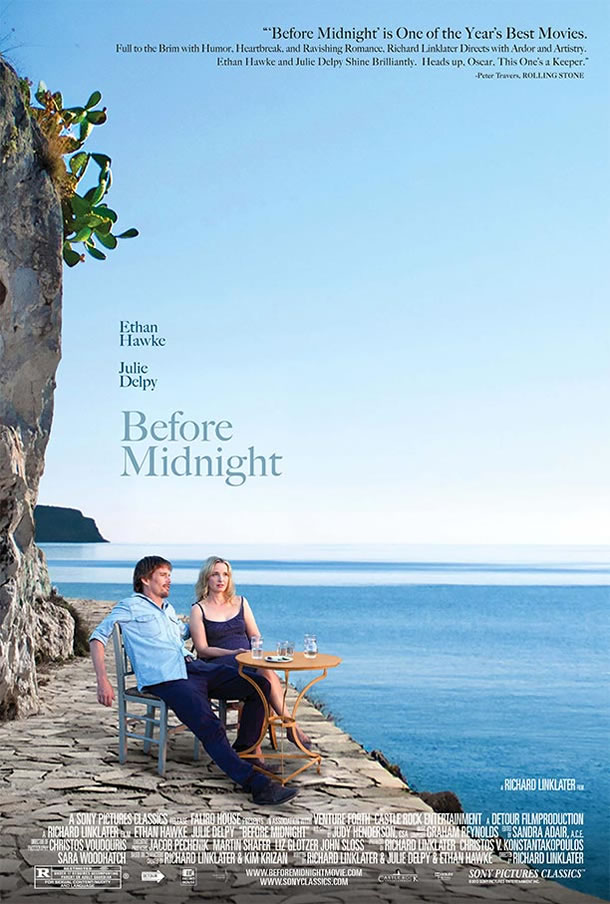 If you’re a fan of writer/director Richard Linklater’s previous movies (Before Sunrise and Before Sunset), as I am, then a new Before movie is a cause of celebration. It feels like we’re checking in with old friends. It’s fascinating to take stock of these characters and their new points in their lives, now approaching middle age. This series is becoming the dramatic equivalent to the 7 Up documentary series that periodically checks up on its subjects every seven years in their lives (56 Up came out this year). Individually, the films are wonderful, but when taken as a whole, the series becomes something truly special, something indelible and sweeping and transporting. Before Midnight is a wonderful movie, brimming with heart as well as ache. It’s also one of the best movies you’ll see this year and another touchstone to the impressive legacy of the series.
In 1995, 23-year-olds Jessie (Ethan Hawke) and Celine (Julie Delpy) met on a train and spent a magical day strolling through Vienna and essentially falling in love. In 2004, Jessie was touring Paris on his book tour, having turned the events of that Vienna night into a successful novel. Celine meets him and the two pal around, reconnecting, with Celine revealing how much that night meant to her as well. Now, in 2013, Jessie and Celine are together, though unmarried, and have twin seven-year-old daughters, Ella and Nina. They’ve been vacationing in Greece for a month while Jessie works on a new novel. Over the course of one long day, the couple will try and stir old passions and question whether they still share the same commitments.
 We’re watching the evolution of two human beings, and your response will vary depending upon your own life’s stopping point at the time of viewing. I must say, as a man now in his early thirties, that I enjoyed Sunrise and Sunset even more, finding greater thematic resonance to the characters, their anxieties, and the concern about faking your way through the “adult world.” I imagine I will find these movies even more emotionally engaging as I continue to age and cross similar hurdles as the characters do. For fans of the series, we’ve already invested 20 years and four hours of screen time with these characters. There’s more at stake when they fight. Watching the other movies beforehand, which I heartily recommend for multiple reasons, also provides stirring points of contrast, the romanticism of youth, the exuberance of promise. What Before Midnight does, and does so exceptionally, is take the romance of the earlier films and put it to the test. There’s a lovely dinner scene with several couples, and you realize that each one is an analogue for Jessie and Celine: the teenagers, the middle-aged couple starting out, the older couple discussing the demise of their previous spouses. It’s hard not to contrast the different stops and the different realities of love by the age.
Fair warning, Before Midnight is the least romantic of all three movies (I want a new movie every 9 years or so until the last one is essentially Amour). The first movie was them connecting. The second movie was about them reconnecting. The third movie establishes that they’ve been together for nine years and have a pair of twin daughters. The focus of Midnight is the struggle of maintaining a long-term relationship, something rarely given such thoughtful, perceptive, and compassionate depth on screen. We’d all rather watch lovebirds make goo-goo eyes at one another while we swoon appropriately, but Midnight’s many battles, small and large, new and ongoing, explore a relationship reality that many should find alarmingly relatable. While the particulars may be different, you may be surprised at how similar these conflicts can be. Exclude stuff like vacationing in Greece, the cushy jobs, and look to the mounting difficulty to retain that spark, a reminder of why you fell in love long ago, with the responsibilities of parenting and work stretching you in different directions. Routine can quickly transform into malaise. Jessie has a teenage son from a previous relationship, and this pushes him into great remorse when the kid departs, making him feel inadequate as a parent, which leads him to suggest unlikely relocation scenarios. Celine, being something of a worst-case scenario creature, notes the moment, saying this is when couples start falling apart. She’s worried he’ll resent her for choosing against a cross-country move. However, as the movie progresses, you realize there are already enough long-simmering resentments between the couple. This is a hard movie to watch at times because Jessie and Celine both go for broke when they argue, and it can get ugly (he dismisses her feelings as “crazy”; she vents about his lack of virility). Ending on a moment of ambiguity, like the other films, it’s perfectly reasonable to assume you just watched a two-hour breakup movie. Their problems don’t really seem resolved but I guess we’ll see in nine years, won’t we? Hopefully the next one isn’t called Before Divorce.
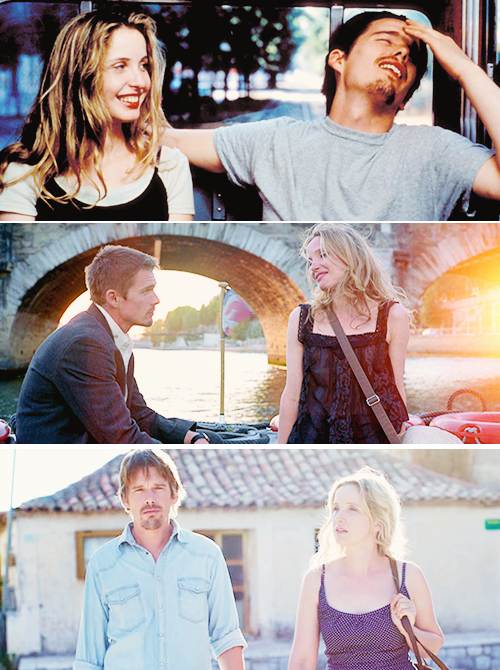 The hallmark of the series, its sparkling conversation, is alive and well, with added maturity and reflection. When you get dialogue this good, this fluidly natural, this engaging, I could listen to them talk for days. In my mini-review for Before Sunset I compared it to listening to birds sing. The shots can last upwards of ten minutes as the camera just slowly walks ahead of Hawke and Delpy as they converse. In the first film we got a foot-tour of Vienna, the second Paris, and now Greece. The sights, while nice, are incidental because I was consumed with the dialogue, which spills so effortlessly from Hawke and Delpy, relishing playing these characters once more. Their give-and-take is often breathless, with nary a pause between them, and it can become overpowering for the uninitiated (lots of old ladies, I have found, dislike this movie, though when asked, none have seen the previous two). But there’s such added dramatic subtext now that we’ve jumped ahead in time. Rather than yearn for the characters to get together, now we’re assembling what we can of their history together and the durable conflicts. The exposition never feels forced, and each new bit provides another prism to view the character actions. You’re studying the characters, parsing their words, sizing up their honesty, and analyzing the various tests and dodges they dole out to one another. It’s a more active experience than you might expect for watching people talk a lot.
Hawke (The Purge) and Delpy (2 Days in New York) are so exquisitely natural with these characters and together and never better. They know these people inside out, and they should because both are credited yet again as co-screenwriters with Linklater. I’d expect another Oscar nomination in their future, much like Before Sunset. Delpy has a wonderful faux youthful voice she uses for hilarious disdain to narrate Jessie’s female fans. Both actors go a long way to flesh out their characters, provide degrees of new wisdom and worry while making us care about their problems. One character does not have the moral high ground, which makes their arguments all the more challenging to process. I don’t want to make it sound like Before Midnight is some twenty-first century Whose Afraid of Virginia Woolfe? There are innumerous moments of humor and grace and compassion, but the louder ringing of the raging conflicts can swallow them up. I also found it intriguing that this is the first movie in the series with nudity from our couple. Granted, it would seem somewhat forward if it happened in Sunrise and Sunset considering the narrow timeframes. As presented in Midnight, it loses erotic context and becomes another indicator of the struggles of maintaining passion.
I want to reiterate that I really hope that Linklater and his stars continue to bless us with a new film every decade, checking back on the lives of Jessie and Celine. The next one, if we continue the nine-year tradition, will deal with them turning fifty, which seems like a grand opportunity for some existential ennui. Also, Jessie son from a previous marriage will be roughly the same age Jessie was in 1995’s Before Sunrise. That could provide another interesting perspective for dad. I’m just not ready to say goodbye to these characters yet. Much like the 7 Up documentary series, the movies provide a point to reflect on our own lives, how we’ve changed and grown, the setbacks and triumphs, surprises and sadness. Catching up with the series, I viewed the movies very differently than I did when I first watched them. The art remains the same but the frame changes; we change. The glorious aspect of Linklater’s series is that we get to chart that change, checking back with old friends we’ve grown with. The movie’s attention to character and the relatable problems of middle age and long-term relationships is rich, nuanced, and just about everything This is 40 should have been and wasn’t. Before Midnight may lack the idealistic romanticism of previous entries but it substitutes a soulfulness to a series that has always been mature beyond its years. Approaching half a life lived, the characters still have plenty of life in them, plenty of dreams worth pursuing, and plenty more hurdles to go. It has been an ongoing privilege to get to spend time with these two. I pray this is not the end but just another stop on what ends up being one of cinema’s definitive statements on love through the ages.
Nate’s Grade: A
Share this:

Man of Steel (2013)
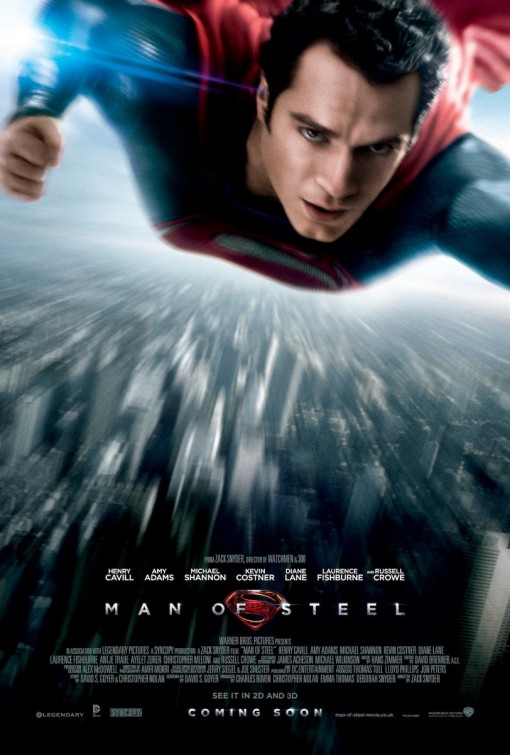 I think I began my review for 2006’s Superman Returns the same way but I don’t care. Does Superman have any relevant appeal in today’s society? I understand being a moral pinnacle has been his MO from the start, and I understand that today’s generation likes its heroes dark and broody and tortured. I know you can make Superman into an interesting figure (the man just celebrated his 75th anniversary, so there have to be some people who identify), though it is a bigger challenge, surely. I think taking a darker tack can be achievable but needs finesse. Christopher Nolan and David Goyer, having fashioned the highly successful Dark Knight trilogy, seem like a formidable pair to shepherd a darker Superman into the twenty-first century. Combine that with director Zack Snyder (300, Watchmen), and you’re guaranteed a pretty movie. Where does Man of Steel go wrong?
You know the drill at this point: Superman a.k.a. Clark Kent (Henry Cavill) was originally born on the doomed alien planet Krypton. His biological father, Jor-El (Russell Crowe), sent his son to Earth with the hope that he could survive and achieve great things. Raised by Jonathan and Martha Kent (Kevin Costner and Diane Lane), he then accepts his destiny to be mankind’s protector, butting heads and flirting with dogged reporter Lois Lane (Amy Adams). Except now Superman has the entire genetic code of Krypton’s history (?) transported into him via a “codex” (whish resembles a charred baby skull). General Zod (Michael Shannon), imprisoned off planet when Krypton was destroyed, is determined to retrieve that code and start his race anew. He and his crew travel to Earth and demand superman turn himself in, or else Earth will suffer.
 Where this movie gets into deep trouble is that it fashions Superman into an inactive loner, turning him into a super bore. He has such superhuman strength at his command but his doubtful dad has taught him that humanity would lose its mind if he revealed himself. And so Superman goes through half this movie hiding his super ability. He actively avoids conflict and confrontation. It’s basically the same formula as the Incredible Hulk TV show, where Bruce Banner would drift from town to town, warning others not to make him angry, then mournfully have to leave yet again. He can’t help himself save lives but, in flashback, dearly departed dad admonishes him for it (Clark: “Should I just have let them die?” Pa Kent: “Maybe.”). I think the isolation the character endures is essential to understanding his heavy burden, but at the same time this was compensated by Clark Kent, Superman’s opportunity to blend in with the natives, assume a frail phony identity, and to flash some much needed personality. In Man of Steel, he doesn’t become Clark Kent, news reporter, until the very last scene. It’s not a movie about a man becoming Superman but Clark Kent, experience-free reporter.
Two of the chief complaints about Bryan Singer’s 2006 Superman movie were that it was too reverent to its source material, namely the Richard Donner films, and it lacked sufficient action. Well, both of those issues are tackled in the very opening of Man of Steel. Goyer reworks plenty of Superman mythology from a science fiction angle, and so we get stuff about alien invaders, genetic bloodlines, clone baby labs, teraforming, and all sorts of spaceships. The characters keep referring to Superman as “the alien,” and dad worries that the knowledge of his super son will upset people’s worldviews about humanity and God (have no fear, there’s still messianic imagery to sledgehammer you with). I’m fine with Goyer playing fast and loose with Superman’s history but his alterations need to have solid reasoning. Nolan played around with Batman’s history and it worked because, in the context of the world and characters he developed, it fit. Does Jor-El riding a dragon like a live-action Heavy Metal fit? Does a billion people’s DNA transposed into Superman’s cells fit? Do Superman’s actions during the quite controversial ending fit? Does Clark’s stepdad, Jonathan Kent, willingly dying in a tornado fit? Does Lois Lane immediately knowing who Superman is, before he even adopts the Clark Kent disguise, fit? I doubt it, though it still could have worked. However, Goyer’s script is a mess structurally, preventing the story from gaining serious traction. First, we start with twenty-something minutes on Krypton, which could be condensed in half, then we slam into the present and this new formula appears: present, flashback, present, flashback, present. That happens for another twenty minutes. Then there’s 40 minutes of Superman dithering as the reluctant hero. Then the last hour plus is a nonstop barrage of meaningless action that squeezes out room for character growth.
I’ll credit Snyder and company for likely tripling the action quotient of any previous Superman movie (maybe even all of them combined), but I never thought such action would be so boring. Oh sure, it delights for a while with advanced special effects and Snyder’s eye for visuals, but the action sequences drag out far too long. A long action sequence? Isn’t that what you’re always demanding, critic Nate? Well anonymous and theoretical detractor, yes, I enjoy a well-developed and sustained action sequence. The problem with action sequences is that they have to matter. They have to accomplish something even if it’s just there are less enemies or the hero got from point A to point B. There has to be, at bare minimum, something that is accomplished. Sadly, this is not the case with the action in Man of Steel, which is why the sequences drag and feel like they are twice as long as their already bloated length. There’s a brawl between two evil Kryptonians and Superman and after a whole 10-15 minutes of sparring, the bad guys get on a ship and leave. Come on, Zod has like a crew of twelve henchmen. Can’t one of them at least die in a preliminary battle? Worse, the final confrontation between Zod and Superman could just as easily been eliminated. They punch and yell and punch and yell and stuff gets all smashy, but by the end of the fight, nothing has substantially changed, except the foundational surroundings (more on that below). Having two invincible beings punch each other for a half hour is not engrossing. For a lengthy action sequence to work there need to be complications, organic to the situation, and the stakes should escalate. James Cameron and Steven Spielberg are masters at crafting escalating action. J.J. Abrams is pretty good himself. Even Michael Bay has his merits. I don’t know whether to lay the crux of the blame on Snyder or the screenplay he had to give life.
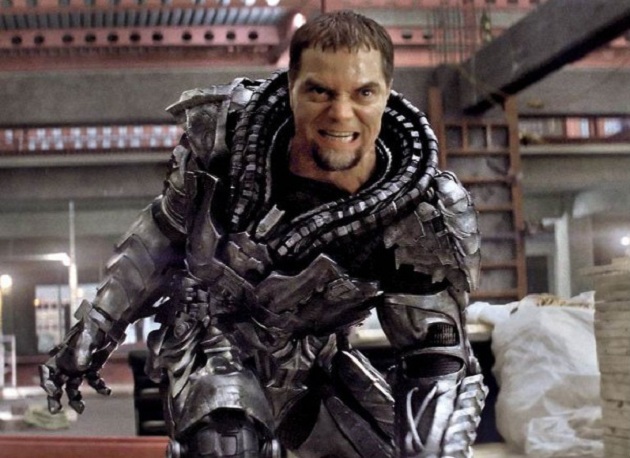 As the plodding action continued to pound me senseless, I was left to seriously ponder just how epic the scale of Superman’s collateral damage truly is. At one point, when Supes is fighting in the small-town center of Smallville, he tells the residents to, “Stay inside. It’s not safe.” What then proceeds to happen is a fight that rips up almost all the pavement in town, takes down a helicopter, a few fighter jets that crash in town, exploding, as well as a train car, plenty of ricocheting gunfire, and debris everywhere. But have no fear because those citizens stayed away from the windows and locked their doors! More than likely they are dead. The concluding clash in Metropolis is like 9/11 times eight. I counted three different skyscrapers that came tumbling down, and this is after the Krypton gravity field has ripped up the city and smashed it to dust, as well as missiles exploding around the city and Zod’s various spaceships. Then there’s the fight where Zod and Superman are blasting through just about every high-rise office building, and even when they collide outside it creates such force that buildings crater. They even fly into space, destroy a satellite, which then comes down as fiery debris that rains down on poor Metropolis. The final plan to foil the bad guys involves, get this, opening a black hole above a major city. It’s not like that sounds as if it will have catastrophic blowback.
The 9/11 imagery is unmistakable and I don’t care if it has been 12 years now. Couldn’t Superman at least react to the desolation he was causing? I really hope some enterprising soul via the Internet tallies the number of estimated deaths because I sincerely believe it would reach into the millions (Update: Ask and ye shall receive). Superman decimates the city and I thought less about the gee-whiz factor of the special effects and more about the innocent lives being lost amidst the CGI devastation. It looks like an atomic bomb went off. Perhaps a sequel will start with Lex Luthor rebuilding Metropolis.
And that’s the problem when you try and make sense of Man of Steel’s more realistic, grounded approach. This is a Superman that came of age in the 80/90s. While touches like young Clark experiencing sensory overload with his powers, like a scared autistic child, are clever and nice avenues toward relatability, you still have to square the more bombastic, over-the-top, and downright stupid moments that clash with that refined tone of greater realism. Nolan wanted Batman to exist in a recognizable world, so it makes sense that he and Goyer would attempt to do likewise with DC’s other champion. The prospect of an invincible alien among us is a potent source for some thoughtful and topical drama. It’s just not going to happen when Superman can demolish cities without blinking an eye or when anyone else fails to register the scale of this tremendous trauma. We don’t even have outside reactions or opinions to the earth-shattering revelation that we are not alone in the universe.
Then there are just the little things that annoyed me. Jonathan Kent dies in an effort to save the family dog. This comes off as lame, especially when Superman could save dad but has to hold back, per pa’s wishes, so as not to expose himself. Except, by the end, when the United States accepts Superman, doesn’t this invalidate all of Pa Kent’s worldview? If so, then the man died for nothing. Also, General Zod wants to transform Earth into Krypton. Except… on Earth all Kryptonians have godlike powers. Wouldn’t the man just want to keep that? Also, why does Zod never dispatch more than two Krypton lackeys to fight Superman? He has all these godlike warriors and decides to just keep them locked away in his spaceship. That just doesn’t make sense from a tactical standpoint. Also, Pa Kent tells his son to do his best to blend in, but in one scene bullies harass Clark as he’s reading from Plato. Yes, because your typical teenager can’t rip himself or herself away from the likes of Plato. Careful: Plato is a gateway read to Epicurus. Then there’s the overbearing product placement. Usually I give movies a pass if they’re not obnoxious with product placement; however, Man of Steel stages entire action sequences so we can get long-lasting looks at the logos for Sears, 7-11, and IHOP: “This callous destruction brought to you by the good (surviving) people at Sears.”
 Cavill (Immortals, TV’s The Tudors) sure has the look for the part. He’s appropriately bulky but because the role is too often inactive loner, always holding back, that makes his performance somewhat bland and more reticent than necessary. Part of this is also that Snyder has historically been a poor actor’s director. You can tell throughout the film as talented, Oscar-nominated and winning thespians like Crowe and Shannon will just give off deliveries, little tinny trills that clunk, moments that a director should have stepped in for. Shannon (Take Shelter, Premium Rush) is one of our best working wacko actors, but even he comes across as a bit too unrestrained and stiff, especially when he has to scream “I will find HIM” half a dozen times in a row. I thought Zod’s second-in-command played by German actress Antje Traue (Pandorum) had more personality and better moments. Adams (The Master, Trouble with the Curve) is a good choice for a plucky Lois Lane, especially one sharp enough to see through Clark’s disguise. The movie is packed with good character actors like Laurence Fishburne, Harry Lennix, Christopher Meloni, Michael Kelly, Richard Schiff, Mackenzie Gray, and two actors from Battlestar Galactica. That’s nice. The best actor in the movie is Dylan Sprayberry as teen Clark.
Snyder’s reworked Superman for our modern age just doesn’t cut it as popular entertainment. Its misshapen structure, heavy with exposition, doesn’t provide enough space for the characters to develop, and the general edict to make Superman an inactive loner on the fringes of society is a surefire way to keep an audience at bay. The CGI-heavy action sequences feel like they go on for an eternity, straining and struggling to keep your attention because the stakes fail to escalate or have consequences outside ridiculous amounts of collateral damage to rival the worst of Mother Nature. The over-amped sci-fi reworking tries to make a clean break from the demands of Superman’s mythology, and while some revamps work, most feel needless and ham-fisted, like Pa Kent’s somewhat pointless death. But the worst charge is that the movie is just too boring. I know people have levied this charge against Superman movies in the past, particularly the 2006 Singer film that I will still stand by my positive review for. Man of Steel is a good looking movie for certain, often a great looking movie, but all those pretty pictures are for naught because of a flawed approach and overindulgence with tedious action sequences. Given its box-office riches, I expect this Superman retread will garner the sequel that Singer’s film did not. I just hope the next chapter in the new adventures of Superman experiences a Dark Knight-level rise in quality.
Nate’s Grade: C+
Share this:

This Is The End (2013)
 There are three apocalyptic comedies this year and Seth Rogen’s This Is The End is undoubtedly the biggest in profile. The plot is simple: Rogen and his pals, Jonah Hill, Jay Baruchel, Craig Robinson, and Danny McBride, are holed up in James Franco’s lavish home while the world comes to an end outside. Your enjoyment level for this movie will largely depend on your enjoyment level of the cast since they are playing self-involved, idiotic versions of themselves. While it dithers with the occasional self-indulgent sidetrack, I found Rogen to be savvy about providing enough for an audience to invest in. There’s a slew of Entourage-style cameos, though mostly pre-apocalypse, to ease us into the film. It’s fun seeing Michael Cera and Emma Watson (Perks of Being a Wallflower) play against type, but there’s so many blink-and-you’ll-miss-them figures that it can be tiring. But once it rains fire, demons emerge, and the righteous are Raptured, the movie gets outlandish and even better. For a solid hour it’s a survival tale where egotistical actors are at one another’s throats and it genuinely gets funnier as it goes. The comedy is, as you would expect, completely vulgar but hilarious often enough. A shouting match between Franco and McBride over masturbation habits, complete with angry, enthusiastic miming, is a thing of comic glory. I was not prepared for how well Rogen and his collaborator Evan Goldberg (they wrote and directed the movie) are able to handle suspense, special effects, and a climax that is equal parts silly and heartwarming. There is a rewarding payoff to a character arc amidst all the talk about penises, human and satanic, and cannibalism, and that’s saying something. I only wish the ending had more punch, settling for an extended and mostly lame pop-culture cameo that seems to sap the good times. Still, if you had to spend the apocalypse with a bunch of guys, you could do worse.
Nate’s Grade: B
Share this:

After Earth (2013)
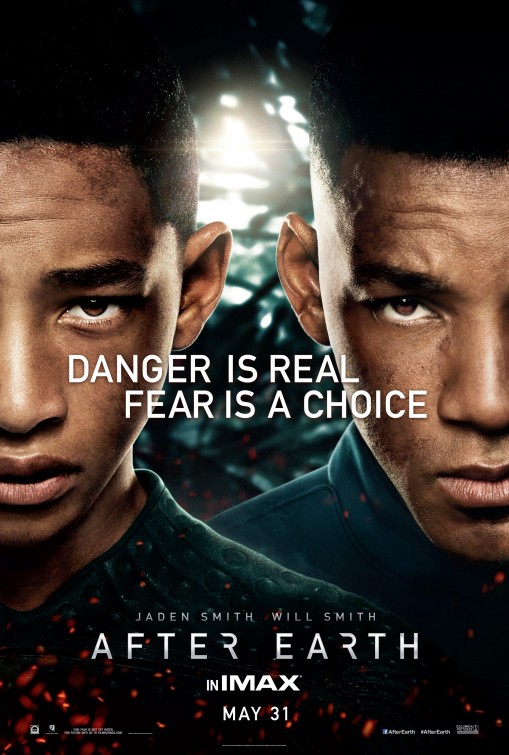 Rare is the movie that just seems to fail at every level of filmmaking, from writing to direction to pacing to casting to production design to logic to, well, you name it (perhaps the craft services were the exception to the rule). Director M. Night Shyamalan’s After Earth is one of those exceptional, big-budget passion project failures that just mystify on every account, making you scratch your head and wonder who could possibly be passionate about something this utterly terrible? I’m reminded of John Travolta’s 2000 sci-fi Scientology-ode, Battlefield Earth, for a comparison that comes close to approaching After Earth’s star-powered ineptitude (this movie also has plenty of vague Scientology references as well). While I doubt this will kill anyone’s careers associated, though it probably eliminates some good will for the Smith clan, it definitely piles more dirt on the grave that was Shyamalan’s film career. Enough preface, let’s get into the meat of why After Earth is one of the worst sci-fi films in years.
In a sloppy bit of exposition, we’re told that humans left planet Earth after we made it too unsustainable. The human race then colonized an alien world except that the indigenous aliens weren’t too happy about this. The aliens made a space monster, known as an Ursa, which would track and kill human beings by sniffing out their fear pheromones. Cypher Raige (Will Smith) rises in the ranks of the Ranger corps because he has the unique ability to “ghost.” Because the man does not register fear he is able to sneak around the Ursa as if invisible. His relationship with his teenage son, Kitai (Jaden Smith), is strained at best. Dad has been gone a long time and has high standards for his boy; the kid has to refer to him as “sir” even at the dinner table. Father and son are traveling through space when their ship crash-lands on good old Earth. Cypher’s legs are broken and he entrusts his son to make the trek to send out the distress call. The dangers of Earth, we’re told, have only magnified since humans left, and the Ursa onboard their ship has escaped.
Oh boy, where to even start with this one?
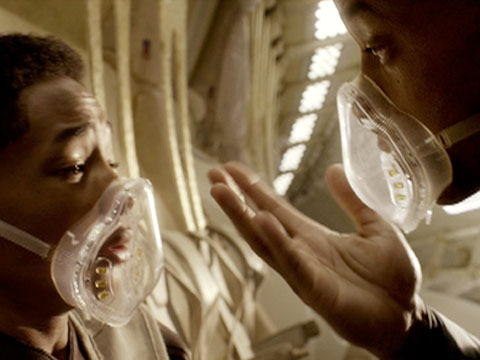 I’ve got a great idea, let’s take one of the world’s most charismatic actors and then turn him into a stone-faced hardass, terse with words of encouragement, and mostly sidelined so that his son can go on his stupid hero’s journey. I suppose Smith deserves some credit for stepping outside his comfort zone to play against type, but that praise only matters when the portrayal works. Smith is arguably miscast in his own passion project. That’s because this was really a $130 million dollar birthday present to his son, trying to use dad’s star power to establish Jaden as a star. It’s less a movie and more like a product launch. On its face, I don’t really have an issue with this. Nepotism has been alive and well in Hollywood for over 100 years and those in power have been producing vanity vehicles for their beloved for even longer. What I chafe at is that the finished product is so lacking and unconvincing. Jaden was cute in 2010’s The Karate Kid remake, a movie that was far better than it ever should have been. Unfortunately, After Earth came at that special time in his life known as puberty, so he gets his lanky, squeaky-voiced, awkward growth stage forever captured on film. Thus when he gets into a huff, squeals at his dad, and then become the world’s most improbable super warrior by film’s end, it mostly brings about snickers. You don’t buy a second of this character’s ascent to hero.
Let’s tackle the ultimate elephant in the room here, namely the involvement of Shyamalan. This is his first project he didn’t conceive; Smith himself came up with the story and personally hired Shyamalan. Who deserves more of the blame? There’s a reason why the marketing for After Earth has not breathed a word about Shyamalan’s involvement. In my theater, when the end credits appeared and it opened with Shyamalan’s director credit, the guy behind me remarked, “Well, that figures.” His sense of dissatisfaction now had a tangible culprit. It’s almost become a joke how much of a critical punching bag Shyamalan has become as a filmmaker. The man has genuine talent but it’s five duds in a row (I am counting The Village) and not even the world’s most bankable star could have saved this movie. As anyone who witnessed the atrocious Last Airbender can attest, Shyamalan is not a filmmaker who works well with a big special effects canvas. I’d suggest that Shyamalan, besides taking some time off, which may be a self-prescribed death sentence in Hollywood, find a smaller project to foster, perhaps something more personal and intimate. Nobody except the sadistic enjoys watching once-promising talents keep hitting a brick wall. Then again, people also dislike having to pay for terrible movies, especially when the director of said terrible movies keeps getting the opportunity to deliver more disappointment.
The plot, which Shyamalan is credited as a co-writer for, is so dull that I found myself almost falling asleep. You would think father and son surviving crash on a hostile alien world would be packed with survival thrills and excitement. You’d be wrong. It’s as if Shyamalan takes a page from Smith’s ranger character, and just goes about its business in the most thankless, ho-hum, undeterred manner. When we have characters that don’t react to the danger they’re in it has the misfortune of feeling less real, less urgent, and less dangerous. This was a problem with The Matrix films when Neo became a super being because then the stakes evaporated. It’s hard to sympathize with characters that don’t reflect the reality of their setting. With that said, so much of this script is just Kitai running off and running into different animals. He meets baboons. He meets a tiger. He meets an eagle. He meets a slug. Scintillating stuff. Such ambition. If this is what the execution was going to be like, why didn’t Smith and Shyamalan just make the planet an actual alien world? It would certainly open up the storytelling options. Or they could have gone in the opposite direction, setting this survival tale on a modern Earth. That would probably have made it much more relatable and resonant and also far cheaper.
 The character back-story is also woefully familiar and just as ineffective. Before it even happened, I knew that there would have to be some tragic personal history so that Kitai could overcome his past. We’re given some cringe-worthy moments of flashbacks to the family’s happier times, when Kitai’s older sister Senshi (Zoe Kravitz) was still alive. It’s a plodding and contrived plot device for the father to preposterously blame his son for, who was like seven years old at the time. I kid you not, during one of these oh-so-necessary flashbacks, Senshi tells dad she got a copy of Moby Dick and a boy let her hold it. Dad doesn’t get it, though I don’t know if this is meant to be some lame sex joke. This back-story is ladled in with no real logical connection to events. All of a sudden, Cypher will be thinking about his broken leg and then, whoosh, we’re thinking about Moby Dick.
There’s also the issue of its tenuous grasp on reality. I know this quality is a give-and-take depending upon the tone of the sci-fi film, but After Earth is so drearily self-serious that it becomes even more unbearable when it so clearly conflicts with credulity. This movie’s big message that it pounds into your head repeatedly is that fear is a choice, fear is not real, and that fear is a hindrance for mankind’s progress. This is nonsense. Fear is what kept our ancestors alive rather than trying to play with larger predators. Fearlessness is a great way for your species to end. You know an animal without fear? Lemmings. The fact that the movie has to literalize this conflict in the form of a fear-smelling alien monster is just beyond absurd. Let’s keep this literalizing-of-theme going; maybe next the aliens will fashion a monster that smells intolerance or illiteracy. Why are these aliens even genetically creating a monster to do their dirty work? If they have the superior scientific prowess to create a gnarly beast, I’m pretty sure they can take care of mankind. On top of this assertion, why would you make a beast that is effectively blind and only reliant upon one sense and then you limit that one sense to “fear”? Why not just have the alien monster smell human beings? That seems to make a lot more sense.
What also buggers my mind is the fact that, according to After Earth, everything on the planet has evolved to kill humans. First, I don’t think substantial leaps in evolution work in meager thousand-year spans; secondly, these evolved creatures are really just slightly larger versions of familiar animals, which doesn’t really make much sense either; and lastly, if humans have been off planet for a thousand years, how did these animals evolve to kill something they no longer have any interaction with? Then there’s the fact that the Earth drops rapidly into freezing temperatures overnight, for no good reason. How do all those plants survive? As an extension, Kitai’s super suit is just a prime example of a poorly developed idea that just as easily could have been abandoned. He has a special leotard that changes to his environment. We’ll watch it change colors though we’re never given any worthwhile reason why this is happening. However, Kitai’s suit will not shield him from Earth’s sudden temperature drops. So he’s wearing this super suit that adjusts to his environment… except temperature? If you’re going to present something all super scientific and then give it such obvious limitations, then you never should have introduced it in the first place. This is an ongoing theme with the film.
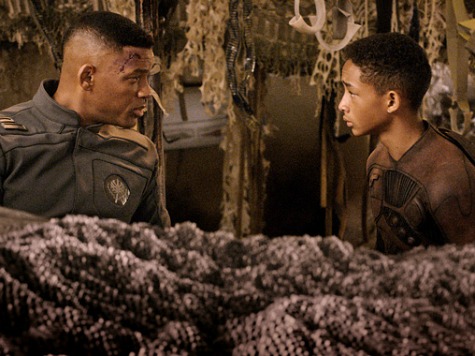 Then there are just nit-picky things like my total distaste for the production design of this movie. The spaceships look so chintzy. They have plastic flaps separating sections, like what you’d see in an office building when there’s construction. The spaceship interiors, as well as home interiors, also look like some bizarre mix of honeycomb and bamboo. I’m all for thinking outside the box when it comes to futuristic design, but this is just stupid. One of the great possibilities of sci-fi is to capture our imagination with out-of-this-world visuals, the unfamiliar, the spectacle of the alien. If your spectacle is good enough, it can even save a so-so movie, like last year’s Prometheus. Being stuck on Earth, only slightly different, emphasis on slightly, fails to deliver anything visually that will captivate an audience too often settling into boredom. Apparently After Earth looks pretty much like Earth except for Mount Doom popping up. The special effects are also lackluster and the score by James Newton Howard will try and trick you at every turn into thinking what’s happening onscreen is a lot more interesting than it is.
If you value your entertainment, please ignore After Earth. It doesn’t even work from a derisive enjoyment angle. The movie is lethargic and unimaginative to its core. It’s predictable at every turn and underwhelming throughout. The plot consists of the most boring father-son team in recent memory and a hero’s journey that feels false at every step. This big-budget star vehicle doesn’t work when its star doesn’t have the intangibles to be a star, nor does it help when the story is so poorly developed. The science feels boneheaded, the characters are dreary, the pacing sluggish, the spectacle clipped, and the world building to be bland. The shame is that this premise, even this exact same premise on a future Earth, could have easily worked as a suspense thriller. Smith seemed more interested in building an After Earth enterprise, since companion books were commissioned, and extending the reach of the Smith family empire. Making a good movie, it seems, was secondary. Being fearless also has its disadvantages.
Nate’s Grade: D


You must be logged in to post a comment.