Blog Archives
Deadpool (2016)
 Deadpool is easily the most fan service of comic characters, so it makes sense that his big screen spotlight is a movie that feels a fan service movie. The “merc with a mouth” is a character that doesn’t take himself seriously and neither does his big screen adventure, which is the biggest appeal of an otherwise standard super hero formula hiding under waves of winking irony, crass humor, and gleefully bloody violent mayhem. Ryan Reynolds plays Wade Wilson, a hired gun that undergoes a risky experimental treatment by a shady black ops organization to cure his terminal illness. It makes him generally indestructible with a rapid healing ability but his flesh is also horribly scarred and Wade is afraid his girlfriend Vanessa (Morena Baccarin), a hooker with a heart of gold, will reject him. Even in the opening credits, you know this isn’t going to be a typical super hero movie. The time is ripe for a film that knowingly ridicules the tropes of the super hero film industry, and Deadpool scores some big laughs when its making fun of itself and its super peers. The dark humor can often surprise with how go-for-broke it can get, like Wade and his Vanessa’s flirty one-upsmanship of hypothetical sexual trauma. There’s a clever montage of Wade and Vanessa’s romantic history told through sexually-specific holiday celebrations, and the inclusion of a couple of low-rent X-Men provides a comic foil for Deadpool to bounce off from. The action is fun and the movie is entertaining from its opening credits to the now-mandatory post-credits bonus. Reynolds is spiritually attuned with the irreverence of the anti-hero, finally plugging into a part that makes full use of his charm, motor mouth, and physicality. Deadpool’s runaway box-office success (grossing more than any X-Men film and on at least half the budget) will hopefully allow Hollywood to feel comfortable allowing their less than family-friendly comic titles to stay true to their intentions. Then again maybe they’ll just take all the wrong messages and think that audiences just want to hear more swearing from people in spandex. Deadpool is a super hero movie that prioritizes fun over everything else, and while it may not be for everyone, at least it’s trying to be for someone different.
Nate’s Grade: B
Share this:

Not Cool (2014)/ Hollidaysburg (2014)
 Last year, Starz aired a reality TV series called The Chair. Produced by actor Zachary Quinto and Project Greenlight breakout Chris Moore, the aim was to give two different directors the same script, the same budget, the same shooting city, and the same access to resources to see what kind of movies they would create. The public would vote on a winner and the winning filmmaker would earn a $250,000 prize. Film is a director’s medium, and both of the chosen participants, Shane Dawson and Anna Martemucci, were allowed to rewrite the script, likely to the dismay of screenwriter Dan Schoffer. Dawson has built a following of millions making comedy shorts on his YouTube channel. Martemucci has written one other film and has professional ties to Quinto. Over the course of one winter in Pittsburgh, both Dawson and Martmeucci shot their films under the extra scrutiny of the reality show cameras. Whatever their TV portraits may have been, the work stands on its own. Dawson made the sex comedy Not Cool and Martemucci made the coming-of-age drama, Hollidaysburg. They are two quite different films, but are they any good and should The Chair be considered a success?
Scott (Dawson) is home for Thanksgiving break from his first year at college. In high school he was prom king and a big deal. Life since hasn’t been that easy. His girlfriend, Heather (Jorie Kosel), dumps him after a spontaneous hookup in a public bathroom. His father is closing the family’s record store. His sister, Janie (Michelle Veintimilla), might not graduate on time from high school. And then Tori (Cherami Leigh) accidentally hits him with her car. The two have history: Scott was responsible for Tori’s cruel nickname, “Tori the Whore-y.” Not having any of it, she lays in to him and unleashes years of anger, and then the two of them have sex. They try and pass it off as a one-time deal but they both can’t stop thinking of the other person. Tori’s pal Joel (Drew Monson) is determined to have sex with his high school crush, Janie. He agrees to help her with her schoolwork for a prime opportunity to make her fall in love with him. As Joel and Scott chase after their resistant love interests, they have to decide how far to go.
 I was completely unfamiliar with Dawson and his YouTube fame before seeing his film, and after watching Not Cool I wish I had remained in blissful ignorance. To call Not Cool unfunny is too kind. It is aggressively unfunny, going above and beyond to shock and appall. By no means am I a prude when it comes to crass comedy, but you have to put effort into it just like any other style of telling and developing jokes. You don’t just blurt out something vulgar repeatedly and confuse that for comedy construction. I knew I was in trouble when the movie resorted to projectile vomit within two minutes. Dawson’s direction consists of telling his actors to go as broad as possible; they feel like over-the-top cartoons engaging in shouting matches. A Thanksgiving dinner with Scott’s family feels like an insane asylum was evacuated. It’s fine that Not Cool doesn’t approach a relatable reality, but it needs to have some internal grounding that makes sense. It also needs to be funny. Much, much funnier. After ten minutes I had to stop the movie and gather pen and paper to start noting the unfunny and off-putting misogynist jokes on display. Let me make this clear: characters can be unlikeable and have non-P.C. POVs, but when the film itself seems to be adopting a tone and perspective that allies with ignorance and intolerance, that’s when a movie can become increasingly uncomfortable. Dawson’s interpretation of the script is rife with jokes that are homophobic, xenophobic, slut shaming and in general anti-women, and, I repeat, they just aren’t funny:
In response to dad’s new girlfriend (who is never mentioned again) being named Anastasia: “With that name she’s either a Disney princess or a stripper.” Fresh.
Janie relates how her sexist teacher is flunking her, which Joel responds with, “I’m surprised he didn’t give you an ‘A’ for those tit-ays.” Ugh. Just ugh.
“Tori the Whore-y? You look kinda good now. You know that nick-name might not be ironic anymore.” Because Scott is the arbitrator of what is acceptable attraction, therefore Tori should now have a sense of self-worth because he has deigned to find her of interest. This is later reiterated when Scott tells her, “You’re beautiful. You always were.” Thanks, now that you said it Scott it must actually be true.
Joel: “The only thing hotter than Leonardo DiCaprio is a retarded Leonardo DiCaprio in a sexy diaper.” What? I don’t think he ever wore a diaper in What’s Eating Gilbert Grape?. And Janie’s response is equally baffling: “That shit makes me so wet.” Huh? Watching an actor play a mentally handicapped child makes you sexually aroused?
To quickly wrap up this detour, let me highlight the most egregious stab at humor in the entire movie. During the film’s climax, his horny ex-girlfriend sexually assaults Scott. Tori sees this and, oh no, miscommunication. Scott explains he was raped and it was not consensual. The party’s host quietly walks over to a dry erase marker board that says, “Rapes at this Party.” He erases the zero and writes a “one” on the board, then goes back to partying. Let that sink in. The board was prepared for some sense of inevitable rape, and yet once it happens, the host carries on. That’s offensive on a number of issues.
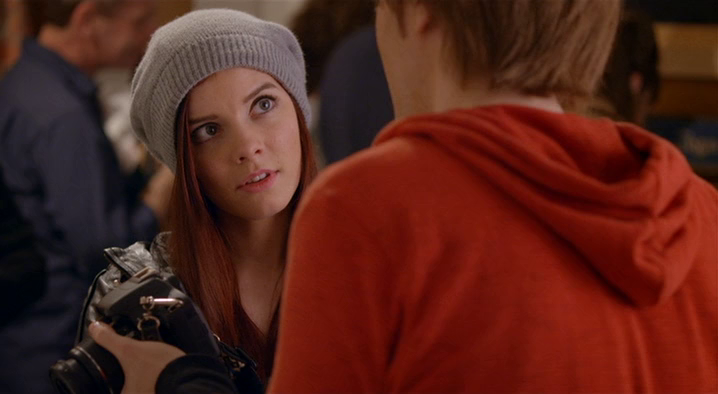 These scenes and lines are merely par for the course in what is ultimately a coarse and misguided comedy that is stocked with vile characters. Scott is served up as a figure that needs to get past his hubris, but the movie treats him more of a hero who the other characters just can’t help but love. It’s hard not to feel like the film is made to flatter Dawson as an actor. Within minutes of meeting Scott again, Tori says, “Would I have sex with you? Probably.” No one can resist his appeal, certainly not Tori’s family. Tori’s mother is practically begging to jump on top of him. When the character’s defining moment of humility and growth is cutting his Justin Beiber-like hair, it’s a failure. Tori is written in such an inconsistent fashion. She’s supposed to be all about negativity and hates everything in the world, but then she transforms into a Manic Pixie Dream Girl for Scott’s cutesy scavenger hunt. Leigh does a credible job with the character but she’s a half-formed assortment of quirks and messages meant to push Scott along. Dawson errs considerably by casting himself as the romantic lead. It further exacerbates Scott’s flattering portrayal, but really Dawson is just not a good enough actor to carry a film. But a lead role wasn’t enough, and Dawson appears as several female supporting characters in drag. The appearances stop the movie dead in its tracks. The characters are also just lame mouthpieces to blurt lazy inappropriate comments, especially a popular girl who just keeps calling people names at the top of her lungs. It is deeply unpleasant.
The worst character in the entire film is Joel. This guy is obsessed with having sex with his high school crush, who is still in high school while he’s in college, by the way. She has clearly and consistently stated that she does not have feelings for him, but what’s a woman stating her decisions going to matter to this guy? Joel’s pursuit of Janie is just insanely creepy. He mimes preforming cunnilingus on her. He stalks her online profiles to mine useful personal information. He enlargers and decreases a picture of her face on his phone and narrates the experience like she is giving him oral sex. At every point he treats her as a sex object. Even after a night out, where she wears a dress he picked out for her after trying it on himself and fondling himself in expectation (!), she tells him she doesn’t feel the same way, and he still forces the situation. It’s gross and at no point is Joel and his behavior held up to criticism. He’s rewarded for his “virtue” by having Janie pimp out all her promiscuous friends onto him. What makes the character even more repulsive is just how annoying Monson’s performance comes across; he’s going for faux bluster but it’s more like misplaced entitlement. If this storyline had ended with Joel murdering her while weeping and slow dancing with her corpse, you wouldn’t be that surprised.
 As the previous two paragraphs should indicate, there is certainly a point of view that emerges from the movie, one that trumps the heterosexual white male at the top and looks with derision on anybody that falls outside that definition. It feels like every joke is at someone’s expense. In the opening minute, an overweight woman tweets a picture of herself as a skinny model. I suppose it’s funny because she’s misrepresenting herself but it feels like the joke amounts to, “Ha, she’s ugly and fat.” But those who are conventionally attractive still don’t get off easy. Tori is slut shamed as a whore in high school, lead by Scott, and this is merely excused as the behavior of a loveable scamp. Janie’s friends are treated like idiotic sluts. Tori’s gay friend is defined by his flamboyance and obsession with sex. Disabled people are apparently hilarious just because they’re disabled and different. Tori’s older sister is blind and it’s funny because she accomplishes things… but she’s blind. I suppose the joke is that she shouldn’t have a successful life. There’s a woman at a party in a wheelchair (confession: I know this actress) and the joke is she’s doing normal activity. There’s one black character in the movie that is a homeless man who devours his own feces. At one point, his genitals are also used as a laugh. There’s also the characters’ flagrant and casual use of the word “retarded” to describe anything repulsive. The hoary stereotypes and unfunny portraits blend together, creating a mosaic of intolerance masked as comedy. Dawson’s sense of comedy is fairly puerile but it’s also offputtingly mean-spirited and denigrating.
Dawson makes too many fatal mistakes as a director for Not Cool to survive. Casting himself in the lead was a mistake. Appearing as female supporting characters was also a mistake. Excusing the bad behavior of his male characters, and rewarding them, was a mistake. Catering the humor to make fun of anyone that doesn’t classify as a heterosexual white male was a mistake. Relying solely on gross-out gags without better comic development was a mistake. Trying to earn a heart late into the film was also a mistake. After watching jerks behave like creeps with their inflated sense of entitlement, I don’t care if they maybe have feelings. Directing his actors to be heightened caricatures was a mistake. In short, Not Cool is a comedy graveyard of mistakes and bad decisions. I’m sure there will be people that find something to enjoy here, who laugh at the easy juvenile humor. I even laughed a couple times. There was a visual gag with a smuggled watermelon that was simply inspired. I think Dawson didn’t want to stray too far from his YouTube persona and the tone of his videos, lest he upset his fan base of millions, but what works as a three-minute YouTube short doesn’t translate to a feature film. Not Cool is proof enough that an overabundance of energy and cheap vulgarity does not compensate for a deficit in storytelling and execution. Not Cool is just not good.
 Going far in the other direction is Hollidaysburg, a modest coming-of-age drama that patterns itself after the mumblecore movement of indie cinema. Director Anna Martemucci definitely takes a more restrained approach to her interpretation of Dan Schoffer’s screenplay. She has some problems of her own but on a whole Hollidaysburg is the more promising and well-executed movie. It’s more sophisticated, better articulated, heartfelt, and comes far closer to achieving something worthwhile.
Right away you can tell a difference. We begin once more with Scott (Tobin Mitnick) and his girlfriend, Heather (Claire Chapelli), breaking up in the middle of sex, but they keep at it. It’s not exaggerated for extra laughs; the situation itself naturally draws them. The character isn’t made the butt of the joke either. It’s a much more encouraging opening than projectile vomit. Scott is also dumbstruck when he discovers his family home is days away from being emptied and sold. He reconnects with high school acquaintance Tori (Rachel Keller) and the two sleep together impulsively. As they’re trying to make sense of possible feelings, Heather is seeking out some company, anybody, and settles on her pot dealer, Petroff (Tristan Erwin), who happens to be buds with Scott. He’s wary of stepping over some kind of friend code, but in his efforts to get Heather out of her funk, Petroff starts to form a romantic interest he can’t help.
The focus is on our foursome of young, curious, and emotionally free-falling characters stumbling for some sense of personal identity. The theme of the film is about stasis versus change. Heather reasons that their long-distance relationship is not meant to be, and that it’s better to check out early. She’s also disillusioned by college, an experience that she had hoped would be remarkable at pointing her life in the right direction. Scott is quite literally saying goodbye to his childhood and his prior sense of who he was. His task for the holiday weekend is to pack the last of his childhood things in his old room so they can be sent to Florida. He won’t be returning to Pennsylvania likely, which is what Tori is also wrestling with. How far does she let herself get attached to something that could never happen? The two of them dance around their attraction and unconventional courtship. There’s real uncertainty about their possibility as a couple that’s palpable. Then there’s Heather’s sense of ennui that might just be a symptom of depression. She feels like she’s in a fog and that college is not the gateway others perceive it to be. Petroff is trying to juggle his role as friend and potential more-than-friend, and even though he has no real obligation to Scott on this one, he is trying to be deferential and sensitive. Before the breakup, he didn’t even consider Heather a friend. Now they’re getting to know one another on a much more personal level. The foursome is likeable, complicated, flawed, and pleasant to be around, enough to excuse some of the movie’s genial pacing.
 There are assorting supporting characters, notably siblings to Scott and Tori, but they are complimentary and better inform the story. Scott’s older brother spends the entire film trying to recreate his father’s recipe for pumpkin pie. It’s just the sort of concept that is slight enough to be fun but also lead into a dramatic character payoff. The dialogue feels attuned to the natural speech rhythms of human beings while still being entertaining. Scott and Tori’s initial reunion revolves around her keeping watch to make sure he doesn’t have a concussion after she hit him with her car. It’s a cute scenario that’s played with the right flirty tone that nicely sells the emergence of their romance. The humor isn’t as loud and underlined as Not Cool, and that’s to its benefit.
Your enjoyment of Hollidaysburg (named after a city in Pennsylvania) will depend mightily on your personal tolerance for the observational, delicate human comedies of the mumblecore genre. Sometimes derided as affluent navel-gazing, the often-DIY subgenre can have its own hardscrabble charm and touch upon relatable themes and conflicts that transcend their often self-indulgent characters. There’s also a stronger sense of realism in how fleshed out these worlds feel, and so I have enjoyed mumblecore primarily because of the combination of well-developed characters, emotional truths, and sincerity. I acknowledge a movie about a bunch of teenagers sitting around, mingling, smoking pot, and making life decisions is a harder sell than, say, sex comedy shenanigans. The difference is that you feel the care put in by Martemucci. She cares about these people and makes you start to care as well, or at least be interested. But if you’re not on the same wavelengths, one person’s observational is another person’s doddering.
While technically better on just about every level, Hollidaysburg has its own issues. The character arcs for Scott and Tori are rather nebulous. I’ll credit Dawson with this, in Not Cool the characters’ arcs were front and center and there was a progression. With Hollidaysburg, Scott is vaguely defined by his past but he doesn’t go into many details, failing to indicate how he’s undergoing some sort of high school hangover as he adjusts to a bigger pond. He’s uncomfortable with the discovery of how close Heather and Petroff have gotten, but this character turn doesn’t get developed enough to matter, instead coming across as a somewhat manufactured conflict break. Likewise Tori is looking to redefine herself in college but finding it harder than she anticipated. By the end of the film, her closing voice over quotes John Updike about being reborn every day, and how reassuring she finds this reflection. You could make the argument that through her romantic tryst with Scott, she’s better accepted the notion that she will define herself as she pleases, but I don’t even know if that approaches the conclusion. The two characters with the more clearly defined arcs are Heather and Petroff, and they’re on a relatively straightforward path where their biggest obstacle is hiding their emerging feelings from their mutual friend who would be hurt.
 I don’t necessarily know if I’d call The Chair a success. The fascinating premise has given birth to very different movies, but in the end one of them is an aggressively unfunny comedy and the other is an acceptable coming-of-age mumblecore entry. It’s hard to call either a rousing success. Not Cool is an abysmal comedy that is overly reliant on witless shock humor to substitute for storytelling basics. Dawson makes a slew of bad decisions, mostly playing to ego or his built-in audience, but I’ll say at least he goes for it. Martemucci certainly comes across as the more promising filmmaker; her film is better on a technical level and her handling of actors is far defter. At the same time, her aim is lower with her goals and her character arcs less defined. I suppose you could argue the hazy arcs tap into the characters trying to better find themselves but I won’t. Hollidaysburg is clearly the better film but Dawson’s legions of fans came to his service, and in the fall of 2014, Dawson was declared the victor by a majority of public voting. I purposely wanted to watch the finished movies before delving into the TV show so my feelings toward the filmmakers would not influence my reviews. Usually Project Greenlight was at its best when things were falling apart for its fledgling filmmakers, and I imagine the same level of entertainment will be had with The Chair. My foreknowledge will create a delicious dose of dramatic irony, as I know what all these efforts will lead toward. In my head I’ll likely be thinking, “Not worth it.”
I’ll add to this double-review after watching the series for any additional thoughts on Dawson and Martemucci as filmmakers and human beings.
Update: After having watched all ten episodes of The Chair, I can say neither director comes off terribly well. Martemucci is indecisive, poor with time management, and loses the big picture, but she’s far more open to collaboration and criticism. Dawson knows what he wants, is decisive, but is also quite thin-skinned and defensive and hard-headed to criticism. He seems incapable of thinking outside the bubble of his fanbase. He also has a far higher opinion of many elements of his film that I found awful, but that isn’t surprising. What’s surprising to me is that established producers could read Dawson’s script and watch the final movie and say, “Yeah, this is good.” Not everyone did though, as I discovered Quinto and another producer were so appalled by Not Cool that they elected to take their names off of it. They did not want to be associated with that material, which Dawson has trouble seeing as more ugly than standard “raunchy teen sex comedy” stuff (it is uglier, Shane). The funniest part for me was a tattoo parlor owner who discovers Dawson’s YouTube resume after she agreed to let him film in her parlor. She doesn’t want her shop’s name visible and associated with what she feels is racist, sexist, unfunny jokes. She even chastises Chris Moore about it. It’s like this one tattoo shop owner spoke as the prophet of me and all other home viewers and those who endured the awfulness of Not Cool. Congratulations for telling it like it is, Pittsburgh small business owner.
Nate’s Grades:
Not Cool: D
Hollidaysburg: B-
Share this:

Trainwreck (2015)
 Amy Schumer is having what some might refer to as a moment. Her comedic rise has accelerated as her sketch comedy show has gained greater notoriety for its social commentary from a post-feminist feminist perspective. For many, Schumer has become a relevant and empowering creative voice, and the fact that she breaks free from the Hollywood “thin is the only beautiful” mold is refreshing. Her star is only going to rise higher as soon as audiences get a load of Trainwreck, a raunchy romantic comedy penned by Schumer herself and starring Schumer as the lead. Paired with director Judd Apatow (Knocked Up), Schumer excels and surprises in Trainwreck, a modest but appealing rom-com that’s not afraid to get real when it counts and sweet when needed.
Amy (Schumer) is a magazine writer in New York City and follows her dad’s (Colin Quinn) words of wisdom he dispensed when she was ten years old: “monogamy is unrealistic.” Amy dates and sleeps with an assortment of men. Her current boyfriend Steven (the wrestler John Cena) likes to spend time at the gym but he doesn’t quite satisfy her, at least enough not to still see other men. Amy’s younger sister Kim (Brie Larson) rejected dad and settled down with a single dad and his son. The idea of marital bliss and raising children makes Amy uncomfortable. Amy’s editor (Tilda Swinton) assigns her a profile on a sports surgeon, Aaron (Bill Hader), specifically because Amy hates and is ignorant of sports. Amy and Aaron hit it off and she confidently takes their relationship in a non-professional direction. It’s then that Aaron surprises Amy. He calls her the next day and is interested in seeing her again. Amy has to come to terms with how to navigate a relationship with a good guy who understands her and would like more.
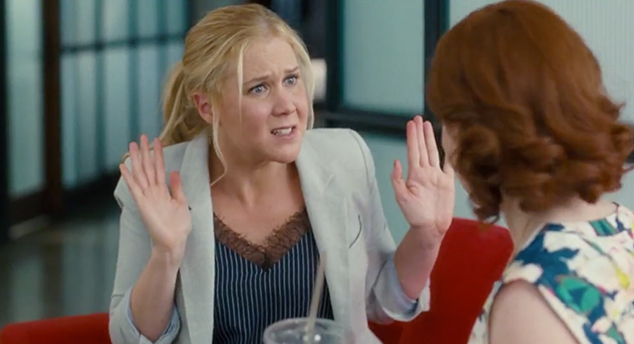 The tone and spirit of Trainwreck is very clearly Schumer’s voice, following her brand of sexually brash humor from an unapologetic and independent perspective. Amy is a love-em-and-leave-em character who would shrug at being called a “loose woman.” Then again if we applied these same standards to men we don’t have the gender-swapped “loose man” nomenclature. Instead of the standard male playboy character who beds a plethora of sexual partners and then moves on about their day, this time it’s a woman, and while perhaps this isn’t the strongest foothold in the realm of being progressive, every bit counts (women can do it too!). Amy is unrepentant about her sexual appetites and she is not punished for them. Imagine that, a sexually liberated woman who enjoys sex and doesn’t have to suffer some physical or psychological trauma related to her desires. We’ve come a long way from Mr. Goodbar. The character of Amy is much more than just her dating habits. She’s ribald and unapologetic while finding ways to be relatable and more in depth than just the commitment-phobic lead character in a mainstream romantic comedy. Her views on relationships go back to idolizing her cad of a father and a strong sense of fatalism. Relationships can’t work out so why bother? This accentuates Amy’s already self-destructive habits, which make her in many ways our protagonist and antagonist. She’s an enjoyable character who can also be mean-spirited, petty, and push the important people in her life away from her. Her biggest challenge isn’t getting the story, holding a long-held secret, or even landing the guy, because he already wants to be with her. It’s about whether she can accept a different view of herself. That’s way more interesting and complicated than your standard rom-com fussbucket or workaholic.
The content of Trainwreck is far easier to engage with than Apatow’s previous film, 2012’s This is 40. Even though she has a cushy job and a nice apartment in the big city, Amy’s struggles with her relationship with her boyfriend, her sister, her father, and her boss, trying to please others without giving away too much of herself. Her father is the source of much of her discomfort as she and her sister debate how to take care of him in his ailing health. Where Amy views her father as an admirable straight-shooting guy who rebels against the social standards and expectations of decorum. Her sister views him as a bigoted and sexist jerk that was never much of a father. The slow acceptance Amy comes to about the degree of pain she’s dealing with and guilt related to her father is a key development. Her rejection of the “old ways” is a repudiation of her father. The arguments that she has with Aaron are realistic, and he admits that he’s uncomfortable with certain aspects of her lifestyle but he’s not forcing her to change. There are some dramatic turns in the film that require Schumer to do some heavy dramatic lifting, and she carries it gracefully, keeping in character but also losing her carefree façade. It opens up your sense of the character just as much as the actress. Trainwreck is still very much a romantic comedy and it spends its third act coalescing to its happy ending, but Schumer’s self-deprecation won’t let it get too saccharine.
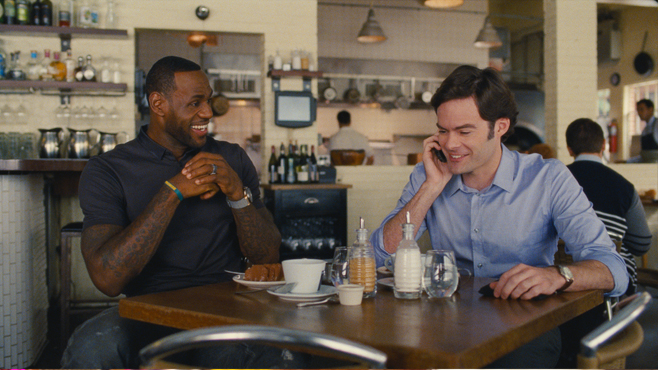
The movie is also funny quite often though it ultimately gives in to more rom-com conventions than subverting them. There’s a funny sequence where Amy is trying to coax her boyfriend into being more vocally risqué during sex, and John Cena does a great job awkwardly trying to be dirty. There’s a funny moment tied to character as Amy mingles with far more straight-laced married women at a baby shower. They play a game of revealing secrets and it’s everything you would want it to be. The satirical broadsides at the tabloid and celeb navel-gazing industry are broad but quite amusing, including article topics like “Ugliest Celebrity Kids Under 6” and, “I’m Not Gay, You’re Just Boring.” Amy’s self-destructive attitude and her outer layer of confidence lead to many humorous observations and exchanges, especially with Hader. The two actors have good chemistry and bounce off one another well, capturing a fun energy of a couple that really enjoys one another’s company and exploring that. Swinton (Snowpiercer) is almost unrecognizable and quite hilarious as the unfeeling boss. The biggest scene-stealer and breakout star is the world’s greatest basketball player, Lebron. He plays the standard rom-com “concerned best friend,” even warning Amy not to break his man’s heart and having a dating debrief while playing very one-sided basketball with Aaron (all elements lampooned in last year’s rom-com spoof, They Came Together). The basketball scene is particularly amusing as Lebron dominates his friend so casually and without ego. It’s a fictionalized version of Lebron but the man just has natural comic timing and a star presence. I could totally see more acting work coming Lebron’s way if he wanted it.
 However, there are jokes, storylines, and moments that don’t feel as well constructed and simply don’t work, enough that it hampers the overall impact of Schumer’s story. There’s a recurring theme of gay equals funny, notably when all of Cena’s threats to a movie patron bear a striking homoerotic quality. That scene works well enough, but the theme reappears in a late storyline where a lisping intern at the magazine played by Ezra Miller (We Need to Talk About Kevin) unleashes his inner sexual freak, which involves a lot of homoerotic foreplay and positioning. It’s a comedy angle that gets old fast. I also never believed the sentimentality attached to Amy’s father after his health worsens. Schumer tries to turn a bigoted jerk into a well-liked character and it just doesn’t connect. He has real physical struggles dealing with MS but at no point does he come across sympathetic. I sided with Kim on this one, though I think I wasn’t supposed to by the film’s end. There’s also far too many supporting characters that just kind of float along the peripheral; this is common in Apatow comedies but these characters, from a homeless bum to Amy’s work colleagues, don’t feel well integrated. There’s a misfire late in the film when Lebron holds an intervention for Aaron. The core idea would work but Lebron’s intervention participants include Chris Evert, Matthew Broderick, and Marv Albert, with the bulk of the jokes being Albert’s in-game announcing. They don’t address that the figures are playing themselves until much later in the scene, so I was wondering if somehow Broderick was Aaron’s father. It’s a miss. The movie-within-the-movie is also never that funny or satirical of Sundance indies, but thanks for the effort.
As a side note, it seems like quite a missed opportunity that the Knicks game at the end of the film did not feature the Cavs. With Lebron as a supporting character, it would seem like a natural fit to include him in the climax. My theory on this is such: the Knicks play the Brooklyn Nets and we see Paul Pierce in a Nets uniform. As NBA fans know, Pierce left the Nets and signed with the Washington Wizards for the 2014-2015 season (he has since signed with the L.A. Clippers). That means that Trainwreck must have been filming the spring of 2014, which means Lebron was still with the Miami Heat. No wonder the movie didn’t feature the Cavs in its finale. Also, in what NBA universe is Amar’e Stoudemire the star of the Knicks? Does Carmelo Anthony and his $120 million dollar contract not exist in this universe? It’s a little comical that Stoudemire’s knee surgery is given such dramatic stakes for a player that the Knicks were looking to dump.
Trainwreck is by no means the disaster implied by its title. Even Amy isn’t really a trainwreck of a person. She can be mean and self-destructive, but her shocking behavior isn’t all that shocking. She drinks and has sex with multiple partners and does not feel shame in this. Look out, world. Yet it’s Schumer’s sprightly comedic voice that shines throughout the film even when certain jokes or storylines misfire. Make no mistake, Trainwreck is also a star vehicle for Schumer and she earns it. She even sheds some tears in very effectively dramatic moments. She can do it all (refraining from obvious bad joke…) and still be funny whether she’s cutting someone to size or the butt of a joke. Trainwreck is an enjoyable romantic comedy, another in Apatow’s sweet lineup of raunchy and somewhat old-fashioned romances with their happy endings. There should be more than enough to tide Schumer’s fans and for her to make new ones.
Nate’s Grade: B
Share this:

The Interview (2014)
 Well, so maybe you’ve heard something about this little movie, The Interview? Seth Rogen and his writing partner Evan Goldberg (This is the End) weren’t intending to spark an international incident with their comedy about a pair of idiots trying to assassinate North Korea’s glorious leader, but after a few crazy turn of events, this little movie became a quixotic symbol of American patriotism. How dare North Korea get to dictate what Americans can and cannot see! Well, now The Interview is widely available in digital markets and we can agree that the fervor was for naught. The film is most shaky in the beginning, setting up Rogen as a TV producer and James Franco as the obnoxious talk show host. Once the boys get tangled up with the CIA, and especially once Kim Jong-Un comes into the picture (played by a much better looking actor, might I add, North Korean readers) the movie starts to even out and find its comic rhythms. While the ending is a little ho-hum, there are nice payoffs for several jokes and a poison strip has a wild and very funny comic development. I also enjoyed the emerging bromance between Franco and Kim Jong-Un that danced around with being subversive. However, there are two problems with the film. It doesn’t get risky enough (too many penis jokes) and James Franco. He’s been a capable comic actor but always in supporting or as a foil. Franco is not a comic lead, and his performance is much too amped and broad, needing to be dialed down to feel less desperate in overexcitement. It’ll be more a footnote in history than comedy, but The Interview is a fairly innocuous comedy that does get better as it chugs along, though clearly hits a ceiling. It’s certainly not anything worth going to war over.
Nate’s Grade: B-
Share this:

Best Night Ever (2014)
 There are no more reviled names in the world of comedy than the duo of Jason Friedberg and Aaron Seltzer. Together, these writer/directors have unleashed such loathsome films as Epic Movie, Meet the Spartans, and their most recent spoof, The Starving Games. Each film was further evidence that Friedberg and Seltzer had no grasp on the basic tenets of comedy. But, free of the shackles of a spoof formula, what could these two accomplish? That’s a question no one on the planet was seriously pondering but here comes Best Night Ever, a found footage comedy where four thirty-something female friends (Desiree Hall, Samantha Colburn, Eddie Ritchard, Crista Flanagan) travel to Las Vegas and get into oh so scandalous trouble. How original, right?
Being Friedberg and Setlzer’s first straight comedy, it’s fascinating how it fails in a completely different yet similar manner than their normal spoof monstrosities. The problem, among others, with their spoofs is that they are not structured for comedy but merely lame pop-culture references, with the reference standing in the place of what should be a joke. It’s a notable absence of comedy. With their first original work, Friedberg and Seltzer lose the references but forget to replace them with, you know, comedy. Take for instance a scenario where our four heroines hide in a dumpster. The police are outside and they don’t want to be caught. All right, this setup could afford some nice squeamish comedy. Instead, we hold onto the same painfully long night vision shot (4 minutes and 45 seconds – thanks Ignatiy Vishnevetsky at AV Club) with the ladies breathing heavily. It takes several minutes until this situation changes, when the girls start singing “What’s Up?” by 4 Non Blondes as a patented means of soothing a panicked friend, which itself isn’t any funnier. Let’s unpack this scene. They’re in an uncomfortable place and forced to be quiet lest they alert the police. Why set this up and do nothing with it? And the supposed payoff for the scene is more a jump scare than a joke, and it’s not worth the wait. There’s also a lengthy dialogue-free montage where the girls do a scavenger hunt of activities around Vegas, most of which are fairly innocuous for a sex comedy (rub a bald man’s head?). There’s no wilder escalation. When the girls put a blacklight to their seedy motel room, it goes as expected. Oh no, semen stains are everywhere, but you keep waiting for a capper. It’s got to be more than this, something different, something a little more bizarre, like perhaps someone spelling out their name in semen. Nope. And that’s Best Night Ever in a nutshell (no pun intended): a tediously long wait without payoff or jokes.
 Best Night Ever wants to pretend it’s intended for a female audience but the writing makes it seems like Friedberg and Setlzer don’t know women. It’s a girls’ night out, and from a male perspective, which means a lot of shouting, “woo,” dancing, drinking, and all sorts of tame activities. None of these people feel like human beings, let alone friends that we should care about. Being Friedberg and Seltzer’s first R-rated comedy, the guys should be embracing the tasteless possibilities, getting their ladies into crazy scenarios that spiral out of control. Instead, the whole sad affair has such a timid feel, as if Friedberg and Seltzer decided a largely female audience would be put off by too much crass content. There’s a sequence where the ladies take pills they found in am ambulance. All right, you’re thinking, this should lead somewhere. Oh how wrong you’d always be expecting something from these two filmmakers. We’re treated to an extended sequence of the girls just dancing for several minutes, in slow-mo no less, mouthing, “Best night ever.” That’s it. Why does the movie repeatedly pull its punches when it comes to the bridesmaids behaving badly? I think it’s the misplaced idea of not wanting to rankle its target audience, that women have a lower quotient for bad taste.
Let’s explore what happens in the lone sequences where Friedberg and Seltzer decide to indulge their R-rated crassness. The ladies kidnap the valet driver who they believe mugged them. Disguised in ski masks that can’t help but trigger associations with Spring Breakers, they break into his home, strap him to his bed, and then one of the ladies eventually urinates on his face. And if that wasn’t enough, she craps on him as well accidentally. Of all the directions this setup could have gone, a woman pooping on a man’s face just seems lame, having to settle for cheap shock value over jokes. The end gives us our first glimpse of nudity, as the ladies stumble into the wrong hotel room on an amorous interracial couple. Incensed, the naked couple couple chases after them. The chief threat is an overweight black woman and, apparently, her overweight nude body is meant to be the outlandish joke. Oh look, a fat woman chasing after our characters! And so, her nudity is allowed because it’s meant to be comical (visions of Borat dancing in my head). Like other sequences, this part is drawn out and exhausts whatever brittle comic potential it may have had. Then there’s the lingering thought that the only minority characters in the movie are presented in states of undress, their nudity meant to serve as discomfort.
I understand the sexy marketing hook of making a found footage movie, but does the entire film have to be stuck in this limited narrative constraint? Can a movie not just incorporate found footage elements but be free to break away on its own, like The Purge? Alas, Friedberg and Seltzer embark on found footage and can’t even adequately maintain that guise, often failing to produce reasons for why their characters are still filming. First off, why would anyone just film themselves introducing who they are on a bachelorette voyage when, presumably, the only people watching it will be close friends? Then there’s the pesky habit where people keep holding the camera out, framing all four ladies so carefully. Then there’s the fact that the footage is seen rewinding and fast-forwarding, presenting sequences out of sequence, some with intertitles added for dates because having a date stamp for a recording wouldn’t be good enough. So, the age old question, who did all this? Who added music to the sequences? Then there’s the fact that later on the camera cuts to reaction shots and different angles in single scenes, completely destroying the illusion of being found footage. Why blur nudity in an R-rated movie in general, but even more so, if this is found footage, what hypocritical hypothetical editor is blurring certain nudity and letting other nudity pass? Nothing of substance or humor is added to this film by forcing the prism of found footage. Instead it only makes the characters dumber and less realistic than the one-note placeholders they already are.
 Let’s talk about those characters. Comedies have a long history of putting together archetypes; take for instance The Hangover, a surefire inspiration for Friedberg and Seltzer. We’ve got the smarmy asshole, the uptight straight guy, and the goofy nutball, all classic comic archetypes that can bounce off one another. With Best Night Ever we have… the… mother… the slutty one… the… actually it doesn’t matter because the characters are so poorly written that they are indistinguishable. Not one of them has a personality or anything memorable to them. They’re all one type: bland. The only way I was keeping track of who’s who was by hair color, and even that is something of a challenge at times (two redheads?). Friedberg and Seltzer hastily throw in some “character details” for some, like one one just had her husband leave her for a man and another is a mother and has a breast pump. Okay, 1): why pump milk on a Vegas trip? Is that going to keep on the multi-hour car ride home? And 2): you’d expect with a detail like that there would be a later payoff…. Nope. Like most things in the movie, the details are just hastily thrown into the mix and readily discounted.
I was morbidly curious what Friedberg and Seltzer would set their sights on when not cannibalizing pop-culture in their spoof movies, and now I know. Best Night Ever is just as inept a comedy as their previous spoof atrocities. It irritates me even more that Friedberg and Seltzer could have done any comedy they want, and this is what they delivered, a tacky and too often timid sex comedy that has far too many drawn out sequences in place of actual humor. I don’t think found footage works in the context of comedies. It provides a sense of realism, and the long takes naturally build tension, but these aspects benefit the horror genre, not so much comedy. With comedy you still need to develop setups, complicate them, provide payoffs, and make sure to provide detours from the expected. There is nothing truly unexpected from this girls’ night out, and the cheap jokes rarely build or alter, so the pained setup at the beginning of the scene remains the same by the end. The simple premise of a bachelorette party gone wrong is ripe with potential, a potential that will never see any flicker of life under the guise of Friedberg and Seltzer. I never thought I’d write this but these two can just go back to their spoofs. Of course my first request would be never to make another movie again.
Nate’s Grade: D-
Share this:

The Hungover Games (2014)
 With so many dimwitted, half-baked, and often comically inept entries, it’s hard to remember when a spoof movie was actually something to be enjoyed. We’re beyond the era of Airplane and The Naked Gun, but even some of the early Scary Movie films had some merit, and then Walk Hard, Black Dynamite, and Wet Hot American Summer are shining examples of the best the comedy subgenre has to offer. We’ve become used to the Friedberg/Seltzer style of spoof, a machine-gun rattle of pop-culture references with no thought given to comedic instruction, just the soon-to-be-dated reference. With all of that established, I could not hate The Hungover Games. It doesn’t work well enough to recommend, but the joke-to-laugh ratio is higher than I would have thought, with about every one in five jokes landing, a few had me cracking up. Plus there’s actual critical content here, parodying the sources rather than just dull repetition. In the future, the public rises up against Hollywood because we have become sick to death of all their remakes, reboots, and unoriginal crap. And so, the twelve districts of Hollywood genres duke it out for our bloodthirsty entertainment (there’s a Johnny Depp district where even they have Depp fatigue). It’s a sharp contrast to Friedberg/Seltzer’s own inferior spoof, The Starving Games. The pacing is slippery, the content can be questionable, but with lowered expectations, you may be pleasantly surprised, or at least mildly less irritated with the results. The actors onscreen also do credible work, particularly Ben Begley, playing the Ed Helms Hangover role. He has nailed down Helms’ speech patterns, mannerisms, and he even looks like Helms. This guy deserves a better movie. With an R-rating, the film is afforded the opportunity to go weirder and dirtier than the lame brained spoofs from Friedberg/Seltzer, like the Gratuitous Nudity district or when they keep reminding us that Katniss is underage. Look, I haven’t hit my head all of a sudden; this still isn’t a good movie by conventional standards. However, spoof movie standards have gotten so low that The Hungover Games is passable. Again, grading on a curve.
Nate’s Grade: C
Share this:

We’re the Millers (2013)
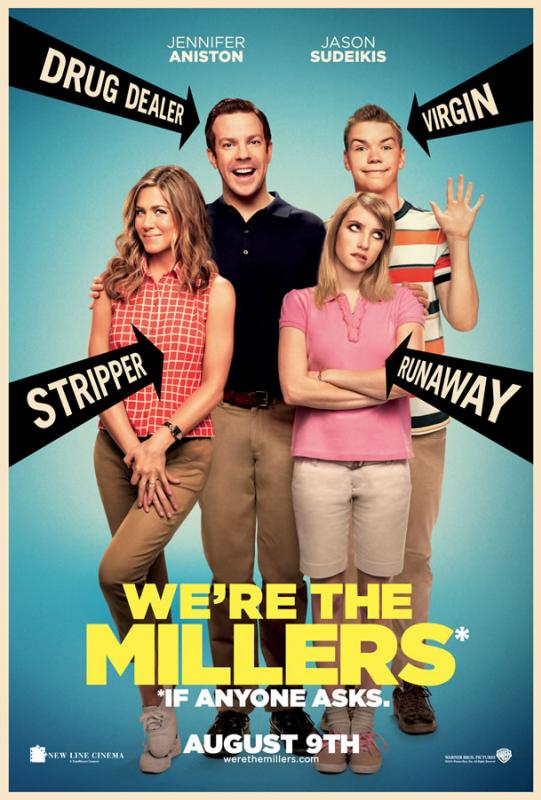 I finally caught one of the biggest surprise hits of the year, the raunchy comedy We’re the Millers, and while fitfully entertaining, mostly in its second half, I have to wonder what made this film the hit it was, despite lack of clear comedy competition. The setup involves four people (Jason Sudeikis, Jennifer Aniston, Emma Roberts, Will Poulter) posing as a model nuclear family to smuggle drugs into the United States. You’d think the difficulty would be getting back into this country, but no, it’s all about keeping their cover, especially when a vacationing DEA agent (Nick Offerman) pals around. The flimsy setup gets much better in the second half as the false family dynamics and roles are skewered, particularly an educational kissing session between siblings and mother. I can also see the markings of why audiences gravitated to this otherwise so-so comedy. It offers each member to contribute meaningfully, it gives each a lesson and a triumph, and they form a likable bond. So while the joke payoffs may whiff, there’s a character payoff to pick up the slack. Plus there’s an Aniston stripping sequence to showcase the fitness of the forty-something actress. The jokes settle for easy vulgarity a bit too often but every now and then the film surprises. Sudeikis is slyly enjoyable channeling a young smarmy smartass Chevy Chase, and Offerman is hilarious, enough to make you wish the movie followed his family. We’re the Millers reminds me of the 90s works of the Farrelly Brothers, a mixture of gross-out gags, slapstick, uninspired villains, and a dash of sentiment. We’re the Millers is an acceptable comedy, not a great one, but after its quarter billion dollar box-office riches, get ready to meet the Millers all over again.
Nate’s Grade: C+
Share this:

Don Jon (2013)
 Joseph Gordon-Levitt, one of the most talented and, yeah I’ll say it, dreamy young actors working today is proving to be more than a pretty face. Don Jon is his assured writing and directing debut, and it shows that every man has one more reason to feel insecure compared to Gordon-Levitt. The titular Jon (Gordon-Levitt) is a New Jersey lothario who sleeps with lots of women but the real thing just can’t measure up to his porn. The schism between reality and sexual fantasy is too much. Jon tries to reform his porn-addiction ways when he meets a hot lady (Scarlett Johansson) but old habits are hard to break, especially when he has to wait before sleeping with a woman. The narrative isn’t terribly deep or that developed but remains entertaining throughout, buoyed by feisty performances and stylish direction. The editing, sound design choices, and smooth camerawork made me feel like I was watching a promising Scorsese student. I found Don Jon to be a far more successful look at sex addiction than the recent sex addict drama, Thanks for Sharing. The parallel between porn and Hollywood rom-coms, both an inflated fantasy of relationships, doesn’t really stick, and Jon’s family is a bunch of loud Italian stereotypes, but the lead guy is a self-possessed lunkhead anyway, so it makes sense for his family to follow suit. Don Jon is funny, sexy, and an enjoyable diversion at the movies. What it really does, though, is provide the first notch in what may prove to be an exciting directorial career for its star.
Nate’s Grade: B
Share this:

Thanks for Sharing (2013)
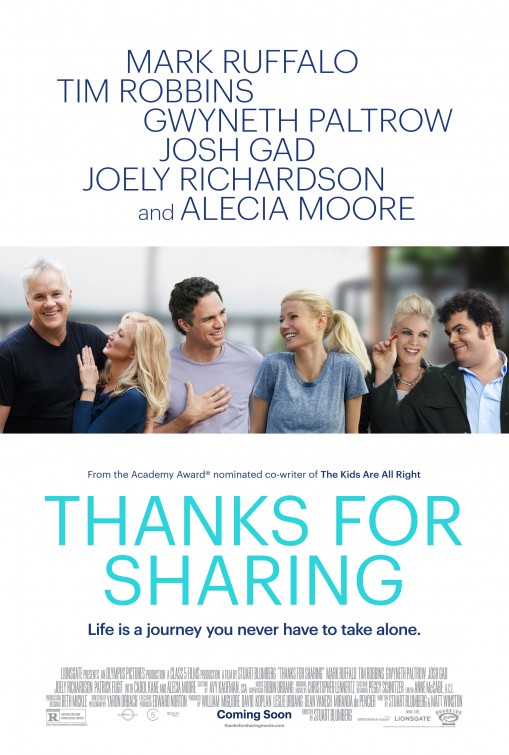 “Isn’t sex addiction one of those things guys make up when they’re caught cheating?” asks a character in Thanks for Sharing. This movie treats the topic of sex addiction very seriously, rattling off plenty of adverse side effects rather than just a wandering eye. Director and co-writer Stuart Blumberg (The Kids Are All Right) is certainly empathetic to his characters on screen. I just wish the movie knew what it wanted to be.
We follow three sex addicts in one therapy group, all at different points of recovery. Mike (Tim Robbins) is the paternal figure of the group. He’s long been married to his high school sweetheart. Adam (Mark Ruffalo) is five years sober and being prodded by Mike to start seriously dating again. He meets Phoebe (Gwyneth Paltrow), a cancer survivor, and hides his addiction from her. Worst of all is Neil (Josh Gad), a doctor who has been mandated to attend sex addict group therapy after “bumping” into people on the subway and recording an upskirt video of his boss. He doesn’t believe he has a problem, but, under the guidance of Adam and Mike, comes to the conclusion that the only person who can fix his impulses is himself.
 Thanks for Sharing is an admittedly entertaining movie, at turns, but it’s a movie with one debilitating identity crises. What kind of movie does it want to be tonally? We get raunchy sex gags, and then the film transitions into rom-com fluff, and then the film transitions into hard-hitting addict drama, and then it’s all back again. All of these elements could have been carefully threaded into one movie, but Blumberg and co-writer Matt Winston cannot nail down a consistent tone. In fact many of the changes can be quite jarring. One minute people are engaged in wacky sex hijinks, and the next they’re lamenting all the horrible life choices they’ve made in tears. When there isn’t a clear tone, or clear transitions, then the comedy undercuts the drama and vice versa. Therefore, certain elements can be appreciated or be found engaging, but the movie cannot become more than the sum of its parts. And let me get into whether sex addiction is really a topic that can work in the realm of romantic comedy. With the right finesse anything can be presented in a comedic light that still maintains the humanity and dignity of its flawed characters. However, is something as easily misunderstood as sex addiction, whose particulars can be quite appalling to many, the right fit for a genre that is predicated on whimsical coupling? I don’t think so. Thanks for Sharing doesn’t change my mind.
About that rom-com part, notably the relationship between Adam and Phoebe, it’s easily the least interesting part of the film. Both of these characters are fairly bland. Adam’s the sober guy trying to keep things going, except that we never really feel like he’s challenged. We don’t feel the threat that he’s going to relapse. And we don’t really get to know much else about the guy. He vaguely works for some sort of environmental firm. As a character, he is defined by Phoebe, herself a collection of quirks that doesn’t coalesce to form a human being. The film weirdly keeps harping on the fact that Phoebe likes her food to not touch, as if this minor peculiarity is some harbinger of a greater OCD complex (she’s into physical fitness!). The fact that other characters have to jump in on this makes it even more transparently reaching. Worse than all this, the couple’s interactions, and much of their budding relationship, feels overwhelmingly artificial. The dialogue should be sparking, charming, but you get no real sense of why either of these people would fall for the other, excluding the obvious physical attributes of each. The rom-com convention of the Big Secret (Adam’s addiction) is left dangling until, surprise, it’s defused early. I’d expect the movie to push further since there is a wealth of drama to be had about the trust levels of dating a sex addict, but instead it just forces them apart all too easy. Then there’s the fact that the movie covers perhaps a month of time and their relationship seems to move ridiculously fast, mostly because Blumberg is impatient for his couple to get to a more physically intimate stage.
Thanks for Sharing works far better as a darker drama, and as a movie, when it focuses on the roles of Mike and Neil. The film smartly connects sex addiction with other impulse control issues; for Mike he’s been sober from booze for 15 years, and for Neill he has weight control issues. These are the characters we see struggle, these are the characters at the more interesting points. Neill especially is a doctor whose hit rock bottom and can’t get away from the felonious things his addiction tempts him to do. Mike has a surrogate family with his support group. Now that his prodigal son (Patrick Fugit) returns, that adds tension to his family dynamic, both at home and in group. I would have preferred Thanks for Sharing to be told chiefly from the perspective of these characters, eliminating Adam and Phoebe altogether. But even these good storylines find themselves wading into all-too familiar plot devices. Mike’s arc involves reconnecting with his son, which will lead to a misunderstanding, a conflict, and ultimately forgiveness, and you see every step coming. Neill’s journey gets an unexpected boost when he takes initiative to help Dede (Pink a.k.a. Alecia Moore), one of the only ladies in group. Of course it takes a pretty girl to push Neill out of his selfishness and self-loathing, but he does progress, and it’s the most emotionally rewarding moment in the film. The problem is that Neill’s storyline is tied up in a platonic head-scratcher. Dede takes Neill to a dance hall where they are just there to… dance, but the kind of dancing that hipsters do. It all seems like something for people on drugs, but whatever reason, Neill shaking his groove thing, and coming to an understanding that he will not be touching Dede, makes his character better. I was surprised that Blumberg was able to end the movie on something of a downbeat, falling back to the central message of one day at a time, vigilance.
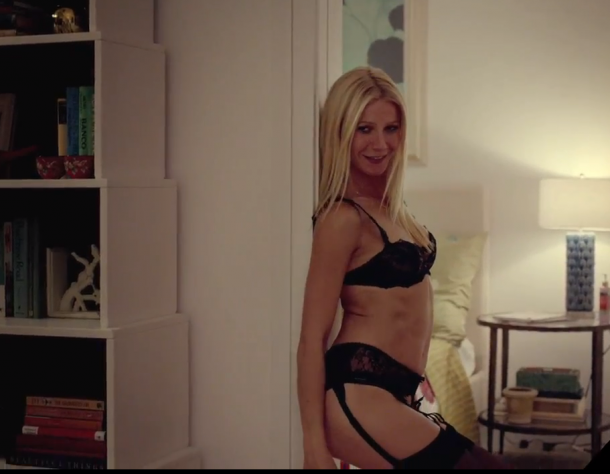 There is one standout scene that really gets to the scariness of sex addiction succinctly. Once Adam falls off the wagon, which shouldn’t be much of a spoiler people, he regroups with Becky (Emily Meade) a gal he had a one-night stand with. Their flirtation is quick, settling into their attraction, and then she engages in behavior that, meant to be alluring, is rather insightful. She has a daddy fixation and wants to be punished as a “bad girl” with Adam pretending to be her stern father. That could be a red flag, but Adam carries on. Then she asks him to slap her. Adam refuses. So she does it herself, beating herself, eventually descending into a mess of tears, screaming. Adam tries to console her, stupidly deciding to try and make contact with her after she keeps screaming, “Don’t touch me!” She locks herself in the bathroom and threatens to harm herself. This one moment in the film gets at the damage of sex addiction like nothing else. It points to possible abuse, but really it all falls apart so rapidly that your head is spinning. The conclusion is pat and anticlimactic, but the lead-up is fantastic. If the rest of the movie had been thematically closer to this scene, Thanks for Sharing would be worth sharing.
From an acting standpoint, the cast does a fine job portraying their characters and his or her respective foibles. Ruffalo (The Avengers) is a bit too even keeled for his character. Gad (Jobs, The Internship) is the film’s comedic spark but also its greatest source of internal drama, which Gad handles well, showcasing the desperation of Neill. The real surprise is actually pop singer Pink in her first real acting performance (Charlie’s Angels: Full Throttle counts under no circumstances). Her introductory monologue, which she nails, makes you take notice that Pink has some genuine acting muscles.
Thanks for Sharing is an uneven mishmash of genres and ideas, rarely settling down into something worthy of the talent at work here. The comedy works against the drama, the drama works against the comedy, the clichéd character developments don’t serve anyone, and the overall artificial nature of the central rom-com coupling drags the enjoyment level further down. There is good work here, good acting and some memorable scenes and offhand laughs, but all Thanks for Sharing can amount to is a series of scant moments, passing encounters of entertainment. I didn’t find many of the characters to be as nearly compelling as the filmmakers did, and some of their hasty resolutions and developments feel far too simple for an addiction this complicated. The potential of the film is never fully realized. While I’m doubtful rom-com is a good fit for a serious exploration on sex addiction (wasn’t Shame hilarious?), it does lend itself to a bevy of juicy setups and possibilities. We get little of these. It’s as if the film wanted to present a case for the legitimacy of sex addiction, front-loaded with stats and horror stories and characters to open our eyes, and the notion of telling a laudable story was secondary to the educational efforts. Congrats. Now give me a story to care about.
Nate’s Grade: C+
Share this:

InAPPropriate Comedy (2013)
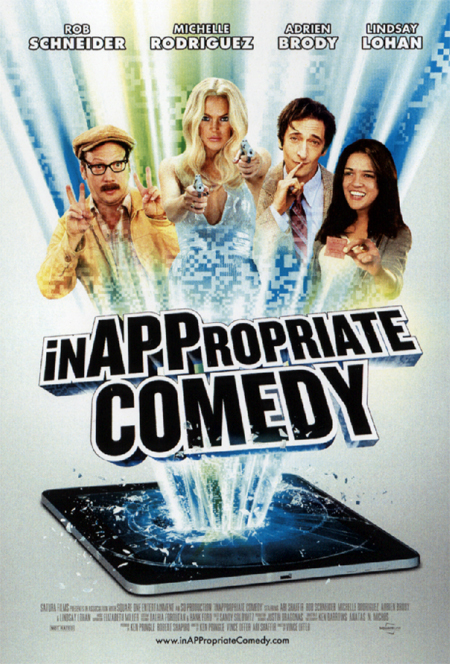 Vince Offer is best known as the successful pitchman for infomercial products like the Sham Wow and the Slap Chop. He’s less known as an amateur comedian. In 1999, he co-wrote and directed The Underground Comedy Movie, pooling all the favors he must have accrued with celebrities and struggling L.A. comics. You’d think after one resounding dud people would know better, but alas Offer and his friends have funded another sketch comedy movie, InAPPropriate Comedy. You see the title refers to the joke delivery system, namely Offer’s finger hitting apps on a tablet to start sketches. And if that inept setup doesn’t seem like a insightful indicator for the misery that is to follow, then allow me to confirm that InAPPropriate Comedy may be the least funny comedy I’ve ever seen.
I’m not saying that ALL people who find some measurable level of enjoyment from InAPPropriate Comedy are racist, homophobic, and sexist, but chances are, if you are all three things, you’ll probably enjoy the comedic abyss that is InAPPropriate Comedy. For the purposes of truly showcasing how comically bankrupt this enterprise is, overdosing on witless shock value and groan-worthy stereotypes, I will quickly dictate exactly what you get in this movie, sketch-wise. It’s really only about four reoccurring segments.
-Before the meat of the comedy begins we’re treated to the lamest, more obvious 127 Hours parody and the sight of tough-guy bikers riding around on bicycles. Does that mental image automatically make you laugh? If so, you’re in luck.
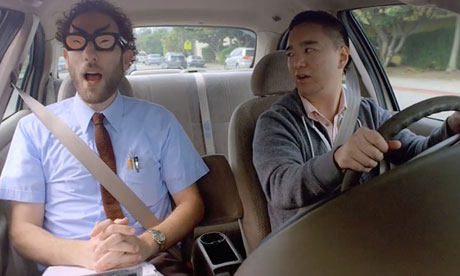 -A parody of Dirty Harry called “Flirty Harry” where Oscar-winner Adrien Brody is a cop who speaks in nothing but overblown gay-centric double entendres (GAY JOKE #1). Is that half-assed twist on the name worth an entire ongoing series? It’s like you took one of the parody names from MAD magazine and then just called it a day. The second time around, Flirty Harry stops a robber and we see him in pink pants. He’s wearing pink pants. How could that not be hysterical? (GAY JOKE #2) The third segment doesn’t want to waste any time, so now Flirty Harry is getting his nails done at an Asian salon. You better believe these women are portrayed as nattering, horrendous, screeching caricatures (GAY JOKE #3, RACIST JOKE #1, SEXIST JOKE #1). Then Harry shoots a guy in the ass (GAY JOKE #4). Adrien Brody, why?
-The next ongoing sketch is a parody of MTV’s Jackass, and this one, with about as much wit as you’d expect, is called Blackass. It’s about a group of obnoxious, ignorant, lazy, foul-mouthed, angry black males engaging in rude and offensive behavior. These segments may be the most offensive in the whole movie because it is wall-to-wall negative stereotypes; the joke is that black men are not to be trusted and will harass white people, especially white women. The first time we see Blackass it has our characters running from the police. One of them even has a giant boombox over his shoulder because people still do that, right? (RACIST JOKE #2). These guys dress and behave exactly like the harmful misrepresentation your elderly grandmother has about black people. The sad part is that the festering stereotype of the black male up to no good can have serious and tragic consequences, coloring people’s judgments and assumptions.
Stepping down from the soapbox, the first segment involves the Blackass crew falling into a vat of raw sewage. The second segment involves them playing joust in shopping carts with lances made to resemble giant black penises (RACIST JOKE #3). The third involves the Blackass crew as the world’s worst babysitters, threatening a white woman in the process (RACIST JOKE #4). You see black people are terrible fathers, so this movie would argue. They talk about welfare checks and carry around 40s of malt liquor. The fourth segment has one of the Blackass guys and his white girlfriend antagonizing another couple in a hot tub before having anal sex (RACIST JOKE #5, SEXIST JOKE #2). The fifth segment has one of the Blackass guys in an abortion clinic waiting room. He harasses a young couple and offers to abort their pregnancy for cheap with a coat hanger (RACIST JOKE #6). The last segment involves the gang trying to lure a mouse by putting cheese on one of their penises. While it’s the closest in conception to an actual Jackass stunt, it’s still unfunny and much of the humor seems to rest on the enormous size of African-American phalluses (RACIST JOKE #7). Crap, I forgot about another segment where the guys blindfold a dude and have him get run over by a rhino. I don’t even get this one.
 -The longest and most painful of the reoccurring sketches is a parody of The Amazing Race dubbed The Amazing Racist. You might expect it to have something to do with the popular reality TV competition, perhaps people competing to see who is the bigger racist, racism across color, or even forcing two racists of different ethnicity to team up in competitions. Nope. It’s just co-writer Ari Shaffir and his unending improvisation. The first segment has him rant in front of the U.S.-Mexico border, and then he harangues a gas station owner and assumes any Hispanic present is an illegal alien (RACIST JOKE #8). The next involves him as an insulting driving instructor for Asian drivers (RACIST JOKE #9). The next involves him wandering a predominantly Jewish supermarket trying to gather signatures to apologize for killing Jesus (RACIST JOKE #10). The next segment involves Shaffir entreating black passerbyes on a beach to take a boat ride back to Africa (RACIST JOKE #11). Finally, Shaffir is abandoned in a Middle Eastern territory with armed Arabs. I guess it’s supposed to count as comeuppance but it sure doesn’t feel it. There’s a post-credit sequence where Shaffir is trying to lure Jews into a box to ship to Hitler from the future (RACIST JOKE #12). I later learned that the hidden camera aspect of Shaffir’s bits is another fallacy. The people onscreen are all actors, which makes The Amazing Racist even less amazing. It feels like Offer and Shaffir watched Borat and thought they could replicate what they saw.
-The only other repeating segment is a pair of film critics that specialize in reviewing pornography. The idea on itself actually has the most potential out of everything Offer throws onscreen. It’s got recognizable faces; Michelle Rodriguez and Rob Schneider are the critics. Their reviews, however, are just another excuse to make more racist and gay jokes. A porn they review is called “Sushi Mama” and it features two Asians engaging in over-the-top, badly dubbed sex (RACIST JOKE #13). Another porn they review is weirdly a parody of Swan Lake, with guys dancing around in tutus and eventually humping and ejaculating on a helpless victim (GAY JOKE #5).
There are two other sketches that have the luxury of not being repeat offenders, so to speak. Lord knows what Offer and company saw in the others. One involves Schneider as a sleazy therapist aroused by his client’s vigorous sexual history (SEXIST JOKE #3). Another is called “Things You’ll Never See” and purports that hot ladies would never date someone poor because all good-looking women care about is money (SEXIST JOKE #4). I haven’t even mentioned how all of these sketches are supposed to take place, literally, inside Lindsay Lohan’s vagina (SEXIST JOKE #5). It’s a nonsensical framing device. We zoom out in the end, meaning that Lohan has a treasure trove of unfunny sketches stuffed in her special place. She should probably consult an OBGYN.
And that’s it! That’s the movie, all 75 wretched, horrendous, soul-draining minutes. Did any of that, on the surface, seem funny to you, or, like most people with active senses of humor, did it seem overwhelmingly lazy and poorly thought out? The biggest problem with InAPPropriate Comedy is that it’s trying to be more inappropriate than funny. It’s confused shock value for actual humor. Having a troika of irresponsible black males playing into demoralizing stereotypes and fears isn’t comedy. Having a guy make fun of Asian drivers isn’t a sketch. Having a gay cop make forced double entendres isn’t a sketch. There’s no development here, no escalation, no twisting of the premise, no nothing. All Offer and his motley crew of comedic imbeciles do is take a one-joke premise and pummel it into submission, making the laborious sketches feel even longer. It just so happens that most of their one-joke ideas aren’t even ideas so much as mean slights against minorities, women, and gay people. There is no ironic distance to the joke telling; they are merely just being crushingly racist, sexist, and homophobic.
 I am by no means a comedy prude. I love a terrific vulgar joke as much as the next guy. I think when comedy is concerned that nothing is off limits. You can make anything, no matter how horrific and offensive, funny under the right circumstances, but it takes work and able skill. The problem with Offer’s movie is that there is no consideration to context, setup, developments, let alone surprise. You’ll see every dreadful joke coming before it arrives. That’s because all this movie does is trade in pained, outdated stereotypes. The scenes themselves feel like improv jags that just go on endlessly, like Offer was trying to replicate the process of a Judd Apatow comedy. His faulty reasoning may have been if people just say enough offensive things long enough, then something has to arrive at funny. Comedy doesn’t work like that, and as a comedy writer I find it personally insulting. This is just rampant and pointless vulgarity without any parameters, no point of view, nothing to mask the fact that it’s just cheap shock value. What are the jokes here? Asians are bad drivers? Black men are reckless? Women are superficial? Do these sound like jokes or merely groundless insults? If you removed all the ostensibly offensive elements, there would be nothing to this movie whatsoever.
As a longtime detractor of the duo Friedberg and Seltzer, the men responsible for cinematic crimes against humanity like Epic Movie (my worst film of 2007) and Meet the Spartans (my worst film of 2008), I’m torn. Friedberg/Seltzer don’t so much create jokes as they do lame pop-culture references with built-in expiration dates (go on, try and watch one of their past movies and see if you recall everything). Whatever jokes they do foster are mostly broad slapstick, but it could be classified, no matter how charitably, as a joke. After watching Offer’s InAPPropriate Comedy, I may have second thoughts about the intensity of my screeds against Friedberg and Seltzer. Their movies are still terrible, still the cannibalistic, cinematic watery discharge I dubbed them, but Offer’s comedy may even be worse. There’s no way any of InAPPropriate Comedy could ever be funny. It’s so obvious and desperate that it confuses offense for smashing taboos. This is a black hole of funny, where funny cannot escape and instead gets smashed down to an atomic level. How could anyone making this find it even remotely funny? If I see a worse movie in 2013 than InAPPropriate Comedy, it will make me reevaluate the existence of a loving God.
Nate’s Grade: F


You must be logged in to post a comment.