Blog Archives
The Thing (2011)
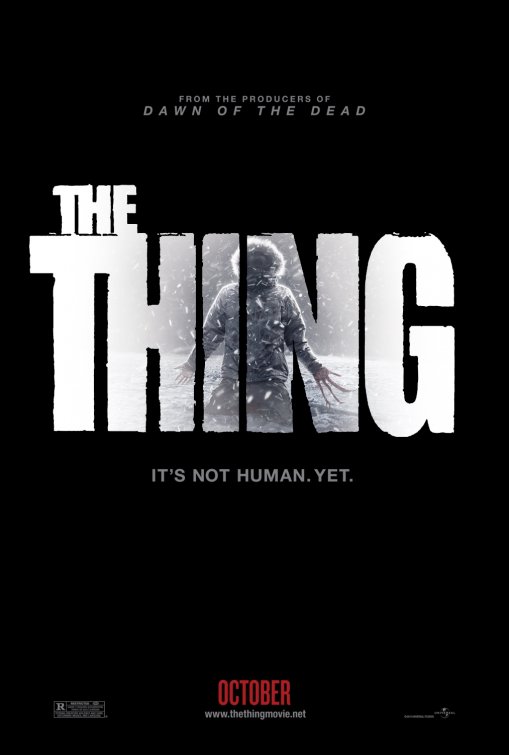 Has any modern filmmaker endured more crappy remakes of their films than John Carpenter? The man has suffered through remakes of Halloween, The Fog, Assault on Precinct 13, and now his 1982 creep-fest The Thing, itself a remake of the 1951 Cold War allegory, The Thing From Another World, gets the same awful treatment. This new Thing is some hybrid of remake and prequel, because it’s set before the events of the 1982 film but it pretty much follows the same overall plot. Once again a group of scientists (this time they’re Norwegian!) on a remote Antarctic outpost discovers an alien body buried in the ice. Once again the alien breaks loose and can assume the fleshy form of man. But this new film forgoes the rampant paranoia and rising tension of Carpenter’s film for cheap Boogeyman thrills. The alien monster is introduced early and the rest of the film succumbs to people looking around pensively, afraid it will jump out and attack. This alien creation is an odd quirk of evolution; a species that seems to be made of nothing but gnashing teeth, spindly legs, and vaginal imagery. How these things built and fly spaceships, I have no idea. Some of the gore effects are crafty and stomach-churning, but nothing is as memorable as the practical effects used sparingly and to great effect in the 1982 flick. This Thing is too much of a familiar monster to make an impact.
Nate’s Grade: C
Share this:

Real Steel (2011)
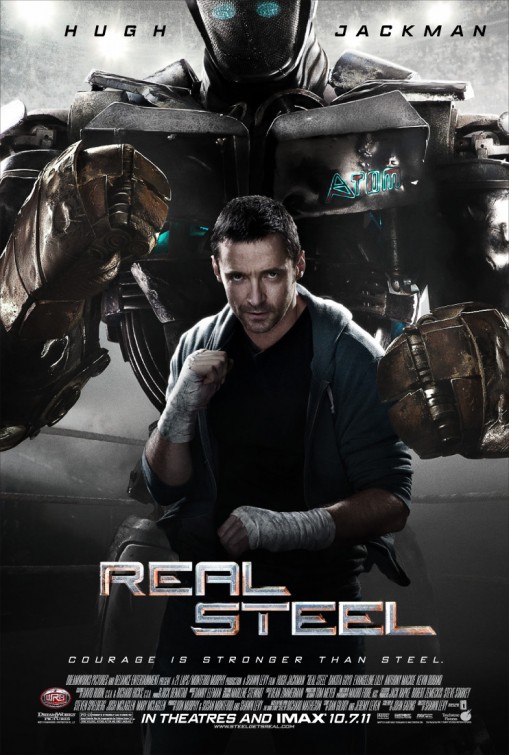 In the future world of Real Steel, set in 2020, robot boxing has become a huge sensation. It seems that audience bloodlust was not being satisfied with flesh and blood hitting the canvas, so robot brutality will do. Whatever happened to mixed martial arts, a sport arguably more popular than boxing in this day and age, popular enough it even got its own uplifting sports drama earlier this year (the overlooked Warrior). I strongly doubt that in only nine years we’d have giant fighting robots and that this “sport” would be nationally recognized. Did anyone see Comedy Central’s mechanical Coliseum showdown, Battlebots? There’s your answer, America.
In this future world where trucks have glass panels to show the world your feet (why? Because it’s “futuristic” you fool), Charlie Kenton (Hugh Jackman) is a has been. He enjoyed a fleeting career as a professional boxer before the mechanical men came into popularity. Now he goes from town to town trying to scrounge up some petty money with small-market robot boxing rings. His only pal is Bailey (Evangeline Lilly), his former flame and the owner of the boxing ring/chop shop that Charlie calls home. Charlie owes plenty of money to plenty of not nice people. His solution arrives in the form of his 11-year-old son, Max (Dakota Goyo). Charlie ran out on Max and his mother when Max was a baby, but now mom’s dead and custody is being discussed. Mom’s aunt (Hope Davis) and her rich hubby want Charlie to sign away his parental rights, which he agrees to do for the right price. Max spends one last/first summer with his estranged father before going off to live with his auntie. The two bond when Max discovers a beat-up old sparring robot when father and son are skimming parts illegally at a junkyard. The old bot, which Max names Atom, becomes a champion fighter. Father and son ride the success all the way to a championship bout with Zeus, a legendary robot that destroys all challengers. Can they stun the world? Can father and son bury the hatchet? If these answers are in doubt, I advise you to see any sports movie ever released.
J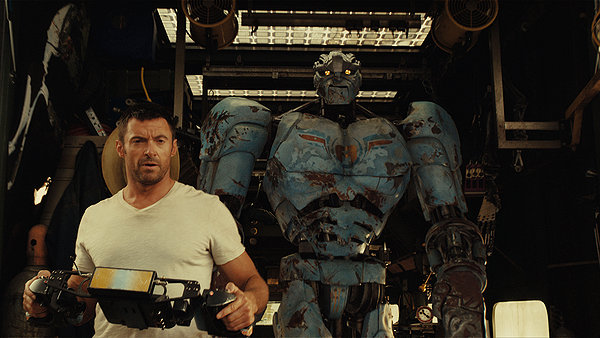 ust in case you stood clueless and slack jawed at the film’s storytelling prowess, you’re in luck because every character will take great pains to explain the significance of plot points, key metaphors and symbols, and personal motivations. Usually this stuff is tucked away as subtext, but Reel Steal decided that it would rather rub the audience’s nose in the architecture of its screenplay. Characters will just go around speaking blurting out their feelings in the most transparent way possible: “I can’t be with you again, I’m afraid of being hurt again, and seeing you in that ring is like seeing my father again in that ring, and fighting this fight is your attempt to regain redemption and prove yourself wrong, and the robot is old and busted but still has some fight in it left, just like you Charlie…” It gets tiresome. Max squeals, “All I’ve ever wanted was for you to fight for me!” Your dad’s kind of a lout, kid. You’d be better off being adopted by your preposterously rich aunt, which is really the moral we learned from Annie. Who talks like these people? It’s astounding how blatant the film is about explaining its sotry mechanics so that the dumbest common denominator in the audience can walk away feeling like Roger Ebert (“Did you notice how the robot was a metaphor for Charlie? I did.”).
Never in my life would I have anticipated that someone would watch Over the Top and say, “What if we added robots?” This movie essentially is a souped-up version of Sylvester Stallone’s 1987 flick where a dad fights for the custody of his kids through the weirdly court-approved process of the gentleman’s game of arm wrestling. First off, who in their right mind would make a movie about professional arm wrestling? There’s a reason this specific sports genre still stands with one entry. Charlie finds redemption over one summer spent with the kid he abandoned and then sold. The strange thing is that Max knows from the start that he’s more a commodity than a valued son. Yet he still bonds with dear old dad though he’s still going off to live with his rich aunt by the end. The father/son relationship becomes the heart of the movie, but what good can come from two annoying characters learning to get along? They’re still too annoying for me.
Charlie’s fight to become a better father is hampered by the fact that I wanted to strangle his kid. There was rarely a moment that passed where I didn’t want to punt this little brat. From the moment he first steps on screen, Max is surly and aggravating. Given that he’s meeting the father who abandoned him, I’d expect some confrontation but this little twerp cops a bratty attitude throughout. He hops on the boxing ring mic and walks around with a phony swagger and challenges the biggest baddest robot. The kid seems like a chip off the ole block, falling victim to hubris just like dead. When Goyo (Thor) screams it becomes a high-pitched caterwaul that caused me to writhe in physical pain. The subplot of Max teaching the robot how to dance is just embarrassing. You better believe the kid teaches his metal friend how to do the robot. The young actor deserves a fair share of the blame. Goyo flounders, overselling every emotion and hovering at a persistant petulant level of acting. I do not advocate the endangerment of children, obviously but I’d be lying if I failed to admit that I would have slept soundly had Max tumbled to his death in the robot junkyard. Goyo is so powerfully awful that he may well be the tarred as the Jake Lloyd of this decade (Lloyd infamously played the twerpy kiddie Darth Vader in the first of the regrettable Star Wars prequels). It’s hard for me to root for the reunion of father and son when I’d rather see father bury son in the ground.
 Real Steel is littered with nonsensical or dropped subplots, the worst offense being Atom’s secret. It’s revealed midway into the film that Atom is not just a sparring robot but a sentient being. It’s faking that it can only shadow human movement. When Charlie “teaches” Atom how to box he really is teaching the robot, though conveniently Atom seems to keep this knowledge to itself. Even when it’s being battered mercilessly, Atom doesn’t employ the skills it’s been taught. Maintaining his cover is more important than self-preservation, so suck on that Asimov. The fact that Atom is sentient is the filmmaker’s desperate attempt to add empathy to the robot. Without sentience, the robot is just a junky avatar that can be scrapped. It’s a piece of equipment but if sentient it becomes a character we can feel for. You don’t share empathy with a coffee maker. I kept waiting for this secret to somehow get out because it’s kind of a monumental deal. But it never does get out. The story never once revisits this gigantically important revelation. What does this mean about other robot boxers? Are they too sentient? What do they think about destroying each other for sport? There are important questions here that are ignored. What’s the point of making Atom sentient if you never do anything with it? It’s only a ploy to drum up empathy, but at no point does Atom feel like a character, only a collection of parts. It’s a coffee maker on steroids.
The movie borrows liberally from other sports movies, taking the emotional beats from Rocky and the family drama from a film like The Champ, though loses the downer ending. Everything is too recognizable, too formulaic, as if it was assembled on a factory floor. The only points of surprise are when Real Steel just carelessly drops plotlines, as mentioned above. What’s the point of introducing a plot point like the robots can malfunction if hit correctly in Act One and not have it resurface in Act Three? Jackman (X-Men) acts with all the power his neck veins can afford. He seems to be constantly growling or on the precipice of said growling. The romantic subplot with Bailey is an undeveloped thread only meant to tie back together into a pretty bow at the plot’s earliest convenience. Lily (TV’s Lost) plays the “girl,” which means all she’s given to do is remind the hero of his potential and be the warm body waiting in bed. But this is a family film, so we stop at late-night cuddling. Then Max ends up being a savant at mechanical engineering and electronics because… he plays video games? Give me a break. And it just so happens that every character we’ve been introduced to will be in attendance for the big fight, even the Texas bookie (the great and underutilized Anthony Mackie). Wouldn’t Detroit bookies take umbrage to this?
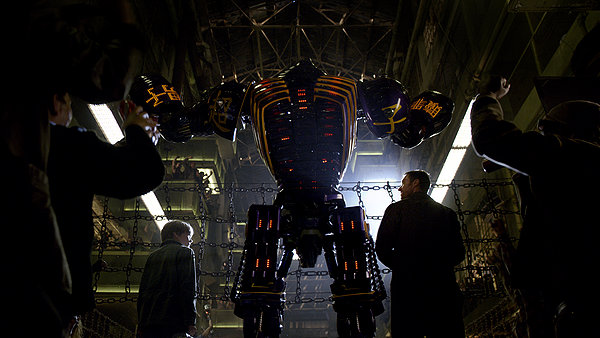
Do you like reaction shots? Real Steel is chock full of them: people wincing, people yelling and clapping at TVs, people muttering under their breath the optimistic instructions, “C’mon, c’mon, c’mon.” You accept some reaction shots as part pf the terrain of the sports movie, but when they’re presented in excess then it becomes a crutch, the director reminding the audience what to feel with the subtlety of a sharp stick to the eye. Then again subtlety was never the forte of director Shawn Levy, he of Date Night and Night at the Museum fame. The special effects are strong and the boxing sequences even have some livened suspense to them, though why would anyone build a robot boxer with two heads? What advantage does that offer other than two things to hit? Levy gets lost in the special effects and treats the actors with the same indifferent level of care that the humans show the robots.
Real Steel wants to be a rousing, family-friendly crowd pleaser; it just won’t ever let you forget that this is its primary function. This outlandish sports flick is much like its robotic pugilists: big, dumb, loud, and prone to malfunction. The film has no faith in its audience’s intelligence so every feeling and symbol is plainly explained with unwanted diligence. The characters are unlikable or underwritten, the story is shackled by lockstep devotion to formula, and Goyo’s wretched performance makes it damn near impossible to sympathize with the father/son reunion. Filled with unresolved plot setups and a mystifying similarity to Over the Top, Real Steel is just like every other boxing movie on record except this one has robots. I’m fairly certain the screenwriters were robots too. Why else would they make a robot becoming sentient seem like no big deal? Obviously this is propaganda to lull us into complacency before the impending robot war. Real Steel is a classic example of a movie done by committee; it feels like it was crudely assembled from the spare parts of other, better movies.
Nate’s Grade: C
Share this:

Attack the Block (2011)
 Attack the Block is the hip new sci-fi comedy/thriller from across the pond. The Brtis know a thing or two about elevating genre movies to an art form. While not rising to the same level of executive producer Edgar Wright’s oeuvre, this is one of the most fun experiences I’ve had in a movie theater all year.
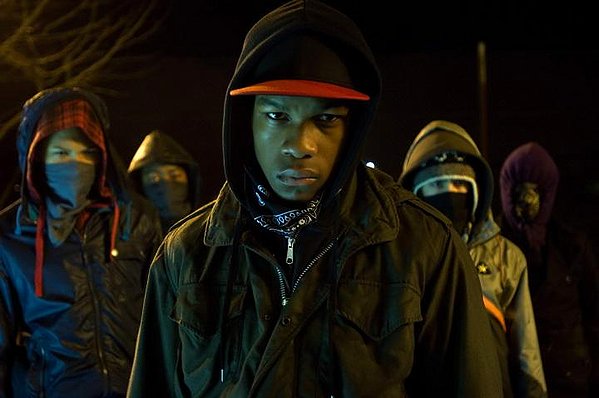
On New Year’s Eve in a South London ghetto, a very different kid of firework is lighting the moonlit sky. An alien race is crashing to Earth as fiery meteorites, which the kids of the neighborhood term “Gollums.” Moses (John Boyega) is the leader of a group of teenage wannabe hoodlums. Their crazy night begins with mugging Sam (Jodie Whitaker), a nurse who lives in the boys’ apartment complex. Moses and his crew later run into Sam and need her help when one of their own is injured. The alien monsters have descended upon their block, scaling the apartment building looking for easy prey. Moses and other block residents band together to battle a common foe, the outer space monsters, which have the misfortune of trying to invade the wrong neighborhood.
Attack the Block is a refreshing spin on a genre that seemingly had covered every ground. But lo, it never covered the modern urban landscape, or, as the tagline succinctly puts it: inner city vs. outer space. It’s not long before you realize that writer/director Joe Cornish (writer of the upcoming Tin Tin flick) is the real deal. The camera angles are lively and inventive, without crossing over into self-infatuation for style’s sake. The cinematography by Thomas Townend is delightful to look at, often making our own home feel like an alien landscape with harsh color tones. The movie has the slick look we associate with music videos and commercials, but never does the movie let the visuals overwhelm the story. The edits are crisp and quick, packing a lot of material into a small 99 minutes and doing well to quicken your pulse during several iterations of the alien attacks. But most of all, the film is completely, unabashedly fun with a capital F. It has a swagger to it, adopting the same cocksure attitude of its main characters. The accents and the breathless jargon take some adjusting, but by the time we’re running from aliens you’re pretty much at the same pace of astonishment with the characters, forgetting the language barrier. I was quickly sucked into the world of this movie, able to enjoy the depth of skill by the invisible technicians. There’s an immense sense of satisfaction watching this crew band together to take out superior numbers of baddies, some of them even Earthlings. Cornish confines his narrative focus to one apartment building over the course of one night, setting up our orientation to the building so that when we have characters running back and forth, and various storylines criss-crossing, we are kept in the loop. As people start becoming monster chow, the stakes get even higher.
 The dialogue is regularly clever without having to stoop for self-aware gags. This is not a genre spoof. This is played relatively straight, just with amusing characters (“You’d be better off calling the Ghostbusters, love.”). One of the kids, who is on a pay-as-you-go cell plan, breathlessly says, “I only got one text left. This is just too much madness for one text!” Attack the Block is the right combination of scary and funny, the same fine line that its forebear, Shaun of the Dead, so successfully walked. This is the kind of movie that genre fans tell their pals about in breathless declarations of awesome before falling over dizzy. Nick Frost, star of Hot Fuzz and Shaun of the Dead, even has a minor roll as the neighborhood pot supplier. While Block doesn’t approach Shaun’s utter genre-spoofing greatness, there is enough of squandered potential in Cornish’s script, particularly how the various pieces ultimately stack together for its standard but effective fist-pumping climax, to keep Block from being crowned an instant genre classic. The characters remain little more than types, distinguishable by the few traits thrown to the actors like meager breadcrumbs (kid with glasses, angrier kid, white kid, etc.). If you’re a fan of Shaun of the Dead, and witty, bloody sci-fi, then you already know that Attack of the Block is destined to beam into your home.
The aliens themselves deserve a special mention since they break away from the traditional mold of cosmic movie monster we’re familiar with. These minimalist aliens look more like giant yeti creatures that run on all fours. They’re all black, like inky black hole light-cannot-penetrate black, which is scary but also a clever way to hide the shortages of a limited budget and the reality of people in suits. The only thing that stands out is a set of fluorescent blue jaws that snap wildly. It’s like the monsters ate a can of glow sticks. This aspect is smartly used at points to pump up suspense. It’s a novel approach that veers away from the H.R. Geiger (Alien) stuff that’s been copied and recopied to death for the last 30 years. These aren’t smart aliens. They’re more like rabid beasts overwhelmed by their biological impulses. These aliens don’t come across as organized as other movie aliens. It seems like they’re just floating around through the void of space waiting to land on the right rock and multiply.
The musical score is greatly enhanced through the talents of Felix Buxton and Simon Ratcliffe, better known to big beat electronica fans as Basement Jaxx. The musical duo provide a score tinged with their famous electronic mélange of sound, including pieces that sound like retro video game sound effects (Space Invaders?), 1950s sci-fi movie scores thick with Theremin use, and an ongoing sludgy beat that weaves in and out of the picture. Working with Steven Price (Scott Pilgrim vs. the World), traditional rousing musical pieces are enhanced with the Basement brothers’ dubsetp influenced bass and drum lines. The score perfectly matches the frenzy of what’s happening onscreen, evoking a fuzzy mood. I have been listening to clips of the Attack the Block score for days. It’s not as integrated and essential to the film as Run Lola Run’s famously kinetic electronica score (the standard bearer of all electronica-enhanced scores), but I was delighted every time it remerged. With the Chemical Brothers score for Hanna and Oscar-winner Trent Reznor’s score for the Girl with the Dragon Tattoo later this year, this may be the best time yet for film lovers that enjoy toe tapping to some electronic beats. These kinds of scores age so much better than synth scores, one of the absolute worst things ever to happen in the history of movies (Apocalypse Now is almost unmatchable thanks to its dreadful synth score).
 Of course your level of enjoyment is going to severely rest upon whether you want the main characters to survive or get eaten. Attack the Block begins with an empathy deficit, meaning it puts its hoodlums immediately in a hole that they might not get out of. Our first introduction to Moses and the gang is watching them mug Sam. Later on one of the guys says the knife that was bared was just for show, and that the boys were just as scared as she was. I doubt that. When you’re on the receiving end of a weapon, and outnumbered, and surprised, it sure seems like you got it worse. The movie then spends the rest of its running time with these wannabe ruffians, and we do get to know them slightly better but really only slightly. Some of the kids have absentee parenting situations, which isn’t too shocking, and occasionally a character will take a moment to reflect, thinking beyond the situation, blaming the government in a fit of paranoia for being behind the alien nasties. One kid even makes a curt remark when he finds out Sam’s boyfriend helps impoverished kids in Africa. “We don’t got poor kids here that could use some help?” he comments. Well, kid, I wouldn’t dismiss the magnitude of systemic poverty in the African continent, but you could have made your point without seeming like a dick. And these are our characters. They blather a lot; in fact they rarely stop talking. Eventually they do apologize to Sam for mugging her and Moses does take the mantle of hero to redeem himself. However, by that time some audience members may have checked out. Attack of the Block is decidedly less fun if you don’t give a fig for its wannabe thug figures.
Attack the Block is like a delirious head rush, witty, full of energy and style to spare, and an infectious attitude that washes over you. The movie delivers what Super 8 promised, namely the bond of kids coming together to thwart an alien invasion on their home turf. This is a high-energy flick that succeeds as a comedy and a thriller, with a few nasty splashes of gore thrown in for good measure. It has some issues that keep it from the pantheon of genre greatness, but I won’t quibble the movie to death. Not when I get something as deliriously entertaining as Attack the Block.
Nate’s Grade: A-
Share this:

Paul (2011)
 This sci-fi comedy by the guys behind Hot Fuzz and Shaun of the Dead, though absent director Edgar Wright (Scott Pilgrim came a callin’), is an irreverently fun flick that lovingly sends up just about everyone in its sights. Simon Pegg and Nick Frost play a pair of British sci-fi geeks road tripping through the American southwest when they come across Paul (voiced by Seth Rogen), an alien on the run. Together they outrun various pursuers, from government agents to angry rednecks, and Paul transforms into a delightful road comedy with the different characters ping-ponging back and forth, narrowly missing but still in the hunt. It’s a cheeky even rollicking action comedy in the vein of a Midnight Run, though with way more stoner jokes. The plot nicely weaves these various elements and characters together, creating a satisfying escalation in suspense and comedy. The characters are pretty familiar and some of the gags are below the caliber of talent onscreen (really, more “people think we’re gay” jokes?), but the final product is unabashedly fun and it’s easy to feel Pegg and Frost’s enthusiasm. Paul is a light-hearted, funny, even tender sci-fi comedy that borrows from better movies but still manages to charm.
Nate’s Grade: B+
Share this:

Apollo 18 (2011)
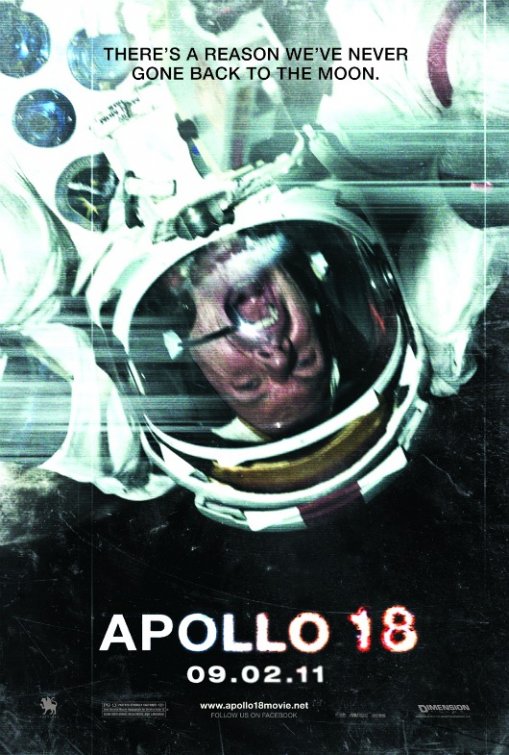 Apollo 18 is the latest in a swelling subcategory of films known as “found footage,” movies that purport to be discovered documents and aesthetically adhere to this premise. That means lots of handheld camerawork, selective editing, and other efforts meant to convey that what the audience is watching is not a movie made by professionals. It’s a professional attempt to look unpolished and amateurish, which is like having a four-star chef make you Taco Bell. 1999’s The Blair Witch Project popularized the found footage concept, and to this day there are still people today hoodwinked into believing it as unvarnished reality. Maybe that’s why NASA issued an actual press statement this week wishing to inform the general public that Apollo 18 is a work of fiction. I don’t think they have much to worry, because very few people will be seeing Apollo 18 and even fewer will enjoy it.
Apollo 18 concerns the failed secret mission of three astronauts (Warren Christie, Lloyd Owen, Ryan Robbins). The astronauts were sent to the moon for the Department of Defense, which means this is the second film of the year to concern a covert reason for landing on the moon. The two astronauts who actually land of the moon’s surface discover a dead Cosmonaut and some strange occurrences. They realize that they have been lied to by their own government and placed in a danger that few can comprehend.
But an intriguing premise can only get you so far and Apollo 18’s clumsy execution makes the movie disintegrate upon reentry, or, any critical thought. A secret NASA mission that went horribly wrong sounds like a great start to a conspiracy thriller, that is until you realize all you’re being presented with is the fake found footage. That means that we spend an eternity watching guys in suits float around, biding their time. Then they go outside and wander around the lunar surface. Then they hear an occasional noise. Or did they? Then they go back to floating around, to make up for the lost time they weren’t floating around. Really, this movie is an hour of nothing. It fails to create a sustainable atmosphere of dread or even basic curiosity. But when locked into the found footage concept, we are generally left with a lot of time on our hands. You would think that the basic premise that people have reassembled this footage would lead to cutting a lot of the filler and just getting to the good parts. It seems almost resentful that this hypothetical editor trying to showcase a long-buried truth would decide that the important stuff can wait. I was so thoroughly bored with Apollo 18 that I started counting stars.
 The structure of the story is just too insular and limited in scope. I strongly feel that Apollo 18 would have benefited greatly by opening up its storytelling parameters. It could have kept the found footage motif, but instead of being an entire 90-minute movie the found footage would be one component of a wider faux documentary. Interviews with science experts, conspiracy theorists, former NASA employees speaking under the protection of anonymity, and even family members, particularly the now grown-up son of one of the astronauts holding out hope, would add some balance. It would make the story feel larger and more authentic, let alone give the audience something new to watch. There could have been a parallel story of the discovery of this evidence, the process of getting it authenticated, and the potential dangers that would be exposed. It all seems a little too slapdash and simplistic to just say the footage was uploaded to a website. Anything, really, is what I’m looking for to broaden Apollo 18. There’s so much more that could have been added, but alas we’re stuck with three blander-than-bland, interchangeable characters collecting moon rocks and battling interstellar cabin fever.
Now I’m about to enter into the orbit of some serious spoilers concerning the ending to Apollo 18, so skip to the next paragraph if you wish to remain pure. The entire premise of this mission gone wrong (why did NASA create Apollo 18 uniform patches for a secret mission? It seems counterintuitive to create merchandise for something meant to be covert) is that there is something on the moon that the higher-ups in government want to investigate. This dangerous mystery claimed the life of a Russian cosmonaut, whose body is discovered by our American squad. When exactly the Russians put a man on the moon is never explained; yet another ingredient that would have worked better as a faux documentary. So you have one dead man on the moon, but soon the body count rises. It’s not some strange cosmic virus that infects the astronauts, leading them to psychotic episodes and murder. No, that would have been too plausible. You see, the villain of Apollo 18 is the moon rock. The rocks themselves somehow can transform into spider-like creatures that like to scurry around. Never mind the fact that we’re dealing with life that evolved in an environment without any atmosphere, but what have these moon rocks been doing for billions of years? It seems to me that after Neil Armstrong stepped onto the moon, the rocks must have been like, “There goes the neighborhood.” After twelve moon walkers, my only explanation for the motivation behind these killer rocks is that they just got sick and tired of being disturbed so often (“You stomp around like you own the place, you leave your trash behind, that’s it!”). A post-script tells us that these moon rocks were brought home and sent as “gifts” (their emphasis, not mine) to leaders and dignitaries of foreign countries. What are the implications with this? That the United States has kept its place atop the world because of the threat of moon rocks? Do the moon rocks even work on a planet with a vastly different climate than the arid moon? For that matter, since Apollo 18’s mission ended circling the moon, how the hell was any of the film footage retrieved? It wasn’t broadcast, so how did NASA or any truth-seeker come a hold of this damning evidence of killer lunar rocks? And to think we once thought that the moon was made of cheese. Oh how naïve we all were.
Apollo 18 is probably the most boring of all the found footage horror movies thus far. It does nothing to justify being 90-minutes, lacks any minor thrills or chills, and seems creatively stagnate. There are some cheap jolts, including having a character awake from a dream screaming twice. This Paranormal-Activity-on-the-moon fails to live up to the possibilities of its intriguing premise, instead settling for something aiming for slow-burn but achieves no-burn. The laughable conclusion is meant as a payoff but only for the nuttiest of geologists. Apollo 18 sticks with its core limited concept to the bitter end. This is a disappointment from all angles. It fails to scare, it fails to stimulate, and it fails to entertain big time. In space, no one can hear your boredom.
Nate’s Grade: C-
Share this:

Rise of the Planet of the Apes (2011)
 I owe the makers behind Rise of the Planet of the Apes a huge apology. I have been vocally dismissive of a new Apes film from the first moments I heard about the project. I just thought rehashing this material was a stupid move. Then I heard James Franco (127 Hours) was going to be the lead, and I sighed. Then I saw the trailers and verbally impugned them in my theaters. Upon the conclusion of the trailer I yelled, “You can still shoot them!” and my criticism drew applause from those around me. The concept that we suddenly made apes smarter and they could now enter the Bronze Age, brandishing spears, didn’t overwhelm me. Just because the apes suddenly had tools didn’t seem like enough to topple mankind from the top of the evolutionary ladder. So in the months and weeks ahead I sneer, jeered, and overall dismissed Rise of the Planet of the Apes. And then the reviews came out and they weren’t just good, they were ecstatic. I went begrudgingly into the theater, waiting to hurl my own feces at the screen (figuratively, of course). Then I was completely taken aback by how much I unabashedly loved it.
Will Rodman (Franco) is a young scientists working hard at create a miracle cure for Alzheimer’s. His corporate company has been testing their drugs on chimps to mixed results. One day a promising ape, made smarter by a dose of ALZ 112, goes bananas and is put down by security. The lady ape left behind a baby ape that has taken on traits from the ALZ 112. Will takes the little chimp home to care for the “company property.” But then he ends up adopting the chimp, which his ailing father (John Lithgow) names Caesar. Due to the super drug, Caesar shows remarkable intelligence and looks to be getting even stronger. It looks like Will might have found his cure, and his boss (David Oyelowo) will make billions. But then complications ensue, as they always do, and Caesar is taken to an animal preserve facility run by a crooked father/son team (Brian Cox and Harry Potter’s Tom Felton). Caesar is mistreated and distraught to adjust to a life in pens. He makes plans to escape but then decides to rally his fellow imprisoned apes to a greater cause with the help of some of the ALZ 112.
Even through Franco is the headliner he’s really nothing more than a supporting character, a catalyst. The real star of the movie is undoubtedly Caesar the chimp. After about he 45-minute mark, Franco is reduced to making frowny faces while he scowls, trying to ascertain where his favorite monkey is. His dialogue is mostly reduced to different iterations of yelling Caesar’s name in different locations (the guy even manages to smirk in his sleep in one scene). But the major surprise is that Caesar is not only a compelling leading character but also a well-developed one at that. This is a living, breathing character brought to life thanks to top-notch computer wizardry and the talents of Andy Serkis, the leading authority for soulful motion-capture performances. Caesar may be the greatest single special effect of all time, not because of its life-like quality (it’s close, but again the creature’s features seem too waxy). But the reason Caesar is so impressive is because of the depth of emotion that can be read onscreen. This is a textured performance where you can read varying emotions through the looks of eyes, the twitching of facial muscles, the biting of lips. The emotions are genuinely recognizable; he flashes guilt, anger, frustration, heartache, disbelief, betrayal, fear, shame, just about everything in the book. From a DNA standpoint, chimps and humans share 96 percent of the same genes, so it’s understandable that we can relate to the plight of our distant relatives. Serkis is responsible for providing the groundwork for CGI creations like Gollum and King Kong, so he’s the world’s go-to guy when it comes to providing a framework for animators (Robert Zemeckis, why have you never called this guy?). It’s an amazing special effect accomplishment and works side-by-side with the storytelling to make Caesar a complicated, interesting, and deeply empathetic hero. He’s a terrific center for the movie and a figure that you root for, even with the tacit understanding that cheering on the apes’ escape is also tantamount to cheering the decline of the human race. But by God, during the apes-run-amok climactic sequences you are cheering for mankind’s downfall hardcore.
The Planet of the Apes saga (six films) is, let’s be honest here, rather abysmal. Everybody loves the first movie but the quality sharply drops from there, with four sequels in four years each managing to answer the depressing question, “Can this thing really get any worse?” The 2001 Tim Burton “re-imagining” was just embarrassing and filled with loopy logic (how can the apes take over Earth’s past when Marky Mark crashes on a DIFFERENT planet in the FUTURE?). Given that, the filmmakers behind Rise of the Planet of the Apes did not have to achieve much to separate themselves from the monkey-stank of the sci-fi franchise. The film serves as a prequel to the series but it’s easily the best film since the original. Easily. For one, the storytelling is not overwhelmed by the allegory of sci-fi packaging. The world is decidedly our own and the problems the characters grapple with are fairly relatable. Will may be responsible for the annihilation of the human race but his motivation is pure – he wants to save his ailing father. That’s a believable motivating force that would push the character to action over caution, testing his special serum without fully examining all the side effects. You know what they say about the road to Hell (my friend Eric Muller always suspected Franco would be linked to the end of civilization)? But in a Planet of the Apes movie there is a wealth of thoughtful human drama. Animal rights are one of the more obvious messages the movie deals with, but the film takes a character-driven approach following the animal himself. You care about these characters and when one CGI ape was cradling a dying CGI ape, I swear I was getting choked up over those computer pixels. That’s how emotionally involving this new Apes film can be. It’s refreshing to have a Hollywood action film that has more on its mind than blowing stuff up all good like.
 But when the action shapes up, mostly during a stirring man vs. apes climax, the film easily delivers. The nimble screenplay by Rick Jaffa and Amanda Silver (their first film since 1997’s Relic!) is a terrific example of economical big-budget pacing. Every scene moves the story forward and doesn’t waste a frame. The final running time is only 105 brisk minutes but it squeezes in so much entertainment and emotion. Director Rupert Wyatt keeps the thrills coming on a human-scale, never letting the enormity of the events getting too out of hand. Sure suddenly there are like 500 apes all of a sudden and all of them are super smart, but I can roll with that. The stakes are always clear and the action is easy to follow and easier to get swept up in. There are a few shout-outs to the original film’s iconic lines, which will either come across as fun or ham-handed. And thankfully a plausible scenario is put forth to explain why the humans would be overtaken by the apes. That’s not to say that everything is smartly woven into the narrative. Several of the side characters are but crude renderings. Frieda Pinto’s (Slumdog Millionaire) underdeveloped love interest could be completely taken out with minimal effect on the plot. Likewise the Evil Business Head seems to have nothing but speeches that remind you his sole interest is making lots of moolah.
Rise of the Planet of the Apes is a Hollywood movie with a soul. Finally late in the summer a major studio movie emerges that has the right balance of brains, brawn, and thrills. It’s an exciting action movie, a poignant drama from an animal’s point of view, a tour de force of special effects that manage to make the film more emotionally involving, and a sci-fi prequel that’s actually worthy of its name. Serkis’ gifts for physical performance are invaluable to the emotional core of the movie. By going back to its DNA, Rise of the Planet of the Apes has given new life to a franchise whose best days were 40 years ago. I don’t see where the series can go from here. A prequel to the prequel seems superfluous. A sequel would only really showcase the waning days of humanity and also seem superfluous. Then again, until the moment I was watching Rise of the Planet of the Apes I would have said this very movie was superfluous too. Instead this is the finest summer spectacle of the year and destined to make my top ten list for the year. If you can’t beat them, join them, damn dirty apes and all.
Nate’s Grade: A
Share this:

Captain America: The First Avenger (2011)
 In the summer of superheroes, you’ll be excused for feeling some fatigue when it comes to men in tights. Captain America: The First Avenger is a surprisingly enjoyable sepia-tinted action film that flexes enough might to pleasantly hark back to the days of 1940s adventure serials. Taking place almost entirely in the era of World War II, the film, and its hero, and unabashedly square and earnest. Steve Rogers (Chris Evans) begins as a 90-pound weakling determined to fight for his country and gets transformed into a behemoth of beefcake by the Army. Captain America is devoid of the dark brooding that has come to encapsulate modern superhero movies, but it’s also playing its B-movie silliness straight. The flick has more in common with Raiders of the Lost Ark and Sky Captain than most other superhero product. Better yet, the movie finesses the in-your-face patriotism of the title character. I mean the guy is called Captain America. Yet the film finds a way to resonate a sincere nationalistic pride without falling back into Michael Bay-level jingoism. And who’s going to make for better villains than Nazis? Director Joe Johnston (The Rocketeer, Jurassic Park 3) turns out to have been the perfect choice to helm this rah-rah retro enterprise. The pacing is swift, the acting is engaging, the special effects are terrific particularly Evans’ transformation into a weakling, and the film is unexpectedly emotional at points. This is a comic book movie that would appeal to an older generation not normally interested in superheroes, namely people like my dad.
Nate’s Grade: B
Share this:

Transformers: Dark of the Moon (2011)

After the obnoxious, oafish mess that was 2009’s Transformers: Revenge of the Fallen, a sequel that took everything good from the first flick and undermined it and took everything awful and magnified it, I wasn’t expecting much. True, low expectations have benefited this franchise built upon merchandizing, product placement, and giant freaking robots that fight. I still remain a fan of the first film back in 2007, and I do feel like director Michael Bay (Bad Boys, Armegeddon) is a natural fit for this material. But after another overlong, overblown, and overloaded Transformers film, I’m starting to think that the franchise’s best days left with Megan Fox and her cut-off jean shorts.
Sam Witwicky (Shia LaBeouf) has graduated from college and is now perusing a job in Washington D.C.’s vast center of government contracts. He’s living with his new girlfriend, Carly (Rose Huntington-Whiteley), the assistant to a rich billionaire (Patrick Dempsey) and his fleet of collector cars. Sam gets a job with at a military private contractor run by a angry loon (John Malkovich). But Sam’s post-collegiate journey once again runs afoul with killer alien robots. The villainous Decepticons are plotting to steal a spaceship that crash-landed on the dark side of Earth’s moon. Inside that spaceship are teleporter orbs and a sleeping robotic giant known as Sentinel Prime (voiced by Leonard Nimoy, hooray). Optimus Prime, leader of the noble Autobots, revives his predecessor. Together, the group attempts to thwart the Decepicons, lead once again by Megatron (voiced by Hugo Weaving).
The Transformers films have been getting larger and larger in scope and destructive power; the first film messed up some L.A. streets, the awful second film trashed Egyptian pyramids (only Six Wonders of the World left in your punch card, Bay), and now the third film pretty much obliterates downtown Chicago in stunning and overblown fashion. The climactic Windy City beatdown lasts a solid 50 minutes and may just be the greatest thing Bay has ever put onscreen, which admittedly might be faint praise to many. Perhaps the city of Chicago thought this would make for good tourism: ”Hey kids, come see the buildings that were turned to rubble in your favorite summer movie!” The impressive special effects are uniformly terrific, and the integration of reality and fantasy seems seamless. That goes without saying. I must credit Bay for creating sustainable action that is, here it goes, actually coherent. I know that “Bay” and “coherency” rarely go together, so I’m as shocked as everyone. No longer does geography become a hindrance to understanding. During this climactic Chicago onslaught, the locations are established, the objectives are clear, and the audience has a crisp understanding of the different teams, their paths, and their organic roadblocks and setbacks.
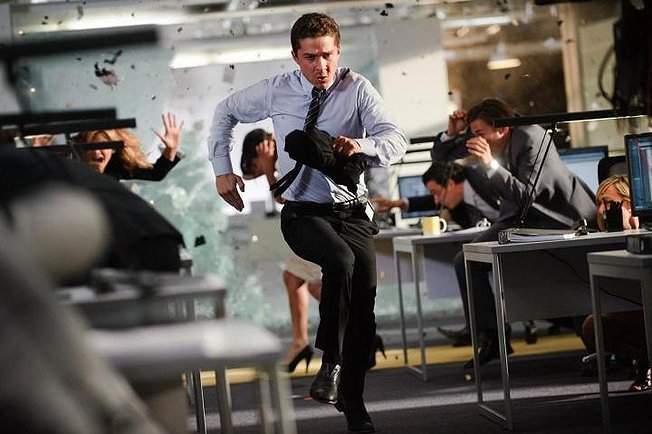 There’s a strong set piece within this 50-minute assault where Sam and company enter into a crumbling skyscraper that then teeters on its side. The organic complications allow for some nifty, almost ingenious, split-decisions utilizing a specific location, the hallmark of good action sequences. One moment they’re climbing up the floors, the next moment they’re tumbling through the floors, then sliding down the sheer glass wall, then firing at the glass to fall back inside and tumble some more. All the while a giant worm-like robot is churning through the foundation of this collapsing building. The scale of the sequence is quite thrilling for the time being. And yes, the 9/11 imagery is undeniable and relatively unearned without even a nod to solemnity or anything less than brainless summer spectacle. Sure the “cool-ness” of the individual parts never really materializes into something greater, and yeah maybe the action would have more impact if you actually felt for the characters, or knew who some of them even were, but you take what you can get in Michael Bay world. The extended climax for Transformers: Dark of the Moon is relentless and will beat you into submission, admiring the intrinsic beauty unique to Bay’s epic, albeit mind-numbing, demolition of the senses.
But Dark of the Moon is also the most visually coherent of Bay’s troika of Transformers flicks because the man has finally settled down when it comes to editing. Now no one will confuse this movie for Rope or Russian Ark (look it up, Transformers geeks), but the edit/panic button is given a slight reprieve. The shots last longer; the editing is far less frenetic and chaotically ADD-addled, and no longer does a Transformers action sequence look like jumbled, mechanical scrambled porn. Image A and Image B make a logical connection, at long last. You can tell which robot is which, for the most part. Perhaps this editing epiphany was a result of Bay’s corporate betters insisting that the film be shot in 3D (I chose to see the film in good old boring 2D, feeling that 150-minutes of Michael Bay with headache-inducing glasses was not worth the extra dough). Perhaps Bay had to consciously think about his audience’s well being so his shot selections lasted longer than his usual whirlwind of cuts. Perhaps the secret was loading Bay with cameras that weigh the same as couches. Maybe a little extra weight was all the man needed to formulate lucid action sequences.
And yet Dark of the Moon is just as stupid, outlandish, and tonally disjointed as the other movies, particularly the abysmal Revenge of the Fallen. The comedy remains at a puerile, sophomoric level. Bay’s sensibilities have always somewhat mirrored that of a snickering 14-year-old boy; the love of destruction, the fascination with things that go “boom,” the ogling of lithe feminine bodies. No joke, the first image seen directly after the film’s title is a close-up of Huntington-Whiteley’s ass ascending a staircase. I imagine there were plenty of men spasming in their 3D glasses trying to reach out and grab the circumference of a Victoria Secret model’s talents. I wrote about the second film: “Women don’t seem to exist in the Michael Bay world, only parts and pieces of women.” Huntington-Whiteley’s character certainly leaves much to be desired, outside aesthetics. At least Megan Fox’s character had, you know, some character traits. I also wrote: “Amazingly enough, [Fox] manages to lose more clothes the more she runs in slow-mo, allowing the male audience members to follow the nuance of her bouncing breasts. She’s clearly not the next Meryl Streep but this girl deserves more than being wordless arm candy.” Seems apt to me. Carly is as bland as she is blank-eyed beautiful, just the way Bay likes ‘em.
The first 90 minutes of the film is spent with the humans and it’s like being trapped inside a bad comedy. There has always been a strong comedic bent to the franchise ever since the first film in 2007; however, the latter films have taken to grotesque caricature. In Dark of the Moon, the comedy is so deeply unfunny but so consistently antic, trying to overwhelm you with its bad taste. There’s a scene where Ken Jeong (yes, you read that right) corners Sam in a bathroom stall to distribute his crackpot manifesto. Then Sam’s boss walks in and, oh boy, he overhears and thinks they’re having a homosexual liaison in the men’s stall. What a hoot. Then Sam’s mother gives him dating advice, stating there’s no earthly way her son is going to nab a third “hottie” unless her boy has a giant…. and trials off (wouldn’t a mother kind of have an idea about that subject?). And then there’s the little Autobots, the size of remote control cars (perfect presents for Christmas mom and dad), who wheel around spitting smart-alecky backtalk. The entire Malkovich portion could have easily been cut from the film without damaging a soul. The Ken Jeong stuff should have been eliminated first. There’s something to be said when John Turturro’s returning Agent Simmons is the least annoying comic sidekick in this movie. But hey, at least there aren’t any overt racist depictions and jokes about robot scrotums. Nope, there’s only infantile humor and nonchalant misogyny. The comedic pit stops and non-sequitors never allow the movie’s tone to gel.
 Before the movie descends into an all-out series of explosions and shrapnel, the setup actually has some genuine interest. Then it just all goes nuts at warp speed. The fact that the space race to the moon had a sinister ulterior motive, investigating alien technology, is an intriguing start. Bay even shoots the 1960s sequences like he’s ripping off Oliver Stone, swapping film stocks and black and white film to showcase his historical reinactors (three presidents get represented, including Obama). Apparently after this film and X-Men: First Class, the breakout star this summer is archived footage of JFK (man did he have a full plate, mutants and robots, and the man still found time to bang Marilyn Monroe). There’s even a cameo by the real Buzz Aldrin, which served to make me remember his better cameo on TV’s 30 Rock (“Would you like to yell at the moon with me?” he politely asked Tina Fey). The space race was a pretense for getting our human hands on some alien technology. Of course we were warned years ahead of time via Pink Floyd but nobody could put the pieces together. But there’s more alternative history to be had. Turns out that the disastrous nuclear accident at Chernobyl was caused by the Russians trying to operate alien/Transformer technology. I’m sure modern-day Ukrainians will adore having their deadly tragedy turned into a plot point in a stupid movie about fighting robots. The Decepticons wicked plan is to open a teleportation portal and bring their dead planet, Cybertron, to Earth. Then they will use Earth’s human population as slave labor to bring their dead planet back to life. My question is this: when you’re a huge robot the size of a building, wouldn’t puny little humans make for a terrible labor force with their stunted little legs and feeble muscles? I know there’s billions of them, but there’s a reason human beings have never turned on ants and forced them to become a labor force for our construction projects. How many more deadly things from Cybertron are secretly going to be hidden on Earth? And yet none of this is even one-tenth as stupid as Transformers’ heaven in Revenge of the Fallen.
Transformers: Dark of the Moon is likely everything fans would want from a franchise. There’s wanton destruction, a plethora of noisy explosions, and plenty of eye candy both in special effects wizardry and pouty, full-lipped women. But at a colossal 150-minute running time, this is a Transformers film that punishes as much as it entertains. There’s really no reason a movie about brawling robots should be this long. There’s no reason it should have to resort to so much dumb comedy. There’s no reason that the women should be fetishized as if they were another sleek line of sexy cars. There’s no reason why something labeled a “popcorn movie” can’t deliver escapist thrills and have a brain too. Dark of the Moon is saved by its long Chicago-set climax, which gives way to some staggering action set pieces. The newest Transformers movie is just as stupid as the rest (what the hell is up with the weird Igor robots tending to Megatron that just seem to grumble and grunt?) but, unlike the previous installment, it’s not offensively stupid. Dark of the Moon is an exhaustive experience whose thrilling high points even feel mechanical and pre-programmed. Is this the future of Hollywood? Bay and his army of robotics and excessive spectacle have taken over the world. When it comes to big-time summer entertainment, the machines of Hollywood are going nowhere fast and even louder.
Nate’s Grade: C+
Share this:

Green Lantern (2011)
 To quote that sage Kermit the Frog and his words of wisdom concerning Green Lantern: “It ain’t easy being green.”
Hal Jordan (Ryan Reynolds) is a cocky pilot working for his ex-girlfriend, Carol Ferris (Blake Lively). Hal never takes anything too seriously and seems to freeze up in moments, recalling his own father’s crash. Then one day a purple alien crash-lands on Earth and seeks a replacement. This alien belongs to the Lantern Corps, a group of intergalactic policemen for the universe. He was mortally wounded by Parallax, a creature that grows stronger on fear but looks like a big rain cloud. The alien’s ring chooses Jordan as the replacement. Next thing you know, the guy is training on the alien world Oa and meeting lantern officers from all over the universe led by Sinestro (Mark Strong). Jordan is unsure of his heroic destiny, though we are reminded many times “the ring does not make mistakes.” In the meantime, Hector Hammond (Peter Sarsgaard) is dissecting the dead purple alien and gets infected with the fear cloud/Parallax. He lashes out at his father (Tim Robbins), at Jordan, and signals to the giant evil rain cloud that Earth is an all-you-can-eat fear buffet ready for the binging.
For starters, he power is a bit silly and hard to explain. I fall in with the majority of the public when I say, “Green Lantern who?” So the guy’s super duper power is to channel his imagination into green-tinted reality? It’s a bit vague and hard to quantify. So when a helicopter is falling to earth, instead of, say, picking it up or steadying it, Jordan creates a green Hot Wheels racetrack for it to zoom around to a stop. When the evil rain cloud fires its energy projectile, Jordan conjures a catapult to catch the projectile and fire it back. And of course at some point he materializes a green gun to use in combat. I’m sorry but for me this just seems silly. It’s one thing to say, “His strength is the power of his imagination,” and I can see where young kids would gravitate to this stuff, but when it’s realized on the big screen is seems infantile. What are the rules here exactly? It just seems dumb. I can better accept a magic ring that allows Jordan to fly or shoot sparkly lasers. If a healthy imagination is key, then the rings should be choosing some of the world’s greatest living authors and artists. Can you imagine Charlie Kaufman (Being John Malkovich) with a lantern ring, or Neil Gaiman (Sandman)? Surely those guys would come up with something more interesting than catapults and racetracks. But you see, the rings, and the lantern world itself, runs on the power of will. Will power is their energy resource (talk about going green). The enemy, the cosmic rain cloud, runs on the power of fear, which is represented by yellow energy. What are the other colors of the rainbow? Is the power of love red? Is the power of envy a darker green? Is orange the color of hunger? Is brown the color of painful bowel movements? Is the power of apathy… forget it.
The biggest misstep is all the time the screenplay squanders on boring old Earth. Just like Thor, the alien worlds are the best part of the movie. But in Green Lantern, we see the training home world (Oa) and the thousands of weird, fun-looking aliens staffed to police the universe. We get a taste of the lantern life and the heavy responsibilities. We get a sense of the powers. And… then… Hal… quits. He up and quits. He says, after about five minutes of training, “You got the wrong guy,” and we head back to Earth. What the hell? We then get to spend the majority of Act II with this guy moping over whether he should or shouldn’t be a superhero. Memo to Hollywood: no one spends this kind of money on a movie where the main character can’t be bothered to accept being a hero with amazing super powers. I can’t be bothered with a hero who can’t be bothered. The screenplay structure should have been: Act I spent on Earth, Act II spent on Oa and in space, Act III return to Earth to save the day. Instead we get about ten minutes spent on Oa. And while I’m on the subject, whenever we see this alien planet it’s like a non-stop Green Lantern convention (does Oa host other conventions? Is next week the semi-annual gathering of amateur ornithologists?), so who is left policing the universe? I understand that a majority of the universe is empty space, but if the lanterns keep getting together for pep rallies on Oa, what’s to stop a universe full of criminals from stealing everybody’s car stereos? Also, lanterns intervene in the universe when evil is afoot, but nobody seemed to give a damn about planet Earth until we got lantern representation with Hal Jordan.
So the bad guy here is a semi-formless rain cloud with a head that sucks people’s fear. It feeds on fear. That is its energy source (get a job in the media, son). Like much else in the film, the rules concerning the villain are never fully explained. At times, this rain cloud thing seems invincible. Most of the time it’s never explained what exactly this thing could do. See, if you explain things then you box in your characters. So if you don’t establish rules for your villain, your heroes, their respective powers, the history of the universe, etc., then they are limitless. It also means that everything onscreen lacks any sort of logic, internal or otherwise. So the villain is really just a fuzzy concept of fear. Hal Jordan and the lanterns have nothing to fear but fear itself. That means that the screenplay falls prey to a plethora of hackneyed messages that feel ripped out of some Saturday morning cartoon series. Everyone feels fear. Accept your fear. Courage means rising above. It’s the same patter that’s been rehashed for hundreds of episodes of people in tights teaching schoolchildren it’s okay (take a drink every time a character utters the word “afraid” or “fear”). The simplistic moralizing on fear and courage made me yearn for a ring so that I could imagine a better villain. Lastly, there’s a scene where our dastardly cosmic rain cloud descends to Earth and starts sucking away people’s fear/energy/souls. There’s a shot of a school bus screeching to a halt and children dashing away. I imagine children’s fears are more heightened since their healthy imaginations and lack of world experience would exaggerate scary things that adults would try and simply deny. Their fear has to be like a delicacy. I guess what I’m getting at is, if I were a giant space cloud that fed on people’s fears, I’d go for the children first.
Director Martin Campbell has crafted some truly spellbinding, breathless action sequences in movies like Goldeneye and Casino Royale, but you can tell that he seems to be straining against the onslaught of computer effects. Campbell is more at home with the open world of practical effects and the tangible. Being confined to the realm of green screen and CGI seems like a shackle for this guy’s own imagination. He constructs solid action sequences, admittedly, but nothing worth bearing the name of Campbell. It’s a special effects bonanza without a hint of realism, like a computer start vomiting onto the screen. It feels weightless and formless, like a giant evil rain cloud. The film reportedly cost over $200 million, which is a high figure for a movie that spends so much freaking time on Earth! Here’s an example of a costly filmmaking expenditure – the suit. Hal Jordan has a skin-tight green suit that is complete a computer effect. That means that every second Reynolds is seen onscreen in his signature outfit, it’s another effect that people labored over for months. Why? I’m pretty sure that in this day and age we have the technology for clothing. Campbell succumbs to the limitations of the material and Green Lantern ends up feeling more like a TV pilot with a runaway budget than the beginning of an epic franchise for its parent company.
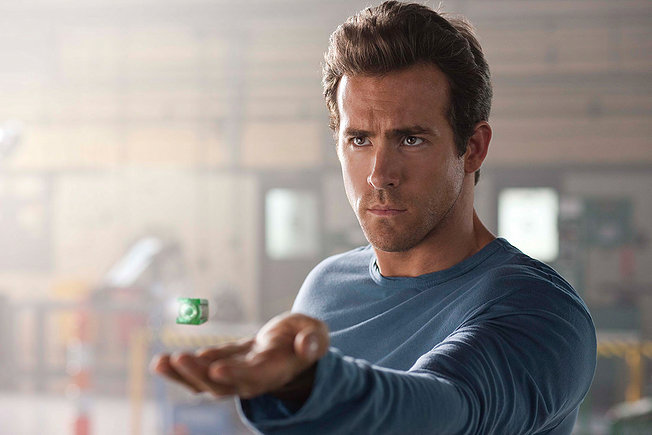 Reynolds (The Proposal) is an extremely likable actor whose biggest drawback is that he rarely seems serious, last year’s Buried a notable exception. He’s got this carefree attitude, practically bobbing his head and winking to the audience, and you like the guy even when he’s being a cad or a wimp. His character’s arc is supposed to be the guy who accepts responsibility, learns to accept and move beyond his fears, and it’s a character track that has been long journeyed and will continue to be. It makes for a simplistic hero’s journey storyline that seems to do the least work necessary to move things along. The movie did not fail on Reynolds’ shoulders; you can blame the four screenwriters and a ballooning budget for that one. Lively showed that she really could act in The Town. She shows no proof of this ability in Green Lantern. She speaks every line in a flat, monotone delivery, so much so you start to think she has like an inner-ear infection and can’t hear her own modulation. Her character is the weak love interest/damsel in distress role that regularly peoples these kinds of movies. Her monotone delivery does nothing for the lukewarm chemistry between her and Reynolds. Only Sarsgaard (An Education, Orphan) comes away mostly unscathed. His underwritten villainous character undergoes a monstrous transformation that would elicit sympathy from the Elephant Man.
Green Lantern is a movie that will thrill twelve-year-old boys and few others. It’s full of special effects, noise, and little clarity or wit. It’s not even a particularly fun movie. It repeatedly tells the audience things it should be showing, and it can’t help showing the audience character points (like Hal’s dead dad) that could have been handled with smoother nuance. The movie never feels like it can trust its audience for anything subtle. This is the kind of movie that needs to spell out everything. Green Lantern is muddled, tonally disjointed, the rules are not established, the villain is abstract, the messages are simplistic, the powers are ill-defined and also silly, the action is lackluster and overly dependent on often needless CGI, and the hero can’t even be bothered to accept his super powers. Apparently Green Lantern has about 60 years of comic history and a rich sci-fi universe, and this is the best four screenwriters could come up with? This is the best stuff they pulled from? Green Lantern is a movie that feels dimmed from start to finish.
Nate’s Grade: C
Share this:

Super 8 (2011)
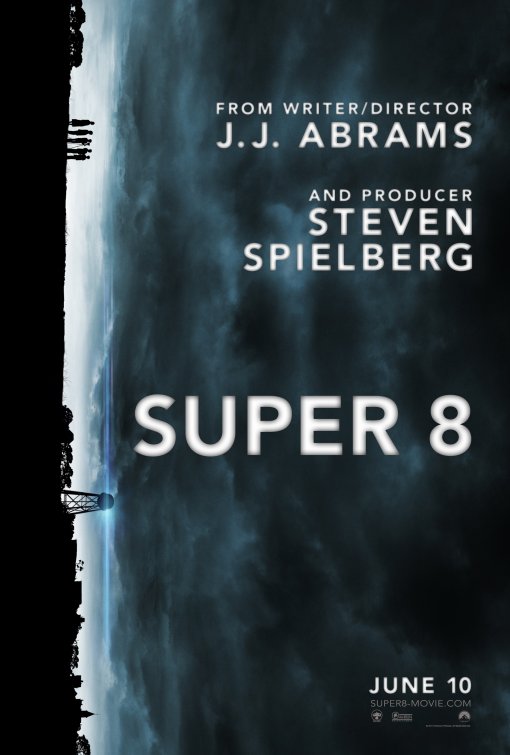 Super 8 is writer/director J.J. Abrams’ reverent homage to early Spielberg movies. For some, it will be too reverent to the point of being a slobbery love letter.
In 1979, a small Ohio town, 13-year-old Joe Lamb (Joel Courtney) is reeling from the death of his mother in a factory accident. His father, Jackson (Kyle Chandler), is a police officer who doesn’t know how to raise his boy. He even tries to convince his son to spend the summer at a baseball camp. “It’ll be good for you to spend some time with kids who don’t run around with cameras and monster makeup,” he says. That kid is Charles (Riley Griffiths), a self-possessed amateur filmmaker. Charles is writing and directing a short Super 8 film and all his friends are helping. Joe’s specialty is makeup, given his attention to delicately painting models. Being the makeup guy comes in handy when the gang invites the local pretty girl, Alice (Elle Fanning), to be in their movie. Joe gets to apply her zombie makeup. One night, the gang sneaks out to a train yard to film a scene in their movie. A U.S. Air Force cargo train is passing by and suddenly derails, in grand apocalyptic fashion. Strange things start happening all over town shortly after the train crash. Car motors and electrical equipment go missing, dogs run away to neighboring communities, and people start to go missing. The Air Force comes into town and takes charge. It seems that train was carrying something and that something has escaped.
What Super 8 does best is replicate a time, place, and mood. The movie is successfully awash in nostalgia, and that childhood nostalgia is the best aspect of an otherwise ordinary film. Abrams has fashioned the greatest film tribute to Spielberg in history. But its limited ambition makes it feel like the greatest cover band of all time. You’ve assembled al your talent and energy into replicating someone else’s original work. Congratulations, Super 8 is a glossy tribute to Spielberg. Now what? Well, the movie works well at finding that unique, infectious spirit of being young and full of ideas. Filmmaking, and movies in general, has a magic to it, the synergistic creativity and the sheer possibilities that can abound. Translating the imagination into a communal artistic experience. I’m sure Abrams was just as excited about the possibilities of a camera in his childhood as Spielberg was. That feeling of discovery, that rambunctious creativity, and the endearing clumsiness of amateur productions, it all rings completely true. I made silly movies with a camera and my friends when I was younger; my group of friends and I became known for our video projects in high school. So I could have readily watched an entire movie about kids and cameras and their artistic aspirations (as long as it was better than Son of Rambo). The highpoint of Super 8 for me was, surprisingly, the children’s short film “The Case” that plays over the closing credits. It’s funny and charming and sweetly affable. Finally seeing Charles’ finished film is the ultimate payoff.
Abrams as a director is quite capable of delivering big summer moments. He’s a genre specialist and a geek’s best friend. I’ve even compared his style to that of a young Spielberg in my review of 2006’s Mission: Impossible III. Abrams has a natural feel for putting his camera in the right placement. While Abrams can do exciting action with the best of them, crafting compelling screen compositions to ignite the senses, it’s the smaller touches that connect to his storytelling that impress me most. The very opening shot tells you so much and grabs you. It’s a slow zoom into a factory’s sign proclaiming how many days have gone by without an accident. A man takes down the number plates and the count drops from 750 to 1. There’s a small moment where alice imitates a zombie, cocking her head, lurching, going in to bite Joe. And you see her, in that moment, as Joe does: a lovely young woman who makes your heart melt. With the aid of Michael Giacchino’s very John Williams-esque score, you effectively feel Joe’s burgeoning young love. Then when we pull back there’s a trace of Alice’s red lipstick along Joe’s neck, indicating she made actual contact. It’s a small detail that makes you smile all over. It’s these small details that often play to plot or character that affirm for me that Abrams is a director of fantastic promise, a true Spielberg protégé. Now if Abrams could lay off his excessive use of lens flairs (though it’s not as prevalent as Star Trek; you could make a drinking game into every time there was a lens flair).
The young actors are pretty good despite the somewhat hollow characterization by Abrams. These kids are defined by one-note traits (the kid obsessed with explosives, the wuss, etc.). I was going to be more upset by this until I remembered that movies like The Goonies, deemed a nostalgic classic by my generation, also had flimsy, one-note characterization (the fat kid is fat, the Asian kid has funny gadgets!). The scenes where all the kids are assembled make for some of the best entertainment. The young actors have a great rapport with one another and feel like a true makeshift band of friends. Their camaraderie, uncertainty, and hopes seem entirely genuine. They seem like real kids with real kid problems and worries. Courtney is a strong emotional center for the film. It’s hard to believe this is his first role on the big screen. Fanning (Somewhere, Curious Case of Benjamin Button) has been acting ever since she was the two-year-old version of her famous big sister in I Am Sam. I’m on the record as saying that Elle is a superior actress to her sister, and I feel like that claim bears fruit with Super 8. There’s a scene where Fanning’s character is asked to practice some feeble dialogue. Her cohorts think of her as a pretty girl and a source of transportation. But in this one scene, she turns on a dime, bringing out real emotions that leave the boys breathless and the audience too. It’s reminiscent of the audition scene in Mulholland Drive where Naomi Watts, at the flip of a switch, transformed into a different person, coursing with vibrant life. Consider it the toned-down kiddie version.
 Truthfully, the monster stuff is actually the weakest part of the film. Super 8 works best as an endearing, nostalgic trip about being young. It works best as a coming-of-age tale and a somewhat touching first romance between teenagers. It does not work well as a sci-fi monster movie. You can tell that the monster/alien stuff has been grafted on to a separate storyline; the plots have little to no bearing on one another. If the kids happened to never go to that train stop that one night, their storyline would be almost entirely unaffected. It’s like parallel movies that pass each other occasionally but have little shared resonance. I found the human stuff, about being young and hurt and with your friends, to be affecting and interesting. The big-budget explosions, the monster mystery teased far too long, the subterranean third act that ends in a gob smack of logic issues, the heavy-handed metaphor about “letting go” (after only fours months? I think you’re still allowed to be sad four months after your mom dies) – that stuff plays well in trailers, but it’s far less interesting. The monster/alien conspiracy fails to lead to anything ripe in the narrative; the Air Force antagonists are more furtively empty than menacing. They don’t seem to care so much about a group of kids filming around the crash site. They’re pretty ineffective antagonists. The monster is hidden for so long, the film builds to an expectation level that it could never meet. The creature design of the monster/alien looks exactly like a smaller version of the Cloverfield creature (also produced by Abrams). When Super 8 is a poorly mimicking other B-movies, trying to wring tears by the film’s somewhat forced ending, I kept thinking, “The Iron Giant did this much better.” I guess once again aliens or a supernatural encounter helps people heal their family strife, which is something M. Night Shyamalan has been selling for years. This is one monster movie that would have been infinitely better without its monster.
Super 8 is obviously a personal film for Abrams, harking back to his boyhood days of monster movies, amateur filmmaking, and young love. This nostalgic time warp will likely succeed with many audience members. Nostalgia is a powerful narrative weapon. It taps into our warm memories of old. But nostalgia is easy to pattern. What’s difficult is creating a work of art that people will be nostalgic over a generation hence. Super 8 is not going to be an inspiration to a new generation of budding young filmmakers; it reconfirms the joy of monsters, movies, and creative possibility. But the elements don’t gel. The monster stuff feels tacked on to an affecting coming-of-age tale about a group of kids working together to make a movie. Rarely will the two plots really have much traction with one another. I think Super 8 would have been an even better movie had the “summer movie” elements been stripped. No monster. No sci-fi thrills. No military intervention. No train crash. Just kids, a camera, and the emotions of growing up.
Nate’s Grade: B


You must be logged in to post a comment.