Blog Archives
X-Men: First Class (2011)
 Marvel’s X-Men franchise had some serious damage it needed to undo. The once mighty superhero series had been harmed by that age-old foe – bad sequels. The collective stink from 2006’s X-Men: The Last Stand and the 2009 Wolverine debacle, the franchise had lost some serious luster. While the recovery was not nearly as deep and cataclysmic as what the Batman franchise had to deal with in the wake of 1997’s Batman and Robin, a film that flirted with salting the earth, the X-Men needed some kind of facelift. Enter director Matthew Vaughn (Kick-Ass, Stardust), the man who was going to save the series back in 2006 when original director Bryan Singer flew away to direct a different man in tights. Vaughn was originally tapped to direct Last Stand but he dropped out and was replaced by the hack Brett Ratner (Rush Hour). Thus began the slide toward mediocrity. Now Vaughn is back to tidy up unfinished business, taking the series back to its historical roots in the 1960s. It seems that a trip back in time was just what was needed to make the X-Men fresh.
Back in 1944, Erik Lehnsherr is a prisoner in a Polish concentration camp when Dr. Schmidt (Kevin Bacon) discovers the young boy’s great potential. When enraged, Erik can control anything metallic. In upstate New York at the same time, young Charles Xavier discovers a young shape shifter named Raven. She’s blue from head to toe and afraid. They’re delighted to find one another, fearing they were the only ones “different” in the world, children of the “atomic age.” All three of these people are headed for a collision course. In 1963, Charles (James McAvoy) has become an Oxford professor, Raven (Jennifer Lawrence) has followed him to England, and Erik (Michael Fassbender) has been systematically hunting down the Nazis responsible for his pain and suffering. Dr. Schmidt has now become Sebastian Shaw, a younger-looking playboy with the intent to push the Soviets and Americans to nuclear war. Shaw has his own team of mutant henchmen, including telepath Emma Frost (January Jones, proving once again that she can really only ever be good as Betty Drapier) who walks around in white lingerie the whole movie. Together with CIA agent Moira MacTaggert (Rose Byrne), Charles and Erik assemble their own team of young mutants to thwart Shaw.
Similar to 2009’s Star Trek, this film provides the opportunity to reboot a franchise by going back in time. It transports the series back to the beginning of the friendship between Charles and Erik, and spends the next 130 minutes filling in the rationale for the “why” of their varying personal philosophies. By dialing back, we’re able to play around with 40 years of back-story and histories. While we know the end results, that these two giants will become enemies, that Charles will lose the ability to walk, and that Raven/Mystique will eventually side with Erik, that doesn’t mean there isn’t pleasure to be had in watching the journey. There are all sorts of self-aware in-jokes for fans and a few nifty cameos that left me howling with glee. The script, credited to Vaughn, his writing partner Jane Goldman (Kick-Ass), and four others, smartly moves the film forward; no scene seems at a waste. Even better, the film strikes a tone that manages to take its real-world implications seriously (nuclear brinksmanship, Holocaust, and fighting for equality and acceptance) without diminishing its popcorn thrills.
As a summer movie, X-Men: First Class has enough razzle-dazzle to compliment its intelligent social pontification. Vaughn and his screenwriters have composed action sequences that neatly incorporate the mutant abilities of its subjects while building the tension and smartly utilizing the contours of geography. I hate action sequences that don’t play to the potential of location and subject. An evil teleporter (Jason Flemyng) finds a fiendishly clever way to dispatch 20 CIA agents. Magneto efficiently takes out former Nazis residing in Argentina in one chilling sequence (“I’m Frankenstein’s monster,” he tells one man). Shaw makes for an actual formidable opponent for our fledgling heroes. The personal connection he has with Erik, on top of Bacon’s devilish glimmer of villainy, makes Shaw a strong antagonist that the audience can rally against. Vaughn has a splendid reveal with Shaw. Back when he was a Nazi doctor, he asks young Erik to move a coin with his abilities. The shots consist entirely from one side of his office, showcasing it to be a bookish study. Then when Shaw calls the Nazi guards to bring in Erik’s mother for a little more direct incentive, the camera flips position. We see the opposite side of the room, a medical station on the other side of large glass panels. Inside is a torturous display of medical cutlery. It’s a fantastic reveal that kicks up the tension while adding to the terrifying character of Shaw. The action highpoint, a mutant vs. mutant battle amidst the Soviet and American naval fleets, provides plenty of parallel action to follow that keeps the movie alive and kicking.
The film mixes a frothy, James Bond-esque spy thriller feel in production design and whatever-goes plot savvy, but then recomposes real life events as mutant enhanced. Alert the history textbooks, because the Nazi scientists experimented on mutant children and that mutants averted World War III. Some will chafe at the alternative history approach, but I find it to be more interesting, suspenseful, and a natural fit with the overall Cold War paranoia feel of the setting. Melding the X-Men into history makes for a more intellectually stimulating adventure, tipping its hat at various historical revisions that payoff as small rewards for a well-informed audience. I’m not saying that the movie is like Noam Chomsky’s take on X-Men by any means, but it’s certainly the most heady film in the series since the departure of Bryan Singer (he serves as producer on this flick). Indeed, this is a rather talky X-Men adventure with plenty of philosophical debates and speeches. But then it’s got naked women in blue too. But you see, it’s not just naked women in blue, it’s that a naked woman in blue can become a political statement – man!
And it’s on that note I’d like to say a few words. Mutants have always been a central metaphor for the oppressed, be they Jews, African-Americans, homosexuals, whatever minority group you’d like to slot in. That’s been one of the secrets to the continued success of Marvel’s flagship series – anybody can identify with the fear of being judged, feared, and despised because of who you are. That’s why the character of Raven/Mystique, short of Magneto, is the most fascinating character in the movie. Her true form, scaly and blue, is what keeps her feeling like an outcast. She doesn’t have an invisible power like her surrogate big brother, Charles. She constantly disguises herself in order to fit in, albeit her disguise is the alluring natural figure of Jennifer Lawrence (Winter’s Bone). “Mutant and proud,” she says in disdain when she stares at her bluish reflection in the mirror. It is through Erik hat she begins to believe in this mantra, gaining pride that “blue is beautiful” and she need not even wear clothes to cover who she is up. Raven/Mystique is the figure torn between the two philosophies argued by Charles and Erik. She is the central figure that has to struggle with reality vs. idealism. It’s also a little funny that a movie piggybacking the civil rights movement of the 60s (mutant rights!) also trades in the casual misogyny of the 1960s (women in lingerie as outfits, regularly practiced sexism). I suppose some of this is intentional. I guess the women’s movement will be saved for a sequel.
While the retro setting ties in nicely with the series’ core metaphor about being different/disenfranchised, the dichotomy of ideas presented by Charles and Erik are not given equal measure. That’s because, quite frankly, Erik is a much more powerfully interesting character and more sympathetic than a rich kid who can read people’s minds. Charles Xavier and Magneto have always represented a comic book version of Martin Luther King Jr. and Malcolm X when it came to the ideas of integration, equality, and representation. Charles believes that mutants should assimilate and that humanity will accept in time; peaceful and hidden. Magneto, on the other hand, takes a more militant stance and feels that mutants need not hide who they are out of fear or shame, that they are the dominant species and should not be threatened by the weaker Homo sapiens. But where X-Men: First Class runs into some trouble is that the ideological deck is completely stacked in Magneto’s favor. He’s the one who suffered through concentration camps, Nazi experimentation; he’s seen the worst of what mankind of capable of. He’s a tormented man seeking vengeance, which is character motivation that is easy for an audience to fall behind. Then, even after the mutants save mankind’s bacon during the Cuban Missile Crisis (the first person who tells me this is a spoiler gets a history book thrown at them), they still get treated as the enemy. Almost everything that plays out onscreen aligns with Magneto’s ideology, which makes it hard not to be on Team Magneto as the movie draws to a close. I suppose the film utilizes our knowledge of future events to counterbalance Magneto’s pessimistic world philosophy.
The other issue that lends more credibility to Magneto than perhaps the filmmakers were hoping for is the fact that he’s the most interesting character in the movie, easily. The X-kids are a pretty bland bunch of boys and gals. This is the first class the filmmakers chose? Did they have recruiting violations at the school? Havok (Lucas Till), a goy who can shoot energy beams, Banshee (Caleb Landry Jones), a guy who can scream loudly and fly, somehow, Angel (Zoe Kravitz), a gal with fairy wings and an acid tongue, and then Darwin (Edi Gathegi), a guy who… adapts? Darwin’s power is so obtuse to explain, it’s no wonder he doesn’t last long in service to his country (it’s a bit tacky that when one character says “slavery” the edits have to cut back to the one black mutant for a reaction shot). Each one of these teenagers has a different reaction to their powers. Some are ashamed, some are afraid, others proud or apathetic. But they are all singularly uninteresting. Once they establish their power, they become less a character and just another piece on a game board to be positioned. And Lenny Kravitz’s kid in fairy wings? Plus she spits little fireballs? I’m sorry but that should have been the first thing removed from rewrites. This crew makes it sure that we empathize even more with Magneto as he refines his powers to reach his personal vengeance, which is the film’s pre-designed payoff. We’re not really looking for the team to band together, which they inevitably do, but we’re awaiting that splash of vengeance. And when it does come, it’s satisfying, stylish, and dramatically fitting (“At the count of three, I’m going to move the coin.”). The fact that the movie still has like 15 minutes of material afterward is almost inconsequential.
Vaughn certainly delivers the spectacle, it’s the actors that produce the real fireworks. This is a vehicle for McAvoy (Atonement, Wanted) and Fassbender (Ingloruious Basterds, Jane Eyre), and both men provide admirable gravitas. McAvoy’s role offers a more jocular performance, showing Charles to be a bit of a lady’s man in his younger years, harnessing his telepathic powers to bed him some beauties. Then again, as I’ve been told from my female friends, looking like McAvoy will certainly also help matters. But this is Fassbender’s show. He has a chilly intensity to him, rather than just being cold and indifferent like January Jones. His performance captivates you from the start, and his slow-burning hatred consumes the man. It’s a dramatically rich performance given the material. After being discriminated against for being a Jew, than a mutant, he has to sell that his character, haunted and rage-filled, would ironically follow the same social Darwinism that his Nazi tormentors evoked. And Fassbender sells every bit of an iconic Marvel villain coming into his destiny. However, his Irish accent slips out in the film’s final reel, and I’m really curious why the studio couldn’t have shelled a few bucks to fix that with ADR. Rushed for time, or revealing that Magneto has unheard of Irish lineage?
Going back in time manages to open up all sorts of possibilities for the X-Men franchise. There could be a whole slew of sequels that play around with the rich, complex back stories of the X-Men without having to serve the aging stars of the original trilogy. Vaughn keeps the proceedings amazingly fluid, stylish without being overtaken by visual artifice, and the swinging 60s provides a groovy backdrop. The action delivers when needed, the smart script doesn’t downplay the clash of ideas to go along with the clash of fists, and the special effects are relatively up to snuff as summer escapism goes. The movie is not without its misses, including a cadre of lackluster junior mutants. But Vaughn has re-energized a flagging franchise and given hope for a future (past?). In the pantheon of X movies, I’d place X-Men: First Class as an equal to X2, the best in the series. It may not be at the head of the class, but this superhero flick earns is stripes with a solid effort and strong potential.
Nate’s Grade: A
Share this:

Thor (2011)
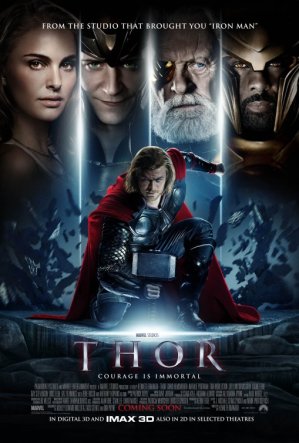 I had strong misgivings going into Thor. How was a powerful Norse god going to seem remotely relatable? How was the most improbable member of Marvel’s Avengers ensemble going to be explained in a way that didn’t feel like a ton of cheese richly slathered in hokum? I was expecting this movie to be a silly, trippy, LSD-enhanced flashback (rainbow bridges! Pass the bong!) that could barely strain any sense of believability. It’s one thing to have stories about super heroes who have gotten their powers via genetic defect, scientific accident, or act of God. But what about when your character happens to be a god? It just seemed too goofy for it all to be pulled off with any conviction. A Thor movie seemed destined for some Xanadu-level of camp. Get a load of the blonde with the big hammer, boys. Not every super hero flick has to be as brooding and dark as The Dark Knight. Marvel’s own Iron Man was a great example of a briskly entertaining movie. Now that I’ve prefaced my experience, let me publicly admit that Thor is indeed a somewhat silly but mostly fun entry in the mighty realm of summer blockbusters.
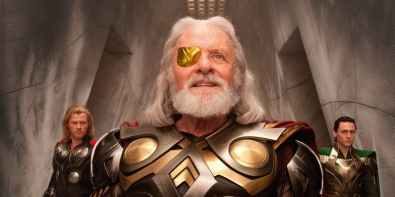
Thor (Chris Hemsworth) is the god of thunder on Asgard, a distant planet populated by the Norse mythical figures (apparently, they visited Earth and the Scandinavian amongst us worshipped these… space aliens?). Thor waits to inherit the throne from his father, Odin (Anthony Hopkins), a wise king who has kept a tenuous truce with the fierce Frost Giants, inhabitants of another planet. But Thor is not ready to assume the responsibilities of leadership. He’s quick to action and temper, arrogant, and defies his own father’s orders by trying to start some intergalactic conflict with the Frost Giants on their home turf. Thor is robbed of his powers, his mighty hammer, and banished to Earth to walk amongst the smelly Earthlings. He crashes in the New Mexico desert and is retrieved by a team of scientists (Kat Dennings, Stellan Skarsgard) led by Jane Foster (Natalie Portman). The group wants to learn where exactly this man from the sky came from. So does the government, led by the S.H.I.E.L.D. agency who takes possession of Thor’s hammer. Thor thinks if he can reunite with his beloved hammer, then he can go home. But for a thunder god, he’s got a lot of lessons to learn. While Thor is out of the picture, his younger brother, Loki (Tom Hiddelston), plots to take what he feels he is owed – the kingdom of Asgard.
 The biggest surprise for me was that the Asgard sequences are the best part of the movie; thankfully the majority of the running time is spent in this fantastic realm. I credit Kenneth Branagh’s direction, which neither hides the silliness of the material nor fully acknowledges it. By the time Thor hurtles to Earth, I was completely engaged in the operatic tale of fathers and sons, gods, jealousy, hubris, intergalactic conspiracies, you know, the stuff of juicy drama. It jus so happened that these characters wear funnier costumes. The family dynamic between Thor and Loki, the infighting and the scheming, intrigued me. Some critics have thrown around the word “Shakespearean” to describe the movie’s outsized family conflict, but I think that’s just the critical community getting lazy. Would they even approach that term is Branagh was not the director? This opening section of Thor effectively explains the history of Asgard as well as its place with the other eight worlds, the shaky relationship with the Frost Giants, the family responsibilities at play as Odin must decide the future of his ABBA-infused nation, as well as the various mechanics of how this different world operates, like Idris Elba (The Wire, Luther) stationed at the end of the rainbow as a gatekeeper to the other worlds. I liked discovering how all the pieces of this world fit together. If analyzed out of context, any part of the Asgard section just seems stupid. But taken in the film, Thor‘s crazier, more fantastic elements come together and spark genuine interest. I wanted to spend more time in this magical realm. The more ridiculous and fantastical that Thor got the more interesting it became.
But unfortunately Thor was sent tumbling to our ordinary planet. It is the Earth section that seriously deflates the movie’s vibe. It’s a relief that the fish-out-of-water comic relief is kept to a minimum, because the character of Thor isn’t an idiot, just an arrogant brat. But it’s the period on Earth where the God of Thunder learns his Really Important Lessons and finally understands what it means to be a good leader. It’s all very expected and the execution is less than inspired. The trio of scientists that Thor encounters (Portman, Skarsgaard, Dennings) could easily have been consolidated into one character. Their contributions to the story are weak. Skarsgard is mostly there for fatherly advice and the occasional expository ejaculation. As a gawky little sister scientist, I don’t even know why Dennings is in this film other than to make my eyes happy. I anticipated that Portman would assume the “love interest” spot in comic book movies that we now reserve for Oscar-winning actresses, and I assumed that role would be underwritten. But I never expected Portman’s part to be this underwritten. She’s practically nonexistent except for that winning smile of hers. Over the course of… two days, she falls in love with our banished brute. But to be fair, it’s not every day that a guy looking like Hemsworth falls out of the sky. New Mexico isn’t exactly looking like a great singles mingles hotspot. Anyway, their relationship is supposed to be the trigger that makes Thor realize he’s been a selfish and reckless fool. But their scenes lack any tension, any charm, anything of interest. They feel like two actors sitting in chairs telling stories. You don’t feel any romance between them. The drabby Earth sequences only serve as a losing contrast to the crazy Asgard territory. You can’t compete with rainbow bridges (imagine the tolls on those suckers).
 Branagh has never directed anything of this magnitude in size before, and it shows at parts. While none of the action sequences are particularly bring, none of them are particularly thrilling. The beginning battle between Thor and his pals on the Frost Giant planet (Jotunheim) is so poorly lit that the darkness forces you to squint to focus on what’s happening. Why spend $150 million on a super hero flick and shoot a dankly lit action scene? What’s the point in that? The choppy editing can also be too hectic to follow with all the quick-cuts that fail to orient the action geography. Really, there are only three serious action sequences in Thor, but then again I remember Iron Man having a light load when it came to on screen action. That film was devoted to character and performance. This film, under Branagh’s watch, is devoted to just making the entire universe of Thor credible. It’s a lot to take in, and Branagh’s biggest accomplishment is producing a sense of grandeur to the film that saves it from falling into the sticky clutches of camp. The world of Asgard feels convincing in production design and infrastructure; the cities look like pipe organs. Branagh’s film expands the Marvel universe significantly, broadening the scope for future installments. Mercifully Thor does not hard sell the upcoming Avengers movie as appallingly as Iron Man 2.
The acting in Thor is as splashy as the Asgard scenery. Hemsworth gave a notable performance as the doomed father of James Kirk in 2009’s Star Trek. He as only in the film for that ten-minute prologue, and yet the actor found a way to do much with what he was given. You got to see his character hurdle through a gauntlet of emotions: fear, duty, relief, desperation, and acceptance. His sacrifice still can make me tear up, and Hemsowrth deserves some of that credit. However, Thor is a different matter entirely. Obviously it’s going to be a more challenging role to play a buff cocky god with a magic hammer. Buff he does quite well. Cocky he does fairly well, but this is not a great starring vehicle for the actor. Hemsworth looks too self-satisfied, like he’s playing his character as an intergalactic hotel heiress. In sharp contrast, Hiddelston (Wallander) commands your attention. Those penetrating eyes, the cold yet calculated demeanor, this is an actor who feels like he walked off a Shakespeare production and just changed his headgear. You want to spend more time with Loki than watch Blondie futz around on Earth. Loki has much more depth to him than Thor; he feels betrayed by his family and an outcast to his society. I’m glad that we’ll be seeing more from this trickster in future Marvel movies (have I said too much?). Hopkins knows how to sell silliness like few other actors. And for those who have been wondering where Renee Russo has been for the last six years, well here she is, as Thor and Loki’s mother, a role that’s best suited to confirm that she is still alive.
 I was expecting far worse judging upon the scraps I had seen from the Thor advertising campaign. So I suppose that beating my low-flying expectations might not necessarily be something to champion. Thor is an inherently goofy, yet mildly satisfying and credible action film. It doesn’t have the style or panache of other heroes, but the fact that Branagh could make a two-hour Thor film that didn’t cause me to laugh derisively from start to finish is an accomplishment. Again, that sounds rather dismissive. I’m just very surprised that this movie works. Because if you take it apart, it doesn’t seem like it should. The acting ranges wildly in quality, with Hiddelston outshining everyone else. Thor is a solid if inconsistent start to the summer season of blockbusters. If you must turn your brain off for some movie, you’d do far worse than Thor. It has pretty colors.
Nate’s Grade: B
Share this:

Skyline (2010)
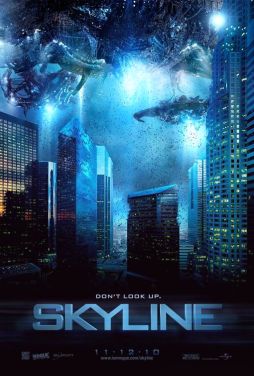 This movie is out-of-this-world terrible. Who wouldn’t want to spend an alien invasion stuck in some L.A. condo with a load of insufferable Los Angelinos? From a storytelling standpoint, watching characters I don’t care about talk about amazing and horrible things happening off camera is not the best use of anyone’s time. Skyline is a movie that keeps surprising you with the depths of its stupidity; just when you think it couldn’t plumb any deeper, the aliens have invaded to eat our brains. Yes, they’re after our brains. So that explains why gigantic monsters will claw away at a building, scrounging for the tiniest morsel of human (that still doesn’t explain it, really). That does not explain why they targeted L.A. if they’re after brains. The special effects are notable for a $10 million dollar movie, but due to the budget restraints, that’s probably why most of this alien invasion is spent indoors and behind trusty sets of Venetian blinds. The pacing is as shoddy as the character work. I kept waiting for these nitwits to step into the light and be vacuumed up into the alien mothership. The end almost looks like it might redeem part of this monstrosity, with our survivors accepting a doomed fate together. But then… I can’t even put into words how shocking, dreadful, and groan-inducing the true ending is for this junk. Suffice to say, it ends with zero resolution, a jagged plot left turn, and setup for a sequel that I’m absolutely positive not one person will be demanding.
Nate’s Grade: D
Share this:

Sucker Punch (2011)

Director Zack Snyder (300, Watchmen) has been drubbed in many circles for being an empty visual stylist, someone in the Michael Bay camp that worships at the altar of style. Snyder is a nearly unparalleled visual stylist. If only he would use his considerable talents for the purposes of good. I’m not a Snyder basher by trade, and have enjoyed all three of his previous films to some extent, but it’s obvious that Snyder spends much of his time scribbling down imagery he thinks will be cool, and then figuring out how to connect it all at the last minute. So Sucker Punch gives us a bevy of highly stylized, anime-influenced imagery complete with a posse of full-lipped ladies with heavy fake eyelashes operating heavy weaponry in fetish-style clothing. If you were expecting much else, then you’re the one who’s been suckered.
Baby Doll (Emily Browning) is a 20-year-old sent to live the rest of her days locked away inside a dilapidated mental ward thanks to her wicked stepfather. He even makes arrangements with a dastardly orderly (Oscar Isaac) to lobotomize Baby Doll to shut her up for good. Then step dad can swindle the family estate for all its worth. While in this asylum, Baby Doll imagines she’s inside a different world to survive. Her fantasies offer her a world to escape to. Inside, she plots with a group of other patients, including Rocket (Jena Malone), her feisty take-charge sister, Sweet Pea (Abbie Cornish), Blondie (Vanessa Hudgens), and Amber (Jamie Chung). Together, along with the sage advice from a mysterious mentor (Scott Glenn) in her visions, they will collect four items to secure their escape. But time is of the essence. The lobotomy doctor, known as the “High Roller” in the fantasy (played in a major surprise by Mad Men‘s Jon Hamm), is scheduled to come do his needle through the brain trick in a matter of days. It’s up to Baby Doll to utilize the therapeutic techniques of Dr. Gorski (Carla Gugino) and retreat into her mind to find the key to save herself.

You can tell Snyder was trying to crowbar in a meek message about female empowerment, but I ask you: is it female empowerment when the women have to be reduced to pretty play things that still operate in the realm of male fantasy? Just because women fight back does not mean that you are presenting a feminist message. Baby Doll’s mode of power is erotic dancing? And her main outfit looks like a grown replica of Sailor Moon’s, which should be a dream come true for just about every male fan of the animated series. You think having characters in short skirts and names like “Baby Doll,” “Sweet Pea,” and Sucker Punch is no more about female empowerment than some ridiculous women’s prison movie where they all fall into long lesbian-tinged shower sequences. That’s female empowerment, right? It’s got women loving women, so what could be more empowering to women?
After Sndyer’s kitchen sink approach to storytelling, the one thing that Sucker Punch lacks, in abundance, is sense. There is no real connective tissue to anything happening onscreen. Snyder employs two different framing devices before slipping into the metaphorical delusions of a third. I felt like I was tumbling through the Inception dream levels without a roadmap or a competent guide. Considering that the first framing device, Baby Doll being locked away in a mental ward, is only featured onscreen for ten minutes, Snyder could have exercised the bit completely. The second framing device, that Baby Doll has imagined her institutionalized imprisonment into a vaguely 1920s-esque burlesque theater/brothel seems just as unnecessary, but whatever. But it’s the third metaphorical level that gave me a headache (more on that later). The premise alone, girls use fantastic imagination to escape from a cruel prison, is good enough to tell a compelling tale. But there desperately needs to be a connection to those images, a relationship between the fantasy and the movie’s reality. In Sucker Punch, there is no substantial relationship to anything. It is a barrage of images meant to arouse and entertain but little more. The different metaphorical levels are only metaphors for, well, hot girls kicking ass, which isn’t so much a metaphor as it is a literal translation. And when the girls are at play in those fantasy sequences, the movie drops all pretenses of any purpose. It’s not just reality defying, which is what movies were meant for, but it defies its own narrative. If I can just cram whatever cool junk I want then what purpose do I even need to set up characters or develop a plot. When the ladies are off on their fantasy tours, they’re invincible and no law of physics, or man, applies to them. It zaps all danger from the screen, and with that, all tension. They all become superheroes who just run around doing super heroic things. And I might have cared if I felt there was any real purpose for what I was watching other than Snyder wanting to scratch a few cinematic itches.

The girls’ quest to attain their needed items for escape is laid out in the most shockingly lazy manner. Snyder uses the power of dance, yes dance; you see, when Baby Doll starts movin’ them hips of hers, she plunges into a fantasy world of her own doing. And then we witness all sorts of crazy things, and she returns back from the fantasy and the mission is complete. The girls have stolen whatever item they were after. I was expecting the fantasy binges to have some direct correlation with the makeup of their world, so that, say, if they have to cross a massive bridge to gain their item, in the brothel they have to cross some massive barrier. It’s the height of indolence for Snyder to simply type “character dances” and then we get an indulgent fantasy sequence and the job is done. We don’t see the steps the girls had to do to win their freedom, the relationships between fantasy and reality, or any clever plotting along the way. There’s no cleverness at all to be had. The fantasy is not just an escape for the characters; it’s an escape from having to do any thinking when it came to storytelling. Imagine what would happen to other works of cinema if they followed this same approach. Why watch the back-and-forth arguments of a courtroom thriller when we could just have “prosecutor dances” and cut to the case being over? Or why bother watching the complicated struggles of a relationship drama when we can have “guy dances” and just cut right to the shot of the camera spinning around the couple kissing? It’s like a fast forward button that eliminates all plot development. Isn’t that much more satisfying? What, you mean it isn’t because it’s a self-indulgent diversion that has no connection to the main storyline and fails to add anything?
I think ultimately Snyder just really wanted to make the most expensive music video of all time. The dialogue is clipped and kept to a minimum, mostly of the expository “you need to do this now” variety. There are long stretches of full-length musical interludes by Tyler Bates (300) and Marius De Vries (Moulin Rouge). The duo orchestrates some uninspiring fuzzy alt covers of alt songs, so familiar tunes like Bjork’s “Army of Me” and the Pixies’ “Where is My Mind?” get a polish they didn’t need (how many times is that Pixies song going to be covered?). Worst of all is a bizarre mash up of Queen’s “I Want It All” and “We Will Rock You” with a rap track. And of course no film that aimed to ape the tropes of Alice in Wonderland would be complete without some version of Jefferson Airplane’s “White Rabbit,” this time covered by talented Icelandic singer Emiliana Torrini. The entire musical oeuvre is a bunch of distorted, loud, blaring guitars meant to amplify the visual noise.

Sucker Punch is not so hot in the acting department. Browning doesn’t particularly act well in the movie, but then again nobody does, especially Gugino’s awful accent. But this isn’t a film about acting so much as it’s looking the part. And Browning is a geek fantasy come to life, samurai swords, pigtails and all. She makes for a great moving poster.
Expect nothing more from Sucker Punch than top-of-the-line eye candy. Expect nothing to make sense. Expect nothing to really matter. In fact, go in expecting nothing but a two-hour ogling session, because that’s the aim of the film. Look at all those shiny things and pretty ladies, gentlemen. This is the perfect film for a 13-year-old kid fed on anime, comic books, and horror films and who don’t give a lick about things like plot, character, or substance. It’s like somebody combined One Flew Over the Cuckoo’s Nest with every single damn videogame cut scene in the history of time. I was waiting for the next dance/trance sequence where Baby Doll was going to start jumping on turtles and collecting coins. It’s a series of vignettes that have no connection whatsoever. Sucker Punch is really a live-action Heavy Metal, except with even less plot. This isn’t a fairy tale. This is a meth-fueled explosion of a Hot Topic store, captured in Snyder’s signature slow motion. Everyone is entitled to their own fantasies but not everyone gets a $100 million dollar check to throw them all together on screen.
Nate’s Grade: C+
Share this:

Megamind (2010)
Y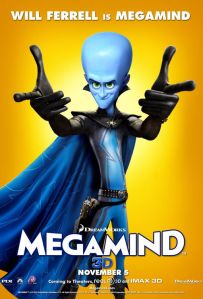 ou’ve seen this movie before, and pretty recently too given in the influx of superhero tales in the last decade. Megamind recycles heavily from numerous other super forbears, and yet this animated tale about a tired hero (voiced by Brad Pitt) and his inept nemesis (Will Ferrell). While it’s never as funny as its premise and cast should make it, the movie does pack a lot of fun and even a little bit of heart. The action sequences are inventive enough and the movie has a tone that drifts from sincere to self-conscious satire, while never settling down but doing enough right not to inflame your sense of irritation. The concepts of identity, good and evil, the duality of man, striking a life for your own… they’re all here. It’s a sloppy message that feels copied out of a plot playbook. Ferrell is funny but a bit more restrained than I like him. I think he works best when he cranks up his absurdist tendencies with a jolt of enthusiasm. Megamind doesn’t come close to approaching the magic, thrills, and emotions of How to Train Your Dragon, but it’s still many ways better than stuff like Monsters vs. Aliens and Shark Tale. It’s overly familiar story given a super spit shine.
Nate’s Grade: B
Share this:

Source Code (2011)
 Captain Colter Stevens (Jake Gyllenhaal) awakes on a train. His mind has been transplanted into the body of Sean Fentress, a doomed train passenger. Fentress, along with 200 others, were killed in an explosion on a commuter train heading in to Chicago. But this has all happened in the past. Colter has been quantum leaped into a top secret government program known as the source code. It uses people’s brain waves to simulate a recorded reality. The last thing Colter can remember is a firefight in Afghanistan, and now he’s aboard a train looking for a mad bomber. Whatever info he can retrieve will help the officials (Vera Farmiga, Jeffrey Wright) prevent a second terrorist bombing scheduled that day. Colter only has eight minutes to interact with the train passengers and deduce who the bomber is. After eight minutes, the train explodes and the reality resets itself again. Things get even more complicated when he falls for Fentress’ fetching female friend Christina (Michelle Mongahan). Can he save her? Can he save anyone? Can he get out of the source code?
Source Code manages to be a twisty, trippy little film that doesn’t so much knock you out but definitely packs a bit of a punch. Its simplicity is its very best asset. There’s a bomb on a train (ignore the questionable movie sci-fi physics). Colter has exactly eight minutes to learn what he can before he and everybody else blows up. Then the fun starts anew. The movie is less a time-travel flick than an alternate reality sort of experiment. Personally, I love movies that present a timeline and then slowly thumb away at the edges, stretching the narrative space, showing the audience the various intricacies of this tiny world. Whether it’s Pulp Fiction, Groundhog Day, or the propulsive fun of Run Lola Run, I enjoy a story that expands outward into a greater foundational complexity. I enjoy the clockwork of a story that shows me how the different pieces work together. I enjoy that through the variations I can experience a richer world, seeing what happens to a passenger as they leave the train, seeing how a character’s actions can impact another, seeing how altering that character’s action alters other forces in the story. That kind of narrative trickery, perfected in Groundhog Day, makes the story feel like a living creature because you witness the interconnected relationships of everything and everyone. It also makes it pretty fun to watch.
 Director Duncan Jones makes slick use of tight spaces like he showcased in 2009’s celestial sci-fi thriller, Moon. The quick pacing and collective rhythm of the movie helps contribute to its entertainment factor. Source Code is playful enough in design and execution. It remains consistently clever with its plotting, but what’s really surprising is that Jones is able to find a personal human story inside all the thriller trappings. Colter is trying to make sense of his situation, but he’s also trying to reconcile the idea of life, death, fate, and getting to speak with his parents who assume he was killed in Afghanistan (he’s been with the source code project for over two months). There’s a human face to all this, and while the love story feels tacked on and underdeveloped, Colter’s emotional turmoil and existential struggles to reassert his identity and find some peace from his life ring true. Gyllenhaal (Prince of Persia) is an ever capable lead who takes a near Hitchcockian leading man role and plays it straight to fine effect.
At the same time, Source Code tries to have it all with an ending that I don’t truly believe it pulls off. Spoilers will lurk, so skip the next two paragraphs those who wish to remain pure and chaste. The film does a fairly nimble job of setting up an appropriate, if mostly downbeat, ending. Colter doesn’t want to be a brain in a box; he doesn’t want the government using him as their newest tool for the rest of his unnatural days. He was pulled from the brink of death and he now just wants to die in peace. In the recorded reality of the source code, he’s allowed the chance that most of us will never have – he can find closure. Whereas he would have died on a desert battlefield, now Colter has an opportunity to speak to his father one last time, to say goodbye. The entire denouement of Source Code seems to be establishing a memorial for the people who were lost on that train, because once the source code is erased so too will they be. They’re electronic recreations but in the end it reminds you that they were real people, and now they get something of a proper sendoff, a fairly touching memorial to the people who will just be seen as numbers in a news report.
 And then… just as Colter makes peace with passing over, he passes over into another reality. The train doesn’t blow up. The people are able to get off. He gets to walk hand-in-hand with his new sweetheart. Jones doesn’t make it clear what really happens, which can lead to some mounting confusion. Did they really alter the past? Did they create a parallel dimension? In one dimension is everyone on the train dead whereas in another everyone lives, short of Sean Fentress? And how crappy is that? Yes, Gyllenhaal is a charming and terrific looking guy, but does no one shed a tear for the fact that he stole another man’s body? Sean Fentress may not have had the courage to ask out his pretty friend, but that doesn’t mean he deserved to have his identity hijacked and his existence more or less erased from time and space. It’s a weird blemish that the filmmakers don’t truly want to address, and why would they? The ending lacks commentary of any sort strictly because the movie wants to have it all. It wants the sad, mournful ending, it wants the happy “Everything’s gonna be okay” ending. It almost let’s you choose. But Source Code doesn’t come across so much as a film that begs to be opened for different interpretations so much as a film that didn’t want to upset anyone by picking an ending.
Source Code is nicely paced, nicely plotted, and it produces just as many intriguing questions as it does substantial thrills. Jones finds interesting ways to make the same material different. The various characters, converging storylines, and science-fiction mumbo jumbo are all nicely woven into a satisfying bite-sized sci-fi thriller. It fumbles with the landing, in my view; it seems like a pandering appeal to please every faction of the audience, or at least to confuse them with the illusion that they have gotten what they wanted. This is an intellectual sci-fi potboiler in disguise as a thriller. Roll with it, play along, don’t think too hard about the moral implications of its murky ending, and enjoy the ride.
Nate’s Grade: B+
Share this:

Battle: Los Angeles (2011)
 It’s just your typical sunny, Southern California day. Blue skies, good vibes, and aliens wiping out the indigenous species (read: us) for our bountiful resources. Staff Sergeant Michael Nantz (Aaron Eckhart), literally a morning away from retirement, is pulled back into combat to be apart of a Marine platoon that must hold up in the city and fight back against our otherworldly intruders.
Well there is a battle, and it is set in Los Angeles, but that’s about all you’re going to get from this movie. If you were looking for something approximating character, you’re looking in the wrong place. The characters are purely defined by one-note superficial differences, like this guy’s a doctor from Nigeria, this guy has a pregnant wife, this guy has… glasses, etc. The characters were so powerfully indistinct that there were three separate times that a person appeared onscreen and I said aloud, “Hey, I thought that guy died.” Battle: Los Angeles is a military movie, a grunts-eye-view to an alien invasion. And we keep that limiting POV for the entire movie. Battle: Los Angeles has more in common with Black Hawk Down than it does with Independence Day. Replace the depiction of angry, faceless Africans with aliens and there you go. We move from house to house, rubble-filled street after another, shooting wildly, barking commands, and trying to make sense of the urban battles. I’m doing the film too much of a favor because that makes it sound thrilling, which it is not. While there is plenty of action kept at a fairly frenetic pace, that action consistently stays at the same level of intensity. Nothing truly builds or develops to add extra levels of tension. The action is consistent, shooting through one neighborhood after the next, and when the action is plentiful but fails to develop, then the entire movie feels stagnant. Sure it develops from a “We have to go here now” assembly of plot dominoes, but advancing from one location to another with fewer characters each time is not the same as a plot.
 These have got to be some of the dumbest aliens in the universe. These are the aliens that the other aliens pick on. Some scientist/exposition device pontificates that the aliens are after our water, which is a better reason than invading a planet to harvest our tasty brains (Skyline, I’m looking in your direction). The talking head says it’s a rarity to find a planet with liquid water and thus Earth is so attractive to outsiders. Okay, so you’re going to tell me that aliens lack the ability to take ice melt it? There’s an awful lot of ice in the universe that could be more easily obtained. That seems like a better solution than an interstellar road trip for a drink. The creature design is decidedly lacking as well. The aliens look like a cross between squids and a hardware store shelf; they have metallic weapons forged to their skin. At one point Nantz and his crew is dissecting an alien POW to look for vulnerable spots (this might violate some sort of treaty somewhere) and find a lone sack underneath about five layers of armor and exoskeleton. Then they relay the news about this “delicate” spot to all the troops and miraculously all of the aliens start to now go down easily by being shot at a great distance and having the bullets penetrate layers to hit one spot a half a foot in diameter on a moving target. Makes perfect sense now that they know. That info didn’t seem any more helpful than just blindly shooting at the area below the head, which was the previous method for killing. These alien spaceships look like someone attached rockets to the shantytowns from District 9. These ships look like something assembled over at a junkyard and I thought to myself, “You traveled through space in this heap?” It’s like an invasion from an impoverished alien race that also happens to be ignorant and uneducated, which might explain the whole coveting water thing. Battle: Los Angeles might secretly be a metaphor for class warfare. Or not. Probably not.
The movie transforms into a two-hour commercial for the Marines. Battle: Los Angeles espouses the selfless bravery and honor of our servicemen, which is commendable, but it should have been done in the ame of recognizable human characters. It does the honor of good men no justice when they are turned into statues. These aren’t people, they’re recruitment figures spouting poster slogans through gritted teeth. The valor turns just this side of jingoism, and that does a disservice to the sacrifice of the men and women of the armed services. It’s hard to watch Battle: Los Angeles and not come away with the impression that the Marines are superhuman badasses and let’s fight some aliens! What compounds this messy association is that the Marines have long featured TV ads where their square-jawed recruits battle fantastical monsters (I recall one of them being made of lava).
 Director Jonathan Liebesman (Texas Chainsaw Massacre: The Beginning, most famous for Jordana Brewster’s gravity-defying low-rise pants) is no great lensman. He gives shrift attention to the significance of geography in action composition, but he makes up in quantity what he lacks in quality. There is plenty of loud noises and the like, so you’ll be kept awake, that is until you heard the stilted dialogue and wish you could fall asleep. The film packs enough stuff into an overlong 110 minutes but it’s not terribly interesting stuff, which is saying something for an alien invasion movie.
Disappointingly, the movie makes no usage of its titular location. Los Angeles may be the battlefield in name, but this movie could have been set anywhere. It does not take advantage of any of the geographic features that are unique to Los Angeles, or even California. Why bother establishing a specific location in the title and premise when the execution means you could have set the story anywhere (Battle: Cleveland?). It’s a crumbling city; it could be Libya for all that matters. Some of this is likely due to the fact that the movie was almost entirely filmed in Louisiana, which seems like a rather unnatural double for Los Angeles pre and post-alien invasions.
Battle: Los Angeles is a studio film that gets its job in an efficiently empty-headed manner. The space invaders are dumb, the action is too limited and erratically framed, and the story exists only in a theoretical state. Eckhart grunts in his raspy Two-Face voice from The Dark Knight for the entire film. I suppose if you have low expectations and just want to fill up on special effects, Battle: Los Angeles should sate your desire for straight-forward shoot-em-up entertainment. It’s not brainless but it’s close to it. Near as I can tell, Battle: Los Angeles is devoid of political or topical commentary on contemporary conflict because that would just get in the way of its straight-laced heroics. Sorry District 9, what were you thinking?
Nate’s Grade: C
Share this:

The Adjustment Bureau (2011)
 Gentlemen, if you were looking for an original excuse about not calling a girl back, try this one on for size: I couldn’t call because a team of men who control human destiny told me that if I did they would erase my memory and keep you from the fame that you are destined to achieve. She’ll probably at least give you points for originality before throwing a drink in your face (but it was all part of The Plan, or was it?).
David Norris (Matt Damon) has just lost a New York congressional election thanks to his frat boy ways of old resurfacing. As he composes his concession speech inside the men’s restroom, he meets Elise (Emily Blunt), a ballet dancer hiding out. They have one of those crazy only-in-a-movie conversations that manages to feel authentic. Then they kiss. She inspires him to ditch his prepared remarks and speak from the heart to the national TV audience, which eats it up. David spends the rest of his days trying to meet the enchanting Elise again. Then he runs into a big stumbling block. He’s late to a meeting and catches a group of mysterious men in suits and fedoras fiddling around with people frozen like statues. They are the adjusters, the ones who ensure that the participants of mankind follow The Plan. These are the people responsible for the illusion of choice in our lives. If we deviate too far from The Plan, causing ripple effects that too need to be accounted for and adjusted, they step in. Richardson (John Slattery) is the spokesmen for the group and decides to just level with David. He is not supposed to be with Elise. He has a different future ahead of him, so sayeth The Plan. They will throw obstacles between the two of them. David seeks out Elise and fights against the whole universe for the two of them to make a future together.
 Horrible title aside, The Adjustment Bureau is a sometimes corny but often deeply satisfying movie. It may distract with some efficient and just-smart-enough sci-fi leanings and magic tricks, but it’s really a unabashed romance at its core. Not just that, it’s a good romance, once that flutter the heart and causes the ends of your mouth to do that thing, you know – smile. It helps when you have movie tars as gorgeous as Blunt and Damon, and are such good actors that they can fill their roles with dangerous amounts of charm, but let’s credit writer/director George Nolfi (The Bourne Ultimatum, Ocean’s Twelve). He takes a fairly routine concept (powerful forces control our lives and choices) and turns it into a finely tuned character-driven romance. Immediately from their first meeting in a men’s room, Blunt and Damon have that electric dynamic that you can genuinely believe in. Their chemistry will knock you over. You feel the spark between these two, which is essential because the two characters spend years apart at times, forever hoping to reunite. In that brief encounter, you fall in love as well and realize that this character, and this actress, is worth waiting for. I think people are going to be surprised that The Adjustment Bureau is a big gooey, stars-in-the-eyes love story, and it’s actually good. It’s a really enchanting love story, tackling the question of whether whom we love is a result of choice or destiny. This central concept is what every sci-fi element and thriller sequence is spun from. Here’s a funny thought: it’s all in service to the story.
It’s rare to see a studio movie that mixes so many different elements together to such effective, satisfying results. The film doesn’t get overly dark despite the cosmically long-reach and determination of the adjusters. There’s never any real threat of danger, only a broken heart or dashed dreams. The film has many light moments throughout, creating a rather bouncy tone that suits the romance angle nicely. The adjusters aren’t very menacing, more so comically perturbed. John Slattery, all silvery Mad Men appeal, is a perfect foil as the face of the adjusters. He feels like an exasperated parent baffled by the thought-processes of his youthful charge. It helps that these cosmic accounting agents have a finite level of power. If they had unlimited power then the film would fail to have any hope for David and Elise. But we learn that there are only so many adjusters that there are limitations to their powers, and that they can be outsmarted with enough gumption. Mingling with that light touch is enough whimsical science fiction to engage your brain. The concept of the adjusters and their supernatural abilities is nicely teased, setup, and then developed, making sure never to rock the audience with too much weirdness at one time. It’s a gradual process of discovery and it leads to a somewhat goofy, but infectiously amusing, climax that involves multiple doorway portals and magic hats. Yes, I said magic hats, which means there is an honest to God good reason why that stupid fedora hat, seen so prominently in advertising that it feels like the third-billed star, is featured. Admittedly, a concept like a magic hat that allows you to teleport through doorways would seem silly, but Nolfi makes it all work. The hardest aspect to believe (in a film with, I repeat, magic hats) is that Blunt could be a ballet dancer, let alone a future star of the medium. I’m by no means saying that the British beauty has anything to worry about in appearance, but she does not have a ballet dancer’s dangerously minuscule physique. Natalie Portman in Black Swan looked like a real-deal ballerina of fragile frame. Blunt doesn’t have the movement or the physique.
 In his directorial debut, Nolfi does enough good things, and does them with a smooth sense of style, to impress. The visual trick of going in one door and opening to another world walks a dangerous line of over saturation, but it’s playfully utilized enough to forgive. Nolfi is not perfect with his plotting, falling to misstep that can push back momentum. Characters will be chatting, and then they’ll walk away and we’ll get a title card that says something like, “Three years later,” and it sort of makes it feel like we have to start all over again. The fact that this happens more than once means that Nolfi might have wanted to plot his story around a series of events that occurred more often than Senate election terms. If we have to begin with David losing one campaign at the start and then zoom ahead at several points through another campaign, then perhaps the timeline could have been condensed a bit in retrospect. The film manages to be religious and faith affirming without pushing an agenda or overstating its romantic cause. The ones behind the plan are only referenced in oblique business terms, never confirming a certain high power but definitely nodding in that general direction.
Damon and Blunt are a terrific team. This is easily Blunt’s finest role as an actress since breaking out in 2006’s Devil Wears Prada. The actress has taken many a role that makes use of her large crystalline eyes and her sometimes go-to acting response of simpering. But in this film, she finally finds that perfect role that makes use of Blunt’s modest, goofy charm. She’s never been a leading actress in a traditional set; there’s always been a delightful goofy appeal that set her apart. When Blunt offers her playful smiles and asserts those glassy eyes of hers, you too will be smitten. Her character is a charming woman thanks to Nolfi’s writing, but having an actress of Blunt’s ability fill her out is a blessing. Damon is at a point in his career where he just grinds out good-to-great performances that manage to be convincing in unassuming, dignified ways. Damon has never been an actor given to the superfluous. His character feels like a sincere sport, which is amazing considering he’s supposed to be playing a politician. He’s the kind of guy you’d actually stand in the rain to vote for, and you understand why Elise would keep a place tucked away deep in her heart for the dashing Damon.
While the movie hinges on the coupling of Damon and Blunt, the rest of the supporting cast does fine work matching tone and making the most of their roles. Actors like Anthony Mackie (The Hurt Locker), Terrence Stamp (Valkyrie), and Michael Kelly (Changling) can make any movie better.
 The Adjustment Bureau, on paper, should not work. A sci-fi fantasy that’s unapologetically grounded in romance. A tone that nestles firmly in a safe, bubble-wrapped whimsy. And those magic hats, need we forget them? On paper this should be one overly silly, dumb, tonally disjointed, cornball movie worth venomous mocking. And yet it works; it does better than “works,” it succeeds. Blunt and Damon are terrifically charming together and imbue the movie with a sense of cheerful optimism in the face of uncertainty (and perhaps heaven itself). You desperately want these two crazy kids to get back together; they’re good, decent, charming people, winning personalities apart and even better together. What might have fallen apart in other hands becomes this endearing, fizzy piece of studio entertainment that fulfills and exceeds most expectations. I was really taken by this movie, won over by its effusive charm offensive, and left buoyant with happiness by the time the tidy, perhaps too tidy ending, came rolling. The Adjustment Bureau is hooey but it’s my kind of hooey.
Nate’s Grade: A-
Share this:

I Am Number Four (2011)
 Despite being based upon a young adult book series, I Am Number Four is an unfortunate title. What do you call the sequel? I Am Number Four 2? I Remain Number Four? Let’s not even mention the obvious pan that is begging to be covered by that title (“I Am Number Four? More like I Am Number Two!”).
Number Four, a.k.a. “John” (Alex Pettyfer), is your normal teenage alien hiding on Planet Earth and trying to live a regular life while eluding intergalactic mercenaries. Numero Quatro has relocated to the town of Paradise, Ohio with Henri (Timothy Olyphant), his alien guardian who poses as dear old dad. The two are trying to keep a low profile because Number Four is one of the last nine super-powered aliens from a dead planet. The aliens develop different special abilities as they mature and Number Four has begun to notice that his hands glow in the dark. Number Four catches the attention of Sarah (Dianna Agron), a pretty gal whose ex-boyfriend happens to be the super jealous quarterback. Number Four also befriends the school’s nerd (Callan McAuliffe) who thinks his father was taken by aliens. He’s not exactly keeping the desire low profile. Numbers 1-3 have been killed by a pack of alien mercenaries who intend to dominate Earth, and now Number Four is next.
While neither special nor afflicting, I Am Number Four is a pretty mundane, mediocre, special effects driven goof aimed primarily at young teen males. The plot lacks any trace of nuance and seems fantastical in what should even be ordinary. The Ohio town is one of those small towns that exist in the minds of west coast studio executives, where everyone gathers round for a carnival and the roads are mostly of the dirt variety. Sarah’s family is one of those ideal, chatty families that exist primarily in the minds of nostalgia. They don’t just sit around and chew their food; they are actively involved in dinner cutesy dinnertime games and cutesy embarrassing interactivity. But the movie never lets you think about these inauthentic tidbits for long before more explosions or colorful special effects rattle you. The plot follows an almost mechanical process, supplying some PG-13 skin (ladies in low rise jeans! Cleavage!) or some rudimentary chase scenes at a fairly brisk pace. The story borrows liberally from many sources, including a dash of super powered loner Spiderman stuff, angsty teen romance from Twilight, and a sprinkle of whatever is playing on TV right now as you sit reading this.
 The action is never really takes off beyond the general concept of Things Exploding and People Running. Director D.J. Caruso (Eagle Eye, Disturbia) can string together a series of pleasing visuals but they never amount to much. The film lacks real suspense and any risible sense of excitement. The action sequences are disposable but at least Caruso makes sure that the audience can follow along. I thought with all the sci-fi elements that the film would make more interesting choices, but alas I Am Number Four relies all too easily along commonplace action tropes like it’s an accomplishment. Number Six (Teresa Palmer) gets to walk away from an explosion in slow-motion (while she wears sunglasses). Nobody in town seems to ever pick up on the mounting collateral damage of this interstellar spat. Caruso and the screenwriters are too content to just be happy playing with the special effects toolbox, emulating the favorite moments of the sci-fi action genre. And one of those tropes is that ANIMALS CAN NEVER DIE. Number 4 has a shape-shifting guardian pet that decides to take the form of a dog. Then when things get rough, this dog mutates into a hulking CGI creature, which still looks like a dog. And when he gets wounded fighting another CGI monster, it’s not enough that we get the pained dog cry but the filmmakers decide that he also has to transform back into a regular Earth dog at this point to hammer home the image of pooch in trouble. Shameless to the very end. And then, during our resolution this space dog has to come hobbling out.
Fortunately for the audience, the actors are all rather beautiful. Pettyfer (Alex Rider) isn’t much when it comes to this thing called acting, but he’s got abs you could scrub laundry with and really that’s half the part of playing a hunk from outer space. I give the guy more credit just for having to be saddled with the lame superpower of glowy hands. It’s a long wait for those glowy hands to become instruments that launch glowy fireballs. For most of their screen time, Pettyfer’s power just looks like he’s clenching two very powerfully charged indigo-glowing cell phones. Olyphant (Deadwood, Hitman) is too young for me to be covering as the dad to a 17-year-old kid. I still remember Olyphant in 1999’s Go. Maybe that’s just my hang-up. The ladies are all gorgeous are all in the flawless skin and teeth variety, you know, the ones that populate every small town. No one truly makes much of an impression but they’re easy on the eyes. It’s like an Abercrombie and Fitch catalogue come to life with extra explosions (and more clothes).
 The only actor that stands out is Kevin Durand and he’s under pounds of makeup as the chief villain. Durand first came to serious attention as a season-long villain on TV’s Lost as Martin Keamy. He has a real distinct menace that doesn’t come across as self-satisfying or ironic. He’s got a real presence and it seems like casting directors have caught on to this former Canadian standup comedian. From there Durand has become something of a go-to guy when it comes to large intimidating men and men with some kind of mild speech impediment; his characters in X-Men Origins: Wolverine, Legion, and even Robin Hood all sounded like they had their mouths stuffed with cotton. Durand always has a good time with his bad guy roles, whether they are flinty or over-the-top. I enjoy watching this man onscreen even if he’s under some fairly lackluster creature makeup that makes him look like a tattooed shark man.
The point that caught my attention, and was scantily mentioned but once without nary a rejoinder from any character, was the fact that the big bad evil aliens are killing the alien teens in order. No reason is ever attempted. There are nine super alien teens but for some reason these interstellar killers are uncontrollably anal-retentive (“We may be vicious monsters, but we respect the value of numerology”). It makes little strategic sense to stick to the doctrine of taking out your enemy one at a time and in a predetermined order that everyone knows about. It also means that presumably Number 9 will be the hardest to vanquish since they will have the longest time to master their super power. Later on, Number 4 gets an added boost from a sexy, slinky Aussie who happens to be Number 6. My first thought: “What the hell happened to Number 5?” Then I figured that Number 5 has to be locked away somewhere in a protective safe house at an unknown location. Because that affords Number 6 to do whatever the hell she wants; the evil aliens would just have to stop and say, “Look Number 6, we’d really, truly love to vaporize you right now, but first we gotta go find and kill Number 5 first. See ya later.” If that’s the case then Number’s 7-9 need to get off the bench and team up. Number 4 can’t keep this up forever, guys.
I Am Number Four is tailor-made for a young male audience that doesn’t have the urge to see something harder or edgier. It’s got superfluous jet-ski stunts, girls with flat tummies, explosions, cool space weaponry, CGI monsters, villains in long black trench coats, failed attempts at romance, a dog, and even a reference to famous Cleveland Browns quarterback Bernie Kosar. It’s not an incoherent cacophony of light and sound like you’d find in a Michael Bay film; director D.J. Caruso is like Bay lite with more self-discipline. I Am Number Four is fairly derivative stuff but nothing worth getting upset about. After you see derivatives of derivatives, you start forgiving the final product for lacking any discernible flavor. All of the elements come together in rather harmless fashion making a rather empty but harmless sci-fi action flick.
Nate’s Grade: C
Share this:

Predators (2010)
 For a solid 45 minutes, Predators is a fairly good genre movie. No, it’s a very good genre movie. We snap awake in freefall with a ripped Adrien Brody. A group of deadly warriors from all cultures find themselves stranded in some strange jungle. For that 45-minutes of goodness, the assembled killers (and Topher Grace as a doctor?) try and piece together their circumstances while exploring the foreign terrain. It’s a setup straight out of the Twilight Zone catalogue. And then, at minute 46, they find out they’re on a game preserve planet for the notorious alien bounty hunters, the Predators. The characters get picked off one-by-one and the patient buildup unwinds in a familiar and depressing bloodbath. Predators will work as a quick fix of junk food, but it teased a promising alternative that never came to fruition. The action is bloody but listless. The plot twists are seen from miles away (Topher Grace as a doctor?) and after all that badass macho posturing, the end credits blast the song… “Long Tall Sally” by Little Richard? It’s the most bizarre element in a movie with killer space monsters in dreadlocks.
Nate’s Grade: C+


You must be logged in to post a comment.