Blog Archives
Pacific Rim: Uprising (2018)
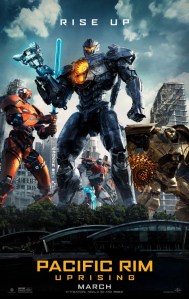 The original Pacific Rim brought out my inner child with its gee-whiz spectacle of giant robots fighting giant monsters, and under the artistic vision of Guillermo del Toro. I was eager for a sequel, as was my inner child. Thanks to China, a sequel was granted, though del Toro left to go win Best Director and Best Picture at the Oscars. The new director replacing del Toro, Steven S. DeKnight, came to fame on shows like Buffy the Vampire Slayer, Spartacus, and Netflix’s Daredevil. DeKnight acquits himself well in a world of big-budgets and big worlds, and while Pacific Rim Uprising is definitely lesser than the original, it’s still a whole lot of fun. John Boyega (The Last Jedi) leads the way as the son of Idris Elba’s character. It’s been ten years since the events of the first film and humanity is considering replacing Jaeger pilots with more cost-efficient drones. Then a rogue Jaeger starts attacking the remnants of the fleet, and Boyega and a scrappy pre-teen girl have to team up with a bunch of other Jaeger recruits to save the day. Where the first Pacific Rim rode the wave carefully to find a middle ground between cheese and awe, this time the movie swerves far more into cheese. Stuff gets silly, but if you can’t abide a little silliness then what are you doing watching this movie? The mythology and world building deepen, building off the last film, and they even supply a motivation for the aliens. It does feel at times like a pilot for a TV series, Jaeger Academy, and oddly the plot seems to follow Independence Day 2, Iron Man 2, Ender’s Game, and then ends right back with Independence Day 2’s closing sales pitch for a sequel that was never destined to be. Boyega has a fine reserve of charm and much is asked of him since the remaining characters are pretty slight. The action takes place almost entirely in daylight, a positive change from the original. The monsters don’t appear until the final act, which is not a positive change. It’s fun, goofy, and entertaining in the way that Saturday morning cartoons of your youth were entertaining. Uprising probably won’t be saved by China this time, but if you’re a fan of the first I have to think you’ll still enjoy the sequel.
Nate’s Grade: B-
Share this:

Ready Player One (2018)
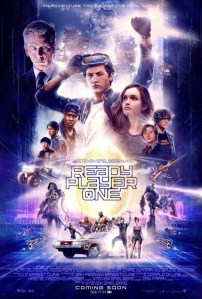 Ready Player One was a best-selling book that established a future world built upon the pop-culture artifacts of the 1980s, a future that celebrates and looks back to the past, to a halcyon childhood of classic and not-so-classic video games, movies, comics, and music. It was no surprise that author Ernest Cline’s novel would become a success, as we’ve been in a full-blown 80s nostalgic renaissance for quite some time now. When living legend Steven Spielberg got aboard as director, it seemed like fate. As a non-reader, my worry was could the big-budget, Hollywood version of this movie, lead by a Hollywood master, be more than the sum of its parts, more than the nostalgia and pop-culture references? I feared the finished product would be Avatar meets VH1’s I Love the 80s (“Hey, remember that thing? We do too.”). My fears were overblown, but then so is Ready Player One a bit, an entertaining vision that glides by with little else but vigor.
In the future, most of humanity spends their days living out fantasies and dreams in the Oasis, a virtual reality hub with different worlds, games, and features, allowing players to design their own avatars and their own adventures. The Oasis was created by Halliday (Mark Rylance), a reclusive genius who also programmed a contest upon his death. Whoever finds three hidden keys would win ownership of the Oasis. Wade (Tye Sheridan) is a regular kid living in Columbus, Ohio (woot, represent!) but when he’s in the VR world he’s Parzival, a more confident and assertive player. He’s fascinated and intimidated by Artemis (Olivia Cooke), a fierce competitor who brushes aside others. Together they team up to thwart the evil corporation IOI (Innovative Online Industries) run by Sorrento (Ben Mendelsohn). They want to own the Oasis, riddle it with ads and product placement, and restrict the freedoms to a lucrative caste system. Parzival and Artemis must find the keys, stay ahead of IOI and their team of super players, and hide their real-world identities before they can be unplugged one way or another.
 Ready Player One is a first-rate action spectacle from one of cinema’s masters of spectacle. Spielberg unleashes his incredible imagination with the full-force of a pretend world where any thrill-seeking adventure can happen. You can feel his genuine sense of joy at getting a chance to play in such a big world where anything is possible. This is best encapsulated with a race that challenges all laws of physics and good sense. The obstacles are extreme and as the cars careen into one another, King Kong trounces the track, and various nasty surprises await, it becomes a propulsive, thrilling, and ridiculously entertaining set piece. The last time I can recall a Spielberg film feeling this downright fun, first and foremost, was perhaps 2011’s Tin Tin, an underrated adventure. Spielberg has a delightful comic touch when it comes to constructing creative and satisfying action set pieces, laying the foundation for future payoffs and complications. There’s an extended sequence where the players have to infiltrate the Overlook hotel from Stanley Kubrick’s The Shining, and it’s glorious. It’s the most sustained pop-culture reference and nostalgia point, but it actually lines up cleverly with a mission goal. The overpowering flurry of pop-culture references I was worried about never come to much more than momentary visual signifiers (“Look, he’s driving the car from Back to the Future. Look, he’s got the Holy Hand Grenade.”). You don’t need the background to enjoy the film, and the references are just a bonus for those nostalgic aficionados in-the-know. It rises above the hefty anchor of nostalgia to tell its own story on its own epic terms.
With that being said, Ready Player One is also little more than its eye-catching spectacle. There’s very little substance here to be had. The film is 140 minutes long and feels breathless, allowing nary a moment to catch contemplate, deepen the characters, or explore the outside world in greater detail. The movie is packed with expository plot beats about the inner workings of the Oasis and every time it hops to a new level it resets and we have to learn more rules and surprises. It kept me entertained, don’t get me wrong, but when you come out the other end you can look back and see little. It’s a thrill ride first and foremost but one that feels entirely ephemeral. There’s so little to hold onto that generally matters. It’s the film equivalent of fast food, a tasty jaunt but something not exactly made from the best ingredients. It even takes that’s 80s pop-culture appreciation and transforms into feeling like an 80s movie, complete with an ending where even the bad guy gets his just deserts in a comical low-stakes way. We’re watching a bunch of teenagers fight against The Man taking control of their play space and corporatizing it. That feels like the VR equivalent of, “We gotta save the rec center from those evil land developers who just don’t get the communal power of art, man.”
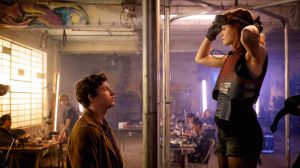
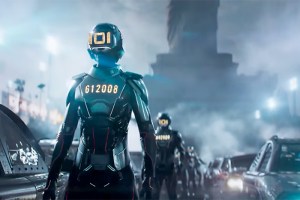 I didn’t really get a sense of any of the characters and it felt like the “be whoever you want to be” freedom of the Oasis could have been better employed. Take for instance Artemis, who in real life is Samantha and has a blotchy birthmark on her face. I understand that she’s self-conscious about the mark but she still looks like Olivia Cooke (a pretty girl with a birth mark still looks like a pretty girl). The romantic relationship between Parzival and Artemis feels like user projection, falling for the cool, kickass gamer girl. She rightly retorts, “You think you’re in love. You don’t know me, only what I show you.” This stand for female agency regrettably melts away and Artemis/Sam fall into that familiar dance of emotions. The side characters feel more like second or third tier team members on a spy mission, offering little variance. I didn’t really get a sense of any of the central characters from a personality standpoint except for their loving appreciation of pop-culture, which is then morphed into a pop-culture artifact itself. The larger mystery of Halliday’s past regrets is rather predictable and amounts to little more than “seize the day,” which is also a pretty 80s message if you think about it.
Another aspect hampering the impact is the dire lack of stakes. As far as I can tell, the biggest loss the players experience is their in-game credits and achievements. They may have spent months or years accumulating those, but if they were to disappear there’s no real larger harm to anyone. It’s a mere inconvenience, the same thing with dying in the game. I was waiting for another step where dying in the game would translate into the real world (“You die in the game, you die for real!”). They even introduce a fancy VR suit you can wear to literally feel the action of the game, though why anyone would want to feel the pain inflicted via a video game is beyond me (the pleasure I can understand). When we watch characters fight against incredible odds, the most that’s at stake is having to regenerate at a different location and get back into battle. It makes the struggle feel less realized and certainly less substantial. It plays into the already ephemeral spectacle. I heard from my seat neighbor, who had read Cline’s novel, that (book spoilers) one of the players is killed by the evil corporation by finding out where he lives and throwing him out a building. The movie needed a moment like that. Imagine, Sorrento being confronted by Parzival and friends, and he points to one and says, we know where you live, we’re breaking down the door now. The guy turns around, hearing the sounds coming from his real-life environment. Then Sorrento gets a radio call about breaching the room and a gun is placed against the character’s head. His scream is cut short as the sound of a gunshot echoes and his avatar disappears. Then Sorrento points to the remaining players and says we know where each of you live. That scene would have raised the stakes for the final act, not to mention be a sly nod to The Matrix. Unfortunately, even when the bad guys are trying to kill people, the stakes feel small.
 I think part of the lower stakes is also because we never get a clear sense of life outside the Oasis. If just about every human being is wired into this VR world, how is all that electricity being generated to power this experience? What is the economy of this world? What do people do to subsist in their homes? Is money related to in-game achievements? These loyalty pods, which are essentially a twenty-first century debtor’s prison that profits off virtual slave labor, how are they legal? What exactly is the legal system like in this world? Also, we see people running outdoors with their VR helmets on. Won’t they run into traffic or a building or some kind of obstruction? I never understood how this world operated. Perhaps that’s the reason Spielberg spent a solid 75 percent in the Oasis, keeping our minds occupied with shiny things before we can begin to question.
Sheridan (Mud) is a handsome and likeable leading man, though he just came from another movie where he wears a visor over his eyes (X-Men: Apocalypse). He leaves enough of a favorable impression to make you wish he had more going on. The same with Cooke (Me, Earl, and the Dying Girl) who plays the spunky, spiky love interest and experienced gamer girl. It’s a role that Cooke performs nonchalantly, evoking the ethos of being enviably cool and thus desirable to legions of gamer boys. Cooke is capable of much more, as evidenced recently by her phenominal performance in Thoroughbreds, but I’m happy that she’s getting a big platform and from Spielberg too. The other castmates add a needed sense of diversity to this future world, though I was wondering why the pop-culture references were almost entirely American. Surely Halliday would have been the kind of guy that was entranced by the gee-whiz cool artifacts of other cultures like Japan. The best actor is Mendelsohn (Rouge One) who seems to be carving out a fine career in Hollywood movies as an officious middle-manager villain. He’s the right kind of slimy while still being weak at his core that fits so perfectly for these kinds of roles. Sorrento also employs a fierce female enforcer (Killjoy’s Hannah John-Karmen) with some sharp bangs who reminded me of Luv from Blade Runner 2049. Even more 80s-ness!
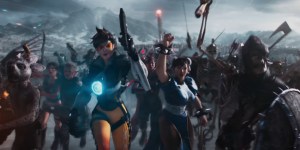 With Spielberg at the helm, it feels like he’s the perfect person to bring Ready Player One to the big screen considering he’s one of the biggest progenitors of our 80s nostalgia. It’s a loving homage to pop-culture without being suffocated by the cumulative artifacts of pop-culture. It’s a rousing, imaginative adventure with some terrific special effects and stunning action set pieces. It’s an enjoyable trifle of a movie, lacking larger substance, characterization, and sustainable stakes. It feels too light, but then maybe that’s another argument for its adherence to the feel of 80s movies, where problems could be solved with dance-offs or choice montages set to Jefferson Starship. Ready Player One should delight fans of the book and even those ignorant of all its myriad references. Whether audiences cherish this alongside those keepsakes of the past is another matter.
Nate’s Grade: B
Share this:

Annihilation (2018)
 Alex Garland has been one of Hollywood’s most stable sci-fi screenwriters for some time. In 2015, Garland made his directorial debut with Ex Machina, a sly and invigorating potboiler that made you think. It helped make Alicia Vikander a star and Garland himself was nominated for an Academy Award for his original screenplay. The movie even won an Oscar for best visual effects, beating out some pretty pricey competition. With one movie, Garland displayed a natural knack for directing. His follow-up, Annihilation, is based on a book by Jeff VanderMeer and has already run into some trouble. After poor test screenings, the producer tried to force changes but these were refused. In a face-saving outreach, Annihilation will only be playing theatrically in North America and will debut on Netlfix weeks later for the rest of the world. The suits are not confidant in the larger public clicking with Annihilation, and they might be right. This isn’t going to be one of those films that people leave declaring their love over in effusive terms, despite what the critical praise may lead you to believe. This is a movie that you leave saying, “Huh.” It’s so powerfully inscrutable to the point that most other conventional forms of cinematic entertainment and narrative are smothered. And yet, it’s that inscrutability that might be the movie’s biggest point and might be its biggest asset.
Lena (Natalie Portman) is a biologist whose husband (Oscar Isaac) has been missing for a year ever since he ventured into a strange environmental disaster zone. Then he reappears with a mysterious illness and little memory of the events. Lena joins an all-female crew of scientists (Jennifer Jason Leigh, Tessa Thompson, Gina Rodriguez, Tuva Novotny) to find out some answers by exploring The Shimmer, the site where an alien meteorite collided with coastal land and has been changing local life forms at an alarming pace.
 Like I said, this movie is a conundrum, not just in a “What did I just watch?” sort of analysis but also in a, “Did I actually like that movie?” personal introspection. There isn’t really a mystery here to unpack as there is an enigmatic experience to explain. I’m doing something I don’t normally like to do, which is immediately type my review shortly after seeing a movie. I generally like to marinate on my feelings after experiencing a movie; however, with this one I felt compelled to put furious fingers to the keyboard, trying to explore my myriad conflicted feelings and find my way out the other side, or at least articulate that journey. I’ll try and steer away from any major spoilers though I worry that even discussing some of my confounding responses will require some thematic and plot context, so beware readers who wish to go into this experience completely pure.
Annihilation is an existential horror movie about biology’s indifference to mankind; at least that’s my best thematic interpretation. In the beginning, Lena is explaining the history of cellular life, the simple splitting of cells that begat all life on the planet. There was no larger forethought, no agenda, and no malice, only the enacting of DNA programming. Ultimately, I think the alien mutations are running on a similar principle. This isn’t an invasion by any traditional definition. This isn’t anything nefarious. This isn’t even anything as clearly identifiable as a virus spreading its illness. This is simply life stirring in a few new recipes. There’s a general level of indifference to the overall setting, which makes the environmental wonders and horrors more dispiriting. For those who demand clear answers from their storytelling, they will be left sorely disappointed. Annihilation doesn’t have any real answers for why these things are happening. They just are occurring, much like the beginning steps of cellular life that found new modes of survival on Earth billions of years prior. It’s just another stage in the development of life. The fact that humanity can be so easily cast aside, it’s hard not to feel insignificant. There’s a mounting sense of existential dread about man’s inevitable demise. One character dubs their mission suicidal and is corrected by another. “People confuse suicide with self-destruction,” she says. “Very few people are suicidal, but all of us are self-destructive.” The plotline confirms this as characters fall victim to hubris and curiosity. However, one may argue there is biological in destruction and reconstitution.
 Be warned, dear reader, this is a rather slow movie with a lot of space for breathing, the kind of thing meant to establish a particular atmospheric mood. If you connect with the material, it works, obviously. The problem with Annihilation is that because it’s so inscrutable, because it keeps you at a distance on purpose, that it allows more opportunities to check out. We’re anticipating weirdness and a general breakdown in the group of scientists, and Garland seems to understand this, which may be why he gradually delivers his genre scares. There is an amazing sequence in the middle that is the fuel of nightmares, made all the more searing and scaring by a horrifying sound design that’s even worse when you connect it with the visual source. I was almost compelled to look away and spare my memory this ghastly sight. There are other unsettling moments and the overall feel of the film is definitely one of discomfort and dread, but it’s this scene I’ll always remember and that also solidified the nasty surprises from Mother Nature. Unfortunately, these moments are few and far between. The eventual ending should be easy enough to predict thanks to Garland’s flash-forwards tipping your expectations, that is, if you can actually understand the ending. I still cannot say for certain what happened and why or whether I cared about a why. If, as stated above, the point of the movie is man’s inability to find a recognizable motive in the replication of life by biological factors, then that lends itself to a generally unsatisfying end.
One interesting idea that I regret gets short shrift is just the fact that this is an all-female group of scientists venturing where literally only men have gone before. I’m not celebrating this as some sort of nod at feminism but because it offered an interesting storytelling avenue. All the previous groups were all men and they either were killed by the new environmental dangers or went crazy and killed each other. Minor spoilers, but the women fall under the same sway, destined to the same fate, and it feels like a shame. If you’re going to make a point of questioning whether the deterioration of order and sanity is related to an all-masculine entanglement of thinkers, then don’t just have the women repeat the same decline. Or maybe that’s the point? I don’t know.
 Portman (Jackie) does an convincing job of alternating looking confused and spooked, mimicking most of the audience reaction. Her character isn’t asking to be found likeable, only capable, though the first time we get a little taste of her as a person is far too late into the movie. Her marriage might not have been built on the strongest foundation, which again leads to the potential thematic deliberation over self-destruction and rebirth. Leigh (The Hateful Eight) is a bit too flatly monotone for my liking. It feels like she’s sleepwalking through the film, like maybe she was on Ambien and can’t remember even performing in this movie. Tessa Thompson is underwhelming especially with knowing how fully captivating she can be onscreen (see: Thor: Ragnarok). The other notable actress is Rodriguez (TV’s Jane the Virgin) who put on some muscle and swagger and has a terrific breakdown sequence that showcases some unnerving desperation.
I still cannot even say if I liked Annihilation. There are aspects I can definitely admire, like the commitment of its actors, the emphasis on a more scientific approach to an outbreak/invasion thriller, and Garland’s general sense of place. I still think the majority of audiences are going to leave shrugging. Annihilation is more akin to an Under the Skin or Solaris than a monster hunt. It’s quiet, philosophical, and also often boring. It has its thrilling points, its moments of mystery and intrigue, but it also feels like a slow windup to the eventually disappointing reveal that won’t be enough to justify the lethargic pacing. In the end, this is a difficult movie, but not in a way that requires a thorough decoding like mother! or even in a way that requires repeat viewings to play out the twists. Annihilation is difficult by design, keeping its audience from fully engaging, and then offering little in the way of answers or resolution. And I still don’t know if I like that. Dear reader, this is a confounding movie but it might not be the good kind of confounding.
Nate’s Grade: C+
Share this:

The Cloverfield Paradox (2018)
 The most interesting part of The Cloverfield Paradox might be the film’s release. Following the model of secrecy and subterfuge from producer J.J. Abrams, this was originally a script called God Particle by Oren Uziel (Shimmer Lake). It was reworked by Doug Jung (Star Trek Beyond) to meld it into the ongoing Cloverfield universe. It was originally scheduled for theatrical release in February, and then pushed back to April, and then it was scaled back to being released directly through Netflix. The first time the public saw a frame of this movie was during a high-profile Super Bowl spot that advertised it would be available for viewing as soon as the big game was over (the ad spot cost $4 million, or about one-sixth of the film’s modest budget). The Cloverfield Paradox is an intermittently entertaining film with some nice visuals, curious moments, and a bevy of good actors looking frantic and perplexed in space. It’s also a bit of a storytelling misfire and an underwhelming addition to the larger Cloverfield mythology.
High in space, a team of scientists is testing a cutting-edge particle accelerator that, if functioning, will provide abundant and renewable power for an Earth that is plunged on the brink of a world war thanks to depleted energy resources. Hamilton (Gugu Mbatha-Raw) is one of the scientists and wondering if she will ever get back to Earth and see her husband again. Then one fateful day, the accelerator works but then goes on the fritz, slamming everyone around the station. When they come to they realize that the Earth and moon are missing and they are adrift. That’s not the last of the peculiarities. A woman (Elizabeth Dibecki) is found inside the station, connected to the wiring. Where did this woman come from, where are the scientists, and what happened to the Earth?
 The Cloverfield Paradox is never going to be confused as great sci-fi, but it can be good enough depending upon the tastes of the individual viewer. The opening very succinctly establishes the stakes of the mission as well as the toll of the repeated failures. Once the station does its wonky thing and the Earth vanishes, that’s when it hooked me. Are they in a different part of the universe? Did they accidentally wipe out the Earth? These are pertinent and intriguing mysteries deserving of attention. The visuals in the movie are slick and well lit by cinematographer Dan Mindel (Star Wars: Force Awakens), who ignores the old staple of the poorly lit space corridors throughout the film. The actors are all well cast and provide the kind of performances that make you care enough. Mbatha-Raw (Black Mirror’s “San Junipero”) is a terrific lead. She’s strong, smart, but also given a tragic back-story that informs her decision-making when the weirdness hits. Dibecki (Guardians of the Galaxy vol. 2) is primarily directed to be a statuesque mystery. Chris O’Dowd (Molly’s Game) is the comic relief that doesn’t wear out his welcome. None of the characters do anything that stupid. It’s just enough that you might feel sorry for some of them when they eventually perish. There are workable elements throughout the movie that will hold your attention and curiosity.
It’s shortly after its inciting incident of being mysteriously vanished that you start to realize the deeper story problems inherent with The Cloverfield Paradox. The central mystery (where are we? what happened to the Earth?) is enough of a hook but doesn’t allow for much in the way of a clear-cut throughline of how to uncover these answers. The clues that occur throughout the second act serve as almost random points of weirdness that rarely add up to anything significant. Little things like missing worms, the missing gyroscopic GPS drive, and a crawling arm serve as points of peculiarity but they feel disconnected from anything else happening. It’s during this stretch of the film where the film feels like anything can happen and not in a good way. The strange occurrences don’t follow any rhyme or reason even after it’s revealed what is causing them. They just happen because, most likely, somebody thought it would be cool or unexpected. This will only get you so far in plotting unless to can tie events back to character. The resulting explanation is a shaky experiment-gone-wrong that plays out like an unmemorable Star Trek episode, with the crew discerning what their new reality is and why. If you read about the original screenplay, when it was called God Particle and unrelated to anything Cloverfield, there was a lot more hard sci-fi intrigue and a paranoia plot reminiscent of the breakdown in civility in the flawed but serviceable thriller It Comes at Night. It’s hard not to have the opinion that the original screenplay by Uziel was made more generic.
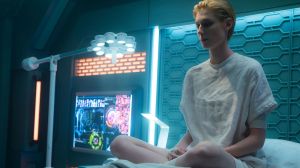 The third act goes all-in on the action heroics and survival thrills, pitting characters against one another for the well being of their homes. What once began as a trippy, reality-distorted sci-fi film becomes a lazy climax where one character stalks corridors and casually shoots people. It’s a conclusion that feels too expected and rote for all of the weirdness that transpired earlier. It’s not quite the steep crash that was the final act for Danny Boyle’s otherwise engaging 2007 film Sunshine, but it’s certainly a less interesting way to tie up your movie. There are some fun set pieces. O’Dowd interacting with his missing appendage is a funny almost buddy comedy. Some of the deaths are visually interesting as they make use of the cold vacuum of space in killer ways. There’s a nice climactic moment involving a character coming to terms with his or her personal grief that feels moderately earned though still facile enough to be unmovable. It feels like another in a series of checklists as far as what kind of character arcs, set pieces, twists and turns are to be expected from a mid-range sci-fi thriller. I thought last year’s Life did all of this better and with more style and nasty menace. If you’re going to watch a derivative space station thriller, at least make it one where the filmmakers have more of a plan from scene-to-scene and a genuine appreciation for their source material.
Now let’s talk about what exactly makes this a Cloverfield movie. Much like 2016’s agile contained thriller 10 Cloverfield Lane, this is a follow-up where the Cloverfield elements feels inelegantly grafted on. I suppose the use of the giant particle accelerator in space may have opened a hole in space-time for giant monsters to come through, but I thought it had been previously established as an alien invasion? Regardless, the only real storyline that tenuously connects the events in space to the larger Cloverfield universe is the storyline on the ground with Hamilton’s husband, Michael (Roger Davies). He’s recovering from whatever went wrong in space, which has resulted in cataclysmic damage across the Earth. He finds a lost and scared little girl and takes her under his protection, swearing to reach out to her family. They take refuge in a shelter. Every time the movie cuts back to Michael trying to reach his wife, or anyone really, and pacing nervously, I was getting bored. Who cares about this little kid when we have realty-bending mysteries up in space? If we don’t know what’s going on topside, or if the movie refuses to entertain some kind of accessible mystery, then every moment spent away from the space station is a moment wasted. The concluding conversation Michael has over the phone is simply there to remind the audience once again that this is indeed a Cloverfield movie, with an obvious visual reminder that feels too late.
 The Cloverfield Paradox is another Cloverfield movie where the Cloverfield elements feel like the least interesting part. I don’t know if this is exactly the best plan for extending this franchise. With 10 Cloverfield Lane, I felt the gnawing suspense of an effectively developed contained thriller. With The Cloverfield Paradox, the space mystery and its ensuing twists and turns feel too arbitrary and disconnected to have more than their immediate impact. It’s a movie that sadly gets less interesting every moment it marches closer to its generic action-thriller conclusion. Still, there are moments here that will entertain and I’m happy that Netflix is becoming a breeding ground for the mid-range sci-fi films that Hollywood no longer seems willing to give space for. If you’re a fan of the Cloverfield series or high-concept space thrillers, there may be enough here to warrant a viewing and justify your time. I look forward to this model continuing, the next Cloverfield movie having even less to do with the Cloverfield universe. Maybe we’re only years away from an Oscar-bait film about overcoming adversity set amidst World War II and Cloverfield monsters. It’s like a recipe: just add Cloverfield monsters (or are they aliens?).
Nate’s Grade: C+
Share this:

Downsizing (2017)
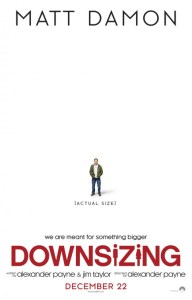 Alexander Payne is not exactly the first name you would think of when it comes to science fiction. The man has a history of road trip comedies, average Midwestern men, mid-life crises, and the colorful miscreants of society. The fact that the director of Sideways and The Descendants is tackling The Incredible Shrinking Man is a bold move. Payne is outside his comfort zone with Downsizing, and it shows at points. While never quite satisfying the possibilities of its premise, Downsizing is still worth watching for its memorable moments and for the sheer brilliance of one outstanding performance.
In the not-too-distant future, science has developed the technology to shrink human beings to five inches tall, approximately 1/100th of their size. A middle-income couple can live like the top one percent because their money goes further. Paul Safranek (Matt Damon) is a schlubby, regular guy suffering from the ennui of a job he hates and a life that feels unfulfilled. He and his wife, Audrey (Kristen Wiig), decide to undergo the downsizing procedure, which is irreversible. Paul’s wife backs out at the last minute but he doesn’t find out until after he’s gone small. Now with a McMansion all to himself, Paul has to readjust to what he thought his new life would be like. He moves into a condo and shirks the offers to join the parties of his hedonist neighbor, Dusan (Christoph Waltz). Paul finally decides to live life and embraces new experiences, the biggest befriending Ngoc Lan Tran (Hong Chau), a one-legged Vietnamese cleaning lady who was downsized against her will for being an overseas political activist. Paul feels drawn to this woman and she opens his eyes to the larger world around him.
 The strangest part of Payne’s movie is that the main thrust of the story could have been told without all of the science fiction dross. This is very much a romantic comedy/drama that follows the formula of a man jilted at the altar who has to get his life back together, finds someone new who changes his perspective on life, and then they get together by the end. You could have plucked this story and set it in an ordinary world and it still would have worked, which begs the question whether the world of Downsizing is properly applied. The consumer commentary seems muddled, with the rationale for downsizing being helping the planet, reducing the population so to speak, but really it’s an escape into a fantasy of wealth. People are downsizing so they can live in luxury and leisure. This should set up Payne for his incisive brand of satire as he skewers the selfish and self-righteous foibles of mankind, except that doesn’t really happen. Sure, eventually in the second half the movie opens up its tiny world a little wider, revealing the not-so-hidden subculture of immigrant labor toiling away to keep everything stable and pretty. It’s obvious social commentary and rarely does it go a step further than just recognition. And so the film becomes another in a long line of movies about a man who must be shaken from his malaise and enjoy the possibilities of life he never knew existed. Downsizing eventually ignores its sci-fi conceit to tell a relatively ordinary tale of self-actualization.
Payne’s premise would have best been explored through the more open parameters of a television series. Downsizing is an interesting concept that leads to other natural questions over how this tiny world operates and also how it interacts with the larger community. There’s a small scene where a drunk overhears Paul’s plan to shrink and argues that little people shouldn’t be granted the same voting rights as “normal-sized” citizens. The normies contribute more to society and should be given more credit, he argues, before being shooed away. This political division could have made for an interesting topic of reflection itself, but like many of Payne’s pit stops, it comes and goes after whetting your appetite for further examination. What about a story where downsizing is a punishment to do away with the “undesirables” of a nation? A TV series would have allowed more room to explore, with finer nuance, the details and possibilities of this fanciful world. Payne allows his movie to breathe, taking extended jaunts on different ideas but rarely enough to satisfy your sense of curiosity. The last act takes place at the original downsized colony in Norway, though at their diminutive size I wonder if it took them months to travel in Dusan’s yacht. It’s meant to think about what will come after humankind has passed the point of no return when it comes to climate change. Paul has to rethink what he wants his legacy to be and what meaning his life will have, which then pushes him into a rather simplistic choice of go with the girl or the cause. Given the rest of the movie’s focus, you shouldn’t be surprised what decision he ultimately makes.
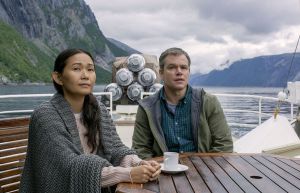 However, the real reason you should legitimately see Downsizing is for the astounding, star-making, can’t-take-your-eyes-off-her performance by Hong Chau (Inherent Vice, Big Little Lies). I cannot recall another movie where a character comes in at the halfway mark and just takes over completely, single-handedly lifting the movie up. Every moment she is onscreen is made better. You’ve never seen a character in a mainstream movie quite like Ngoc Lan Tran. She’s a political dissident, amputee, and lower-class cleaning woman who teaches Paul about the class divides. Tran is tragic, comic, caustic, lovable, and Chau is an acting revelation. I’ve read several reviews that found her to be a cringe-worthy, borderline racist depiction of an Asian woman meant to be laughed at, and I strongly disagree. At no point was I laughing at Tran because of her status, her ethnicity, or her broken English cadences. I was laughing because she was a force of nature that blew away the pretensions of others, that cut to the chase, and spoke her mind in a carefree and honest manner. Her matter-of-fact affectations are so perfectly delivered in accordance with the character’s personality. There are moments where her character is being set up for one thing and Tran goes entirely in another direction, and whereas you might have laughed at the start she surprisingly earns other emotions. Take for instance a scene where Dusan tries to ditch her by making an excuse about a sudden travel commitment. Tran takes this moment and turns it into a genuinely poignant monologue about the unexpected nature of fate. By the end she’s crying out of sheer elation, and those tears are not meant for ridicule. Downsizing realizes what an asset it has and makes her the deserved focal point of the second half. You’ll fall in love with her too. Chau doesn’t just deserve an Oscar nomination; she deserves to win everything.
Downsizing is an episodic high-concept comedy where the shrinking is irrelevant to the main storyline that evolves over two plus hours. This is an adult movie that explores some mature topics with surprising time and scrutiny, and then it can also be a simplistic rom-com that misses the mark on larger, Swiftian social satire. It’s another story in a long line of disaffected, middle-aged men finding their groove again, except then it becomes the story of a Vietnamese activist and her unique persona. Hong Chau is the reason you should see Downsizing above all. She doesn’t so much steal her scenes as just take full ownership over the back half of the movie. Her performance is so uniformly excellent that you wish the rest of Payne’s uneven movie could meet her commitment. There are a lot of ideas here that seem to get brushed aside for the conventional formula of a romantic union, even if the pairing is rather unconventional. Downsizing is an entertaining movie that doesn’t quite amount to more than the sum of its little parts.
Nate’s Grade: B
Share this:

Star Wars: The Last Jedi (2017)
 As I stated in my review of Star Wars: The Force Awakens, “The first mission for Episode VII is to reset the course, to wash away the bad taste of the prequels that haunt many.” Mission accomplished, mostly, though the biggest criticism for J.J. Abrams’ resurgent sequel was how all too closely it hewed to the original plot beats of its own past. It was an overcorrection, a swing too far in the other direction and turned a reboot into “a loving homage that approaches facsimile.” I enjoyed the new characters, the next generation of Star Wars heroes, and wanted to see what would happen to them next. I just hoped the franchise could steer a course of its own. Having a talent as unique as Rian Johnson (Brick, Looper) as the writer/director of Episode VIII certainly portends to that. The Last Jedi is a better movie, structurally and even emotionally than Force Awakens, but it’s flawed and definitely less fun and is driving so many fans to the dark side.
The First Order is crushing the last vestiges of the puny Resistance. General Hux (Domhnall Gleeson) is chasing the last ships of General Leia (Carrie Fisher) through the galaxy. Finn (John Boyega) is looking for Rey (Daisy Ridley) who is missing. He is teamed up with Rose (Kelly Marie Tran), a plucky mechanic, to find a master code breaker to thwart the First Order’s tracking system so everyone can safely escape. Meanwhile, Rey has sought out the last Jedi, Luke Skywalker (Mark Hamil), who agrees to train her just to teach her why the Jedi are wrong and he will not help the Resistance. She’s also been psychically linked to Kylo Ren (Adam Driver), who is still struggling with his own identity as a pupil of the dark side. Supreme Leader Snoke (Andy Serkis) has lost his faith in Kylo, who he feels is too weak to embrace his darkest impulses. Kylo believes he can convince Rey to join him, and Rey believes that Kylo can be saved and turned into an ally. The Resistance is looking to survive another day and rebuild their rebellion in the hearts and minds of the downtrodden.
 I was hopeful Johnson would be able to tread safely away from the undertow that is the pull of Star Wars nostalgia, and he did so, both to the movie’s great benefit and oddly to its peril at different points. Episode VIII is not a repeat of the plot beats of Empire Strikes Back, though there are some thematic similarities that go along with a middle chapter in a trilogy, like separating the heroes, experiencing losses, etc. Clearly, once Johnson received the handover from Abrams, there were certain Star Wars storylines setup in Force Awakens that he had no interest in continuing. I won’t specify what they are for the sake of spoilers but Johnson definitely undercuts the expectations of extraordinary developments with ordinary, mildly indifferent responses. Certain characters fans may have thought would be more important are gone. It’s as if Johnson is saying to the audience, “Did that thing really matter to you? Who cares?” It’s not Johnson’s fault the fanbase spun off intense theories. He undercuts your expectations throughout. The characters are allowed to fail. The reported saviors don’t want the responsibility. By upsetting the balance of the force, if you will, Johnson has injected a sense of uncertainty into the Star Wars mix, a badly missing element ever since the original trilogy. When a major character looks ready to sacrifice his or herself, you start to believe that this genuinely may happen. When the characters finally fulfill their mission and track down their special contact, they’re denied their goal. You can tell Johnson is having fun with misdirection and, as one character says, “letting the past die.”
However, that same sense can also get Johnson into trouble. From a narrative standpoint, we’re not much further by the end then where we began. From an emotional standpoint, I don’t know if we’re that much farther either. There are elements you can clearly tell that excited Johnson, namely the Rey/Luke/Kylo moments. That relationship, dynamic, and hidden history is easily the best part of The Last Jedi. The decision to psychically link Rey and Kylo seems cheesy at first but works out beautifully, synching up the two force wunderkinds forces them closer and each one looks at the other as a potential kindred spirit. They each think they can save the other, and so it becomes a far more concrete battle over the soul of our characters rather than just a philosophical exercise. It opens up more of a literal dialogue between these opposites and deepens their chemistry. Luke might be following a typical hero’s journey/acceptance of the call, but it’s still an interesting path because he’s bitter and lost his faith in the moral primacy of the Jedi.
 On the flip side, there are also elements where you can clearly tell Johnson had less excitement. The middle section involves a side mission onto an alien casino, and it feels like filler, especially with where it eventually goes and what it opens up about the world. I think it’s meant to showcase the exploitation of the underclass, the rich getting richer off war profiteering and the subjugation of civilizations. It doesn’t land and detracts from the other, more interesting storylines. The cutsey comic relief characters inserted to sell toys are not overpowering but they clearly feel like a studio requirement. At least I’m giving Johnson the benefit of the doubt that he didn’t decide that his Star Wars movie needed winged, big-eyed guinea pig creatures. The concluding half hour also could have been eliminated considering the second act break feels like a more climactic ending. The premise of an elongated chase through space that exhausts fuel supplies and where an enemy ship can track light speed jumps is oddly reminiscent of the first episode in the Battlestar Galactica reboot series (maybe Johnson was a fan). There are things the Force is able to do that we’ve never seen before. It begs questions over what exactly are the parameters of this invisible made-up zen power. Also, if you just solve things by saying “new Force powers” then it becomes a Star Wars cheat. There are also nobodies that could have been, and should have been, replaced by other higher-profile characters. There’s a moment of pure unchecked badassery that should have been someone else taking the sacrifice. By cramming in all of this other material, Johnson is trying to find things for his various characters and storylines to do, and not everything is on the same plane. Finn and Poe (Oscar Isaac) recede into the background all too easily. This is the longest Star Wars movie in franchise history and it could have easily been cut down by 20 minutes.
Fortunately for us, Johnson’s eye for striking visuals and strong, punctuated character moments is still alive and well, and The Last Jedi has moments that left me awed. There are a handful of visuals that are burned into my memory. A multi-dimensional shot of action that pans over to a frantic eyeball. A blast of light that cuts through space like a razor, with the sound dropping out for that extra degree of awe. Speeding ships kicking up red plumes. A slow-motion team-up that all but dares you not to pump your fist. Johnson’s unique sense of visual composition is still present an accounted for. He also reveals a strong handle over the coordination of action sequences, an unknown quantity for him until he landed on this biggest stage. The opening sequence is a great showcase for Johnson with multiple points of action both macro and micro. The X-wing fights are snazzy but the simple struggle of pilot trying to reach a detonator is terrific tension. Abrams, and now Johnson, have brought the feel of Star Wars back, where the alien settings are real and not just a green screen warehouse like the prequels. The light saber battles (all two of them) are given personal stakes. The fights matter. Unlike the prequels, we have people that behave and fight like human beings and not cartoons that leap off walls, do thirty flips in the air, and take leaps off 100-foot canopies. The characters and their conflicts don’t get lost among all the special effects wizardry and explosions.
 The characters with the best material are also the ones who give the best performances. Hamil (Sushi Girl) is fantastic as the old curmudgeon, the bitter man who’s lost his faith. There are later moments where all of his acting is performed through his eyes and little twitches over his face, and he communicates so many emotions. Ridley (Murder on the Orient Express) continues her flinty determination while being somebody who isn’t as instantly adept at every new challenge. Her one-on-one sessions with Luke and Kylo are made better from her charisma. She’s a star. Driver (Logan Lucky) is still compelling as a villain struggling with being a villain. I enjoy having a bad guy who is sloppy, tempestuous, and not fully immersed in the dark side. It makes scene-to-scene more interesting and it plays better to the film’s theme of trying to save one’s soul from the power of influence. Driver has less “woe is me” moments than Force Awakens and feels more committed to his character’s ultimate journey. Kelly Marie Tran (XOXO) is the newest edition and makes quite a favorable impression as the crafty, thoughtful Rose. She’s got some key emotional moments and Tran nails them. She’s also an eager fan of the heroes of the Resistance, namely Finn, and when the reality doesn’t quite match her fantasy, she mimics the Star Wars fandom in her dejection. While the movie doesn’t find the most useful places for her inclusion, I was happy to watch Rose make her case as a new and valuable addition to the franchise. The actor I felt worst for is Gleeson (Goodbye, Christopher Robin). His character is simply an officious weasel we’re not really meant to take seriously, and this is further accomplished by Gleeson’s screeching voice. I worried the man was going to give himself an aneurysm.
This is also the last time we’ll see Carrie Fisher in the Star Wars universe, barring the misbegotten CGI version of her that resembled a chalky blow-up doll in Rogue One. Fisher died almost a year ago and that knowledge hangs over every one of her scenes. You wonder if there will be any sense of closure with her character in this universe. Johnson provides a scene between Luke and Leia that is so poignant and shot so tenderly that it feels like the perfect sendoff for Fisher. He even kisses her forehead before slowly departing, feeling the urge to stay, while a burst of light halos her face. If you were going to cry at any point in The Last Jedi it will probably be this moment to remind you of Fisher’s passing. Leia does have a couple other appearances after this moment but it’s really this scene that serves as her effective curtain call from this massive franchise.
 Star Wars: The Last Jedi is an exciting transitional chapter, and this movement seems to be chaffing many fans, bringing forth the question of whether the fanbase will allow there to be a different Star Wars. This is a movie that discards storylines and characters with the wave of a hand, that subverts expectations and plays with misdirection. This is Rian Johnson’s response to nostalgia in place of genuine emotional responses. As Kylo Ren says, “Let the past die.” It’s not the movie’s fault that people devoted countess hours to speculating about possible film theories that were deemed relatively inconsequential. Johnson refocuses on the characters that matter most, Rey and Kylo, by pairing them up as twin forces. While The Force Awakens definitely has more of a brash sense of fun, I find Last Jedi to be the better movie. It’s not quite up to par with the original trilogy. Johnson gets a little overburdened by trying to add too many things, including a casino subplot that feels like a unsatisfactory side mission in a video game. The new Star Wars films have lacked the bold unpredictability of the original trilogy. There’s nothing quite as seismic as Darth Vader being revealed as Luke’s father or even Han Solo captured and locked in carbonite. Even the major deaths in the new films feel anticipated, like in Episode VII, or less momentous, like in Episode VIII. There are some fake-outs with major deaths that many will deem cheap gambits, and I won’t disagree. I was entertained throughout The Last Jedi. I enjoyed the new characters. I enjoyed the action sequences. I even enjoyed the porgs. This is a movie that is looking for balance between the light and dark, and Johnson establishes a Star Wars that resets the table in exciting and frustrating ways. With J.J. Abrams now onboard of Episode IX, we’ll see how he brings home the characters that he brought into the universe a long time ago in a galaxy far, far away. I imagine the fans grousing this new direction might be more forgiving of nostalgia.
Nate’s Grade: B+
Share this:

Blade Runner 2049 (2017)
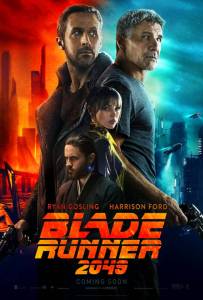 It’s confession time, dear reader. I do not love Blade Runner. In fact I find it to be overrated and then some. I’ll freely admit that it’s been an extremely influential science fiction work and its noir-soaked depiction of a cyber punk future has been the starting point for cinematic storytelling in that vein for decades. It’s got merits but I find the real merits to be its amazing use of production design, special effects, and the establishment of an overall atmosphere. It has some big ideas, yes, but it doesn’t know what to do with them, neglecting them for a slapdash story with some so-so acting. Rutger Hauer’s soulful yet doomed replicant should have been our central perspective. I wish I enjoyed the film more but I cannot attach myself without nagging reservation, and that’s not even accounting Ridley Scott’s numerous re-edits and the harebrained idea to imply that Harrison Ford was really a replicant after all even though that runs counter to the logic and themes of the film and Scott had to splice in unused unicorn footage from a movie he shot years later, thus proving this new twist ending was never part of anyone’s original story conceit. Anyway, what I’m saying is that the 1982 Blade Runner was not going to be an impossible hurdle to clear as far as I was concerned. The sequel 35 years in the making, Blade Runner 2049, is a better and more accomplished film experience and film story than the original, and it’s also one of the best, most visionary movies of the year.
Set in 2049, replicants have been shuttered and replaced with a new breed of android slave labor controlled by the enigmatic Niander Wallace (Jared Leto). He’s after a very special kind of replicant, one that will lead to even greater success, allowing mankind to reach further out into the stars. Agent K (Ryan Gosling) is a blade runner who finds himself looking for this same special kind of replicant. He must find it before Niander does and K’s journey of self takes him right to the doorstep of retired blade runner, Deckard (Ford).
 Apologies for the frustratingly vague plot synopsis above, but I’m trying to keep things as relatively spoiler-free as possible because I think that will improve the overall viewing experience. In an age where trailers and TV advertisements tell us everything about a movie in a zealous attempt to get our butts in seats, I was genuinely surprised at significant plot beats the 2049 advertising had successfully and deliberately kept under wraps. There are intriguing plot turns and character moments that I want to leave the reader to discover on their own. It will be worth the wait.
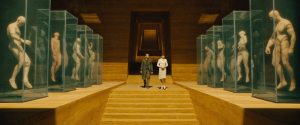
Director Denis Villeneuve (Arrival, Sicario) has created a filmgoing experience that immerses you in feeling. Every set, every little corner, every minor character goes toward enriching this world and making it feel real, like we’re just dropping in for a visit. He builds off the iconography from Scott in the first film and creates a future that is hypnotic and eerily beautiful, aided by the greatest living cinematographer, Roger Deakins. Seriously, if Deakins finally doesn’t win his long overdue Oscar for this, then the Academy is just never going to favor him. The visual landscapes of this movie are jaw dropping and the use of lighting is gorgeous. There’s a late sequence set in an irradiated Las Vegas where an orange fog hovers over the empty landscape of earthly pleasures. There’s a hiding sequence that takes place in a casino showroom, with holographic dancers and even Elvis fritzing in and out, static movements and bursts of sound that make for a dream-like encounter. Another wonderful hypnotic sequence is a threesome between K, a prostitute, and a virtual intelligence (V.I.) named Joi (Ana de Armas). Reminiscent of Spike Jonze’s Her, the sequence has one woman literally folded over another as hands caress, mouths kiss, and the whole sequence has an alluring disconnect during the acts of physical intimacy. This is a gorgeous movie to simply take in and appreciate the sumptuous visual brilliance. Villeneuve has quickly become one of the best big screen visual artists we have today.
 What separates 2049 and makes it better than the original is that here is a film that takes big ideas and knows what to do with them. This is an intelligent film that finds time to develop its ideas and to linger with them. This is a long movie (2 hours 43 minutes, the longest film so far of 2017) and one that many will decry as boring. That’s because Villeneuve and screenwriters Michael Green (Alien: Covenant) and Hampton Fancher (Blade Runner) commit to allowing the movie time to breathe, and scenes can take on an elegant life of their own becoming something of stunning power. Take for instance a scene where K visits the woman in charge of creating the false memories for replicants. Because of an autoimmune disorder, her life is behind glass, but she gets to create her own world to thrive in, and we watch her fine-tune the memory of a child’s birthday party while K asks her questions over her work. He has questions over the validity of memories, and this opens up a deep discussion over the concept of self, authenticity, and ownership over memory, all while still being character-based. It’s lovely. It’s like somebody saw the potential of the original Blade Runner and added the missing poetry.
2049 is driven by a central mystery but it’s also an exciting action movie. The sequences are few and far between but when they do happen they too luxuriate in the extra ordinary. The way the replicants are able to move again brings up that visual disconnect that can be so pleasing. A replicant-on-replicant fight is like a sci-fi superhero brawl. Dutch actress Sylvia Hoeks is our chief antagonist, Niander’s muscle on the outside. She might not have the languid magnetism of Daryl Hannah or playful philosophy of Hauer but she more than makes for a memorable and impressive physical force. The action and chase sequences are minimal, but when they do pop up Villeneuve doesn’t put the rest of the movie on pause. The characters are still important, the story is still important, and Deakins’ visual arrangements are still vastly important. 2049 is a movie at its best when it’s still and meditative, savoring the moment, but it can also quicken your pulse when called.
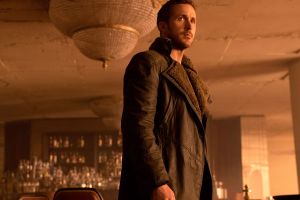
Gosling (La La Land) is uniquely suited for this character, another in the legacy of Sam Spade and Phillip Marlowe. His taciturn nature is essential to his character. This is a man going from day to day. His only emotional attachment is to Joi, the V.I. projection, and even that relationship is called into question knowing she is a product meant to serve. This relationship is given a healthy dose of ambiguity so that an audience never fully knows whether Joi genuinely cares or is just following the dictates of her programming. Gosling provides a quiet yet impactful turn as a man searching for answers. In the opening scene, Dave Bautista (Guardians of the Galaxy vol. 2) plays an older replicant that K must “retire.” Bautista says the difference between them is one of faith, as he has seen a miracle, and this allows him to believe in something greater. This opening interaction lays the foundation for K’s character arc, as he searches for his own faith. It’s not necessarily a spiritual faith per se but definitely a belief in a renewed hope.
 Another aspect lovingly recreated is the trance-inducing synth score from Vangelis, this time cranked up all the way to eleven by composers Hans Zimmer and Benjamin Walfisch (It). It comes in like waves, blaring loudly to the point that you swear you can hear the theater’s speakers rattling. It’s omnipresent and oppressive and it’s so freaking loud. I challenge anybody to fall asleep in the theater and actually stay asleep.
Blade Runner 2049 is one of those rare sequels that not only justify its existence but also improve upon its predecessor (again, not the biggest fan of Scott’s movie). It’s reverent to the older film and its film legacy while still charting a path all its own that it can stand upon. It takes a far more interesting narrative perspective to jump forward, possibly serving as a corrective to the original. I was fully engaged from the start as it challenged and entertained me to its concluding image of snowfall (oh no, spoilers!). This is a long movie but your patience pays off and then some. This is a deeper dive into the themes of author Phillip K. Dick and a better development of them. See it on as big a screen as possible, make sure to get your bathroom visits out of the way before it starts, and prepare for your eardrums to bleed from Zimmer’s blaring tones. Villeneuve has created a thoughtful, mature, exciting, and absorbing work of art that will stand the test of time. It won’t be as monumentally influential as the original Blade Runner but it is the better movie, and right now, in 2017, that’s a much more important factor for me as a viewer.
Nate’s Grade: A
Share this:

The Dark Tower (2017)
 I have never read any of Stephen King’s popular fantasy series, The Dark Tower, so I walked into the long-awaited film adaptation with no investment. I walked out with very little investment. The film peaked at its casting, with Idris Elba as the mythic Gunslinger hunting down a notorious evil sorcerer, The Man in Black (Matthew McConaughey), a.k.a. Randall Flagg. For the first fifteen minutes or so, the world building is pretty straightforward and accessible. The Man in Black is looking across universes for special psychic children whose abilities he can focus to destroy the titular Dark Tower, a monument protecting the stability of all universes. A young kid is having prophetic dreams but appears emotionally disturbed to his family. Before a group of rat people hiding behind human masks can kidnap him, he runs away, finding a portal to Midworld, and into the path of the Gunslinger, who seeks personal vengeance against the Man in Black. From there the movie gets pretty hazy with its rules and lore. The production design of this alien world is a bit bare. The characters stay in an archetypal range and don’t give you much reason to care. The action is serviceable but unmemorable, the Gunslinger credo is rather cheesy especially when repeated with such self-seriousness, and sometimes it feels like McConaughey is in a different movie altogether. If you’re a fan of the series, I have to imagine you’ll be processing some level of disappointment by the end of the film. If you’re a franchise novice, like me, you may find some stray things to enjoy in the moment, but the film evaporates from your mind immediately after leaving the theater, banished to the dustbin of bland sci-fi action.
Nate’s Grade: C
Share this:

Valerian and the City of a Thousand Planets (2017)
 Watching the trailers for French maverick Luc Besson’s latest, the sci-fi opus Valerian and the City of a Thousand Planets, I was wondering where it would fall on a scale between Besson’s own funky, enjoyable Fifth Element and the lackluster and laughable Jupiter Ascending. It looked to tell a big story in a big world and with its director’s quirky visual hallmarks. It should at least be fun, I reasoned, and it is for a while. Unfortunately, Besson’s film (the most expensive European production in history) is a movie that almost needs to be seen to be believed but I wouldn’t actually advise people go see it. Perhaps a better title for this movie would have been Valerian and the City of a Thousand Better Ideas.
Based upon the comic series by Pierre Christin and Jean-Claude Mezieres, we flash forward to the twenty-eight century with agents Valerian (Dane DeHaan) and Sgt. Laureline (Cara Delevingne). Their mission is to retrieve a special alien something-or-other that will relate to a larger conspiracy involving the eradication of an alien home world.
Besson’s face-first dive into the wacky world of sci-fi will frustrate the hell out of you, chiefly because it does such an amazing job of creating a vibrant, weird, wild, and luscious world brimming with alien life only to toy with interesting subjects and then indifferently discard them. The elements are all there, it’s just that Besson doesn’t integrate them in meaningful ways, retreating back to being an overly caffeinated, erratic tour guide. My friend Ben Bailey and I came up with several different revisions that would have instantly improved the movie, and that only took us twenty minutes after leaving the theater (more on that below in full detail). Over the course of 137 self-indulgent, hyperactive yet meandering minutes of story, I am stunned at the level of ineptitude.
 It’s not all bad, and in fact the first 30 minutes are some measure of good to great. The prologue is a thing of beauty and the highlight of the movie (if you walked out immediately after, when the title popped up, you would be better off). Set entirely to David Bowie’s “Space Oddity,” we visually chart the history of man’s habitation of space. Stock footage of 1970s space missions gives rise to the early twenty-first century construction of a working space station. The station’s captain accepts each new national group with a magnanimous handshake. Each scene is a jump forward in time, wordlessly building a stronger sense of community and the accomplishment of man’s dreams. Eventually this greeting also extends to First Contact and different alien species come aboard, and they too are given the same handshake of peace. It’s an earnest sequence that comes across as genuinely moving and uplifting. Finally, we see that the space station has, over the course of hundreds of years, collected into a massive floating home to thousands of alien species that came from far to explore and intermingle.
The next part is also wordless, following the idyllic existence of a planet of Na’vi-like lithe, blue-skinned alien natives who frolic along a beach and collect pearls. It’s another rather sincere visual sequence. This tranquil CGI world comes to a screeching halt when fiery debris begins to rain down from the atmosphere, followed by a gigantic alien spaceship that crashes and causes an extinction-level event. One of our lithe aliens is trapped behind and comes to terms with her fate. She sends out her spirit in one last radiant burst before the pyroclastic cloud engulfs everything. These two sequences engender good will with the audience and show the potential power of Besson’s transporting vision.
Shortly afterwards we get the first major set piece of the opening act, an inter-dimensional bazaar known as Big Market. In one dimension it’s just a large expanse of empty desert, but with the right gloves and glasses visitors can interact with alien vendors and shop to their hearts content. It’s a fantastic setting and Besson takes time to set up the different particulars and rules and then lets it loose. It’s exciting and imaginative and the only sequence where the character of Valerian feels in trouble or at a disadvantage. It’s a wonderfully knotty sci-fi set piece with multiple points of action interweaving into a satisfying spectacle. There’s even a fun alien crime boss voiced by John Goodman. I whispered to my friend that this was already better than Jupiter Ascending. I regrettably spoke too soon.
 Everything afterwards is a cascading mess that assaults your senses and wastes your time. There isn’t a strong narrative drive to the movie, never felt more than during its protracted second act that is nothing but a series of wearisome narrative cul-de-sacs. The movie errs significantly by establishing Clive Owen as an obvious villain so early (he’s torturing a Na’vi-like alien in the friggin’ first act). Owen’s character becomes the supposed MacGuffin that propels the characters forward. They have to retrieve him, but when the audience already knows so early that he’s not worth the effort, the sense of urgency deflates, not that there was much of a sense to begin with. The movie quickly adopts a flippant attitude where it feels like nothing matters, and so nothing does. We jump from one detour to another as if they were single-issue comics that Besson was determined to realize on the big screen. The characters never feel in danger because Besson deploys contrived solutions at every turn. A special jellyfish on the head is a solution to finding a missing Valerian. Simply jumping down a floor grate is a solution to charging aliens. It’s like Besson throws his characters into dilemmas and merely points to the exit door conveniently there the whole time. That’s not satisfying or entertaining. It makes the movie feel episodic, listless, and like it’s just filling up time. What started so promisingly rapidly degenerates into overly exuberant camp nonsense.
Another major issue is that the main characters are awfully boring and miscast. Valerian is supposed to be a charming rogue, a swaggering playboy, a fearsome cop, and none of these attributes work with DeHann. The guy has been excellent in other movies but is entirely unbelievable as the title hero, intimidating nobody and impressing even less. He’s supposed to be a talented expert operative but the results on screen don’t back up the praise. His combat moves require a large suspension of disbelief. DeHann (A Cure for Wellness) speaks in a baffling 90s Keanu Reeves voice for the entire movie, relegating his entire emotional range to a grating monotone. Valerian isn’t charming whatsoever but Besson seems to think an audience will fall for him. He’s an irksome misogynist who sets his sights on his partner, Laureline. Their “romance” is unconvincing and hindered with some laughably clunky dialogue. The movie runs like you have a pre-existing relationship with these characters, but we don’t know them or their back-stories or their shared history. He’s immediately hitting on her and proposing marriage in the first act, though it all seems like a sleazy scheme just to sleep with her. Delevingne (Suicide Squad) has a striking look to her but I can’t tell if she can act yet. Granted the roles I’ve watched ask her to mostly serve as a model. Her character is stiff and unemotive and equally boring, though slightly more convincing as an aloof badass. It’s a shame she gets sidelined as a damsel needing rescue when she seems far more capable than her partner. These two are the living embodiment of prioritizing attitude over characterization.
There’s a very late moment when Besson has his two lead characters just spout transparent exposition at one another to communicate themes and character arcs, and it took everything I had not to laugh out loud. Laureline is about to give an alien something valuable and Valerian pulls her aside and tells her they can’t. “I follow the rules,” he says, and I snapped my head back in alarming whiplash. What? This dolt has been breaking everything and doing whatever he has wanted for hours, and now at the last minute Besson is trying to force him to articulate a paradoxical character description? Being saddled with these two distant, glib, irritating leads is bad enough, but DeHann and Delevinghe have as much chemistry as a batch of dead fish. No danger of sparks flying here.
 Before I got into some spoiler detail with my suggestions on how to improve Valerian and the City of a Thousand Planets, let me appreciate some of its virtues. The movie is often a technical marvel bursting with detail at every edge of the frame. Besson’s quirky sense of humor and playfulness is on display from the imaginative alien designs to the lived-in settings. The movie isn’t afraid to get weird, and some of those details are delightful like a two-barreled gun that can point in different directions. There’s even a small creature that will poop out copies of whatever it eats. Even when the characters and story let you down, the visuals provide a reason to keep going. I enjoyed Rihanna’s shape-shifting alien, a burlesque dancer whose routine feels almost like a medical test to determine which Rihanna fetish works best for you (rollergirl, French maid, naughty nurse, S&M kitten, torch singer, school girl?). Part of her appeal is that she’s the only supporting character in the movie. Her presence changes the character dynamics of Valerian and Laureline and gives us somebody new to hang onto. I liked the dopey aliens that resemble the sloth from the Ice Age movies, and I especially enjoyed a surprise payoff for their insistence that Laureline wear a stupidly large hat. Whether these moments are enough to cancel out the rampant excess will be up to the individual moviegoer.
This next section is going to involve spoilers, though I don’t think this is a movie where knowing the plot is going to really ruin the experience. Still, you have been warned, and if you wish to remain spoiler-free, please skip to the last paragraph (though do come back later).
I was beside myself in frustration because it feels like there are story elements ripe for the plucking that would have instantly improved Valerian and Besson is just too oblivious. Firstly, none of the characters that Valerian and Laureline run into seem to matter in the slightest. That alien mob boss who swore vengeance? Never returns. The aliens that kidnap Laureline and offer her up as a tasty treat to their king? Never return. Besson’s Fifth Element benefited from establishing different groups of characters with conflicting purposes that would continually run into one another and complicate matters. It makes the movie much more fun and it allows characters to have greater meaning than one-off appearances. We should be building a team and gaining a new member from every new location visited, which would make the visits more meaningful and lighten the time spent only with Valerian and Laureline. My first solution would be to bring back these different alien antagonists in comical and bungling ways, especially for Act Three. Another solution is to radically change the angelic, Na’vi-like ethereal aliens. It’s revealed they’ve been hiding on the station for decades (though not in a different dimension, another missed potential payoff). They just want to go home, though whether that’s a replication or a different dimension is unclear. What if these peaceful aliens didn’t forgive humanity for obliterating their planet? What if the key to bringing back their home world was to suck the life force out of the space station or Earth itself? That would flip the script and make you question whether these displaced aliens are morally justified in their actions. It would also set the stage for a rollicking third act that culminates in a frantic chase through all the different levels and communities introduced throughout the film, complete with the various antagonists complicating matters with their own motivations. This would all be infinitely better than the third act we get, which left me flabbergasted at how slack and uninspiring it is (defusing a bomb?). Why build up this strange and wonderful world and do nothing with it by the end?
 Getting back to my original question: is Valerian and the City of a Thousand Planets better or worse than the Wachowski sisters’ misfire, Jupiter Ascending? Besson’s latest certainly looks lovely and is crammed to the rafters with ideas, several of which you desperately wish had garnered more attention and development. This is an overstuffed movie, especially at 137 minutes, and yet it will leave you seriously wanting. The disinterested lead actors slog their way from one uninspired chase scene to another, gallivanting in a world that will have no real significance once we move onto the next expensive set. It all feels like manic decoration meant to stimulate and distract from the glaring deficiencies with characters and story. It starts out great and then degenerates into kitschy futuristic junk. It feels like somebody made a PG-13 Barbarella but mandated that nobody ever smile. DeHann is grossly miscast as a rakish rogue and his onscreen relationship with his leggy costar is painfully realized. I think I respect Jupiter Ascending more because that cinematic world could have sustained something interesting and they took it all seriously enough even when things got absurdly silly. Valerian is so flippant and stuck with sourpuss leads. A better movie was within reach, which makes it all the sadder that Valerian and the City of a Thousand Planets is reluctantly the movie we get, a visual spectacle that bores as it overwhelms. If you put this movie on mute and did some peyote, maybe it would achieve its true artistic value.
Nate’s Grade: C
Share this:

War for the Planet of the Apes (2017)
 Matt Reeves is a director who seems to have found his true calling refashioning the work of others. He remade the Swedish film Let the Right One In and improved it in several areas, though having Richard Jenkins and Chloe Grace Mortiz and a complete lack of CGI cats certainly helps. Then he inherited the new Apes franchise with 2014’s Dawn of the Planet of the Apes and the fledgling franchise didn’t miss a beat. I’ve been pleasantly surprised about these damn dirty apes ever since the 2011 prequel kicked things off. Reeves took control of the franchise and deepened it, following a very non-Hollywood playbook that embraced subtleties, patience, and quiet moments. It had its crazy apes action but it was a movie in service to its characters first and foremost. Reeves, serving as co-writer once more with Mark Bomback, brings the franchise to its natural and thrilling conclusion. War for the Planet of the Apes is a blockbuster with soul.
It’s been fifteen years after the outbreak of the devastating Simian Flu. Mankind is dwindling and falling victim to a secondary virus as well. There are only pockets of humans left and small militias taking the fight to the super-intelligent apes. Caesar (Andy Serkis once more in mo-cap) and his followers have taken refuge near a waterfall. The ape community is ambushed by soldiers led by The Colonel (Woody Harrelson). With their home exposed, Caesar splits up the remaining numbers and sends them out to find a new shelter. He is determined to seek out the Colonel for vengeance. Eventually the other apes are captured and put into a slave labor camp and Caesar and company must rescue them and flee mankind’s last gasp at staying atop the food chain.
 This may be one of the bleakest blockbusters in recent memory, especially when you consider that you’ll be actively cheering for the relative extinction of mankind by the end credits. Human beings are on the brink of extinction and this has drawn out the worst fight-or-flight instincts in the remaining numbers. This is about a final fight for survival on a visceral, us versus them level, and after two movies it should be abundantly clear what direction this is all heading. Even as humankind is doing a terrific job of wiping itself off the planet, humans still present a clear threat to the remaining apes. The second film explored how a working trust was improbable and unfathomable to many on both sides of the conflict because of the injustices. That’s pretty heady for a talking ape summer blockbuster. War closes the series with an even bigger and bleaker scenario, as humanity is entering the hospice phase of its social dominance. Roger Ebert referred to the movie theater as an empathy machine, and it’s amazing how far you will empathize with non-human characters. You will feel their triumphs, setbacks, loss, and anger, and you will root for the demise of mankind. We had a good run but maybe it’s time for a different species to become the caretakers of dear Mother Earth.
This is a final film that makes allusions to some of the darkest aspects of human history including, but not limited to, slavery and the Holocaust. It doesn’t traffic in black-and-white moral absolutes. There is good in some humans, several of whom were thrown into military service unprepared, under-trained, and simply existentially lost. There are apes that have made the calculation that it’s better to work with the humans than be killed. That’s right, there are collaborationist apes, and Reeves doesn’t look down on them. They too are allowed complexity and nuance and even the possibility of redemption. No one, man or ape, is beyond the capacity for compassion. You strongly feel their shame brought from moral compromises. It’s hard not to think about real-life analogues like the Jewish police that chose to work at the behest of their Nazi oppressors. They’re all still victims.
 There is great suffering and vengeance on display with War, and it’s all too easy for characters to justify it on a literal specist argument (“Apes aren’t people, and they would have done the same to you”). Caesar is trying his best to manage a fragile co-existence, though this becomes untenable with every new attack. It’s a cycle of violence that only knows recriminations and fear. This struggle is personalized for Caesar as he wrestles with his own selfish, self-destructive impulses to seek out vengeance at the potential cost of the greater good for apekind. Caesar is still haunted by the ghost of Koba (Toby Kebbel, in a welcomed albeit brief appearance), the ape he slew in the previous film. Koba could not let go of the hatred he carried for mankind for their myriad abuses. It consumed him at great cost. Caesar is battling these same impulses but is self-aware about his responsibilities as the leader of his people, but even that might not be enough to dissuade him. To have that kind of emotional conflict within a CGI animal who happens to be the protagonist in a major Hollywood production is simply remarkable.
I don’t want to scare people away. War for the Planet of the Apes is still a very entertaining and gripping movie that can easily warrant stuffing your face full of popcorn. It’s also a blockbuster with tremendous weight. At a steep 140 minutes long, I still could have used even more of this movie. Reeves displays an uncommon sense of patience for a blockbuster filmmaker given a big studio’s checkbook. A majority of this movie is silent and this doesn’t panic Reeves. The director tells his story in a visually appealing and accessible way that doesn’t scrimp on characterization and depth. For long stretches the only communication on screen is ape sign language (small quibble: the apes too often fail to look at one another when they do this). There’s a lingering hush over much of the film, allowing the audience to immerse themselves fully. When the action does heat up, the sounds and music matter more. The solemn silences, hunting parties, and tense standoffs should remind people of Westerns and prisoner-of-war movies. This is the second big-budget 2017 movie making direct Vietnam parallels concerning a man-vs-apes conflict. The prison escape structure of the second half is immediately compelling and just as well developed as what came before. The multiple points needed for an elaborate escape are presented one-by-one and organically. The mini-goals and geography are clear at all times. It leads to an all-out assault climax that is thrilling on multiple levels but also deeply satisfying because of the extensive legwork.
Serkis (Star Wars: The Force Awakens) has been the beating heart of this franchise and his work as Casaer has been a monumental achievement in the advancement of special effects (the series has never won an Oscar for its VFX). Caesar is a fully formed character with relatable flaws and doubts, and thanks to the wizards at Weta, you can see the nuances flash across his face. Serkis brings an impressive range of emotions to a non-human character that’s piercingly silent often. It’s a performance that deserves shared credit to the animators and to Serkis, who is deserving once again of awards consideration that I know will unfairly never come. Harrelson (Now You See Me 2) is definitely evoking a Colonel Kurtz homage, a man given over to the darkness. I appreciated that his character has a credible back-story that informs his actions. He’s not simply a maniacal madman. He respects Caesar and the apes, but views life as a zero-sum game, which makes genocide an appealing last-ditch option. The pleasant surprise among the cast is Steve Zahn (Captain Fantastic) who plays Bad Ape. It’s a character that seems prone to comic relief non-sequitors, but he’s scarred from his own survival experiences. This is an ape still going through PTSD and that presents even the comedic with a twinge of tragedy. The unseen actors behind their mo-cap performances breathe startling life into the numerous non-human characters, bringing unparalleled realism to this sci-fi realm.
 As the conclusion to the Apes prequel trilogy, you will also experience plenty of powerful emotions. I full-on cried twice and teared up about four other separate occasions. I cannot even remember another major summer tentpole that triggered that kind of emotional response (maybe a Pixar title or two). We’ve traveled with Caesar and several of these apes for three movies and six years. We’re emotionally invested. I knew I was going to lose it if anything happened to the orangutan, Maurice (I won’t confirm his fate). The community and empathy we’ve shared with these characters for three movies comes to a gratifying conclusion that feels appropriate, sizeable, and aching with potential for further adventures in this new and exciting world.
War for the Planet of the Apes is a movie so rewarding, so engaging, that you walk away angry that other Hollywood blockbusters can’t be this good or aren’t even trying to be. It’s emotionally rich and resonant, hitting you in the heart just as often as it quickens your pulse. Because of the investment in the characters, and their ongoing progression, we genuinely care about what happens like few blockbusters. The characters don’t take a backseat to the plot mechanics. Serkis and his amazing cast of mo-cap performers have delivered performances that rival live-action actors. There are clever nods to the original series that fans will enjoy but this Apes franchise has been its own beast from the beginning. This is a thoughtful, reflective, and contemplative film that fits well for such a thoughtful and contemplative series, and yet it still knows how to deliver stupendous sci-fi action (our lives are just that much more complete having watched an ape fire dual machine guns while riding a horse). I would declare Dawn as the best action of the trilogy, but I think War is the best movie because of how much everything matters and finishes. I think once the initial dust settles, it’s time to start thinking about this new Apes trilogy place among the all-time great movie trilogies. It’s been consistently enthralling from the beginning and has treated its animal cast as equally worthy of the greatest stories movies can deliver. War for the Planet of the Apes is powerful proof of what blockbuster filmmaking is capable of offering at its absolute finest.
Nate’s Grade: A


You must be logged in to post a comment.