Blog Archives
Vox Lux (2018)
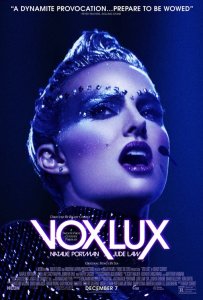
I don’t know what this movie was trying to say about anything. Vox Lux stars Natalie Portman as the adult Celeste, a survivor of a school shooting as a teen who became an international pop star in the months after. Is there something writer/director Brady Corbet wants to say about the transformation of tragedy into mass entertainment? The dulling effect of an entertainment industry to grind up human beings and re-purpose them into shiny, inauthentic, easily marketable figurines? I don’t know. I warily thought as we open on an upsetting school shooting, “I don’t know if the final product will justify this tone,” and it doesn’t. There are decisions that feel like they should mean something, like having the same actress, Raffey Cassidy (Tomorrowland), play both young Celeste and her eventual teen daughter, but what? It feels like an idea looking to attach to an interpretative message. Then there’s a modern terrorist group dressing like one of Celeste’s iconic music videos. She distances herself from the violence and even publicly challenges the perpetrators. This will obviously come back and mean something, drawing upon her own beginning stages of fame derived from the bloodshed of others, right? Or during her big concert the terrorists will invade and attack her, bringing the main character face-to-face with the ramifications of hubris. None of these things happen. Instead, Portman enters the scene at the 45-minute mark and proceeds to lash out at others, lament her parenting deficiencies, gets drunk, and then puts on her show. That’s it. It’s like Vox Lux forgot to be a movie for the final 20 minutes and just becomes a numbing series of EDM pop dance numbers. Portman is actually very good and digging deep into her anxious, entitled, and spiraling pop star, rounding out her dimmed humanity when Corbet cannot. There’s a solid storyline here between the adult Celeste trying to reconnect with her teen daughter who she’s been neglecting. This isn’t it. The pretension level of the pedantic exercise made me think of Lars von Trier as filmed by Darren Aronofsky. Skip it.
Nate’s Grade: C-
Share this:

Bumblebee (2018)
 Why haven’t they been making these kind of Transformers movies from the beginning? Bumblebee is a scaled-down, character-driven family film where the bigger moments re about fitting in, finding your sense of self, and keeping your new alien robot friend hidden from your parents. Set in the late 80s, Hailee Steinfeld (Edge of Seventeen) plays a high school senior dreaming of a life beyond her neighborhood and family. The ticket out is a new car, which just happens to be an Autobot from another planet disguised as a VW beetle. Because Bumblbee had his memory wiped from a fight years earlier, he’s very childlike and endearing, and the interaction between the big robot and Steinfeld will rekindle more than a few memories for The Iron Giant, E.T., and other classic “boy and his dog” tales. There’s a real attention to the characters, big and small, that makes this the best Transformers movie. Not everything has to be about the next world-destroying cataclysm. There’s plenty of formidable drama in watching a teen girl navigate the world with an unconventional new friend. Director Travis Knight (Kubo and the Two Strings) graduates to the world of live-action with a terrific feel for the visual parameters and material. It helps that Knight gives his film a sense of scale without sacrificing coherency. The camera prefers wider shots and longer takes so the audience can follow the action. The movie also has a sly sense of humor it knows when it call upon, like a highly enjoyable John Cena who is baffled at his government’s open door policy to evil robot aliens: “They have Decepticon in their name. Is that not a red flag to anyone else?” This is a well-paced, sweetly heartfelt movie with good humor, good characters, and good action. If this is what happens when you strip Michael Bay from the franchise, then lock him up.
Nate’s Grade B+
Share this:

Aquaman (2018)

It’s hard not to talk about the fledgling DCU without grading on a curve. Wonder Woman was a great success and a definite step in the right direction but it still had clear Act Three problems. However, when your previous movies are the abysmal Suicide Squad and Batman vs. Superman, anything in the right direction is seen as enlightenment. There are currently no planned Superman films, no planned Batman films, and it looks like the teetering DCU is banking its future on the success of Wonder Woman and Aquaman. If you had told me that the future of an interconnected series of franchises would rest upon the shoulders of a man who talks to fish, I would have laughed. Enter director James Wan, best known for the Conjuring franchise and plugging into Furious 7 without missing a beat. Warner Bros. desperately wanted Wan’s stewardship to get a notoriously difficult comics property to float in the modern market. The early marketing was not encouraging but I held out a slim degree of hope that Wan would make it work. While Aquaman as a whole has its share of problems, Wan has done it. He’s made a big screen Aquaman movie that is fun, visually immersive, weird, and packed with great action. I was just as surprised as you, dear reader, but the smile on my face was evident.
Arthur Curry (Jason Momoa) is heir to the undersea throne of Atlantis. His mother (Nicole Kidman) fled her arranged marriage and had a son with a human lighthouse keeper. She retreated back into the ocean to prevent further harm to her shore side family. Arthur is approached by princess Meera (Amber Heard) to return to Atlantis and claim his birthright to the throne, currently occupied by Arthur’s half-brother, King Orm (Patrick Wilson). The reigning king is planning to unite the seven sea kingdoms to launch an attack against the surface-dwellers. Arthur must go back to the people who reportedly killed his mother and challenge his half-brother for supremacy. Along the way he’ll have to venture across the globe with Meera for a series of adventures to reclaim lost artifacts, while also dodging Black Manta (Yahya Abdul-Mateen II), a pirate gifted with underwater technology who swears vengeance against Arthur for letting his father die.

Make no mistake, there is definitely a ceiling capped for Aquaman. The characterization is pretty standard stuff with little added nuance. It’s a dash of Chosen One destined to bridge communities, a dash of Prodigal Son outcast trying to make amends and duty, and there’s the general pledged vengeance that reappears again and again for motivation. The plot is reminiscent of a video game, structured so that Arthur and Meera have to travel from one stage to another, finding an important artifact and then going to the next stage. Sometimes there are mini-bosses at these various video game stages. The antagonists are acceptable but without much in the way of depth or charisma. You might even find yourself agreeing with King Orm as far as his pre-emptive strike over mankind (the latent racism of “half-breeds” maybe not as much). The leads are also given little. Momoa (Justice League) is a naturally charismatic actor but his range is limited; he basically has two modes, off and on. This might have been one reason why the screenplay resolves to merely push him toward his “call to action,” which I thought was his Justice League arc. Still he’s an affable and handsome presence even with lesser material. Heard (London Fields) is struggling to find her character’s place in the story. She’s a romantic interest, quest cohort, and there are attempts to push through more feminist agency but it’s too murky. It feels like she’s trapped by her character and her giant Halloween store red wig. If you cannot get over these deficits, it’s going to feel like a relentless 143-minute video game.
And yet the movie works thanks to the talents of Wan and the overall abundant sense of exuberant fun. Wan has become a first-class chameleon, able to adapt his skill set to whatever genre he attaches himself to, be it high-octane car chase thriller, slow burn horror to grisly torture porn, or now splashy superhero blockbuster. Early on, I knew we were in good hands when Wan showcases a destructive fight scene between Kidman and a group of aqua storm troopers in long takes and wide angles, letting the choreography speak for itself and allowing the audience to fully take in every smash and crash. The action is consistently interesting and filmed in ways to highlight its best points. An underwater brotherly battle takes the movement within water into account, adapting fight choreography to add this new dimension. That’s what good action movies should be doing, applying their unique settings into the action development. There isn’t a boring action moment in the film. Even when we get to the big CGI armies duking it out, Wan instinctively knows to pull back to avoid overkill. Even the otherwise normal hand-to-hand combat is clever and consistently entertaining. The highlight of the movie is actually on land, an extended chase through the villas of Tuscany. Arthur and Meera are battling Black Manta but they’re also divided, and Wan’s camera will zoom back and forth between the two, connecting each on their parallel tracks. They jump from tiled roof to tiled roof, escaping danger. There’s one super aqua storm trooper who takes a more direct approach and just runs through room after room, and the camera follows him on this direct line of destruction. There’s even a payoff where Meera uses her powers in a wine shop to her great advantage. It’s moments like this where Wan is clearly having fun and demonstrating that he and his team have put good thought into their action.

The visuals are wildly immersive and amplify the sense of fun the film has to offer. There are plenty of cinematic reference points of influence here, from George Lucas to James Cameron, but Wan and his team do an excellent job of making this universe feel full. We visit many different undersea realms and people, including seahorse people, crab people, and just taking ownership of the weirdness without irony is refreshing. With the exception of Momoa’s need to undercut moments with quips, the film feels genuine and proud of its old-fashioned mentality, taking the ridiculousness and treating it with sincerity. That doesn’t mean there aren’t campy and absurd moments that are enjoyable precisely because of their camp and absurdity. There are people riding great white sharks and battling crab people to the death. How can that not be silly? There’s one group of creatures that feel plucked from Pitch Black, a band of feral monsters vulnerable to fire. There’s a fun and effective sequence where Arthur and Meera must dive to escape with their lit flare and we see the full totality of their situation, a literal sea of these monsters breaking apart just so as they dive. It’s a creepy moment made even better by Wan’s visual choices, which always seem to correspond to what’s best for the experience. The special effects are uniformly great and the attention to the undersea worlds is pristine.
Ultimately your view of Aquaman will come down to what you’re willing to forgive in the name of fun spectacle. Its best Marvel Cinematic Universe (MCU) equivalent are the pre-Ragnarok Thor films. There are definite deficits with the minimal characterization and the familiar hero’s journey plot arc, but the execution level and the sheer energetic entertainment are enough to rise above. The action sequences are routinely thrilling, eye-catching, and wonderfully alive and clever thanks to Wan. They’ve found a way to make Aquaman cool and fun, which is what rules the day when it comes to the film version. Aquaman is another step in the right direction for the notoriously gloomy DCU. If Wan was attached for a sequel, I’d genuinely be interested. This is nothing you haven’t seen before in any number of movies (just now underwater), it’s not exactly intellectually stimulating or emotionally involving, and yet the sheer success of the visuals, action orchestration, and the sense of fun override the rest of the detractions for me. It reminds me of the Fast and Furious franchise. I don’t care a lick for any non-Rock/Statham characters; I’m just there for the physics-defying stunts and set pieces. It provides the goods when it comes to action spectacle, and so does this movie. If you’re looking for a 90s throwback to big, fun action movies, then take the dive with Aquaman.
Nate’s Grade: B
Share this:

Mary Queen of Scots (2018)
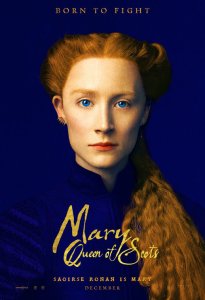 Serving as a feminist reclamation project, Mary Queen of Scots attempts to re-contextualize “Bloody Mary” in the royal dispute for the English throne. As played by Saoirse Ronan, Mary is portrayed as an empathetic, open-minded but strong-willed ruler looking to make peace between the two nations, and Elizabeth is portrayed as a flinty, scared, aloof woman that literally tells her younger cousin that she is her better in every manner. It’s a flip of how the two women are often portrayed throughout history, which raises the question of whether history has been twisted from centuries of revisionist and political obfuscation. There are definitely elements in this movie that I know are historically questionable, like Mary accepting a gay man into her royal court of ladies with open arms and a dismissive view of his sexual leanings. I find it hard to fathom that a devout Catholic woman who ordered heathens burned at the stake would be so anachronistically tolerant of homosexuality. If there’s a new theme for this costume drama it’s that women, even those in power, even those who were deemed wicked or corrupt by historians (universally men for centuries), were hemmed in by scheming men who were trying to usurp their power, undermine them, and manipulate them. Mary is thrown into one faulty suitor after another, positioning her as the victim of a patriarchal society. Again, I suspect there is validity to this context but it treats Mary with kid gloves, denying her righteous impulses. Ronan (Lady Bird) delivers a fine performance of grit and grace, but it’s Margot Robbie (I, Tonya) as Elizabeth that really misses the mark. She is sadly miscast and seems to shrink in the role. The depiction of Queen Elizabeth is also a disservice for drama and the concluding makeup reminded me of the Queen of Hearts from Tim Burton’s Alice in Wonderand. Mary Queen of Scots is an acceptable costume drama told with a little more heat (it’s R-rated for some reason) and a little more consideration to its subjects, but Mary Queen of Scots made me question the voracity of its portraits and made me really wish I was watching the Cate Blanchett Elizabeth movie instead.
Edit: There are two Marys at this time, Stuart and Tudor, and I have conflated them. In my defense, it seems like there shouldn’t be more than one Mary by name when you’re talking about a Catholic rival who is related to Elizabeth. I’ve left my review uncorrected to further own my ignorance.
Nate’s Grade: B-
Share this:

Mortal Engines (2018)
 Mortal Engines is a confusing movie. I mean what does the title even mean? I was all but certain somebody would explain what it meant during the two-hour-plus movie, but nope. My best guess is that it refers to the people operating the roaming cities of the future, the tiny instruments of flesh and blood that have become the gears to these monstrous mobile cities. That’s only the start and it’s simply the title. Mortal Engines is the latest in dystopian YA to make the leap to the big screen, but this time with the guidance of Oscar-winning blockbuster maestro, Peter Jackson. If anyone could elevate a YA novel into big screen eye candy, it has to be Jackson and company, right?
In the distant future, the world we know it was decimated by a war that took all of 60 seconds. In the ensuing years, cities have taken on a new life. They have become mobile and roam the land, swallowing and attacking other smaller cities, and the most notorious is London. Tom (Robert Sheehan) is living a blissfully ignorant existence on London until he runs into the scarred, feisty Hester Shaw (Hera Hilmer) who attempts to kill Valentine (Hugo Weaving), accusing the leader of London of killing her mother. Tom hears too much and Valentine tries to dispose of both of them while he can also assemble a weapon from the old world to gain total supremacy.
 I think the good slightly outweighs the bad when it comes to Mortal Engines, but this is definitely a sci-fi action blockbuster where the sum fails to weigh more than its moving parts. The world building on display is more imaginative and intriguing than I was expecting. I was expecting a PG-13 steampunk Mad Max and I got a larger, more developed, weirder and wilder world. Early on, the opening sequence gives a sense of the dangerous reality of predatory cities, and it’s thrilling and large-scale. Immediately you understand why Jackson and company wanted to tell this movie on a big canvas. From there, we get a better sense of how the world has rebuilt itself in the ashes of our civilization and how others have adapted. If London is the scourge of this new world, others have taken to hiding, eking out fragile lives on the fringes of this society. That leads to smaller moving buildings designed to hide. This leads to the skies being an escape from the earthbound cities. This leads to outer reaches where slave auctions occur. This also somehow includes zombie cyborgs, which I don’t quite follow how a world of giant cities that covets “old tech” somehow has conquered life and death, but hey. With each new location, the world got a little bit bigger, and it was already plenty big to begin with. That’s something that Mortal Engines has in spades – a sense of scale and scope. The visual grandeur of the film is expansive and richly detailed, pushing the outer boundaries just a little bit further. There’s a fun chase scene through a city as it’s sliced and diced into smaller parts by grinding gears and sparking saws. The budget was only $100 million but it looks like it could have easily been double that. Even at its worst, Mortal Engines is a visual treat that surprises with ingenuity and terrific special effects.
The good is drowned out by the messy, bombastic, ridiculousness that takes flight. This is a big, dumb movie that readily announces itself as big and dumb. The dialogue is often cheesy and occasionally painful, with characters spouting self-parody lines like, “I’m not going to tell you my sad story,” and then 30 minutes later, “So that’s my sad story.” It’s the kind of movie where every character seems to be angling for that movie quip. One character says, “I’m not known for subtlety,” which could have been the message of the movie as a whole. Another character says her name relates to her desire to have her ashes scattered by the wind upon her death. Guess what doesn’t happen at all? My friend Cat McAlpine wrote in her notes for the movie, “Why is the dialogue so bad?” four separate times. There’s one moment late where a character with a bowler hat is shown and it’s meant to be played like some big moment of leverage or betrayal (“Oh no, not Bowler Hat Man!”) but I don’t recall any scene establishing who this man was or his connection to the Mayor of London. It’s just like a man in a bowler hat appears and the movie treats it ludicrously seriously, and I wanted to laugh uproariously. It was not the only time I felt this impulse.
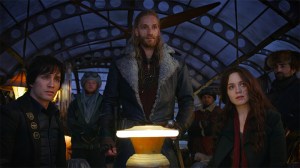 It’s never boring even when it’s being patently ridiculous and dumb. The main characters are powerfully bland, and they also give way to bland supporting friend characters who serve no purpose other than to be the eyes needed to oversee certain villainous revelations. The romance between Hester and Tom is nonexistent and painfully contrived. Much like the equally bonkers Jupiter Ascending, the main characters and their story are the least interesting parts of the world. Sheehan (TV’s Misfits) seems a bit too old to be playing a 16-year-old. Hilmar (DaVinci’s Demons) has little to work with but is very leaden and flat. There’s no spark of charisma between the two of them. Hugo Weaving (The Hobbit) is clearly enjoying himself as the hammy villain bent on bringing back old imperialism into this brave new world. The entire population of London is only seen cheering in reaction shots, which makes it harder to believe when characters talk about innocents amongst this throng of happy imperialist cheerleaders. I was happy to see Frankie Adams (TV’s The Expanse) as a do-nothing role as Revolutionary Fighter Pilot #3.
There is a massive plot hole in the second act that Mortal Engines cannot recover from (minor spoilers). The entire motivation for Hester is her vengeance against Valentine, enough so that she’s willing to risk her life by running out on her zombie Terminator surrogate father Shrike (Stephen Lang, in CGI mode) to see this through. But if Hester has a zombie Terminator surrogate father, why doesn’t she simply say, “Hey new dad, help me kill this one evil guy, and I’ll happily do whatever you want after”? In flashbacks, we see her open to the idea of transforming into some form of a robotic hybrid, shedding her humanity and losing the ability to feel any pain. It makes no sense why she wouldn’t use this new asset to her advantage, especially when the second act is mostly spent proving how formidable a threat he can be. This plot turn is further evidence at how sloppily the storytelling can get with character choices. Shrike is introduced as another antagonist to chase our heroes, but by introducing him at all, it makes me wonder about the better version of this movie, the Leon: The Professional version where a young girl teams up with a zombie Terminator father figure for vengeance. Don’t you, dear reader, want to see that movie too? It already sounds far more interesting and a better use of the unique story elements.
 Here’s another example of how confusing this movie is – the poster image. Go back to it in this review and study it, then ask yourself why the marketing team decided to put the visual emphasis on a woman’s face covered by a bandanna. It’s a movie about giant cities on wheels attacking each other and it also has a zombie Terminator… and the emphasis is on a bandana? If all you saw about the movie was the title and that key poster image, you would never suspect what kind of movie you were in store for, which seems like the exact opposite purpose of advertising. What’s the hook of this image? What’s underneath that bandanna (spoilers: a second smaller bandanna)? What about the tagline which talks about her scar? Did the marketing team actively try and hide the buzzier genre elements?
Mortal Engines feels assembled from the many scattered pieces of other, better movies. I wish we spent more time in this world and less time with the bland assembly of characters not played by Hugo Weaving. I wish we saw more about the intricacies of life on the move and the working infrastructure of these new environments. I wish we had more importance with the Anna Fang (Jihae) character where she didn’t feel like she just ported over from a Matrix sequel. I wish a lot of things were different about Mortal Engines and yet even when it’s bad, even when it’s dumb, and even when it’s insane, the movie is always worth watching and fairly entertaining, for a variety of reasons. I could see a select group of audiences enjoying this for ironic and non-ironic purposes. It’s a big shambling mess of a movie but it puts on a solid show.
Nate’s Grade: C+
Share this:

Roma (2018)
 Alfonso Cuaron won a bushel of Oscars for his last groundbreaking project, 2013’s lost in space epic, Gravity, and one of the most daring and innovative filmmakers working in cinema had what every artist craves — cache. He could do whatever he wanted with his earned credits. And so Cuaron told a personal story about growing up in Mexico City, a love letter to his own nanny. Roma follows the life of Cleo (Yalitza Aparicio) for most of the year 1971, through her ups and downs and the loping rhythms of domestic life. This review is going to come across sounding far more critical than I intend. It’s mostly because I’m trying to deduce why my own experience with Roma was not the rapturous, transformative experience that my fellow film critics have sang. It’s a good movie but I’m trying to pinpoint why it kept me from fully engaging, or what within me stopped from engaging further. I think it stems from the central intent of the film and its overall perspective that proves too limiting for my tastes.
But first the good and the exquisite. Roma is a lusciously photographed and composed movie that brilliantly recreates the time and place of Cuaron’s childhood with stunning black and white photography (Cuaron serves as his own cinematographer for the first time). There are moments that are stupendously put together, pulled directly from Cuaron’s impeccable memory. Sometimes these even stem into the surreal, like a forest fire that features a man in holiday costume singing to himself while life and the flames rage on behind him, the chaos of the moment centered on a beautiful focal point. There’s an extended sequence of a car trying to park down a narrow driveway that becomes a symbol of unchecked manhood. There’s a riot that feels like it is being captured live, even though your brain tells you it’s the work of hundreds of people all coordinated to bring about Cuaron’s vision. There’s even a subtle (maybe not so subtle) nod to Gravity at the local movie theater. There is one family relative who garishly hangs the heads of dearly beloved dogs from the past as if they were hunting trophies. It’s a peculiar and striking detail and something that carefully tells you more about a side character. Then Cuaron cleverly cuts to the current canine being pet, establishing the connection of present and future as well as past and present, an achingly affecting theme throughout the film, trying to better understand our beginnings and the people who impact us.
 You can tell he has great affection for the women often responsible for the upbringing of children in rich homes. Cleo is the main character of Roma and given humble life by first-time actress Yalitza Aparicio. She’s very passive and selfless to a fault, but her actions demonstrate the care she has for the family she works for, especially the younger children. The emotional thrust of the film is Cleo’s unexpected pregnancy. She’s single, young, and worried it might cost her employment. It’s a difficult decision and the would-be father, a friend of a cousin, seems to want nothing to do with this new responsibility. There’s a moment late in the film, filmed in Cauron’s signature long takes, that breaks your heart, forcing the audience into Cleo’s position where she is struggling for meaning as an agonizing reality sinks in. Aparicio shows that she is more than capable of communicating larger emotions when given the opportunity.
And yet, I kept waiting to be truly transfixed, and waited, and ultimately I found myself enjoying Roma but more as a lyrical long form memory piece from someone else’s life than as a functioning drama. This is a love letter to Cuaron’s childhood nanny (it’s dedicated to her by name) and it’s a recreation of his childhood memories, which makes it deeply personal and lovingly realized from the basis of plucking fully formed moments and bringing them to startling life. The visual arrangements, movements, and bustling activity of life feel beautifully reconstructed. The problem starts to be that the movie feels like a series of moments rather than a larger story, and the argument for many will be that this is by grand design, that Cuaron is intending to comment upon the nature of life and memory through the smaller details, the kind that find their sticking places in our senses, and I do not dispute this intention. However, the end result can approach feeling like watching someone else’s dream of their past, a collection of home movies. The entry point for an audience member is going to be narrower because we didn’t live these memories.
Roger Ebert said that cinema was an empathy machine and with the right storyteller an audience should have no problem being able to experience a plethora of emotions and experiences from a wealth of characters in an array of circumstances and settings. The added problem with Roma is that Cuaron purposely chooses an outsider perspective but also choosees to film it as an outsider. Cleo is an outsider presence, which is a good starting point for drama and contrasts. She’s an indigenous Mexican, working poor, and the family member who isn’t really family. She floats through different communities feeling like she doesn’t fully belong, reminded of what sets her apart and unable to fully immerse herself in her surroundings. She’s left her family, her old way of life to move into the city and be a surrogate parent, and when she becomes pregnant she has to question her commitment to having her own child. The character of Cleo has great potential for human drama, though Cuaron seems to idealize her and hold her as a romantic symbol of his childhood, like he’s trying to do right by her legacy and memory. She’s a little too simplified, a little too selfless, and a little too opaque for the lead of a movie.
 Being an outsider is a good starting point for a story, allowing insight and criticism. This perspective is nullified by Cuaron’s storytelling and filmmaking choices to make the audience feel like a passive observer. Cuaron favors long wide shots that keep the viewer at a relative distance, both literally and figuratively. We’re soaking in all the details of the scene but those details are set dressing and visual compositions (Cuaron even imported his family’s old furniture). We don’t delve deeper into this realm because we are observing it from afar, from the added distance of time. It’s like a museum piece of a middle-class Mexican family’s life, safe for consumption and minor consideration before an audience is free to move onto the next exhibit. There’s a compassion that almost feels clinical, like the artist too afraid to spoil their art. I have no doubt how meaningful the movie is personally for Cuaron but he curiously forgoes the tools to make it more accessible, more open to others to empathize, and more meaningful for people who unfortunately didn’t have a Cleo.
Roma is a gorgeous movie that is handsomely made and lovingly dedicated to the people who often go unseen and undervalued in a lifetime. It’s elegantly photographed and often has the feel of a living dream built from Cuaron’s childhood memories. It’s well intentioned and with obvious artistic flair. However, when it was all done, all 135 minutes, I felt surprisingly unaffected. It’s a movie of moments, some of them vivid and others lyrical, but the outsider perspective and filmmaking choices made it hard to find an entry point and to fully engage in Cleo’s plight and the characters as a whole. So much more attention seems to be placed upon recreations of time, place, and people that were meaningful to Cuaron, but that doesn’t make them meaningful to me without added efforts. Roma is a quality movie with quality production and an okay story that holds back the intended reach.
Nate’s Grade: B
Share this:

Mowgli (2018)
 Sometimes second place might as well be last place in the film industry. Pity Andy Serkis and the years he spent making a live-action, mo-cap enhanced version of The Jungle Book only for Disney to scoop him years in advance and deliver a billion-dollar hit. It’s impossible not to compare the two and unfortunately Serkis’ passion project is found wanting in many areas. For starters, there’s far less Shere Khan (voiced by Benedict Cumberbatch), which is a shame. He’s really only in the film for very little. I think Cate Blanchett is miscast as the voice of the snake, Kaa, who acts like a grand keeper of the jungle’s history and future. I’m not sold on Serkis as Baloo, a grumpy paternal figure present from the beginning that trains the wolf pups so they can join the pack. The middle half-hour Mowgli spends in the company of man with a kindly poacher also feels like the movie is spinning its wheels. It keeps the rest of the jungle on hold. There are some rather dark asides that can be quite surprising, from wolf pups plummeting to their doom, bloody scars, cute severed heads to haunt your dreams, and three separate occasions where characters will watch the light vanish from a dying animal’s eye. It’s definitely a more brutish, cruel, and dangerous world, but at what greater expense? The characterization doesn’t add up to much. The character relationships are minimal. The CGI creatures and settings look unfinished. The whole enterprise feels rushed even though it’s been on the shelf for some time, which may be why the studio was eager to sell it to Netflix for a cool $90 million. You’ll watch Mowgli and nod, generally entertained, but questioning whether it’s 90-million worth.
Nate’s Grade: C+
Share this:

Green Book (2018)
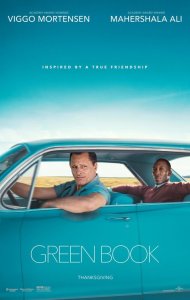 Green Book plays like a twenty-first century rendition of Driving Miss Daisy, a well-meaning and relatively gentle movie about race relations where a prejudiced white person comes about thanks to their firsthand friendship with an African-American male. It’s reportedly inspired by the true story of Tony Lip (Viggo Mortensen), a nightclub bouncer, driving around a famed pianist, Dr. Don Shirley (Mahershala Ali), as he performed throughout the South in 1962. The best part of the movie is the character interaction between this odd couple, and you’ll get plenty of it too. The actors burrow into their very distinctly conflicting characters, so it’s a natural pleasure to watch them eventually bond and learn from one another. This is the kind of racism that doesn’t make people feel too uncomfortable, and you could say that about the film as a whole. It’s a bit safe and has its intentions set on being a big, inclusive crowd-pleaser, and it plays like one. There are moments to make you laugh, moments to make you cheer, and moments to make you tear up. Morstensen and Ali are terrific together and find dignity and humanity in characters that could have easily become one-note stereotypes. The more we learn about Dr. Shirley the more interesting he becomes, a man used to feeling like an outsider no matter the company he keeps. Watching the two men grow and open up to one another can be heartwarming and deeply satisfying. Remarkably, the film is directed and co-written by one half of the Farrelly brothers, the pair responsible for ribald comedies like There’s Something About Mary and Dumb and Dumber. It’s an easy movie to fall for, with its winning formula and enjoyable actors, but there’s a little nagging concern I have that Green Book is too safe, too straight, and too pat in its life lessons. Despite its Best Picture win, it’s not like Driving Miss Daisy has any lasting cultural impression, and I wonder if maybe Green Book is destined for the same. Still, the acting and writing is enough to bring a smile to your face and remind one’s self about the power of kindness.
Nate’s Grade: B
Share this:

Creed II (2018)
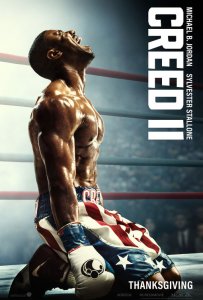 Technically the eighth movie in a franchise spanning five different decades, I think every ticket buyer knows exactly what they are getting with Creed II. It’s more of the same formula that’s been packing in audiences because it works. Once again Adonis Creed (Michael B. Jordan), son of the legendary Apollo Creed, climbs high, only to be brought low by a challenger, the son of Ivan Drago (Dolph Lundgren), the man who killed his father in the ring. Once more he finds himself with something to prove, a personal score to settle that blinds him as a fighter. I was able to predict every major plot beat from early on, and that’s beside the point. Creed II is at its peak performance when it offers small, well-developed character moments to go along with the training montages and boxing beat downs. Spending more time with the characters is where this movie elevates itself from the formula. There’s a potently dramatic subplot where Adonis’s wife, played by Tessa Thompson, worries that she may have past down her degenerative hearing loss their newborn child. There’s a wordless scene of looks that explains everything over the course of an auditory test, and it’s gut wrenching. I wasn’t expecting the film to humanize the villains as well. Ivan has been living in shame since his loss to Rocky (Sylvester Stallone), cast out by the elites of his society, and his own wife walked out on him and his son. They both see this opportunity as a way to prove something to the woman who abandoned them and the country that turned its back. It’s not just a scene either; the Russians (Ukrainians?) get the second biggest storyline of the movie. It made it so that I was genuinely having mixed emotions during the climactic bout, not wanting either side to really lose. That’s solid writing, movie. The performances are uniformly strong (even Lundgren!) and the emotions build and build until it crescendos. Creed II likely won’t be the last in the franchise, and even though I can predict the sequel already, as long as the filmmakers find room to meaningfully flesh out these enjoyable and winning characters, I’m game.
Nate’s Grade: B
Share this:

Border (2018)
 Border is a hard movie to describe without giving away key parts of its plot. Ostensibly this Swedish film is about Tina, a customs agent with a genetic deformity who can literally smell fear. She’s bedeviled by another man, Vore, who looks to have the same genetic deformity she has, which unleashes a flurry of gnawing questions over whether the two have some deeper connection, who might be her real family, and whether this genetic deformity is really what she’s been lead to believe. The movie is from the writer of Let the Right One In and takes a very macabre and understated look into a fairy tale realm bleeding into our own world. The movie is mostly grounded and benefits greatly from its lead actress, Eva Melander, who gives a rousing, nuanced performance under heavy prosthetic makeup. Tonally, it feels like the darker impulses, which can get extremely disturbing, are at odds with some of the other competing storylines, like her gradual self-awakening and the potential romance with Vore. Nothing will prepare you for how weird things will get including an awkward sex scene that defies belief. Border holds out a bit too long with its pertinent information, delaying the mystery without enough clues to tease things out in a satisfying manner. Afterwards, the remaining reveals reflect more on the cruel depths of Vore and less with Tina’s response. It makes an uncomfortable direction feel like it’s meant more as provocation. Ultimately I think I needed more from the story and characters to better meet out the aims of its genre-defying vision. It’s definitely a different movie and will register for those looking for dark, adult fairy tales.
Nate’s Grade: B-


 nathanzoebl
You must be logged in to post a comment.