Blog Archives
How to Train Your Dragon 3: The Hidden World (2019)
 How to train your expectations for the concluding chapter in the How to Train Your Dragon franchise: step one, lower them. I was dispirited to discover what a disappointing final chapter The Hidden World comes across, especially considering the previous movies, including the 2014 sequel, are good to great. At its core it’s always been a tale of prejudice and family, dressing up a simple boy-and-his-dog story with fantasy elements. It also presents a world with danger and cost; even the fist film ended with the main character, Hiccup, losing a freaking foot. He loses his father in the second film. It’s a series that has grown naturally with heart, imagination, and a real sense of stakes. This is why I’m sad to report that the third film feels like a different creative team made it. The villain is a repeat of the second film, a dragon hunter with little to be memorable over. The plot is very redundant, stuck in an endless loop of capture, escape, capture, escape, etc. The addition of the new lady dragon is a perfunctory means to drive a wedge between Hiccup and toothless, his dragon. The lady dragon has no personality and needs rescuing too often. Her inclusion relates to a rather regressive emphasis on the need for coupling and marriage. The titular Hidden World amounts to a grand total of five minutes of screen time. The action starts off well involving the various colorful side characters but misses out on that sense of danger that defined the other movies. It feels goofy and safe and listless. How to Train Your Dragon: The Hidden World is a sizeable disappointment and coasts on the emotional investment of the first two movies. You’ll feel something by the end, sure, but it’s because of the hard work of others and not this movie.
Nate’s Grade: C
Share this:

Alita: Battle Angel (2019)
 James Cameron has been dreaming about making Alita: Battle Angel for decades. He bought the rights to the 90s manga and has been sitting on the property, having to continuously push it back because of technological demands and the demands of, at last count, a thousand Avatar sequels. Cameron co-wrote the screenplay and handed the directorial duties over to Robert Rodriguez (Sin City), a talented visual stylist who has been struggling of late. The marriage looks good and the final 122-minute feature is the closest a live-action film has ever gotten into replicating the look and feel of an anime, for better and worse.
Hundreds of years after the fall of civilization, a lonely scrapper and doctor, Dr. Ido (Christoph Waltz) discovers the remains of a cyborg with a still beating heart. He puts her back together with a new body and names her Alita (Rosa Salazar). She’s special and learning about the big new world, trying to unlock her memories of the past, and we’re talking way way back into the past. She’s old technology, something that’s quite valuable for the street gangs that strip amputees for parts and for the global corporation whose emissary (Mahershala Ali) needs to reclaim the powerful tech. Alita falls in love, learns about her sense of humanity, and fights lots and lots of robotic villains.
This visual decadence of Battle Angel is the greatest reason to see it, especially on the big screen if able. The future setting is immediately visually engaging, with people walking around with mechanical limbs that look like they were literally cobbled together with whatever junk was lying around. There is a have/have not dichotomy between the huddled masses trying to eek out a living in a garbage city and the floating metropolis above that regularly dumps its trash onto the people below. It’s easy to see the influences of Battle Angel in other media, like Elysium, as well as its own cyberpunk influences, from the likes of Blade Runner to recycling the chief sport of Rollerball. The character design is to die for in this movie, with exceptionally assembled figures that stand out in memorable, dangerous, sometimes junky ways. There are a number of different robotic killers with colorful and unique weapons and personalities, and the larger world invites further scrutiny. There is a bustling post-apocalyptic life here and it’s plastered on a splashy, broad visual canvas with some spectacular special effects. Not all of the effects are at the highest level, from some compositing issues with faces to the big anime eyes (more on that later), but Battle Angel is an expensive movie that puts it all onscreen. The world is fun to watch and the action sequences feel ripped directly from the manga, with larger-than-life creatures fighting in vicious and frenetic ways. Even when the movie feels like it’s losing its momentum there’s always the visuals to enjoy.
 The central idea of this post-apocalyptic junk town being populated with deadly bounty hunters who work for a mysterious conspiracy is a great starting point. There is a bevy of killers with different allegiances and different codes, and then you throw in a powerful new addition who doesn’t remember her hidden past and you’ve got a recipe for drama and conflict with some crazy characters. There are even little dark touches that I would have thought would have been clipped in the adaptation process. Battle Angel has so much going for it that it can get a little frustrating when it feels like it’s spending so long to stay in the same place. The plot revelations are fairly predictable but still effective, but the long delays between them are filled with numerous action set pieces that diminish a sense of progression. I liked the Alita character and her relationship with her surrogate human father, but I didn’t think enough of any other relationship she had in the film. I wasn’t that invested in uncovering her past, which was still a bit too vague for me as a non-reader of the source material. At the end of the story, Rodriguez has set up his audience for a continuing saga of strife that feels too incomplete. Alita has learned more about herself (though I’m still confused) and has a goal of vengeance (against a force that is left too vague) and a renewed sense of purpose (built upon a relationship that doesn’t feel that affecting). It’s a curious end point and a questionable decision for a movie this expensive to assume it would secure demand for a presumptive sequel.
Where Battle Angel began losing me was because its title character, Alita, became too overpowered for her own good, eliminating a sense of stakes early on. The battle calculus skewed far too quickly. After the first act, actually from her first fight onward, there is never any doubt whether Alita will triumph. She doesn’t undergo any training or any real learning curve when it comes to her superhuman defense. Right from the get-go she’s doing amazing acts of fight choreography and making it all look easy. She even defeats an enemy when she’s only a one-armed torso. That’s admittedly impressive but another indicator that there is no real threat that can be posed against her. No matter how huge the cyborg, or how many pointy appendages at their disposal, it’s only a matter of time before our little pint-sized warrior is eventually triumphant. There is really only one fight where she’s presented with any slight disadvantage, the aforementioned one-armed torso sequence, but this too is shortly rectified. She goes from having a nigh-invincible body to an even more nigh-invincible body, making her, you guessed it, even more powerful. This reality takes something away from the numerous cyborg-on-cyborg battles, and without greater variance on the scene-to-scene needs, the fights become somewhat stale. Visually they are still impressive with a sense of fun watching the manga pages come to startling life, but without stakes and variance, it’s all the same punches with less power.
 Now Battle Angel isn’t the only story to deal with an overwhelmingly powerful protagonist (see: Neo, Superman, just about every character on Dragonball). The solution is usually a specifically applied weakness or, most often, the vulnerability of those closest to the hero. It’s the regular people that can be gotten to, that can be endangered, that approximate the “weakness” for the overpowered protagonist. However, for this to work, you need an emotional connection to the characters in order to feel their potential loss. This cannot work if the characters are stuck in archetypal mode and add little help. That’s the problem with Battle Angel; I didn’t really care about any of the other characters. They had points of interest, a tragic shared back-story, a dream to escape their earthbound poverty, some secrets they don’t want getting out, but it’s never enough to make them feel that much more refined than the secondary background players. The film doesn’t even go the route of really threatening the more vulnerable people in Alita’s life, which is a strange miscalculation. What we’re left with is a very kickass robot woman doing her thing and taking down the big bad cyborgs. It’s entertaining and there’s enough of an interest in bullies being beaten by the underdog, but Alita isn’t really the underdog and so the many action sequences become a tad tedious.
Salazar (The Maze Runner: The Death Cure) gives an expressive performance and enables her superhuman cyborg to find a semblance of her humanity. Because of the character design the degree of performance capture relies much on the micro expressions of Salazar, so if she overdoes it then Alita can lose that tenuous sense of reality. She finds a balance that makes her feel real, at least real enough to exist in this world. Waltz (Downsizing) is enjoyably paternal with a few dark secrets of his own. His rocket-powered pickax thingy falls under my category of something that’s futuristic but not exactly practical. This wouldn’t present much of a problem except his character is an expert at using the parts he can scrounge up to get the job done. Skrein (Deadpool) has found a real career for being sneering villains with oh-so punchable faces, and he succeeds yet again. Ali (Green Book) and Jennifer Connelly (Only the Brave) deliver enough with so little that you wish the screenplay asked more of them than the occasional in-shadows skulking. It’s interesting to look at this cast, which has four Oscars to their names (possibly another one for Ali), and an additional nominee with Jackie Earl Haley.
 Let’s talk about those eyes. The film is based upon a popular manga and anime and James Cameron was determined, from the earliest point, to recreate that stylized big-eyed look famous to Japanese art. It’s one thing on the page and another brought into real life, and the response has been all over the place. Some cite the uncanny valley and cringe while others argue it makes Alita more vulnerable, the eyes being the window to the soul and all. It does set her apart from the crowd, which is supposed to befit her character and where she came from, so to that end it works. It’s not as distracting as I feared and you do grow accustomed to them. However, was any of it necessary? Would we feel any different for Alita if she had more human-sized eyes? I doubt it. The costly effect of a very costly movie ($200 million reported) made me think of a similar quirk with the 2011 Green Lantern film where Ryan Reynolds’ suit was a CGI effect. Rather than simply wearing a costume the filmmakers spent millions applying one in post-production, and in the end what of value did it offer to the experience?
It’s hard for me to watch Alita: Battle Angel and understand why this was a property that James Cameron set aside for almost two decades. What about this makes it special or at least separates it from the pack of imitators? It’s a world with points of interest and characters that could be interesting, though many stop short at the design phase. The live-action version is entertaining and visually sumptuous, but I was finding myself grow tired of the film’s loose stakes, predictable plotting, simplistic themes, and archetypal characterization. The action can be pretty fun but even as Alita lines up more obstacles and more enemies we never feel threatened or concerned. Without a larger sense of danger and plot development the many fights start to grow monotonous. The special effects are wild but they service a story that seems ordinary genre. Alita: Battle Angel ought to please fans of the source material but it short-circuited for my attention.
Nate’s Grade: C+
Share this:

Happy Death Day 2U (2019)
 On one hand I can admire the “who gives a damn?” ethic behind the sequel to Happy Death Day, a fun time loop of slasher cinema tropes. The original had some darkly comic edges but mostly played its premise straight in the realm of horror. The sequel doesn’t play anything straight. It’s completely bonkers and looking to turn anything into a joke. This provides a charming carefree sense of bravado; however, if you were a fan of the first film, it also might rub you the wrong way and seem overly flippant and messy. We get a science fiction explanation involving parallel universes as to why the time loops are happening, and now our heroine Tree (Jessica Rothe) is stuck in a parallel version of her looped day. The film sidesteps a Back to the Future 2 sense of repetition but doesn’t stray too far from the outlines of the original Happy Death Day, just with a few new surprises. The big question is whether Tree will return to her home dimension or stay as a tourist in this new dimension, a world where her mother is still alive but her boyfriend is with somebody else. As should be obvious, this hard choice isn’t really that hard considering that she could always still get with the would-be boyfriend again. There are some comedic sequences that borderline on farcical sitcom, like a montage of suicide set to Paramore’s “Hard Times” and a woman faking being a bumbling blind student, and too many of the plot complications feel artificial and random, especially the delays to return to the home dimension. The world can often feel constrained as well, like this bustling campus only comprises the same eight faces (and their bushy eyebrows). My biggest gripe is that the first act is completely superfluous and it presented a more compelling mystery, a student from a future trying to kill their past self to avert a crisis. That’s way more interesting than another dopey killer in the baby mask. Still, the movie never pretends to be anything other than a fun couple of hours with sprightly visual comedy and a terrific anchor in Rothe, a comic stalwart. Happy Death Day 2U gets more ridiculous as it goes and I hope it just keeps digging further, never finding its bottom.
Nate’s Grade: B-
Share this:

Stan & Ollie (2018)
 This sweetly nostalgic film looks back at the friendly and fractious relationship between classic comedy partners Stan Laurel (Steve Coogan) and Oliver Hardy (John C. Reilly), the top comedy duo for decades. Flash forward to 1957 and they’re older and touring England to regain enough relevancy to scrap together a movie deal. It’s a delight to watch both actors just perform as the famous comedians and they cannily turn any opportunity into a recitation of a physical comedy bit. At its heart, the film is about the close relationship of the two men, what pushed them apart, and what brings them back together. It’s a very undemanding movie that is very nice, populated with nice people doing nice things for one another, bowled over by the sincere power of humor. Coogan and Reilly (in a very big fat suit) give honest performances rather than impressions. I never knew Laurel was so instrumental in developing their material, and he continued writing Laurel and Hardy material long after his partner died. The movie glides along on its good feelings and historical recreations, settling into a nostalgic sweet spot that isn’t too far into maudlin but interesting enough to justify the trip. If you’re a fan of Old Hollywood magic and Laurel and Hardy, then Stan & Ollie is a dream.
Nate’s Grade: B
Share this:

Glass (2019)
 M. Night Shyamalan has had a wildly fluctuating career, but after 2017’s killer hit Split he’s officially back on the upswing and the Shyamalan bandwagon is ready for more transplants. At the very end of Split it was revealed it had secretly existed in the same universe as Unbreakable, Shyamalan’s so-so 2000 movie about real-life superheroes. Fans of the original got excited and Shyamalan stated his next film was a direct sequel. Glass is the long-anticipated follow-up and many critics have met it with a chilly response. Shyamalan’s comeback is still cruising, and while Glass might not be as audacious and creepy clever as Split it’s still entertaining throughout its two-hour-plus run time.
It’s been 18 years since David Dunn (Bruce Willis) discovered his special abilities thanks to the brilliant but criminally insane Elijah Price (Samuel L. Jackson), a.k.a. “Mr. Glass.” David has been going on “walks” from his security day job to right wrongs as “The Overseer,” the rain slicker-wearing man who is incapable of being harmed (exception: water). He looks to stop David Wendell Crumb (James McAvoy), a.k.a. The Horde, a disturbed man inhabited by over dozens of personalities. David Dunn and Kevin are captured and placed in the same mental health facility as Elijah. The three are under the care of Dr. Ellie Staple (Sarah Paulson) who specializes in a specific form of mental illness with those who believe to be superheroes. She has only so many days to break through to these dangerous men or else more extreme and irrevocable measures might be taken.
 Shyamalan has a lot on his mind and spends much of the second half exploring the classical ideas of superheroes via Dr. Staple and her unorthodox therapy treatments. She’s trying to convince each man they are simply wounded individuals and not superior beings blessed with superior powers. Because the audience already knows the fantastic truth, I’m glad Shyamalan doesn’t belabor this angle and make the crux of the movie about her convincing them otherwise. The second act is something of a sleeping predator, much like the wheelchair-bound, brittle-bone Elijah Price. You’re waiting for the larger scheme to take shape and the snap of the surprise, and Shyamalan throws out plenty of red herrings to keep you guessing (I’ve never been more glad that convenient news footage of a new skyscraper opening meant absolutely nothing for the final act setting). Part of the enjoyment is watching the characters interact together and play off one another. The conversations are engaging and the actors are uniformly good, so even these “slow parts” are interesting to watch.
It’s fun to watch both Willis and Jackson to slip right into these old characters and conflicts, but it’s really McAvoy’s movie once more, to our immense benefit. Between a ho-hum character who has accepted his ho-hum city guardian role, and an intellectual elite playing possum, the narrative needs Kevin Wendell Crumb/The Horde to do its heavy lifting. McAvoy is phenomenal again and seamlessly transitions from one personality to another, aided by Dr. Staple’s magic personality-switching light machine. The command that McAvoy has and range he establishes for each character is impressive. He reserves different postures, different expressions, and different muscles for the different personas. I was genuinely surprised how significant Ana Taylor-Joy (Thoroughbreds) was as the returning character Casey, the heroine that escaped Kevin’s imprisonment in Split. She’s concerned for the well being of Kevin, the original personality who splintered into many as a means of protection from his mother’s horrifying abuse. I was worried the movie was setting her up to be a disciple of Kevin’s, looking to break him out having fallen under an extreme Stockholm syndrome. This is not the case. She actually has a character arc about healing that is important and the thing to save Kevin’s soul. There are in-Kevin personalities here with more character arcs than the other famous leads.
Shyamalan has been improving in his craft as a director with each movie, and stripping down to the basics for a contained thriller gave him a better feel for atmospherics and visual spacing with his frame. With Glass, the cinematography by Mike Gioulakis (It Follows, Us) smartly and elegantly uses color to help code the characters and the development of their psychological processes. The direction by Shyamalan feels a bit like he’s looking back for a sense of visual continuity from his long takes and pans from Unbreakable, which places greater importance on the performances and precise framing.
 I think the disappointment expressed in many of the mixed-to-negative critical reviews comes down to a departure in tone as well as the capitalization of being an Unbreakable sequel. Both of the previous movies in this trilogy were less action vehicles than psychological thrillers that emphasized darker human emotions and personal struggle. Shyamalan purposely grounded them, as much as one can, in a sense of vulnerable realism, which only made both of their endings stick out a little more. The movies weren’t about existing in a superhero universe but more so about unknown heroes and villains of comic-sized scale living amongst us every day. It was about the real world populated with super beings. Because of that tonal approach, Unbreakable was the epic tale of a security guard taking down one murderous home invader and surviving drowning. It was more the acceptance of the call, and part of that was getting an audience that had not been fed as much superhero mythos as today to also accept that secret reality hiding in plain sight. 18 years later, movie audiences have become highly accustomed to superheroes, their origins, and the tropes of the industry, so I was looking forward to Shyamalan’s stamp. I think our new cultural environment gave Shyamalan the room to expand, and Glass moves into a less realistic depiction of these elements. It’s not the gritty, understated, and more psychologically drawn dramas of his past. It’s more comfortable with larger, possibly sillier elements and shrugging along with them. There are moments where characters will just flat-out name the tropes happening on screen, with straight-laced exposition. It can lead to some chuckles. I think fans of the original might find a disconnect in tone between the three films, especially with this capper. They might ask themselves, “I waited 18 years for these characters to just become like other supers?”
And that refrain might be common as well, namely, “I waited 18 years for this?” While it’s inherently true that a filmmaker doesn’t owe fans anything beyond honest effort, an extended time between sequels does create the buildup of anticipation and the question of whether the final product was worth that excited expectation. Fans of Unbreakable might be somewhat disappointed by the fact that Glass feels like more of a sequel to Split. McAvoy is top-billed for a reason. Perhaps Shyamalan had more of a desire to foster the continuation from a recent hit than an 18-year-old movie. Whatever the rationale, David Dunn gets short shrift. After the opening segment, he’s being institutionalized but he’s not actively trying to escape. As a result, the attention focuses far more onto our two villains, and one of them doesn’t says a word until an hour into the movie. This further exacerbates the disproportionate emphasis on Kevin Wendell Crumb (and The Horde). As stated above, I think that’s where the emphasis should be because he has the most storytelling potential, and McAvoy is amazing. However, if you’ve been waiting 18 years for another face-off between Mr. Glass and the Unbreakable Man, then this might not seem like the special event you dreamt about. Shyamalan still has difficulty staging action sequences. The fights with David and The Beast are pretty lackluster and involve the same non-responsive choke hold moves. There are like half a dozen characters involved with the climactic showdown but half of them are bystanders waiting to be tapped in when the narrative needs them to console their fighter.
 I think the ending will also turn some people off for what it does and what it doesn’t do (I’ll avoid spoilers but will be speaking in vague terms this paragraph, so be warned, dear reader). The ending opens up a larger world that leaves you wanting more, even if it was only a passing scene acknowledging the resolution to the final actions. This holds true with an organization that you get only the smallest exposure to that adds to the deluge of questions seeking answers. It sets up a bigger picture with bigger possibilities that will ultimately be left unattended, especially if Shyamalan’s recent interviews are to be taken at face value. What Glass does not do is play with the implications of its ending and explore the newer developments. The ending we do get is indeed ballsy. I gasped. Shyamalan takes some big chances with the direction he chooses to take his story, and I can admire his vision and sense of closure. On the other end, I know that these same decisions will likely inflame the same contingent of disgruntled and disappointed fans.
Shyamalan’s third (and final?) film in his Unbreakable universe places the wider emphasis on the three main characters and their interactions. While McAvoy and Kevin get the light of the spotlight, there are strong moments with Elijah and David Dunn. There are some nifty twists and turns that do not feel cheap or easily telegraphed, which was also a Shyamalan staple of his past. It’s not nearly as good or unnerving as Split, the apex of the Shyamalanaissance, but it entertains by different means. If you were a fan of Unbreakable, you may like Glass, but if you were a fan of Split, I think you’ll be more likely to enjoy Glass. It might not have been worth 18 years but it’s worth two hours.
Nate’s Grade: B
Share this:

The House That Jack Built (2018)

I believe I’m ready to cast Lars von Trier in the same dustbin I’ve consigned Terrence Malick and Michael Heneke. I think I’m done with him and his films. The man has obvious talent but is often his own worst enemy, given to self-destructive impulses and excessive cruelty meant to be daring and challenging but is mostly perfunctory. The House That Jack Built is distasteful by design but also heavy-handed, obvious, and vacuous to a fault.
Jack (Matt Dillon) narrates his life as an American serial killer in the 1970s and 80s. He’s traveling through the afterlife with the help of Verge (Bruno Ganz), a supernatural guide and easy listener. Jack divides his murderous exploits into a series of five key incidents: Lady 1 (Uma Thurman) being picked up looking for car help; Lady 2 (Siobhan Fallen Hogan) as a suspicious neighbor answering the door; Lady 3 (Sofie Grabol) as a mother with kids who is taken hunting and then literally hunted; Simple (Riley Keough), the one who tried to get away; and finally the last scenario where Jack tried to kill multiple men with a single “full metal jacket” bullet. Along the way, Jack talks about the frustrations of his boyhood and adulthood, living with OCD, and the implications of his life’s legacy.

It’s not that a serial killer film, whether it be a psychological examination or gnarly genre thrill ride, can be without artistic merit, but von Trier settles for empty provocations. He’s using the nature of the movie serial killer to essentially terrorize the audience and make them question what entertainment value they ever saw in these kinds of figures and stories, or von Trier’s films at that. I was expecting an unsettling experience given the nature of the subject and the reputation of the filmmaker, but what made the situation all the more oppressive and disquieting is how obvious and heavy-handed everything comes across. The central metaphor could not be any more transparent for any person familiar with von Trier’s back catalogue of punishing feature films. Jack views himself as an artist, specifically an architect, and his art is via terrorizing women for personal satisfaction. In case you needed it further spelled out, Jack is von Trier, a filmmaker who makes movie after movie featuring a central heroine being abused and exploited with no cosmic justice. A von Trier film experience is all about unchecked suffering and systemic abuse from the patriarchy. Sometimes this can be a condemnation that elicits strong emotional responses like a Dancer in the Dark, and other times it feels like von Trier wallowing in flip nihilism, like the conclusion of his two-part Nymphomaniac opus that undid the preceding four hours. Jack kills women for his art; von Trier tortures women for his art. There you go. With that central metaphor established, you’d expect the movie to become an introspective and excoriating probe into von Trier as a notorious filmmaker who often shocks and appalls. Oh how wrong you would be. The House That Jack Built is the same stale slog only with a slight meta twist.
For no better example of how heavy-handed the movie is, simply observe its unnecessary framing device where Verge/Virgil is literally leading Jack in the dark toward the subterranean bowels of Hell and the two are digressing the long walk. My friend and filmmaker Jason Tostevin said he was watching The House That Jack Built with a “scrunched-up face” for its majority until the last thirty minutes when he accepted it as a morose comedy, and then it started playing better for him. That might just make sense, considering von Trier’s overwrought pitch-black sense of humor and overall belief that life is a joke. I did laugh out loud once Jack and Verge are floating in bubbles. It also provides some, not much, context to scenes like Thurman’s, where she keeps needling Jack about what a bad serial killer he would be based on his decisions. It’s almost like von Trier is trying to say that Jack took the psycho killer plunge because a bossy woman kept annoying him and pushed him into it. The early sequence of Jack stumbling into being invited into a woman’s home has a clumsiness that almost invites a degree of wicked comedy, especially after Jack tries to treat the woman who seems incapable of dying. There’s also the absurd conclusion of the “house” Jack actually finally constructs. However, even as a supposed “comedy,” The House That Jack Built is an obnoxious experience that will make you feel worse by the end of its painfully lugubrious 150-minutes.
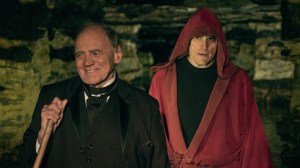
There was one kernel of an idea that could have worked, the nature of a serial killer with OCD. Those competing impulses would provide a level of new interest. During the second incident, Jack is compelled to go back to the crime scene again and again, risking being caught by a pesky neighbor or police officer, but he can’t help it. He’s obsessed that he didn’t check every last square inch and there’s an unseen blood droplet that will doom him. The concept isn’t new as Ray Bradbury had a short story “The Fruit at the Bottom of the Bowl” about a killer obsessed with eradicating every trace of his fingerprints. It puts the killer in a position of vulnerability that makes every killing more fraught. It’s almost like von Trier can suspect his audience enjoying this aspect of his story and so he must snuff it out. For whatever reason, Jack says he eventually just stopped caring. He just got over his crippling OCD tendencies through the power of criminal apathy. Jack is never in any danger of being caught because, and even Verge interjects on this, the people of this world are preposterously stupid. Nobody believes Jack is a potential murderer, and so this level of ignorance (and white male privilege) enables him to kill with impunity. By removing the possibility of any external threat, Jack becomes that much more boring. The only possible points of interest now become his disturbing murder tableaus. An extended sequence with Keough (Logan Lucky) made me feel queasy, especially when her character’s breasts end up getting severed and slapped onto an ignorant officer’s windshield. That moment felt like von Trier rubbing it in that a good-looking white man can get away with anything.
Even with its five-incident structure, plus celestial-spanning epilogue, the movie is all over the place. von Trier never met a Wikipedia article he didn’t like and want to awkwardly shoehorn into a longer narrative. Get ready for more seemingly unrelated academic asides meant to come across as philosophical pontification on the nature of art, evil, culpability, and whatever else sounded smart at the time. Jack compares his murder sprees to… medieval architecture. He then digresses about pianist Glen Gould, dessert wines and their decomposition process, the screaming WWII German airplane the Stuka, the theory of Ruin Value, the balance of light and shadow from two streetlamps, and you bet there are concentration camp anecdotes. At one point Jack and Verge are debating how one can best enjoy art and von Trier uses clips from his own movies as examples of “challenging art” in case you wondered whether or not he was going to be too hard on himself and his past. These quizzical asides often feel tacked on like academic footnotes, yet the film is stuffed full of them. It lurches from incident to incident and footnote to footnote, mostly because Jack is a rather boring lead character with a boring worldview and past. Then there’s the final epilogue that literally takes place in Hell. If you can make it past that, dear reader, you’ll be treated to a smash cut to the end credits set to, I kid you not, “Hit the Road Jack.” It’s a baffling, tonally discordant decision that only furthers the theory of Jack as a comedy.

I feel like I’ve endured enough von Trier films in my life at this point that I can walk away, content with the decision. It’s getting harder and harder for von Trier to tell a new story and his old tricks have grown tired, placing him into unintentional (or intentional?) self-parody. There isn’t enough introspection or insight or narrative complexities to justify this bloated and bedeviled look at one man’s many misdeeds. The characterization is slack and there are no significant supporting figures, only victims and stooges, and sometimes both at once in von Trier’s mocking reflection of our universe. I felt varying degrees of sympathy for every actor in this movie. They deserve better. Matt Dillon can play to the dark side well but he deserves more than to be a smiling cardboard cutout. Uma Thurman was one of the best actors in Nymphomaniac Part One. Doesn’t she deserve better than to get repeatedly smacked in the face with a broken car jack (get it, a “broken jack,” because the main guy’s name is… oh, you do get it?)? Riley Keough definitely deserves better than to have her breasts fondled for a solid minute onscreen and then used as a coin purse later. And the audience likewise deserves better than to spend 150 minutes watching misguided torment and misogyny disguised as introspection and social commentary. The House That Jack Built is rotten to its very foundations and another excuse in cheap sadism for the cheap seats.
Nate’s Grade: C-
Share this:

The Mule (2018)
 Clint Eastwood plays a real-life 90-year-old drug mule, though I must inform you dear reader that at no point does he hide his cargo in a very uncomfortable place. The Mule is an interesting story about the most unexpected mule. Eastwood plays a man broke and on the outs with the family he’s neglected their entire lives. He takes up an offer to simply drive albeit for a Mexican drug cartel. As with most life-of-crime movies, what starts off uneasily becomes second nature as our characters get in over their heads. Except that doesn’t really happen in The Mule. I would estimate twenty percent of the movie is watching Eastwood drive and sing along to the radio. There are some tense near misses where he’s almost caught, but these are confined to the first half. In the second half the cartel becomes the chief source of danger, all because he doesn’t go by their routes. If he’s their most successful mule, having never had a ticket in his life, then why micromanage? There are some other nitpicks that nagged at me, like the cartel knows the DEA agents (Bradley Cooper and Michael Pena) are pulling over a very specific color and kind of car, but at no point do they change out Eastwood’s car. Also, Eastwood is spending vast sums of money in public for a man who was losing his house, and yet no red flags there. Eventually Eastwood has to make a choice of family over angering the cartel and risking his life, and I think you’ll know where his character arc is destined. The dramatic shape of the movie feels a little too inert for the stakes involved, leading to an all too tidy conclusion. Eastwood delivers a fine performance, as does every other actor involved. The movie kind of coasts along, much like Eastwood in his truck, on the inherent interest of its premise and the star power of its lead/director. The Mule might have worked better as a documentary.
Nate’s Grade: B-
Share this:

Welcome to Marwen (2018)
 When I saw the trailer for Welcome to Marwen my first response was pained wincing. Robert Zemeckis is one of the most daring, inventive, and imaginative filmmakers working today, but this movie just looked misguided with its approach. Welcome to Marwen is so fascinating, so tonally off, that I might almost recommend people watch it.
Mark Hogancamp (Steve Carell) was a war illustrator until the day he was attacked by a gang of neo Nazis. In the ensuring months, Mark has lost portions of his memory, is unable to use his hands to illustrate any longer, and has become something of a shut-in. He has gained notoriety through his new artistic outlet. Mark has created a WWII era Belgian town called Marwen with a group of dolls fighting evil Nazis. We escape into fantasy sequences where Mark imagines himself as Cap’N Hogie and his gang of supportive ladies. Nicol (Leslie Mann) moves in next door to Mark and he takes an immediate interest in her (she even appears in Marwen in doll form). Mark must grapple with his feelings and work up the courage to attend the court hearing to make sure the men who hurt him stay in prison.
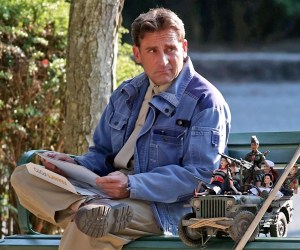 I was amazed at how miscalculated Welcome to Marwen plays out. It feels like Steve Carell’s Patch Adams, a sentimental movie where every step seems strange, mistaken, maudlin, and false. Firstly, this is the second documentary that Zemeckis has taken and adapted into a live-action film, as if the man is spending the wee hours of his nights pouring over award-winning documentaries of the past and determining which he can add a little razzle dazzle to with visual whimsy. Look out The Cove because maybe an undersea realm of talking dolphins will open up that horrifying Oscar-winner to a whole new mainstream audience. I’d have less of an issue with Zemeckis remaking the documentary if it didn’t seem like his entire rationale was the fantasy interludes.
The original documentary is about one man and his unique brand of healing through art. He is becoming further whole by building an intricate world through his imagination. By visualizing the fantasy worlds, Zemeckis is turning the doll segments into literal escapism that becomes tedious, obvious, and often redundant. The doll segments are about his gang of girls supporting him, expressing his interest in his kind new neighbor, and tackling the Nazis in a safe space where he can win. Every time we cut to the doll sequences it feels like the movie is spinning its wheels with these ill advised fantasy cut scenes. It gets boring watching the doll segments without any sense of stakes. The special effects are creepy and there are aspects that amplify this, like one doll’s penchant for having her top ripped off in combat, revealing her stout, rounded chest. Keep in mind that the female dolls, with the exception of one, are all analogues for people in his life, so then Mark is consistently indulging in stripping one woman of her clothes. Even though the movie sets this character up to be a potential love interest, it’s still not a good choice. Zemeckis intends to literalize Mark’s struggles and fears so that he can triumph over them, but it feels like it’s minimizing the complexity of trauma into digestible whimsy. With every trip to Marwen, I was eager to return back to the land of human beings where they might still be over-the-top but at least I wouldn’t have to watch creepy doll CGI.
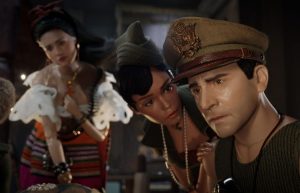 The most significant doll is the blue-haired Deja Thoris (Diane Kruger) who is meant to represent Mark’s suicidal impulses. He keeps her atop his wall so that she can watch over him, and in his sleep he dreams about her whispering in his ear, “Nobody will ever love you like I do. You should just end it now.” Oh man, that’s heavy, but when applied through the prism of a talking Barbie doll it loses its sense of seriousness. If you don’t lose yourself in the central conceit and take the dolls seriously, the movie will fall flat. Take for instance the cross-dressing aspect of Mark, which is what lead to his brutal beating. It’s a delicate subject and something easy to get muddled, and that’s exactly what happens in the presentation of this movie. The shoe fetish is initially portrayed as wacky and then becomes serious and then becomes like an artifact of horror. It’s another sign that the tone for this movie is mismatched. These things require a delicate touch with some ambiguity and sensitivity. Welcome to Marwen turns these into a loud, noisy cartoon that bumbles into its messages. Things that are meant to be charming or endearing or emotional can come across as goofy or campy or even uncomfortable.
I felt bad for so many of the actors. Carell (Vice) is trying to maintain his character’s sense of dignity throughout, but the story often goes into contrived contortions to force him into dramatic confrontations. It turns out the court appearance is rescheduled to be the same day of Mark’s photographic exhibit. Will he be able to triumph over these forces to stand up for himself? Carell is a capable dramatic actor but he’s struggling here to find stable footing because of the mish mashing tones. The development of Mark makes him come across as a creep in some moments, like his one-sided advances for Nicol, and a simpleton at other moments, where he might have sustained brain damage. Mann (Blockers) is sweet and gentle but strangely the movie hides her most interesting character aspects, like the prospect of a deceased child. You would think overcoming tragedy would be a tool for Nicol and Mark to bond. Merritt Wever (Godless) is another sweet and gentle woman in a world that seems overstocked with them. It feels like everyone in this small town exists just to be nice to Mark. She’s clearly romantically interested in Mark but he doesn’t care until the very end. She deserves better than being someone’s runner-up choice, especially only after he was turned down.
 A movie that deals with delicate issues through fantasy escapism can work, but it requires a precise hand with tone and with its storytelling detours. Guillermo del Toro has been able to prove he can tell rich, adult stories with the assistance of whimsical, weird fantasy elements. Charlie Kaufman has been able to weird the mundane and the fantastic. It can be done and Zemeckis has done it himself before, best evidenced by the masterpiece, Who Framed Roger Rabbit?. However, Welcome to Marwen is a sizeable tonal misfire. The serious elements don’t blend well with the fantasy elements, and even worse, they are made less serious and approach the realm of camp. The fun, fantasy elements are given bizarre and unsettling contexts that make them creepy and inappropriate. Escaping into Mark’s imagination winds up stripping him of much of his agency, and literalizing his psychological push-and-pull feels like a misguided examination on depression. I left my theater in a daze, trying to make sense of what I had just witnessed. The filmmakers and cast certainly mean well and want the film to be a triumph of the human spirit. I found it to be two meandering hours of watching somebody play with their disused toys.
Nate’s Grade: C-
Share this:

If Beale Street Could Talk (2018)
 Barry Jenkins’ follow-up from his Oscar-winning masterpiece Moonlight is an affecting adaptation of James Baldwin’s novel exploring a larger picture of the African-American experience through the life of one family under pressure. It’s a beautifully tender movie that aches with human feeling, tragic and joyous. We follow a young couple where Tish (Kiki Layne) is pregnant and Alonzo “Fonny” (Stephen James) is in jail for a crime he did not commit. Jenkins jumps around in time, providing mirrored juxtapositions that enliven the emotional outpouring of the scenes on screen, adding a sense of dread at the hardships we know await and a extra compassion for the good times while they last. Regina King is so outstanding as Tish’s mother, who goes out of her way to gather evidence to free Alonzo, that I wished she had more to do than her handful of big Oscar moments. There’s a racist cop that comes into the picture and is easily sidelined again. Many moments follow this lyrical, free-floating structure, zipping from one memory to another, which nicely presents a fuller picture with less. However, it also makes the film feel like it doesn’t fully come together by its very end and whether all of the assorted moments and insights are as helpful. It presents a case study of criminal justice reform and reminder that this family is only but one example. The intimate cinematography is gorgeous and the use of color is spellbinding. The music by Nicholas Britell is also highly involving without being overbearing. If Beale Street Could Talk might not have the awe-inspiring power and artistry of Moonlight, but it’s a moving, compassionate, and beautiful movie that confirms Jenkins as one of the greats.
Nate’s Grade: B+
Share this:

Vice (2018)
 If Oscar-winning funnyman Adam McKay can take the arcane, convoluted world of finance and spin it into one of the most entertaining, accessible, and enraging films of that year, then just imagine what he could do with the life of Dick Cheney?
We follow Dick Cheney (Christian Bale) from his early days as a college washout, to Washington intern to Donald Rumsfeld (Steve Carell), to youngest chief of staff in a White House administration, to Wyoming Congressman, and eventually Vice President to George W. Bush (Sam Rockwell) where Cheney redefined the VP role as a defacto second president. This is the story of his 60 years shaping the annuls of political power.
 If you have one reason to watch Vice, it’s the staggering performance by Bale (Hostiles). As is custom, the man completely transforms himself into his subject, gaining weight, building muscle in his neck to simulate the Cheney shoulder hunch, and going unrecognizable in startling older age makeup. He doesn’t just look the spitting image of Dick Cheney but he sounds like him too, exhibiting his cadences and mannerisms, and fully inhabiting the man every second he’s onscreen. It’s a compelling, captivating turn that ranks up there with Bale’s best. He’s beyond great but strangely nobody else is. Amy Adams (Arrival) plays Lynne Cheney, Dick’s wife and shrewd political partner, and her worst acting moment is her introductory scene where she lays into the young Cheney. It’s like an audition where the actor is hitting the wrong notes too strongly. Adams regains herself as the film carries on but never has a standout scene. Nobody else other than Bale is given the material to stand out. Rockwell (Three Billboards) and Carell (Beautiful Boy) are enjoyable and aided by impressive makeup, especially old Rumsfeld, but they’re given one note to play. Their roles become more impression than performance and both men drop out of the movie for long periods of time. The next best actor might by Tyler Perry (Gone Girl) as Colin Powell, and maybe that’s because Perry is used to brokering nonsense with his own array of nonsensical characters. He’s already the weary adult.
The meta interludes and fourth wall breaks that helped The Big Short succeed conversely are part of the problem with Vice. Most Americans know a decent amount about the Iraq War and its documented fallout, so there’s less need to have celebrities interject and explain complex scenarios and institutions (the absence of Margot Robbie in a bubble bath will always be felt). The narration by Jesse Plemons (Game Night) doesn’t feel necessary, and his ordinary identity becomes a guessing game for most of the film, trying to link him with Cheney. I was thinking he would be an Iraq War soldier and get killed later on, that way establishing a stand-in for the thousands of men and women who are no longer walking this Earth as a direct result of Cheney’s misguided action. Nope. When his identity is finally revealed you’ll go, “Oh,” and that’s it. Because he wasn’t really a character, he was a narrative device and one that didn’t stand for anything larger. The visual metaphors can also be very, very obvious. There are consistent cuts to Cheney fly-fishing in a river, meant to evoke him luring others into his desired machinations. Even the end credits feature fly-fishing imagery, in case you had forgotten about this enduring metaphor. The conclusion literally involves a heart being removed and the sequence cut along a more figurative betrayal, and you can feel McKay vigorously pointing at the screen and yelling, “See, it’s because he’s heartless, get it? Do you get it?” We get it. The documentary-style and comedic techniques that allowed The Big Short to be as entertaining and accessible, and one of the best films of 2015, are paradoxically the things that seem at odds with Vice.
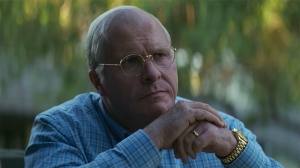 The meta breaks are meant to provide a degree of comedy to the picture, which is generally absent comedy otherwise, unless you count the rise of Cheney’s reign as the darkest of comedies. I suppose Cheney’s nonchalant recognition of his heart attacks (he’s had five) could be a potential comedic lifeline if you’re being generous. One second we’re told people don’t speak in Shakespearean soliloquies in real life, and the next second the Cheneys are talking in Shakespearean verse. When it looks like the Cheneys will drop out of public office to spare their gay daughter Mary (Alison Pill) the inevitable storm of harassment, the movie has a fake-out end credit sequence to sum up their hypothetical lives. To demonstrate Cheney’s knack for making the most ridiculous statement sound statesmen, he recommends that the Oval Office team put miniature beards on a part of their anatomy and perform an adult puppet show, which draws solemn nods of approval from the others. It’s a joke that feels too glib, like the intended point is being lost by the lewd nature of the comedic aside. The only meta aspect that feels earned is the final one, where Cheney turns to the camera and directly addresses the audience, acknowledging he can feel their contempt but refuses to apologize for his actions in order to keep people safe. Because he’s having the final say, because he’s offering a rebuff to his movie, it feels more earned and fitting, and it would have had even more power if it were the only break in the movie rather than the last. It’s hard to call this a comedy; it’s more an incredulous indictment looking for its mob.
I honestly think a straightforward biopic might have been the better route for Cheney. The first half of the film is more interesting and successful because it is the more illuminating half. I never knew that Lynne Cheney’s father likely killed her mother. That’s a pretty bold charge on behalf of the filmmakers. The early Cheney years are the moments the majority of Americans don’t know about, whereas the later years have been well documented by a slew of hard-hitting documentaries, books, and journalistic exposes. There are whole movies about topics like the Valerie Plame leaking (Fair Game), the mounting mistakes after the invasion of Iraq (No End in Sight), the administration’s policy on torture (Taxi to the Dark Side, Standard Operating Procedure), the drumbeat to the war and snuffing out of critical journalism (Shock and Awe, Lions for Lambs), the missing WMDs (Green Zone, Body of Lies), the Bush deferment memos (Truth), the long-term consequences for those servicemen who survive (The Hurt Locker, The Messenger, Stop-Loss, Last Flag Flying, In the Valley of Elah, American Sniper, Thank You For Your Service) and anything that Michael Moore sets his sights on. This list is not exhaustive by any means. Because of that the film seems to become a rudimentary montage once the Iraq War kicks off, sprinting through the rest as an intended tableau of hubris as Cheney’s star and influence falls. I would rather have learned more about Cheney’s early years in the Nixon, Ford, and H.W. Bush administrations and gleaned more personal insights into the man before he becomes this shadowy, mythic figure that seems downright Machiavellian in his control of government. It’s interesting to watch Cheney and his cohorts plot their unchecked executive power behind the back of President Bush, but then what?
 It’s the “then what?” question I keep revisiting with McKay’s film, trying to figure out the larger intended message, themes, and dire warnings. I feel like because of the expanse of time covered, and the meta quirks applied, that the film too often feels like it’s just scratching the surface of Cheney, providing a slight gloss to a political caricature. The biggest takeaway is the slippery slope of the “unitary executive theory,” a term you’ll hear often, that basically follows Nixon’s own words: “If the president does it, it’s not illegal.” This questionable interpretation of Article II of the Constitution gives the president powers that approach a monarch, which seems antithetical the Founders’ intents. McKay warns that any president could take advantage of this theory to do whatever he or she (sad trombone noise… sigh) desires. This is clearly meant to draw a line right to President Trump, but it’s not like the 45th president needs sketchy legal cover to do his misdeeds. The idea that the Justice Department memos would be a lurking danger is quaint. A bad man with power is not going to look for the rules to allow him or her to break them. The idea that a president could be above the law is also a legally specious argument and one I don’t believe our courts would readily back, even with the “unitary executive theory” (at least I hope so). With that in mind, Vice becomes a cautionary tale about the expenditure of power but lacks the adequate follow-through.
Vice is a tricky biopic for a tricky subject and I wonder if it would have worked better being stripped of its prankster, meta interjections and tricks. It’s a condemnation of Dick Cheney but it doesn’t feel like it goes far enough if McKay’s eventual thesis is that the current world problems began, or were grossly exacerbated, by the actions of Cheney. Climate change warnings going unheeded, ISIS formations going ignored, the generational consequences for unsettling the Middle East, and laying the foundation for an authoritarian strongman to be an acceptable political position for millions of Americans. These charges are clearly intended to be a denunciation of Cheney’s legacy, but the end results play out somewhat differently, like a slap on the wrist. I think Dick Cheney could even watch this movie and nod in appreciation. That seems like a mistake. McKay is still a talented writer and filmmaker that knows how to keep his movie flowing and entertaining, buoyed by an outstanding performance from Bale. It’s a movie with great components but seems to clumsily get in its own way with its presentation. If you’re going to expose Dick Cheney as a heinous manipulator of power that has wrecked havoc for billions, then maybe you don’t want to dilute your message.
Nate’s Grade: B-


 nathanzoebl
You must be logged in to post a comment.