Blog Archives
The Ballad of Buster Scruggs (2018)
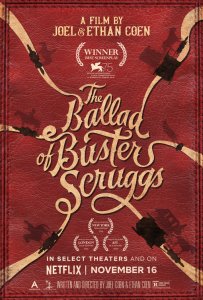 Netflix might just be the best pasture yet for brothers Joel and Ethan Coen. The Oscar-winning filmmakers were reportedly creating a Western series for the online streaming giant but that has turned into an anthology film, The Ballad of Buster Scruggs. The Coens’ love of the beautiful, the bizarre, the bucolic and the brazen are on full display with their six-part anthology movie that serves as reminder of what wonderfully unique cinematic voices they are. The Ballad of Buster Scruggs is uneven, as most anthology films tend to by design, but it reaches that vintage Coen sweet spot of absurdity and profundity.
The best segment is also the one that kicks things off, the titular adventures of Buster Scruggs, a singing Gene Autry-style cowboy who manages to get into all sorts of scrapes. The tonal balancing act on this one is pure Coen, at once inviting an audience to nostalgically recall the Westerns of old while kicking you in the teeth with dark, hilariously violent turns that veer into inspired slapstick. There is a delightful absurdity to the segment thanks to the cheerful sociopath nature of Buster Scruggs, the fastest gun in the West that’s eager to show off at a moment’s notice. He’s a typical Coen creation, a wicked wordsmith finding himself into heaps of trouble, but through his quick wits and sudden bursts of violence, he’s able to rouse an entire saloon full of witnesses to his murder into a swinging, carousing group following him in song. I laughed long and hard throughout much of this segment. I was hooked and wanted to see where it would go next and how depraved it might get. Tim Blake Nelson (O Bother Where Art Thou) is wonderful as Buster Scruggs and perfectly finds the exact wavelength needed for the Coen’s brand of funny and peculiar. He’s like a combo Daffy Duck and Bugs Bunny breaking the fourth wall to let the audience in on his merry bravado. The segment ends in a fitting fashion, another song that manages to be hilarious and strangely poignant at the same time. The Coens allow the scene to linger into a full-on duet of metaphysical proportions. I could have watched an entire series following Buster Scruggs but it may have been wise to cut things short and not to overstay its novelty.
 The other best segments take very different tonal destinations. “All Gold Canyon” is a slower and more leisurely segment, following Tom Waits as a prospector who systematically works the land in search of a hidden trove of gold he nicknames “Mr. Pocket.” The step-by-step process has a lyrical nature to it, and it reminded me of the opening of There Will Be Blood where we follow Daniel Plainview’s initial success at unearthing the beginning of his fortune. Waits is fantastic and truly deserving of Oscar consideration as the prospector. He’s hardscrabble and resilient, and there’s a late moment where he’s narrating a near escape from death where he’s tearfully thankful, possibly losing himself in the moment, and so grateful that it made me tear up myself. The segment ebbs and flows on the strength of the visual storytelling and Waits. It’s a lovely short with a few hidden punches, which is also another fine way to describe the other best segment, “The Gal Who Got Rattled.” It stars Zoe Kazan (The Big Sick) as a woman making her way to Oregon with a wagon train. She’s heading west for a new life, one she was not prepared for and only doing so at the urging of her pushy brother who dies shortly into the journey. Now she’s on her own and struggling to find her own place in the larger world. There’s a very sweet and hopeful romance between her and Billy Knapp (Bill Heck), one of the wagon train leaders who is thinking of settling down. It’s also a segment that slows down, accounting for the longest running time of the six. It goes to great care to establish the rhythms of life on the road, where many people walked the thousands of miles across the plains. The budding courtship is at a realistic simmer, something with more promise than heat. It’s such an involving story that its downturn of an ending almost feels criminal, albeit even if the tragic setups were well placed. Both of these segments take a break from the signature irony of the Coens and sincerely round out their characters and personal journeys and the dangers that await them.
 The remaining three segments aren’t bad by any stretch (I’d rate each from fine to mostly good) but they don’t get close to the entertainment and artistic majesty of the others. The second segment, “Near Algodones,” has some fun moments as James Franco is an inept bank robber who seems to go from bad situation to new bad situation, getting out through miraculous means until his luck runs out. The interaction with a kooky Stephen Root is a highlight but the segment feels more like a series of ideas than any sort of story. Even for an anthology movie, the segment feels too episodic for its own good. The third segment, “Meal Ticket,” is about a traveling sideshow in small dusty towns in the middle of winter. Liam Neeson plays the owner and the main act is a thespian (Henry Melling, best known as Dudley Dursely in the Harry Potter films) with no arms and no legs. The thespian character says nothing else but his prepared oratory. It makes him a bit harder to try and understand internally. I was also confused by their relationship. Are they father/son? Business partners? It’s also the most repetitious short, by nature, with the monologues and stops bleeding into one another, giving the impression of the thankless and hard life of a performer trying to eek out a living. It’s a bit too oblique. The final segment, “The Mortal Remains,” is like an Agatha Christie chamber play. We listen to five characters engage in a philosophical and contentious debate inside a speeding stagecoach that will not slow down. It’s an actors showcase with very specifically written characters, the Coens sharp ear for local color coming through. The conversation takes on a symbolism of passing over to judgment in the afterlife, or maybe it doesn’t and I’m trying to read more into things. You may start to tune out the incessant chatter as I did. It’s a perfunctory finish for the movie.
 Being a Coen brothers’ film, the technical merits are mesmerizing. The cinematography by Bruno Delbonnel (Amelie, Inside Llewyn Davis) is sumptuous and often stunning. The use of light and color is a gorgeous tapestry, and some of the visual arrangements could be copied into ready-made scenic postcards, in particular “Meal Ticket” and “All Gold Canyon.” The isolation, hostility, warmth, majesty of the setting is expertly communicated to the viewer. The production design and costuming are consummate as well. The musical score by longtime collaborator Carter Burwell is classic in its use of melancholy strings and motifs. It’s a glorious looking movie made with master craft care.
Before its release, the Coens had talked about how hard it was to make their kind of movies within the traditional studio system, even with their 30 years of hits and classics. Netflix is desperately hungry for prestige content, so it looks like a suitable match. I’d happily welcome more Coen brothers’ movies like The Ballad of Buster Scruggs, a goofy Western that’s equally heart wrenching as it is heart-warming, neither shying away from the cruelty and indifference of the harsh setting nor neglecting to take in its splendor. Just give them whatever money they need Netflix to keep these sort of movies a comin’.
Nate’s Grade: B+
Share this:

Fantastic Beasts: The Crimes of Grindelwald (2018)
 When they adjusted the Hobbit movies so there was going to be three instead of two, it required some very noticeable padding and filler material to meet out that requirement. The second Fantastic Beasts film (of a planned five film series, expanded from a trilogy) feels exactly that way, a mostly table-setting movie with more incidents than plot, a few pertinent revelations, and not much in the manner of resolution. The second Fantastic Beasts does improve on its predecessor in several regards. It introduces a formidable villain that’s well played by Johnny Depp. It introduces a compelling younger version of Albus Dumbledore that’s played by the dashing Jude Law. It also finds more purpose for its hero, the shy magical zookeeper Newt (Eddie Redmayne), as the series inches closer to a wizards-vs-wizards world war. Things take a turn for the darker; within the First Act, a baby is murdered. They didn’t even do that in the new Halloween. The larger world building of Beasts, written by author J.K. Rowling for the screen and directed by longtime stalwart David Yates, has been its biggest draw. The supporting characters are back, though not everyone has much to do. Rowling is improving as a screenwriter but she still has trouble executing exposition-heavy scenes, resorting to sequence after sequence of characters prattling on. Ultimately, it doesn’t feel like there’s much of consequence until the very end, so we endure characters running through underdeveloped and contrived storylines. One of these involves Katherine Waterston mistakenly believing Newt is engaged (his brother is) and somehow, despite having access to magic let alone other forms of media, never findings out the easy truth. It’s stuff like that that show me Rowling was struggling to find material for every character to push them forward on this now extended journey. Crimes of Gindelwald is an overall step in the right direction for the prequel series even if this individual movie has trouble standing on its own magical merits.
Nate’s Grade: B-
Share this:

Widows (2018)
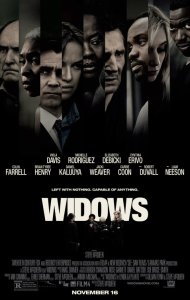 Widows has an all-star cast, an Oscar-nominated director, and a best-selling novelist-turned screenwriter, so my expectations might have been turned up a bit too high. It follows a team of titular widows (Viola Davis, Michelle Rodriguez, Elizabeth Dibecki) picking up the pieces in the wake of their husbands’ deaths. It seems their dearly departed spouses stole money from a local criminal who very much demands the sum returned. The women must enter into a criminal heist, using notes left behind by a dead hubby, to settle the debt and spare their lives. Widows is a higher caliber crime movie with notable texture given to a wide assortment of characters; even the villains are given small character touches to better flesh them out and feel more realized. There’s a concurrent election tying together different corrupt and criminal enterprises that widens the scope of the film into a grander scale. The characters and performances are the selling point of the movie and provide consistent entertainment. Davis (Fences) is the strong-willed linchpin of the group and I could watch her boss around people for hours. Dibecki (The Great Gatsby) has a nice turn as a trophy wife accustomed to being abused. The problem is that there might be too many characters. Rodriguez has far more significance in the first thirty minutes and then is put on ice. Likewise, Carrie Coon and Cynthia Erivo are hastily added when the plot requires something of them. That plot, adapted by Gillian Flynn (Gone Girl) and director Steve McQueen (12 Years a Slave), proves to be the film’s biggest hindrance by the end. The second half plot turns seem to come from a schlockier version of this story, not the classier version we had been treated to beforehand. There are character decisions that baffle credulity and personal safety. The quality of the characters deserved a movie that could refrain from the hacky genre twists. McQueen’s precise camerawork is still alive and well and highlights tension and also moments of social commentary, like when we watch a car travel mere blocks from a rundown inner city neighborhood to a fancy gated residence. There’s a lot to like with Widows, and plenty to get excited about, but I wanted to like even more.
Nate’s Grade: B
Share this:

The Girl in the Spider’s Web (2018)

The Girl with the Dragon Tattoo was an international best-selling trilogy that gave way to three hit Swedish movies, one Hollywood remake that netted a Best Actress nomination, and millions in worldwide revenue. The problem was that its author, Stieg Larsson, died of a heart attack in 2004, before the publication of any of the original novels. The property was too valuable to simply collect dust and thus a new author came aboard to tell further adventures of Lisbeth Salander, the pint-sized Gothic avenger. A new set of novels began being published in 2015, and after David Fincher’s 2011 version underperformed at the box-office, it seemed expected to reboot the franchise with a new big screen story that had yet to be adapted. In steps a new director, a new dragon-tattooed lady for The Girl in the Spider’s Web. Unfortunately, my fears have come true and the eventual reckoning has happened: they have made Lisbeth Salander boring.
Lisbeth (Claire Foy) is thrown into another criminal conspiracy with shadowy forces at play. A network of high-powered assassins, known as “spiders,” has stolen a dangerous technology that will allow the user control of nuclear arsenals. Lisbeth is hired to retrieve this tech, betrayed, and then on the run from Swedish authorities, professional killers, a dogged NSA operative (Laketih Stanfield), and the head of this cabal, Camilla Salander (Sylvia Hoeks, Blade Runner 2049), her long lost sister Lisbeth left behind years ago.
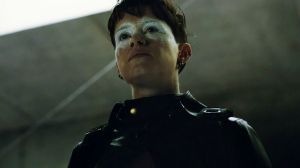
In her first 2010 outing, Salander was presented as a complex, emotionally withdrawn figure, eminently capable but flawed, hurt, and looking to punish others from her fraught history with terrible men. Strip away all the Gothic trinkets and camouflage, her assertions of identity, and she’s still a deeply intriguing human being. However, even the latter Swedish films started veering in this more derivative direction. As I wrote presciently with the second Swedish Dragon Tattoo movie back in 2010: “We project the interest we felt for her from the first film to the Salander stand-in represented in the second film. She’s still a resourceful, loyal, and cavalier presence, but the plot corners her into being a creature of action. She becomes the fantasy bisexual ass-kicking protagonist that was merely hinted at previously. That sounds like a good thing, but trust me, it does the audience a disservice to box in such a fascinating character.” With Spider’s Web, Lisbeth Salander has become a Gothic Jason Bourne spy figure, and as anyone who has seen the Bourne movies can attest, he’s the most boring character in his own movies, which is why he needs to be kept constantly on the move and hunted. He’s only interesting when he’s getting out of jams, and Lisbeth is now sadly in that realm.
Lisbeth has been reduced to her most essential, and most superficial, characteristics, which also go for the film as a whole. The Dragon Tattoo series began as a twisty investigative procedural with a litany of suspects and dark secrets worth killing over. From there, the Swedish films turned Lisbeth into an indestructible Terminator capable of getting the drop on anyone and axe-fighting oversized men. The Swedish series began more grounded as a mystery/thriller and suddenly, and regrettably, transformed into a preposterous Hollywood-style action-thriller, following the edict of bigger being better. That same mentality has carried over past Larsson’s contributions, and now Lisbeth has become an action superhero and the series has become trashy fun, high-calorie junk food, a safe excursion to a seedy underbelly. The Girl in the Spider’s Web still provides a consistent degree of entertainment, but it’s not playing at a higher level, content to hand-wave away its story for cool chases and fights. It’s the kind of movie where, to escape an encroaching fireball, Lisbeth dives into a bathtub of water. It makes for a visually interesting shot but it’s pretty cliché 90s action movie stuff. Director Fede Alvarez has a slick handle with visuals and evidenced real talent at sustaining and developing tension with 2016’s Don’t Breathe. He has obvious visual talent. There are some engaging fights, like a close-quarter struggle in a bathroom, and some nifty chase scenes, like a motorcycle chase over a frozen lake. I would have liked even more action if Spider’s Web was going to brush aside narrative and moral complexity for stylish set pieces.

The story of The Girl in the Spider’s Web feels like a lukewarm repackaging of spy clichés, and the film does little to make any of it feel important or relevant. There’s a super powerful technology that everyone wants, which falls into the wrong hands, and now it’s about retrieving this device and saving the world. That’s like the plot of just about every James Bond movie. It’s a formula, but where Spider’s Web missteps are that it doesn’t add anything else to this staid foundation. There are scenes but it’s usually about this group going after this group, or this group now going after this group, and without wider relevance it becomes redundant plot placeholders, something meant to distract long enough to get our characters from Point A to Point B. With a mystery, there’s a natural momentum that builds as the case builds coherency and the investigation focuses the direction. With action thriller mode, Spider’s Web just has a bunch of guys that occasionally interact until the movie needs some of them dead. This model by itself can work but it requires concerted effort, and that just isn’t present here.
The most interesting aspect of Spider’s Web is the further examination on Salander’s troubled upbringing, this time introducing a sister that has been plotting vengeance. Salander is, first and foremost, the selling point of this franchise; she is, after all, the titular girl with that particular tattoo. She is what separates this from any other paperback thriller. The Swedish sequels opened up her past traumas with her Soviet-defected father. He was the Big Bad Man behind the scenes trying to institutionalize and neutralize her. While skirting into the above-stated dangerous territory, the Swedish sequels still knew that Lisbeth Salander’s complicated history was the real mystery the audience craved, and it set up a series of antagonists ready to be foiled for years-in-the-making payback. I don’t really know how the events of Spider’s Web gibe with the overall series. I had to look up whether the evil father in the opening was the same evil father in the other films (both are listed as Alexander Zalachenko, so I think so). But the established history has Lisbeth committed after trying to set dear old dad on fire to save her abused mother. I don’t see how any of that is likely if she escapes her father’s clutches as a pre-teen and is supposedly on the run. The secret Salander sister revelation also impacts little. She was the one left behind, whose continued abuse and degradation are strongly referenced. It doesn’t feel like Lisbeth harbors great guilt over leaving her sister behind. During their final face-to-face, Camilla actually poses a worthy question: “Why did the woman who hurts men who hurt women never come back and save her own abused sister?” Because this storyline is flagrantly underdeveloped, the evil sister angle is a cheap twist. There’s nothing to the Camilla character, so she serves as a symbol of shame, and yet the movie doesn’t seem to capitalize on this in the slightest, which is a puzzling disservice.

Foy (Netflix’s The Crown, First Man) is having a big year for herself but feels slightly miscast. She never really gets an opportunity to show off her range, which is a byproduct of the streamlined, reductionist screenplay emphasizing bare plot mechanics. She is missing the intensity or fire that we’ve seen in prior Salanders, breakout-star Noomi Rapace and the Oscar-nominated Rooney Mara. When Foy tries for glower you see the effort. She’s more grumpy than tortured, like maybe she skipped a meal. Even with the requisite piercings, tattoos, and black leather wardrobe, Foy seems a bit too clean-cut for the part. Personal admission: Foy with her sharp bangs, saucer-eyes, facial shape, and Gothic accessories, looks remarkably like an ex-girlfriend of mine from the early 2000s. That was something that kept sneaking into my mind throughout the film, which made the experience a tad stranger as if I was imagining an ex engaged in action heroics. Even excusing that personal connection, Foy ranks a distant third place for the Girls With.
The new Dragon Tattoo movie will likely also be its last. I can’t imagine fans getting too much pleasure out of a streamlined, underdeveloped spy thriller that sands away the edge and complexity of its characters for rote action movie chases. It’s not a bad movie and it does carry moments of excitement and entertainment, but it’s also become a standard Hollywood thriller, no different than a dozen other high-tech, junky hacker thrillers. The Girl in the Spider’s Web gets caught in its own formulaic web. If Lisbeth Salander has been transformed into a standard action hero, then we don’t deserve more adventures.
Nate’s Grade: C
Share this:

Suspiria (2018)
 The idea of remaking Dario Argento’s horror classic Suspiria seems like movie heresy. How could any filmmaker attempt to come close to the Italian master’s original? Though that has not stopped Hollywood from remaking other horror classics of yore. Italian director Luca Guadagnino (Call Me By Your Name, A Bigger Splash) tempts the unwise with a new version of Suspiria, this time following the exploits of Susie (Dakota Johnson) in Cold War Germany as she is seduced by a private dance company lead by Madame Blanc (Tilda Swinton) that’s really a front for the occult. The new Suspiria is a worthy, splashy artistic endeavor but it suffers from too much airy meandering in the name of redundant atmosphere, vague and arbitrary plotting, and poor characters.
We’re told up front this is a story in six acts and a resolution but frankly the first two acts could have been completely eliminated. Their bearing on the overall story is minimal, but then I could say the same thing about much of the characters. Chloe Grace Moritz’s role could have been entirely cut. The majority of the story is strange things happening very slowly in the background of a dance school. The characters that do investigate aren’t our protagonists, which then traps us with people who know too much and won’t share, people who don’t know anything, and people who don’t want to know anything. It gets frustrating spending that much time with them, especially when the end destination (coven conspiracy sacrifice) is obvious even if you haven’t watched the 1977 original. I was told that Guadagnino edited an hour out of the final movie. How? What in the world was left out? It feels like everything they could have shot found its way into the finished film, whether it needed to be there or not. There’s an ongoing subplot about the Red Army Faction (a.k.a. Baader-Meinhof Gang) that we keep returning to as if there’s supposed to be larger relevancy. It’s a left-wing conspiracy that translated post-war anger into violence against the government. If I work really hard I can make a larger thematic connection to witches and women, but I won’t. With Suspiria 2018, it’s really just historical atmosphere that adds little but yet is returned to again and again. There is even a post-credit scene of a character doing something unclear while looking toward the camera. Why include any of that? It’s arbitrary and superfluous to the very end.
 The new Suspiria toggles through three tepid lead characters: 1) Johnson’s new dance recruit, 2) Swinton’s artistic director at the school, and 3) Swinton in old-age makeup as a grieving psychiatrist trying to make sense of his life (yes, “his,” as she plays a man). Two of these characters matter in strict plot terms and only one of them are granted some degree of characterization. Susie is essentially an empty vessel who is extremely passive, going along with whatever she’s told (there is a reason for this but it falls under the category of contrived dues ex machina). There are hints of the connection she has to some occult force at play, but we don’t really see any transformation on her part because she’s so opaque to start with. Madame Blanc is the most interesting character, somewhat by default, but she only becomes that in the last third of the film when her personal feelings for Susie make her doubt how far she’s willing to go to achieve the coven’s goal. It’s the only character with a direct internal conflict that seems to matter to the story. The old man has no reason to be in this movie. By the end, it feels like the film has found a significant story reason for his inclusion, one that will actually produce some thematic relevance for Swinton also playing this role, but nope. He serves no purpose other than exposition and to hammer home a tangential historical context of generational guilt. There is a nice character moment between two characters in the resolution but by then it’s too little too late. Even this nice moment doesn’t really need to happen. I think the reason the film toggles between these three characters is even it knows you will get bored with them.
When the horror hits, that’s when Suspiria is at its most rattling. Watching a woman’s body betray her, one excruciating limb convulsion after another, culminating in her own jaw seeming to rotate out of her head, is wince-inducing and terrifying. The sudden jolts of violence made me gasp and squirm every time. This culminates in a third act that is heavy on blood and lunacy, so much so that it feels like the finale to another movie. If the proceeding two hours was understated, atmospheric horror, the last thirty minutes feels like the splatterific Sam Raimi Evil Dead 2. There’s an explicit campiness that feels at odds with the self-serious meanderings of earlier. There are also moments that cannot be described as any other word than “goofy.” There’s an ongoing shot of characters being dispatched in a very exaggerated and theatrical manner, and the fact that we watch thirty of these in a row just invites some degree of laughter. I know I laughed. The final act and confrontation is my favorite part of the film, delivering some long-sought vengeance, but it feels like a different movie. It’s also where Guadagnino’s “put the camera anywhere” stylistic approach betrays him. It’s hard to tell what exactly is happening on a literal level, let alone understanding it, and that’s not even taking into account the muffled sound design of several characters when they hoarsely whisper aloud whatever.
 I would be more forgiving if the new Suspiria had not been as exasperatingly long, a full hour longer than the 1977 original. Long movies only feel long when they haven’t fully engaged you, and there are generally only so many ways to keep an audience’s sustained attention and investment. I understand wanting to allow a movie to breathe or wanting to create an uncertain atmosphere of intoxicating dread, but there has to be more than that. There’s also what I’ll affectionately coin the Nicolas Refn Trap, meaning where all of that breathing space ultimately exposes a lot of empty indulgences and vamping. Suspiria 2018 falls into this trap too often; there simply isn’t enough of anything to spread over those 150 minutes. The odd comparison I would make is to the notorious 1980 Western disaster, Heaven’s Gate, a movie I watched for the first time two years ago and actually appreciated. Let me be more specific: I appreciated the 100-minute very good movie somewhere inside there suffocated by the artistic excesses and peculiar and mercurial artistic demands from its uncompromising director (the man refused to shoot anything for ten hours until he got a cloud positioned exactly where he wanted). I’m convinced there’s a potentially great movie in Suspiria but it’s going to require a lot of excavation to allow it to see the outside.
I was interested in re-watching Argento’s 1977 original for the first time in years, and some things have aged better and some things have aged worse. Argento is a first-class visual stylist and his famous use of color makes the cinematography often beautifully horrific as young women are terrorized. There is even less plot than I remembered, a series of surreal murders finally leading to the obvious reveal of the dance company being a coven of witches. The characterization is even thinner than the thin 2018 film, which means that Guadagnino and company had a lot of room to roam when it came to their grandly grotesque remake. Argento’s film is a remarkable example of the immersive power of the screen, with his gorgeous use of light and color, production design, and a pulsating score that is perhaps a bit too omnipresent and anxious. There is one reoccurring musical sting that sounded precisely like the beginning of “Footloose” and it made me laugh every time, imagining Kevin Bacon dancing through the hallways. It’s a testament to the transcendent power of style when done by a first-rate stylist, and it works so far as to create a nightmarish, oppressive atmosphere. However, that eerie atmosphere and technical craft are about all the original Suspiria has to offer since there is a gnawing scarcity when it comes to characters, structure, and story. That makes the 2018 Suspiria a little more confounding. While it clearly works as an homage to Argento it’s also radically different, and yet it still manages to also have underwritten characters and bad storytelling choices even when it could have ditched the original’s original sins. At least Argento’s version is only 90 minutes and a lot easier to watch in one sitting.
 The Suspiria remake was clearly a labor of love and not a soulless paycheck for all those involved. The technical craft is accomplished, and even though it lacks the vibrant colors of Argento’s original the cinematography is still highly evocative and unsettling. Guadagnino has put a concerted effort into making his movie operatic, lavish, and radically different from the source material. I think it’s different yet reverent enough that fans of the original will find something to enjoy as the film asserts its own identity. And yet the moody atmosphere is undercut by the shortcomings of the characters and the contrived nature of the overly padded and meandering plot. The more I think back on the movie the more it falls apart under further scrutiny. Suspiria is a tonally confused movie that doesn’t have enough substantial material to fill out its gargantuan 150-minute running time. There will be blood but what there needed to be was a more judicious editor.
Nate’s Grade: C
Share this:

Bohemian Rhapsody (2018)
 Biopics are trickier than they appear because how best can you distill the essence, and significance, of a person into two hours? We’ve edged away from the standard cradle-to-grave biopics more in favor of stories that hinge on monumental moments in a person’s life, meant to encapsulate their life both in micro and macro. Bohemian Rhapsody favors the former approach, which causes the movie to feel like it’s rushing through the cornerstones of Queen singer Freddie Mercury’s life. Even at over two hours, the movie feels like it has little time for things, often jumping into polished, well-edited montages of time progression. The creative birth of many of the band’s hits are treated as absurdly easy formations, going from a clap of hands and stomp of feet to “We Will Rock you,” or a bass line to “Another One Bites the Dust.” It’s like the movie is checking boxes for a biopic with an anxious eye toward the clock. Mercury’s homosexuality (he comes out as bisexual to his long-time girlfriend who corrects him and calls him gay) is given its due, not having been underplayed in an effort to court a more mainstream audience. Mercury’s sense of sexuality, and the struggle of his own acceptance, is essential to getting to know this flamboyant front man. Except several of these scenes feel mishandled, which is odd considering director Bryan Singer (X-Men) has often found parallels in big studio films for the gay experience. The movie seems to say if his band mates had only accepted him more then maybe he wouldn’t have fallen into promiscuity by a bad influence and thus contracted HIV. There are also some pat answers as well like a disapproving father. However, the faults of Bohemian Rhapsody are compensated by its virtues, none more so than the electric performance by Rami Malek (TV’s Mr. Robot) as Mercury. The actor struts and preens with infectious charisma, and a mouth full of Mercury’s oversized choppers, and he miraculously captures the powerful stage magic of his character. The concluding 1985 Live Aid performance is astounding to witness and a reflection of just how essential and virtuosic Mercury and company were as live performers. It’s a sustained set of several hits and the movie just sings to a close on the highest of high notes. Bohemian Rhapsody is carried by the music and performance of Mercury the character and Malek the actor. It will make you want to rock out to Queen on the car ride home.
Nate’s Grade: B-
Share this:

Can You Ever Forgive Me? (2018)
 Melissa McCarthy adopts the Oscar bait route of pre-approved credibility, which usually means playing a tragic, self-destructive real-life figure, stripping away any sense of vanity, and working with an up-and-coming indie film director (Diary of a Teenage Girl‘s Marielle Heller). The recipe is alive and well in the consistently entertaining, but only for so far, Can You Ever Forgive Me? which traces the life of literary author Lee Israel, a biographer who nobody wants to read, that is, until she starts “discovering” lost letters from the likes of Noel Coward, Dorothy Parker, and other famous authors. In total, Israel forged 400 letters and sold them to private collectors and archivists until the FBI charged her with fraud. Because of the relatively low-stakes nature of her accidental jaunt into criminality, the “how” is less interesting than the budding friendship formed between Israel and a malcontent bawdy barfly/partner in crime (Richard E. Grant). Their rapport is wonderful and they truly seem to be having a ball with their ill-gotten gains, yet they still maintain a vulnerability even to the very end. In many ways this film does for McCarthy and her standard barrage of caustic, anti-social characters what Punch-Drunk Love did for the Adam Sandler introverted goofball sad-sack barely concealing his explosive rage. It’s a grounded deconstruction on that familiar movie archetype we’ve seen from a popular comic actor. There are some interesting aspects about Israel’s lonely life, like a timid female bookshop owner who circles around a potential romance with Israel, but it’s really a two-hander of a movie between Grant and McCarthy. Can You Ever Forgive Me? is a slight character-driven drama with comedic elements, but McCarthy shows that she has the acting chops to play multi-faceted characters in any genre if given the right opportunity.
Nate’s Grade: B
Share this:

Twisted Pair (2018)
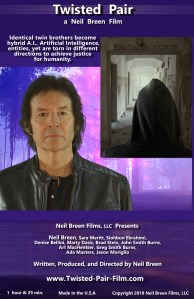 Neil Breen is the closest thing we have today to a living Ed Wood, a filmmaker so determined to tell his stories without a clue how to accomplish this feat, routinely finding new and astounding ways to transform the medium of film into an incomprehensible experience that can only be best appreciated through the howls of incredulous laughter. In 2013, Neil Breen came to attention among a certain select audience seeking the pleasures of a so-bad-it’s-good movie, and I count myself chief among this nation. I was fascinated by Fateful Findings and have since sought out Breen’s other films, using them as the main attraction for a gathering of like-minded friends and adult beverages. He may not be the next Tommy Wiseau or produce an accidental masterpiece like The Room (I don’t think an Oscar-nominee will be playing Breen in any biopic, though I pick Eric Roberts). Breen is taking advantage of the pocketbooks of eager midnight movie enthusiasts but he refuses to see his movies in that derisive light. To him, and God bless him, they are legitimate pieces of art and he personally disallows any marketing of them as “midnight” or “cult” movies (I saw portions of his actual contract he sent to our local art house theater playing his newest picture). His latest is Twisted Pair, a “psychological thriller” with double the onscreen Breen. It may not rise to the craptacular heights of Fateful Findings, but Twisted Pair is a worthy and hilarious entry in the ever-expanding yet mordantly redundant Neil Breen cinematic universe.
To explain the premise or story is almost superfluous, like trying to find a logical interpretation in a David Lynch movie or a Jackson Pollack splotchy painting. I’ll try. Cade and Cale Altaire (Breen) are twins who were… abducted by aliens… and given supernatural powers thanks to… A.I. technology? Back on Earth, Cade (or Cale?) has a wife (Sara Meritt) and plant bombs in the buildings of evil corporations, I think. Cale (or Cade?) is addicted to drugs (maybe?), has an addict girlfriend, and abducts corrupt CEOs, politicians, and authority figures and chains them in a murder dungeon where he lectures them and occasionally shoots them casually in the kneecap or shoulder. There’s also a conspiracy about trying to… do nefarious things with a cutting-edge A.I. virtual reality program… that shouldn’t fall into the wrong hands? Cade (or Cale?) must stop these evil forces from doing… evil things… by blowing them up? Also, his wife may be a spy.
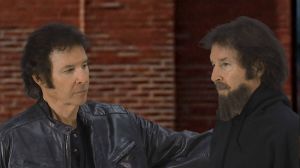 If the above sounds like pure insanity straight from the cuckoo source, then you have read it clearly. Twisted Pair doesn’t abide by any traditional standards of film or storytelling. There isn’t so much a plot with a beginning, middle, and end as there are a jumble of scenes that could have been placed in any order whatsoever and lost nothing. With Neil Breen as writer and director, we typically get a lot of visual repetition; whatever info can be imparted in one moment Breen decides to impart in five. On the other side, storylines and characters will be summarily dropped or introduced with little context. Take for instance the villain who, as best I can tell, speaks with a voice-modulated tone in real life. It’s not like he’s holding some mask to his mouth or anything that would alter his voice to that super deep register. Apparently he just speaks this way normally, and it’s hard to understand half of what he says, and it’s hilarious. Does this character matter in the scheme of things? Not really. He’s there to be another face to a vaguely defined conspiracy of forces that Breen is determined to thwart. The villainous character just happens to fondle dollar-store costume jewelry as a side bonus.
As another sign of repetition, Neil Breen obviously bought a package of special effects, and he is determined to get all his money’s worth. Thanks to the alien A.I. (I think), Cade and Cale are gifted with super powers but these only seem to involve jumping. Cade will form a Super Mario Bros.-esque jumping pose, or spread out onto the ground like Spider-Man, and then magically leap fifty feet in the air. It’s a cheesy effect that looked more realistic on the Six-Million Dollar Man in the 1970s, but Breen is going to make sure you become familiar with it again and again. Sometimes the jumping seems more trouble than it’s worth, as Breen’s character could have more easily taken a flight of stairs. A similar effects package must have been explosions, so you’ll see the same fiery effect over and over across a variety of surfaces, though never impacting those surfaces or leaving anything resembling debris. You may become more familiar with this oft-repeated explosion than the faces of your own relatives. There’s also a strange addition where whenever Cade touches a presumably locked door a little light goes on, as if to communicate he is unlocking it. This happens a lot. The last scene of the movie, Cade addresses the camera directly, touches his heart with two fingers that glow, and says without a hint of irony, “I’ll be right here.” He has to know he’s ripping off E.T., right? By the rules clearly established, does this mean he’s unlocking his own heart?
 The side storyline with the twin could have been cut entirely (not that there’s much that genuinely serves a larger story). I was expecting more interaction between the two Breens and for each to reflect some sort of dichotomy between good and evil. Nope. The second Breen, Cale, is a vengeful vigilante in a hooded sweatshirt and a gloriously fake beard. He shouts questions like, “Who am I? What am I?” but doesn’t seem that torn up. He kidnaps some corrupt officials and promises to hold them an undetermined period of time, occasionally shooting or beating them. Then the screen starts to have other images of other chained officials superimpose while an eerie soundtrack kicks in, seemingly implying the sheer numbers of Cale’s victims. At no point are we meant to see Cale as a wayward figure succumbed to his darker impulses. In fact, Cale and Cade aren’t that different at all; both of them destroy the apparatus of corruption and take human life. The prisoners have a hilarious moment that feels like an improv run amok as they try and top one another with all the bad things they have been committing. They almost run over each other in their carefree confessions of moral decay. Yet these missing people, presumably important enough to attract the attention of the police and investigators, never impact the larger plot. You would think only naturally that an identical twin kidnapping people would have some direct mistaken identity complications. Either the bad guys come after Cade or the authorities do, thinking he’s the other brother. Nope. Strangely, the brothers only interact in dreams and brief flashbacks.
There’s a distinct reason that Neil Breen’s onscreen characters are always lionized as heroes. It’s filmmaking as therapy session, and as I wrote for my Fateful Findings review: “Assessing the film, it sure comes across like Breen’s attempt to bolster his sense of self. In every scenario, people treat him as a treasured human being, he’s at the center of a diabolical conspiracy, he’s gifted with magic powers that separate him from normal men, all women want to seduce him, and then in the end he’s the one who makes the world a better place by exposing corruption. It sounds like a hero complex to me. Even acts that deserve harsh scrutiny, like his enabling of his wife’s addiction or his blasé attitude about carrying on an affair, are ignored. In this universe, [Breen] is always right, always desired, always respected, and always special.” This may be why even his “twisted pair” is spared any sort of scrutiny for their own bad behavior.
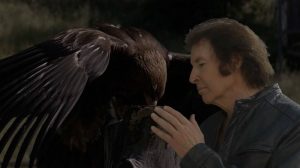 There are numerous sequences that just make you shake your head. My favorites include an interlude with a slow-motion hawk that Breen nuzzles up next to. Seriously, there is a lot of green screen work throughout the film including a Wiseau-style fixation on things that shouldn’t need green screen. Why green screen the exterior of a building? Could Neil Breen not find one building exterior in all of his home state of Nevada? There’s a sequence where a woman materializes and literally turns on another Neil Breen movie, firmly establishing the connected universe theory. This same woman leads a man inside a literally red-lit abode (more on lighting below) and you suspect someone will be killed, either the woman or the mysterious john you never see above the neck. Nothing comes of it. Occasionally we’ll get a wide shot and watch Cade or Cale walking… for thirty seconds, and sometimes a tree will obstruct our view and we’ll wait for him to appear on the other side of the tree…. but instead he’ll be in the tree! Aha, you weren’t suspecting that, were you, complacent audience member? I would estimate a solid 80 percent of the movie’s dialogue is Breen’s voice over stating the obvious or the preposterous. In consecutive lines of voice over he says, “I miss my brother,” and, “I miss what I never knew.” But you knew your brother; we’ve seen footage of you two together.
The relationship with Cade’s wife is baffling. It begins with Cade running into a woman and profusely apologizing and declaring he will make it up with dinner. She is not interested in the slightest but he doesn’t acknowledge her discomfort at all and persists. He then FOLLOWS her home. He then BREAKS INTO her home. He then ATTACKS her and ostensibly tries to rape her while calling her a “bitch.” This awkward moment then transitions into the eventual revelation that it was all one big role-play. What? Neil Breen purposely staged his character attempting rape and made it into a sex game for he and his ever-accommodating wife? That’s so weird and off-putting. I don’t think Neil Breen is the kind of artist to attempt something approaching Elle.
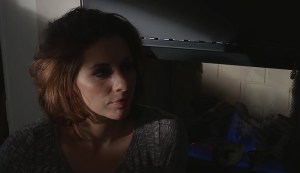 The technical specs are spotty, especially the lighting. There seems to be two prevalent styles of lighting a scene: 1) overblown to hell, casting harsh shadows, and 2) with a small diagonal sliver. This sliver approach happens in numerous scenes and always seems to find the faces of the actors in the scene, or Breen or whoever will use it as a mark, walking into that small sliver of light and exposing their face. It happened so often that my rowdy theatrical audience turned it into a game, loudly cheering whenever a character “met their mark” and was highlighted by that available strand of light. I think this is what Breen thinks makes a professional looking movie or a film noir.
The acting hasn’t gotten any better over time. As I wrote about Breen’s performance in Fateful Findings: “Let’s start with Breen himself, who is fairly listless and deadpan throughout. He raises his voice but rarely does he change how he’s responding. He’s aloof and strikingly self-serious at the same time.” Since there are two Breens, consider this observation even more fitting. The rest of the actors don’t have much to work with. There isn’t a natural performance in the film. Often the delivery is stilted or overemphasized, pausing at weird points or simply raising the volume for effect. At least with previous Breen outings there was another actor or two to single out, usually not in a positive way mind you. With Twisted Pair, it’s all Breen, all the time, for better or worse.
 So ultimately where does Twisted Pair fall on the curve of so-bad-it’s-good cinema? It is a hoot, a misguided and poorly executed sci-fi thriller with baffling and repetitious plot turns, characterization, and puzzling decisions at nearly every level of filmmaking. Having digested five Breen movies (and lived to tell the tale) I can attest that there are patterns that emerge in each one of his films. He’s always going to be portrayed as a crusading hero against the corrupt forces out there bewildering the little guy, he’ll have a dash of supernatural elements that will never be adequately explained, his idea of romance is comically chaste and usually involves women face down and topless, and he’ll gift the audience with head-smacking redundancy of scenes, motifs, messages. If you have to skip out to the bathroom at any point, whatever you miss will be covered again. Twisted Pair is mid-range Breen, not quite as high as his crowning achievement, Fateful Findings. It runs out of steam in the final fifteen minutes and even my rowdy midnight-movie crowd sensed the drop-off. The movie is playing one-night-only screenings across the country. If you get a chance, and love the weird world of sincerely made bad movies, then I highly recommend gathering a group of friends and checking out Twisted Pair and doing your best to make sense of it during and after the film.
Nate’s Grade: F
Entertainment Value: A-
Share this:

Bad Times at the El Royale (2018)
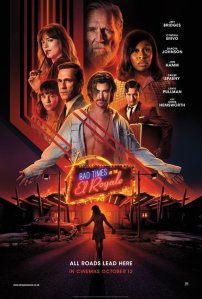 It is no disservice when I say that Bad Times at the El Royale joins the ranks of the finest of Tarantino imitators. It’s packed with twists and turns that keep an audience glued to the screen and continually re-evaluating the characters that we thought we knew. Because of that dynamic the movie invites the audience into becoming more involved, dissecting the information available and waiting for the next clue or plot revelation. It turns watching the film into a game and makes the experience that much more active and thrilling.
In the summer of 1969, the El Royale hotel is in for one hell of a night. The old fashioned hotel sits on the border between Nevada and California, allowing its dwindling customer base the opportunity to choose which state they would like to stay in. A group of strangers cozy up for the night including a priest (Jeff Bridges), a chatty vacuum salesman (Jon Hamm), a hopeful lounge singer (Cynthia Erivo), a skittish bellhop (Lewis Pullman), and a mysterious woman (Dakota Johnson) who happens to have a hostage in her trunk. As the night progresses and the characters uncover one another’s secrets, sometimes with deadly results, menacing cult leader Billy Lee (Chris Hemsworth) comes swaggering to the El Royale to reclaim by force what he feels is rightfully his.
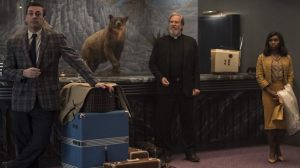 There are Act One twists and reveals in El Royale that would have been the Act Threes of other movies. Writer/director Drew Goddard (Cabin in the Woods, The Martian) has packed his movie full of sinister intrigue as he establishes the hotel, the main characters, and an immediate impression of each in the first 15 minutes. From there, the movie is divided into chapter titles (another Tarantino motif) where we follow different room inhabitants who get 20-minute-vignette spotlights. Once in private, the characters shed their false faces and begin to reveal who they really are, or who we think they might really be, and the movie starts to resemble Tarantino’s own hidden identity parlor game, 2015’s Hateful Eight. The vignettes begin to overlap, ending on cliffhangers and then circling back with a new character as our focal point, re-watching prior scenes but from a different perspective. Goddard’s script is wonderfully clever, layering in questions and answers and a constant desire to upend audience expectations. Even though some segments will repeat, Goddard doesn’t waste time on redundancy. A character will be seen prying loose floorboards searching for something desirable, and we never have to relive the before or after of this moment from that character’s perspective because we’ve been imparted the necessary info and can put the pieces together with the next jump. I appreciated Goddard’s faith in the intelligence of his audience. The pleasure of El Royale is watching it deftly unfold as a fun, funny, startling, appealing mystery.
The characters must also be worthy of our attention, and Goddard does fine work teasing out his colorful cast of criminals and lost souls and deepening most. Everyone has something to hide at the El Royale, and finding out his or her true intentions and motivations is part of the film’s fun. I won’t spoil any of the big surprises or which characters are really putting on a show. Despite all the many plot machinations intertwined, Goddard still finds time for his film to breathe and let the characters talk, opening themselves to one another, sometimes with the assistance of dramatic irony. Jeff Bridges and Cynthia Erivo play the best characters and deliver the best performances. Both of them are haunted by pasts they don’t feel like sharing, both are under some element of disguise to embark on finding their happy ending, and both form a sort of bond throughout the film as kindred spirits, even if they can’t fully trust one another. Bridges has the most complicated back-story but it actually links with a very real and emotional condition: memory loss. His character is (legitimately) going through early dementia and he’s losing full control of his sense of self, occasionally blanking and forgetting who he even is and how he got where he did. For a character pretending to be someone else, there’s a cruel irony to this malady. The seven main characters aren’t all on the same level (some are more plot devices than people) but Goddard knows this, making sure his 142-minute movie spends the most time with the best of them.
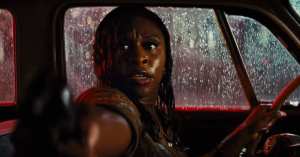 The actors given the best characters are also the ones that deliver the best performances, if you can imagine that. Bridges (Hell or High Water) brings a strong sense of pathos to his memory-addled priest trying to assess his life and his choices. He seems genuine in every moment, which is a feat considering his character has his share of secrets like anyone else. Erivo is a Broadway star making her film debut here, and she steals the show with her bruised sense of optimism. She’s the heart of the movie and a proven survivor, especially from a rigged system that protects predatory men. She brings a quiet power to her character as well as a believable vulnerability that makes you care. Hemsworth (Avengers: Infinity War) is all shaggy, scraggly charm as a cult leader who gets off pitting his followers, and captives, against one another. Really he likes to listen to himself speak, and Hemsworth is having a grand ole time with the part. Another actor exhibiting clear joy is Hamm (Baby Driver) who is, if you’ll pardon the pun, hamming it up with great gusto. He does a far majority of the talking for the first twenty minutes. He’s practically bouncing all over the place as an unchecked extrovert, but when alone, Hamm demonstrates an additional layer to his outlandish character. Another strong impression is from Pullman (Strangers: Prey at Night) as the lone employee eager to find absolution for his part in the El Royale’s history of sin as well as his own personal demons. The weakest of the ensemble ends up being Johnson (Fifty Shades Freed) who gets lost in her femme fatale archetype and can’t seem to find her way out again.
This is only Goddard’s second directing feature and his best directing aspect is that he knows when to linger on the written page. There are several segments that dwell in a certain emotion, elevated by Goddard’s tracking shots to continue the predicated unease. There’s one early moment where the bowels of the El Royale are revealed as hidden viewing areas to secretly record the guests doing their seemingly private illicit good times. The lead character of this vignette walks along the corridor, studying other characters and slowly realizing the implications of what he or she is finding. The scene is given a beautiful and eerie soundtrack thanks to Darlene practicing her singing, belting out “This Old Heart of Mine” like her life depended upon it, the tune taking on a sinister edge as it echoes through the dark hallway along with the tick-tock of the metronome. There’s another terrific singing suspense segment in this very same location, except with a different character spying on Darlene as she and another character work in conjunction to coordinate their movements, timing striking sounds in the room to her claps. Goddard has an adequate eye for visuals but he benefits from the gorgeously conceived and constructed El Royale setting, allowing the quirks of the rundown hotel to serve as another character to his ensemble. I enjoyed little touches, like only the Nevada side having a liquor license and the bright red line that runs down the middle of everything.
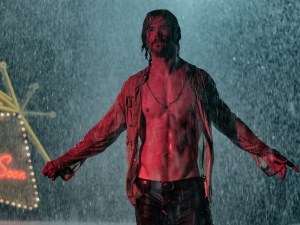 And yet there are some lingering doubts that halt me from a full-throated endorsement of El Royale, and I’ve been trying to articulate them better in the days since I watched the film. It frankly doesn’t fully come together by the end in a way that feels suitably climactic. Once Billy Lee enters the third act, the movie stabilizes and we spend time with the remaining characters assembled together to be terrorized by the cult leader. After seeing everyone else’s story in smaller vignettes with some slippery non-linear perspectives, we’ve finally come to our big confrontation and summit with everyone. Except it doesn’t feel as big as the movies needs it to be. Characters will be dispatched swiftly, and instead of it feeling shocking it feels abrupt and contrived, devaluing the character arcs that had been shuffling forward to that point. The deaths feel too ho-hum, and the final confrontation and melee too chaotic and random. The sacrifices feel wasted and sloppy rather than the payoff from some long established setup. It’s here where Goddard cannot hide his narrative trickery anymore and the machinations are exposed. I couldn’t help but feel that the final act was slowly losing the momentum and excitement that had been built carefully over the course of two hours. Billy Lee isn’t quite the force that his whispered presence has been made out to be, no fault to Hemsworth, who impresses me more and more with every new performance. It’s like by the end of his movie Goddard has realized that certain characters were inevitably just more interesting than others and he saves room for them to get a climax and brushes off the rest. Thematically I don’t quite know if it comes together with any sort of final statement about the 1960s, the dichotomy of good and evil, or anything else. It’s a final act that left me a little disappointed and realizing the end wasn’t nearly as fun as the journey.
Bad Times at the El Royale is a movie jam-packed with twists, plot turns, and colorful characters played by great actors who are clearly enjoying themselves, given the room to roam and stretch their muscles as exaggerated and dangerous criminal cohorts. Goddard’s film is impeccably structured up until its final act where it feels like the answers and confrontations cannot match the mysteries and setup that had been laid before. If you’re a fan of the top level of Tarantino imitators, like Things to Do In Denver When You’re Dead or Lucky Number Slevin, or enjoy unpacking a good mystery, then check into the El Royale, a hotel where maybe the cockroaches have the best chance at survival.
Nate’s Grade: B+
Share this:

First Man (2018)
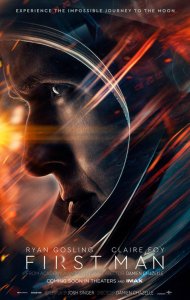 Oscar-winning filmmaker Damien Chazelle got to be the director of a Best Picture winner for approximately three minutes, which, to be fair, is more than most us will ever experience. La La Land won the top prize at the 2017 Oscars only to have it taken away and given to the smaller indie, Moonlight. Where an Academy of old white people that love to celebrate Old Hollywood decide to award a small million-dollar movie about growing up gay and black in the 80s, where does one go next? For Chazelle, it seems the answer is something even more irresistible to the Academy. First Man is partly a biopic on Neil Armstrong and partly a recreation of the 1960s Space Race. The finished movie is so mercurial, so insulated, so dry that I found a far majority of it be kind of boring.
Neil Armstrong (Ryan Gosling) is one of the select pilots training for space. NASA is racing to beat the Russians to the moon, and every new breakthrough is thanks to long hours of hard work. Janet Armstrong (Claire Foy) worries at home, listening to every radio broadcast and wondering if her husband will come back safely.
What First Man does best is make you realize how dangerous every step of the way was to get to the moon. Every leap forward required months of trial-and-error, and sometimes those mistakes cost lives, like the crew of the Apollo 1. The film opens on Armstrong flying above the atmosphere. The emerging curvature of the Earth is beautiful, but the beauty turns to horror quickly as it appears Armstrong’s plane is bouncing off the atmosphere and drifting into orbit. There’s another sequence where he and Buzz Aldrin (Corey Stoll) are above the Earth and planning to dock in space and their capsule spins wildly and if they can’t fix it they’ll black and out and assuredly die. These moments remind the audience about the inherent dangers of the Space Race that we don’t necessarily get in the history books. Looking back, we know the American astronauts succeed in the ultimate mission of landing a man, or an eventual dozen, on the moon, but that foreknowledge produces a false sense of security. Chazelle’s movie reminds us of the enormity of this challenge and the enormity of the dangers. The sound design in this movie is terrific, and Chazelle makes sure you hear every ping, every metal-on-metal scrape, to the point that you fear the whole thing could fall apart at any moment. When Janet furiously dresses down the Mission Control head (Kyle Chandler) that tries to calm her concerns, she accuses them of being boys who think they know what they’re doing. Even after the triumph of the final act, we know what happens two missions later (Apollo 13) to reconfirm just how much we still haven’t perfected when it comes to space travel.
 Besides reminding you of the precarious nature of early space travel, let alone the tests leading up to said travel, First Man doesn’t find much to justify its own existence other than as the latest in Oscar bait. It’s not exactly an in-depth look at the heroism and chutzpah of the Space Race like The Right Stuff, and it’s not exactly an examination on the frailty of man and the meticulous problem solving needed to achieve big goals, like Apollo 13. In fact, while watching this movie I would repeatedly think to myself, “Man, I should go home and watch Apollo 13 again.” When you keep thinking about watching a better movie, you have lost your audience, and that happens throughout First Man. There are thrilling, awestruck sequences to be sure, but that only accounts for perhaps a quarter of the lengthy 140-minute running time. The rest is spent at a distance trying to understand a man who comes across as largely impassive. He’s intensely focused but it’s like the movie adopts his very no-frills attitude, and it goes about its business with little thought for letting an audience into its inner world. We’re still only visitors at best here.
I admittedly don’t know much about Armstrong the man, so I can’t tell if the role was shaped for Gosling’s talents or he just matched perfectly with the man. Armstrong feels like one of the Nicolas Winding Refn roles (Drive) that we’re used to watching Gosling portray. Armstrong feels like somebody ported over a guarded, reserved, mostly silent Refn character into a staid biopic and asked Gosling to communicate a majority of emotion through unblinking stare downs. If there’s one actor you don’t want to challenge to a staring contest, it’s Gosling. Armstrong comes across a very internal man who seems uncomfortable in the spotlight, far less natural than Buzz Aldrin, who the movie unexpectedly positions as kind of a saying-what-we’re-all-thinking jerk. Because Chazelle has decided to keep Armstrong so guarded, it makes the film feel distant, like we’re being told the story second-hand, and that requires Chazelle to fill in the gaps as to the internal motivations and insights for an intensely private man. The answers we’re given seem almost cliché (the death of his young daughter is what drove him into his work, to escape the bounds of his Earthly grief, and to finally say goodbye to her). It’s too convenient as a simple character arc to be fully believed, but that’s all we have to work with because the movie won’t give us much more. It feels more like you are getting the idea of Neil Armstrong the Man rather than a realization. It’s a frustrating experience, watching a biopic and having the filmmakers keep their prized figure behind glass.
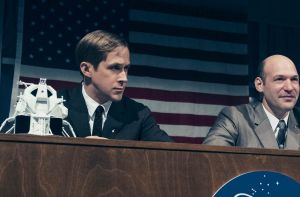 As a director, Chazelle is proving to be a remarkably skilled chameleon. First Man is completely different in style and approach to La La Land as it is to Whiplash (still his finest). His chosen approach for First Man is locking to Armstrong’s perspective, so we’re working with a lot of handheld camerawork that orbits our movie star. Chazelle’s cameras emulate a docu-drama aesthetic and there are several moments where the action happens onscreen and the cameras race to frame it, leaving the image blurry for seconds. I’m not sure that was the best decision. It does create a sense of verisimilitude, which heightens the thrilling aspects of the film like the excursions into space travel. However, it does little to heighten the underwhelming domestic drama on the NASA block. The added realism only benefits a small portion of the movie. At times, a camera racing to catch up with the onscreen action would be considered a hindrance. The claustrophobic feelings are heightened from Chazelle’s cramped camerawork, reminding us again of the tightly precarious spaces these men were willingly sliding into, the fragility of the cockpit walls separating them from an unrelenting empty void. When we switch over to the Apollo 11 mission, Chazelle keeps the attention squarely with the three men making the famous lunar landing. There’s a stirring thrill of destiny and the film transitions into an IMAX footage to make the moment that much more immersive and transformative.
First Man is much like the man of its title, reserved, guarded, and with a laser-like focus on its mission at the expense of outside drama. Chazelle is an excellent filmmaker and the craft on this out of this world, from the production design to the thrilling recreations of the dangers of space, bringing together the alarm through a sumptuous combination of editing, sound design, and cinema verite photography. Of course that verite style is also a double-edged sword, providing another layer to distance the audience. This is a pretty guarded movie with few insights into Armstrong the person. We get more Armstrong the pilot and numbers-cruncher, and I wish Chazelle had steered more into whatever version of Armstrong that opened him up to the audience. The family drama stuff is pretty pat and Foy (The Girl in the Spider’s Web) is generally wasted as the supportive and anxious wife. Most of the actors are generally wasted in this movie, with the potential exception of Gosling, who slips into the shoes of an impassive and emotionally restrained protagonist like it’s second nature. First Man might not be a giant leap artistically, and in fact a majority of the film is dull, but the artistic highs are enough to warrant one viewing. From there, you’ll likely conclude that you don’t need to watch Neil Armstrong stare forlornly into the middle distance again. Frankly, I’d rather watch La La Land again, and that’s saying something.
Nate;s Grade: B-


 nathanzoebl
You must be logged in to post a comment.