Blog Archives
A Star is Born (2018)
 There have been four official renditions of A Star is Born. I say “official” because other storytellers have imitated the famous formula countless times (2011’s Best Picture-winner The Artist is essentially the same tale). The original 1937 version starred Janet Gaymor and Frederick March and was about a Hollywood acting starlet. The 1954 version starred Judy Garland and James Mason and was nearly three hours. The 1976 version swapped Hollywood for the music industry, starring Barbara Streisand and Kris Kristofferson (a generation asks, that guy from Blade?). Now Bradley Cooper has taken to reviving this old favorite, much like a singer re-imagining a classic song. As a character says in the film, there are only 12 notes within each octave, and it’s up to the individual artists to take those same 12 notes and spin them in meaningful ways; it’s the singer, not the song. Cooper and his company have refashioned A Star is Born for 2018 audiences, and it’s an emotionally satisfying showcase for its booming stars.
Jack (Cooper) is a popular singer-songwriter with a long career of hits stretching back decades. Ally (Lady Gaga a.k.a. Stefani Germanotta) is a waitress with big dreams of stardom. She writes her own songs but is afraid to perform them because of her looks. One night Jack stumbles onto her performance in a drag club, and from there he’s smitten. He invites her onstage at one of his concerts and the duo sing Ally’s song she wrote. From there they’re inseparable and Ally’s career explodes. She transitions to a solo pop act thanks to a thinly veiled villainous British manager (Rafi Gavron). Jack’s addictions and maladies seem to be getting worse as the relationship continues and Ally must choose between her blossoming career and being the caretaker for the self-destructive man she loves.
 This is Bradley Cooper’s debut as a director, as well as a screenwriter, and he knows that the formula of A Star is Born is universal and requires little tinkering. The real draw will be in the characters and the performances, and that’s where A Star is Born 2018 shines. Cooper’s character is a talented mess and we’re introduced to both aspects early. The film opens with him playing onstage and it’s full of vigor, swagger, and all shot in a long take to keep the electric feeling alive, also highlighting Cooper doing his own strumming. This is a rock star that knows what he’s doing, we immediately sense. Then in the car ride as he desperately looks for a source of alcohol, we see how cavalier he is about his own addictions and self-destruction. He’s also suffering from tinnitus and refuses to wear hearing aids because he feels it will make it harder for him to be in the moment, thus taking away something from the authenticity of his performance. That’s a key word when it comes to Jack. He is obsessed with authenticity and using the spotlight to say something meaningful. This ethos will cause friction in his relationship with Ally as she gets molded into a pre-fabricated pop star with lyrics about butts in jeans. Jack knows deep down that his time in waning, both commercially and physically, and he is driven to make the most of it before the spotlight dissipates. In some ways, Ally is a reclamation project for his career and his person. It’s not manipulative. He genuinely wants to do right by her and give her the opportunities that he thinks she deserves. I never doubted Jack’s fidelity to Ally, especially as we learn piece-by-piece his troubled back-story with a troubled father. Jack has two significant relationships in his life, Ally and his older brother and tour manager, Bobby (Sam Elliot). He pushes them away while needing to draw them closer and that conflict drives the character more so than his musical legacy.
Cooper the actor does a suitably good job losing himself in the character, alternating charm and warmth and rage and stubbornness. His singing vocals are pretty solid and add to the overall impression of Jack as a character rather than an acting vehicle for a director who wanted to show off. As a director, Cooper follows the instincts of his character and has a very practical, no-frills sense of style, sticking to longer takes and pinning the camera to his performers to get every nuance of emotion across their tear-stricken faces. His camera instincts are on verisimilitude and trust in his actors, and they deliver for him. I liked the little moments that Cooper finds to let his characters stretch and for his film to breathe. The initial courtship between Ally and Jack over the course of one long night sets the tone for the rest of the movie. We can tell early on there’s something special between these two. There’s also some fine moments between Cooper and Elliot (The Hero) expressing the hardships of two hard-headed brothers tired of dealing with the scars of their alcoholic father. It’s a delicate balance so the soapier elements don’t overwhelm the pivotal sense of realism that Cooper is after. The fact that he finds that right balance throughout a 135-minute movie is an accomplishment in and of itself, let alone for a novice director, although the pacing is a bit sluggish at points.
 This is rightfully Gaga’s show and she dazzles on stage and on screen. It’s tailor-made to be a showcase for Gaga and her sensational singing, so she’s got many supports from Cooper and company to succeed. Cooper is good but she is unquestionably great. It’s her movie and just as Ally becomes a star so too does Gaga. It’s not just the musical performances too, which are uniformly outstanding while still being able to be done through the lens of her character. Her performance of “La vie en Rose” is slinky, brimming with assurance, and magnetic to watch, giving the audience a sense to what Ally is capable of. You can easily see why Jack would become enchanted with her immediately. Her big moment singing her original song to a stadium of thousands is the highlight of the film. Cooper’s camera stays trained on Ally on the sidelines as she goes through a myriad of emotions, working up the courage to saunter onstage at the right time to belt out her original tune. It’s a thrilling and emotionally rousing moment that feels literally star making. You see her nerves melt away as she lets go and immerses herself in the music. The dramatic moments are just as nicely delivered, though there are the occasional bump or two. Gaga has a feisty sense of self that pushes her to push back, but she can also be achingly vulnerable and lovesick as her character falls head over heels for a troubled man. She’s present in every scene and has a strong rapport with Cooper. I fully expect her to earn an Oscar nomination for her performance and likely one for an original song.
With all that being said, A Star is Born 2018 also strangely relegates Ally’s character. Walking away, I began thinking over the movie and its characterization and I realized that Cooper and his team of screenwriters have given the rising star the least amount of material. She’s got the most screen time and her character arc is evidently clear, the rags-to-riches ascent, the naiveté giving way to hard-won wisdom and heartache. She has big dreams and gets more confident as the film continues and her career comes alive. All of that is clear, but dig deeper and you’ll discover less than you remember. Ally doesn’t even follow the track where as her notoriety increases so does her ego. She’s pretty much the same caring, humble, ambitious human being as a waitress and as a Grammy award-winning musician. I suppose her static status says something about how solidified her own sense of self is even after her dreams come true. She’s not one for the temptations of the recording industry and grater fame and fortune. I don’t think she even has a flaw; perhaps a mild lack of confidence in her performance abilities thanks to shallow male executives that equate physical looks with commercial mass appeal (Gaga herself has spoken about the negative feedback she received for years because of her looks). But a lack of confidence is a pretty weak and easily resolved flaw in a narrative. I think her big character flaw is actually her devotion to her self-destructive relationship with Jack. In order to go into more detail, I’ll be spoiling portions of the movie (if you haven’t seen any of the other versions) so please skip the next paragraph to remain absolutely pure.
 Inherent with every rendition of A Star is Born is one performer on the rise and one performer on the decline. This goes with the territory, as does the falling star having some kind of crippling addiction that only gets worse. Cooper is too devoted to bringing a sense of realism to his film to merely add a happy ending. The romantic relationship between Ally and Jack is the heart of this movie but I began questioning whether it was actually a good relationship, not good in a sense of the quality of writing but good in a sense of whether it was ultimately healthy for Ally. He’s an alcoholic, a pill-popper, and he’s pushing himself too hard in a race against his irreversible hearing loss. He’s spiraling and figuratively drowning (literally in the 1954 version) and looking for a lifeline, and that’s Ally. She becomes a primary caregiver for his benders. She’s willing to sacrifice her career for him, and that level of devotion alarms even Jack, pushing him into making a fatal decision in the guise of helping her. That’s right, it’s a movie that portrays suicide not just as a tragedy but also as a misplaced gift (2016’s Lights Out did something similar to resolve its supernatural dilemma). It’s hard to tell what Cooper’s view of this decision is, whether it’s romantic or wrong-headed and cruel. Their relationship is self-destructive and Ally’s insistence on sticking it out, with a man who doesn’t trust his own will power to stay sober, comes across as a questionable asset. Should I not be hoping that she leaves and finds happiness with someone who is healthier for her?
A fun thing I noticed was the ongoing appearance of alums from the TV series Alias. The show aired from 2001-2006 and was some of the best network TV, especially its first two rollicking seasons of spy hijinks. Cooper was a supporting character on that show and he does right to his co-stars by using his own increasing leverage in Hollywood (three Oscar nominations, repeated bankabaility) to give them high-profile work. Greg Grunberg, J.J. Abrams’ lucky charm, plays Jack’s understanding and put upon personal driver. Ron Rifkin plays an addiction counselor that offers hard wisdom to Jack. I was hoping that Victor Garber and Jennifer Garner might be around the corner but alas it was not to be.
A Star is Born 2018 is a worthy and emotionally involving addition to the oft-repeated formula. It’s more emotionally grounded, eschewing sensational melodrama for something authentic and resonating after it’s long over. This is a familiar story but it’s been made relevant to a modern audience and given an emotional clarity that is richly affecting. It’s a big Old School sort of movie with big feelings but Cooper maintains a sense of integrity throughout, treating his characters as flesh-and-blood human beings. Gaga is the sensational standout but every actor does good to great work here. I wish the script gave her character more dimension and opportunity to flash even more complex impulses, but I’ll be happy with what I got. A Star is Born 2018 may be the best version yet, and that’s saying something for a story that’s been kicked around since FDR. It’s the singer, not the song, and this movie is sweet music to your ears.
Nate’s Grade: B+
Share this:

Life Itself (2018)

Under the thumb of writer/director Dan Fogelman (TV’s This Is Us), the lives of several inter-connected characters in Life Itself are bonded by a seemingly endless assembly of human tragedy. That’s life, he seems to say, but there’s also a lot of death here. There’s death by accident, death by suicide, death by cancer, parental abandonment, addiction, mental illness, let alone fleeting mentions of sexual abuse and incest. Throughout it all, the characters of Fogelman press onward, making whimsical observations about human existence and perception, some of which I don’t think are quite as profound as he may think. What does “life is an unreliable narrator” exactly mean? I understand the implication of unexpected twists and turns, but life is objective, it’s more a medium for events that others will impart differing perceptions… it doesn’t matter. We jump around through multiple chapters across generations, though it all looks like it takes place in the same five or so years, waiting for the final revelations of what connect these different people and their stories of heartache. Much of the story hinges on these connective revelations because a far majority of the characters have little characterization other than broad strokes. they are pieces meant to form a puzzle. Because of its ensemble nature, some storylines are just more interesting than others, and some characters are given more meaningful things to do onscreen. The film gets significantly better once we transition away from Oscar Isaac as an over-caffeinated smarty-pants reflecting about his pregnant ex-wife (Olivia Wilde). From there we go overseas to an olive ranch in Italy and Antonio Banderas, who uncorks a swell Spanish monologue to a man he wants to ingratiate into his family. Fogelman alternates his hearty doses of old melodrama with meta asides, some of which work like a grandfather-granddaughter sit-down where they express the verbose subtext out loud, and some of them do not, like Samuel L. Jackson appearing as a literal flesh-and-blood narrator. An ongoing diatribe about a Bob Dylan song from his 1997 comeback album also seems a strange student film-level pretentious linchpin. I liked individual performances, individual moments, but Life Itself cannot escape the smothering effect that Fogelman employs as a dramatist, trying to turn every moment into a mosaic he feels will gain beauty and clarity if he just keeps pulling further and further back to reveal the grand design. It wants us to take comfort in the big picture but the details are misery.
Nate’s Grade: C+
Share this:

Assassination Nation (2018)
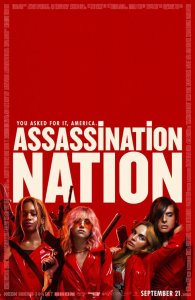 Assassination Nation is an explicitly potent and timely Movie of the Moment; it’s a modern “Monsters Are Due on Maple Street” for the Age of Trump, exposing the fissures in our society, primarily the elements that prey upon, police, and punish women. The film is brimming with female rage that you may leave shaking. It’s a movie that wants to grab you and scream its message in your face, and that will be off-putting to several, but the overall experience was so stimulating, so ambitious, so affecting, and so emotionally cathartic, that I wanted to howl back, now championing this audacious movie to whomever might listen. This is one of 2018’s best movies and most vital statements.
In Salem, four teenagers have become the most hated people in town. An anonymous hacker has been stealing people’s private information, correspondence, and intimate pictures and uploading it for the public to digest. The town has gone mad with this feeding frenzy of new info and open secrets, leading to suicides, retribution, and murder. Lily (Odessa Young, a strong debut that reminded me of Olivia Cooke) and her BFF posse, Bex (Hari Nef), Sarah (Suki Waterhouse), and Em (Abra), become the main suspects and the town turns on them, looking for some good old fashioned vigilante justice.
The film is messy and chaotic but these are not the usual detriments; it is exploding with things it wants to say about the hypocrisy and nastiness of our modern era. Early on Lily remarks to the audience, “I read this quote from a writer once who said 10 percent of the population are cruel, and 10 percent are merciful, and the other 80 percent can be swayed in either direction. I’m sure that writer has never seen 4chan or Twitter.” At the end of the day, Assassination Nation will not allow its audience to take comfort even as it transforms into a female revenge thriller. Here is a movie that grabs you forcefully and says, “This is who we are now so what are you gonna do about it, huh?”
 When Twilight Zone creator Rod Serling wrote “Monsters Are Due on Maple Street” he was critiquing the veneer of civilization we clung onto through our “good manners,” yet with the right pressure points we could just as easily turn on our fellow man with suspicion. The divisions in our current political climate often feel unable to be bridged; how does one reconcile a middle ground between one side that views gay people, trans people, women, people of color, and immigrants as human beings deserving of rights and protections and another side that laments the Way It Used to Be? There was one tense moment at gunpoint where a character that had previously led a literal lynch mob says, through convenient tears, that he’s sorry. Oh, he’s sorry he almost murdered an innocent classmate? Are there some decisions, some votes that you just can’t erase with a “sorry”? When people are willing to drop all pretenses of humanity for tribal allegiance, then perhaps those people don’t get away with an apology for their grievous harm. As the hacking begins, it’s initially pinpointed coming from a Russian IP address, and I wondered if maybe writer/director Sam Levinson (son of Barry) was making an additional comment about how easily these divisions can be exploited by an outside actor, as they were with the Russian propaganda missions of 2016 (and beyond). There’s another culprit responsible for the dissemination and the eventual explanation for a motive is a pitch-perfect end note demonstrating the destructive nature of casual cruelty.
The breakdowns in the Salem society stem from a deluge of secrets being unleashed and consumed without abandon. Everyone feels exposed, naked, some of them quite literally considering the treasure trove of hacked pictures, again drawing comparisons to celebrities like Jennifer Lawrence getting their intimate personal pictures broadcast. The expectations of privacy are malleable in a digital age of consumption, where the wider public is insatiable to know and see everything no matter the violation. The ravenous consumption of intimate secrets then foments into a mindless mob in need of blood. It’s the social media horde that has to find a new victim to point the outrage machine at. This is best demonstrated by the school’s principal (Colman Domingo), an early victim of the hacker. Included on his cell phone’s gallery are nine pictures of his young daughter in the bathtub. Ready to take down another target, the community demands that the educator resign despite his pleas that they are innocent pictures but the crowd argues that all nudity is the same and therefore sexualized, especially when it depicts females. He’s dubbed a pedophile and a child molester and every horrific term. He’s pressured by the school board to resign and he faces down his hostile, accusatory crowd. I was so taken with this storyline and the personal anguish this man was going through that I wish we had gotten more time and appearances with him as a significant supporting character (this refrain will be referenced again). It’s these early moments that made me think of the Salem of Arthur Miller’s play, a bluntly obvious comparison point for a painfully blunt movie.
 The world of Assassination Nation is deadly to women. It’s the kind of movie where male entitlement can turn a street harasser into a would-be murderer, which dredges up memories of Mollie Tibbetts, killed by a man who refused to accept that she didn’t have to talk with him or acknowledge him while she was out jogging. The teen girls are pressured to be sexual beings by those who want to commoditize their bodies, and then they are puritanically demonized when these actions become public knowledge. I kept finding relevant correlations with so many moments and themes throughout the film, and I imagine many others will do the same. That is one of the charms of a movie bursting with so many things to say; each person may be challenged or affected by something different. The satire is unsparing and darkly comic but when it needs to be serious and disturbing, Assassination Nation can switch tones with ease. You’ll be laughing at some violence, cringing at other examples, and possibly cheering by the end as just deserts are served. Having a multitude of tones and messages doesn’t detract from the overall impact; it just means there are more storytelling avenues to chase and different emotions to elicit.
Take for instance a scene that occurs after the end of the movie. We watch an African-American marching band lead by a lead female performer with a baton. They stomp in unison through the smoldering remains of a suburban neighborhood and play a brassy rendition of pop scion Miley Cyrus’ “We Can’t Stop.” It’s a song about youthful revelry but also a declaration of independence from the oppressive expectations of others (“It’s our party, we can say what we want/ It’s our party, we can kiss who we want”). Can this moment relate to the idea that a younger generation must keep marching onward in the face of tragedy after tragedy, that the racism and misogyny and mass shootings won’t stop, that we’re a constant shuffling funeral march in the unmovable face of broken politics? Is there reference to the expectation of African-Americans to perform through horrifying adversity for the entertainment of a white audience? Is this a celebration or elegy? It’s a strangely beautiful coda that left me thinking even more, and if something that happens even after the end credits can stay with me, you know you have a worthy work of art.
 This is a movie that affected me deeply as a drama and, as it changes gears, a suspense thriller. There are some extended assault and torture sequences that will test the comfort level of every viewer. There is a healthy exploitation streak that runs through the film, but I found it far more meaningful than say the recent gonzo art flick earning overzealous critical raves, Mandy. Levinson’s camera will adopt the male gaze that imprisons these teen girls with close-ups of gyrating movement and pouty stares. Some will characterize these moments as Levinson muddying his message by indulging in the same objectification he has been criticizing. I can understand that analysis but I think it goes deeper. I think the camera is adopting the objectification of the world and Levinson is asking us how we feel now that we’ve gotten to know many of these women. Are they so easily disposable once you widen the lens and see them as vulnerable, sympathetic, and relatable human beings?
The final act delves into full-on exploitation vengeance thriller and becomes a feminist rallying cry against the wider array of misogyny poisoning society. I imagine future generations will memorize Lily’s final speech to the American public with the same degree of awed reverence as college-aged males do for Tyler Durden (a movie where its target audience missed the satire). It would be glib to simply dismiss Assassination Nation as an opportunistic RiotGrrrl response to the Me Too movement. This is a primal cry against the Age of Trump and feels like the first great film in response to our 45th president and all that his ascension has wrought.
When the film does go into thriller mode, Levinson proves surprisingly adept. There is an extended tracking shot that swoops from window to window, floor to floor as we slowly watch a home invasion in progress, and it’s exceptionally taut. The camerawork by cinematographer Marcel Rev (White God) is remarkably fluid, floating around its subjects in glides like the camera is serving as the eye of god. There’s a mesmerizing quality to the visuals that transcends the array of genres the film effortlessly hops between. One minute you’re caught up with the arresting, upside down camerawork leading to an explosion of violence, and the next you’re taken with a surreal depiction of suburbia. The music selection is also on fire with choice tracks by K. Flay, Bishop Briggs, Joywave, Bams Courtney, Gracie Mitchell, Billie Ellish, and others. It alternates between guttural and polished, angry and contemplative, but it screams as loud as the film itself. I’ll be surprised if I come across a better contemporary soundtrack to a 2018 movie.
If there is a niggling detraction for the movie it’s that we could have used more time spent rounding out the supporting characters. Besides Lily and Bex, the other girls are more defined by their relationships and proximity to our protagonist. I wanted them to open up more as characters. I also wanted even more catharsis by the end of the movie. After almost two hours of rampant misogyny and subjugation, I could have used even more lingering vengeance as the girls defended themselves from their attackers. Still, my biggest regret with Assassination Nation is that I didn’t spend more time with the supporting characters and their individual personalities and trials. I just wanted more.
 Bristling with anger and feminine agency, Assassination Nation is a warning shot, a rallying cry, and a daring artistic statement about the role of women in response to the rise of Trump and his cronies. It’s not subtle but that doesn’t mean it isn’t effective. It’s blunt and extreme because our times are blunt and extreme, it’s messy because our news cycles are messy, desperate to cover a cascade of catastrophes and scandals, it’s using the language and imagery of exploitation cinema because that is too often the lens with which women are viewed in modern society, as achievements to unlock, as trophies to be won, and as a product for mass consumption. Levinson has put together a movie that has a possibility of being a seminal film, of being a touchstone of the resistance to the Trump Era and all that it stands for, but at its core it opens up with excoriating detail the pressure and punishment women must persevere through on a daily basis as targets of patriarchal entitlement and the dangerously fragile egos of dangerous men. In the recent weeks we’ve watched a possible Supreme Court nominee who might have committed multiple acts of sexual assault, and the response has been to “plow ahead” and appoint the man for a lifetime position ruling on the legality of women’s rights without further inquiry or investigation. The film feels even more charged, relevant, and prophetic with each new allegation of wrongdoing being hand-waved away as mistaken identity, boys-will-be-boys moral relativism (more like rapists-will-be-rapists), and the same kind of nonsense that women have been subjected to since the original Salem and well beyond that. For every woman fed up with the status quo, Assassination Nation is your movie, and for every man whom needs a feminist lesson with an extra dose of Purge-style bloodletting and vengeance, here is a brazen and affecting statement. Assassination Nation is the movie of the moment and it’s a knockout.
Nate’s Grade: A
Share this:

The House with a Clock in Its Wall (2018)
 Who could have guessed that splatterhouse horror director Eli Roth (Hostel, The Green Inferno) was the right candidate to helm a children’s movie that hearkens back to the 90s era of Disney Channel? The House with a Clock in Its Walls is a whimsical and enjoyable family movie that is definitely made primarily for those under the age of twelve. It features a young boy (Owen Vaccaro) going to live with his uncle (Jack Black) who is a warlock and where the neighbor (Cate Blanchett) is a witch. He learns magic, self-confidence, and the legend of the hidden clock that may or may not trigger a doomsday. The 1950s house itself and its magical elements is practically another character in the movie and there’s a cheerful sense of discovery throughout, with a dog-like armchair, a topiary griffin, and a stained glass window that keeps changing. The school scenes could have been trimmed entirely, especially when you consider our main kid had enough motivation to try and bring his departed mom back to life. He didn’t need to impress a bully at school because he wanted a friend. Black (Jumanji 2) is charming as ever and a natural with children. The visuals are colorful and fun. The signature weird and icky details Roth adds made me smile, like pumpkins that vomit pumpkin guts as a weapon. Kyle Maclachlin (TV’s Twin Peaks) plays an evil wizard who wants to end the world after seeing the horrors of the Holocaust. That’s a dark implication for a “children’s movie,” and I appreciate that the film allows for the existence of darkness, which also includes unvarnished appearances of the occult and a red-eyed demon. How about that? The House with a Clock in Its Walls is an entertaining fantasy adventure for families whose kids like to tip-toe into spooky material but aren’t quite ready yet for the harder edged PG-13 scares.
Nate’s Grade: B
Share this:

Mandy (2018)
 Mandy is a gonzo, psychotropic mood piece that will infuriate some, test others, and delight a select audience that responds enthusiastically to atmospheric indulgences. Set in the 1980s, because of course it’s the 80s, a logger (Nicolas Cage) and his titluar girlfriend Mandy (Andrea Riseborough) have a bad run-in with a small cult. Their leader, Jeremiah Sand (Linus Roache), declares that the god of the universe told him he is entitled to everything, and he picks Mandy. Bad things transpire and Cage is left for dead. He sets off on a quest for vengeance against the cult and a fetish-clad biker gang they employ as muscle, and in the process he might be going insane.
So what kind of movie is Mandy? There really isn’t a plot here so much as an immersive experience of fever dream imagery with a loving yet detached nod to its cultural influences from the 1980s, heavy metal music videos, Heavy Metal magazines, heavy metal album covers (sensing a trend?). There is the bare bones of a plot here, a revenge formula, but it’s really more about the moments and the feelings that writer/director Panos Cosmatos (Beyond the Black Rainbow) is trying to communicate through the screen. He’s another disciple of the Terrence Malick/Nicolas Winding Refn School of Filmmaking, ditching the story details for a visually immersive and hallucinatory sensory experience. The problem with these kinds of movies is that you either check into that wavelength or you don’t. I know that sounds like an oversimplification, as all movies either engage or disengage, but because the story and characters are so minimalist, the opportunities to click with the material rely entirely upon the moody atmosphere and creative execution.
 Mandy is overwhelmingly a campy revenge thriller that celebrates the unique Cage-ness of Nicolas Cage’s more unhinged, bizarre performances. This is a movie that asks Cage to go the full Cage, and that can be a beautiful thing. There’s a knowing campiness to the whole exercise that doesn’t feel condescending. It’s not making fun of the onscreen antics so much as it is celebrating the artful absurdity. This is the kind of movie where there’s a chainsaw-on-chainsaw duel and it’s awesome. This is the kind of movie where every patch of woods has a blast of fog to make it feel like a dark fairy tale. It’s the kind of movie where the practical gore effects are stomach churning and memorable. It’s the kind of movie where Cage lights his cigarette from the fire of a decapitated head. It’s a movie where Cage goes on a journey where he transcends into the mythic. He is no mere mortal by the end; he is the mythic figure of vengeance. The man doesn’t just find his foes to foil; he has to first construct his own metallic scythe straight out of a fantasy adventure. Cage is fully aligned with the bizarre and eerie primal nature of the film. His crazed intensity is matched perfectly with the overwrought atmosphere and villains. There are moments where his bug-eyed stare or maniacal laughter will give you chills. He has one sequence that’s petty much non-stop screaming on a toilet as he tries to process shocking grief. It’s a performance that asks Cage to be unrestrained and tightly coiled at parts, relying more on physicality and intense looks than dialogue. For fans of the ironic and sublimely weird Nicolas Cage, Mandy should be a deranged delight to hoot and holler.
However, there’s really no entry point for a viewer if they do not celebrate the campy, gonzo, detached atmospherics of the film. Walking out of Mandy, I told my friends that it needed 20 percent more plot and 20 percent less movie. There’s no reason this movie needs to be over to hours long, especially with its threadbare plot. It takes far too long to get going, with the cult attacking Cage and his girlfriend at the one-hour mark. The second half has improved pacing but still takes its sweet time too. Cosmatos seems to favor a dreamy sense of pacing, so instead of, say, ten seconds of watching Cage’s pained reaction, we’ll get 30 seconds. The self-indulgence has a way of making the artful intent redundant. Did we need those extra 20 seconds to really feel the full artistry? Or, perhaps, could Cosmatos have used all the extra time saved from collectively trimming the excess moments and diversions to better develop the characters and story? The other problem with diverting the majority of the attention to atmospherics is that the eventual comeuppance of the cult lacks a full sense of satisfaction. If we don’t get to really know the cult members then we won’t feel the rush of catharsis when they are dispatched. I talked about this very topic with my review for Peppermint, another revenge thriller with inherent structural problems that mitigated audience payoffs. The revenge formula is a simple thing and engineered to deliver payoffs. Here are two September releases that fumble that formula, although Mandy places less importance upon it. Most of these cult members are given a look, at best, which makes them interchangeable and disposable. Jeremiah Sand is an intriguing, hilarious, pathetic creature, and so the final showdown proves satisfying and somewhat revelatory, as his ego-driven bluster transitions quickly to pleading and bargaining and abject fear. It’s a fitfully climactic moment but did we need two hours to get here? There’s a better 90-minute movie trapped inside here, subsumed and suffocated by Cosmatos’ love affair with his influences and indulgences.
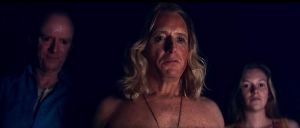 This is also sadly the last score from composer Johann Johannsson, who passed away in February of this year. He was an eclectic creative voice whose musical abilities were diverse. He could create a thundering score that felt like an incoming army, like with Sicario, or a soaring melody that could lift your spirits, like his Oscar-winning score for Theory of Everything. With Mandy, Johannsson relies upon those 80s metal influences and produces a sonic landscape fitting for Cosmatos. The score is kept at a rumble that accentuates the nightmarish qualities of the visuals. To the end, Johannsson sought unconventional methods to give voice to his movies.
Mandy is a crazy, dreamy, moody movie heavy on brooding atmosphere and light on story and characters. If you can hop on its wavelength, Mandy will prove to be a gonzo good time. If you can’t, it’s going to be overly reverential to its cultural influences and laboriously long. I fall somewhere in the middle. I’m not a fan of most Refn movies because I feel like they fall into the trap of emphasizing pretty yet hollow imagery. The ideas don’t tend to go as deep as the filmmakers think they do, and I grow restless for more. Mandy needed more time spent giving greater shape to its world and narrative. This criticism may sound unfair given the nature of the film (do you ask for the details of a dream?) but I feel dismissing its lack of substance is a step too far. Mandy is essentially a dream with hazy plotting, vivid imagery, and intense feelings, but it can wash away upon waking. I left my theater torn over the movie, wanting to celebrate its artistic vision and weirdness while also wishing there was more weirdness and more of a vision.
Nate’s Grade: B-
Share this:

The Nun (2018)

It’s amazing to me that The Conjuring series has become a literal billion-dollar franchise and in only four cost-effective movies. Rare is the film franchise that births spin-offs so readily, but The Conjuring has already introduced two Annabelle movies, one Nun film, and an upcoming Crooked Man feature. It’s almost as if any supernatural creature given a minor spotlight in the James Wan-produced series is destined for greater things. It’s like the Conjuring universe is a pipeline to stardom for America’s next big malevolent demon. I’m thinking the Conjuring 3 could spend 30 seconds on some tall tale about a haunted plunger and it would be spun off into its own franchise within a year, tops. The Nun is the fifth film in the series, the second spin-off film, and probably the movie with the least amount of narrative substance given its starting material. It’s a mixture of old horror staples and exorcism mumbo-jumbo, and it’s also not half bad.
In 1950s Romania, a small abbey is being haunted by an evil presence that had been confined behind a door that ominously warned, “God ends here.” A nun has committed suicide under mysterious circumstances. Father Burke (Demian Bichir) is called by the Vatican to investigate the strange happenings. He teams up with a local nun-in-training, Sister Irene (Taissa Farmiga), and a traveling merchant Frenchie (Jonas Bloquet) who first discovered the dead nun’s body. The sisters inside the abbey are behaving oddly and it’s not long before our characters realize they’re trapped in the abbey with something wicked looking for a human host to escape.
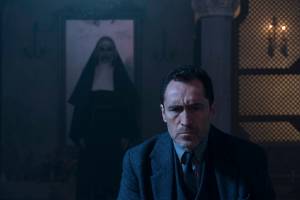
There’s not really much to the plot of The Nun so the emphasis comes in the realm of atmosphere, unsettling visuals, and unnerving set pieces. The investigative process with our priest and nun-in-training doesn’t amount to many revelations, and the information won’t be new for the audience considering this specific demon Valak has been seen in two other Conjuring-related movies now (maybe three?). It becomes a haunted house thriller and, like the earlier and much ballyhooed Hereditary, a movie of moments. So your mileage will vary depending upon how affected you are by the atmospherics and imagery. With The Nun, I felt like the visuals were built upon more rigorous Catholic religious iconography and a foundation of decades of accumulated exorcism film imagery. Plus the very design of the titular nun is just super unsettling by itself, let alone placed in a spooky setting with spooky lighting. Director Corin Hardy (The Hallow) finds visually pleasing and distressing imagery that he emphasizes for better effect, like a team of faceless nuns standing in formation, or a tormented boy with a snake that slithers out of his screaming mouth. It’s not subtle in the slightest but credit for not relying upon an inordinate number of jump scares for its chief spooks. In the realm of schlocky horror, The Nun is actually a little restrained when it isn’t being ridiculous, but it’s the kind of ridiculous that makes you laugh and anticipate the next scene rather than check your watch. Again, your mileage will vary, but I enjoyed the theatrics and imagery more than the overrated Hereditary.
This brings me to the biggest head-scratcher in the movie that would have seemed designed to ensure audience investment. I had no idea Taissa Farmiga (TV’s American Horror Story) was going to be in this movie let alone the co-lead of the movie. As soon as I saw her face I leaned forward, newly intrigued. My working assumption was that the younger Farmiga was going to be the prequel version of the character played by her older sister, Vera Farmiga (yes, they’re sisters and not mother/daughter). Suddenly this made her character that much more interesting and created a direct connection from the events of the nuns to the larger Conjuring universe, providing a back-story for the Warrens to lean upon. It also allowed me to transfer my feelings for the character onto Taissa Farmiga, making me care far more about her well-being as she creeped around dimly lit corners than if she had been any other woman in a habit in a bad place. The fact that The Nun had so effectively hidden Taissa Farmiga’s presence from the marketing made it feel like an intentional surprise, something to let the audience know the filmmakers weren’t skating by. It raised my opinion of the movie and my enjoyment from scene-to-scene.

And then I found out Taissa Farmiga’s Sister Irene is a separate character from Lorraine Warren. Huh? Of all the young actresses in the world to select, choosing the literal younger sister of Vera Farmiga, who looks strikingly similar, feels far too intentional to be coincidental. Why isn’t she just the younger version of Lorraine Warren, setting her up for a life of hunting the supernatural after this formative experience? She’s even presented as a nun in training and not a full-fledged bride of Christ. Even the decades in age difference would add up. It’s not like you’re playing that close to the facts of the case when it concerns the Warrens who, by modern accounts, are considered frauds by many. Come on, James Wan. Come on Conjuring universe. What are you doing here? The solution was right within reach and you deliberately ignored it.
The Nun is a moderately entertaining movie subsisting on strong production design, exorcism iconography, and solid performances from capable actors. It’s not really more than the sum of its parts but, for me, there were enough effectively creepy moments and punchy images that won me over by the end of its 96 minutes. If you’re a fan of the Conjuring series, or particularly demonic possession/exorcism movies, then you’ll likely find enough entertainment to be had, even if the filmmakers absurdly decide not to have Taissa Farmiga play the younger version of an already established central character. Was this a late-in-the-game rewrite to absolve her of her connection to Vera Farmiga? I’m happy for anyone connected to the production to contact me and clear this up (after my surprising conversation with a key creative on Sherlock Gnomes, I’ll just start openly asking for clarifying correspondence from Hollywood filmmakers now). The Nun in essence does just enough to be silly or scary when needed and possibly worth a watch for horror fans. Now about that haunted toilet plunger. I may have a pitch ready if you’re open to it, James Wan. After all, what’s scarier than a broken toilet?
Nate’s Grade: C+
Share this:

Searching (2018)
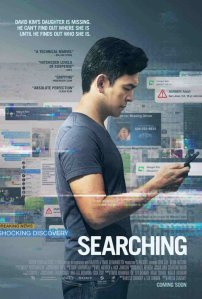 Searching is a clever, crafty found footage mystery told from the point of view of a computer screen. Unlike many found footage entries, writer/director Aneesh Chaganty has put considerable thought into the mechanics of his storytelling gimmick. The opening sequence even reminded me of Up as far as how deft it was with the economy of storytelling while providing an affecting emotional blow. In the opening, we watch a little girl grow up as computer technology and websites also advance documenting her life, culminating in her mother getting cancer and passing away, communicated via a “Mom’s Coming Home” date removed from a calendar. It was so well done I actually felt like I just might summon some tears for the passing of this woman. Right away I realized I was in for something special. Flash forward and the teen daughter goes missing and her stressed-out father (John Cho) dives into the investigation firsthand by looking through her online history and realizing how little he may have known his not-so-little girl. The movie illustrates nicely how easy it is to hide your real self online and how easy it is for others to find you and your digital impressions. Every time Cho is visiting a website, whether it’s Venmo or Instagram or Facebook or a webcam, there’s a solid reason for it and the movie has a satisfying step-by-step progression. The mystery has plenty of unexpected twists and turns and it’s anchored by a harried and distraught Cho (Star Trek Beyond), who does not look like he’s in his mid 40s at all (Kal Penn has also aged well, which makes me only want a cross-generational Harold and Kumar sequel more). The only knock on Searching is that there really isn’t a pressing need to see it on the big screen. After all, you’re watching a computer screen and typing for much of the movie. It will play just as well, if not better, on your home television or whatever smaller screen is at your discretion.
Nate’s Grade: B+
Share this:

The Little Stranger (2018)

If you’re a fan of slow burning Gothic horror, the kind where characters wander slowly inside ornate and empty houses investigating various noises, then The Little Stranger is the movie for you. It’s about a laconic doctor (Domhnall Gleeson) inserting himself in the lives of a wealthy family who has fallen on hard times, their once glorious estate left to wither in post-WWII Britain. The family is convinced the spirit of a dead little girl haunts their estate and has its ghostly sights set on destroying the last vestiges of their bloodline. It’s a ghost story by design but the supernatural elements get placed on pause for long stretches. The rest of the movie is a restrained romance between the doctor and the introverted and awkward lady of the house, played by Ruth Wilson (TV’s The Affair). In reality, the doctor is more infatuated with the house than the people inside, fondly recalling his early obsession from childhood. It’s easy to see why. The house, and its exquisite production design, is enchanting. At points it feels like the movie has to remember that it’s a ghost story or a mystery as it shifts narrative tracks. The Little Stranger is a movie simmering in eerie atmosphere and is pristinely directed by Lenny Abrahamson (Room), a man proving how readily he can adapt his artistic style. For a good hour, I was on board with the movie and enjoyed its patient, controlled buildup. It’s practically the opposite of the more visceral horror set pieces we’ve become accustomed to. By the end, I was unsure whether the somewhat ambiguous ending justified the time and path taken to get there. If you don’t have a healthy love of Poe-styled Gothic horror, you’ll likely be restless as you watch understated, refined, restrained British family going through understated, refined, restrained drama.
Nate’s Grade: C+
Share this:

Operation Finale (2018)
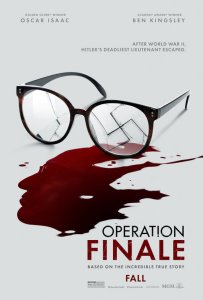 Operation Finale is one of those kinds of movies that is just good enough to make me wish it had been better. It’s based on the true story of an Israeli team of spies that located Adolph Eichmann (Ben Kingsley), one of Hitler’s lieutenants who authored The Final Solution. He’s been hiding in Argentina for years and giving public lectures, which isn’t helpful with keeping a low profile. Oscar Isaac (The Last Jedi) leads the Israeli spies as they plot to kidnap Eichmann, get him to admit his guilt for the Holocaust in writing, and smuggle him out of the country and to Israel to stand trail for the deaths of millions. This story should be exciting, it should be fascinating, it should be compelling, and for stretches it can be, but Operation Finale errs in capturing Eichmann too quickly. The majority of the film is the spy team holding him in a secret location and interrogating him, while the surprisingly Nazi-coddling police force of Argentina hunts for their location. I’m assuming the filmmakers were accurately telling the true story, but you start to question why the spies are taking their sweet time. Why not get on a boat as soon as possible and sail to another country to fly away, one less friendly to former Nazis? There aren’t really any set pieces where their cover might be blown. It’s mostly Isaac talking with Kingsley, and while their conversations are entertaining, it’s yet another preview of a better movie that we’re never going to have delivered. The film lacks enough urgency. The characterization is too limited and the supporting characters are more faces than people; Melanie Laurent essentially plays The Woman Spy. Operation Finale should have either spent more time on the specifics and complications of nabbing Eichamann, presenting a challenge, or it could have accentuated the debate between Isaac and Kingsley over the nature of culpability, rationalization, guilt, and vengeance. There’s probably a really good Nazi-hunting mini-series or Nazi-debating play in here. Either way, the actual finished film is well made, well acted, and well intentioned but also dramatically lacking.
Nate Grade: C+
Share this:

First Reformed (2018)/ You Were Never Really Here (2018)
 Both First Reformed and You Were Never Really Here use sly genre subversion to act as commentary on what kinds of movies the audience associates with these kind of haunted men, their arcs, and the nature of violence. Subverting audience expectations is in and of itself not necessarily a better option. You can have unexpected things happen but the narrative that happens after needs to be compelling, and if possible, unavoidable in hindsight (Game of Thrones is good at this). By the same notion, the finale of Breaking Bad was pretty easy to anticipate but that’s because of how well written the storytelling trajectory was pointing to its natural end. I can tell a tense father-son reconciliation story and then if I end it with a meteor wiping out the Earth all of a sudden, well that’s unexpected but that doesn’t make it better storytelling. What helps elevate both movies is that the subversions are thematically related to the relationship between violence and vengeance, absolution and atonement, and the audience and our desires with these films.
In First Reformed, Reverend Toller (Ethan Hawke, enthralling) is the caretaker of a small upstate New York church where the weekly attendance can be counted on one hand. The church, First Reformed, is nearing the commemoration of its two hundred-fiftieth anniversary that will be celebrated by local dignitaries and the governor. Reverend Jeffers (Cedric the Entertainer, surprisingly adept in drama) is the pastor for the mega church that seems to have everything that First Reformed lacks. Jeffers wants to help out Toller but the humble man of the cloth refuses. Rev. Toller is pushed out of his comfort zone by the husband of a pregnant woman (Amanda Seyfried) who challenges him on man’s stewardship of the environment. The husband worries about bringing a child into this world and contributing the larger problem of climate change. This interaction gets Rev. Toller to think about his own culpability and sets him on a path of righteous justice.
 Writer/director Paul Schrader is famous for his stories about violent men confronting the wickedness of the world around them. From Taxi Driver to Raging Bull to Hardcore, Schrader has a penchant for documenting the self-destructive recourse of flawed men who feel removed or constrained by a society they feel is out of step with morality. What better canvas then for Schrader than a middle-aged pastor at a small, reclusive church? Rev. Toller is so humble he doesn’t own more than a few sticks of furniture in his home, the adjoining parsonage to the church. He’s friendly but often choosing to keep to himself, forgoing comforts and perceived handouts from the people around him. A woman his own age keeps trying to connect with him, their romantic coupling in the past a platform for her to continue hoping he’ll come around to her. She’s a perfectly nice woman, a choir headmistress for the mega church down the road, but she reminds Toller of his weakness and maybe even something worse. The aforementioned mega church basically keeps Toller’s small parish afloat as a charity (First Reformed is nicknamed the “gift shop church” for its historical notoriety). Rev. Jeffers is concerned about his fellow man of the cloth and the toll his solitude and seclusion is taking on him. It’s like he’s trying to atone for something, taking on a very Christ-like path of penitence. It’s around here that the character is activated into a higher calling in conflict with the church.
I’ll explain what I was expecting given the premise and presence of Schrader. I was expecting a movie much in keeping with A History of Violence, where a small-town man is thrust back into a past life of violence by outside forces and he has to confront how far this “new him” has come from the sins of “old him.” I was expecting Toller to become more violent and radicalized, pitting others in his cross-hairs for retribution. That’s not really First Reformed at all. First off, it’s the slowest of slow burns. You better be prepared to luxuriate in the day-to-day details of Rev. Toller’s simple life, from unclogging toilets to visiting with parishioners in their homes and having long philosophical conversations with them about faith and man’s role in the ecosystem. That conversation specifically teeters toward ten minutes and serves as the end of Act One, and I think if you’re still invested by then, you’ll be along for the rest of the film. However, it’s not going to be an easily accessible movie. This conversation stirs something deeper inside Toller, dissatisfaction with the church and how it coddles with big business, the chief polluters of God’s kingdom. Toller becomes a late-in-life environmental activist who questions the stewardship of the church body. This sets him on a path that seems destined for bloody violence. He’s going to go out in a fury of righteousness. We’re expecting a big bang by the end, especially given Schrader’s history of these kinds of stories with these kinds of men. But that doesn’t happen.
 I’ll try and avoid spoilers but discussion over the thematic relevance of the end of First Reformed will unavoidably suggest to the reader some significant plot developments, so please feel free to read this paragraph or skip to the next one. The second half of the movie is setting you up for a very specific ending, one where Toller strikes back against forces he feels are detrimental to the well being of the church. It’s setting you up for a climactic showdown with powerful forces that feel unaccountable for their actions. I was ready for a final rush of violence to serve as the crescendo to Schrader’s slow burn. This is where the movie swerves away from audience expectations. We’re prepared for a meaningful death but instead Schrader’s ending, in retrospect, makes us question why we should have desired such a violent and vengeful finale. Why should this character be a martyr for our bloodlust against the powerful? Ultimately, Schrader’s movie ends on a romantic, optimistic note of personal salvation after setting you up for a dark story with a predetermined, self-destructive end. The abruptness of the ending may inspire some titters, but when you look back at the film, it makes complete sense and calls into question why we would wish for blood and violence over human connection and forgiveness. Schrader is saying that you wanted the wrong kind of movie.
First Reformed takes the modest aims of its protagonist to heart when it comes to the presentation of its story. Schrader films the entire movie in the old-fashioned 4:3 aspect ratio, the square box of old pre-high definition televisions. It’s an aspect ratio that keeps everything centered for the audience and on display. I think there was exactly four camera movements in the entire movie; almost the entirely of the 113 minutes is from a stationary, documentary-styled camera. It’s a very specific visual style that limits the visual information and dynamism but manages to personalize the main character even more. It’s his movie and his journey of self, so the visual representation is also restrained. There’s really one flash of upsetting violence in the whole movie, as if to remind the audience how a violent death is not something to be celebrated. For an R-rated Paul Schrader movie, it’s far more reserved, subtle, and thoughtful. It left me thinking about Rev. Toller and his messianic mission and our desire for a big bloody finish. The idea of a selfless death directed toward violent retribution is inherently self-involved. It’s not death that provides meaning but life, it’s not how we end but what we do with the days beforehand.
 You Were Never Really Here is built as a hitman thriller based on Jonathan Ames’ novel. Joe (Joaquin Phoenix) is a hired gun who specializes in rescuing young women. He’s hired to find the missing adolescent daughter of a senatorial candidate. He investigates the underbelly of sex trafficking to save this little girl, but larger forces are at play and will make Joe suffer gravely for interfering with their wanton exploitation.
The average audience for You Were Never Really Here has been steadily fed a diet of these kinds of movies, from the artful (Luc Besson’s The Professional), to the pulpy (The Long Kiss Goodnight), to any number of hollow, nihilistic video game-styled murder fantasies (Hitman, a thousand straight-to-DVD movies). We’re expecting men of action who are ruthlessly efficient and clever when it comes to their killing. We’re expecting stylish merchants of death who leave behind a heavy body count with swagger. That’s not what brilliant Scottish writer/director Lynne Ramsay (We Need to Talk About Kevin) has in mind at all. She takes the iconography of the hitman thriller and turns it into an expectation-smashing existential character study, but not just of its disturbed main character but also for the audience and our relationship to these movies. We expect remorseless killing machines that turn death into splashy and cool tableaus. These movies aren’t so much key on mediation and reflection, beyond the standard “reap what you sow” adage.
Much of the violence is kept off screen or purposely denied to the audience. I’m trying to remember if we even see Joe kill anyone on screen. The infiltration of the sex trafficking organization hops between fixed security angles, edited together in a dissonant manner, where the last shot doesn’t fully line up for a smooth edit, leaving a half second. The effect is one that’s knowingly alienating and challenging. When Joe does unleash his violent skills, it’s rarely given a showcase for entertainment. This is a movie that doesn’t celebrate its violence. There’s a moment where Joe lies on the ground beside a mortally wounded bad guy. They exchange a few cordial words, he procures some vital information, but then Joe stays with the man and the two sing a song together. It sounds bizarre when written out but it’s a moment that really stuck with me. After everything, these two men can find a small sliver of humanity between them to share. Even the final confrontation, the big climactic set piece of any other movie, ends with a shoulder shrug, as if Ramsay is saying to the audience, “Why would seeing all that be cathartic?”
 For Ramsay, the focus of the movie is on the man committing the acts of violence rather than how stylish and cool and cinematic those acts of violence can be. This is the one area where I feel a longer running time could have better helped her goal. I think Ramsay might be the best filmmaker we have for triptych narratives. 2011’s We Need to Talk About Kevin is a startling and insightful movie that opens up the guilt of a woman whose son grew up very badly, jumping around time periods, using a repetition of images to provide visual stings and associations. You Were Never Really Here does similar labor, establishing our strong silent protagonist through glimpses of a troubled past, from a childhood with an abusive father and a mother he would have to save, to incidents during military service and police investigations that reminded Joe about the depravity of others, in particular the ability to exploit and dehumanize women as disposable property. Ramsay offers discorded images and brief flashes and asks the audience to put together the pieces to better understand Joe as a man propelled and haunted by his bloody past. However, at a slim 89 minutes, the audience could have used more time and opportunity to better develop and analyze this central character. The pieces are tantalizing but I wanted more, and as a result I found Joe to be an interesting start to a character that was in need of more time and attention to transcend the boundaries of his archetype. I needed a little more from him and his world.
There are several moments that quickly come to my memory, sticking with me because of the level of artistic arrangement or implication. Because Ramsay wants to take the Hollywood hitman revenge thriller and deconstruct it and provoke her audience and its desires for violence, there isn’t much of a plot to this movie. I could literally spoil the whole thing with the following sentence: a man of violence is hired to find a missing girl, finds her, loses her, and finds her again at great personal expense. The movie is more of a poignant and intriguing exercise in our relationship to these kinds of stories. There are moments of beauty in the movie that took my breath away, like when Joe lowers a wrapped body into the depths of a lake, and with the shafts of light, the curls of hair, the small visual details, it felt like watching a living baroque painting. There are also several bizarre moments that stand out, like when Joe fantasizes about blowing his brains out at a diner while the patrons, and the blood-soaked waitress, go about their day. It’s these little flourishes that make the movie stand above other hitman movie deconstruction exercises like George Clooney’s overly solemn The American. It’s not all tragedy and inescapable dread. Amidst Joe’s tortured past and troubled future, there’s a necessary sense of hope. You don’t know what will happen next but you’re not resigned to retrograde nihilism.
 Both First Reformed and You Were Never Really Here are slow burn indie character studies that ask their audience to question the movies they’ve been set up for. Schrader and Ramsay are deft storytellers who pair their visual gifts to the psyches of their damaged, haunted, and self-destructive middle-aged men. Hawke is phenomenal as Rev. Toller and Phoenix is suitably unsettled from a life of confronting predatory violence. Both movies have also stayed with me, though First Reformed I find to be the better developed, better executed, better acted of the two films. It’s enough of a comeback for Schrader, whose last film I remember seeing was the laughably bad Lindsay Lohan “erotic thriller” The Canyons. These are two movies that aren’t exactly the most accessible. Both challenge the audience to analyze the personal relationships with genre storytelling. If you have patience and an open mind, both First Reformed and You Were Never Really Here provide thoughtful and methodical examinations on genre, violence, and the visceral appeal of empty bloodshed.
Nate’s Grades:
First Reformed: A-
You Were Never Really Here: B


 nathanzoebl
You must be logged in to post a comment.