Blog Archives
Crazy Rich Asians (2018)
 Crazy Rich Asians is a frothy mix of familiar 90s romantic comedy cliches and tropes but now with an all-Asian cast and Asian culture given a dignified spotlight. Thanks to the strides in representation, it makes the familiar feel fresh again. This is a very Pretty Woman princess fantasy story of an ordinary woman, Rachel Chu (the great Constance Wu) falling in love with a rich man who then whisks her away to his rich family home out of country and introduces her to the world of the cloistered elites, ex-girlfriends, and hangers-on and their disapproval. Much of the conflict hinges on her feeling accepted by her man’s scowling, scary mother played by the formidable Michelle Yeoh (Crouching Tiger, Hidden Dragon). The two-hour running time mostly consists of a lot of blandly nice people. I think enough of these supporting characters could have been consolidated or eliminated to give more space to characters that matter. The film reminded me, in some regards, of the 50 Shades series where we jump from scene to scene to celebrate the extravagance of an elite lifestyle of luxury. It’s intended to alienate Rachel and contrast with her humble, hard-working, honest sensibilities, but after two or three of these, I don’t think it’s quite having that effect. Wu (TV’s Fresh Off the Boat) is a charming, loveable lead, and the film has fun, colorful characters played by Awkwafina (Ocean’s 8) and Ken Jeong (The Hangover trilogy), who amazingly doesn’t overstay his welcome. The production design and costumes are sensational and might even get some Oscar attention. Crazy Rich Asians is a fairly formulaic but pleasant enough movie, and the fact that an all-Asian cast rom-com is slotted as a summer movie is a positive sign. The end results are a fizzy fantasy repackaged but still entertaining and without a sense of pandering.
Nate’s Grade: B
Share this:

BlackkKlansman (2018)/ Sorry to Bother You (2018)
 Two African-American filmmakers, one making his debut and another in his fourth decade of popular storytelling, have produced two of the most uncompromising, entertaining, provocative, and exacting and relevant movies of this year. Boots Riley’s absurdly comic indie Sorry to Bother You was a festival smash, and Spike Lee’s BlackkKlansman is being positioned as a summer breakout. Audiences have often looked to the movies as an escape from the woes of our world, and when the news is non-stop catastrophic woe, that’s even more apparent. However, both of these movies, while enormously entertaining and charged with fresh relevancy, are a reminder of the very social ills many may actively try to avoid. Both films, and their respective filmmakers, make cases why ignorance is a privilege we cannot afford. Also, did I mention that the movies are outstanding, daring, and hilarious?
It’s the early 1970s, and Ron Stallworth (John David Washington) is the first black officer on the Colorado Springs police force. He wants to be a detective and taken seriously, and one day he calls the leader of the local chapter of the Ku Klux Klan pretending to be a white nationalist. He builds a relationship over the phone with the Klan but he can’t meet them in person. Enter fellow officer Flip Zimmerman (Adam Driver) who stands in as the public Ron Stallworth, avowed white supremacist. Problem is Flip is Jewish, a group the Klan isn’t much more favorable with. The two officers must work together to gather enough actionable evidence to stop the Klan before they kill.
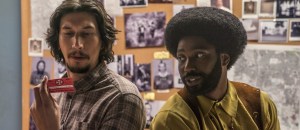 This is Lee’s best film since 2000’s Bamboozled and he feels jolted awake by the material. He doesn’t shy away from the film’s relevance and potent power but also knows how to faithfully execute the suspense sequences and police procedural aspects of the story by Charlie Wachtel, David Rabinowitz, Kevin Willmott, and Lee himself, based upon Stallworth’s book. The story alone is the film’s greatest selling point. It feels like a bizarre recreation of that Dave Chapelle sketch about the blind, and black, Klansman. It’s a story inviting irony and bafflement, and it’s ribald and funny for long stretches, buoyed by Washington’s charismatic and forceful performance (close your eyes and he sounds just like his dad, Denzel). The story is so fascinating that you just want to see where it goes. Stallworth is fighting for respect in a still-racist police force, and he’s pushing Zimmerman to feel more invested in their operation from his own maligned status. “I never thought much about being Jewish,” he shares with Ron, “But I’ve been thinking a lot about it recently.” Theirs is a partnership we root for, and each new accomplishment bonds them together and increases their credibility with a wary police chief. It’s a movie that has a steady supply of payoffs and complications, leaving you satisfied by the end but also more than a bit rattled at the uneasy connections to contemporary news.
This is a character-driven suspense film that does so much so well, drawing in thrills and laughs without making either feel cheaper by their inclusion. This is an undercover operation so every scene with the Klan has the electric uncertainty of whether or not Flip will be caught and our heroes doomed. Because you have two Ron Stallworths, we already have a complicated ruse to keep up (though why Flip couldn’t simply also be the voice on the phone is likely just how it happened in real life). Each new piece of information, each new meeting, takes our characters deeper into the Klan infrastructure, including a guided visit from none other than Grand Wizard (a.k.a. head honcho) David Duke (Topher Grace in an outstanding performance). The risk escalates from being caught to thwarting a planned bombing that could kill innocent minority protestors. The movie does a great job of finding new ways to remind you what is at stake, and while the Klansman are set up to be laughed at and ridiculed, they are still seen as dangerous. They still have the direct intent to physically harm others, not just harass and intimidate.
 Because of the undercover operation, you’d be right to assume that Stallworth’s personal life and blossoming romance with a collegiate activist, Patrice (Laura Harrier), would be the least interesting part of the movie. It’s not poorly written or acted by any means. She serves as a reminder of Stallworth’s split loyalties, working for the police, which many in his community see as a tool of oppression from racists with a badge (and we too see this in action). He is always hiding some part of himself, be it his racial identity, his personal affiliation, or even what he really feels about his corrupt colleagues. Even with her, he cannot relax completely. It shows the more personal side of the Stallworth character and provides something real for him to lose, especially once the local Klan targets Patrice. I understand the role she serves in the larger story but I’d lying if I wasn’t eager to get out of every one of her scenes and back into the action. That’s the problem when you have one superior storyline; the others begin to feel like filler you’d rather leave behind to get back to the good stuff.
BlackkKlansman also can’t help itself with the political parallels to our troublesome 45th president, but I loved every one of them. A superior officer warns Stallworth about his dealings with Duke, specifically that he might make good on the promise to retire as Grand Wizard and go for political office. “Come on, America would never elect a man like David Duke as president,” he says with thinly veiled incredulity. The characters might as well turn and wink to the camera and say, “We’re talking about Trump,” but I laughed all the same. At one Klan dinner, the participants chant, “America first,” which is a Trumpian campaign slogan, if you didn’t know dear reader, derived from the Klan (Trump’s own father was arrested attending a 1927 Klan rally). These parallels are destined to turn off some viewers, though I think the subject matter and Lee’s name should be enough to know exactly what kind of movie you’re electing to watch. Nobody goes to a Lars von Trier film expecting to be uplifted about the state of humanity.
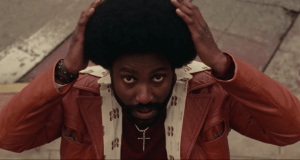 It’s at its very end where the film reminds you just how sadly relevant it still is today (minor spoilers but I don’t think they will ruin anything for you). While Stallworth has bested the local chapter of the KKK, there’s another late night with a sudden alarming noise, Stallworth on his guard, and a cross is burning out in the distance. Just because our characters have foiled a band of racists doesn’t mean racism has been eradicated. Instead, as the film suggests, it evolves, and Lee concludes with an impactful montage of news footage of the Charlottesville white supremacist rally and President Trump contorting to find fault on “both sides” when clearly one side was murderous and racist. You even see real-life David Duke on the premises spewing his re-branded style of hate. The evolution of white supremacy demagoguery has become political, and it has found cover under the guise of a president eager to stoke racial resentments and divisions to his advantage. He’s normalized the abhorrent behavior and given it mainstream cover. It’s a powerful and lasting conclusion (much in the same way as the montage of Hollywood’s harmful depiction of black people in Bamboozled — including the Klan hero worship in Birth of a Nation, also featured here prominently) that should remind people that the threats of racism and Nazis and the KKK are not a thing of the past. It is very much a staple of the present, and how much it is allowed to remain a staple is up to the moral outrage of voters.
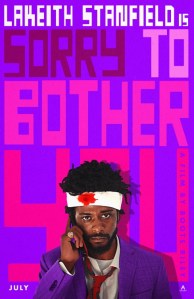 Sorry to Bother You is also sharply cutting and topical about being black in America. In present-day Oakland, Cassius “Cash” Green (Lakeith Stanfield) is struggling to make ends meet, move out of his uncle’s garage, and do right by his girlfriend and performance artist, Detroit (Tessa Thompson). He gets a job at a telemarketer and discovers a new talent when he turns on his “white voice” (voiced by David Cross) and becomes a power caller, crushing his competition. He moves his way up the chain, losing touch with his base of working-class friends looking to strike to unionize. Once at the top, Cash draws the attention of the CEO, Steve Lift (Armie Hammer), who has big plans for a man with Cash’s gifts and seeming flexibility when it comes to corporate moral relativism.
Sorry to Bother You is a wild, hilarious movie bursting with things to say with its shotgun approach to satire, or as my pal Ben Bailey termed, a blunderbuss approach, messy and all over the place and, sometimes, maybe missing its intended mark. I thought the movie was simply going to be about the modern-day struggles of being black and poor in America, and the movie covers those aspects with aplomb. It’s also sized up ample room to satirize consumer culture, labor exploitation and worker rights, male and female relationships, art and media, cultural appropriation, and even memes. Because of all the topics, the movie could run the danger of feeling unfocused, but thanks to the remarkably assured vision and handling of writer/director Boots Riley, it all feels connected by its unique voice operating at a risky but exhilarating level.
 There are a lot of bizarre dips into the absurd that had me howling and on the edge of my seat wondering where we would go next. The most popular TV show is just watching a person get the stuffing beaten out of them, and it adopts a pretty simplistic name to go along with this transparency. A very Google or Amazon-esque company is offering “lifetime jobs” for employees to live in their factories and have all their cares taken for by a corporate slaver, I mean kindly overlord. There’s an art show that consists of hurling cell phones at a woman’s body. There’s a corporate video with a female caveman narrator where she is, 1) stop-motion animated, and, 2) topless the entire time, complete with animated swinging breasts. There’s an ongoing thread that seems to trace the life cycle of a meme. A woman throws a Coke can at Cash in protest. She gets plucked form obscurity, gains a talk show, gets an endorsement from Coke and her own video complete with dramatic re-enactment and chirpy jingle, and Cash getting hit becomes its own Halloween costume for white people. There are throwaway lines in this movie that any other major comedy would die for. This is a movie that is impossible to fall asleep to because every moment could be different and you won’t want to miss one of them.
There are moments that strike beyond the immediacy of the onscreen absurdity. One of those moments was when Cash was invited to join the big corporate after party. He’s out of his element, surrounded by rich, relatively young privileged white people. They assume, being black, that Cash will instinctively know how to rap, and they insist that he perform a free-style rap for the assorted group. This ignorant assumption is just the start for Riley, because Cash gets up there and struggles to perform, barely able to scrap together the most elementary of rhyme, and the illusion has become dashed with the crowd. He notices they’re losing their interest with him, so in a desperate ploy, he just shouts two words over and over into the microphone with enthusiasm: the N-word and a profanity. He does this for like a minute, and the crowd of privileged white people shouts it back at him, seemingly lying in wait for some tacit permission by “popular music” for them to likewise use the N-word. It was an indictment that went beyond that scene. Another is ultimately what happens to the big bad corporation by the film’s end. It literally made me guffaw because it felt completely in place with the tone of the movie.
 All of this zany and funny stuff would feel passing if there weren’t at least some characters worth our time. Cash is an engaging young man trying to get his life on track. He discovers he has a gift when it comes to coding, to blending into a white-majority community in a comfortable and acceptable manner. It’s a survival technique many African-Americans have had to perfect on a daily basis, and soon to be featured in the upcoming adaptation of the best-selling YA novel, The Hate U Give. Even amidst its more bizarre moments and asides, the movie is about a black man trying to get by with limited opportunities in a society that too often devalues him.
Stanfield (Get Out) has been a strong acting presence for some time, first in the remarkably powerful Short Term 12 and most recently on Donald Glover’s Atlanta. He grabs your attention and Stanfield has a gift for comedy, particularly a nervous energy that draws you closer rather than pushing you away. His character goes on the rise-and-fall path, so we still need to be pulling for him to turn away from his newfound egotism, and Stanfield keeps us rooted. Thompson (Thor: Ragnarok) is Cash’s conscience and her wardrobe and accessories are amazing, from her declarative “The Future is Female Ejaculation” T-shirt to her large earring messages. Hammer (Call Me By Your Name) is confidently smooth and sleazy as a coked-out, venal CEO that is so blasé about his wrongdoing that it doesn’t even register for him as wrong. I appreciated that even with all the wackiness of this cracked-mirror version of our universe, Riley puts in the time and effort to make the characters count rather than be expendable to the satirical aims.
Now, there is a significant turn in the third act that veers the movie into territory that will test how far audiences are willing to go along with Riley’s raucous ride. I won’t spoil what happens but for several of my friends it was simply a bridge too far. For a select few, they even said this turn ruined the movie for them. It worked for me because it felt like an escalation in the dastardly labor practices of the corporation and was finally a visceral reminder of their cruelty. Beforehand, Cash has been making moral compromises to keep his ascending career, excusing the after effects of his success even when it’s selling weapons to foreign countries. That stuff is over the phone, part of his coded performance, and easier to keep out of mind. This escalation finally is too much to pretend to ignore. It’s too much to excuse his own culpability working for the enemy. It’s what pushes Cash back to his circle of friends he had left behind for the corporate ladder, it’s the thing that politically activates him, and it’s what pushes him to make a difference. I can understand, given the somewhat goofy nature of the plot turn, that several viewers will feel like Riley gave up his artistic high ground to self-indulgence. However, I would counter that the line between self-indulgence and an assured vision can be tenuous. The movie is so alive, so vibrant, and so weird, so having another weird detour felt agreeable.
 BlackkKlansman and Sorry to Bother You are each unique and fun but with larger messages to say about the black experience and other fissures within our volatile society. You’ll be thoroughly entertained by either film and you’ll walk away with something to ponder and discuss with friends and family and maybe that one racist uncle at Thanksgiving, the one who uses the term “false flag operation” a little too liberally. BlackkKlansman tells a fascinating, comic, and thrilling story about racism of the past, drawing parallels to the trials of today, in particular under the era of Trump. Sorry to Bother You has many targets, many points, and much to say, exploding with thoughts and cracked comedy. Riley is holding up a mirror to the shortcomings and inanities of our own society and the ease we can all feel to turn a blind eye to the difficult realities of systemic racism, capitalism, and worker rights. Lee is a known firebrand and his polemic doesn’t shy from its political relevancy, but it tells a highly engaging story first and foremost, with top acting performances from its cast. In a summer of studios afraid to take chances, here are two excellent movies that take crazy chances and provide bountiful rewards.
Nate’s Grades:
BlackkKlansman: A-
Sorry to Bother You: A-
Share this:

The Equalizer 2 (2018)
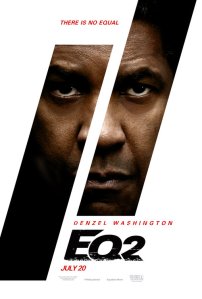 The Equalizer 2 is lucky that the threshold for entertainment is just low enough to cover even middling affairs where Denzel Washington dishes out righteous justice to the cocky criminals and ne’er-do-wells of the world. This is very much a strict formulaic second entry for 2015’s original movie, based on the TV series. It’s lesser in just about every regard although it returns Washington, director Antoine Fuqua, and writer Richard Wenk. It’s hard not to feel like a paycheck venture where everyone went on some autopilot. The plot takes a bit long to get into gear and it’s desperately missing the first movie’s lead mob investigator to create an enticing game of cat and mouse. I miss the gradual escalation, as Washington’s character gets in worse and worse trouble as he moves up the ranks of the Russian mafia. I would actually say Equalizer 2 is a movie that peaks in its first act (my favorite moment was an episodic dishes of violent retribution with a group of arrogant sexual assaulters). There just isn’t anything truly memorable here. The action can often feel murky with how it’s been photographed, and there is the occasional questionable quirk that would take me out rather than fully engage (baking flour is combustible now?). There is a satisfying storyline where Washington reaches out to an at-risk youth to dissuade him from joining a gang. It has some nicely drawn character moments that feel meaningful, but then it’s back to the grind of whatever an Equalizer movie means in the twenty-first century. I enjoyed the first Equalizer as a modern-day Canon action vehicle with some pretty sickly entertaining deaths and taut action/suspense sequences. It was a movie that made its presence felt beyond Washington’s cool charisma. With the sequel, all we’re left with is Washington’s charisma performing the heavy lifting.
Nate’s Grade: C+
Share this:

Mission: Impossible – Fallout (2018)
 Coming down from the surging adrenaline rush, I was trying to determine when was the last time an action movie made me feel the immersive, delirious highs that Mission: Impossible – Fallout offers in spades, and what I came up with 2015’s Mad Max: Fury Road. Simply put, this is the best straightforward action movie in three years. It’s the best Mission: Impossible movie in the series, which, if it hadn’t already, has assumed the peak position of the most consistent, most entertaining, and best action franchise in Hollywood. Allow me to explain how returning writer/director Christopher McQuarrie (Jack Reacher) makes an action movie that demolishes the competition.
Ethan Hunt (Tom Cruise) has been pulled back into spy action thanks to the lingering fallout (eh, eh?) of the capture of Solomon Lane (Sean Harris), whose followers, nicknamed The Apostles, have stolen three plutonium cores. It’s Ethan Hunt’s fault the nuclear cores got loose, and so he and his team, Luther (Ving Rhames) and Benji (Simon Pegg), must clean up after their mess. The CIA sends its own asset, the burly August Walker (Henry Cavill), to help oversee the mission and specifically Ethan Hunt, who must pose as a shadowy terrorist broker to maintain appearances with important figures in the criminal underworld. In order to get the nuclear parts, Ethan Hunt has to retrieve Solomon Lane and release him back into the open. Complicating matters further is Ilsa Faust (Rebecca Ferguson) who needs Solomon dead to clear her own spy debts.
 Every action movie lives or dies depending upon its unique set pieces, often the first thing constructed by a studio and then the plot mechanics are ladled on merely as the barest of connecting tissue. They need to have stakes, they need to have purpose, they need to be memorable, and they need to be understood and develop organically. Mission: Impossible – Fallout could be taught in filmmaking schools about how to properly build action set pieces. They are brilliant. McQuarrie finds interesting ways to set them up, complicate them, and just keep the escalation going in a manner that still maintains the believability of the moment. Take for instance a foot chase where Ethan Hunt is trying to nab a bad guy through downtown London. Where McQuarrie pushes into the extraordinary is by having that foot chase on a multi-level terrain. Ethan Hunt has to chase after his target but multiple stories above the ground, and so he’s leaping out windows, jumping over rooftops simply to keep up. It’s a simple twist that takes what we’re familiar with and, literally, elevates it to new heights. Or take for instance the mission in Paris to capture Solomon Lane. At first it’s capture, then it’s flee police, then it’s flee another assassin. There are multiple stages to this sequence, each with a new goal, each with new complications, and each with new eye-popping stunts and escapes. The action finds natural points to progress, making smart use of the geography, and keeping different elements at play to come in and out to add more problems. This is how you do action right. As soon as the half-hour mark settles in with the arrival of Walker, the movie is practically nonstop in its set pieces until the very end. At a steep 147 minutes, this is the longest Mission: Impossible movie yet but it’s breathless in its execution.
Amazing set pieces that are cleverly designed is one aspect of a great action movie, but if you can’t tell what’s going on, what’s the point of all that cleverness? Fortunately, McQuarrie understands this and adheres to a visceral depiction of the action that creates gloriously immersive and pulse-pounding sequences. The set pieces are terrific, so it stands to reason the stuntwork should be terrific, and to make sure you appreciate the stuntwork, McQuarrie makes sure the photography highlights the verisimilitude. It’s a symbiotic (or as the Venom trailer tells me, “sym-BI-oat-ic”) relationship but when done correctly, as evidenced in this film, it’s the key to truly kinetic action sequences. Take for instance a parachute jump that marks the start of the second act. McQuarrie films it as a sustained long take, and as the camera plummets to the ground chasing after the two men, our brains can tell us that there is some special effects trickery to mitigate the dangers, but our senses are overwhelmed with the sustained illusion of tension. The fight choreography is equally up to the challenge. A bathroom brawl with Ethan Hunt and Walker and another man becomes a lesson in how many things can be smashed and what can be used as a weapon. A high-speed motorcycle chase through Parisian streets gets even more frantic when Ethan Hunt drives against traffic, and the scene becomes even more exciting when McQuarrie’s lens allows us to see the danger in all its glory.
 The Mission: Impossible franchise has been notable for its insane stuntwork but also, chiefly after the second installment, its edict to practical effects and maintaining the believability of its reality. It’s still movie spy shenanigans and globetrotting adventures, yes, but the moment-to-moment thrills feel like they’re really happening. The Fast and Furious franchise has gained great acclaim for the bombast of its physics-defying spectacle, and the Mission: Impossible franchise seems to have gone purposely in the opposite direction. It’s real Tom Cruise jumping off that building, it’s real Tom Cruise riding through traffic on a motorcycle, and it’s real Tom Cruise falling and climbing up a speeding helicopter during the thrilling finale. Cruise has had a death wish when it comes to throwing himself into the high-wire stunts of his franchise, but even at 56 years old he’s still at it, essentially trying to commit suicide on film for all of our amusement. Cruise is one of the few remaining movie stars and his commitment is without question.
This is also the first Mission: Impossible film that feels like the characters matter. It’s a direct continuation from the previous film, 2015’s Rogue Nation, bringing back the (somewhat lackluster) villain, the newest spy counterpart/potential love interest, the CIA and IMF brass, and the essential supporting team members from prior engagements. Because of this it feels more like what happened previously was establishment for a new story building upon that foundation. Rather than starting all over, the characters find ways to deepen their relationships, and the film opens up Ethan Hunt as a character and the toll his duty takes on those closest to him. There are some nice quiet moments that examine these characters as actual people. Several complications are as a direct result of personal character decisions, some good and some bad. I was joking with my pal Ben Bailey beforehand about wondering whether they’d find a way for Ving Rhames to matter, since he hasn’t been much more than “a guy in the van” for four movies, and by God they make him matter. They make each team member matter, finding moments to give them, mini-goals they’re entrusted with. During the dizzying helicopter chase in the finale, supporting players are left with their own task. Luther has to defuse a bomb but doesn’t have enough hands. Benji has to find something valuable in a very needle-haystack situation designed to torment and waste precious time. Ilsa is at cross-purposes for most of the film, not wanting to harm her fellow allies but also being given her own orders to prove her loyalty and protect her future. All of this comes to a head and it makes the parts feel as important as the whole. That’s great storytelling.
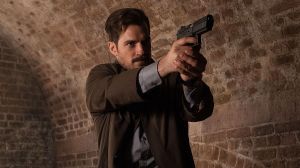 Let’s talk about that million-dollar mustache of Cavill’s. It was a year ago that Justice League re-shoots required Cavill and the Mission: Impossible team refused to allow their actor to shave his mustache, thus leading to that unsettling fake baby lip Superman was sporting in a majority of his scenes in the haphazard Justice League film. I just read an AV Club interview with McQuarrie where he for the first time discusses the whole mustache brouhaha and apparently Paramount estimated that it would have cost them three million for the effects to uphold Cavill’s upper lip continuity. Warner Brothers refused to pay up and so went down that ill-fated CGI mustache-removing route. It was shortly afterwards that Cruise shattered his ankle in a roof-leaping stunt (that is in the finished film and advertisements) and the production had to shut down for a month. If only Warner Brothers had waited, perhaps we all could have avoided this mustache mess.
Mission: Impossible – Fallout is a new highpoint for the best action franchise going in movies today (I’m still waiting for a third Raid film, Gareth Evans). The set pieces are memorable and unique, leading from one into the next with exquisite precision and thought. The action sequences are stunning and shot with stunning photography, highlighting the stunning stuntwork by the best death-defying professionals. It’s the first Mission: Impossible movie that doesn’t climax at its middle; in fact there’s a pretty obvious reveal that feels like it was going to be a late Act Three twist, but McQuarrie recognizes the audience thinking ahead, and there’s like a whole other exciting 45 minutes after. The stakes are better felt because the characters matter and are integrated in meaningful ways. This is the most I’ve enjoyed Henry Cavill in a movie (with possible exception of another spy movie, Man From U.N.C.L.E.), and you know what, his mustache works too. While the vertigo-inducing Burj Khalifa sequence is the best set piece in the franchise, Fallout has everything else beat at every level. Mission: Impossible – Fallout is a reminder that there are few things in the world of cinema better than a properly orchestrated, properly filmed, and properly developed action movie operating at full throttle. This is one of the reasons why we go to the movies, folks. See it in IMAX if possible. Soak it up.
Nate’s Grade: A
Share this:

American Animals (2018)
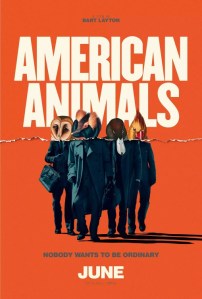 This review is weeks late after having sat down and watched American Animals, and it’s stuck with me in a powerful way. It’s a movie that pulls back the disparity between crime in the movies, so stylized and slick and carefree, and crime in real life, often traumatic, dehumanizing, and with lifelong complications for both victim and perpetrator. It’s a movie that examines a youthful sense of ennui that their lives are missing out on something extraordinary, and a step too far over a very clear moral line thanks to a fantasy given shape by escapist movies and other media. It’s also a slippery I, Tonya-style look at memory and contradiction but this time from the real-life people involved. It’s an entertaining dark comedy, an unexpected true-crime caper, and most resonating of all, a nerve-wracking thriller that left me morally queasy and unwell, but in a good way. In short, American Animals is one of the best films I have seen so far in 2018.
In 2004, at a small Kentucky liberal arts university, four young men are planning their own version of the “perfect crime.” The school has a rare books section including an original copy of Darwin’s Origin of Species and a large and valuable edition of John James Audobon’s The Birds of America. The books are appraised at $12 million dollars. Spencer (Barry Keoghan), an art student, teams up with Warren (Evan Peters), Erik (Jared Abrahamson), and Chas (Blake Jenner) to plot a daring heist. The men feel like their lives are missing something exciting and a heist is just the ticket. They just have to break in, steal the books, and subdue a librarian (Ann Dowd). Easy stuff, right?
 For the first half of the movie, American Animals plays out like a dark comedy. I had no prior knowledge that we were going to get the real-life subjects appearing as themselves in interviews cut throughout the film (their family members are still actors though). The film even plays around with this narrative hook for a few laughs, making quick cuts for punchlines and trying to square conflicting accounts, like having one scene alternate between two locations in dispute of its telling. It also helps set one of the major themes going forward in a nimble fashion, namely the difference between the reality of events and the whimsical, fantasy movie version of what an excursion into crime would be like. Having been bred on cinema’s glorified depictions of heists, the guys come to assume that a heist is sexy and fun and something that doesn’t end up hurting anyone. There’s a charming quality to the fact that Spencer uses his art skills to create models of the rare books room. There’s a laughable ingenuity to the fact that they’re planning on holding the heist in the middle of their class exams, since who would suspect students during that important time? There’s a bemused naiveté about the power of their disguises when they dress as a shuffling group of old men in powdered faces. We’re set up for a funny story about bumbling students falling all over themselves at attempted criminal shenanigans.
I was expecting a relatively light movie just from the plot particulars. It’s a heist film and the goal is to steal a bunch of books. It seemed small-scale in scope and anodyne. What trouble could a group of students get into attempting to steal books? Writer/director Bart Layton (The Imposter) seems to know this, lulling the audience into a false sense of security. He even teases the movie version of what the heist might be like, with our characters suavely stepping into their parts with practiced precision, all while music reminiscent of the Ocean’s Eleven franchise hums in the background. This is the cool-movie version, the version the characters have fantasized over in their minds, and the version that the audience is more attuned to expect. What we actually get is something very different. The heist itself plays out in excruciating detail and it runs counter to their planning. The reality of subduing the librarian is upsetting. It’s supposed to be so simple, after all, but the reality is anything but. The characters almost avoid this whole scenario, aborting their heist only to return back to it the next day. You feel the anguish of how close they were to turning away at several steps, the moments this ordeal could have been avoided, and yet fate barrels onward, energized by a misplaced sense of purpose. American Animals doesn’t let you or its characters off the hook either. I was fidgeting and sweating nervously throughout the heist and its subsequent fallout. Again, this is all about a bunch of stolen books, and I was beside myself with anxiety.
 It’s only afterwards and looking back that you realize how masterfully Layton has built up his scenes and the necessary information to make you squirm. With every heist, the particulars of the setting, the challenges and tight window need to be established, and once that occurs, we’re hoping for unexpected complications. But in order for those unexpected consequences to really hit hard, we have to be trained with what Plan A was going to be, and American Animals does this superbly. People have their designated roles and areas they refuse to partake in, like Eric makes it clearly known he will not be responsible for subduing the librarian in any way. Of course, you can expect what will eventually happen, pushing his character to an even more uncomfortable place. I was very appreciative that there’s an extended resolution after the heist, where the guys try to unload the books to a seller, and the further complications. You really feel the screws being tightened and the overwhelming feeling of dread. It’s another confirmation for me that I’m just not cut out for a life of crime. The day-to-day anxiety is just too much.
I left this movie feeling a strange mixture of jubilation and sadness, still reeling from the expertly developed and executed moral tension. The technical skills are just as strong, each working in succinct harmonious sequence to bring about Layton’s vision to startling effect. The editing is extremely tightly constructed. The smooth cinematography by Ole Bratt Birkeland frames the tension and comedy expertly, and the ominous music by Anne Nikitin kept me on the edge of my seat. It’s almost like a full-blown David Fincher film by the end. The acting is another strong point, with each actor initially relegated into a stock role (“The Muscle,” “The Wheelman,” etc.) we’ve come to associate with these kinds of movies. The film nicely pushes the characters beyond a casual, cursory understanding, blurring the lines of who they are as they blur lines of their own. A surprise standout is Blake Jenner (unrelated to the Kardashians/Jenner clan) who joins the team the latest, seems like a stereotypical rich jock lunkhead, but when he breaks down and articulates why the team is as screwed as they are, his clarity can catch you off guard. He’s the first to realize they’ve trashed their lives and are doomed and for nothing. Also deserving of praise is the always-wonderful Ann Dowd (The Handmaid’s Tale); your heart hurts for this poor woman who is confused, scared, and undeserving of her harrowing ordeal.
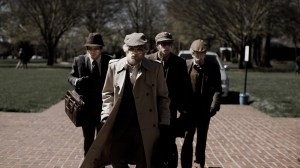 American Animals hasn’t been able to leave my thoughts for weeks, which is usually the sign of a pretty good movie. It upset me. It rattled me. It entertained me. Most of all, it made me think, about the lines people cross in the name of missing out on some vague sense of grand experience, of the differences between the reality of crime and our appealing fantasy versions of crime, and why those stories appeal to us in general. I kept thinking about the pain these four men had caused themselves and others and their regrets. I kept thinking about how smartly Layton utilizes documentary storytelling techniques to enhance his film as well as better examine the disconnect of reality-versus-movies. It’s a movie that could have been told as a documentary but excels best as a hybrid of the two, one that challenges our conception. I’m shocked it wasn’t credited to a book or news article as its source material, meaning Layton compiled all of this impressively on his own. This is a movie that got under my skin, that made me uncomfortable, but also thrilled me and entertained me from its first minute until its very last. I highly advise looking for American Animals once it becomes readily available.
Nate’s Grade: A
Share this:

The First Purge (2018)
 This is the first Purge movie to exist in the era of President Donald J. Trump, and that has made the films more political and even more oddly relevant. The movies have been pretty upfront about the political machinations of the Purge events from the start, the rich elites (read: white males) using the annual occasion to sweep the world of undesirables (read: poor, minorities). The fourth film, The First Purge, goes back to the origins and it’s even more bluntly political with its commentary. However, when we see children being held in cages in our daily headlines, it’s an affirmation that we may live in blunt times and perhaps we need blunt instruments of dark social satire to get the message across.
The residents of Staten Island have been selected for a social experiment from the governing party of the New Founding Fathers (NFF). For twelve hours, all crime will be legal. Dmitri (Y’lan Noel) is a local gang leader with his eye on his community, making sure his people will be taken care of and protected. His ex-girlfriend Nya (Lex Scott Davis) rejects his outreach, and little brother Isaiah (Jovian Wade) is looking for vengeance against a psychopathic loner in the neighborhood. The creator of the Purge, social scientist Dr. Updale (Marisa Tomei), only wants to see where the data leads. The NFF, on the other hand, have their own motives and will make sure the experiment succeeds at all costs.
 Never has the Purge universe felt closer to our own than with this new movie, and that’s a testament to the film franchise finding new ways to spin its stories, but it’s also an indictment on our own modern times. When we have a president who on a whim, as recently reported, asked why we can’t just invade Venezuela or why we can’t just use nuclear weapons, it doesn’t seem too far away that he might, without a moment’s notice or hesitation, champion a real Purge program. The new movie reflects this reality with even more explicit relevance. The figures of oppression and white supremacy are preying upon vulnerable black and brown Americans. We have militiamen dressed in Klansmen garb, shiny Nazi outfits, police uniforms, and even masks that evoke blackface. These same creatures of hatred have been given a new platform of legitimacy from a president who has trouble saying anything bad about his fans, thus ennobling and enabling the fringe elements into renewed visibility. This is a movie where the citizens of a poor neighborhood have to fight back against the racist elements set to kill them and empowered by the government. If that doesn’t sound eerily relevant today, you haven’t been keeping up with the omnipresent news cycle of outrageous offenses.
Another interesting turn of events is that this might be the first Purge movie that is hopeful about the human race. For three movies, the Purge has celebrated our darker natures, positing that mankind when stripped of responsibility for its actions would inevitably trend toward brutish violence because they could. The core belief of the Purge is that people need a release of the evil inside them, as if there was a finite level. We’ve watched crazy people do wantonly destructive and murderous acts for three movies. The First Purge offers a completely different perspective. Once the event happens, the majority of the “participants” will elect not to engage in casual mayhem and murder. There will be the occasional few acts of vandalism and theft, and an outlying psycho or so (more of that dude later), but the majority of State Island residents just stay indoors, find refuge in their church, or simply attend a block party. They actively disengage. It’s then that the NFF fret that the social experiment they’ve bet so much political capital on will not turn out with the preferred results they need. They need Americans to be afraid, and it also helps eliminate the minority voting bases for their rival political parties. This reality is not to their liking, so they will simply repackage the news to their liking. That’s when the NFF push the reactionary elements (paramilitary white supremacists) to infiltrate and instigate mass death to ensure the Purge experiment is successful. The numbers are skewed, and paying people based upon their level of violent participation may start the process skewed to begin with. In an unexpected bout of optimism,The First Purge argues for the morality of humanity.
 Because of this very purposeful perspective, it also means that the movie is a bit slow and dull for the first hour. The First Purge has the same flaws as the other films, notably an over reliance on jump scares and less-than-interesting peripheral characters. One female supporting player (Mugga) is meant to be comic relief but I found her to be exceptionally grating, like she had been ported in from the sitcom version of the Purge (There is a TV show headed for USA and a commercial for it in the end credits, the first I’ve ever seen that happen). The glowing iris contact lenses of the participants created an eerie mood in place of larger set pieces. Some of the run-ins are actually rather lame, like an armed holdup where the gun is revealed to be… a water pistol. Who is running around pranking people with a toy when actual murder, with actual murder-capable guns, is sanctioned? That’s just beyond stupid. Likewise there’s a crew of people waiting in the sewers to… sexually assault women by grabbing their crotches. It’s a bit odd considering all of the uncomfortable waiting they must endure. I did find the lead character Dmitri to be quietly compelling as he tries to protect his neighborhood. When the final act comes, and Dmitri becomes a one-man wrecking crew taking down murderers in Nazi regalia, that’s when the movie transitions into the action spectacle we’ve been craving. The final fight is righteous and satisfying, and it even brings back a wildcard character you may have forgotten. By its conclusion, The First Purge has packed its best, most exciting stuff, but until then it’s a somewhat somber, somewhat restrained experience that may rankle the blood-lusting audience that had grown familiar with the series’ depravity.
And now we have to talk about the best character in the whole movie, and maybe second best after Frank Grillo’s grizzled badass hero. Skeletor (Rotimi Paul) is a local criminal who seems pretty unstable, prone to violent outbursts and self-aggrandizing talk. Whenever he talks it feels like you need a spittle guard as protection. He either has facial implants of scars running along his exterior, though I’d bet they were self-induced scars. He is, as my friend Ben Bailey attributed, the human equivalent of Roberto from Futurama, a psychopathic stabby robot that would mumble to himself and, very often, stab repeatedly. That is Skeletor, who is so brazenly crazy that he circles around from threat to figure of entertainment, like some 80s slasher villain elevated by personality and execution (not literally). When he reappeared I would chuckle to myself and say, “Oh, what’s that Skeletor going to get up to next?”
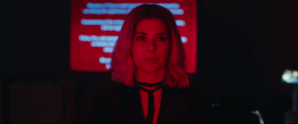 The First Purge is the latest in an unsubtle sci-fi thriller franchise, though this is the first Purge movie to separate itself from its grisly ilk in interesting and thematically relevant ways. It rejects the core pessimistic belief system that human beings, when given the freedom to be violent, will exercise that opportunity. This is the first questionably (naively?) optimistic Purge movie, even though we know what comes after. It’s a bit slow and still beholden to the overall staid formula of the franchise, but this is a Purge film with enough sharp contrasts and a streamlined thematic perspective that it stands out. I won’t say it hits the peak of 2014’s Purge: Anarchy, but I would easily call this the second best entry in the franchise. In Trump America, it’s scary how relevant these movies have become and it’s refreshing they haven’t shrunk from that unexpected relevance.
Nate’s Grade: B
Share this:

Gotti (2018)
 The John Gotti biopic has become somewhat notorious because of its 0% rating on Rotten Tomatoes, not that this is the first film to hit that dubious mark. It is bad, though not quite 0% bad. The biggest crime of this movie is that it at no point solidifies a reason why we should find John Gotti interesting. As played by John Travolta, he’s a ruthless leader who beat so many prosecutors that he was nicknamed the “Teflon Don.” He’s also really really boring, spouting stereotypical bromides about the importance of family, never giving an inch, never turning on your family (both capital F and lowercase f). It’s a cock-eyed worldview I’d expect, however, at the very end of the movie, the movie itself adopts this cock-eyed justifications, presenting the federal government as the real villains and inserting interview footage of real people eulogizing Gotti, saying he made their streets clean and cared about his community and was, essentially, a hero. It’s amazingly misguided, like director Kevin Connolly (“E” fro HBO’s Entourage) has suffered Stockholm syndrome from his lunk-headed, murderous criminals. That same sense of misjudgment is never more adamant than in the musical score by pop star Pitbull. Read that again. There’s a sequence where Gotti goes out on furlough and is escorted to kill an associate, and the musical score is jaunty and uptempo. There were several moments where the score just took my breath away, so tonally disjointed was this mostly modern-day musical score. The movie is structured as an ongoing series of interviews between Gotti Sr. (Travolta) and his adult son, with choice flashbacks interspersed. We don’t even get a rise-and-fall sort of formula. It never provides sufficient evidence why Gotti was interesting at all and worth a big screen biopic. The dialogue feels like it was written with all exclamation points. Nothing is subtle or left to the imagination here, and that extends into the scenery-chewing acting as well from a bunch of unmemorable stock roles. There is also a 1996 TV movie about John Gotti starring Armand Assante. Sight unseen, it must almost assuredly be the better movie and more worth two hours of your precious time.
Nate’s Grade: D+
Share this:

Pure O (2018)
 Ideally, every scene in a feature film should have a purpose, whether it’s pushing the overall story forward, informing us about characters and their interior lives, setting up plot points or jokes, or establishing the atmosphere and way of life examined on screen. This is even more necessary with shorts simply from the truncated run time. I was asked to review the short film Pure O, produced by several hard-working, creative types in the Ohio film community. Confession: I know several of the people in front of and behind the camera with this project. I will hold as much of my personal bias back and judge the film on its artistic merits but I thought that should be mentioned upfront.
Pure O follows Purity Oglander (Stella Singer), the lead singer and guitarist for a grunge band on the verge. She also suffers from a mental condition called Pure OCD (sounds almost like a misguided Calvin Klein cologne), which is an intrusion of harmful thoughts and visions. These thoughts don’t necessarily translate into action but the worry for the recipient is that they might. Purity must navigate her mental illness, the stigma attached to mental illness circa the 90s, and work up the courage to get the help she needs.
 It feels like the narrative terrain Pure O mines is our protagonist’s question over who she really is and if she’s ready to embrace change. She’s a local musician who we’re told, via long successions of handy answering machine voice over exposition, has a band “O” on the cusp of its big break. Even titles appear onscreen to tell us this is her “last day of obscurity.” This is a prime conflict as it can push a character outside of their comfort zone and transition from an old life into an uncertain new one. The problem is that this is kept much more as a backdrop of potential conflict; it’s background seasoning. I’m also curious how different her band’s big break is going to be if they’re playing on low-rent, Wayne’s World-style public access television talk shows (“The Mr. Dick Show”). The fact that she blows off this rinky-dink performance and her label is ready to drop the band makes me think that they might not have been so close to that last day of obscurity after all. It’s also not like Purity is returning to her old stomping grounds and reflecting on its influence before she’s whisked to a new level of fame and fortune. She’s still home and presumably with the same people as before.
The larger intended focus of acceptance is with her mental illness. That’s an interesting starting point for conflict and an opportunity to visualize some pretty alarming imagery. I was confused whether Purity was just now getting these intruding thoughts. It felt like she had to have had these thoughts before, but her reactions to them seemed so sudden and new, the question over what is going on rather than the recognition that these dark impulses have returned. I think the stronger narrative would have been the acknowledgement that she’s already been struggling to live with these thoughts. That doesn’t mean they are normalized but that it’s not some sudden mental break. I don’t know if there’s any rhyme or reason for what triggers these outbreaks, but we’re treated to two instances or her envisioning brutal assaults and murdering innocents. It’s intended to be a shock to the system, and it delivers mostly, but the overall film tone hampers that.
 If I had to single out one element that holds Pure O back from its stated intentions of writer/director W.M. Weikart (Insidious Whispers), that would be its mishmash of tones. There are some pretty significant tonal divergences here with the incursion of psychological horror, but really it’s more the depiction of its everyday world as something akin to a wacky network sitcom. The supporting characters add little to the larger story. They seem to be serving as auditions for a crazy roommate sitcom. There’s the Dickish Dude (Dan Nye), the Soft-Spoken Brainiac (Ann Trinh), Oblivious Girl (Lauren Paulis), Annoying Self-Involved Sister (Sara Morse), Concerned But Out-of-Touch Dad (Carl G. Herrick), and then there’s the even smaller supporting characters of Sardonic Goth Waitress (Kira L. Wilson), Pathetic Local Host (Joe Kidd), and Lisa (Iabou Windimere), a roommate who paints varying degrees of the same circle. Does that sound like the kind of cast of characters for an examination on the crippling effects of mental illness? It feels like an overdose of quirk that doesn’t materialize into something greater or related to Purity. The visit with Purity’s friends amounts to reminding her of the stigma of mental illness, but this same point is served in the next scene with the family lunch when her sister makes the same points. If these characters are meant to reflect our heroine’s journey to some road of acceptance, it’s hard to take that evolution seriously because it’s hard to take them seriously. The sentimental conclusion with Purity getting the help she needs, with the support of her immediate family, feels like another example of a clashing tone keeping the film from gelling properly.
The problem for me is that Pure O didn’t quite earn that hopeful, well-traveled ending. The characters were amusing in their brief encounters but didn’t feel like they contributed to the overall larger story. They felt like holdovers from a larger universe of stories making a “special guest appearance.” They felt less like people. That would be fine except I believe we’re meant to feel that sting of hope by the end, that Purity’s family is supporting her accessing therapy. It works, but the ensuing 18 minutes feels cluttered as far as the path taken to get to this conclusion. I think the friends could have been cut entirely especially if the aim is to make Purity feel more like an outcast floating by. It doesn’t feel like all the stops along the way accomplished the goal of moving toward self-acceptance. I’m hard-pressed to really think why she gets the help she needs except for an outpouring of support via answering machine exposition dump. But even those are in response to her near catatonic walk-off from the TV gig, a response that doesn’t seem to earn the outpouring of concern. She does get a phone call from Betty Bosey (Danielle Vettraino), the girl everyone else mocks for being crazy, so perhaps that’s intended as a reminder of self-care.
 There are many merits to Pure O. The acting is fairly good throughout and Stella Singer (Choices) is an excellent choice as a lead. She has great moments. Her character is very passive for the majority of the short film, either being talked to or keeping the intruding voices/thoughts at bay, which causes her to feel like a passenger too often. Singer has such a striking, expressive face (seriously, she looks so different with her hair up versus down) that I wanted her to have more opportunities to stretch her acting muscles. It may be fresh in my mind, but she reminded me of Lola Kirke (Gemini). This is a professional looking and edited short film. Even the opening concert scene impressed me with how it was able to tie together an effective looking stage experience. The 90s aesthetic feels very gamely committed, none more so than in wardrobe where each character almost feels entirely defined by a color or extreme look. The strict adherence to stylized costuming does a smart job of telling you about the characters in visual ways, already cuing you without wasting precious time. The sound design is excellent, with the collage of negative voices crashing against her brain like the oncoming surf. The line, “It all went to hell after Karen Carpenter pierced her clit,” is a wonderful non-sequitur that took my breath away. The strange humor of a low-budget public access TV talk show was amusingly absurdist, complete with talking pine tree sidekick and break dancing robot. It’s the kind of show that seems destined for a dedicated YouTube life. My favorite genuine moment is the small conversation Purity has with Betty Bossy before she checks into her therapist’s office. It’s slow and develops Betty’s character effectively in small strokes, discussing her life decisions and corrections. It was the moment in Pure O where the characters onscreen felt like living, breathing people and done with a degree of subtlety. The fact that everyone else mocks Betty is just another indication of their general flippancy.
 Pure O is a well-intentioned short film with fine attributes, both in technical matters and with its troupe of actors, notably the compelling lead heroine, Stella Singer. The variety of supporting characters will keep you watching since it’s something new every few minutes; however, the glut of characters also detracts from the drive of the story and its aim toward Purity learning to accept her mental illness. The inconsistent tone also poses as a distraction from the narrative goals, making the serious stuff feel less serious and the comic asides feel like they’ve been retrofitted from another project. This marriage of tone could have worked, but this calibration doesn’t quite get there. I do think people can get entertainment from Pure O (after all, the time investment is pretty accessible). It feels like a glimpse of a larger story, one worth developing into a tighter, character-driven plot with less wacky side diversions. Still, congratulations to the many talented people who pooled their efforts and brought a short film into life. Pure O is an intriguing yet flawed start to a character and a world worth further exploration. But if this is all we get, at least there was a break dancing robot to go with my Karen Carpenter pierced clitoris aside.
Nate’s Grade: C+
Share this:

Gemini (2018)
 Dear reader, I want you to know upfront that I’m writing this review for one major purpose, and that is to complain about its ending. Had this movie ended differently, I probably would have simply postponed writing about it. Then writer/director Aaron Katz (Land Ho!) went with his ending, and now we need to talk about Gemini, a neo-noir set in the world of movie stars, paparazzi, and sycophantic hangers-on in the city of angels.
The beginning thirty minutes do a fine job of establishing a world and perspective. We follow the day-to-day of Jill (Lola Kirke), a personal assistant to a popular actress, Heather Anderson (Zoe Kravitz). She deals with pushy directors, invasive press, and boundary-blurring fan interactions. She’s Heather’s support and one of her best friends. Katz does a very effective job of establishing Jill’s world of responsibilities as well as her confusing sense of where she fits in this equation. Is she more hired-help or BFF? Heather backs out of a movie and talks about starting her own production company, with Jill and her developing projects that appeal to them. That night, Heather is fearful that someone has been following her and asks for a gun. Jill gives her one, loading the bullets. The next day, Jill comes back to Heather’s palatial home and finds her dead on the floor and the growing realization that she is the number one suspect (her fingerprints are on the gun).
 That’s the first third of the movie and it works well. Katz’s screenplay slowly builds, organically establishing the complicated world of Jill and her general sense of being an outsider wherever she goes. Once the murder takes place, Gemini becomes more recognizable with its film noir elements, as Jill adopts a disguise and investigates a series of suspects that could have killed the starlet, including the director she spurned and an old boyfriend who has trouble letting go. This is also where Katz introduces a new threat in the presence of Detective Edward Ahn (John Cho). He’s a calm, empathetic man but he always seems to know more than he lets on, asking probing questions that Jill doesn’t feel comfortable answering. Each new trip to a suspect presents a different mood and aim. Jill’s visit with the director becomes a humorous sit-down where the guy theorizes who is guilty if it were a movie, finally concluding it would probably be Jill as a twist. Jill infiltrates the ex-boyfriend’s hotel room and has to avoid detection and it is an efficient small-scale suspense sequence. All the while the detective appears to be circling something.
The are several merits of Katz’s film that are worth mentioning. The acting is generally good all around, especially from Kirke (Gone Girl, Amazon’s Mozart in the Jungle). She’s a natural screen presence while still radiating a sense of relatability. There’s a lot going on behind those saucer-eyes of hers and I wish the movie served her better by the end. Kravtiz (Rough Night) and Cho (Star Trek Beyond) are both unpredictable in different ways, making the audience glean extra subtleties from their guarded performances. The sleek cinematography by Andrew Reed (Cold Weather) deals in cool teals and purples, creating a hazy, 1980s-esque atmosphere without becoming annoying omnipresent like in a Nicolas Refn film. It’s style without being eaten alive by it (Neon Demon broadside?). The musical score by Keegan DeWitt (Hearts Beat Loud) is suitably moody, working in typical noir elements like brass instruments with a modern ambient sensibility. Under Katz’s direction, the movie has fun with introducing classic noir tropes and giving them a twist, as well as diverting from them, like our heroine being an ordinary outsider.
And now comes the part where I must discuss the ending to Gemini and, in doing so, will spoil the movie significantly. If you’d like to continue reading and understand the bulk of my grievance, please proceed ahead with spoilers. This has served as your warning, dear reader.
 As the film is nearing its end, it looks like Heather’s secret bisexual fling is being presented as the most likely candidate. The two of them were caught smooching by a late-night paparazzi and this could present some career problems. Jill sneaks away from the supposed lion’s den and heads out to a cabin in the California woods, the spot the fling was talking to. She enters the cabin and finds… Heather there alive and well. You see the dead body in Heather’s home was not her but the super eager fan they had encountered earlier, a look-alike made more obscured with parts of her brain missing. Apparently Heather killed her because she was stalking her and she feared for her life, or so she says. She hid out and waited for everything to die down. Jill is understandably very angry especially since she became the prime suspect. Heather is sorry but not that sorry. Do the crime scene investigators not take fingerprints? Blood samples? I’m uncertain of the timeline of Gemini but this fake-out could only last a couple days, charitably. It creates suspicion that there’s more than Heather is willingly admitting.
This sets up an exclusive interview with a big journalist, the first point in re-branding Heather after the news came out, and trying to push the narrative in the direction they want. Then all of a sudden Detective Ahn shows up at the taping and asks if he can watch as a favor. Jill considers this, confirming the case is closed, and allows it. All right, it’s at this point where all the major players are together in a crucible of secrets. Something good is going to happen, because why else bring these characters together in this moment? And then as the interview begins and Katz’s camera slowly pans over to the L.A. skyline and slowly zooms in, and this is where I started yelling at my screen. This is not an ending. This is five minutes away from an ending. The comeuppance of a starlet thinking she can get away with anything and put upon her vulnerable and faithful assistant is all set. The instincts of our wily detective will be proven right. Jill will have become a stronger character, able to suss out the truth and cut off a destructive force. Justice will be had, the truth will come out, and it will feel like a natural climax of the entire 90-minute movie. And then none of that happens. Nothing happens. It’s all setup and then the L.A. skyline (end spoilers).
Gemini is a frustrating movie with good acting, a dash of style, and some potently moody moments to tickle a neo-noir enthusiast. Until the ending. I was flabbergasted. Katz delivered a cop-out of an ending, and subsequently makes his overall film one that I don’t even think I can recommend, even to neo-noir acolytes. Gemini, I wrote this review because of your ending and I’m still waiting on one. I’ll be here if you need me.
Nate’s Grade: C
Share this:

Jurassic World: Fallen Kingdom (2018)
 There has always been an element of suspension of disbelief with the Jurassic Park films even with the hubris-pushing premise, but the sequels specifically have had to manage a rising tide of incredulity and sense of dumb. You can only keep going back to a dinosaur-infested island or thinking this time mucking with the DNA of large, extinct, highly advanced killing machines will be different. Jurassic World: Fallen Kingdom may be the dumbest yet, and while it does have moments of fun and excitement, the dumb outweighs all else.
Years after the deadly attacks at Jurassic World, the volcano on the island has reactivated and the remaining dinosaurs are in imminent danger of another extinction (except for the flying ones, but whatever). Claire (Bryce Dallas Howard), with sensible footwear this go-round, is looking to raise money and awareness to save the thunder lizards. A wealthy magnate (James Cromwell) wants to save the dinosaurs and whisk them to a wildlife preserve far from mankind, but first they must secure the raptor Blue, and in order for that to happen Claire needs to convince her former flame and co-worker Owen (Chris Pratt) to go back. They venture back to the endangered island only to run into more trouble from stampeding dinosaurs, new super predators, and a plot to house and sell the creatures off the island.
 Maybe it’s just a side effect of being the fifth movie in a generation-spanning franchise, or maybe it’s a holdover effect of the 2015 film’s meta-commentary about audiences becoming complacent with what used to inspire awe, but it feels like returning screenwriters Colin Trevorrow (The Book of Henry) and Derek Connolly (Safety Not Guaranteed) couldn’t be bothered picking a tone or developing their plot. It reminds me of the seventh season of HBO’s Game of Thrones, specifically the back half of episodes. It felt like the creators had certain conclusions in mind and rather than smartly develop storylines that would naturally reach those conclusions, the “how” of the narrative became jumbled, confounding, and frustrating. I felt the same way while watching Fallen Kingdom; the stylish set pieces were likely established first and foremost and the stuff in between, you know the story and characters and their interaction, was given far less attention. It didn’t matter how we got from one set piece to another. This lack of consideration leads to many moments that keep you from fully engaging with the movie, namely dumb and/or awful characters doing dumb things for dumb reasons. The conclusion of Fallen Kingdom seems meant to leverage interest in a third movie, which is already scheduled for release in 2021. Was this 128 minutes the best way to get there?
When people repeatedly do stupid things, it tests your limits of empathy. This happens to me with horror movies and it happened for me with Fallen Kingdom. It’s the kind of movie where a little girl runs into her bedroom and hides under her covers from an approaching hungry dinosaur. The ensuing image of the stalking beast entering the bed with the claws is a killer image, but what did we lose getting here? This little girl was not established as some dumb kid either. The preceding hour showed her as resourceful and plucky, so this just erases all that. There’s another moment where characters have to choose between escaping through an ordinary door or an open window and crawling along the edge of the roof… and guess what they choose. This is the kind of movie where characters will be in danger and then, hooray, another character arrived in time to save the day, and then another character arrived to save the shortly-after next day. Then there’s a bad guy who enters a dinosaur cage simply to retrieve a dino tooth for his personal necklace of dinosaur teeth. I’ll repeat that. He’s not extracting them to sell to another bio-engineering company for its DNA (the opening scene presents this very example). He’s removing dinosaur teeth for his own personal decorative hobby. My preview screening groaned in unison loudly at how stupid all of this was. How am I supposed to even enjoy this dumb character’s inevitable death when they’re this dumb and undefined?
 The dumbest action of all is tied to its central premise of saving the dinosaurs. When Jeff Goldblum’s Ian Malcolm (relegated to a two-minute cameo, don’t expect much) was championing letting the dinosaurs go extinct again and the folly of mankind playing God in the realm of genetics, I was right with him, and I’m no GMO spook. Bringing gigantic, killing machines back to life was clearly a mistake as five movies have now shown in great, bloody detail. At some point a lesson must be learned. I know that Fallen Kingdom is meant to imbue the dinosaurs in an animal rights lens, with Claire trying to atone for her time shaping and selling these creatures for public consumption. The animal rights angle never clicked for me. There are moments the film really tries, wanting you to shed a few tears for the fate of these gigantic creatures. Maybe you will, and there are a few shameless sequences to make you (the child sitting next to me was losing it at points). That’s why it’s not enough to have the bad guys have bad guy plans but they also have to be cruel and abusive in their treatment of the dinosaurs. The multi-million dollar ploy to weaponize the dinos also baffled me. Are they going to be that much better than firepower? There’s a reason we don’t just drop hungry lions into our war zones.
The new characters fail to add anything of merit to the story and larger Jurassic world. Cromwell’s Benjamin Lockwood is basically just a John Hammond stand-in (“Oh, there were TWO super rich dudes who funded the research and park now”). He’s confined to a bed for most of the movie and adds little besides his bank account. Then there are the two main team members, computer whiz Franklin Webb (Justice Smith) and med vet Zia Rodriguez (Daniella Pineda). He’s only here for comic relief and to do computer magic whenever called upon, and she’s only here for spiky attitude (she gets called a “nasty woman” for commentary?) and to do medical magic when called upon. Each of these characters is less a person than a handy plot resolution. When the movie transitions into its second half, both of them are kept on the sidelines. Then there’s little Maisie (Isabella Sermon) who has her own secret that really doesn’t come to much of anything and begs further examination. I suppose her perspective relates to a difficult moral choice at the end over the value of life, but she still felt underdeveloped. Even the villains are disappointing with the exception of Toby Jones (Atomic Blonde) as a slimy, one percent businessman looking for new thrills. I wish the screenplay had devoted more time to establishing the rich’s entitled sense of privilege even as it comes to a new world with living dinosaurs as the next big, commoditized play thing to buy and sell.
 With all that said, there are moments of enjoyment and excitement to be had with Fallen Kingdom. Director J.A. Bayona (A Monster Calls) has a great gift for finding the right image and holding onto it for maximum impact. He showcased this in his crafty, brooding, and highly effective ghost story The Orphanage and in his emotionally uplifting and harrowing tsunami survival drama The Impossible. With his first crack at a major studio movie, Bayona comes most alive in its second half when the movie transitions into a haunted house thriller in a mansion of secrets. His command of visuals and mood comes into sharper focus and there are some tense, delightful sequences. As much as I wrote about Fallen Kingdom being a movie of set pieces and little else, those set pieces are actually pretty entertaining. The island material only lasts about a half hour, wasting little time in getting the important pieces in play. There’s one long take inside a submerged capsule taking on water that keeps spinning and ratcheting up the tension that reminded me a bit of Alfonso Cuaron’s Children of Men. There’s another sequence involving a blood transfusion that I thought married comedy and tension better than anything else in the film, and it served a purpose that was credible.
If you can shut off your brain and stuff your mouth with a steady supply of popcorn to thwart your incredulous grumbling, there might be enough to enjoy with Jurassic World: Fallen Kingdom. It’s technically well made and the special effects are pretty good, the photography is evocative, and there are potent set pieces and imagery to stimulate the pulse. It’s loud, dumb fun, but for me, this time, the dumb outweighed the fun.
Nate’s Grade: C


 nathanzoebl
You must be logged in to post a comment.