Blog Archives
Master and Commander: The Far Side of the World (2003) [Review Re-View]

Originally released November 14, 2003:
Without sounding easily amused, this movie really is glorious filmmaking. With Peter Weir’’s steady and skilled direction we get to really know the life of the early 19th century. We also get to know an armada of characters and genuinely feel for them. Russell Crowe is outstanding as Captain Jack Aubrey. His physicality and emotions are expertly showcased. When he gives a motivational speech you’’d understand why people would follow him to the ends of the Earth. Paul Bettany (again buddying up to Crowe after ‘A Beautiful Mind’) is Oscar-worthy for his performance as the ship’s’ doctor and confidant to the Captain. He’’s not afraid to question the Captain’’s motives, like following a dangerous French ship all around South America. ‘Master and Commander ’hums with life, and the battle sequences are heart-stopping and beautifully filmed. It took three studios to produce and release this and every dollar spent can be seen on the screen. ‘Master and Commander’ is fantastic, compelling entertainment with thrills, humanity, and wonder. It’’s grand old school Hollywood filmmaking.
Nate’s Grade: A
——————————————————
WRITER REFLECTIONS 20 YEARS LATER

They really don’t make movies like Master and Commander anymore and that is a detriment to every facet of our society. It took three different studios to bankroll this expensive movie, made all the more expensive by being almost entirely set at sea, a very costly and volatile location. In a just world, this would have been the beginning of a cinematic universe to rival Marvel, and the dashing Captain Jack Aubrey (Russell Crowe) would be as beloved as Captain Jack Sparrow, and children would beg their parents to read the dozen naval adventure novels by Patrick O’Brian. Just imagine lines of children for Halloween eagerly dressed in little admiral outfits with long blonde ponytails. Unfortunately, we do not live in this utopian universe, and 2003’s Master and Commander was the one and only movie we ever got. It received ten Academy Award nominations including Best Picture and Best Director for Peter Weir, winning two Oscars for Cinematography and Sound Editing, two of the only categories where runaway champion Return of the King wasn’t nominated. This is a masterpiece and a prime example of Hollywood filmmaking at its best. It’s just as easy to be transported in 2023 as it was back in 2003.

This movie is still effortlessly engaging and enthralling, dropping you onto the HMS Surprise during the Napoleonic wars. Even the opening text starts to get your blood pumping: “Oceans have become battlefields.” The opening act is a tremendous introduction to life onboard an early nineteenth-century ship, giving us a sense of the many crewmen and their responsibilities, as well as the different pieces working in tandem while under attack from a French vessel. The movie is structured as an elongated cat-and-mouse chase between the two ships, with the English trying to outsmart the faster French ship with its heavy cannons that easily outnumber the Surprise. Each stage presents a new challenge. One sequence involves them setting up a ruse with a smaller ship attached with a lantern to trick the French vessel into following the decoy at night. The constant threat of this sleeker ship getting the drop on them and attacking is always present, turning the opposition into a mythic monster breaking forth through the fog. The tests of command and camaraderie lead to important questions over duty and sacrifice. There are several children manning the decks as well, cadets eager to be the next generation of English warriors. It’s a shocking reality to process through our modern perspective, and it’s made even harder when tragedy befalls these youngest sailors just like any of the other crew. The movie is steeped in authentic details and realism that makes you feel like you’ve dropped into living history.
In 2023, Gabriella Paiella wrote a GQ article titled “Why Are Guys So Obsessed with Master and Commander?” noting its enduring popularity with a certain selection of Millennial men (yours truly included). She theorized part of its ongoing appeal is how wholesome the movie comes across, with depictions of positive and healthy male friendships. Even the dedication to service is depicted in a way forgoing jingoism. This is a deeply empathetic movie about men who deeply love one another. The most toxic depiction on screen isn’t one born of masculinity run amok during wartime but more a division in class amplified by superstition. Pity poor midshipman Hollum (Lee Inglebee), a man who cannot make friends with the crew because they disdain his privilege and will never see him as a better or an equal. He becomes a scapegoat for the bad luck of the ship, as they feel he is a “Jonah,” a curse. Poor Hollum, who sees no way out of this dilemma and literally plunges overboard with cannonball in hand, ridding the crew of their reputed curse (the wind picks up the sails the next morning). Beyond this valuable and sad storyline, the men of the Surprise seem so grateful for one another’s company. It’s a guy movie that invites men to escape to the frontier as an inclusive summer camp (no girls allowed!).

By the end of this movie, as we’re utilizing every nautical trick we’ve learned and preparing to seize the elusive French boat, my body was shaking in anticipation. We’ve gone on this journey and gotten to know a dozen faces, and we feel part of the team to the point that we’re onboard too. Seeing any of these men close their eyes permanently is awful. It’s not just keen military strategy and theory being discussed; we feel the real human cost. A small moment at the end, where a young man asks for help to sew the death shroud of his mentor, just hits you in the guts. Even watching poor Hollum processing his final fateful decision is heartbreaking. I still gasp even today watching Doctor Maturin (Paul Bettany) accidentally shot and then have to perform his own surgery. You feel the highs and lows throughout this voyage because the movie has made you care. The sheer adventure of it all is terrific, but it’s the immersive details and the strong character writing for everyone that makes this movie so special. It’s not just a rousing high-seas tale of bravery but also a stirring and empathetic character piece and absorbing drama.
It’s astounding to me that Weir isn’t still one of the hottest working directors. The Australian has earned four Best Director nominations across three decades (1985’s Witness, 1989’s Dead Poets Society, 1998’s Truman Show) and proven he can handle any genre with any style. He’s only directed a single movie since Master and Commander, 2010’s Siberian prisoner of war movie, The Way Back. In twenty years, we’ve only been given one other Peter Weir movie, and that is a travesty. In a recent interview, Weir confirmed he’s essentially retired from directing. If only time had been kinder to this great director. For comparison’s sake, other famous artists that also have four Directing nominations include Clint Eastwood, Stanley Kubrick, and Francis Ford Coppola.

I assumed Master and Commander would still be good to re-watch in 2023, but I was amazed at how quickly I fell back under the movie’s sway so completely absorbed. It’s the kind of movie where everything just feels so natural, so authentic, and so compelling, where the hard work can be too easily undervalued because it all just feels like a documentary. This movie is so captivating and enthralling and every adjective you can devise. It earns them all. Why oh why did we never get a second of these? There were over a dozen novels as source material at the time of the first movie. According to that same 2023 GQ article, the studio head at Fox, Tom Rothman, explained that he was a lifelong fan of the O’Brian novels, having fallen in love with them as a boy. It took the studio chief using his position to get this kind of movie made in 2003, that’s the level of corporate power necessary to circumvent all the naysayers trying to kill this. I guess rather than mourn the lack of sequels I should count my blessings that we have even one. You were too good for this world, Master and Commander: The Far Side of the World.
Re-View Grade: A
Share this:

Mission: Impossible – Dead Reckoning Part One (2023)
 I was a nominal fan of the Mission: Impossible series after three movies, and it seemed like the American public was feeling the same. After 15 years, it felt like the franchise was considering a soft reboot/shift with 2011’s Ghost Protocol, setting up Jeremy Renner as the heir apparent to Tom Cruise’s super spy, Ethan Hunt (weirdly, Renner was also set up to be another franchise replacement for Matt Damon’s Jason Bourne in 2012). Except what may have been initially planned as a franchise hand-off became a franchise renewal, with a delightfully twisty plot, fun teamwork as they scramble to adapt, and a show-stopping action set-piece that remains the franchise’s high-point, the scaling of the towering Burj Khalifa skyscraper. It also reminded us that not only does Cruise love to run but the man has a death wish when it comes to performing his own amazing stunts. With Cruise firmly back in place as lead, and Renner jettisoned (which also happened after 2012’s The Bourne Legacy), the franchise was further boosted by two of its best additions: actress Rebecca Ferguson and writer/director Christopher McQuarrie. The Oscar-winning Hollywood screenwriting staple was not known as much for his directing efforts, but he became a Cruise confidant after 2008’s Valkyrie, and he’s worked almost exclusively on Cruise projects ever since. He earned the man’s trust and proved a fantastic action director. 2018’s Mission: Impossible Fallout is just blockbuster filmmaking at its high-stakes finest. I was bouncing in my chair with excitement and simply luxuriating in action thriller nirvana.
This time Ethan Hunt (Cruise) and his select team of trusted friends and colleagues are battling a villain terrifyingly relevant to our modern times, especially in light of the screenwriters’ strike – artificial intelligence. The big bad is an A.I. that can control the world’s security apparatus, and it’s become self-aware and resentful of its human overlords. It exists inside a computer console inside a Russian submarine at the bottom of the Arctic ocean under a wall of ice, and the A.I., known as “The Entity,” doesn’t want to ever be found (must be an introvert). If only it was that easy. The world is racing to be the first to claim this unparalleled prize, and the Impossible Missions team has to ensure they can find the location, which of course involves a MacGuffin, this time two interlocking keys to access the A.I. sub station. Can Ethan get there first and can he even trust his own government to do what’s best with access to this kind of power?
 Mission: Impossible – Dead Reckoning Part One is a mouthful of a title. We got a colon, a dash, and a “part one,” a presumptuous gamble that after 160 minutes the audience is going to be ravenously hungry for a continuation in a series that has never had a two-parter before. In short, the movie is a lot, a lot of the same action and renowned stunt work we expect, and a lot of setup and extension that might have been better trimmed by focusing on one movie rather than setting up two. McQuarrie has done this before and been successful without the need of a direct two-parter. For all intents and purposes, Fallout is a direct sequel to 2015’s Rogue Nation, carrying over the same villain for the first time in the series and the ongoing relationship between Ethan and Ilsa Faust (Ferguson). Both of those movies feel complete and satisfying and well-designed in structure and development without needing one part to complete the other. With Dead Reckoning Part One, henceforth known as M:I 7 to spare me from writing this title every time, it feels like an overlong setup. By the end of the movie, our characters know where the A.I. is located but they still don’t know where the sub is or how to get there, which means the entire movie could have been collapsed into a more streamlined venture. Part of this may be the production troubles where they had to shut down and rejigger the plot multiple times from COVID outbreaks, as M:I 7 is the last of the big Hollywood movies to release that was shutdown in 2020 by the devastating pandemic. It all feels a bit overstretched and absent a satisfying conclusion.
The draw of the franchise, and chiefly its 2010s renewal back into the zeitgeist, is still the eye-popping stunts and set-pieces and Dead Reckoning still delivers. Most viewers will likely find the final action sequence aboard a speeding train to be the high-point, and it’s got some wow moments, my favorite is when the train is hanging over a blown bridge and Ethan has to leap from train car to train car before it plummets, oh and it’s all at an incline. It turns each car into a new obstacle to overcome utilizing its specific dynamics, like a dining car with a falling piano to a kitchen with vats of hot grease to avoid. The standout stunt involves Cruise driving a motorcycle off a mountain in a desperate effort to parachute onto this speeding train. However, this whole train sequence didn’t excite me too much, outside of its beginning stunt and the end. Watching men chase one another atop the speeding train, let alone wrestle and fight with knives, only serves to limit what can be done and it reminds me how fake the moment is for a franchise that has made its mark on its daredevil realism. That extended middle feels a bit too much like other Hollywood thrillers and action movies, and that’s what made it disappointing for a series I consider the current gold standard of franchise action.
 A much less heralded sequence around the forty-five minute mark was my favorite, where Ethan is running around the Abu Dhabi airport while the following takes place: 1) Ethan trying to evade federal agents (the dependable Shea Whigham) looking to arrest him, 2) Ethan is trying to find the owner of one half of the MacGuffin keys who happens to be a pickpocket that keeps giving him the slip, 3) Ethan’s team, Luther (Ving Rhames, the only other actor who has appeared in every M:I film) and Benji (Simon Pegg) trying to find a nuclear bomb in a suitcase through the maze of baggage claim and disarm it, 4) the introduction of our villain Gabriel, well, our primary lackey to The Entity, who also happens to be a former IMF turncoat who killed Ethan’s girlfriend and essentially “made Ethan Hunt who he is” following Batman logic. This entire sequence is pure McQuarrie splendor, where it introduces the different characters, several at cross-purposes, lets them loose and then finds organic complications and specific turns that take advantage of the geography as well as the character’s emotional states. I loved it, and it made me hopeful that after a bit of a slow start that M:I 7 was now cooking and would be the prolonged deluge of near-perfect set-pieces that was Fallout. Not so much, but this sequence was indeed good fun.
Another issue I had was that our villain, again more like chief lackey, is so bland. I like Esai Morales (Ozark) as an actor, but the character of Gabriel is such a non-starter. Even giving him the personal history with Ethan feels like an admission that this bad guy has little to offer on his own. I think it’s part of how the character is written but I think it’s also a reflection that he’s the number two behind the all-powerful, scheming A.I., and then he too has a number two (number three?) played by Pom Klementieff (Guardians of the Galaxy vol. 3), and she is so much more engaging as an antagonistic presence. She’s the one driving through cars and stonework throughout Rome to chase down Ethan. She’s the one who fights him in a narrow alleyway, a nicely claustrophobic change-of-pace action moment for a series that gorges on scale. If the true villain is going to be an A.I., why can’t Pom simply be its number two hench-person? Gabriel is redundant and boring and his fight sequences don’t feel believable against this crew.
 There are a couple other storytelling choices that I wasn’t happy with, but I’ll save delving into those for the sake of spoilers. Suffice to say, I hope Dead Reckoning Part Two in 2024 course corrects and we have some welcomed returns. It’s kind of fun to see Kittridge (Henry Czerny, Ready or Not) make his first reappearance since the 1996 M:I and also get so much screen time. He’s essentially the face of the U.S. government infrastructure for the duration of the movie. His clenched-jaw consternation is a nice foil to the always rogue super spy.
Dead Reckoning – Part One is a good but not great Mission: Impossible movie, conceived as two parts and suffering some of the consequences of its over-extension. The thrills are still there, the sturdy production values, the emphasis on the spectacular stunts and fun action set pieces, so any fan of the franchise will find enough to enjoy over 160 minutes. The addition of Hayley Atwell (Avengers: Endgame) as the wily pickpocket who has stumbled into international espionage is great, though she cannot escape feeling like an Ilsa replacement while Ferguson is off-screen for too long. Cruise is still the movie star who delivers the most from film to film, and his high-wire efforts are appreciated. By the end of the movie, the sub is still at the bottom of the ocean, our characters are still in a race to find it, and I wondered why we couldn’t have ditched “Part One.” The answer, as much in Hollywood, is of course money, but I wish this Part One made me more psyched for Part Two.
Nate’s Grade: B
Share this:

Kill Bill vol. 1 (2003) [Review Re-View]

Originally released October 10, 2003:
Breathtaking and stylistically amazing. That’s all there is to it. Can’t wait for part two.
Nate’s Grade: A
——————————————————
WRITER REFLECTIONS 20 YEARS LATER
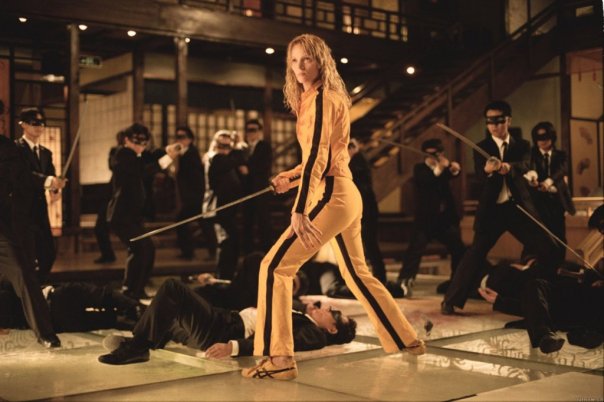
Kill Bill was a turning point in the career of one of the biggest cinematic artists of the past 30 years, and as exciting and stylish as Volume 1 proved, this is the point where Quentin Tarantino vanished within himself and became the ultimate B-movie revivalist. It only took two films for Tarantino to not just become an indie brand name but his own adjective, as Hollywood was flooded with “Tarantino-esque” imitators chasing after the man’s unique voice of snappy pop-culture soliloquies, hard-boiled dialogue, and meta-textual irony. Of course the imitators could never truly capture the full appeal of Tarantino’s movies, overvaluing the surface-level aspects (quirky characters, non-linear plots, unexpected bursts of violence) and missing the greater character depth and thematic intricacies that allow the style to accentuate the entertainment rather than solely serve as that value. 2003 was the crossroads where Tarantino switched from smaller dramas and crime thrillers about semi-recognizable and relatable people (the middle-aged romance in Jackie Brown is the most tender and sincere writing of his career) to remaking and re-packaging his favorite grindhouse exploitation movies. It was like Tarantino himself was following the path of the would-be Tarantino-esque imitators.

Kill Bill began as an idea between actress Uma Thurman and Tarantino on the set of Pulp Fiction; it even feels like a big-screen realization of the failed Fox Force Five pilot that Mia Wallace (Thurman) filmed. Thurman had the idea of the opening, a bloody and beaten woman in a wedding dress being executed only to survive her execution. The idea germinated for years and became two movies worth of material. It’s hard for me to envision Kill Bill as one whole entity because the two volumes feel so thematically distinct. The first is an homage to 1970s kung-fu movies and Eastern cultural influences whereas the second volume serves as an homage to spaghetti Westerns and Western cultural influences. I’m shocked that through the annals of numerous physical media releases at no point has someone released Kill Bill as one whole four-hour movie. It’s only ever been physically screened as such once by Tarantino, and I think the implicit admission is that, while conceived as one sprawling and gargantuan epic, the movies work better as halves that reflect and enrich one another due to that separation. As I wrote in my 2004 review of Volume 2, the first part is the “show” and the second is the “tell,” but what a show Tarantino pulls off.
There was a time where the idea of Tarantino helming an action movie felt antithetical, but he tapped every corner of his encyclopedic knowledge of genre cinema to give us one of the best action movies of all time. The centerpiece sequence pitting The Bride against the Crazy 88s, as well as the ball-and-chain-wielding schoolgirl Gogo, feels like the culmination of a lifetime of cinema geek passion. It’s viscerally exciting without getting boring over the course of twenty-something minutes because Tarantino keeps things shifting, never falling upon redundancies, as if he’s so eager to squeeze in each and every loving homage and reference point. The climax, which again feels so natural an escalation and end point for a “part one,” took eight weeks to film, and the MPAA insisted it be toned down to secure an R-rating (he turned it black and white to obscure the color of the blood, itself another indirect homage to martial arts movies of old when they played on American television). Reportedly over 450 gallons of fake blood was used during the production of both volumes, but this first edition is definitely the more gleefully over-the-top.

The revenge structure is shaped around The Bride (née Beatrix Kiddo) killing the five members of her former gang, the Deadly Viper Squad. Volume 1 only covers two members meeting their just desserts, one of which is the opening scene. That means after the first ten minutes fighting Vernita Green (Vivica A. Fox), we’re working the rest of the movie to the next boss fight. That’s where we get the character dynamics, the obstacles that The Bride must overcome (step one: wiggle your big toe), and the history of O-Ren Ishii (Lucy Lui) and her ascension to Japanese crime lord. With less careful filmmakers, this middle stretch might feel sluggish, but with Tarantino, it’s invigorating as the new world and its many faces connect together to create such an intriguing and engrossing larger picture. Volume 1 provides the structural bones of the story, as well as buckets of sticky viscera, whereas Volume 2 adds the meat and complexity and larger nuance. That doesn’t mean Volume 1 is lacking creativity, it’s just that it’s the half that has to perform more foundational lifting so that those character details and choices will have the larger impact they do. Volume 1 is a long straight line back to O-Ren Ishii, and the accelerating carnage is wonderful to behold.
Thurman has never been better than with her Quentin collabs. After her sudden rise in Pulp Fiction, it felt like her career stalled playing many “hot girl” roles in misfires like The Truth About Cats & Dogs, The Avengers, and of course Batman & Robin. After her Kill Bill revival, her star rose again only to once again falter from more reductive “hot girl” roles in misfires like Paycheck, My Super Ex-Girlfriend, and the movie musical of The Producers. She recently came into the casting orbit of Lars von Trier, a filmmaker who never met a beautiful woman he didn’t want to punish excessively onscreen for society’s ills. Her role in 2014’s Nymphomaniac volume 1 was a memorable high point as a contemptuous woman confronting her husband’s younger lover, the titular nymphomaniac. Perhaps it was the meta-textual comment of Thurman’s cinematic type-casting, the older “hot girl” replaced by the younger, newer beauty. I’m probably just grasping for greater meaning here. Thurman and Tarantino didn’t speak for years after the conclusion of the Kill Bill series, but it wasn’t until 2018 that we found out why. That’s when the public found out about the existence of a video where Thurman was driving a car and crashed. The problem was it should have been a stunt driver but Tarantino insisted and pressured Thurman into doing the stunt, she crashed, was injured, and still suffers to this day. She says she has since forgiven Tarantino even though he and Harvey Weinstein withheld footage of the incident for years.

The music has taken on a life of its own. Much was repurposed from old movies and given new context, much like Tarantino’s overall creative mantra. The siren-blaring announcement of two foes facing each other has become its own pop-culture meme. The slow-motion walk to “Battle Without Honor or Humility” has also become pop-culture shorthand. “Twisted Nerve” is a great ringtone, and “Woo Hoo” by the Japanese surf rock girl group The 5,6,7,8s became so inescapably hummable that it eventually became the catchy theme of a wireless company.
This movie also holds a special place for me because the image that immediately comes to mind is watching my father uproariously laughing throughout the movie and rocking in his theater seat. A severed head leading to a geyser of endless blood had my father cackling like a child. By the end of the movie, I recall him turning to me, smiling ear-to-ear, and exclaiming, “Now that was a great movie!” Conversely, I also remember my college roommate falling asleep next to me as The House of Blue Leaves was bathed in (>450) gallons of (black and white) blood.
In the ensuing two decades, Tarantino has directed five other movies, published two books, been nominated for Best Director twice, won his second screenwriting Oscar, and essentially brought the tastes of the Academy to his own. He’s written three Best Supporting Actor winners (Christoph Waltz in 2009 and 2012, Brad Pitt in 2019) and become one of the most commercially reliable names, a director whose very name itself is a selling point for mainstream audiences. Even while some may bemoan that the indie provocateur might be “slumming” with his own highly polished version of B-movies, he’s dragged those same tastes to wide commercial appeal and industry acclaim. Kill Bill Volume 1 is the beginning of Tarantino tattooing ironic air quotes to his output, but when you’re this talented and passionate about movies of all kinds, even a kung-fu homage can become a cultural force and one of the best superhero origins ever (The Bride is pretty much a superhero and compared to Superman in Volume 2). Kill Bill Volume 1 is still a masterfully entertaining and bloody fun experience twenty years later.
Re-View Grade: A
Share this:

The Meg 2:The Trench (2023)
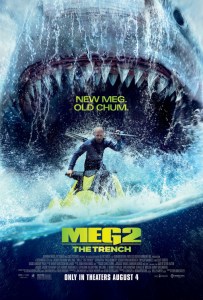 It’s Jason Statham riding a Jet ski and literally jousting giant sharks, so the fault should be on me expecting something more from The Meg 2, right? I wished there was more of this kind of gonzo schlocky action, moments like Statham kicking a guy into the mouth of a killer shark and saying, “So long, chum.” Too much of this movie is setting up an ensemble of characters that are boring and not Jason Statham, including villainous turncoats that I kept forgetting who they were. There are also small-sized dinosaurs but other characters just chase them down to shoot them. I was mostly fine with the first Meg movie as dumb fun, and this one seems to be going for the vibe of a bigger-budget Asylum/Sci-Fi Channel schlockbuster, the kind of movie with a “Sharktopus” or “Mega Shark” in its outlandish title. Unfortunately, the movie doesn’t seem to accomplish even that aim. I wish the movie had been even more crazy but it feels like, for whatever misplaced idea of tone, that the filmmakers held back. Next time just have Statham psychically linked to the shark and fighting dinosaurs and own it.
Nate’s Grade: C
Share this:

Retribution (2023)
 Liam Neeson has had one of the most unexpected second acts, from an esteemed dramatic thespian to Boomer action hero. The man’s natural gravitas elevated 2009’s Taken, plus the undiscovered thrill of watching Oskar Schindler karate chop goons in the neck, and ever since the Liam Neeson Action Vehicle was a 2010s Hollywood staple. He has been a downtrodden father, ex-husband, CIA agent, FBI agent, air marshal, border patrol agent, cop, ex-cop, ex-hitman, wolf-hunting marksman, snow plowman, ice road trucker, usually an alcoholic or recovering alcoholic, and always the beleaguered fighter called back reluctantly into action. But by the turn of the next decade, the Neeson Action Vehicle shifted from playing on the big screen to the small one, as the direct-to-DVD/streaming phase may likely extend to the remainder of the man’s career. He’s approaching his Geezer Teaser era (71 years old), though he has already made an appearance in an Expendables sequel, practically a subsidy for AARP action castoffs
I haven’t watched many of these latter Neeson action movies but the premise of Retribution intrigued me. Reminiscent of Speed, Neeson is Matt Turner, another beleaguered father who spends ninety percent of the movie in the confines of his car thanks to a pressure-triggered bomb that will explode if anyone exists. Unfortunately, Matt’s teen son and daughter are along for the ride in the backseat. They’re beset by antagonizing phone calls from a mysterious culprit with an escalating set of demands and orders. Can Matt save his family and maybe even his car too?
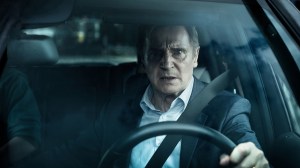 Apparently the third remake of a 2015 Spanish movie of the same name, Retribution moves along on a wholly predictable yet efficient plot as we’re introduced to supporting characters who will inevitably only serve one function. You don’t hire a famous name and then relegate them to one scene to get blown to smithereens. Likewise, there’s always an authority figure investigating the pieces who always has a supportive ear no matter the wild predicament of our hero. The kids are pretty much interchangeable as disaffected family members who will, over the course of 90 minutes of fantastic events, come to see that dad maybe cares after all and they shouldn’t be so rude to their old man. On the flip side, Matt will also come to better understand, through the intervention of a mad bomber, the importance of family he has been heretofore ignorant thereof. It’s all fairly mechanical clunky genre stuff, and if you’ve ever watched any relatively lower budget, straight-to-DVD action movie, especially the Geezer Teasers, then it’s all predictable. The viewing experience thusly comes down to finding nuggets of something memorable or different, something to hold onto unless the movie simply slips into a morass of mediocrity.
Retribution has one such moment and it just so happens to be its ending, so there will be spoilers ahead but I cannot fathom the person who would watch something like this, so formula-laden and familiar, and chafe at spoilers. Still, be warned, dear reader. It’s revealed by the end that our villain is none other than Matt’s business partner, a.k.a. The only other person that could profit off their personal bank stash who also happens to be played by a name actor (Matthew Modine, collect that paycheck). I don’t know why he personally sneaks into the backseat to threaten Matt at gunpoint when he’s been fine making threats from afar on the phone. Why the gun too when there’s already a bomb in play? Seriously, is it supposed to be surprising that Modine turns out to be our real villain, even after he fakes his own death as an elaborate fake-out? Anyway, after monologuing, Matt goes into full angry dad mode, growling a one-liner, and drives his precious car into the guardrails of a bridge, turning the car on its side. If Matt were to detach his seat belt, he would tumble into the river waters below, utilizing gravity as his savior from the potential blast radius (I suppose just forget about shrapnel or the real prospect of the car falling on top of him from the explosion). It makes for a satisfying if slightly clever (grading on a curve) comeuppance for our smarmy villain. Ending with your best moment is a sign that the filmmakers recognized what they had as a payoff. The movie literally ends seconds after, with Matt treading water, deserting any family resolution, admitting it was all just dross anyway.
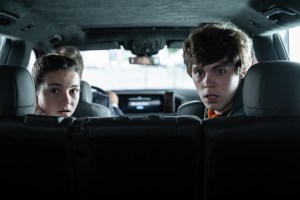 What’s funny is how inconsequential the family drama is that is intended to underpin the high-stakes peril. We find out mom is talking to a divorce attorney, and this news is a bigger bomb than the one under the seas. Suddenly the squabbling children realize the love of their family, even gruff dad, and they want things to stay the same. This storyline is so underwritten, really just serving as a catalyst for the kids to shut up and stop being jerks, that it all feels like self-parody that a mad bomber terrorizing a family has helped facilitate their renewed bonds.
As a late career action vehicle for an actor getting long in the tooth, the blandly titled Retribution is a relatively forgettable thriller that asks too little of its star and its audience. There are all sorts of directions a story can go with the concept of a man being unable to leave his car, so it’s disappointing that Retribution does so little, tying events to an obvious conspiracy with few complications. Imagine the funnier version of this movie, where Matt lives the rest of his life in the car. He gets drive-thru fast food for every meal. His daughter’s wedding has to be outdoors and near an easily accessible parking lot. He begins to see the car as an extension of himself and refers to the both of them in the third person. It takes a Titane-esque twist, and he wants to become the car itself. Then, as a decrepit 101-year-old man, the car breaks down on the side of the road and he has no choice but to leave it, and he accepts his fate with open arms. Then again maybe that isn’t as funny to anyone but me. Even Neeson’s weathered gravitas can only do so much when all the movie asks of him is to stay upright and look forward.
Nate’s Grade: C-
Share this:

Teenage Mutant Ninja Turtles: Mutant Mayhem (2023)
 As an elder millennial, the Teenage Mutant Ninja Turtles have been a formative franchise for me. I grew up on the cartoon, got the toys for Christmas, died endlessly during the shockingly hard underwater stage of their Nintendo video game, and generally have a soft spot in my 80s nostalgia for the likes of Leonardo, Donatello, Raphael, and Michelangelo, plus their surrogate father, Master Splinter. Apparently Seth Rogen felt the same way, and he and his writing partner Evan Goldberg have spearheaded a new animated variation of TMNT that just so happens to also be co-written and directed by the man behind my favorite film of 2021, The Mitchells vs. The Machines. It was a recipe to guarantee my personal enjoyment, and Mutant Mayhem thusly delivered. The biggest selling point for me was how lovingly realized the “teenage” part of the title was, getting a foursome of actual adolescents to portray our heroes, and using high school experience about acceptance and fitting in as effective and even poignant parallels. I loved just hanging out with these characters, who view their surrogate dad (voied by Jackie Chan) with a mixture of love and embarrassment, and who want to be accepted by a world predisposed to finding them monstrous. Naturally, becoming crime-fighting heroes is their best method for winning over the public, with a young and aspiring journalist April O’Neil (The Bear‘s Ayo Edebiri) hoping to improve her own social standing at school by breaking the existence of these unknown mutants. The comedy is robust and layered while allowing for nice character details and moments, giving each turtle their own satisfying arc. The action is fun and inventively staged while still being thematically relevant. The vocal cast is great, and the young actors are tremendous together, sparking an enviable improvisational energy that made me smile constantly. The art style has an intentional messiness to it, like smeared colored pencil drawings, and the imperfections are themselves part of the vast visual appeal. It’s a family movie that will succeed with old fans and new, and Mutant Mayhem is the best film depiction yet of the famous heroes in a half-shell.
Nate’s Grade: B+
Share this:

The Rundown (2003) [Review Re-View]
 Originally released September 26, 2003:
In the beginning of the new action comedy The Rundown, Beck (The Rock), a bounty hunter, is entering a club on a job. On his way in Arnold Schwarzenegger passes him by and says, ”Have fun.” Consider it a proverbial torch passing, because while Schwarzenegger is going to be busting the campaign trail, The Rundown establishes The Rock as the fresh and capable marquee name for all future action films. This man is a star.
Beck is offered a chance to square off all debts to mobster Billy Walker by agreeing to journey into the Brazilian jungle. His mission is to retrieve Travis (Seann William Scott), a hyperactive screw-up who happens to be Walker’s son. One Beck travels to the Amazon he runs into Hatcher (Christopher Walken) who claims to own the jungle and whatever contents dwell within. He asserts that Travis has stumbled upon a wealthy artifact in his jungle and therefore refuses Beck to leave with Travis. It’s at this point that the chase is on.
I don’t care what your little sister told you, Vin Diesel is not the next face of action, no, it’s The Rock. Despite only appearing in three movies (and he was only in The Mummy Returns for like three minutes), The Rock displays a razor-sharp sense of comedy. He’s also huge, likeable, and he can even emote well during smaller moments, not that The Rundown will stretch you as an actor. He’s also honed in excessive eyebrow arching.
Walken exists in a plane of brilliant weirdness that we simple human will never be able to co-exist upon. His Hatcher is one mean villain who exploits indigenous workers, wears his pants up to his armpits, and says he put the heart in the darkness. Walken’s hysterical tooth fairy monologue is worth the price of admission alone.
Director Peter Berg (Very Bad Things) adds a delectable cartoonish flavor to the film. His action sequences pop with exaggerated energy and zestful humor, like when Travis and Beck roll down a hill for a near minute. This is everything an action film should be: lively, funny, with keen action sequences that are low on CGI but filled with characters we care about. The Rundown is the best summer film not released during the summer.
The Rundown is an adrenalized punch of fabulous action and hilarious banter. When you’re not laughing and spilling your popcorn you’ll be sitting straight up to catch every lovely eyeful of spectacular action. It’s a terrifically entertaining and fun flick. The Rock has arrived.
Nate’s Grade: A
——————————————————
WRITER REFLECTIONS 20 YEARS LATER

Looking back, The Rundown really was a sea change for action cinema, and it also helps that I called it all the way back in 2003, because even a little 21-year-old me could recognize what seems almost blindingly obvious over two decades of hindsight: The Rock was a born star.
The Arnold Schwarzenegger cameo in the opening scene of the movie feels even more like a passing of the baton, as Arnie was stepping out to join the world of politics and Dwayne “The Rock” Johnson was only beginning to get started building a movie career. “Have fun,” Schwarzenegger says in passing. The wrestling phenom had built a powerful following and had begun making the leap into mainstream features with 2002’s one-two-punch of The Mummy Returns and his spinoff, The Scorpion King (did you know there are five Scorpion King movies and the 2012 edition co-starred fellow wrestler-turned-movie star Dave Bautista? Well now you do!). His appearance in the Mummy sequel was minimal, and marred by some of the worst CGI of the new century, but his solo Scorpion King adventure wasn’t quite the launching pad Johnson’s team had hoped. It wasn’t really until his fortuitous inclusion with the re-surging Fast and Furious franchise in 2010 that Johnson finally hit superstardom. However, the same magnetic appeal that would come to define Johnson as one of the biggest and more consistent movie stars in the world can be seen so evidently in 2003’s The Rundown, an action-comedy vehicle that plays to all the man’s many strengths. He’s got an immediate presence, a trained comedian’s command of timing and inflection, a gift for slapstick and lack of vanity about being goofy, and the man is just an agile and impressive physical specimen who throws himself into the rough and tumble stunt work. In short, Johnson knows how to look cool, knows how to look tough, knows how to look silly, and knows when to change gears. He’s a generational talent. My friend Ben Bailey says Johnson should play Superman because he really is Superman hiding among us pitiably frail mortals.
 The Rundown, formerly known as Helldorardo, is also an excellent launching pad for director Peter Berg, who until this time had only one other movie on his resume as a director, 1998’s relentlessly dark comedy, Very Bad Things (a film I remember “enjoying,” if that could even qualify as the correct word). This was Berg’s coming out party for the realm of bigger studio fare, and while it didn’t launch his career much like his leading man, it led to Berg’s breakout, helming 2004’s Friday Night Lights. From there, Berg has directed blockbusters (Hancock), blockbuster misfires (the unjustly maligned Battleship), and five reportedly different Mark Wahlberg action dramas from 2013-2020, though you’d be forgiven if you inadvertently confused a Spenser Confidential with a Mile 22. Berg’s docu-drama style became entrenched in 2004, though it didn’t always suit every movie equally. That’s why the movies that stand out from this default cinema verite visual style are even more remarkable for me, especially when Berg showed he can do over-the-top flashy fun violence just as good as any other big screen movie maker. His zest for the outlandish makes the movie feel like a living cartoon, but in the best way. The screen is coursing with energy but within a dedicated vision of spectacle, unlike say the mass chaos and indifference to coherency that dominates a Micheal Bay extravaganza.
Chiefly, The Rundown is just such an overwhelmingly fun experience. The actors have an infectious and combustible chemistry, bringing to mind the likes of Midnight Run and Romancing the Stone. The plot holds up well and allows for momentous action and a pleasing revolt against an exploitative villain played with panache by none other than a cranky Christopher Walken. Even while being irreverent and ridiculous, the movie still works as a story and a buddy movie, and the ending feels fulfilling and satisfying on its own terms. As I said in my 2003 review, this is everything an action movie should be. It’s exciting with engaging set pieces and outlandish stunt work but it never loses sight of its characters and their fractious screwball relationship. I love movies where the two lead characters are working against odds and constantly one-upping each other, flipping who has the upper hand. It makes for a far more unpredictable experience and ensures neither character is ever too confidently in control.
 This is an excellent movie to just put on and dash away your cares for two hours. I’ve watched The Rundown probably a dozen times, introduced friends and students to it, and everyone walks away a believer. It’s got style and banter and enjoyable characters and surprises and is just one of those movies that nobody really ever talks about but deserves to be on everyone’s DVD shelf.
Re-View Grade: A
Share this:

Heart of Stone (2023)
 Heart of Stone is pre-molded for the Netflix formula of star-driven action vehicles and spy thrillers that are meant to pass the time and do little else to stimulate your thinking or entertainment. These expensive and generally disappointing genre movies feel remote and mechanical, as if the almighty Netflix algorithm thought, after housing and documenting thousands of action movies, that it too could make a competent spy thriller.
Rachel Stone (Gal Gadot) belongs to MI-6 but also another organization, The Charter. They’re a clandestine peace keeping force powered by a super A.I. known as The Heart. Super hacker Keya (Alia Bhatt, RRR) is after the Heart, and she’ll wreck havoc until she gets it.
There are plenty of recognizable genre elements and inspirations here, but the problem with Heart of Stone is that it never gets beyond feeling like another bland summation of its formula-laden parts. You’ve seen bits and pieces of this movie before, so the viewing experience becomes a personal guessing game of how long it will take for Heart of Stone to utilize this genre cliche or that cliche. There’s no surprise or verve or quirk to be had here. Everything is pulled from a big bucket of cliches and then reassembled to best simulate a genre movie that you mostly remember seeing before. This lack of effort and finesse can make the movie quite a slog to sit through. The lack of imagination translates even to its generic title. See, her last name is Stone, and she works for a secret organization where people have code names after playing cards. Do you get it? This clunky name generator title feels like something that some feeble social media post would ask as it really intends to steal your identity from security questions.
 I keep going back to the very core construction of the plot and scratching my head in confusion. Stone is part of MI-6, a spy agency, but she’s also part of ANOTHER even more secret spy agency, which she must keep secret from her fellow secret keepers already doing their spy thing. Why do we need the extra layer of subterfuge? What does this add? The situation where the very deadly and skilled person is hiding in plain sight, the Superman pretending to be the bumbling Clark Kent, is already there with her being a hidden spy, so why do we need a second layer? It’s a complication that doesn’t add anything of value. She’s already on a mission and getting tech help from her own spy team and agency, and she’s also given even more secret tech help from the other more secret spy agency. It’s redundant. It’s not like TV’s Alias or Hydra in the Marvel movies where there was an opposition force within the spy agency, actively working against its aims. It also has the detriment of prolonging the eventual revelation and inevitable betrayal from within the team (don’t act like you didn’t see this coming from the opening mission). We all know it’s coming, so then I think that perhaps the filmmakers will use this extra time with these co-workers to better develop them, give them intriguing dimensions, or at least complicate the relationships with our protagonist who is actively lying to them about who she is. Nope. She does take care of one guy’s cat.
Another element that made little sense to me was the chosen villain. Spy and action movies lend themselves to larger-than-life characters that aim at world destruction and big swings. This movie introduces us to a super hacker who excelled in her field. Okay, and? The character feels more like a hostage than the antagonist that is masterminding the world-trotting schemes. There’s nothing of interest to this Keya character; she’s practically amorphous, so poorly defined that any other character can project onto her. I kept waiting for the motivation for why she’s resorted to her schemes, what she would want to do with the secret supercomputer, something to better add dimension or at least context for this character. Her motivation is just as frustratingly vague as the rest of her, as it’s revealed quite late that she wants the supercomputer to right the wrongs of the world, though what exactly those are, and whether she has a personal connection, who knows? She’s so bland as a villain that (mild spoilers) when she’s eventually deposed by another villain, I felt a little surge of relief that maybe someone else could do better villainy.
Even familiar genre movies can be saved with well constructed and exciting action, like those Chris Hemsworth Extraction movies that coast off the fumes of the most tortured military action cliches. Alas, there is no relief for Heart of Stone. The action is supremely bland and lacking better connections to the characters and their plights. It’s usually just chases and shootouts. There’s one sequence that takes place inside a floating satellite station, and I thought that for once things might get interesting. The subsequent action is just another fist fight and beating the other person to grab a thing before everything explodes from a gas leak. This could have just as easily taken place in a warehouse or a boat or a house or a basement or anywhere. Why introduce a fantastical setting and then ignore utilizing those unique aspects? I guess it does lead to a debris chase that reminded me of Black Widow’s finale. There is a mid-movie chase through the streets of Libson that has some life to it as we watch cars careen at high speeds, but it’s also nothing we haven’t seen before and better in a dozen other movies with more conviction than this one.
 Gadot has rocketed to fame from her Wonder Woman status and she can be a charming screen presence, but let’s acknowledge there are definite acting limitations as well. I challenge you, dear reader, to think of a beloved Gadot performance outside of her Amazonian warrior woman. Were you floored from Triple 9? Or Keeping Up with the Joneses? Or Death on the Nile? There’s a reason the producers decided to just make everyone on Wonder Woman’s ancient island mirror Gadot’s Israeli accent. With that said, Gadot seems so thoroughly bored here. It might be the groan-inducing dialogue that confuses what constitutes banter and quips; take for instance a moment when a member of the spy team remarks about her haphazard driving, “Are you trying to kill us?” and Gadot woodenly replies, “Actually quite the opposite.” The movie is filled with these lackluster quotes and genre buzzwords but without any real meaning behind the words. It’s a movie going through the motions, and Gadot is following suit. It’s not that she’s bad here. She’s never asked to really try.
The conclusion of this review is as good a place as any to talk about the implications of the story, something that Heart of Stone doesn’t seem slightly interested in. The “heroes” of the super secret spy agency have a supercomputer that makes scarily accurate predictions, enough so that the spy agency takes them on blind faith as operating orders. Nobody really asks whether this is a good thing, except for a scant reference by our antagonist before they decide to jump ship and join Team Follow the A.I. Nobody explores the more existential question of whether these things are accurate because the machine was right or because the people were just doing what the machine said, thus making these things become accurate because of the engineering direction. There’s a Minority Report aspect about free will and abdicating this to machines that is begging to be better explored. Unfortunately, this all-knowing supercomputer is just any other disposable spy thriller element jumbled together to best resemble another disposable product. I read that Netflix intended for this to be the start of a franchise, and without an intriguing world, lead character, spy agency, or set of ongoing conflicts, it’s hard for me to envision anything Heart of Stone could offer that people would request a return visit. If you need something loud and derivative to take a drowsy nap to, then Heart of Stone is the next The Grey Man.
Nate’s Grade: C-
Share this:

Guardians of the Galaxy vol. 3 (2023)
 It’s taken me longer to review the third, and reportedly final, installment of the Guardians of the Galaxy trilogy because I didn’t think that I nor my family had the emotional bandwidth when the movie was originally released to herald the summer. I’ve been a big fan of writer/director James Gunn’s comic book escapade efforts with the Marvel Cinematic Universe (MCU), as well as his first DC entry, 2021’s The Suicide Squad, the best DC film of the new era, so I’ve been highly anticipating a third Gaurdians ever since the second ended six years ago. Of course all fans have had to wait a little longer after Disney fired Gunn in 2019 for offensive social media posts they already knew about before the first Guardians film in 2014, and then they came to their senses and re-hired one of the most unique voices working within their giant sandbox of superheroes. The reason I decided to wait even longer is because I had been warned by many of my critical colleagues about the heavy thematic nature of the third entry, namely the frequent sequences of animal abuse. My family had to put down their household dog of over ten years in late April, and having to re-open that wound by watching pretend animals get abused was not the best for any of our emotional states. And so I waited until it was available on digital and in the comfortable sanctity of my home, and I alone in my family watched Volume Three, partly as a harbinger of future warning over what scenes to skip over for them. It’s a fitting end to a strange and funky series of movies that taught us to feel real emotions over racoons and trees, and even though I’d rate this as last in its respective Guardians standing, it’s still a winner and a topical reminder that these big-budget blockbusters are only ever as good as when the passion is evident.
The Guardians are on a mission to save their friend, Rocket (voiced by Bradley Cooper). He’s been incapacitated and is sought after by his creator, The High Evolutionary (Chukwudi Iwuji), a maniacal man with a god complex who is trying to create a perfect life form. This forces the Guardians to learn more about Rocket’s tragic past as a cruel science experiment, and it brings back Gomorrah (Zoe Saldana), though she’s not the same woman who fell in love with Peter Quill (Christ Pratt), and he’s having a hard time reconciling the different green girls. They’ll have to work together to rescue Rocket and stop the High Evolutionary from further harm.
 This is a movie built around the back-story and emotional connections of Rocket, a character that, prior to Gunn’s first film, had fewer than a dozen comic appearances but has had an outsized influence over the movies. If the first movie was about the formation of our team, and the second was deepening the supporting characters, as well as exploring Quill’s daddy issues, then the last movie is all about how we say goodbye to the ones we love. Volume Three is clearly structured like Gunn’s fond farewell for these characters rather than merely a pause in their contractually obligated appearances (whether Marvel overrules Gunn is another matter). It makes the interaction more meaningful and also more emotionally rich, not just because certain characters might perish, but because of the journey we’ve been privileged to hop along for, how far they’ve come and how much they matter to others, and by extension us, the audience.
Case in point: the emotional evolution of Rocket Racoon. He began as a surly visual joke, a teeny mammal with a big gun and a big attitude. It wasn’t until a drunken outburst in Volume One that you got a glimpse of the trauma and pain beneath that antisocial demeanor. With Volume Three, he gets sidelined pretty early, which means the majority of the time we spend with Rocket is through a series of flashbacks with baby Rocket and his cute pals, all ongoing science experiments (one needs only to recognize the absence of these childhood friends as grown-ups to anticipate where this is inevitably heading). In some ways, it is cheap and manipulative. It’s not hard to make an audience feel extreme emotions by introducing a slew of adorable animals as well as a villain who hurts them and sees them as expendable experiments undeserving of sympathy. I wish Gunn hadn’t gone so hard in this direction because it feels excessive in the ideas that the film bluntly communicates. Yes, a storyteller will need time to establish a baseline of relationships, conflicts, and looming change, but do we need six or seven flashbacks to settle the concept of animal testing and animal cruelty being a bad thing? I credit Gunn with making his thematic intent unambiguous; this is wrong, and you will feel it explicitly. However, sidelining Rocket for a majority of the movie and having characters project onto his unconscious body, while providing more insight through a system of excessive and heavy-handed flashbacks, might not be the best model for ensuring this character gets his due when it comes to this showcase. Quill keeps calling Rocket his “best friend” and I’m trying to remember when this happened. I re-watched Volume Two this summer, and now consider it the best of the trilogy, and I cannot recall the specific events that bonded these two bickering alphas into inter-species BFFs.
 Another facet of Gunn’s relevant themes is personified in the romantic realizations of Quill. Not to get too complicated, the current Gomorrah is a past version of herself and not the one who joined the Guardians, fell in love with Quill, and died in Infinity War. She’s back, but from her perspective she never left, and this moon-eyed dolt keeps projecting his feelings onto her. I respect that Gunn doesn’t try and wave away this complication, nor does he mitigate the agency and importance of this Gomorrah not having to follow the same path as her predecessor. The easy thing would have been for Quill to wait and for this new/old Gamorrah to see the same qualities that made the old/dead Gomorrah fall in love. It would be like one of those soapy romances where a person suffers amnesia and gets to fall in love with their spouse all over again. Gunn doesn’t do that. These are different people, and despite the aching desire of Quill to rekindle what he had, it has been lost, and this needs to be acknowledged and accepted. “I bet we were fun,” she says, and it’s a bittersweet summation that extends beyond the Guardians.
There is still Gunn’s signature sense of style and humor while checking the boxes of a big-screen action blockbuster. There’s an infiltration set piece that plays like a goofier Mission: Impossible setup but in a squishy bio-mechanical facility that reminded me of the eccentric and schlocky sci-fi diversions personified in the Lexx movies and TV series. There’s an entire planet of animal-human hybrids that feels wasted as further proof of the High Evolutionary’s already established evil. The entire character of Adam Warlock (a beefed up Will Poulter) is a himbo that definitely feels lacking in larger purpose now that the Infinity Era is over. There is one signature action scene involving a protracted fight through a crowded hallway, and it’s exciting and fun. The jokes are mostly contained to sardonic banter, which can be hilarious depending upon the combination of characters, though it also can be grating when it feels forced, like Mantis (Pom Klementieff) and Nebula (Karen Gillan) butting heads. The celebrated dad rock soundtrack has moved onto 90s and early 2000s music, and as a 90s kid, it gave me a personal nostalgic lift watching scenes jamming to dreamy whoo-hoo alt-rock acts like Radiohead and Spacehog and The Flaming Lips.
 This also might be the grossest MCU movie yet, and not just from the animal abuse but a face-peeling scene that will startle most. I had to pause the screen and drag my 12-year-old stepdaughter into the room with the promise, “Want to see the grossest thing ever in a Marvel movie?” She agreed that it was indeed that. It’s reassuring that no matter the budget, Gunn’s sensibilities that make him the unique storyteller he is, the same man who began with Troma, will be there. Though this point also concerns several of my friends wondering if Gunn can abandon these silly and schlocky tendencies to tell an earnest and tonally appropriate tale for his 2025 Superman reboot.
Guardians of the Galaxy volume 3 is the end of an era for Gunn and for the MCU. As the new head of the DC film and TV universe, it’s unlikely he’ll be lending his talents to Marvel any time soon, although the characters he made us fall in love with could carry on. Gunn clearly loves these characters, and especially identifies with Rocket, the angry malcontent lashing out in pain, so it’s fitting to give this character the big stage for a final outing, and if he can throw in some animal cruelty messaging along with silly humor and pathos, then so be it. This practically feels like Marvel is giving Gunn even more leeway as an apology for firing him. The Guardians trilogy stands out from the prolific MCU assembly because of how much Gunn has personalized these movies to make them special. They have permission to be weird, to be heartfelt, and to be reflections of their idiosyncratic creator, a much more benevolent force than the High Evolutionary. Perhaps there’s even a parallel to be drawn there, a filmmaker trying to endlessly tinker with their creation in the futile pursuit of perfecting it whereas the imperfections and rough edges are often the lasting appeal of a movie. I don’t know if the MCU will contain a series quite like this again, and that adds to the feeling of this serving as a farewell. It was a fun, messy, ridiculous ride, and it was all Gunn.
Nate’s Grade: B
Share this:

Nimona (2023)
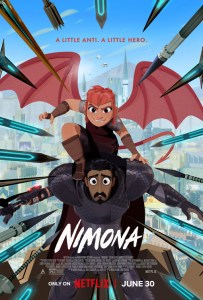
Based on the graphic novel by ND Stevenson (She-Ra), itself a web comic from 2012-2014, Nimona was developed by Blue Sky Animation Studios and originally scheduled to be released in 2020, and then Disney bought Fox, shut down Blue Sky, and pushed back against the gay content of Nimona before just canceling it altogether in 2021, and then Netflix came in and saved the project and released it, gay and all, during the last day of Pride Month. It’s been a long, protracted journey for Nimona to get to your screen and, reader, it was worth it. The movie is a rambunctious and revisionist fairy tale that is both subversive and deeply sincere, enough so that an emotional confrontation of accepting someone on their own terms elicited genuine tears on my part (for those keeping record, that’s three straight animated movies in the month of June that caused me to cry). Nimona (voiced superbly by Chloe Grace Moretz) is a high-energy prankster in a fantasy world melding Medieval culture with future technology. She befriends a fellow outsider, Ballister (voiced by Riz Ahmed), after the kingdom views him as a wanted villain. Together, they try and clear Ballister’s name by finding the real killer, and maybe they can wreck some stuff too just for fun. The cell-shaded style, a familiar aesthetic in the realm of video games, adds a bright and slickly appealing quality to the animation, and the frenetic pace and anarchic humor keep the movie bristling with entertainment, while the emotional core (vulnerable outcasts finding community) sneaks up on you and delivers a more resonating climactic finish than simply vanquishing a baddie. The ending even has rich thematic notes of The Iron Giant, which is never a bad influence. The queer content is also treated without sensationalism and treated as any other aspect of human compassion. The heart and message are just as impressive as the visuals and the humor. Nimona is a funny all-ages adventure that deserves its big screen moment after its long gestation.
Nate’s Grade: B


You must be logged in to post a comment.