Blog Archives
Repo Men (2010)
 It’s not unheard of for different writers to independently create similar projects. Remember back in 1998 when there were two animated bug movies and two apocalyptic asteroid flicks? Granted, those were big budget studio movies and the final films had little in common other than concept or premise. Repo Men takes place in a world where people open contracts on new organ transplants, but if the buyer is late on the payment then a repo man will come and take back the merchandise. This gory premise might sound familiar for fans of the Goth opera, Repo: the Genetic Opera, which was released a whole 18 months earlier. The makers of Repo Men and Repo have engaged in a he-said/she-said argument over who originated the idea. Repo Men‘s screenwriters claim they came up with the concept in 2003, though the book the film is based was only released in 2009. The Repo team point out that their funky little musical began as a theatrical show that was first performed in 2002. The songwriters behind Repo say that the idea itself goes back to 1999 and began as a 10-minute opera experiment. I suppose we’ll never know who really had the idea first, though I’m inclined to side with the Repo musical fellas because they can back up their claims with evidence. It seems like a whole lot of squabbling over so little, but hey, that’s Hollywood for you.
In the not-too-distant future, one corporation, The Union, seems to hold sway in the world of organ transplants. Remy (Jude Law) is an expert repossessions officer who will slice open anybody 90 days late on his or her payment. His wife wants him to transfer to sales; it’s less messy. Remy’s partner (Forest Whitaker) is an old childhood friend and doesn’t want to lose his butcher buddy. One night, Remy is sidelined by some malfunctioning equipment that fires his heart. He has no choice but to get his own organ transplant. Following the operation, Remy finds that he no longer has the stomach for his old line of work. Remy’s newfound moral compass comes at a cost. He quickly falls behind in his payments and his old bosses plead for Remy to refinance. Reluctantly, they sic the repo men, including Whitaker, on Remy to retrieve company property.
 Repo Men takes some nice commentary on predatory lending, pushing the hard sell knowing that the customer can never stay ahead of the mounting fees and payments. The allegory has some sharp moments. However, the movie would have benefited from being pushed further in pretty much every regard. The side characters are horribly shallow. I’m fairly certain that Carice van Houten (electrifying in Black Book), as Remy’s beleaguered wife, could have been replaced with a cardboard cutout boasting a disapproving look. She gets to glare and complain and talk about family issues and then she’s gone, replaced entirely by Beth, a mysterious organ replacement junkie. Beth could have an intriguing back story, and the concept of surgery addiction could dwell upon the human cost of beauty and “upgrading,” but alas, her real purpose is to become an oddly implacable love interest for Remy. She gets to hold his hand while they run. That’s her main contribution (except for one key scene detailed below).
The entire concept of a future world held hostage by a greedy health care corporation could use more contemplation. What is happening with society? No epidemic is ever mentioned, so why do people start contracts on million dollar organs? Do the heavy debts pass on to the next of kin? What is the legality of organ repossession? What level of competition is there out there in the market? What does the government have to say about all this? Does this mighty company supersede the U.S. government? How come Remy can’t even get an employee discount on the merchandise? Has anybody had enough surgeries to become the six million dollar man? There is a wealth of questions born from this premise, but the movie only scratches the intellectual surface and sets its standard change-of-perspective morality storyline into gear. I actually would have found the life of an organ salesman to be more dramatically appealing. What kind of ethical rationalizations take place in the mind of a man who makes his living signing saps into modern indentured servitude? I find that story direction to be more compelling than following the guys who bring back the company merchandise.
But then something weird happens. The movie gallops to a satisfying close, and then it somehow gets even better in its closing moments. I was certain that I was going to write off Repo Men but then 4 things happened to make me sit up straight in my chair (I’ll refrain from any large spoilers):
1) In a film relentlessly aping the visuals of other, superior dystopian films, there’s not much new to look at. You’ve seen this future society thing before, just with more flying cars or jet packs. I came to terms with this; it’s not every movie that reinvents how we interpret the future short of some calamity. Then when Remy breaks into the Company HQ, which is awfully easy by the way, he stumbles into the genetic organ hatchery, if you will. Rows and rows and rows of scientists tinker with organ replacements. The entire environment is a strikingly sterile white, including the scientists wrapped in bulky white biohazard suits. Then Remy and Beth make a run for it, and they are covered head to toe in black. It’s a fabulous visual image, watching the color contrasts. It’s debut director Miguel Sapochnik’s high point.
2) Once Remy and Beth move beyond this laboratory, they get caught in a hallway, and Remy proceeds to take out a mob of employees. The fight sequence is several minutes long and a clear nod to the memorable extended hallway fight in Oldboy (Remy takes out a hammer as his final weapon). Weirdly, Remy’s opponents are suit types, middlemen, office employees, numbers crunchers, but they all leap into battle to take out the corporate intruder. The fight sequence is bloody and stylish enough to please the senses, like when Remy swings a hacksaw and we get Swinging Hacksaw POV as characters duck out of the way lest their jugulars get sliced.
 3) Following this, Remmy and Beth must deposit their corporate-licensed organ replacements. This involves cutting each other open, taking a bar code scanner (think a grocery check-out), and digging inside each other to get those subcutaneous scans. What’s amusing is that the scene is blatantly juxtaposed as a sex scene; Remmy and Beth intimately penetrate each other, the editing cuts to close-ups of moaning, and the other tries to soothe the pain with physical assurances, and it’s all set to a slow jam. It’s something of a bizarre sequence, especially upon further review (how effective can scanning for bar codes be inside the gook-filled human body?), but man is it interesting.
4) Just as I had come to terms with the movie settling for a conventional conclusion, the movie pulls the rug out from under you. It offers up a last-minute ending that upends the conventional framework, and, actually, presents the easy coast to a conventional stop in a new light. This is one of those rare instances where a last-minute ending twist actually improved the film. More often than not, a last-second twist is forced and the nail in the coffin of lasting entertainment.
Repo Men is a competently looking, competently entertaining sci-fi thriller that miraculously stumbles into a final act that not only works, it elevates the rest of the movie. My mild boredom vanished and I started wondering why they made me wait so long for the good stuff. Repo Men is a mixed marriage of overall tone. One second it will be darkly humorous, the next it will be satirical, the next it will pine for serious drama, and occasionally it goes for Guy Richie-styled slapstick. A sequence where Remy describes the three occasions he’s been knocked out, with visual interludes, feels like a deleted scene from an entirely different movie. The movie never really settles, touching upon a lot of areas but mostly poorly. The script desperately needed to be fleshed out to make any lasting impact. Now that I’m living in a two-Repo world, I’ll probably stick with the campy musical fun of Repo: the Genetic Opera. At least that movie left you humming.
Nate’s Grade: C+
Share this:

Legion (2010)
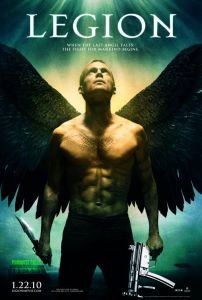 Just to be upfront, I am a big fan of action movies making use of Christian mythology (sorry if the use of the word “mythology” offends some). You tell me a tale about angels, demons, in a contemporary setting no less, and I’m hooked. You give those two sides weapons and have them fight over the fate of mankind, and I’m already revving my engines. So please know that no matter what the artistic achievements of Legion may be, I was predisposed to enjoying a movie that features the angel Michael (Paul Bettany) on the poster with a sword in one hand and an automatic weapon in the other. The premise of Legion is that God has finally had it with mankind and is making good on his threat to “turn this thing around right now.” He’s sending a host of heavenly angels to … eliminate humanity. Michael rebelled, believing man was still capable of making good on its promise. So he fights alongside a handful of characters shacked up in Dennis Quaid’s greasy spoon diner in the middle of nowhere. The action isn’t really involving but the movies does have some cool moments, like when Michael goes mano-a-seraphim with Gabriel (a marble-mouthed Kevin Durand). Legion deals with an antagonist (God) that is so powerful that there have got to be arbitrary limits placed on that power. So the attacking angels don’t overwhelm the tiny diner with their superior numbers, nor does the Almighty just blink the troublemakers out of existence. The end doesn’t really give much in the way of clarity but I got what I wanted from a movie like Legion. Though, in retrospect, I really didn’t want sizzling acid popping from boils.
Nate’s Grade: C+
Share this:

Daybreakers (2010)
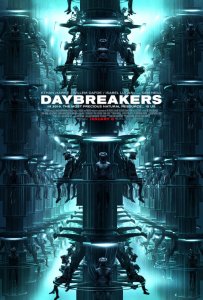 Taking a cue from zombie cinema, Daybreakers takes the idea of vampire-as-virus to an apocalyptic crescendo. The world is populated almost exclusively by vampires now. Human beings are farmed for blood but they are in such limited supplies. You see there is an extreme blood shortage because the vampires have lived beyond their means. That’s right, it’s a consumer consumption/environmental metaphor. The limited resources are dire because if vampires go without human blood they begin to devolve into senseless, winged mutating monsters known as “subsiders.” The poor cannot afford the skyrocketing blood prices so they are most fated to doom, while the rich argue that the blood supplies need to go to families first and not be wasted on the lesser dregs. The U.S. vampiric military, when not hunting humans, shackles the subsiders and marches them into the sunlight to be executed. Daybreakers has a lot more on its mind than most vampire movies, and it’s plainly fascinating to explore the realities of a world run by vampires (cars that drive during the day, the Subwalk, blood in your coffee). For most of its running length, Daybreakers is an intriguing setup that makes room for cool visceral action and social commentary. Then in the final act it sort of devolves itself into one big, dumb action movie. Ethan Hawke is a blood scientist trying to work on a synthetic substitute for a super vampire corporation that, of course, is evil. He stumbles upon an outlandish “cure” for vampirism and wants to resurrect humanity. This leads to a climax where Hawke and his human warriors wage battle inside the corporate HQ. For a promising concept, it’s depressing that Daybreakers had to end in such a typical manner. At least the vampires explode in the sun instead of sparkling.
Nate’s Grade: B-
Share this:

District 9 (2009)
 I can’t believe I forgot to review this some how. The sleeper hit of the summer, District 9 is an intelligent, and rather obvious, apartheid metaphor, and a grandly executed action thriller with a strong moral compass. Aliens crammed into ghettos and being mistreated and abused? Sounds like Alien Nation to those with longer memories, however, writer/director Neill Blomkamp forges a docu-drama that manages to be bristling with ethical questions and kick-ass action. It’s very easy to get wrapped up in all the excitement, so much so that I was trying to will the characters onscreen to take certain precautions. Blomkamp manages to take shots at some easy targets, like shady corporations and mercenaries, but that doesn’t make the movie any less affecting. The movie belongs to actor Sharlto Copley, who begins the film as a dithering bureaucrat and ends as a truly unlikely action hero, and you buy every single step of this man’s satisfying emotional arc. While the Academy is picky when it comes to genre films, Copley deserves Oscar consideration; I haven’t seen a more compelling performance by an actor all year. The special effects are astounding, and they were accomplished on a scant budget of 30 million, which is probably what Transformers 2 spent on one explosion. District 9 makes you feel that movies can still surprise you, as long as we have visionary, intelligent life working outside the studio system.
Nate’s Grade: A
Share this:

12 Rounds (2009)
 This action flick bankrolled by World Wrestling Entertainment is an empty and aggravating movie. Let me list the ways this lamebrain action movie fails and flounders. And to be charitable, I’ll do it in only six rounds of concise action.
Round 1: John Cena is not an actor, like at all. The famous pro wrestler has a face that looks to be chiseled from granite.
Round 2: The movie strains credibility even for an action movie. The villain reappears with no explanation and begins a series of clever traps that must have involved massive man-hours to conceive and put into order, especially with every last variable taken into account like bus schedules.
Round 3: The villain is totally non-threatening in every capacity. He acts like an impish teenager instead of a devilish rogue. At one point, I kid you not, he’s rolling around on a bed while he taunts Cena over the phone, like he’s gabbing to a girlfriend. The fact that this dude is a criminal mastermind makes everybody dumber.
Round 4: The villainous M.O. is a shameless rip-off of Die Hard with a Vengeance. I repeat: a rip-off of the third freaking Die Hard movie, which isn’t terrific anyway. Every little game, every little round, is a puzzle that leads to the next puzzle, and Cena must figure it all out before his time runs out. And it’s all an elaborate ruse to distract the police so that our bad guy can pose as a Federal Reserve moneyman and steal from a bank, more or less just like Die Hard with a Vengeance.
Round 5: The director is Renny Harlin, whose last watch-able movie involved super intelligent psycho killer sharks. His action choreography relies all too heavily on ridiculously tired action tropes, like having Cena leap hundreds of feet from a helicopter to land safely in a rooftop pool. The erratic camerawork does no favors, aping the visual style of better movies. Even Harlin himself has done everything here before and better.
Round 6: The bad guy blames Cena for his girlfriend’s death and thus puts him through this day from hell. He blames Cena instead of blaming the driver of the car that plowed into her, his girlfriend for choosing to run right into the path of an oncoming vehicle and for being complicit in a murderous jewelry heist, or even himself for putting everybody in danger in the first place. His motivation is fairly faulty. He might as well blame the manufacturer of the automobile for lackluster brakes.
I’ll cut it off from there to be merciful. 12 Rounds is a classic example of a cookie-cutter, brainless, preposterous, and un-inventive action movie that typifies the Hollywood assembly line. It’s ludicrous from start to finish and your eyes will glaze over from watching such stolid action scenes without a hint of creative impulse.
Nate’s Grade: D
Share this:

Sherlock Holmes (2009)
 Sherlock Holmes as a gritty pub-brawler? Before you dismiss the big-budget Hollywood retooling of the literary detective, look back at author Arthur Conan Doyle’s source material. Appearing in over 50 stories, Holmes was a bit of a rude rapscallion who would get into brawls and recreationally use cocaine. It was only until Dr. Watson stepped into his life that Holmes cleaned up and became a proper, respectable gentleman and the figure we know. With stylish director Guy Ritchie (RocknRolla) attached, it appears that this Holmes for a new generation is actually a throwback to his roots.
Famous detective Sherlock Holmes (Robert Downey Jr.) and his assistant, Dr. Watson (Jude Law), are at an impasse. Watson wishes to leave Holmes establishment and start a new life with a woman he loves. Holmes is also threatened by Lord Blackwood (Mark Strong), an aristocrat in prison for killing women in ritualistic manners of the dark arts. He’s about to be executed when Lord Blackwood promises he will return from the dead, and his murders will continue. Sure enough, after Blackwood is hung by the neck and pronounced dead by Watson, the murders resume and the dead man himself is seen walking among the living. Holmes is on the trail of his resurrected foe when he meets Adler (Rachel McAdams), the woman who broke his heart. She’s employed by a mysterious stranger and becomes mixed up in the deadly hunt to stop Lord Blackwood.
 As is quickly becoming commonplace, Downey is the best part of the movie. His combative relationship with Law makes the movie worthwhile. They have a feisty, squabbling chemistry that generates a lot of humor, and they interact like a 1980s buddy cop movie. Their verbal jousting practically saves the movie from collapsing due to the overwrought plot. At its best moments, Sherlock Holmes feels like a buddy cop movie transplanted to Victorian England. Downey is having a hoot as the character and brings a vibrant energy to his role, turning Holmes into an eccentric who gets buggy if he cannot obsess over a case, taking several cues from the Monk playbook of eccentric detective genius. Downey is cocksure and a charming cad, enjoying every moment he can outsmart the competition. Law is more equal than sidekick and plays the straight man to Downey’s neurotic detective. I’m not usually one to bemoan foreign accents, but this is one movie that would benefit from subtitles. The actors don’t necessarily talk in thick accents but they speak so fast that it begins to sound like an unintelligible mumble.
The romantic subplot is a non-starter as Holmes reunites with both The One That Got Away and his Crafty Equal. McAdams is a fine actress with a luminescent smile, but her involvement is really an afterthought. She’s the old flame that always re-enters in those 1980s buddy cop movies. She stays long enough to rekindle some old feelings and provide a figure in need of rescuing. Her storyline is one of several that could have been completely eliminated. The same could be said for Watson’s girlfriend, the steamboat accomplice, the put-upon maid, and many of the conspirators.
The plot for Sherlock Holmes feels like three screenplays were crudely sewn together. There are so many junky side stories and characters that need to be eliminated. It’s just far too busy without anything making real traction. The story is weighed down with expository dialogue and mounting subplots. There are a few sequences that jump forward in time but don’t inform the audience, so we’re left a tad discombobulated. The film jumps immediately into the fray without any pertinent flashbacks or setup, daring the audience to pay attention. At some point in the middle I gave up, having disengaged from the plot and determined to simply wait it out for Holmes to explain what I was missing. I think at one point I was even starting to nod off to sleep, which is a deadly sign for an action movie. The central occult conspiracy has a lot of men in cloaks but no discernible outcome. The movie is littered with conspirators and locations and details that all seem meaningless until Holmes can tie all the jangled pieces together. The script is overloaded and half-cocked and bides its time waiting for Holmes to provide relative clarity. It gets old after a while when only Holmes knows the clues and he won’t share.
 You don’t usually think of the intellectual detective in the deerstalker cap as a man of action, but this brash reinterpretation would be acceptable if Holmes found himself in some action sequences that would befit his legendary stature. Ritchie?s hyperbolic shooting style makes for a lot of fast whooshing and quick spinning but it doesn’t add up to many satisfying sequences; the best is probably a battle with Holmes and a giant that destroys a shipyard plank by plank. Ritchie introduces an intriguing action device for this beefed-up Holmes; he mentally envisions the steps of his attack, going from punch to counter punch. This technique is a fun peek into the mind of Holmes and it makes the action easier to follow for the audience. The fact that this narrative action device is used twice in the 30 minutes made me alert. Surely this cool little stylish flourish would come into play during a climactic moment. Nope. This visual quirk is done twice and then curiously never resurfaces. Instead, the movie ends in a climax dotted with the tired routine of atop high places. The showdown is rather weak. Watching Holmes and Watson beat their way through thugs has its meta-literary appeal but Ritchie and his screenwriters fail to summon entertainment amidst the cluttered chaos.
I am a self-described Ritchie fan, though he hasn’t made a good movie since 2001’s Snatch. He lathers on the style right from the opening studio titles being integrated into the cobblestone streets of London. The production design is impressive and the actors seem to be having a game go with the literary legend, but it all comes back to the murky story. Sherlock Holmes could have succeeded on a crackerjack story or on being an entertaining thrill-ride, but it fails in both areas. The nonsensical conspiracy plot feels like a leftover from a bad Dan Brown novel (redundant?) with secret societies and mystic orders and blah blah blah. The characters feel less than real because they aren’t given time to be fleshed out, so they resort to being stock archetypes locked into well-defined place by the fact that the plot gallops from the start. The action is uninspired and occasionally incoherent. Sherlock Holmes as a man of action is an acceptable premise but he needs to be placed in strongly constructed, inventive action sequences. I like Downey and Law, and I especially like their time together, but the movie lets them down. Maybe I was just holding out hope that Holmes would come back and explain the whole movie, providing compelling evidence for mass entertainment that I had been missing. It was never to be.
Nate’s Grade: C+
Share this:

Avatar (2009)
 Avatar cannot possibly meet expectations. Can it? The long-in-development pet project of director James Cameron has been dubbed as nothing short of a tectonic shift in moviemaking; it will “change movies forever.” Cameron had the idea for the movie 15 years ago but held on, waiting for the technology to catch up. After you’ve directed Titanic, the highest grossing movie in history, I suppose you have the luxury of waiting. The budget has been rumored to be wildly anywhere from $250 million to $500 million. Avatar was always planned as a 3-D experience and nothing short of the savior of modern movie and the theatrical experience. It would make going to the movies an event once again, something that could not be duplicated at home on puny TV screens. Given the reams of hype and anticipation, Avatar couldn’t possibly succeed, could it?
In the year 2154, mankind has posted a colonial base on the distant moon of Pandora. The planet orbits a gas giant and the atmosphere is deadly to humans after a few minutes exposure. The planet is inhabited by all walks of deadly, incredibly large life, including the indigenous Na’vi tribes, skinny, nine-feet tall blue aliens. The Na’vi also have connective tissues coming from their ponytails that allow them to connect with all nature by “jacking in,” so to speak. They are a relatively peaceful clan that makes sure to respectfully use every part of the space buffalo. It just so happens that they are also sitting on top of a huge enrichment of the mineral Unobtanium, which sells for a crapload of money back on Earth. A corporate exec (Giovani Ribisi) has hired a private army of mercenaries to forcefully move the natives. In the meantime, they are trying to reach a diplomatic solution. Dr. Grace Augustine (Sigourney Weaver) is the head of the Avatar program, where they biologically grow Na?vi bodies with some human DNA mixed in. People can then link their brains to the giant Na?vi bodies and walk and talk among the natives.
 Jake Sully (Sam Worthington) is an ex-Marine who is living the rest of his life in a wheelchair. His twin brother was apart of the Avatar program but was murdered, and he?s signed on to take his brother’s place (the avatars, naturally, are hugely expensive). Jake will plug into his avatar body and be able to feel like he can walk again. Colonel Miles Quaritch (Stephen Lang, superb) likes the idea of having a former Marine on the inside. He makes a deal with Sully: provide useful Intel on the Na’vi, and he’ll get his “real” legs back. Jake and his fellow avatars ingratiate themselves with the Na’vi, and Jake is taught the ways of the tribe by Neytiri (Zoë Saldana). Their teacher-student relationship transforms into a love affair, and Jake begins having second thoughts about his mission.
To the heart of the matter, the special effects are transcendent. This is one of those pinnacle moments in the advancement of special effects technology. Avatar is now the new standard. The environments are so incredibly realistic that if I were told that Cameron and his crew filmed on location in some South American jungle, I would believe it without a moment’s hesitation. But everything in this movie was filmed on a giant sound stage. The visual detail is lushly intricate and altogether astounding. The planet of Pandora feels like a living, breathing world, with a complex environmental system. Every blades of grass, every speck of dust, every living creature feels real. Cameron and his technical team have crafted an intensely immersive, photo-realistic alien world. The level of depth is unparalleled. I found myself trying to soak up the artistry in every shot, admiring a tree canopy four dimensions back. The planet has an extensive night period, which has allowed the planet to evolve with an emphasis on bio-luminescence. Everything from moss that glows from being stepped on, to dragonflies that look like spinning flames, to glow-in-the-dark freckles on the Na’vi allows the movie, and Pandora, to feel like it has a rich evolutionary history. The ecosystem makes sense given the particulars of this world. Cameron isn’t just giving an extra leg or another eye to make the wildlife alien. The special effects are so good that you can easily take them for granted, like Jake’s atrophied legs. Those were special effects as well and yet they looked so real that I never stopped to consider them.
The Na’vi don’t necessarily have the same level of photo realism, however, this is by far the greatest motion capture accomplishment of all time. The creatures don?t appear rubbery or waxy, and there is honest to God life in those eyes, the same life that is absent in Robert Zemeckis’ motion capture movies. The CGI characters have believable facial expressions, capturing subtle movements and realistically capturing emotion. I’m still not a fan of motion capture, but at least Cameron makes effective use of the technique by recording actors movements and mannerisms and transforming them into nine-foot tall blue cat people. That seems like a better use of the technology than having Tom Hanks play a mystical hobo.
 The 3-D is impressive as well but not the “game-changer” it was heralded to be. This is because Cameron doesn’t want to distract the audience and make them conscious of the 3-D gimmicks. There aren’t any moments where someone just hurls something at the screen randomly. There aren’t any clumsy swordsmen jutting forward. Because the 3-D glasses naturally dim the screen and make things darker, Cameron has smartly compensated by cranking up the natural light and vivid colors on screen. Nothing ever comes across as murky or hard to distinguish. Cameron has designed a 3-D environment that spaces out the different elements of the foreground and the background. There will be floating bits like ash or water that will seem right in front of your face. Short of that, you may find yourself forgetting about the 3-D because it’s not always utilized for a 160-minute action movie. It’s more just pushing the visual planes back with your depth of field. After all the praise about Avatar being the triumphant 3-D experience, I’m surprised that the best 3-D I’ve ever seen is still Zemeckis’ Beowulf. At least you still have that laurel, Zemeckis. For now.
From a narrative standpoint, Avatar has a lot of borrowed elements. It follows the exact same plot paces as Dances with Wolves. In fact, this story is exactly Dances with Wolves in space. Like Kevin Costner’s film, we follow an injured military man find acceptance and community with a native (Pandorian?) population. He falls in love, changes his world perspective, and realizes that these dignified people of the land deserve more than to be pushed aside for the greed of the Encroaching White Man. So he bands together and leads the natives against the superior military power of the White Man (It’s also the same plot formula for 2003’s The Last Samurai too). There?s even a young native that distrusts our hero at the start but eventually comes to call him “brother.” Add a few touches from Ferngully and The Matrix and there you have it. It’s the modern tale of colonialism where we, the people in power, are the enemy, though the villains of Avatar are corporations and private military contractors. That might not sit well with certain parts of the country; the same people that blithely think America can do no wrong simply because of its name. Cameron’s politics are pretty easy to identify on screen, and it’s probably too easy to dismiss the flick as “tree-hugging” eco-worshipping prattle. However, this is the same man that wrote and directed True Lies, which is nothing but the cool allure of the military industrial complex AND the villains were Arab terrorists.
Now, the characters aren’t too deep and the love story between Jake and his blue lady seems to be missing a couple reels worth of romantic development, but the movie follows its familiar beats with ease and the last act is terrific. It’s once again one of those all-out endings that gives way to a relentless series of explosions, but Cameron brings together all the creatures and characters he has established prior, which makes for a hugely satisfying and kick-ass payoff. Cameron is one of the greatest masters when it comes to constructing an invigorating action sequence, and he pulls out some great ones in Avatar. Geography is so key to staging a compelling action sequence, utilizing the particulars of the location and having an audience familiarized with the location. By he end, Cameron has fleshed out his world so well that we recall specific locations and remember their strategic value. The assault between the giant mechanical robot suits and the noble natives is great, with different points of action on the ground and in the air. Some have complained that the action sequences of Avatar are like a video game cut scene, and so what? My one complaint about the action is that we lose perspective by being with the Na’vi for so long. The audience becomes accustomed to seeing the world from the Na’vi proportional perspective, forgetting that these creatures are nine feet tall and even they look tiny on their flying dragon creature things, so how big must those things be?
 The movie is not without some level of flaws, primarily in the storytelling department. The first 90 minutes of the movie feels really solid but then the next hour kind of simplifies everything in a rush to the climactic booms. The human villains become dastardly, the Na’vi become extra noble, and the romance with Jake and his blue lady gets consummated in a sequence begging for biological questioning (Do they “jack in” to each other? Is this somehow considered bestiality?). Jake could have benefited with some more back-story as well. The earnest “I see you” Na’vi greeting can get silly after a while. The whole avatar aspect doesn’t feel fully committed and could use more explanation. The Ribisi character is a shallow glimmer of the corporate weasel that Paul Reiser played so perfectly in Aliens. Cameron never says why the Unobtanium element is so valuable in the movie; apparently, Earth is out of energy resources. There are elements that border on the ridiculous, like the giant mech robot suit having a giant Bowie knife. The end leaves the distinct impression that the defeated human beings will just come back with bigger hardware and stronger nukes. If this Unobtanium element is so valuable to the energy resources of Earth, I doubt that one butt whipping is going to stop the exploitation of Na’vi resources. The sappy end credit love song by James Horner and Leona Lewis also might elicit more than a few guffaws.
The only real groundbreaking part of Avatar is the visuals but a familiar story doesn’t stop Cameron’s technical achievement. The plot is entirely predictable, and wholly borrowed, with a crazy different environment and a fresh coat of CGI. But can a highly derivative story kill a project built upon visual wonders? Not for me. Star Wars itself was derivative of many other stories, from samurai tales like Akira Kirosawa’s The Hidden Fortress, to Buck Rogers and Flash Gordon, to Westerns like The Searchers, and war movies like The Guns of Navarone and The Dam Busters. Has that hindered the lasting impact of George Lucas’s quintessential space opera? I’d doubt you?d find too many folk with nagging complaints about Star Wars being too derivative. That’s because the characters were interesting and we cared about them, the story was satisfying, and the visual techniques pushed the medium forward. I could repeat that exact same sentence, word-for-word, about Avatar. It might not change movies forever as we know it, but Avatar is a singular artistic achievement that demands to be seen at least a few times, if, for nothing else, to stare at lifelike trees some more.
Nate’s Grade: B+
Share this:

Race to Witch Mountain (2009)
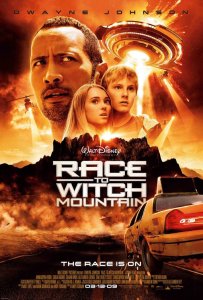 Does anyone ever fondly recall, let alone even recall, the 1975 original children’s film, Escape to Witch Mountain? This remake is Disney-fied in all places. It’s a lackluster kiddie adventure with more special effects, car crashes, and one-liners. Dwayne “The Rock” Johnson cements his tight grip on the family film genre; I really like this guy as an action hero and as a charismatic comedic actor, but being a wisecracking chauffeur to monotone yet strikingly Aryan-looking space aliens isn’t cutting it. The little green pre-teens need to get back to their ship and escape the clutches of government agents and an alien killer. This is one of those movies were everyone leaves their brain at home. This is the kind of movie where everybody is profoundly stupid and easily tricked. You’d think space aliens and intergalactic travel and psychic abilities would be met with more than incredulous jokes. Regardless, Race to Witch Mountain is devoid of fun, wonder, and excitement despite a decent effort by the assorted cast. This is lazy, by-the-numbers stuff masquerading as quality family entertainment. Families and children deserve coherent stories with actual characters and action sequences that feel like they matter. The only thing that really matters in Race to Witch Mountain is the fact that nobody will remember this movie in 35 years time, allowing Disney (or whatever alien/robot/alien robot overlords run the show at the time) to follow through with another thoughtless, mechanical remake.
Nate’s Grade: C
Share this:

Terminator Salvation (2009)
 The fourth Terminator movie ultimately comes across as a lifeless enterprise. It’s set during the war between man and machine, which means John Conner (Christian Bale) is leading the human resistance, as was prophesied. He must stop those crafty machines from finding and killing Kyle Reese (Anton Yelchin), who is destined to be sent back in time and become Conner’s father. The storyline focuses a lot more attention on the mysterious man Marcus (Sam Worthington), who isn’t so mysterious because they give away in minutes that he’s a machine. But he’s a thinking machine that reclaims his humanity, or whatever. The point of this movie is to make some cool action sequences and not step on the toes of the previous movies. Director McG (Charlie’s Angels) has a few nifty visual tricks up his sleeve, but this is one soulless machine just going through the Action Blockbuster subroutine. The character development is nil, the story is muddled, the machines are dumb, and Bale forgoes any normal kind of speaking voice in favor of growls and hissing. The throwbacks to the other movies can be fun (a 1984-aged Arnold!) or agonizingly lame (shoehorning in famous quotes like, “I’ll be back”). The movie is competent and has one or two exciting chase sequences, but that is simply not good enough coming from this storied action franchise. Terminator Salvation plays out more like Transformers, where the robots are big and bad and loud and sort of dumb. I guess that sums up the movie pretty well.
Nate’s Grade: C+
Share this:

The Taking of Pelham 123 (2009)
 This needless remake is yet another nail in the coffin for the filmmaker that is (was?) Tony Scott. The director seems to have a love affair with irritating and superfluous visual artifice. Scenes will jump into slow-mo, or stutter-stop speed, or the visuals will all of a sudden turn into blurry shadows. Scott proves yet again that he’d rather fiddle around with film stocks and random jarring effects than aid his narrative. The story of Pelham is rather mediocre, as a tattooed gunman (John Travolta) and his crew take a subway car hostage. A train dispatcher (Denzel Washington) becomes the only one allowed to speak to the gunman. Travolta is wholly unconvincing as a profane criminal mastermind. The villains are gruff idiots, some of whom think at the end that maybe, just maybe, they can get the jump on 30 armed policemen surrounding them. They were not the top of their class at Henchmen School. The story is frustrating and the character motivations for Travolta remain vague and unclear. Sure, he gets financial gain, but what else? What about his shady past? Why this specific route to this mundane goal? It’s like Scott and the movie simply just didn’t care anymore because they knew it was time for the film to end in a big chase scene. Also, the movie seems to make a case that NYC cops are the worst drivers in the world. They crash more cars than Billy Joel (joke brought to you by the year 2003). This is one train to miss.
Nate’s Grade: C


You must be logged in to post a comment.