Blog Archives
Inception (2010)
 Without a doubt, no movie has piqued curiosity like Christopher Nolan’s Inception. After breaking all sorts of box-office records with The Dark Knight, Nolan earned some capital. He wanted to make an expensive, intellectually demanding, high-concept movie that takes place mostly in the realm of dreams. The studio said yes, anything to keep their golden goose happy before a third Batman can roll out. Nolan has been tinkering with the script for Inception for almost ten years, trying to scale it down but never being content. This is a story that called for the biggest stage, which required a heavy price tag, and could only be fulfilled once Nolan was an established hit-maker. Early images of shifting gravity and folding cityscapes got people buzzing but then the concern was whether Inception would be too smart for audiences to embrace. You know, the same public that made two Alvin and the Chipmunks films blockbusters. Two weeks running, Inception has made a sizeable portion of money and become the “must-see” movie of the summer. Score one for the public.
Dom Cobb (Leonardo DiCaprio) is an expert extractor. He can sneak into your dreams and discover whatever secret you’re hiding from your self, your wife, even your shrink. All for a tidy sum, of course. He’s on the run from U.S. authorities because they believe he killed his wife Mal (Marion Cotillard). A rich businessman, Seito (Ken Watanabe), promises to clear away the pending charges if Cobb can perform one important job. Instead of stealing an idea, Cobb will have to plant an idea, known as inception. A young upstart (Cillian Murphy) will inherit his dying father?s empire, and Seito wants the guy to break up that empire and sell it off. Cobb enlists the help of a skilled team to pull off what is believed to be impossible; Arthur (Joseph Gordon-Levitt) as the point man, Ariadne (Ellen Page), as the architect of the dream world, Eames (Tom Hardy), a forger who can convince the mark he?s other identities, and Yusuf (Dileep Rao), a chemist that creates a compound to put the team under a deep sleep. They’ll need it because Cobb plans to go three levels deep, a dream within a dream within a dream in order for inception to take root. The only way out is a “kick,” the sensation of falling that will awaken the dreamer. The team is under great risk not just from the dream world, but also from Cobb. He?s been secretly keeping memories of his dead wife alive and she keeps intruding into shared dreaming, causing havoc, relying on the same info that Cobb knows. The deeper they go into the dream the deeper they also go into Cobb’s memories.
 Inception can be many things to many people, as is the nature of dreams. I found the movie to be a master class mousetrap. Watching Nolan and his origami-like script fold and bend and connect is a true pleasure. However, the movie is not a great character piece. Cobb is the only person on the entire team allowed any sort of back-story or inner lives or even personality traits. What do we know about Arthur, Ariadne, Eames? Nothing. They are all members of the team, but it is Cobb who is the only one allowed to have supporting details. Despite Cobb’s tragic past with his wife, emotionally the movie can best be described as a bit distant (not cold, distant). Nor does Inception deal with the psychology of dreams or the interpretation of the subconscious and its links to our own reality; this movie does not have Freudian psychoanalysis in mind. What Inception does deliver is a brilliantly staged heist that takes place in the realm of dreams, and if that doesn’t sound like a fun concept then I don?t know what does. To get to that heist, the audience must slosh through about 90 minutes of solid set-up and exposition (Pages character is essentially an exposition device). There are a lot of rules to digest in order for the final hour to have the impact that it does. If you nod off for a portion of that time, like my father, you will be lost as to why anything is exactly happening. Having seen the film a second time, I can say that once the hyperactive “Oh my gosh, this is awesome!” haze of newness wears off you do realize that the pre-heist portion of the movie can be a bit slow. I think that for future DVD-viewings I will skip to the start of the heist and sit back and relax (much like skipping the first hour of King Kong).
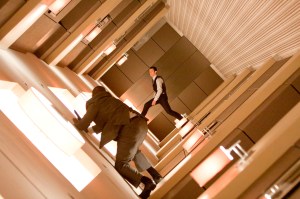
After talking about what Inception is not, let’s focus on what Inception is. It is a massively entertaining, brain-tickling thriller with eye-popping visuals that verge toward the iconic. Nolan isn’t the greatest orchestrator of action (a foot chase in Mombassa is pretty lackluster short of a narrow alleyway) but the man knows how to put together tremendously memorable set pieces. From Paris folding upon itself to a fistfight in a revolving hallway, Inception is packed with stimuli to ignite the senses. It’s the first movie in years that I walked out and thought, “How did they do that?” It renewed my sense of mystery and wonder with the movies. And the last hour is ridiculously fraught with tension as the movie descends level after level of subconscious, juggling four separate action set pieces with mounting climaxes. The revolving hallway fight is perhaps my favorite action scene in years. I still got goose bumps the second time. Gordon-Levitt hops from ceiling to floor like he’s Spiderman, or Gene Kelly, all while the camera remains fixed. Gordon-Levitt gets a lot of zero gravity experience in this movie. He might have qualified for a free ride on the space shuttle.
Like the alternate reality of The Matrix, people can manipulate the world of dreams, which allows for some imaginative visuals. Aside from the dreams-within-dreams impacting one another, there aren’t really playful distortions of reality. There?s a few M. C. Escher-inspired staircases but nothing too out of bounds. Nolan devises a reason for this since the dreamers do not want to call attention to altering the dream. They want to hide among the subconscious projections; get in and get out without being noticed. You do wish that Nolan played to the potential of his flexible reality, but on the other hand, it’s still fairly mind-bending to reach inside a magician?s hat into another magician?s hat and so on. I wonder if there was another story that could have succeeded in this setting, namely competing thieves that have to race against time within the world of dreams. Think about it next time, Nolan. That one?s on me.
 But the most exciting aspect of the movie is how intellectually stimulating it is. The movie is jam-packed with ideas like Nolan’s other works, so much that it’s hard to fully process everything the film offers in one sitting. The pieces do fit together and the movie follows its own internal logic, so if you didn’t skip out on any bathroom breaks, you should be able to follow along reasonably. On first viewing, Inception is bristling with intelligence and narrative complexity, and it rarely stops to pander to an audience. It expects you to keep up for the rewards that will follow, and they are indeed rewarding. The movie isn’t as complicated to follow but it can definitely get complicated when you try and explain action beyond a literal level. Nolan laces all sorts of narrative stops and peculiarities that can be targeted for an alternative thesis statement on the ending. The very ending shot is ambiguous perfection. It keeps the mystery of what constitutes reality while providing an out for people that want to formulate a happy ending. There’s plenty of room for interpretation and analysis but it doesn’t get in the way of telling a good story. Hollywood is pretty risk averse when it comes to anything that makes people think, let along anything expensive that requires active synapses. Nolan has long been a filmmaker of intellectual heft and non-linear narratives. His narratives are complex puzzles that snap together with airtight precision. The joy of a Nolan film is surrendering yourself to his narrative origami and waiting to see the Big Picture. There are new insights to discover with every viewing. Nolan may not be the second-coming of God, as those frothing at the mouth on Internet message boards proclaim, but I can think of no other director working today who harnesses Big Ideas on such a big stage.
Inception is a $160-million dollar studio film with substance, but it also looks like money well spent. The film looks amazing. The cinematography by Wall Pfister (Dark Knight) is gorgeous without being self-consciously arty, pleasing the senses without drawing too much attention away from the story. But with a screenplay that makes all kinds of leaps, you need the help of a good editor to guide the proceedings. Lee Smith (Truman Show, Master and Commander) is that man. While the repeated cutbacks to the van falling in slow motion can be giggle-inducing, Smith gamely holds everything together thanks to his skill in juggling all the parallel storylines/dreamscapes. Finally, the score by Hans Zimmer (The Lion King, Gladiator) is full of ominous, blaring horns that send shivers and get your blood pumping. Johnny Marr (The Smiths, Modest Mouse) even added an assist by strumming the guitar licks on the score. Apparently Zimmer’s key score themes are actually the tune “Non, Je Ne Regrette Rien,” the Edith Piaf signature song used to signal “kicks,” played at a slowed speed. At the risk of sounding like one of those frothing from the mouth on the Internet, that’s insanely cool.
 The acting is uniformly good with a few bumps. DiCaprio (Shutter Island) might need to do something light after continuous roles where he inhabits mean weighed down by guilt and dead wives (three in a row for those counting). He’s a good emotional anchor. Watching the star of 500 Days of Summer and Brick as a suave, cool-as-can-be action star is improbably awesome. Hardy (Bronson) is a scene-stealer mostly because he?s the only member of the team that has a sense of humor. Cotillard (Nine, Public Enemies) who won an Oscar playing Edith Piaf in 2007’s La vie en Rose, gets her best part since then. She gets to do many things as Mal, a projection of a character. This means that she must be limited in how she fills out the character because she is defined by Cobb’s fading memory. Yet she can be malicious, playful, spiteful, loving, vulnerable, and more. Cotillard and her big, glassy eyes do a great service in selling a romance we only see after the fact. Page (Juno) just feels out of place. She seems like the kid among a group of adults. And while the elfin actress will always look youthful until she applies for an AARP card, Page just seems in over her head. Her performance is fine if a bit mealy-mouthed but she still feels miscast.
Inception. Expect it to become a fanboy religion in a matter of weeks. It wears its influences on its sleeve, from The Matrix to Abre Los Ojos (or the American remake, Vanilla Sky). Thrilling, stimulating on different levels, and supremely engrossing, Inception is just about everything you could wish for in a summer blockbuster, except when it can also feel mechanical, distant, and free of emotion and character development save DiCaprio (perhaps this is further evidence that it was all a dream?). Regardless, Inception is easily the brainiest movie of the year, and usually those don?t get packaged as big-budget Hollywood spectacle. Just make sure to bring your totem the second time you watch the movie.
Nate’s Grade: A
Share this:

The Bounty Hunter (2010)
When a woman runs out of a trunk and is chased down by a man who then tackles her and drags her back to said trunk, how would you react? Horror, right? This scenario is the opening minute of The Bounty Hunter, an abhorrent romantic comedy that fails in every regard. The opening scene is supposed to be funny because it’s two stars and we learn, via onscreen text, that the guy and gal are formerly married. Somehow this knowledge makes the scene… funny? Because in real life no spurned ex-spouses inflict punishment on their former halves. This disastrous and bizarre opening clued me in that The Bounty Hunter was going to be one hell of a slog to sit through. It made me want to put a bounty on the filmmakers who made this mess possible.
Milo (Gerard Butler) is an ex-cop who currently pays the bills as a bounty hunter. Nicole (Jennifer Aniston) is an investigative reporter looking into a series of suicides that might not be what they seem. She’s also due in court for hitting a police horse with her car (the reveal of her actual crime is intended to be a payoff; you?re welcome for having it spoiled). Nicole gets too close to a crime conspiracy that has connections inside the New York City police force, so goons chase her down to kill her. Naturally, she misses her court date and becomes a wanted fugitive, which brings her ex back into the picture. Milo is elated that he gets to drag his ex-wife to jail and get paid for doing so. Along the way, the couple improbably rekindles their old romance while being chased by hordes of goons with guns.
First off, The Bounty Hunter is one of the more unpleasant, tone-deaf comedies I’ve seen in years. It assumes if two people, with obviously zero chemistry, will bicker long enough in shrill voices, eventually comedy will emerge. This is the comedic equivalent of the faulty scientific theory of Spontaneous Generation. The comedy just isn’t coming. I never laughed once during the entire painful 115 minutes. I failed to crack even a smile. I sat dumbfounded, looking back and forth between the screen and my then-partner’s reaction, to gauge if I was truly missing something, mainly the “comedy” part. These people are unlikable and not once do you ever believe that they are capable of even expressing a realistic human emotion. These are people that shouldn’t even exist in a crummy romantic comedy. These are the background players in a crummy romantic comedy, given starring roles and proving with every exhalation why they should have remained Angry Dinner Couple #2. Milo is a jackass who’s full of himself and Nicole is whiny and annoying and they both have massive egos. Butler and Aniston have various acting abilities, though both seem to be in rapid decline, but their hammy acting is trying to overcompensate for the film’s numerous shortcomings. They’re playing broadly, but now they’re just broad, unlikable idiots rather than unlikable idiots. The only way anybody could like these characters is imagining that they’re completely different people.
 The premise itself routinely destroys any plausible sense of believability. Milo chases down his ex-wife in scene after scene, taunting her, spitefully laughing at her misfortune, harassing and threatening her. At NO POINT WHATSOEVER in the entire movie does a single person look at this ongoing relationship and cry foul. Nobody calls the police, nobody intervenes, nobody notices what explicitly looks like a woman being stalked and kidnapped by a creep. At no point does Milo flash a badge to at least provide some context or explain his actions, so scene after scene looks like a blatant kidnapping with the female captive kicking and screaming. There is nothing wacky or amusing in watching a world of apathetic rom-com extras ignoring what is obviously somebody in trouble. The fact that Milo can get away with this behavior in a gala of public venues only makes the movie, and every living being within it, infinitely dumber.
The very nature of the comedy oddly results in plenty of cruel slapstick. Nicole has an officemate, Stewart (Jason Sudeikis), who is smitten with her after a drunken bout of making out. He follows her to Atlantic City and eventually gets hijacked by the goons after Milo. There are several astonishing scenes that just involve the goons torturing Stewart. They hit him in the leg with a golf club, they inject a horse tranquilizer into his neck, and all of this is somehow supposed to be funny. It’s really just mean and rather distasteful. The fact that The Bounty Hunter thinks that this situation is a comedy goldmine speaks volumes to me. Watching a dweeby character repeatedly get injured is not funny on its face, and it’s even less funny when the film just lets it keep happening without comment. Stewart doesn’t deserve his pain and neither does the unfortunate audience watching this garbage.
Director Andy Tennant (Hitch, Fool’s Gold) and screenwriter Sarah Thorp (Twisted) wouldn’t know comedy if it chained them to a car door. Tennant’s idea of comedy is to stretch the comedy, play things as big and as long as possible. There are plenty of moments that have a rather slipshod comedic setup (oh look, they’re chasing a guy on a golf course in a golf cart! This has to end well right?), and then the movie just keeps going and going, long after what was designed to be funny crashed, burned, and had its ashes scattered at sea. His visual style also leans on bright pastel colors that heighten the cartoonish atmosphere. The comic set-ups are along the lines of? Milo chains Nicole to bed. She crawls over him to reach for gun. Sexual dialogue about a “gun.” Milo chases a guy on stilts. Stilts! How could you resist that? And then at one point Nicole tries to make a break for it in a rickshaw. I’m already not laughing. And then the movie wants to be an action caper and lo does it fail miserably at this as well. Nicole is being chased by a bevy of goons because she knows too much. Milo is also being chased by his own bevy of goons that want to collect on his gambling debts. Then there’s a mutual friend/cop who may be dirty or might not be, but it’s just way too many extraneous characters chasing after the likes of Milo and Nicole.
 Thorp lacks an ear for dialogue. She seems to have some basic grasp on the ingredients of funny, but she can’t make them come together and work. Every line alternates between being clumsy, obvious, or clumsily obvious. We’re supposed to be amused by Milo and Nicole’s banter. It’s grating, like you’re stuck in someone else’s miserable family vacation. There’s a moment in the end where Milo has distracted the bad guys and come to save his ex-wife, and then instead of bolting they sit and glumly talk about the failed state of their relationship. Could that not have waited until you were safe? The tone is decidedly uneven and the second half of the film feels like an eternity. The comedy completely gets smothered in the last half because now the movie wants to be taken seriously and we’re supposed to care about the characters getting back together, as if their reconciliation was ever in doubt. Thorp’s screenplay feels like a pastiche of 1000 different movies. There isn’t an original thought anywhere inside this movie. Even worse, there isn’t anything funny. This is the kind of movie that you say, “Well, it had its moments,” except The Bounty Hunter doesn’t even have those “moments.”
The Bounty Hunter is a colossal miscalculation on the part of everyone involved. It is neither funny nor romantic in any sense, it’s weirdly cruel and very casual about it, and the entire movie exists in some contrived, sketchy realm of reality that only exists in the furthest reaches of the rom-com universe. I find it funny (much funnier than anything in this movie) that Butler and Aniston were rumored to be dating after filming this movie. They have no screen chemistry whatsoever, though they can argue in annoying tones effectively. As the film neared its merciful end, I thought about calling somebody to round up those responsible for such an egregious waste of time and money. It’s not just that The Bounty Hunter is a bad movie; it’s a woefully clumsy and excruciating movie even considering the depths of romantic comedies. And if anybody sat through The Ugly Truth, or Over Her Dead Body, or anything with Freddie Prinze Jr. in it, then you know exactly how alarming that statement is.
Nate’s Grade: D
Share this:

Knight & Day (2010)
 Imagine a James Bond movie from the point of view of the Bond girl. That’s the premise for the curiously titled Knight and Day, a mostly breezy action movie that really resembles a romantic comedy with guns. It works thanks to the chemistry between Cameron Diaz (Bond girl) and Tom Cruise (super agent). She’s engulfed in a sketchy international spy caper that is replete with typical stock characters (sleazy agents, kooky scientists, angry authority figures). The movie, under the direction of James Mangold (3:10 to Yuma), tried too hard to be lighthearted and can veer from confidant to indifferent. The film is told from Diaz’s point of view, which means there are chunks of the movie where the action occurs off screen, which will naturally disappoint people. There’s one montage where Diaz has been drugged and she keeps going in and out, waking up to a different dangerous situation. It’s meant to be satiric but it might also frustrate. The action sequences, on whole, are well paced and make use of their exotic locales. Knight and Day doesn’t fully work due to its leaps in tone from satire to sincere romance, the on/off switch for the law of physics, and introducing a secondary antagonist far too late in the film. Cruise lays out a full-on charm offensive. You’re reminded that this man is a movie star, and Cruise has fun tweaking that image as well as the public perception over his mental state. His character may be crazy after all, but Cruise is having serious fun and you might too watching the man with the million-dollar smile.
Nate’s Grade: B
Share this:

Eclipse (2010)
 This may be an obvious statement but I will never be a teenage girl. Shocking news to anybody who never knew of the existence of my Y chromosome. Regardless, it’s hard for me to empathize with the madness that surrounds the cultural juggernaut that is the Twilight series. I cannot work myself into a frenzy. I cannot get madly passionate about the merits of Team Jacob vs. Team Edward (though full disclosure: I lean more toward Jacob). I cannot even understand the appeal of the main character and why she’s worth every human, vampire, and werewolf fighting over her. I just can’t walk in the same shoes of the Twilight faithful and their devotion to author Stephenie Meyer’s series. I get the appeal because its adolescent wish fulfillment with the flashes of danger muted by the overall security of traditional values (the vampire wants to wait until marriage before they have sex). I fully acknowledge my divorce from this conjured reality of the Twilight series. But that doesn’t mean I can’t judge the films on their merits. The first film worked for what it was, the second one was resoundingly bad, and now the third film, Eclipse, manages to reheat the same love triangle squabbles and call it something fresh.
Bella Swan (Kristen Stewart) is about to graduate high school and, presumably, graduate from the human race. Her vampire boyfriend, Edward Cullen (Robert Pattinson), has pledged to grant her wish and make her a vampire so they can truly be together forever. Bella’s friend/werewolf/ab model Jacob (Taylor Lautner) is vehemently against this plan. He wants Bella to be with him instead. He’s the safer choice and she doesn’t have to become dead for a happily ever after. Bella is torn between her two romantic options, again. However, Victoria (Bryce Dallas Howard) is out their plotting vengeance against Bella and the Cullen clan of “vegetarian” vampires. She’s creating an army of newborn vampires in Seattle. The army is so powerful that the Cullens reach out to the werewolves for an alliance. Mortal enemies comes together, including feuding paramours Edward and Jacob, to protect Bella and vanquish Victoria once and for all.
 For starters, stuff actually happens in the third Twilight movie. I know that’s a fairly damning comment in itself that one must wait until the third movie for action. But here’s the thing: the plot fails to advance more than an inch. At the end of New Moon, Bella pretty much made her choice when she decided to whisk to the other side of the earth at the very utterance of Edward’s name, leaving poor Jacob high and dry. In Eclipse, she solidifies her choice. In New Moon, Bella implores Edward to turn her into a vampire, which he agrees to do after she graduates from high school (what a bizarre academic motivation strategy). In Eclipse, Bella further implores Edward to turn her into a vampire, which he is reluctant to do, but eventually he agrees. In New Moon, the werewolves and vampires don’t like each other. In Eclipse, that’s about the same, but they form an uneasy alliance to protect Bella, the most important girl in the whole wide world. The third film feels like a student’s paper revision; characters now add supporting evidence to explain their decision-making. Bella now gets to expound in further detail why she should be turned into a vampire (hint: she doesn’t feel like she fits in), Jacob adds to a budding Master’s thesis on why he is the better romantic option for Bella, and Edward gets plenty of opportunity to be the wet blanket, whether he’s turning down a horny Bella (no action there) or warning her about the dire lifestyle of today’s modern vampiric American. Much of Eclipse is people sitting around and chatting about their decision-making, verbalizing stuff that Meyer has no ability to place as subtext. By the end of the movie, at least you feel satisfied that everybody has weighed their options, even if they keep making the same dumb mistakes.
Speaking of action, Eclipse greatly benefits from having an external threat throughout the movie. The first two films felt prosaic and self-involved partially due to the fact that an antagonist was never introduced until the final act of each movie. The first two movies were two hours of brooding and making cow-eyes at each other, followed by a requisite climactic fight that felt anything but climactic.
 With Eclipse, we have Victoria building her army of newborn vampires, and we see that army form, wreck havoc on the streets of Seattle, and for once the Twilight series feels like it has a real threat. That’s because Victoria has never ever felt like a threat. I don’t know how she’s represented in Meyer’s books, but in three movies, this curly-haired vampire has always come across as woefully unintimidating. She feels like a Kate Hudson romantic comedy character with fangs. It just doesn’t work no matter how fast the filmmakers show she can run through forests. The Cullen clan will occasionally chase after her, that is, when they’re not lining up like they’re making superhero posse poses. Victoria has never cut it as a villain, so it’s a good move for her to amass an army of super vampires that will do her bidding. The audience is repeatedly told, rather than shown, how serious the newborn vampires are because, you see, newborns still have some human blood in them. Never mind that the Twilight movies have never made mention of this power before. What’s puzzling is that Victoria has been building up her base of bloodsuckers for over a year, so why aren’t there like a ton more? The army of newborns consists of like twelve vampires. I understand the logistics of having to feed and house multiple vampires, but if I was planning for a brutal assault I’d want as many of these super vampires as I could sire.
Let me rephrase some of what I just said. New Moon did have an antagonist and her name was Bella Swan. She was sullen, whiny, self-involved, casually hurtful, and she led around Jacob on a leash. The dude is obviously in love with her, and even tells her face-to-face in Eclipse. Bella toyed around with her self-described “best friend” for whatever she needed and then she screwed him over for her sparkly vampire. In Eclipse, she starts to repeat this same pattern of behavior. Every movie makes it emphatically clear that Bella and Edward are destined to be together, and yet every movie has Bella engage in this annoying, wishy-washy “Maybe I’ll be with you, maybe I won’t” dance to make the boys fight over her one more time and thus validate her existence. I’ve seen this type of behavior before; it’s loathsome. She’s less unlikable and callous in Eclipse. Bella is absent any defining characteristic so that the millions of Twilight readers can insert themselves into the story as the girl everybody wants to fight over. Edward practically hounds her at every turn to marry him, which also seems like another case of wish fulfillment. Bella seems defined by whatever man she has at the current time. I’m surprised more of Meyer’s readers don’t find this fact insulting. Well, in Eclipse Bella doesn’t magically sprout a personality so you’re stuck yet again with the Bella bores.
 Director David Slade (Hard Candy, 30 Days of Night) was an interesting choice to handle all this teenage melodrama. The visual aesthetic is much more refined and accomplished, and the pacing is infinitely better. New Moon was 130 minutes but felt eight times that long because of all the repetitious plotting and brooding, not to mention the gratuitous beefcake shots. Eclipse is only six minutes shorter than its predecessor and yet it moves along at a steady jaunt thanks to the immediate external threat. It still has to fit in all those beefcake shots to make the soccer moms swoon, but at least the movie maintains that pulpy teenage synergy from the first Twilight movie. The special effects have greatly improved as well, which makes the wolves vs. vampire fight scenes more entertaining to witness for the right reasons.
The screenplay for Eclipse includes all sorts of extras to round out the Twilight universe, though they are tangential to the plot at best. Jasper (Jackson Rathbone) and Rosalie (Nikki Reed) get their back-stories revealed, which means flashbacks with costumes! While each is momentarily diverting, why am I getting time taken out from the movie to flesh out the lives of what are, essentially, background characters? At least Slade doesn’t just let the actors jaw away with exposition; he shows the audience their pre-vampire lives. Screenwriter Melissa Rosenberg has adapted every movie so far and she seems well aware of what her audience expects. Eclipse has the exasperating habit of not leaving anything implied. When Rosalie warns Bella about choosing to become a vampire, Bella promises she’ll never want anything more than Edward. “There’s one thing more you’ll want,” Rosalie says. And then, because the audience is perhaps too thick to pick up that subtlety, she adds, “Blood.”
Our threesome of young actors all seem to have their parts well memorized at this point. One part pouting, one part glowering, and two parts yearning. This is the meatiest film yet for the actors as they all get to assemble heir cases. Jacob argues that he’s best for Bella and tries to convince Edward that if he truly loves her, he won’t let her become a vampire. Edward knows the heartache that comes with transforming into a monster and watching as everybody you love dies while you seem to be standing still. Oh, and there’s that whole insatiable desire to drink blood thing, which is just gross. Bella realizes she’s in love with two guys at the same time. She also realizes that in order for her relationship with Edward to last, she will inevitable have to be turned into a vampire. It’s the fork in the road every “girl who dates vampire” story must ultimately lead.
 Stewart and Pattinson give serviceable performances, though Stewart seems like she’s doing you the favor of acting, like she’d rather be elsewhere. Once again, Lautner, who seems to have the most fun with his role, upstages them. There’s a sequence where the threesome share a tent in the mountains, and Bella is freezing and the ice-cold Edward cannot warm her. A plan is hatched: Jacob will crawl into the sleeping bag with Bella and warm her with his body heat. The ridiculousness of the scene is pierced by Lautner deadpanning, “Well, I am hotter than you” (which left my packed theater screaming in approval). Even though he’s saddled with quasi-stalker dialogue like “You love me, you just don’t know it yet,” Lautner makes the most of his wolf-boy licking his wounds.
Here’s another revelation thanks to Eclipse: vampires are apparently made of porcelain. When a vampire is destroyed in the Twilight world, they literally can have limbs snapped off like it’s nothing. They look like dolls getting ripped apart. Occasionally someone will have their head beaten and the vampire cranium will just shatter into thick pieces, much like a porcelain doll. Weirdest of all, whenever a vampire gets hit they are accompanied by this rattling sound effect, like inside the vampires are filled with rolls of nickels and dimes. It’s bizarre and distracting. I don’t ever remember this happening to vampires in the previous two installments. Why not go the Buffy route and just have dead vampires turn into ash? It doesn’t have to be as violent and nauseating as vampires getting staked on HBO’s superior True Blood, but I expect more than vampires just breaking. These are the creatures of the night. They should not be fragile little porcelain dolls. I know Slade and the producers went this route so that they could ramp up their bloodless action and get away with more onscreen.
The fact that something other than two-hours of lovey-dovey romantic declarations and intense, self-indulgent brooding happens means this is by far the most action-packed film in the Twilight series yet. It’s still not that good but it is a vast improvement over the dour suckfest that was New Moon. In fact, since Eclipse repeats many of the same plot points there really is no reason to ever watch New Moon. Skip it altogether. Once again, little of consequence happens in the film but at least Bella isn’t insufferable and we get some nice supernatural fight scenes out of it. The appeal of the series has failed to be translated on the big screen. It’s all about the swoon, and Eclipse will keep the Twi-hards swooning as they take in their male sex objects brought to visual life. Once again, I will state that the Twilight series comes across like a tedious teenage soap opera scrubbed clean of teenage hormones. Eclipse is probably the most guy-friendly of all the films so far, but even that isn’t enough to keep old material interesting the third time it’s reheated.
Nate’s Grade: C+
Share this:

The A-Team (2010)
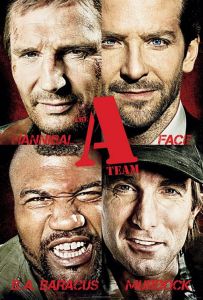 “Overkill is underrated,” quips Col. Hannibal Smith (Liam Neeson) in this big-screen adaptation of the 1980s hit TV show of the same name. And appropriately enough, like its source material, The A-Team is the very definition of mindless action. It’s completely shallow, goofy, yet over plotted and occasionally too serious for its own good, but like the A-team, the movie delivers when it counts. There is an undeniable pleasure in watching professionals work together, hatch a plan, and then watch that plan come to fruition. The A-Team is like an ADD-child because it can rarely sit still; five minutes won’t pass before something blows up. Writer/director Joe Carnahan (Smokin’ Aces) makes sure to keep things flying on screen so that the audience won’t stop and think about the multitude of plot holes and absurdities. The signature sequence that sums up the movie best is when the A-Team boys have escaped a downed aircraft by hiding inside a tank with parachutes attached. As they tumble back to earth they must try to “fly that tank” to land properly. It’s ridiculous on its face but rather entertaining. But the movie has its tongue firmly planted in cheek, even when it comes time to incorporate the show’s signature catch phrases (you could make an effective drinking game for the amount of utterances of “fool,” and, “I love it when a plan comes together”). The A-Team is overblown, silly, high-octane B-movie that obliterates your senses and thinking abilities, which means it successfully captures the spirit of the TV show.
Nate’s Grade: B-
Share this:

Prince of Persia: The Sands of Times (2010)
 This video game adaptation has the curious distinction of being both too simplistic and too complicated, sometimes in the very same breath. The harried screenplay could have used a lot more clarity concerning back-story, exposition, character roles, setting, rules of this Middle Eastern time period, supernatural rules, etc. At the same time, Prince of Persia is saddled with a pretty dopey story with weak characters. The plot is far too repetitious; somebody has the magic dagger that can turn back time, they lose it, they regain it, they lose it, repeat for over an hour. It feels like the story is never getting anywhere despite the fact that new, and still weak, characters are being introduced. The tone and look of the movie feels too beholden to its video game roots; the action is momentarily rousing but then seems overly coordinated to squeeze in all the game’s special signature moves. You’ll grow tired of all the wall flipping, wondering if a controller is stuck somewhere. For a movie dealing with a time-traveling dagger, give me more time travel. This fantastic plot device is used too sparingly in a ho-hum plot about an adopted son (Jake Gyllenhall, buff and with a sporting accent) of the king being accused of killing the king. Despite the Disney name, this feels less like a Pirates of the Caribbean knockoff and more cut from the same cloth that gave us the Mummy sequels. It’s loud, stuffed with empty special effects, and feels like junk food for your brain but it’s not even good junk food. Weirdest of all, the movie is one big metaphor for the U.S. invasion of Iraq (acting on false intelligence about some country aiding an enemy by manufacturing weapons). Seems Prince of Persia is Hollywood’s second attempt to rewrite our past political blunders in the Gulf and come up with a dubious happy ending.
Nate’s Grade: C
Share this:

Iron Man 2 (2010)
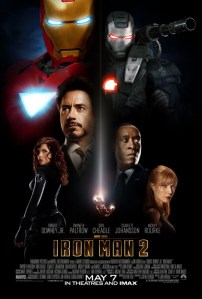 Iron Man was a fresh surprise in the summer of 2008, offering a superhero movie dominated by a middle-aged man’s personality and not the special effects. The story was not overwhelmed by all the demands of what we expect in a glorious summer popcorn experience. Marvel was smart to sign on the same team behind the first film, including director Jon Favreau, but setting a deadline exactly two years after the first film made me worry. There wasn’t much time to get everything together, and it should be no shock that Iron Man 2 feels rushes and absent the finesse of the first film. As much as it pains me to say it, Iron Man 2, while fun in spots, doesn’t come close to the original. You can trace much of it back to the sequel ethos that you take what worked in Part 1, make it much, much bigger and louder, and now you have Part Two. But what worked so exceptionally well in the first Iron Man movie was not the action sequences but the characters, so guess what happens when you pollute the narrative with more characters and disposable action sequences?
Tony Stark (Robert Downey Jr.) is a self-made superhero and now the world knows that he is indeed the metallic warrior, Iron Man. Stark refuses to hand over his technology to the government, saying he has “successfully privatized world peace.” He appoints his girlfriend/loyal assistant Pepper Potts (Gwyneth Paltrow) to CEO so he can devote his time to ridding the world of evil and lapping up the fame that goes with being Iron Man. Lt. Col. James Rhodes (Don Cheadle replacing Terrence Howard) is concerned for his buddy but also eager to help play around with that super suit. But not everybody loves Tony Stark, notably Justin Hammer (Sam Rockwell), a rival weapons dealer aiming for a Pentagon contract, and Ivan Vanko (Mickey Rourke), a Russian scientist who blames his father’s exile from America and Siberian internment on the Stark family. When Hammer sees Vanko’s attack at a Monaco speedway, he knows he has found an ally against Stark. Hammer whisks his newest Russian friend to New York and enlists his expertise in creating an army of super mechanical fighting suits.
 The screenplay by actor-turned-writer Justin Theroux (Tropic Thunder) is overstuffed with people and events all fighting for screen time and narrative dominance that it starts to become unintentionally comical after a while. There are too many storylines jostling for control when any one of them could have comprised a whole movie: military demands to have the suit, Tony deals with blowback from being the most famous man in the universe, and escalation (others trying to top Stark). Don’t even get me started on how Iron Man 2 bends over backwards to advertise that future Marvel Avengers movie lead by Nick Fury (Samuel L. Jackson). I mistakenly believed that the trailers ended before my movie started. There’s a storyline where Tony’s blood is becoming infected with a dangerous chemical every time he uses the Iron Man suit, so being a superhero is literally killing him. You can work with that for some pathos, debating the needs of one man vs. the needs of society and the greater good, personal sacrifice, mortality, legacy, but it all gets way too easily resolved in an absurd way (all I’ll say is, thanks Mad Men‘s Roger Sterling!). It tries to up the ante when less would have been considerably more.
Most of the new characters feel poorly integrated, further causing distraction to any attempts at narrative cohesion. Iron Man 2 also pushes Johansson into the mix so that she can shake up the Tony/Pepper relationship and, plus, she looks good in a skintight cat suit. But her third wheel/love triangle status is barely touched upon and Johansson gets one solid action sequence where she takes out a litany of goons in a hallway with the amazing power of her spinning thighs. Johansson is mostly just another assistant to take notes in the background, although she does it beautifully. The Rourke scenes are few and far between. They establish him as an intimidating force and then he pretty much sits in a room tinkering with stuff, garbling Russian, and feeding his cockatiel for the rest of the movie. He never feels like a real threat or a true match for Tony. Rockwell is the more appealing, slimy villain of the duo, aided by Rockwell’s exasperated bellowing and desperation for the spotlight. Hammer is more interesting to me than a Russian ex-con that rarely speaks, let alone speaks in English. He’s given so little opportunity to develop Vanko as a character. And yet Gary Shandling, as a smug senator trying to make Stark accountable to the U.S. military, might be the film’s best villain of the bunch (curious side note: Shandling and Rourke look oddly similar).
 The personal relationship between Tony Stark and Pepper Potts was the heart of Iron Man. They had that snappy, droll, screwball comedy-esque give-and-take, with hints of something more underneath. This time, the movie doesn’t even speak about their relationship at all, like it never happened in the first film. That scene where she kisses his Iron Man helmet, tosses it out the belly of a plane, and he dives off uttering, “You complete me”? Not in the film. You start to wonder why the movie is being purposely vague and it gets maddening. Their relationship lacks the frustration tinged with flirtation and replaces it with agitation. Both Tony and Pepper are harried and on each other’s last nerve, which doesn’t make for much romantic traction. Their chemistry seems to have dampened. I’m kind of with Pepper on this one because Tony Stark might be even too obnoxious in this movie. Following the sequel-it is code, Tony’s egotistical behavior is expanded and he becomes prone to self-destructive behavior, getting riskier and riskier, pushing others away including, perhaps, decent portions of the audience. He’s stopped being the cocky, likeable arrogant playboy and transformed into a bit of a rich douchebag. Part of this is related to the storyline about the suit literally killing Tony, and his character’s alcoholism featured heavily in the comic books, but it’s just another plot element that feels like it was put in for momentary conflict and then easily resolved or dropped. I understand Tony will be his biggest antagonist but that didn’t stop the first Iron Man film from flying high in entertainment.
The first Iron Man had an unexpected low level of action for a summer movie, but because of the characters you didn’t care. It was that rare comic book movie where you wanted more dialogue and fewer sound effects. To be fair, Favreau and crew saved a pretty nice Iron Mano y Iron Mano fight sequence at the end. Following that narrative lead, Iron Man 2 is structured pretty much like the first when it comes to action. There’s the attack at the Monaco raceway, which features an unrealistic, cartoonish tone that conflicts with the rest of the flick. But the film’s biggest moment of sustained action is the climax involves Tony Stark versus a bunch of silly killer robots. Soulless robot drones don’t get very compelling, plus haven’t we seen a thousand movies where people combat killer robots? What’s more disappointing is that Favreau incoherently stages the action. It’s not due to any sort of hyperactive editing, no, the culprit is that the onscreen action is just moving way too quickly. As a result, much of the action feels like whooshes of color. It’s hard to adjust your eyes to the rapid movement and process what exactly is going on. Because we can’t follow the action the whole thing lacks tension, danger, and drama. I wanted to be blown away by the action, which has several trailer-ready moments of awesome, but mostly I just wanted to be able to understand what I was watching.
 Despite all my complaints, Iron Man 2 still manages to be a fun time out at the movies. Downey is always immensely talented and brings great amounts of energy to the role, centering the movie on his witty charms. While his character is less engaging this go-round, Downey is still on top of his game. Rourke, Rockwell, Paltrow, and Johansson all contribute fine performances when they’re on screen. The low output of Iron Man in suit is compensated by having TWO Iron Men, thanks to Rhodes donning the metal gear and fighting alongside his pal. The opening of this movie captures your interest fairly well, though it loses it again thanks to slack pacing and an influx of new faces. The tone of the movie takes a cue from Downey and the movie as an agreeable, comedic feel without seeming overly glib. And hey, the special effects are pretty nice, too. Iron Man 2 is an adequate popcorn movie but the tragedy of the movie is that the first film was much more than adequate. I think the Iron Man film franchise is in need of a slight upgrade.
Nate’s Grade: C+
Share this:

Surrogates (2009)
 Surrogates feels either like an early first draft or maybe one half of a discarded final draft; this half-baked, shrift movie is not complete by any means. It’s too streamlined following the most obvious plot beats imaginable and adding nothing new to the sci-fi genre. In the future, people don’t go out, they just sit back and experience the world through the eyes of their surrogate robotic person. This plot device is ripe for social commentary but instead it just becomes the starting point for a snoozy detective story destined to climax in “My God, what have we done?” territory. There is too many interesting avenues the story could have gone but it doggedly sticks to the well-tread main road of sci-fi: technology will turn against us. The movie comes across like one long allegorical jab against people devoted to technology, namely the Internet, and the end might as well carry big flashing letters that spell, “Got outside and play, you nerds!” The action and special effects are listless, and director Jonathon Mostow (Terminator 3) waited so long to make this movie but you never feel his interest in a single frame. I suppose, in the end, there is no surrogate for good writing.
Nate’s Grade: C
Share this:

Ninja Assassin (2009)
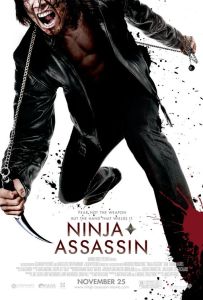 I never would have fathomed that a movie with both “ninja” and “assassin” in its title would barely hold my interest. This is a movie I got up and did the dishes through. Over-the-top never felt so boring, and perhaps it comes down to the flimsiest of stories strung together to connect the various ninja fights. It really does the bare minimum narrative-wise to get to the next opportunity for bloodletting, and oh what bloodletting! This is an extremely bloody movie but its power is undone because the violence is too stylized. Blood sprays like geysers and every slash of the flesh unleashes a balletic dance of painterly, soupy blood. The movie might work as disposable trash if only the action sequences were exciting. This isn’t a ninja movie but some half-assed video game. These aren’t Bruce Lee Ninjas, these ninjas can literally vanish into thin air before your eyes and they blend into the shadows. They are supernatural creatures that defy our traditional notions of what defines a ninja. This ain’t it. The characters all take such brutal beatings, and they spill tanker truckloads of blood, that it’s a wonder they can even stand let alone fight. There are a fee snazzy fight sequences but only thanks to choice in geography. The choppy editing only makes matters worse. I expected much more from the director of V for Vendetta. Ninja Assassin is just an un-engaging, hyper violent cartoon with a dimwitted story and little reason to care. The action isn’t even that good because the editing and lighting conspire to make sure you won’t be able to comprehend what’s going on. The best part of this entire damn stupid movie is the animated segment at the start of the closing credits. So have fun washing dishes until then, folks.
Nate’s Grade: C-
Share this:

Green Zone (2010)
 I have noticed that I’ve really been dragging my feet when it comes to writing a Green Zone review. I’ve prioritized it only to have something more necessary (catching up on VH1 reality shows) come to the forefront of my attention span. It’s not like the movie is bad. It may have been misleadingly advertised as Jason Bourne’s tour of Iraq, bringing back together Matt Damon and director Paul Greengrass (The Bourne Supremacy), but it’s not bad. It’s a perfectly fine movie, except in this instance, given the politically explosive and monumentally relevant subject matter, “perfectly fine” sounds like a missed opportunity. This movie should be incendiary, shocking, aggravating, enlightening, and if it happens to be entertaining then that ain’t bad either. The subject matter –the false rationale for war, WMDs– deserves a sober examination. Green Zone is not that movie. Green Zone is about uncovering and righting the mistakes of the Iraq War, and I believe I figured out what keeps Green Zone from being a better, more powerful, more engaging movie — it fictionalizes a story that is already wroth telling. This is a true story that could have stood well on its own merits.
Shortly after the fall of Baghdad in 2003, Chief Warrant Officer Roy Miller (Damon) is on the hunt for those weapons of mass destruction (WMD), the chief argument for invading Iraq. His team investigates suspected weapons sites but they keep coming up empty. The intelligence appears to be in sharp contrast with the reality on the ground. Miller butts heads with shady government officials (Greg Kinnear) and finds aid in a state department realist (Brendan Gleeson) and a reporter (Amy Ryan) who put her reputation at stake parroting the government intelligence as fact. The Iraqi army is disbanded and now the former generals under Saddam Hussein are conferring what the next steps should be. General Al Rawi (Yigal Naor, who played Saddam in a TV mini-series) is waiting for the Americans to extend a hand, and if not then they will become an insurrection. Miller is racing to track down Al Rawi because he knows the truth in the lead up to the war, which is why those shady government officials are also trying to kill him.
 Based upon reporter Rajiv Chandrasekaran’s book Imperial Life in the Emerald City: Life Inside the Green Zone, the filmmakers have resorted to a fictional narrative informed by the real events. My biggest gripe is this: the true story is far more interesting, complicated, and relevant than concocting a story about one military man’s search for answers. The film is laid out like a conspiracy thriller, where our hero gains a small sliver of information that leads to another piece, and another and another, until finally a picture emerges. I get it. With Damon as a soldier, the audience has an obvious rooting point, a protagonist who we can easily be labeled as good. And then when he uncovers the truth, and alerts the media, it provides a tidy, satisfying end for the movie. Except that’s not what happened. In the real world, the hunt for those phantom WMDs carried on for months, and the news trickled drip by drip. There were no smoking guns, no white knights to shine the light of truth (Joe Wilson and Valerie Plame might be the closest in consideration), and there wasn’t anything as conclusive as a military officer writing a report and sending it the mainstream media.
Green Zone attempts to craft a satisfying close to the WMD hunt and likewise the war itself. This is nothing more than revisionist wish fulfillment, wanting to insert a hero of conscience and ability during a time where we had a malaise of responsibility from those in the realms of higher command. And just to make sure they don’t make too many waves, Greengrass and screenwriter Brian Helgeland (Mystic River) wrap their crusading character in the uniform of America’s finest, making it difficult to criticize his noble hunt, striping away politics. The trouble is that the Bush Administration rarely made apolitical decisions; everything was steeped in politics, even the truth about weapons of mass destruction. So Green Zone does the audience a disservice by trying to play nice, setting up a villainous fictional straw man, and forgoing naming the names of those that led this country astray. Because of placing the film’s point of view squarely with Miller, we never get to examine the bigger picture, the manipulations and machinations that led to war. We are stuck in a very limited focus of finding the WMDs.
 Now, I must ask whether or not I’m unfairly judging the movie. Hollywood has often taken fascinating and momentous true-life stories and redirected them toward fiction. Green Zone is certainly a technically proficient film. Greengrass’ trademark shaky camera is ever vigilant, always roving and looking for the action; although in a realistic war setting, the kinetic handheld camerawork can come across as potentially hyperactive. Conversations between two people can come across like intense linguistic battles. Walks down hallways can appear to be speedy jaunts brimming with purpose and anxiety. The tension just doesn’t materialize. Without a nervy story, the Greengrass visual staple can seem over the top, antsy, nervous, and also annoying. This is one narrative for Greengrass that could have improved by the dedicated use of a tripod.
Green Zone is not Bourne at all. The Universal marketing team was trying to hoodwink the public into seeing an Iraq War movie. Damon isn’t as polished and in command as Bourne. Those who argue that Green Zone is anti-American or anti-troops are grossly missing the point. Reactionary, bellicose rhetoric, without a wit of substance, is part of the reason the U.S. is currently in Iraq. You can argue against policy, including war policy, and still be considered a patriot. Patriotism is not synonymous with warmongering. It’s too bad that the filmmakers felt that the true story wasn’t good enough to be told, instead settling for a decent if unmemorable political thriller. This adaptation takes the most significant foreign policy event in modern American history, one where the ramifications will be felt for over a generation, and clears all the hard-boiled details to attach a conventional one-man-fights-for-truth tale. It’s hard to get self-righteous when the movie keeps trying to cover its own ass.
Nate’s Grade: B-


You must be logged in to post a comment.