Blog Archives
2012 (2009)
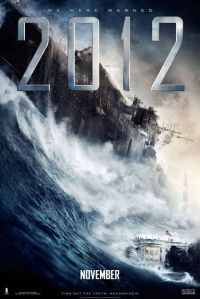 Let’s get this out of the way. The world isn’t going to end in 2012. Well, it might, but it won’t be because the Mayans said so. Because truth be told, the Mayans didn’t say anything about the world ending. The Mayan calendar exists in large circular amounts of time, and the largest period of time is called a bactun. An epoch, 13 bactun, will be coming to an end somewhere around December 21, 2012, but this in no way is a signal for the end of days. It just means that one cycle of time has come full circle and we begin anew. This is entirely a Western invention. If you learn nothing else from this review, know that the world will be fine come 2012. At least in this regard. Who knows about nuclear holocaust, biological warfare, religious fanatics bringing about the end of days, Sarah Palin running for president. The world could still end, but don’t blame the Mayans. They’re already dead anyway. They didn’t see that one coming, either.
2012 is the latest disaster movie from director Roland Emmerich, who fondly destroyed the world in Independence Day and The Day After Tomorrow. In news interviews, Emmerich has insisted that 2012 will be his last disaster movie (yeah right!), so he wanted to pull out all the stops. And he does. 2012 is like the disaster movie to end all disaster movies. It’s great escapist fun but it’s also silly and cheesy and hokey and all things a great memorable disaster movie should be. The movie packs so much that you may likely experience fatigue by the end.
 Like previous Emmerich movies, we follow a dispirit group of people from all walks of life who coincidentally come together. Jackson (John Cusack) and his wife Kate (Amanda Peet) are separating. Kate is currently seeing a new guy, Gordon (Thomas McCarthy, the writer/director of The Station Agent), and Jackson’s son thinks highly of new dad (maybe he saw the excellent Station Agent). Jackson is trying to become a better dad and take the kids camping to Yellowstone National Park. It’s there that he runs aground with government officials and a conspiracy radio host (Woody Harrelson) warning about impending doom. He puts enough pieces together to hatch a plan to save his family and escape. The government was alerted by a geologist (Chiwetel Ejiofor) in 2009 and has been preparing for massive seismic shifts. The president’s chief of staff (Oliver Platt) has been planning the “continuity of our species.” The elites have secured a place on massive arks built in the Himalayan mountain range. Jackson and his family must find a way to reach the arks in China for any hope of surviving the next chapter in human existence.
Emmerich packs so much earthly chaos into this movie that it can get flabbergasting. It’s not enough that California is upending by earthquakes and gaping chasms, it has to be thrown into the sea city block by city block. It’s not enough that Yellowstone National Park emits a thunderous volcanic discharge; it has to explode with the might of three mushroom clouds. It’s not enough that a 150-foot tidal wave strikes Washington D.C., it has to drag along a U.S. aircraft carrier that topples the memorable architectural sights of the city. It seems like Emmerich is trying to one-up everything that has come before in disaster cinema, but beyond the cheesy Irwin Allen movies of the 1970s, his only real competition is himself. No one wreaks havoc upon the world like Emmerich. He has the same destructive tastes of a mad scientist of Godzilla. He’s a big kid that likes to see things fall down and go boom. And in that regard, Emmerich has no equals. Not even Michael Bay, who certainly has panache to his record of ruination, can compete with this German master of disaster. No one can do enjoyable cheesy entertainment on such a mass scale like this man.
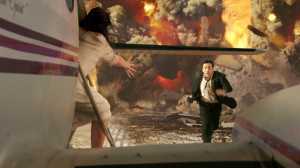 The special effects in 2012 are first-rate and the true draw to see this thing on the big screen. Large-scale global devastation has never looked so pretty. This is a full-blown summer movie in the midst of the fall prestige season. The destruction is often awe-inspiring thanks to Emmerich and his team of visual wizards, and the buildup of suspense can be palatable as well. The pacing is better than you would expect for a movie that runs over 150 minutes, but that didn’t stop the contingent of teenagers in my theater from standing up and leaving whenever there wasn’t violent death. At least Mother Nature wasn’t taking out specific monuments with pinpoint precision like She normally likes to do in these things. And just like in disaster movies, the “chosen few” are gifted with the amazing ability to outrun fireballs, earthquakes, falling debris, falling buildings, and just about everything falling at high velocity. Sure the immediate heat from an explosion at Yellowstone would instantly fry the characters, and sure an airplane can?t fly through a pyroclastic cloud, but it’s all part of the territory for the genre. If it was really true to life than we’d all be dead and the movie would be considerably shorter.
So what is the protocol for enjoying mass entertainment that coincides with massive death? Emmerich is usually very good about his disaster sequences to keep his focal point at long distance angles, both so that the audience can get a full vision of the mayhem and also to make sure that we cannot concentrate on the little people fruitlessly scurrying away for their lives. If you stop and think, practically every second of on screen destruction in 2012 involves thousands of nameless, faceless people dying horribly, and these are the big moments when the audience chows down on greasy fistfuls of popcorn. It reminded me somewhat when the news kept repeating the planes crashing into the World Trade Center towers as pieces for their 9/11 segments, and I’d stop and think, “You know, you just paused an image and in that image is the reality that hundreds of people are dying.” It’s a strange thing to contemplate, which is probably why Emmerich overloads your senses with (safe distance) disaster carnage. There is an image that does cross a line, where we witness office building workers tumbling out of the crumbling high rise. That’s one 9/11 image that’s just too distasteful even for a disaster flick.
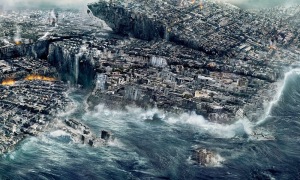 Naturally the reason to see these kinds of movies is the big bangs for your bucks, but what happens during the downtime? I was genuinely surprised how involved I became with the collection of characters. I’m not saying that this is deep, penetrating writing, but it’s easy to wring some pathos out of a story when you have one character after another delivering a teary “Goodbye, I always loved you” speech to their soon-to-be-dearly-departed relatives. I cared about these characters enough to wince when they began being picked off one-by-one when the script called for heroic sacrifice upon heroic sacrifice. Burrowed beneath the avalanche of special effects, like really really buried in there, is an interesting philosophical argument about how people would behave during the end of the world. Would they be selfless or selfish? Would they step on their neighbor’s neck for another minute of life or would people sacrifice? Personally, I’m a bit of a pessimist, but the debate is intriguing. I also thought that 2012 had a vital conversation about who exactly gets to survive. In the story, a seat on the super arks are a billions Euros, which gives the insanely rich a huge advantage, but it’s because of the insanely rich private sector that the world’s governments are able to build these massive arks and plan for a future. So there you have it: a future world with the likes of billionaires and politicians. Who will get them all coffee? Who will pick up their dry cleaning? Who will take their calls? Is this even a world worth living in?
2012 is dopey and self-serious and way too long but man is it entertaining. The fabulous special effects are the real star of the movie, though the assorted cast does well. 2012 is deemed Emmerich’s last disaster picture, and if that holds true then he’s making sure there isn’t anything left to destroy. This is disaster pornography on a scale rarely seen in the movies. It deserves to be seen on the big screen for maximum enjoyment of maximum destruction.
Nate’s Grade: B
Share this:

The Spirit (2008)
 This is the last time someone will let Frank Miller direct. Astoundingly bad, The Spirit is borderline camp for every absurd and bizarre second. It careens all over the place, never settling on a tone. So one minute it will be hard-boiled noir and the next it will break down the fourth wall and amp up the goofy slapstick to Looney Tunes levels. The story is threadbare, the characters are half-developed ideas, and each scene almost exists in its own five-minute world before Miller barrels forward. Sure the flick has some appealing visuals, but even those are derivative of the superior Sin City. As a director, Miller doesn’t cut it. He will shoot scenes with nothing but close-ups, giving no point of establishment for the audience, and he’s too prone to random diversions. Miller displays zero ability, or a complete disregard, for directing actors; they are terrible in different ways. Gabriel Macht, as the back-from-the-dead crime fighter The Spirit, sounds like Paul Rudd doing a Harrison Ford impression. Samuel L. Jackson, as the nefarious criminal/mad scientist/also semi-immortal The Octopus, overacts to a degree not even seen by Samuel L. Jackson. Scarlett Johansson, as an evil assistant, can’t even hide her disdain and boredom. This stuff just becomes unchecked lunacy, but it still manages to be boring through and through. The hero is a stiff, all the women are sex objects, and the conflicts are pointless when the combatants can’t be killed. The only thing worth mentioning is that Eva Mendes is still a gorgeous looking woman. Even Miller couldn’t fumble that one.
Nate?s Grade: D
Share this:

G.I. Joe: Rise of Cobra (2009)
 While plenty stupid, the big-budget G.I. Joe movie is actually passably entertaining. Sure the characters are one-note, the motivations and romances are strained, the acting is abysmal, Dennis Quaid looks to be in particular pain, the plot has too many unneeded flashbacks, the special effects are cheesy, and the movie is crammed with deliberate toy merchandizing connections, but I had fun with this flick. Director Stephen Sommers (The Mummy) works the right kind of stupid, the loud noisy kind that manages to tickle a childlike sense of glee like watching an eight-year-old’s imagination blown up on screen. The scale of weapons and special vehicles and special suits and special ladies in special leather outfits for engaging in criminal activity should delight younger film goers. The action is frenetic (if there is a pane of glass within 100 miles, the movie assures that you will see it shatter) and the international collateral damage is colossal, so much so that G.I. Joe almost comes across as a goofy, straight-laced version of Team America. Certainly the benefactor of rock-bottom expectations, G.I. Joe: Rise of Cobra is a brash blast of acceptable action movie stupidity. Grab a big bag of popcorn, shut off your brain, and enjoy the film’s cartoonish yet entertaining qualities.
Nate’s Grade: C+
Share this:

Max Payne (2008)
 I have no idea whatsoever what the point of this movie was. Adapted from the popular video game, Max Payne follows a hardened police officer played hysterically super serious by a grumpy Mark Wahlberg. He scowls, he grumbles, he chews over laugh-out-loud “tough guy” dialogue as he searches for his wife’s killer. For whatever reason, this storyline dovetails with a super drug on the streets that makes people see hallucinations of winged demons/angels. The entire storyline has no merit except to squeeze in some semi-cool effects shots. But when you know they’re all just hallucinations, what does it matter? Can that really be scary? But then these creatures seem to interact with reality and pull people to their deaths, so what are the rules here? There’s not an ounce of fun to be had amidst this drabby neo-noir landscape. The plot is a formulaic revenge tale, where every turn is easily telegraphed and every character is a one-note stock role, complete with the video game favorite of doe-eyed pixie girl who carries huge guns (Mila Kunis, why?). Even the action sequences are dour and dull. Max Payne is a movie that was built to exist in moments and not as a whole. The most troublesome aspect of this whole sodden adventure is how much the film openly fetishizes guns. The end credits are like a reel of money shots, watching glistening CGI guns rattle off. What better way to end such a thoughtless exercise in pseudo entertainment.
Nate’s Grade: D
Share this:

The International (2009)
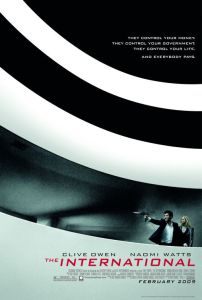 How much does one fantastic sequence count? Can it save an otherwise so-so movie? This is the case with The International, a plodding conspiracy thriller that is shockingly action-free sans two sequences. One sequence is a lackluster foot chase that serves as a frustrating anticlimactic climax. The other is a gripping shootout inside the Guggenheim museum in New York City between Clive Owen and some mercenaries. It is a fantastic piece of action cinema, expertly handled so that the geography is clear, the stakes get more fraught, and the twists and turns arise naturally. It feels like something out of one of the Bourne movies except with extra firepower. It is a terrific ten-minute sequence; the trouble is that is comes at about minute 70 and there isn’t much worth watching afterwards. The International is slow and fairly uninteresting. The flick thinks that by taking its time the movie will be more intriguing and involving. It?s not. The movie has one good sequence and it places it directly in the middle, just enough to snap you out of a stupor and get your hopes up that something equally entertaining will reemerge later. It doesn’t. The International is a snooze-worthy conspiracy thriller that just careens toward an incomplete ending. Take my advice: zip to the 70-minute mark and enjoy what you can.
Nate’s Grade: C
Share this:

Street Fighter: The Legend of Chun-Li (2009)
 It’s not every day that Jean Claude Van Damme gets some marginal level of redemption. The original 1994 Street Fighter film took the classic arcade fighting game and took it as seriously as possible, which meant it was incredibly silly. Van Damme was Colonel Guile and entrusted to rescue hostages from the evil dictator, Bison (Raul Julia). The big screen adaptation rewrote entire characters but managed to keep the stuff fans really care about, like catchphrases, costumes, and super moves. God forbid that audiences see Cammy (Kylie Minogue, yes that Kylie Minogue) make the wrong victory pose. It’s always the unimportant things that somehow matter the most to execs. Street Fighter is a campy blast. How could you despise a movie that has its villain say, “For you, the day Bison graced your village was the most important day of your life. But for me… it was Tuesday.” Though the movie does have the depressing distinction of being Julia’s last film before he died. Let this be a lesson to all actors looking to take a paycheck role. Years later, in the wake of a writer’s strike, the execs at Fox thought they could pump new blood into a Street Fighter franchise. Street Fighter: The Legend of Chun-Li purports to tell the back-story of one of its most popular fighters, the diminutive fireball-tossing lass with Princess Leia’s haircut. This movie proves that you don’t need a Van Damme to make a boring and mediocre action movie.
Chun-Li (Kristin Kreuk) is trained to be a master pianist and also a master martial arts warrior. You don’t realize the kinds of dangers classical pianists constantly run into. Her father is kidnapped by the crime lord Bison (Neal McDonough) for some reason or other. Three years later, a mysterious scroll falls into her possession. She travels to Bangkok to find her father. Bison has the ingenious plan of buying waterfront property, introduce high levels of crime, and then making money on lowered property values, which is simultaneously confusing and stupid. Bison has a few evil henchmen, notably the giant boxer Balrog (Michael Clarke Duncan) and the masked warrior Vega (Taboo from the Black Eye Peas), who help wipe out his criminal competition. In Bangkok, Chun-Li is mentored by Gen (Robin Shou, who played Liu Kang in two Mortal Kombat movies) and together they attempt to thwart Bison and his dastardly real estate scheme.
 For a movie about streets and fighting, well there’s a clear shortage of the latter. Much of the movie is structured around Chun-Li conducting her own private investigation and achieving some level of inner peace. She decides to try and make it on the streets of Bangkok. There are forgettable training exercises with forgettable platitudes disguised as wisdom (“You’re hurting me,” “No, you’re hurting yourself”). There are a handful of lackluster fights and chases, some of them through streets even, but the movie has a scarce amount of action until it revs up for a climactic showdown. The action is also poorly shot and poorly edited, distracting the senses and making it downright impossible to understand. The choreography is nothing special. When the movie suddenly introduces a supernatural element the other characters don’t even bat an eye. Screenwriting neophyte Justin Marks has too much revenge-seeking father drama and real estate scheming and not enough brawling. The Legend of Chun-Li has zero respect for the intelligence of its audience. It has flashbacks to flashbacks that just aired minutes earlier. How hard would it have been to just actually base a Street Fighter movie on a fighting tournament?
Director Andrzej Bartkowiak (Doom, Romeo Must Die) shoots the movie in such a dull manner that the fight sequences fail to even elicit any interest. There’s one scene in the middle of the film that serves as a testament to the lack of care put into this movie. Chun-Li has battled a Bison henchwoman in a women’s bathroom. The bathroom set design includes partition walls with portholes. Chun-Li is on one side and the henchwoman tries to punch her through the porthole. Chun-Li grabs the woman’s arm and squeezes. The camera angle is from the side of the actresses, so it would make the most sense to have the henchwoman’s right arm caught, that way her expression could be seen. Nope. Chun-Li is gripping the woman’s left arm, meaning that her raised arm and shoulder block any view of the woman’s face, and yet she talks through this scene. How difficult would it have been to just switch arms? Why purposely obscure an actor’s face, especially in a scene that doesn’t require a stunt double?
 Here’s a curious item. Chun-Li has always been a full-blooded Chinese woman in the history of the video game. When we see her as a child, baby Chun-Li and child Chun-Li are very obviously Chinese in features. Flash forward a few years and she’s transformed into looking like Kreuk, who is half-Chinese. Apparently, one of the less common side effects of trauma is becoming less Chinese looking as you age. Along these same strange ethnic lines, we’re told that Bison was the child of Irish missionaries and was left behind in Bangkok. And yet, the child grown up completely in Southeast Asia manages to sport an Irish accent. Anybody want to explain that particular linguistic loophole?
Kreuk (TV’s Smallville) is one of the film’s biggest handicaps. The script saddles her with great amounts of pointless voice over, to the point that half of her performance is listlessly explaining what is literally happening on screen. Kreuk is a dead-eyed robot in this movie; she displays some glimpses of human emotion, like sadness and rage, but they never feel remotely credible, like someone who only knows the definitions of emotions and not proper application. Her lesbian seduction dance is a small moment of absurdity. She thrashes on the dance floor and her “dancing” reminded me more of a bird’s mating dance without the excessive plumage displaying. Kreuk can run and flex well enough, which is also a nice benefit for a martial arts action flick.
The acting is terrible but there is one bright spot in a most unexpected location. Ladies and gentlemen, I present to you the best worst performance of the year, brought to you by Chris Klein (American Pie). Klein plays Interpol agent Charlie Nash who is conducting a parallel investigation into Bison’s Bangkok activities. He’s partnered up with a local gangland homicide detective (Moon Bloodgood) who takes extra care to showcase her cleavage thanks to work outfits with plunging necklines. Klein is awful to a powerful degree but here’s the thing — I’m fairly certain it’s one hundred percent intentional. Being a conosoire of trashy cinema, I feel that I’ve adopted the skill of being able to deduce when an actor is hopelessly serious or just goofing off. Klein comes across like a self-aware man; he knows this is a crummy movie with crummy dialogue, so he’s going to have as much fun as possible. His performance is all forced swagger, from the way he constantly swivels his head to the way he cannot purposely walk in a straight line. He overemphasizes lines, chewing over the faux hard boiled detective talk and spitting it out in a singsong delivery. He grimaces and furrows his brow, widens his eyes to comical levels, and when he crouches in a gunfight the man spreads his legs as far apart so that he looks like he could have effectively doubled as a backup dancer in an MC Hammer music video. It’s obvious that Klein has given a staggering performance, but the observant will note that this is not an inept performance. This man knows exactly the kind of movie he’s in. I always tabbed Klein as a wooden actor that came across like Diet Keanu Reeves, but I must credit him for making a bold acting choice to knowingly dig deeper when it comes to being bad.
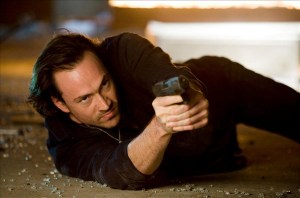
Hero of this movie, Chris Klein.
Readers know that I am skeptical and dismissive about the prospect of a good movie ever being born from a video game adaptation. Games call for interactivity and movies passivity. But if you’re going to make a movie called Street Fighter than stick to the script. This borefest wants to be a gangland drama with a tacked-on buddy cop side plot. Street Fighter: The Legend of Chun-Li is an awful work partially redeemed from the sheer amount of unintentional hilarity. Kreuk is extremely miscast as a warrior woman. The acting is bad, the direction is bad, the writing is bad, and Chris Klein tries to outdo them all in badness, and I admire the chap for trying something different in an admittedly abysmal movie. To be fair, I was never a big fan of the original video game. The special moves always seemed much more tricky to pull off. How many different incarnations of Street Fighter II were there before they eventually mastered basic math and released Street Fighter III? These are the things I was thinking about wistfully whenever Klein or Bloodgood wasn’t on screen.
Nate’s Grade: D
Share this:

Star Trek (2009)
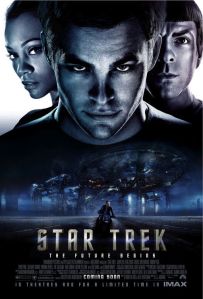 Star Trek has a hold on geek culture like no other franchise. It’s lasted over forty years, sustained five television series, and ten feature films (about four of them good), and let’s not forget the plethora of fanatical merchandise that includes everything from Trek cologne to Trek coffins. Star Wars has all the box office clout, but Trek has followers so devoted that they will create and learn a separate language, Klingon, that almost assuredly will never be spoken by anyone else outside of the festival circuit (you will never see a written Klingon exam that asks you “Where the library is?”). The Star Trek fans have been a foundation of geek culture for over four decades. People take this stuff very seriously. Trek has always been a headier brand of sci-fi, more devoted to ideas and moral dilemmas than shoot-outs and space chases, though Captain Kirk did teach the universe how to love, one green-skinned buxom alien babe at a time. 2002’s abominable Star Trek: Nemesis was meant to open up the franchise to a wider audience, but the film was the low-point for a franchise that also included William Shatner writing and directing the fifth flick (Nemesis also broke the odd/even movie curse).
When director J.J. Abrams approached Star Trek with the purpose of reinvigorating the flagging film series, you would think the man would wade into such a storied franchise with trepidation. Nope. He openly said he was making a “Star Trek movie for people who weren’t fans of Star Trek.” He was even going to change Trek canon. I imagine Trekkies (and no, I will never use the preferred nomenclature “Trekkers”) were nervous about an outsider, the author of the cinematic classic Gone Fishin’, meddling with hallowed ground. As I suspected, these fears were unfounded. The newest Star Trek does more than put a new coat of paint on an old franchise. This movie boldly goes where none of the Trek movies have gone before — turning reverent geek culture into a grand populist entertainment smash.
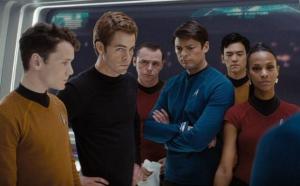 This new incarnation looks backwards, explaining how the crew of the U.S.S. Enterprise came together. The movie shows the path of Jim Kirk (Chris Pine), from troubled youth to eventual starship captain. Kirk’s father captained a starship for about 10 minutes, but he managed to save 800 lives under attack, including the birth of his son. Captain Pike (Bruce Greenwood) recruits Kirk to Starfleet Academy with the promise of doing something more with life. We also witness the boyhood of Spock (Zachary Quinto), who is teased for being half-Vulcan and half-human. His human mother (Winona Ryder) encouraged Spock to embrace his human emotions instead of cutting them off, Vulcan-style. Kirk and Spock clash at the Academy, and then an emergency requires all the recruits to saddle up for their first mission in space. Nero (Eric Bana) is a dastardly Romulan who has traveled back in time. In the future, he blames an older Spock (Leonard Nimoy) for the destruction of his home planet and the deaths of billions of Romulans. To ensure this does not happen, Nero is going to eradicate Starfleet home planets, starting with Vulcan and then Earth.
J.J. Abrams is a geek’s best friend. He understands geek culture, and yet the man is able to take genre concepts and make them easily accessible to the unconverted while still making a finished product that is respectful, playful, and awesome. Abrams is an expert on the pop culture catalogue, and he knows how to make genuinely entertaining productions that succeed on brains as well as brawn. He brought tired spy conventions into the twenty-first century with the cool, twisty Alias and Mission: Impossible III, which was really an extravagant two-hour episode of Alias, and I mean this in the best way. He has an innate understanding of action sequences and knows well enough that an audience needs to be engaged emotionally, so he makes the action as character-based as much as possible. Abrams has a terrific imagination behind the camera, and he reminds me of a young Steven Spielberg in his ability to marry artistic integrity with big-budget crowd pleasers. Abrams and his screenwriters Alex Kurtzman and Roberto Orci (Transformers, TV’s Fringe) have crafted a stellar Trek that will appeal to die-hards and those who couldn’t tell a Romulan from a Vulcan (I fall somewhere in between).
 The time travel storyline could have used more juice, however, it serves its purpose by establishing a parallel Trek universe to work with. Beforehand, Trek had established so many previous stories that it hamstrung writing new stories because they had to be extensively researched to make sure they did not conflict with 40 years of canon. Abrams and company wrestled free from the grip of the established history and can now play around unencumbered to a degree. I mean, fans don’t want to see something radically inauthentic, but Uhura and Spock as a couple? Sure, why not? The fan favorite character catch-phrases (“She’s givin’ it all she’s got,” “Dammit Jim, I’m a doctor?,” etc.) are organically worked into the story so that they don’t become falling anvils.
Star Trek‘s pacing can be whiplash inducing. It speeds through two hours of action and setup while still maintaining an emotional connection to the characters involved. The movie has a boyish enthusiasm for adventure and it’s fun watching well-known characters assemble and amble into new and interesting directions. The action is routinely thrilling and I enjoyed Abram’s small touches, like watching a crew member get sucked out into space and cutting all sound to illustrate the cold, empty vacuum. The amount of humor injected into the movie can be distracting at times, not because it isn’t funny but because of the brisk tone breaking. One second it’s a life-or-death scenario and the next Kirk is running around with giant goofy hands. Still, it’s good to see some humor in the Trek universe that isn’t related to alien culture clashes.
The young ensemble is amazingly well cast. I didn’t think a younger generation of actors would be able to step right in and play such lived-in characters, but they pull it off. The hardest shoes to fill are unquestionably Kirk’s, and Pine (Smokin’ Aces, Just My Luck) carries that same cocksure bravado without stooping to a stilted Shatner impersonation. His performance feels at times like Han Solo and Luke Skywalker rolled into one, and he’s an appealing presence that captures the essence of a dashing and rebellious scrapper. This Kirk is still an adventure-seeking, skirt-chasing 1960s kid at play. Quinto (TV’s Heroes) is blessed to look remarkably similar to Nimoy, but the actor also gets to explore the human side of Spock. He feels compelled to harness emotion, like all Vulcans, yet it’s intriguing when certain emotions slip out and build a bigger picture about what’s going inside the mind of a being dominated by logic. Quinto has less to work with by design and yet the man finds interesting ways to ensure Spock can be recognizable. Each of the supporting actors has their moment, but my biggest surprise was Karl Urban as Dr. Leonard “Bones” McCoy. Urban has mostly been confined to lame action movies as of late, like Doom and Pathfinder. But he’s really funny and his performance captures DeForest Kelly’s mannerisms down without turning into a caricature.
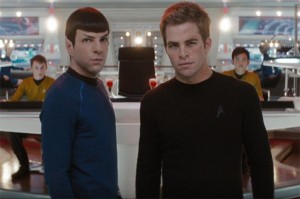 If there is a main weakness to Abrams’ Trek outing it’s that it feels far more like the opening act of a larger movie. Nero is a fairly weak villain, though Bana gives him a nicely polished glower. The villain is really just a tie-in for the time travel storyline, which is also a narrative quirk to secure an open field for further stories. Meaning, that much of the movie can be seen as assembling the pieces to simply move forward on their own. It’s an expensive set-up movie, and Abrams makes sure that the audience sees every dollar of the splashy visuals onscreen. Personally, I was also getting tired of the cinematography decision to fill the screen with as many light flares as possible. It seemed like every other moment had a blast of light beam in from some direction. After a while it sort of felt like an eye exam where the optometrist shines a flashlight back and forth. And it takes far too long for Scotty (Simon Pegg) to appear in the movie.
J.J. Abrams does more than hit the restart button. He has made a Star Trek that manages to be respectfully reverent but at the same time plays along to the mainstream visual sensibilities of modern cinema. It’s fun without being campy, reverent without being slavish, and this Trek never forgets to entertain from the opening assault on a starship to the Michale Giacchino’s closing credits score. This is an enjoyable rush of sci-fi escapism. The Star Trek series was always deeply hopeful and humanistic, believing in the best for humanity and that man, in cooperation, could achieve greatness. I think further escapades with this cast and Abrams at the helm could reach greatness. For now, I’ll be happy with this rollicking first entry into a franchise that seemed adrift in space. Bring on more of the green-skinned women.
Nate’s Grade: A-
Share this:

Paul Blart: Mall Cop (2009)
 Cute but very dumb would be the best way of describing Paul Blart: Mall Cop, which is miraculously one of the highest grossing movies of 2009. Kevin James stars as the titular security man and he proves to be a capable physical comedian, throwing himself into the jokes. It’s too bad that some of these jokes don’t deserve James’ efforts. A group of extreme sport crooks (they ride around on BMX bikes and skateboards like they’d rather be at the X-Games) hold Blart’s mall hostage on Black Friday, and Blart is the only security officer of any kind left on the inside. It’s Die Hard in a mall, but, surprisingly, the movie has some decent jokes when it’s riffing on tired action movie tropes. Some of the comic setups have funny payoffs because they work against audience expectations (like a bottle of hot sauce you know will be key at some point). Mostly, this is a goofy, almost saccharin comedy, with James earnestly playing a man held back from his life’s pursuit by his diabolical blood sugar. The flick is a bit more character-based than most slapstick farces, so I’ll give it that. Blart is a lovable loser who eventually wins respect and the girl of his dreams (Jayma Mays). The film is also more leisurely than an 87-minute comedy should be. The bad guys don’t take over the mall until after 40 minutes in, leaving little room for the comic clashes with Blart. The movie also doesn’t maximize its potential, much like its title figure. This is Blart’s mall, and he has an innate knowledge of it, but he doesn’t use this to turn the tables on his opponents. Paul Blart: Mall Cop has plenty of dead moments but in the end I found the movie to be tolerable thanks to James.
Nate’s Grade: C
Share this:

X-Men Origins: Wolverine (2009)
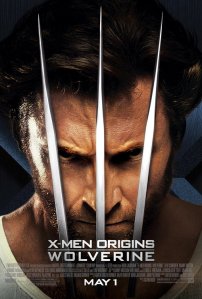 X-Men Origins: Wolverine has been slashed from all sides. First, the movie has not been able to shake bad buzz, from extra reshoots to rumors about conflicts between the studio and the director. There was even one rumor that the head of 20th Century Fox Studios ordered a wall repainted a happier color. Then in early April it got even worse. A DVD-quality print of Wolverine was leaked onto the Internet and spread like crazy, and once something finds itself inside the realm of cyberspace it cannot be put back. The reaction to the leaked copy was mixed, at best. The studio went into damage control mode, stating that the leaked copy was an unfinished work print, that they too were not thrilled with this version and paid millions for reshoots, and the final version that would be released in theaters had 20 minutes of new stuff and 10 minutes additionally edited out. But guess what? The wolverine’s out of the bag, it’s the same exact version minus some completed special effects shots. What amuses me about this whole situation is that the studio is on record trashing the movie, saying they were unhappy with this version, and yet this is the final release. After having seen Wolverine, at least I can say that those Fox execs know mediocrity when they see it.
We get to witness the storied history of Wolverine (Hugh Jackman), which goes all the way back to the pre-Civil War era. Born James Logan, and a mutant, the kid had the unusual ability to produce three jagged bone claws from his knuckles. Logan also had the ability to miraculous heal like his older brother, Victor “Sabertooth” Creed (Liev Schreiber). The two of them make use of their primal, animal instincts and near invulnerability by fighting in every major U.S. war, from Civil to Vietnam. Eventually that kind of thing gets noticed, and General Stryker (Danny Huston) recruits the brothers to be apart of a mutant mercenary group. The group also includes the likes of William “Deadpool” Wade (Ryan Reynolds), “The Blob” (Kevin Durand), and some other unimportant mutants (one of them played by a Black Eyed Pea, will.i.am). Wolverine walks away from the group when he decides that he isn’t cut out for a cutthroat life.
The man finds a quiet place to live along the Canadian Rockies. He’s found a hard-working job, lumberjack, and a good woman, Kayla (Lynn Collins), who loves him. All of this is ruined when Sabretooth comes back around, intent on eliminating the former mercenary members one by one. Stryker appeals to Wolverine to apply for the Weapon X program. He says he can give Logan the tools for his revenge. Wolverine then undergoes the famous procedure that bonds his skeleton with adamantium, an unbreakable metal, and his bone claws become extra sharp metal. Stryker has other plans, naturally, and Wolverine breaks out of the facility. Stryker tells his assassin, “Bring me back his head.” Sorry pal, but you’re the one that just spent half a billion dollars giving Wolverine an unbreakable spinal column.
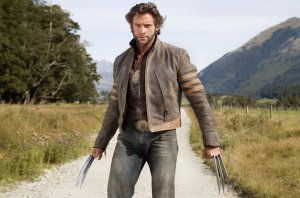 Is this origin tale worth telling? Short answer: no. The mysteries behind Wolverine’s back-story aren’t too involving and the answers make the character less interesting. I don’t really care why Wolverine got his metal skeleton or how he came to be an amnesiac, I just accept that the man has some mystique to him. I care even less that one of the answers to those mysteries is a murdered lover. The plot is incredibly thin; Wolverine meets one mutant who tells him to meet another mutant who tells him to meet another mutant, etc. Eventually the film heads for a mutant showdown that plays out like a lame video game, specifically the mid-90s Mortal Kombat (the Final Boss super villain resembles the blade-handed Baracka). What are Gambit (Taylor Kitsch) and Emma Frost doing in this? That?s not the end of the mutant cameos, either. I feel like the only thing we learn about Wolverine is that his super sense of smell cannot detect the difference between real blood and stage blood. The filmmakers think character development involves someone saying no to slaughtering innocents, and then other characters keep telling him, “You’re not an animal.” The movie meanders from one unimaginative special effects set piece to another, stopping at points to shove in various mutants that serve little purpose to the story other than diehard comic fans will be more forgivable.
Oh, but what to do when your main character is indestructible, your main villain is also indestructible, and your other lead villain cannot be killed because he?s due for an appearance in X-Men 2? Why you bring in a third, nigh indestructible being into the stakes, however, this being doesn’t already play into the established X-Men onscreen mythos, so this guy’s okay to kill off, that is, until he too gets a movie built around his character and then that movie has to backtrack to fill in on time before its capped ending. We already had a healing ability mutant with super claws vs. a healing ability mutant with super claws smackdown in X-Men 2, where Lady Deathstrike fought Wolverine. That fight was brutal and well staged. The fights in Wolverine’s big show are uninspired; how much stabbing can you watch between people who instantly heal? Also, apparently another side effect of the Weapon X program is that these metal claws are self-cleaning, because every single damn time Wolverine stabs someone there isn’t a droplet of blood to be found on his claws. It?s hard to get emotionally involved in characters that are fearless and have little at stake. Which, of course, is why Logan had to be given a cruddy romance where he gets to hold his dead lover?s body in his arms and bellow to the heavens for what feels like the 80th time. Seriously, twenty percent of all the dialogue in this movie is some combination of growling, spitting, and bellowing.
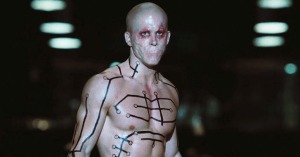 Wolverine isn’t a terrible movie but it’s rather shoddy and thoroughly mediocre. I never thought I’d see this character do the beyond-cliché action movie motif of strutting in slow-mo while an explosion sizzles in the background. This is the kind of film that involves a super team standing shoulder-to-shoulder to walk down like they’re from The Right Stuff. This is the kind of movie that opens with a needless family squabble about Logan finding out the pointless identity of his real father. What was that about? (After killing his father, I remarked to myself, “I guess that he gets that whole healin’ thing from his mother’s side of the family.”) This is the kind of movie that hires Ryan Reynolds and then disarms the man of his greatest asset, his smart mouth. This is the kind of movie that theorizes the only thing to kill an adamantium-skeleton man is with an adamantium bullet, like a sort of werewolf. This is the kind of movie that sends a super assassin, with super bullet-bending powers, out to kill Wolverine but does not arm the super assassin with those special adamantium bullets. Why not shoot this guy in the eye? That is an open body cavity. This is the type of movie where the final super villain is controlled by, get this, key commands like “Engage.” This is the kind of movie where an assortment of characters refrain from killing super bad murderers out of the morally pretentious idea that they, too, would be no different from the super bad murderers. Excuse me, executing super bad murderers would be doing the world a favor here. This is the type of movie that fills the running time with pained dialogue like, “You wanted the animal, you got him,” and, “Nobody gets to kill you but me,” and the best line of them all: “I thought you were the Moon and I was your Wolverine. Turns out you’re the Trickster and I’m just the fool who got played.” Top that, screenwriters.
Whatever the budget was for this movie, well, apparently it wasn’t enough. The adamantium effects looked perfectly reasonable in the first X-Men film and that was nine years ago, so I cannot understand why the claws look astoundingly fake this go-round. They look like direct animation, like Wolverine is holding cartoon claws a la Who Framed Roger Rabbit? When did they become so thick too? These claws are like the size of the steak knives you get at restaurants.
Jackman deserves some of the blame here since he is listed as a producer and he hand selected director Gavin Hood (Tsotsi, Rendition) who does not have the interest or the eye for this kind of material. Hood lacks the finesse and vision to stage exciting action sequences, which explains why he falls back on tired genre tropes like the slow-mo strut in front of fireballs. I am dead certain that this stupid super assassin was pushed into the movie after film producers saw how much money the bullet-curving Wanted made the previous summer. The movie borrows heavily from recent Marvel Origin comics, or so I’m told, which is where the whole “Wolverine through the ages” storyline comes from. Personally, I don’t much care for the idea that Wolverine’s healing ability also deters aging until you hit that agreeable, desirable Hugh Jackman age range, but fine, whatever. The movie takes great effort to showcase Jackman’s flawless physique, and this dude is ripped to the point that you can see bulging veins. I just wished Jackman made more use of his acting muscles in this movie. He snarls and glares, and even has a softer moment or two with Collins, but rarely does Wolverine get to prove why he is such a beloved comics character.
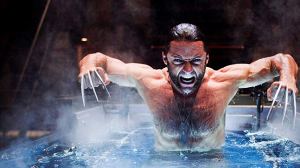 Thank goodness for Liev Schreiber (who actually also co-starred with Jackman in the forgettable romantic comedy, Kate & Leopold) because this man entertained me from start to finish, which is more than I can say about his movie. Schreiber has fun with his role and totally buys into the character’s animal instincts. He relishes the kill. The bizarre sibling rivalry between he and Wolverine is the best part of the movie, and the interplay between the two actors is when the movie has its few moments of life. Like Watchmen, the film finds its creative peak during the opening credits, as we watch Jackman and Schreiber claw and bite their way through American battlefields.
Here’s an easy solution to the Wolverine amnesia issue that doesn’t involve the use of admantium bullets. Kayla (Silverfox) has the power of hypnosis through touch, so why not in the emotional climax have her touch her dear lover Wolverine and wish, “Forget me. Forget all about me.” There, problem solved, and this way it works emotionally and organically with the story. It took me an hour after seeing X-Men Origins: Wolverine to come up with a better ending, so just imagine what more time will allow. Jackman and company are lost thanks to a mediocre script that sacrifices character for action beats, and even then the action is fairly mundane. There are a handful of cool moments, like Wolverine propelling himself onto a helicopter from an exploding car, but after four movies nothing has come close to producing the adrenaline rush that was the X-Men 2 sequence where Logan unleashes his berserker rage on the commandos in the mansion. By the end of his first solo outing, Wolverine is left without any memory. I won’t say we should all be so lucky but the X-Men filmmakers would be better off paying little attention to this origin tale, unless they want to bring Schreiber back, which they should do at all costs.
Nate’s Grade: C
Share this:

Fary Cry (2008)
 Say what you will about Uwe Boll as a writer and director; Lord knows I’ve written nearly a Master’s thesis on the notorious schlock filmmaker. However, this man would be an asset to have as a producer, at least initially. The German tax loophole was closed and yet the man still finds a way to make like three to four movies a year. He can pull together resources and organization as well as anybody in the business. So what if the final product happens to be substandard? This man knows how to produce. He’s just not as skilled at other positions. Far Cry, Boll’s latest video game adaptation, is a clunky action movie that treats genre clichés as virtues. It is not a bad movie but it’s not a good bad movie either. It’s just Boll’s version of disposable action.
Valerie (Emmanuelle Vaugier) is a Vancouver newspaper reporter who has got a great lead on a story. Turns out Dr. Krieger (Udo Kier), your classic mad scientist, is running experiments on a nearby island and he has an armored guard. Our spunky heroine is determined to investigate. Her uncle Max (Ralf Moeller) is actually working for the mad doctor and having misgivings, which is why he tries to send Valerie classified info on the experiments. Dr. Krieger is bankrolled by the (Canadian?) government to develop genetically modified super soldiers. They have a layer of armor under their skin and the only foolproof way to kill these super soldiers is to shoot them in the eye or mouth. My best guess why is because they both lead to the brain, but then why stop there? Why not shooting into ear and nose cavities? Anyway, the super soldiers won’t take orders so the mad doctor and his mercenaries capture Max and turn him into the newest test subject. Valerie has chartered a boat to meet up with her uncle. The boat captain, Jack (Til Schweiger, who sounds like his voice was dubbed by an actor that could not widen his mouth to enunciate), just happens to be an old Special Forces buddy of Max’s. This comes in handy when both Jack and Valerie are attacked once they reach the island. The duo must run for their lives and inflict much ass-kicking justice.
 Far Cry is a mediocre cliché-ridden action vehicle. You’ve got so many formula elements widely circulated in numerous other action flicks, and I’m not even talking about the standards like that the good guys are marksmen, the bad guys are terrible shots, and anyone can move unfazed if they get shot in the shoulder. We also have the fact that all evil hideouts, when not hewn into volcanic rock, must be located in giant warehouses with too many catwalks and chains and extraneous machinery that do little else but spit sparks when called upon. Jack also pulls the timeless tactic of stripping an enemy solider, putting on his uniform, and then infiltrating the enemy camp under a flawless disguise – a change in clothes. Let’s not also forget the tried-and-true method of throwing a rock in a different direction to cause a distraction. I think at this point only dogs fall for that. By the thirty-minute point, we’ve already seen two separate shots of Jack swimming underwater while an explosion rages above the surface. Though the word has likely lost all meaning to Boll, I would describe that as excessive.
Another major cliché of action movies is the forced coupling between Jack and Valerie. It doesn’t take long before their bickering leads to smooching. Shortly after just escaping mercenaries and a helicopter explosion in a lake, Jack and Valerie find a shack nearby and tend to their wounds. She changes out of wet clothes and makes sure that he doesn’t catch a peek (he does) and he dresses a flesh wound on his rippled abdomen. Eventually she crawls under the blankets on a bed to warm herself for the night. He does too, to stay warm of course. “I have to take off my wet pants, you know,” he reasons (oldest trick in the book). But after they’re in bed together they have to still talk about how cold they each are still, and then Jack suggests, “shared body heat,” you know, just to stay dry. After what seems like forever, these two just give up this charade and start kissing and have them some sex. Naturally, the introduction of an attractive female character in an action movie is designed so that she can snuggle and then be put in danger. Valerie does little else to the story. I want to know why either of these two is acting so casual moments after they escaped fiery death. They know that they’re still being hunted, and the shack is within walking distance from the crash site, which is being investigated by the mercenaries. For that matter, why do the bad guys call off each attack to search and confirm for kills? Are they that concerned with paperwork?
 Far Cry feels like every generic moment rises from the shadow of other generic action movies. The final conflict between Jack and Max the Super Solider boils down to an appeal to the man inside the monster, trying to tap the humanity buried beneath the killing machine. You’ve seen this in countless other movies. Dr. Krieger has a dominatrix-esque second-in-command that has some personality to her; it must be hard to be a female henchwoman, having to be even more evil than the henchmen to prove her self. The initial plot setup even reminds me of Ed Wood’s Bride of the Monster — girl reporter investigates mad scientist. The whole island-based setting, with the aquatic inclined stunts, led by a Central European action star, buddied up with a yammering idiot as a comic sidekick … it oddly reminds me of the entirely forgettable 1998 Jean Claude Van-Damme movie, Knock-Off, with also had the misfortune of co-starring Rob Schneider. A knock-off of Knock-Off? Well it is time for the tenth anniversary after all.
Boll stubbornly tries to make his mundane action movie into a comedy. The comic elements never fully gel with the rest of the film, and yet Boll keeps transforming the movie into this screwy action comedy. There’s the bickering between Jack and Valerie, which is expected territory for the genre, but then the movie fills its time with excessive wisecracks, strange digressions, and so much comic relief that it fails to be relief (or comic). Chris Coppola chews as much scenery as possible as Emilio, the irritating, hapless sidekick to Jack. He’s introduced at almost the hour mark and seems to be trying to make up for lost time in annoyance. He’ll offer to help Jack fight but then recoil and scamper off. This is the kind of movie that has the overweight Coppola lovingly caress a sandwich and coo, “I’ve been thinking about you all day.” Get it? He’s fat. Fat people love food.
But by far the funniest and weirdest aspect abut Far Cry is how unbelievably prepared Jack is for any situation. He hands Valerie a handcuff key from his pocket, which he always carried with him because, presumably, Jack lands in handcuffs often or cannot be trusted to remember his “safe word.” But then late in the movie, Jack is handcuffed and he literally regurgitates ANOTHER handcuff key. This means that Jack keeps a key in his pocket and swallows a spare. Does he eat these daily? What else is hidden among his body? The man could be a human Swiss army knife.
 No one ever seems to question what the chances are that a German former Special Forces agent will work at a Canadian lab, within reach of his Canadian niece ace reporter, who will charter a boat from another German former Special Forces agent who also happens to be within reach of this lab. I guess when you’ve got invincible super soldiers you don’t sweat the details.
Despite all its flaws and general laziness, Far Cry is a semi-decent action movie, especially one with a low budget. Boll manages to construct some passing action sequences with respectable camerawork, and the end battles between our heroes and the Super Soldiers is actually well-edited, with sharp cuts that help ratchet up the energy level, and has plenty of good stunt work. A chase through the nondescript warehouse between Jack and a super soldier actually makes use of some spiffy Parkour choreography, a welcomed addition. The forced comedy can actually succeed at times during the action, like when Valerie is hurling grenades with the pins still attached or when she accidentally lassos a helicopter with a harpoon gun (Dr Krieger scolds her, “You know, you owe me a helicopter.”).
In the pantheon of Boll movies, Far Cry lands more toward the top. It’s a middling action movie that tries too hard to constantly inject misguided humor into every freaking minute. The movie suffers from the same boneheaded flaws that plague the action movie genre, but by the end of its admittedly brief running time, Boll has pulled off a minor success. Far Cry is not a good movie and has too many derivative and unimaginative elements, but Boll seems to have cranked this one out. While Far Cry is not a particularly good action movie, it is relatively indecipherable from the thousands of other cheap mediocre action movies that pollute the direct-to-DVD market. He’s made an easily digestible product that isn’t even bad enough or weird enough to be memorable. To him that’s victory, but to me, an avid Boll expert, that’s just plain boring.
Nate’s Grade: C


You must be logged in to post a comment.