Category Archives: 2020 Movies
The Prom (2020)
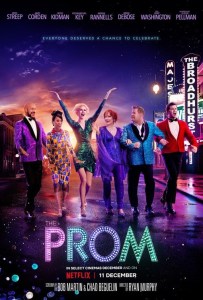 It’s full of big feelings, declarations of self-identity, an unabashed love of the transformative power of theater, and its power of positivity can be a balm to many during this holiday season. The Prom is based on a short-lived Broadway musical about a girl in Indiana who wants to bring her girlfriend to the school prom and the ensuing media controversy that erupts. A team of out-of-work theater actors (Meryl Streep, Anthony Rannels, Nicole Kidman, James Corden) see publicity value in rallying to her cause, so they decamp to Indiana and challenge the homophobic PTA leader (Kerry Washington) who refuses to hold an inclusive prom. Director Ryan Murphy’s style and sensibilities work well within the realm of musical theater; a decade of television curation for FX and now Netflix has made him an expert on camp and flash. The man loves applying slick gloss to trash. His camera is constantly, uncontrollably moving during the numerous musical numbers, attempting to compensate for the generic quality of the majority of them. There are two standouts. The first is when Corden’s character takes our lesbian teen to the mall for a makeover. It’s got a catchy hook and one that becomes a reoccurring theme for the show. The second is when Rannels’ character is pointing out the hypocrisy of local Christians decrying homosexuality but falling short of other Biblical teachings. The story is sweet but un-challenging. The plot exhausts so quickly that I was amazed at one point to discover there was still an hour left in the over two-hour production. Each member of the squad gets a signature number to varying degree of success. The happy ending is affirming and heartfelt but also quite easy and kind of unearned. The amount of catharsis and reconciliation doesn’t gel with the emotional investment and development of these characters. They’re nice but relatively dull, and the industry satire only goes so far to chide the out-of-touch Broadway elites for their own prejudices of Midwest life. The Prom is disposable fluff that will pacify an afternoon.
Nate’s Grade: C+
Share this:

Soul (2020)
 I needed to watch Soul twice before I fully processed how I felt about it. Pixar’s latest animated wonder follows a New York City music teacher named Joe (voiced by Jamie Foxx) who goes into a coma right before his big break playing for a jazz legend. He’s transformed into a cuddly little blue tuft of cloud creature and informed his soul is ready for The Great Beyond. In a nod to Heaven Can Wait, Joe indignantly fights his way back to Earth to reclaim a life he felt was just now getting on track. His ticket back to Earth is through mentoring a surly, pessimistic young soul 22 (Tina Fey) that nobody seems able to reach, even Mother Theresa. Early on, there are two very clear realizations. First, Soul is beautiful to look at and very weird and art deco with its character designs in its spiritual realms. Second, the world building and rules of this special world are quite convoluted. Unlike Inside Out where you were dropped into a new world and all the parts added up with a sense of logic, the spirit world and especially the process of how baby souls become what they are seems hazy and arbitrary and not fully articulated. This confusing world building also includes the idea of people “being in the zone,” lost souls wandering the land as lumbering monsters, and a traveling group of mystics that can meditate their way into this higher plane of existence. That’s even before a second act trip back to Earth that reminded me of Brave and leaned into slapstick and comical misunderstandings. There is a soul guardian on the hunt for Joe to keep things back in order, though the consequences of a soul count being out of whack are never explained. I thought this antagonist character was going to amount to much more but is mostly forgotten. Where Soul succeeds is with its heart about people trying to find their spark, that special something that lifts their spirits and makes them who they are, and I think it’s an important lesson that it’s not the same as a purpose. The comedy banter between Foxx and Fey is solid and there are some funny sequences and a few gags that impressed for going the extra mile. I was interested from the opening moments but I cannot say I was terribly emotionally invested. Part of this is because the movie swiftly runs through so much world building and rule-setting in 90 minutes, partly because the character of Joe is a bit close-minded in how he designates success, and partly because the young character of 22 feels more like a sidekick than a developed supporting role. The musical score by Atticus Ross and Trent Reznor is highly original and evocative. It was providing an emotional resonance and wonder I found missing at other points in the film. It feels very ethereal and propulsive and just new and exciting. The climactic track “Earthbound” feels so stirring and emotional and light. It’s my favorite film score of the year. Soul is a fun and imaginative movie that has some wrinkles with its world building, characterization, and delayed emotional investment, but even a second-tier Pixar movie means it’s still one of the better movies you’ll see for 2020.
Nate’s Grade: B
Share this:

Wonder Woman 1984 (2020)
 Big, colorful, and brimming with optimism easy to scoff at, Wonder Woman 1984 (WW84) is finally here to save Christmas and maybe movie theaters and it’s an escapist treat. It won’t register among the best of superhero cinema but will likely keep a smile on your face.
In 1984, Diana (Gald Gadot) is working at the Smithsonian Museum in Washington D.C. and fighting crime as her costumed alter ego. She’s never quite moved on from the death of Steve Trevor (Chris Pine) back in WWI and she dearly needs some friends. Barbara (Kristen Wiig) is a mousy co-worker who comes across a mystical artifact, a rock that magically grants wishes. Barbara wishes to be strong like her boss/idol Diana and she gains new intoxicating power. Max Lord (Pedro Pascal) is a wannabe TV pitchman and an empty suit, fleecing investors and barely keeping ahead of his own Ponzi scheme. He learns of the magic rock and wishes himself to become the rock itself, turning him into a living genie. From there, Max’s wishes are spinning out of control, placing the world in greater crisis. Diana is torn because, before Max absconded with the wish rock, she wished for her heart’s desire, the return of Steve. Stopping Max and reversing the effect of the wishes means having to say goodbye to Steve all over again.
The original Wonder Woman was a break from the pallid doom and gloom motifs that Zack Snyder established, and the sequel goes even further with its candy-colored recreation of the 1980s. I was wondering if there would be a good reason to set the movie specifically during the 80s, and it’s mostly for the Cold War and Yuppies. I was pleasantly surprised that Jenkins and company don’t overdo the 80s nostalgia or the fish-out-of-water comedy for Steve Trevor. I thought this was going to be the entire reason for the throwback setting, and this time instead of Diana marveling at a modern world she did not understand it would be Steve. If you’ve watched the film’s trailer, then you’ve seen all of those jokes at Steve’s expense. That’s it. WW84 can manage to surprise you, mostly in a pleasant manner. Its sincerity is its biggest virtue. It’s a movie about plenty of goofy things but at its core it’s about relatable desires and struggle.
 WW84 is an improvement over the original in the action department. Returning director Patty Jenkins feels freed of emulating Snyder’s house style and brings a welcomed sense of levity and playfulness to the action. The fight choreography makes significant use of Diana’s lasso, opening up the playing field for her to swing around wildly, at times even literally riding the lightning. At points the lasso seems to have a mind of its own and able to divide into fragments. It’s something that helps separate WW84 from the glut of other superhero movies and it offers pleasing visual variance for the fights. There’s a car chase midway through the film where Diana has to leap from speeding truck to speeding truck, dodging goon gunfire. It’s an exciting and sustained action sequence, yet even across the Middle East, chase clichés will reappear, like dumb kids playing in the street ignorant to any emerging noise like a caravan of speeding vehicles. Jenkins seems even more adept behind the camera for the action, delivering big stunts and memorable spectacle ready to make a splash on a big screen. However, some of the CGI can be shockingly dodgy for a big-budget blockbuster and a final confrontation with a CGI-hybrid creature unfortunately reminded me of the lamentable Cats.
The magic wish rock setup shouldn’t be any harder to believe than, say, a secret island of immortal female warriors or just about anything in the absurd and absurdly entertaining 2018 Aquaman feature film. If I can accept a drumming octopus, I can accept a magic wish rock. WW84 hinges on the concept of the drawbacks of creating your own false reality where every wish comes with a cost and an increasing flood of alarming consequences. It it better to just accept the comfort of lies or accept hard truths? The characters even name-check the classic short story The Monkey’s Paw recognizing the ironic trap. That doesn’t stop characters from struggling with the pull of their burning desires, and it makes for an agreeable return for Steve Trevor. Ever since it was revealed that Pine’s character was returning, I was worried what the possible explanations could have been, pessimistic it would be satisfying. Is he going to be a clone? Reincarnation? The grandson who happens to look identical? The screenplay by Jenkins, Geoff Johns, and Dave Callaham finds a way to make it work by bringing him back through magic but with restrictions. In a very Source Code sort of style, Steve is operating in someone else’s body, but only Diana sees Steve. It’s a decision that frames the return in a personal way that also reminds us what is eating at her. It’s been 70 years and she hasn’t moved on from the man she loved, which can be viewed as sad, romantic, and unquestionably unhealthy. It’s a familiar character arc, having to move on from a loved one and accept grief, but it still works, and it humanizes this mighty Amazon warrior woman. It’s a worthwhile development that opens up these living gods into emotional, vulnerable beings.
 With the wish plot comes some gripes and lingering questions. I kept asking, “Is everyone simply not seeing what’s happening?” or, “Is everyone forgetting what has happened?” The scale of the wish consequences is substantial and very public but it never feels like the world is registering just how fantastic these supernatural shenanigans are. In 1984, Wonder Woman is fighting crime as a hobby but still not a named and identified hero. The world does not seem aware of the presence of super beings and amazing powers living among us. So as Max continues his wish-granting ways there are immediate consequences of huge staggering scale, but nobody seems to register how weird and not normal things are, like a giant 50-foot wall suddenly appearing in Egypt. People should be asking what is going on or what others are doing. Therein lies the lingering problem with setting this movie in the past. Much like the 80s-set X-Men: Apocalypse, the events presented generate questions to why future-set movies seem to be ignorant of these same events. If Wonder Woman comes forward and addresses the world, why is she still hiding her identity in 2016’s Batman vs. Superman? And if she learns more about her own super abilities, why does she not make use of these very helpful skills in 2017’s Justice League? These sound like quibbles, and they mostly are, but the movie would have benefited from being a little more judicious with its rules and applications because I started wondering if everyone was oblivious.
I was genuinely surprised how much screen time and consideration was afforded to the primary villain. No, I’m not talking about Barbara/Cheetah, who could have been completely cut from the film. I’m talking about Max Lord. He’s arguably in the film as much as Diana. He’s a con man trying to be a successful TV pitchman and oil tycoon but really he’s trying to be a “somebody” to make his son proud. The problem is that his goal always seems to be just out of reach no matter what is gained. This part confused me. After successful wishes with power and money, Max seems to desperately continue searching for more. I suppose it could just be a general “power-hungry corruption” explanation but I kept asking when enough was enough, and that’s likely the point. I don’t know if Max Lord is a character deserving of this much consideration, but the approach appeals to the film’s empathetic mentality that no one is beyond reach. Rather than the villain having to be physically defeated, WW84 rests on emotionally appealing to a broken man’s sense of self. It makes for a more intriguing conclusion in a superhero realm than merely out-punching the CGI antagonist, like the clunky, lumbering finale from the prior Wonder Woman movie.
The conclusion of WW84 rests upon millions having to make a personal sacrifice for the greater good, which is a lovely sentiment that we could all use at this point after a dispiriting 2020. However, this year has also proven for me that the conclusion of WW84 is pure escapist fantasy. Throughout a deadly pandemic, the United States has been beset by too many people refusing to endure inconveniences in the name of protecting others and saving lives from COVID-19. The cost-benefit doesn’t add up for many if they can’t see the results, never mind the harsh yet sterile reality of over 300,000 dead Americans and counting aided by this selfish obstinance.
 Gadot might not ever escape the long shadow of playing a famous superhero but she’s settled into the role nicely and even gets to flex some untapped acting muscles. I was skeptical of Gadot early when she was hired but became a believer in 2017. She definitely has an unmistakable presence onscreen. Gadot’s best moments aren’t even the punching and kicking, which she does with gusto, but the moments where she has to make grand appeals and hard decisions. There are a few emotional moments where Gadot’s familiarity with the character blends together and she and the filmmakers are not afraid to show strength in other ways other than brawn. Gadot still has a very enjoyable chemistry with Pine (Hell or High Water) that makes them a winning pair. One of the film’s highlights is a personal flight through fireworks that delivers sheer joy for Steve Trevor. His awe about the future and getting one more spin with life itself is heartwarming. Pascal (The Mandalorian) is going big and hammy with his performance that reminded me of the Richard Donner Superman movies. Wiig (Ghostbusters) is the big miss for me. She’s not convincing as a threatening foe and her early scenes as a klutzy, put-upon dweeb feel overdone and yet insufficient. We needed more establishment of Barbara’s life before her wish to better recognize why she would never want to go back. One reoccurring street harasser doesn’t cut it.
Wonder Woman 1984 is fun, splashy, and doesn’t lose sight of its characters and their emotional states even as it elevates the world-annihilation stakes. It’s a movie that seems more confident in its identity than the first film. It accepts that it can be silly, it can be sincere, it can be exciting, it can be smaller and more personal, it can be hokey, it can appeal to your best self. It’s overly long (the opening flashback of young Dianna in the Amazon Games could have been ditched entirely) and not everything works, but the problems are easier to digest and forgive with what does work. It might be the last blockbuster for some time given the uncertain theatrical landscape so I’ll take it. WW84 isn’t the swaggering solo venture the first film proved to be, but I would say it still makes for a mostly satisfying and fun experience that plays to the strength of the creative team.
Nate’s Grade: B-
Share this:

The Wager (2020)
 The Wager is a gob smacking example about the utmost significance of screenplay structure and a lesson for others to learn and avoid. I was beside myself with frustration from this 90-minute movie available on Amazon streaming, occasionally yelling at my TV screen, but mostly I was dumbfounded by the storytelling choices. The wager of the title, which is also prominently noted in the synopsis attached for the film, doesn’t even occur until 78 minutes in. That’s right, you don’t get the hook of the movie until the very end. This astounds me. The Wager is an Ohio-made faith-based indie that generally bored me and occasionally made me guffaw or scream in bafflement. I’d wager unless you’re already among the faithful flock, you’re going to be unmoved and more than a little mystified by this tone-deaf drama.
Bruce (Ty Shelton) is a young man abandoned as a child and raised in the foster system. He gets into trouble at school and eventually gets plunged into a life of crime against his will. As an adult (Jim Gloyd), he’s strung out on drugs and resorting to petty robbery to find his scores. His childhood friend Suzy (Stephanie Haff) runs into him at a casino and offers spiritual outreach, but Bruce wants nothing to do with God. That is until an angel enters his life with a big bet about reliving Bruce’s tortured past with a new perspective.
 If you’re going to present a Christian spin on the classic It’s a Wonderful Life formula, having a guardian angel intervene in a person’s life to show them a highlight reel of memories and what could have been, why wait until there’s only ten or so minutes left in your entire movie? Once Bruce does review his tortured life, it includes scenes we’ve already seen, including his birth, which begs the question why we needed to see these moments twice. It’s not like what came before this celestial review needed 78 minutes of undivided attention. For the first 15 minutes, all that happens is that an abused woman gives birth, drops the baby on the doorstep of the police, and the officers call social services. Did we need that to take up 15 minutes? From there we witness young Bruce getting in trouble at school and then being kidnapped (oh, there will definitely be more on this later) and living life as a drug dealer. We spend an hour establishing Bruce’s life as being awful, from child to adult, and it’s repetitive and deflating. How many scenes do we need to see of Bruce sleeping on the ground or shooting up drugs or being pushed around? Not only could the far, far majority of this plotting have been condensed considerably, it would have been more impactful to watch Bruce reflect on his experiences by re-living them rather than dwelling in the extended misery that made me wonder if this was going to be a modern-day passion play. Truly, imagine It’s a Wonderful Life but we spent an hour of watching George Bailey haggle over business practices with Mr. Potter. This central screenwriting miscue is just so catastrophic to the entertainment factor.
We could have easily established adult Bruce being a troubled man and the people of his past having difficulty recognizing the man they thought they knew from the movie’s start. This would establish that bad things have happened, and he could hint at more that he doesn’t want to reveal, and then the end of your first act could be him hitting rock bottom and getting his angelic intervention. We don’t need more than 20-25 minutes to establish how crummy this man’s life is. When given an hour, it just becomes too crushing and risks undercutting the message of personal redemption. Learning with the character about his life’s hardships would be more engaging with him having to come face-to-face with the them and his guardian angel partner. It also allows us to not have to be dependent on chronology and jump around to the major events we need to best define Bruce. This obvious structure makes so much sense that I am shocked the filmmakers missed out. Having an angelic guide would also force the character into conversation and confrontation and potential reflection, giving us better insight into the man than simply watching the events on our own without commentary. Simply put, you shouldn’t name your movie after a key plot event that happens in the last 15 minutes unless you’re a disaster movie and the Big One is finally striking.
 The mistakes in plot structure also harm the overall slack pacing. The pacing is practically nonexistent for long portions. The energy level is so subdued that I thought I might just fall asleep. The camera movements will often utilize long takes and slow pans with minimal cuts, which just makes the lack of energy that much more palpable. So many dialogue exchanges sound like people are just reanimated zombies, and so much dialogue feels needlessly expositional. People talk in that phony way where they’re constantly repeating what the other person says but turning it into a question. It’s an inauthentic way of conversing that reminded me of Neil Breen’s silly films. Take these examples of poor onscreen conversations and see what I’m talking about:
“I have no clue what we’re going to do in Science today.”
“Me neither. I guess we’ll find out soon.”
“You’re right. See you there.”
Wow, did we need to be privy for that vital information? Or how about:
“I know you have your troubles, but I know you.”
“No, you don’t. That’s just how I act around you. I don’t think you know.”
“Just stop. I know what you’re trying to do. You’re trying to make excuses rather than accepting yourself for who you really are.”
Isn’t writing better when characters just blurt out another person’s internal dilemma for the audience? Or:
“He asked me for Herb’s Garage.”
“Oh yeah. I remember that place.”
“We all did. So, I didn’t expect a thing.”
We needed less time with scenes like these, where it feels like characters are detached and drifting with excess time to fill. There’s one long hallway exchange between a young Bruce and Suzy that lasts over a minute of chit-chat that feels like they’re just reading off the script. The performances have that rushed feeling, of sentences starting immediately after the next, but lacking an energy level that would justify the delivery. Simply put, when two or more characters are sitting down and talking, you might as well go get a refill or hit the bathroom. The chances will be good they will still be in that same sedate conversation and you will have missed little. This is why the structural choice to spend 78 MINUTES OF MOVIE on establishment scenes is so maddening, because writer/producer/co-star Gloyd did not have the material to cover the time.
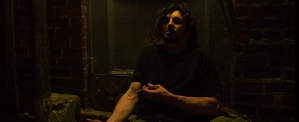 Let’s get into what I think is the most egregious portion of The Wager and that is the lengthy middle where Bruce gets kidnapped and coerced into a life of crime. I thought we were headed for some Oliver Twist territory and we’d watch Bruce’s struggles over the pressure to commit criminal acts he was uncomfortable doing, maybe even while he schemed to escape. First off, the fact that the criminals are stereotypical depictions of black males made me sigh. I also was confounded why they placed so much emphasis on kidnapping teenagers and runaways to serve as drug dealers. When you have access to money and power, you have people that will come to you for opportunities (you’re a job creator). You don’t need to kidnap children and hold them hostage to sell your wares, especially having to worry whether they will run away or whether someone will recognize them as missing. It’s stupid risk. Considering these men just sit in the car and watch young Bruce make his first street corner deal, it’s not like they’re being terribly conspicuous.
And then there’s the undetermined time jump, which is revealed during one of those static camera angle montages. It’s a nice surprise; however, it means that Bruce has been sleeping on this same dirty mattress in the same room for, like, twenty or thirty years (also none of the items on the shelves moved in that same time, meaning Bruce never touched a thing in his living quarters or he is very, very particular about where things should go). The same crime bosses are still alive and in their same position of leadership. Bruce is now played by Gloyd in a horrendous looking ratty wig and I needed to know desperately how much time has passed. Gloyd definitely looks to be in his 40s, and this significant jump in time raises so many irksome questions. The police haven’t found adult Bruce in 30 years but the same officer who found him as a baby, who is still alive and working as a security officer, can recognize him on the spot? How old are these same criminal leaders then, and Bruce hasn’t ascended higher up the organization than street dealer? If we’re jumping that far ahead, wouldn’t it make more sense for Bruce to be the new leader, letting us know he has been molded under the negative influence of his captors? If he’s just going to be a drug-addicted adult then why do we need to jump so far ahead in time? The answer, it seems, is so that the writer/producer can have a starring role. That’s fine, but we could have done more structurally to maximize the drama rather than dwelling in redundant misery.
Let’s analyze the spiritual message at the heart of The Wager. Bruce’s life is pretty bad. He’s in and out of foster homes, gets abducted and held hostage as a criminal lackey, becomes addicted to drugs and desperate, and then homeless and contemplating suicide. He’s had, by all accounts, a hard go of things. He’s understandably resentful about the forces he feels have conspired to lock him into agony, so when other characters raise the notion of a loving God that has his back and watches over him, Bruce scoffs and views his life as refutation. There’s even a nature versus nurture argument to be had. In fact, the first time Bruce went to Suzy’s church was when he was abducted. The cop character tells Bruce he’s been praying for him since the moment they first crossed paths, but considering what Bruce has endured, that’s not exactly a ringing endorsement for the power of prayer. Now obviously Bruce will conclude with accepting the love of God and finding a greater purpose with his life, but why did we need to wait so long? The end is never going to be in doubt with a Christian-themed indie any more than whether or not James Bond will get out of his latest scrape. That’s why refocusing the structure onto Bruce having to confront an angel over his feelings of abandonment from God would be far more dynamic, powerful, and I’ll say it, even Christian than the message as presented. Don’t get me wrong. I’m not questioning the faith and credentials of the filmmakers. I’m saying the way they go about telling their story makes the overall message less believably impactful.
 The acting in The Wager is typically rather flat, given that energy-sapping direction that makes each scene feel twice as long. However, there is one actor I want to single out and that’s Cameron Arnett (Overcomer) as the unfortunately named Gabe Angelus (get it?). Arnett reappears in different roles, my favorite being a batty homeless man that helps out Bruce from time to time. In that moment, Arnett is so believable and arguably natural even while playing a highly mannered character. He immediately drew my attention and I remarked, “Here’s a good actor.” As for the other thespians, it’s hard for me to tell whether they just didn’t get the material to showcase their skills or whether those skills are in need of polishing. I know KateLynn Newberry (Widow’s Point, Dark Iris) as the queen of Ohio indies, and she’s pretty much wasted as a doting wife who lives to ask her husband what he wants for dinner. Fun fact: one of the crime lords is played by former Columbus resident and famous boxer James “Buster” Douglas.
With The Wager, I couldn’t believe what I was watching. Obvious dramatic setups seem to be sorely missed, a structural reformatting was in dire need to maximize the hook, because without that it’s like watching one poor man spiral and suffer for an entire feature-length film. It feels like overwrought overkill. Do we need a half-hour of a guy slinging drugs and sticking needles in his arm, without any supporting characters to interact with, or can this information be conveyed with practiced brevity? I am amazed at so many choices that left me scratching my head. The movie ends with our guardian angel staring into the screen and laughing maniacally for several prolonged seconds, even over the cut to black. What? This is the kind of behavior we associate with evil beings. Why do we need a flashback of a young girl running out the door when the adult version could have just relayed this event in words? I know Christian movie audiences aren’t exactly the most discerning audiences, prioritizing message over storytelling and technical achievement, but the decisions that the filmmakers make impair that faithful message. You don’t make an It’s a Wonderful Life story and just reserve it for the last 15 minutes. I advise select people to watch The Wager simply to learn what not to do with the importance of screenwriting structure. That’s its ultimate cautionary tale.
Nate’s Grade: C-
Share this:

The Midnight Sky (2020)

The Midnight Sky is really two sci-fi survival movies in one. In 2040, the world is experiencing a planet-killing ecological disaster. A team of astronauts, lead by a pregnant Sully (Felicity Jones), is returning from a multi-year mission to check if a moon of Jupiter is habitable. On Earth, Augustine (George Clooney with a Santa beard) is the lone scientist left at an Arctic research station. He has cancer and sees his life as having run its course, that is, until he finds a small girl (Caoilinn Springall) who missed being evacuated. They band together to brave the wintry, poisonous elements to travel to another outpost to better communicate with the returning astronauts and possibly secure an escape from this dying world. It sounds like it should be a very exciting and interesting movie. There are even sinking ice floes, space walks amidst deadly asteroids, and Augustine having to stop at points lest he overtax his frail body. In practice, the movie isn’t so much exciting as it is ponderous, grasping for a larger philosophy and existential meaning that seems entirely elusive. We’re treated to several flashbacks of a young Augustine (different actor but still voiced by Clooney) that seem superfluous until a grand reveal that made me audibly groan so loud I thought my neighbors would complain. I kept waiting for the relevancy between the stories to be demonstrated, and when it happened it was not worth the two-hour wait. The realization was so hokey that it retroactively made me dislike the movie’s moments that had been working earlier. As far as direction, this might be one of Clooney’s strongest turns as a visual storyteller, even if he borrows liberally from other recent sci-fi movies, notably Gravity, The Martian, and Interstellar. There are moments of stark beauty and terror. Ultimately, the whole movie amounts to a sad man taking stock of his life and legacy (is he a metaphor for the Earth? Is the Earth a metaphor for him?), and I’m still wondering how something this glum could also be so maudlin. The pacing is another issue. I was always eager to jump to the other storyline to see what they were doing (a cinematic “grass is greener” mindset). The acting is fine and I wish I could have spent more time getting to know the crew of this space mission (including Kyle Chandler, Demian Bichir, David Oyelowo, and Tiffany Boone) or conversely gotten to feel more of bond between Augustine and his near-mute charge that felt like it was providing insight into this man. Looking back, there’s a reason for some of the stilted characterization, but having an excuse for why your characters aren’t better developed is like preparing an excuse why you did something self-sabotaging. The rest of The Midnight Sky doesn’t better compensate for this storytelling choice, and so the movie feels too dull, frustrating, opaque, and overly manipulative, aided and abetted by Alexandre Desplat’s sappy score. No more than the sum of its parts, you can soon watch The Midnight Sky on Netflix and fall asleep to it on your own couch.
Nate’s Grade: C+
Share this:

Minari (2020)
 Gentle, heartwarming, and deeply authentic, writer/director Lee Issac Chung’s semi-autobiographical movie about growing up in rural Arkansas in the 1980s won the top honors at Sundance and is poised for an Oscar run by its studio into 2021. Each moment in Minari feels plucked, fully realized, from the personal experiences of Chung. There’s an intimacy here that cannot be imitated. It’s a story about immigration, assimilation, hopes and the American dream, as well as struggles, setbacks, economic anxiety, and fitting in and figuring out the world around you. We spend time equally between the parents (Steven Yeun, Jeri Han) and their youngest child, David (Alan S. Kim), as the Korean transplants try their luck as farmers. Their elderly grandmother (Yuh-Jung Youn) moves in with them to provide childcare and assistance where able. At first, the kids declare their grandmother is “not a real grandmother” as she doesn’t bake cookies or do typical grandmother pastimes, but in time, she learns the ways of the new culture and becomes a lover of televised professional wrestling. It’s a small-scale story about a family trying to stake their claim at a better life and beset with challenges; the son has a heart murmur, their property is so far from other Korean immigrants to be part of a community, the land’s sources of water can be fickle for crops, the mounting mortgage payments. It ultimately becomes a push between personal goals and family unity, and then Minari ends in a way that made me feel like I was cheated out of a real ending. I suppose there’s a lesson to be had about life just moving on, resetting after tragic setbacks, and this plays into the real-life rhythms of this gently observational movie with its well of compassion. I also found myself starting and stopping the movie often and stretching out my viewing as I was distracted with other tasks. I never doubted Chung’s love for his story and his characters. Like the similarly themed Nomadland, this is a movie of quiet moments, and your mileage will vary whether they add up to a more complete whole or understanding. There are moments that tugged at my heart, like the grandmother hugging her grandson tight and swearing to protect him from any death coming in his sleep, or the kids folding paper airplanes that declared “Don’t Fight” as their parents argue. It’s a mostly restrained, quiet, slow-moving sort of story that gives you a peak into the lives of others. It’s so specific and finely textured to be genuinely authentic. The family’s very normality as an American immigrant experience is the movie’s big thesis and a reminder that there are thousands more stories to be told about what it means to be an American.
Nate’s Grade: B
Share this:

Freaky (2020)
 A body swap movie set in a slasher universe, Freaky is a fun and gory romp that still feels like it could have been even more entertaining with the possibility of its premise. A masked serial killer (Vince Vaughn) stabs a teenage girl (Kathryn Newton) with a magic Mayan knife and they swap places and must learn to cope in their new bodies and roles. The teen-in-adult body is wonderfully played by Vaughn, who seems to be really enjoying himself with a silly role that pushes him outside his smooth-talking leading man roles. He might be playing up the girlishness and higher-pitched voice but his energy level is high and provides plenty of entertainment with the absurdity. There are a few inspired moments developed from the crazy premise, like when Vaughn has a heart-to-heart with his/her mother at work, able to offer insight into the daughter she feels she is failing, and the mother becomes romantically intrigued by this mysterious man. There is a first kiss sequence in the backseat of a car that is so awkward but owns its outrageous quality. I wish the movie from co-writer/director Christopher Landon (Happy Death Day) made better use of its fruitful premise. There are so many more bizarre scenarios that could be gleaned here, especially if the masked serial killer had more of a personality. Clearly modeled after the silent stalkers like Michael Myers and Jason Voorhees, this makes the film feel too one-sided with ideas. Sure the teenage girl is now to be feared, dresses sharper, and kills her high school annoyances, but it doesn’t make for much of a creative cat-and-mouse game when it comes to outsmarting the original owner of this new body. I will also champion the gory kill scenes as above average in their conception and execution. It’s really over-the-top and memorable and I wish there had been even more wild splatter. Freaky is a decidedly fun movie from the Blumhouse assembly line but I can’t help wishing it was a little bit funnier, a little bit weirder, and little bit more imaginative. The parts were there to make this hilarious and brilliantly creative, and settling for chuckles and disposable entertainment feels like a nagging compromise.
Nate’s Grade: B
Share this:

Tenet (2020)
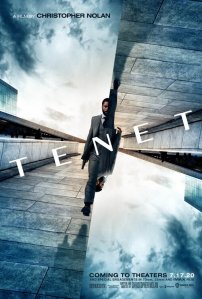 As my girlfriend described, Tenet is a headache disguised as a movie. I can agree about the confusion and irritation from trying to make sense of a 150-minute movie that almost defies you to even keep watching. From the opening sequence, my head was hurting from trying to make sense of everything and deduce meaning and connection. Christopher Nolan’s movie was set up to be the savior of the summer, a thinking man’s blockbuster with such size and scope that people would come back to the newly opened theaters to get a taste of the summer they missed because of COVID. It didn’t work out that way and Tenet’s box-office disappointment contributed to the recent decision for its parent studio to release its entire 2021 slate of movies onto its streaming service (nobody should risk their life to go see the Tom and Jerry film). Tenet has too much going on for me to call it a bad movie, but it also has too much going on for me to call it a good movie.
Protagonist (John David Washington) is recruited by a secret organization that is trying to thwart a cold war from becoming hot between the future and the past. Neil (Robert Pattinson) explains about “reverse entropy,” about effect before cause, and that there are machines that can allow people to reverse their direction in time. It’s less jumping through points than it is hitting the rewind button. A Russian oligarch (Kenneth Branagh) and his wife (Elizabeth Debicki) may be the key to preventing a future catastrophe or one that hasn’t happened yet or has already happened. It’s time travel so the tenses can get confusing. That’s not the only thing that’s going to likely confuse you.
 At around the half-hour mark, it felt like every character was talking past me, like they had no intention of being accessible. It is practically maddening to be in a conversation where everyone is talking above your level, relying upon lingo and references you are unfamiliar with, and you can try your best to grasp the basics of context clues to try and decipher a base level of understanding, and then, when you think you have things together, they start talking backwards. That is Tenet in a nutshell. It is a mystery how Nolan expected general audiences to even want to keep up with this. I’m not one of those people that needs my story spoon-fed to me, and I welcome challenging storytelling that rewards multiple viewings. However, the problem with that gambit is that if you require your movie to be seen a multitude of times to be understood, you better guarantee anyone will want to watch it a second time. I’m certain I’ll better understand Tenet with another watch and that I’ll find even more little clues to celebrate the exquisite cleverness of Nolan, but I don’t want to re-watch this any time soon, if possibly ever.
Nolan has been here before with 2010’s Inception, a movie that could have been confusing from its very conception given a heist upon four levels of dreams each with their own sense of linear time. Early on, Inception was also confounding, but slowly Nolan opened up his world, allowing the audience to adjust to a learning curve and process the information we needed to be set by the time the big heist got underway. Even after, we had mysteries and complications to be solved. It was a complex puzzle with layers but it was accessible. I thought early into Tenet we would be following a similar track, and I kept waiting to adjust to the learning curve, for things to gain a momentum. There needs to be rules, a demonstration of the rules, and then we proceed. I guess I understood things on a general level, stopping the bad guys from somehow destroying the world, and special turnstiles that make you go in reverse time, and there’s a palindromic plotting emphasis that becomes a late justification for 90 minutes of mostly boring blather with the occasional set piece. For the purposes of further clarity, I even read the Wikipedia plot summary to fill in the gaps of my personal comprehension, and it didn’t really assist beyond confirming for me that I understood the broad strokes of an otherwise confounding movie. It’s hard not to feel like Tenet is more an expensive, globe-trotting experiment for Nolan than a movie intended for mass entertainment. Again, I’m not deriding Tenet because it’s ambitious. I’m deriding it because it’s indignant of a potential audience.
I cannot stress enough that every time characters began speaking, I liked Tenet less. If somehow the movie had eliminated all dialogue, it might have worked better. It’s not like Nolan’s scripted words offer much comprehension anyway. It feels like the dialogue is nothing but impenetrable riddles about scientific jargon and vague pronouncements often given to too cute dialogue about the nature of time. There were points I just wanted to scream. Of course there were other moments I was straining just to try and understand what was being said. Tenet is another example of Nolan’s self-sabotaging sound design where he makes the volume of characters speaking subsumed to the volume of sound effects and score. It becomes another hindrance to try and understand an already confusing and aggravating movie experience.
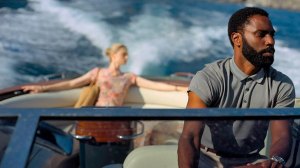 Another factor that made Tenet a slog was the lack of any emotional engagement. Nolan has often been criticized for being a cold filmmaker, one more beholden to the intricacies of his origami-styled plots and surprises. I think this is often an unfair charge but he’s certainly a filmmaker known for his preference for plots that take ownership of character. You would not confuse a Christopher Nolan blockbuster for some mumblecore indie. Even in a movie with as much plot groundwork as Inception, Nolan provides an emotional core with the story of a man literally haunted by the ghost of his wife and his grief over his own culpability for her demise. The climax even involves him having to finally let her go in order to save the day. With Tenet, we get nothing. There’s an abused wife and while I don’t want to watch her get threatened and attacked by her husband, that’s not exactly the same as providing an emotional anchor. She’s, at best, a supporting player. The world-saving stakes are all you’re going to get. I didn’t care about Protagonist as a protagonist, and I didn’t care about Tenet as a secret organization, and I didn’t even like spending time with these people. These characters are boring, but the movie thinks by keeping them moving fast enough, or talking nonsense long enough, that you will fail to notice.
I’m not even fully cognizant of the benefits of inverse time. You can travel backwards and watch people go in reverse but is this really a practical application of technology? Reverse fight choreography can be cool, like people doing reverse flips, and it can also look extremely silly with punches exchanged that look too fake and people scooting on the ground like child trying to break dance. For me, it’s a toss-up whether watching characters run in reverse is surreal and dreamlike or just plain goofy. I guess one could reverse and then un-reverse, more or less traveling back to a point in the past and going forward from there. This means you’ll have to live those extra days, weeks, whatever the time difference, but it also seems to indicate that you must do everything you did before because you have already done it. If this is the case, why bother going back in time if you’re just indebted to doing the same things all over again? Why take a test again when you have to give all the same responses to the same questions? It feels like Nolan wanted to try and make a time travel movie that isn’t quite a time travel movie, so he settled on people running backwards. There is an intriguing disorientation at work when Nolan really plays with the physics of reverse time, but I don’t think this core idea ever fully comes together in a satisfying manner.
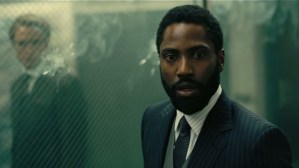 The last hour of Tenet does liven things up as we have two large action set pieces that play out with patience and an expansive scope. This is Nolan’s spy action-thriller. A high-speed heist on the road leads to a car chase with reverse cars to combat. It’s the only action sequence where the audience has a good understanding of the mini goals. Even an earlier art heist resulted in raising questions of credulity (“If the security system sucks out all oxygen, and they’re triggering this, why have they not come prepared with their own oxygen tanks?”). The high-speed heist and ensuring chase sequence flat-out works and is pretty cool. The conclusion involves two teams of soldiers, one going forward in time and one going in reverse, and that has such amazing potential for an intricate and exciting culmination of action. Imagine a character going back and forth and jumping from their unique perspectives to aid and inform each team. Unfortunately, in execution it comes across as jumbled chaos. Again, I imagine there are details and parallels I would notice more with a second viewing but I doubt when that will happen. For a movie essentially about time travel, it feels like Nolan has put more careful thought into trying to make his movie a palindrome than trying to come up with engaging and cool things to do with time travel action.
Christopher Nolan is one of the biggest names working today, a man whose risky, expensive blockbuster projects get greenlit because of his artistic audaciousness. You would never want a Nolan movie to simply play things safe. He seems at his most comfortable when it’s playing around with chronology and audience expectations of what moments have meant. There is a reverse palindromic feature to this screenplay I do admire from a writer’s perspective. However, knowing it takes a confounding 90 minutes to get to that reveal means that you’ve had to endure 90 minutes of protracted set up and with characters that are, at best, glib archetypes, empty suits, and guns with people attached to them to occasional bark orders or say confusing terminology. It makes for a very frustrating and at times disengaging viewing experience, one I even contemplated retreating from. I’m glad I stuck it out but cannot say it was worth the time and ensuing headache.
Nate’s Grade: C
Share this:

Nomadland (2020)
 Part poetic elegy for an America of old, part sunset-tinted road trip, part condemnation of economic fragility, part character study of a lost soul who prefers wide open spaces, Nomadland is a small indie trying to say a lot but in as few words as possible. Consider writer/director Chloe Zhao’s film a mixture of the compassionate, languid colorful character-driven slice-of-life Linklater movies and the romantic, spiritual hymns to nature and the universe from Terrence Malick. It’s ultimately about Fern (Frances McDormand) as a woman who travels the American southwest from season to season in her van, going from one temporary job to another. The temptation would be to make it about her running away from her past, her pain, and need to finally process her grief in a transformative way before she can settle down and make herself a home. Zhao’s movie rejects that easy formula; there are several moments where characters implore Fern to plant roots, to have a comfortable life with a man who adores her, but she can’t. She has to keep moving, from job to job and state to state. It’s not like a rejection of privilege and standing like 2007’s Into the Wild. If Fern could be rich, she’d happily not have to crap into a bucket in her van or sleep in parking lots or scrounge for food. She’s one of millions on the fringes of society because of how disposable so many corporations view their laborers. The opening text tells us that within one year of the factory in Fern’s hometown closing, the chief employer of the town, that its zip code was dissolved. Nomadland doesn’t ever feel like a preachy movie but it definitely has points it wants to raise about how we treat people in need, how business exploits them and their lack of options, and how others view these itinerant Americans and their plight. Really, though, it’s a movie of moments and there are some that are beautiful and powerfully poignant, like a woman stricken with cancer talking about her final desire to return to a lake frequented by birds, or another character discussing the death of his son and how that has informed his view of God and an afterlife. It’s these moments where a character just seems to take center stage and become fully developed, adding to Zhao’s humanist thesis about how every person, no matter their circumstances, is worthy of compassion and consideration. I enjoyed McDormand (Three Billboards) and thought she was a fine entry point into this under-seen world. I also think she was better served as a sort of living journalist letting us discover non-professional actors that open up their hearts and lives and feel like genuine human beings with a wealth of life inside them just waiting to be learned. That gracious, affirmative spirit hangs over every lovely frame and moment in a movie that could be described as Frances McDormand Tries All the Jobs. Still, it’s a movie of moments, and some of them truly sing and others just sort of go by without leaving as much of an impression. Nomadland is a pretty, thoughtful, meditative movie about persistent, stubborn creatures, namely us.
Nate’s Grade: B
Share this:

Promising Young Woman (2020)
 “I’m a gentleman,” says a man at his bachelor party, trying to bashfully turn down any sexual antics with the women paid to entertain him and his friends for one boozy night. He’s also trying to indicate he’s “not like those other guys” and genuinely respects women. He gets it. “Well,” says the woman in the shiny fetish outfit, “I’ll have you know in my experiences that ‘gentlemen’ can often be the worst.” This line summarizes Promising Young Woman, a revenge thriller in a post-Me Too era that is unsparing to all those who would proudly say, “Well, I support women.”
Cassandra (Carey Mulligan) was the top of her class at med school. Then her best friend was sexually assaulted at a party while she was inebriated, which allows the university to paint her as guilty and the accused as blameless (“What do you expect when you get drunk?” kind of victim-shaming). Years later, Cassandra has never been the same. She poses as a drunk at clubs and waits for her knight in shining armor to take her home, and often these modern men of chivalry prove to be creeps looking to take advantage of women and in needing of some harsh medicine.
 This is a movie that walks a fine line to stay out of the shadow of becoming just another exploitation film with a higher gloss. I was yelling at the screen early about the choices men were making with susceptible women in their care. Admittedly, it plays upon that icky genre and taps into our inherent feelings associated with it as well as vengeance thrillers, and writer/director Emerald Fennell (TV’s Killing Eve) smartly subverts our expectations and loyalties. We want Cassandra to achieve her righteous vengeance regardless of the moral or psychological effect it has upon her because vengeance is satisfying. We want to see bad people who have escaped punishment suffer, but Fennell challenges the audience to see how far we’re willing to go for this goal. There are moments where it appears that Cassandra is going to go the extra step to antagonize her targets, and this might involve facilitating other innocent women into potential danger. It’s a sharp turn that asks the audience how badly they want to hold onto that righteous sense of indignation. Do all ends justify the means? Now I won’t confirm whether or not Cassandra follows through for the sake of spoilers but this is one very knowing movie about how to make its audience uncomfortable. Obviously, dealing with the subject of sexual assault and predatory men, it should be uncomfortable because of the nature of the subject, but Fennell has a wicked sense of when to twist her audience into knots. She doesn’t let anyone off the hook easily and that includes her heroine and those close to her. Nobody looks clean here. It makes for a truly surprising experience. When I say that Promising Young Woman makes some bold choices, it really makes some bold choices. There were points I was sighing heavily and others where I was stunned silent. It brought to mind No Country for Old Men. The commitment that Fennell has to her excoriating artistic vision is startlingly provocative and effective.
One early scene stood out to me and let me know that Promising Young Woman was going to have more on its mind than bloodshed. Cassandra is walking home from a night out in her same soiled clothing and eating a sloppy hotdog with ketchup running down her body. A group of construction workers watch her and begin yelling from across the street, harassing her with unwanted sexual advances while they yuk it up. Cassandra stops, turns her head, and simply stares them down. She doesn’t glare at them or shout at them; all she does is look in silence. The workers get quiet very fast and then after several seconds they become angry and defensive, uncomfortable from her attention, and they walk away insulting her. Didn’t they want her attention? Weren’t they boasting? By merely drawing her focus onto these men and making them mildly reflective of their behavior they became uncomfortable and elected to leave. This scene only plays out for like twenty seconds and yet it serves as a symbol for what Fennell has planned with the rest of her thriller. She is going to take what you want and make you re-examine it with a fresh perspective that might just make you rather uneasy and disgusted with yourself.
The first half of the movie establishes a routine that explains what Cassandra has been doing since dropping out of med school. She’s never been able to move on from the trauma of her past and so she seeks out new potential perpetrators to inflict pain upon or scare straight through tests. By the second incident, we adjust to her formula and lie in wait for Cassandra to strike back. She’s the smartest person in the room and it’s deliciously enjoyable to watch her enact her plans. This avenging angel routine runs into a roadblock when she reunites with a friend from med school, Ryan (Bo Burnham), a pediatric surgeon. They share a meet cute that involves Ryan drinking a coffee that Cassandra has spit into as a declarative sign of his interest (trust me, I’m making it sound far creepier than it plays onscreen). They go on several dates and have a palpable romantic chemistry together. This is aided by Fennell’s excellent dialogue, which can be cutting when it needs to and also supremely charming when it wants to be. It’s a peculiar rom-com but on its own terms, including unashamedly reclaiming a forgettable Paris Hilton pop song with full sincerity. At this point, Promising Young Woman is sizing up a choice between following vengeance and following romance. It’s a formulaic fork in the road and Fennell completely understands this, as she’s also testing the audience how much they are willing to sacrifice to see Cassandra check off her guilty names. This storyline doesn’t feel like a cheap alternative either. I liked Ryan and Cassandra together. However, Fennell stays true to her poison-tipped plans and this storyline becomes another chapter in her larger thesis on the condemnation of “boys will be boys” rationalization.
 There is another scene worthy of being hailed because it goes against your and the character’s expectations (some spoilers). Cassandra tracks down the lawyer responsible for defending the university and discrediting her friend once she came forward with her rape accusation. Alfred Molina (Spider-Man 2) is this man and he’s quite antsy because he has been waiting for months for a visitor he anticipated would inevitably arrive. He’s been let go from his firm after having what they refer to as a “psychotic break” and what he refers to as a crisis of conscience. He’s made a career over sliming victims’ reputations, a fact he confesses has been made infinitely easier by modern technology. “We used to have to go digging through the trash,” he says, “But now all we need is one picture on Facebook of the girl at a party and you’ve got jury doubt.” Cassandra is taken aback by how eager this man is, not for absolution which he believes he will never earn, but to be punished. It’s not like a weird fetish but a genuine accounting of what he feels he deserves. It’s a short scene but it challenges Cassandra and the audience about the potential of redemption and forgiveness. This is what she wants after all, people to account for their part in the injustice that happened to her friend and to make amends for their guilt.
Mulligan is ferocious and on another level with this performance. She’s listed as a producer so I assume she had a personal connection with the material because she feels so aligned with the character that she can make you shudder. Mulligan has been an enchanting and empathetic actress since her breakout in 2009’s An Education, the source of her lone Oscar nomination. I’ve never seen her quite like this before. She has a natural sad-eyed expression, which made her perfect for Daisy Buchannan in the new Great Gatsby. With this role, she’s taken those natural sad-cute instincts and carved them out and replaced it with bile. Mulligan gets to play multiple false versions of Cassandra as she adopts disguises and personas to dupe her prey. This also makes the viewer subconsciously question which version they see is the real Cassandra. Is it a distortion upon a distortion? How well can we ever get to know this woman? I think Mulligan is most deserving of her second Academy Award nomination for this bracing, incendiary turn.
This is Fennell’s directorial debut and it will not be her last time in the director’s chair. Her command of pace and visuals can be sneaky good, framing figures to squeeze in potent symbolism as well as ratchet up tension and discomfort. The visuals can also be comedic poetry, like the opening images of men in khakis gyrating and thrusting on a dance floor. She also demonstrates supreme restraint where needed. The sexual assaults of past and present are never visualized but they are not mitigated either. She also has a tremendous ear for music. This soundtrack is sensational from the club bangers to the old timey country ditties. It feels as exceptionally selected as any Wes Anderson or Quentin Tarantino movie soundtrack. The score by Anthony Willis is deeply emotive with its use of strings and cello. They deliver a cello cover of Britney Spears’ “Toxic” and it’s as if the filmmakers made this choice specifically for me.
 If there is one slight downside, I’d have to say many of the supporting characters are under developed. There are plenty of famous faces in this enterprise, like Adam Brody, Laverne Cox, Clancy Brown, Connie Britton, Max Greenfield, Chris Lowell, Jennifer Coolidge, Christopher Mintz-Plasse, but most of them are deposed for a scene and then vanish. It starts to feel like a series of guest appearances from actors as they’re passing through town. Alison Brie (Happiest Season) has a longer and slightly more nuanced part as a former college friend who betrayed Cassandra when she needed her most. This character, along with Birtton’s school dean, illustrate that just because you happen to be a woman does not automatically mean you will be a helpful ally. I view it less as a snide “girls can be bad too” equivalency and more an indication just how insidious and prevalent rape culture can be and condition people into gross excuse-making complacency. I will say that it was nice to have Clancy Brown play a normal dad role and he was sweet too.
Beware, men of the world, the next time you size up a pretty young thing who looks meek and helpless. Promising Young Woman wears the skin of an exploitation movie but it’s so much more. Fennell has created a tart, twisted, and powerful film that is coursing with righteous fury. It’s a female revenge vehicle but with far, far more ambition than simply providing tingles to baser instincts. The artistry here is special and transforms the iconography of exploitation movies into a contemplative and jolting experience. Promising Young Woman is a definite conversation-starter and the first thing you might say upon its conclusion is a breathless exclamation of, “Wow.”
Nate’s Grade: A-


 nathanzoebl
You must be logged in to post a comment.