Author Archives: natezoebl
The Bad Batch (2017)
 Days after viewing writer/director Ana Lily Amirpour’s The Bad Batch, I’m still contemplating what I just saw. That can be the sign of a good, thought-provoking movie, or it could be further proof that The Bad Batch is really an empty experience.
In a not-too-distant future, the United States has found a unique solution to crime. Those deemed irredeemable are tattooed with “bad batch” and abandoned into the American Southwest. It’s a dusty land of outlaws that the U.S. doesn’t even recognize. Arlen (Suki Waterhouse) is deposited into the wastes of the Southwest and she is abducted by cannibals who make a meal out of her right arm and leg. She escapes and finds Comfort, a small outpost where she can heal and find community. The makeshift leader of Comfort is The Dream (Keanu Reeves), a messianic figure who doles out free drugs to the townspeople. He also has a harem of pregnant women. Miami Man (Jason Momoa), one of the hunkier cannibals, loses his daughter and forces Arlen to help him.
 I’m going to summarize the sparse two-hour plot, dear reader, to share with you just how little there is to this film (will keep spoilers mild). Arlen gets kidnapped. She escapes. Months later she kills one of the cannibals. She quasi-adopts a little girl. Her father goes searching for her. Arlen loses the little girl. The father finds Arlen. They find the little girl who was unharmed. They eat a bunny. The end. Now admittedly any movie can sound rather flimsy when boiled down to its essential story elements (Star Wars: “Space farmer accepts call to adventure. Rescues princess.”) but the counterbalance is substance. Characters, world building, arcs, plot structure, setups and payoffs, all of it opens up the film’s story beats into a larger and transformative work. That’s simply not there with The Bad Batch. It’s a vapid film that has too much free time to fill, so you get several shots that are simply people riding motorcycles up to the camera. I grew restless waiting for something of merit to happen. Arlen simply just walks out into the desert like three different times, and this is after she was captured by roving cannibals that are still out there in healthy numbers. If you went to a store and the owner captured you and cut off your arm, would you venture back in that direction? Maybe there’s a commentary about victimhood and the cycle of abuse and exploitation, or maybe I’m left to intuit some kind of grander implication out of a filmmaker’s lack of effort. There’s just not enough here to justify its running time. It feels stretched beyond the breaking point.
If the film is meant to be about immersion, something that holds together via hypnotic Lynchian dream logic, then it better work hard to hold my attention since plot has already been abandoned. This is where The Bad Batch also lost me. It’s just not weird enough, though even weird-for-weird’s-sake can be insufferable, like Harmony Korine’s Gummo. Amirpour (A Girl Walks Home at Night) has an innate feel for visual arrangements and little quirky touches that can burn into your memory, like the sight of Arlen sidling next to a magazine clipping of a model’s arm she taped to a mirror or a well-armed pregnant militia. The most interesting elements of the story are left unattended though. This is a vague dystopia where the government has decided to let the “bad batch” fend for themselves in a desert. It screams neo-Western with a lawless land populated with criminals and killers. There are only ever two locations we visit: the cannibal’s junkyard and the outpost of Comfort. Do we know anything about these locations? Are they at war? Is there some kind of understanding between them wherein Comfort offers sacrifices for protection? Is there an uneasy peace that could be spoiled thanks to Arlen’s vengeance? It’s all just vast wasteland, but even when they get to actual places, it still feels like empty space. How can you make something about dystopian cannibals be this singularly boring?
 The characters just aren’t worth your attention and ultimately don’t matter in service of story or even a potential message. Arlen is much more of a figurehead than a person, and perhaps that’s why the director chose Waterhouse (Pride and Prejudice and Zombies) as her lead. The former model certainly makes a visually striking figure and knows how to arc her body in non-verbal ways to communicate feelings. However, I don’t know if there’s a good actress here. There’s no real reason to take away her arm and leg except that it looks cool and edgy. Initially it presents a visceral vulnerability for her and a disadvantage of escape, but after she arrives in Comfort, it’s as if she’s just any other able-bodied character. It feels like the director just liked the look and thought it would grab attention or say something meaningful. Momoa (Justice League) has a natural intimidating screen presence but he’s given so little to do. He’s just on glower autopilot. Miami Man is a killer and we watch him cook people’s limbs for some good eats. It’s almost like the movie wants you to forget this stuff when his paternal instincts kick in. Rather than embracing the light-and-dark contradictions, the movie just has him shift personality modes. There’s no confrontation or introspection. Reeves (John Wick 2) gets an idea of a potentially menacing character but even he isn’t presented as an antagonist. The Dream is living large thanks to the cooperation of those in Comfort. He has a harem of willing ladies for breeding but he doesn’t seem dastardly. He’s like the grown-up rich kid throwing the party that everyone attends. Then there are near cameos by Giovanni Ribisi, Jim Carrey, and Diego Luna, which make you wonder why they ever showed up.
The depressing part is that The Bad Batch starts off with a bang and had such potential. Amirpour is so assured early on and draws out the terror of Arlen’s plight in a gripping and satisfying manner. Her drifting is then met by a futile escape, and then we witness the relatively tasteful dismembering of our heroine. It’s disorienting but establishes the conflicts of the scene in a clear and concise fashion. The odds are against her and Arlen uses her captors underestimating her to supreme advantage. The opening twenty minutes are thrilling and well developed, presenting a capable protagonist and a dire threat. And then the movie just drops off the face of the Earth. I haven’t seen a movie self-sabotage an interesting start like this since perhaps Danny Boyle’s Sunshine. The first twenty minutes offer the audience a vantage point and set of goals. We’re learning about Arlen through her desperate and clever acts of survival. The rest of the movie is just bland wandering without any sense or urgency or purpose exhibited in that marvelous opening (hey, the amputated limbs special effects look nice).
 Vacuous and increasingly monotonous, The Bad Batch valiantly tries to create an arty mood piece where it re-purposes genre pastiche into some kind of statement on the broken human condition. Or something. The story is so thinly written and the characters are too blank to register. They’re archetypes at best, walking accessories, pristine action figures given life and camera direction. It’s flash and surface-level quirks with distressed art direction. It feels like it’s trying so hard to be a cult movie at every turn. I’m certain that, not counting Keanu’s cult leader, there might only be 100 words spoken in the entire film. I feel like The Bad Batch is going to be a favorite for plenty of young teenagers that respond to its style and general sense of rebellion. Until, that is, they discover movies can have both style and substance.
Nate’s Grade: C-
Share this:

The House (2017)
 It’s got an appealing premise and many funny people attached, so why is The House such a shoulder-shrug of a comedy? Will Ferrell and Amy Poehler open a casino in a sleepy suburb to try and make enough dough to send their daughter to the college of her dreams. Ultimately, it’s just too safe and expected. There are plenty of jokes about the couple trying to adopt the mafia thuggery they’ve seen in popular movies. The set pieces feel underdeveloped and quick to end on strangely violent notes, including a running gag of physical harm coming to one of the daughter’s friends. Ferrell and Poehler don’t have strong characters to play, so when the scenes go long, as they often do, you feel like they’re just throwing whatever improv riffs they can to see what sticks. It gets tedious. The depiction of this reality also leads to difficult questions. They didn’t lose their child’s college fund through some swindle; they just never saved, always assuming their daughter would earn a scholarship. They also have never heard about student loans, which every person is guaranteed access to. We also don’t see the ramifications of Ferrell and Poehler fleecing their neighbors of hundreds of thousands of dollars. Wouldn’t that have a deleterious effect on a small suburb? It should at least create more conflict. The movie jumps directly from the parents deciding they will open a casino to having an open casino. It feels like we skipped a whole act of valuable material. How did they hire these people? Where did they get the capital? I think a major mistake was having such a select number of characters. This premise deserved to be an ensemble comedy with each character contributing in some fashion. Jason Mantzoukas (TV’s The League) is the funniest resource the film has and I knew at least when he was on screen that I had the best chance for laughter. I may be heartless but I found the daughter to be a simpering, annoying character. What teenager doesn’t have or desire an independent life outside his or her parents? She doesn’t seem worth all the trouble. The House finished filming around January 2016, which means it’s been a long edit to find as much funny as they could with the available footage. I think they either ran out of time or just gave up.
Nate’s Grade: C-
Share this:

Spider-Man: Homecoming (2017)
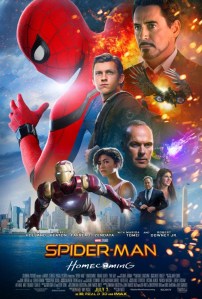 15 years. 6 movies. 3 different lead actors. 2 reboots. I wouldn’t be surprised if a majority of the American public likely knows more about Spider-Man than their relatives. In 2002, the first Spider-Man movie kicked off the new century by affirming to studios that superhero movies are a sound financial investment. Director Sam Raimi and Tobey Maguire kicked off the glut of superhero cinema, paving the path for the massive Marvel Cinematic Universe (MCU) and its own unparalleled run of financial and critical success. Then the overreach killed off Raimi’s Spider franchise in 2007 and overreach again killed off Sony’s Spider reboot in 2014. Sony wisely sought out an assist from the gurus of Marvel, striking a deal and having the web-slinger return to the MCU. Fans rejoiced. Spider-Man: Homecoming announces itself as a brash, exhilarating, hilarious, and amazingly assured film that immediately lines up with the upper tier of the MCU. Marvel should use this as Exhibit A, submit it to Fox, and say, “Here’s how we can do your franchises better.”
Peter Parker (Tom Holland) is your ordinary 15-year-old from Queens, New York who was given amazing powers after being bit by a radioactive (or genetically modified) spider. It’s been weeks since he was called into action by Tony Stark (Robert Downey Jr.) to thwart Captain America (Chris Evans). Now Peter is back home and waiting for his literal call to adventure, for Stark to officially call him up to join the Avengers. Peter anxiously waits for school to end so he can don his Spider-Man suit, modified by Stark Industries, and fight local crime and injustice. This mostly amounts to stopping bicycle thieves, helping old ladies with directions, and other inglorious tasks. Peter’s Aunt May (Marisa Tomei) would prefer he focus on his studies rather than the time he’s been spent on the “Stark internship” (his fib to cover said crime-fighting). New weapons begin appearing on the streets, built from the discarded alien technology from The Battle for New York. Spider-Man investigates the source, Adrian Toomes (Michael Keaton), a pilot who adopts the moniker of The Vulture while in the sky with his winged jet pack. The formidable weapons pose a real pressing danger to society, and Peter pushes further, at his own peril, to confront the Vulture and stop the flow of high-tech weapons.
 For many fans of the webhead, this will feel like the first time they’re watching the Spider-Man of the comics on screen. This is the first film incarnation where Peter remains in high school for the entire duration of the movie, and it’s also thankfully the only telling that eschews an origin story. He just is Spider-Man, however, the arc of the movie is him settling into that identity. It’s in many ways a coming-of-age story for the superhero set, as Peter has to come to terms with his earnest desire to help others and his own maturation, both as Spider-Man and as a high school sophomore. He’s learning just as much to be Peter as he is Spider-Man. Just because he has these powers doesn’t mean he’s ready for the rigors of the world. Homecoming is very much a high school movie. There are familiar John Hughes influences throughout, and the film smartly subverts certain high school tropes (driving lessons, prom dad from hell). It presents our hero struggling with asking the cute upperclassman (Laura Harrier) to the dance just as much as the demands of being a fledgling local superhero. His interior life is much more available and relatable but he’s still a teen navigating the world. Also, by having Peter be the youngest film incarnation yet, it allows for the satisfying indulgence of superhero wish-fulfillment. Whereas the X-Men powers are naturally linked to the progression of puberty, those are usually portrayed as a curse, something that ostracizes, confuses, and produces great anxiety and fear. With Spider-Man, being a superhero is the coolest thing in the world. He’s not consumed with angst like Andrew Garfield’s broody Peter Parker and his weirdly special DNA (what was the deal with his parents and that conspiracy? Oh well). Watching this exuberant Peter Parker embrace his new abilities with glee is a great way to keep the movie light and bouncy.
This is also, bar none, the funniest film yet in the MCU (yes, even dethroning Guardians of the Galaxy). With the lighter tone, the movie finds consistent opportunities to inject comedy, from the irony of Peter trying to lead a normal life, to the awkwardness of Peter’s attempts at crime-fighting, to his over eager demeanor, to misunderstandings and hasty excuse-making to conceal his double life, to the sterling supporting cast of characters that contribute different flavors of jokes when called upon. If anything there is so many talented supporting players I wanted even more time with them (Donald Glover, Hannibal Buress, Martin Starr). This cast is a comedic embarrassment of riches.
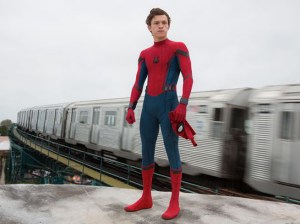 I was laughing pretty much from beginning to end with Homecoming. Just thinking back on the school’s morning announcements (complete with anchor Betty Brant) makes me giggle. Peter’s best friend Ned (Jacob Batalon) is the movie’s chief source of comic relief, and in less careful hands he would become rapidly annoying. Instead, he’s a reliable presence and given a character arc with a payoff of his own, his desire to be Peter’s “guy in the chair.” It’s genuinely impressive screenwriting when even the comic relief sidekicks have arcs. Zendaya does an impressive job of selling every one of her jokes, which traffic in a very specific smart-aleck, apathetic tone. She’s graduated from the Disney Channel to the bigger leagues. There’s a hysterical series of inspirational education videos featuring Captain America, and if you stay past the end credits there’s a great payoff for that. There’s even some sly meta jokes calling back to Raimi’s Spider-Man. Every joke at least lands and most of them hit hard, benefiting from strong development and timing.
Nevertheless, just because it happens to be one of the funniest movies of the year, Spider-Man: Homecoming still finds plenty of space to be dramatic and thrilling. The comedy doe not tonally detract from the other elements. This is not an insubstantial movie just because it knows how to have some fun (take notes, Zack Snyder and DC). This is not a flippant movie because of tone or the heavy joke quotient. There are sincerely sweet moments born out of the characterization, like when Aunt May takes it upon herself to teach Peter how to dance (this would not be possible with a geriatric Aunt May). Director Jon Watts (Cop Car) has a steady command with his high-flying visuals and maintains the tight walk of tone that allows all the elements to work together as a blissful whole.
There are superb action sequences that advance the story forward and allow for the characters to grow. It’s exactly what good action is supposed to do, besides, you know, quicken the pulse. The humor can also arise naturally from these set pieces. Take for instance Peter suiting up while attending a suburban house party. He spots some alarming energy discharges on the other side of the suburb, but without any tall buildings for him to latch onto, he has to hoof it the whole way on foot. It’s a smart comedic aside and it helps to remind us that this Spider-Man isn’t an instant pro after getting his powers. It all comes together best in a D.C. rescue at the Washington Monument. It bridges the personal with the action. The bifurcated ferry set piece serves as the Act Two break and it’s a killer segment that pushes Peter to his limits to solve a dilemma that seems incapable of being fixed. There may not be any action scene to rival Raimi’s finest but the character-centric action and the organic development of the complications lays a foundation for a consistently entertaining film littered with joyful payoffs.
 The biggest fear I’ve read from Spidey fans was that the involvement of Robert Downey Jr. would tip the scales, turning a Spider-Man movie into a defaco Iron Man sequel. Considering America loves Iron Man, I don’t see how his inclusion is a problem. Civil War was still very much a Captain America film even though Iron Man was the co-lead. Tony Stark represents a distant mentor for Peter and also the gatekeeper. Peter is anxious to become an Avenger and looking for Stark’s approval, which brings an enjoyably unorthodox paternal side from Downey. If there is a complaint I can foresee, it will be that Spider-Man is too similar to Iron Man thanks to the special suit. Spider-Man’s suit has its own Jarvis-style A.I. program (adeptly voiced by Jennifer Connelly, wife to Paul Bettany, former voice of Jarvis) and extra special gadgets including a spider drone and unusual web shooting options. It provides a new sense of discovery for the character since we’re already starting with him powered. The second act is Peter getting accustomed to the boost his suit gives him, becoming reliant upon them, and then having it stripped away as a natural Act Two break so that the conclusion has even more stakes without the security of the suit. It makes Peter much more vulnerable. The Iron Man parts are more a background motivational force and this is still very much a Spider-Man film.
Holland (The Lost City of Z) is already my favorite Spider-Man. Period. He made such an immediate and strong impression in Civil War that I was greatly looking forward to his first big starring venture, and Holland does not disappoint. This is the first Spider-Man that doesn’t feel crushed by the heavy burden of being a superhero. He’s a kid eager to grow up and join the world of other caped crusaders, but he’s modeled his crime fighting from what he’s seen on TV. He doesn’t really know what he’s doing. He’s still an awkward kid, and Holland brings great authenticity to the smaller character moments and the bigger heroic strides (while maintaining a convincing American accent). This is a more relatable, vulnerable, and interesting Peter Parker. Even though he thinks he should be beyond the mundane life of high school, he doesn’t ever act pompous or look down on other characters, which is endearing. At times Holland feels like he’s going to explode with energy, as if life is too much to process in the intermediary. He’s a teenager and the world feels so big and open. It’s an instantly engaging and likeable portrayal that wonderfully capitalizes on the introduction from Civil War. This is a Spider-Man, and his spider world, that I want multiple sequels to further explore and challenge.
 Keaton’s Vulture already ranks as one of the best villains in the MCU (a low bar, I admit), and that’s because the movie humanizes him and gives him significant moments. He’s just a regular working-class man trying to provide for his family. In fact the first five minutes of the movie focus exclusively on Toomes and explains his sticky situation. He feels cast aside by those in the upper echelons of power. His eventual “you and I are the same” speech to Spider-Man has credible points. You can see, from his perspective, how he’s an underdog sticking it to the rich elites. Shockingly, there’s only one death in the entire movie and even that is an accident. Toomes is not your standard comic book villain, and there’s a brilliant third act twist that makes him even more centrally involved in the narrative. That opens a delicious sequence of dramatic irony. Keaton has a quiet menace to him that’s very unsettling. It’s all in the lower register. His character doesn’t blow up. He just narrows his brow and intensifies that scary stare. I’m glad the filmmakers realized that more Keaton was an asset to the film.
Let’s also take some time to celebrate the sixth Spider-Man movie for having a diverse population of characters that would actually represent Queens. Peter’s best friend is of Filipino descent, the girl he crushes on is biracial, the loner girl is biracial, and even the high school bully, Flash Thompson, is Hispanic, played by Tony Revolori from The Grand Budapest Hotel. This might be Marvel’s most diverse cast yet, though “yet” being the operative word considering that Black Panther is arriving in early 2018.
This movie is a total blast. Spider-Man: Homecoming actually manages to give new life to a character that has already appeared in five other movies. That’s an amazing feat. Another amazing feat is that six different screenwriters, including the director, are credited with this movie, yet it feels fully coherent in its vision and presentation. This is Peter Parker, the teenager struggling with self-doubt, hormones, and an eagerness to grow up, and the movie feels much more human-scaled, forgoing giant CGI smash-em-ups for something more grounded, personally involving, and ultimately successful. Just because Homecoming is fast-paced and funny doesn’t mean it lacks substance. I was elated during long portions of this movie, impressed by the steady stream of setups and payoffs, the incorporation of the many characters and comedic voices, and the varied action set pieces that were focused on character progression. If you are tired of superhero stories, I’d still heartily recommend this movie. Dear reader, I feel like I’m failing you and turning into a frothing fanboy because I can only think, at worst, of negligible quibbles against the film. Everything in this movie works. Everything. It’s everything I was hoping for and then some.
Nate’s Grade: A
Share this:

XX (2017)
 XX is the first horror anthology comprised entirely of female writers and directors. That’s the most noteworthy thing for this relatively disappointing movie. None of the four main segments are that interesting and several don’t really have endings. The first segment has the most potential, “The Box,” about a child that stops eating after getting a peak inside a stranger’s wrapped gift. The family joins him one by one except for the mother. That’s it. There’s no resolution, one moment of shocking gore, and the rest is straightforward maternal ennui. The second is from musician St. Vincent (née Annie Clark) called “The Birthday Party” and it’s not really horror so much as it is dark comedy with a heaping helping of slapstick. Melanie Lynskey (Togetherness) is an overextended mother who discovers the dead body of her husband on the morning of their daughter’s birthday. She has to go to elaborate measures to hide the body while still juggling all the responsibilities others expect from her. It’s amusing in spurts but is often too obvious. The third segment “Don’t Fall” is the most professionally realized and has some nasty special effects, but it’s nothing more than another throwaway entry in the teens-meddle-with-forces-in-nature-and-are-swiftly-punished subgenre. It’s the shortest segment so that helps too. Finally, Karyn Kusama (Jennifer’s Body) writes and directs “Her Only Living Son” which intends to flip the script on the Rosemary’s Baby scenario. The segment reveals its secrets slowly, which makes it a more engaging short to digest. However, it too ends on a perfunctory note. I know there are many talented female filmmakers out there biding their time, waiting for their chance to show their mettle in genre filmmaking, an area that skews heavily male. That’s what makes XX so frustrating. There has to be better material and better filmmakers out there who would kill for this kind of showcase. Maybe next time (XX2?).
Nate’s Grade: C
Share this:

Baby Driver (2017)
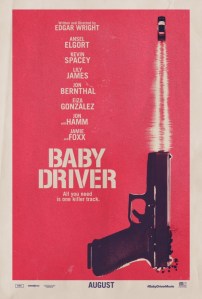 Car chases are one of the greatest things in movie history. The visceral sensation, the speed, the urgency, the thrills, the syncopation of edits to carry out the escalating collateral damage and stakes, it all works to seamlessly create one of the pinnacles of the moving pictures. If you’re going to create a musical where car chases are the chief instrument, then you could do no better than having director Edgar Wright as the maestro. Baby Driver is being hailed by critics as a blast of fresh air, an eclectic wild ride of an action movie with style to spare. That’s true. Unfortunately, this is the first movie of Wright’s career where it feels like the gimmick is all there is to be had.
Baby (Ansel Elgort) is the getaway driver for Doc (Kevin Spacey) and his crews. Baby was in a car accident that killed his parents when he was a child and he was left with tinnitus (a “hum in the drum” as Doc dubs it). To drown out the ringing, he listens to music at all times, including during those high-speed getaway chases. In his downtime, Baby romances Debora (Lily James) a diner waitress eager to hit the road without a map. Pulled into one more job, Baby is paired with a hotheaded group of dangerous criminals (Jamie Foxx, Jon Hamm, Eiza Gonzalez) that could threaten his future plans with Debora.
Baby Driver is a gimmick movie, but this isn’t exactly unheard of from Wright. Each of his movies has a strong genre angle that can tip over into gimmicky, so a gimmick by itself is not an indictment. This is, by far, the least substantial film of Wright’s career. Let’s study his previous film, 2013’s The World’s End. Like the other entries in the Cornetto Trilogy (Shaun of the Dead, Hot Fuzz), that film has a clear adoration for a certain genre and its styling, in this case alien invasion/pod person sci-fi. It didn’t just emulate the style and expected plot trappings of its genre. It spun them in a new direction while telling an engaging story on the strains of friendship over addiction and stalled maturity. It’s the heaviest and most emotionally grounded film in the trilogy. Every single moment in that movie adds up, every line, every joke, every plot beat, it all connects to form an inter-locked puzzle that would make Christopher Nolan whistle in appreciation. It wasn’t just clever plot machinations of genre parody. It was a layered and heartfelt story. It all mattered. With Baby Driver, what you see is pretty much what you get.
 It’s a car chase musical, a novelty that certainly entertains with Wright’s visual inventiveness and ear for music. The film has that alluring quality of wondering what will happen next, especially with its extensive collection of songs on the soundtrack. A trip to get coffee can become a long take perfectly timed so that graffiti and prop placement along street windows lines up with lyric progressions in the song. Some sonic standouts include “Bellbottoms” and Queen’s “Brighton Rock” during the climax. There’s a fun sense of discovery with the movie and each new song presents a new opportunity to see what Wright and his stunt performers do. The car chases are impressively staged and the stuntwork has dynamism to go along with Wright’s high-level energy output. The emphasis on physical production goes a long way to add genuine excitement. This isn’t the ricocheting CGI car chase cartoons of the Fast and Furious franchise. As far as gimmicks go, it’s at least an amusing one. Perhaps I’m just a musical philistine, or more likely my brain just isn’t as accustomed to sound design idiosyncrasies, but I actually wish Wright had done more with his central gimmick. I’m fairly certain I missed half of the connections with the music. If this is the film’s calling card then it needs not be subtle; rub my face in all the clever edits and how the gunshots equal the percussion, etc.
The ceiling imposed upon Baby Driver is because of its characters. Wright and his collaborators have done effective work shading depth to genre characters in the past, even Scott Pilgrim vs. the World, which examined unhealthy usury relationships and entitlement. The characters in Baby Driver are defined by their archetype designations and often behave in unbelievable ways just because the plot necessitates them. The worst offender is Baby’s love interest, Debora. Her initial scenes with Baby are sweet and work on their own, but when she’s ready to abandon her life for a guy she met days ago, Debora comes across like one of those people who write engagement proposals to incarcerated felons. Her decision-making leaps don’t feel plausible. I don’t think she’s acknowledged her lingering co-dependency issues. The problems are magnified when so much of the second half involves Debora being put in harm’s way or needing to be rescued. Then there’s Baby, a kid with a conscience who uses music as an escape figuratively and literally. He’s too bland and uncomplicated for the lead. Baby takes care of a deaf foster father. He surreptitiously records conversations to remix them into Auto-Tune cassettes. Yes that really is as dumb as it sounds especially when those conversations involve criminals. All we know about Baby is he’s nice, he wants out, and he’s good at driving. Elgort (The Fault in Our Stars) doesn’t have the space to do anything but look cool and springy. The supporting characters are assorted hardasses and nincompoops. Foxx (Django Unchained) seems like he’s there always to push contrived conflict.
 As a genre movie with above-average execution, Baby Driver is going to be a suitably enjoyable time at the movies for most. Wright couldn’t make a boring movie if he tried. However, it doesn’t feel like he tried hard enough with Baby Driver, at least to make a full-fledged movie. It’s an admirable assemblage of music and visuals but after a while it feels like a collection of music videos, albeit with highly impressive stuntwork. The movie suffers from overblown hype because it doesn’t have the characters or story to balance the action. There isn’t much of an attachment to what’s going on beyond the surface-level thrills of Wright’s central gimmick. As a result, you may get restless waiting for the next song selection to kick into high gear to provide another pert distraction. It feels like the gimmick has swallowed the movie whole and Wright was too busy timing his precise edits to notice the absence of appealing, multi-dimensional characters. Baby Driver is a fun movie with plenty of sweet treats for your senses but it’s too devoid of substance to be anything other than a rapidly dissipating sugar rush.
Nate’s Grade: B
Share this:

Beatriz at Dinner (2017)
 Billed as a Trump-era satire, and given the fact that the premise involves a middle-aged, working class Mexican immigrant going head-to-head with a rich, bilious, selfish real estate tycoon who proudly skirts the law, you’d be expecting fireworks. That’s quite a culture clash and writer Mike White (School of Rock) serves up the making of a delicious and squirm-inducing evening as the titular Beatriz (Salma Hayek), a holistic massage therapist, is marooned at the house of a rich client (Connie Britton). They’re hosting a very famous, very influential business tycoon (John Lithgow), and his demeanor and perspective couldn’t be more opposite from Beatriz. As the night wears on, and the wine is consumed, Beatriz confronts these privileged and oblivious people. The most frustrating part about Beatriz at Dinner is that all the pieces are there for a terrific movie but White’s script goes slack in the second half. The film never really escalates the drama and you keep waiting for more confrontations. I think perhaps I wanted the stage play version of this story, a dialogue-driven debate between two combative characters buoyed by a sense of righteous indignation. Hayek is quite good and reminds you what kind of actress she has at her disposal. Her wounded expressions say volumes. The other problem is that this 85-minute movie ends on a note of baffling nihilism that left me cold. It’s like White threw up his hands and declared that as long as there are powerful men in the world like Trump, with an oversized influence the common man cannot compete with, then why bother trying to heal the world and make it a better place? It’s an abrupt ending and one that doesn’t feel in keeping with the character. I wish someone would take this story and adapt it for the stage and give it the treatment it deserved before White sacrificed all for his fatalistic message about the futility of trying in the Trump era.
Nate’s Grade: C+
Share this:

Below Her Mouth (2017)
 It feels like the Below Her Mouth filmmakers watched Blue is the Warmest Color and its lengthy, explicit sex scenes and said, “Lesbians don’t have sex like that. There’s way too much scissoring,” and then decided to make their own Blue-style lesbian romance to showcase the frank reality denied to mass audiences. Well, the explicit sex scenes in Below Her Mouth definitely feel more realistic, and they don’t involve even one act of scissoring (just about everything else though). However, they kept the breathy, graphic sex and left behind everything else that made Blue such a phenomenal movie, namely complex characters, an emotionally engaging story, and genuine reasons why these two star-crossed lesbians would be drawn to one another besides the purely physical. To put it simply, Below Her Mouth is inelegant soft-core porn dolled up in indie film dross.
Jasmine (Natalie Krill) is a fashion magazine editor and engaged to her long-time boyfriend, Rile (Sebastian Pigott). Her life is privileged and wealthy but missing passion. This is awakened when she bumps into Dallas (Erika Linder), a love-em-and-leave-em lesbian. Something awakens within Jasmine, who can’t stop thinking of that chance encounter. She climaxes under the running faucet of her bathtub while listening to Dallas work atop a roof, nailing shingles. With Rile conveniently on business, Jasmine agrees to go out for a night with Dallas. They can barely keep their hands off one another, even against the exterior wall of a dirty alley. The two lose themselves in one another for days. Rile accidentally walks in on their activities and Jasmine must decide whom she truly wants.
 Since the vivid sex scenes are grabbing all the publicity, let’s discuss them first. Whether it’s a masturbation scene, sex scene, or stripper lapdance, there’s generally something every ten minutes like clockwork, and that’s not even counting the casual nudity of the actors. The lovers get together at the half-hour mark and from there almost half of the next 30 minutes is some variation of the above (I clocked it). So there’s quantity but is there quality? Is the sex erotic? There is a ferocious carnality to it that radiates through the screen and it’s magnified by the kinship of Krill and Linder. They may not be the best actors but they can sell the earthly pleasures like pros. There are multiple instances of the use of a strap-on, which from what I’m told by my lesbian friends is far more prevalent than repeated hard-core scissoring. The sex is lengthy, sweaty, and explicit. I’m fairly certain at one point you see Krill’s inner labia (the movie is unrated, to the surprise of no one). If you’re here for the sex, you’ll leave fairly satisfied.
On the other hand, if you’re here for any other reason or curiosity, Below Her Mouth will leave you cold and indifferent. Because there’s so much sexual congress there’s very little time to get to know either character. Jasmine had a lesbian experience when she was younger that she never got closure from. Dallas has been a “tomboy,” a term she hates, all her life and identified as more masculine than feminine. She also has commitment issues. That’s about it. Neither of those back-stories is worthy of a deep-dive exploration. Without better understanding of the romantic pair we have further trouble identifying why exactly they would fall in love. Blue is the Warmest Color was three hours and explained in great detail why its characters would be attracted to one another and what would ultimately drive them apart. They came across as living, breathing, complicated, flawed, and achingly human characters. The sex in that movie was a bonus to a rich and heartbreaking character study. Jasmine and Dallas exist as ciphers that only exist to lust for one another. These are not interesting people and I think director April Mullen must have realized this. I would feel more passion if I felt more for these people. Even the character names sound soft-core-ish, and that includes Rile, a name I’ve never heard before in my life (#11,580 most popular name according to Baby Center.com).
The dialogue includes some doozies that might just take your breath away, further hampering any connection or engagement with the characters. There are the pseudo-intellectual, laughably poetic lines like, “Have you ever tried to count how many breaths you take in a minute?” There are the clunky, on-the-nose declarations like, “Even inanimate objects aren’t safe from you.” But I think the winner for most groan inducing goes to Dallas’ bit of nonsensical introspection: “I have no emotional stamina for intimacy.” If someone ever says something like that, walk in the other direction.
 The acting by our lead couple is rather stilted and unconvincing. I feel like the filmmakers just needed semi-competent actresses that would feel comfortable with the demands of the roles. Linder is a Swedish model making her film debut and she has many roles to go before she becomes comfortable with this whole acting thing. And yet she has a presence that draws you in; perhaps it’s the hunger in her eyes. Krill conversely has a lengthy resume of Canadian TV appearances (Rookie Blue, Wynona Earp). She’s far too emotionally aloof. That could be an acting choice to communicate her character’s funk, but even when she starts to light up from increased interaction with her sweetheart, Krill is flat. I was impressed with Krill’s abs and command of pelvic thrusting, for what it’s worth. Suffice to say both actresses are at their best during their love scenes. I thought the best actor was Dallas’ last ex-girlfriend, Joselyn (Mayko Nguyen, also of Rookie Blue, Killjoys), who has to reconcile that the woman she’s in love with cannot return her feelings. Hers was a character that had the most dramatic potential as presented.
Let’s get to a better question, which is whether or not simply being an erotic escape is enough to justify the film’s validity. Below Her Mouth is one of the few films to have an entirely female-lead crew, which lends it greater credibility with the handling of the subject matter. If you’re looking for a steamy way to pass 85 or so minutes, Below Her Mouth will definitely deliver some desired sensations. There is obvious merit to telling the stories of minority groups that have infrequently seen themselves represented on the big screen with care and normalizing their everyday lives and challenges. The 90s was an explosion of quirky, sexy lesbian indies, mainly rom-coms (Better than Chocolate, Go Fish, Show Me Love, The Incredibly True Adventures of Two Girls in Love). While those movies broke ground in their own ways with gay voices, they also had the essential elements of story and character and didn’t rely upon a gimmick. People do go to the movies to feel turned on, but if you’re only there to watch the sexy parts, then the characters aren’t people so much as sexual objects for your personal gratification. If the sole purpose of a movie is to titillate then I think you’re in the realm of high-minded pornography. It feels like Below Her Mouth was made for the disposable consumption of the horny. This is a movie that’s only ever skin deep.
Nate’s Grade: C-
Share this:

Transformers: The Last Knight (2017)
 Unlike many of my critical brethren, I do not view Michael Bay as the devil incarnate. I think the man has definite talent and is one of the finest visual stylists working in the realm of film. I’ve enjoyed about half of the Transformers franchise and don’t consider it the end-all-be-all of modern American cinema. Transformers: The Last Knight is exactly what the detractors have railed against from the start: a cacophonous ejaculation of incomprehensible nonsense. The charge has often been made against Bay’s long filmography that his stories are unintelligible, but Transformers 5 proves to be the new measuring point for incensed incredulity. This isn’t only the worst Transformers entry in a seemingly never-ending franchise (thanks product placement, merchandising, and toy sales) but an early contender for worst film of 2017.
Cade Yeager (Mark Wahlberg) is hiding out with other Autobots in a South Dakota junkyard awaiting the return of Optimus Prime (voiced by Peter Cullen). Prime ventured into space to find the remnants of the Autobot home world, Cybertron. Once found, he’s brainwashed by the Cybertron goddess Quintessa (Gemma Chan) into being her servant. She’s after an ancient staff that will prove to be the key to restarting Cybertron. It was last seen on Earth during the Dark Ages and rumor has it was given to Merlin. Cade is enlisted by a centuries-long secret society to help find the staff before the evil forces at bay get hold of it.
 It feels like the Transformers 5 writers were on a week-long cocaine bender when they cobbled together this impenetrable narrative. Let me give you but a taste of the confusing, muddled, and overall mind-numbing plot as it exists. There’s a magic staff from the robot world that will recharge the robot world, and it just so happens 12 robot knights, which form a giant robot dragon, landed on Earth and gave it to Merlin, played by a soused Stanley Tucci who was already a different character in the fourth Transformers movie, who then established a secret order that would keep the giant alien robots secret even as they were doing things as high-profile as literally killing Hitler, and the members of this secret society include Frederick Douglass and Queen Elizabeth and Shia LeBouf, and this staff needs to be retrieved from an underwater spaceship under Stonehenge by Merlin’s blood progeny and will be aided by an alien talisman that forms an alien sword that does something, and the evil alien robots are going to recharge their planet by scraping the Earth’s crust, which has horns protruding from it that once aligned with Pangaea, and there’s an evil alien robot goddess who brainwashes Optimus Prime to retrieve her magical items on demand and then Megatron is being hired the U.S. government and a team of special ops are trailing him to get to the staff and… I’m sorry; did your brain start bleeding out your ears? I looked over to my friend Ben Bailey during the screening and saw him slumped over in his chair and thought, for a fraction of a second, that the movie had literally killed him (he had just fallen asleep for the third time). What an ignoble end.
The movie is a nonstop barrage of yelling and movement, an assault on the senses that leaves you dumbfounded and dazed, and without anything to moor onto. Almost every single actor is on screen for one of two purposes: quips or exposition. These are not characters but devices for words that ultimately don’t make sense. Wahlberg has two different female sidekicks. For the first half, he’s got a plucky teen that serves as a surrogate daughter figure. Izabella (Isabella Moner) is a kid with attitude and carefully arranged strands of hair that always fall over her face in every single shot in the entire movie. Izabella’s introduction actually might be the highlight of an otherwise soul-crushing experience. Then Wahlberg leaves for England and he adopts a new sidekick, this time the hot smart woman who changes into a more comfortable outfit but literally keeps her heels. Vivian (Laura Haddock) is pretty much the next in a long line of highly sexualized, tawny female characters under Bay’s alluring gaze (I wrote about the second film: “Women don’t seem to exist in the Michael Bay world, only parts and pieces of women.”). Her mother doesn’t care about the end of the human world, or her daughter’s many academic credentials, and instead pesters her about getting herself a man. This leads to one of the film’s worst comedic moments, as Vivian’s mother and friends giggle and eavesdrop on her and Wahlberg trashing a library as a spontaneous bout of sexy time. Wouldn’t it be weird for anyone’s mother to take pleasure in listening to your escapades and offer a play-by-play?
 But the strangest characters are Anthony Hopkins’ Sir Edmund Burton and his 4-foot robot ninja (voiced by Jim Carter). You can clearly tell that Hopkins didn’t care at all what he was saying. He uncorks ungainly monologues with relish and then transitions into strained comedy as a doddering old man. The robot butler begins as a C3PO-esque prim and proper servant with a disarming fighting ability, and it works. However, as the movie progresses, the robot butler gets downright belligerent and seemingly drunk. It’s truly bizarre, as if this robot is acting out to be seen like he’s one of the cool kids, but whom exactly is he trying to impress? At one point, he tells Wahlberg that he is “on my shit list” and torpedoes out of a submarine, brings back fish, prepares a sushi dinner for the humans while supplying ingredients that were totally not found on a WWII-era sub that was parked as a tourist locale up until 20 minutes ago. The character makes no sense and seems to bounce around behavioral extremes. Take this passage late into the film:
Robot Butler: “Of all the earls I’ve served-“
Me: “You were the greatest?”
Robot Butler: “-You were the coolest.”
Me: “Whaaaaaaaa?”
Another confusing part of the film is the setting of its story. We’re five movies in to an alien civil war taking place on Earth, so you would assume that normal life shouldn’t feel normal after so many catastrophes. Egypt was destroyed in the second film (only Six Wonders of the World left in your punch card, Bay), Chicago was decimated in the third film, and China was blown up in the fourth film. It’s about time that people started paying attention to these things and behaving differently. A new government agency is tasked with hunting down Transformers and there are war zone portions of the world that are quarantined, but that’s about it. I initially thought this fifth movie was going to take place in a somewhat post-apocalyptic Earth where human beings have to struggle to survive. That’s not Transformers 5 at all. It seems all too easy to ignore reality; Wahlberg’s daughter is away at college. After four movies, the world of this franchise needed a jump in its stakes. Bay’s films have always possessed an alarming sense of urgency but it rarely feels earned. Characters yelling, running, and explosions going off like fireworks isn’t the same thing as genuinely developed stakes.
 Another confusing aspect of Transformers 5 is Bay’s jumbled aspect ratios (i.e. how wide the frame of the movie is presented). Sizeable portions were shot on IMAX, which has become all the rage for action movie directors since Nolan’s The Dark Knight. I expected that. What I didn’t expect was three different aspect ratios that jumped from shot to shot. Two characters will be having a conversation and the aspect ratio will cycle and it rips me out of the movie every time (there are SIX credited editors). The Dark Knight’s IMAX sequences worked because they were sustained sequences. I expect the higher-grade IMAX film stock for the expansive action or picturesque landscapes to take in the natural splendor. What I wasn’t expecting was measly interior conversations to be filmed in IMAX. Did I really need to watch a conversation with Vivian and her mother in IMAX to fully appreciate their bookshelf? Like much else in this perfunctory movie, this game of pin-the-tail-on-the-aspect-ratio makes no sense.
I don’t normally like to quote myself, but reading over my concluding paragraph of 2011’s Dark of the Moon, I was struck by how much of my assessment could equally apply to the fifth film, even down to the exact running-time: “Transformers: Dark of the Moon is likely everything fans would want from a franchise built around the concept of robots that fight. There’s wanton destruction, a plethora of noisy explosions, and plenty of eye candy both in special effects wizardry and pouty, full-lipped women. But at a colossal 150-minute running time, this is a Transformers film that punishes as much as it entertains. There’s really no reason a movie about brawling robots should be this long. There’s no reason it should have to resort to so much dumb comedy. There’s no reason that the women should be fetishized as if they were another sleek line of sexy cars. There’s no reason why something labeled a ‘popcorn movie’ can’t deliver escapist thrills and have a brain too.” Take this assessment and times it by ten for The Last Knight. The incomprehensible plotting, infantile humor, nonchalant misogyny, empty action bombast, and dispiriting nature of the film are enough to suck the life out of you. I was bored tremendously and contemplated walking out on the movie (I stayed for you, dear reader). It feels like the screenplay was put into a blender. Transformers 5 is exhausting and exhaustively mechanical, and if this is the first start in a larger Expanded Transformers Cinematic Universe (ETCU?) then resistance may be futile. Still, it’s worth fighting against brain-dead spectacle that only moves you to the exits.
Nate’s Grade: D
Share this:

Rough Night (2017)
 As the girl power counterpart to Very Bad Things, the rowdy comedy Rough Night follows a group of broadly characterized friends through a night of mishaps, but the strangest development is that the funniest moments all center around the men. Jess (Scarlett Johansson) and her gal pals (Jillian Bell, Kate McKinnon, Ilana Glazer, Zoe Kravitz) are celebrating her bachelorette party when they accidentally kill a stripper. From there the ladies have to try and dispose of the body while not getting caught. The movie is rather slow to get started, establishing broad character types for each of the bachelorette partiers. It’s once things get criminal that the movie enters more solid comedic ground. The acting ensemble is rife with terrific comedy stars that know how to hit their material in stride, in particular the boorish Bell and the goofy McKinnon. And yet it’s the asides with Jess’s fiancé Peter (Paul W. Downs, co-writer) where the movie hits its highest marks and delivers inspired comedy. At first the wild atmosphere of the girls’ night out is contrasted with the quaintly tame boy’s night out. Soon after Peter is worried something troubling has happened and is determined to travel nonstop to reach Jess. His traveling moments produce the most unexpected comedy, like a badass montage about something very uncharacteristically badass. It just kept going, trying to maintain the same demeanor, and I was almost in tears from laughing so hard. There’s a sequence at a gas station that could be taught in comedy classes for how well structured and developed it plays out, tying together characters and conflicts and even ending on a sweetly jocular moment. It got to the point where I wanted to check back more often with Peter. I chuckled throughout Rough Night and the energy level of the actors keeps things eminently watchable but it plays it too safe for something so apparently transgressive. The sentimental moments don’t feel earned and the dark comedy doesn’t feel dark enough. Still, when it gets to be weird and unpredictable, Rough Night can be a delight.
Nate’s Grade: B
Share this:

47 Meters Down (2017)
 Summer is the perfect season for escapist B-movies about man-eating killer sharks, the film equivalent to the paperback beach read. The famous marine predators have become a Hollywood industry unto itself. Just add “shark” to a pitch and you got yourself a movie or at least an Asylum movie (the studio behind Sharknado and Sharktopus). 47 Meters Down was originally titled In the Deep and was scheduled to come out on DVD in 2016. It’s low budget, light on stars, and driven by its concept. It’s also not good enough to be good and not bad enough to be enjoyable. It just is.
Lisa (Mandy Moore) and Kate (Claire Holt) are sisters vacationing in Mexico. Kate is wild, Lisa is a bore, and they meet some cute local boys. They all agree to go swimming with sharks in a giant metal cage that will lower five meters into the water. Captain Taylor (Matthew Modine, you bet it is) takes the gang out to the ocean and dumps chum and blood in the water to attract the great whites. The ladies are in the cage, the shark has made itself known, and that’s when the cable snaps. The cage descends the titular 47 meters (approximately 150 feet) onto the ocean floor. The sisters are stranded, trapped with limited oxygen, and there’s a hungry shark waiting to strike.
 47 Meters Down has many challenges to overcome and it ultimately falters under the pressure. For starters, having a movie take place almost entirely on the bottom of the ocean provides filming and storytelling limitations. The suspense sequences are going to be restricted because there’s only so much variance that can happen. The geography is also rather murky and it’s very dark in presentation, which means that it’s hard to fully understand what’s happening around the characters. This detracts from implementing suspense sequences that need multiple points of action. Take a sequence in The Shallows, where Blake Lively has to time the shark’s pattern to determine how many seconds she has to retrieve a valuable item in the water. She plunges into the water with the ticking clock letting us know about the impending window of danger. That’s a good arrangement. An audience appreciates being in on the suspense and that requires clarity. 47 Meters Down supplies some immediate mini-goals that feel organic to the situation but it can’t last long. The immediate need to try to get out of the cage supplies a cleanly understood series of goals. They need to remove the debris on top of the cage’s entrance. Before that they need to slip out of the cage. Before that they need to remove their mask in order to fit through the bars, which provides another even more pressing danger.
Beyond that promising early challenge, 47 Meters Down essentially becomes a contained thriller with a boogeyman repeating the same routine. Once this realization settled in I started losing significant interest. Because of the overall murkiness of geography we’re stuck with repetitions of jump scares. A few of them are pretty good as far as jump scares go, but without anything else to subsist upon the tension fades precipitously. It’s the aquatic equivalent of a big scary monster jumping out of the dark and yelling, “Boo.” In moderation and with effective setup, this is fine. When it’s all you have then diminishing returns is to be expected. 47 Meters Down supplies cinematic “fetch quests” for the characters to leave the relatively safe confines of their station, but the larger particulars are never fleshed out efficiently. Much of the second act involves a character having to leave the cage to grab something and worrying about the shark appearing out of nowhere. The hypothetical omnipresent nature of the killer shark is meant to foster a claustrophobic sense of anxiety. Instead it achieves the opposite. I grew bored wondering what random moment the shark was going to rear its CGI head.
 The third act goes into a more mainstream action-survival mode and supplies the heroics that mass audiences have come to expect. The problem is that 47 Meters Down tries to have it all and actually loses everything in a misapplied series of endings. This is one of the most egregious cases since A.I. of a movie not knowing when to call it quits. Kate and Lisa are given the bare minimum of back-story before being thrown to the sharks (Lisa just got dumped for not being spontaneous enough so… swimming with sharks… to prove the ex wrong… that she still wants back?). They’re mostly annoying and whiny, and perhaps I have a heart of stone but I was indifferent to whether or not they became shark food.
Then when the third act rolls around (spoilers to follow), Lisa decides to take charge and becomes an action movie heroine. She’s active and rescues her injured sister, swims to the surface, and even kills a shark after it chomps down on her leg twice. It feels like a climactic finish and serves at least as a modest endpoint for Lisa’s character arc, going from meek to assertive. Then Lisa notices the blood floating from her cut hand and it’s revealed, twist, that everything relating to the escape was a hallucination caused by nitrogen narcosis. Captain Taylor was worried that switching to another oxygen tank would be too much for the ladies and produce strange behavior and hallucinations. If the movie decided to end at this point then it could have worked. However, 47 Meters Down unwisely keeps moving for a needless resolution that left me staggered. Lisa is rescued by faceless Coast Guard diving members and brought to the surface. That’s it. Dear reader, what’s the point of having a dark twist ending if she’s just rescued immediately? For that matter, why even have the twist then if she’s going to be rescued? Why not just keep the earlier sequence where she gets her heroic moments of action? The filmmakers replaced an ending where the protagonist is active with one where she is passive. That’s not a satisfying decision and it erases Lisa’s entire agency as a character (end spoilers).
 There’s also a massive plot hole in how exactly are Kate and Lisa able to hear anything? Astute audience members will notice that there is no listening device in either woman’s pair of ears and their scuba helmets cut off their ears. How can they hear anything? A simple fix would have been just literally having a speaker in their ear like local newscasters. This way the illusion would not be broken and it would also allow the filmmakers to directly communicate with their actors while underwater. It’s win-win. Maybe they can introduce in-ear speakers for the sequel, 48 Meters Down.
If you need to beat the heat this summer for 90 minutes, you could do worse than venturing into the shark-infested waters of 47 Meters Down. The visuals are pretty grimy and indistinct but it does offer the occasional thrill, though to stark diminishing returns. I would advise everyone to instead just watch The Shallows, a superior shark thriller with natural style, tautly wound suspense sequences, and the luxury of an emotionally compelling character arc to go along with the benefits of a sun-kissed Blake Lively. If anything, this feels like the Asylum knockoff on The Shallows. Audiences with a deep abiding fear of the water or killer sharks may find enough entertainment to be had, but for everyone else 47 Meters Down is an exercise in treading water.
Nate’s Grade: C


You must be logged in to post a comment.