Blog Archives
Saltburn (2023)

Promising Young Woman was easily one of my favorite films of 2020. It used the structure of a rape-revenge genre movie to tell a hard-hitting drama and pitch-black comedy. Writer/director Emerald Fennell was nominated for Best Director and won the Oscar for Best Original Screenplay, so I wasn’t alone in singing her praises (my critics group declared it the top film of 2020, huzzah). It was, in short, pastiche elevated into something jarring and relevant and daring. With her follow-up Saltburn, she has taken the British class drama of an outsider trying to fake their way in the world of the rich and powerful, a Vanity Fair or Brideshead Revisited if you will, and attached a whole lot of salacious campy nonsense. If Promising Young Woman was elevating a trashy genre movie with vision and daring, then Saltburn is taking the soapy costume drama and degrading it with cheap shock, and “degrade” is quite the appropriate term.
Oliver Quick (Barry Keoghan) is a young Oxford student who doesn’t quite fit in with his peers. He doesn’t come from money and instead from a broken home, but he’s set his sights on success, and that includes winning over the handsome Felix Catton (Jacob Elordi). He’s popular and athletic and from a rich family, and Felix takes a liking to Oliver, even defending him against his posh peers. Oliver is infatuated with Felix and convinced that he’s in love. After a personal tragedy, Felix invites Oliver to summer at Saltburn, his family’s enormous private estate in the country. Oliver amuses Felix’s parents (Richard E. Grant, Rosamund Pike) and sister (Alison Oliver) and settles into the black-tie dinners and racchous parties. He might not ever want to leave, and he might not be able to leave, and he might not ever want to be able to leave.
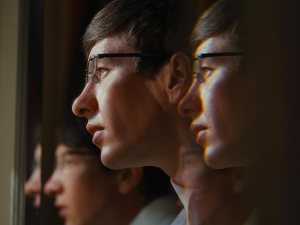
Saltburn is like if The Talented Mr. Ripley was made by the auteur of tawdry trash Larry Clark (Kids, Bully). It’s trashy nouveau camp that works as a sour class comedy until it becomes too sour and most definitely doesn’t work as any sort of engaging character piece or legitimate thriller. I don’t really know what Fernell was going for here and it doesn’t feel like she does either. I think back on the similar tale of Mr. Ripley as an advantageous upstart who got a taste of the good life and didn’t want to give it up. Like Saltburn, we know about our lead’s duplicitous and untrustworthy nature early, but with that movie we could see why others could be charmed by Tom Ripley, and we understood why he would want to stay in this privileged life. With Saltburn, when the rich are treated as shallow twits practically bored with one another from their opulence, the question remains what exactly is the appeal beyond simply attaining more? Also, the appeal of watching con artists slip into a world not their own includes seeing how they will get away with everything, how they’ll cleverly avoid all the traps that materialize. With Saltburn, there is no thrill of clever escapes because the insidious force is obvious and the other characters are too stupid to recognize because they’re meant to be satirical send-ups. It’s a would-be thriller that has gutted all its thrills by eliminating a foreboding sense of consequences.
However, the movie cannot work because all of the surprises were alleviated through poor character development of Oliver and in the performance of Keoghan. I don’t think anyone who ever watches this movie will be even the slightest surprised that Oliver isn’t quite the noble and honest young coed that he may have appeared to be. Except after maybe a couple of early scenes of nerdy awkwardness, Oliver has been depicted as an obvious predator. From the beginning, as he’s sharing his sad family back-story, I was already shaking my head in skepticism and predicting that the truth would be something ordinary and boring that he would choose to cover-up. It’s just too obvious where this scheming, covetous character is going, and Fennell doesn’t do anything to counter this overwhelming and, again, transparent assessment. If you have a character acting all weird and shifty and literally slurping up spent bathwater belonging to the target of his obsession, you shouldn’t then make the later machinations a big reveal. I wanted to laugh that Fennell thought the audience would need flashbacks to better clarify Oliver’s scheming nature behind a series of tragic events. I always assumed it was him because who else would it be? It’s an obsessive young man with oblique and yet obvious motivation to have what he desires from the privileged. We get it. The problem is that the movie never really better examines this desire from his outsider status. We already know he’s the malignant force.
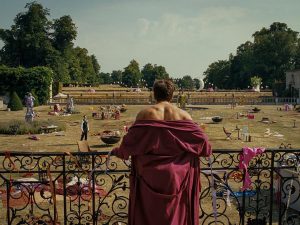
Keoghan is a great actor but “naif” is not a comfortable role for the man. By his casting alone, you’re already looking at Oliver with measured distance and scrutiny. He’s already got a leer that will set people ill at ease. The way the character is written only further confirms this judgment. If Tom Ripley was acting this outlandishly bizarre and creepy from the get-go then he would have been arrested immediately. It’s not even a lack of nuance that hurts Oliver. Not all villains and screen psychos require a full three dimensions, but the characterization is just so lazy and unexplored. He’s just a font of unchecked lust. At least in 2017’s Killing of a Sacred Deer, where Keoghan also played a malevolent young man tearing apart a family unit, his character was meant to have a mythic quality of inescapable retribution, like the Greek tragedy its title was in reference to. With Saltburn, he’s just a creepy perv, but he’s also a boring and redundant creepy perv by the ongoing refusal to provide other context. He’s less a character than a proverbial set of hands to prod characters and poke the viewer in the eye. He’s a recycled program of tedious provocation.
Given how masterfully Fennell utilized and subverted salacious elements in Promising Young Woman, I’m shocked there wasn’t much more than empty shock value. Whatever intended satirical value of this movie is glancing and fleeting. Did you know rich people can be, wait for this, superficial? Saltburn becomes a gross-out game of how far this daft creeper will go with his deadly obsessions, and on that front it all feels too annoyingly flimsy, constructed merely to be transgressive for its own provocative sake. Watching the lengths Oliver will go to prove his disturbing bonafides, it overwhelms the movie and simply becomes the movie’s purpose itself, a measurement between how far Fennell can repulse you before you reach a breaking point. It’s not merely that the characters are easy jokes, it’s that they’re bad jokes. I will say though that the ending shot is so joyously performed that I wish the rest of the movie had this kind of entertainment.
I do think there is an audience for Saltburn, the kind of people who celebrate Harmony Korine’s art-trash movies (Gummo, Spring Breakers), the kind of people who love candy-colored stylistic excess and tongue-in-cheek provocations, and people that seek out twisted love stories and dark romances. Satburn styles itself as a romance, at least early, but it’s clear that there’s nothing romantic about watching a predator set his sights on his prey and work through the family. Sadly, there’s also nothing truly entertaining here either, other than wondering when the next extreme yet desperate attempt at shock value would appear. The characters are too thin and unexplored to support this movie, and the antagonist is too obvious, as are his machinations, though his motivation remains cloudy and also undeveloped. This movie would be akin to watching a bad flu work its way through a family for all the personality Oliver offers. Fennell is a talented storyteller and exceptional at spinning genre pastiche into something so much more, so it’s quite disappointing that Saltburn is so much less than even the sum of its sundry parts.
Nate’s Grade: C
Share this:

The Killer (2023)
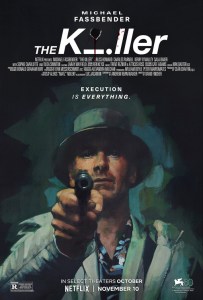 Were you even aware that David Fincher had a new movie? The celebrated director has been very mercurial since 2014’s Gone Girl, only helming one other movie. His partnership with Netflix has afforded the notoriously perfectionist director a lot of creative latitude, though sadly not a third season of Mindhunter. But even the artistic cache of a new Fincher movie isn’t enough for Netflix to change its business model. The Killer only played in theaters for two weeks before beaming into millions of homes. You would think this streaming giant would want to leverage its big names and their new projects, but I’m reminded of how much money Netflix likely left aside forgoing Glass Onion’s theatrical run. Alas, The Killer is an intriguing if cold and unsatisfying thriller that epitomizes the limits of surface-level living.
Our titular killer (Michael Fassbender) is hired to kill a Parisian businessman and botches the job. He’s on the run and fears for his well-being from his employers wanting to eliminate any loose ends. His girlfriend in the Dominican Republic is beaten and threatened, and the lead killer realizes he’s going to have to out-kill all the other killers after him if his loved ones don’t get killed. Through five chapters, each ending in a death, the killer works his way up the food chain.
 Fincher is attempting to strip out the movie-cool mythos of the world of hired assassins, to subvert the entertainment value that can come with expert murderers leading to blood and death. The Killer is Fincher’s stubborn subversion of what a trained assassin movie should be, and his main takeaway, beyond stripping the misplaced glamor from the profession, is how tedious it would all be in real life. In the movie world, being a trained killer involves all sorts of exciting derring-do and acrobatics and the like. In the possible real world, being a trained killer is more like a paid security guard; it’s a lot of protracted sitting and waiting and watching, and it’s easy to understand just how overwhelmingly boring all this would be. The opening twenty minutes quite convincingly strips the cool factor away from this profession. It doesn’t make you feel the weight of the culpability, like 2018’s You Were Never Really Here (more on that later), but what it makes you feel is just how maddening and boring this whole job must be and what kind of dedicated people would succeed. It’s like Fincher is making a bet with a mainstream audience that he can find a way to make a boring assassin movie, and while doing so can be seen as subversive to some degree, bleeding much of the thrills out of the picture, it also feels like a bet gone wrong. You made the main character boring on purpose to prove a point, but regardless of intent, your protagonist is still boring. Victory?
As physically inactive as Act One proves, watching our title killer sit and wait and watch, it is conversely hyperactive in narration. This is wall-to-wall narration as our lead character expounds upon his regiment to keep his mind and body ready when his eventual window materializes. It reminded me of the narration of Patrick Bateman from American Psycho, about his methodical lifestyle routines. Except that character was being satirized from their first moments, whereas the emptiness of our killer here is the larger point, that he’s fashioned himself into an unfeeling weapon. Here is a character that feels he is only effective if he strips everything human away, if he only focuses on the job regardless of politics or consequences, and lives his spartan existence. I’m sure he envisions himself as some noble modern-day samurai, living a code others cannot keep. Except the movie reveals throughout that he might not be the best killer in the phone book. First off, he misses shooting his target, which sets everything into motion. All his narration about focus and yoga and dedication and even I know you shouldn’t fire while someone else is in front of your target. There’s a jarring scene where he fires nails into the lungs of a character and theorizes the man has six or seven minutes left to live before his lungs fill up. Nope. The man dies within one minute max. For all his resourcefulness, which is benefited by the long reach of capitalism, the man also doesn’t live up to his self-image. His paranoia keeps him from returning to his home on time and allows the attack on his girlfriend to happen in his absence. There might be an even deeper commentary on how even the lead is confusing his life for a movie.
 My favorite scene is a sit down with a competing hired hitman played by Tilda Swinton (Three Thousand Years of Longing). She’s one of the two competing assassins responsible for targeting his girlfriend, so she presents a threat. He meets her at a fancy restaurant and she already accepts that she will not be making it to dessert. She is the exact opposite of our main character, a woman who has found a way to live a normal life in the suburbs, marry a man, and enjoy the luxuries of a life afforded by her wealth. She’s not living out of storage units or purposely dressing like a German tourist to stay under the radar. In some ways, this has allowed our more single-minded assassin to get the jump on her, to take advantage of her complacency. However, it’s also an indictment on the stripped-down, isolationist life our lead killer has prioritized. Here is a woman who has embraced allowing herself to enjoy things. She’s not eating McDonald’s breakfast sandwiches minus the slimy egg patty. She’s not slumming it for her “art.” She sees no value in abstinence. This stark contrast, as well as a sustained conversation between two foes, is the highlight of the film. It’s also interesting to watch Swinton’s character go through her own mini-grieving process accepting the likelihood that this will be her final meal, and so she savors it without fear.
Being a David Fincher movie, you can rightly assume that the technical elements are nearly flawless. The visual arrangements are beautiful, the cinematography is chilly and atmospheric, and the editing is precise and smooth. The first attempted kill has a nice degree of tension simply from shifting audio levels, going from diegetic to narration, never allowing the viewer to properly adjust during such a heightened point of paying attention. It’s naturally unsettling and effectively raises the tension of a moment we’ve been waiting over twenty minutes to arrive. There is an extended hand-to-hand fight sequence that’s exceptionally well choreographed and carries on from room to room, transforming with each new location and utilizing the geography of each space nicely (the John Wick folks would approve). The overall movie feels more in keeping with the likes of Fincher’s Panic Room or The Game, a more straightforward thriller that lacks simply extra levels and commentary, like Zodiac or Gone Girl. There’s nothing wrong with a well-executed and developed thriller purely designed to be a good time. It’s just at this stage of Fincher’s career, the expectations are raised, fairly or unfairly, with every new release. The Killer is a polished thriller meant to be pared down to its essential parts and can be enjoyed as such.
There is little to hold onto here emotionally though, so we’re left with the intellectual curiosity of watching a so-called professional go about their business and see how he gets around obstacles. Very often it’s dressing up in a delivery outfit and simply waiting on other polite strangers to open doors for his unassuming facade. One could argue that the character arc is about a man who rejects empathy, argues that it is weakness, comes around to accept empathy, and embraces it on his way out. I can see some of this, as the motivation for his trail of vengeance is to protect his loved one from being harmed again. There’s even a moment where he demonstrates a sliver of sympathy to a victim, albeit still utilizing gruesome violence. Except I don’t believe that easy assessment of this being a journey of embracing empathy. This doesn’t come across as a character changing who they are but instead as a character cleaning up their own mess. The main character keeps reiterating to “stick to the plan, don’t improvise,” but I don’t think he’s reflecting at any point on his actions beyond a clinical cause-effect relationship. He’s stripped all the complexities of humanity out from himself but recognizing fault isn’t the same as building and maintaining a sense of empathy. I also think the reading that many critics are making of Fincher standing in for the main character, a dedicated tactician who tries to do it all, is a little too cute and desperate for meta-narratives to derive a better lens to analyze the overall vacancy of the lead character.
 This is very different from Lynn Ramsay’s You Were Never Really Here, a film that also subverted the same hitman sub-genre and made the audience re-examine its own bloodlust. As I wrote in 2018: “The focus of the movie is on the man committing the acts of violence rather than how stylish and cool and cinematic those acts of violence can be. …Ramsay offers discorded images and brief flashes and asks the audience to put together the pieces to better understand Joe as a man propelled and haunted by his bloody past…. It’s not all tragedy and inescapable dread. Amidst Joe’s tortured past and troubled future, there’s a necessary sense of hope. You don’t know what will happen next but you’re not resigned to retrograde nihilism.” This is not the feeling I took from The Killer, and I recommend everyone watch Ramsay’s movie too.
The problem with making a boring assassination thriller on purpose is that, at the end of the day, you still have a boring assassination thriller. Fassbender (who hasn’t been on screen since 2019’s Dark Phoenix killed the X-Men franchise) can be compelling for two hours doing just about anything, and a performance that is minimal in spoken dialogue does not mean a minimal performance. He’s great to sit and watch, the running commentary of his narration serving as a starting point to assess all the concentrated, nuanced acting under the surface. The Killer has sheen and skill, much like its title character, but it too also misses the mark where it counts.
Nate’s Grade: B-
Share this:

Five Nights at Freddy’s (2023)
 I’ve learned so much more about pre-teen horror video games in the years since I’ve become a parent. There is no shortage of horror-themed games, many of them available through Roblox, that act as gradual entry points for burgeoning new horror fans that might not be emotionally ready for more intense horror (for my money, the creepy smiley creatures with dozens of teeth are more frightening than Michael Myers on any day). This brings me to the Five Nights at Freddy’s movie based on the insanely popular video game series that essentially said, “What if Chuck E. Cheese was, like, evil?” The game involved shifting between security cameras to keep watch on some frisky animatronics that have a hard time staying put, and of course jump scares and bloodless deaths. It’s a game about alternating camera feeds and waiting, and so the big screen version is also a movie very much about waiting for the creatures to stir. That’s probably why a quarter of the feature is watching Josh Hutcherson (The Hunger Games) travel into a dream-space to try and communicate with mysterious children to figure out what must be some of the more obvious plot revelations that he just can’t seem to grasp about this sleepy town and its history of missing kids. Why are we spending this much time on the human character’s back-story when we have killer robots to maim dumb teenagers? There are more scenes with the ghost kids than the animatronics of fame. The protagonist’s motivation seems wishy-washy since he’s putting his life on the line to keep his little sister and then makes an ill-advised bargain with the robots to get rid of her because… we need a moment for him to realize what really matters most? Huh? The scenes of horror rely much more on impressions, favoring shadows and implied violence than featuring anything too overt. I found the revelation of the ultimate villain to be laughable, no matter if it matches up with whatever the convoluted lore is for a game that, again, is flipping through TV channels and trying not to get eaten. There just isn’t a whole lot going on here, and the human drama of Hutcherson trying to win custody of his little sister feels a bit too dramatic and real for something this silly. He can’t get any other job than guarding an abandoned pizza parlor? Why does anyone just not enter the restaurant? He keeps returning to the job even after he realizes the danger. Unless you’re a diehard fan thrilled to just see live-action versions of your favorite furry friends, Five Nights at Freddy’s fees like four nights too many.
Nate’s Grade: C
Share this:

Retribution (2023)
 Liam Neeson has had one of the most unexpected second acts, from an esteemed dramatic thespian to Boomer action hero. The man’s natural gravitas elevated 2009’s Taken, plus the undiscovered thrill of watching Oskar Schindler karate chop goons in the neck, and ever since the Liam Neeson Action Vehicle was a 2010s Hollywood staple. He has been a downtrodden father, ex-husband, CIA agent, FBI agent, air marshal, border patrol agent, cop, ex-cop, ex-hitman, wolf-hunting marksman, snow plowman, ice road trucker, usually an alcoholic or recovering alcoholic, and always the beleaguered fighter called back reluctantly into action. But by the turn of the next decade, the Neeson Action Vehicle shifted from playing on the big screen to the small one, as the direct-to-DVD/streaming phase may likely extend to the remainder of the man’s career. He’s approaching his Geezer Teaser era (71 years old), though he has already made an appearance in an Expendables sequel, practically a subsidy for AARP action castoffs
I haven’t watched many of these latter Neeson action movies but the premise of Retribution intrigued me. Reminiscent of Speed, Neeson is Matt Turner, another beleaguered father who spends ninety percent of the movie in the confines of his car thanks to a pressure-triggered bomb that will explode if anyone exists. Unfortunately, Matt’s teen son and daughter are along for the ride in the backseat. They’re beset by antagonizing phone calls from a mysterious culprit with an escalating set of demands and orders. Can Matt save his family and maybe even his car too?
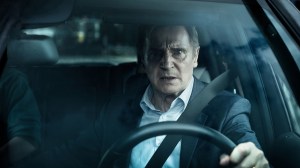 Apparently the third remake of a 2015 Spanish movie of the same name, Retribution moves along on a wholly predictable yet efficient plot as we’re introduced to supporting characters who will inevitably only serve one function. You don’t hire a famous name and then relegate them to one scene to get blown to smithereens. Likewise, there’s always an authority figure investigating the pieces who always has a supportive ear no matter the wild predicament of our hero. The kids are pretty much interchangeable as disaffected family members who will, over the course of 90 minutes of fantastic events, come to see that dad maybe cares after all and they shouldn’t be so rude to their old man. On the flip side, Matt will also come to better understand, through the intervention of a mad bomber, the importance of family he has been heretofore ignorant thereof. It’s all fairly mechanical clunky genre stuff, and if you’ve ever watched any relatively lower budget, straight-to-DVD action movie, especially the Geezer Teasers, then it’s all predictable. The viewing experience thusly comes down to finding nuggets of something memorable or different, something to hold onto unless the movie simply slips into a morass of mediocrity.
Retribution has one such moment and it just so happens to be its ending, so there will be spoilers ahead but I cannot fathom the person who would watch something like this, so formula-laden and familiar, and chafe at spoilers. Still, be warned, dear reader. It’s revealed by the end that our villain is none other than Matt’s business partner, a.k.a. The only other person that could profit off their personal bank stash who also happens to be played by a name actor (Matthew Modine, collect that paycheck). I don’t know why he personally sneaks into the backseat to threaten Matt at gunpoint when he’s been fine making threats from afar on the phone. Why the gun too when there’s already a bomb in play? Seriously, is it supposed to be surprising that Modine turns out to be our real villain, even after he fakes his own death as an elaborate fake-out? Anyway, after monologuing, Matt goes into full angry dad mode, growling a one-liner, and drives his precious car into the guardrails of a bridge, turning the car on its side. If Matt were to detach his seat belt, he would tumble into the river waters below, utilizing gravity as his savior from the potential blast radius (I suppose just forget about shrapnel or the real prospect of the car falling on top of him from the explosion). It makes for a satisfying if slightly clever (grading on a curve) comeuppance for our smarmy villain. Ending with your best moment is a sign that the filmmakers recognized what they had as a payoff. The movie literally ends seconds after, with Matt treading water, deserting any family resolution, admitting it was all just dross anyway.
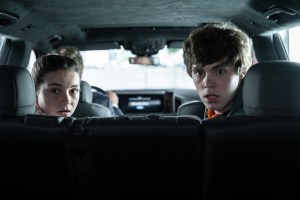 What’s funny is how inconsequential the family drama is that is intended to underpin the high-stakes peril. We find out mom is talking to a divorce attorney, and this news is a bigger bomb than the one under the seas. Suddenly the squabbling children realize the love of their family, even gruff dad, and they want things to stay the same. This storyline is so underwritten, really just serving as a catalyst for the kids to shut up and stop being jerks, that it all feels like self-parody that a mad bomber terrorizing a family has helped facilitate their renewed bonds.
As a late career action vehicle for an actor getting long in the tooth, the blandly titled Retribution is a relatively forgettable thriller that asks too little of its star and its audience. There are all sorts of directions a story can go with the concept of a man being unable to leave his car, so it’s disappointing that Retribution does so little, tying events to an obvious conspiracy with few complications. Imagine the funnier version of this movie, where Matt lives the rest of his life in the car. He gets drive-thru fast food for every meal. His daughter’s wedding has to be outdoors and near an easily accessible parking lot. He begins to see the car as an extension of himself and refers to the both of them in the third person. It takes a Titane-esque twist, and he wants to become the car itself. Then, as a decrepit 101-year-old man, the car breaks down on the side of the road and he has no choice but to leave it, and he accepts his fate with open arms. Then again maybe that isn’t as funny to anyone but me. Even Neeson’s weathered gravitas can only do so much when all the movie asks of him is to stay upright and look forward.
Nate’s Grade: C-
Share this:

No One Will Save You (2023)
 Brian Duffield has been an industry screenwriting phenom for years, though it took too many years for his ribald, clever, and high-concept stories to eventually find their way as finished films, or at least finished versions of his once ribald, clever, and high-concept stories. I fell in love with him as a storyteller with 2017’s The Babysitter, and that love matured into admiration and appreciation with 2020’s Spontaneous, his directorial debut, also my top movie of that year. As hyper verbal and bracing and layered as that stylish movie with major attitude was, and brilliantly so, his follow-up is a sprint in the other direction. No One Will Save You (I keep wanting to type You Will Not Survive This as its title) is a contained thriller with hardly a line of spoken dialogue as we follow Brynn (Kaitlin Dever) battle aliens. Being a nearly dialogue-free experience puts much on the immersive visual experience, and I don’t know if the movie fully sustains this, but the combined effort is solid and sneaky fun.
This is a throwback to the early 1990s invasion thriller, the heyday of The X-Files and Fire in the Sky when the little gray guys with the big black eyes became our default model for aliens. There’s an easy dread to compile when it comes to a powerful and otherworldly entity that has decided to target you, a lowly human. Duffield is able to engineer plenty of anxious moments and jump scares, allowing the scares to luxuriate by building suspense as well as the adrenaline bursts of sudden surprise (a moment with “toes” made me squirm). He makes a key creative decision early to showcase his aliens. Usually these kinds of movies are more guarded about their monsters, confining them to the shadows or at least relying upon the viewer’s imagination to fill in the blanks before pulling back and finally revealing their true form. There’s a reason that so many filmmakers follow this model, and it’s because the final reveal usually pales in comparison to whatever unseen horror the imagination can fathom. The slender creatures do make for creepy silhouettes, and there are three or four different versions of the aliens and this allows for some additional fun design discovery. A long-limbed one reminded me of a praying mantis. The chattering sound design and ominous lighting do a lot of atmospheric heavy lifting to elevate the mood. If you’re looking for a generally well-executed home invasion thriller with some gasp-inducing moments, No One Will Save You fulfills its promise. There’s a pleasing clarity to the plot mechanics, even if you are wondering why this woman doesn’t abandon her house.
 There isn’t much that needs explaining, which streamlines its 90 minutes into a series of reactive responses to the home invasion, with some clues and inferences throughout for us to start to piece together why our heroine is so troubled and seems so isolated by her small-town community. It makes for a visceral, visual method of storytelling but it also limits how much information and depth we are going to encounter. Our main character is still suffused by her own guilt and lasting trauma from her past, and as the movies seem to magically allow, she’s going to be given an external struggle that might just allow her to finally exorcise and resolve a dicey internal struggle. The alien encounters don’t seem to give us better insight into who our protagonist used to be, who she is now, and the misplaced perception of the townspeople. She’s retreated inward. She’s resourceful. She uses what she has to better guard from further close encounters, but all she has are ordinary items found in an old farmhouse, not high-powered weapons and booby traps. She’s just one frightened young woman in an old house trying to do her best. By holding back, we’re only given so much with this character, so she can feel somewhat underwritten and kept archetypal, underpinned by her past mistakes and her current otherworldly dilemmas. I just don’t know if there’s enough going on with this character even with the repeated alien visitation.
Dever (Booksmart) is one of our best young actresses and an excellent choice to anchor our drama. Without the safety of words, much is required from her, and Dever provides a compelling presence even when I feel like the character is hitting her limits. Carrying an entire movie and doing so much with non-verbal acting techniques can be a weighty ask, but Dever relishes the challenge, and through her capable performance we are given a hero worth rooting for.
 The movie does an acceptable job of keeping us, and her, relatively in the dark while still not making the sides too overwhelming. How can one Earth girl combat a species with such advanced technology, size, and power? Well, we don’t fully know what they want, and these little green men are still made of fleshy stuff and can still be hurt and killed like any other fleshy goo-filled life form. They may be advanced but they can still get killed, and that at least gives our heroine a chance that she shouldn’t have. The aliens’ plan is generally unknowable, and just trying to piece together a fuller picture of who they are, the different species and forms, and what their purpose might be for the town is plenty of work for the rest of us that don’t speak the space language. It’s enough of a reasonable learning curve to fill out a short movie while keeping focus on the task at hand, whether it’s hiding under the bed, running around the house, or simply trying to figure out whether going into town for help is worth the effort. I wish there was a little more deliberation on her part about whether the aliens might be preferable to her neighbors. The ending isn’t exactly ambiguous but reminds me a little of 2019’s Midsommar, where letting go of one’s personal hang ups might not be the catharsis of enlightenment it may appear to be.
No One Will Save You is a throwback sci-fi thriller that speaks to the human vulnerabilities we can all feel, being helpless against overwhelming powers, be they alien or our own guilt. It’s a fun thriller with some well-wrought sequences of suspense and jump scares. I don’t know if there’s more happening beyond the visceral appeal of the experience. The character and the situation don’t provide much in the way of larger depth and analysis, and more than a few will likely be able to guess her tragic back-story, though that’s also a credit to Duffield providing the key pieces. As a change of pace, No One Will Save You proves that Duffield is an entertaining and capable storyteller no matter what restrictions he holds himself to. I just prefer my Brain Duffield stories without any restrictions because we only have one Brian Duffield.
Nate’s Grade: B
Share this:

Talk to Me (2023)
 If you were at a party and were told that if you shake hands with a severed hand you could allow a ghost or spirit or whatever into your body, would you agree to this? I may be naive but I think most free-thinking adults would pass on this opportunity, but then again people are chasing all sorts of dangers as distractions or coping mechanisms, so perhaps I’m dead wrong. Now, if you present this same question to teenagers, I’m positive of different results. This is the kickoff for Talk to Me, the new hit horror movie of the summer. Mia (Sophia Wilde) discovers that this magic hand can allow her to see and talk with her mother, who killed herself about a year prior. How far will she go to reach out to her mother and what consequences is she willing to bear?
Reminiscent of Smile, the small horror hit from last year, Talk to Me is a small-scale horror thriller that might not have much extended thematic commentary but it knows how to goose an audience and ratchet up your sense of dread and compiling unease. The premise is gloriously straightforward and creepy from the start, allowing a possibly malevolent spirit to inhabit your body as a thrill. There are plenty of places to go with this premise, as flirting with the “other side” has been a staple of horror movies, just as much as teenagers making bad decisions. It’s a possession movie by way of an addiction metaphor, finding a new and impossible to replicate high, and this too as a vehicle for our protagonist to try and obliterate her grief. The characters feel downright euphoric afterwards, having communed with someone or something, and it certainly makes for fun spectator viewing. The vulnerability of losing control, and especially to a power that you have little understanding of, is a potent direction for the story. Naturally, once we’ve established “safe parameters,” we must then break them and suffer the consequences, and Talk to Me does a truly excellent job of making you feel that omnipresent trepidation. This is a creepy movie that makes fine use of practical effects and an engaged sound design. It’s nothing new from a technical standpoint but it’s yet another example of someone knowing what to do with their tools to create an affecting and uncomfortable atmosphere of uncertainty. It’s more a well-engineered thrill ride, much like my assessment of Smile, but when it’s this well done, you’re just happy to have a conductor who is operating on such a high level of execution.
 There isn’t much in the way of commentary with the movie besides some fleeting criticisms of transforming personal pain and discomfort into a spectator brand. The movie doesn’t have much to say on this front other than teenagers are predisposed to make bad decisions, and giving them cell phones, social media, and a magically cursed totem might be a damning combination. The different characters treat the possessions like a party, everyone with their phone ready to record the crazy and unexpected results, many of which they cannot fully understand. There’s something there about messing with forces beyond your control and feeling protected, possibly even nigh invincible, because you’re a bystander and not a direct participant, that holding a screen in front of your face somehow stops you from being complicit in the activity. The movie utilizes the severed hand as more of a plot device than a starting point for intriguing dimensions of social commentary. Thanks to how well executed the movie is, I forgave the oversight.
I wish the movie had explored some of its intriguing avenues a little further, but one area I’m glad we didn’t need to delve into was the origin of the severed hand. Many of these curse movies push the protagonist to investigate the mysterious origins of the Evil Thing and try to find the beginning of the chain of death and destruction, such as The Ring, Smile, and It Follows. There may be a fascinating story behind this totem but I’m more than comfortable just accepting it on its own vague terms as our catalyst for unrest. I don’t require its unholy backstory. This devotes more of the 90 minutes to focusing on the characters and their emotional turmoil, which allows the grief metaphors to really simmer. It also makes for an intriguing dilemma because Mia has been granted access to her deceased mother through these very unusual circumstances. She misses her dearly and is willing to break rules to continue that connection, which puts others at risk and brings about lingering consequences. Once mom is back, it becomes an ongoing game of whether or not this could be her real mother or something malevolent manipulating her. I found this storyline to be more compelling than a series of clues connecting to more clues to reveal the history of the severed hand, likely learning about a litany of prior owners who have experienced tragedy and ruin. This centered the movie more as an extension of our main character’s grief and the limits and risks she was willing to meet in order to find closure.
 The directors have been a mainstay on YouTube for a decade as the popular RackaRacka channel, and the Australian twin brothers Danny and Michael Philippou make a seamless transition into big screen horror. They don’t overload their movie with stylistic distractions, and the editing is very confident and patient to better build a sense of dread. It’s that atmosphere that proves to be the best element of Talk to Me, as the second half pushes the audience to question what we’re seeing and whether it’s reality or hallucination (also like Smile). When there are stylistic flourishes, it’s almost like its own form of a jump scare, a break from the normal. The opening house party sequence is filmed like one continuous tracking shot and it succeeds in building your unease and anticipation that some very bad things will be happening soon enough. I was especially impressed by the ending, which I won’t spoil in any significant sense, except to say that it’s a fitting and humbling conclusion that also provides a nicely morbid reversal.
If you’re in the mood for a spooky spine-tingler that delivers the goods with a streamlined story and extra emphasis on its protagonist’s fraying emotional state, then Talk to Me is for you. It’s nothing revolutionary but it is creepy and quite effective and evidence that the filmmakers have been taking careful notes about what makes horror stories and movies succeed. Sequels and prequels are likely inevitable, though I don’t know if the premise supports an extended universe of lore and complications, but I’m willing to be wrong. Go ahead. Take hold.
Nate’s Grade: B
Share this:

Gray Matter (2023)

As a lifelong film fan, I’ve always been fascinated with the trials and tribulations of the many seasons of Project Greenlight. It began in 2001 as a contest shepherded by Matt Damon, Ben Affleck, and irritable producer Chris Moore to select the best submitted script and turn it into a movie. The process would also be documented at every stage by TV cameras for an HBO documentary series, but this is an organization defined by its chaos and mistakes, which make for spellbinding schadenfreude television and rather disappointing movies. Each season tried to retool. Season one winner Peter Jones was more a writer than a director and not fully ready when he was thrust to also direct his winning script, so season two had separate submissions to select a winning writer and a winning director to pair. Season three realized that the coming-of-age indies of the first two seasons (Stolen Summer, The Battle of Shaker Heights) didn’t exactly ignite the box-office, so the intent was a more commercial genre script, which ended up becoming the monster siege thriller, Feast. Season four, coming nearly ten years later, decided that the commercial script needed to come from a more trusted and studio-backed source rather than amateurs. That source: Pete Jones, now having become a co-writer to some Farrelly Brothers comedies. That season only sought to select a director, having now completely ditched the screenwriting aspect from the start of the contest, but the winning director ditched the approved script to make a middling comedy feature of his own short film (The Leisure Class). Now, many years later, HBO Max (or now just… Max, because somebody thinks “HBO” lacks brand value) has rebooted Project Greenlight, again, and has another more commercially-minded script to serve the eventual directing winner, this time among a team of ten female finalists. So after twenty years and five movies, what has Project Greenlight proven? Good TV doesn’t mean good movies.
Gray Matter will forever be known as “the Project Greenlight movie,” and if it wasn’t for that series, we wouldn’t be seeing this movie because it’s so generic and underwritten, which, having spent the day binging through the new Greenlight season, are the same problems that all the many producers were complaining about with the script. Well, you folks picked this script, right?

Aurora (Mia Isaac) is a 16-year-old who just wants to feel like a normal teenager. Her mom, Ayla (Jessica Frances Dukes), is afraid she won’t be able to defend herself in this scary world. They’re a mother-daughter psionic duo, exhibiting mind powers. After a tragedy away from home, Aurora finds herself in a weird complex run by Derek (Garret Dillahunt), a mysterious authority figure who says he’s trying to find all the psionics he can to help them better understand their unique abilities. Aurora suspects her captors don’t really have her best interest at heart.
That plot description above sounds like a hundred other YA-tinged stories, from The Darkest Minds to Firestarter to the X-Men TV show The Gifted, which also co-starred Dillahunt. It’s a fine starting point but the story and characters need to find ways to better personalize this formula, and that’s where Gray Matter falters. It’s all too surface-level, from the mother-daughter relationship, to the determination of Ayla, to the self-actualization of our teen. It’s not that you’ve seen it before, it’s that you’ve seen it before much better in so many other stories.
The story pieces are present that can be developed for a more engaging and character-centric sci-fi drama. There is potential here. I think more could be made about Ayla’s past connections to this psionic complex, but instead of being offered to co-chair it as an administrator, it would have been more interesting if she had been younger, a pregnant teen, and her unborn baby was the course of great speculation for the facility, especially being the child of two psionics. This would add an extra layer of urgency why Ayla felt she had to leave as well as why Aurora would be more coveted than other psionics. It could also easily explain why Aurora would be more powerful than any other psionic. It would also personalize the sacrifice of Ayla as well as her paranoia about the lengths they will be hunted. We needed more time with Ayla as a character because once the daughter gets kidnapped around the Act One break, she’s seen more in flashback and fantasy sequences than reality. If this is going to be the emotional core of the movie, then we need to flesh out the mother and the scenes between them. As demonstrated in the movie, Aurora is here to push her daughter, tell her she isn’t ready, then restrict her but also not really restrict her, as Aurora seems to sneak out every night to meet boys. If this woman is so paranoid, why is she alternating between being a strict gatekeeper and a free-range parent? It didn’t make sense. She’s keeping her child out of school and the public and constantly moving, but hey, go ahead and fraternize with these teenagers supposedly behind my back?
It’s also a shame that our protagonist is such a boring blank. The puberty/super power allegory has been prevalent for decades, but for a movie that literally spends so much of its time inside the mind of its main character, she’s unfortunately too underdeveloped and unexplored. She’s just kind of present for too many of her scenes rather than an active participant. This is partly from the nature of the script, where Aurora has to learn about her powers and the history of psionics, but why does the first act of the movie resort to repeating this exposition? We have one scene where mom is explaining powers and what’s at stake, and then twenty minutes later we have another scene of Derek explaining powers and what’s at stake. The biggest problem with Gray Matter is that its central character feels like an afterthought of a simple yet empty empowerment message. It’s about a young woman coming into her own power, externally and internally, but it’s also expressed under such generic terms. What do we know about Aurora? She wants a “normal life” but what does this constitute? Does she resent her mother’s rules? Has she rebelled in the past? What really animates her? What is her sense of purpose? I don’t know, which diminishes all the sequences of her running in terror, and that dominates the middle hour. I wish the script had started with her sneaking out, hanging out with these kids who consider her “that weird homeschool girl,” and then when things go wrong we have to learn with what we see rather than sitting through multiple people trying to explain the world and rules. It would be a better shock when things go wrong, and the added time would allow more breathing room to try and flesh out Aurora before she’s defined by her powers.

Another aspect that needed further re-examination was the nature of the psionic powers. The plot needed to better define the rules of these powers, which are quite varied. We begin with the powers mostly being telekinetic, the ability to move things with one’s mind. Then it jumps into telepathy, the ability to speak through one’s mind, then read the minds of others, then project mental structures, then working all the way to teleportation. There is a good scene where Derek is impressed by Aurora’s ability to hide her thoughts with a false setting construct, and I enjoyed him pointing out the giveaway details, like a character reading a book that is only ever the same page. That was a smart scene that better visualized the powers. However, the characters talk too broadly about the powers in sweeping proclamations. I think the movie could have improved had the story ditched more of the powers and settled down on one, with Aurora having the ability to manifest more than one power being a sign of her extraordinary identity.
As a low-budget genre movie, Gray Matter looks like a professional movie and has good actors doing their best. Debut director Meko Winbush has made a genre movie that looks practically indistinguishable from other disposable Hollywood genre thrillers, and maybe on a sliding scale, feeling and looking like a generic sci-fi thriller might be a success in the history of Project Greenlight. But I doubt all the many people who lent their labor and names to this project were hoping for it to be on par with a forgettable streaming entity eventually crushed by a library of content. Winbush presents enough visual polish that could lead her to future work, something that has also plagued many of the director winners from seasons past (Jason Mann, the season four winner, has one feature credit after The Leisure Class, serving as DP to a 2019 Slovenian movie). It’s hard to feel what exactly people could get passionate about with Gray Matter, and they just waited for a rewrite to supply all the missing emotional engagement and introspection and fun that was absent. Once again, the finished film ends up being a disappointing season finale to a train wreck of reality TV.
Nate’s Grade: C
Share this:

Sound of Freedom (2023)
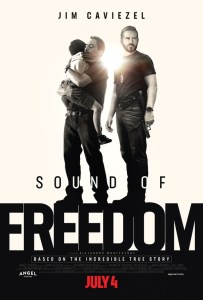 The surprise of an otherwise underwhelming summer at the box-office, so far, has been an indie movie made for only a fraction of the bigger studio fare. Sound of Freedom is an action drama originally filmed in 2018 and even resorted to crowdfunding for post-production assistance, so you’d be curious as to what about this movie is making it the hot commodity in 2023? Well, the answer is both uplifting and also dispiriting, with good intentions running against possible bad faith. However, as an action drama chronicling the ills of human trafficking, it’s pretty mediocre genre stuff and indulges too often in wallowing in the danger of these innocent children under the guise of raising awareness of a pertinent problem that too many may unfortunately misconstrue.
Reportedly based on the experiences of Tim Ballard (Jim Caviezel), a former Homeland Security agent who was tasked with breaking up child-trafficking rings. He even goes undercover to bust skeevy mustachioed pedophiles looking to meet up with buyers, which causes obvious physiological distress and a strain on his marriage, although his wife seems saintly (played by Mira Sorvino, who is only here briefly to urge her man on). A Honduran brother and sister are sold through the front of a child beauty pageant into sex slavery, and after rescuing the brother, he’s determined to reunite the siblings. His efforts lead to Ballard quitting his government job and going to Columbia to try and rescue the children being held as commodities by gangs.
 Allow me to be a little glib, dear reader, as I summarize what the plot of Sound of Freedom boils down to. Here goes: the movie quickly establishes sex trafficking as bad. Not hard. Got it. Our hero sees this and says, “This is very bad. I should do something.” The government says, “This is very bad. But what are you gonna do, you know?” Then our hero proclaims, “I can do something,” and the government brass says, “Well, we don’t know if you should,” and then our hero declares, “Well, I’m gonna!” Then he infiltrates the trafficking ring and reunites a little girl with her brother, and by the end we all learned a valuable lesson that human trafficking is very bad. The end. Now, yes, when you reduce any movie to its most essential plot points, it can feel reductive and like you’re missing something (Star Wars: farm boy leaves home, has adventure with hermit, saves princess), but there isn’t anything more to this Sound of Freedom than any of the Taken movies. It’s not exactly illuminating though it feels very sincere in its convictions.
As an action movie, there sure is a deficit of action to go on for a movie pushing two hours. There’s a climactic rescue but the majority of this movie is the overly simplified journey of trying to find one missing girl. Criminal procedures can be intriguing when there’s a real sense of continuity and progression, chasing down leads, connecting the dots, building the case. It can be invigorating when done well by smart people, like in 2012’s Zero Dark Thirty or the more recent true-life tale of exposing the murderous subject of 2022’s The Good Nurse. With Sound of Freedom, the problems are too easily overcome and the details are minimal. A lot of the breakthroughs are reliant upon chance.
Sound of Freedom feels like a professional action movie, with grimy cinematography and a mournful score, but there’s too little else going on here that is unknown to a general audience. It’s all pretty straightforward and yet sludgy with its overwrought pacing. This is a slow burn of a movie with an obvious end point manufactured for audience uplift, with Caviezel appearing as himself during the end credits to plead for others to donate to the cause and buy tickets for others for the “Uncle Tom’s Cabin of the twenty-first century,” which is what many are doing and donating them to others or passing them off to strangers.
 There is one moment that I thought was unexpected, where reliable character actor Bill Camp (The Queen’s Gambit) plays an ally to assist Ballard in putting together a fake sex trafficking palace for pedophiles (this is much of the last act). Camp plays a businessman who indulged in the illicit excess of power until one fateful sexual encounter with a prostitute that he believed to be in her mid twenties. He’s sickened by the revelation that she was only fifteen years old, and this causes him to have a moral shakeup of his behavior, his complicity, and the entire system of wealthy and powerful people indulging in vices that leave others trapped in cycles of violence and degradation. It’s a potent moment that I wished that Camp’s character was the actual protagonist, a character with flaws trying to overcome a shameful past and do some measures to rectify change. That’s a more interesting starting point than a stoic yet familiar action hero who is defined by his dedicated calling to save the lives of children.
Nobody needs much persuasion to believe that sex trafficking is a definite bad thing, and yet the movie spends so much time wallowing in the grotesque terror of its captive children. It’s one thing to highlight the harsh reality of real-world trauma, but it’s another thing to keep going back for dramatic weight not provided through the rest of the movie. It’s hard to watch young children, gasping and crying, knowing they are likely minutes away from being abused, but why go back to this repeatedly? Did they think the audiences forgot what was happening? Because there is so little else to this movie, plot and character-wise, the frequent stops to watch kids in horror right before being abused are galling, and not just for the intended artistic purpose. Too much of Sound of Freedom is watching a grief-stricken dead-eyed Caviezel gravely intoning, “How can we let this happen?” intermingled with prolonged scenes of terrorized children. It feels too exploitative and gross. I recognized it as a cheap emotional cudgel, and one I didn’t appreciate considering the film’s intended message about the well-being of children.
Here’s where I think the movie’s good intentions run up against the reality of trafficking. The far majority of people who are victims of sex trafficking are not being abducted in public by foreign strangers, they’re not being grabbed at Target stores or somehow hidden in Wayfair furniture (this specific and moronic conspiracy theory was propagated by Ballard as well, sigh); instead, the common perpetrators are friends and family. Often it’s low-income parents with significant substance abuse issues who, in desperation, resort to the most cruel outcome to resolve their addiction. The far majority of trafficking victims are in their teens, seventy percent between 15-17. Victims are also often members of the LGBTQ community who have been kicked out of their homes, and some of these victims resort to trading sex for their own survival. Victims are often those seeking out relationships because of abuse and neglect at home and those coercive relationships then transforming into trafficking. The reality of human trafficking is a lot more complex. It is a worthy topic of imminent concern, but it’s not scary brown-skinned foreigners coming to steal your unsupervised babies. It’s not a cabal of Democrats wanting to drink the blood of children for its power (this specific and moronic conspiracy theory was propagated by Caviezel as well, sigh). The problem with crusading against sex trafficking is when your concept of the topic does not match the reality of the problem. It’s this sensationalized boogeyman, and not knowing the actual reality of the problem will only lead to misapplied solutions for a different reality. Also, the far majority of human trafficking is with labor trafficking, which will be much easier to succeed by lowering the age of child labor in certain states, so there’s that too.
 By every objective measure, Sound of Freedom is a hit. The movie cost $14 million and has already grossed over $50 million at the U.S. box-office. While part of this is a campaign for people to buy tickets to then give away to others, the tickets are still purchased regardless of whether the seats are filled in their entirety. Many people have been inspired by the movie and its heroics, and far be it from me to deny them their uplift. I was let down by the deficiency of the find-and-rescue plot details and the sludgy pacing. I was especially put off by the excessive time spent exploiting the terror of abused children for unnecessary drama. Obviously the subject should make anyone feel uncomfortable, and sex trafficking is a very real evil that everyone should be able to condemn, but there needs to be more to this movie than reminding you that sex trafficking is very bad. I will credit Sound of Freedom with not depicting any specific pernicious QAnon conspiracies, but there’s significant overlap between that community and the audience for this. As a genre exercise, it’s kind of dull. As an expose on human trafficking, it has potential but skirts complexity for the finality of a feel-good mission with clear cut heroes and villains. There are obvious good intentions here wanting to highlight a worthy cause, and that might be enough for many viewers who can coast on the slick production values and overall stoicism.
Nate’s Grade: C
Share this:

Hypnotic (2023)
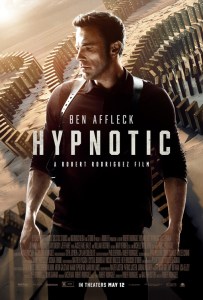
Powerfully forgettable except for its time-wasting twists and erasure of stakes, Hypnotic is an action thriller that feels out of time from the 1990s. In this movie’s universe there are a clandestine group of “hypnotics,” people with genetic powers that can manipulate others to do whatever they want. Ben Affleck plays a detective who is also searching for his abducted daughter and the case is mixed up with uncovering the secrets behind hypnotics and a mysterious and devious man (William Fichtner) who commands people to kill themselves. This should be a fun movie from its premise, Affleck chasing after killer physics like Scanners. It’s written and directed by Robert Rodriguez based on a script he’s been dying to make since the early 2000s. The problem with Hypnotic is that it wastes so much of its structure on playing into the expected, and once that happens it more or less invalidates the first hour of the movie. Once they introduce the concept of hypnotics erasing their own memories and placing triggers to remember key things, it’s not so hard to determine where the ultimate twist is heading. It leads to some serious wheel spinning from its plot, and then the end relies upon a standoff where one side is so all-powerful that there is no real danger. Therefore the emphasis of this movie hinges on the “wow” factor of its twist with little else to keep your waning attention. I suppose the appeal for Rodriguez from a directing standpoint were the sequences where the hypnotics are altering perception, watching the world bend onto itself in trippy Inception-style visuals. I wish there was more of this. The problem with Hypnotic is how unremarkable it is and how inevitable it will be forgotten (with or without your own psychic powers).
Nate’s Grade: C
Share this:

John Wick Chapter 4 (2023)
 As many of you are well aware, I believe great action can be some of the highest cinematic highs one can experience through the transporting thrill of the movies. It’s the larger-than-life quality, the symbiosis of so many tactical teams working in harmony to pull off the breakneck stunts, rapidly escalating stakes, and organic story complications, that it all feels like the best kind of magic trick. For my money, Mad Max: Fury Road is closer to the pinnacle of the artform than a majority of self-serious Oscar bait drivel. In many ways, musicals are very similar to action movies, as fight choreography is nothing more than a rehearsed dance between professionals. Both must incorporate geography, spacing, and interaction to maximize their appeal. It is from this perspective that I approach the John Wick franchise, a series that I have enjoyed and has gotten more popular with every new entry. John Wick: Chapter 4 is about as action-packed as they come, running at nearly three hours long. I purposely waited and saw the movie with my father, a fellow lifelong lover of big screen action and particularly Fury Road. We both had a blast, and rather than write a review of exclamatory nonsense, I thought I’d look over some of my finer critical points with 2019’s John Wick 3 and analyze how 4 excels beyond.
John Wick (Keanu Reeves) is a legendary assassin in a world where I think half the population are secretly, or not so secretly, trained assassins. I have to think the union collective bargaining negotiations are brutal. Regardless, John has been on the run ever since he upset the High Table, the cloak-and-dagger authority over this clandestine universe. He’s had a bounty on his head getting larger and larger with every foiled assassination, and there have been hundreds at this point. To finally clear his name, John plans on challenging the Marquis (Bill Skarsgard), the new controlling High Table member who is un-sanctioning every international hotel that gives refuge to Wick. The old rules state that Wick can challenge the Marquis to a duel, but getting to the actual dueling site might be murder.
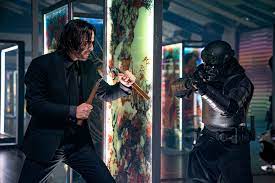 As I wrote in 2019: “Most other action movies have one or two moments that make you wince or make you shake your head in astonishment of something intense, gnarly, or self-evidently awesome. John Wick 3 is packed with these moments… For action fans, the John Wick series is a simplified adrenaline shot where the director and star are working in unison to compose goose bump-triggering action cinema for the masses.”
This compliment is still applicable because the lasting draw of the John Wick franchise has always been its highly polished and intense action sequences. Series director Chad Stahelski has an intimate understanding of his star’s physical capabilities, having served as Reeves stunt double for years, and he and his team stress the fidelity of visceral realism with their overtly preposterous movie. The action is displayed in long takes, wide shots, and gloriously accessible visual arrangements to allow the audience to truly enjoy the splendor of the moment. This philosophy stretches to car chases, like an exciting roundabout of the Arc de Triomphe making bodies fly through the air, and even horseback chases, like an opening evoking Lawrence of Arabia. There were several moments that made me giggle in giddiness, like a woman relentlessly stabbing a man she rode piggyback up the stairs, and a sustained high angle where Wick clears room after room of baddies with fiery canisters that turn each target into a burst of flames, and a fight ascending many flights of stairs that has echoes of Wile E. Coyote slapstick. If you are a lover of action, these movies will not disappoint in that department. The movie takes about 30-40 minutes to set up its stakes and goals, and from there it’s relentless. The best compliment I can give is that Chapter 4 did not feel like three hours because it just flew by for me.
This is where my small criticisms of 2019’s third entry began, and I’ll address them one-by-one: “Because the movie rarely catches its collective breath, it can also feel like a mindless video game, with each new location a new level and with innumerable, faceless cohorts rushing in to be battled. The violence can be brutal but also feel a bit programmed, lacking some of the visceral dynamic realism of The Raid movies, the closest equivalent action franchise.”
 This was a concern I was beginning to notice with Chapter 3, that the movies were in danger of becoming repetitive as Wick clears room after room of opponents. In general, that is the plot of all four movies, so the emphasis needs to be on how each sequence differentiates itself. Chapter 4 does this very well by giving every sequence its own underlying identity. This can be through unique locations or even weapon preference. One sequence is entirely John battling with nunchucks. One sequence is John fighting through a rainy Berlin club that becomes an ax fight. There’s a fight that utilizes well-placed doorbells to cue a blind swordsman Caine (Donnie Yen). The change in locations also helps differentiate the action sequences, with trips to Osaka, Berlin, and finally Paris each adding their own style. It’s a lot more fun to change things up and make sure that the change in scenery, weapon preference, and character is incorporated into the fight.
Another undervalued aspect of the Wick franchise is how damn good looking these movies are. Stahelski can frame some beautifully lit sequences to make all the subsequent carnage and fisticuffs that much more pleasing. We’ve been settling for far less for far too long, folks. There’s no reason our grungy, dank, overly gray action movies cannot look as pristine and striking as the John Wick series.
I also wrote in 2019: “The further and further we get from the events of the original John Wick, the less emotional involvement the series seems to ingratiate, especially with its central baddies onscreen. Every dog-loving audience member was willing Wick to get his vengeance in the first movie. We wanted him to get the bad guy in the sequel. Now it’s basically wave after wave of hired guns that he has to defeat, and without a better connection to that opposing force, the movie franchise runs the risk of losing any long standing personal stakes. The bad guys are just interchangeable and only present to be dispatched. There’s no emotional victory or satisfaction for the audience if Bad Guy #12 gets toppled by the climax.”
 I was beginning to worry that by the time of John Wick 12 he would have killed the entire world’s population and forgotten it all started because of one dog. It’s not that story is the preeminent feature of the Wick franchise but there is more thought and curiosity put into this world building and it would be a shame to ignore it simply for wall-to-wall violence. Fortunately, I think Chapter 4 does the best about introducing new and engaging characters. The John Wick series has introduced new faces but rarely do they seem like more than overly glorified NPCs meant to root for John or take stock of the current predicament (they’ve never found a meaningful use of Laurence Fishburne). With Chapter 4, the new characters actually matter, and they’re great. The best addition is Caine, made even more intriguing by being a blind assassin and made even more fantastic through the performance of Yen (Rogue One, Ip Man). He’s a friend to John and feels great guilt about trying to kill him (his daughter’s life is threatened as leverage). He’s a conflicted killer, the rueful warrior, and his disability makes every fight worthy of watching how exactly he’ll take down his next opponent. It’s enough that I could foresee a Caine spinoff if the fortunes of the universe demand even more Wick spinoffs (Ballerina, a spinoff starring Ana de Armas, is expected to be released summer 2024).
The other new characters are also strong. Skarsgard (It) makes a great hiss-able villain and he really eats up his French dandy accent. There’s also Mr. Nobody (Shamier Anderson) who spies from afar, biding his time until the bounty on Wick gets high enough. He has a dog too that is trained to attack men in a very vulnerable spot first. Then there’s Scott Adkins (Ip Man 3) in perhaps the performance of his career. He gets to slather on makeup, a fat suit, false teeth, and really becomes a broad character, a German crime lord but more a menacing fairy tale behemoth. The way Adkins relishes every syllable is a delight. The man isn’t known much for his acting, other than his finely honed martial arts skills, but he showcases plenty of potential if given a chance. It’s fun to watch all these martial arts experts cut loose, most in their middle age. Recording artist Rina Sawayama makes a killer acting debut as the concierge of the Osaka Continental hotel, and she wreaks havoc with a bow and arrow and some intense knife work.
Because of having more interesting characters meaningfully involved, including those who have a familial history with John Wick, it brings a new emotional stakes to the franchise because we don’t know what will happen to these new faces. I cared enough to be newly invested.
 And lastly, in 2019, I concluded with: “I’ll happily continue watching further adventures of John Wick, though I’d be just as interested in an exploration of the world without its titular star. At some point it may be necessary to retire John Wick (Reeves seems to have lost a step, but he’s still like a hundred steps beyond most of us) and when they do, I hope this interesting and peculiar world is allowed to house further weird and exciting adventures.”
By the end of Chapter 4, you question whether this universe can exist beyond the bloodshed of Mr. Wick, and my answer would be yes. A Continental TV series is premiering in the fall on Peacock, taking place in the 1970s with younger versions of Winston (Ian McShane) and Charon (the late Lance Reddick). There’s at least one spinoff in the works I’ve mentioned earlier. It very much appears that Reeves and Stahelski intended for Chapter 4 to be the definite conclusion to their story they began in 2014. I doubt things will stay that way, especially with Chapter 4 becoming the biggest earner in the franchise. I would suspect the studio would be begging for a Chapter 5. Regardless, if this is the intended series finale, then Reeves and Stahelski have gone out on top. John Wick: Chapter 4 is action movie nirvana.
Nate’s Grade: A-


You must be logged in to post a comment.