Blog Archives
I Saw the TV Glow (2024)/ The Watchers (2024)
 I Saw the TV Glow is a strange experience by design, a hallucinatory ode to early 1990s television, coming of age sagas, feeling out of place in one’s own body and mind, and on a Lynchian dream logic wavelength that few filmmakers occupy. From a plot standpoint, Owen (Justice Smith) is a shy kid who looks up to an older girl at school, Maddy (Bridget Lundy-Paine), and they share a love for the TV show The Pink Opaque, a tween-aimed horror series in the vein of Goosebumps or Are You Afraid of the Dark?, which ultimately might be real after all. This movie exists more on a slippery emotional plane than on its story sense. Writer/director Jane Schoenbrun (We’re All Going to the World’s Fair) has created an allegory for self-actualization and self-acceptance through a love of 90s nostalgia and that transitional time of being young and just seeing the cusp of what adulthood promises for the good, the bad, and the mundane. The recreation of the SNICK-era television is perfect, and I loved the little glimpses of these horror monsters taking on new nightmarish incarnations. I wanted the movie to explore its premise more, that this old TV show might be real and posing a danger that only they would uncover. It’s really more a pathway for the characters to explore their selves, what animates them, what confuses them, what provides a sense of community. It’s a movie about the perils of loneliness and finding an outlet, a life raft, whatever that may be, and for Owen it’s this TV show. He connects more with this world than the real one, and when he revisits it later as an adult, it doesn’t live up to his memory. It’s a weird movie but it’s designed for weird kids, or weird adults who used to be weird kids, who found kinship through weird media. It’s a slow and provocative experience that asks you to give yourself over to its vision, but Schoenbrun also makes that engagement quite accessible. While existing as a clear trans allegory, I Saw the TV Glow is open to any outsider who felt unsure of themself and their body and their place in the universe. It’s about obsession and the price of holding onto said childhood obsessions, even if they prove disappointing in your adulthood. It doesn’t offer any general answers or catharsis and is kept on the slowest of slow burns. I began daydreaming of the less arty version of its spooky premise, but that’s simply not going to be this movie. I Saw the TV Glow is impressively personal and surreal and obtuse, but by the end I was hoping for a little more of a foundation to hold onto and its ideas to be fully realized.
Nate’s Grade: B
 The expansion of the M. Night Shyamalan creative dynasty has begun. While based on a 2022 novel by A.M. Shine, The Watchers is brought to us primarily by Ishana Shyamalan, who makes her feature directing debut and adapted the screenplay. It has a buzzy premise that feels at home in a Shyamalan movie, namely a young woman (Dakota Fanning) who stumbles into a strange location with captive people telling her she cannot leave or her life will be in danger from monsters. The group of survivors have to “perform” for their unseen watchers, staring into a two-way mirror inside a closed room. There are certain rules that are hazy and unevenly applied: don’t go out after dark, never turn your back to the mirror, don’t go into the creatures’ subterranean dwelling. This poses an intriguing mystery for a while as the movie unpacks and reveals more about this world and the creatures. However, The Watchers ultimately cannot help feeling like an over-extended episode of a sci-fi anthology TV series like Black Mirror or maybe even Shyamalan’s own Apple Plus series Servant (Ishana wrote and directed several episodes). There just isn’t enough here. The revelations do not sustain our emotional and intellectual investment. Once it’s revealed what the monsters are, I kept waiting for extra levels of twists and turns, and there really aren’t any. Once we settle into Act Three, the movie becomes more or less about housekeeping and gaining acceptance. The whole reason the protagonist is on her journey is to deliver a bird in a cage, and every time this thing keeps appearing even so late into the movie, while she’s running for her life but cannot forget about the caged bird, I felt like laughing. It’s a case of inelegantly finding a way for the visual metaphor (the bird is her!) to continue being tied to the plot after it long stopped making sense. Likewise, there are cutaways to the captives watching a Love Island/Big Brother-stye reality TV show, but little is made as far as commentary on communal voyeurism, so they just come across as little odd comic asides. The movie loses some serious momentum once we get to the convenient info dump sequence (a Shyamalan family favorite: scientist vlogs) and you realize there are no more tricks to deliver. It’s disappointing that a movie with such potent folklore atmosphere becomes a lackluster variation on The Village.
Nate’s Grade: C
Share this:

The Ministry of Ungentlemanly Warfare (2024)

This is my kind of Guy Ritchie, leaning into the pulp sensibilities of genre movies with style, swagger, and cheek, and The Ministry of Ungentlemanly Warfare is his grand ode to the WWII men-on-a-mission capers. While reportedly based upon the recently divulged secret files of Winston Churchill, the heavily fictionalized account of Gus March-Phillips (Henry Cavill) assembling a team of experts to blow up Nazi plots treats the men like super heroes. For the first hour or so, the movie is rollicking, with the team mirthfully mowing down Nazis at a steady pace, chumming it up, and having a fine time. It’s only after that midpoint where some of the movie’s flaws start to drag and become more apparent. First of all, an extended mission of getting close to a Head Nazi (Til Sweiger) and abscond with some ships off the coast of Africa makes for a very labored stay but without much fekt in progression or complication. I was feeling wanderlust to get moving. Next, the entire team feels unstoppable to the point of becoming boring. They never break a sweat fighting and casually plow through their enemies, so the entertainment value of the slaughter begins to ebb when it all feels too easy for too long. You can do an entire movie of Nazi destruction from the hands of an unstoppable force, like Sisu, but the bloody appeal of that movie is its creative carnage. We needed more variation in the action and set pieces. These gents have no formidable adversary, no overwhelming odds, and no real bouts of bad luck to thwart them. Alan Ritchson (TV’s Reacher) is a hulking mountain of a man, and he has such poise and charisma to be the breakout character, and Ritchie just fumbles it. Ritchie has excelled in the past with easily imbuing striking and memorable personality and conflicts with his Cockney crime larks, and I was missing more of that peppy style and unique flavor. Don’t get me wrong, The Ministry of Ungentlemanly Warfare has great promise and entertainment value, but it unfortunately creates its own ceiling, stalling in the second half and failing to develop intriguing challenges to test its underwritten crew.
Nate’s Grade: B-
Share this:

The Strangers: Chapter 1 (2024)
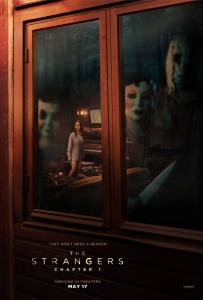 The most terrifying part of The Strangers: Chapter 1 is during its closing seconds, as text appears to inform all of us woeful viewers: “To be continued.” Oh no. Chapter 1 is intended to be the first in a new trilogy bringing back the essential concept of the 2008 home invasion thriller, that the masked attackers have no agenda, no motivation, and are being sadistic silent tormentors just because. The explanation, “Because you were home,” was a key revelation to the original, and here this famous line gets re-worked and has the same clumsy impact as Madame Web trying to reword that Spider-Man oath (“When you take on the responsibility, great power will come“). Not that the dialogue is the strong point of this thriller, with clunky expositional lines as nakedly transparent like, “Today is the third day of our three-day road trip around the country,” followed by, “Or our five-year anniversary.” It’s in the annoying, “Yeah I work here too” kind of lazy exposition. But you’re here for the scares, of which Chapter 1 has precious few because I think these are the most unimpressive and lackadaisical home invaders I’ve ever seen. I think the Wet Bandits might give these goons a run for their money (I’d watch Kevin take on The Strangers). Much of the movie is spent waiting, or checking places around the cabin, sometimes while one intruder plays the piano for ambience. One could make an argument they’re toying with their prey, but I would counter that I just don’t think they’re good at their whole enterprise. It doesn’t help that the main couple are so boring and undeveloped and I found it hard to fear for their well-being. As far as memorable scares or set-pieces or ingenious obstacles or overcoming said obstacles, it’s a big miss on all counts. A home invasion scenario can be exciting and terrifying, and it can be delicious fun to turn the tables on the attackers. This movie has so little that even the core ideas feel stretched beyond their breaking point. It’s hard to even feel much reverence for the original here, as The Strangers: Chapter 1 feels more like the steady, unrelenting squeezing of all IP for any possible drops of renewed audience interest. If this is what Chapter 1 has to offer, please spare us the rest. Fun fact: if you want to know what director Renny Harlin (Die Hard 2, Cliffhanger) has been doing lately, well here’s your underwhelming answer.
Nate’s Grade: D+
Share this:

The Last Stop in Yuma County (2024)
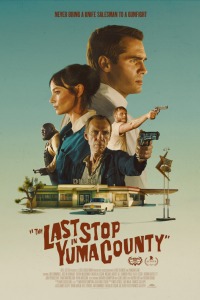
As a general rule of thumb, if some movie is described as “Coen-esque,” I must watch it. The Last Stop in Yuma County is a blend of Coen darkly comic malevolence, as well as Tarantino’s knack for the menace of dramatic irony and boiling tension waiting to explode, and it’s a firecracker of a debut for writer/director Francis Gallupi. It’s a relatively contained tale, sticking mostly to one rustic roadside diner and gas station along the dusty Arizona byways. On this day, two of its patrons happen to be recent bank robbers on the run, and they’re holding the other diner patrons captive until the gas pumps get fixed to fuel up and escape. The first hour then becomes a dread-filled game of waiting for things to go very badly. Our two main characters, a traveling knife salesman (Jim Cummings) and a waitress (Joceline Donahue) who happens to be the wife of the town sheriff, are working together to try and elicit help without endangering their lives, all the time more people keep entering the diner and inadvertently joining the simmering hostage situation. The way Gallupi writes his different characters is sharp and efficient, and the dread compounds in such organic complications, showing how fiendishly well-developed he’s made his potboiler. It also has a clear eye for style. Around the Act Two break, the movie becomes something else, which it intimated through a very specific film reference in conjunction with a specific character reference. It still proves compelling, but the overall sense of darkness and tragedy wore me down a little by the end. By the conclusion of its 90 minutes, I was hearing the saintly voice of Marge Gunderson in my head, shaking her head at the preventable body count and bad choices (“And all for a little bit of money. There’s more to life than money, don’cha know?”). The Last Stop in Yuma County is a twisty and twisted little macabre morality play in the guise of familiar Coen-esque capers. Welcome to the big leagues, Gallupi.
Nate’s Grade: B+
Share this:

The Hunger Games: The Ballad of Songbirds & Snakes (2023)
 Who exactly was watching The Hunger Games and thought to themselves, I wonder if this evil old fascist dictator played by Donald Sutherland was ever young and sexy and in love? Well fear not, whomever you are, because 2023 gave us the adaptation of The Ballad of Songbirds & Snakes, the far too long adaptation of Suzanne Collins’ prequel book, thus granting the studio more material to grind into products. I guess we should all be grateful that this wasn’t stretched into two movies like the original plan. Taking place 60 years prior to the events of the first movie, young Coriolanus Snow (Tom Blyth) is trying to financially secure his family’s safety in the Capitol, and he’s also mentoring one of the district combatant’s in the tenth annual Hunger Games death match. His charge is District 12’s Lucy Gray Baird (Rachel Zegler), a feisty Romani-esque young woman who uses song as her vehicle for rebellion, and young Snow has to coach her to victory if he has any hope of righting his family’s lost standing. Fortunately, the Hunger Games behind-the-scenes coordination and development is interesting, and filled with top-level actors living it up in these outsized roles (Viola Davis, you national treasure). The deadly games themselves are confined to one dilapidated arena and are visually engaging even in such a limited space. Unfortunately, the would-be Romeo and Juliet romance between Snow and Lucy Gray is far less engaging, and young Snow proves to be a handsome bore. There was potential here in exploring the origin of a monster but the villainy seems awfully contrived to push him along on an arc, with several drastic personal decisions absent believable development. We’re talking big character leaps here, the kind that I can’t even really explain except, “Well, I guess he just had it in him the whole time.” The hazy rationalization and rushed development reminded me of Anakin Skywalker’s underwhelming descent into the dark side. Songbirds & Snakes is only really going to work for the diehard fans of the franchise asking for a little more time in this dystopian universe and daydreaming about the washboard abs and baby blue eyes of their favorite older fascist.
Nate’s Grade: C+
Share this:

Civil War (2024)
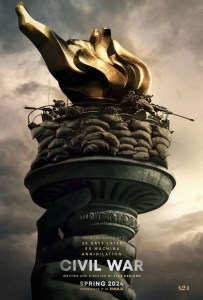 In writer/director Alex Garland’s Civil War, the United States has broken after a third-term president (Nick Offerman) has disbanded the FBI, attacked his own citizens, and used the power of the government to remain in office. The forces of California and Texas have joined an unlikely alliance to depose the American president. With this conflict escalating, we follow a group of journalists, primarily prize-winning war photographer Lee (Kirsten Dunst) and her would-be protege Jessie (Priscilla’s Cailee Spaeny), as they drive from New York down to D.C. with the intention of getting one more interview with the president before it all comes to a bloody end.
Civil War is Garland’s (Ex Machina, Men) attempt to evoke the ethos of journalists who stress merely trying to depict the world rather than question it. It’s a movie really about shared trauma, as these characters are plunged into a world where your neighbor might be stringing up men at the car wash. Garland’s sound design does him major credit at being able to keep his audience unsettled, not just in the melange of gunfire and explosions but also the absence of sound. After one close explosion, the sound drops completely for over a minute. During key parts of the frantic action, the movie will cut to the black and white images of our photographers, providing an immediate reprieve to contemplate as a depiction of what is taking place. Garland’s movie keeps things on a realistic level and is really less of a movie about an America on the brink than a story of journalists going about their dangerous job. It just so happens that instead of it being Afghanistan or Syria or other more familiar war zones that it’s the United States. As a simplified, point-A-to-point B war zone road trip, the movie works well enough, unless, that is, you’re expecting anything more than the quasi-objective documentation of terrible acts.
 However, that same ethos of centrist non-engagement also kept me struggling to really invest in the movie. I kept waiting for… simply more to happen, for insightful exchanges with our characters, for harrowing moments really crystallizing the state of this nation, for clues that gave a clearer picture of the larger conflicts and how the United States got to this point. For anyone expecting much from Offerman’s presidential character, he’s literally in the movie for, at best, two minutes. The far majority of the movie follows along on this road trip with these undeveloped characters taking pictures of occasionally upsetting and occasionally mundane events, although the totality of these events fails to add up to a clearer picture or more coherent social commentary. I just kept waiting for the characters to get more compelling, along with the conflict, and it just didn’t. I think we were following the wrong characters, people who are trying to stay objective and above it all, because then they’re just stand-ins for a camera and a microphone. We know Lee is a celebrated war photographer, and we get snippets of her past worldwide skirmishes, but what else do we know about her? What else do we know about Jessie, besides she’s an aspiring photographer who idolizes Lee? Does a mentorship relationship form? Not really. Does a rivalry form? Not really. The characters are just there, opaque, acting essentially no more than a stand-in for the audience. Now there’s a deeper conversation to be had about the ethics of embedded journalism, of documenting horror rather than intervening, or turning tragedy into digestible art for the masses. What are the ethics of non-intervention and holding to one’s moral objectivity in the face of the most objectionable? However, this is not the movie interested in having that conversation.
 The world of this civil war felt strangely unaffected. Hotels are going about their business, WiFi is carrying on, local shops are carrying on their discounts. I understand that part of this is meant to be surreal, the juxtaposition of a nation going about business as usual, even though these are unusual circumstances, but it makes the movie feel less significant, and the cavalier attitude of the characters continually betraying the stakes of the drama. If it’s just another assignment, how bad can it be? It makes Civil War feel like there’s hardly much of a civil war going on, which begs the question why even tackle this concept if this is it? If you have a movie about an American civil war but pussyfoot around on the why, forgo making the impact felt, and have the majority of the characters shrug it all off, then why are you even going through this story? The apolitical nature makes it so that many viewers will project their own perspectives and prejudices to fill out the unspoken history. It’s an interesting artistic decision but also one that nagged at me as a “both sides are bad” declaration to the middle to tell us that polarization is the real enemy.
There are a few sudden jolts and unsettling moments in the movie, but watching Civil War feels like I’m only watching 45% of a movie that will never be filled in. By that I don’t mean I need every point spoon-fed to my stupid plebeian brain, but I needed a movie where the time added up to something more substantial than “people do bad things during war.” I kept mentally going back to The Purge franchise, a concept that asked what people might do if they had a brief window of lawless freedom, and what that says about us as a society when the rules are put on hold. That is a franchise that embraces its genre roots and premise but finds ways to make its concept a reflection of our troubled times, and while it’s blunt commentary, when we have Nazis marching in the streets, maybe blunt times call for blunt commentary. Civil War feels so timid to say anything really that might be relevant to our current anxious and fractious political climate. Civil War was disappointing to the point that I was longing for the clarity and conviction of The Purge franchise.
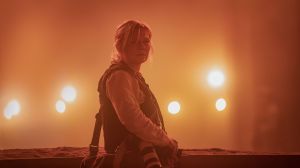 There are so many different versions of this story and concept that can prove compelling, so it’s all the more mystifying for me why Garland wanted to pick this version. Imagine a grueling Downfall-style drama about the last hours inside the White House of a three-term fascistic president who turned on his own people and enacted a bloody civil war, and imagine watching those closest to him reconcile with their own culpability as well as the resignation of the end coming for all of them and what they have done. Or even imagine a similar version about being behind enemy lines and looking for safe harbor, not knowing which American could be trustworthy and which might ultimately be a defector (as Jesse Plemons so ominously says in the movie’s intense high point, “Okay, but what kind of American are you?”). There’s a little known indie war movie from 2017 called Bushwick, starring Brittany Snow and Dave Bautista, that has a similar premise, following a military invasion of Brooklyn (Texas allies with the Southern states to attack the big cities, though they didn’t expect so much push-back from the locals). This is a better version of the similar modern civil war premise, with characters that are more compelling, a conflict that keeps upending our sense of safety, and some gutsy filmmaking choices, not all of them successful (the ending is too bleak and mean and deserved a ray of hope). There are myriad ways to tell this story and make it engaging and though-provoking, and Garland inexplicably chose this dull option. You could do worse than Civil War, but with such tantalizing dramatic potential, you could do better.
Nate’s Grade: C+
Share this:

Love Lies Bleeding (2024)
 With 2019’s Saint Maud, writer/director Rose Glass made her mark in the realm of religious horror, but it wasn’t just a high caliber boo-movie, it was an artistic statement on isolation, on obsession, and with stunning visuals to make the movie stand out even more. Next up, Glass has set her sights on a similar tale of isolation and obsession, in the realm of film noir.
In 1989, Lou (Kristen Stewart) works as the manager of a small gym in the American Southwest. She spots Jackie (Katy O’Brian) passing through on her way to a bodybuilding competition in Las Vegas. Together, the two women form a passionate relationship and are transfixed over one another, but in order to keep the good times rolling, each will be required to commit more desperate acts, including body removal and keeping secrets from Lou’s estranged father, Lou Senior (Ed Harris), a shooting range owner who operates as a cartel gun runner.
 Love Lies Bleeding powers along like a runaway locomotive, a genre picture awash in the lurid and sundry language of film noir with a queer twist, until it goes completely off the rails by its conclusion, a pile-up of tones and ideas that’s practically admirable even if it doesn’t come together. Until that final act, what we’re given is a contemporary film noir escapade following desperate and obsessive people get completely well over their heads into danger. Reminiscent of the Wachowski’s Bound, we have a film noir that lets the ladies have all the fun playing into the tropes of the sultry femme fatales, and in this movie, both the lead characters are their own femme fatales and ingenues. Lou is the one who pushes steroid use onto Jackie, who resists at first and wants to go about building her body the old-fashioned way. Lou is also the one with the shady past and connections that come calling back at the worst time. Once fully hooked on her diet of steroids, Jackie becomes increasingly more unpredictable and desperate, leaving Lou to try and clean up their accumulating messes. They both use the other, they both enable the other, and they both project what they want onto the other even after their collective screw-ups. It’s a self-destructive partnership but neither can see through the haze of desire. They see one another as an escape, when really it’s an unraveling of self (though I suppose one could argue “living your best self,” already a subjective claim, could include being a genuine garbage human). In a way, this is a relationship that’s all rampant desire and unfulfilled consumption, and it leaves both parties always wanting more. It’s a bad romance with bad people doing bad things badly, and if that isn’t a tidy summation of most film noir, then I don’t know what is.
For the first hour, I was right onboard with the movie and its grimy atmosphere. The plot has a clear acceleration point, though the first twenty minutes is also given to some cheap “who-slept-with-who-before-they-knew-who” drama that I was instantly ready to put behind. However, once the climactic death hangs over our two lovers, there’s an immediate sense of danger that makes every scene evoke the gnawing desperation of our characters. The screenplay by Maud and Weronika Tofilska has such a deliberate cause-effect construction, and no film noir would be complete without the loose ends the characters would have to fret over. What also helps to elevate the immersion is the electric chemistry between Stewart (Spencer) and O’Brian (The Mandalorian), who worked previously in the world of women’s body building and clearly felt a kinship with this role, and she is also a born movie star. The two women are great together, enough so that the audience might start believing that these two lost souls are actually good for one another. We too might get seduced by the possibility that everything will turn out for the better, when we all know that’s not how film noir goes. I will say there are some gutsy decisions toward the end that will test audiences with their loyalty to our couple, but most felt completely in character even if their lingering impact is for you to reel back, hold your breath, and then heavily sigh.
 It would also be impossible to discuss the movie without discussing just how overwhelmingly carnal it can be. I recently reviewed Drive-Away Dolls and noted how horny this lesbian sex comedy road trip was, though to me it felt empty and exploitative. With Love Lies Bleeding, the desire of these two women, and their mutual fulfillment, serves as another drug for them to mainline and then abuse. There is a hanger to the film’s gaze that is effective without feeling overly leering. The body building aspect puts a more natural fixation on lingering on the muscles and curves of human forms, and how Jackie is intending to transform herself into a fantasy version. The sexual content begins to ebb as soon as the murder content ramps up.
Unfortunately, for a movie that gets by on some big artistic chances, not all of them work, and most of the miscues hamper the final thirty minutes. In the final act, Jackie abandons Lou and goes off on her own to her Las Vegas bodybuilding competition, and at that point it’s like she’s in a completely different kind of movie. Hers is a movie about drug addiction and hitting a wall, as she has some very public freakouts and hallucinations. Although from there, Love Lies Bleeding indulges in some peculiar imagery that emphasizes the extreme bulging muscles of Jackie like she was the Hulk. While the movie never presents these flights of fancy as magic realism meant to be taken literally, the sheer goofiness of these moments and imagery can hamper moments, especially during a climactic showdown that feels more like someone’s kinky dream. Ultimately, I don’t think the characters of Lou or Jackie are that interesting. Lou’s criminal past was deserving of more attention far earlier, and Jackie is so narrowly-focused that every scene with her after a certain point is only going to reinforce the same obsessive drive and perspective. Like other genres, film noir works with archetypes, and Love Lies Bleeding isn’t re-inventing the genre, merely giving it a very specific sapphic spin, set amidst the haze of the go-go 1980s.
Rose Glass is a hell of an intriguing filmmaker after two very different movies in two very different genres, both of which have been defined for decades by male filmmakers. This woman is a natural filmmaker with clear vision, and even through the bumps, you know you’re in good hands here with a storyteller that’s going to take you places. The cinematography is fluid and grimy to the point where you may feel the need to take a shower afterwards. Everything seems coated with dirt and sweat. The synth-heavy musical score accommodates rather than overwhelms. The performances are strong throughout, and the screenplay choices, while not always working out, are bold and in-character. Love Lies Bleeding provides just about everything you could want from a lesbian bodybuilder film noir thriller, a movie that recognizes the sizzle of its genre elements and makes grand, scuzzy use. At this point, we should all be paying attention to whatever Glass wants to do next as a filmmaker. It might not be perfect, it might not even work, but it will certainly demand our attention and time.
Nate’s Grade: B
Share this:

The Beekeeper (2024)

The Beekeeper is a ridiculous action thriller that begs for incredulous laughter but this proves to be the movie’s real appeal. Jason Statham plays a retired black ops soldier whose call sign was Beekeeper, and who belonged to the secret group known as the Beekeepers, which would be really hard to differentiate agents, and then in his retirement, he literally keeps bees. Imagine a secret spy agency known as The Window Washers, and then their top operative decides to work in retirement as a window washer (or a Grave Digger who digs graves etc.). This on-its-head literalness is part of the silly entertainment value of the movie, along with Statham continuing to make bee-related quips no matter the scenario, which just makes him seem crazy or mentally trapped in a different movie, a more satirical version that the rest of the actual movie cannot support. There are many scenes that are one wink away from self-parody, like the FBI agents on the trail and one of them starts reading up on bee science as a means of better understanding this elusive man. What sets Statham off on his journey of bee-themed vengeance is when his kindly neighbor gets her life savings stolen from online hackers who are treated like Jordan Belfort of The Wolf of Wall Street. The old lady takes her own life, and from there Statham is blowing up office buildings, cracking heads, and at one point literally becomes a national terrorist. If you stop and think about the actual implications, The Beekeeper starts to feel like madness personified. As a revenge-thriller, it still works on the simple satisfying structure of watching bad guys get their comeuppance. It can be enjoyed as an effective B-movie (or… hear me out, a “Bee-Movie”?) that hits its genre marks, but as an unintended comedy and self-parody of the stupidity of so many direct-to-DVD action titles, this is where The Beekeeper is at its buzz-buzz-best.
Nate’s Grade: C+
Share this:

Eileen (2023)
 Based upon the novel of the same name, and adapted by the novelist and her husband, Eileen is an affectingly broody unrequited romance awash in noir trappings and feelings. It’s set in a prison facility in 1960s Boston, and one young worker Eileen (Thomasin McKenzie) becomes enraptured with her new co-worker Rebecca, a psychologist with an exceptional sense of confidence and hunger, played by Anne Hathaway. For a solid hour, the movie becomes something akin to 2015’s Carol, a lesbian romance where the social norms of the time force both participants to speak in codes and glances and gestures. Eileen is given to flurries of intense daydreams, often sexual, and sees a fellow creature in Rebecca, who doesn’t so much as walk through rooms as slinks, doesn’t so much as stare but smolders. Hathaway is in full-on femme fatale seduction mode here and enjoying it. It is following along this path of possible mutual connection, of finally acting upon these hidden desires, and then the movie takes a SHARP LEFT TURN and stays there for the rest of the duration. The twist works, and forces the audience to reconsider our notions of obsession and perspective, but it also feels like we’ve abandoned the prior movie into this new even pulpier, slightly more manic movie, and I don’t know if I wanted to leave so suddenly. If this twist were to stand, I think it needed to be introduced sooner, especially if it obliterates the prior dramatic work, and allow more time to deal with its myriad consequences. There is a powerfully gripping and deeply devastating monologue by Marin Ireland that might be the best part of the movie. Eileen the movie is a little like Eileen the character, gliding on appearances and secretly something much darker at its core.
Nate’s Grade: B-
Share this:

Leave the World Behind (2023)
 Apocalyptic thrillers can oddly enough serve as a therapeutic means for dealing with our fears of being helpless against forces well beyond our control, but they’re also reflections of our current state of anxiety as well. There’s more than just giant hurricanes or earthquakes breaking records on the Richter scale, it’s about how we respond to the momentous and alarming changes and what that says about The Way We Live Now. The new Netflix apocalyptic thriller Leave the World Behind, based on the 2020 book of the same name, has some big mysteries that I feel safe to say won’t fully be explained by the end. There is a possible explanation but it’s a movie more consumed with how people respond to tumult than the tumult. I found the majority of the movie to be gripping and engaging, and while it doesn’t exactly nail the landing, writer/director Sam Esmail (Mr. Robot, Homecoming) crafts a paranoid thriller with flair. It’s an apocalyptic thriller at crossroads with a paranoia thriller and a disaster movie, and the biggest challenge of them all is ultimately being able to trust another person during a time of remarkable uncertainty.
Amanda (Julia Roberts) and her husband Clay (Ethan Hawke) have elected to take a spur-of-the-moment family vacation out of New York City and onto a lavish home in Long Island. Everything seems so placid until the phones no longer get a signal, the TV broadcasts are strictly limited to a blank emergency screen, and two strangers show up (Mahershala Ali, Myhal’la) saying this is their house and they would like to stay inside. They claim that the U.S. is under a cyber assault and there’s more to come.
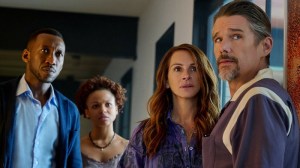 Leave the World Behind has two intriguing questions to keep the audience hooked: what is actually happening and who are these new people? Most disaster movies put you in the thick of the action, from presidential boardrooms to scientific outposts keeping up with the changing data and going over the options to prevent further loss of life. This movie purposely leaves you in the dark in a well-kept Long Island home and the first thing that goes is the expediency of knowing things from our phones. When two new people come knocking at the door to say the world is falling apart and this is our home, trust us, it’s hard not to hold some level of suspicion. Can we take these people at their word? What kind of agenda could they secretly have? And if so, what does that say about what has happened or what is happening in the outside world? They seem like they know more than what they’re letting on, so how much do they know themselves? It’s the slow drip of information that makes the movie simmer in such an anxious predicament of looking at every new piece as another new question. This places the viewer uncomfortably in similar territory as Amanda, who despite her prejudices might be right not to trust the newcomers. We’re stuck on the outside wondering what has happened and what may be left. The movie is carefully crafted to only give us so much to work with while our minds start reading and rereading everything for more connection and meaning, running rampant and going stir crazy just like the characters. While the second big question naturally gave way and could only produce so much tension, the main thrust of the movie kept me hooked and excited and worried and actively questioning just what exactly was going on.
I appreciate how Esmail is a restlessly ambitious filmmaker. He took on directing duties for the entire second season of Mr. Robot and from there continued coming up with new challenges. There was an episode meant to be told as an episode-length elaborate tracking shot. There was an episode that was told almost without any spoken words, entirely through visual action. There was an episode that was presented like a five-act stage play and it was enthralling. While these are the easy to recall gimmick episodes, Esmail’s directing vision for his series never eclipsed the series itself. It elevated the episodes but the emphasis was still on the significance of the characters and their emotional states (highly recommend Mr. Robot, one of my favorite 2010s TV shows, to anyone who has yet to watch). With Leave the World Behind, only his second feature after 2014’s parallel universe rom-com Comet, Esmail refuses to let any sequence pass without some kind of visual flourish. His camera is constantly swooping through the visual landscape, flipping and spinning and craning above the characters from on high. It reminded me of Brian DePalma, who also loves the high angle pans across rooms and also abides by the dogma that there should be no uninteresting shots in a movie. It’s easy to appreciate but without an engaging story can quickly become a distracting exercise in empty artifice, which is also how I view most DePalma. Here, much like Esmail’s accomplished prestige TV work, the style makes me better appreciate how much effort and thought Esmail has put into his presentation and his ideas. The man wants you to see his work, and there’s no fault in that as long as you’re enjoying the experience, which I was for the most part.
 There are some supremely well-crafted moments played to a breaking point of intensity. Early on, as the family relaxes on the beach, they see a ship in the distance, an ordinary sight on a seemingly ordinary day. Then hours pass and it’s getting closer, and closer, and finally the realization begins to settle in that this thing is now a danger and they need to very much run very much now. Esmail’s camerawork keeps the scene feeling kinetic, with a long take that establishes the colossal danger as the tanker runs aground and the family has narrowly fled in time. In many ways this moment also serves as an ecological metaphor, with problems looming in the distance but ignored until they are at their most dangerous and right on top of us. Another sequence involves Clay venturing outside and discovering what appears to be a dust storm the color of blood. It’s getting closer and closer and the movie is testing how much we can take before you start hitting an imaginary gas pedal to strongly suggest Clay out of there. There’s another sequence that’s a literal pile-up of driver-less cars coming to the same nexus point like they’re all migrating. It makes for an immediately eerie sequence that becomes extra horrifying once the Teslas become unmanned missiles.
The themes of disconnection aren’t exactly subtle but that doesn’t mean they are misguided. This movie is about as subtle as an oil tanker heading straight for you, but I didn’t mind because of the skill of the storytellers and the ongoing mysteries that kept me begging for every new morsel. The messaging isn’t exactly complex. At one point Amanda has a speech that might as well be titled “This is Why Humans Are Terrible and We Deserve This.” Following this, another character tells her that they may not agree on much but she agrees with every word she just uttered with her speech, so you know this is the kind of pessimistic monologue that can reach across the doom-scrolling aisle. The movie almost frustratingly ends without a larger sense of clarity over what has been happening, a fate that would have greatly angered my wife. Esmail gives you something that can work as an explanation without making it definitive; it’s merely a theory but it’s enough to hold onto if you desperately need an explanation. However, the way the movie ends feels less conclusive and more like the conclusion of a season of television where the characters, now grouped together, are in for something fierce next year so stay tuned. The nature of this story is designed to leave you hanging, and that’s why I circle back on it mattering more on how these characters respond to this apocalyptic event versus what is clearly happening.
 Chilling and effectively plotted to keep you guessing until the end, Leave the World Behind is an apocalyptic thriller that really simmers in the anxiety of the unknown. It’s not perfect but it’s pretty good, as long as you can accept not having all the answers. The acting is strong but it’s the control and finesse that Esmail exhibits as director and screenwriter that really makes the material engaging and impactful. It’s an apocalyptic thriller where the scariest proponent might be having to live with one another.
Nate’s Grade: B


You must be logged in to post a comment.