Blog Archives
Knock at the Cabin (2023)
 Knock at the Cabin continues M. Night Shyamalan’s more streamlined, single-location focus of late, and while it still has some of his trademark miscues, it’s surprisingly intense throughout and Shyamalan continues improving as a director. The premise, based off the novel by Paul Tremblay, is about four strangers (Dave Bautista, Nikki Amuka-Bird, Rupert Grint, Abby Quinn) knocking on the door of a gay couple’s (Jonathan Groff, Ben Aldridge) cabin. These strangers, which couldn’t be any more different from one another, say they have come with a dire mission to see through. Each of them has a prophetic vision of an apocalypse that can only be avoided if one of the family members within the cabin is chosen to be sacrificed. Given this scenario, you would imagine there is only two ways this can go, either 1) the crazy people are just crazy, or 2) the crazy people are right (if you’ve unfortunately watched the trailers for the movie, this will already have been spoiled for you). I figured with only two real story options, though I guess crazy people can be independently crazy and also wrong, that tension would be minimal. I was pleasantly surprised how fraught with suspense the movie comes across, with Shyamalan really making the most of his limited spaces in consistently visually engaging ways. His writing still has issues. Characters will still talk in flat, declarative statements that feel phony (“disquietude”?), the news footage-as-exposition device opens plenty of plot hole questions, and his instincts to over-explain plot or metaphor are still here though thankfully not as bad as the finale of Old, and yet the movie’s simplicity also allows the sinister thought exercise to always stay in the forefront. Even though it’s Shyamalan’s second career R-rating, there’s little emphasis on gore and the violence is more implied and restrained. I don’t think Shyamalan knows what to do with the extra allowance of an R-rating. The chosen couple, and their adopted daughter, are told that if they do not choose a sacrifice, they will all live but walk the Earth as the only survivors. It’s an intriguing alternative, reminding me a bit of The Rapture, an apocalyptic movie where our protagonist refuses to forgive God and literally sits out of heaven (sill worth watching). The stabs at social commentary are a bit weaker here, struggling to make connections with mass delusions and confirmation bias bubbles. I really thought more was going to be made about one of the couple being a reformed believer himself, with the apocalyptic setup tapping into old religious programming. It’s a bit of an over-extended Twilight Zone episode but I found myself nodding along for most of it, excusing the missteps chiefly because of the power of Bautista. This is a very different kind of role for the man, and he brings a quiet intensity to his performance that is unnerving without going into campy self-parody. He can genuinely be great as an actor, and Knock at the Cabin is the best example yet of the man’s range. For me, it’s a ramshackle moral quandary thriller that overcomes Shyamalan’s bad writing impulses and made me actually feel some earned emotion by the end, which is more than I was expecting for an apocalyptic thriller under 100 minutes. What a twist.
Nate’s Grade: B-
Share this:

M3GAN (2023)
 It’s early January, typically a dumping ground for the unwanted leftovers of Hollywood studios, but an unexpected meme queen has emerged in the form of M3GAN. The latest hit from Blumhouse is styled as a horror-comedy and from the same writer as 2021’s Malignant, which was a delightfully gonzo horror movie that only got more absurdly entertaining the crazier it went. My hopes for M3GAN were confirmed early as I laughed within seconds of the movie. There isn’t much in the way of genuine scares as a PG-13 chiller, so M3GAN leans into the knowingly awkward camp comedy. An advanced robot is given to an orphan to test-drive and the little robot forms a strong attachment that cannot be broken even by bloodshed. It’s a crazy killer doll movie combined with a crazy killer robot movie as well as a corporate satire. When the little robot literally bursts out into song to help cheer up her human counterpart, there’s nothing to do but laugh and acknowledge this is what the filmmakers wanted in response. It’s a fun movie that doesn’t overstay its welcome but needed a little more crazy or a little more biting satire to really satisfy. I was hoping for a more Malignant-style escalation of crazy and was left wanting. Still, it’s a goofy horror comedy that just wants to have fun with the uncanny valley of your expectations.
Nate’s Grade: B
Share this:

The Outfit (2022)

What a disarmingly suspenseful movie this was. The Outfit flew under the radar when it was released in the early months of 2022, but it deserves better and is genuinely one of the best films of that year. It’s structured much like a stage play, based in one location with a group of characters under great duress. Set in 1956 Chicago, the movie takes place entirely within the tailor shop of Leonard (Mark Rylance), an expat from Britain’s famed Savoy Road who has a special arrangement with local gangsters. He lets them use his shop for their business and doesn’t ask questions. Then one fateful night a job goes wrong and the surviving criminals hide out in the shop, suspecting one among them is a traitor. Written and directed by Graham Moore (Oscar-winner for 2014’s The Imitation Game), the movie is an ever-shifting game of constant suspense, with new characters coming into the fray and with every person holding their own secrets. I was impressed with how the movie kept upending my expectations while holding onto clarity, as each new combination of characters onscreen meant a different dynamic of who knows what and what angle they’re gunning for. Rylance is our anchor of this shifting game and it’s an open question whether he is hapless victim or manipulative schemer. The writing is so sharp and the ensemble are so refined each in their role (Dylan O’Brien, Zoey Deutch, Simon Russell Beale) that you ignore the rather pedestrian direction by Moore. This little movie is such a sly surprise that can pack a wallop while keeping you entertained and duly satisfied by the end. The Outfit is is a well-made yet familiar story but told with pristine craftsmanship.
Nate’s Grade: A-
Share this:

Decision to Leave (2022)
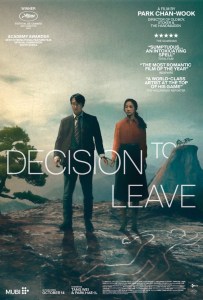 Imagine crossing a classic film noir detective story with some unrequited romance heavy with yearning, like In the Mood for Love, and that’s the combo you get with director Park Chan-wook’s newest, Decision to Leave. In Busan, a straight-laced detective (Park Hae-il, The Host) is investigating an older government official who fell to death from a mountain peak. He suspects that the man’s wife, Song Seo-rae (Tang Wei, Lust, Caution), a much younger Chinese immigrant, might have something to do with the death, and so the detective gets closer and closer to his suspect, blurring the lines of the investigation and his own personal desires. It sounds like familiar genre territory, and it can be, but director Park Chan-wook (The Handmaiden, Oldboy) is the X-factor, and quite simply, he shoots the hell out of this movie. There are some jaw-dropping shot selections and camera arrangements here to cherish. The movie is less interested in its sordid murder mystery details and more the possible relationship between its two magnetic poles, made even more complicated by the detective already being married, though only spending the weekends at home. There is a stormy swell of will-they-won’t-they sexual tension in constant churn, and it adds a dour sense of melancholy to the entire movie. There’s a time jump two-thirds of the way through the movie that is slightly aggravating, because it’s like starting over and repeating the mystery catch-up but with less time, making the details of this new case even less meaningful than earlier. Decision to Leave ends on a strong downbeat that feels appropriate given the mood of the preceding two-plus hours. I don’t think the characters are as textured as they could be, part of this is being jostled around by the non-linear storytelling and artistic tricks of Chan-wook. I think the movie generally favors mood and flirts with wanting to be seen a tragic romance worthy of Hitchcock, though I don’t think it fully gets there. So much of the movie is about probing whether or not the feelings are real between these two, whether she’s toying with him or he just wants to complete the unfinished assignment (the dynamic reminded me of Luther and Alice in the BBC series Luther). Decision to Leave feels like a solid film noir mystery, elevated by A-level directing talent, and then missing its ambitious grasp with its lilting love story that feels a little too subdued and understated to really smolder.
Nate’s Grade: B
Share this:

Thirteen Lives (2022)
 The true tale of rescuing the trapped 13 Thai boys in the summer of 2018 is turned into an engrossing and often thrilling if overly long 2022 movie experience thanks to director Ron Howard and a dedicated crew bringing to vivid life the harrowing drama. I was vaguely aware of this story as it played out originally, though missed the critically acclaimed documentary The Rescue from last year that covered the same material, but watching the movie I realize I knew very little of the actual horror. The movie centers around a pair of English divers (Colin Farrell, Viggo Mortensen), both with over 30 years of specific cave diving experience, helping the Thai Navy Seals and government officials to find and save the missing children and their coach. The submerged path is one that lasts about seven hours, and it’s narrow, dark, and treacherous, easy to lose your way. when you only have a tank of air, navigation is the difference between life and death. It’s also a race against time as the monsoon waters are flooding the cave further. The cave traversal sequences are nerve-wracking and deeply immersive, enough so that even I, while watching, started sitting on the edge of my couch in the safety of my own home. The story isn’t entirely centered on our two heroic white guys, as the screenplay by William Nicholson (Gladiator) widens the focus onto many who contributed to the boys eventual rescue, from an engineer who realized they needed to dam water drainage at the top of a mountain, to the locals who agreed to have their crops flooded for the possibility of saving the kids, to the bravery of the Thai Seals, to the hope and burdens of the parents. I never knew the boys had to literally be anesthetized to be removed, and the ensuring climax as the rescue team keeps tabs on how their precious cargo is responding during the multi-hour journey underwater. Howard keeps things pretty straightforward and helpfully provides onscreen graphics to better provide a sense of distance within the cave, which just makes the heroics even more dizzying. Thirteen Lives is an inspiring story about the world coming together for common cause (except Elon Musk, who baselessly accused one of the divers as being a “pedo”) and it’s also genuinely exciting even when you know they all make it out alive, which is its own credit. It might have used some tightening up for pacing, but it’s a well-made dramatization that pays real homage to the many heroes without overplaying its drama.
Nate’s Grade: B+
Share this:

Emily the Criminal (2022)
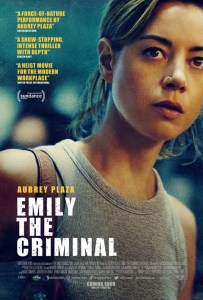
This Sundance indie thriller packs more anxiety into 90 minutes than most Hollywood thrillers combined. It’s a starring vehicle for Aubrey Plaza as the titular Emily, a woman with a prior criminal record who finds herself in debt and struggling to find a better paying job. In desperation, she joins a small-time credit card fraud squad, using stolen identities to purchase expensive electronics and pass along to her employer to resell. At first, it’s a quick and easy fix and she can walk away at any time, but the money is good and Emily begins to take on bigger and riskier jobs. It’s here where I really started sweating as Emily gets into some very serious jams, but she comes back swinging, and it’s a thrill. At the same time, you worry that she’s going too far and there may be no turning back. The movie reminded me a lot of 2016’s Good Time, an electric indie thriller that vibrated with anxiety as well as a surprising but thoughtful cause-effect story flow. Emily the Criminal begins as an indictment on the social mechanisms that trap the poor into poverty but then in its second half escalates urgently, spiraling into a tragic confluence of violence and vengeance. Plaza is outstanding from the first scene onward. Even her posture speaks volumes about her character. It’s a performance where you can see the gears of her decision-making, whether it’s fight-or-flight impulses, swallowing her pride, holding to a façade, or regaining what has been taken from her. The very ending of the movie is perfect and a fitting end of Emily’s character arc. It’s the American Dream turned into a modern nightmare of perfectly perpetual desperation.
Nate’s Grade: A-
Share this:

Glass Onion (2022)
 When writer/director Rian Johnson wanted to take a breather after his polarizing Star Wars movie, he tried his hand at updating the dusty-old Agatha Christie mystery genre, and in doing so created a highly-acclaimed and high-grossing film franchise. The man was just trying to do something different and at a smaller-scale with 2019’s Knives Out, and then it hit big and Netflix agreed to pay $400 million dollars for exclusive rights to two sequels. Now as Johnson has reinvented his career as a mystery writer the big question is: can he pull it all off again?
Renowned detective Benoit Blanc (Daniel Craig) has been invited to the world’s most exclusive dinner party. Miles Bron (Edward Norton) has invited all his closest friends to his Greek island soiree, setting up a murder mystery game his friends must spend the weekend solving. Except there are two interlopers: Andi Brand (Janelle Monae), the former partner of Miles who was betrayed by Miles and his cronies and… Benoit Blanc himself. Why was the detective invited to the murder dinner party unless someone planned on using it as an excuse to actually kill Miles?
 Knives Out was a clever deconstruction of drawing room mysteries and did something remarkable, it told you who the murderer was early and changed the entire audience participation. Instead of intellectually trying to parse clues and narrow down the gallery of suspects, Johnson cast that aside and said it didn’t matter as much as your emotional investment for this character now trying to cover up her tracks while working alongside the “world’s greatest detective.” It made the movie so much more engaging and fun, and for his twisty efforts, Johnson was nominated for a Best Original Screenplay Oscar. Now, every viewer vested in this growing franchise is coming into Glass Onion with a level of expectations, looking for the twists, looking for the clever deconstruction, and this time It feels like Johnson is deconstructing the very concept of the genius iconoclast and including himself in the mix. The movie takes square aim at the wealthy and famous who subscribe to the idea of their deserved privilege, in particular quirky billionaires whose branding involves their innate genius (many have made quick connections to Elon Musk in particular). The movie’s first half is taken with whether or not Miles Bron’s murder mystery retreat will become a legitimate murder mystery, but by the midpoint realignment, Glass Onion switches into pinning down the bastard. It makes for a greatly satisfying conclusion as Blanc exposes the empty center of Miles’ calculated genius mystique.
 As Blanc repeatedly says, the answers are hiding in plain sight, and this also speaks to Johnson’s meta-commentary of his own clever screenwriting. This is Johnson speaking to the audience that he cannot simply copy the formula of Knives Out. This is a bigger movie with more broadly written characters, but each one of them feels more integrated in the central mystery and given flamboyant distinction; it’s more like Clue than Christie. Through Miles’ influence, we have a neurotic politician (Kathryn Hahn), a block-headed streamer (Dave Bautista) pandering to fragile men on the Internet, a fashionista (Kate Hudson) who built an empire on sweatpants and has a habit of insensitive remarks, and a business exec (Leslie Odom Jr.) who admits to sitting on his hands until given orders from on high by Miles. All of these so-called friends are really bottom-feeders propped up by Miles’ money. It would have been easy to simply replay his old tricks, but Johnson takes the heightened atmosphere of the characters and plays with wilder plot elements of the mystery genre, such as identical twins and secret missions and celebrity cameos (R.I.P. two of them) and corporate espionage. The very Mona Lisa itself plays significantly into the plot (fun fact: Ms. Mona was not the universally revered epitome of art we know it to be until its 1911 theft). This is a bigger, broader movie but the larger stage suits Johnson just fine. He adjusts to his new setting, veers into wackier comedy bits with aplomb, and has fun with all the false leads and many payoffs. You never know when something will just be a throwaway idea, like the hourly chime on the island, or have an unexpected development, like Jeremy Renner’s hot sauce. Glass Onion is about puncturing the mirage of cleverness, and by the end, it felt like Johnson was also playfully commenting on his own meta-clever storytelling needs as well.
It’s so nice to watch Craig have the time of his life. You can clearly feel the passion he has for the character and how freeing this role is for an actor best remembered for his grimaced mug drifting through the James Bond movies. Craig makes a feast of this outsized character, luxuriating in the Southern drawl, the loquaciousness, and his befuddled mannerisms. After Knives Out, I begged for more Benoit Blanc adventures, and now with a successful sequel, that urge has only become more rapacious. Johnson has proven he can port his detective into any new mystery. Netflix has already paid for a third Knives Out mystery movie, and I’d be happy for another Blanc mystery every so many years as long as Craig and Johnson are willing. These are fabulous ensemble showcases as well with eclectic casts cutting loose and having fun. Norton (Motherless Brooklyn) is hilariously pompous, especially as Blanc deflates his overgrown ego. Bautista (Dune) is the exact right kind of blowhard. Hudson (Music) is the right kind of ditzy princess with a persecution complex. Her joke about sweatshops is gold. Jessica Henwick (The Gray Man) has a small role as the beleaguered assistant to Hudson’s socialite, but she delivers a masterclass in making the most of reaction shots. She made me laugh out loud just from her pained or bewildered reactions, adding history to her boss’ routine foot-in-mouth PR blunders.
 There is one big thing missing from Glass Onion that holds it back from replicating the surprise success of its predecessor, and that’s the emotional lead supplied by Ana de Armas. She unexpectedly became the center of the 2019 movie and it was better for it. Glass Onion tries something similar with Andi Brand, and while she’s the easiest new character to root for among a den of phonies and sycophants, it’s not the same immediate level of emotional engagement. That’s the biggest missing piece for Glass Onion; it’s unable to replicate that same emotional engagement because the crusade of Andi Brand isn’t as compelling alone.
Glass Onion is a grand time at the movies, or as Netflix insisted, a grand time at home on your streaming device. It’s proof that Johnson can handle the rigors of living up to increased expectations, making a sequel that can stand on its own but has the strong, recognizable DNA of its potent predecessor. It’s not quite as immediate and layered and emotionally engaging, but the results are still colorful, twisty, and above all else, immensely fun and satisfying. I’m sure I’ll only think better of Glass Onion upon further re-watching as I did with Knives Out. Johnson once again artfully plays around with misdirects and whodunnit elements like a seasoned professional, and Glass Onion is confirmation that Benoit Blanc can be the greatest film detective of our modern age.
Nate’s Grade: A-
Share this:

The Menu (2022)
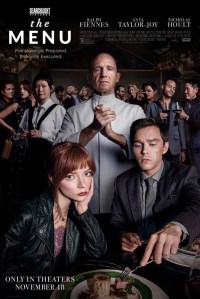 The first thing I thought about with the horror black comedy The Menu is what famous film critic and pun enthusiast Gene Shalit would do with this title and setup. He’d say, “Don’t send this one back to the chef,” or, “I’ll have seconds,” or, “Book your reservation now,” or any number of bad jokes (fun fact: Shalit is STILL alive and 96). Regardless, The Menu is an excellent main course for fans of dark comedies and biting satire. It’s not really scary or thrilling, even if it borrows liberally from the structure of contained thrillers. A dozen wealthy guests are selected for a once-in-a-lifetime dining experience from a legendary chef (Ralph Fiennes). The story is a balancing act of mysteries, with what is happening on this secluded island, each new course on the menu and what it reveals about its chef and his intentions, why each of the couples is present and what troubles they have, and why our head chef is so fixated on Margot (Anya Taylor-Joy), a last-second replacement date for arrogant would-be foodie, Tyler (Nicholas Hoult), and who she really is and whether she belongs here or not. Part of the wicked fun is watching things escalate and the characters freak out, or try and rationalize or bargain through the experience. I was chuckling throughout the movie, tickled by its sardonic humor and the excellent heightened performances from its ensemble cast. Fiennes (The King’s Man) is locked-in as his enigmatic yet intensely dedicated chef, so much so you might admire him while also being creeped out. His annoyance and cold disdain for the guests is a constant source of entertainment, especially a scene where he insists that the know-it-all foodie put on a chef’s robe and try his hapless hand at actual cooking. Hong Chau (Downsizing) is terrific as a no-nonsense sous chef simmering with barely concealed contempt. Her pronunciation of “tortilla” is one of the movie’s biggest laughs. With The Great and now this, Hoult is finding a great stride in playing outsized egotistical buffoons. By the end, I was left wanting a little more in the way of answers or catharsis or even its class conscious commentary, but The Menu still packs plenty in its 105 minutes to be an appetizing experience.
Nate’s Grade: B+
Share this:

Smile (2022)
 Smile was not initially intended for a theatrical release. The $17 million-budgeted horror thriller had been intended as a streaming exclusive for Paramount Plus, but after the movie tested so well, its parent company thought why not try a theatrical run? They even hired real actors to creepy stand still grinning outside Good Morning America or behind home plate for baseball playoffs. Then the movie made over $200 million worldwide and possibly began its own franchise. Not bad. After having finally watched Smile, I can understand why it became a word-of-mouth sensation. It’s thoroughly unnerving and a horror film that just knows its fundamentals.
Dr. Rose Cutter (Sosie Bacon) is a clinical psychologist with her own trauma. As a child, she discovered her own mentally ill mother’s body after she had overdosed on pills, and this has spurned Rose to try and help others suffering from depression and mental illness as a career. She encounters one very frantic young woman, Laura (Caitlin Stasey), who fears she is in danger. She says she keeps seeing… smiling people, people that aren’t there, and she was told today was her last day to live. Sure enough, the woman struggles and then stands, eerily smiling, and casually slices her own throat in front of Rose. While she tries to shake off the disturbing burst of violence, Rose is starting to see Laura again, smiling that same eerie smile, and this propels Rose to investigate the origins of this curse that leads each victim to take their own life.
 There isn’t much in the way of deeper themes or social commentary here, though I suppose you could find some pieces about how we stigmatize mental illness or that the curse has to be spread through witnesses of trauma. Smile isn’t an example of elevated horror and instead it’s just a well-constructed, well-developed horror movie that knows what to do to properly get under your skin. The premise reminded me of the indie breakout in 2014, It Follows, where there is a curse with very specific rules for passing it along, and new chains can be created or broken depending upon the duplicity of the person (see also: The Ring). I liked thinking of the curse as a puzzle, and my wife was able to jump to a conclusion before the movie as far as how to possibly break the curse, going against the assumptions of Rose and her ex-boyfriend police detective, Joel (Kyle Gallner). Much of the second half of the movie is this discovery period, untangling the longer history of the curse, implicit with this is that each new occurrence involved a violent suicide and an observer. I suppose maybe there is some theme possibly attempted about the shared nature of trauma, how it unpredictably spills out before us and is tricky to be cleanly contained. After establishing the pattern with the curse, now it’s time for our protagonist to wonder if she can beat the odds. I appreciate that writer/director Parker Finn provides plausibility to make her efforts credible. My issue with the latter part of It Follows was why the beleaguered teens would have thought that they could electrocute an invisible phantom and kill it when it was otherwise unfazed by bullets.
As a straightforward horror thriller, Smile knows what it takes to make you squirm and jump. It taps into something universal: smiling, without careful context, is often very creepy. It’s not a world-breaking observation and yet its simplicity is part of what makes it all so effective. Very often, the movie will anticipate the audience’s dread, feeling out that something is about to go off the rails or a jump scare might be approaching, and it will deliver in a different direction. Much like James Wan’s Conjuring movies, the film also has a firm handle on setups and payoffs, establishing a situation and then letting the audience simmer in dread. There was one moment where Rose was instructed to turn around and look behind her by a voice that no longer seemed so helpful, and the drawn-out response was deliciously squirm-inducing. There was another moment that I knew a jump scare was coming, it was literally walking towards Rose, and I kept thinking, “Okay, here comes the startle,” and then the movie brought it but in a way that still surprised and elated me. Given the nature of the curse messing with its victim’s mind, you might start to anticipate what Rose sees and hears is not to be trusted, and there are a few fake-outs too many. Thankfully, the movie doesn’t just rest on one spooky trick. There’s a children’s birthday party that manages to tie a few plot elements together in a masterfully traumatizing manner. When Smile does start revealing more about the design of its monster, that’s when my wife started averting her eyes more often and muttering “No no no” to herself. Some of the imagery is prime nightmare fuel, and I applaud Finn’s innate ability to scare the hell out of an audience.
 Some action movies and horror flicks are best described as thrill rides, an experience that exhilarates and delights and doesn’t offer much more by the end than the experience, and that’s perfectly acceptable. Not every movie has to be one with deeper meanings or breaking the mold in a way that no filmmaker has ever achieved before. Sometimes just having a good time from a well-constructed thrill ride is sufficient for a fun and diverting viewing. Smile is that film, a horror/thriller that is cleverly focused and developed to garner every goosebump. I will also say that I incorrectly thought that this movie was PG-13, and that was quickly disproven by the intensity and disturbing nature of its violence. I can’t say why I always thought that this was a PG-13 movie, maybe because of its instant box-office success, but it definitely doesn’t soft pedal its intense atmosphere and disquieting nature. It takes a lot to scare me, and Smile made me sit on the edge of my seat and perfectly dread the next moment, that is, when I wasn’t averting my eyes like my wife and trying to forget its nightmarish imagery.
Nate’s Grade: B+
Share this:

Don’t Worry Darling (2022)
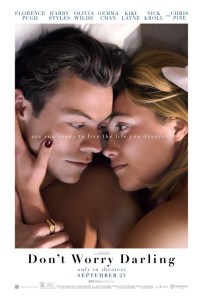 By now, you’ve likely heard all about the gossip-churning headlines from behind the scenes of Don’t Worry Darling, which eclipsed everything else about the movie and is, sadly, the most interesting thing about an otherwise flawed Stepford Wives retread. There were scandalous rumors of affairs, rumors of actors uncomfortable with affairs, rumors of actors refusing to take part in publicity for the movie, which motivated legions of online super sleuths to analyze every social media missive to the finest point to discover hidden messages and meaning. There was even a point where the Internet debated for a week whether or not Harry Styles actually and actively spit upon Chris Pine at the Venice Film Festival (both actors deny this happening). Looking back, it was a wild time, a bit silly, and far out of proportion for the actual movie we eventually get with Don’t Worry Darling.
Alice (Florence Pugh) is living the perfect 1950s life – OR SO SHE THINKS. Her husband, Jack (Harry Styles), leaves with the other men for work in the desert facility owned by Frank (Chris Pine). The wives of the community diligently tend to the household chores, gossip poolside, and have a full-cooked meal and drink in hand for their returning breadwinners. Alice begins seeing disturbing visions she cannot explain, and another wife (Kiki Layne) starts acting up, trying to warn her, and men in red suits seem to pounce whenever someone steps out of line. It’s a lush suburban community designed by Frank, meant to be the sparkling, hopeful epitome of the American Dream, but it might be a nightmare instead as Alice investigates.
 Don’t Worry Darling is a fleetingly entertaining movie with big ideas but it doesn’t know how to handle them and what to say beyond its obvious points. Immediately in the movie, you’ll know something is wrong with this idyllic community. The Stepford Wives is an obvious comparison point, so I kept waiting for the movie to pivot from this predicted influence, to go a separate route or go deeper, making its commentary meaningful for today’s world. Unfortunately, the movie never does move beyond this influence, nor does the movie go deeper than to easily castigate its men for wanting to control their women and remodel them as dutiful, cheerful, robotic housewife throwbacks to the halcyon age of 1950s Boomer nostalgia. It’s all too surface-level for a movie about superficial men wanting to unburden themselves of having to live up to the expectations of women. There’s plenty that could have been said about the pernicious forms of toxic masculinity festering around the darker corners of society and the Internet, the rise of fragile men in the alt-right and incels and trolls, and their angry, entitled, self-loathing feelings toward women projected into harassment. This movie only merely glances at its touchy subject. The commentary is too basic, leveling men want to dominate women and erase their agency and identity for their own satisfaction, the same points from The Stepford Wives in the 1970s, which was a direct response to the feminist movement challenging traditional gender roles in the home. I won’t spoil the exact means of what this false reality is for Alice and the others, but suffice to say, it leaves a lot more questions for me than answers (Has nobody reported any of these women missing? Their friends and family? Why have such potentially deadly stakes? Why would modern men fantasize about six-decade-old Boomer nostalgia?).
In short, this reality is false, and the screenplay by Katie Silberman (Booksmart) and Carey and Shane Van Dyke (The Silence) makes it known immediately, so the story is structured with our foreknowledge in place. It becomes a game of how long before Alice puts together her conclusion and which strings she chooses to pull and what blowback from the established order that demands ignorance and obedience. There just isn’t enough intrigue here. In The Truman Show, the protagonist gradually began to doubt his reality but each suspicious peculiarity added to a better sense of the larger picture, and since it wasn’t until halfway through that we saw “the other side” of Truman’s manufactured world, the audience too was learning about this facade and all the effort to keep it hidden. Don’t Worry Darling has a repeated motif of Alice seeing confusing images of her and the other wives in a stark Bubsy Burkeley-esque musical number, but why? What does this reveal about the inner workings of the reality behind the reality? It’s not even made clear what it relates to literally, so it must be a metaphor, but it’s again too obvious and heavy-handed. I understand all the women are learning and practicing dance, but to what end does this serve? I needed further rules established about this secret society so I had more of an understanding of what was at stake as Alice begins to test her boundaries and put others in danger. The conclusion is also ludicrously short-sighted, just a matter of crossing a magical line, like a kid touching base in tag, and that’s before a segment of self-awakening that made me wonder if Alice had miraculously become Neo. It’s the kind of conclusion that feels way too easy and unfulfilling, attempting a note of “what happens next?” ambiguity but really feeling more unsatisfyingly incomplete and empty.
 Even though Don’t Worry Darling is flawed, Wilde’s directing is still an asset. She’s clearly having fun playing in a much different genre than 2019’s Booksmart, and the thriller elements are achieved by the eerie contrasts that Wilde finds to highlight of this hidden prison. The sunny cinematography and retro production design are sharp, and the musical score by John Powell (How to Train Your Dragon) has an off-kilter but electric charge to it, often working in hums and stutters to better accentuate the horror atmosphere creeping into this would-be paradise. Wilde even captures the speeding cars in the desert with a certain thrilling aplomb. Much publicity was made about the portrayal of the sex scenes within Don’t Worry Darling, namely, with a woman behind the camera, that they focus on feminine pleasure, a feature often lacking in a male-dominated field built upon the sizzle of the male gaze. I’ll agree that both scenes put more focus on Alice, also our main character so perhaps there’s that, but knowing the full context of the story, it seems more than a little misguided to purposely emphasize feminine pleasure. Also, it’s hard for me to actually believe these kinds of self-involved, parochial men would prioritize giving pleasure to their partner. This detail seems in conflict with the larger thesis.
Thank goodness for Florence Pugh, a refrain every viewer repeats with every movie co-starring the Oscar-nominated actress. Pugh (Black Widow) ably carries this movie on her back. Her performance has more nuance than the character writing provides, and it’s enjoyable to see her challenge the imposition of authority and push back. It’s yet another emotionally heavy role with several scenes of sobbing and screaming, and Pugh is one of the best actors when it comes to expressing the heights of emotional distress without overdoing it into histrionics. As my wife said by the end of the movie, Pugh deserves to star in a feel-good, chippy rom-com after all the grueling emotional work she’s endured in many of her more prominent roles.
 Harry Styles (Dunkirk) doesn’t fare as well, dwarfed by his scene partner. There is one moment where he has an emotional breakdown in his car that is nicely portrayed, a mixture of pity and guilt and pure cowardice, and Styles really nails it. However, his smooth hunky husband persona works well enough, enough so that it’s hard for me to see someone like Shia LeBeouf, who Wilde originally had cast in the role, working as intended considering his more intense presence would make you doubt the man’s intentions almost immediately. I wish somebody gave Chris Pine more to do in this other than smugly smirk in the background (admittedly his “being in the background” of one scene was an uncomfortable oddity that demanded further exploration).
There are things that genuinely work with Don’t Worry Darling, moments that dazzle and excite, technical elements that elevate the material, and performances that stick, but it all comes down to a disappointing and underdeveloped script that cannot figure out what to do with its messy themes. It’s too obvious where the movie is headed given its heavy thematic similarities to The Stepford Wives, but it could have taken that familiarity and reapplied it to today’s Internet-age misogyny preying upon female autonomy, but it doesn’t. It could have also fleshed out the particulars of its fraying world-within-a-world to better feel complete and intriguing and meaningful, but it doesn’t. It could have presented a compelling hero’s journey of Alice pushing back against formidable opponents, but it doesn’t do that. It could dress down these bad men and make them account for their misdeeds, but it doesn’t really. It’s a mystery with an all-too obvious answer, with the exception of the exact circumstances behind the pretty facade, and not enough substance and commentary that pushes beyond simple social moralizing. I guess ultimately the movie is much like its own gilded reality: pretty to look at but lacking much below the surface.
Nate’s Grade: C


 nathanzoebl
You must be logged in to post a comment.