Blog Archives
Elektra (2005)
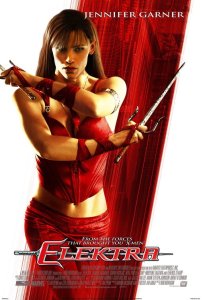 January is typically a cinematic wasteland. It’s the place where films go to die. So imagine my surprise when I heard that Elektra, a comic book movie built around a nimble sai-spinning assassin, was going to be released in January 2005. I remember at one time there were plans for a summer release, which means Elektra had fallen from the very top to the very bottom of expectation. After viewing Elektra for myself I can perfectly understand why anyone would want to dump this clunker.
Elektra (Jennifer Garner) is a feared assassin-for-hire (she even has an agent for her hits). She’s been brought back to life by a powerful sensei, but has ignored a possible higher calling to make her money killing folks. Apparently she is the mythical warrior that will keep the balance between good and evil, or something or other. Her next hit ends up being a nice guy (Goran Visnjic) and his teenage daughter. Elektra doesn’t have the heart to kill them, so she joins them and all three run away from the really bad guys, an ancient group known as The Hand.
Elektra doesn’t really bare comparison to other comic book films because Elektra feels more like a video game. In true video game fashion, I’ll numerically list the likenesses:
1) There is no such thing as characterization, just definition by super power. One assassin is super strong, another can suck the life out of creatures, and a third has the amazing ability to have his tattoos come to poorly rendered life (lucky this guy doesn’t have butterflies and fairies). With a powerful lack of imagination, these assassins are called Stone, Pestilence, and Tattoo (not the Russian girls who make out with each other. That’s Tatu.).
 2) The only sense of a story is pitting Elektra against one bad guy after another. There aren’t character arcs and subplots so much as there are end stage boss battles. It gets really repetitious.
3) The film seems like it’s bending over backwards to get character special moves into the story. With 1995’s Mortal Kombat, the writers, and I use that term in the loosest possible sense, had to work a story that included popular video game moves. Working so hard to include something so trivial and arbitrary really ties the storyteller’s hands. Elektra feels like the film would rather try and include some character’s special move rather than formulate a cogent storyline.
4) Once our assassins are vanquished they burst into clouds of yellow dust. I am not kidding. When they die they explode into clouds of mustard-hued gas. Just like in a video game, once you kill the bad guy they disappear with no necessary cleanup. It’s really thoughtful of them.
5) A second player can jump in at any time! In Elektra, different characters magically appear whenever it’s convenient and I?m not even talking about the super assassins.
6) Just like in a video game, you get an extra life! I don?t know why the producers of Elektra didn’t just make a prequel. With a sequel they have to work around their heroine’s untimely death in 2003’s Daredevil, and so we are introduced to the idea that a warrior of great mind can bring people back from the dead. So if Elektra dies (again) she can just be brought back to life. This whole idea practically eliminates any sense of danger and consequence.
So little of Elektra makes any kind of sense. Characters make rash choices and surprise appearances. The villains are a bland, cliched crop from some back order of ancient kung-fu brotherhoods. The plot is mysteriously oblique and has the frustrating habit of using cheats to get around logical roadblocks. About halfway through Elektra I gave up shrugging my shoulders and rolling my eyes. There is no definition on character limits, so anything can happen, and when it does it’s usually very stupid.
 Even worse is how dreadfully dull Elektra can be. The last two acts are compromised of nothing but a long, boring chase scene. The action sequences are brief and unoriginal, which include the thousandth inclusion of a hedge maze. There’s one moment where Elektra is battling in a room that has sheets flying all around for no good reason. It’s visually reminiscent of a Where’s Waldo? page. Take that for what you will.
The film is brisk, clocking in at just 90 minutes, but you don’t care about the characters because 20 minutes is spent establishing them, and the remaining 70 is spent watching them run.
The only redeeming quality of Elektra is its star. Garner is suited for the running, jumping movies, but she also has great acting chops behind her square jaw and impeccable physique. She casually generates intensity but also has a light, humorous touch. It doesn’t hurt that she looks fabulous in a red bustier. Her character is given OCD but then this plot is dropped entirely. Without the appeal of Garner, Elektra would simply be Catwoman.
Elektra is a flat comic adaptation that plays more like a video game, and just like in real life, watching a video game is no fun at all. Things happen, characters appear, people explode into clouds of yellow dust, and it’s all a bunch of uninteresting, half-baked nonsense. Elektra is frustrating, labored, ridiculous, and empty of thought and enjoyment. Why should I pay to watch Garner kick ass when I can watch Alias on TV and see Garner kick ass for free? And the plots of Alias are brazenly complex, fun, and high-spirited. I care about the people and events on Alias. With Elektra, the only thing I cared about was when the film was going to be over.
Nate’s Grade: D
Share this:

The Incredibles (2004)
 You’ve been there before. You know the drill. You’re staring up, mouth agape, at the multiplex’s list of new titles wondering what to see. It happens to the best of us. Who can you trust in these situations? Most people used to think they could trust Tom Hanks, but after his accent experimentation in The Ladykillers and The Terminal, not to mention his giant creepy mustache in The Polar Express (with accents!), that train of trust might have left the station. A lot of people felt they could trust an Oliver Stone movie, and, well, look how that turned out. No, moviegoers, the only trustworthy name that won’t let you down is Pixar. With hits like Toy Story and Finding Nemo you know that those computer wizards are looking out for you. Their newest work, The Incredibles, will keep Pixar alive in the moviegoer circle of trust.
The Incredibles takes place in a world where superheroes walk, run, jump in single bounds, and zip through the sky. They’re beloved and revered, with the super-strong Mr. Incredible (Craig T. Nelson) at the head of the pack. But then a fiend strikes more powerful than any dreaded super villain: litigation. A mountain of lawsuits pile up against superheroes, and the government disbands its programs and relocates all super-abled beings into new identities and homes.
Fifteen years later, Bob Parr, a.k.a. Mr. Incredible, has married Helen (Holly Hunter), a.k.a. Elastigirl, who can stretch her shape, which comes in handy keeping their two children in line. Dash (Spencer Fox) begs his parents to allow him to use his power of super speed, especially at his schools sports. Violet (Sarah Vowell), all long haired Goth angst, uses her power of invisibility to just disappear during school and other functions she feels she doesn’t fit. It seems the only member of the family fully adjusted and happy to a “normal” life is Jack Jack, the Parr’s infant son who may or may not develop super powers of his own. Bob feels crushed by the grind of office work and hiding what makes him and his family special. He escapes at nights with old friend Frozone (Samuel L. Jackson) and the two of them relive the good old days with attempted heroic acts. Helen catches on and they have a huge fight with the kids as witnesses. Helen explains to her family in the best way that she can that their days as superheroes are over. They have to adjust to a different life now.
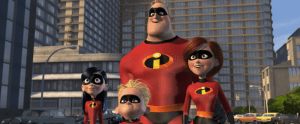 Bob’s wanderlust is soon quenched when he receives a mysterious invitation from a beautiful, white-haired woman named Mirage. She offers Bob the chance to become Mr. Incredible once more, to use his gifts and abilities to stop a robot on the loose on some island. Bob leaps at the chance, hiding his ongoing super exploits from his wife, and regains a sense of purpose. He hasn’t been this happy in ages; however, it all comes to a head when he learns that Syndrome (Jason Lee), the one responsible for the run-amok robots, has other plans. Not only this, upon capture Mr. Incredible realizes that he has ties to Syndrome way back during one of his less-than-super moments.
Helen is shocked when she finds out what Bob’s been up to, but also partially relieved it’s not an affair. She visits their old costumer Edna Mode, whose glasses and black wig may be bigger than the rest of her shrimpy body. Edna has redesigned a team of superhero costumes, and with them in hand Helen becomes Elastigirl once more and takes Dash and Violet on a journey to save their father and become a family once more.
The Incredibles is a film bursting with entertainment. This is an explosion of imagination, of wit, of grand storytelling, that the audience should sit and soak up every loving and beautiful second of it.
The voice work is wonderful. I’m sure Disney execs were scratching their heads over Craig T. Nelson, but I cannot imagine anyone else that could deliver as much in the role. Hunter is excellent, as always, as a doting mother and crime fighter. Lee is great with a villainous role that has a lot more depth to it than near any live-action film. His verbal gymnastics are perfectly suited for a slighted super villain.
Writer/Director Brad Bird’s first feature was the 1999 masterpiece, The Iron Giant, which I consider the finest animated film of all time (you heard me, Walt). Bird’s first film was a masterful mixture of little boy fantasy, reality, strong characters, humor, and excuse-me-there’s-something-in-my-eye tenderness. I know many people who, after seeing The Iron Giant, say they were, “crying like they watched a puppy get hit in the face with a shovel.”
 With this being said, my trust in Bird as a master storyteller is still there. The Incredibles is the first Pixar film concerning real people, not just toys, ants, fish, monsters, and, uh, more toys, and the results are astounding. This is a film rich in complexity, human insights, family warmth, and, again, realism. Bird has fully realized The Brady Bunch of superheroes. They feel just as flesh and blood as any characters I’ve seen in any film this year. They have desires, secrets, shame, guilt, anger, burdens, pride, and above all, love. I mean, how many animated films have an actual subplot involving marital suspicion? You won’t find that in The SpongeBob Squarepants Movie. When Elastigirl and the kids go off to save her heroic hubby, she has a sit-down with her children and warns them that, yes, death is very real, and that these people will indeed kill them if discovered (this is the first PG-rated Pixar film, by the way). It’s a great moment that reminds you how much you care for these people.
Bird’s imagination seems incomparable. He has a razor-sharp feel for comedy, like Elastigirl’s scene caught between several sliding doors or the lively, hysterical Edna Mode personality, but he also possesses the ingenuity for crafting some of the most exciting action sequences in a long time. The Incredibles has uncanny action scenes, set to Michael Giacchino (TV’s Lost) blazing jazz score, which should make the James Bond producers die from envy.
Bird has created a stupendous action film, a heartwarming family drama, a hilarious comedy, and a gorgeous film to watch. Movies rarely get this entertaining, but for Pixar, it’s all just part of the norm. I hope someday we don’t take Pixar’s accomplishments and staunch consistency for granted, because they aren’t just reinventing what animation can do, they’re also reinventing what films themselves can do. You can have all the accents you want Tom Hanks; I’ll gladly take The Incredibles and its bounty of offerings.
Nate’s Grade: A
Share this:

Catwoman (2004)
 Halle Berry has not exactly followed up her 2001 Best Actress Oscar with the wisest choices. There was a starring role in a James Bond movie, Die Another Day, there was Gothika, a spooker that didn’t scare anyone, except studio executives who saw the final gross. Now there’s Catwoman, a big-budget superhero film that’s got such a ripe odor to it to smell from miles away. It’s not good when a studio pulls a trailer because fans laugh at it, and it’s certainly not a good sign when the studio hires reshoots a month before the film is released. Catwoman’s looking for a big chunk of the superhero money out there, but will it land on all fours?
Patience Phillips (Berry) is a frazzled, down-on-her luck graphic designer at Hedare, a giant cosmetics corporation led by husband and wife team George and Laurel Hedare (Lambert Wilson and Sharon Stone). Patience is described as being “fun-deficient,” and lets people walk all over her. She tries saving a cat from a ledge one morning, and Officer Tom Lone (Benjamin Bratt) jumps out of his car to intervene, thinking she’s a jumper. He rescues her, though she doesn’t need it, and then asks to go out some time for coffee, the universal first date without it having to be a date.
 Patience is returning her designs late one night and overhears that Hedare’s newest product has the unfortunate side effect of making people’s faces melt if they discontinue use. The Hedare goons chase her down a water drain and flush her into a river. She’s revived somehow by the same cat she tried saving from the ledge. Patience reawakens with superhuman powers, heightened sense, and expert agility. There are some kinks, though. She sleeps in odd places, gobbles tuna by the handful, and loves to swing a whip. Who knows what she does to go to the bathroom. The new Patience is a bit confusing to Tom, but he goes along for the ride. He’s also on the hunt for the Catwoman, a mysterious leather-clad woman responsible for some jewelry theft. Patience unravels Hedare’s cosmetics conspiracy and aims to stop George and Laurel from mass production, all the while staying one step ahead of her boyfriend’s investigation. But Laurel is also experiencing some growing pains of her own. Unsatisfied with being pushed out her company’s advertising spotlight for being “too old,” she begins using heavy amounts of their newest beauty product and makes her skin as tough as living marble. With this new power, she schemes to retake power from her husband, as well as eliminate a pesky Catwoman.
Let’s not mince words and get directly to the elephant in the room: Berry’s hideous, trashy costume. This is, by far, the worst costume ever in a superhero movie, and possibly the worst costume in cinematic history. It’s so overwhelmingly ridiculous that perhaps the filmmakers felt Catwoman’s ultimate weapon against evil was having it die from laughter. It’s a bizarre combination of a mask with large mouse ears, leather bra, criss-crossing belts, gloves with diamond-tipped nails, and leather pants that look like they were mauled by a bear. Oh, and then there’s also the open-toed shoes. What? A superhero who wears open-toed shoes? All evil doers would have to do is step on her feet. The only purpose the outfit serves is to make Berry look sexy, but you didn’t need a stupid, tacky outfit for that.
The story of Catwoman takes a giant leap into weird mythology. Apparently, possibly immortal cats decide someone will become a Catwoman, a woman we’re told is not bound by our foolish rules. There’s no explanation why the cats choose who they do, what the purpose of this is, or what is even expected in return. We do get a montage of Catwomen through the ages dating back to ancient Egypt. Apparently, Catwomen follow the same lines of mythology like Buffy the Vampire Slayer: “Unto each generation, a Catwoman is born.” It’s also kind of funny that a film called Catwoman, about mythic Catwomen, has a crazy old cat lady (poor Ruth Fisher).
 The villainous scheme in Catwoman is awful. I can’t imagine the FDA not having some grumblings when their test bunnies start having their faces melt off. More importantly, what company would EVER release a product that melts your face in our litigious society? Just think of the mounting class action lawsuits that could very likely bankrupt that company. So, right there the villain’s plot is moronic for two big reasons. Don’t even get me started on Stone’s superhuman strength aided by the beauty cream we learn melts faces.
The acting is what you would expect. Berry is a beautiful woman, no doubt, but her performance is split between flighty wallflower and naughty dominatrix, neither of which is convincing. Bratt is the worst police officer ever (he can’t identify Catwoman even though only a tiny part of her face is obscured) and tries valiantly to hold his own amongst the ridiculousness. Wilson was such a stock corporate villain that they could have erected a cardboard cut-out of him and gotten the same performance. I never thought I’d say this, especially after The Muse, but Sharon Stone is the best thing about this movie. She’s an ice queen, but an entertaining one until she goes overboard on her beauty cream.
Catwoman is the first superhero film for Warner Brothers since their disastrous franchise-killing Batman and Robin in 1997. It’s hardly a coincidence that Catwoman is the also the worst superhero film since Batman and Robin. The film is trying really hard to be Spider-Man. Before her feline transformation, Berry is a frumpy dweeb, and afterwards she gets heightened senses, a new jolt of self-confidence, and the love of her man. Catwoman even has the guts to rip-off Daredevil, an amusing but fairly flawed movie itself trying to be Spider-Man. There’s a scene where Patience and Tom play a competitive game of basketball surrounded by chanting children. This is a direct rip-off of the scene in Daredevil where Ben Affleck and Jennifer Garner play fight on a playground. I don’t know about you, but when you’re ripping off Daredevil of all movies, you have problems.
This film has five credited writers, which works with my Rule of Five for films: if there are five or more people responsible for the script, then there was no script. Who amongst the five wants to take credit for all the dreadful cat puns in the dialogue, like Catwoman saying, “What a purrr-fect idea.” There’s also this wonderful repartee where Laurel says, “For you, Patience, it’s game over.” Then Catwoman responds, “It’s overtime!”
 Catwoman is director Pitof’s (perhaps short for Pitof-ful?) first real break as a director. He began his career as a visual effects artist on films like Alien: Resurrection, City of Lost Children, and The Messenger, but can anyone recount a visual effects artist that went on to become a decent director? (If you bothered to answer with Joe Johnston, then I don’t think you understood the question)
Movie Director Pitof has a love for cheesy CGI shots, but what’s more harmful is his penchant for confusing quick-cut edits. After watching Catwoman, I had to pop some Advil when I got home because the film’s editing had actually caused me a headache. It became so annoying that I started counting “one Mississippi, two Mississippi, etc.” to gauge the average length of a shot. Let’s just say that we didn’t make it past “one Mississippi” about 95% of the time. Now, there’s nothing inherently wrong with quick-edits; The Bourne Supremacy used them effectively to keep a lively, unpredictable experience. Catwoman’s editing is just jarring, especially during action sequences where you’d be hard-pressed to figure out what’s exactly going on.
The effects work is also rather pathetic. Pitof adores zooming exterior shots that become tiresome after the eighth or ninth time. Worse are all the scenes where Catwoman jumps and leaps through the city like she’s Spider-Man’s long-lost sister. The film is bending over backwards to try and ape Spider-Man, and these joyless, silly sequences of CGI Halle Berry crawling and jumping around the city don’t help the comparison. I do suppose that making a CGI Halle Berry flex and bend in her leather outfit was probably the most rewarding work for an animator since digitally making a breast grope itself in Hollow Man.
Who exactly is this movie intended for? If the filmmakers were going for fans of the Catwoman character, then why did they break away from the comic’s history and create something distant and different? If the filmmakers were strictly making an action movie, then why all the visual fluff, idiotic romance, and headache-inducing editing? I suspect that the producers felt that the names Catwoman and Halle Berry would be enough to put butts in the seats. So, then, I deduce that the selling point of Catwoman is, “Wanna see Halle Berry in a sexy leather outfit?” Now, most males will say, “Sure thing,” but why would they pay seven to ten dollars to see sexy non-nudity when they could go online. The short answer to who this film is intended for is, of course, no one.
 Catwoman is derivative, incomprehensible, dumb, and just plain boring. The only people who will get a kick out of Catwoman are either hormonal teenagers aroused by Berry’s outfit, or those who enjoy jeering a terrible movie. I can’t even recommend seeing Catwoman because of its ineptness. It’s bad, oh boy is it bad, but it’s not insanely idiotic like Bulletproof Monk or Dungeons and Dragons to the point where the lunacy is a must-see. It’s just boring bad, enough that it almost put me to sleep.
Perhaps the funniest thing of all, Berry has publicly stated in interviews weeks after Catwoman’s release that she’d love to don her leather outfit and do a sequel. Maybe she needs to talk to the producers who lost a bazillion dollars and inadvertently created a midnight movie howler. Catwoman will certainly get delegated to the litter box, but how many lives does Berry have left in Hollywood?
Nate’s Grade: D
Share this:

Spider-Man 2 (2004)
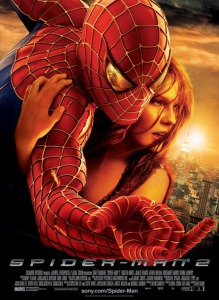 No other movie had higher expectations than Spider-Man 2 and no other movie met and trounced those expectations than director Sam Raimi’s high-flying webslinging sequel. Spider-Man 2 was that rare sequel that excelled in near every way. The action sequences were lively and highly exciting, but what made Spider-Man 2 so thrilling was its success in building strong emotional characters. After all, how many superhero films are written by the writer of Ordinary People? (One wonders what he would have done with Catwoman) Alfred Molina, as Doc Ock, made for a great formidable foe and brought surprising humanity to the dastardly part. Spider-Man 2 was a momentous crowd-pleaser that also dazzled the hardest critics. It reaffirmed exactly what a summer popcorn film can make us feel.
Nate’s Grade: A
Share this:

Daredevil (2003)
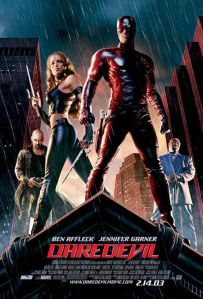 Not as bad as it could have been. That’s the best way to sum up Ben Affleck in tights.
Nate’s Grade: B-
Share this:

Spider-Man (2002)
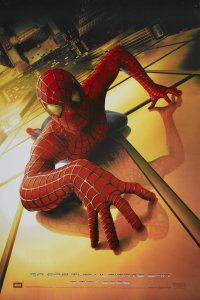 Hollywood take note, Spider-Man is the prototype for a summer popcorn movie. It has all the necessary elements. It has exciting action, great effects used effectively, characters an audience can care for, a well toned story that gives shades of humanity to those onscreen, fine acting and proper and expert direction. I recommend movie execs take several note pads and go see Spider-Man (if they can get in one of the many sold out shows). What summer needs are more movies in the same vein as Spider-Man, and less Tomb Raider’s and Planet of the Apes.
Peter Parker (Tobey Maguire) is a dweebish photographer for his school yearbook clinging to the lowest rung of the popularity ladder. He lives with his loving Aunt and Uncle who treat him like a son. Peter has been smitten with girl-next-door Mary Jane Watson (Kirsten Dunst) ever since he can remember, but he’s been too timid to say anything.
At a field trip to the genetically altered spider place (there’s one in every town) Peter is snapping pictures when he is bitten by one of the eight-legged creatures. He thinks nothing of it and awakes the next day to a startling change. He has no need for his rimmed glasses anymore and has a physique that diet ads would kill for. He also discovers he can cling to surfaces, jump tall building in a single bound and shoot a sticky rope-like substance from his wrists. Hairs on his palms and shooting a sticky substance from his body? Hello puberty allusion! Peter tries to use his new abilities to win the girl and when that doesn’t work out he turns to profiting from them. He enters a wrestling contest in a homemade costume and proceeds to whup Randy Savage. Following the fight Peter’s Uncle Ben is dying after being involved in a car jacking Peter inadvertently let happen. Haunted by grief Peter becomes Spider-Man and swings from building to building as an amazing arachnid crime stopper.
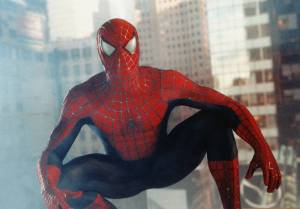 But every hero needs a villain, and that is personified in the Norman Osborn (Willem Dafoe), scientist and businessman. Osborn is experimenting with an aerial rocket glider and a dangerous growth serum. When the military threatens to cut his funding and shop elsewhere Osborn haphazardly undergoes the serum himself. What it creates is a duality of personalities; one is Norman, the other is a sinister and pragmatic one. The evil alter ego dons the glider and an exoskeleton suit and calls himself the Green Goblin. The Goblin destroys all that are in his way, and has his yellow eyes set on the pesky Spider-Man.
The casting of mopey-eyed indie actor Tobey Maguire over more commercial names like a DiCaprio or a Prinze Jr. (I shudder to think of a Freddie Prinze Jr. Spider-Man) left some people scratching their heads. Of course the casting of Mr. Mom to portray the Dark Knight likely got the same reaction in the 80s. Maguire plays the nerdish and nervous Peter Parker to a perfected awkwardness with his sensitive passivity. When he explores his new powers with exuberant abandon then begins crime fighting, we as an audience are with him every step of the way pulling for Peter.
Kirsten Dunst was also a surprising casting choice but works out very well. She allows the audience to fall for her along with Peter. Her chemistry with Maguire is great and could be a major reason why rumors have surfaced about the two leads taking the onscreen romance off screen.
Willem Dafoe is one of the creepiest actors in the business (though he made an effective creepy-free Jesus) and delves deliciously headfirst into the cackling menace of Spider-Man’s nemesis. Dafoe, with a face that looks like hardened silly putty and jutting rows of teeth, relishes every maniacal glare and endless evil grin. But instead of being one-note he adds certain amounts of sympathy and understanding as Norman Obsorn. No one could have done this role better than Dafoe.
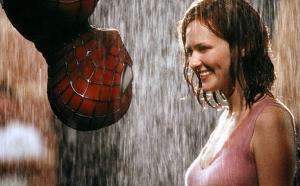 Director Sam Raimi was most known for his cult splatter house Evil Dead series, but he’s got a new resume topper now. Raimi was chosen over a field of directors because of his passion for the character and story. Raimi brings along integrity but with a joyous gluttony of spectacular action sequences. He expertly handles the action and daring-do all the while smoothly transitioning to the sweet love story. He has created the movie Spidey fans have been dreaming of for 40 years.
Spider-Man swings because of the respect the source material has been given, much like 2000’s X-Men. The story follows the exploits of the comic fairly well but has some stable legs of its own. The multitudes of characters are filled with life and roundness to them, as well as definite elements of humanity. You can feel the sweet romance budding between the two young stars, the tension and affection between Osborn and son, but also the struggle with Norman and his new sinister alter ego.We all know villains are the coolest part anyway. Isn’t that the only reason the last two Batman films were made?
There’s the occasional cheesy dialogue piece but there is that one standard groaner line. In X-Men it was Halle Berry’s query about what happens when lightening hits a toad. In Spider-Man it was the response to the Green Goblin’s offer to join him, to which he asked “Are you in or are you out?” (Obviously channeling George Clooney). The dreaded response: “You’re the one who’s out Goblin. Out of his mind!” Sigh. Maybe a well placed “freaking” before “mind” would have made the line better.
Spider-Man is the best kind of popcorn film: one that leaves me anxiously anticipating the sequel (which will come out two years to the day the first one was released).
Nate’s Grade: A-
Share this:

Unbreakable (2000)
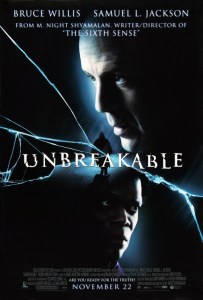 “I should have known it from the children…” Ladies and gentlemen, you have now witnessed the most atrocious ending of this year. Unbreakable has a simple yet moderately sophisticated premise in the examination of what makes a super hero. The psychology going into it would be fascinating, like do you feel a civic duty to help others? This could have made ‘Unbreakable’ a good escapist flick with some imaginative thoughts, but instead it all gets destroyed by a lame lam-shackled ending that will suck the life out of everything good and decent.
There are numerous shots in the film that go on and on and are single coverage. This likely wouldn’t pose as much a problem if it weren’t so persistent and annoying. The opening scene where the camera dances back and forth between two seats to see Bruce Willis fumbly trying to hit on another woman is aggravating to the least in its set-up. Willis himself is a security officer for a college and basically suffering from a faltering marriage and overall loser status. That is, until he is the lone survivor in a horrific train accident. Samuel “Mr. Glass” L. Jackson seeks him out to reveal to Willis that he believes he has been chosen to do good, and comic books are true, and whatever else. How can you trust a man with Gumby hair?
Unbreakable is not a movie without merits, in fact it almost could have been a good film or at least a better one. There are moments of tension, and a scene with Willis stretching out his arms in a bus station a la Christ is particularly well directed. Then there is…. the ending.
M. Night Shyamalan had true break-out success with the monumental Sixth Sense but he is now a victim of his own success because everyone and their invalid grandmothers will be looking and waiting for a twist ending. And the payoff is NOWHERE near as rewarding as Sixth Sense. In fact, it might make you mad. Mad that it ruins the rest of the film that had its few moments. Mad enough … to become a super villain all your own.
Nate’s Grade: C
Share this:

X-Men (2000)
 Take a storied franchise that has long been the backbone of Marvel comics and develop it into a feature film where the last superhero movie was the purple-spandex-in-the-jungle The Phantom and you’re just asking for trouble. A nation of fans is breathing down the neck of the film crew nitpicking every fine detail. Studio execs want the film done as fast as possible and under budget regardless of the numbers of effects needed. Despite what would seem like a cataclysmic set-up, X-Men proves that Hollywood can occasionally take a comic book and get it right. For the most part.
X-Men is basically the pilot for a movie franchise. It sets up characters, conflicts, origins, but periodically forgets its audience. Numerous people are introduced and then given a grocery list size of dialogue to read. Some even have atrocious John Watters-like wigs they are forced to wear. It’s a good thing then that the film centers mainly around Wolverine (Hugh Jackman), Rogue (Anna Paquin) and Magneto (Ian McKellen), the three most interesting characters.
 Often times the action in X-Men is surprisingly lackluster and contained. The battle royale finale atop the Statue of Liberty might induce more than a few eye rolls. I can’t help but hope that with all the groundwork laid out with this film that the eventual sequel will be more efficient with its action set pieces.
For the most part the dialogue in X-Men is passable and it even has a few rally snazzy sound bites. However, there is that ONE line delivered by Ms. Berry (“You know what happens when a toad gets struck by lightening? The same thing that happens to everything else.”) that is groan-worthy and destined to be notorious.
It may sound like I’m coming down hard on X-Men, but for a comic adaptation it got a whole hell lot more right than wrong. I want to congratulate director Bryan Singer (The Usual Suspects) for the amount of pressure he had looming over his head and what he pulled through with. X-Men is no campy nipple-plate festival but an attempt at possibly serious drama with tortured characters. The whole mutant/racism metaphor may be a little bludgeoned at times but for the most part is handled very well with care. The best aspect X-Men has is its patience. The film is in no rush and takes its time even if it is only like an hour and 40-some minutes. Still, it’s a welcome change in the summer action.
 Singer’s direction is smooth and well executed. The casting of the movie is near perfection with some minor exceptions. Stewart and McKellen were born to play their dueling think tank leaders. Jackman is an exciting breakout in a role that was supposed to be occupied by Dougray Scott (thank you MI:-2 delays). I look forward to more from this actor. And does anyone know when young Oscar recipient Anna Paquin became so attractive? Someone buy this casting director a fine steak dinner.
X-Men may have its flaws, one of which is an absolute mundane score, but the film is one of the better summer entries into the world of explosions and noise. I just hope the sequel(s) will be a tad better.
Nate’s Grade: B
Reviewed 20 years later as part of the “Reviews Re-View: 2000” article.


You must be logged in to post a comment.