Blog Archives
Cars 2 (2011)
 Universally regarded as the least involving and nuanced film in Pixar’s illustrious catalog, Cars was the last film I thought would get the sequel treatment. Was it a creative tale that yearned to be told on the big screen, or is this just a business decision motivated by the sound of merchandizing coffers? Those talking cars seemed pretty content by the end of the 2006 original film. It doesn’t take long to realize that Cars 2 was done strictly for the cash. A sequel to the least involving Pixar film, with an even less involving storyline and elevating the most annoying character (Mater the tow truck) to lead status provides little in the realm of adult entertainment. The storyline, a mistaken identity spy thriller, seems like a rejected plot for a lesser direct-to-DVD sequel. While the visuals are still outstanding, the humor is stuck in neutral, overloaded with motor vehicle puns and groan-worthy visual gags. The message about accepting your uncouth friends no matter what their bad behavior might be seems rather misguided. That’s the message? Congrats Pixar, for providing cover for irresponsibility and incivility. The environmental message and its connection to a Big Oil conspiracy feels tacked on as an afterthought to try and crowbar in something more meaningful than a mediocre spy farce. I think cars are rather limited in their anthropomorphic expressions. There’s only so much they can do. And a world populated completely by living, breathing, gas-guzzling (can they get drunk on ethanol?) vehicles begs for an examination on how this world operates without any opposable thumbs. After a magical slate of films that dealt with serious mature themes and danced with storytelling finesse, it’s a shame that daring run comes to an end with such a rudimentary roadblock. Little kids will be entertained by all the bright colors and simplistic storytelling, but I cannot foresee too many fans of Cars even justifying the sequel’s existence. It’s not out rightly bad it’s just so pitifully pedestrian. Cars 2 has so little going on under its hood, you’ll swear it came from a different maker.
Nate’s Grade: C+
Share this:

Transformers: Dark of the Moon (2011)

After the obnoxious, oafish mess that was 2009’s Transformers: Revenge of the Fallen, a sequel that took everything good from the first flick and undermined it and took everything awful and magnified it, I wasn’t expecting much. True, low expectations have benefited this franchise built upon merchandizing, product placement, and giant freaking robots that fight. I still remain a fan of the first film back in 2007, and I do feel like director Michael Bay (Bad Boys, Armegeddon) is a natural fit for this material. But after another overlong, overblown, and overloaded Transformers film, I’m starting to think that the franchise’s best days left with Megan Fox and her cut-off jean shorts.
Sam Witwicky (Shia LaBeouf) has graduated from college and is now perusing a job in Washington D.C.’s vast center of government contracts. He’s living with his new girlfriend, Carly (Rose Huntington-Whiteley), the assistant to a rich billionaire (Patrick Dempsey) and his fleet of collector cars. Sam gets a job with at a military private contractor run by a angry loon (John Malkovich). But Sam’s post-collegiate journey once again runs afoul with killer alien robots. The villainous Decepticons are plotting to steal a spaceship that crash-landed on the dark side of Earth’s moon. Inside that spaceship are teleporter orbs and a sleeping robotic giant known as Sentinel Prime (voiced by Leonard Nimoy, hooray). Optimus Prime, leader of the noble Autobots, revives his predecessor. Together, the group attempts to thwart the Decepicons, lead once again by Megatron (voiced by Hugo Weaving).
The Transformers films have been getting larger and larger in scope and destructive power; the first film messed up some L.A. streets, the awful second film trashed Egyptian pyramids (only Six Wonders of the World left in your punch card, Bay), and now the third film pretty much obliterates downtown Chicago in stunning and overblown fashion. The climactic Windy City beatdown lasts a solid 50 minutes and may just be the greatest thing Bay has ever put onscreen, which admittedly might be faint praise to many. Perhaps the city of Chicago thought this would make for good tourism: ”Hey kids, come see the buildings that were turned to rubble in your favorite summer movie!” The impressive special effects are uniformly terrific, and the integration of reality and fantasy seems seamless. That goes without saying. I must credit Bay for creating sustainable action that is, here it goes, actually coherent. I know that “Bay” and “coherency” rarely go together, so I’m as shocked as everyone. No longer does geography become a hindrance to understanding. During this climactic Chicago onslaught, the locations are established, the objectives are clear, and the audience has a crisp understanding of the different teams, their paths, and their organic roadblocks and setbacks.
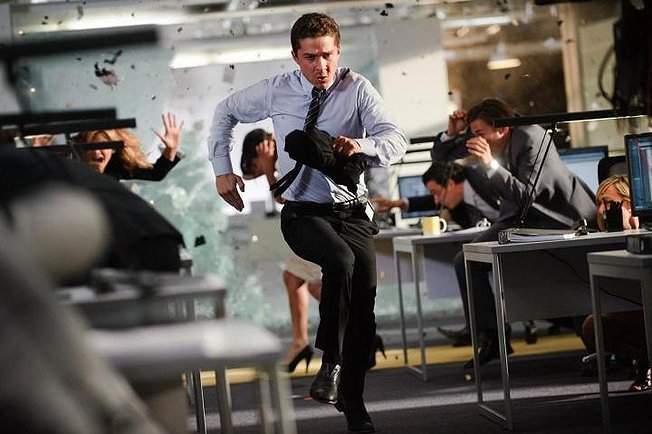 There’s a strong set piece within this 50-minute assault where Sam and company enter into a crumbling skyscraper that then teeters on its side. The organic complications allow for some nifty, almost ingenious, split-decisions utilizing a specific location, the hallmark of good action sequences. One moment they’re climbing up the floors, the next moment they’re tumbling through the floors, then sliding down the sheer glass wall, then firing at the glass to fall back inside and tumble some more. All the while a giant worm-like robot is churning through the foundation of this collapsing building. The scale of the sequence is quite thrilling for the time being. And yes, the 9/11 imagery is undeniable and relatively unearned without even a nod to solemnity or anything less than brainless summer spectacle. Sure the “cool-ness” of the individual parts never really materializes into something greater, and yeah maybe the action would have more impact if you actually felt for the characters, or knew who some of them even were, but you take what you can get in Michael Bay world. The extended climax for Transformers: Dark of the Moon is relentless and will beat you into submission, admiring the intrinsic beauty unique to Bay’s epic, albeit mind-numbing, demolition of the senses.
But Dark of the Moon is also the most visually coherent of Bay’s troika of Transformers flicks because the man has finally settled down when it comes to editing. Now no one will confuse this movie for Rope or Russian Ark (look it up, Transformers geeks), but the edit/panic button is given a slight reprieve. The shots last longer; the editing is far less frenetic and chaotically ADD-addled, and no longer does a Transformers action sequence look like jumbled, mechanical scrambled porn. Image A and Image B make a logical connection, at long last. You can tell which robot is which, for the most part. Perhaps this editing epiphany was a result of Bay’s corporate betters insisting that the film be shot in 3D (I chose to see the film in good old boring 2D, feeling that 150-minutes of Michael Bay with headache-inducing glasses was not worth the extra dough). Perhaps Bay had to consciously think about his audience’s well being so his shot selections lasted longer than his usual whirlwind of cuts. Perhaps the secret was loading Bay with cameras that weigh the same as couches. Maybe a little extra weight was all the man needed to formulate lucid action sequences.
And yet Dark of the Moon is just as stupid, outlandish, and tonally disjointed as the other movies, particularly the abysmal Revenge of the Fallen. The comedy remains at a puerile, sophomoric level. Bay’s sensibilities have always somewhat mirrored that of a snickering 14-year-old boy; the love of destruction, the fascination with things that go “boom,” the ogling of lithe feminine bodies. No joke, the first image seen directly after the film’s title is a close-up of Huntington-Whiteley’s ass ascending a staircase. I imagine there were plenty of men spasming in their 3D glasses trying to reach out and grab the circumference of a Victoria Secret model’s talents. I wrote about the second film: “Women don’t seem to exist in the Michael Bay world, only parts and pieces of women.” Huntington-Whiteley’s character certainly leaves much to be desired, outside aesthetics. At least Megan Fox’s character had, you know, some character traits. I also wrote: “Amazingly enough, [Fox] manages to lose more clothes the more she runs in slow-mo, allowing the male audience members to follow the nuance of her bouncing breasts. She’s clearly not the next Meryl Streep but this girl deserves more than being wordless arm candy.” Seems apt to me. Carly is as bland as she is blank-eyed beautiful, just the way Bay likes ‘em.
The first 90 minutes of the film is spent with the humans and it’s like being trapped inside a bad comedy. There has always been a strong comedic bent to the franchise ever since the first film in 2007; however, the latter films have taken to grotesque caricature. In Dark of the Moon, the comedy is so deeply unfunny but so consistently antic, trying to overwhelm you with its bad taste. There’s a scene where Ken Jeong (yes, you read that right) corners Sam in a bathroom stall to distribute his crackpot manifesto. Then Sam’s boss walks in and, oh boy, he overhears and thinks they’re having a homosexual liaison in the men’s stall. What a hoot. Then Sam’s mother gives him dating advice, stating there’s no earthly way her son is going to nab a third “hottie” unless her boy has a giant…. and trials off (wouldn’t a mother kind of have an idea about that subject?). And then there’s the little Autobots, the size of remote control cars (perfect presents for Christmas mom and dad), who wheel around spitting smart-alecky backtalk. The entire Malkovich portion could have easily been cut from the film without damaging a soul. The Ken Jeong stuff should have been eliminated first. There’s something to be said when John Turturro’s returning Agent Simmons is the least annoying comic sidekick in this movie. But hey, at least there aren’t any overt racist depictions and jokes about robot scrotums. Nope, there’s only infantile humor and nonchalant misogyny. The comedic pit stops and non-sequitors never allow the movie’s tone to gel.
 Before the movie descends into an all-out series of explosions and shrapnel, the setup actually has some genuine interest. Then it just all goes nuts at warp speed. The fact that the space race to the moon had a sinister ulterior motive, investigating alien technology, is an intriguing start. Bay even shoots the 1960s sequences like he’s ripping off Oliver Stone, swapping film stocks and black and white film to showcase his historical reinactors (three presidents get represented, including Obama). Apparently after this film and X-Men: First Class, the breakout star this summer is archived footage of JFK (man did he have a full plate, mutants and robots, and the man still found time to bang Marilyn Monroe). There’s even a cameo by the real Buzz Aldrin, which served to make me remember his better cameo on TV’s 30 Rock (“Would you like to yell at the moon with me?” he politely asked Tina Fey). The space race was a pretense for getting our human hands on some alien technology. Of course we were warned years ahead of time via Pink Floyd but nobody could put the pieces together. But there’s more alternative history to be had. Turns out that the disastrous nuclear accident at Chernobyl was caused by the Russians trying to operate alien/Transformer technology. I’m sure modern-day Ukrainians will adore having their deadly tragedy turned into a plot point in a stupid movie about fighting robots. The Decepticons wicked plan is to open a teleportation portal and bring their dead planet, Cybertron, to Earth. Then they will use Earth’s human population as slave labor to bring their dead planet back to life. My question is this: when you’re a huge robot the size of a building, wouldn’t puny little humans make for a terrible labor force with their stunted little legs and feeble muscles? I know there’s billions of them, but there’s a reason human beings have never turned on ants and forced them to become a labor force for our construction projects. How many more deadly things from Cybertron are secretly going to be hidden on Earth? And yet none of this is even one-tenth as stupid as Transformers’ heaven in Revenge of the Fallen.
Transformers: Dark of the Moon is likely everything fans would want from a franchise. There’s wanton destruction, a plethora of noisy explosions, and plenty of eye candy both in special effects wizardry and pouty, full-lipped women. But at a colossal 150-minute running time, this is a Transformers film that punishes as much as it entertains. There’s really no reason a movie about brawling robots should be this long. There’s no reason it should have to resort to so much dumb comedy. There’s no reason that the women should be fetishized as if they were another sleek line of sexy cars. There’s no reason why something labeled a “popcorn movie” can’t deliver escapist thrills and have a brain too. Dark of the Moon is saved by its long Chicago-set climax, which gives way to some staggering action set pieces. The newest Transformers movie is just as stupid as the rest (what the hell is up with the weird Igor robots tending to Megatron that just seem to grumble and grunt?) but, unlike the previous installment, it’s not offensively stupid. Dark of the Moon is an exhaustive experience whose thrilling high points even feel mechanical and pre-programmed. Is this the future of Hollywood? Bay and his army of robotics and excessive spectacle have taken over the world. When it comes to big-time summer entertainment, the machines of Hollywood are going nowhere fast and even louder.
Nate’s Grade: C+
Share this:

The Hangover: Part II (2011)
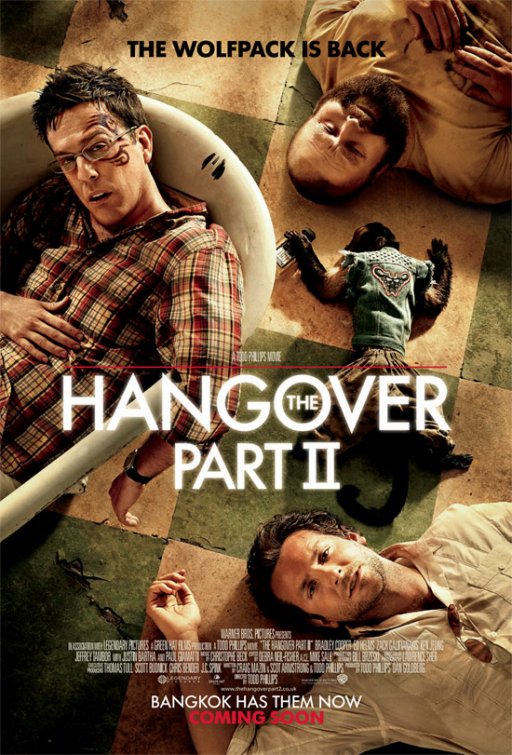 When you’re responsible for the highest-grossing R-rated comedy of all time, a film that grossed over half a billion dollars worldwide, then you don’t want to tinker with a winning formula of a surprise hit. Naturally, with that kind of money, a sequel was inevitable. Director/co-writer Todd Phillips (Old School, Due Date) is back and so is everybody and everything else. You’ll get a strong sense of déjà vu watched The Hangover: Part II. That’s on purpose. This calculated, rather soulless cash-grab sequel wants to recreate the organic experience of the first film. If you played The Hangover and The Hangover: Part II on simultaneous TVs, I would not be surprised if the same plot points happened at the exact same minute-marks. It might even be like a Pink Floyd/Wizard of Oz experience. I paid twice to see the same movie two years apart.
Stu (Ed Helms) is about to get married in Thailand to Lauren (Jamie Chung). Our favorite wound-up dentist is apprehensive about any sort of bachelor party shenanigans after the events of two years ago in Las Vegas. His pals Phil (Bradley Cooper), Doug (Justin Bartha), and the socially inept Alan (Zack Galifianakis) make the trek to attend the festivities. For Alan, it’s a reunion of the Wolfpack and an excuse finally to venture out of his parent’s home. Stu has some ground to make up with his bride-to-be’s father. Her father seethes about the prospect that his beautiful daughter is going to marry Stu, a man he compares to watered down rice. Lauren’s younger brother, Teddy (Mason Lee), a pre-med student and concert cellist, is left to the Wolfpack’s care the night before the wedding. They’ll just have one drink on the beach. What’s the worst that could happen? Flash to the next morning. The guys awaken in a strange apartment. Teddy is missing and missing a finger as well. Stu, Phil, and Alan must once again retrace their steps and solve the mystery of their hard-partying antics before the wedding ceremony.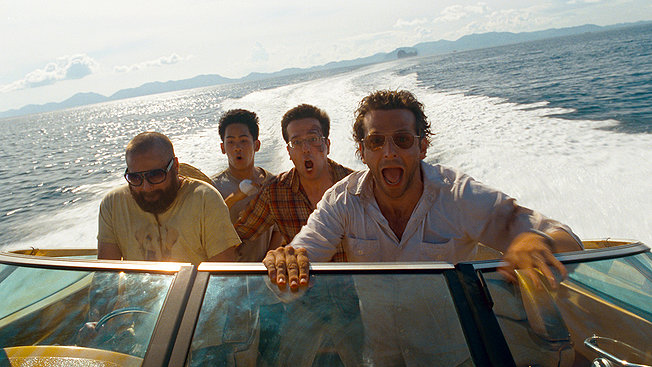
The Hangover: Part II is a carbon copy of the original. Because the same joke is just as funny the second time around, right? This empty enterprise gives its audience exactly what they want, which is precisely the same experience they had with the first film. But so much of comedy is predicated on surprise, so how can you recreate the experience of discovery that people so heartily enjoyed with the first film? The Hangover: Part II is like a cheap comedy Mad Libs game: it reuses the same gags and just fills in the blanks. Hey, if Joke A worked before, why couldn’t we just have Joke A in this different location (instead of two guys walking into a bar, they walk into a different bar)? It’s like somebody copied and pasted the screenplay from the original movie, changed the locations and minor details, and cashed a check. Let me get into how stunningly indolent the screenwriting is (small spoilers to follow). Once again a person in their group goes missing before a wedding. Once again Stu has some self-inflicted wound to his face. Once again the guys have stolen someone else’s unorthodox pet. Once again they find themselves with a ward (baby in first film, Mr. Chow in second). Once again Stu has gotten involved with a prostitute. Once again Alan was secretly responsible for their drugging. Once again Justin Bartha gets left out of the escapades. Once again Mr. Chow shows his junk for shock value. Once again Mr. Chow jumps out of a locked container attacking the guys. Once again the guys have to return money to a gangster. Once again Stu plays a song of his own creation bemoaning their situation. Once again they have to race to the wedding minutes away. Once again we have a Mike Tyson cameo. Once again the guys find pictorial evidence of their debauchery and they play over the credits. Even directing touches like a time-lapse high-rise shot passing the time before they wake up is reused.
That’s what kills the movie is the lack of surprise. It throws the guys into a different setting, gets darker and meaner, but it’s rarely funny. I was surprised how many jokes left me in stony silence. Phillips and his screenwriters have gotten into the trouble of having to top themselves, so they rely on the “bigger is better” approach to match the outrageousness of the original. If Las Vegas is Sin City, then what would be even seedier? Bangkok, of course. Where would they go for a third film? What gets seedier than Bangkok (The Hangover 3 to be set in Rep. Anthony Weiner’s office). Yet the film curiously ignores much of what makes Bangkok the world’s preeminent hotspot in the sexual trades. The payoffs are darker and lack the bemusement of the original. Knowing some guy is missing a finger is not as whimsical as somebody missing a tooth. The movie has an unpleasant homophobia to it thanks to male genitalia being used to shock and horrify and humiliate. The horror of being involved with transsexual women made my theater audience groan with extra relish, like the presence of a penis or homosexual content makes everything automatically more disgusting to the common people, as if anything gay is the worst thing that could possible befall a man. Mr. Chang is an odious and fairly unfunny stereotype, and Jeong (Role Models, TV’s Community), so funny in just about every other role he’s ever had, is a braying, high-pitched annoyance. This go-round the jokes feel stale, the characters feel tired, and the payoffs seem too mean-spirited to be satisfying.
When you have a movie where the comedy is situation-based, then those situations better be funny because the characters are only serving as a means to an end. The premise allows the filmmakers to have it both ways. They can fulfill the hedonistic spectacle that will make people blush, and at the same time they can have button-uped, likable, relatively relatable nice characters that an audience will root for. If we watched these characters acting like irredeemable morons, then audience sympathy would wan. But having the guys investigate their previous dirty deeds, and react in horror, does not lessen audience sympathy. I enjoyed how the main trio played off each other in the first Hangover, and the central mystery was a solid glue to hold together a loose collection of mostly worthwhile gags. Just as the first film fell short of its potential, so too does the second movie. A monkey serves little purpose other than to get it to do things that seem outrageous just because it’s a monkey (it smokes, it mimes oral sex – hilarious!). But the second time around, the amusement of seeing Stu fly off the handle, or listen to Alan’s moony non-sequitors, doesn’t have the same draw. Galifianakis (Due Date) made the film watchable for me despite the fact that the screenplay makes his character a petulant and highly irritating character rather than a man-child doofus. And the women are once again relegated to the sidelines when it comes to being in on the comedy.
For The Hangover‘s legions of fans, more of the same will likely be exactly what was desired. But without the cheeky element of surprise, the comedy just seems like it’s hitting pre-ordained stops according to its formulaic cheat sheet. For the original Hangover I wrote: “Let’s face it; once you know the solution to the mystery and all the surprises, will this movie still play out as funny? …But once you knew who was behind what, and how the whole game was staged and operated, could you even watch the movie a second time? Would it still work now that a repeat viewer knew all the secrets? Does this comedy have a built-in expiration date?” Well, The Hangover: Part II is the answer. If the first film was a comedy with an expiration date, then The Hangover: Part II is one comedy that’s gone rancid.
Nate’s Grade: C-
Share this:

Pirates of the Caribbean: On Stranger Tides (2011)
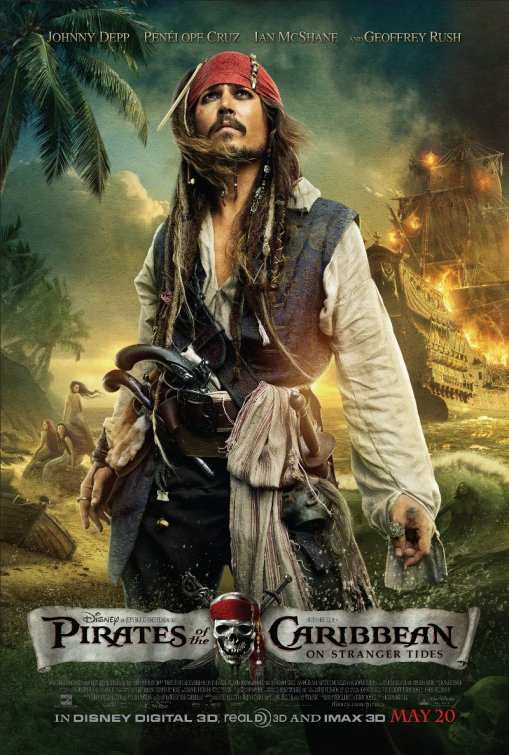 The public reaction to the two previous Pirates of the Caribbean sequels, 2006’s Dead Man’s Chest and 2007’s At World’s End, were decidedly mixed, though that didn’t stop them each from earning a bazillion dollars. Fans didn’t care for the darker tone, the confusing interlocking of the story, and especially the bloated running times. It feels like Disney’s uber-producer Jerry Bruckheimer must have taken notes from the sequel backlash and they amounted to: “Less of everything.” Welcome to less plot, less character, less involvement, and far less entertainment. Welcome to Pirates of the Caribbean: On Stranger Tides.
It’s been a few years since the non-world-ending events of At World’s End, and Jack Sparrow (Johnny Depp) has been in London putting a new crew together. Except, it’s a Sparrow imposter. Turns out it’s Angelica (Penelope Cruz), a former lover of Jack’s who woud still like to settle some scores. She and her father, the feared pirate captain Blackbeard (Ian McShane), force Sparrow to lead them to the Fountain of Youth. Apparently, Jack at one point had the map. King George II (a delightfully hammy Richard Griffiths in one of the film’s best scenes) is in a race against the Spanish crown. The English monarch hires Barbossa (Geoffrey Rush), Sparrow’s occasional enemy and ally, to find the fountain as well. It’s a race to see who can benefit from eternal youth first because, apparently, no one can share a source of water. Second grade teachers nationwide are very disappointed, Disney.
The entire enterprise just lies there on the screen, devoid of all energy or danger. The entire picture is just so shockingly inert, lazy, phoned in from every angle, missing any resonance of magic. Rob Marshall was the wrong man to be tapped as the new director of this series. Marshall has a fine eye for visuals, but the man couldn’t stage an action sequence to save his life. The Oscar-nominated director of musicals like Chicago and Nine stages his action sequences like dance sequences, which on paper don’t sound too far off. That’s until you realize action needs to incorporate story, location, build in tension, create organic obstacles, and be easy to follow. The action sequences in On Stranger Tides aren’t outlandish enough. It’s all so dull, a sword fight here a sword fight there. Short of a mermaid attack sequence, there’s no excitement to be found onscreen. That is disastrous for a franchise that has built a reputation for its anarchic, wild action and storylines. Marshall’s action angles and editing don’t communicate urgency. There’s no mood to these set pieces. The editing feels like it’s always catching up, always too late, needing a myriad of trims. Action cinema has been lambasted when it’s hyper edited and the audience cannot see what is happening; On Stranger Tides is not edited enough. One of the reasons these half-baked action sequences can never get going is because they always seem to be starting and stopping with the lackadaisical editing, always a step behind. The shots linger when they shouldn’t. The ingredients are there for a tasty meal but the chef (Marshall, screenwriters) doesn’t know what to do. The musical score by Hans Zimmer tries very hard to compensate and rattle the audience, compelling them to think what is transpiring on screen is exhilarating. It is not, and the music is just loud and annoying.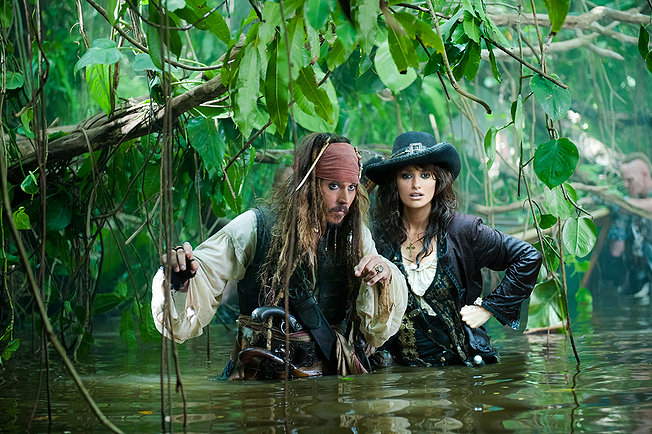
One of the chief criticisms of the two Pirates sequels were that they were overstuffed with storylines, characters, setups, and were just far too convoluted and confusing for their own good. So with On Stranger Tides we get a simplified, pared down one-off movie. Much of the film is just characters walking in circles and, likewise, talking in circles. Motivations are flimsy. The dialogue is stilted; Sparrow’s malapropisms and one-liners feeling sloppy (“I agree with the missionary’s position,” he quips. Groan). The entire premise is to get to the Fountain of Youth, and then they get there and, well, very little happens. The characters will talk about little, walk a few feet, talk about little more, and this process repeats. Barbossa should be an interesting foil, going from fop to pirate by film’s end, and yet his every appearance in the movie feels like when the next-door neighbor appears on a TV sitcom. It’s an intrusion meant to remind you that you, the audience, like this character, even if they don’t serve any point in the story. The plot lacks any twists and turns, ultimately having every competing force converge on the Fountain of Youth at exactly the same time for a slapdash climax that involves more lackluster sword fighting, just like all the other sequences. On Stranger Tides is a full half-hour shorter than the third movie, and yet it still feels like an eternity at two hours and seventeen minutes because it spends so much time doing so little.
At least the other three Pirates movies found clever ways to mingle their sci-fi mythology into an old-fashioned Errol Flynn swashbuckling adventure. With On Stranger Tides, the sci-fi fantasy elements are just as underdeveloped as the characters. The Fountain of Youth is another of those magic do-hickeys that involve gathering magic tokens and blah blah blah, mermaid tears, silver chalices. Hey, if you wanted to drink up some mermaid tears, have them watch 2009’s Oscar-winning best documentary, The Cove. That ought to do it (a scene driving the mermaids into nets oddly reminded me of The Cove). Blackbeard and Angelica have a Jack Sparrow voodoo doll, which is highly effective, and yet this plot device is nearly forgotten for the entire film. There is no clever application of this unique device. Blackbeard has a magic sword that makes ships come alive. Why? How? It’s just another magical Macguffin, like Jack’s compass. Man-eating mermaid temptresses is an interesting idea, and a great way to squeeze in a lot of obfuscated nudity in a Disney film for teen boys who have not discovered the Internet. Too bad the mermaids are confined to one scene, albeit the highpoint of an otherwise bad film. Their feeding frenzy is the only moment in the film that channels that high-flying sense of verve that made the original so memorable. Don’t even get me started on the fishy romance presented between the captive mermaid (played with all the acting capability of a French perfume model) and a missionary (Sam Claflin). The whole experience feels like a shambled, draggy, inarticulate rip-off of Last Crusade, complete with a climactic drink from a magic chalice. I appreciate Marshall’s emphasis on practical special effects but if these are the results then bring back the previous sequels’ CGI vomitorium. This franchise feels like every ounce of energy and danger has been squeezed out of it.
So does that means that this Pirates venture is more character-based now that it has jettisoned side characters and complex plots? Fat chance. The problem is that Jack Sparrow is not a good lead protagonist. He’s not meant to be a classic good guy. He’s a libertine, somebody who makes selfish choices but will revert to do something proper when his conscience nags him enough. Sparrow is more of the dashing rogue at best. Does anyone remember how he was going to trick doomed men into signing their souls to Davy Jones? He also needs a foil, a striaghtman to bounce off of. I almost miss the wooden performance of Orlando Bloom. Without a do-gooding striaghtman, Jack Sparrow plays like a man adrift, searching for his groove. Unfortunately, Sparrow never finds it in this vehicle, which just asks him to go through motions and mannerisms. Blackbeard makes for one very bland villain. McShane (TV’s Deadwood) can glower and chew scenery with the best of them, but his baddie never seems too menacing. He burns one guy alive and threatens to kill his own daughter in order to keep Jack in line. I’m sorry, but that doesn’t even compare after the previous films included a monstrous ship captain who would readily slice prisoners’ throats and a British bureaucrat who hanged an eight-year-old before the freaking opening credits. Blackbeard, in contrast, just comes off like a crusty old man in need of a shave.
 The film’s biggest addition was bringing in Jack’s former flame Angelica, a woman he robbed of her virtue and personally betrayed. But is there any tension? No, because Jack and Angelica don’t have any old feelings for one another they rehash (oh how I was even pleading for a trope like that), and the characters don’t really feel any antagonism either. Sure they will parry and threaten one another, but it’s so devoid of danger or tension or interest. This is no screwball romance. They feel like a couple that can’t be bothered working up any notable feelings toward one another. Therefore, all their shared scenes, and there are many, sink the film’s flow. Their bickering should bring some sparks. She should be exciting; she’s the daughter of a notorious pirate, she was going to be a nun until Jack Sparrow came sailing into her life. She should be sore. She should be angry. She should be a lot of things that ultimately the character is not. Cruz (Nine, Vicky Cristina Barcelona) doesn’t come across as an equal or love interest, she just feels like an annoying sidekick, harping on “Yack.” At one point, Jack tells her, “If you had a sister and a dog, I would take the dog.” When she’s got a personality like this, I’d agree.
Depp (Alice in Wonderland, Sweeney Todd) is obviously a comic gift and his Sparrow character will go down in the ages as one of the most universally beloved figures in cinema history. Everyone adores this character, a loveable scoundrel. But that doesn’t mean the screenwriters can just strand him in a crummy story with nothing to do. Depp will always be enjoyable when he puts on his Captain Jack eye liner and does that funky, swishy walk of his, but even he feels like he’s phoning this one in. He realizes that his character is trapped in a sodden adventure that offers little to do as a character and an actor.
I never thought I would say this, but On Stranger Tides makes me positively reevaluate the other Pirates sequels (I admit to being one of the few critics who liked Dead Man’s Chest a good deal). If this is what a simplified Pirates of the Caribbean film gets you, bring me back the messy, maddening plots of the previous films. Bring me back the scope, the danger, the clever mingling of genre elements, the adventure, the sizzle, the anarchy, and bring me back director Gore Verbinsky. Marshall has no feel for this material or how best to serve story. I never expected a movie with this kind of budget to be so lifeless. It all just sits there on screen, expecting the pieces to come together through ardent wishful thinking. On Stranger Tides suffers not because it strips away some of the excess and convolution that plagued the other films, it suffers because it gives no reason for its existence. It does not enrich the characters, the Pirates universe, or provide a rip-roaring story. Obviously, the film exists to line the coffers of Disney. It may earn plenty of booty this summer, but this is no way to rejuvenate a sinking franchise.
Nate’s Grade: C
Share this:

Piranha 3D (2010)
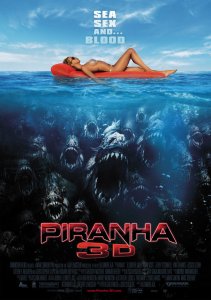 Truly missing out on seeing Piranha (as its home release now calls it) in 3-D will be one of my life’s greatest disappointments. This boobs-and-blood-soaked ode to 80s exploitation horror has its tongue firmly clenched in cheek. This is a gleeful gorefest that plays many of its absurd elements for laughs while squeezing in gratuitous nudity at every turn. There’s an underwater lesbian synchronized swimming sequence that I’m utterly certain would have been the greatest thing to witness in the third dimension. Regardless, this Jaws rip-off (Richard Dreyfuss even shows up in the opening dressed identically to his character and named “Matt”!) plays like an ironic parody of the genre while still satiating its red meat-hungry target audience of teenage boys. To this point, it succeeds admirably. It is crass beyond belief and delivers exactly what it promises. Watching actors like Elisabeth Shue, Adam Scott, Christopher Lloyd, and Jerry O’Connell ham it up alongside some fairly cheesy special effects critters, you never feel the waft of desperation. The movie ends too abruptly for my tastes, leaving too much open and unresolved for presumable sequels. As my friend Eric Muller said: “We watched a 3D movie in 2D that was really 1D.” While the movie is entirely one-dimensional in scope, that lone dimension is a blast. I know where I’m going to be when the rumored Piranha sequel is released. And this time, I’m seeing the campy carnage in 3D.
Nate’s Grade: B
Share this:

Resident Evil: Afterlife (2010)
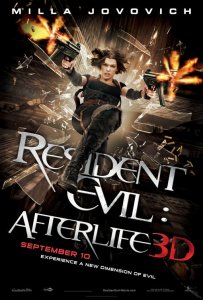 I won’t pretend these movies are anywhere close to good, but each one has provided some mild, mindless thrills. However, the fourth film in a franchise going nowhere is the first of the series that just says, “To hell with trying to be even remotely real.” This is a living video game, especially the opening sequence where it’s a nonstop barrage of self-conscious visual tricks, hails of bullets, gore, and a general kick in the balls to the laws of physics. I’m not asking for much, but I’d like my mindless violence to be of a quality where it doesn’t feel 100 percent gratuitous and, frankly, boring. If every single scene involves someone doing something fantastic, over-the-top, and absurd, then where can my interest go but down? Director Paul W.S. Anderson returns to the series he begat in 2002. Get ready for more zombies, more weird mutant creatures that will act however they damn well feel like, and more Milla Jovovich confusing toughness with cold stares. The action is ripped purely from a video game with no regards for geography, setup, tension, development, or anything that would matter. It’s just all flashes of violence one after the other. It’s a mostly depressing enterprise. But where do they go from here? The second movie was subtitled “Apocalypse” (little too hasty there), the third “Extinction,” and now this one is subtitled, “Afterlife.” Is the next one going to be, “Reincarnation”? And the certainty of a fifth movie only adds to my depression level.
Nate’s Grade: C-
Share this:

Saw 7 (2010)
 The story behind Saw 7 (or as presented in theaters, Saw 3D) is more intriguing than anything you’ll find in this lackluster chum bucket of guts. The director of Saw 6, series editor Kevin Greutert, was all prepared to go off and direct the sequel to the surprise smash, Paranormal Activity. The folks at Paramount even penciled in a Halloween release date, long the fertile ground for the annual Saw sequels. It seemed like Paramount was rubbing in the fact that they now had the more exciting, buzz-worthy franchise and they would tap dance on the grave of Saw. Well the studio suits didn’t take too kindly to this broadside, so they activated a clause in Greuter’s contract. The man was legally required to leave the Paranormal Activity 2 project so that he could direct a seventh Saw film. Because nothing says “work of art” like forcing your director to make a movie by threat of legal action.
Saw 7 is billed as the “Final Chapter” but it doesn’t feel like a satisfying conclusion, more like an overdue mercy killing. It’s no secret that the Saw franchise has been flailing and sputtering for quite some time, with the bizarre exception of Saw 6 (my friend Eric proudly deems it the “Godfather II of the Saw franchise”). It was because of Saw 6, a fascinating return-to-form by tackling the topical issue of health care reform, that got my hopes slightly renewed for the franchise’s finale. Having health insurance employees as the victims gave the franchise some much-needed populist anger, a renewed morbid fascination that was surprisingly enjoyable. Imagine Saw 7 taking on the extension of the Bush tax cuts? Alas, my fledgling hope was for naught.
 Part Seven follows a self-help guru Bobby Dragan (Sean Patrick Flanery) who talks about surviving a Jigsaw death trap as a spiritual awakening. Except that he’s a fake; he’s devised this phony survival tale as a scheme to get rich. Naturally Jigsaw (Tobin Bell, as always, in flashback) doesn’t take too kindly to this misrepresentation. Dragan would seem like a prime candidate for the haunted warehouse of horrors that Jigsaw usually specializes with, except that Jigsaw has been dead for four films now. His second apprentice, Hoffman (Costas Mandylor), is wanted by the police and FBI and even Jigsaw’s own widow (Betsy Russell), who unsuccessfully tried killing Hoffman with one of the series’ infamous bear traps masks. So let’s stop and think this out. Hoffman, who is on the run and established as a serial murdering fiend, still takes time out to set up a warehouse full of death traps for Dragan to fulfill his late employer’s wishes. If it’s not obvious now let me make it pointedly clear – in whatever city these murders, take place, it has the most incompetent police force in the history of the universe. Did they literally hire the Police Academy crew? That would make for an entertaining diversion that might reboot two franchises.
As always, the sinister death traps are the real draw of the franchise, and these convoluted killing devices have been getting less inspired from each shallow sequel. These contrived contraptions always bothered me in their uniform intricacy. The franchise began with some pretty simple scenarios: crawl through barbed wire to reach an exit, while covered in kerosene hold a candle to see a written combination, saw off your feet if you want to escape a filthy bathroom of doom. Then in order to top the previous film, the death traps got more contrived and involved a lot more engineering muscle. The more complex they got the less interesting they became. Now with Part Seven, some traps include a three-headed saw with each member of a love triangle in its aim. Two guys, the boyfriend and the “other man,” have to overpower a saw or they can relax and let the woman that’s come betwixt them lower onto a saw blade. This opening trap is the start of some dubious misogyny even for a genre as female punishing as horror. There’s a gauntlet of grisly horror in store for a bevy of female characters, usually involving something sharp penetrating them. But for the lone man who falls into a Jigsaw trap he meets his death by… hanging. Yes, a simple almost merciful hanging compared to the gruesome fates the women encounter. I’m not seeking feminist sensibilities from a genre that profits from their half-naked terror, but Saw 7 is even sicklier because of the undercurrents of misogyny. The traps in number seven aren’t memorable, interesting, and they feel like they’ve been done before in some earlier incarnation (a woman being “smoked” in a mechanical pig does seem to be different).
 The biggest problem with Saw 7 is that it doesn’t feel like anybody gives a damn anymore, including the filmmakers and actors. The production values seem like a world away from other movies in the series. The entire affair reeks of “direct to video” even though it was shopped as a 3-D theatrical experience. As you can imagine, because of the gimmicky 3-D, the movie is filled with plenty of pointy objects pointed at the screen. When watching in traditional 2-D, it gets fairly tiresome. Also because of the 3-D presentation, the filmmakers had to compensate for how dark the 3-D glasses make the movie. That means that the spurts of blood are in a rather unrealistic pink lemonade shade, like the retro blood from 1970s exploitation flicks. Without the glasses, as most will view the film at home, it further cements the overall cheap atmosphere. The production design, cinematography, and editing all feel like the Lionsgate intern team performed them. Every technical aspect feels more than sub par, it feels like no effort was exerted whatsoever. Sure it got finished, but finished and complete are different.
The Saw franchise has always been built around the craft death traps and a last-second twist ending accompanied by a barrage of scenes given new context. This formula has been repeated with each installment, so I expected nothing more and “nothing more” is what I received. Saw 7 thinks its audience demands to know its convoluted back-story, which gives way to all sorts of behind-the-scenes flashbacks that are always retroactively changing and channeling the timeline of events and participants. I think it’s all frightfully boring. I don’t care who screwed what bolt into what. I’m not watching Saw for realism (hence why the police NEVER think about tracking what vacant warehouses are sucking down gads of electricity). But at this point, with the thrill of the death traps long beaten into a bloody submissive pulp, I don’t even know what I would watch this series for. The appeal seems to have died along with its boogeyman, Jigsaw, four films back. The subtitle “The Final Chapter” seems like a promise destined to be broken. In the annuls of horror, any successful franchise will live on forever with cheap made-for-DVD sequels. Saw 7 just feels like the first made-for-DVD sequel, except it got a theatrical release as one final gasp at cash. Just wait twenty years and the whole thing will be rebooted as some sort of prestige picture that speaks to man’s inhumanity to man circa 2030.
Nate’s Grade: D
Share this:

Shrek the Fourth (2010)
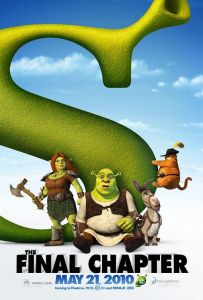 By taking a page, or even the entire script from It’s a Wonderful Life, Shrek tackles a mid-life crises and wonders how life would be if he had never saved his lovely wife Fiona from her tower (hint: it sucks). He wants his life back and makes a deal with the devious Rumplestiltskin. Except Shrek wakes up in a world where he was never born. While generally better than the third feature, this is still a noticeable step below the first two Shrek features. The tiresome plot device feels more like material for a lazy direct-to-video sequel rather than the (supposed) final chapter to the series. The film wants to be reflective and tap into our inventory of attachment to these characters, but time and again the movie doesn’t go far beyond the “don’t know what you got until it’s gone” cliché. Gags still feel too safe, the energy feels too loose, and the overall feel of Shrek 4 is casual. The novelty is gone. This is a rather middling trip to that big happily ever after. The story, with its reflexive moralizing, just makes the whole film feel slight; Rumplestiltskin is a villain of wasted potential, the characters feel poorly incorporated, and the general time-travel concept implies that the filmmakers have run out of stories to tell. As expected, Shrek 4 looks great, but that’s the only thing great about this once vaulted fractured fairy tale franchise. If this is the final chapter, then let it go with some fading sense of dignity.
Nate’s Grade: B-
Share this:

Predators (2010)
 For a solid 45 minutes, Predators is a fairly good genre movie. No, it’s a very good genre movie. We snap awake in freefall with a ripped Adrien Brody. A group of deadly warriors from all cultures find themselves stranded in some strange jungle. For that 45-minutes of goodness, the assembled killers (and Topher Grace as a doctor?) try and piece together their circumstances while exploring the foreign terrain. It’s a setup straight out of the Twilight Zone catalogue. And then, at minute 46, they find out they’re on a game preserve planet for the notorious alien bounty hunters, the Predators. The characters get picked off one-by-one and the patient buildup unwinds in a familiar and depressing bloodbath. Predators will work as a quick fix of junk food, but it teased a promising alternative that never came to fruition. The action is bloody but listless. The plot twists are seen from miles away (Topher Grace as a doctor?) and after all that badass macho posturing, the end credits blast the song… “Long Tall Sally” by Little Richard? It’s the most bizarre element in a movie with killer space monsters in dreadlocks.
Nate’s Grade: C+
Share this:

Tron: Legacy (2010)
 In 1982, TRON was a movie ahead of its time. It took place in a world inside the world of computers, which couldn’t have been that advanced back then. But “ahead of its time” and good are not the same things. Arguable one of the most influential science-fiction films in terms of design and CGI, the original TRON was a financial dud for its film studio. All this makes it so curious why Disney would spend upwards of $200 million dollars on a fancy, shiny, big-budget sequel to a movie people didn’t really give a damn about before. TRON: Legacy looks to capitalize on a generation of geek nostalgia. At least it doesn’t fare as poorly as the Star Wars prequels.
Sam Flynn (Garrett Hedlund) is 27 years old and the lead shareholder of Encom ever since his father, Kevin Flynn (Jeff Bridges), mysteriously disappeared in 1989. Kevin had found a way inside the world of computers, which he called The Grid. He studied it and based his company’s arcade games on what he found. Then after saying he was going to break the world of gaming wide open, he vanished. Then in 2010, Alan Bradley (Bruce Boxleitner, a sight for sore eyes) visits Sam with a message. He got a page from a number that’s been disconnected for over 20 years. Sam ventures into his father’s old arcade/workstation and gets zapped inside the world of computers. Now he’s amidst all those racing light motorcycles and flying disc battles. The slinky program Qorra (Oliva Wilde) rescues Sam from the gladiatorial battles. Inside this realm, the Grid is run by Clu (CGI Bridges), a digital doppelganger of Kevin Flynn. Sam is reunited with his dear old dad and together they try to escape this digital prison and stop Clu.
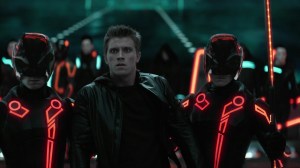 Never have I felt more like an old man than after watching TRON: Legacy. All the special effects dazzled, but after a while it felt relatively empty and insubstantial. But what did all those gleamy flashes of light and snazzy 3-D effects do, ultimately? Distract from the void of a story. I consider myself a fairly intelligent individual, able to follow complicated narratives and appreciate complex storytelling. And yet, when the lights came back up in my theater, I said, “There is a lot that I never understood.” The setup is relatively painless, but where the movie grinds to a deadly halt is for an exposition-heavy 20 minutes in the middle after our second big action sequence. When father and son are reunited they get to talking, and talking, and talking some more about God knows what. I think my brain shut off from all the stilted dialogue. Every character seems to stop and unload a pile of exposition. Even though the characters seem to explain so often, you always feel like you’re still missing something important. You still feel left out. But after this dreadful slog, suddenly there’s Michael Sheen (Frost/Nixon) to save me from my stupor exactly like he did at the end of the turgid Twilight film, New Moon. He brought me back to life, but after his campy, cane-guitar rockin’ sequence of battle, I was trying to get caught up on the parameters of plot and setting. But then the film just flew from one set piece to another and I was forever lost. I couldn’t tell you why anything happened in the last hour of the movie. It just seemed like one thing was following another without any sense of logic or foresight. I got the idea of the need to escape this virtual world and that there was a special doorway to make this happen, but after that it all became an unintelligible chain of ones and zeroes.
The incoherent screenplay by Lost scribes Adam Horowitz and Edward Kitsis is a bleak vehicle for special effects. TRON: Legacy will certainly melt your eyes but it leaves the brain cold and overlooked. The rules of the TRON universe are never adequately explained. When Qorra suddenly drives a vehicle off the Grid and says, “We can do this, they can’t,” you’re forced to just shrug and go with it. Why is Clu trying to kill Sam and his dad when he’s pretty much had the run of things for 20 years? What exactly is his plan for world domination? He thinks his electro-tanks will be able to take out the military powers of the real world? Do these programs have free will or does their engineering trap them? Why would they gather at a stadium to cheer the death of other programs in violent sport? All of these walking/talking computer programs got me thinking about The Matrix and how much more creative and effective and overall better that movie was with storytelling. There are some token nods to character, mainly Sam’s reunion with his long lost pop, but this is a movie designed to mesmerize with flashing lights rather than story and character. I would find this somewhat acceptable if I wasn’t bored so much, let alone paid an extra four bucks for the luxury of being bored in three dimensions.
 But if special effects are what you want, TRON: Legacy delivers big time. The sleek production design is married seamlessly with the flashy, techno-oriented effects inside the computer world. Watching the floating spaceships and zooming racecars is a luscious, exhilarating rush to experience. The visual style obviously has to hew close to the first film in 1982, which seems to handcuff the imagination of the crew. We’ve made gigantic leaps in the world of movie special effects but we’re stuck with characters in glow-in-the-dark jumpsuits and cityscapes that look at like half-finished neon outlines. I haven’t seen a 3-D movie since two-time reigning king of the world James Cameron’s Avatar, but I would readily advise people to see TRON: Legacy in 3-D if available. It gives the film that extra whiz-bang quality. This is not just a cheap grab at extra cash where the studio throws a 3-D rush on a film late in the game. The 3-D, which kicks in when Sam travels inside the computer world (like the change into color from the Wizard of Oz), feels more immersive without resorting to hurling countless objects at the audience. The greatest 3-D effect, bar none, is Olivia Wilde (TV’s House, Year One). Director Joseph Kosinski has a steady background in computer effects, and it shows. His handle on actors is another matter entirely.
But the biggest misstep with the special effects occurs with the 1980-version of Bridges. Whenever we get a glimpse of this Bridges of old, whether it’s from Clu or a brief and distracting scene in the film’s 1989 opening, it’s another opportunity for the movie to remind you of its lack of authenticty. The de-aging technique still needs some serious tinkering. What it does is make an actor look like a plastic doll, with dead Polar Express zombie eyes. It’s creepy and off-putting and every time you see the de-aging effect it rips you out of the movie. Watching young Bridges take on older, current Bridges would have been more interesting if we had an entire digital rogues gallery of Bridges characters. Imagine the Dude and his drunken, self-destructive country singer from Crazy Heart involved in digital games of combat.
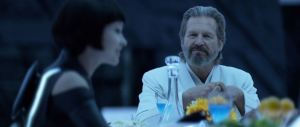 There are some nice action sequences that begin to touch imaginative possibilities of this unique world. The flying disc duels are interesting enough for the time being. The first few disc battles make fine use of the unique features of the boomerang-esque weapon. The motorcycle battle where the ribbons of light/exhaust create a wall is still a great idea for battle of wits at high-octane speeds. It just never fully materializes. The edits don’t occur in that hyperkinetic Michael Bay fashion that discombobulates the senses; however, I never really grasped the geography of the action realms. In order for the viewer to appreciate the action and the moves and counter-moves, we need to understand the arena and boundaries of the setting. With the cycle chase, it just seems like they’re all appearing at random. An action sequence is less satisfying if it doesn’t seem like it’s building and making use of the particular surroundings. The moody score by electornica duo Daft Punk gives the film a thematic lift, though having them score with a full orchestra feels like hiring Yo Yo Ma and forcing him to play a trombone.
TRON: Legacy feels at times like a super-sized Light Bright meant to dazzle and distract from the gaping void at heart. The story merely exists to get the characters from one place to another. The leaden exposition pretty much destroys the film’s momentum. It becomes plodding and tiresome. It would be like if Luke Skywalker sat and listened to 20 years of history rather than actually, you know, doing something. It’s been 28 years since the first TRON and the world has gotten far more computer savvy, and the jargon from the first flick would be readily understood. TRON: Legacy doesn’t feel like you’re in a computer, just whatever weird alternative universe. It seems like the real legacy of TRON ends up being hollow special effects.
Nate’s Grade: C


You must be logged in to post a comment.