Blog Archives
The Fate of the Furious (2017)
 I’ve written before that all I demand from the ever-ascendant and popular Fast and Furious franchise are its eye-popping action set pieces that teeter into madcap lunacy and impressive stunt work. A fiery meteor could crush all the characters, short of The Rock, and I wouldn’t shed a tear. Despite the super serious plaudits about the importance of family and loyalty and blah blah blah, I’m only here for the action spectacle that obliterates the laws of physics. I’ve said before there’s a fine line between stupid action and stupidly awesome action, and the Fast and Furious franchise has planted its flag like few others. Nobody today goes to the level of action spectacle that the Fast and Furious films achieve, bringing to life exciting action set pieces that feel fully plucked from the imagination of an exuberant child, and I don’t mean that at all disparagingly. These movies deliver like few others nowadays. We’re a long way from undercover cops and underground street racing. Vin Diesel and his team are essentially superheroes and their power involves doing amazing things with cars. I’m not a gearhead, I don’t care a lick about automobiles, but I’ve come to eagerly anticipate this franchise. It delivers ridiculous action on a ridiculous scale like few others. It’s earned my confidence. The Fate of the Furious, the eighth film, still delivers the high-octane goods even if it can’t quite keep up with the best of the franchise’s entries.
Dom (Diesel) has been preaching the virtues of family for years but now he’s turning his back on them. The notorious cyber terrorist Cipher (Charlize Theron) extorts Dom into helping her get her hands on nuclear codes. Dom’s crew (The Rock, Michelle Rodriguez, Ludacris, Tyrese Gibson, Nathalie Emmanuel) is wondering whether the man they know is still there. Government agent M. Nobody (Kurt Russell) reassembles the team to track down Dom, and they’re working with some unexpected help. Deckard Shaw (Jason Statham) has been released from maximum-security prison to thwart Cipher.
 This is a franchise that soared to new heights of commercial success after it left behind its inhibitions of the imagination. It’s a franchise that lives or dies depending upon its giddy action set pieces. As I wrote about Furious 7: “The set pieces of the last few films have been stunners, and at its height, the franchise can make you feel giddy like a child watching the unreal unfold with such delight. There’s a tremendous and infectious high watching a well-executed action scene on such a large scale. With every movie our expectations are hungrier, and the franchise has found a way to satiate our action movie demands.” Fortunately for the eighth film, there are two standout action set pieces that are some of the stronger ones in the history of the franchise. The first is a car chase through New York (though filmed primarily in Cleveland) that builds and changes as it continues, an essential element for any great action sequence to stretch forward. At one point Cipher takes control of an armada of hackable, self-driving cars and pilots them as a collective weapon of mass destruction. They resemble a herd of runaway bulls. The destructive fleet leads to some impressive sights such as a bevy of cars plummeting from a parking garage. It’s a strong sequence that also finds room for the other characters to try and take down Dom, and it allows Dom the ability to outsmart them, adding the personal element. The other standout is the entire third act set around the Arctic Circle in Russia that climaxes with the dizzying heights of a nuclear sub chase and The Rock manually redirecting a speeding torpedo. There are multiple points of action and mini-goals that lead logically to the next, allowing escalation to mount. It’s dangerously over-the-top even for this franchise and it’s generally awesome and I loved it.
Eight movies in and Fast and Furious is really becoming an expansive ensemble series. The core team has been picking up players here and there with each additional movie, building its diverse definition of a diverse family. This is getting to be a crowded film and there’s just not enough room to go around for everyone to contribute meaningfully, which means it’s more likely from here on out, unless there is some judicial pruning, that characters stay religiously archetypal. Ludacris is the tech guru, but isn’t Emmanuel now also the tech guru, or does she only specialize in the tech subgroup of hacking? Why do I need Scott Eastwood (The Longest Ride) to join the gang as the awkward rookie trying to look cool? Isn’t that a milder version of what Tyrese Gibson offers as the comic relief bravado? Admittedly, I only started really paying attention to this franchise once it added The Rock, but I’m still unsure what Rodriguez brings to the dynamic beside history and romance. This general sense of the characters settling into their expected roles is exemplified in the in-car banter and one-liners. It appears often that they’re just talking to themselves for these lines. I could do with far less Tyrese reaction shots and Rodriguez one-liners. Theron is also generally wasted as the new villain du jour. She’s got the icy glare down and looks to be having fun, but she’s not given anything interesting to do. Without going into greater spoilers, I will say that Dom’s heel turn is wrapped up by the end of its 135-minute running time. No need to turn it into a multi-film arc.
 Paul Walker’s character is understandably absent and I’d hate for them to bring him back after the very sweet and surprisingly poignant sendoff at the end of Furious 7, but he does still exist in this universe. I can agree with characters not wanting to get him involved in their dangerous missions across the globe, but at the end when they’re all dining as one big family, wouldn’t they also invite Dom’s sister, brother-in-law, and their children too? It gets into the Avengers territory where you start wondering why the Avengers haven’t assembled for the world-destroying threats from their respective solo film adventures.
The best post-Rock addition to the franchise has easily been Statham (Spy) and he proves it with his limited but highly entertaining time on screen. His appearances were a fun disruption in the previous film and he served as the most formidable villain. Reintegrating him onto the team was a smart move because he adds charisma, unpredictability, and a new dynamic that also seeds conflict. It was also smart because more Statham means including hand-to-hand combat action sequences that can involve a higher degree of stunt choreography, even if the former Transporter is starting to show his age. His scenes with The Rock were a natural highlight. However, adding Deckard onto the team to tackle a bigger baddie presents some weird questions. By the film’s end, everyone seems rather chummy with the man who straight up murdered their friend Han (Sung Kang). Sorry dude but it seems like everyone is rather relaxed with your murderer and big government having unlimited and regulation-free surveillance powers. My advice to future Fast and Furious installments, and there will be various, is to try and include as much Statham as possible (it’s essentially a repeat of The Rock Rule).
Where the movie has rougher terrain is in the area of drama and comedy. Look, nobody is going to confuse the Fast and the Furious films as great works of human drama. Director F. Gary Gray (The Italian Job, Straight Outta Compton) takes over for James Wan (The Conjuring) who took over for Justin Lin (Star Trek Beyond), and the discrepancy is noticeable. While having two excellent set pieces that place highly along the big board of the franchise, they’re not as well shot. Gray’s command of visuals is more than adequate but lacks the sizzle and vision of his predecessors. Wan was able to adopt the house style of the franchise and deliver a satisfying though lesser experience (Lin is king). Gray has a harder time with the material. The CGI approaches cartoon levels at points and Gray doesn’t better maintain tone. He doesn’t know when to pull back, which is unusually exemplified in the comedy asides. Everything that gets a laugh will be repeated until it becomes somewhat annoying, in particular a scene with Statham and a baby. It begins fun and cheeky, and Statham even uses the baby carriage as part of the fight choreography, but then it overstays its welcome like the other comedy bits. The dramatic moments are also far too overwrought, even for this franchise. It can be a bit much.
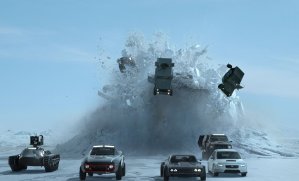 This is a franchise that revels in the ridiculous, that embraces being a big dumb action movie in the best way, delivering imaginative and often eye-popping action that deserves the full big screen treatment. Fate of the Furious falls somewhere in the middle of the franchise from a quality standpoint. It’s not as good as seven, which wasn’t as good as six, which wasn’t as good as five, but it’s still good enough. It’s definitely lesser and the new director doesn’t have the same natural feel for the preposterous as previous directors, and even after eight films I’m still mostly indifferent about the far majority of the characters on screen. As I’ve written before, though, thankfully the movie has the good sense to know what the audience is paying to see. It’s here for the fast cars, eye-popping stunts, and gratuitously framed camera angles highlighting women’s derrieres (I think there’s a contractual law that a close-up of booty shorts must make a grand entrance in the opening minutes of every film). Fate of the Furious is just enough of what I want from the franchise, though it’s getting harder to keep up with every new movie. Furious 9 and 10 are already in the works, and it’s only a matter of time before we get Fast and Furious in Space. It’s getting further and further removed from a sense of reality but as long as it keeps up with incrementally raised expectations and employs enough charming actors to compensate for Diesel’s enormous lack of charisma, then they’ll keep fans like me happy in the short run.
Nate’s Grade: B
Share this:

Logan (2017)
 The Wolverine solo films have not been good movies. The 2008 first film was widely lambasted and while it made its money it was an obvious artistic misfire. The second film, The Wolverine, directed by James Mangold was an improvement even though it had its silly moments and fell apart with a contrived final confrontation. The Wolverine movies were definitely the lesser, unworthy sidekick to the X-Men franchise, and this was a franchise that recently suffered from the near abysmal Apocalypse. Mangold returns for another Wolverine sequel but I was cautious. And then the cheerfully profane Deadpool broke box-office records and gave the Fox execs the latitude needed for a darker, bloodier, and more adult movie that’s more interested in character regrets than toy tie-ins. Thank goodness for the success of Deadpool because Logan is the X-Men movie, and in particular the Wolverine movie, I’ve been waiting for since the mutants burst onto the big screen some seventeen years ago. It is everything you could want in a Wolverine movie.
In the year 2029, mutants have become all but extinct. Logan (Jackman) is keeping a low profile as a limo driver and taking care of an ailing Charles Xavier (Patrick Stewart) south of the border. Xavier is losing his mind and a danger to others with his out-of-control psychic powers that need to be drugged. Caliban (Stephen Merchant) is also helping, a light-sensitive mutant with the ability to innately track people across the globe. Logan is ailing because his healing power is dwindling and he can’t keep up with the steady poison of his adamantium bones. A scared Mexican nurse tries to convince Logan to help out the little girl in her care, Laura (Dafne Keen, feral and a better non-verbal actor). She’s an angry, violent child and built from the DNA of Logan. She too has unbreakably sharp claws and a healing ability. Bounty hunter Pierce (Boyd Holbrook) is trying to recapture the runaway merchandise/science experiment, capturing Caliban and torturing him to track his prey. Logan goes on the run with Xavier and they try to make sense of what to do with Laura, a.k.a. X-23. They’re headed north to Eden, a hypothetical refuge for mutants to sneak over into freedom in Canada, and along the way are deadly hunters who aren’t afraid of leaving behind a trail of bodies to get their girl back.
 It feels like it shouldn’t haven taken Jackman’s reported final outing for the execs to realize that a guy with freaking knives attached to his hands might be a concept that would work in the more grisly, more adult territory an R-rating creatively affords. It’s about time this man got to fully use his claws, and it was a joyous explosion of violence and gore built up for fans such as myself for a long time coming. It feels like Fox has been planning for this event as well, as if they stationed a production lackey to devise all sorts of grotesquely fun ways that Wolverine might skewer his competition in bloody beauty (“Finally, your preparation will not be in vain, Ronald”). There’s one scene in particular where a bunch of armed henchmen are psychically frozen in place and Logan struggles to move past each, and we get to anticipate just how each one will be viciously stabbed. For a series that has shied away from overly gory violence, Logan certainly celebrates its new opportunities with bloody glee. The fact that the first word spoken is an f-bomb and there’s a gratuitous moment of drunken sorority girl boob flashing is like the producers trying to directly communicate to the millions of ticket buyers and saying, “Hey, we’re sorry it took so long. Hope it was worth the wait.” Oh dear reader, it was worth the wait.
It’s not just the action that’s invigorating but the emotional core of the film is deeper and more compelling and ruminative than ever before, and finally these great actors are given material to deliver great performances worthy of their talent. Stewart and Jackman have never been bad in their respective roles even if and when the movies have been. They just have never been called upon for much more than genre heroics, anguish, and pained moral dilemmas. With Logan, both actors are finally given meaty material that affords nuance and ambiguity, and they are excellent. Charles Xavier is losing his battle with Alzheimer’s and ALS, which is a major concern when his mind is considered a weapon of mass destruction by the government. He’s going through his own end of life deliberations (“You’re waiting for me to die,” he groans at Logan) and it brings out a far different Xavier than we’ve ever seen, even with the youthful cockiness from James McAvoy. This is a cranky, defiant, and doddering Xavier, someone who is barely outpacing his sense of grief, guilt, and depression. There’s a tragic back-story we only get a glimpse of but it’s suitably devastating for a man who has devoted his life to others. He’s looking for a few last moments of grace and looking to hold onto something by journey’s end.
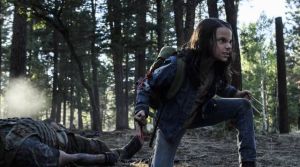 Thanks to his healing ability and the star wattage of Jackman, there was little fear that anything serious would ever befall Wolverine in his many previous film appearances. Sure bad things happened to him and he lost plenty of female love interests, but you never feared that he wouldn’t be able to ultimately handle himself. That’s not the case in Logan, which opens with a Wolverine who has clearly lost more than a step or two. He’s tired, rundown, and his adamantium skeleton is slowly poisoning his body. His healing powers are slowing down and he’s not as berserker fast and agile as he used to be. For once there’s an uncertainty attached to the character and a vulnerability. This turn greatly increases the intensity of the fight sequences and the greater stakes of the drama. The comparisons of the samurai were rife in The Wolverine and now the comparisons to the aging, lone gunslinger are ever-present in Logan. He’s drawn into a conflict that he was not seeking and he’s found a little bit of his remaining humanity and compassion to do right in the face of overwhelming odds and near certain destruction. There’s a subtle moment that the film doesn’t even dwell on that stuck with me. It’s after an accident, and in the thick of confusion, Logan is trying to save his mentor but he’s also worried that Xavier will think he betrayed him. “It wasn’t me,” he repeats over and over, not wanting this man to suffer more. It’s a small moment that doesn’t get much attention and yet it really spoke of their relationship and the depth of feeling during these fraught final days. This is the first Wolverine movie that feels like the characters matter as human beings just as much as purveyors of punching and kicking (now with gruesome slashing at no extra cost). Jackman showcases more than his impressive physique this go-round; he delivers a wounded performance that’s built upon generations of scars that he’s been ignoring. It’s the serious character examination we’ve been waiting for.
I also want to single out Merchant (Extras) who gives a performance I never would have anticipated from the awkwardly comedic beanpole. He even gets a badass moment and I never would have thought Stephen Merchant would ever have a badass moment in life.
Mangold’s film plays as a love letter to Western cinema and uses the genre trappings in ways to further comment on the characters and their plight. This is a bleak movie. It’s not a dystopia. In fact it resembles our own world pretty closely with a few technological additions; automated machines and trucks, the common knowledge that mutants have been wiped out like the measles. Knowing that it’s reportedly the end for Stewart and Jackman playing these characters, I was anticipating the film to strike an elegiac chord. His past and legacy are catching up with Logan. He becomes an unlikely guardian to Laura and explores a fatherhood dynamic that was never afforded to him before. The unlikely partnership, and it is a partnership as she’s a pint-sized chip off the block of her tempestuous father, blossoms along a cross-country road trip for a paradise that may or may not exist, while desperadoes and powerful black hat villains are out to impose their will upon the weak. This is explored in a leisurely pit stop with a working class family (welcome back, Eriq La Sale) that welcomes Logan and his posse into their home. We get a small respite and learn about greedy landowners trying to pressure them into giving up the family farm. It’s completely reminiscent of something you might see in a classic Western of old, just transported to a new setting. There’s even an extended bit where Laura watches 1953’s Shane on TV, and when those final words come back in expected yet clunky fashion, I’d be lying if they didn’t push the right emotions at the right time.
 But when it comes to action, Logan more than satisfies. The action is cleanly orchestrated by Mangold in fluid takes that allow the audience to readily engage. The film doesn’t go overboard on the Grand Guignol and lose sight of the key aspects of great action sequences. There’s a refreshing variety of the action and combat, and the action is framed tightly to the characters and their goals. It makes for an exhilarating viewing. If there is anything I would cite as a detriment for an otherwise incredible sendoff, I think the movie peaks too soon action-wise. The emotional climax is definitely where it ought to be (tears will be shed whether you like it or not) but the third act action doesn’t have quite the pop. Also, while Holbrook (Narcos) is an entertaining and slyly charismatic heavy, the villains in the movie are kept relatively vague as is their overall plan. The vacuum of villainy is kept more one-dimensional, which is fine as it allows more complexity and character moments to be doled out to our heroes, but it is a noticeable missing element.
One of the best attributes I cited from last year’s Captain America: Civil War is that the full weight of the character histories was felt, giving real emotional stakes to all the explosions and moralizing. When our characters went toe-to-toe, we felt a dozen films’ worth of setup that made the conflict matter. Logan carries that same emotional weight. We’ve been watching Wolverine and Professor Xavier for almost two decades and across nine films. These characters have gotten old, tired, and they carry their years like taciturn gunslingers looking for solitude and trying to justify the regrets of their lives. It’s a surprisingly emotional, serious, and altogether mature final chapter, one that provides just as many enjoyable character moments and stretches of ruminative silence as it does jolts of gritty, dirty, hard-charging action and bloody violence. It’s as much a character study as it is a superhero movie or Western. I cannot imagine this story as a watered down, PG-13 neutered version of what I saw on screen. This is a movie for adults and it pays great justice to the characters and the demands of the audience. The final image is note-perfect and can speak volumes about the ultimate legacy of Wolverine and by extension Xavier and his school for gifted youngsters. Logan is the second-best X-Men movie (First Class still rules the roost) and a thoughtful and poignant finish that left me dizzy with happiness, emotionally drained, and extremely satisfied as a longtime fan.
Nate’s Grade: A-
Share this:

The Lego Batman Movie (2017)
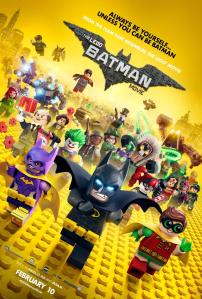 The Lego Batman Movie intends to expand the world of a movie that was designed to sell toys and was far better than anyone ever imagined. It’s frenetic, silly, and paced at spoof level speed with genial gags flying fast every ten seconds or so. It’s also flat, and while intermittently amusing I only chuckled, at best, a handful of times. Will Arnett’s self-involved Batman was a fun side character in the original Lego Movie but there’s not exactly enough there for his own starring vehicle (Jack Sparrow Syndrome). He’s saddled with a weak plot about letting others get closer and not having to be a loner. Besides a brief comedy bit about a cataclysm, the movie could have just been a broad Batman movie. It doesn’t really utilize the landscape of a Lego universe in any way. While many of the jokes didn’t work for me, I knew another one was mere seconds later, so I shrugged off the misfires. The final act of the movie involves a separate league of villains, all conveniently connected to other Warner Brothers properties. Lego Batman wore me down after the opening sequence where Batman battles his entire rogues gallery. It was high-energy but its aim was just too low for my tastes, and the results made me appreciate even more the cleverness and plain comedic accomplishments of the original Lego movie. There aren’t any memorable moments or jokes and there’s far too much Batman rapping. It’s colorful, it’s wacky, it’s filled with fine vocal actors with very little to do other than Arnett and an amusingly awed Michael Cera as The Boy Wonder himself, adopted sidekick Robin. It’s an acceptable albeit numbing experience that I wanted to enjoy more. I don’t know if this is the start of Lego spin-off movies but if it is I hope others do better with their own building blocks.
Nate’s Grade: C+
Share this:

50 Shades Darker (2017)
 I’ll admit not understanding the appeal of the 50 Shades of Grey phenomenon. The introduction into BDSM was a worldwide sensation and the 2015 first film made half a billion dollars, the kind of money usually reserved for movies featuring muscular men in rubber costumes that use whips and chains for different purposes. I happily watched the first film to get a sense of what the big deal was and was unmoved. For a film designed to be titillating and provocative, I came away wishing it had more action (of any sort). With great success, author E.L. James asserted more authority in the film series. Out went original director Sam Taylor-Johnson, who at least provided a sleek sheen to the final product and sexual tension where able, and in came new director, James Foley (Glengarry Glen Ross). Out went the original screenwriter Kelly Marcel and in came a new screenwriter, James own husband Niall Leonard, which could only mean the threat of the film hewing closer to the book was a guarantee. James is giving fans of her popular though critically savaged romance novels more of what they want, and I guess what they think they want are relatively bad movies, limp sex scenes, and an inert romance.
Anastasia Steele (Dakota Johnson) is trying to get back on her feet after leaving her ex, billionaire and bondage enthusiast Christian Grey (Jamie Dornan). He’s got serious issues but won’t stay out of her life. He has to have her back, and rather easily the on-again off-again couple is back on and back getting it on. However, their sex life is threatened with women from Christian’s past and the question of whether he can settle down for good with such a plain Jane submissive like Ana.
 There is a mystifying lack of conflict in the movie that makes 50 Shades Darker feel aimless. There are occasional bumps in the road in the form of old girlfriends still looking for their turn, and Ana’s aggressively inappropriate boss (Eric Johnson), but they’re dealt with almost immediately and without larger consequence. One of these antagonists is foiled by nothing more than a stiff drink to the face like a full-on Dynasty parody. Dealing with Christian’s past seems like natural territory for a sequel. A character as cold and self-serving as Christian could very likely attract a host of dangerous women. Stalkers who cannot let go would present an organic threat to their relationship and Ana’s literal life. A deranged former lover would provide a substantive question for Ana to deliberate. Is she doomed to the same fate? Bella Heathcote’s troubled character is begging for attention but she is so unceremoniously sidelined to the point of hilarity, and then she’s never seen again. Why should the story provide any question that these star-crossed lovers might not magically work out in the end? None of the mini-conflicts last longer than fifteen minutes before being effortlessly overcome, including a helicopter death scare. The shapeless plot structure is tediously airy, leaving too much space for characters and a world that doesn’t warrant the consideration. You would think the extra time would be spent with lengthy, over-the-top sex scenes stripping away all inhibitions and pushing the boundaries of cinematic good taste, but that’s not so much the case (more below). I knew we were in trouble when a sequence of Ana sailing Christian’s yacht was as long as one of the so-called outrageous sex scenes.
Here’s a prime example of just how poorly 50 Shades Darker is plotted. While dressing up for the masquerade, Christian admires Ana in lingerie. “You just going to stand there gawking?” she asks. “Yes,” he replies. Later, she walks in on him exercising shirtless and getting all sweaty while practicing for the Olympics on a pommel horse. It’s a flip of the male gaze, for once in the movie’s two hours. This is obviously a prime spot to repeat the dialogue exchange for a clever payoff, have Christian ask if she is going to just stand there gawking and her answer be in the affirmative. This movie cannot even do that! 50 Shades Darker doesn’t just fumble the big things, like plot and character and tone, it fails to even achieve modest, easily reachable payoffs that can be as ludicrously obvious.
Devoting more time with Ana and Christian outside of the bedroom is also best not advised. These one-dimensional characters are also barely removed archetypes from late night soft-core porn. Ana is an audience cipher but she’s also one incredibly dense human being. Forget the annoyingly mousey acting tics that Johnson (How to Be Single) is instructed to never abandon, this is a lady who just doesn’t get it. She’s had sex with her dude like minimum a dozen times and she’s never noticed the array of scars across his chest? After her boss tries to force himself on her, she fights back and runs into Christian’s arms, and he gets the guy fired (because a woman reporting a sexual assault on her own is not convincing enough?). Hearing the news, Ana acts deeply confused, as if she cannot understand why her boss is now not her boss. Did she just forget the upsetting assault? Every man in this universe seems to find Ana uncontrollably irresistible. She’s the ultimate prize to be owned. Even her own friend, who clearly has a crush on her, creepily makes her the centerpiece of his photography gallery show without her consent. She can huff and puff all she wants about agency but Ana is still a woman looking for her prince to sweep her away to a land of exotic privilege. Her reason for accepting a dinner date with Christian: she’s hungry. That’s fine, not every romance needs to be progressive or healthy, but when that guy is as controlling and worrisome as Christian Grey, then the romance starts to sour and become an exhibit of toxic misogyny. And that’s before Christian reveals that Ana, as well as his previous subs, looks like his dead mother.
 Christian is your dark, brooding, oh so attractive as the bad boy but he’s defanged, turned into proper boyfriend material, the kind of guy who would drop down for an old-fashioned proposal of a girl’s dreams. In other words, the movie makes him boring. He’s still problematic as a romantic partner. While he swears this time will be different and no finely worded legal contracts are necessary, he’s still a controlling jerk and a boor. Even during his “please take me back” dinner he’s attempting to order for Ana. He deposits money in her account despite her protests, he buys the publishing company she works for to become her ultimate boss even outside their relationship, and he’s constantly insisting she is his and his alone in the creepiest of declarations. The movie seems to think it’s found a palatable excuse to explain away his warning signs. His mother, depicted in a hilariously sad picture that looks like a Wal-Mart family photo from a refugee camp, died of a drug overdose at a young age and he was physically abused by his father. It’s a slapdash, simplistic cover for his bad behavior. Another strange discovery: the childhood bedroom of Christian Grey has a framed poster of 2004’s The Chronicles of Riddick. I know Universal is trying to play some studio synergy here, but come on. How old is Christian supposed to be? Also, HE HAS A FRAMED POSTER OF THE CHRONICLES OF RIDDICK.
All of this can be moderately forgivable if the movie more than makes up for where it counts with fans, namely steamy and scorching sex scenes that were the hallmark of the lurid book series. While the first film was far from perfect, or even adequate, let it be said it still could constitute an erotic charge when it desired. With the sequel, the sex is shockingly lackluster. There are only four full sex scenes and they start to become weirdly routine. You anticipate that Christian will spend a little time here doing this, and little time there doing that, and then as soon as would-be penetration comes into being they oddly jump forward and spare the audience the sight of sexual congress. It’s different minor tracks of foreplay and then the movie seems to shy away from the sex itself. For something this supposedly kinky it becomes strangely mechanical, predictable, and boring. Another irritating feature is that every sex scene is accompanied by a blaring rock or pop song. It announces itself with what I call “sex guitar music.” It blares over the scene and makes it difficult for the viewer to better immerse in the scene. Some of the music is downright nails-on-chalkboard awful from a tonal standpoint, creating its own source of comedy. The absolute most hilarious musical pairing is Van Morrison’s “Moondance” while Christian is fooling around surreptitiously with Ana in a crowded elevator. Go ahead and look up the song and come back to this review, I can wait. The jazz flute playing over the scene is certainly… different. It might be the worst sex scene song pairing since Leonard Cohen’s “Hallelujah” in Watchmen. I stayed until the end credits and counted 27 songs used in a 118-minute movie. Reportedly there’s a score by Danny Elfman in the film but I challenge you to find it (easiest paycheck of his career).
 If you’d like to be spared the turgid two-hour experience, I’ll spoil the specifics of the sex scenes in this paragraph so you can see how truly tame the movie is for something so reportedly transgressive and kinky. The first sex scene is their reunion as a couple and he undresses her, goes down on her, then climbs atop, then it’s over. The second involves him spanking her, upon her request, then he goes down on her, climbs atop her, then it’s over. The third sex scene involved Ben Wa balls as foreplay reminiscent of the superior and far more erotic Handmaiden (seriously see that Korean movie like 1,000 times before this), or was that the second sex scene? As I type this, it’s only been mere hours since I left my screening and I can’t recall the general details of the third sex scene, that’s how boring it was. The fourth is more montage but it’s an unleashed exuberance of sexual id. Christian dumps an entire bottle of massage oil onto Ana’s breasts, which seemed impatient and wasteful to me, but I’m not a billionaire. I cannot overstate just how dull and lazily staged the sex scenes are in the film, extinguishing any kind of titillation and strangely demurring once things get passionate. The nubile bodies are on display, Johnson’s in semi-permanent arched back, though Dornan is often coquettishly obscured (sorry again, ladies). The word that seems most appropriate for the sex scenes is “anticlimactic.” Ana jokes that she’s a vanilla girl and trapping Christian into a plain relationship, and their big screen sex life typifies this (anyone remember Ana’s question about what a butt plug was?). It’s a world of kink where nipple clamps are giggle-worthy accessories to the participants and the go-to sexual position is missionary. This movie is not the daring dip into untapped sensuality it’s been made out to be. It’s much more conservative at heart.
Ironically, 50 Shades Darker is a curiously reserved romance that lacks serious heat. The actors have very little chemistry and are fighting losing effort to convince you just how sexy they find one another. Dornan still seems like a dead-eyed shark to me. I know people aren’t going to this movie for the story, but some better effort could have been afforded rather than false conflicts that are arbitrarily resolved one after another. It’s an empty fantasy with boring characters and timid sex scenes that register as sub-soft-core eroticism. I wrote of the original film: “Surprisingly boring and rather tepid, 50 Shades of Grey feels too callow to be the provocative film experience it wants to be. It needs more of just about everything; more characterization, more organic coupling, more story, more romance, more kink. It is lacking in too many areas, though the production values are sleek, like it’s the most technically accomplished episode of Red Shoe Diaries.” Every criticism is still valid and even more so. Whereas the first film was about the flirtation and exploration of the coupling, the sequel inevitably treads the same ground, watching pretty dull people get dressed in pretty clothes and then take them off. For a book series so infamous for its tawdry smut, I was expecting more smut or at least better smut.
Nate’s Grade: C-
Share this:

Bad Santa 2 (2016)
 A comedy with no reason to exist is a lousy thing and it’s even worse when that comedy seems to know it, and thus is the pitiful state of Bad Santa 2, a sequel that feels far too stale. I wonder if the original movie was as enjoyable as I recall or if in the ensuing 13 years we’ve just become more inured to the casual vulgarity of these movies, but I was left bored by the overwhelming listlessness of this comedy. Billy Bob Thornton returns but he’s generally on autopilot. The loose plot involves another score, this time engineered by his mother (Kathy Bates), but really it’s mostly a hangout film with nasty characters insulting each other in painfully provocative ways. I was getting restless and the comic set pieces are to a whole poorly developed and routinely settle on the easiest joke, which is again witless shock value. There’s no range, no unexpected turns, so much of the comedy falls flat, the same smutty joke repeated with little variance. Stay tuned for a tepid end credits sequence that justifies the “graphic nudity” of the rating (hopefully Snapchat does not get any ideas for the tie-in). Without a stronger plot and characters, the shock value begets diminished returns, and even my preview audience was deadly silent for long stretches. I laughed about ten times total, not enough to justify a theatrical viewing but perhaps enough to keep it on TV while folding laundry. The strange thing about a dark comedy is that it feels like all the consequences from the plot were cut in editing as several storylines and their reasons to exist fail to fully manifest. There are payoffs you anticipate that never come and storylines that seem created entirely for reasons that never arise. The most consistent comic presence is Brett Kelly replaying his now grown-up simpleton from the first movie. Kelly is the only actor who plays a different note, providing a dose of unyielding optimism that befuddles. If you’re a big fan of the original and just looking for another fix perhaps Bad Santa 2 will provide enough nasty humor to satisfy. By the end I felt drained from this thoroughly pointless affair.
Nate’s Grade: C
Share this:

Inferno (2016)
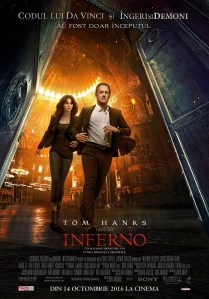 You know it’s a bad sign when the best part of your movie is the scenery. Inferno is the third in the Robert Langden series where Tom Hanks stars as the world’s foremost symbologist that traverses old European museums and cathedrals to solve mysterious puzzles. The Da Vinci Code was pretty bad, its sequel Angels & Demons was a marked improvement, and now Inferno is a depressing step backwards. Langden has to stop a madman (Ben Foster) from releasing a super virus that will kill half the world’s population. The villain’s plan requires him to wait and he has no reason to do so. Waiting only needlessly delays his goal and makes it more likely for him to get caught or fail. His plan is stupidly convoluted, but I didn’t expect that the good guys’ plan was also stupidly convoluted, relying upon fake blood squibs and disguises and for what? There are three competing, stupidly convoluted storylines that smash together. I simply could not engage with what was happening and felt I had little reason to care. The mystery aspect is pretty tame and the thriller set pieces are unmemorable save for a climax that at least feels like the highpoint. There was one interesting aspect that never fully gets developed and that’s the idea that Langden can’t trust his senses. He’s a man who relies on his arcane intellect and to turn that against him, as well as possibly draw in hallucinatory visions, was a smart move. It’s only more disappointing when they fail to do anything with this possibility. The myriad plot holes were clearer to me than the hackneyed plot itself. Inferno has some very nice footage as Hanks and Felicity Jones scamper from one Florence site to another and that’s the best thing I can offer about this mess.
Nate’s Grade: C-
Share this:

Bridget Jones’ Baby (2016)
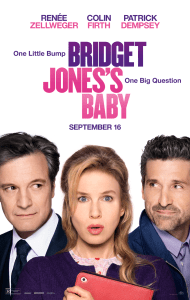 Coming 12 years after the last Bridget Jones outing, I was pleasantly surprised to discover how warm my feelings still were for this plucky, feisty heroine. Now in her mid/late 40s, Bridget is contemplating a life never becoming a mother when, surprise, she gets very pregnant and has two possible fathers: billionaire love guru Jack (Patrick Dempsey) or her newly available on-again off-again beau, Mark Darcy (Colin Firth). It’s a frothy plot contrivance but the screenwriters (including author Helen Fielding and co-star Emma Thompson) are able to produce fun comic scenarios that fully embrace the premise and its soapy conflicts. Bridget has two pretty appealing options, and when both men finally discover the possibility of the other, it becomes an entertaining game of one-upsmanship. The requisite romantic comedy elements don’t forget to be funny too, including an ending rush to the hospital that achieves some inspired slapstick. The film is swiftly paced and filled with zingers, and I just sat back for the two-plus hours and enjoyed the company of these silly yet realistic human beings. I enjoyed the adult humor and conversations that rarely get as much development in this genre. With all her self-sabotaging ways, you come to realize how much of a prize Miss Bridget is, and Zellweger slips right back into the role like no time has passed. However, plenty will grumble about Zellweger’s much-publicized plastic surgery, or the fact that she didn’t pack on the pounds for this picture, but I don’t see why any of that greatly matters in the interpretation of this character. The personality of Bridget is more than the alignment of her facial features. For fans of the series, Bridget Jones’ Baby is a welcomed return to form from 2004’s Edge of Reason and an extra dose of enjoyable fan service, tying up its tidy happy ending with a bow. Here’s something to chew over: my father had no prior knowledge of the Bridget Jones series, decided to see this movie, and enjoyed it thusly. Give Bridget Jones and her baby daddy drama a chance and you too may be surprised.
Nate’s Grade: B
Share this:

Blair Witch (2016)
 As is mandatory with all reviews, let us acknowledge the tremendous impact of the original Blair Witch Project, a full-borne cultural event that tapped into the zeitgeist. It was a rare indie movie that curated a must-see reputation and became a blockbuster. The found footage format was highly influential afterwards as were its low-fi thrills, community interactivity, viral marketing, and experimental construction. I remember having heated arguments with people about whether the movie was indeed real or a work of fiction. I pointed to the TV once and said, “Look, the actors are promoting it on MTV.” Naturally imitators followed suit and the studio looked to eagerly turn a curiosity into a franchise. 2000’s hasty sequel Book of Shadows was quickly rejected and just as quickly the Blair Witch phenomenon had slipped away. It remained dead until this summer. Director Adam Wingard (You’re Next, The Guest) and frequent screenwriting partner Simon Barrett had recently made a horror movie called The Woods, but at 2016’s Comicon the secrecy was finally dropped. It was a sequel to The Blair Witch Project, filmed in secret J.J. Abrams-style. It was a stunt that worked, and once again there was life in this franchise. This will only last until people see the new Blair Witch, a monotonous, confused jump-scare haven that’s too indebted to the original and discards anything interesting it stumbles onto.
Sixteen years after three backpackers went missing, footage has been posted that possibly shows one of these backpackers, Heather, still alive. James (James Allen McCune) is now an adult male and determined to find out if his sister is alive. Lisa (Callie Hernadez), a film student and maybe James girlfriend, tags along to record James’ hunt for the truth into her graduate thesis. Their friends (Corbin Reid, Brandan Scott) come along for the adventure into the woods, as well as a conspiracy couple (Wes Robinson, Valorie Curry) responsible for posting that new footage. The conspiracy couple leads them into the woods and it isn’t long before people get lost, tempers get heated, and strange disturbing noises materialize from the never-ending night.
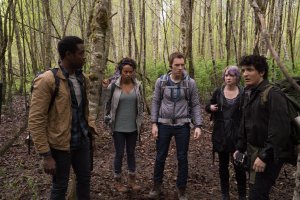 Much can be forgiven if a scary movie delivers the spine-tingling goods, and standing in the shadow of one of the biggest horror hits of all time is no easy proposition. It’s too bad then that Wingard’s Blair Witch is far more tedious than terrifying. I didn’t fall under the spell of the 1999 original but I could appreciate its slow-burn efforts and execution, which relied upon a lot of unsettling dread left to audience imagination. With the 2016 reboot, the filmmakers have upped the ante but don’t have patience. There are over six different jump scares, each punctuated by a loud, often shrill scream. At one point there are three in a row in a succession of mere minutes, enough so that a character provides a meta dose of commentary by saying in exasperation, “Why do people keep doing that?” Calling attention to the annoying trait doesn’t make it better. The sound design is also, in a word, amplified. It sounds like Bigfoot or a dinosaur is tearing through the woods and wrecking havoc. It was enough that I hoped the movie would just reveal the Blair Witch never existed and instead it was some other sizeable monster of legend. I’ll give Wingard credit for the found footage cinematography not being self-consciously overdone. The characters have an incredible stash of cameras, from GoPros to flying drone cameras, which makes the editing less choppy and the movie easier to watch.
There are exactly two scenes that unnerved me. One is the sheer numbers of an expected item upon waking up, the immense quantity and variation in size providing an eerie sight as it fills the screen. The other is a late sequence that involves squeezing in a tight space, which allows Wingard to employ some nice claustrophobic tension. Short of these two moments, and they are mere moments, the movie was boring me so profoundly that I considered just leaving, and I’ve never walked out on a movie before. It felt like it was going nowhere fast with characters I didn’t care about and without any relevant suspense. The found footage filming elements are even used to enhance the jump scares with sudden visual and sound glitches amplifying the tired attempts to constantly startle its audience. This is a movie more concerned with startling its audience than scaring it.
When the movie does start to tantalize your interest, it’s like a mirage that soon vanishes and you’re once again left in your dire predicament. Getting lost in the woods is not interesting minus interesting aspects. However, finding out that time is operating at a different level, now that’s interesting. The characters set their alarms for seven A.M. but it’s still dark out. The possibility of the Blair Witch manipulating time to trap hikers was the first moment in this entire movie that made me sit up in my chair. It took the movie in a different direction that demanded my attention, and it opened up the possibilities of what had been a rather lifeless enterprise up that point. Show me this movie. Alas, it’s an aspect that is quickly shoved aside and largely forgotten even with the timeline of events regarding the footage. There’s a scene where the stick figures directly communicate a powerful connective relationship, and yet this too is never touched upon again. There’s a new threat introduced that takes the movie in a body horror direction and raises questions about whether the woods themselves can become alive. It’s another intriguing moment that culminates in what promises to be a memorable gross-out image, and instead it too peters out and then unwisely abandons the body horror angle. It’s almost like the movie is so single-minded in its path that it ignores the intriguing and preferable detours.
Wingard and Barrett are trying to expand the Blair Witch mythology but their reboot operates on the assumption that there is even a base to work upon and that its audience is familiar with heretofore unspoken rules that appear arbitrarily and randomly. This reboot operates in a world that acknowledges the release of the first Blair Witch movie, yet nobody seems to be any different from this. Obviously James is different having to lie with the legacy of the movie, but why venture out into the woods on a whim of hope to find his long-lost sister who vanished 16 years ago? Does he think she’s just been living off squirrels and twigs in the ensuing time? Why doesn’t James try and question who edited the footage from his sister into a narrative? Why doesn’t he try suing the film production for profiting off his family pain? Why hasn’t Burkitsville, Maryland become a counter-culture tourist destination from taking ownership over its supernatural legend, much like Salem or Roswell? The town should be swamped with adventurous backpackers who want to live the experience. The much maligned Book of Shadows did far more to discuss the reality of the Blair Witch phenomenon and the tenuous hold on reality that the Internet age was ushering in. Wingard’s version eschews this world-building context for narrative immediacy. James wants to find his sister, he gets a clue that she might be out in those woods still, so they all go into the woods. Once the conspiracy theory couple insert themselves onto the trip it seems odd that we’ve ignored the larger context of the legend, instead rehashing how the Blair Witch died.
 As things begin to fall apart in the second half, the events start to feel arbitrary and poorly defined. There’s a sequence during the climax that I’ll try my best to describe with some discretion but be warned, folks (spoilers): the remaining characters eventually find that same shack in the middle of the woods, though the exact number of floors seems unclear. The witch looks to finally confront our characters, though why she/it waited until this moment is also unclear since she/it seems to be entirely overpowering. That’s when a character declares, with no prior guesswork to arrive at this conclusion, that they have to stand in corners and as long as they don’t turn around and look they will survive. And this works. It’s not explained why this Raiders of the Lost Ark closed-eyes routine is somehow the secret to supernatural survival (ignorance is bliss?). When the character unleashes this tidbit it’s treated like the audience knows the rules of the Blair Witch universe, and we sure don’t. At no point has a larger system been established, so when characters start spouting rules it feels like the movie is making it up as it goes. This don’t-look-back trick is played out almost to a comical effect, which culminates in the rising question of whether a character is going to backwards walk out of the whole stupid forest. The muddled world building (time dilation, voodoo sticks, tree monsters?) makes it feel like the doomed characters are ultimately trapped in a half-finished screenplay.
I was honestly expecting more from Wingard and Barrett after their previous genre collaborations. These guys know the underpinnings of enjoyable genre filmmaking and how and when t upend the conventions and expectations, zigging when others would zag. I felt these two would be able to take a studio gig like Blair Witch and find something new, something interesting, and certainly something scary with the property. I regret to say that this Blair Witch might be new but it sure fails to be interesting or scary. The characters are meaningless and interchangeable and boring. Their decisions are often illogical and stupid. The scares are stacked too high in favor of cheap jump scares, and the movie lacks the patience to develop its tension and horror. It can’t even properly establish rules for the audience to follow. It’s like the filmmakers are being upfront with their lack of faith in their final product. I think the key missing ingredient is, surprisingly, humor. Both You’re Next and The Guest balance along a delicate tonal line that can veer into macabre comedy any moment to lighten or heighten the tension. There are no (intentional) laughs to be had with this retread into the woods. I think the newest Blair Witch has done the unthinkable: it’s redeemed Book of Shadows.
Nate’s Grade: C-
Share this:

God’s Not Dead 2 (2016)
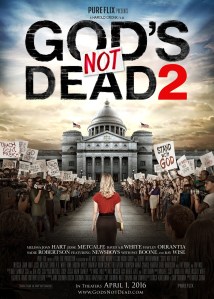 The creators behind God’s Not Dead 2 won’t admit it but their movie is pure science fiction; it exists in an entirely parallel universe that’s topsy-turvy where atheists want to stamp out the last signs of Christianity and will use their collusion of government and media power to marginalize and eliminate freedom in the name of “tolerance” and “diversity.” It’s another heavy-handed moral parable that feeds into the persecution complex of its target audience, the same people who made 2014’s God’s Not Dead a surprise hit. While the sequel isn’t nearly as mean-spirited and cruel (the godless characters don’t have to die or get stricken with cancer this time), it’s still speaking in code to stoke its audience’s unfounded fears of losing religious liberty. We follow an AP History teacher (Melissa Joan Hart) who gets into trouble from making a purely literary connection with the teachings of Jesus and non-violent revolutionaries Gandhi and MLK. The school board wants to “wash the blood off its hands” and she’s taken to court where her very faith is on trial and where her hunky lawyer has to prove Jesus historically existed. The entire premise is laughably preposterous given the context of her pedagogical reference. A student makes the Jesus connection and asks about it, and the teacher was not endorsing a religion but merely quoting a piece of literature as it pertains to those inspired from it. There’s no time for subtlety in this movie because we have a martyr that needs roasting, and in comes an ACLU lawyer played by Ray Wise (God bless this actor saying yes to everything) who may very well be the devil. Wise is the lone source of entertainment for me. There’s also a nasty TV pundit who says Christians are the real danger in this country (replace “Christian” with “Muslim” and the TV segments start to sound more familiar from our own world). Several characters from the first film pop back up but with very little to do. God’s Not Dead 2 is a pretty lackluster, laughable, and theologically simplistic morality tale but at least it isn’t as risible and offensively insincere as the original film. Like the first film, the credits close on a list of court cases the filmmakers say inspired the movie. Except, upon minimal research, not one of these cases echoes the movie I just watched. All of these cases involve intolerance against accepting gay marriage or fulfilling birth control and/or abortion services, all legal and protected aspects of our culture. I’m reminded of the quote “when you’re accustomed to privilege, equality feels like oppression.” I wonder if this kind of thinking would have lead an enterprising filmmaker telling the “brave story” of the segregationist standing up against government pressure to accept integrated schools. It’s not far off.
Nate’s Grade: C-
Share this:

Star Trek Beyond (2016)
 With J. J. Abrams’ departure from the franchise for the greener space pastures of Star Wars, there was a creative void to fill, and in stepped director Justin Lin (Fast and Furious series) and co-writer/star Simon Pegg, acclimating to the established new movie universe and providing a Trek movie that proves to be the most “recognizably Trek” in the series thus far. The crew of the Enterprise is stranded on an alien world after being attacked by a hive-like armada of ships. It’s a somewhat familiar formula, a distress call that ends up being a trap, from an unknown entity that is harboring vengeance against the Federation. This allows for several dispirit storylines to explore the surroundings but also the enjoyable character dynamics of the crew; the casting department hit the jackpot with this franchise, and it’s just satisfying to watch the actors deliver solid, satisfying character moments. The new character Jaylah (Kingmen’s blade-legged Sofia Boutella) is interesting, kickass, and a source of deadpan comedy conflicts with others. There’s a genuine sense of discovery that’s patiently paced, not so much the set-piece-every-ten-minutes of the Abrams films. Idris Elba (The Jungle Book) makes for an intimidating villain and I’m happy to report he doesn’t get lost under gobs of makeup. He becomes more Elba as it goes, and he’s given a credible motivation and back-story to explain his actions. The action is a bit less exciting than I was hoping for from Lin, whose special blend of crazy has been somewhat dampened as he adopts the house visual style of the franchise. Pegg and co-writer Doug Jung have steered the franchise into safer territory but also put the focus on the crew and their bonds, which is the secret weapon of Trek. You sense that Pegg and Jung are fans, and they even provide greater context and justification for the new Trek elements that drew earlier complaints, like the use of the Beastie Boys song which now becomes a fun moment of fist-pumping triumph. Star Trek Beyond (no colons necessary, apparently) doesn’t quite hit the same highs as the previous two films, but it’s a solid movie overall and might be the best movie for the most ardent fans of classic Trek. My last piece of advice: go into space construction in the future. The way they go through starships, you’ll always have a job.
Nate’s Grade: B


You must be logged in to post a comment.