Blog Archives
Rocketman (2019)
 It seems like Bohemian Rhapsody was a trial run for actor-turned-director Dexter Fletcher. He had previously directed an inspirational sports movie (2015’s Eddie the Eagle) amongst other smaller films but he really came to attention when he filled in for the final weeks of Rhapsody after the original director Bryan Singer was removed. Fletcher helped steer the movie to its finish, and what a finish it had, collecting $700 million worldwide and four Oscars. Now Fletcher is a lone credited director of another musical biopic, Rocketman, chronicling the highs and lows of Elton John’s personal and professional career. Does it soar?
Elton John (Taron Egerton), nee Reggie Dwight, struts into rehab and tells his life story, from his humble days in England with distant, unsupportive parents, Sheila (Bryce Dallas Howard) and Stanley Dwight (Steven Mackintosh), meeting lyricist Bernie Taupin (Jamie Bell) and forming an instant connection, signing a record deal and traveling to America, blowing up immediately in popularity, his on-again-off-again relationship with his manager John Reid (Richard Madden), and all the drugs, parties, and excesses of rock and roll that Elton turned to in order to feel better about his own crippling loneliness.
 I wish more musician biopics took the approach of Rocketman, blending real-life with glitzy, dreamy fantasy sequences to create a musical fantasia. It just makes running through the typical tropes of biopics that much more entertaining. I appreciate the fluid nature of being able to dip into the fantastical at a moment’s notice, opening to a world of dance and delights, which keeps things lively and serves as a better integration of the artist’s songs. Take for instance last year’s Bohemian Rhapsody, which showed the formation of some of Queen’s most famous songs in comically abbreviated, almost impossibly easy creative sessions. They go from clapping to cutting away to a completed “We Will Rock You.” That movie became a series of sequences demonstrating how the band made its songs. With Rocketman, the songs are more designed as vehicles to the emotional journey of Elton John. When he thinks back to his childhood, we blast “The Bitch is Back,” and when he’s talking about his first performance experiences in his town’s pubs, we get “Saturday Night’s Alright (For Fighting).” When Elton’s family is at a breaking point, each member sings a section of “I Want Love.” When Elton feels alone in a giant party, and nursing his unrequited feelings for his writing partner, he warbles “Tiny Dancer.” When he’s caught up in his attraction to his manager, they duet, “Don’t Go Breaking My Heart.” By going this route, the filmmakers have opened their movie to more narrative and emotional potential.
The steps into fantasy also communicate Elton’s emotional state, especially as he starts spiraling into more drugs and loneliness. His elation translates into feeling like he and the audience are floating on air in one scene. His sense of succumbing to addictions and urges is demonstrating by a darker rendition of “Bennie and the Jets” where he crowd surfs into a sweaty orgy of flesh, people pulling at him, wanton desires obscuring anything else. It also plays into Elton’s fraying mental state. After a fantasy number, he says, “Where am I?” We too don’t know where he is. We too don’t know how much time has passed. It’s a clever conceit to get the audience to feel the protagonist’s distaff confusion about what is real and what is drug-addled. This approach also allows for some obvious visual metaphors that seem more palatable. When Elton literally hugs the child version of himself, and thus is allowing himself to finally be loved by himself, in a literal physical act, you mostly buy into it as catharsis because of the flights of fancy.
 The use of songs comes into play in three shapes: 1) breaking out into song as a fantasy sequence meant to communicate the inner emotional state of the characters, 2) Elton or others performing songs as diagetic musical performances happening in real life, and 3) the musical score built upon other Elton John tracks. It pretty much means the film is wall-to-wall Elton John, which works especially well considering it is the man’s biopic, but it also creates a world of sound that belongs to this man. Even the musical score adopts his signature tunes, which provides a nice undercurrent since he is telling his own story, so why wouldn’t he rely upon his own music score to provide that extra oomph?
There is a notable downside to the interwoven fantasy angle and that’s instilling a sense of added skepticism with the audience. Every biopic is going to make fictional inventions for the sake of storytelling, be it combing characters, making the internal external, or reordering scenes for maximum drama. It’s when a biopic goes overboard with the deviations from the truth that it can alienate the audience (though this didn’t bother the $700 million gross for Rhapsody). By Rocketman choosing to amp its fantasy elements, this is going to test the believability of scenes. I’m not talking about whether or not the crowd at L.A.’s Troubadour actually floated for Elton’s first U.S. live performance. Obviously that’s an exaggeration. But it calls into question moments like Elton and Bernie Taupin meeting by coincidence, Elton storming off from Madison Square Garden straight to rehab, and in particular his relationship with his parents. There’s a phone call where an adult Elton comes out to his mother, and she responds that she always knew her son was gay. It’s at this moment where the audience may be thinking, “Oh, that’s a sweet little moment to bring out her humanity.” Then in the next breath she castigates him for “choosing” a lifestyle that will condemn him to never knowing love. Yikes. It’s such an outlandish statement that I questioned whether this scene actually happened or was dramatic license to further sock it to Elton (apparently Howard had the same concern and it’s legit). The downside of asking an audience to accept the unbelievable additions is that they may be in search of them too.
The movie hinges upon its star and Egerton delivers. He previously sang Elton John (Sing) and previously saved the real Elton John (Kingsman: The Golden Circle), so it seems like his career has been destined for this role. Egerton is great at capturing the magnetic presence Elton had as a performer. He’s sprightly, larger than life, and fully inhabits the manic stage presence that became a force to reckon with. He also does a great job of communicating the insecurities, doubts, and yearning of a person who has been fighting for acceptance and affection and feels he is incapable of either. Being in the closet is only one aspect to Elton’s self-loathing (he did come out as bisexual in 1973). The character’s biggest emotional hurdle is loving himself, which might sound corny but is given genuine pathos by Egerton, who rages for that fleeting feeling. Egerton has been a charismatic performer from the first moment I saw him, and he feels like a natural fit for this role, ably handling all his own singing to boot. Not even Oscar-winner Rami Malek did that.
 The other actors do fine with their smaller roles. The problem is that the supporting cast is kept in tidy boxes of one-note requirements. Taupin is supportive. Reid is manipulative. Sheila is self-absorbed. Stanley is detached and non-approving. Each serves a very distinct purpose, and their underwritten natures would be more of a hindrance if the film weren’t entirely predicated upon Elton John’s personal experiences and interpretations of those events. I will say I was surprised that Sheila was played by Howard (Jurassic World: Fallen Kingdom). I kept thinking to myself, “I need to look up this actress.” I didn’t recognize her with the weight gain and, later, the dodgy older age makeup.
With all these wild visuals and extravagant consumes, the strangest thing to me about this whole movie is the role of Elton’s primary lover and manager, John Reid. This person makes another appearance in another musical biopic — Bohemian Rhapsody. This same character was played by Aiden Gillan (Game of Thrones) and he got Queen to new heights before seeming to glom onto Freddie Mercury and convince him to leave the band for a solo venture. He’s portrayed as a conniving villain in Rhapsody, and he’s portrayed as another conniving user in Rocketman, and two different actors who were both on Game of Thrones play both versions. Where’s this guy’s biopic?
Fletcher has found a clever and playful approach that accentuates his story and provides insights into a clever and playful musician. I was routinely smiling throughout Rocketman, which knowingly takes elements that would be campy and corny and says, “So what?” It’s also an R-rated movie that doesn’t shy away from John’s sexuality in a safe manner, at least “safe” for a Hollywood studio film aimed at mass appeal. I enjoyed myself throughout Rocketman as it floated by on its sense of whimsy and heartache, anchored beautifully by Egerton, a compelling and charismatic young lead who gives it his all. Rocketman is what more movie biopics should aspire to be like, sequins and everything.
Nate’s Grade: B+
Share this:

The Favourite (2018)
 As soon as I saw the name Yorgos Lanthimos attached to the royal costume drama The Favourite I knew it would be one of my most anticipated films of 2018. I’m not naturally a sucker for these kinds of movies without some interesting new angle (Mary Queen of Scotts, we’ll meet soon), but Lanthimos has quickly become one of my favorite (favourite?) voices in cinema, rivaling perhaps even the esteemed Charlie Kaufman. His movies are so wonderfully weird and tonally distinct. A Lanthimos joint, if you will, is two hours of surprises and expanding the surreal with assured foresight. He’s earned such a highly regarded reputation as far as I’m concerned that I’ll see any movie with his name attached in any creative capacity. The Favourite is a different kind of costume drama.
In the early 18th century, Queen Anne (Olivia Colman) is leading her country through a protracted conflict with the French that is weighing heavily on everyone. Lady Sarah Marlborough (Rachel Weisz) is the Queen’s childhood friend, close confidant, and secret lover. She’s also perhaps the real power behind the throne, directly influencing the Queen to enact her own bullish policies. Harley (Nicholas Hoult), leader of a parliament, is worried about the country going bankrupt from the military expenditures. Enter Abigail (Emma Stone), a cousin to Sarah and someone seeking to save her once proud family’s name. She rises through the ranks and becomes a rival for the Queen’s affections and a threat for Sarah to maintain her position of power in the court and with the Queen.
 What distinguishes a Lanthimos experience is the development and commitment to a distinct vision and the sheer unpredictability. You really never know where the man’s films will go next. One minute you’re following a man struggle to find a romantic partner, and the next they’re talking about turning people into lobsters. One minute you’re watching a family deal with a creepy stalker, and the next people are debating which family member should be killed in the darkest family game night ever enabled. Even though Lanthimos did not write The Favoruite, it still feels of his unique, deadpan, darkly comic worlds and his fingertips are all over it. The story is already playing fast and loose with the history (it’s pretty unlikely Queen Anne was a lesbian, despite the centuries of character assassination from Sarah) so its curiosity where it might go next is electric, especially when it shows some bite. This is a movie that’s not afraid to be dark, where characters can behave badly, testing our sympathy and allegiance as they fight for supremacy. I love how unapologetic the characters are in their pursuits. They will scheme and manipulate to whatever extent works and demonstrate abuse of power for power’s sake (poor bunny). “Favor is a breeze the shifts direction all the time,” says Harley. “Then in an instant you’re back sleeping with a bunch of scabrous whores.” The ensuring two hours of palace intrigue and political gamesmanship is given a sordid boost from the historical deviations, making the political more personal and even more intriguing. I cackled often throughout with the amazingly witty one-liners and curt insults as well as the wonky asides and tonal juxtaposition. It’s a funny movie for offbeat audiences who enjoy offbeat humor.
This is a costume drama that is radical amongst the stuffy world of prim and proper Oscar bait involving kings and queens and the ostentatious royal courts. I’d say it reminds me of Stanley Kubrick’s Barry Lyndon and how it broke from the long film tradition of costume dramas, but I’ve never watched Barry Lyndon, my lone Kubrick omission (what, do you have three hours to spare?). Lanthimos has an anachronistic visual style that allows The Favourite to feel modern and different as it plays in familiar terrain. What other Oscar drama can you expect to see a modern dance-off in the queen’s court? The visuals make use of very stylized deep photography with the use of fish-eyed lenses and a locked camera position even while panning and moving. It’s not exactly the colorful, punk rock aesthetic of Sofia Coppola’s Marie Antoinette but it gives the film a dreamlike, odd sensibility. It’s a nice visual pairing that achieves the same effect as the screenplay by Deborah Davis and Tom McNamara; it piques your interest, drawing you closer with each moment.
 Lanthimos requires a very specifically attuned ironic wavelength that comes across as purposely deadpan, muted to better make the bizarre as the mundane. It’s a type of acting that can be very restrictive unless an actor can tap into that specific rhythm. The three women that top line The Favourite are each terrific. Colman (taking over Queen Elizabeth from Claire Foy in Netflix’s The Crown) is the standout as the temperamental monarch. Her favor is the prize and at some level she knows that people are playing games with her. It’s hard to know what degree of self-awareness Queen Anne is capable of considering she is beset by maladies both physical and mental (she really did lose 17 children in her lifetime, a dozen of them miscarriages). Because of all of this, the unpredictable nature of the Queen matches the unpredictable nature of the film, and one second she can be childish and defiant, the next playful and warm-hearted, the next manipulative and pushy, the next easily cowed and embarrassed. It’s a performance that has definite comic high-points as she howls at her servants and confuses her confidants, but there are layers to the character that Colman digs into. Sure she can be volcanic in rage or extremely funny when giving into the Queen’s whims, but it’s the degrees of sadness and vulnerability that creep through that round out the performance and person.
Weisz (Disobedience) has already starred in one kooky Lanthimos film (The Lobster) and easily slips into those peculiar comic rhythms again like a nicely fitting dress. Hers is the “fall” of the rise-and-fall tale, so she begins self-satisfied and ends humbled, except under Weisz she is never truly humbled. Her spirit does not break regardless of her unfortunate circumstances, including at one point being held hostage at a brothel. Even when she knows she must write a gracious letter she can’t help herself, composing drafts that keep veering into profane insults. Weisz is deliciously deadpan and never abandons the confines of that narrow acting range required for a pristine Lanthimos performance. Stone (La La Land) is the freshest face of the troupe as the underestimated young companion who rises through the ranks thanks to her cunning. Stone adopts a solid British accent, which is helpful, but her intonations are perfectly suited for Lanthimos. There are small, stranger moments where the character is breaking the facade with the audience to reveal an eager peculiarity, an imitation of a monster that’s random, or the most delightfully dismissive “yeah, sure” snort in the history of film. Stone is a versatile talent with comic bonafides, so it’s fun and satisfying to see her expand her already impressive, Oscar-winning range.
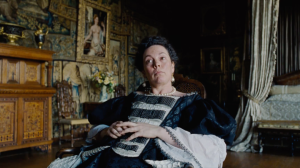 This is a movie that does not work without a distinct vision, sure handed direction, and pitch-perfect acting, all seamlessly working in tandem to create such a finely crafted dark comedy that can go in many perversely entertaining directions at a moment’s notice. Lanthimos and his cadre of award-worthy actresses have great, prankish fun playing dress up in their fancy locations and making a costume drama with a dash of anarchic farce. The Favourite doesn’t quite rise to the top of my own list of Lanthimos favorites (I’d probably rank it a noble third) but it’s still a razor-sharp, sardonic, unpredictable, and wonderfully, vibrantly weird movie worth celebrating.
Nate’s Grade: A
Share this:

Bohemian Rhapsody (2018)
 Biopics are trickier than they appear because how best can you distill the essence, and significance, of a person into two hours? We’ve edged away from the standard cradle-to-grave biopics more in favor of stories that hinge on monumental moments in a person’s life, meant to encapsulate their life both in micro and macro. Bohemian Rhapsody favors the former approach, which causes the movie to feel like it’s rushing through the cornerstones of Queen singer Freddie Mercury’s life. Even at over two hours, the movie feels like it has little time for things, often jumping into polished, well-edited montages of time progression. The creative birth of many of the band’s hits are treated as absurdly easy formations, going from a clap of hands and stomp of feet to “We Will Rock you,” or a bass line to “Another One Bites the Dust.” It’s like the movie is checking boxes for a biopic with an anxious eye toward the clock. Mercury’s homosexuality (he comes out as bisexual to his long-time girlfriend who corrects him and calls him gay) is given its due, not having been underplayed in an effort to court a more mainstream audience. Mercury’s sense of sexuality, and the struggle of his own acceptance, is essential to getting to know this flamboyant front man. Except several of these scenes feel mishandled, which is odd considering director Bryan Singer (X-Men) has often found parallels in big studio films for the gay experience. The movie seems to say if his band mates had only accepted him more then maybe he wouldn’t have fallen into promiscuity by a bad influence and thus contracted HIV. There are also some pat answers as well like a disapproving father. However, the faults of Bohemian Rhapsody are compensated by its virtues, none more so than the electric performance by Rami Malek (TV’s Mr. Robot) as Mercury. The actor struts and preens with infectious charisma, and a mouth full of Mercury’s oversized choppers, and he miraculously captures the powerful stage magic of his character. The concluding 1985 Live Aid performance is astounding to witness and a reflection of just how essential and virtuosic Mercury and company were as live performers. It’s a sustained set of several hits and the movie just sings to a close on the highest of high notes. Bohemian Rhapsody is carried by the music and performance of Mercury the character and Malek the actor. It will make you want to rock out to Queen on the car ride home.
Nate’s Grade: B-
Share this:

Can You Ever Forgive Me? (2018)
 Melissa McCarthy adopts the Oscar bait route of pre-approved credibility, which usually means playing a tragic, self-destructive real-life figure, stripping away any sense of vanity, and working with an up-and-coming indie film director (Diary of a Teenage Girl‘s Marielle Heller). The recipe is alive and well in the consistently entertaining, but only for so far, Can You Ever Forgive Me? which traces the life of literary author Lee Israel, a biographer who nobody wants to read, that is, until she starts “discovering” lost letters from the likes of Noel Coward, Dorothy Parker, and other famous authors. In total, Israel forged 400 letters and sold them to private collectors and archivists until the FBI charged her with fraud. Because of the relatively low-stakes nature of her accidental jaunt into criminality, the “how” is less interesting than the budding friendship formed between Israel and a malcontent bawdy barfly/partner in crime (Richard E. Grant). Their rapport is wonderful and they truly seem to be having a ball with their ill-gotten gains, yet they still maintain a vulnerability even to the very end. In many ways this film does for McCarthy and her standard barrage of caustic, anti-social characters what Punch-Drunk Love did for the Adam Sandler introverted goofball sad-sack barely concealing his explosive rage. It’s a grounded deconstruction on that familiar movie archetype we’ve seen from a popular comic actor. There are some interesting aspects about Israel’s lonely life, like a timid female bookshop owner who circles around a potential romance with Israel, but it’s really a two-hander of a movie between Grant and McCarthy. Can You Ever Forgive Me? is a slight character-driven drama with comedic elements, but McCarthy shows that she has the acting chops to play multi-faceted characters in any genre if given the right opportunity.
Nate’s Grade: B
Share this:

Molly’s Game (2017)/ Call Me By Your Name (2017)
 Two new awards-caliber film releases couldn’t be more different. One of hyper-literate in a high-stakes world of drama, gambling, and crime, and another is somber, lackadaisical, and personal, chronicling a summer love that changed lives. One movie has scads of plotting it zooms through with high-powered visuals and voice over, and another luxuriates in the moment, a placidity on the surface interrupted by rising passions. One of these movies I found captivating and the other I found perfectly nice but unremarkable.
Molly’s Game is Aaron Sorkin’s directorial debut, clearly having studied at the altar of David Fincher, and he packs a lot into his 140 minutes chronicling the rise and fall of Molly Bloom (Jessica Chastain), a former Olympic hopeful who found herself running an expensive, private series of poker games. She’s drawn into an unfamiliar world and through her tenacious grit, preparation, and fortitude, she is able to become a fixture amongst the rich. Then the FBI comes knocking and wants to charge her in conjunction with being part of a Russian money laundering operation. Driven by a fierce performance from Chastain, Molly’s Game is a gloriously entertaining movie that glides by. It burns through so much plot so quickly, so much information, that you feel like you might have downloaded Bloom’s book while watching. The musical Sorkin dialogue has never sounded better than through the chagrined, take-no-prisoners Chastain. The snappy dialogue pops, the characters are richly realized, and even during its more outlandish moments, like a surprise paternal reunion therapy session, Sorkin packs multiple movies of entertainment in one brisk, excellently manicured production.
 In contrast, Call Me By Your Name is a slower peak into the discovery of romantic feelings between 17-year-old Elio (Timothee Chalamet) and grad student Oliver (Armie Hammer). Set amid the sunny countryside of northern Italy, the film takes it sweet time establishing the lazy world of its characters and their closely intersecting orbits. I became anxious because the characters kept me at arm’s length, leaving their burgeoning romance to feel distant and tame. I understand the hesitation of both parties and the age difference complicating matters. I understand caution. But it feels like the film is cautious to a fault, to the point that one of them laments later why they wasted so much time. The acting is pleasant if undistinguished. The best scene is a terrific monologue by Michael Stuhlbarg as the world’s most lovably accepting father. For an earth-shattering romance, I too often felt unmoved and restless. If we’re going to spend this much time hanging out with these people we should get to know them more intimately, and not just in the physical sense. I missed the compelling artistic charge of something like a Moonlight. I’m a bit stupefied at all the praise heaped upon Call Me By Your Name, a fine indie drama that, for me, too infrequently delves below its pretty surface into something more substantial.
I don’t know if this recent comparison sheds light on any personal insight, but perhaps I just love big, showy, obvious plot that calls attention to itself, with characters that fill a room, rather than an airy romance that moves at the speed of its own breeze. Anyway you have it, one of these movies makes my Best Of list and the other just makes me shrug.
Nate’s Grades:
Molly’s Game: A-
Call Me By Your Name: B-
Share this:

Below Her Mouth (2017)
 It feels like the Below Her Mouth filmmakers watched Blue is the Warmest Color and its lengthy, explicit sex scenes and said, “Lesbians don’t have sex like that. There’s way too much scissoring,” and then decided to make their own Blue-style lesbian romance to showcase the frank reality denied to mass audiences. Well, the explicit sex scenes in Below Her Mouth definitely feel more realistic, and they don’t involve even one act of scissoring (just about everything else though). However, they kept the breathy, graphic sex and left behind everything else that made Blue such a phenomenal movie, namely complex characters, an emotionally engaging story, and genuine reasons why these two star-crossed lesbians would be drawn to one another besides the purely physical. To put it simply, Below Her Mouth is inelegant soft-core porn dolled up in indie film dross.
Jasmine (Natalie Krill) is a fashion magazine editor and engaged to her long-time boyfriend, Rile (Sebastian Pigott). Her life is privileged and wealthy but missing passion. This is awakened when she bumps into Dallas (Erika Linder), a love-em-and-leave-em lesbian. Something awakens within Jasmine, who can’t stop thinking of that chance encounter. She climaxes under the running faucet of her bathtub while listening to Dallas work atop a roof, nailing shingles. With Rile conveniently on business, Jasmine agrees to go out for a night with Dallas. They can barely keep their hands off one another, even against the exterior wall of a dirty alley. The two lose themselves in one another for days. Rile accidentally walks in on their activities and Jasmine must decide whom she truly wants.
 Since the vivid sex scenes are grabbing all the publicity, let’s discuss them first. Whether it’s a masturbation scene, sex scene, or stripper lapdance, there’s generally something every ten minutes like clockwork, and that’s not even counting the casual nudity of the actors. The lovers get together at the half-hour mark and from there almost half of the next 30 minutes is some variation of the above (I clocked it). So there’s quantity but is there quality? Is the sex erotic? There is a ferocious carnality to it that radiates through the screen and it’s magnified by the kinship of Krill and Linder. They may not be the best actors but they can sell the earthly pleasures like pros. There are multiple instances of the use of a strap-on, which from what I’m told by my lesbian friends is far more prevalent than repeated hard-core scissoring. The sex is lengthy, sweaty, and explicit. I’m fairly certain at one point you see Krill’s inner labia (the movie is unrated, to the surprise of no one). If you’re here for the sex, you’ll leave fairly satisfied.
On the other hand, if you’re here for any other reason or curiosity, Below Her Mouth will leave you cold and indifferent. Because there’s so much sexual congress there’s very little time to get to know either character. Jasmine had a lesbian experience when she was younger that she never got closure from. Dallas has been a “tomboy,” a term she hates, all her life and identified as more masculine than feminine. She also has commitment issues. That’s about it. Neither of those back-stories is worthy of a deep-dive exploration. Without better understanding of the romantic pair we have further trouble identifying why exactly they would fall in love. Blue is the Warmest Color was three hours and explained in great detail why its characters would be attracted to one another and what would ultimately drive them apart. They came across as living, breathing, complicated, flawed, and achingly human characters. The sex in that movie was a bonus to a rich and heartbreaking character study. Jasmine and Dallas exist as ciphers that only exist to lust for one another. These are not interesting people and I think director April Mullen must have realized this. I would feel more passion if I felt more for these people. Even the character names sound soft-core-ish, and that includes Rile, a name I’ve never heard before in my life (#11,580 most popular name according to Baby Center.com).
The dialogue includes some doozies that might just take your breath away, further hampering any connection or engagement with the characters. There are the pseudo-intellectual, laughably poetic lines like, “Have you ever tried to count how many breaths you take in a minute?” There are the clunky, on-the-nose declarations like, “Even inanimate objects aren’t safe from you.” But I think the winner for most groan inducing goes to Dallas’ bit of nonsensical introspection: “I have no emotional stamina for intimacy.” If someone ever says something like that, walk in the other direction.
 The acting by our lead couple is rather stilted and unconvincing. I feel like the filmmakers just needed semi-competent actresses that would feel comfortable with the demands of the roles. Linder is a Swedish model making her film debut and she has many roles to go before she becomes comfortable with this whole acting thing. And yet she has a presence that draws you in; perhaps it’s the hunger in her eyes. Krill conversely has a lengthy resume of Canadian TV appearances (Rookie Blue, Wynona Earp). She’s far too emotionally aloof. That could be an acting choice to communicate her character’s funk, but even when she starts to light up from increased interaction with her sweetheart, Krill is flat. I was impressed with Krill’s abs and command of pelvic thrusting, for what it’s worth. Suffice to say both actresses are at their best during their love scenes. I thought the best actor was Dallas’ last ex-girlfriend, Joselyn (Mayko Nguyen, also of Rookie Blue, Killjoys), who has to reconcile that the woman she’s in love with cannot return her feelings. Hers was a character that had the most dramatic potential as presented.
Let’s get to a better question, which is whether or not simply being an erotic escape is enough to justify the film’s validity. Below Her Mouth is one of the few films to have an entirely female-lead crew, which lends it greater credibility with the handling of the subject matter. If you’re looking for a steamy way to pass 85 or so minutes, Below Her Mouth will definitely deliver some desired sensations. There is obvious merit to telling the stories of minority groups that have infrequently seen themselves represented on the big screen with care and normalizing their everyday lives and challenges. The 90s was an explosion of quirky, sexy lesbian indies, mainly rom-coms (Better than Chocolate, Go Fish, Show Me Love, The Incredibly True Adventures of Two Girls in Love). While those movies broke ground in their own ways with gay voices, they also had the essential elements of story and character and didn’t rely upon a gimmick. People do go to the movies to feel turned on, but if you’re only there to watch the sexy parts, then the characters aren’t people so much as sexual objects for your personal gratification. If the sole purpose of a movie is to titillate then I think you’re in the realm of high-minded pornography. It feels like Below Her Mouth was made for the disposable consumption of the horny. This is a movie that’s only ever skin deep.
Nate’s Grade: C-
Share this:

Moonlight (2016)
 What Moonlight achieves is both something different and familiar and amounts to nothing less than watching the birth of human identity on screen. The film chronicles three formative experiences at three different times of a man’s life, each serving as its own one-act play examining our protagonist and his tortured sense of self. The results are breathtaking and deeply immersive, allowing the formation of a human being to take place before your eyes in such magnificent artistic strokes. This is a sensitive, sincere, beautiful movie that serves as an indie coming-of-age tale sliced into three significant parts. I was completely under its sway within ten minutes, finding its perceptive perspective and nuances to be convincingly naturalistic. I felt like I was watching a documentary of a young black man’s life told with ferocious realism, or at least a loosely fictionalized version of a life informed by fully authentic personal experiences. It’s a somewhat ineffable quality for slice-of-life movies but they live or die on whether the film carries an unforced sense of realism, telling larger truths with small details, each piece coming together to make the world and the character feel fully formed. Moonlight pulls you immediately into its orbit thanks to its authentic drama and observations.
The three segments compliment one another as they build toward a young black man’s understanding of his homosexuality. We’ve seen movies before where characters undergo sexual awakenings and from gay perspectives; it’s practically a cottage industry unto itself in independent film. However, rarely have we seen this story from people of color. The expectations of accepted masculinity are entrenched at a young age, where “Little” (Alex Hibbert) is chided by, among others, his own mother Paula (Naomie Harris) for the “swishy” way he walks. It goes without saying that being gay is not exactly widely accepted in the Miami projects of the 1980s. This conflict of what makes a man is wonderfully symbolized with Juan (Mahershala Ali), an unexpected father figure that takes “Little” under his wing along with his girlfriend, Teresa (Janelle Monae). The kid wants to know how he can know if he’s gay because it’s certainly something he doesn’t want. Juan doesn’t pressure the boy or make big speeches about what it means to be a young black man in America. Instead, he tries teaching him to accept himself and provides an alternative home that serves as a refuge during his mother’s long absences and crack-withdrawal tirades. There’s a lovely moment where Juan teaches “Little” how to swim, and it’s touching in how recognizably father/son the activity is, how much trust is involved and vulnerability, and how the film doesn’t need to oversell the subtext. Juan definitely becomes the father figure that Chiron lives up to for the rest of his life. This first segment is dominated by their relationship but also Juan’s sense of responsibility. He’s making a living through selling drugs, including to “Little”’s own mother. In a very memorable and heated moment, Paula angrily calls out Juan for thinking he would make a better parent given the moral culpability of his own actions to her habit.
 The second segment zooms ahead to when Chiron (Ashton Sanders) is a teenager in high school and subjected to hostile bullying. The schoolyard taunts from his youth have morphed into something more ferocious and toxic, as a collection of bullies torments Chiron and looks to rob him of his personal connections to others. The central focus on the middle segment is about the growing relationship with Kevin (Jharrel Jerome), the childhood friend who Chrion crushes on. Their closeness takes a leap one fateful night that Chrion will always remember. It’s an awakening and a confirmation of self, and it’s only after having this fulfilling outlet cruelly taken from him that Chiron finally lashes out, with lifelong repercussions. It’s an explosion we can see coming and one that feels fully set up. The second segment feels more familiar because of the age range and it’s the one with the dawning of sexual realization, a story situation we’ve seen before. What elevates it is that it’s a fairly direct carryover from the beginning segment, which means the personal issues have magnified for Chiron. His relationship with his mother has become even more frayed as he’s grown, and what once was name-calling and questions over his maturation has become confirmed. Her addiction has become even stronger and she’s harassing her own son for whatever meager money he’s given from Teresa, his surrogate mother figure. Chiron is struggling to make sense of his feelings in an upbringing lacking support and clarity. You could examine the conclusion of this segment as an empathetic cautionary tale, as we see the years of abuse and measured choices that lead to that confrontation.
The final segment is where Moonlight transforms into a late blooming unrequited romance that should steal your heart if it’s still functioning. “Black” (Trevanta Rhodes) is a fully-grown adult that has seemingly followed in the footsteps of Juan in a life of low-level crime. He’s hardened both emotionally and physically. The muscles will provide an intimidation factor missing during his youth if anyone questions his sexual leanings. He’s burrowed into himself and the role he feels he must accept, but all of that changes the instant he gets an apologetic and searching phone call from Kevin (Andre Holland). Now working as a chef at a diner, Kevin reaches out to his old friend though even he can’t fully explain why. This reawakens “Black”’s longing and he works up the courage to travel back to Miami to surprise the friend who meant so much to him. Their reunion is treated like the culmination of a romance that you may not have realized had you completely. After two segments of setup and years apart, you may find yourself projecting your thoughts to the screen, trying to compel these two men together. It’s an extended sequence that moves at a gradual pace, a fitting tempo for a character racked by insecurities and suppression. By going forward he’s taking a big risk, putting himself out there, and we desperately hope “Black” finds a sense of support. It’s the segment where “Black” finds resolution with the major conflicts that have defined his life, and the climax of the movie is a deeply tender moment where an emotionally reserved man reaches out to another and lets his firmly fixed guard down in the process.
 I don’t usually go into such a detailed plot synopsis with my reviews because I like to hit the basics and let the readers experience the story for themselves, but the pleasures and artistic triumphs of Moonlight are in how fully immersed and felt the movie becomes. By telling the story in three noteworthy sections, Moonlight provides an impressionistic statement about the formation of personal identity, specifically a young man growing up black and gay in a hostile environment to both. The movie also blows apart the argument made for 2014’s Boyhood about how truly necessary it was to watch one young actor play the same part for 14 years. Here we have six different actors playing two different characters at three different points in time and the impact is no less great. Here is a movie that doesn’t need a gimmick to have a larger emotional impact on its audience.
Director/co-writer Barry Jenkins has a marvelously fluid and natural feel for his camera, swinging around the parameters of a scene to make the world feel more charged with energy. Jenkins is a born filmmaker and knows how to squeeze the most out of his scenes with gorgeous cinematography and an eclectic musical score that feels traditional with classical orchestration like churning strings layered and rearranged into something arrestingly new and yet still personal. There aren’t many overly stylized choices, rather Jenkins tells his story with uncommon poise and treats one man’s life like an opera, like the greatest story never told on film, like a life of complexity worth the deep dive. There’s a classical lyricism to the presentation that reminded me of the works of Todd Haynes (Carol). There’s one scene where Paula is strung out on crack and finds her son in the middle of a joyous high. Her face fills the frame, absorbing all of Chiron’s world, and her euphoria is inter-spliced with jarring speed ramps in editing, meant to convey the mania and peace that pumps through her veins in this fleeting moment. It’s a stylistic device that isn’t overplayed and has genuine purpose. Jenkins is restrained from self-indulgences and keeps every aspect focused on reflecting the inner life of his lead.
The very talented company of performers makes the movie even more powerful. Ali (Hidden Figures, Luke Cage) is creating serious awards buzz and it’s deserving, though every actor in this movie is deserving of notoriety. Ali plays a man trying to do right by his own sense and he lets you see the troubles that wash over him. Should he insert himself into this young boy’s life? Is he in a position to set an example? Ali has such paternal strength and tenderness while still displaying doubts and regret, hardly deifying this found father figure. Harris (Spectre) is wonderfully horrifying and heartbreaking in her role and has some big moments that convey her given completely into desperation. She’s offended that others would deign replace her but does little to reclaim her title of mother and provider. Holland (Selma) has a world-weary smooth sense of wisdom to him, and his unassuming charisma helps unlock his friend’s true feelings. The three actors who portray “Little”/Chiron/”Black” are each exceptional, giving different performances and interpretations, further supporting Jenkins’ artistic thesis.
 Moonlight is a beautiful film told with such delicate care and a resounding sense of authenticity and personal detail. It swallows you whole and leaves you with the impression of a human life observed with tenderness, intimacy, empathy, and grace. It’s about the people and experiences that help guide us onto the paths we take, and while there’s a sense of heartache as we think of what might have been, there’s also the serenity of accepting what has been and what can still be. Jenkins proves himself a superb talent who doesn’t lose sight of his artistic goals with extraneous artifice. There’s a lilting, lovely lyricism to the movie that elevates Chiron’s life into feeling like poetry. This is a life we so rarely get to see given such an artistic and honest examination without condemnation or judgment. It’s the story of a man embracing his identity and overcoming isolation and suppression. This disadvantaged young man is worth your emotions, your sympathies, and your attention. Moonlight is an alluring and heartrending film that manages to be deeply personal and universal at the same time. It’s sublime.
Nate’s Grade: A
Share this:

The Handmaiden (2016)
 I’m glad there’s still a filmmaker at the talent level of director Park Chan-wook (Oldboy) dedicated to making genuine Gothic romance with style and reverence. The Handmaiden is a ravishing, enrapturing, and momentously engaging movie with dark delights, startling depths, palpable romance, simmering tension, and high-wire twists and turns that keep redefining the story. The absurdly talented filmmaker takes a novel set in Victorian England and adapts the setting to 1930s Korea during the time of Japanese occupation, a fascinating and little-known time period for a Western audience. A poor orphan Sook-Hee (Tae-ri Kim) is pressured into a scheme to trick the wealthy Lady Hideko (Min-hee Kim) into being admitted to an insane asylum, her family riches sold. From the opening minutes, The Handmaiden produces immersive drama that pushes the central characters into consistent conflict to achieve their varying goals. They’re constantly at odds with one another and themselves. There’s even tension between those who hold onto their Korean culture and those who adopt the culture of their oppressors, namely Lady Hideko’s perverse and treacherous uncle. Sook-Hee grows an unexpected affection for her mistress, and this includes a burgeoning attraction that the movie communicates with serious sensuality. The passionate lesbian sex scenes are, if anything, a tad restrained from what I was expecting from Chan-wook, and they’re definitely far more restrained and absent the male gaze than the still excellent Blue is the Warmest Color. I felt the same carnal desire the characters were discovering, a feat worth celebrating for still staying true tonally without veering into tawdry exploitation. More than the sex or the top-notch technical aspects, it was the characters that hooked me and refuse to relinquish. The deepening relationships and the subtle shifts of loyalty, perception, and desire make what is essentially a twisty and twisted chamber-play into world-class drama. You think it’s one kind of movie, and then it flips the script, and then it does it again, each time opening wider this mysterious, dangerous, and invigorating world. My one quibble is that the final twenty minutes feels unnecessary and self-indulgent, Chan-wook finally scratching a few violent tendencies he had been keeping as veiled up to that point. The Handmaiden is a ridiculously entertaining movie that is handsomely mounted, wonderfully acted by its leading ladies, and a romance worth losing your self over. Plus, there’s also the sex.
Nate’s Grade: A-
Share this:

Carol (2015)
 Have you ever watched a movie that was so understated you wanted to jump into the onscreen world and push the characters around? That’s exactly how I felt with Carol, an unrequited lesbian romance set against the closeted and intolerant era of 1950s America. Carol (Cate Blanchett) is a rich wife who meets Therese (Rooney Mara), a department store employee who assists with her Christmas shopping. They are both drawn to one another in the strange way that love works, and their possible relationship could jeopardize Carol’s custody of her young child. Because of the time period, so much of this romantic liaison is internalized and thus we get longing looks, small gestures that are meant to speak volumes, and plenty of starting and stopping, leaving the audience to fill in the blanks. I don’t have an issue with unrequited romances but Carol is one that feels like its entire world, painstakingly recreated, has been placed under glass for study. There’s no passion evident throughout the movie and I was left wondering what exactly Therese saw in Carol and vice versa. Neither woman has a particularly strong personality, though that could be a side effect of having to live publicly as a different person. I couldn’t get into them as characters and so felt little interest in seeing them together, which made the constant circling and nervous indecision even more belabored. Blanchett and Mara are quite good and director Todd Haynes (I’m Not There) handles the material with respectful subtlety, I just wish that Carol could have shaken off some of that subtlety and given me a better reason to care about these women. It’s understated to death.
Nate’s Grade: C+
Share this:

Blue is the Warmest Color (2013)
 The French drama Blue is the Warmest Color has been bathed in publicity and controversy ever since its debut at the prestigious Cannes Film Festival. It’s a three-hour lesbian romance about sexual awakening and finding a deep human connection, but all anyone wanted to talk about was the graphic sex. The drama split audiences down the middle, with people like Steven Spielberg praising its unflinching examination on the craving and heartache of young love, and others like New York Times film critic Manohla Dargis called the director/writer Abdellatif Kechiche “oblivious to real women.” It’s an impressive film, a rapturous love story for the twenty-first century that defies swift categorization. This isn’t just a gay film. This isn’t just a romance. This is a highly relatable, appealing, and heartbreaking movie of the first-order; however, both the defenders and detractors of Blue have substantial merits to their claims.
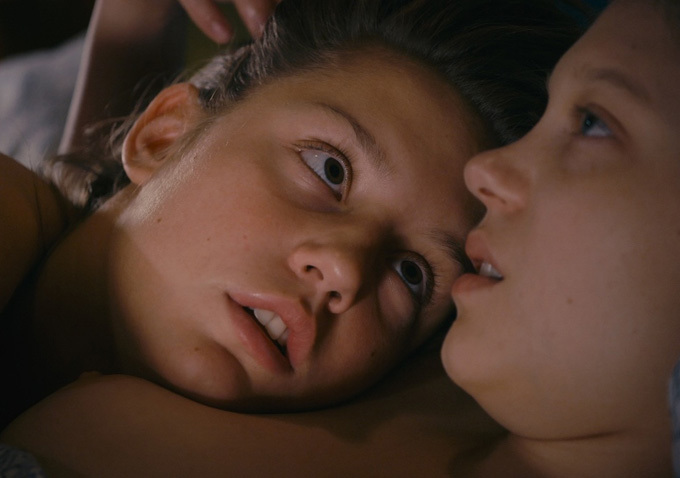
Adele (Adele Exarchopoulos) is a normal 17-year old girl trying to gather a sense of her self. Her peers are pressuring her to lose her virginity with a popular guy, but it’s another person, a mysterious blue-haired lass, that Adele can’t stop thinking about. This woman, the somewhat older Emma (Lea Seydoux) is an art student and an out lesbian. One night, Adele follows her into a lesbian bar and they strike up a friendship, one that quickly translates into something more romantic. Over the rest of the movie, we cover several years of Adele and Emma’s lives together and learn that each has left an indelible mark on the other, for good and bad.
 Let’s tackle the portion that’s gotten the most coverage in the media, the graphic sex sequences that earned the film the rare stateside NC-17 rating. You may have thought 2011’s sex addict drama, Shame, earned its NC-17 rating, but Blue trounces it. Short of unsimulated sex scenes in movies like Shortbus and 9 Songs, I doubt many audience members have experienced sex sequences this explicit and this lengthy (you may start checking your watch at some point). At its Cannes premier, the critical response breathlessly hyped a sexual encounter that went on for 18 minutes. That number may be the total onscreen copulation time; the longest sex scene is seven minutes or so, but you do feel the vigorous extension. Is there a particular reason the steamy sex scenes needed to be this long or this graphic? Kechiche likely wanted to communicate an explosion of immeasurable passion unlike anything Emma or Adele will experience in their lives. But did this need to be communicated with seven minutes of orgasmic fingers, lips, and tongues exploring every crevice of their bodies? Would six minutes of enthusiastic sex prove insufficient? I’d be a hypocrite if I said I found little entertainment in watching. I just don’t think the film demanded as much drawn out sex when the drama is this strong.
And that’s the mass appeal blurb when it comes to Blue is the Warmest Color: come for the intensity of the sex, stay for the intensity of the feelings. You will swiftly feel the nervousness and sexual tension that comes from the exploration of attraction. All those high school butterflies come fluttering back. The depth of feeling is easily relatable. The characters are searching for unparalleled human connection but also discovering more about who they are. This is a moving, absorbing, and crushing love story, but it’s just as much about two people falling out of love. That was a major surprise for me. What’s more is that the forces behind their breakup are completely understandable and you can see them coming; at heart, they are two different people that operate in different worlds, and they do change over time. That’s excellent storytelling when one can feel for both sides of a breakup, comprehend how this moment arrived, and looking back, see how inevitable a conflict like this would be. Emma’s sphere of friends is one that Adele does not feel a comfortable place within. Emma worries that Adele needs to find a sense of identity outside their relationship. Adele is still too timid to admit the truth about her relationship with a woman to her colleagues and family. These are major conflicts and they simmer and gestate in ways that feel like real life. Beyond some of the specifics in the bedroom (more on that later), there isn’t a moment that feels unbelievable in the entire three hours. This is a naturalistic love story that unfolds in small waves, allowing us to get to know the characters and their lives.
 The two actresses are outstanding and bare much more than their flesh for this film. Exarchopoulos and Seydoux disappear into their characters. These are richly developed characters, and each actress does her best to bring them to startling life. Exachopoulos (who looks like a Parisian Maggie Grace) has so much of the film riding on her 19-year-old shoulders since her character is the film’s major point of view; we often see the world through her perspective. She’s excellent as the curious, anxious, bashful young woman, and her encounters with Emma open her world up, allowing Adele to broaden as a person. She’s still not confidant, given to doubts that Emma seems to lack, but Exarchopoulos convinces you of the difference. Every step along her journey is credible, acted with poise, even the uncontrolled weeping. In a just world, this French newcomer would be up for serious acting award consideration. Seydoux is the more assured character, the one who sizes up her interest, but when hurt, the ferocity of Emma’s fury is staggering. This is not a woman to scorn, and Adele will learn this the hard way. Later in the film, as the history hangs in the air between Emma and Adele, we get a powerful sense of how conflicted both women are, having never turned off their feelings but trapped by circumstance and consequences. You feel each member cycle through the myriad of emotions, fumbling between desire and desperation. The actresses work together beautifully, raising one another’s performance, and giving one another the environment to get truly intimate, emotionally and physically.
The film is more a representation of a man’s fantasy of lesbian sex. The male gaze, a term referred to often in feminist film criticism, is trenchant in this film. Kechiche’s camera doesn’t just love his two young stars; it fawns over them, lusts over them. The camera is always within inches of Adele’s face, glued to tight shots lingering over Exarchopoulos’s pouty lips. Seriously, the actress has her mouth open the entire movie, her lips forever pillowy, forever pouting. It’s a sensual movie, yes, but does every shot of young Adele need to be so tawny and voyeuristic, her hair always slightly askew in her face, her body positioned just so that her assets are featured? Critics like Dargis are correct about Kechiche’s fawning camera pushing over into the boundary of erotic fetishism. This is where my questioning of sexual positioning comes back; going ass backwards when it comes to cunnilingus (and yes, I will intend that pun) is aesthetically pleasing in a sensuous manner, and that feels like the dictum of Kechiche’s intimate camerawork. It’s heterosexual male pleasure represented on screen, at least in its depiction. Otherwise, with the camera always tethered inches away from Adele’s face, why don’t we remain focused on her face during all this physical pleasure? It can be just as erotic. However, with all that out there, why can’t lesbian sex be given the same ridiculous fantasy depictions of heterosexual sex in the movies? I can almost guarantee that pool tables are not a prime location for indulging one’s urges. And just showcasing lesbian sex onscreen between a committed couple (not just girl-on-girl flings like in Black Swan) and normalizing it, whatever intention, is a virtue.
 But it’s not just the sex scenes that could use some judicious snipping; the entire three-hour enterprise could be easily consolidated. The film is replete with loping scenes that sort of drift along, recreating the ordinary rhythms of life rather than the plot beat connect-the-dots we associate with most film narratives. That’s fine, you need time to establish characters and setting, but do we need people interpreting poetry at length and indulging in gender philosophy for minutes on end? Perhaps if I watched Blue is the Warmest Color a second time I’d be more tolerable of the narrative bloat, finding added subtext and metaphor to all those ponderous philosophical discussions over the nature of the self and gender identity. Of course seeing a three-hour movie, again, is going to take a significant time commitment.
Sensual throughout, beautifully developed, richly observed, and brought to life with bristling and audacious acting, Blue is the Warmest Color is a love story that hits hard with emotional force. By nicely realizing the characters, providing them depth and fallibility, we can empathize with them along the different stops of their romantic journey, seeing where each is coming from and understanding the yearning, frustration, and passion. When things are good, there’s a frisson on screen, a palpable sense of desire accentuated by Kechiche’s loving (and occasionally obsessive/fetishized) camerawork. The acting by Exarchopoulos and Seydoux is as raw and fevered as their onscreen lovemaking. I doubt it needed to be a full three hours long, and I doubt the notorious NC-17-earning sex scenes needed to be as graphic to communicate delight, but I’m most pleased that Blue is offering a full movegoing experience, watching the formation of two characters over time and how they change. It’s easily watchable even during its more ponderous, dare I say French-y, sidesteps. The ending is a slight misstep, calling out for greater certainty, but the French title for the film was, Adele: Chapters 1 & 2, the implication being there may be future cinematic adventures that await these people. I don’t know if this will ever come to fruition considering the original graphic novel by Julie Maroh is a mere 160 pages, rather shrift considering the medium, but I can hope. Romances this involving, observant, and intense don’t come around too often and deserve to be cherished. Just consider the sex a bonus.
Nate’s Grade: A


You must be logged in to post a comment.