Blog Archives
Pacific Rim: Uprising (2018)
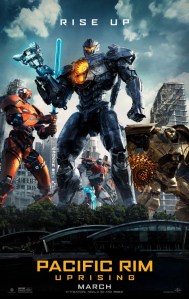 The original Pacific Rim brought out my inner child with its gee-whiz spectacle of giant robots fighting giant monsters, and under the artistic vision of Guillermo del Toro. I was eager for a sequel, as was my inner child. Thanks to China, a sequel was granted, though del Toro left to go win Best Director and Best Picture at the Oscars. The new director replacing del Toro, Steven S. DeKnight, came to fame on shows like Buffy the Vampire Slayer, Spartacus, and Netflix’s Daredevil. DeKnight acquits himself well in a world of big-budgets and big worlds, and while Pacific Rim Uprising is definitely lesser than the original, it’s still a whole lot of fun. John Boyega (The Last Jedi) leads the way as the son of Idris Elba’s character. It’s been ten years since the events of the first film and humanity is considering replacing Jaeger pilots with more cost-efficient drones. Then a rogue Jaeger starts attacking the remnants of the fleet, and Boyega and a scrappy pre-teen girl have to team up with a bunch of other Jaeger recruits to save the day. Where the first Pacific Rim rode the wave carefully to find a middle ground between cheese and awe, this time the movie swerves far more into cheese. Stuff gets silly, but if you can’t abide a little silliness then what are you doing watching this movie? The mythology and world building deepen, building off the last film, and they even supply a motivation for the aliens. It does feel at times like a pilot for a TV series, Jaeger Academy, and oddly the plot seems to follow Independence Day 2, Iron Man 2, Ender’s Game, and then ends right back with Independence Day 2’s closing sales pitch for a sequel that was never destined to be. Boyega has a fine reserve of charm and much is asked of him since the remaining characters are pretty slight. The action takes place almost entirely in daylight, a positive change from the original. The monsters don’t appear until the final act, which is not a positive change. It’s fun, goofy, and entertaining in the way that Saturday morning cartoons of your youth were entertaining. Uprising probably won’t be saved by China this time, but if you’re a fan of the first I have to think you’ll still enjoy the sequel.
Nate’s Grade: B-
Share this:

Ready Player One (2018)
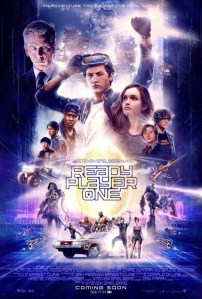 Ready Player One was a best-selling book that established a future world built upon the pop-culture artifacts of the 1980s, a future that celebrates and looks back to the past, to a halcyon childhood of classic and not-so-classic video games, movies, comics, and music. It was no surprise that author Ernest Cline’s novel would become a success, as we’ve been in a full-blown 80s nostalgic renaissance for quite some time now. When living legend Steven Spielberg got aboard as director, it seemed like fate. As a non-reader, my worry was could the big-budget, Hollywood version of this movie, lead by a Hollywood master, be more than the sum of its parts, more than the nostalgia and pop-culture references? I feared the finished product would be Avatar meets VH1’s I Love the 80s (“Hey, remember that thing? We do too.”). My fears were overblown, but then so is Ready Player One a bit, an entertaining vision that glides by with little else but vigor.
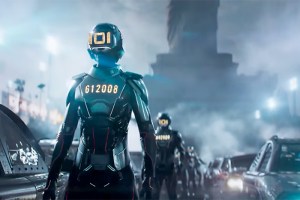
In the future, most of humanity spends their days living out fantasies and dreams in the Oasis, a virtual reality hub with different worlds, games, and features, allowing players to design their own avatars and their own adventures. The Oasis was created by Halliday (Mark Rylance), a reclusive genius who also programmed a contest upon his death. Whoever finds three hidden keys would win ownership of the Oasis. Wade (Tye Sheridan) is a regular kid living in Columbus, Ohio (woot, represent!) but when he’s in the VR world he’s Parzival, a more confident and assertive player. He’s fascinated and intimidated by Artemis (Olivia Cooke), a fierce competitor who brushes aside others. Together they team up to thwart the evil corporation IOI (Innovative Online Industries) run by Sorrento (Ben Mendelsohn). They want to own the Oasis, riddle it with ads and product placement, and restrict the freedoms to a lucrative caste system. Parzival and Artemis must find the keys, stay ahead of IOI and their team of super players, and hide their real-world identities before they can be unplugged one way or another.
 Ready Player One is a first-rate action spectacle from one of cinema’s masters of spectacle. Spielberg unleashes his incredible imagination with the full-force of a pretend world where any thrill-seeking adventure can happen. You can feel his genuine sense of joy at getting a chance to play in such a big world where anything is possible. This is best encapsulated with a race that challenges all laws of physics and good sense. The obstacles are extreme and as the cars careen into one another, King Kong trounces the track, and various nasty surprises await, it becomes a propulsive, thrilling, and ridiculously entertaining set piece. The last time I can recall a Spielberg film feeling this downright fun, first and foremost, was perhaps 2011’s Tin Tin, an underrated adventure. Spielberg has a delightful comic touch when it comes to constructing creative and satisfying action set pieces, laying the foundation for future payoffs and complications. There’s an extended sequence where the players have to infiltrate the Overlook hotel from Stanley Kubrick’s The Shining, and it’s glorious. It’s the most sustained pop-culture reference and nostalgia point, but it actually lines up cleverly with a mission goal. The overpowering flurry of pop-culture references I was worried about never come to much more than momentary visual signifiers (“Look, he’s driving the car from Back to the Future. Look, he’s got the Holy Hand Grenade.”). You don’t need the background to enjoy the film, and the references are just a bonus for those nostalgic aficionados in-the-know. It rises above the hefty anchor of nostalgia to tell its own story on its own epic terms.
With that being said, Ready Player One is also little more than its eye-catching spectacle. There’s very little substance here to be had. The film is 140 minutes long and feels breathless, allowing nary a moment to catch contemplate, deepen the characters, or explore the outside world in greater detail. The movie is packed with expository plot beats about the inner workings of the Oasis and every time it hops to a new level it resets and we have to learn more rules and surprises. It kept me entertained, don’t get me wrong, but when you come out the other end you can look back and see little. It’s a thrill ride first and foremost but one that feels entirely ephemeral. There’s so little to hold onto that generally matters. It’s the film equivalent of fast food, a tasty jaunt but something not exactly made from the best ingredients. It even takes that’s 80s pop-culture appreciation and transforms into feeling like an 80s movie, complete with an ending where even the bad guy gets his just deserts in a comical low-stakes way. We’re watching a bunch of teenagers fight against The Man taking control of their play space and corporatizing it. That feels like the VR equivalent of, “We gotta save the rec center from those evil land developers who just don’t get the communal power of art, man.”
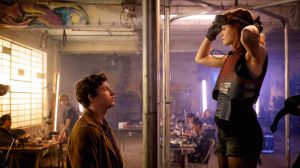
 I didn’t really get a sense of any of the characters and it felt like the “be whoever you want to be” freedom of the Oasis could have been better employed. Take for instance Artemis, who in real life is Samantha and has a blotchy birthmark on her face. I understand that she’s self-conscious about the mark but she still looks like Olivia Cooke (a pretty girl with a birth mark still looks like a pretty girl). The romantic relationship between Parzival and Artemis feels like user projection, falling for the cool, kickass gamer girl. She rightly retorts, “You think you’re in love. You don’t know me, only what I show you.” This stand for female agency regrettably melts away and Artemis/Sam fall into that familiar dance of emotions. The side characters feel more like second or third tier team members on a spy mission, offering little variance. I didn’t really get a sense of any of the central characters from a personality standpoint except for their loving appreciation of pop-culture, which is then morphed into a pop-culture artifact itself. The larger mystery of Halliday’s past regrets is rather predictable and amounts to little more than “seize the day,” which is also a pretty 80s message if you think about it.
Another aspect hampering the impact is the dire lack of stakes. As far as I can tell, the biggest loss the players experience is their in-game credits and achievements. They may have spent months or years accumulating those, but if they were to disappear there’s no real larger harm to anyone. It’s a mere inconvenience, the same thing with dying in the game. I was waiting for another step where dying in the game would translate into the real world (“You die in the game, you die for real!”). They even introduce a fancy VR suit you can wear to literally feel the action of the game, though why anyone would want to feel the pain inflicted via a video game is beyond me (the pleasure I can understand). When we watch characters fight against incredible odds, the most that’s at stake is having to regenerate at a different location and get back into battle. It makes the struggle feel less realized and certainly less substantial. It plays into the already ephemeral spectacle. I heard from my seat neighbor, who had read Cline’s novel, that (book spoilers) one of the players is killed by the evil corporation by finding out where he lives and throwing him out a building. The movie needed a moment like that. Imagine, Sorrento being confronted by Parzival and friends, and he points to one and says, we know where you live, we’re breaking down the door now. The guy turns around, hearing the sounds coming from his real-life environment. Then Sorrento gets a radio call about breaching the room and a gun is placed against the character’s head. His scream is cut short as the sound of a gunshot echoes and his avatar disappears. Then Sorrento points to the remaining players and says we know where each of you live. That scene would have raised the stakes for the final act, not to mention be a sly nod to The Matrix. Unfortunately, even when the bad guys are trying to kill people, the stakes feel small.
 I think part of the lower stakes is also because we never get a clear sense of life outside the Oasis. If just about every human being is wired into this VR world, how is all that electricity being generated to power this experience? What is the economy of this world? What do people do to subsist in their homes? Is money related to in-game achievements? These loyalty pods, which are essentially a twenty-first century debtor’s prison that profits off virtual slave labor, how are they legal? What exactly is the legal system like in this world? Also, we see people running outdoors with their VR helmets on. Won’t they run into traffic or a building or some kind of obstruction? I never understood how this world operated. Perhaps that’s the reason Spielberg spent a solid 75 percent in the Oasis, keeping our minds occupied with shiny things before we can begin to question.
Sheridan (Mud) is a handsome and likeable leading man, though he just came from another movie where he wears a visor over his eyes (X-Men: Apocalypse). He leaves enough of a favorable impression to make you wish he had more going on. The same with Cooke (Me, Earl, and the Dying Girl) who plays the spunky, spiky love interest and experienced gamer girl. It’s a role that Cooke performs nonchalantly, evoking the ethos of being enviably cool and thus desirable to legions of gamer boys. Cooke is capable of much more, as evidenced recently by her phenominal performance in Thoroughbreds, but I’m happy that she’s getting a big platform and from Spielberg too. The other castmates add a needed sense of diversity to this future world, though I was wondering why the pop-culture references were almost entirely American. Surely Halliday would have been the kind of guy that was entranced by the gee-whiz cool artifacts of other cultures like Japan. The best actor is Mendelsohn (Rouge One) who seems to be carving out a fine career in Hollywood movies as an officious middle-manager villain. He’s the right kind of slimy while still being weak at his core that fits so perfectly for these kinds of roles. Sorrento also employs a fierce female enforcer (Killjoy’s Hannah John-Karmen) with some sharp bangs who reminded me of Luv from Blade Runner 2049. Even more 80s-ness!
 With Spielberg at the helm, it feels like he’s the perfect person to bring Ready Player One to the big screen considering he’s one of the biggest progenitors of our 80s nostalgia. It’s a loving homage to pop-culture without being suffocated by the cumulative artifacts of pop-culture. It’s a rousing, imaginative adventure with some terrific special effects and stunning action set pieces. It’s an enjoyable trifle of a movie, lacking larger substance, characterization, and sustainable stakes. It feels too light, but then maybe that’s another argument for its adherence to the feel of 80s movies, where problems could be solved with dance-offs or choice montages set to Jefferson Starship. Ready Player One should delight fans of the book and even those ignorant of all its myriad references. Whether audiences cherish this alongside those keepsakes of the past is another matter.
Nate’s Grade: B
Share this:

Unsane (2018)
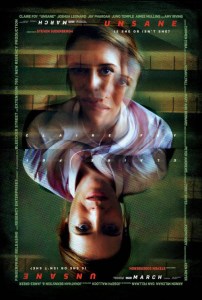 Steven Soderbergh is a restlessly experimental filmmaker who enjoys adopting new technology to tell familiar stories. Unsane was shot entirely on an iPhone (7s, if you must know) but I’ll never know the reason other than to see if it could be done. Otherwise, Unsane is Soderbergh’s woman-in-peril Lifetime movie of the week. Claire Foy (Netflix’s The Crown) plays a harried woman on the edge that accidentally commits herself to an in-patient mental hospital. That’s the best part of the movie, the first twenty minutes, as she diligently tries to convince everyone she is not crazy and there has been some sort of mistake. From there she begins seeing images of her stalker (Joshua Leonard) from another city. Is she really crazy? Is he really there? Has he followed her and gotten a job at a mental hospital and been waiting his time anticipating she would commit herself to this exact facility? The film answers this question ridiculously early and finds the most boring yet also preposterous route to go with its pedantic thrills. There’s a good concept here with the idea of a person trying to navigate the Byzantine, bureaucratic system to prove their sanity from behind bars, but it’s so poorly developed as to feel like a promising TV episode stretched thin. There simply are not enough twists and turns to keep an audience consistently engaged. Soderbergh has played in the trashy B-movie realm before with 2013’s Side Effects to much better effect. There aren’t enough credible characters to grapple onto. Foy is enjoyably incensed and erratic and keeps your attention, though I think she studied at the Kate Winslet School of American Accents. Gorgeous looking movies have been shot on cell phones, like Sean Baker’s Tangerine. This movie looks like it was shot on someone’s phone while it was dying. It looks so ugly on the big screen, flat and over-saturated in lighting, and just unappealing. It’s deeply un-cinematic and Soderbergh has the skills to do better. Unsane is un-good.
Nate’s Grade: C-
Share this:

Thoroughbreds (2018)
 Thoroughbreds is a dishy, tart little treat that kept me squirming, laughing, and gleefully entertained. Olivia Cooke (Me, Earl, and the Dying Girl) and Ana Taylor-Joy (Split) are outstanding as privileged teenagers trying to resuscitate their former friendship through collaborative murder. Cooke plays Amanda, a sociopath who cannot feel anything, who is incurably honest, and has stopped caring what others think. Taylor-Joy plays Lily, a self-involved young lady that feels overwhelmed by life and is skilled at dissembling. Together, the girls scheme to kill Lily’s boorish stepfather and enlist the aid of a hapless small-time dealer with big plans (Anton Yelchin, in his final performance) through blackmail. The story from writer/director Cory Finley is immediately engaging with how it naturally reveals the complicated histories between Amanda and Lily as well as what makes each questionable. These are two very interesting people and just watching their probing push-and-pull was entertaining enough, especially with such strong performances. The characterization of a sociopath without a heavy moral condemnation was refreshing. We assume Amanda will be the bad influence but it really becomes the other way around, with Lily faking for her own purposes. Thoroughbreds is more dread-filled and unsettling than conventional thriller, and while there are some gallows humor to be had from the abnormal characters, this is less a dark comedy. There are drawn out tracking shots and methodical push-in camera movements meant to build audience anticipation, and they’re mostly effective. The first half is a bit more engaging than what it ultimately delivers as a climax. It’s still satisfying and well handled, but Finley throws in some misdirects that don’t add a rising sense of stakes. The stakes are really more personal, which works since the crux is on the relationship between the girls and whether they are being honest or manipulative with one another. By the end, I thought I could argue either way who was manipulative and when. Small irony: the last scene you see of Yelchin is him as a valet parking other people’s cars.
Nate’s Grade: B+
Share this:

Tomb Raider (2018)
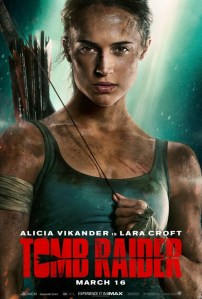
Lara Croft was best known for her exaggerated physical assets (rendered as Madonna-worthy pointed polygons) and short shorts than as any sort of character. She was realized on the big screen in 2001’s Tomb Raider as an elite physical specimen portrayed by Angelina Jolie, where the filmmakers went the added step of padding Jolie’s bosom to better reflect the source material’s image. The filmmakers literally thought this aspect would be make-or-break with fans, as if Jolie herself was not naturally vivacious enough. As you can imagine, Lara Croft was primarily seen as a sexy avatar, whether on the small screen or the big screen. This new Tomb Raider aims to better ground its story, tone, and central heroine, and it mostly succeeds. This is a solid, pleasantly enjoyable mid-tier action movie that might also qualify as the best video-game-to-film adaptation so far (sorry Uwe Boll).
Lara (Alicia Vikander) is struggling in the wake of her father’s (Dominic West) disappearance. It’s been years but she holds onto hope that dear old dad is still out there. One day, she discovers her father’s secret study and a video message he recorded confessing why he left. He’s seeking a fabled tomb on a hidden island off the coast of Japan, a tomb devoted to a powerful goddess of myth who sacrificed her admirers. Also looking for the tomb is Vogel (Walton Goggins) and a team of armed mercenaries. Lara must stay ahead of the mercenaries, find her father and the long-lost hidden tomb.

This is a Lara Croft stripped down and absent the male gaze, which has defined her travails just as much as the treasure hunting adventures. There’s not a single shot in the movie that seeks to ogle Vikander’s lean body. Even her outfit, as mentioned a staple of Croft’s early appeal, is a modest take top and khakis. The emphasis this time is on what she endures and overcomes rather than the curvature of her body. This is an attempt at an origin tale, rebooting Lara for a new generation of fans. She’s less the cool buxom sexpot with the twin pistols than a struggling young woman facing her fears. This is the first time Lara Croft has been envisioned as a character. There’s a level of broader realism that the movie holds onto, positioning this Croft as less the gun blazing super cool badass and more as a stealthy, plucky, and scrappy figure of moderate action. There are moments where she hides and moments where she runs, as they are the best recourse. She’s not imposing in her build and poise like a Gina Carano (Haywire) but Vikander’s got some serious moves. With all that in mind, let’s not get too carried away here. Lara Croft may have some extra dimensions but she’s not exactly a fully formed, three-dimensional character or boasting the kind of magnetic personality that drew us to Indiana Jones or even a Nathan Drake. She’s capable but also limited in interest and charisma.
The action is invigorating enough and given a clear scope of play. Norwegian director Roar Uthaug (The Wave) orchestrates the action in clean long shots and precise edits, allowing the audience a clear sense of what is happening. A frantic bicycle chase and foot chase in the first act are given extra vitality by a roaming camera that takes in the full view. There’s enough variety in the action and natural consequences to keep things interesting. This is a movie that doesn’t feel overpowered with CGI, even though I know it’s present. Uthaug makes a point of emphasizing practical effects and sets, which adds a further level of realism to the excitement. I’d call it a more pared down, realistic version of an action adventure but it still has outlandish set pieces like Lara finding refuge atop a crumbling WWII era bomber that just so happens to be wedged atop a rock face overlooking a steep waterfall. Even during these moments, and the last act takes place almost entirely within the ancient tomb and its traps, the movie keeps things relatively credible. It’s fun without being too flippant and serious enough without losing its sense of amusement. Tomb Raider reminded me a lot of a big-screen version of an Uncharted game, a rollicking adventure that also feels rooted in our own world, but with a hint of the supernatural creeping along the edges. The conclusion has a few nice surprises following this pattern even with the possibility of actual zombies emerging.

Vianker (The Danish Girl) acquits herself nicely in the realm of action-adventure. She gained twelve pounds of muscle and has a pretty impressive six-pack. Vikander is a smaller actress by nature but the filmmakers do a fine job of placing her in believable action scenarios that rely upon her athleticism. Her Lara is a stubbornly independent protagonist who refuses to give up, which makes her a winning force even when her personality fails to sufficiently light up the screen. Vikander hurls herself into the role, performing an impressive array of stunts, and yelping along to the genre demands.
There are some plot holes that are hard to ignore, mostly pertaining to motivations. In the first act, we learn tat Lara is heir to a vast fortune of money and a big company that owns many other subsidiaries. However, she refuses to essentially inherit the company because it means having to sign papers declaring her missing father as deceased. I understand the character’s rejection of wanting to accept her father’s death, but when taken to this extent it becomes almost comical. Lara is seen scraping by for enough money to survive on her own. She’s forced to pawn her heirlooms and work as a bicycle messenger. She’s struggling to get by and yet her pride is standing between her and a massive fortune. This is just stupid. What’s to stop Lara from signing the paperwork, inheriting the fortune, and using said fortune to continue the search for her father? There’s also the motivation of her absentee father, who left to thwart the bad guys from finding the special tomb. However, he inadvertently leads them there because he was tracked. Had he not even left, the bad guys would not have found the island’s location and he could have been in Lara’s life. This is transparent potting to simply move the pieces across a board. Another example is Lu Ren (Daniel Wu) a ship captain ally she picks up that serves no real purpose other than ferrying her to the island. One character that benefits from motivation is the villain, Vogel. He’s not some mustache-twirling rogue but rather a guy hired for a job that wants to go home and see his kids again. It’s a nice, empathetic touch that makes Vogel grounded and a better fit.
Tomb Raider is a smaller, leaner, and enjoyable little action movie of modest ambitions. That sounds very conditional, I’ll admit, but it’s a scaled-down version of an exaggerated character doing splashy, sexy, exaggerated action heroics. It’s a stripped down reboot that grounds the action while still finding enough ways to have fun. It does get a little caught up in the edicts of an origin tale, overpowering moments with “First” significance (First Adventure, First Kill, First Fight, etc.). There are also some head-scratching plot holes that get glossed over to keep things moving along. Vikander is one tough cookie, and the film celebrates her brains as well as her brawn and absent any ogling camerawork. Tomb Raider is a suitably exciting action film that gives some hope for future Croft adventures.
Nate’s Grade: B
Share this:

Red Sparrow (2018)
 The Cold War-worthy spy thriller Red Sparrow is a misfire that doesn’t seem to be able to commit to what it wants to be. It wants to be provocative but serious; however, it lacks the substance to be serious and lacks the conviction to be provocative. It lands in a middle ground between the sleek genre fun of Atomic Blonde and the understated paranoid realism of a Tinker, Tailor, Soldier, Spy. By landing in the middle zone, Red Sparrow is that rare boring movie plagued by untapped potential.
Dominika (Jennifer Lawrence) is a classically trained Russian ballerina that suffers a gruesome injury. Her leering uncle (Matthias Schoenaerts) enlists her into a state-run school for spies and assassins who specialize in seducing their targets. “Whore school,” as Dominka terms it, is run by the Matron (Charlotte Rampling), who methodically trains her recruits by stripping away every ounce of fear, shame, and defiance. Their bodies belong to the state now, she says, and they will be put to good use for Mother Russia. Nate Nash (Joel Edgerton) is an American spy working in Europe who tries to convince Dominika to switch sides, to take refuge in the United States. Dominika’s superiors order her to get what she can on Nash, find their secret contact, and eliminate them both.
 Firstly, Red Sparrow is far too long and far too leisurely paced at a bladder-unfriendly 140-minutes. When things do get interesting, the overall slow pacing has a tendency to sap whatever momentum was starting to emerge. The entire first act should have been condensed down into an opening ten minutes rather than stretching out into 30-some minutes. We don’t need a full half-hour explaining what Dominika’s life was like before her new life as a deadly state-sponsored seductress. We don’t need all that time to see her life as a ballerina, her life caring for her sick mother, and her hesitancy with her first mission before she’s roped into fully accepting her fate. I don’t need this much convincing that her life was better before or that she was trapped into this decision. I don’t care that Lawrence studied ballet for four months. It’s not integral and it’s a deadly start to a story. Once Dominika is at her spy school, that’s when the movie really starts. I was getting awfully sleepy as the movie just seemed to drift along. I know a high school student who saw the movie and said, “I fell asleep at the beginning, and then I woke up later and it was STILL the beginning!”
Another problem is that the parallel storyline about Nash and the Americans is far less interesting. Every time the movie jumps to his perspective, you can feel the movie stalling. A U.S. spy who is pushing against his own brass and the politics of the agency can’t compete with a woman who is thrust into unfamiliar and dangerous missions that test every physical and psychological boundary she knows. When Nash and Dominika cross paths, he finally starts to justify his placement. Much like the delayed first act, though, the extra time setting up his life before he was important was not time well spent. Their relationship together is mean to appeal to Dominika to convince her to flip allegiances. They don’t feel like they really connect, and part of that is the lackluster chemistry between the actors. The emphasis on their romantic relationship is even more moot because Dominika’s real motivation is revenge. She didn’t need a handsome, doe-eyed American man for that to happen.
 Where Red Sparrow does work is with its unique, high-pressure, destabilizing training environment. There’s a prurient appeal when it comes to watching the training program for assassins who must strip everything away and use their bodies as a weapon. This is where the film is at its most interesting and its most sensational as far as use of genre elements. There is an uncomfortable amount of stark sexual violence depicted in the movie. I lost track of the number of times Dominika is raped, tortured, sexually assaulted, or assault is attempted upon her. I don’t feel like these moments of sexual violence are glamorized or designed for base titillation; it’s a window into the harsh reality these women face. They have been robbed of their agency, their very sex weaponized. There’s a fascinating story to be told from that perspective and the trials and tribulations within “whore school” are harrowing, shocking, and always intriguing, which makes it even sadder when the filmmakers try and posit an arty sheen of self-seriousness. This is a movie about training spies to seduce the enemy and then prove their skills. This is a movie where the head of the spy school runs a play-by-ply analysis on a student’s use of a handjob. This is not going to be John le Carre, and that’s fine. Rather than embrace its inherently trashy side, Red Sparrow tries to stay above the icky stuff, while still indulging in a heaping helping of blunt sexual violence. It’s truly strange. It’s like the filmmakers felt they were making something sober and thoughtful and didn’t want to taint their award-caliber production with too much emphasis on the thing that makes it most interesting. And then instead they threw in a lot more sexual violence, because that’s also serious, and that’s the kind of thing serious movies do to be serious.
Lawrence (mother!) is once again a strong anchor for the audience, even if her Russian accent falters from scene-to-scene. This is a very different role for Lawrence and requires her to simultaneously put much of herself on display physically while finding ways to hide the inner life and thinking of her character from the audience. There’s an interesting character here buried under layers. After her accident, Dominika viciously injures her dance partner and his new leading lady, and it previews the cruelty that Dominika is capable of. Much of the press in the lead up has focused on Jennifer Lawrence’s nudity, and it’s there, okay, but it’s never really emphasized. There is one sequence in particular where she disrobes and taunts her would-be rapist to try and ravish her available body, humiliating him, and it’s one of the few scenes where Dominika turns her body around as a tool of empowerment. Granted, it’s within the prism of a school that’s practically state-run sex slavery, so let’s not get carried away with larger feminist implications. Lawrence keeps the audience guessing scene to scene as she transforms from setting, slipping into different identities that suit her, thinking on her feet, and being, frankly, adult.
 There are a slew of good supporting actors tasked with saying ridiculous and foreboding things, like Charlotte Rampling as the headmistress of “whore school” and Jeremy Irons as a high-level Russian spymaster. What really catch the attention are the accents. We have a group of actors from the U.S., Britain, Belgium, Netherlands, and Germany portraying Russians, and with Edgerton, an Aussie portraying an American. As you might expect, the Ruskie accents can be a bit thick and obviously phony at times.
It’s not too difficult to see the kind of movie that Red Sparrow could have been. It even previews it from time to time, providing a glimpse into an alternative version of the movie that decides to take ownership of its more sensational, sexualized elements with genre pride. Red Sparrow feels like an out-of-time throwback to the erotic thrillers of the go-go 90s. I mean does Russia even need to train sexy assassins any more in the information age where a troll farm and some Facebook ads can get the job done? Director Francis Lawrence (The Hunger Games movies) has a controlled, precise Fincher-like visual acumen that gives the film a sleek and sterile allure to the spy shenanigans. It’s a nice-looking movie to watch, but without a better story, let alone a verdict on tone, it’s a nice-looking movie that runs self-indulgently too long. Consider it a screensaver you forgot was still going on but with Jennifer Lawrence nudity.
Nate’s Grade: C
Share this:

Black Panther (2018)
 Black Panther is unlike any other Marvel Cinematic Universe (MCU) film prior. It’s unlike any other super hero film prior. Yes, there have been African-American leading men in comic-based movies, notably Wesley Snipes’ half-vampire-all-badass Blade. However, this is the first movie I can think of with this kind of budget, this kind of backing, and with this kind of ownership over its cultural heritage and the heavy burdens it carries.
We last saw T’Challa (Chadwick Boseman) in Captain America: Civil War mourning the loss of his father, the king of the African nation of Wakanda. The outside world does not know that Wakanda sits on a vast supply of virbanium, the strongest and more durable metal in the world and the key to Wakanda’s impressive technology. Under a holographic cover, Wakanda is a thriving metropolis with flying cars, skyscrapers, and next gen weapons. T’Challa goes home and must earn the right to the throne. However, Erik Killmonger (Michael B. Jordan), a former top-level black ops solider, is looking for his own path into Wakanda and onto the throne. Killmonger teams up with arms dealer, Ulysses Klaue (Andy Serkis), to force Wakanda to deal with being cut off from the world.
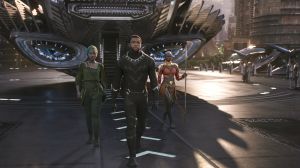 This is a movie populated almost entirely by black faces, notably black women (more on that later), and they are given a mainstream platform that celebrates its multitudinous African roots and traditions thanks to co-writer/director Ryan Coogler (Creed). This movie is proudly black, which will rankle some on the fringes of society, as if celebrating one’s own identity is somehow denigrating those who do not apply to that status. Black Panther is not an exclusionary movie because of its content and execution; this is a very accessible movie to a mass audience, even those who haven’t been paying attention to every nitty-gritty detail in the previous seventeen MCU entries. There are only two characters from other MCU films that appear, one as a post-credits cameo and the other an officious representative (Martin Freeman) of the outside’s clandestine organizations. This is a unique world isolated from the long shadow of colonialism. Wakanda has never known, to our knowledge, the depravity of the European and American slave trade. They have continued to develop uninterrupted by conquerors, slave traders, and the crippling aftereffects of racism. The Wakanda people could very easily be the conquerors themselves. They’re the most technologically advanced nation on the planet and hide as a “third-world nation,” utilizing the ignorance of the Western world to its security. The world of Wakanda is a fascinating, awe-inspiring, and defiantly independent nation.
The larger theme is over the responsibilities inherent to those with privilege. The nation of Wakanda is vastly successful by all conventional metrics. T’Challa must wrestle with whether to continue their exclusionary stance, ignore the plight of the larger world and say it’s none of their business or engage with the world, potentially putting his own kingdom’s peace and prosperity at risk. It’s a simple enough theme and yet it has tremendous weight to it especially when you account for those on the other end of the Wakanda borders. The character of Killmonger is a direct reflection of this. His experiences in Oakland are not the ideal pairing with the luxury of Wakanda. Killmonger sees Wakanda’s great influence as a way to protect beleaguered black citizens of the world and especially in the United States. It’s a way to prevent more senseless deaths from black citizens who were slain as a result of the fear of just being black (a powerful example was Coogler’s debut film, Fruitvale Station). It’s a pointed political statement that doesn’t get too heavy-handed (even though I would have preferred that). It questions the value of isolationism especially when suffering can be prevented. Killmonger works as a villain because you can understand his point of view. He goes beyond the need for vengeance. The wrongs he wants to right are larger and historical. Even Killmonger’s last line really attaches itself to this theme. T’Challa offers him a way out but with imprisonment. “No,” Killmonger declines, “My people were the ones who leaped over the sides of the slave ships. They knew death was better than bondage.” The emphasis is “his people,” not T’Challa’s, not Wakanda. His people were the ones who suffered from slavery. Could Wakanda have possibly prevented it?
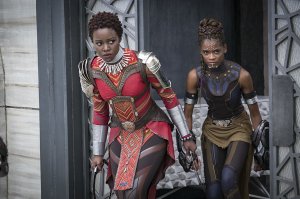 Another wonderful surprise of Black Panther is its incredible all-female ensemble that provides expert support to their king. T’Challa has the good fortune of four strong women, each of them having a different and vital relationship to him. The standout will be Danai Gurira (TV’s Walking Dead) as the fierce chief of security, Okoye. She has a swagger that vacillates between being intimidating and being brashly enjoyable. Okoye has many of the best lines and she throws herself into every fight. There’s also a sense of duty that transcends a single man that challenges her loyalty. Letitia Wright (TV’s Humans) plays Shuri, the Q of this world, the top scientist and creator of many a gadget. She’s T’Challa’s little sister and their interplay is very competitive and teasing. She’s looking to be more involved in the action and a highlight is when she teams up with her big bro. Lupita Nyong’o (The Jungle Book) is Nakia, a former flame of T’Challa’s who comes in and out of his life as an undercover spy. All three of these women have a powerful sense of agency and are integrated in important and essential ways. Even though Nakia may slide into that romantic interest role, she still has a vibrant life outside whatever feelings she may or may not have for the hero. Then there’s T’Challa’s mother, Ramonda (Angela Bassett), who radiates strength and fortitude. These women gave me some of the biggest moments of entertainment in the entire 135 minutes of movie.
Now some careful readers might note that I haven’t done much to emphasize the actual action of the super hero action movie, and that’s for a good reason. Black Panther stands stronger on theme and character than it does its actual action sequences. Coogler had a wonderful sense of scale and verisimilitude with 2015’s Creed, relying on long takes to put the audience in the heightened drama of the boxing ring. With Black Panther, the action sequences can lose a sense of immediacy. Many happen at night or are filmed and edited in ways that diminish some of their impact, like hand-to-hand combat in splashing water where the splashes obscure the activity. Other scenes felt like a video game CGI cut-scene. Speaking of video games, Black Panther’s suit has a crazy ability to absorb the kinetic energy of weapons, which means the stakes take a dip when our hero can merely just stand and allow himself to get shot repeatedly. The payoff for this absorption is a giant energy shockwave but it plays out like a fighting game’s special feature. It’s an aspect that’s not really utilized in a satisfying or unique way. The final showdown between Black Panther and Killmonger feels too weightless in execution. It’s meant to even the playing field by nullifying their extra abilities, but if they both have the same “Panther powers” isn’t the field already even? The third act, the usual punching bag for MCU critics, is the best part of the movie from an action standpoint. It utilizes the characters in significant ways and allows for organic complications while still maintaining its wider sense of spectacle. Plus it’s one of the few action sequences that allow all the pyrotechnics to be enjoyed during the visibility of day.

Boseman (Marshall) was an excellent choice for a stoic and too-cool-for-school character that can glide right on by. The ageless Boseman is at his best when he’s working off the other actors, especially his female posse. He has a couple of very effective emotional confrontations as he learns of his family’s secrets. As steady and soothing a presence as Boseman can be, this is Jordan’s movie. Michael B. Jordan (Creed) has been Coogler’s cinematic good luck charm and we’re still benefiting from that divine kinship. His character is at the heart of the central thematic question. While T’Challa is ultimately the one who has to decide, it is Killmonger who embodies that need for change and the desire to rectify the past. There’s a flashback with Jordan that got me to tear up, and this guy was the villain! It’s one of the film’s biggest mistakes sidelining Jordan for far too long. After his introduction, Killmonger is strangely absent for the next hour or so of the movie, ceding the spotlight to Serkis (War for the Planet of the Apes), a more antic and goofy scenery-chewing baddie who has a few regrettably “faux hip” lines of dialogue that land awkwardly. Serkis is having a blast but can feel like a holdover from a different film.
Much like last summer’s Wonder Woman, this is a movie that is going to mean a lot to a lot of people. It has a personal significance that I will not be able to fully tap into, no matter the expansive powers of empathy. Black Panther, as a long-awaited cultural moment, will have many ripples of inspiration. After my early screening, I sat back and watched an African-American boy, no older than seven or eight, walk out of the theater in a daze. His eyes were wide, his mouth agape, and he said in astonishment, “That was the best movie ever.” That kid has a hero he can call his own. That matters. Black Panther, as a work of art, is rich in topical themes and has a wide supporting net of exciting, robust, and capable women. I enjoyed how personal and relevant and political the movie could become, folding new and challenging ideas onto the MCU formula. Coogler is a marvelous director and storyteller showing rare acumen for being able to handle the rigors of a Hollywood blockbuster and deliver something hearty. The action has some issues and there are some structural hiccups that hold it from the MCU’s upper echelon (I enjoyed all of the 2017 MCU movies better). Black Panther is a winning movie when it features its sterling cast celebrating their virtues and solidarity and a still respectable enough action spectacle when called upon for big screen duty.
Nate’s Grade: B
Share this:

50 Shades Freed (2018)
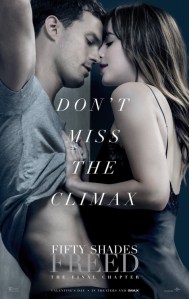 I think Fifty Shades Freed as a title works well not just for the audience but also the actors, as everyone is celebrating putting one of Hollywood’s least engaging film franchises well behind them. E. L. James’ best-selling erotic novels have made for pretty lifeless big screen entries. Director James Foley (Glengarry Glen Ross) is free from having to bring this silly thing to straight-laced life. The actors are free at last from the mechanical sex scenes that populate these films, free at last from their terrible chemistry with which they cannot conceal, free at last from having to say stilted dialogue for stilted characters, and free at last from the six hours of boredom and overstated kink. This is a franchise that wants to go out in a toe-curling climax but goes out with a whimper. If you’re like me you’ll scratch your head and wonder, “Was that it?”
Anastasia Steele (Dakota Johnson) and Christian Grey (Jamie Dornan) are now Mr. and Mrs. Grey. While honeymooning in France, Christian still can’t help his domineering ways and instructs Ana not to sunbathe topless. She finds ways to assert her independence and defiance. Meanwhile, the happy couple is challenged by two foes: a vengeful Jack Hyde (Eric Johnson) and the prospect of children.
 It’s hard to say which in this trilogy is the worst film but I still venture that the second, Fifty Shades Darker, is the winner in that regard. It’s hilariously bad and incompetent, whereas Fifty Shades Freed is slightly better simply because there’s less of everything, which also includes less of a reason to exist. If you thought the previous film was struggling to stretch enough story to fill a feature-length runtime, then just wait until you watch the new movie where we have such scintillating plotlines like whether Christian’s brother might be cheating on his girlfriend or Christian being mad because Ana hasn’t changed her work email to her new married name. That last item also serves as another blaring waning sign about the scary control freak that is this franchise’s supposed brooding, Byronic hero, but we’ll get more into that later. The characters introduced in the last film don’t really matter. There just isn’t a credible story here, which may be why this is the first Fifty Shades to clock in short of two hours (and it has a montage that cycles through highlights of the trilogy). The problem is that the last film mostly completed the journey of Christian Grey from bad boyfriend material to slightly less bad marriage material, as he got down on one knee and proposed to Ana. He learned to settle down, open up about his past behavior, and start the process of compromise. With Fifty Shades Freed, we start off with them getting married and their frolicking honeymoon, and the movie seems to exist in that post-“happily ever after” phase of romances that we rarely see because nobody wants to know what happens after the couple gets their Big Closing Kiss. Does anybody want to check in with Cinderella and Prince Charming arguing over who has to do the dishes (trick question: it’s the servants)?
Conflicts are once again introduced and hastily taken care of, much like the laugh-out-loud helicopter crash from that last film that was resolved in the very next scene. They’ve carried over a lackluster villain from the second film, Ana’s unfortunately named old boss Jack Hyde who tried to sexually assault her. This man worked as a fiction editor in the world of publishing and now suddenly he’s an expert on kidnapping, breaking and entering, and stalking. It’s a ridiculous threat meant to provide some level of dread and danger, except he’s easily dispatched by the end of Act One. There’s a hilarious courtroom scene where his lawyer is trying to argue that Jack was simply trying to work things out after exhausting all his communication resources. Ignore the fact he held a knife to Ana’s throat. He goes away for the second act only to, surprise, come back in another stupidly preposterous way to re-establish his menacing threat… only to once again be easily dispatched in an anticlimactic manner. This guy sucks. The screenplay tries to hastily add some duality to Jack, saying he despises Christian Grey for denying him the life he deserved. Apparently (spoiler alert but do you actually care anymore?) Jack and Christian were in the same Detroit foster care system together and I guess Jack assumes without Christian he would have been adopted by wealthy elites instead? Jack seemed to make a name for himself even without that cushy starting point. Mostly this is another Fifty Shades movie that feels like it has time to fill and time to kill.
 That’s where you’d expect the steamy sex scenes to provide a jolt. Isn’t the whole purpose of this franchise watching pretty people get naked and do sexy things? For all its whips and chains and BDSM banter, the Fifty Shades sex has been tepidly tame. As I wrote previously of this franchise: “I cannot overstate just how dull and lazily staged the sex scenes are in the film, extinguishing any kind of titillation and strangely demurring once things get passionate. The nubile bodies are on display, Johnson’s in semi-permanent arched back, though Dornan is often coquettishly obscured (sorry ladies). The word that seems most appropriate for the sex scenes is ‘anticlimactic.’ Ana jokes that she’s a vanilla girl and trapping Christian into a plain relationship, and their big screen sex life typifies this (anyone remember Ana’s question about what a butt plug was?). It’s a world of kink where nipple clamps are giggle-worthy accessories to the participants and the go-to sexual position is missionary. This movie is not the daring dip into untapped sensuality it’s been made out to be. It’s much more conservative at heart.”
The lusty thrills are of the soft-core porn variety with close-ups of erect nipples and heavy breathing. The sex scenes in the second film were most strange because they all followed a routine that was cut short once actually sex began, cruelly teasing the target audience. By my count, there are three actual sex scenes in Fifty Shades Freed and two or so aborted efforts. The strongest sex scene is the one that feels inspired from 9 1/2 Weeks, where Ana takes control and dabbles melted dollops of ice cream over Christian’s shirtless torso only to lovingly lap up every morsel. It’s the only scene that feels like it has some spontaneity and sexiness. Maybe it’s because it breaks free from their Red Room routines or maybe it’s because it has Ana in charge, or maybe it’s just residual good will from memories of 9 ½ Weeks (side note: I re-watched it a year ago as “research” for a short script, and it is not as sexy as you’ve been told. There’s an extended sex scene on the scuzziest and grimiest fire escape stairs in the rain). Another disappointment for its intended audience must be the lack of full-frontal male nudity, something each film has curiously shied away from. There is plenty of Jamie Dornan’s pubic hair, which I guess was dangled as a concession to the fans. If you came to watch erotic sex scenes you’d be better off getting off from late night cable.
 With bad sex, bad storytelling, and bad pacing, what we’re left with is the closing realization that these two people really shouldn’t be together. Much of the second half of this movie revolves around a core difference over their views on children: Ana wants them and Christian is less than enthusiastic. This is a conversation that should have taken place before they got hitched. It’s another example of Christian not wanting to share Ana with anyone (he literally says this in response to being a potential father). You can bring the man to sing a dopey love song on the piano but you still can’t remove all the scary, controlling elements of his character. I think ultimately Christian’s love of bondage is because he is portrayed as being damaged, abused, and this informs his sexuality. While that may be the case for various people, transforming moments of trauma into uncontrollable and subconscious desires or titillation, it presents a pretty distorted picture of the consenting adults who frequently enjoy participating in BDSM. These people are simply not that interesting. Anastasia Steele (and it pains me every time to type that out) is a mousy audience surrogate meant to be whisked away into a hidden world of luxury, where the hunky man is obsessed with having her, and only the power of her love can make him whole again. That doesn’t exactly sound like the makings of a healthy relationship, and the fact that it’s spun into being a smutty fairy tale is even more disconcerting. The Twilight fan fiction origins become clearer with every film.
Struggling to justify its whole existence for 105 lugubrious minutes, Fifty Shades Freed is the flaccid finale to a boring and underwhelming trilogy. I have no problems with movies whose sole purpose is to turn on their audience. Erotic movies certainly have their place in the landscape. They can even be specifically designed for very specific audiences that do not include me, and the Fifty Shades series is definitely not my kind of smut. I’m not the target audience but I’m open to interesting stories and visceral sexuality. With how redundant and tedious the film franchise is, I think I’ll recycle yet again an observation I wrote of the original film: “Surprisingly boring and rather tepid, Fifty Shades of Grey feels too callow to be the provocative film experience it wants to be. It needs more of just about everything; more characterization, more organic coupling, more story, more romance, more kink. It is lacking in too many areas, though the production values are sleek, like it’s the most technically accomplished episode of Red Shoe Diaries.” Skip the Red Room, these insipid characters, and the high-camp tawdry attempts at sensuality. The final Fifty Shades is a fitting end for a franchise that could never get its mojo going.
Nate’s Grade: C-
Share this:

Phantom Thread (2017)

When the 2017 Oscar nominees were announced, one of the bigger surprises was the amount of love the Academy dished out for writer/director Paul Thomas Anderson’s Phantom Thread. In hindsight, maybe this should have been more obvious considering the Oscar-friendly pedigree (Anderson a.k.a. PTA), the acting phenom (Daniel Day-Lewis), the setting (1950s), and the subject matter (obsessive artists). I had no real desire to see Phantom Thread after enduring PTA’s last two movies. I strongly disliked Inherent Vice and The Master, to the point that when I read about the love for either I can only stare at my feet, shake my head, and hope one day these defenders of rambling, plotless, pointless navel-gazing will come to their better senses. While not nearly ascending to the heights of his early, propulsive, deeply felt works, Phantom Thread is for me a marked improvement as a PTA film experience and an intriguing study in toxic desire.
In 1950s post-war London, fashion designer Reynolds Woodcock (Day-Lewis) is famous for dressing movie stars, princesses, and the rich elite of the world. His sister, Cyril (Leslie Manville), acts as his business manager and personal manager, including kicking out the old muses who have overstayed their welcome. After a day out in the country, Reynolds becomes instantly smitten with Alma (Vicky Krieps), a foreign waitress. He pulls Alma into his highly secluded world. She lives in the Woodcock offices and he summons her at all hours, caught up in the madness of inspiration. Alma is overjoyed by the attention and adoration from such a famous and brilliant artist. It’s the kind of feeling she doesn’t want to end, and when Reynolds begins to lose interest with her, Alma will fight however she can to stay longer in this new and exciting world.
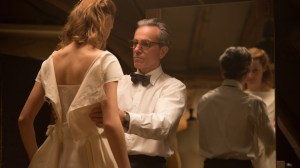
While this doesn’t have nearly the same amount of plot in comparison to early PTA, Phantom Thread at least held my interest and felt like what I was watching mattered. The character dynamics were compelling. Reynolds is a puzzle and we’re side-by-side with Alma trying to figure him out, suss his moods, and analyze why he is the way he is and how best to compensate. It becomes something like a portrait of a Great Artist who doesn’t operate on the same social and interpersonal levels as the rest of us, leaving Alma fumbling for stability. A breakfast in silence can become a battle of wills on the sound design team (you’ll never notice the sound of bread scraping like ever before). It’s not quite the thorough character study that There Will Be Blood purported to be, but Day-Lewis is as reliable an anchor for a movie as you’ll get in cinema. I was especially fascinated by the role of his sister, Cyril. She’s the gatekeeper to a very private world and knows the precise routines and preferences of her very fussy brother. She doesn’t necessarily approve of his actions but she sees them out, though occasionally she has to be more of the responsible one of the pair. Cyril is his lifeline, enabler, and enforcer. She treats Alma as a visitor into their home, further magnifying her worry about eventually being replaced by another muse for Reynolds. This insecurity is what drives much of the film’s second half as Alma tries everything she knows to assert power and influence so that she will not be unceremoniously carved out of this new special life for herself.
At its core Phantom Thread is an exploration of the stubborn artistic process and the toxic relationship of chasing those mercurial, waning affections. It’s very easy to feel for Alma, a relative nobody plucked form obscurity and whisked away to a glamorous world of the London’s fashion scene where she is the chief muse of a brilliant man. When he lays the full force of his attentions on her, it’s like feeling the warmth of the sun, and her world revolves around feeling that intensity. When his attention is elsewhere, Alma can feel lost and discarded, desperate to seek that warmth and fulfillment once more, though running into barriers because of Reynolds’ peculiar personal habits and demands. She plans a surprise romantic dinner that Reynolds resents, and he congratulates himself on the “gallantry” of eating his asparagus with butter instead of the salt he normally likes. Reynolds is a powerful figure who casts a powerful shadow. You feel for Alma as she tries again and again to find the exact formula for pleasing and comforting this obsessive man given to routines. She’s tying to crack the code back into Reynolds good graces. He’s an inscrutable force and one Alma is willing to genuflect to for his affections. Because of this dynamic, much of Phantom Thread is watching Alma try and fail to impress or win back the attentions of Reynolds, which is part fascinating and part humiliating. The film explores Reynolds’ history of burning through his shiny new muses, relying upon the iron-hearted determination of his sister to finally push out the discarded lovers/muses. For Reynolds, his muses follow the cyclical pattern of a love affair, the excitement and discovery of something new, the possibilities giving way to artistic breakthroughs, and then what once seemed en vogue is now yesterday’s old fashion.

Because of this tight narrative focus, the film does become repetitious in its second half, finding more ways to expound upon the same ideas already presented. Reynolds is a jerk. His process is of utmost importance and must not be altered. Alma is struggling to make herself more essential and less expendable in his orbit. She doesn’t want to end up like all the other prim women who have been elbowed out of the spotlight. She’s feisty and pushy and will challenge Reynolds, and this doesn’t usually work out well. While the strength of the acting never wavers, the plot does feel like it reaches a ceiling, which makes the film feel like it’s coasting for far too long (and it’s also far too long). It feels like Alma is fighting an unwinnable battle and after all her efforts she’ll just be another muse in a history of muses. That’s probably why Anderson gooses his third act with a thriller turn and with a specific plot device I’ve weirdly seen a lot in 2017. It feels like this plot turn is going to disrupt the cycle of Reynolds affections, and then as things begin reverting back to the old Reynolds, it all feels so hopelessly Sisyphean. And then, dear reader, the literal last few minutes almost save this entire movie’s lethargic second half. It’s a new turn that made me go, “Ohhhhh,” in interest, and it redefined the relationship and power dynamic between Alma and Reynolds in an intriguing way. It says a little something about the relationship between self-sacrifice and self-sabotage and how the power of giving can approach perverse levels of distorted self-fulfillment.
The biggest selling point of any movie with Daniel Day-Lewis is the man himself. He’s literally only been in four movies over the last decade, and in two of them he’s won Best Actor Oscars and was just nominated for another with Phantom Thread (Gary Oldman has that thing in the bag this year, though). The excellence of Day-Lewis is beyond dispute, and yet I would argue that Day-Lewis is pushed aside by the acting power of Krieg (A Most Wanted Man). This woman commands your attention enough that she can go toe-to-toe with Day-Lewis and win. She’s the worst at holding back her emotions and playing games, which makes her the most affecting to watch. When her romantic dinner goes badly, you can feel her reaching for reason, thinking out loud, her eyes glassy with uncertainty. When she’s speaking in an interview about her relationship with Reynolds, the warmth in Krieg radiates out from her. The other standout is Manville (Harlots) who does an incredible amount with mere looks. She can be withering. It’s a performance as controlled as Alma is uncontrolled, relying on the facade of calm to operate through a manufactured space of rules and expectations. And yes Day-Lewis is terrific. It’s also the first time he’s used his natural speaking voice in decades on screen.

Paul Thomas Anderson’s newest movie is about the world of fashion but it’s really about three characters jostling for understanding, attention, and control. We follow the tumultuous power dynamics of an artist-muse-lover relationship and the toxic implications it has on Alma as she struggles to maintain her position. The second half can get a bit repetitious and feel rudderless, but the eventual ending and wealth of great acting makes it an arguably justified journey. I lamented that Anderson was no longer making movies for me with the lurch he had taken with The Master and Inherent Vice in particular. He doesn’t have to make movies for me at all, but it was this sad realization that made me feel like I was undergoing a breakup with an eclectic artist I had loved tremendously in my younger days (Boogie Nights remains one of my favorites). Phantom Thread doesn’t exactly return things back to the way they used to be but it at least rights the ship, offering a mild course correction with a movie that is accessible and substantive. If this is indeed Day-Lewis’ last movie, at least it was better than Nine.
Nate’s Grade: B
Share this:

Hostiles (2017)
 A slow-paced Western with A-list actors, Scott Cooper’s Hostiles is a ponderous Western that feels too lost in its own expansive landscapes. It’s about an Army captain (Christian Bale) reluctantly taking the lead to escort a Cheyenne chief to die on his native soil. As you could expect from that premise, Hostiles is reverent and meditative to the point of boredom. It deals with Major Themes about man’s place in the world, connection to nature and the land, and our treatment of Native Americans, but it feels like it believe it’s saying a lot more than it accomplishes. The final film is over two hours but I kept waiting for the movie to feel more substantial, for the real story to start. The premise is workable and there are some interesting side characters, notably Rosamund Pike as the sole survivor of her family’s Native American attack, but it all feels underdeveloped to serve the central figure. It’s a story of one man having to come to terms and forgive himself for the cruel things he’s done in the past in the name of glory, honor, and patriotism. There are too many moments where characters reach out to remind him that he is, in fact, a Good Man. It gets to be too much. The talented supporting cast is generally wasted. Bale (The Big Short) is very internal, almost far too insular as a man speaking with looks and eyebrow arches, as he feels the weight of his soul over the course of this journey. I just grew restless with the movie and kept waiting for it to change gears or get better. Hostiles is not a poorly made movie, nor without some artistic merit, but it’s too languid and lacking.
Nate’s Grade: C+


 nathanzoebl
You must be logged in to post a comment.