Blog Archives
Clifford the Big Red Dog (2021)
 What can one expect from the 80-minute live-action feature film of a children’s book series that was about a giant red dog? While ostensibly made for little kids, like those strictly under ten, Clifford the Big Red Dog (not to be confused with the equally alarming Clifford) is banal entertainment that’s inoffensive as long as you don’t have a deep personal attachment to the best-selling source material. It’s your standard children’s fantasy come alive with a giant dog that needs to be cared for as well as kept a secret. There are rambunctious moments of quelling the dog, mischievous moments of chasing the dog, and frantic moments of running away from a gene-splicing tech guru (Tony Hale). And oh, you bet there is scatological humor. We got dog farts. We got dog butt humor. We got dog pee. We got dog poop, at least in reference though thankfully never seen. I don’t know why we needed an added story of a little girl struggling to fit in at middle school with preppy, mean girls. I guess because a big red dog is also struggling to fit in? For that matter, the movie never returns to the opening scene of Clifford’s dog family being taken from him (a baffling and sad opening). There’s a more charming, heartfelt movie somewhere in here, akin to a Paddington where the central character changes those around them for the better, but our little New York City neighborhood is strictly in a more plastic and safe world. There are a few jokes that slipped past and made me laugh, so it’s not all a loss. Clifford doesn’t pretend to be anything more or less than its meagerly stated goals, and it’s a serviceable family film as long as your little ones have a low threshold for realistic-looking CGI dogs.
Nate’s Grade: C, for Clifford
Share this:

Dune (2021)
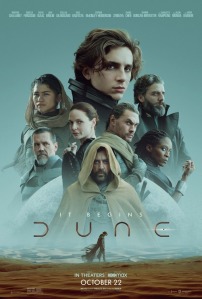
I attempted to read Frank Herbert’s novel Dune when I was in the seventh grade. I had begun to read more fantasy literature and was looking at older, heralded novels. I can still recall my frustration of reading those first five pages and having to repeatedly flip back and forth to a twenty-five-page glossary of terms so that I could even start to comprehend what was happening on the page. After those five excruciating pages, I gave up. Maybe I was too rash, and maybe my older present self would be more accommodating to the struggle, or maybe it just wasn’t worth the effort. I never watched the 1984 David Lynch adaptation that was met with great derision from critics and fans alike, although it does have its vocal defenders (Hindsight alert: Lynch turned down directing Return of the Jedi to helm Dune). So when acclaimed filmmaker Denis Villeneuve (Arrival, Blade Runner 2049) became attached to direct a big-budget, large-scale adaptation of Herbert’s novel, I was finally interested for the first time in my life. It was originally slated to be released in 2020, and after the studio planned to release Dune onto its HBO Max streaming service, Villeneuve and the production company negotiated to make sure a theatrical release would still be an important part of the plan. Alas, I watched the 2021 Dune at home, and I found myself enjoying the experience and development of the world building. However, it’s unlikely to watch this version of Dune and feel like you got a full movie for your money.
In the distant future, like 10,000 A.D., mankind has colonized worlds and the most important planet of them all is Arrakis. It’s a desert world inhabited by poor natives, Freeman, who live a moisture-preserving life mining the natural “spice,” a special substance that makes space travel capable as well as prolonging human life. The top family houses are vying for dominance and House Atreides has been assigned by the unseen Emperor to rule over Arrakis and bring it and its spice production back in line. Duke Leto Atreides (Oscar Isaac) sees great opportunity but also great danger. The other houses will scheme to engineer the failure and desolation of House Atreides, especially House Harkonnen, led by the Baron (Stellan Skarsgard), who is like a mixture between Marlon Brando from Apocalypse Now and Marlon Brando from The Island of Doctor Moreau (plus with levitation powers?). Paul Atriedes (Timothee Chalamet) is his family’s heir and much is expected of him, especially from his mother, Lady Jessica (Rebecca Ferguson), who believes he may be long-prophesied messiah. On Arrakis, Paul and his father must tackle this very delicate new mission while keeping the many adversaries at bay.

As anticipated, Dune is yet another visually stunning and gorgeously immersive visual experience from one of the greatest visual filmmakers working today. If you can watch the movie on a big screen, or at least a bigger screen, then you owe it to yourself to do so. The sweeping vistas and startling science fiction imagery have so much power and grandeur to them. If Lynch’s movie inspired a generation of devotees and impressionable children, I imagine that this superior modern version will do likewise. The production design and costumes are terrific and perfectly in keeping with the larger scope of the expansive visuals. You really feel the size of this world and its imposing weight. Villeneuve has such a natural keen eye for pleasing visual compositions, but he also has the patience many famous big screen stylists lack. He allows the moments to linger and to let scenes breathe in a way that feels more transporting and immersive. If you were simply looking for a visually resplendent movie-going experience, then Dune is the ticket. The sound design is also very smartly aligned and makes use of unconventional and alien sounds to make the movie feel even more like its own thing. When Dune came out in 1965, this was before much of the modern building blocks of our sci-fi pop-culture, so in a way while Dune was the influence it feels partially like an odd after-effect rather than a predecessor. The same thing happened with 2012’s John Carter, based upon a novel a hundred years old that influenced many sci-fi adventure serials and now seems derivative even though it came before the many imitations. I was happy with the first 90 minutes of Dune and felt like the slow pace of the first hour, and its heft of needed but spaced-out exposition, was paying off with a thrilling assault. The concept of the protective shields is a smart way to communicate the casualties of battle, where “kill shots” are illuminated in red, informing the audience of a mortal wound. It makes for an easy to read visual to keep up with the development of battle and stay in a safer PG-13 realm. The whole rescue sequence on the mining station is thrilling at every step.
The cast is another major credit to the success of Dune. Chalament (Little Women) has a soulful yearning to him, to learn, to be his own man, to prove his father wrong and then prove worthy of his father’s faith. Surprisingly, the next biggest role isn’t Zendaya (Malcolm and Marie), the woman that Paul dreams about (prophetically?); it’s Rebecca Ferguson (Doctor Sleep) as Paul’s mother. She’s a woman with deep secrets belonging to a powerful religious sect that might be the real power behind the throne. Lady Jessica is more Paul’s mentor than any man. She teaches him to hone and focus his mind, to use the “Voice” to impart his will, and to prepare for the hardships to come. With every new exposition dump, and she has many, we learn about her growing concern for the fate of her son and her possible culpability for that fate. There’s a genuine warmth between them that serves as the film’s emotional core. I enjoyed watching Jason Momoa (Aquaman) and Dave Bautista (Army of the Dead) as opposite ends of Super Good Fighter Guy, though Momoa looked unsettling without a beard. Needless to say, the 2021 movie is far more diverse than the 1984 movie. It makes space feel more lived in when it’s reflective of a diversity of people that we already have at this point in our history.
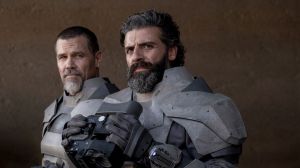
And then, after the hallway mark, Dune became a protracted sequence of chases and then I started to worry that things were just going to end in an unsatisfying manner, relegating the 150 minutes as setup for the as-yet-unplanned sequel, and that’s exactly what happened. My mood began to deflate somewhat during the last hour of Dune. I was still interested and the visuals were still mighty captivating, but the events had the unmistakable feeling of being stretched out to meet a frustrating stopping point, a pause that didn’t produce a satisfying endpoint. I just kept thinking, “Oh, they’re not going to resolve this,” and, “Oh, Zendaya is barely going to be in this movie,” and the movie proved my predictions correct. It’s hard to judge the movie as its own entity since it’s so dependent on a Part Two that has yet to be greenlighted (though its strong opening box-office returns are hopeful). This is an expensive movie, possibly pushing $200 million, so it’s quite a gamble to declare you would only be adapting roughly half of the story. Villeneuve’s Blade Runner sequel, a movie I loved, had a budget of $150 million and a worldwide gross that didn’t make the producers comfortable going forward with a Blade Runner 2050. To be fair, that was an original story, a sequel, and rather well contained. Still, it’s an expensive sci-fi movie that has as much in common with dry art house fare as it does blockbuster adventures, like Villeneuve’s Dune. The promise of a second movie is not secured. If Dune doesn’t do well enough, we’ll forever be left with a movie that feels designed to only be a teaser. It reminds me of the hubris of 2007’s The Golden Compass where the filmmakers had a whole 20-minute finale that they carved out with the intention of having it be the opening for the assumed sequel (welp). Even when designing a multi-movie arc, it’s necessary to plan each entry so that it can exist as its own beginning-middle-end and with a suitable intermediary climax. The Lord of the Rings movies each had their own climax, each moving the larger picture forward, and each had storylines and subplots that came to a head by film’s conclusion. Dune doesn’t. There are more dead characters by the end and certain characters are displaced, but it feels less like the end of the big-budget Dune movie and more like the conclusion of episode two of the Dune mini-series.
My resonance with the source material is minimal, but the world of Dune feels stuffed with stuff and not as deep in the realm of commentary. Fans of the book series will likely thrill at the level of minutia the 2021 movie luxuriates in, allowing fans to lap up the lore. For those of us uninitiated into the fandom, it feels like there could be more going on behind the scenes. The book was released in 1965 and has clear parallels to Middle East occupations and quagmires, a subject even more relevant in the first quarter of this new century. There’s the occupying force coming in to manage the supposedly primitive natives on a desert planet, replacing the last occupier who made bold promises that were unable to be met by the reality on the ground. The parallels of colonialism are there and obvious, but that’s because everything in Dune seems obvious to me. The bad guys are corpse-white and dressed in all black. They look like the alien zombies from 1998’s Dark City (itself referencing the silent sci-fi classic, Metropolis). The leader of House Harkonnen is this noxious man who bathes in black goo and sucks the life force from others. I don’t need my sci-fi to be ambiguous about its heroes and villains. We clearly recognize the bad guys because they’re grotesque. However, the lessons learned by the heroes seem a bit stilted. Its attacks on capitalism are a little more nuanced but not much. The planet of Arrakis could produce water but that’s not in the interest of the power brokers of the galaxy. They need the spice for the economy and thus keep the exploitative status quo. The parallels are there but there’s not much more to be had other than direct summations. The movie has more to say with religion and messiah figures but at this point we’re grading on a curve, and the more complex commentary attached to messiah figures seems reserved for a Part Two.
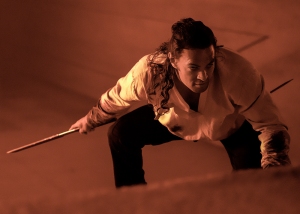
Another aspect I want to highlight that seems trivial but no less intriguing to me is how Herbert chooses his character names. We’re eight thousand years into the future, spanning multiple planets with names like Arrakis and Giedi Prime and Salusa Secondus, and then we have such anodyne twentieth-century names like… Paul and Jessica? It’s funny to me that Herbert goes to the trouble of coming up with so much jargon and terminology and alien-sounding names and then he says, “Hey, this guy’s name is… Duncan Idaho,” like he’s a supporting character in Point Break. I realize this is a very dubious criticism, and there are other character names to conflict with this assertion, but it made me laugh at the different levels of effort Herbert put into his world-building and universe than selecting character names for that same far away land.
After watching the new Dune, I went and watched the 1984 David Lynch version for the first time and was, quite simply, dumbfounded. I’ll credit Lynch for many of the weird choices in style and how it never stoops to even be accessible for a mass audience, despite having characters explicitly narrate their schemes and motivations out in the open (by scene one, the power play that took up 90 minutes of Dune 2021 is awkwardly explained in full). By the end of Lynch’s movie, it is an incomprehensible campy mess. I only have more appreciation for the 2021 Dune after watching the goofy (those eyebrows!) 1980s version that Lynch has disowned entirely, although that stirring guitar riff from the score still rocks thirty years later. The new Dune is only intended as Part One as its presumptive title promises, and because of this key artistic decision, there’s a feeling of padding and wear by the end. I found myself reflecting back on the first 90 minutes more fondly. It’s not that the last hour is absent great moments or audacious style, but it’s hard to fully judge this Dune when its last line is its own conditioning of expectations: “This is only the beginning.” The 2021 Dune is a visually remarkable movie experience with fantastic artists executing at some of the highest points of their talent. I’m eager to see if a Part Two can provide the satisfaction lacking in this beginning half. It’s a hell of a start but it feels too incomplete and in need of an ending.
Nate’s Grade: B
Share this:

Infinite (2021)
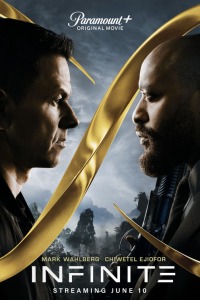
The cast and crew of Infinite were taken by surprise when their corporate overlords decided to shuttle the big-budget action movie to its fledgling streaming service, Paramount Plus. Fortunately for me, I had just purchased a yearlong subscription plan because I wanted to watch Bar Rescue whenever I pleased, so I was one of the lucky ones to gain access to this first “Paramount Plus Original Movie” as it quietly premiered. It might be for the best after all. Infinite is a high-concept action movie by committee that feels so lacking in just about every critical department.
Evan McCauley (Wahlberg) is a man suffering from schizophrenia, or so he believes. He has strange visions in his head from past historical time periods and he instinctively knows how to forge a samurai sword. He’s interrogated by Bathurst (Chiwetel Ejiofor) who recognizes Evan as an ancient foe that he has fought through multiple past lives. Bathurst wants to kill Evan before he can remember who he is and stop Bathurst’s evil scheme. Evan is rescued by Mora (Sophie Cookson, Kingsman) who informs him that he is one of the Believers, a group of immortals who get reincarnated after each death. They’re waging a secret war against the Nihilists, lead by Bathurst, who want to obliterate the world rather than be reborn into it again. Evan must relearn his many pasts and help the Believers recover a hidden doomsday weapon his past self hid.
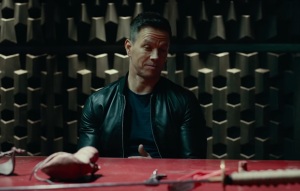
You’d be forgiven if you thought you had watched Infinite before, perhaps in a past life, because it’s so highly derivative. The story runs on two very well-worn tracks of science fiction storytelling, the Chosen One plot and the Secret War plot. You’ve seen variations on both in plenty of familiar sci-fi action movies, comic books, and the central pillars for countless Young Adult titles. Think about being told this statement: “Your ordinary life has been merely an elaborate cover, and you’re no ordinary person but secretly a powerful and important [fill in the blank] and there’s been a war going on in the shadows between [fill in the blanks] and you’re the key to solving this ages-old conflict.” I bet many of you can already think of similar titles that apply. There’s Harry Potter and Highlander and The Matrix and the Assassin’s Creed series and even more specific examples like Wanted, where it too features a sexy woman rescuing our lead in a sexy car and fending off bad guys while she informs him of his secret true calling. Even Ejiofor was in a strikingly similar movie just last year, 2020’s The Old Guard. It’s all so vaguely familiar at every moment that you’ll question whether it’s all built from spare parts.
Then there’s the added reincarnation angle, where people have amazing skills that they never knew they possessed (The Matrix, Wanted) and souls going from host body to host body (Cloud Atlas). In fact, David Mitchell, the author of Cloud Atlas, essentially wrote this very story in his 2014 novel, The Bone Clocks. In that novel, we learn that there are two factions of immortals who are reborn after every death, one group that preys upon the souls of mankind and another trying to defend the innocents. That book explores a lot more in the realm of identity (characters are reborn in different genders and races), time, and purpose than with Infinite, which settles for a recycled B-movie doomsday plot that even video games are getting tired of now. If past lives and reincarnation is just another disposable gimmick for super powered beings duking it out over a cataclysmic MacGuffin, then why bother with the existential possibility of the premise?

For a movie that takes so much time to spit out clunky exposition, Infinite is fairly incoherent and, occasionally, self-defeating. When you’re entering any new territory, there’s going to be a learning curve. Imagine how Neo learned about his misconception of reality, the war and history with the machines, and his capabilities he was opening himself up to. Exposition is best done in portions equally spaced out and tied to action, so our characters can learn through doing and failing and then succeeding. With the gimmick of past lives, it could open up such intrigue and possibility about human potential as well as the difficulty of these immortals finding one another across the globe for centuries, restarting with every rebirth (a fact explored in The Bone Clocks). It also would lend itself to characters being reckless with action movie stunts because, at worst, they die and take a twenty-year or so timeout before getting back into the action. Nothing of real interest happens with the past lives gimmick. The movie treats it as a shortcut to give its characters superpowers, and by tapping into those memories, now they have all these crazy super abilities that no mortal could accomplish in merely a single lifetime (sorry Bruce Lee). Imagine if in The Matrix, instead of Neo learning and training that they just uploaded everything into a Chosen One 3.0 security patch they downloaded (yes, he downloads skills, but we see the process demonstrated as visual progression). It’s boring to watch. The movie even could have explored more about these past lives, experiences, and lessons learned rather than in kaleidoscopic flashbacks. For the entire premise, Infinite seems so strangely limited in scope.
Then there’s the plot device that destroys the scheme of the villains. The Nihilists are tired of the eternity of being reborn and stuck with the accumulation of their memories. Bathurst says when he begins anew in the womb, he is a fully cogent adult brain and it’s nine months of torture. This, ladies and gentlemen, is the only interesting component in the entire movie that relates to the reincarnation premise. The Nihilists want to destroy all life so then they can never be reborn again, though this still seems theoretical. They have also developed a special device that will store a person’s consciousness onto a computer hard drive or microchip, supposedly stopping that consciousness from being reintegrated into a new host body. If this is the case, why isn’t Bathurst and his Nihilist fellows taking advantage of this? They’ve already developed a solution that works and doesn’t involve the destruction of all life on the planet. I don’t even know why Infinite introduces this absurd plot mechanic considering the damage it does. I guess it was an attempt to raise the stakes with immortals where death isn’t permanent, but for the purposes of the movie, a death means they are taken out of this present fight for the fate of the world. The stakes are still there. The implications are also nebulous, as they talk about souls as currency but can human souls be downloaded onto a portable technological deice? This entire plot device is silly in conception and even worse in execution, with big swirly bullets that also glow as they zip along.
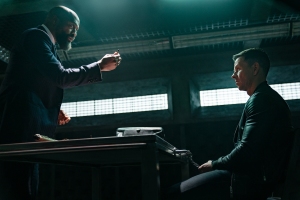
Wahlberg (Spenser Confidential) is on autopilot for the entire movie. He’s laconic and nonplussed and without any hint of humor or fun to be had. His under-performance is compensated by the overacting of Ejiofor (Doctor Strange) in a disastrous dynamic that reminded me of the 2011 Oscar hosting performance by the tandem of James Franco (under performing) and Anne Hathaway (over performing). At least Ejiofor is holding my attention with his high energy level and a maniacal glee that reminded me of James Bond villains. The problem is that nobody else is delivering this same arch level of camp. Everyone else in the cast is trying to play things so icy cool and nonchalant, and it just makes all the characters feel like boring robots.
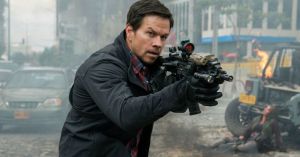
And yet all of this could be forgiven if Infinite had some memorable and exceptionally exciting or well-developed set pieces to entertain. Much can be excused or mitigated if an action movie delivers upon its action. Alas, Infinite cannot escape the orbital decay of its lack of imagination. The derivative nature extends to the action, which consists of a series of rote chases and gunfights. There is one sequence that had promise for the scale of its destruction, a car chase through the different floors and levels of a police building. It’s viscerally entertaining to watch all of the many things gets smashed while raising the question just how fragile concrete walls are constructed to be in downtown metropolitan architecture. This is also the moment that Evan is brought into the new world, which means it’s all downhill from here. Antoine Fuqua (The Equalizer) is an action genre veteran and can be counted on for some degree of style to jazz up the proceedings, but he can only do so much with sequences lacking points of interest and tension. Infinite would play better as campy nonsense, but it won’t acknowledge this identity.
Given how derivative everything appears, it’s surprising Infinite is based on an original work, the self-published 2009 novel The Reincartionist Papers by D. Eric Maikranz. The author offered his readers ten percent of his advance for whoever helped get him to sell the film rights to Hollywood (true to his word, Maikranz paid out in 2019). Already, this is more entertaining to me than anything provided in the 106 plodding and incoherent minutes of Infinite as a movie. The high-concept premise is reduced to a lazy shortcut for superpowers for a group of know-it-alls trying to act cool and strut while delivering exposition by the truckload. The action is stifled, the characters are dull, and the world feels so sprawling but without needed definition. This could have been any combination of Chosen One and Secret War story elements. What about Harry Potter battling the bullet-curving killers from Wanted? Or what about Neo facing off against the ancient society of werewolves and vampires in sleek lather catsuits? Or an immortal special ops crew that must track down other immortals before they can do lasting harm? This mix-and-match formula belies how truly interchangeable the story elements are with Infinite. It closes on voice over by Wahlberg that genuinely made me guffaw. Looking to the future, he says, literally, “Well the possibilities are… infinite.” For this hopeful film franchise, I strongly doubt that.
Nate’s Grade: C-
Share this:

The Conjuring: The Devil Made Me Do It (2021)
 Three movies in, plus four spinoff films and more on the way, and The Conjuring franchise is losing some of its luster. The original director, James Wan, is still involved in an advisory capacity but his absence is felt in the director’s chair, not that The Devil Made Me Do It is poorly directed by Michael Chaves (Curse of La Llorona), but it’s starting to feel stale. The Warrens (Patrick Wilson, Vera Farmiga) are a husband-and-wife team of paranormal investigators traveling the country and solving 1970s/80s mysteries. This third entry feels the most like an expanded episode from a TV series, like X-Files, and maybe that’s because of its inherently procedural nature. The Warrens are defending a young man accused of murder but who says, as the subtitle describes, that he is not guilty by reason of demonic possession. From there, the Warrens are investigating to prove the demon exists and then trace its demonic history. The scares are low although the intensity feels cranked just as high; there are lots of scenes of gale force winds, shattered windows, characters yelling, and loud music. I miss the perfectly executed Old School horror sequences that were the hallmark of the earlier movies. It set up its rules, wound up the scene, and you just squirmed in anticipation. This franchise has never been revolutionary but more an expertly polished and honed tension machine. However, when the calibrations are off, then the franchise has even less going for it. There are some interesting ideas and elements, like Lorraine (Farmiga) being able to see from the eyes of the demonic killer, but the franchise feels more repetitive and stalled, with multiple exorcisms and Ed (Wilson)’s health being a motivating factor for his wife to prevent, again. The supporting characters are bland or broad and the mystery itself isn’t that interesting, nor is the ultimate villain. In the realm of Conjuring as weekly TV show formula, this feels like an acceptable middle episode with the expectations that they can improve the next week. The “based on true cases” selling point is also starting to grate in light of the reality that a man blamed his own actions on the devil and these controversial people sought to exonerate a murderer. The real-life version is morally abhorrent. The junky horror version can work as long as it doesn’t take itself too seriously. If the other Conjuring movies were gourmet entries, then this is more the fast food version. It may still satisfy fans but it’s definitely not as well made and with questionable ingredients.
Nate’s Grade: C+
Share this:

The Woman in the Window (2021)
 The story behind The Woman in the Window is far more fascinating than the finished movie, based upon the 2018 best-selling debut novel by Dan Mallory under the pseudonym A.J. Finn, a hasty rehash of popular thrillers, notably Rear Window, mixed with recent unreliable narrator mystery/thrillers like The Girl on the Train. It’s actually somewhat shameless how derivative it comes across, so much so that you might be able to guess one of the movie’s Big Twists in the literal opening minutes. Amy Adams plays an agoraphobic psychiatrist who believes the new neighbor (Julianne Moore) across the street has been killed by her husband (Gary Oldman), and no one believes her because of her drinking and medication and general misogyny and obvious twists. I cannot tell if screenwriter Tracy Letts (Killer Joe) and director Joe Wright (Darkest Hour) were going for camp or sincerity, as the movie veers chaotically until its final groan-worthy revelation, which is apparently taken right from the source material. There aren’t any significant moments of tension. I was more confused why and how everyone was constantly coming into this lady’s opulent New York brownstone. I was also wondering why the filmmakers made Oldman look like Jon Voight. The troubled movie was delayed twice, went through several re-shoots by Tony Gilroy (hey, it worked for Rogue One, right, Disney?) and ultimately cast off to Netflix. The most interesting aspect of this movie, by far, is the author being discovered as a fraud and fabulist of the first order, lying about everything and anything to elicit pity and use it for personal and professional manipulation, and I’m talking lies about his mother dying of cancer, his brother committing suicide, himself suffering from a recurring brain tumor, and even pretending to be his brother to write emails to colleagues while still maintaining the same distinct writing voice. Mallory’s years of pathological lies (he blames it all on being bipolar now) have actually inspired a TV series where Jake Gyllenhaal is set to play him. You should spend the time you would have used watching The Woman in the Window on Netflix and instead read the extensive New Yorker article that painstakingly paints the damning portrait of Mallory as a narcissistic con artist who would weaponize people’s sympathy.
Nate’s Grade: C-
Share this:

Those Who Wish Me Dead (2021)
 If I told you I had a movie where Angelina Jolie is on the run from a team of assassins and under the backdrop of a raging forest fire, you’d likely be intrigued. Then if I said that it was co-written and directed by Taylor Sheridan, one of the best screenwriters working today who excels at taking muscular genres of old and providing uncommon depth and poetry, then you might say, “Why aren’t we watching this right now?” Those Who Wish Me Dead, based on the book by Michael Koryta, is Sheridan’s second directing effort after 2017’s excellent Wind River, and while I would not classify it as a bad movie, it is easily Sheridan’s weakest film to date. There’s so much amazing potential here with these plot elements, this cast, and this rising filmmaker, and to only produce a square, straightforward 90s action throwback feels deeply unsatisfactory. There could have been so much more.
We follow Hannah (Jolie) and her team of Montana forest fire fighters. She is still recovering from a recent tragedy where she was unable to save campers from a fire. She’s been reassigned to a lonely lookout tower to deal with her guilt and PTSD. Along comes Connor (Finn Little) whose father is being hunted down by a team of hired assassins (Aidan Gillen, Nicholas Hoult). His father is killed but Connor escapes, finding refuge with Hannah and wary of trusting anyone new. The two of them make a trek to find help while the killers narrow their search and start a forest fire to provide a very attention-grabbing distraction for the local authorities.
 The problem with the plot description I just provided is that there really isn’t much more to anything. You can probably see the progression of Hannah’s character arc immediately, having to confront her past trauma through combating the forest fire and saving this young boy’s life to make amends mentally for those she could not save in her past. The Sheridan of his past work would recognize that familiar arc and provide extra nuance, commentary, and make the character more emotionally resonant. Unfortunately, this version only produces a lead protagonist that is, shockingly, disposable. You could have eliminated the entire character of Hannah from this movie for all the personal significance she provides for this story, and that stunned me. We don’t really get insight into he beyond generic observations. She doesn’t really bond with this kid in any meaningful way. She doesn’t really teach this kid anything generally useful for his own safety. This is the type of relationship dynamic where the adult teaches the kid some means of defense, and then in a pivotal moment in Act Three, the child uses that technique to save themselves or the adult. It’s textbook (think: Face/Off with the butterfly knife as but one example). This movie doesn’t do that. In fact, once this kid hands over to Hannah the “unseen paper carrying dead dad’s important information” then he also comes across as disposable. I guess he’s still a witness to murder but the valuable intel seemed more pertinent to thwart. The fact that these two characters can arguably be removed from the story, either entirely or far earlier, is not a good assessment of their value added.
The competing storyline with Jon Bernthal (The Punisher) is surprisingly the one that feels most attached to the events of the plot and could have been its lead vehicle. He plays Ethan, a small-town sheriff’s deputy who happens to be Connor’s uncle. Ethan also has a pregnant wife, Allison (Medina Senghore), and they both take up a generous amount of screen time. There’s a good reason for this because they’re the best part. The loving yet pointed interactions between the two of them are the best example of characterization evident in the movie. When Allison is confronted by the assassins, she’s sees through their law enforcement disguise easily. When the bad men want to torture her to get key information, she manages to subdue them and escape, all while being seven months pregnant. In two short scenes, this woman proves more capable and fearless and badass than our lead character.
 It’s easy to see a version of Those Who Wish Me Dead where the Ethan character and his drama completely cover the same narrative territory that Hannah offers. Ethan’s wife is pregnant, the baby is due soon, and yet Ethan feels scared and unsure about whether he has what it takes to be a father. He comes across a young boy on the run from big trouble and protects him, and over the course of their shared experiences, he bonds and discovers paternal capabilities within himself, he teaches the kid a thing or two about defense, and he becomes more self-assured about his own personal future. Admittedly, you could say that’s a simplistic character arc, but is the one presented any less simple where we watch a person haunted by trauma confront that trauma by the end? My point in this revisionary hypothetical is that this version would be more aligned with the plot elements that seem to get the most care and screen time. I know it’s based on a book, but it clearly feels like Sheridan has shown what parts he cares about more so embrace those parts.
It’s also quite easy to identify the parts of the movie Sheridan did not care as much about. There is a surprising sloppiness to much of the setup here, where key connecting information is excluded from the viewer perhaps out of a sense of trying to be ambiguous but also perhaps out of a sense of general indifference. I was confused why the assassins blew up a house in their opening moment, what information Connor’s father had stumbled upon, and even who these killers were and what their connections were with an unexpected Tyler Perry cameo where he appears to be their boss or handler or buyer or someone. The plotting can also be disappointingly redundant, as Hannah and Connor fall into a frustrating pattern of leaving the lookout tower, going back to the lookout tower, leaving the lookout tower again, repeat. Perhaps most egregiously, the raging inferno doesn’t even seem to matter. How can you make a movie about a forest fire where the forest fire barely matter in the scheme of things. It exists as an immovable obstacle but more so as a means of emotional catharsis for Hannah’s prior trauma. Far too often it feels like the fire is practically standing still, watching the actors from afar and not wanting to interrupt, and then at the very end, it’s comically overcharged, zooming at super speeds to compensate for its earlier lazy pacing. There aren’t any real specific survival scenarios tailored to the circumstances of a forest fire, which means this movie could have easily been a flood or earthquake or any disaster or none at all.
 Those Who Wish Me Dead reminds me of the vanishing mid-level thrillers that Hollywood used to crank out on a near weekly basis. That’s probably also part of the reason it feels like a throwback to an earlier time, a time where a big star could be thrown into a disaster and given evil-doers to topple and we’d all gladly gobble it down with a heaping helping of popcorn. Perhaps that unassuming nostalgia will prove enough for some people, especially in the wake of a year of minimal big screen blockbusters. There are still moments here that feel like the Sheridan of old, but too much of this movie cannot escape the gravity of being a dull action movie without anything to say and without characters to invest in. It’s not even that the movie is too simple, because simplicity can be its own virtue, but that it’s underwritten, with characters that could be exorcised completely from the narrative, and a batch of villains lacking entertaining personalities or memorable menace. It’s hard not to feel like everyone’s talents involved were wasted somewhat on something so basic, which is even more baffling when you again recognize those fantastic story elements. Chases. From assassins. Into a forest fire. There’s an obvious movie to be had there. Unfortunately, Those Who Wish Me Dead doesn’t capitalize.
Nate’s Grade: C
Share this:

Without Remorse (2021)
 Tom Clancy’s Without Remorse is Tom Clancy without Tom Clancy. It bears no resemblance to the famous author’s 1993 novel even though the entire production feels remorseless about being generic military thriller genre grist. There’s nothing to spark the imagination here, no signature action sequence or well developed turn of events, no colorful personalities or hissable villains. It’s all predictable from the opening credits onward, from the opening mission that cannot go according to plan, to the assumption of the short shelf-life for the pregnant wife in Act One, to the Obvious Red Herring Antagonist and the Obvious Real Antagonist played by the big name actor, to the presumptuous preparations for building a franchise in post-credit sequences. The best thing about Without Remorse is Michael B. Jordan as our lead Navy Seal seeking vengeance and climbing the ladder of international conspiracy. Jordan gives a far better performance than this material and movie deserves, always demanding your attention. He’s charismatic even in generic thrillers like this one, and it is the definition of a generic military thriller lost in the dull minutia of a thousand other similar movies. There’s really nothing separating this movie from the glut of direct-to-DVD action thrillers starring the likes of Bruce Willis (who filmed his part over a weekend). The motivation for the villain’s plot to kick-start another global war with Russia is laughable when there’s a ideological motivation within reach that would have worked and been interesting, namely declaring Russia already an enemy of the country and forcing those in power to fight the war they are ignoring. Instead, the stated rationale is so much dumber. If you’re a fan of these kinds of action thrillers, or the sub-genre that Clancy carved out for himself for decades, then you’ll likely find enough to pass the time with Without Remorse. It had glimmers where it could have stepped outside the mighty shadow of its influences. I wouldn’t have been surprised if this was starring Dolph Lundgren rather than Michael B. Jordan.
Nate’s Grade: C
Share this:

Chaos Walking (2021)
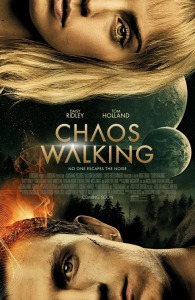 Chaos Walking has been shrouded under the ominous reputation of “troubled production” from its very inception. It’s based on a 2008 YA science fiction series by Patrick Ness and has gone through writer after writer, trying to hone this story into a visual medium. At one point, Charlie Kaufman was attached as the screenwriter, and if Kaufman, the man who turned his struggle to adapt a book about flowers into a meditative and meta experience, can’t find a way to make your story work, then I doubt many other Hollywood writers can. It began filming in 2017 with director Doug Liman (Edge of Tomorrow) and sat on the shelf for years, with the studio execs reportedly dismissing the finished version as “un-releasable.” Fifteen million dollars in reshoots took place in 2019, helmed by Fede Alvarez (Don’t Breathe), and now the finished movie has been quietly dumped to theaters and on-demand markets. Chaos Walking is, indeed, chaotic, but it’s mostly dull and simplistic with a premise that feels ripe for social commentary that the movie has no interest in because it would detract from its eighteenth depiction of another forest chase.
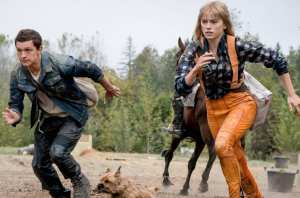
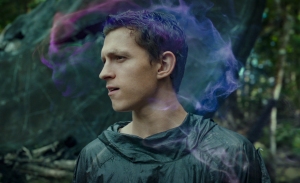 In the future, mankind has settled on an alien world with some unexpected results. There is a strange quirk about this planet – the men are incapable of hiding their inner thoughts, which materialize in front of their heads as visuals with their narration echoing (nick-named “The Noise”). Women, for whatever reason, are unaffected. It’s been so long since another supply ship from Earth has come that life on this alien world has begun to resemble the struggles of the early terrestrial pioneers. Todd (Tom Holland) wants to impress his small town’s authority figure, Mayor Prentiss (Mads Mikkelsen), and become an adult faster than he might be ready. Viola (Daisy Ridley) has made the multiple-generations trip from Earth but her spaceship crashes. Todd finds her and panics because she may very well be the only woman alive on the planet. He elects to hide her and try and reach an old technological outlet, while the Mayor leads a posse to round her up and maybe kill Viola.
Given that premise, you would think that Chaos Walking was setting itself up for some sharp, uncomfortable, and relevant social commentary about the plight of being a woman in a modern society. If Get Out was a horror story about being a black man in America, I was thinking Chaos Walking would be a horror story about being a woman in America, but I was wrong. Think about the premise, with every woman subjected to a society of men that cannot hide their unconscious objectification, their leering harassment, their distressing ulterior motives, where every man’s uncontrollable thoughts will be broadcast. It’s an empathetic and horrifying glimpse into the daily dismissal, exploitation, and condescension that woman experience. You add the extra element that women are immune and now they also become the subject of projected male resentment, that they feel judged, and this only makes the men more hostile and confrontational. Being “the last woman” also presents an obvious threat of sexual violence as well. It’s all right there, and yet Chaos Walking barely even toys with its explosive gender commentary; there’s a reason all the women are dead on the planet, but it’s not exactly revelatory, and its inclusion, at the expense of all other notable social or political commentary, makes the explanation feel more perfunctory. Why even bother having a premise that features a gender disparity if you’re not going to really say something about the treatment of women? If you think about those old movies where it’s one man on a planet entirely of women, or some similar dynamic where there is a giant gender upheaval, and they always say something about it. What would be the point of making an exception for one kind of person and then ignoring the larger implications? Well, I’ll never truly know, because Chaos Walking doesn’t seem to know either.
 I can see why this premise works on the page where the reader is already able to immerse themselves in the inner thoughts of a point of view character. I’ve never read the source material but I can imagine it being like a jigsaw puzzle of first-person perspectives. It’s a little harder to translate into a visual atmosphere in a clear and meaningful way, especially when you’re limiting what it all says. As its portrayed onscreen, The Noise is often muddled and visually hard to decipher, and while it mimics the half-formed nature of thoughts (people don’t typically think in complete, declarative sentences) it’s still too abstract and confusing. The wispy visuals are opaque and glisten like sunlight in gasoline pools, which makes the imagery less easy to determine. It’s like someone made a sci-fi thriller and just ladled on extraneous visual elements but didn’t want anyone to properly decode these special effects. Sometimes the premise works, like when Todd is trying to hide his fears, like when he envisions a beat-down from a dangerous crowd, or when he purposely imagines scary imagery to spook a rival’s horse. Too often The Noise just feels exactly like that when it comes to the narrative. It’s a peculiarity that is underdeveloped and could well be forgotten. It’s such a strange experience to watch a high-concept movie where the filmmakers are seized by indifference with their high-concept. I don’t know if maybe this is a subtle acknowledgement of defeat.
There’s one character that symbolizes the futile adaptation of The Noise and that’s Reverend Aaron (David Oyelowo). He’s living in conflict with his own community and his Noise is more apocalyptic, fire and brimstone, and he views The Noise as a connection between man and God. Now that is interesting, looking at this quirk as a gift or curse from God and trying to make a spiritual understanding over why man, and only man, has been given this ability. It seems to radicalize him. At long last, here is a character with a direct and personal relationship with The Noise, the hook. How does this change his relationship with God, his sense of self, and his feeling of disconnect from being so far away from home in this alien world? Well, all of that tantalizing characterization and potential depth is cast aside. Reverend Aaron is merely a religious zealot and a boring one at that. It’s hard to determine whether he’s gone over into violent extremism or is seeking absolution, which makes him just another dangerous antagonist that appears here and there but you can’t quite square. This character could have been legitimately intriguing from the story specifics of how he would respond to drastic change, isolation, introspection, and a crisis of faith brought on by the environmental turmoil. Instead, he just becomes a secondary heavy chasing characters for vaguely unsatisfying reasons.
 Chaos Walking is not a fascinating failure or a so-bad-it’s-amazing fiasco, it’s just a mediocre chase movie. It’s patterned after Westerns visually and structurally, with the frontier town being lead by a Black Hat who is chasing after the Drifter who represents a threat to the status quo. It’s not just the horses, dusty trails, vilified natives, and small-towns shootouts, Chaos Walking is very intentionally a science fiction Western, a pairing that seems to keep getting tried on by Hollywood studios like an old pair of cowboy boots they’re positive fit perfectly once long ago. As far as space Westerns go, it’s fine. The action is fine, though I grew tired of the visual mundanity of characters continuing to walk in the woods, run through the woods, and take refuge in the woods. For an alien landscape, Chaos Walking often feels frustratingly plain and unimaginative. All of these interesting science fiction asides and additions and it’s really just interested in being a second-rate space Western. The screenplay is held together as a series of rote chases. The main characters are bland and Ridley’s straw-like blonde wig gave me bad memories of Kate Mara’s bad wig from the infamous Fantastic Four reshoots. For its 110 minutes, you won’t exactly be repelled from the screen with boredom but you won’t be tempted to pay close attention either. Chaos Walking is too generic, too safe, and too derivative to be anything more than passing entertainment. I wish it was more chaotic and un-releaseable just to be more memorable and worth your time.
Nate’s Grade: C
Share this:

Cherry (2021)
 Between 2014 and 2019, the Russo brothers directed four Marvel movies with a combined worldwide box-office of over six billion dollars, so for their first foray from the world of super heroes and magic space gems, the brothers had carte blanche to pick whatever project they desired and Cherry was it. Watching all 140 minutes of this true-life tale, you get the feeling it’s less a story about loss and redemption and more an overly extended excuse for Joe and Anthony Russo to use every stylistic trick they’ve ever wanted to employ to make their own inferior Goodfellas (or Casino). Free of MCU oversight, these guys are practically going full Tony Scott or Darren Aronofsky with the multitude of their visuals tricks and gimmicks. We’re talking different aspect ratios, color washes and spotlights, heightened fade outs, fourth wall breaks and freeze frames, chapter titles complete with prologue and epilogue, in-your-face subtitles, tracking shots, and even oblique angles such as a point of view from inside Tom Holland’s inspected rectum. Cherry is aggressively flashy to compensate for how little substance there is with its story and humdrum characters. It’s based on a true story about Nico Walker (Holland), an Iraq War veteran coming back to Ohio, getting hooked on drugs, and resorting to robbing banks The trauma of his war experiences leads him to seek help and the system fails him and pushes opioids on him, turning him into another addict among too many who is desperate to do anything for cash. On paper, that sounds like it would be interesting, and the shocking part is that for all these identifiable dramatic elements and stylistic flourishes, Cherry is kind of dull. Everything feels like it’s kept at a surface-only level. Walker is just not that interesting even though interesting things happen to him. You would think it’s about PTSD, the opioid crisis, economic anxiety, and while these elements are present they are not really explored with any sustained nuance or theme. The level of social commentary stops at Fight Club-level snarky sight gags, like the names of the banks being “The Bank” and “Shitty Bank.” There’s too much bloat with the plot and running time. By far the most interesting section of the movie was his descent into addiction and the criminal excursion, but Walker doesn’t even exit the war until over an hour in. We did not need all the fluff before the war to properly set up this limited character. The real drama of the movie is post-war, and there’s an hour of setup that could have been cleaved away. You leave this stuff in as “texture” if you’re building something rich in atmosphere and character but I can only tell you what has happened to Walker externally. He’s perfectly unremarkable. The movie is too shallow for its own possible ambitions, and it ultimately feels like cribbed notes and homages to other movies the Russos enjoyed, like Goodfellas or Requiem for a Dream or Boogie Nights. It only reminds you of other, better movies, and one I was reminded of was Roger Avary’s Rules of Attraction. I appreciated the flash and style of that 2002 movie because it was about empty characters living empty lives striving for something they were incapable of, so the excessive and prioritized visual artifice worked. With Cherry, the visual trickery is distraction from the underwritten characters who the movie very much wants us to see favorably through their struggles. I enjoy Holland (Spider-Man: Far From Home) as an actor immensely but he is miscast here. He’s too boyish and charming and genial to ably perform dark and gritty antiheroes. You sense he’s eager to try these “darker roles” to prove himself but he doesn’t need to. Ciaria Bravo (Wayne) plays the girlfriend/infatuation object/junkie partner and she looks so young that see feels like an unsupervised child onscreen. Maybe that works with her as a symbol of innocence. Cherry is a movie that left me indifferent and shrugging throughout all its excesses and meandering. It feels like a movie the Russos needed to get out of their system, one of creative indulgence charging into familiar territory when more restraint, nuance, and contemplation would have sufficed, and maybe their next movie will be more mature and fulfilling and worthy of 140 minutes.
Nate’s Grade: C
Share this:

The Map of Tiny Perfect Things (2021)

Reader, I love time loop movies and their very playful nature of storytelling that allows for plenty of payoffs and creativity and inherent pathos of being stuck reliving life experiences. Palm Springs was my second favorite movie of 2020, so how soon am I ready for yet another time loop romantic comedy, this time from a very Young Adult perspective and with an overly precious title? The Map of Tiny Perfect Things is very much a time loop formula by heavy amounts of YA twee whimsy and worldly lessons. It’s charming, witty, predictable, and maybe a little too content, much like its central characters, to meander when there was more meaning to explore.
17-year-old Mark (Kyle Allen) lives in a small town and is stuck in a time loop living the same day over and over. He argues with his younger sister, rolls his eyes at his out-of-work father’s Civil War novel he’s devoted to writing, and skateboarding around town and skipping school. His buddy Henry is stuck on the same video game level, his mom leaves for work before he wakes up, and every night his father tries to talk to Mark about what he wants to do with a future that he will never see. Then Mark meets Margaret (Kathryn Newton) who appears to be aware of the same loop. Now he has a partner and together they have fun being mischievous in a world where people are eternally asleep and unaware, a world without larger consequence.

The Map of Tiny Perfect Things is an immediately entertaining movie that glides by on charm and cuteness before bringing the heavier emotional catharsis we know is coming. Kyle’s daily routine is reminiscent of the beginning of Palm Springs (for fairness, I’ll try to refrain from making comparisons at every turn) where we see the breadth of the man’s knowledge and implication of how long he’s had to accrue this god-like understanding of timed events. It’s fun to watch Mark push a man out of the way before getting pooped on by a bird, or catch a falling book in the library, or know the answer before a person can even ask their question. The movie takes a while to fully get going but it keeps entertaining you in the meantime with these pleasant quirks. This is indicative throughout the movie. Even when the plot is just coasting, screenwriter Lev Grossman (adapting from his own short story) keeps things swift and entertaining. There’s a montage of Mark getting awful haircuts and sending pictures to Margaret, and then lamenting maybe they can meet up the next day instead once his hair resets. The script is packed with quick-witted jokes and fun visuals that it can return to for elevated and imaginative payoffs. Each side character has their own sustained loop and checking in on each is a reminder that they all have their own little universe of struggle and desire and despair. It’s one of those benefits of time loop movies; they are like getting 32 flavors of stories in one delicious 90-minute serving.
Just like Palm Springs (I lied), the big plot change comes with the discovery of a partner also re-living the same day in infinity. From there, the story becomes a very standard YA romance but set in an extraordinary setting. Margaret doesn’t qualify as a Manic Pixie Dream Girl but she is more blunt, assertive, and seeking out a deeper meaning for their shared purgatory. She’s not the quirky free spirit we associate with the type. She’s more goal-oriented and literal than Mark, and she even takes on teaching him algebra. Once the love interest is introduced, the movie starts a countdown clock for how long it will take for a romance to kindle. Mark is clearly lonely and we see his failed attempt to spark up a potential romance with another girl who will forever be trapped in, at best, a first date mentality. You can’t build a relationship when everyone else only has 24 hours unless it’s like Before Sunrise. Margaret expresses a deep reluctance about anything going beyond the platonic, especially if she and Mark are the only two humans in this “temporal anomaly” for a potential eternity. Just imagine a failed relationship with a co-worker and having to uncomfortably mingle at the same job for years. Mark, being the headstrong young lad in a YA drama, is certain he can win her over in the long run and that his feelings must be true and therefore honored. Since the movie is being told from his perspective, his yearning is given primacy and it makes for an uncomfortable arc.

But it’s the last act of the movie where the larger emotional connection takes root and where the actual life lessons are to be had. This is not a movie about stopping to enjoy the little things in life that otherwise might go ignored. That element is present, and the subsequent scavenger hunt across town to catalogue all the cute little moments of humanity and nature dominates Act Two. It’s a cute little premise and something we’ve seen in countless other YA tales, finding the hidden beauty right under our noses in our lives. The message is clear and fine, but it’s what takes place toward the end where The Map of Tiny Perfect Things takes off from its YA orbital decay of preciousness. If you’ve watched enough movies, you should likely start to guess where Margaret disappears every day after six o’clock and what secrets she may be hiding. I won’t spoil what is revealed but I was waiting for Mark to wise up as quickly as I did. He does, and the movie takes on a transformation toward the end that changes perspective, weight, and even provides a little subversion on the previous male gaze that was our primary filter. The end provides a satisfying enough conclusion that examines the nature of grief and processing. The way the secret design of this universe is discovered is slight and ridiculous, but it doesn’t take away from the movie successfully landing the most difficult part of its emotional journey.
It also helps that both of our leads have great chemistry and are genuinely likeable. Allen (All My Life) has a laid-back presence that fits nicely with the genial vibes of the movie. He’s funny without being obnoxious and emotive without being melodramatic. He starts off sardonic and flip but becomes more earnest as his character learns to stop and listen and invest in others. Newton (Freaky) is enjoyably no-nonsense without being prickly. Margaret is a character with layers and ultimately, you’ll wish the movie had been retold from her point of view from the very beginning. There’s a reason for this, but there’s much more depth and sadness to Margaret. Still, even just hanging out with them as they observe the day, share their stories and discoveries, and pop-culture-heavy banter back and forth is entertaining because the writing and acting carry the day.

What holds The Map of Tiny Perfect Things back is that it never really goes into larger questions of self, identity, and the existential conundrum of at once being the center of a universe with limitless time and being unable to move forward. It feels a bit too content to stay on a lower level and dust off many familiar YA tropes to have a diverting good time. That’s fine, though in direct comparison to something like Palm Springs (my apologies), it can feel lacking. Think about Mark’s inability to see his mother again and how that unique circumstance forms its own loss. More attention to these details would have been preferred than on-the-nose pop-culture references and deep cuts for hipster points. It’s a good cheerful time with plenty of wry amusement and some well-earned emotions, but it also feels a little too content to simply hang around and follow the YA map for programmed spiritual affirmation. It manages to subvert the quirky-girl-shows-guy-how-to-carpe-his-diem formula, but that’s not before devoting plenty of time walking the same walk for a little longer than needed. If you’re a fan of time loop parables, YA stories, or unconventional rom-coms, check out The Map of Tiny Perfect Things and then, maybe, if you haven’t already, also Palm Springs.
Nate’s Grade: B


 nathanzoebl
You must be logged in to post a comment.