Blog Archives
The Gray Man (2022)
 Two movies removed from the Marvel Cinematic Universe (MCU), I’m starting to wonder if the brotherly directing duo of Joe and Anthony Russo are absent their own vision. Cherry was an exhausting and annoying experience overloaded with self-conscious stylistic choices that dominated the movie and squeezed it from its dramatic potential. Now we have The Gray Man, based upon the 2009 book by a former Tom Clancy writing collaborator, and it looks indistinguishable from any other big-budget spy thriller. It feels like The Russos doing their version of Michael Bay doing his version of the Jason Bourne series. It’s an expensive movie for Netflix, in the range of $200 million, and it just made me think about 2019’s Six Underground, their $200 million collaboration with Bay where he had creative freedom to make the most bombastic, hyper masculine, and tedious movie of his career. If you’re going to devote a fifth of a billion dollars for a Michael Bay-esque action movie, you might as well hire the real deal again. The Gray Man is a passable action movie, especially in its middle, but it’s wholly derivative and coasting off your memories of better spy thrillers and better characters.
The titular “Gray Man” is a super-secret Sierra agent given the code name Six (Ryan Gosling). He’s been the government’s indispensable tool for taking out bad guy and keeping the world safe for 18 years, working time off his prison sentence. Then it all goes wrong when, of course, his callous boss (Rege-Jean Page, Bridgerton) demands he “take the shot” even if it means the death of an innocent child in the process. Six declines, the covert assignment becomes much messier, and he learns that his target was a former agent from the sane secret Sierra cabal. The dying man gives Six a MacGuffin necklace that the big bad boss really wants. Six goes on the run, with the help of some allies like another agent (Ana de Armas) and his retired handler (Billy Bob Thornton), and the CIA sends every professional killer to get their man. This includes the mustachioed Llyod Hansen (Chris Evans), a ruthless private mercenary who brags about being kicked out of the C.I.A. academy for his lack of ethics and impulse control issues.
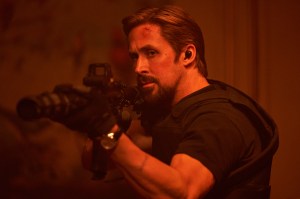 If you’re just looking for an action vehicle that provides enough bang and sizzle, The Gray Man can suffice. I’ll champion the highlights first before equivocating on them. There’s a recognizable blockbuster elan to the movie with enough energy to keep your attention. There is a significant uptick in the middle that gave me a false sense of hope that The Gray Man had transformed into a better movie. Again, this occurs well into an hour into a slightly under two-hour movie, but credit where its due, there is a nicely developed sequence of substantial action. For being a spy thriller, a majority of the movie takes place in and around Berlin. Six is handcuffed by German police to a park bench in the middle of an open square. Lloyd sends in vans of powerfully-armed goons that take out the police and then set their sights on Six. He’s trapped to the bench but still mobile, to a point, but he’s also unarmed. Watching the character react to these limitations and adapt is greatly pleasing. This is the stuff of good action cinema; supermen get boring without having to overcome legitimate obstacles and/or mini-goals. He’s able to escape and thwart his attackers and hides in a tram. This then becomes the next level of our action, and he has to utilize close-quarter combat to tease out his new attackers. And then a speeding truck with a rocket launcher shows up. And then de Armas shows up with a sports car for Six to try and leap into. And then both of those vehicles do battle while Six climbs atop the speeding tram and uses the reflection in a passing building to line up his shot to take out a goon inside the train underneath his feet. This entire middle action set piece is top-notch. It’s exciting, stylish without being too derivative, and there’s a clear set of cause-effect escalation. This is good action writing, and it’s a shame that this is also the peak with still 40 minutes left.
The beginning and closing of The Gray Man blunt whatever enjoyment I could gather. The film is oddly structured and uneven from reliable screenwriters Christopher Markus and Stephen McFeely (Avengers: Endgame). The opening scene watching Thornton recruit Gosling in his jail cell seems completely superfluous as something that could have been explained in passing, or needed no setup, but it’s at least short. There’s also a lengthy flashback in the middle of the movie that sets up Six’s allegiance to Thornton’s niece (Julia Butters, the little girl from Once Upon a Time… in Hollywood) as he babysits and saves her from kidnappers. Again, I don’t think we needed to have a set up why our protagonist would deign to save a child, but even if the movie wants to add more emotional heft to their relationship, why drop this in the middle of the movie? Why not even have this open the movie instead of the jailhouse recruitment? I like their scenes together. It reminded me of 2016’s underrated The Nice Guys. It’s just not enough to hang onto because there is no heart to this film; it is all quips and speed and flagging genre imitation. Just re-read the plot description. The genre cliches are all there, and we even have the old chestnut where the villain monologues that they and the hero are not so different.
 There’s also a questionable series of shorter flashbacks of Six as a kid surviving his abusive father’s rigorous “training,” including burning a kid’s arm with a cigarette lighter or dunking his head underwater. Again, I doubt we needed to visualize these scenes when Six could have explained his traumatic upbringing with Gosling’s acting. I was worried, and I’m still not dissuaded, that The Gray Man was establishing the parental abuse as having trained Six for these unique circumstances, that dear old bad dad somehow saved his adult son’s life. Do we need a flashback of his dad holding his head underwater to convey that Six, as his head is held underwater by Lloyd, does not like this? It reminded me of 2017’s Split when Shyamalan questionably had his character survive her captor because he recognized that she too had been abused. Did her trauma save her? The needless jumping around in time feels like The Gray Man attempting to be cleverer, or perhaps aping more of the genre expectations from an action movie of this size. The finale also lacks either the emotional catharsis or action climax that can serve as a satisfying conclusion. The last act is a compound assault set piece but it’s really just a series of interconnected gunfights and explosions. The mini-goals and engaging cause-effect escalation from before is absent.
There are a few commendable moments or choices among the blockbuster cruise control. I enjoyed that this was not just a Knives Out reunion between de Armas and a villainous Evans but it was also a Blade Runner 2049 reunion between de Armas and Gosling. I think de Armas deserves her own spy vehicle, especially after being one of the highlights of 2021’s No Time to Die (granted, it helps having Phoebe Waller-Bridge writing your character). I liked a hand-to-hand combat scene where Six utilized flares both to obscure his presence as well as an offensive weapon. Evans is fun to watch as a preening peacock of a villain, though there’s so little to his character beyond a bad mustache and smarmy attitude. There are some decent drone shots, though the dipping of the camera makes them feel more like point of view aerial assault shots. The Russos really, really like their drone shots in this movie (how much of the budget did this suck up?). However, the drone shots just made me think of the better drone shots from 2021’s Ambulance, Michael Bay’s newest movie, and it further cemented The Gray Man feeling like a clunky combination of other movies and artists. If you’ve seen any espionage action movie of the last ten years, you’ve seen enough to recognize all the key pieces of The Gray Man, and while its competent enough to satisfy the most forgiving of genre fans, it’s really just more empty noise.
Nate’s Grade: C
Share this:

The Black Phone (2022)
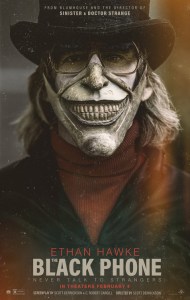 This is the movie that director Scott Derrickson made after departing Marvel over “creative differences” with the Doctor Strange sequel, differences I feel like I can agree with. Based upon Joe Hill’s short story, The Black Phone is a return to Derrickson’s horror roots, along with regular screenwriting collaborator C. Robert Cargill, and you can feel the director’s reflexes resetting. It’s like three movies in one, not all of them needed or entirely coherent. It’s about generational trauma and abuse, a survival thriller about escaping a psychotic serial killer, and a little kid trying to hone her nascent psychic powers. The stuff with Ethan Hawke as “The Grabber,” a kidnapper of children who imprisons them in a locked basement dwelling with a broken black phone attached to the wall, is great, and Hawke is fascinating and unsettling. Each mask he wears seems to come with a slightly different persona attached, so with each appearance we get another sliver of who this disturbed man may have been. The story of survival is made even more intriguing when our protagonist, young Finney (Mason Thames), learns that the past victims can communicate with him through the mysterious black phone. The scene-to-scene learning and plotting is fun and efficient and requires Finney to be a little bit of a detective, exploring his dank surroundings and the failed escape attempts of the other kids to utilize for his own hopeful plan. The ghost kids also have limited memory of their experiences, which is smart so that he isn’t given a clear advantage without limitations. The parts that drag are where Finney’s little sister tries to convince the skeptical police officials that her dreams are real and can help find her missing brother. There is one hilarious moment where she prays to Jesus for guidance and then profanely expresses her disappointment, but otherwise it feels like a Stephen King stereotype leftover (Hill is his son; apple meet tree) that doesn’t amount to much besides padding the running time. It doesn’t even lead to big breakthroughs for Finney to be rescued. As a small-scale creepy contained thriller, The Black Phone is an engaging survival story with a supernatural twist that works as well as it does. It doesn’t have much more depth or meaningful characterization, it’s really just about a kid using the power of neighborhood ghosts to escape a crazy man, and that’s enough at least for a passably entertaining 100 minutes.
Nate’s Grade: B
Share this:

Father of the Bride (2022)
 Those familiar with the 1991 Steve Martin movie, or the 1950 original with Spencer Tracy, or even the 1949 novel by Edward Streeter, who was born in 1891, will understand that Father of the Bride is an old story that can still be relatable with new wrinkles and details. The core elements of the story, about the stress and chaos of wedding planning, or the pressure and patience of family, are still present with this new version where Andy Garcia and Gloria Estefan star as the parents of the bride (Adria Arjona). Garcia is a first-generation Cuban-American, a successful Floridian architect about celebrating old traditions, and a bridezilla of epic proportions terrorizing every soul in Miami. He is an awful person, holding to outdated and cringe-inducing misogyny and at several points making demands that because he is the father of the bride, he will be dictating exactly how his daughter’s wedding will proceed no matter the objections from the bride. Even when the groom’s wealthy Mexican family comes into the picture, neutralizing his power of the purse, Garcia’s bad dad just gets even more pushy and prissy. Ultimately, of course, he sees the error of his ways, the opulent wedding is nixed for something more spur of the moment combining traditions old and new, and everyone seems to get along by the end as one big happy family. I liked the added subplot of Garcia and Estefan hiding the fact that they are getting a divorce, which provides farcical potential. However, some of the subplots feel lightly developed, especially the other daughter being tasked with making all the bridal dresses for her sister. She wants to be a designer but cannot get a break, and yet the final reveal of the wedding gown is absent any drama, taking away from the relationship between the two sisters. Same with a friend who may or may not be queer and vibing for the bride’s sister. It’s strange that the two daughters get underdeveloped when they’re so essential to the wedding, and especially considering the movie is practically two hours long. I wish the filmmakers had trimmed some of the redundant “Andy Garcia is awful” moments and given more time to other supporting players. Father of the Bride is a chuckler of a movie, never netting bigger laughs but providing a few chuckles and smiles here and there. It’s a pleasant movie to watch, though I don’t think Garcia’s tyrannical father has earned his epiphany and forgiveness by the end. Given a Hispanic spin, the personal details and cultural authenticity allows an old story to feel fresh or at least fresher.
Nate’s Grade: B-
Share this:

The Bad Guys (2022)
 Even though it’s based on a popular series of children’s books, if you’ve seen Zootopia, you’ve seen the better version of The Bad Guys. As far as entertainment aimed at the wee ones, you can certainly do worse. It’s brisk, silly, and the animation is quite enjoyable, adding hand-drawn overlays and accents that really make the images pop and provide additional, gratifying textures. The story, on the other hand, is the same old-same old. We have a group of “scary animals” in a world where anthropomorphized creatures walk side-by-side with humans. These spooky creatures get a bad rap because people fear them, so they lean into social prejudices and become a notorious criminal gang. Except now they might want to go good because being good feels better than being bad. Thematically, it’s the same territory that Zootopia trod and with better world-building. We have “bad animals” that are tired of being looked as bad because people wrongly interpret them as scary threats. It’s the predator/prey dynamic but without the depth. Having an all-animal heist crew provides some creative entertainment and Ocean’s 11-style moments of frothy fun; I especially enjoyed that the giant shark is the team’s master of disguise and always very obvious. The character arcs, supposed betrayals, redemption, and plot should be familiar and predictable, which means much of the movie must coast on the appeal of the animation, vocal actors, and general sense of humor. The comedy can be amusing but too often falls upon cheap gags, like the piranha’s defining trait of being a nervous farter. The Bad Guys is suitable for animation aficionados, fans of the book series, and people who have never seen Zootopia, and if that’s you, then just watch Zootopia.
Nate’s Grade: C+
Share this:

Firestarter (2022)
 I have never seen the 1984 original movie starring Drew Barrymore but I have to assume it’s got to be better than the 2022 Blumhouse remake. Stephen King adaptations have a very wide range in quality, and from other reports Firestarter is one of King’s most straightforward novels. The most interesting aspect of this movie is that the score is provided by legendary horror director John Carpenter, as well as Cody Carpenter and Daniel A. Davies, and Carpenter was going to be the director of the 1984 Firestarter before the studio replaced him after the poor box-office performance of 1982’s The Thing, widely regarded now as a classic of its genre. Otherwise this is a pretty generic chase movie where people with superpowers are trying to stay hidden from evil government agencies looking to capture them and use them as weapons. I was reminded of that X-Men TV series The Gifted that lasted one season in 2017 for much of the movie. The dialogue is quite bad, including one climactic line that had me howling: “Liar, liar, pants on fire,” and she doesn’t even set the person’s pants on fire. The parenting miscues for Zac Efron’s psychic dad character are manifest, and it’s still strange to see the High School Musical star enter the dad part of his career. Efron’s character and his onscreen wife bicker about how best to protect and support their powerful little daughter who could go nuclear and has, in anger, set her mom on fire. Apparently, ignoring a problem isn’t the best solution. Regardless, the father-daughter moments are weakly written and you won’t care about any characters. There’s also a really extended and disturbing sequence of an animal in misery after being burned by out little firestarter, so that’s great at creating empathy. Even at just 90 minutes, this movie is a boring slog. By the end, I didn’t care who was being set on fire because the big thing that went up in smoke was my patience and my time.
Nate’s Grade: C-
Share this:

365 Days: This Day (2022)
 At this point, every viewer turning into 365 Days: This Day is doing so for very specific reasons: either for an erotic charge or morbid curiosity to see how bad this bad franchise can sink. The original film was a pandemic breakout for Netflix in 2020, reigning supreme as their number one movie for over a month internationally. It’s based on Polish writer Barbara Bialowas’ trilogy of best-selling erotic novels, clearly inspired from the successful Fifty Shades of Grey series, itself inspired from the Twilight series, the gift that keeps on giving. The first 365 Days got its name from its lead character being held captive by a mafia scion who just knew that this woman would fall in love with him during the time it took the Earth to revolve around the sun. This obviously problematic dynamic led many viewers to detest the movie and its depiction of romance where consent is definitely a concern, not that it would be the first Stockholm syndrome romance in cinema history. 365 Days was a hit explicitly for its explicit and off-putting aggressive sex scenes. Now that we have two sequels prepped, the question remains whether it can still maintain its performance or whether the franchise suffers from diminished returns. Simply put, this sequel isn’t as problematic as the first movie but it’s just as boring and possibly more pointless.
At the end of the first film, Laura (Anna-Maria Sieklucka) survived her tunnel attack but lost her pregnancy. She hasn’t told her jailer/boyfriend/now-husband Massimo (Michael Morrone) about the baby. They wed, they honeymoon, and she begins to resent feeling like a caged woman (oh lady, I thought that was what won you over?) and then she sees Massimo having sex with his ex-girlfriend. She runs away with Nacho (Simone Susinna), a hunky gardener with even more tattoos than Massimo. The new man whisks her away to his beachfront abode and says he only wants to protect her. Masismo is flummoxed trying to find the absentee Laura while a rival crime family schemes to take her out and make a move while Massimo is so torn and distracted.
 The first thing you’ll realize very early on in 365 Days: This Day is that there simply is not enough material here to cover almost two hours of running time. This movie is starched beyond the breaking point, and I’m not even making a pun here. There are twenty-two songs credited to this movie, and when a song plays, it’s not like some needle drop that only plays for a few seconds to impart a very specific impression. These songs are like full renditions. That’s why the movie often feels like a collection of music videos and luxury resort commercials. We’ll watch Laura and Massimo frolic on the beach, go horseback riding, and slinking into a bubble bath, all inter-cut together. If you just cut to an R&B group occasionally singing to the camera, it would all feel complete. Sometimes we are mere seconds between songs. Just as one is ending, another begins, and after 40 minutes of this, I began to question whether this was a deliberate creative decision by the filmmakers to limit the number of scenes relying upon the actors speaking. This is a blessing because both Sieklucka and Morrone have difficulty making the pseudo-smoldering dialogue sound right through broken English. There are lines like, “I can’t calm down, I’m Polish!” and Laura referring to her bedroom activities as “a sex.” The literal second line of dialogue is a reference to the bride not wearing any underwear. I think there might be 200 words spoken in this entire movie and a high percentage of them will make you groan or roll your eyes.
I have to devote an entire section to discussing the golf scene. You see, on their luxurious honeymoon, Massimo and Laura spend some time on the links but their kinky foreplay doesn’t take a break. She lays on the green, spreads her legs, and his grips his golf club (do you get it? do you get it?) and then literally putts a white ball across the green and between her open legs (do you get it? do you get it?). As it was happening onscreen, I joked to my girlfriend that it would follow this route, and sure enough, the filmmakers could not resist. It is the comedy high-point of the movie.
 It’s not like all these songs are soundtracking sequences of arched backs and heavy thrusting. There are even more music montages for luxury porn than for the soft-core porn. We watch Laura and her friend shop in luxury. We watch them drive in luxury. We watch them walk along the luxurious beach. We watch them jet ski in luxury. We watch them dine in luxury. This is why the majority of the first half of the movie feels like the raw footage from a commercial shoot for a getaway vacation. It’s padding upon padding because the characters of Massimo and Laura are wafer-thin. I was trying to even come up with adjectives to describe either lover, let alone full sentences, and my efforts sounded like a second grader trying to bluff their way through a book report. These characters are so boring that the movie won’t allow them to have any drawn out conversations because then the jig would be up. Even when Massimo confesses to having a brother he never toward Laura, this moment isn’t given extended time for her to interrogate. It’s off to the next shopping or driving montage with sun-dappled cinematography. This is also why the filmmakers have inserted a second couple for us to watch their own blossoming romance, but even this gets resolved so quickly with Massimo’s buddy proposing to Laura’s best pal Olga while they’re all still at the same honeymoon location. They’re supposed to be a distraction and they can’t keep our attention because it’s more characters without defining characteristics beyond their body parts.
The sex is put on hold for half of the movie (with the exception of an occasional frisky dream filling the gap, no pun intended) and 365 Days: This Day becomes a ridiculous soap opera. To fully detail the depths this movie resorts to I’ll need to go into spoilers, if that’s really a concern for you, like this movie is being watched for its storyline. The turning point of the film is when Laura catches Massimo fornicating with his ex BUT WAIT because that wasn’t Massimo but… his coke-addicted, twitchy identical twin brother, Adriano (Morrone is actually far more enjoyable in this dual part). He and the ex are scheming to drive Laura and Massimo apart and then kill them both. They’re being paid by the rival crime family that Nacho belongs to, being the son of the competing mafia boss. This overcooked drama reaches such absurdist heights that it ends on a Mexican standoff with the villains being gunned down, Laura getting shot badly in her abdomen, Massimo finally finding out about his lost child, and a question over where Nacho’s loyalty lies, possibly eliminating Massimo so he can have Laura to himself once and for all. This is like three seasons of soap opera storytelling crammed for the very end of what had otherwise been a ploddingly paced movie lacking needed plot events. Even this sequence is stretched thin by the inane cross-cutting from Laura in danger with Adriano to Massimo and Nacho walking down hallways in excessive slow-motion. I laughed out loud as we jumped from overcooked drama to languidly paced hall walking. The movie has the audacity to end on a cliffhanger, which I suppose also happened with the first movie. If you’re dying to find out what happens to these people in Part Three, I just feel sorry for you.
 While the sequel is less problematic over consent than 365 Days, it’s also more boring and tediously forced to draw out the weakest, basest of stories that was never meant to be more than a wish-fulfillment appeal to people’s baser impulses. I don’t want to shame anyone that finds this movie sexy or stimulating. Good for you; attraction is uniquely personal and your found yours. However, this series is making me re-evaluate the Fifty Shades of Grey movies, none of which were good but man at least they were better than this. All of this makes me think the next franchise, inspired by the international streaming success of 365 Days, will be even worse to make me re-evaluate the artistic accomplishment of this very boring, very dumb movie. It is a spiral that will never end and only make us sadder.
Nate’s Grade: D
Share this:

Death on the Nile (2022)
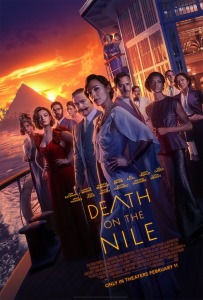 I am admittedly not the world’s biggest Agatha Christie fan, so once again reader, as you did with my review of 2017’s Murder on the Orient Express remake, take my critique with caution, especially if you are a fan of the illustrious author’s many drawing room murder mysteries. Kenneth Branagh returns as director and as the world’s greatest detective, Hercule Poirot, with arguably the world’s greatest mustache (as I said in 2017, it appears like his mustache has grown its own mustache). Death on the Nile takes the murder-on-mode-of-transport formula and leaves us with a gaggle of red herrings and suspects to ponder until the inevitable big conclusion where our smartypants detective reveals everything we had no real chance of properly guessing no matter the clues. Again, these kinds of impossible-to-solve mysteries are not for me, but I know others still find antiquated pleasures with them (Christie was the best-selling author of the twentieth century after all). What I don’t find as pleasing, and I’m sure even ardent whodunit fans would agree, is how cheaply this whole production looks. The budget was almost twice as much as Orient Express but it’s really a chintzy-looking cruise ship with one of the most obvious green screens for a big budget film. It takes away from the grandeur quite a bit, especially knowing the original 1978 movie was shot on location in Egypt. Another aspect that didn’t work for me was the added back-story for Poirot, including the explanation for why he grew his preposterous mustache. Did we need a mustache origin story? Did I need an attempt to better humanize this fastidious detective? If you were a fan of the overly serious and stately Orient Express, and of Christie in general, I’m sure there’s enough to recommend a new Death on the Nile. Branagh clearly has passion for this character and as a steward of this cherished material. However, for me, it took too long to get the movie really rolling, the characters were too lackluster, and there are too many tonally bizarre and uncomfortable moments, like Gal Gadot quoting Cleopatra while being, I guess, dry humped by Armie Hammer against an Egyptian relic. As Poirot’s mustache, which will be given top-billing in the third film, would say, “Yikes.”
Nate’s Grade: C
Share this:

The Time Machine (2002) [Review Re-View]
 Originally released March 8, 2002:
The Time Machine is one of the most famous works of fiction in history. It was writen long long ago by the great H.G. Wells. It presents a fantasy glimpse into our future, but in it Wells also gave readers the opportunity to ponder what would happen if they could go back and change their own lives. People have used the story as a cautionary allegory to our own times, like the 1960 film version of The Time Machine. Now, a bigger budget Hollywood remake attempts to put another spin on the Wells classic.
Alexander Hartdegen (Guy Pearce) is an absent-minded professor interested in cracking down the physics of time. He’s chided by some of his peers for crackpot theories and his fascination with any new gadget. He’s supposed to meet Emma (Sienna Guillory) at Central Park and tonight’s the big night he plans to propose to her. He eventually catches up to Emma and the two go strolling off into the park. Shortly after popping the question the two become victims of a mugging and in the fray Emma is left dead. The death drives Alex to create his fanciful time machine, which only happens to take four years time.
Alex gives his big brass LA-Z-Boy looking machine a try and travels back to that fateful night to avoid Emma’s death. Alex avoids the mugger all right, but while purchasing flowers his fiancé gets plowed over by a runaway carriage instead. It seems that one cannot change the past. Alex decides to give the future a chance and travels to a very Back to the Future 2 looking 2037. Someone astutely asks Alex if his time traveling machine makes a good cappuccino.
 When Alex hops a little further into the future the moon is breaking up because of ill-fated lunar construction. Moon rocks are hurtling toward the surface and disrupting everyone’s day. (It was in this moment that a scene of rocks smashing into the World Trade Center was cut for taste) Alex jumps back into his machine but is konked out by some lunar cheese and falls asleep at the wheel. The next thing you know Alex is in a mysterious future world.
The place where The Time Machine really bogs down is once Alex arrives in 80,000 something or other. The child-like thrills and adventure of Alex zipping between the past and near future are buried underneath the standard post-apocalyptic movie world. The people dress in loin cloths and rags (though some of the female natives wear revealing tops that look like see-through chain mail) but still have perfect teeth. When Alex doesn’t understand the linguistics of 80,000 AD the next words that he hears are English from Mara (pop star Samantha Mumba). It’s amazing that English survived 81,000 years when Latin didn’t last a mere 2,000 and change.
It turns out these people who live in huts resembling hot air balloons along the faces of cliffs are called Eloi. The Eloi don’t have anyone looking old enough to carry an AARP membership and are apprehensive to speak of why. Perhaps it’s because creatures resembling something that would belong in The Mummy Returns pop up from the sand to capture whatever slow moving prey they can and return to for an underground feast.
The creatures, called Morlocks, are the offshoots of evolution. Seems after the whole moon destruction thing (whoops!) those who took refuge below the surface have evolved into dusty hunchbacked cannibals. Their rowdy ranks are controlled by Uber-Morlock (I’m not making up that name) who resembles an albino bassist for Poison or Skid Row. It’s actually acclaimed actor Jeremy Irons under all that pancake makeup and fleshy spine-showing prosthetic. The less said about Irons the better.
It’s during this part that The Time Machine reverts into a half-baked Stargate. Alex encourages the Eloi race to stand up to their oppressors and fight for their freedom. He becomes part of the Eloi community, rallies the troops into rebellion, and also has to save the damsel in distress.
The Time Machine remake isn’t the political statement the 1960 film was on man’s folly with technology, particularly nuclear weapons. What this suped-up version is all about is special effects and plenty of them. The effects are for the most part dazzling, especially the scene where Alex travels to 2037 and we see the development of New York City with skyscrapers assembling themselves.
 Simon Wells (The Prince of Egypt) directed this remake and is actually the great-grandson of the famous adventure’s author, H. G. Wells. Trivial Pursuit fans everywhere rejoice. Wells had to sit out the last 18 days of shooting due to “exhaustion” and Gore Verbinsky came off the bench to finish the directorial duties. The film clocks in at a scant 90 minutes but there are definite moments of drag.
Pearce (Memento) is a hunky hero and for the most part is admirably gung-ho with the role. Samantha Mumba’s motivation must have been to stand and look pretty the entire film. To think that Mumba might be the most talented of the recent singers-come-actors (Mandy Moore and Britney Spears) is a distressing thought all its own.
As The Time Machine kept dragging into its Mumba-filled period, I began day dreaming of an alternate, darkly comic version. In my head, Pearce’s character keeps traveling back again and again to save his beloved only to lose her a different way each time. I could picture a humorous montage of his girlfriend dying an assortment of colorful deaths and Pearce just getting more frustrated and jaded. I could picture them skating only to have her plunge below the ice. I could picture the couple dining at a fine restaurant only to have her choke and Pearce just throw his napkin onto the table and sigh loudly. I was enjoying my alternate take on The Time Machine so much that I didn’t want to return to the one that was playing.
The Time Machine has its moments of thrills and excitement but they are mostly condensed to the opening third. This remake doesn’t have the political edge or wow-factor the original did. It plays more to the rules of conventional Hollywood than the wide open possibilities Wells wrote about. Pearce tries valiantly and the special effects are really something, but more often than not The Time Machine is not worth your time.
Nate’s Grade: C
——————————————————
WRITER REFLECTIONS 20 YEARS LATER

The 2002 Time Machine is fanciful schlock on the verge of being populist spectacle. It’s not just another adaptation of the famous H.G. Wells sci-fi novel, it’s also emerging from the shadow of the 1960 movie that broke ground in the realm of special effects. Storytellers will often find new relevant meaning to be mined from the resources of old, and literature with classic stories can still be compelling decades and centuries hence as long as they are served with care and empathy. In theory, another Time Machine movie could be a worthy venture especially in a realm of modern special effects marvels and a more socially conscious viewpoint. If the 1960 film was a cautionary tale about mankind’s impending doom from nuclear arms and technological hubris, you would think a movie born from the ashes of the Cold War would follow a different approach, perhaps something more in line with the colonialism critiques from Wells. It’s surprising then that the 2002 movie also follows the “be careful with your machines, mankind” thematic warning of the earlier version. It made me think of Tim Burton’s maligned 2001 Planet of the Apes remake where they could have gone with ANY ending possible except one, the original’s famous twist ending, one of the most famous endings ever, and what did the new movie do? The same ending. Re-watching the 2002 Time Machine, it’s more fun than it has any right to be and there are aspects worth celebrating, but much like its hero, it’s a victim of unmet potential.
 Firstly, this is a pretty entertaining studio movie that blows by quickly at only 96 minutes. The screenplay is by John Logan, the same writer with credits like Gladiator, The Aviator, Rango, Hugo, Skyfall, and other quite successful, quite large studio hits. And yet this movie doesn’t just feel like another paycheck for the man. The opening half of this relatively brief movie definitely feels like the favorite half. It’s here where the movie introduces the protagonist’s personal loss being the motivating force that drives him to make a time machine, something absent from the 1960 original and an exciting and emotional way to separate itself. Watching Alexander (Guy Pearce) go back to save his love has an immediate appeal, and watching him fail again brings forth the idea of being unable to change the past. Even twenty years later, I still think about the darkly comic version of this story, just as I did in my initial review in 2002, where Alexander tries again and again to save his beloved only to lose her to some new calamity. It would have a lighter approach even while dealing with darker humor, and it would certainly contribute to the film’s central thesis that man is unable to change the miscues of the past.
You would think The Time Machine would follow a theme about correcting the mistakes of the past to prevent future danger; many time travel tales follow a hero trying to thwart a terrible future, although sometimes they inadvertently cause that same terrible future in grand ironic tradition. This movie doesn’t really dwell on fixing the past but more so upon learning from it. During its post-apocalyptic second half, the focus isn’t on preventing it or going back to warn mankind of the folly of its ways. It’s about adapting to change, which can be viewed as defeatist or pragmatic. The future world of 800,000 years ahead is messed up because of the actions of mankind’s past, namely the lunar collision thanks to bad condo construction (thanks, capitalism!). It’s none too difficult to place a general ecological/climate change message in place, the exploitation of the present spoiling the future for generations yet to come. However, the movie isn’t about Alexander going back to teach mankind how to avoid its own mistakes. Unlike the 1960 original, he stays put in this uncertain future world with his new Eloi family and Eloi girlfriend (Samantha Mumba). He’s content to remain in this new time and live his life, ignoring the foresight of a time machine. There’s a message there about looking ahead in one’s life, not dwelling on the past at the expense of the future, but it’s also unexpected for a time travel action adventure. It’s usually about preventing the horrible future, not learning to live with it and make a better tomorrow. This also could be read as the present giving up on avoiding the mistakes of contemporary excess.
 You can probably tell what kind of person that you are depending upon which half of The Time Machine you prefer. For me, the first half has all the surprises and time jumping and fun, and the second half settles into standard post-apocalyptic rally-the-masses formula. It’s not bad but it honestly feels like an entire second act is missing from the development of the plot. In quick succession, Alexander learns he’s in a far-flung future, the customs of the Eloi, the danger of the Morlocks, their hunting practices, their cannibalistic impulses, what caused them, and then who their leader is, and how there are multiple Eloi-Morlock colonies throughout the world. It’s a lot of absurdly fast exposition that just unfolds to the convenience of our hero, and so little of it occurs from the virtual A.I. figure (Orlando Jones) that seems entirely designed to be an exposition device. It’s during the second half that the playfulness and ideas give way to a grungy future with efficient if unspectacular chase scenes from monsters. I am convinced that the Morlock leader played by Jeremy Irons was originally intended to be the older, more evolved, and more callous ends-justify-the-means version of Alexander. That kind of twist would have brought things back to the personal realm of those first minutes traveling through time. Alas, he’s just another monster with bad hair. It seems like wasted potential for the last twenty minutes of this movie to just be another climax involving blowing up the monsters and rescuing the damsel.
Apparently there was significant contention behind the scenes over the look of the Morlocks. The creatures were designed by the famous Stan Winston studios and then director Simon Wells and the producers wanted to change their look, making them more humanoid and recognizable. This infuriated the effects team who strongly disapproved of this creative direction. I appreciate that the production went to the trouble of expensive prosthetics and costumes rather than just making all of the Morlocks ugly CGI monstrosities. I was worried that twenty-year-old humanoid CGI would not age well, but thankfully I didn’t have to bother with that fear.
 This was the first live-action movie for Wells as director. He spent over a decade in the world of animation and helmed An American Tale: Fievel Goes West, Balto, and The Prince of Egypt. After the mediocre reception to The Time Machine, Wells didn’t direct another movie until almost ten years later, 2011’s Mars Needs Moms, a film that reportedly cost the studio over $200 million in losses. It was one of the biggest box-office bombs ever. It’s not much of a surprise then that Wells hasn’t been able to direct another studio movie until just this year, and even that is a small-scale adaptation of a children’s TV show, to the best of my knowledge. The man has directed two movies in the last two decades. On a more fortunate note, Wells has had steady work in his old field of animation as a consultant and storyboard artist for just about every Dreamworks cartoon (Kung Fu Panda, How to Train Your Dragon, The Croods, etc).
Re-reading my old review, there’s not much more to extrapolate. I agree with just about every word I wrote back in 2002. It’s fun for me when I watch these films twenty years later and have the same remarks in my head only to discover my younger self had the exact same response.
While not breaking new ground or even attaining its own creative potential, the 2002 Time Machine is a perfectly reasonable genre movie that you could put on and kill 90 minutes. It’s relatively fun, has some bigger ideas, and some surprising moments where it appears on the verge of poignancy. One of those is when the A.I., who has survived 800,000 years of isolation, talks about the misery of remembering every face he ever interacted with, cataloging every detail, and how this is tearing him apart and how valued having a lone friend was for him. It’s such a thoughtful and empathetic moment that seems to come out of nowhere and leave just as fast before you can really dig into it for genuine pathos. The Time Machine feels this way, like whenever it presents something intriguing, intelligent, or emotive, it then it has to veer sharply back to the bigger, dumber lane of blockbuster filmmaking for the masses.
Re-View Grade: C+
Share this:

Nightmare Alley (2021)
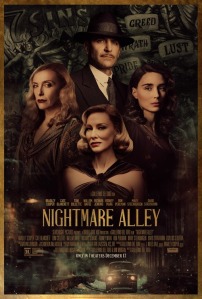 I’ve now watched both versions of Nightmare Alley, the 1947 movie and the 2021 Guillermo del Toro remake, and I guess I just shrug at both. Based upon the 1946 novel by Lindsay Gresham, we follow an ambitious yet troubled man, Stanton (Bradley Cooper), who finds refuge in a traveling carnival, mentors as a phony mentalist, and then uses his skills of manipulation to fleece the rich and privileged while possibly losing his own soul in the process. I kept watching this 150-minute movie and waiting for it to get better, to hit another level, and I had to keep asking, “Why isn’t this playing better for me?” It’s del Toro, an early twentieth-century freak show, a dashing of film noir, and a star-studded cast (Cate Blanchett, Willem Dafoe, Rooney Mara, Toni Collette, David Strathairn), and all those enticing elements should coalesce into something special and dark and adult and transporting, like del Toro’s 2017 Best Picture-winning Shape of Water. However, for me it just feels so turgid and overly melodramatic. I wish the movie had stayed with the traveling carnival and the colorful weirdos that it ditches halfway through. I think it’s because the movie plays to your exact expectations. You expect it to be beautifully composed, and it is, with a flair for the grotesque, a del Toro specialty, and the beats of its film noir-heavy story with femme fatale and double crosses comes across so predictably but minus substantial depth to compensate. I kept waiting for the themes to deepen, to be a better reflection of ourselves, but it’s one man’s circular downfall that doesn’t play too tragic because he’s already an unrepentant scoundrel. Cooper also just seems too old for the part, especially when everyone refers to him as a “young chap.” You might not see a better looking movie from 2021. The cinematography, production design, costumes, and stylish panache that del Toro trades in are all present and glorious to behold. I just wish I could get more from Nightmare Alley besides an admiration for its framing and less about what is happening to the characters within such doting artistry.
Nate’s Grade: B-
Share this:

The Count of Monte Cristo (2002) [Review Re-View]
 Originally released January 25, 2002:
Call it swash without the buckle. While The Count of Monte Cristo does an adequate job of telling the Alexander Dumas story (heavily editing chapters and making the leads friends in this version) the whole experience feels very rote. The sword fighting scenes are nowhere what they were billed as and the direction is surprisingly lackluster. Only the actors allow this film to arise mediocrity particularly with a devious turn from Guy Pierce (Memento). Kevin Reynolds (Robin Hood: Prince of Thieves) directed this film and proves he doesn’t need Kevin Costner to screw something up. Somewhere Costner is laughing. Actually, somewhere Costner is likely crying in his beer wondering what happened to him. “I was the king of the cinema…”
Nate’s Grade: C+
——————————————————
WRITER REFLECTIONS 20 YEARS LATER

I think 2002 is going to be my potential apology tour year when it comes to reviewing my initial film criticism of twenty years hence. The Count of Monte Cristo is my first entry for the new year and I already cringe re-reading my initial review. I think some of my early film reviews went overboard on snark, trying to establish a cool, chipper-than-thou attitude, but this was the early 2000s writing default for many. It was better to make quips, take some cheap shots, and sprinkle in some actual film criticism on top, and it’s a style of writing I’ve tried to grow out of as I’ve aged. I began writing film criticism back in 1999 as a means of expressing myself and showcasing my cinephile knowledge, and in many ways it was like learning to crack a puzzle, why a movie worked or didn’t work and what decisions lead to this eventual outcome. In some ways, early on, it was showing off and exploring my evolving writerly abilities, and sometimes that meant prioritizing cleverness over sincerity. I know I’m going to be reliving this with Crossroads but I’m reminded already with my first movie re-examination for the year 2002. So, to the filmmakers of The Count of Monte Cristo, on behalf of my then-19-year-old self, I apologize. Your movie is actually pretty good and, strangely, even makes some deviations from the book for the better.
Based upon the famous novel by Alexander Dumas (1802-1870), it’s a classic tale of vengeance and it’s plenty fun to watch because it feels like a movie that is giving you so many different turns at once. It’s almost structured like 30-minute episodes, and while being deemed “episodic” is usually regarded as a negative for a film story, I think this is an improvement. The beginning segment establishes how Edmond Dantes (Jim Caviezel) gets into trouble, and he might just be the biggest idiot in the world. The opening features him and his best pal, Fernand Mondego (Guy Pearce), seeking assistance for their ailing ship captain on the island of Elba during the time of Napoleon’s exile. Edmond agrees to deliver a letter from the deposed emperor to “an old friend” of his and then Edmond gets charged with treason in France. His shocked, incredulous response is absolutely hilarious (“What? Napoleon… USED me? I’m starting to rethink my whole appraisal of this man who tried to conquer the European continent.”). There’s a conspiracy by a government official to cover up his father being a Napoleon loyalist, the intended recipient of the letter, but it almost feels like Edmond deserves to be in jail for being this naively stupid. The first half hour sets up the villains, Edmond’s BFF betraying him to covet Edmond’s attractive wife, and the starting point for vengeance to be had. It’s economical storytelling and works well, and each thirty minutes feels like they are defined by a “very special guest star” who comes and goes.

The next thirty minutes explores Edmond’s life and routines in prison, lorded over by a cruel warden (Michael Wincott), and where he finds his mentor and salvation with an old priest, Abbe Faria (Richard Harris). Again, screenwriter Jay Wolpet efficiently establishes the routine, the passage of time, the means of how Edmond might escape, and his growing relationship and tutelage under a new unexpected friend. It’s kind of funny to watch old man Richard Harris (Gladiator) teach the considerably younger Caviezel how to sword fight, especially knowing that Harris would pass away later in 2002 at the age of 72. He needs the training because our first impression of this man is not favorable. Once Fernand betrays him, Edmond engages in what might be the most pathetic excuse for sword fighting I have ever seen. I know the classic character arc of starting inexperienced and weak and coming into experience and strength needs to be laid out, but man this guy just sucks. He runs around like a lame animal, crashing into furniture, meekly pushing glasses off a table and flopping like a soccer player trying to score a penalty card. However, the crucible of vengeance will temper this man into a dashing fighting machine. The prison segment establishes rules, develops a central antagonistic and mentor relationship, develops a prison break, and then provides Edmond with his first victory, first villain to topple, and shows his new cunning.
The next thirty minutes is almost a buddy movie between Edmond and Jacopo (Luis Guzman), the “best knife fighter in the world,” a smuggler whose life Edmond saves before joining the gang. Together they seek out the island of Monte Cristo, find a bountiful fortune thanks to Faria’s confiscated treasure map, and then Edmond reinvents himself as a mysterious count. He makes quite a flamboyant entrance, almost like a dapper nineteenth-century Great Gatsby, flaunting his extravagance and theatricality to make his mark with the upper social classes. His calculated social graces reminded me of any number of costume drama series that are predicated on operating within a rigid system of social manners and expectations. It’s about establishing his new reputation and working his way back into a position that he can tear apart whatever advantages Fernand has gotten used to. His former friend has married his wife, though he flaunts his infidelity, and he also is raising a son, Albert (Henry Cavill), that may or may not belong to Edmond. It’s through this son that Edmond sees his way back into the good graces of this family, staging a kidnapping and his rescue that gives him the standing he needs. Naturally, Edmond’s wife recognizes her former husband instantly, though he tries to deny her claims. This segment establishes the new normal, Edmond’s traps being set, and then it heads into its fitting climax.

Much of these plot points are from Dumas’ original novel, which is so tailor-made to make for an engaging adventure with a thirst for blood. It’s such a sturdy structure that provides satisfaction, as revenge stories often will; they are so easy to root for because it’s so utterly primal. There’s a reason there is an entire sub-genre of exploitation films is nothing but revenge (and yes, sadly, too often including rape as the inciting wrong to be avenged). It’s an easy hook for an audience to get onboard and root for. Wolpert’s adaptation makes some smart changes to better transform the story for the visual medium. By making Edmond and Fernand friends, it does make the betrayal feel even more bitter. Also, the means of vengeance is simply more engaging here. In the novel, Fernand’s bad deeds are exposed publicly and he’s humiliated and kills himself. He’s not even the final villain that Edmond gets vengeance upon. The 2002 movie improves a classic novel and makes the ending feel even more climactic. Watching a villain like Fernand just slink away would not be as satisfying as a finale (that’s not even the story’s finale). Wolpert, who is also credited with the screen story for the Pirates of the Caribbean franchise, died very recently as of this writing, on January 3, 2022.
Director Kevin Reynolds was two movies removed from 1995’s Waterworld, an expensive post-apocalyptic action movie set mainly at sea, and a movie that does not deserve its disastrous reputation. It’s a pretty fun sci-fi action movie with a great Denis Hopper villain and plenty of splashy, big screen spectacle. It was turned into a longstanding and well-received Universal Studios stunt show if it’s any consolation. Reynolds hasn’t really made much of a career after the long shadow of a supposed costly flop (only two movies since Monte Cristo), but if Renny Harlin, he of the also super expensive, studio-killing flop Cutthroat Island, can continue churning out genre dreck, why can’t Reynolds? The man has a natural feel for big screen spectacle, and with 1991’s Robin Hood: Prince of Thieves, he’s proven that he can capture traditional settings and make them feel in keeping with modern tastes, and he can capture futuristic settings while making them feel grounded.
I’m sorry, Mr. Reynolds, because you did not “screw something up” with this movie (fun fact: Reynolds was the screenwriter for Red Dawn). However fair or unfair, the man is defined by his relationship to Kevin Costner, most recently with the 2012 Hatfield and McCoys miniseries and beginning with 1985’s Fandango, which began as a student film that Costner lost out on a role for. None other than Steven Spielberg recruited Reynolds to make a feature version of his short.

It’s strange to go back to The Count of Monte Cristo because of Caviezel’s god and martyr complex. I’m speaking of his 2004 portrayal of Jesus in Mel Gibson’s biblically successful Passion of the Christ, but he’s gone even further now, fully adopting the QAnon conspiracy of a cabal of liberal elites harvesting the blood of children, possibly while trafficked in Wayfair furniture, for Satanic rituals. His persecution complex was already alive years ago, saying he was made a “pariah” in Hollywood after Passion of the Christ, despite its international success, and ignoring the fact he starred in a TV series on CBS that ran for five seasons. I guess that’s what he means when he stars in QAnon-related biopics that nobody wants to release (Sound of Freedom is slated to have been released in January 2022, but I cannot find any evidence this has happened). It’s just sad to recall an actor before they so thoroughly declared themselves to be dangerous and/or crazy, but I’m sure to those who knew him, these uncomfortable impulses and proclivities and conspiracy leanings were already there.
The best reason to watch The Count of Monte Cristo is the supporting cast. Pearce is delightfully wicked and enjoying himself. Harris has such weathered gravitas to him. Guzman is hilarious and his modern acting approach just does not fit with the overall vibe of the movie, but that disconnect is part of his amusement. Even Cavill is fun to watch, especially since he was only 18 years old at the time (Dagmara Dominczyk, who plays his mother, is only seven years older). You’ll see the early indications of the swagger and presence that will define him as a square-jawed leading man. The Count of Monte Cristo is a well made, exciting, and satisfying revenge thriller, as well as a smart adaptation of a classic work of literature that actively finds ways to improve upon it, insofar as a big screen movie. I’m sorry I was so snide twenty years ago (the Costner jab was an unnecessary cheap shot). It’s certainly swash, with the buckle, and deserves a better grade and better appraisal after all these years apart.
Re-View Grade: B


You must be logged in to post a comment.