Blog Archives
Passing (2021)
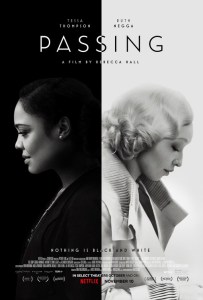 Actress Rebecca Hall’s debut as a screenwriter and a director was snatched up by Netflix and now poised as an Oscar contender. It’s set in the 1920s and follows two women, Irene (Tessa Thompson) and Clare (Ruth Negga). Both women come from the same neighborhood but have lived different though fruitful lives, though Clare’s fortunes hinge on a secret she hides even from her rich husband. She’s a light-skinned Black woman but she has been posing as being white, and she’s reaped the rewards. As the two former friends reconnect, Clare visits the clubs and parties of Harlem as if a tourist, and she seems to have charmed Irene’s husband to spark unrest in her home. The movie is very tasteful and stately, filmed in black and white and in a 4:3 aspect ratio, communicating the boxes these women felt trapped in by society’s racial aptitudes. The problem is that Passing has so much explosive drama at its core but it’s too demure to a fault, which leads to a lot of wheel spinning and pensive glances. The movie almost follows the “uninvited guest” plot device, where Clare makes herself more at home in Irene’s world to her chagrin. There’s a general danger of whether Clare’s secret will come out, especially since her husband is overtly racist, but she seems so blase about her situation. The movie seems to feel like it’s lacking a potent sense of dread for these women, leaving it more implied than felt. It’s a character study but the primary characters seem more like archetypes, symbols intended for a larger social debate after the film’s conclusion. Both actresses are terrific, however, and would be worthy nominees for awards. Negga (Loving) has the more locked-in performance as the woman living her facade, only offering glimpses of what the real Clare thinks about herself. Thompson (Dear White People) is the one trying to hold it all together while she tries to assess whether her former friend has figured out a social cheat code, is deluding herself, or is herself a corrupting influence. The ending is so abrupt that I had to rewind to better understand what had happened. It’s left for interpretation about culpability and intent, but it’s further confirmation that the characters are meant as symbols more than people, and their fates feel a little too tailored for study. Passing is a good movie, don’t get me wrong, but one that left me checking the time a little too often to see how slowly it was passing.
Nate’s Grade: B
Share this:

Cyrano (2021)
 I did not expect the new Cyrano to be a musical at all, though it is a reprisal of a 2018 stage musical by Erica Schmidt. This fact made the movie even more entertaining and surprising, separating it from the pack of Cyrano de Bergerac adaptations (there is a 1970s Cyrano musical with Christopher Plummer in a Tony Award-winning role). This is an old story and this new version still taps into the potent recesses of unrequited love, social scorn, and the farcical angle that transitions into tragedy. You still understand why audiences from multiple generations come back to this story to laugh and cry anew (it began as a play in 1897 by Edmond Rostand). However, when modern filmmakers are tackling these tried-and-true stories of old, I expect, or at least hope for, something new to justify this latest cinematic addition. It could be an elevated point of view given short shrift before, allowing us new eyes into an old tale. There are plenty of earlier versions that haven’t been as considerate to minority positions. It could be updating or transposing the story to a different setting. It can be simply making it weird. Director Joe Wright’s 2012 Anna Karenina adaptation was an attempt to do something different, with the strange concept that it was taking place on a theatrical stage. I guess because the elites felt so obsessively observed? It didn’t really work, but I admire Wright’s game efforts in trying something different with an oft-told tale. With Cyrano, the story translates well into the realm of a screen musical, and one where Wright wants to work within that unique toolbox, letting the audience get caught in the sweep of the movie magic.
Cyrano (Peter Dinklage) is a dwarf but one of the smartest men alive in 1640 France. He’s unafraid of jousting with pompous actors, pompous aristocratic dandies, and even assassins (their pomposity is up for debate). His true challenge is telling Roxanne (Haley Bennett) that he loves her. This is made even more difficult when Roxanne falls head over heels for Christian (Kevin Harrison Jr.). She seeks out her good friend Cyrano’s help to inquire about the boy’s feelings being reciprocal. Christian does indeed fancy Roxanne except he’s unable to articulate his thoughts. Cyrano agrees to serve as the carrier of his words and write his feelings for him in order to better woo Roxanne. Letter by letter, flowing with poetic verse, Roxanne falls in love with Cyrano’s soul, thinking it belongs to Christian. This is made even more complicated by a fiendish fop, De Guiche (Ben Mendelsohn), who expects Roxanne to marry him and give herself over to him, body and soul.
 The other thing you need to know is that Cyrano is a deeply un-hip musical, and its square-ness is also part of its offbeat charm. This is not 2017’s crowd-pleasing The Greatest Showman. These songs are not manufactured to be pop ditties fit for radio airplay. These are songs written and composed by the members of the band The National, an alt rock band better known for their soulful dirges (the lead singer performed the mournful end credits cover of “The Rains of Castamere” for that infamous Game of Thrones episode). The songs of Cyrano by Aaron and Bryce Dessner and Matt Berninger are not going to be the ones you clap your hands to and sing along in the car with your friends. There are no catchy anthems here, no inspirational melodies to rise to triumphant fist-pumping crescendos. These are songs that are methodical, mournful, and, at points, atonal, like twisting the words and sounds to fit an unnatural shape. However, this is the same appeal of songs by The National, how they make uniquely composed tunes that challenge and break free of standard melody conventions. For some, they will find the songs of Cyrano to be slow and low in energy, too self-serious to the point of parody. But for people willing to take the lyrics and songs on the terms presented, there is a smoldering sense of splendor to them, something unexpected, just like the character of Cyrano. Beauty found in unexpected places.
There is one song in particular that disarmed me with how affecting it was. “Wherever I Fall” isn’t even a song sung by any of the main characters. It’s the refrain of a bunch of otherwise nameless and faceless soldiers, the ones who know they will not survive a suicide march into enemy fire during the Franco-Spanish War. This is the song for the fallen and it’s heart-breaking. We take turns with each man writing one last letter and offering instructions to the carrier, which take on the form of last rites. Each man reflects on their life and their cherished loved ones that will read their letter after their inevitable demise. The entire construction of the song is heavy with emotional weight, but I was surprised how much it got to me. I was tearing up for men who weren’t even featured as characters before, or at least served as extras in other scenes that didn’t draw my attention. Bonus points for making the first soldier Glen Hansard (Once). “Someone to Say” has a sweet and lyrical melody that comes in and out as a bountiful motif, and it’s the romantic tug for our lovers. “Every Letter” and “I Need More” have a thrumming intensity of strings and heartbeat-like percussion that reminded me of the soaring 1990s/early 2000s singer-songwriters like Tori Amos and Dido. As I adjusted to its somber wavelength, the music grew on me. It’s music for a rainy day made into an old-fashioned musical that isn’t trying to score points for being edgy.
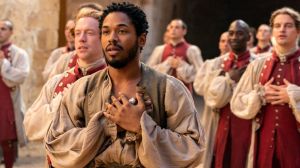 Dinklage (I Care a Lot) is an excellent choice for Cyrano. While he might be the weakest singing voice of the cast, Dinklage is definitely the most accomplished actor and proves it again. His character’s inner struggle and true feelings consuming him is wonderfully portrayed by Dinklage. He has his big outbursts, where he inflicts his wit like a sharp-edged weapon, and others where it’s the total of years of frustration from being sidelined and overlooked and discounted, but it’s the quieter moments where Dinklage retreats behind his sad puppy eyes that got me the most. Bennett (The Girl on the Train) has a spark to her that reminds you why Cyrano would fall in love from a distance. Her light at the beginning of the movie threatens to be snuffed out by bad men, and it feels like a real loss. Bennett and Dinklage are also reprising their roles from the stage musical, so their natural chemistry and comfort with the roles improves the experience. Mendelsohn (Captain Marvel) is a pro at playing those officious, lecherous, pathetic roles, and once again he’s on target. His creepy rendition of “What I Deserve” sounds like the skin-crawling mantra for male chauvinism writ large. It might even make you retch.
Wright’s (Darkest Hour, Hanna) direction makes fine use of the big screen space, and his penchant for long takes and sweeping camera movements for verisimilitude enhance the viewing experience by allowing us to better immerse in the world and appreciate the talents of the professionals. It’s a musical that lets you enjoy it being a movie musical, and its editing is judicious without being disorienting. The movie doesn’t feel like its trapped by its stage-bound origins. The lush setting of Italy and its pristine estates adds an extra layer of enjoyment that makes the movie more transporting.
Cyrano is a sneaky movie, one that seems old and new, serious and impish, square and traditional while still making its own stamp on classic literature. Much of your enjoyment factor will likely rest upon your assessment of the music and songs, which is a fair critical point for a musical. I found them to be romantic and gloomy and so achingly serious that I found it to be adorable. The music worked for me, as a moderate fan of The National, but if you cannot click with the songs or accept that everyone is not going to be a trained singer, then your enjoyment level will certainly dip. I found this movie to be a modestly pleasant surprise that won me over by its depressing finale.
Nate’s Grade: B+
Share this:

The Power of the Dog (2021)
 Every year, it seems that Netflix’s crown jewel for their big Oscar hopes ends up getting marvelous critical acclaim, and then when I finally watch it I am left disappointed. It happened in 2018 with Roma. It happened in 2019 with The Irishman. And it happened in 2020 with Mank. I haven’t disliked any of those movies, but I was unable to see the highly laudable merits as other critics. Now here comes their big Oscar play for 2021, Jane Campion’s The Power of the Dog, a Western that has been gracing the top of more critics lists than any other American film this year (I’ll be getting to you soon enough, Drive My Car). As I burned through awards movie after awards movie to assess, I held back from The Power of the Dog for a time. I just didn’t want to find that once again I was disappointed with the latest Netflix Oscar contender. I’m still chewing over my feelings with The Power of the Dog, which has a lot going on under the surface and a palpable tension that you’re unsure of how and when it will erupt. It’s also a movie that touches upon repression, toxic masculinity, manifest destiny, grooming, emotional and physical manipulation, and the danger of unstable men who are unable to process who they really are.
Set in 1925 Montana, Phil (Benedict Cumberbatch) and his brother George (Jessie Plemons) own and operate a cattle ranch. George marries a widow, Rose (Kirsten Dunst), and brings his new wife and her teenage son, Peter (Kodi Smit-McPhee) to live at the ranch. Phil resents his new sister-in-law, looks down on her son, and torments both repeatedly. Rose sees Phil as an enemy, someone who will not stop until he forces her out, and his target becomes her son, Peter.
 This is less a traditional Western in several respects and more a tight character study that happens to be set at the conclusion of a Western fantasy for America, transitioning to modernity. It goes against our preconceived notions of a Western, not in a deliberately deconstructive way like 1992’s brilliant Best Picture, Unforgiven, but more in providing contrary thematic details that often get squeezed out. I was expecting the movie to take place maybe during the 1870s or 1880s, but the fact that it’s taking place five years removed from the Great Depression offers different story opportunities and larger reflection. There’s a reason this story is told well after the halcyon days of the Old Wild West. The movie is about certain characters holding onto an exclusive past that has eclipsed them and others ready to move forward by shuttling over their past and the obstacles standing in the way of personal progress.
There are thematic layers expertly braided together that touch upon the larger question over what it means to be a man in society. Each of the primary male characters (Phil, George, Peter) is an outsider to some degree, someone who doesn’t neatly fit into what constitutes a conventional man of the times. George is soft, empathetic, meek yet in a position of power from his family’s status; Peter is rail-thin, academic, odd, effeminate at turns, a dandy presented for ridicule; Phil is the one who presents as a “man’s man,” a hard-driving, hard-drinking man of the land who imposes his will on others. However, deep down, Phil is hiding a key part of himself that would conflict with his society’s view of masculinity. Each man bounces around points of conflict and connection with one another, familial bonds fraying, and a slow-burning battle for supremacy escalating.
 The movie could have also been charitably nick-named “Benedict Cumberbatch is a jerk to everyone,” as this is much of what Campion’s script, based upon the 1957 novel by Thomas Savage consists of. The movie is absent a primary perspective. We drift from person to person in the small-scale ensemble, elevating this next character and their views and worries and priorities. Phil could be deemed the primary protagonist and antagonist, especially the latter. He’s a mean man. Phil is a man who likes to make others uncomfortable, who needles them, and he takes great interest in targeting Rose, partly because he doesn’t like the influence she has on his only brother, and partly because he can get away with it. When he sets his sights on Peter, you don’t quite know what this hostile man will do to get his way. Will he manipulate Peter to turn him from his mother? Will he endanger Peter as a threat to Rose? Will he go further and possibly kill Peter? Or, as becomes more evident, does he see Peter in a very different light, a special kinship that had defined Phil’s own secretive past.
I suppose it’s a spoiler to go further so if you want to, dear reader, then go ahead and skip to the next paragraph. Phil reveres “Bronco Henry,” a deceased rancher that taught him many things when he was younger. The movie heavily, heavily implies that this long-departed older man had a romantic relationship with Phil when he was much younger, something the grown Phil cherishes, caressing himself in private with a scrap of fabric belonging to Henry. The lazy characterization would be, “Oh, Phil is homophobic because he’s really gay, and he’s angry because he cannot accept himself.” With Campion, Phil could be viewed as a victim too. He was likely groomed by an older man, and maybe that relationship was viewed by Phil as more romantic and consensual than it was, but it’s the lingering nostalgic memory of the intimate happiness that he holds onto, afraid to move on because of the danger of letting go and the danger of possibly reaching out, being vulnerable again. Yes, dear reader, this is more a gay cowboy movie than Brokeback Mountain (which, to be fair, were sheep herders). Savage himself was also gay. As Phil takes Peter under his wing, you don’t know whether this man is going to kill or kiss him, and the tension is ripe enough that either way it can ties you up into anxious knots.
The acting is extremely polished all around, with each performer having layers of subtext to shield their true intentions. Cumberbatch (Spider-Man: No Way Home) is a thorn in so many sides and it isn’t until much later that the veil begins to drop, ever so slightly, allowing you to finally see extra dimension with what appears to be a bully character for so long. He might just be too impenetrable for too long for some viewers to develop any empathy. Plemons (Jungle Cruise) and Dunst (Melancholia) are sweet together, and I enjoyed how each one leans upon the other for support. Rose is the butt of much of Phil’s torment and teasing, so we watch Dunst break down under the constant abuse of her berating brother-in-law. When her character sees a way to gain an upper hand, it becomes like a light in the darkness for her momentary relief. I felt heartbroken for Rose as she studied a piano tune for weeks to impress esteemed guests of her husband’s, only to succumb to her nerves and insist she couldn’t play because she didn’t think she could be good enough. Then to watch Phil cruelly needle her further about her disappointment by whistling that same tune is even worse. This is the best acting of Smit-McPhee (Let Me In) since he was vying with Asa Butterfield (Hugo, Ender’s Game) for every preteen lead in big studio features. There’s a deliberate standoffish quality to the character, to Peter’s way of viewing others. It’s like he’s part alien, studying the things that make people tick. Like Cumberbatch, there are multiple layers to this performance because his intentions are equally if not more guarded. You almost need to watch the movie a second time to better identify what Smith-McPhee is doing in scene after scene.
 The Power of the Dog is a terrific looking and sounding movie. The photography is beautiful, the New Zealand landscapes are awe-inspiring, the production design is handsome, the musical score by Johnny Greenwood (There Will Be Blood) is discordant strings that enhances the tension permeating through the movie. Campion hasn’t directed a movie in over ten years, and this is only her second movie since 2003’s misbegotten erotic thriller, In the Cut, starring an against-type Meg Ryan. It feels like she’s had no time away with how controlled and resonant her directing plays. I wish her script was less ambiguous to a fault; it errs somewhat I believe by holding out key revelations about Phil for too long, leaving us with the man being an unrepentant bully for too long. There are significant turns in the concluding minutes that will reorient your interpretation of the entire film, and I have every reason to believe that when I watch The Power of the Dog another time it will be even more impressive.
Congratulations, Netflix, on breaking your streak of disappointing me with your prized awards contenders. I’ve included many Netflix movies in my best lists, and worst lists, over the years, as that is the lot when you have such an enormous library in the prestige streaming arms race. The Power of the Dog is an intimate and occasionally even sensual Western that pushes its put-upon characters to their breaking point, and perhaps the audience, while rewarding the patient and observant viewer. There’s gnawing, uneasy tension that gets to be overwhelming, but the movie benefits from the unexpected destination for where that tension will lead. Will it be violence? Will it be passion? Will it be a crime of passion? The acting is great, the artistic quality of the movie is high, and each scene has much to unpack, allowing for further rewarding examination. I wish there was more of the last half hour when things better come into sharper focus, and I wish the movie was a little less ambiguous for so long, but this is one of the better films of 2021 and Campion’s best movie since 1993’s The Piano (I fully expect her to become the first female director nominated twice for the Best Director Oscar). The Power of the Dog is a lyrical, surprising drama, a sneaky character study, and proof that my Netflix overrated front-runner curse has been lifted (for now).
Nate’s Grade: A-
Share this:

The Lost Daughter (2021)
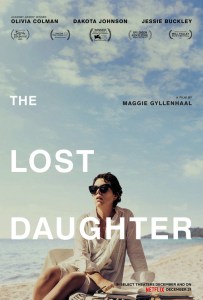 As a film critic part of a credited organization, I’m used to getting goodies in what I call “screener season,” the months of October to December when studios want to court critical favor for year-end consideration of their assorted movies for awards and titles. Netflix has sent me enough heavy coffee table books that I could, in Cosmo Kramer-style, fashion a literal coffee table made from them. For The Lost Daughter, Netflix sent me quite a bundle, including the film’s source material, a 110-page novella written by Italian author Elena Ferrante (My Brilliant Friend), which I read, and an actual bottle of sauvignon blanc wine. This was the first time a movie studio had sent me alcohol (my girlfriend drank a glass and did not like it, so thanks anyway, Netflix, but we dumped the bottle). I found the novella to be well written with plenty of poetic insights and turns of phrase, but I didn’t see the movie there. After sitting down and watching the two-hour feature film, I still don’t quite see the movie in this story.
Leda (Olivia Colman) is 48 years old, a literary professor, and vacationing on a small villa in Greece. Her time away is disrupted by a large, boisterous family sharing her resort. Leda is intrigued by a mother, Nina (Dakota Johnson), and her young daughter, Elena. It makes her reflective of her own time as a mother (played in flashback by Betty Buckley) to her two daughters, now both in their early twenties and having little to do with their mother. One day, Leda picks up Elena’s forgotten doll from the beach with the intention of returning her to the child, and then she simply does not do this. Leda grows closer to Nina, disapproving of her arrogant husband, her boorish relatives, and some of her risky personal choices, and we’re left to question whether she’s relating to this young, besieged mother or judging her from afar.
 This is one of those character study films that will ebb and flow on the level of the performers, and the actors elevate the material beyond what is present on the page. There are several intriguing conversations that shed light on characters and their view of parenthood, like Leda explaining how she feels that she gave the best of herself to her daughters when they were born, and now what she’s left with are the scraps. It’s not breaking new ground to view motherhood in non-glamorous terms. I thought 2018’s Tully did this with great observational detail, unsparing honesty, and great empathy. The Lost Daughter is not exactly Tully, which explored the hardships of motherhood with a put-upon woman who was valiantly struggling to keep her head above water, but it was a woman who wanted to be in the fight. With this movie, you never quite get a clear sense of Leda’s relationship with her two children, who are mostly kept to flashbacks when they are very young. Writer/director Maggie Gyllenhaal (yes, that Maggie Gyllenhaal) employs a non-linear plot to better inform the interior thinking of Leda, so we’ll have past and present juxtaposed for our ongoing evaluation. This is a smart way to follow the imprecise nature of hazy memory. There will be moments that will cause you discomfort, like when one of Leda’s young children is pleading through tears for her mother to kiss her wounded finger, and Leda withholds doing this as a power play, as an act of spite, as a knowing punishment for her wailing child. It’s also potentially relatable for others out there who too have, at the apex of their frustrations and exhaustion, lashed out at children and regretted it later, acknowledging that every parent will fail at some point over the long journey of time and to only attempt to minimize the inherent damage that will be left.
The Lost Daughter becomes an exercise in how long you want to spend with a pleasantly unpleasant woman. Leda is complicated, yes, but she’s also admittedly cruel and selfish, and the movie is trying to make her a case study, to shed our moral judgements and acknowledge that parenthood can be a draining experience. I understand the intention for embarking on empathy for unsympathetic characters; hundreds of movies have invited us into the minds of unlikable and downright psychopathic characters. I’ve always said that I need not like a character, I only need to find them interesting to keep me watching. Leda is an interesting woman because of where she veers from common practice. Most of us would return a missing doll to her rightful owner, especially as that child is grief-stricken and her wave of terror is affecting everyone in her family. Most of us would recognize others suffering and our ability to ease this, to absolve that suffering in an instant, and we would do so. Then the question becomes why isn’t Leda returning this doll to this child? The movie is an elusive attempt to answer, and each person’s interpretation will undoubtedly be different. I don’t know if this doll, perhaps the “lost daughter” of the film’s title, is Leda attempting to hold onto her own daughters, reclaim a version of motherhood that suits her, that doesn’t require of her. Or maybe she views the doll with derision. Whatever the case may be, have at it, dear reader, and enjoy not getting this question resolved.
 I completely understand viewers growing frustrated with watching two hours of a middle-aged woman holding onto a child’s doll and refusing to return it. It’s spiteful, and maybe that’s the point. Maybe Leda wants to impart the same lessons of hardship she endured as a struggling mother at her wits end. Maybe it’s her way of trying to shake Nina to re-examine whether being a mother is a role she is cut out for. Maybe it’s simply the continuation of a sadistic rationalization, “I had to suffer through this, so then you should have to suffer too” that props up whenever sociopolitical reforms and progress are met with generational push-back. By the end of the movie, I don’t know if Leda has seriously changed her outlook or sense of self. I don’t know if anything has really changed, and I don’t know if we’ve gotten to understanding her any better. Again, maybe that’s the point; people are complicated and possibly unknowable. But as a filmmaker showing us a character’s interior life and flashbacks, maybe you should try.
There is a late revelation in the movie that is going to be a deal-breaker for many. I won’t spoil it, though I will say that this reveal is covered in the first chapter of the novella, providing you this key piece of info as a prism for your early assessment. It explains why Leda has a strained relationship with her adult daughters and why thinking back about her perceived parenting failures causes her shivers of grief and guilt. At the same time, there are plenty of feminist stories about women shirking societal demands, so others could perceivablly view this revelation as an act of empowerment or self-determination, and others may just find it as the final straw in giving up in trying to sympathize with an already difficult person.
Fortunately, if you’re going to build a movie around a challenging character, Colman (The Father) and Buckley (I’m Thinking of Ending Things) are two of the most compelling actors for the cause. Much of their performances is naturally guarded, requiring each actress to hold back and utilize more subtle acting muscles. Colman’s middle-aged Leda is more set in her perception of self, more settled though not quite self-assured, so her performance seems more like cracking through a veneer and pushing back, trying to find the real Leda’s feelings about her life and the people she is socializing with. Colman is mesmerizing as always. Buckley’s young Leda is the version that is fraught with being an attentive mother as well as a burgeoning literary academic. Hers is the role of frustration, of shutting down, of desiring an escape hatch from the perils of motherhood. When young Leda is away on an academic retreat, she’s like a completely different person, and Buckley makes it clear that she covets this version of herself. Both women are gifted actresses and provide lifelines for the viewer to better analyze and unpack Leda as a puzzle.
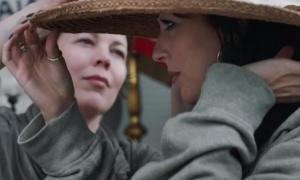 Gyllenhaal makes an impressively natural debut as a director. Her camera is usually very closely tied to her actors, bobbing to catch up and keep them in frame, afraid of leaving their sights. Her attention to detail is solid and her command of the actors is strong across the board. Her adaptation makes smart choices to better visualize the drama. After I read the novella, I genuinely wondered how the movie could even convey the material. It was so insular, so personal, and again, much of the onscreen drama was a woman hiding a doll from a child. I was worried the movie might become a ridiculous thriller of waiting for Leda to be caught, how she had to go to greater lengths to keep her secret, and thankfully that is not the case.
I can easily foresee The Last Daughter becoming a polarizing movie upon its Netflix streaming release at the end of the month. Some will hail it for being challenging and thorny, an indictment on the expectations of motherhood from a society that sets ambitious women up to fail. Some, and I predict the majority of viewers, will find the movie to be an insufferable character study of a misanthropic protagonist. I know the movie wasn’t trying to make an audience like its lead character, but I don’t know if by the end we are better at understanding her and her choices. It leads to a sort of, “That’s all there is?” ending that will frustrate many. The acting is strong to excellent overall and Gyllenhaal has a bright future ahead as a director, but The Lost Daughter might be too lost for too many to care. Just give the kid back her doll already, lady!
Nate’s Grade: B-
Share this:

The Tender Bar (2021)
 When adapting a memoir into a movie, it’s important to ask whether the subject has lived an interesting life that people would want to see. With The Tender Bar, based on the 2006 memoir by journalist JR Moehringer, I think the filmmakers lost sight of this. Young JR has elements of an interesting personal experience; his father, a famous radio DJ, has been absent for his whole life yet JR still pines for him while listening to the radio (the father is simply referred to as “The Voice”); his mother goes through chemotherapy for cancer; his grandfather, whom he and his mother have been forced to move back home to live with, is suffering from dementia; his uncle Charlie (Ben Affleck) runs the local bar and pushes JR to read mountains of classic literature in order to become a better writer. Any of those elements could be further explored and mined for relatable human drama and bittersweet coming-of-age lessons. That’s not what The Tender Bar does. Strangely, it cavalierly jumps around these plot points, never really settling on one for long, only braiding them together in a way that feels fleeting and stalled for building momentum. The choice of mixing in non-linear flash forwards and flashbacks (as well as a narrator) complicates matters and feels like the adaptation was struggling to relay the info it needed. Too much of this movie dwells on the least interesting part of this story, namely JR falling in love with a girl in college who repeatedly dumps him. It’s so frustrating to watch especially when we have more interesting scenarios passed up just to watch this dumb kid get his heart broken by this same girl for the umpteenth time. I wish JR had just remained a youngster and we could have focused on his real father figure shaping him, his uncle, and their time spent running the local watering hole. Mysteriously, this movie is directed by George Clooney, who shows no real affinity for the story or its characters. The movie is generally warm and gauzy but bereft of significant personal details to make the drama more resonant. It’s like you took a coming-of-age story and melted it down to its most recognizable base components. The Tender Bar is assuredly a case where the appeal of the novel must have been from the voice of its author. The story, at least presented onscreen, is a wistful shrug of a movie with an above-average Affleck performance. It’s a nice but dull experience, which is likely an apt description of most ordinary people’s lives.
Nate’s Grade: C+
Share this:

In the Bedroom (2001) [Review Re-View]
 Originally released November 23, 2001:
In the Bedroom hits all the right notes of agonizing pain, devastation and loss. The heart of the film is on the grief encompassing Matt and Ruth Fowler (Tom Wilkinson and Sissy Spacek) over the loss of their son. The Fowlers are well regarded in their cozy New England town. Matt is a flourishing local doctor and Ruth teaches a chorus of local high school girls.
In the Bedroom opens with Frank Fowler (Nick Stahl) chasing his older girlfriend Natalie (Marisa Tomei) across an open grassy field. Frank is a budding architecture student home for the summer and thinking of prolonging his time so he can stay together with Natalie. Frank and Natalie have a distinct age divide but also seem to have been given different lots in life. She has a pair of boys from her abusive husband Richard (William Mapother) that she is finalizing a divorce from. Richard is hopeful he can reconcile with Natalie if he just gets another chance, but Natalie is stern in her refusal.
 Ruth sees the relationship as a detriment to her son’s future. She’s even more upset that Matt is so casual with their son dating an older, working-class mother. Frank rushes over to calm Natalie after another of Richard’s outbursts of violence has left her house in shambles. She rushes her children upstairs just as Richard returns back. He manages to sneak in through a back door and confronts Frank in their kitchen, shooting and killing him. What should seem like a clear-cut case begins to unspool. Natalie admits she didn’t actually see the gun fire and the charges are dropped from murder to manslaughter. Richard is released on bail and free to stroll around occasionally bumping into the grieving and outraged Fowlers.
The majority of the film is the aftermath of the murder and the strain it puts upon Matt and Ruth and their marriage. Beforehand jealousy, anger, and bitterness would simply sit but slowly the tension begins to bubble to the surface. Ruth holds resentment and blames the leniency of Matt for the death of their son. Matt tries to get out of the house as much as possible, even if it means sitting in his car in their driveway at night.
One of the most harrowing scenes of In the Bedroom is also its emotional and acting centerpiece. After the mounting frustration with justice, Ruth and Matt explode into an argument that had slowly been building long before their son’s death. This is the first time they have truly talked about the whole situation and accusations fly like bullets in their first emotional confrontation. In the Bedroom could have easily fallen into the area of sticky made-for-TV land, but the exceptional performances all around by the cast and the deft and studied direction never allow it to falter.
Spacek (Carrie, Coal Miner’s Daughter) can begin writing her Oscar acceptance speech right now. Her portrayal of Ruth displays the pride and seething anger, but keeps her human throughout. She exhibits pure, raw emotion that strikes directly inside you leaving a knot in your stomach and in your throat. Her performance is truly breathtaking and so emotionally visceral to watch. Wilkinson (The Full Monty) plays Matt with passive-aggressive doubt and repression. He dominates in any scene he is in and takes the audience on a wide range of emotions. He has a commanding presence and compliments Spacek’s Ruth nicely. Perhaps the greatest thing Tomei (My Cousin Vinny, Slums of Beverly Hills) was known for was miraculously winning an Oscar and dumbfounding a nation. With In the Bedroom she is given the ubiquitous “And” credit at the end of the opening cast list. She has less to work with and less screen time to work it, fully earning the “And”‘ credit she has.
 Todd Field is an actor-turned-director and has appeared in such a wide array of films from Twister to Eyes Wide Shut. Field has layered his film with rich symbolism and an intelligent, patient pace. Most of the action in movies is centered on what is going on in a scene, but the most telling moments of In the Bedroom are what are not going on in the scenes. Field creates such an intimate portrait that the camera almost turns into another character, catching the lingering silences and the burgeoning inner turmoil. Field also adapted the screenplay from a short story by Andre Dubus, whom he dedicates the film to.
In the Bedroom is not going to be for everyone. Some will find it slow and some might even find it boring. As it stands, it is a powerful film on the study of loss that grips you and refuses to let go. You will feel all the blame, jealousy, anger, and pain of this family and for such emotions to resonate from the screen to the audience is a great achievement.
Nate’s Grade: A
——————————————————
WRITER REFLECTIONS 20 YEARS LATER

Twenty years later and it seems like nobody really talks about Todd Field’s In the Bedroom any longer, which is a crying shame. The movie was hailed by critics upon its release in late 2001 and earned five Academy Award nominations including Best Actor, Best Actress, Best Supporting Actress, and Best Picture. Field would then adapt Tom Perotta’s novel Little Children and direct its 2006 adaptation, again earning favorable reviews and multiple Oscar nominations, revitalizing the career of Jackie Earl Haley. And then Field seemed to vanish from view. There are a few dropped projects and a potential upcoming series with Daniel Craig, but Field has been too quiet as a director for over 15 years, and that’s far too long for a man that showcased such immediate natural talent from his very first opportunity in the director’s chair. In the Bedroom was a movie that I wasn’t exactly excited to come back to on my list of 2001 re-watches; it’s a heavy drama about grief and suffering and that’s not exactly the best entertainment remedy during the holidays. I’m happy to have gone back to the movie, as well as cross it off my list, because this return reaffirmed for me just how great Field is as a director, and a screenwriter, and just how vital this indie film feels. It’s the real deal when it comes to authenticity and emotional power, and watching this as a 39-year-old rather than a 19-year-old gave the enduring two hours added heft for its family tragedy.
The plot centers on the spiraling consequences of one death. Frank Fowler (Nick Stahl) is the 18-year-old son of Ruth (Sissy Spacek) and Matt (Tom Wilkinson), upper-middle class and pleasant but pointed. Frank is dating Natalie Strout (Marissa Tomei), an older woman and the ex-wife (though not yet legally divorced) of Richard Trout (William Mapother), a violent and unstable man and also heir to the local canning company. One fateful day, Richard angrily confronts Frank, a gunshot is heard, and Frank is dead. Richard swears it was self-defense, but Natalie is convinced her jealous ex was finishing the threats he had been making about her ever leaving him. The murder happens at the 40-minute mark, and from there the movie becomes a long examination on grief and guilt and blame, where characters drift from scene to scene like ghosts, some avoiding the painful realities of their enormous grief, finding hobbies or distractions, but most unable to fully articulate the resounding pain and emotions brimming under the surface.
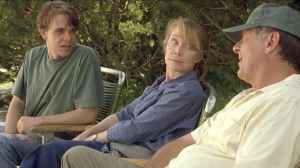 Under Field’s attentive care, there is a palpable dread hanging over every scene. The script allows different bereft perspectives, each person wrestling with feelings of personal guilt. Natalie blames herself for holding onto the relationship, bringing him into her world. Matt blames himself for not calling the police after an earlier fight between Frank and Richard, and he doubts whether he should have pushed harder on his feelings of reservation about the relationship with Natalie. Ruth has escaped into her insurmountable anger and uses it as the fuel to keep her going. The friends and neighbors do their best to be supportive but every conversation or poker game has the danger of veering too close to The Topic, and the awkward but well-meaning silences permeate and become more awkward. It’s a movie about people trying to get on with their lives but not knowing how to reassemble the broken pieces. By itself, that is enough meaty drama worthy of examination by top-notch actors and considerate screenwriting that allows us to really dwell in the beautiful discomfort. Field adds extra degrees of turmoil from the possibility that Richard will be given a slap on the wrists by the indifferent legal system. Richard posts bail thanks to his family’s wealth and even casually strolls through the town like nothing happened, making appearances while Ruth is shopping like her living in an inescapable nightmare. The Fowlers are consistently having their pain poked and prodded and reopened. One friend suggests if Matt has contemplated moving, and he admits he’s considered it, but it wouldn’t change what happened or lessen the pain of having their son’s killer protected by his status.
As you can imagine with that kind of material, In the Bedroom is an actor’s showcase. Wilkinson is the more featured role, and he’s the more laid back one, the one trying to make sense of things as best he can and failing. Wilkinson is terrific in the role and his hangdog expression from scene to scene denotes so much unspoken pain he’s grappling with behind his placid veneer. Just watching this man try and keep his life together is worthy of study. The weariness is harder to note with his performance but more rewarding to watch. Spacek is great herself but playing a role with less dimension. She is the stern voice of outrage and blame, the one who never liked Natalie and always suspected the worst. She has her signature blowup scene that serves as a long-in-the-making emotional confrontation with her husband, who she accuses of hiding from his grief rather than embracing it. However, her character is also painted in an unflattering and I would say unfair characterization. In the heat of their fight, Matt accuses his wife of being so controlling, so unforgiving that her son had no choice but to run away from her. While the character has been presented as cold and disapproving, she’s a victim too. This was Tomei’s confirmation as an actress that her surprise 1993 Oscar victory was no accident. She’s strong in her brief moments, especially when she’s recounting Frank’s murder under oath and realizes her inability to help the case with her conflicting witness testimony. It’s devastating to watch as she processes in the moment the doubt and then utter terror as she realizes that her next words, of honest yet painful reflection, will undermine the case she so desperately needs. I know the slap between Spacek and Tomei got more attention, but this is her clincher.
 All of this well-wrought examination of grief and guilt is sturdily handled, and it effectively sets up the last fifteen minutes of the movie into its own indie thriller. Finally pushed far enough, Matt takes matters into his own hands to find justice. The entire sequence is played out so deliberately that you might not breathe from the protracted suspense. Field and co-screenwriter Robert Festinger (Trust) have patiently built up these characters and their conflicts with such precision that they have developed genuine emotional stakes and uncertainty for the end. For first-time viewers, I imagine there will be legitimate doubt how the final events will play out. Is Matt being honest with his offer to have Richard run away from town? Is he making his stand in secret to absolve his wife of more pain and to rise to her verbal challenges of being too timid, or is she in collusion and possibly the Lady Macbeth from the bedroom shadows? It’s a long, taut sequence that feels like a fitting culmination of the many little details that have been set up, from character dimensions and motivations to small details that come together so smoothly, like a bridge worker or a friend’s large estate. It’s been twenty years since I’ve seen the movie and it still had my heart elevated, and I knew the ending.
Where In the Bedroom separates itself from the dramatic pack, and where it’s deserving of more attention and notoriety in retrospect, is how remarkably considered and assured this movie is about assembling its details and atmosphere. This is a deeply felt and deeply authentic movie that fills out the innumerable edges of this small coastal town with colorful characters that feel genuine, lives that feel lived-in, details that feel authentic without being obvious, and all without losing focus on the central performers as they struggle with their consuming grief. There are great artistic touches too for emphasis, like when Matt seeks out his lawyer to question points of strategy, and when the officious man retreats back to polite deferrals that fall back on the limits of the judicial system, the camera focuses on tight edits, first the man’s mustachioed mouth, then his fiddling hand in his pocket jangling his keys, a sound that intensifies into that of a jackhammer. It’s a clever and effective means of conveying the fractured, infuriating, dismayed response of Matt. However, most of the movie avoids flashy style that calls attention to itself. The very framing of the characters in the shots is so elegantly composed, making fine use of spaces and windows to help convey extra layers. This is a movie that does not feel like a first-time filmmaker or screenwriter. This same measured assurance can be seen in 2006’s Little Children, an equally well-observed, detail-rich, non-judgmental slice-of-life of small-town ennui. We need more Todd Field movies considering he’s two-for-two with literary adaptations.
 My original review in 2001 has some sentimental value for me. It was one of the first reviews I ever wrote for my college newspaper, The Chimes, in the position of film critic, an official role I held for five straight semesters (2002-2004). It was a goal of mine arriving at school and I saw it through, and this first review reminds me of the next stage of my career in film criticism and of my good times in small-scale publishing. My 2001 review gets some things right but I cringe at how awkwardly it’s trying to grasp for further meaning without understanding how to clarify my explanations. Maybe I was more taken with writing to my college-aged audience, hence why I devote a paragraph to explaining the use of the “And” credit in movie casting. There are some good points here and there, and the distillation of the plot and conflicts is solid, but as I’ve noticed with more than a few of my earlier reviews, the depth of critical analysis is shallower than I would prefer. Also, my hasty prediction that Spacek should “begin writing her Oscar acceptance speech now” was short-sighted, as she lost Best Actress to Halle Berry for Monster’s Ball (see you next in December, movie). In the Bedroom is a movie worthy of your time and a cultural re-examination.
Nate’s Grade: A
Share this:

Clifford the Big Red Dog (2021)
 What can one expect from the 80-minute live-action feature film of a children’s book series that was about a giant red dog? While ostensibly made for little kids, like those strictly under ten, Clifford the Big Red Dog (not to be confused with the equally alarming Clifford) is banal entertainment that’s inoffensive as long as you don’t have a deep personal attachment to the best-selling source material. It’s your standard children’s fantasy come alive with a giant dog that needs to be cared for as well as kept a secret. There are rambunctious moments of quelling the dog, mischievous moments of chasing the dog, and frantic moments of running away from a gene-splicing tech guru (Tony Hale). And oh, you bet there is scatological humor. We got dog farts. We got dog butt humor. We got dog pee. We got dog poop, at least in reference though thankfully never seen. I don’t know why we needed an added story of a little girl struggling to fit in at middle school with preppy, mean girls. I guess because a big red dog is also struggling to fit in? For that matter, the movie never returns to the opening scene of Clifford’s dog family being taken from him (a baffling and sad opening). There’s a more charming, heartfelt movie somewhere in here, akin to a Paddington where the central character changes those around them for the better, but our little New York City neighborhood is strictly in a more plastic and safe world. There are a few jokes that slipped past and made me laugh, so it’s not all a loss. Clifford doesn’t pretend to be anything more or less than its meagerly stated goals, and it’s a serviceable family film as long as your little ones have a low threshold for realistic-looking CGI dogs.
Nate’s Grade: C, for Clifford
Share this:

Dune (2021)
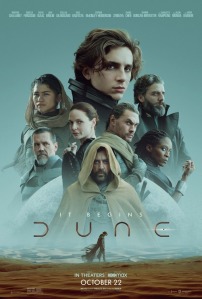
I attempted to read Frank Herbert’s novel Dune when I was in the seventh grade. I had begun to read more fantasy literature and was looking at older, heralded novels. I can still recall my frustration of reading those first five pages and having to repeatedly flip back and forth to a twenty-five-page glossary of terms so that I could even start to comprehend what was happening on the page. After those five excruciating pages, I gave up. Maybe I was too rash, and maybe my older present self would be more accommodating to the struggle, or maybe it just wasn’t worth the effort. I never watched the 1984 David Lynch adaptation that was met with great derision from critics and fans alike, although it does have its vocal defenders (Hindsight alert: Lynch turned down directing Return of the Jedi to helm Dune). So when acclaimed filmmaker Denis Villeneuve (Arrival, Blade Runner 2049) became attached to direct a big-budget, large-scale adaptation of Herbert’s novel, I was finally interested for the first time in my life. It was originally slated to be released in 2020, and after the studio planned to release Dune onto its HBO Max streaming service, Villeneuve and the production company negotiated to make sure a theatrical release would still be an important part of the plan. Alas, I watched the 2021 Dune at home, and I found myself enjoying the experience and development of the world building. However, it’s unlikely to watch this version of Dune and feel like you got a full movie for your money.
In the distant future, like 10,000 A.D., mankind has colonized worlds and the most important planet of them all is Arrakis. It’s a desert world inhabited by poor natives, Freeman, who live a moisture-preserving life mining the natural “spice,” a special substance that makes space travel capable as well as prolonging human life. The top family houses are vying for dominance and House Atreides has been assigned by the unseen Emperor to rule over Arrakis and bring it and its spice production back in line. Duke Leto Atreides (Oscar Isaac) sees great opportunity but also great danger. The other houses will scheme to engineer the failure and desolation of House Atreides, especially House Harkonnen, led by the Baron (Stellan Skarsgard), who is like a mixture between Marlon Brando from Apocalypse Now and Marlon Brando from The Island of Doctor Moreau (plus with levitation powers?). Paul Atriedes (Timothee Chalamet) is his family’s heir and much is expected of him, especially from his mother, Lady Jessica (Rebecca Ferguson), who believes he may be long-prophesied messiah. On Arrakis, Paul and his father must tackle this very delicate new mission while keeping the many adversaries at bay.
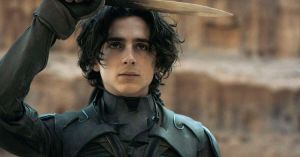
As anticipated, Dune is yet another visually stunning and gorgeously immersive visual experience from one of the greatest visual filmmakers working today. If you can watch the movie on a big screen, or at least a bigger screen, then you owe it to yourself to do so. The sweeping vistas and startling science fiction imagery have so much power and grandeur to them. If Lynch’s movie inspired a generation of devotees and impressionable children, I imagine that this superior modern version will do likewise. The production design and costumes are terrific and perfectly in keeping with the larger scope of the expansive visuals. You really feel the size of this world and its imposing weight. Villeneuve has such a natural keen eye for pleasing visual compositions, but he also has the patience many famous big screen stylists lack. He allows the moments to linger and to let scenes breathe in a way that feels more transporting and immersive. If you were simply looking for a visually resplendent movie-going experience, then Dune is the ticket. The sound design is also very smartly aligned and makes use of unconventional and alien sounds to make the movie feel even more like its own thing. When Dune came out in 1965, this was before much of the modern building blocks of our sci-fi pop-culture, so in a way while Dune was the influence it feels partially like an odd after-effect rather than a predecessor. The same thing happened with 2012’s John Carter, based upon a novel a hundred years old that influenced many sci-fi adventure serials and now seems derivative even though it came before the many imitations. I was happy with the first 90 minutes of Dune and felt like the slow pace of the first hour, and its heft of needed but spaced-out exposition, was paying off with a thrilling assault. The concept of the protective shields is a smart way to communicate the casualties of battle, where “kill shots” are illuminated in red, informing the audience of a mortal wound. It makes for an easy to read visual to keep up with the development of battle and stay in a safer PG-13 realm. The whole rescue sequence on the mining station is thrilling at every step.
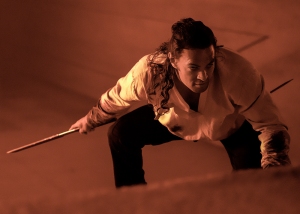
The cast is another major credit to the success of Dune. Chalament (Little Women) has a soulful yearning to him, to learn, to be his own man, to prove his father wrong and then prove worthy of his father’s faith. Surprisingly, the next biggest role isn’t Zendaya (Malcolm and Marie), the woman that Paul dreams about (prophetically?); it’s Rebecca Ferguson (Doctor Sleep) as Paul’s mother. She’s a woman with deep secrets belonging to a powerful religious sect that might be the real power behind the throne. Lady Jessica is more Paul’s mentor than any man. She teaches him to hone and focus his mind, to use the “Voice” to impart his will, and to prepare for the hardships to come. With every new exposition dump, and she has many, we learn about her growing concern for the fate of her son and her possible culpability for that fate. There’s a genuine warmth between them that serves as the film’s emotional core. I enjoyed watching Jason Momoa (Aquaman) and Dave Bautista (Army of the Dead) as opposite ends of Super Good Fighter Guy, though Momoa looked unsettling without a beard. Needless to say, the 2021 movie is far more diverse than the 1984 movie. It makes space feel more lived in when it’s reflective of a diversity of people that we already have at this point in our history.
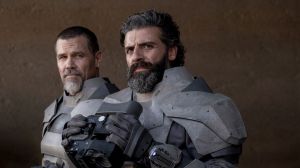
And then, after the hallway mark, Dune became a protracted sequence of chases and then I started to worry that things were just going to end in an unsatisfying manner, relegating the 150 minutes as setup for the as-yet-unplanned sequel, and that’s exactly what happened. My mood began to deflate somewhat during the last hour of Dune. I was still interested and the visuals were still mighty captivating, but the events had the unmistakable feeling of being stretched out to meet a frustrating stopping point, a pause that didn’t produce a satisfying endpoint. I just kept thinking, “Oh, they’re not going to resolve this,” and, “Oh, Zendaya is barely going to be in this movie,” and the movie proved my predictions correct. It’s hard to judge the movie as its own entity since it’s so dependent on a Part Two that has yet to be greenlighted (though its strong opening box-office returns are hopeful). This is an expensive movie, possibly pushing $200 million, so it’s quite a gamble to declare you would only be adapting roughly half of the story. Villeneuve’s Blade Runner sequel, a movie I loved, had a budget of $150 million and a worldwide gross that didn’t make the producers comfortable going forward with a Blade Runner 2050. To be fair, that was an original story, a sequel, and rather well contained. Still, it’s an expensive sci-fi movie that has as much in common with dry art house fare as it does blockbuster adventures, like Villeneuve’s Dune. The promise of a second movie is not secured. If Dune doesn’t do well enough, we’ll forever be left with a movie that feels designed to only be a teaser. It reminds me of the hubris of 2007’s The Golden Compass where the filmmakers had a whole 20-minute finale that they carved out with the intention of having it be the opening for the assumed sequel (welp). Even when designing a multi-movie arc, it’s necessary to plan each entry so that it can exist as its own beginning-middle-end and with a suitable intermediary climax. The Lord of the Rings movies each had their own climax, each moving the larger picture forward, and each had storylines and subplots that came to a head by film’s conclusion. Dune doesn’t. There are more dead characters by the end and certain characters are displaced, but it feels less like the end of the big-budget Dune movie and more like the conclusion of episode two of the Dune mini-series.
My resonance with the source material is minimal, but the world of Dune feels stuffed with stuff and not as deep in the realm of commentary. Fans of the book series will likely thrill at the level of minutia the 2021 movie luxuriates in, allowing fans to lap up the lore. For those of us uninitiated into the fandom, it feels like there could be more going on behind the scenes. The book was released in 1965 and has clear parallels to Middle East occupations and quagmires, a subject even more relevant in the first quarter of this new century. There’s the occupying force coming in to manage the supposedly primitive natives on a desert planet, replacing the last occupier who made bold promises that were unable to be met by the reality on the ground. The parallels of colonialism are there and obvious, but that’s because everything in Dune seems obvious to me. The bad guys are corpse-white and dressed in all black. They look like the alien zombies from 1998’s Dark City (itself referencing the silent sci-fi classic, Metropolis). The leader of House Harkonnen is this noxious man who bathes in black goo and sucks the life force from others. I don’t need my sci-fi to be ambiguous about its heroes and villains. We clearly recognize the bad guys because they’re grotesque. However, the lessons learned by the heroes seem a bit stilted. Its attacks on capitalism are a little more nuanced but not much. The planet of Arrakis could produce water but that’s not in the interest of the power brokers of the galaxy. They need the spice for the economy and thus keep the exploitative status quo. The parallels are there but there’s not much more to be had other than direct summations. The movie has more to say with religion and messiah figures but at this point we’re grading on a curve, and the more complex commentary attached to messiah figures seems reserved for a Part Two.
Another aspect I want to highlight that seems trivial but no less intriguing to me is how Herbert chooses his character names. We’re eight thousand years into the future, spanning multiple planets with names like Arrakis and Giedi Prime and Salusa Secondus, and then we have such anodyne twentieth-century names like… Paul and Jessica? It’s funny to me that Herbert goes to the trouble of coming up with so much jargon and terminology and alien-sounding names and then he says, “Hey, this guy’s name is… Duncan Idaho,” like he’s a supporting character in Point Break. I realize this is a very dubious criticism, and there are other character names to conflict with this assertion, but it made me laugh at the different levels of effort Herbert put into his world-building and universe than selecting character names for that same far away land.
After watching the new Dune, I went and watched the 1984 David Lynch version for the first time and was, quite simply, dumbfounded. I’ll credit Lynch for many of the weird choices in style and how it never stoops to even be accessible for a mass audience, despite having characters explicitly narrate their schemes and motivations out in the open (by scene one, the power play that took up 90 minutes of Dune 2021 is awkwardly explained in full). By the end of Lynch’s movie, it is an incomprehensible campy mess. I only have more appreciation for the 2021 Dune after watching the goofy (those eyebrows!) 1980s version that Lynch has disowned entirely, although that stirring guitar riff from the score still rocks thirty years later. The new Dune is only intended as Part One as its presumptive title promises, and because of this key artistic decision, there’s a feeling of padding and wear by the end. I found myself reflecting back on the first 90 minutes more fondly. It’s not that the last hour is absent great moments or audacious style, but it’s hard to fully judge this Dune when its last line is its own conditioning of expectations: “This is only the beginning.” The 2021 Dune is a visually remarkable movie experience with fantastic artists executing at some of the highest points of their talent. I’m eager to see if a Part Two can provide the satisfaction lacking in this beginning half. It’s a hell of a start but it feels too incomplete and in need of an ending.
Nate’s Grade: B
Share this:

Infinite (2021)
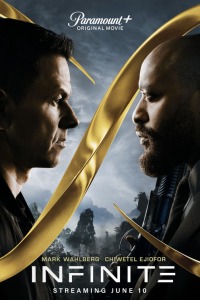
The cast and crew of Infinite were taken by surprise when their corporate overlords decided to shuttle the big-budget action movie to its fledgling streaming service, Paramount Plus. Fortunately for me, I had just purchased a yearlong subscription plan because I wanted to watch Bar Rescue whenever I pleased, so I was one of the lucky ones to gain access to this first “Paramount Plus Original Movie” as it quietly premiered. It might be for the best after all. Infinite is a high-concept action movie by committee that feels so lacking in just about every critical department.
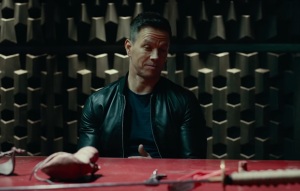
Evan McCauley (Wahlberg) is a man suffering from schizophrenia, or so he believes. He has strange visions in his head from past historical time periods and he instinctively knows how to forge a samurai sword. He’s interrogated by Bathurst (Chiwetel Ejiofor) who recognizes Evan as an ancient foe that he has fought through multiple past lives. Bathurst wants to kill Evan before he can remember who he is and stop Bathurst’s evil scheme. Evan is rescued by Mora (Sophie Cookson, Kingsman) who informs him that he is one of the Believers, a group of immortals who get reincarnated after each death. They’re waging a secret war against the Nihilists, lead by Bathurst, who want to obliterate the world rather than be reborn into it again. Evan must relearn his many pasts and help the Believers recover a hidden doomsday weapon his past self hid.
You’d be forgiven if you thought you had watched Infinite before, perhaps in a past life, because it’s so highly derivative. The story runs on two very well-worn tracks of science fiction storytelling, the Chosen One plot and the Secret War plot. You’ve seen variations on both in plenty of familiar sci-fi action movies, comic books, and the central pillars for countless Young Adult titles. Think about being told this statement: “Your ordinary life has been merely an elaborate cover, and you’re no ordinary person but secretly a powerful and important [fill in the blank] and there’s been a war going on in the shadows between [fill in the blanks] and you’re the key to solving this ages-old conflict.” I bet many of you can already think of similar titles that apply. There’s Harry Potter and Highlander and The Matrix and the Assassin’s Creed series and even more specific examples like Wanted, where it too features a sexy woman rescuing our lead in a sexy car and fending off bad guys while she informs him of his secret true calling. Even Ejiofor was in a strikingly similar movie just last year, 2020’s The Old Guard. It’s all so vaguely familiar at every moment that you’ll question whether it’s all built from spare parts.
Then there’s the added reincarnation angle, where people have amazing skills that they never knew they possessed (The Matrix, Wanted) and souls going from host body to host body (Cloud Atlas). In fact, David Mitchell, the author of Cloud Atlas, essentially wrote this very story in his 2014 novel, The Bone Clocks. In that novel, we learn that there are two factions of immortals who are reborn after every death, one group that preys upon the souls of mankind and another trying to defend the innocents. That book explores a lot more in the realm of identity (characters are reborn in different genders and races), time, and purpose than with Infinite, which settles for a recycled B-movie doomsday plot that even video games are getting tired of now. If past lives and reincarnation is just another disposable gimmick for super powered beings duking it out over a cataclysmic MacGuffin, then why bother with the existential possibility of the premise?
For a movie that takes so much time to spit out clunky exposition, Infinite is fairly incoherent and, occasionally, self-defeating. When you’re entering any new territory, there’s going to be a learning curve. Imagine how Neo learned about his misconception of reality, the war and history with the machines, and his capabilities he was opening himself up to. Exposition is best done in portions equally spaced out and tied to action, so our characters can learn through doing and failing and then succeeding. With the gimmick of past lives, it could open up such intrigue and possibility about human potential as well as the difficulty of these immortals finding one another across the globe for centuries, restarting with every rebirth (a fact explored in The Bone Clocks). It also would lend itself to characters being reckless with action movie stunts because, at worst, they die and take a twenty-year or so timeout before getting back into the action. Nothing of real interest happens with the past lives gimmick. The movie treats it as a shortcut to give its characters superpowers, and by tapping into those memories, now they have all these crazy super abilities that no mortal could accomplish in merely a single lifetime (sorry Bruce Lee). Imagine if in The Matrix, instead of Neo learning and training that they just uploaded everything into a Chosen One 3.0 security patch they downloaded (yes, he downloads skills, but we see the process demonstrated as visual progression). It’s boring to watch. The movie even could have explored more about these past lives, experiences, and lessons learned rather than in kaleidoscopic flashbacks. For the entire premise, Infinite seems so strangely limited in scope.
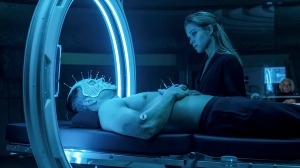
Then there’s the plot device that destroys the scheme of the villains. The Nihilists are tired of the eternity of being reborn and stuck with the accumulation of their memories. Bathurst says when he begins anew in the womb, he is a fully cogent adult brain and it’s nine months of torture. This, ladies and gentlemen, is the only interesting component in the entire movie that relates to the reincarnation premise. The Nihilists want to destroy all life so then they can never be reborn again, though this still seems theoretical. They have also developed a special device that will store a person’s consciousness onto a computer hard drive or microchip, supposedly stopping that consciousness from being reintegrated into a new host body. If this is the case, why isn’t Bathurst and his Nihilist fellows taking advantage of this? They’ve already developed a solution that works and doesn’t involve the destruction of all life on the planet. I don’t even know why Infinite introduces this absurd plot mechanic considering the damage it does. I guess it was an attempt to raise the stakes with immortals where death isn’t permanent, but for the purposes of the movie, a death means they are taken out of this present fight for the fate of the world. The stakes are still there. The implications are also nebulous, as they talk about souls as currency but can human souls be downloaded onto a portable technological deice? This entire plot device is silly in conception and even worse in execution, with big swirly bullets that also glow as they zip along.
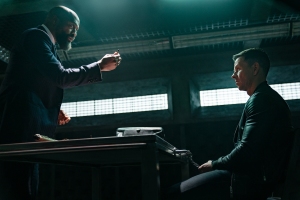
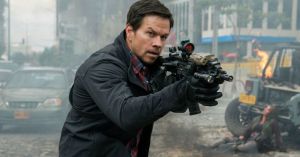
Wahlberg (Spenser Confidential) is on autopilot for the entire movie. He’s laconic and nonplussed and without any hint of humor or fun to be had. His under-performance is compensated by the overacting of Ejiofor (Doctor Strange) in a disastrous dynamic that reminded me of the 2011 Oscar hosting performance by the tandem of James Franco (under performing) and Anne Hathaway (over performing). At least Ejiofor is holding my attention with his high energy level and a maniacal glee that reminded me of James Bond villains. The problem is that nobody else is delivering this same arch level of camp. Everyone else in the cast is trying to play things so icy cool and nonchalant, and it just makes all the characters feel like boring robots.
And yet all of this could be forgiven if Infinite had some memorable and exceptionally exciting or well-developed set pieces to entertain. Much can be excused or mitigated if an action movie delivers upon its action. Alas, Infinite cannot escape the orbital decay of its lack of imagination. The derivative nature extends to the action, which consists of a series of rote chases and gunfights. There is one sequence that had promise for the scale of its destruction, a car chase through the different floors and levels of a police building. It’s viscerally entertaining to watch all of the many things gets smashed while raising the question just how fragile concrete walls are constructed to be in downtown metropolitan architecture. This is also the moment that Evan is brought into the new world, which means it’s all downhill from here. Antoine Fuqua (The Equalizer) is an action genre veteran and can be counted on for some degree of style to jazz up the proceedings, but he can only do so much with sequences lacking points of interest and tension. Infinite would play better as campy nonsense, but it won’t acknowledge this identity.
Given how derivative everything appears, it’s surprising Infinite is based on an original work, the self-published 2009 novel The Reincartionist Papers by D. Eric Maikranz. The author offered his readers ten percent of his advance for whoever helped get him to sell the film rights to Hollywood (true to his word, Maikranz paid out in 2019). Already, this is more entertaining to me than anything provided in the 106 plodding and incoherent minutes of Infinite as a movie. The high-concept premise is reduced to a lazy shortcut for superpowers for a group of know-it-alls trying to act cool and strut while delivering exposition by the truckload. The action is stifled, the characters are dull, and the world feels so sprawling but without needed definition. This could have been any combination of Chosen One and Secret War story elements. What about Harry Potter battling the bullet-curving killers from Wanted? Or what about Neo facing off against the ancient society of werewolves and vampires in sleek lather catsuits? Or an immortal special ops crew that must track down other immortals before they can do lasting harm? This mix-and-match formula belies how truly interchangeable the story elements are with Infinite. It closes on voice over by Wahlberg that genuinely made me guffaw. Looking to the future, he says, literally, “Well the possibilities are… infinite.” For this hopeful film franchise, I strongly doubt that.
Nate’s Grade: C-
Share this:

The Conjuring: The Devil Made Me Do It (2021)
 Three movies in, plus four spinoff films and more on the way, and The Conjuring franchise is losing some of its luster. The original director, James Wan, is still involved in an advisory capacity but his absence is felt in the director’s chair, not that The Devil Made Me Do It is poorly directed by Michael Chaves (Curse of La Llorona), but it’s starting to feel stale. The Warrens (Patrick Wilson, Vera Farmiga) are a husband-and-wife team of paranormal investigators traveling the country and solving 1970s/80s mysteries. This third entry feels the most like an expanded episode from a TV series, like X-Files, and maybe that’s because of its inherently procedural nature. The Warrens are defending a young man accused of murder but who says, as the subtitle describes, that he is not guilty by reason of demonic possession. From there, the Warrens are investigating to prove the demon exists and then trace its demonic history. The scares are low although the intensity feels cranked just as high; there are lots of scenes of gale force winds, shattered windows, characters yelling, and loud music. I miss the perfectly executed Old School horror sequences that were the hallmark of the earlier movies. It set up its rules, wound up the scene, and you just squirmed in anticipation. This franchise has never been revolutionary but more an expertly polished and honed tension machine. However, when the calibrations are off, then the franchise has even less going for it. There are some interesting ideas and elements, like Lorraine (Farmiga) being able to see from the eyes of the demonic killer, but the franchise feels more repetitive and stalled, with multiple exorcisms and Ed (Wilson)’s health being a motivating factor for his wife to prevent, again. The supporting characters are bland or broad and the mystery itself isn’t that interesting, nor is the ultimate villain. In the realm of Conjuring as weekly TV show formula, this feels like an acceptable middle episode with the expectations that they can improve the next week. The “based on true cases” selling point is also starting to grate in light of the reality that a man blamed his own actions on the devil and these controversial people sought to exonerate a murderer. The real-life version is morally abhorrent. The junky horror version can work as long as it doesn’t take itself too seriously. If the other Conjuring movies were gourmet entries, then this is more the fast food version. It may still satisfy fans but it’s definitely not as well made and with questionable ingredients.
Nate’s Grade: C+


You must be logged in to post a comment.