Blog Archives
Independence Day: Resurgence (2016)
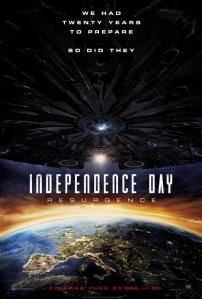 I can recall actively counting down the days until Independence Day was released in 1996, gobbling up every newspaper clipping and magazine article I could. I was a big fan of director Roland Emmerich’s Stargate, which is still a terrific movie, and I was eager to watch the end of the world, as we know it, in the privacy of my local theater. It was a blast, no pun intended, and one of the biggest box-office successes at the time. Surely there would be a sequel, especially after it helped launch Will Smith into another level of stardom. Flash forward twenty years, and here comes Independence Day: Resurgence, a sequel that misses what marked the original as escapist entertainment.
Twenty years later, human beings have been planning for the eventual return of their intergalactic invaders. Former president Whitmore (Bill Pullman) and CIA director David Levinson (Jeff Goldblum) have been trying to get the world prepared and studying our alien enemy. A psychic link is still formed from Whitmore’s brief bond in the first movie, and he keeps drawing mysterious symbols. Whitmore’s daughter, Patricia (Maika Munroe), is a former fighter pilot who works for the current president (Sela Ward). Patricia’s boyfriend and fellow fighter pilot, Jake Morrison (Liam Hemsworth), is stationed on the moon building a defense system. Then the aliens come back and pick up where they left off, annihilating Earth’s landmarks and population centers. It seems that their spaceship is going to suck out the Earth’s molten core, and by all accounts, that’s bad. Our ragtag group of characters must come together and overcome substantial odds once more to save the Earth from certain doom.
So where exactly did things go wrong? I’m not one to simply state that the filmmakers missed their window of making a quality sequel. While twenty years is a long time in between outings, it doesn’t mean that you will fail to come up with a compelling movie. Mad Max was 30 years between movies and this didn’t stop Fury Road from being a masterpiece. By most accounts, yes, there is certainly less of an appetite for an Independence Day sequel in 2016 than there would have been in 1998, but the first film is still fondly remembered and a worthy sequel would be welcomed regardless.
 I think one of the bigger causes to Resurgence not working is the fact that the rest of the moviegoing world has caught up when it comes to big screen spectacle, therefore spectacle by itself is not enough without a zeitgeist edge. In 1996, cutting-edge special effects-laden destruction on a global scale was reason enough to buy a ticket and the largest tub of popcorn. In the ensuring two decades, large-scale cataclysm has become commonplace on the big screen; just about every climax of a Marvel movie involves some world-devastating threat. What once quickened pulses has now become ho-hum. Emmerich himself has become a modern-day Irwin Allen since the first Independence Day, almost specifically focused on global disaster movies. I honestly don’t think there’s a better director working in Hollywood for that gig (his next movie is about the moon crashing into the Earth, so “familiar” territory). I think Emmerich’s skill and vision for big screen spectacle goes unheralded too often and he gets lumped in with empty visual stylists like Zack Snyder and Michael Bay. He’s better than that. However, the tide has turned, and audiences have become sated from empty spectacle. They need something more, or at least something compelling, and Resurgence struggles to achieve this. It feels like the aliens are back and they’re bigger, and that’s about it, folks.
Disaster movies are generally judged by their set pieces, and what is most surprising about Resurgence is that it really doesn’t have action set pieces as it does skirmishes. The movie is only two hours long, which seems like a rarity nowadays, but this is one of the few movies I think could have benefited from some extra breathing room. It feels too rushed, its internal logic often forcibly contrived, and this is evident most in its action sequences. A better term would be “skirmishes” because the sequences themselves are so curiously brief save for the climactic fight during the third act. We’ll get bursts of intensity or dread that comes to a head with violence, but then that’s it and the movie moves along. It’s usually mere moments of brief alien destruction. The action lacks proper development. One of the keys to great action sequences is naturally complicating and developing the events. Resurgence doesn’t even change gears. It provides exactly what you expect, and then it’s over, the surprise being how unsatisfying and short the unimaginative experience was for all parties. It’s a long wait until the third act where the alien queen comes outside to play. The movie shifts into a giant monster melee and it’s the one time where Resurgence feels most lively. It still follows a contrived logic (the Queen has a shield… now she doesn’t…) but I’ll credit the movie with at least saving the best for last and finally letting the action expand. I had enough fun with the final act of Resurgence that I was able to forgive some of its early transgressions.
The first Independence Day wasn’t by any means a cinematic milestone but it was fun and had a clean enough throughline. We spent the first hour in typical Emmerich fashion being introduced to the different characters and then watching the dispirit elements come together. The mystery of what was out there was intriguing and it became a step-by-step process of deducing how mankind should respond. When their hostile intent was revealed, it then became a learning experience as to how to fight back. Aerial dogfights won’t work. Nuclear weapons won’t work. It was a simplistic examination of the threat. While the solution of giving an alien operating system a virus is still a head-scratcher, at that point the movie had earned its ham-fisted solution because it had followed a logically satisfying path of discovery and response from the moment of first contact. Resurgence lacks any real internal logic. Things just sort of happen when the plot requires them and then don’t. If you’re establishing a science-fiction landscape, establishing the rules of what is possible and allowable is essential to the audience’s understanding and enjoyment. Otherwise it feels arbitrary, much like Judd Hirsch driving a school bus of children across the salt flats into danger. This literally happens in Resurgence.
Also fighting for time is a slew of new characters that are charisma-free and contribute little to nothing to the larger story. The biggest offender may be Dylan Hiller (Jessie T. Usher), the son of Will Smith’s character. What does Dylan offer as a character? His entire characterization is, and I kid you not, that he’s upset with Jake over a training accident. He punches Jake in the first act and then… he just sort of pilots ships and shoots things in the sky. That’s it. He doesn’t feel the burden of living up to his father’s reputation, or trying to make his own name for himself. He just has a quarrel to settle and does and then he still just sort of exists in the movie and the screenwriters were like, “Oh right, he’s still here. Well, have him fly something.” Jake and the rest of the young pilots don’t fare that much better as characters. Besides superficial distinguishing characteristics, they’re all variations on the same person. They’re a multi-ethnic collection of vacuous character placeholders; it’s like you took Randy Quaid’s kids from the first movie and made them on par with Smith and Goldblum. These bland characters inspire little love and are often boring with little investment. If the next movie started with them in a car and a giant pillar crushing it, I would not mourn their cinematic loss.
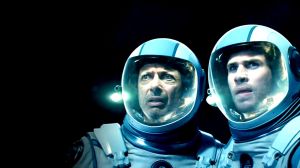 There are some familiar faces returning but none of them are able to compensate for the deficit of charisma and screen presence that is Will Smith. Goldblum is on autopilot and doing his stare off into the distance and talk deadly serious thing. Pullman shows up again as a warning of what was coming, though a superfluous one at that. The biggest screen presence from the first movie belongs to Brent Spiner (TV’s Star Trek) as the Area 51 scientist who conveniently has also been in a coma for twenty years. Some of his comic relief is rather labored and cheesy, but it’s at least something. Charlotte Gainsbourg (Nymphomaniac) collects a check as a psychiatrist who has little bearing other than to be Goldblum’s ex. The most interesting new character feels like he stepped out of a Street Fighter arcade game; he’s an African warlord (Deobia Oparei) who likes to use a pair of machetes to kill the aliens. “You have to get them from behind,” he keeps insisting, and I keep snickering. There’s also that Emmerich staple of an officious government weakling who comically grows a spine. It just so happens this part is played by one of the screenwriters of Resurgence, Nicolas Wright. He studied, apparently.
The best thing Resurgence has going for it is the expansive world building, one of the few aspects of the movie that shows actual thought and care. This is one of the few movies I can recall where people actually try and use the technology of their defeated invaders. Rather than just throwing all those dead spaceships on a junk pile, mankind has decided to backwards engineer technological advancements. As a result, the contemporary feels like a sci-fi hybrid of humanity and the alien technology. It’s interesting to see what advancements have been made and how these have been integrated into regular society. I do question why we only have one defensive weapon/colony on the moon when there’s also one as far as Saturn. I wanted a bit more of a sociological examination on what life post-War of 1996 means. Life would be so fundamentally altered by the realization we are not alone in the universe, and not only that but that we need to play catch up fast to survive. The assumption would be that they will be back. The threat of annihilation unifies the world but what are those consequences? What are the consequences of living in a permanent military state of readiness and anxiety, wondering is it all going to be enough?
If you have fond feelings for the original Independence Day, there may be enough good will with the sequel to appease your demands, though probably only barely. Resurgence suffers from CGI-heavy spectacle that has long lost its appeal without supplying helpful additions like characters to care about, exciting action sequences that develop and impact the plot, meaningful plot turns, and a story that follows some form of logic. It’s not a disaster in all senses of the word. In a summer that’s already building a reputation for its mediocrity, I think there may be enough that Independence Day: Resurgence has to offer that select moviegoers will walk away feeling momentary entertainment. It’s not that the first film was intellectually rigorous sci-fi, but it went about its destructive business with a satisfying precision. This movie all too often just feels like things happening, then not happening, and with characters that are there but without any compelling reason beyond survival. The end of the movie sets up an intended sequel and possible extended franchise of sequels with a larger galactic war against the alien invaders. It’s both hopeful and naïve, dangling the promise of another tantalizing humans vs. aliens throwdown. It’s also a bit aggravating because the premise of the hypothetical sequel (I’m going on record saying it won’t come to fruition for another 20 years) is much better than the “they came back again” sequel we get with Resurgence. Don’t make me pay my money and then tease me with a better movie down the road. Nothing should be taken for granted. Independence Day: Resurgence takes too much for granted, and that’s likely why this resurgence will stop with one entry.
Nate’s Grade: C
Share this:

10 Cloverfield Lane (2016)
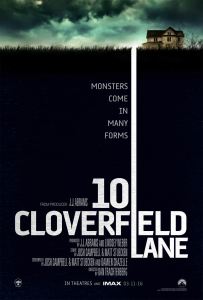 The mysterious sequel to the 2008 found footage monster movie sprung from nowhere, surreptitiously filmed without the general public having any idea of its connection to Cloverfield until mere weeks before its release. It’s the equivalent of a modern-day publicity magic act, something that J.J. Abrams is known for with his crusade against spoilers. The biggest surprise about 10 Cloverfield Lane is that the best parts of a slick and suspenseful movie are the parts that have nothing to do with Cloverfield. The majority of the film’s first two acts take place entirely in a bunker with one possibly disturbed individual played by a terrifically unsettled John Goodman. The unease and dread build nicely and the reveals are paced out in a clever manner to make us second-guess and second-guess our second-guesses. There’s a great moment during an awkward game of charades where Goodman’s character can’t conceive of calling a woman by the term “woman,” instead relying upon patronizing terms like “girl” or “princess.” There’s a darkness and a fury under the surface that should remind of Goodman’s expert turn in Barton Fink. This is a finely suspenseful and mysterious chamber piece until we leave the bunker and the movie officially connects into the Cloverfield universe. It’s a little sloppy and makes for a tonally inconsistent finale. It’s not enough to ruin the movie by any means but it certainly lessens the smartly constructed suspense and paranoia. Mary Elizabeth Winstead (Scott Pilgrim vs. the World) makes for an effective survival thriller heroine, and her line reading of “Oh come on” is a divine highlight. As a Cloverfield movie, this opens up the space for a wider variety of humans vs. monsters stories, but as a movie, it plays at peak performance when it follows its own lead.
Nate’s Grade: B
Share this:

Batman vs. Superman: Dawn of Justice (2016)
 Batman and Superman have been a collision course for a while. The two most famous superheroes were once scheduled to combat in 2003. Then the budget got a tad too high for Warner Brothers’ liking and it was scrapped. Flash forward a decade and now it seems that money is no longer a stumbling point, especially as Batman vs. Superman: Dawn of Justice cost an estimated $250 million dollars. I wasn’t a fan of director Zack Snyder’s first take on Superman, 2013’s Man of Steel, so I was tremendously wary when he was already tapped to direct its follow-up, as well as the inevitable follow-up follow-up with 2017’s Justice League. You see DC has epic plans to create its own universe of interlocked comics franchises patterned after Marvel’s runaway success. Instead of building to the super team-up, they’re starting with it and hoping one movie can kick off possibly half a dozen franchises. There’s a lot at stake here for a lot of people. That’s what make the end results all the more truly shocking. Batman vs. Superman isn’t just a bad movie, and I never thought I’d type these words, it’s worse than Batman and Robin.
Eighteen months after the cataclysmic events of Man of Steel, Metropolis is rebuilding and has an uneasy relationship with its alien visitor, Superman (Henry Cavill). Billionaire Bruce Wayne (Ben Affleck) is convinced that an all-powerful alien is a threat to mankind, especially in the wake of the dead and injured in Metropolis. But how does man kill a god? Enter additional billionaire Lex Luthor (Jessie Eisenberg) and his acquisition of a giant hunk of kryptonite. Bruce runs into a mysterious woman (Gail Gadot a.k.a. Wonder Woman) also looking into the secrets held within Luthor’s vaults. Clark Kent is pressing Wayne for comment on this bat vigilante trampling on civil liberties in nearby Gotham City, and Wayne is annoyed at the news media’s fawning treatment over an unchecked all-powerful alien. The U.S. Senate is holding hearings on what responsibilities should be applied to Superman. Lois Lane (Amy Adams) is worried that her boyfriend is getting too caught up in the wrong things. Lex Luthor is scheming in the shadows to set up one final confrontation that will eliminate either Batman or Superman, and if that doesn’t work he’s got a backup plan that could spell their doom.
 I think it’s only fitting to tackle each of the particular heavyweights in this huge showdown and devote time to dressing down why exactly the movie fails them.
Let’s start with Batman because quite frankly he’s the character that the American culture prefers (his name even comes first in the title for a Superman sequel). Ben Affleck (Gone Girl) was at the bad end of unrelenting Internet fanboy-fueled scorn when the news came out that he was going to play the Caped Crusader, but he’s one of the best parts of this movie, or perhaps the better phrasing would be one of the least bad parts. He’s a much better Bruce Wayne than Batman but we don’t really get much of either in this movie from a character standpoint. There isn’t much room for character development of any sort with a plot as busy and incomprehensible as Batman vs. Superman, and so the movie often just relies upon the outsized symbolism of its mythic characters. We have a Batman who is Tough and Dark and Traumatized and looking for (Vigilante) Justice. We only really get a handful of scenes with Batman in action, and while there’s a certain entertainment factor to watching an older, more brutal Batman who has clearly given up the whole ethical resolve to avoid killing the bad guys, under Snyder’s attention, the character is lost in the action. The opening credits once again explain Batman’s origin story, a tale that should be burned into the consciousness of every consumer. We don’t need it, yet Snyder feels indebted to what he thinks a Batman movie requires. So he’s gruff, and single-minded, and angry, but he’s never complex and often he’s crudely rendered into the Sad Man Lashing Out. He’s coming to the end of his career in tights and he knows it, and he’s thinking about his ultimate legacy. That’s a great starting point that the multitude of live-action Batman cinema has yet to explore, but that vulnerability is replaced with resoluteness. He’s determined to kill Superman because Superman is dangerous, and also I guess because the Metropolis collateral damage crushed a security officer’s legs, a guy he’s never met before. The destructive orgy of Metropolis is an excellent starting point to explain Bruce Wayne’s fear and fury. I don’t know then why the movie treats Wayne as an extremist. I don’t really understand why there’s a memorial for the thousands who lost their lives in the Metropolis brawl that includes a statue of Superman. Isn’t that akin to the Vietnam Wall erecting a giant statue of a Vietcong soldier stabbing an American GI with a bayonet? This may be the most boring Batman has ever been onscreen, and I repeat, Ben Affleck is easily one of the best parts of this woefully begotten mess.
Next let’s look at the other titular superhero of the title, the Boy Scout in blue, Superman. The power of Superman lies with his earnest idealism, a factor that has always made him a tougher sell than the gloomy Batman. With Man of Steel, Warner Brothers tried making Superman more like Batman, which meant he was darker, mopey, theoretically more grounded, and adopted the same spirit of being crushed by the weight of expectations and being unable to meet them. Cavill (The Man from U.N.C.L.E.) was a Superman who didn’t want to be Superman, where dear old Pa Kent advocated letting children drown rather than revealing his powers (Father’s Day must have been real awkward in the Kent household). It wasn’t a great step and I wrote extensively about it with Man of Steel. The problem is that Superman and Batman are supposed to be contradictory and not complimentary figures. If one is brooding and the other is slightly more brooding, that doesn’t exactly create a lot of personal and philosophical conflicts now does it? It clearly feels that Snyder and everybody really wanted to make a Batman movie and Superman just tagged along. Superman clearly doesn’t even want to be Superman in the Superman sequel, often looking at saving others with a sigh-inducing sense of duty. He’s still working as a journalist and making moral arguments about the role of the media, which seems like a really lost storyline considering the emphasis on blood and destruction. He wants Superman to be seen as a force of good even if others deify him. That’s a powerfully interesting angle that’s merely given lip service, the concept of what Superman’s impact has on theology and mankind’s relationship to the universe and its sense of self. Imagine the tectonic shifts acknowledging not only are we not alone but we are the inferior race. We get a slew of truly surprising cameos for a superhero movie arguing this debate (Andrew Sullivan?) but then like most else it’s dropped. Clark is trying to reconcile his place in the world but he’s really just another plot device, this time a one-man investigation into this bat vigilante guy. The other problem with a Batman v. Superman showdown is that Superman is obviously the superior and would have to hold back to make it thrilling. We already know this Superman isn’t exactly timid about killing. The climax hinges on a Batman/Superman connection that feels so trite as to be comical, and yet Snyder and company don’t trust the audience enough to even piece that together and resort to a reconfirming flashback.
 Arguably the most problematic area of a movie overwhelmed with problems and eyesores, Eisenberg’s (Now You See Me) version of Lex Luthor is a complete non-starter. He is essentially playing his Mark Zuckerberg character but with all the social tics cranked higher. His socially awkward mad genius character feels like he’s been patched in from a different movie (Snyder’s Social Network?) and his motivation is kept murky. Why does he want to pit Batman and Superman against each other? It seems he has something of a god complex because of a nasty father. He is just substantially disappointing as a character, and his final scheme, complete with the use of an egg timer for wicked purposes, is so hokey that it made me wince. If you’re going with this approach for Lex then embrace it and make it make sense. Late in the movie, Lex Luthor comes across a treasure-trove of invaluable information, and yet he does nothing substantive with this except create a monster that needs a super team-up to take down (this plot point was already spoiled by the film’s marketing department, so I don’t feel guilty about referring to it). If you’re working with crafty Lex, he doesn’t just gain leverage and instantly attack. This is a guy who should be intricately plotting as if he was the John Doe killer in Seven. This is a guy who uses his intelligence to bend others to his will. This Lex Luthor throws around his ego, nattering social skills, and force-feeds people Jolly Ranchers. This is simply a colossal miscalculation that’s badly executed from the second he steps onscreen. The movie ends up being a 150-minute origin story for how Lex Luthor loses his hair.
The one character that somewhat works is Wonder Woman and this may be entirely due to the fact that her character is in the movie for approximately twenty minutes. Like Lois, she has little bearing on the overall plot, but at least she gets to punch things. I was skeptical of Gadot (Triple 9) when she was hired for the role that should have gone to her Furious 6 co-star, Gina Carano (Deadpool). She didn’t exactly impress me but I’ll admit I dropped much of my skepticism. I’m interested in a Wonder Woman movie, especially if, as reported, the majority is set during World War I. There is a definite thrill of seeing the character in action for the first time, even if she’s bathed in Snyder’s desaturated color-corrected palate of gloom. Realistically, Wonder Woman is here to introduce her franchise, to setup the Justice League movies, and as a tether to the other meta-humans who each have a solo film project on the calendar for the next four years. Wonder Woman gets to play coy and mysterious and then extremely capable and fierce during the finale. One of the movie’s biggest moments of enjoyment for me was when Wonder Woman takes a punch and her response is to smile. I look forward to seeing more of her in action and I hope the good vibes I have with the character, and Gadot, carry onward.
 The last act of this movie is Snyder pummeling the audience into submission, and it’s here where I just gave up and waited for the cinematic torment to cease. The action up to this point had been rather mediocre, save for that one Batman fight, and I think with each additional movie I’m coming to the conclusion that Snyder is a first-class visual stylist but a terrible action director. The story has lacked greater psychological insights or well-rounded characters, so it’s no surprise that the final act is meant to be the gladiatorial combat Lex has hyped, the epic showdown between gods. In essence, superheroes have taken a mythic property in our pop-culture, and Batman and Superman are our modern Mt. Olympus stalwarts. This showdown should be everything. The operatic heaviness of the battle at least matches with the overwrought tone of the entire movie. It’s too bad then that the titular bout between Batman and Superman lasts a whole ten minutes long. That’s it, folks, because then they have to forget their differences to tackle a larger enemy, the exact outcome that every single human being on the planet anticipated. I’m not even upset that the film ends in this direction, as it was fated. What I am upset about is a climax that feels less than satisfyingly climactic and more like punishment, as well as a conclusion that no single human being on the planet will believe. Snyder’s visual style can be an assault on the senses but what it really does is break you down. The end fight is an incoherent visual mess with the screen often a Where’s Waldo? pastiche of electricity, debris, smoke, fire, explosions, and an assortment of other elements. It’s a thick soup of CGI muck that pays no mind to geography or pacing. It’s like Michael Bay got drunk on Michael Bay-filmmaking. What the hell is the point of filming this movie in IMAX when the visual sequences are either too hard to decipher or something unworthy of the IMAX treatment? Do we need an entire close-up of a shell hitting the ground in glorious IMAX? The Doomsday character looks like a big grey baby before he grows his spikes. I was shocked at how bad the special effects looked for a movie that cost this much money, as if ILM or WETA said, “Good enough.” Once it was all over, I sat and reflected and I think even Snyder’s Sucker Punch had better action.
Another problem is that there are just way too many moments that don’t belong in a 150-minute movie. There’s an entire contrivance of Lois disposing of a valuable tool and then having to go back and retrieve it that made me roll my eyes furiously. It’s an inept way of keeping Lois involved in the action. How does Lois even know the relevancy of this weapon against its new enemy? Then there’s her rescue, which means that even when the movie shoehorns Lois into the action to make her relevant, she still manages to become a damsel in needing of saving. She feels shoehorned in general with the screenplay, zipping from location to location really as a means of uncovering exposition. Then there’s the fact that there is a staggering THREE superfluous dream sequences, and we actually get a flashback to one of those dumb dream sequences. The most extended dream sequence is a nightmarish apocalyptic world where Batman rebels against a world overrun by Superman and his thugs. There’s a strange warning that comes with this extended sequence of future action but it doesn’t involve this movie. Batman vs. Superman suffers from the same sense of over-extension that plagued Age of Ultron. It’s trying to set up so many more movies and potential franchises that it gets lost trying to simply make a good movie rather than Step One in a ten-step film release. In the age of super franchises that are intertwined with super monetary investments, these pilot movies feel more like delivery systems than rewarding storytelling. Payoffs are sacrificed for the promise of future payoffs, and frankly DC hasn’t earned the benefit of the doubt here.
 I must return to my central, headline-grabbing statement and explain how Batman vs. Superman is a worse movie than the infamous Batman and Robin. I understand how loaded that declaration is so allow me to unpack it. This is a bad movie, and with that I have no doubt. It’s plodding, incoherent, tiresome, dreary, poorly developed, and so self-serious and overwrought to the point that every ounce of fun is relinquished. It feels more like punishment than entertainment, a joyless 150-minute exercise in product launching. By the end of the movie I sat in my chair, defeated and weary. Here is the most insidious part. Batman vs. Superman: Dawn of Justice obliterates any hope I had for the larger DC universe, let alone building anything on par with what Marvel has put together. If this is the direction they’re going, the style, the tone, then I don’t see how any of these will work. What’s to like here? “Fun” is not a dirty word. Fun does not mean insubstantial nor does it mean that larger pathos is mitigated. If you’re going to have a movie about Batman and Superman duking it out, it better damn well be entertaining, and yes fun. It’s not a Lars von Trier movie. The Marvel movies are knocked for not being serious, but they take their worlds and characters seriously enough. They don’t need to treat everything like a funeral dirge, which is what Batman vs. Superman feels like (it even opens and closes on funerals). This movie confirms all the worst impulses that Man of Steel began, and because it gutted all hope I have for the future of these oncoming superhero flicks, I can’t help but lower its final grade. Batman and Robin almost killed its franchise but it was in decline at the time. As campy and innocuous as it was, Batman vs. Superman goes all the way in the other direction to the extreme, leaving a lumbering movie that consumes your hopes. The novelty of the premise and seeing its famous characters standing side-by-side will be enough for some audience members. For everyone else, commence mourning.
Nate’s Grade: D
Share this:

Lazer Team (2016)
 What makes a disappointing comedy? It’s a question I kept thinking about while watching the sci-fi comedy Lazer Team from the online comedy collective better known as Rooster Teeth, responsible for the longest running online Web series, Red vs. Blue. These are people who know how to be funny. They have a fine resume of shorts to prove their comedy bonafides, but what was it about their first foray into features that diminished their funny? I’ll try my best to provide a critical autopsy for the case subject of Lazer Team, a disjointed and disappointing buddy comedy that died on screen.
A concerned alien species has sent a warning to Earth. A hostile alien race is heading toward our planet with the intent to conquer, pitting their champion fighter against a champion from Earth. This gladiatorial showdown inspires Earth’s military and scientists to train a select warrior (Alan Ritchson) from birth for this mission. The problem is that the wrong people get hold of that alien technology. Disrespected sheriff Hagan (Burnie Burns), his old high school has been pal Herman (Colton Dunn), redneck moron Woody (Gavin Free), and insufferable quarterback Zach (Michael Jones) come across a downed alien ship that they happened to knock out of the sky with drunken fireworks. Each of the foursome puts on a piece of the alien armor, which attaches permanently. Herman gets a pair of super fast boots, Woody a helmet that instantly makes him smarter and British, Zach an arm canon, and Hagan a retractable shield. The bickering idiots are forced to work together over the fate of the planet, and the warring alien species has sent a few of its parasitic infantry to retrieve the special suit.
 To be fair, Lazer Team is not an atrocious comedy that singes your eyeballs with pain, something along the likes of InAPPropriate Comedy or any Friedberg/Seltzer suckfest. You can tell that the Rooster Teeth squad understands the tenets of comedy and what makes for a good joke, which is what makes their final product all the more baffling. For my pal George Bailey, there’s nothing worse than a bad comedy (his worst film for 2015 was Mortdecai). A comedy has one job to do and that is to make people laugh. This should be obvious but you’d be surprised at how often this principle seems to get lost. Rarely does a larger budget make a comedy funnier, a lesson learned the hard way over and over again with Hollywood. With Rooster Teeth’s first movie, they wanted to make a throwback to the sci-fi buddy comedies of the 80s. They raised almost two and a half million dollars via the crowd-source site Indiegogo, a record until Broken Lizard’s Super Troopers 2. It feels odd to say that what amounts to a meager budget by most productions could be at fault for the ultimate disappointment, but I think it leads into the chief problem of the movie: prioritizing the action over the humor.
It’s not uncommon for the comedy to get obliterated by the action in action-comedies, but from a comedy collective I was hoping for more emphasis on the ha-ha and less on the kablooey. Lazer Team has a solid comic premise that pays homage to a pastiche of 80s inspirations and pop-culture. I wanted to laugh. I think I even compelled myself to give it some pity laughs, but after 40 or so minutes a realization could no longer be ignored, and that was that Lazer Team just wasn’t that funny. The enthusiasm of its key cast members and their amiable nature go a long way to disguise the threadbare nature of too many of their first-draft jokes. The foursome never stretches beyond the entrenched lines of their formulaic archetypes. You come to expect specific jokes delivered from them, assigned by type in a way that reminds me of TV’s The Big Bang Theory. The character will rarely surprise you, which is also because their character arcs are so transparent. Hagan will atone for his failure to act and protect Herman while Herman will learn to move on from a past misfortune. Zach will learn to be less selfish. Woody will… well he doesn’t so much have an arc because he’s instantly made smarter thanks to the lien tech. The expected is a deathblow for comedy; if you can anticipate the joke, it’s rarely funny. Lazer Team so rarely subverts your expectations, playing things too safe.
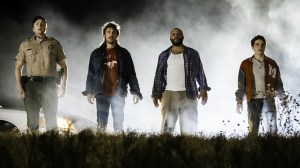 The central conflict of four losers learning to work together as a team to save the world is rife with comic possibilities, even with the locked-in archetypes, but there’s far more attention spent on the sci-fi action and special effects. It’s a low budget film but there are plenty of action set pieces and special effects, many done in-house by the Rooster Teeth team. The effects range in effectiveness but are generally passable and even impressive at turns, especially with properly calibrated expectations. The problem is that the action sequences that are eating up so much creative space aren’t remotely memorable. There’s one car chase in the middle of the film where it feels like the guys have found a tone that works, one where the action incorporates the comedy and they work. For a fleeting moment I thought, “Maybe the whole movie will resemble this new shift.” The other problem is that it feels like the Rooster Teeth squad was stuck with how to get this story to feature-length. Structurally, this thing sure feels padded with additional set pieces that lurch and fail to justify the added time, especially the ex-wife cabin sequence.
The acting foursome is the best aspect of the movie and their amiable interaction is the one thing that Lazer Team has that got me through to the end. These actors know how to sell jokes, when to mug, and their amped-up enthusiasm helps sell the lesser material. I wish this foursome had a better script. Imagine something more low-key in concept that involved less explosions and more emphasis on utilizing their comic talents? I wish less time had been spent on Jones’ obnoxious egotistical quarterback and more on Free’s redneck-turned-British genius, a setup that seems to have far more potential than just being an expositional device. The slobs vs. snobs approach only gets the movie so far, and after that we have to care about the characters, and I just didn’t. Because of how one-note the characters are it’s hard to care about them. After your good will depletes with the actors, you’re left with a bunch of running around but little funny.
Lazer Team is a movie that’s hard to hate, especially if this kind of genre comedy is a favorite launching ground for jokes. It’s nowhere near as wretched as The Watch but it can’t come close to the sci-fi comedies that influenced the Rooster Teeth creative unit. What’s even more frustrating is that these guys have the talent to tell an original and hilarious movie and are creative enough to engineer some fun sci-fi set pieces. They have the talent and expertise to do better than this, to do better than Lazer Team, a movie that is too safe, too predictable, too padded, too formulaic, and just not funny enough. I demand more from people who specialize in comedy.
Nate’s Grade: C
Share this:

Jupiter Ascending (2015)
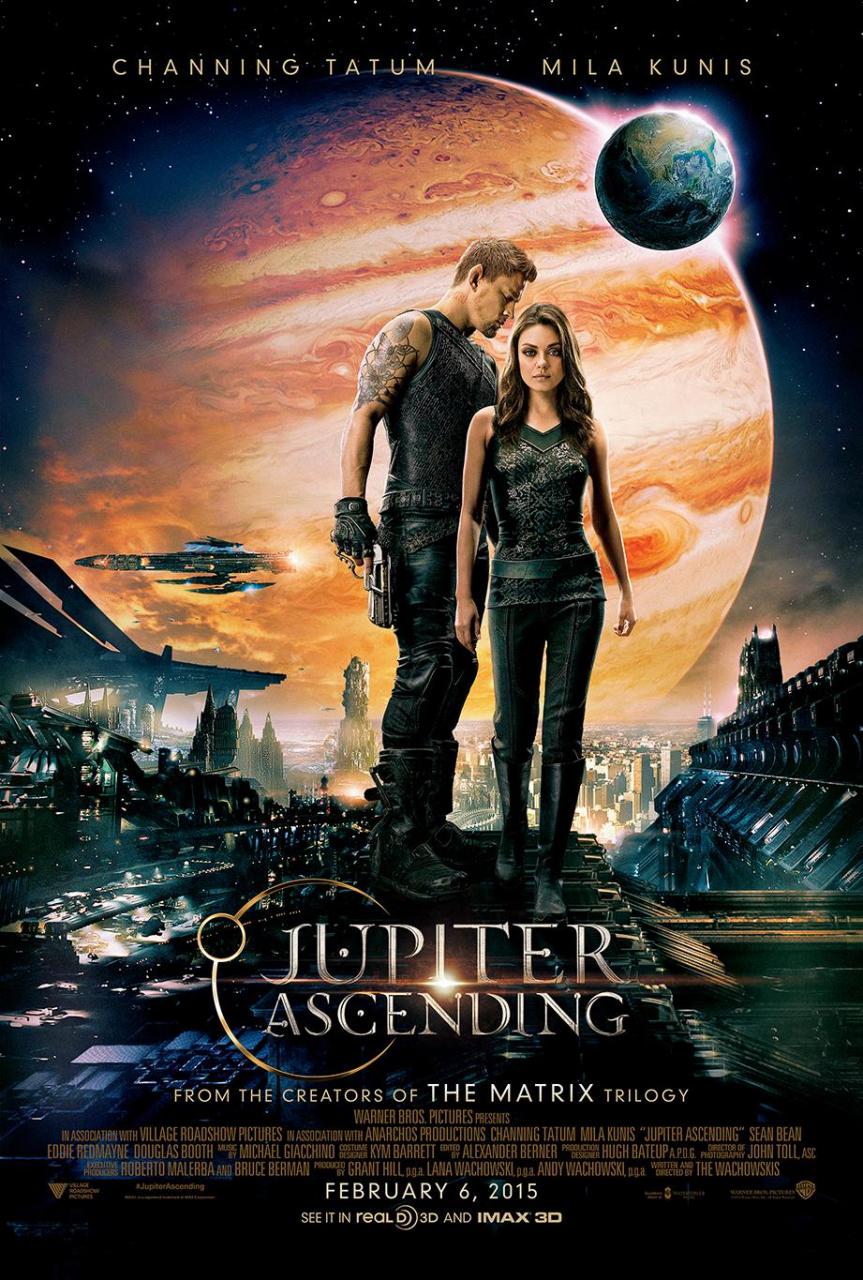 Few would dispute the imaginative powers of Andy and Lana Wachowski. They probably got a free pass from Warner Brothers after creating The Matrix, one of those culture-changing movies that come along so rarely. I was leery of Jupiter Ascending, their newest original science-fiction opus, when Warner Brothers delayed its summer release by nine months. The trailers and commercials were also doing a dandy job of hiding what exactly the movie was about besides cool visuals. I was holding out hope, thinking that maybe Jupiter would be silly but fun in a Fifth Element way, but instead ladies and gentlemen, we have an heir to 1980’s campy Flash Gordon.
Jupiter Jones (Mila Kunis) is an unhappy maid who cleans toilets for a living. Then one day she becomes the most important person in the universe. She discovers she is the reincarnation of the matriarch of House Abrasax, whose three children, Titus (Douglas Booth), Kalique (Tuppance Middleto), and Balem (Eddie Redmayne), are fighting over their inheritance. The biggest prize of them all is Earth, and now the appearance of Jupiter complicates ownership. Various alien species are sent to kill her, but Jupiter has a savior in disgraced galactic solider Caine Wise (Channing Tatum). He’s a “splice,” a result of gene splicing people with animals. He rescues Jupiter and they head off world to explore the much larger, much stranger universe.

Oh look, she’s falling again.
Right away, mere moments after leaving the theater, I knew the first step to make Jupiter Ascending a significantly better movie: completely remove the title character. First off, her name is awful and makes me think she’d be a character in the Jetsons universe. Mostly, she’s a terrible protagonist because she is merely a fairy tale wish fulfillment masquerading as a person. Her normal life is miserable but secretly she’s a space princess who is the reincarnation of a space queen. Allow me to momentarily pause and question this line of monarchy and inheritance law. Apparently Jupiter shares some genes with the deceased Lady Abrasax, but she has no direct bloodline. Does that automatically thrust her into another family’s inheritance squabbles? Why should they even consider her claim valid? Why does that place her at the top of the pecking order? When did we start recognizing reincarnation with inheritance law?
Back to the matter at hand, Jupiter is an annoyingly weak character that’s supposed to follow the arc of weak to strong, inactive to active. Except she doesn’t. Beyond accepting her incredible new position, there’s really not much that changes for her. She remains, from start to finish, weak-willed, gullible, always in need of saving, and so wretchedly annoying and without merit. Her cousin arranges her with a doctor for Jupiter to donate her eggs, but he expects a majority of the money. Why does she need this middleman in this arrangement? It’s another reminder how dim the character is and devoid of agency. And then all of a sudden a romance materializes between her and Caine because of course it does. I use “materializes” because there is no actual setup of any kind beyond the fact that Kunis and Tatum are attractive specimens. Their romantic dialogue will produce dangerously violent eye rolls.
The Wachoswkis are certainly imaginative filmmakers but their ambitious world-building impulses get the better of them and their story. The imagination is on full display when it comes to the visuals, the production design, costumes, and alien designs. There’s a grand mixture of creatures big and small, and even an elephant pilot because why not? However, the storytelling meant to house these cool things is notably deficient. Jupiter Ascending feels less like a story that naturally develops and whose complications arise in a semi-logistical fashion. It feels like somebody guiding you on a tour of Weird Stuff. It’s not so much a story as a collection of Weird Stuff, Weird Incidents, Weird Places, and Weird Creatures. You feel like you’re being skipped off from one exhibit to another, especially when Jupiter is kidnapped and threatened by each of the three Abrasax children in a row. Seriously, the entire scenario is on repeat, so when Jupiter continues making naïve choices, you can slap yourself extra hard having been through this purgatory just moments before. It’s only a matter of time before she gives in to whatever Abrasax demands again. There’s a general sense of repetition to the plot compounded by Jupiter’s incessant need to be saved (she seems to be falling a lot, out of spaceships, buildings, vehicles, etc., which also gets tiresome). The scheming Abrasax children seem to just slide in and out as the plot requires, with little in the way of resolution.
 It’s impossible to discuss the film without acknowledging how damn goofy the whole enterprise comes across. Caine is part wolf, part albino, part human, and apparently part angel since he got his wings removed as a punishment. Does that seem like a good combination of elements or like the aftermath of a drunken writing session? Let’s just run down some of these names: Jupiter Jones, Balem, Kalique, Stinger, Gemma Chatterjee, Phylo Percadium, Chicanery Night (!). To be fair, it’s not like Luke Skywalker or Darth Vader are less preposterous names. Caine has a pair of anti-gravity boots but they’re really just hovering rollerblades. There’s just something silly about watching a guy rollerblade, even if you attach a futuristic spin to it. There’s a hidden factory beneath the stormy Eye of Jupiter, and yet this same important factory seems ready made to fall apart if the slightest projectile pierces its exterior (it’s the Death Star all over again). There are weird small aliens, weird alien bounty hunters who can turn invisible but don’t, weird space police that are really bad at their jobs, weird robots with human faces, and there’s also weird stereotypical Russian immigrants for Jupiter’s obnoxious family. Perhaps all the goofy camp will enchant you but I never got onboard mostly because the story and central characters left me so thoroughly unengaged.
Another ongoing problem is that the Wachowskis are constantly telling you things rather than showing you and allowing the story to organically develop. There are no less than three times when Character A looks at Character B and literally verbalizes what they are thinking or feeling in this moment. It’s lazy screenwriting, beholden to constantly having to explain everything to an audience because either you think they are dumb or your plot is far too convoluted; either way, a problem. Such sample pieces of dialogue include these informational asides: “Bees are genetically programmed to recognize royalty,” and, mere seconds later, “Bees don’t lie.” There you have it; bees don’t lie. Now you know.
The most frustrating part of Jupiter Ascending is that there is a genuinely interesting movie buried under so much of this silly nonsense and ear-clanging noise. The starting premise that Earth is nothing more than a stock portfolio for an alien species, that’s good. The idea that a trio of siblings is squabbling over who gets their galactic inheritance, which includes the deed to Earth, that’s good. The idea that human life is seeded on planets merely to be harvested into an eternal youth elixir for the rich and powerful, that’s even better. It’s not exactly a nuanced critique of capitalism but it’ll do. I’m disappointed that we don’t find out more about a larger market for this rejuvenation technique. There has to be more customers for such a miracle product than one rich family. If this were an intergalactic King Lear or even a space version of Margin Call, it would be far more exciting and creative. Instead, the bigger ideas are grounded into pulp so that we can have more CGI-drenched action sequences. There’s one segment that tonally breaks away from the film, diving headlong into Douglas Adams-style satire on bureaucracy. Like most of the film, it has its moments of entertainment, but it comes from nowhere and has trouble fitting with everything else. I’ll give credit where it’s due and praise the special effects, as well as the overall production design. It’s too bad that the action too often feels like a bunch of pixels exploding, failing to provide a sense of immersion. It’s hard to get a feel for most of the action and its use of space, save for portions of the finale. There is one very fun and well-choreographed fight between Caine and a… dragon… sentry guy (I don’t really know what to call these winged henchmen). That fight is exciting. It’s a shame there aren’t more of them. Bring on more dragon sentry guys.
Kunis is certainly miscast on the part, though I doubt any actress could pull off such a lackluster heroine who is always needing to be rescued. Kunis is more adept in the realm of comedy (Ted) or seduction (Black Swan), neither of which is featured with Jupiter. Let me say one more reason this Jupiter Jones character is awful; part of her struggle concerns whether or not to marry a playboy space prince. I don’t know if the Wachowskis believed that Jupiter was supposed to be a “strong” figure, but reducing feminine value to her being married feels rather reductive for sci-fi (not that there isn’t a storied history of women being treated as objects of fantasy in the genre). Tatum’s (22 Jump Street) remarkable charms are dulled by his silly albino beard and general guard dog characterization. He’s less a character than a protector who inexplicably instantly falls in love with his charge. Both actors will no doubt rebound in short order.
 Reserve some pity for poor Eddie Redmayne, a man who will be experiencing the highs and lows of acting this month. He’s the frontrunner to win Best Actor for his stirring work as Stephen Hawking in The Theory of Everything, which is what makes his performance here even more astonishingly awful. He speaks in this effete whisper for the entire movie, one that is hardly audible at all, except for the occasional line where he screams and spasms, making the contrast all the more funny. He constantly holds his head back like he’s in danger of nosebleeds. This is a performance of such startling misdirection that I physically felt bad for Redmayne. He seemed to be reaching out to me, pleading through his glassy eyes, communicating, “Help me, help me.” Even if his character’s vocal range wasn’t so nonthreatening, Balem makes for a terrible main villain. As a rich lord with power at his disposal, he works, but late in the movie all of that is removed, and he has to be a physical threat. After 90 minutes of watching him on screen, you will never be able to see him as a credible physical threat, and even the movie doesn’t fully treat him this way, and yet the plot still places him in this role. He’s not a heavy. Balem is laughable but he’s another component of a generally laughable movie.
Jupiter Ascending is a rarity in Hollywood, a big-budget epic that overpowers you with a singular sense of style and imagination; it just so happens that so much of the creative fireworks are laughably terrible. The Wachowskis don’t do anything in half-measure, and the film is put in overdrive. There’s a mess of characters and peculiar details to make this world feel larger than life and tethered to the idea of fun. Then why oh why did we have to be saddled with such boring, one-dimensional characters and a secret princess storyline lifted from countless sources? In the past, the Wachoswkis have found ways to turn pop philosophy and pop-culture into an entertaining alchemy that separated them from the sci-fi pack of imitators, which were legion. I still have great fondness for the original Matrix (you can keep the sequels), V for Vendetta, and especially Cloud Atlas of late. The Wachowskis are ambitious filmmakers and they have the imagination and narrative sensibilities to achieve great things. It’s just that with Jupiter Ascending it feels like their real passion was in all the background artifacts, the minutia of the worlds, the alien costumes and makeup, the histories of worlds. It certainly wasn’t on a story or characters or a credible romance. And yet even after all of these words, I have to admit that Jupiter Ascending is entertaining, just not in the way its creators may have intended. It reminds me of 2014’s disastrous Winter’s Tale, a passion project that was so baffling and bafflingly terrible. If you’re curious and willing to part with some money, gather some friends and check out Jupiter Ascending. Just make sure you’ll have suitable time planned afterwards to discuss its particular brand of big screen lunacy.
Nate’s Grade: C
Share this:

Transformers: Age of Extinction (2014)
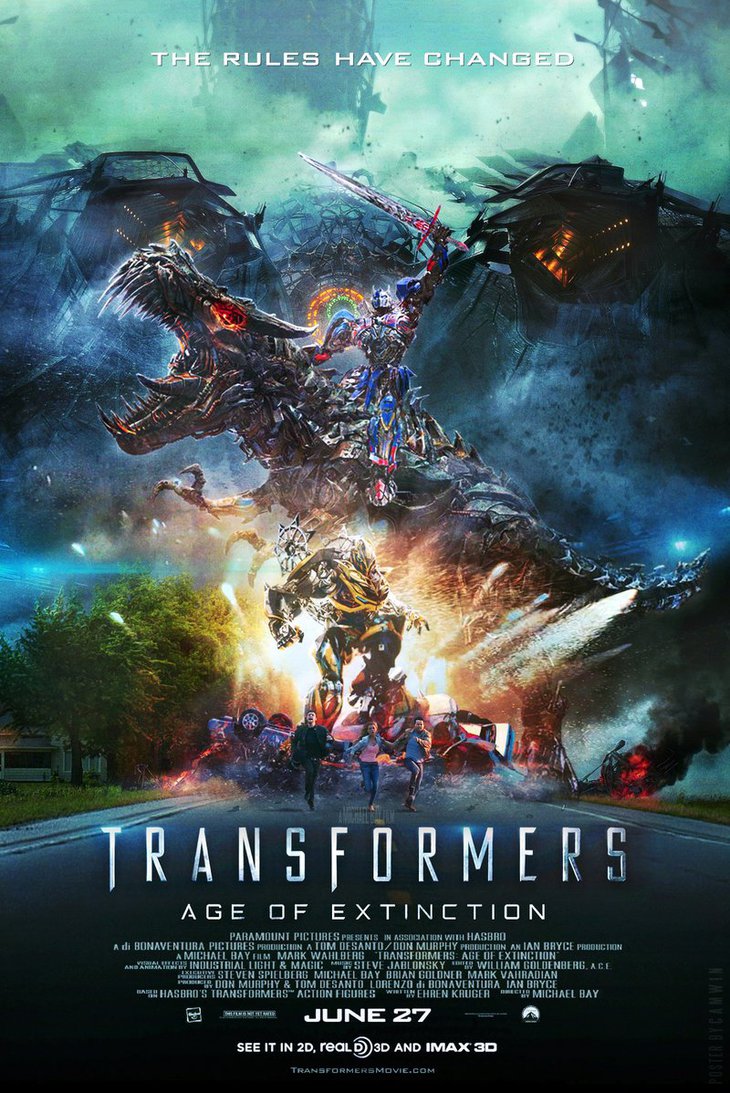 Four movies in, at this point you can either fall back on the old criticisms of Michael Bay as a filmmaker or simply let down your guard and look for any simple pleasures offered by the Transformers franchise, a series mostly known for chaotic plotting and action. Age of Extinction is probably the best Transformers film since the first one (take that for what you will) but it still has all the hallmarks of the obtuse and convoluted plotting, absurd and obnoxious characters, juvenile humor, intense product placement, and often incoherent action. Gone are the characters from the first three films and in their stead is Mark Wahlberg (upgrade) as a Texan inventor named, get this, Cade Yeager. He and his teen daughter come into contact with Optimus Prime and are on the run from multiple forces. Apparently a bounty hunter is looking to target Prime. The U.S. has a black ops team tracking down Transformers in hiding. And Stanley Tucci plays a business tycoon who wants to make his own Transformers via their magic substance “Transformium.” Reading all of that, you realize the pieces still don’t really make sense, and that’s before the robot dinosaurs come into play. And yet Bay and his team have fine-tuned the entertaining aspects of the franchise and better consolidated them in the fourth film. A badass alien bounty hunter/collector is a great addition, adding the government as an adversary, Titus Welliver (TV’s Lost) as a cocksure special agent, Tucci as a corporate blowhard, and robot dinosaurs, it all sort of works on its own terms. Again, if you try and logically connect the pieces, it won’t happen. By this point, if you’re not a fan of the series, there’s no real reason to continue watching, but if you’ve found any semblance of enjoyment then there should be enough to keep your attention with the fourth film, robot dinosaurs and all.
Nate’s Grade: C+
Share this:

Guardians of the Galaxy (2014)
 Who would have guessed that a movie that featured a talking tree and an anthropomorphic raccoon would be one of the best films of the year and one of the top grossing films of the summer? At this point for audiences, the Marvel name can do no wrong, but really it’s the degree of latitude given to Guardians of the Galaxy, an admittedly weird movie with strange characters, that allows this unique film to shine. Attaching offbeat director James Gunn (Super, Slither) to be writer and director was a risk that paid off tremendously, as Guardians is the Marvel film most entrenched with the particular personality of its creative director. This is a gleefully imaginative film that enjoys wading deep into weirdness, dancing to its adventurous Star Wars throwback beat, always with its focus set on comedy but not at the expense of quality drama or character development. Really, the characters are the focus of this entry into the franchise, and Gunn and his actors do a bang-up job of gathering the team and getting you to care about each and every one of them. Each one of these characters has a goal, several payoffs, and each is given their proper attention. In an ordinary superhero film, the archetypes would be ironclad. With Guardians, the tough guy made of muscle can also be a source of unexpected comedy with his literal-minded speech patterns. With Guardians, the talking raccoon can also be an emotionally disturbed victim of genetic experimentation who doesn’t know how to play well with others. These are damaged characters and their formation of an unconventional family unit is deeply satisfying and rather touching. I have seen the film twice and gotten teary-eyed both times. The real star of the film is Chris Pratt (TV’s Parks and Recreation), and what a breakout role he is afforded; he’s like Han Solo’s more juvenile nephew. But like the others, the part is surprising in its depth, with a well of sadness and displacement he still hasn’t processed while he scavenges the galaxy. The plot can be a bit unwieldy at times but pays off better for repeat viewings. This is a world I want to spend far more time exploring and with these characters as my merry prankster guides. With a movie this action-packed, thoroughly entertaining, and gratifying, why come back to Earth?
Nate’s Grade: A
Share this:

Edge of Tomorrow (2014)
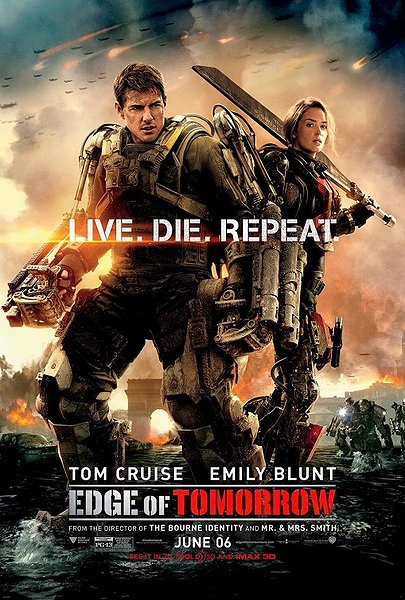 I’ve always been one able to separate the art from the artist, so while Tom Cruise may annoy people in real life because he jumped on a couch one summer, that doesn’t halt my enjoyment of the man’s movies. It seems with every new Cruise vehicle that under-performs at the box-office that I must be in the minority. Cruise hasn’t had a hit to his name since 2011’s suitably awesome Mission Impossible: Ghost Protocol. Both Oblivion and Jack Reacher, perfectly solid action movies, failed to make over $100 million domestically, further calling into question the drawing power of Tom Terrific. It seems that his latest, Edge of Tomorrow, is going to suffer a similar fate. This is a shame. As my critical colleague Ben Bailey said in his own review for the film: “Edge of Tomorrow might just be the most critically acclaimed box-office bomb of 2014.”
William Cage (Cruise) is chiefly an Armed Forces PR flak. He goes on TV to push the talking points of the United States military, which is in a heap of trouble. Aliens have landed in central Europe and spread quickly, proving to be nearly unstoppable. There was one soldier who was able to lead a successful counter attack. The “Angel of Verdun” is Rita (Emily Blunt), a soldier Cage proudly chirps only spent a day in her mechanical fighting suit beforehand yet proved to be so deadly. After vaguely threatening a high-ranking official rather than report for a doomed counter assault, Cage is shipped to the frontlines as a deserter. In hours he and a motley crew of ground forces are flown to the beaches of France, where the aliens will slaughter them. In the firefight, Cage is covered with alien blood and gains their special power. The reason the aliens have won every battle, save one, is because they have the power to reset time. They learn from their errors, which is why they always anticipate humanity’s attacks. Now Cage has this power. Every time he dies, the day resets and he starts over, trying once again to survive. The only person who understands him is Rita, who once had the same power. Together, with some extensive training, they may be able to thwart the alien invaders for good.
 Edge of Tomorrow is the ultimate video game movie, and while I would normally mean this in a pejorative sense, it is actually a compliment. With every death, Cage gets to start over, looking for a way to complete the next stage of the next level, learning from his costly mistakes and hoping to get to the boss battle that usually closes the level. From a structure standpoint, it’s a pure video game, albeit an older sidescroller (remember those, kids?). The visuals and mechanical battle suits also further support the video game comparisons. But really, Edge of Tomorrow is Groundhog Day meets Starship Troopers but brilliantly executed. There is something deeply satisfying about the Groundhog Day formula, namely getting seemingly endless chances to fix one’s mistakes, to try out new paths. It’s also inherently satisfying as an audience member because you watch your hero fail time and after time but they’re still active, they’re still trying to achieve a goal, or a new goal, and thus when they do succeed it’s even more triumphant and gratifying. We get to learn alongside our protagonist. Also, it allows the narrative to explore new material without going stale. In most stories we have one set path, but in films like this one with a time loop, it’s like we get to see all the wheels-within-wheels, the stories just offscreen happening simultaneously. It opens up the world in more interesting and playful ways, providing more payoffs than just one set narrative destination. We get assorted answers to our “what if”’s. Plus we get more screen time with Bill Paxton (2 Guns) as a comically hardass master sergeant. Edge of Tomorrow mines all these areas expertly. This is a movie that embraces the possibility of its sci-fi premise. It’s constantly clever, fast-paced, lively, and expects its audience to keep up with the pace.
It’s great to see director Doug Liman flex his action-thriller abilities again, ineffective or dormant since 2005’s Mr. and Mrs. Smith. The man has an innate ability to orchestrate action without losing sight of character. The beach invasion sequences have plenty going on, enough so that you won’t be bored after multiple trips, and unlike last summer’s disappointing Elysium, this is one movie that knows how to make proper use of a mech suit. These suits don’t look that impressive but they pack some mighty firepower. It’s rather cool when Cage, after a litany of failed trips, has the beats of combat to memory, knowing to shoot in this direction at the right second. It’s like watching a man harness the omniscient power of God (“I said I was a god. Not THE God.”). Under Liman’s guidance, the action is big and exciting and fun, more so than any other Hollywood action movie I’ve seen this year (The Raid 2 is still in a class its own).
The action sequences and special effects are all relatively good, but it’s just the sheer fun of the movie that makes it special for a summer would-be blockbuster. It’s like you get multiple movies smattered together but the eye is always forward to the goal, taking out the alien brain/host. The structure is almost foolproof: by the end of Act 1 he gets the time-tripping powers, and by the end of Act 2, he loses them and the heroics to close the movie have to count for real. I wish the final boss battle didn’t happen to take place in the bowels of a famous landmark/destination, but I suppose Liman and company needed a change of pace from all the beach activity. While the movie covers plenty of ground repeatedly it never feels old or directionless; while it has its share of sticky exposition and silly plot mechanics, it never overwhelms the story or the entertainment factor. The basics of who the aliens are, how they attack, what their magic blood does, what the rules are for utilizing said alien time-repeating power, you would imagine that they would be too silly or bog things down, but they don’t. Except for the very end (the concluding two minutes), the movie plays within its own system of rules. That also means no unrealistic romantic entanglement. Sure we expect movie stars to fall for one another, especially in peril, but for Rita, every day is the first day she’s ever met Cage. He develops feelings for her but she credibly keeps thoughts of romance at bay.
 It’s also a mordantly mirthful movie. Cage can only reset when he dies; if he is just wounded and passes out, he’ll lose his special reset power. So every insurmountable roadblock, wrong choice, or crippling injury must be met with one conclusion, namely Cage being snuffed out. Rita carries out most of the executions in the second half, with a blasé sense of routine duty, like a plumber fixing a clog. It doesn’t really get old and Liman utilizes montage well to give the comedy an extra punch. It lightens a movie more or less centered on human annihilation and mortality. And for the legions of Tom Cruise haters, there’s got to be some degree of entertainment value in watching the man die again and again and again and, well you get the point.
Cruise ably shows again that he is more than capable of carrying an action film (he’s over 50 now too). The man still has enough energy and physical stamina of an action hero in his 30s, and his charisma is still there in spades. It’s also interesting to watch Cruise play a cowardly character. I should have expected it considering that Cage’s arc has to start somewhere before he becomes the super soldier. However, the movie would never have been as good if Cruise didn’t have a strong leading lady, and the surprisingly buff Blunt (Looper) is an excellent match for her costar. She’s tough and can beat the snot out of you. Just her very walk exudes confidence and determination (is it too late for her to be Wonder Woman in the next Superman film?). Having walked in Cage’s shoes before with the time-replay power, she has an extra weariness to her, a certain devil-may-care attitude, especially in battle. The two actors make a winning team and Cage’s recruitment of Rita is another mission with another worthy payoff.
The original title was All You Need is Kill, based on a Japanese graphic novel, and I can’t help but think how much of a better, striking title that is to describe this movie. It’s a wonderfully entertaining movie, with its action spectacle tempered with an intelligence rare for a summer blockbuster that doesn’t have Christopher Nolan’s name attached as director. Here is a playful sci-fi movie that doesn’t downplay its sci-fi, doesn’t dumb down its plot, and explores the richness of its world one dead Cruise at a time. It’s clever and satisfying and brings all the visual fireworks you’d demand. It’s a rotten shame that Edge of Tomorrow appears destined for the cinematic scrapheap. We need more movies like this one. Reverse the tide people and see this movie on the big screen while you can. It’s everything we want in a summer blockbuster fully realized.
Nate’s Grade: A-
Share this:

Ender’s Game (2013)
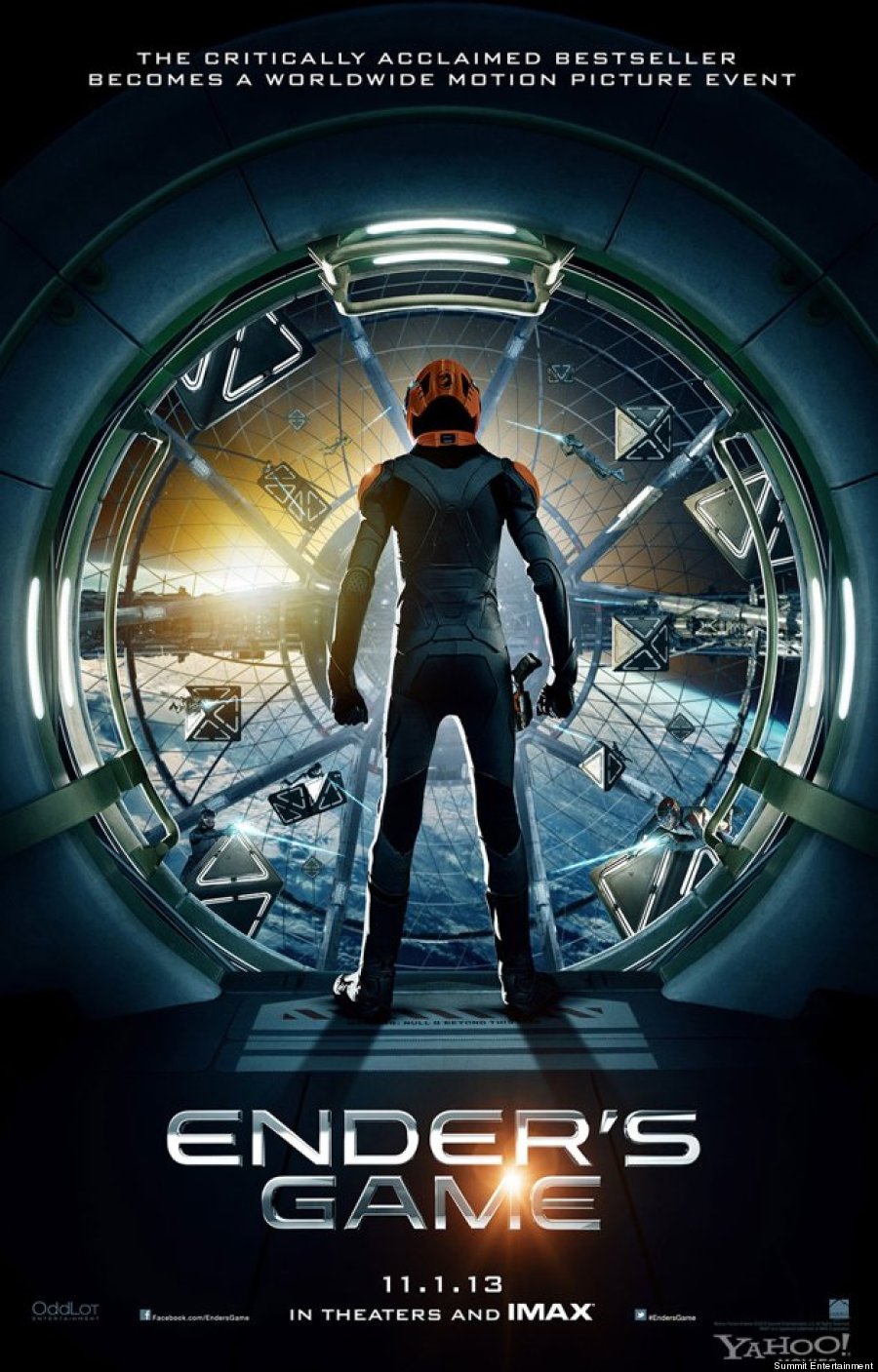 Honestly I know more about Ender’s Game thanks to the swirling rabble about boycotting the film thanks to author Orson Scott Card’s homophobic personal views. I didn’t even know this book existed until I heard about the movie. With my cloud of ignorance, as well as some lingering worries that the director of X-Men Origins: Wolverine was at the helm of this expensive would-be franchise, I was pleasantly surprised at how entertaining I found the movie. It’s set in a future where children are culled and trained to be super soldiers against an alien race that has been in seclusion after a failed invasion of Earth. The emphasis is on strategy and manipulating your opponent, which leads to many military training sequences. At one point I wondered, “Is this whole story going to be training sequences and zero-gravity laser tag?” It’s not, thankfully, but even those sequences are fun. Writer/director Gavin Hood does an excellent job of fleshing out this world while giving enough time in between the games to also flesh out his ragtag group of characters. There’s something inherently satisfying to watching a team come together, and the film has plenty of small payoffs. The visuals are astounding to soak up. The zero gravity fun, backlit by the stars, is dazzling. The acting is strong across the board, with special appreciation that Harrison Ford has a good role that he’s actually well suited for. The pacing does start to slag toward the third act, mostly because the plot feels like an escalating series of games, until it’s not. There’s a measured degree of ethical ambiguity and contemplation to the film that’s admirable. Whether you plan on boycotting Ender’s Game or not, it’s a successful, thrilling, and visually engaging sci-fi flick that deserves to be seen at some point.
Nate’s Grade: B+
Share this:

The World’s End (2013)
 The third in the Cornetto trilogy, the series of loving homages to genre films that end up transforming into those films, written by star Simon Pegg and director Edgar Wright (Scott Pilgrim vs. the World), is so self-assured, so witty, and so stylish, but it’s also the best film Wright has done. While my heart will always bleed for 2004’s Shaun of the Dead, it’s something of a revelation how everything comes together so magically in The World’s End. Every joke, every sight gag, every offhand reference, it somehow is all tied up together or has some greater narrative connection, like the names of the 12 pubs on a pub crawl reunion that discovers an alien invasion. The dialogue is packed with layered humor, with choice bon mots like, “That’s why I drink out of a crazy straw. Not so crazy now, huh?” and, “Or selective memory like that one guy… who? Oh yeah. Me.” Given the previous films, Shaun and 2007’s Hot Fuzz, I knew this would be a funny movie, but I was unprepared for how emotionally adept it is. The characters are given surprising depth and pain and anger, mostly stemming from Pegg’s screw-up alcoholic character desperately trying to relive the good times. The writing is so textured that the characters come across like actual people, and the twists and turns, while entertaining, are far more emotionally grounded than in any previous Wright movie. There is real pain and atonement for these fallible characters, which makes us root for them even more against the robot invaders. Pegg and Nick Frost are terrific again. The action is frenetic and inventive, the laughs are frequent, and the characters are so fully realized that The World’s End isn’t just the best film in a stellar, pop-culture savvy trilogy, it’s also one of the best movies you’ll see this year.
Nate’s Grade: A


 nathanzoebl
You must be logged in to post a comment.