Blog Archives
Apocalypto (2006)
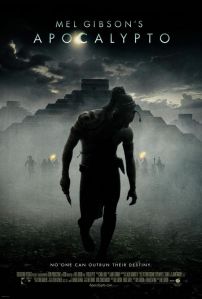 Apocalypto is an action movie set 500 years in the past with a cast of entirely unknown actors, some of who have never acted before. But what does everyone want to talk about? Mel Gibson hates Jews. He’s been in a heap of trouble ever since a DUI where he said some very unkind things about God’s chosen people. He’s made the apology tour and checked into alcohol rehab, the new go-to defense whenever a celebrity screws up. The public finds it hard to separate art from the artist; Frank “It’s a Wonderful Life” Capra was anti-Semitic but few seem to bring that up. Some people have sworn off Gibson thanks to this disgraceful incident. That’s a shame because Apocalypto is brilliantly filmed and Gibson’s finest directing effort yet.
The Mayans seem pretty at ease 500 years ago. We open on a hunting party dividing up a recent kill and playing a prank on one of their members that is having trouble making little Mayans with the wife. Jaguar Paw (Rudy Youngblood) is the son of the tribe?s leader. In the forest they encounter a group of survivors from a different village. They warn of a group of mercenaries that razed their town, killed their people, and took the rest. Jaguar Paw?s father warns not to speak of what they have seen to their people. Fear is contagious, we?re told. That night the same mercenaries attack Jaguar Paw?s village. He scrambles to lower his pregnant wife and young son into a cavern for safety. The surviving men and women are tied up and sent marching. The village?s children are left to fend for themselves and most likely perish without any adults.
 Jaguar Paw and his fellow captives are headed for a Mayan temple. The women are sold into slavery. The men are painted blue and guided to the top of the temple to become sacrifices to an unhappy god. The men are held on a slab, have their hearts cut out, finally then have their heads sliced off and kicked down the stairs. Through a fortunate set of circumstances Jaguar Paw breaks free and races into the forest to return to his family, who is in danger of drowning if the cavern fills with rain water. The mercenaries are not far behind and willing to go to any length to kill Jaguar Paw.
From an anthropological standpoint, Apocalypto is fascinating. Gibson has turned back time and immerses the viewer in a world unseen for 500 years. The details are astounding, and whether they are note-for-note historically accurate or not is inconsequential. You are seeing a living, breathing world right before your eyes. I loved soaking in the new-ness of the experience, seeing how this forgotten world operates, and the power struggles within. These people have great faces, great hulking muscular frames, and great expressions needing to be seen. Gibson has crafted a film that you’ve never seen before, at least with this kind of budget and filmmaking prowess. Apocalypto can quite often be breathtaking to behold. The production design and costumes (yes, there are more than just loin cloths) are incredibly rendered and add greatly to the authenticity and mood. I loved visiting the Mayan temple city (“down town” I guess you could call it) and seeing the different factions intersect, like green painted upper-class harpies being carried around the crowd.
The parallels Gibson puts out there seem tenuous at best. The Mayans have lived beyond their resources, experiencing plague, and feel that the need to pacify the masses, and turnaround their bad luck, is a whole slew of human sacrifices. There’s an Iraq War reference in there if you want to go looking for it and perhaps an ecological one as well. I don’t know if Gibson is using the Mayans as a cautionary example of a society that crumbled. We are treated to an opening quote detailing that no great society can be conquered from outside until it has become corrupt from within. Maybe this is Gibson’s way of telling America to sit up and fly right. Or maybe it’s just an intellectual glob toweled over the blood and guts to make everything seem more meaningful.
The acting is a surprise. Many of these people are really good, especially Youngblood who has a soulful face and a terrific presence onscreen. Gibson creates a great sense of community in the early moments. People feel natural and in touch with their surroundings. Their interaction and the visual shorthand feel like storytelling tricks from classic silent movies. Gibson manages to tell us a lot with little. There are some gut-churning moments, and some of them are because of character. A man from Jaguar Paw’s village hopes his wife did not give up fighting before she perished, because if she did then she will be sent to hell. He pleads that when he dies he might endure the tortures of hell, just so he can be with her again. That hits hard. A cranky mother-in-law also provides a shining emotional moment completely played in solemn silence. A little girl surrounded by crying children tries to assure the adult captives, “They are mine now. I will take care of them.”
 The last hour of the movie is a non-stop foot race as Jaguar Paw valiantly attempts to escape his enemies and return to his swatch of the jungle. There are some fantastic escapes and imagery, like Jaguar Paw outrunning an actual jaguar. The ending is fantastic and a fitting climax for the title. I would have enjoyed just a little shove further, like a new character marveling at some gold trinket Jaguar Paw had gotten from the Mayan temple. “This is gold. Can you tell me where there is more?” he would say. “Tell you?” Jaguar Paw would say in a hearty laugh. “I’ll SHOW you where to get more. Follow me.” The resolution is pretty obvious but left to the imagination. I guess after much derring-do I just prefer more finality with my comeuppance.
This may be about a dead culture and spoken entirely in a dead language, but Gibson’s bloody art house flick is a lively macho action movie at its core. It’s structured exactly like a typical Hollywood action movie, and I don’t know if this adds another level of brilliance to the final product or makes it seem more ordinary taken apart from its historical context. Gibson’s trade is misery. He’s been a martyr onscreen and he prefers to tell stories about the anguished and tortured. Jaguar Paw is beaten, wronged, and has to race against time to save his family. When Jaguar Paw moves onto his own turf he turns his knowledge of the land to turn the tables on his enemies. The movie presents familiar archetypes like the wise father, well-meaning oaf, and impetuous hothead villain, Super Biggest Bad Guy (he does wear the most skull trophies, that has to count for something). The villains are larger than life and have great menace to them. Even better, they’re highly memorable and despicable, and yet they seem to operate within a tribal code of their own honor. They scowl with the best of them.
This familiarity makes viewing Apocalypto less jarring, This is an independent movie high school jocks could enjoy. That may sound dismissive but it’s a compliment. Gibson has great technical skill and after decades of shoot-em-up pictures, he definitely knows how to build and sustain exciting and rewarding action sequences. You know when the bad guys with personality are going to have big deaths, and you know when you see a hunting weapon in Act One that it is going to be put to awesome use in Act Three. The lines of action are well structured and smartly played. When you boil it down, it may just be an action movie, but because of Gibson it’s a good action movie.
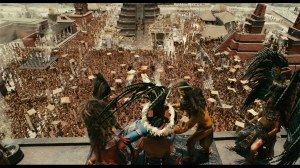 With The Passion of the Christ, I was appalled by the violence, more so how Gibson fell in love with the blood and gore, turning it into pornography. That was the message of The Passion — Jesus sure knew how to take a lickin?. But with Apocalypto, the violence is savage but the appeal of this project is on recreating a world, not sadism. Apocalypto is more interested in opening eyes than shutting them because of nauseating and relentless gore. This isn’t exactly a movie fit for nuns and missionaries, though. Gibson embraces the cruelty of man and showcases some real horrors. The temple sacrifices are fitting and gruesome, but never seem exploitative. There are moments that I wish Gibson would have pulled back, like an extended scene of a jaguar chewing a man’s head or a gusher of blood spritzing out of a man’s temple like a broken sprinkler. I think Gibson loses control of his story and gives in to his own bloodlust in these moments, which serve to take you out of the movie and go, “Ick.”
The violence is also easier to stomach because the audience is more invested in story and character. Everyone that paid a ticket in 2004 knew Jesus was going to die in the end, at least, I really hope they did. That might have been a shocker to a remote few. It was all about witnessing suffering and testing how much you could watch. You felt the pain, all right. Apocalypto, in contrast, is tame and more focused on escape than futility.
After The Passion of the Christ made heaven and earth move at the box office, Gibson can afford to make any movie he wants. If he wants to make a movie about Mayans in Mayan, so be it. At least Gibson knows how to tell a good action story. Apocalypto is beguiling and often breathtaking to behold. The details create a rich environment that feels wholly alive. It’s a typical action movie plucked down in a different historical setting, creating the most unique movie experience of the year. It’s a man’s man independent movie but also manages to hit key emotional notes. I don’t care what he thinks of Jews or anyone else. His art speaks for itself, and Apocalypto is fascinating. It’s an art film for jocks, it’s an action movie for science geeks. Bless you Mel Gibson, you’ve brought us all together in the weirdest way possible.
Nate’s Grade: B+
Share this:

Babel (2006)/ Blood Diamond (2006)
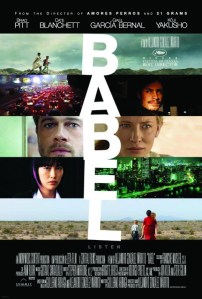 The world is a global community. It is increasingly difficult to shut out unpleasant news just because it happens to an unfortunate few we’ll never know. Hollywood has reminded us through the years that our actions do have sound repercussions, including our indifference. Babel is Mexican-director Alejandro Gonzalez Inarritu’s examination on the fragility of human relationships in the world. Blood Diamond wishes to shine the spotlight on America’s love of diamonds fanning the flames of genocide in Africa. Both movies wish to convince the public that they matter, and not just in box-office, though that would be appreciated. Both of these films have good intentions but the results are sloppy and leaden.
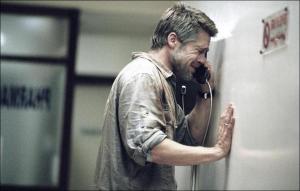
In typical Inarritu fashion, the different storylines of Babel converge, blend, criss-cross, and crash together. The timeline isn’t as disruptive as it was in 21 Grams, so that is a welcome relief. The storylines offer wide-eyed views into different worlds and cultures. A Morocco goat herder purchases a riffle for his sons to protect the herd. The two brothers turn sharp-shooting into a competition, with the one betting the other he cannot hit a bus far in the distance. On that bus is Richard (Brad Pitt) and Susan (Cate Blanchett), a married couple at odds with each other. Suddenly a shot whizzes through the window and into Susan’s neck. Richard panics and struggles with his options being far removed from advanced medical care and being unable to speak with the natives.
 The incident becomes the shot heard round the world. The U.S. government is quick to suggest a terrorist link (who didn’t see that one coming?) but caught up in red tape to rescue the couple. Their nanny, Amelia (Adriana Barraza), cannot find someone to watch the kids so she can attend her son’s wedding in Mexico. Santiago (Gael Garcia Bernal) agrees to drive her and the kids south of the border where the blonde moffetts can learn things like how to kill a chicken. Things take a sour note when reentering the United States at a border crossing manned by suspicious patrolmen.
And half a world away, a deaf-mute Japanese schoolgirl (Rinko Kikuchi) deals in the aftermath of her mother’s suicide by flashing her vagina at boys and throwing herself at older men. Therapy might also be a workable alternative.
The strong ensemble acting is what kept me watching. Babel is filled with many talented actors that each get a turn to look pained, incredulous, and helpless. This is a movie primarily built around sadness and misfortune, and actors jump at those chances. Exhibit A: Brad Pitt. I’ve always thought his serious acting credentials get cast aside because of his good looks (the man even played a Greek god), but he’s into his 40s now and weathering some grown-up gray and wrinkles that, I don’t know how, add a mature sexiness to the man, much like George Clooney. Pitt was serviceable in Babel but failed to impress. He gets to pace a lot and look haggard but he still seems like a distant character. The whole American tourist storyline cannot outrun the sense of pointlessness it seems to be circling. The greatest moments of acting come from the extreme anxiety of Barraza and the dissatisfied yearning of Kikuchi. I expect both women to get nominated for many awards.
The most frustrating aspect of Babel is how little it matters. It’s hard to connect with the characters. And in the end, nothing all that tragic happens to reach anything profound. Most characters leave their shadowy places and only a small number are changed for the worst, mostly the victims of some very bad decision making. But when the movie concludes there is only one dead body and one displaced person. That’s it, and Babel doesn’t even hang on to let us feel that pain. It just skips from story to story never settling in and never evoking any human emotion except for that of morbid curiosity. These people are victims of fate and not much else. Babel is a letdown of a letdown.
 The Japanese schoolgirl storyline has no place in this film. The other three storylines all have a pertinent relationship, but the only thing that ties the schoolgirl into this web of international kerfuffle is that her father once owned the gun in question. Wow. It might have made better drama, and more sense, had this riffle had some significance, like it was the weapon of choice for her suicidal mother. Nope, it’s just another object with no more bearing to this family than a stapler. I think the deaf-mute Japanese schoolgirl is a terrific character and intensely intriguing, especially as she battles the trials of teenage life and feeling like even more of an outcast than usual, but this story needs its own separate movie. It has no business being here and, like much of Babel, adds little understanding or significance. So much of the movie isn’t even told to the audience, like character back-stories and written catharsis, so any distraction feels like a waste of time for a 140-minute movie.
The ending is symptomatic of the film in general; it just kind of peters out and thinks its message has been well-received. What message? What the hell is Babel saying? Stop, look, and listen? The world stage is at such a precarious time and is, for better or worse, unified; someone else’s problem has ripples that will become our problem. Isolationism is dead. But Babel squanders any attempts at a deeper message by playing it safe; never pushing further than the scene descriptions it has confined itself to. The title refers to the Biblical story where God punished man’s arrogance by creating multiple languages. Most of the conflicts revolve around communication issues, but they really only seem like a small portion of the story. When Amelia takes the kids to Mexico, there really aren’t any communication problems. When the car is stopped by the Border Patrol there aren’t any slip-ups in communication, but Santiago freaks out and bolts. The central idea of Babel, lost communication, never really feels properly executed except with the Japanese schoolgirl, who, like I said, doesn’t even belong here.
When Babel does have something political to dwell upon it is usually very lazy. Law enforcement treats illegal immigrants like crap. The U.S. government is more interested in punishing perceived threats than medically helping those in need. American tourists are boorish and see dusty places like Morocco as a place to be alone, despite all the impoverished people shuffling about. Give me a break. There’s nothing within Babel that makes it worth more than one viewing. Once you know the outcome for characters than the film ceases to have a point. This is a true surprise and disappointment from the team that had so much emotional vitality and open humanity with Amores Perros and 21 Grams. I guess a lot must have gotten lot in translation.
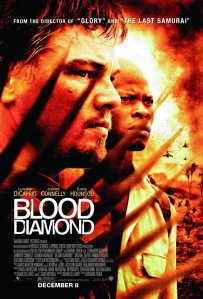 On the flip side, while Babel is a mildly interesting movie desperately needing a message, Blood Diamond is a message in desperate need of an interesting movie. The message rings loud and clear in the film?s opening moments: conflict diamonds are bad. They account for 15 percent of all diamond sales and help finance genocide, civil war, and child brainwashing in Africa. The diamond industry says they cannot decipher which diamonds are which, but come on, they know. They use their market share to control world prices, thus creating a windfall for African rebels. They come up with more diamonds, and the diamond industry purchases them to take them off the market. Got it. But now what?
The short answer is, “‘Just say no’ to conflict diamonds, that is.” The long answer is one very trite movie that wears its liberal idealism on its sleeve with a bit too much fondness. Africa has become the cause celebre of recent films, but have any of them really made a difference? Did The Constant Gardener make us think twice about why drugs are so cheap (because Africans are exploited)? Did Syriana make us think twice why oil was comparatively cheap for Americans (because Africans AND Middle Easterners are exploited)? I doubt it. I may sound a pinch too cynical but I believe that the Unites States of America just generally doesn’t care as long as prices stay nice and low. I applaud filmmakers for attempting to open eyes and change hearts and minds, especially for many thought-provoking and worthy causes. But if you’re going to sponsor a message movie than you need a spoonful of sugar to help the medicine go down.
 Blood Diamond will make you gag, that’s how heavy the message is. It displays a depressing showcase of Africa recycling violence, but it always manages to stay on point. The movie is supposed to be concerned with the well being of Africa, but yet it hangs its attention on a pair of white people. Danny (Leonardo DiCaprio) is a South African diamond smuggler who gets the classic Hollywood redemption arc, courtesy of Solomon (Djimon Hounsou) an enslaved mine-worker that has found a pink diamond the size of a bird egg. Danny and Solomon form a reluctant partnership to get recover the diamond, rescue Solomon’s lost son, and get everyone out of the raging gunfire. But the film is focused on Danny’s arc as he goes from scoundrel to savior, with all those black faces in the background just becoming that — background. The film’s climax involves Danny running through a mining camp looking to rescue Solomon’s lost son. However, Danny shoots and kills all the other kids holding weapons as he dances in between explosions. You cannot root for that as a moral audience member, can you? Danny may save one child but he’ll blow away all the rest, and to the pounding score of Hollywood glory. If this was meant to seem meditative than God help us all.
Jennifer Connelly plays a photo journalist that?s a self-described action junkie. She says she just can’t go through her day sipping lattes and reading Ziggy in the funny papers, not with knowing how cruel the world is to one another. Did she just become aware of this? The world has always had people getting treated poorly and will forever. Her character is an outlet to the Western world, a lens that can capture and broadcast the horrors of Africa which she flippantly predicts will be a minute on CNN “between sports and weather.” She’s your prototypical bleeding heart and the not-so-subtle outlet for the righteous indignation of the filmmakers. There’s nothing to her character except a camera for proof, an unyielding moral compass, and a pair of breasts for Danny to improbably snuggle up to.
 The message of Blood Diamond is what we’re reminded of time and again, including tidbits to clue us in on how it all began (where did Africa learn some brutality? Why white colonists of course). The movie is built as an action vehicle, but it’s an action vehicle going in the wrong direction. The bursts of action are frequent but never anything well imagined or exciting. Usually the film follows two, or more, characters talking and then they’re interrupted by bouts of gunfire. Danny starts uttering “GO!” and “MOVE!” every other breath and they escape. This formula is repeated for the rest of the movie. It hampers getting to know and feel for the characters and sure as hell doesn’t amount to a lot of interesting action. There’s the main problem: we can’t feel for the characters because the movie doesn’t spend enough time with them, and yet we can’t get excited because the movie doesn’t spend enough time to build effective suspense. Blood Diamond finds its way into a balancing act it is hopelessly ill-prepared for.
Director Edward Zwick (Glory, The Last Samurai) is used to fashioning mass-friendly entertainment with cultural issues bubbling to the surface. Perhaps, though, he should have taken a cue from Andrew Niccol’s Lord of War. That film had an easily identifiable message (guns can be bad) but found ways to engage an audience. It had a lot of political ire and troubling statistics to dish, but Niccol knew that an audience must be entertained first and foremost. He found inventive camera angles, stirring monologues, and fascinating true-life anecdotes about arms trading. The main character wasn’t likeable but you just wanted a longer peek into this world behind the curtain. Blood Diamond lacks the biting insights that made Lord of War powerful and enjoyable. Even Lord of War handled the subject of turning children into a blood-thirsty army better. Zwick seems adrift and too close to his message to care about sharpening a good movie.
The movie has a handful of odd moments. In our introduction to Danny he is negotiating a weapons deal. He speaks to the head of a militia in a highly accented speech and subtitles pop up on the screen. Naturally, you would assume the language currently being spoken is not English. Danny is actually just impersonating an African’s English speaking voice. If you listen to what they’re saying they speak English the entire time. And the line, “In America, it’s bling-bling, but over here it’s bling-bang?” No. A thousand times no.
 DiCaprio is muscling his way into a riveting and meaty actor of prominence. His accent is near flawless, just like his Bah-stun accent was in The Departed. He gives more simmer to his role than deserved. Hounsou is a great actor but his most emotive scenes involve a lot of yelling that just seems like yelling. A lot of high-volume yelling doesn’t work when the character is so flimsy. Both of these actors are victims of playing characters with little else to them besides the title of Victim and Victimizer. Connelly and DiCaprio have no chemistry to them, not that the film’s neutered sensuality and agitated story help much. It’s as if Blood Diamond expects that by smashing the two characters together long enough their romance will be plausible. It isn’t. The romance is a distraction at best and eye-rolling at worst.
Babel and Blood Diamond are both pieces of misguided Oscar-bait. Innaritu and his writer for three films, Guillermo Arriaga, have said to have clashed since Babel‘s release and may no longer work again together in the near future. I welcome this trial separation because their film collaborations seem to be dulling. Babel has all the technical skills evident in 21 Grams and Amores Perros, but nothing substantial or contemplative. Conversely, Blood Diamond is a message movie posing as an action flick. It can’t succeed with poorly constructed action sequences and archetypal characters posing as openings for outrage and shameful finger-wagging. The movie is crushed to death by a message. Blood Diamond is a message movie that’s so weighted down it never gets very far. Both films are marginally interesting but nothing transcendent or demanding. Hollywood has its heart in the right place. They just need to make better movies.
Nate’s Grades:
Babel: B-
Blood Diamond: C
Share this:

Casino Royale (2006)
 This is very different James Bond and it’s about time. The Bond film franchise began all the way back in 1962, and it essentially became the blueprint for the modern action movie. Quips, alluring women, exotic locations, car chases, colorful villains, and spoiled plans for greed or world domination. But even if Bond got the ball rolling, the action movie became its own insatiable beast, thanks to the likes of studio bean counters and the ubiquitous uber-producer Jerry Bruckheimer. The 90s Bond revival followed suit. The movies became more about extravagant fireballs, throwaway characters, and preposterous scenarios. After 2002’s Die Another Day, where Pierce Brosnan’s Bond drives an invisible car through a melting ice palace caused by a solar laser from space run by a yuppie playboy who really had the DNA of a North Korean dictator… well, you don’t need to be an expert to figure out that something was rotten in that state of Bond.
The Bond films have great history to them, but let’s not get overly romantic here; a majority of the James Bond movies are outright crap, especially the ones with Roger Moore. There were jaunts into space, men with metal teeth, Timothy Dalton, a title called Octopussy, and Christopher Walken trying to have California fall into the ocean. Let’s face it, half the movies are rubbish. Someone, anyone try and tell me the redeeming qualities of Moonraker. The last good-to-great Bond movie was Brosnan’s debut, 1995’s Goldeneye. The Bond franchise has been in desperate need for a makeover. This is it.
 The producers went back to Bond basics. The long-time producers had the rights to every Ian Fleming novel, except for Casino Royale, which was turned into a cheesy comedy lampooning Bond instead of competing with the franchise. Several decades later, we’re given a serious adaptation of Royale, Fleming’s introductory book about the secret agent that rewrote movie rules. The new Bond has a splash of Jason Bourne in him and seems more tightly wound and hard-boiled. He doesn’t have time for trivial decisions like shaken or stirred. “Does it look like I give a damn?” he barks at the bartender.
Bond (Daniel Craig) is more thug with a badge than a suave secret agent. He’s just risen to double-O status and his boss, M (the incomparable Judi Dench), doesn’t feel that he’s ready or can be trusted. But then, he is the best poker player MI5 has. Le Chiffre (Mads Mikkelsen) is entering into a high stakes poker game worth millions of dollars. He’s playing with the money of African warlords and terrorists and has promised them a great return on their investment. Bond is assigned to gather information and stop Le Chiffre from financing terrorism. Vesper Lynd (Eva Green) is a representative of the bank that will be sponsoring Bond in the card game. It’s up to her to keep tabs on Bond and make sure her bank?s money is wisely invested.
Now this is what action movies should be like. Casino Royale is a terrific ride with great action sequences, great intrigue, strong acting, and some wonderfully exotic locations. The movie, like Bond to Vesper, sure feels the need to prove money was well spent. The story is smart and filled with sharp dialogue, perhaps thanks to co-writer Paul Haggis (Million Dollar Baby, Crash). This is Bond dialed back, stripped of fancy gimmicks and gadgets and left to battle with his wits and his brutality. This is a meat-and-potatoes action movie without irony or frills. It’s serious about its business and business, let me tell you, is good. Casino Royale is monstrously entertaining.
 There was a lot of grumbling when Craig was selected as the next actor to fill the 007 shoes. Some scoffed at the idea of a blonde Bond, as if hair color had shot to the top of the list of important qualifiers. I wrote this about Craig after seeing 2005’s Layer Cake: “This man is a modern day Steve McQueen with those piercing blue eyes, cheekbones that could cut glass, and the casual swagger of coolness. We may never see Craig sweat but he still expresses a remarkable slow burn of fear so effectively through those baby blues.” This man is the perfect candidate for a Bond reboot. He has a boxer’s face, those wonderful eyes, and a sculpted body that will take many a breath away. But even better, Craig is likely the best actor that has even been tapped for 007. Connery will always be the sentimental favorite, and rightfully so, but Craig imbues his Bond with startling amounts of emotion and vulnerability. In the dramatic black and white opening, his first kill isn’t clean and quick, it’s long, drawn out, messy, and leaves Bond shaken, not stirred. His relationship with Vesper gives him even more opportunities to feel and be tortured, sometimes literally (Note: a naked torture sequence is far too intense for children, especially those with their genitals on the outside). Craig gives a rich performance. When he’s chasing bad guys you see the determination of his running, the anguish on his face. When he’s flirting with women you can practically feel the smolder. This is a far more pragmatic Bond and Craig is the right actor for the job.
Green leaves her mark as one of the best Bond girls in the franchise. Usually the Bond women are either respites for fine-tuned lovemaking, or damsels wronged by the eminent domain of evil. She has a nice moment where she sits in the shower in shock after being witness to the reality of murder. She showed a lot of promise and gives a commanding performance on her biggest stage.
Director Martin Campbell has some history with the Bond franchise, restarting it with Goldeneye. He’s a pro at orchestrating action sequences, and there are some doozies in Casino Royale. The beginning sequence is a thrilling foot chase inside a construction zone. Bond’s target, a bomb maker, bounces off walls, swings along ledges, and motors around beams and ladders like he was a trained monkey. It’s an exciting French style of acrobatics called Parkour, and it was used to dizzying effect in this year?s District B13. The chase just goes from one level to another, and the stunts are brutal and of the death-defying variety. It’s a showstopper opening. An airport sequence is also quite memorable, as Bond races to stop a bomb from reaching an airplane. Campbell has taken a hint from the Jason Bourne spy movies and made Bond more reactionary to his surroundings. Many fight sequences feel tense and un-choreographed, even though we know that isn’t the case. When this Bond gets into scuffles you don’t know whether he’ll make it out unscathed. Campbell keeps the pace steady and the visuals crisp. Best of all, Campbell allows the audience to fully see what’s taking place. There’s no MTV-style edits. The film feels totally in control like the best action movies do. You’ll feel battered, bruised, but exhilarated all the same.
 However, Casino Royale is not a perfect action movie. It feels way too front-loaded; all the big action sequences seem to occur within the first hour. The film then settles in for a climactic game of… cards? I’m not one who fell into the spell over Poker on TV the last few years. It just doesn’t seem that thrilling to me to watch one guy turn over his cards and then wait for another to turn over their cards. There are only so many combinations to be had, and hoping for Bond to have a flush to beat out four of a kind is just not high drama. It’s luck. The poker scenes seem to last longer than they should, as does the film as a whole. This is on record the longest Bond movie ever, clocking in at 144 minutes. It’s a whole hell of a lot of fun, but the tacked on ending in Venice seems like an entirely different movie slapped together for closure. The villain is somewhat weak. He’s given a nifty visual item, weeping tears of blood, but it is meaningless. The plot also gets too convoluted for its own good, with double-crosses, triple-crosses, and finally a reveal as to who the Big Bad in Charge was and I could not for the life of me remember who he was. Seriously, there are so many characters and faces shoved in that the producers could throw us a bone. All I’m asking for is some clarity while I chow down on my popcorn.
Casino Royale is the Bond movie Ian Fleming would have paid to see. Craig and Campbell have given new life to a teetering franchise. This Bond is much scrappier and more cunning. The action sequences are slick and the movie is fun and engrossing, plain and simple. In the closing seconds, when the familiar notes of the James Bond musical theme come alive you will feel like the journey has been earned.
Nate’s Grade: A-
Share this:

The Guardian (2006)
 Ever since 9/11 we’ve been redefining who exactly qualifies as a hero. We’re stepping away from the old line of thinking, money and fame, and reexamining those selfless few that protect us, like firefighters, policemen, doctors, and military personnel. But when the culture defines a new hero, then the Hollywood tribute canonizing that role is sure to follow. We’ve had plenty of recent films looking at those who put their lives on the line, but are we, as a friend asked, scraping the bottom of the hero barrel when we devote an entire movie to the U.S. Coast Guard? And does it help your film in this day and age to feature Kevin Costner in a leading role?
Ben Randall (Costner) is a senior officer in the Coast Guard’s team of rescue swimmers, men and women first on the scene no matter what the situation is like. He’s the lone survivor of a rescue attempt gone awry and it’s badly shaken his confidence and ability to perform. He’s reassigned to a teaching position to mold the next generation of rescue swimmers. Enter Jake “Fischbowl” Fischer (Ashton Kutcher), a champion swimmer with an oversized ego. He takes every abuse Ben can dish, and slowly but surely he learns what it takes to devote your life to a job whose motto consists of, “So that others may live.”
 To enjoy this movie you must come to grips with the fact that it is born atop a mountain of clichés. I mean a whole slew of clichés, so many that you may feel genre fatigue by the end of its 140-minutes. It’s like every other military training film. The old buck readjusting to his new position as teacher. The young hotshot he butts heads with but eventually forms a father-son relationship. The tragic pasts both have that still haunt them. Old buck’s job demands cause marital discord. The many many training montages. The requisite bar fight as team building activity. The local girl who starts off as a fling but develops into something more. The lessons about teamwork over individual gain. There’s a sassy bar owner that dispenses life advice. The old buck being pulled back into the game one more time to save his pupil and consequently overcoming his guilt/fear/apprehension from losing his team. And even the heroic ending. Like I said, you will accurately be able to guess where every storyline and every character is heading because you’ve seen them all long before. You might even call the film Top Gun with fins or Kevin Costner Returns to the Water (and just when you thought it was safe to go back in).
And yet the film works. It’s a sturdy, no-frills genre movie that goes about its business in a respectable manner. I may have known every turn but it didn’t stop me from enjoying the movie. The characters are a bit rote, but the harrowing situations they thrust themselves into and their sense of heroism was very affecting. The story is familiar but the demands of the genre almost require a familiarity for success. The Guardian isn’t going to change the world (it will definitely increase Coast Guard recruit numbers), but it’s more than suitable entertainment for a weary moviegoer let down by bigger, louder Hollywood fare and looking for something more adult.
When it comes to genre movies, great acting and great writing can elevate the material. I found the details about how exactly the Coast Guard goes about rescues to be interesting, and the movie is effective at filling in the minutia of this life. I learned a lot of things about the Coast Guard and was impressed with what they go through, despite the misconceptions and dismissals. There is intelligence to the illustration of this world, and the dialogue often has a certain snap to it. Director Andrew Davis (The Fugitive) stages high excitement on the seas with great editing and seamless use of CGI.
Make no mistake about it; The Guardian is definitely tilted to an older audience. It’s a bit of a familiar, old-fashioned story and it doesn’t come close to rocking any boat, but it’s also a durable movie that plugs in the needs of this formula effectively and satisfying. This is a movie that will appeal to dads and granddads and, who knows, may get them to tear up. It’s hard to dislike a film that wears its heart on its sleeve and has such affection and reverence for those in harm’s way. It’s harder when the story, mountain of clichés and all, still resonates with semi-palpable emotion.
There is one very big misstep at the conclusion of the movie. I won’t go into great spoiler detail, but the film leaves you in two positions: 1) the ludicrous notion that something we saw minutes ago did not happen, or 2) a somewhat sappy but too-detailed-to-come-across-as-coincidence puzzler. All The Guardian had to do is trim a few words or made its final lines of dialogue a little more vague, then none of this would matter.
Costner seems to be settling into a nice second life as a middle age supporting actor. Here is an actor that’s had his share of setbacks and creative wounding (The Postman?), and yet he’s still immensely likeable when he turns on the grit and aw-shucks determination. He’s the film’s mentor and father figure and infuses a lot of personality into what could have come across as an idol of worship rather than a human being. After a sublimely laid back performance in The Upside of Anger, and now this, it looks like Costner is back on track and well over dud territory.
 Kutcher is a mystery to me. I’ve mostly found this kid to be grating and overdoing his one-note joke of a dimwit persona. The Guardian is the first film where I’ve begrudgingly found myself enjoying a Kutcher performance. He’s got the physique for hard duty but he finally gets a chance to flex some acting muscle as well. While I won’t say he opened my eyes to the talent behind one half of Dude, Where’s My Car?, I will concede he’s worthy of taking a chance on in upcoming dramas. Don’t let me down Kutcher now that I’ve gone out on a limb for you, boy. Don’t punk me.
The Guardian is in a lot of ways very similar to Ladder 49, another fawning tribute to brave first responders. Whereas Ladder 49 idolized firefighters to the point of worship, The Guardian does a better job of molding penetrating characters. I think firefighters and rescue swimmers are heroes, obviously, but I find their courage and selflessness more admirable when we don’t place them on a pedestal. When we don’t make our heroes into something super-human that makes their decisions and acts that much greater.
I’ve been to few movies where the audience broke out in applause at the end credits. This was one of them. I could understand why. The Guardian is a familiar formula aimed at older adults and reminds them of the sacrifice and heroism of those who keep us safe. This flick is an adoring testament but also succeeds as a respectable, mostly engaging genre piece that manages to be emotionally involving without getting too sappy. It’s a meat-and-potatoes male weepie. Costner and Kutcher create a solid father-son bond and both actors reveal a bit more about themselves. This isn’t a movie that dares to reinvent the wheel, but it is worth a spin if you’re a fan of this genre and don’t mind reworking old clichés into something new.
Nate?s Grade: B-
Share this:

Snakes on a Plane (2006)
 Snakes on a Plane. It’s a title, it’s a catch phrase, it’s a way of life. For a tiny horror movie with a blunt title, this flick has caught the imagination of Internet geeks everywhere, myself included. I couldn’t believe the movie was real at first, but then I slowly got onto its weird wavelength and brought my friends along too. For the past year buzz and hype’s been building, fans have made their own songs, T-shirts, trailers, and potential sequel titles (the equation is [animal] + [location]). Due to such unexpected rabid fan support New Line Cinema spent 5 days shooting additional scenes of gore and nudity to bump Snakes from a PG-13 to an R-rating. It’s hard to squeeze in a lot of nudity into a movie predominantly set on a plane not owned by Hugh Heffner. But has Snakes on a Plane run the danger of peaking before the movie ever opened?
FBI Agent Flynn (Samuel L. Jackson) is transporting a witness to a murder. The big bad Hawaiian gangster doesn’t want the witness to testify against him. His solution is elegant in its ludicrousness: the gangster has stashed a hidden supply of various poison snakes in the plane’s cargo hold. A timed release sets the snakes free to slither around the flight and bite as many passengers as possible. Flynn reports to his base, “You know all those scenarios we counted for, well I’m smack dab in one we didn?t count on.” You see, no one suspects snakes on a plane.
 The big question is whether Snakes on a Plane is just another bad B-movie that will line a video store shelf or a truly So Bad It’s Good Movie. In the accompanying months, this movie has caught on like wildfire by hipsters looking for grand, ridiculously stupid entertainment with a wink. Snakes on a Plane is indeed ridiculously stupid but it does so without the wink. The movie never steers for camp, which is sad. This is more like the silly trifles that routinely air on the Sci-Fi Channel (in anticipation, the network aired a whole night of cheesy direct-to-video reptile thrillers). There’s nothing wrong with those dumb escapist flicks, but then again there?s nothing essentially special or memorable about them.
The real funny thing is that if you haven?t seen Snakes on a Plane already, you’ve probably missed the best reason to go see it. This is the type of So Bad It’s Good movie that needs to be seen in a theater with a rowdy crowd, ready to hoot and holler at the mass stupidity on display on the big screen. This is an experience that demands to be shared with like-minded individuals in shared derision. I doubt it will translate as well on DVD. Something will be lost if you ever watch this movie by yourself (even more will be lost if you’re sober).
Without the rowdy viewing atmosphere, the movie itself sort of sucks. The acting is all over the place, the CGI is at times painfully fake like they had a rushed deadline, and the action gets a tad repetitious. You can only watch snakes bite people for so long before it all gets old. People get bit in the face, eye, tongue, neck, ass, breast, and, in one very unfortunate circumstance, the male member itself. Some of the gore effects are grossly fun. The opening pre-snake 20-minutes of the film feels like a lame episode of Hawaii 5-O complete with lame villain. I don’t know how in the world the bad guys found this witness so quickly when they didn’t see his face, license plate, or any identifying characteristics. Every time the movie cuts away from the plane to a handful of subplots on the mainland it loses its flow, and it takes a long while to get things back.
The sheer nakedness of the film’s conception is amazing. We’re all aware that movie studios can create their product in the most artistically void way possible. Snakes on a Plane was cobbled together by an exec?s idea of combining aviophobia (fear of flying) with another common public fear, ophidiophobia (fear of snakes). The absurdity of the entire premise is on full display while watching the movie. If you allow the images to sink in, especially panicked passengers swatting at the reptiles, you will be seized by uncontrollable laughter. Who really would ever have thought of snakes being on a plane? I love that the evil gangster confesses that “he exhausted every other option.” I would have loved to be in that meeting room just to see all the plans that didn’t cut it compared to “poisonous snakes drop into cabin.” If this movie ever catches fire it could spawn a whole new wave of horror films that are mash-ups of common fears. So keep your eyes peeled next summer for Snakes on a Public Speaking Venture (“Oh no, there are snakes everywhere, and I have to speak in public about it!”).
 Snakes on a Plane, unbelievably, tries to play it too straight and serious. There are so many improbabilities and inaccuracies in the film. It has snakes springing like rockets and moving as if they had 1,000 legs, and yet the film won’t fully commit to camp. After a year of hype and a lightning rod of a title, it’s hard not to be disappointed that Snakes on a Plane isn’t something more than… well, snakes on a plane. But then again maybe the simplicity is the whole genius. Maybe there’s still another layer of satire I have yet to penetrate, but I think I’m grasping out of hope for something more that just isn’t there. The movie is entertainingly bad but it doesn’t ever reach the stratosphere of bad, a world inhabited by the likes of Manos, The Land of Faraway, Showgirls, Glitter, and Bulletproof Monk, to name but a few.
There’s plenty of clichés and stereotypes galore. A stewardess, Claire (Julianna Margulies), is on her last flight before retirement. Flynn’s police partner bites it. A novice needs to be talked through landing the plane. The elitist blowhard gets his. There is a flaming gay male flight attendant that’s supposed to be funny. There’s even a laugh-out-loud moment where Flynn hugs Claire and says, “I need you to be strong for me.” Is the movie making fun of these clichés or just relying on them for a story? Does a difference even matter?
I will say that I was waiting in great anticipation for THE line of the summer: “I’m tired of these…” Once it came I couldn’t help but recite it along with Jackson.
Snakes on a Plane is a victim of a year’s worth of hype. It’s ridiculous, stupid, terrible, but then we all knew that when we bought a ticket. What we hoped for is that this blunt horror flick would be a campy send-up of B-movie silliness. Snakes on a Plane is less a canny parody of stupid thrillers than another example of them. The movie’s most ludicrous decision is trying to play this mess as serious material. If the flick had been a little more open to self-analysis then it could have been a real fun ride. Snakes on a Plane is bad, but after the absurdity of its premise dies down it’s never really that entertaining. It’s more mediocre. If you’re late to the Snakes on a Plane phenomenon then you’ve already missed its glory days.
Nate’s Grade: C
Share this:

Pirates of the Caribbean: Dead Man’s Chest (2006)
 America loves its pirates, plain and simple. We as a nation are infatuated with the characters and the high-seas adventure of 2003’s Pirates of the Caribbean: Curse of the Black Pearl. We?re starving for more, and when the first in a two-part sequel was released it only became one of the biggest movies of all time. Pirates of the Caribbean: Dead Man’s Chest has shattered box-office records, rolling up $100 million in two days and a record $135 million weekend gross, easily surpassing former champ Spider-Man‘s supposedly invincible $118 weekend tally. America loves its pirates more than Spiderman, Star Wars, and who knows, maybe even Jesus. After all, Dead Man’s Chest did just kick out The Passion of the Christ from the top ten all-time grossers. Mel Gibson sure has a lot of grief at this moment.
Jack Sparrow (Johnny Depp) is a wanted man on the high seas. The East India Company, whose emissary now controls the Caribbean town of Port Royal, is after Jack and his special compass. But Captain Jack has bigger fish to fry. Davey Jones (Bill Nighy), ruler of the seas, wants what was promised to him: Jack’s soul. Jack made a bargain with the sea creature and now his time is running out. He must assemble a crew and track down the whereabouts of a buried chest. Inside this chest is the still-beating heart of Davey Jones, and he who controls the heart controls Jones, and thus the seas. That is why the East India Company is so interested in Jack. They’ve made an arrangement with groomis interuptis Will Turner (Orlando Bloom), who had his wedding hijacked and his bride (Keira Knightley) locked away. If he can retrieve Jack’s compass, then he and Elizabeth will be pardoned for aiding and abetting a known pirate. Will and Elizabeth each set off to find Jack Sparrow and to gain their freedom.
 The filmmakers have taken notes in the school of sequels from The Empire Strikes Back. Like the second Star Wars chapter, we’re left with the heroes separated and licking their wounds, evil appears to have the upper hand, and the lives of some beloved characters are left in doubt. Just as long as there’s no Ewoks, Disney has guaranteed my place in line on opening day 2007 for Pirates 3.
It?s hard to fully judge this Pirates sequel because it’s part one of a two-part story. I’m holding out my final say, especially if this movie just turns out to be an expensive 150-minute teaser trailer for Pirates of the Caribbean 3. I can?t fully judge many story and character arcs because we don?t know where movie #3 will carry them. Maybe it’ll end up being like the middling Matrix sequels, where subplots and characters were dropped as if the Wachowski brothers had screenwriting butterfingers (it’s a film critic’s unwritten duty to deride the Matrix sequels at any chance). At least this movie ends with a jolt that I did not see coming.
Most surprisingly, Dead Man’s Chest suffers little from the creative deadlock of sequels. Dead Man’s Chest is more a sci-fi monster fantasy than a swashbuckler. The supernatural edge has swallowed the series whole. Take for example Jack’s broken compass. What once was an oddity befitting its owner is now seen as another element of magic. Some of the interest seems lost if things are simply explained away as being magical. The story, unlike the Matrix sequels (See: above), expands and enriches its universe. Some leftovers from the first film made me cringe. I thought we were headed for a bad track, where the movie uses the audience’s memory as a cheap storytelling device. Familiar characters might pop up every which way, smiling, and saying, “Hey ho, remember me?” Miraculously, the leftovers are integrated so well with the new tale that they really do matter and don’t come across as cheap shortcuts. Norrington (Jack Davenport) and the two comic relief cursed pirates are all smartly woven back into the troupe, and each impacts the story in a non-obtrusive manner. Even the undead monkey is used well.
I made it a point to keep my expectations in check for Pirates of the Caribbean: Dead Man’s Chest. It would be naive to think that you could catch lightning in a bottle again. Yes, now with audience expectation we lose the originality and unpredictability that made the first Pirates adventure so joyously delicious. And yet I found myself getting riled up just the same and being whisked away by spirited entertainment. My expectations may have been tempered for Dead Man’s Chest but I still greatly enjoyed the ride. It seems that my opinion sharply differs from my overly negative critical colleagues; my own sister said Pirates 2 was one of the worst movies she’s ever seen. That seems a bit rash. She hasn’t even seen any Uwe Boll movies.
 There are moments that seem to stretch the credibility of the story. It’s been said before that it’s not the impossible that bugs you but the improbable, and this holds true for Dead Man’s Chest. I’m able to believe Davey Jones and his creepy crawly crew, but I’m not able to believe that Elizabeth Swan could single-handedly best them all at once in sword fighting. The movie becomes dangerously close to eye-rolls in parts, but generally steers clear of moments that rip you out of the story. Of course a Pirates film would be nothing without Johnny Depp. He’s the main reason the first film was so memorably embraceable and entertaining. It?s not every day someone gets nominated for a Best Actor Oscar playing an addled, swishy comic pirate. He’s truly the star and has been one of our finest actors long before he had any box-office clout. He’s created a character so beloved that he’s crossed over into the cultural lexicon. How many Jack Sparrow outfits do you see come Halloween? I had a friend directing a high school performance of A Midsummer Night’s Dream and every young actor wanted to audition as Captain Jack interpreting Shakespeare. Come to think of it, Jack Sparrow would certainly liven up some of the bard’s dusty works.
Depp is still hilarious and likeable even when he’s being a scoundrel. We simply love this character; I love this character. The unpredictable nature of Jack feels squeezed dry by the demands for familiarity with sequels, but Depp finds new ways to enthrall in Dead Man’s Chest. Some people are going to be uncomfortable with Jack being more dastardly, willing to trade others’ lives to save his own hide. I think desperation is an interesting place to put this character. Besides he has his big hero moments as well.
New dimensions are added to the other characters. Knightley gets to be shrewd and try her hand at pragmatic treachery. It eats her up inside at the end and Knightley, a nice comedic actress, allows us to see the rough seas of guilt within her. Bloom will always be Bloom, meaning he’ll be handsome, British, and seemingly too little for grownup movie stuff. Will is given a whole new set of daddy issues when he actually gets to spend time with dear departed dad (Stellan Skarsgard). Best of the rest (“the rest” being everyone other than Depp) is an unrecognizable Nighy, who saunters his deck with the fiery air of a preacher. Nighy manages to make Davey Jones even more interesting. Naomie Harris (28 Days Later) makes her presence felt as a witchy woman responsible for Jack’s compass.
The action sequences are gigantic and well constructed. They expand with organic complications and a lively, graceful sense of humor. An already fun sword fight atop a watermill wheel gets even more pleasing when the giant wheel breaks free and the fight continues. Three characters climb inside and out, all vying for a key that keeps changing hands thanks to gravity. A human-sized fruit-kabob tied to Jack has a wonderful payoff for something that seemed completely random. The special effects are gorgeous. You can practically taste the slime and sea salt from the creatures. Davey Jones is a fantastic design and I’m dying to know how they did his tentacle beard. Whether it be motion capture, CGI, or puppetry (was someone billed in the credits for “operating” Bill Nighy? Does that sound like a fluffer?), it’s all dazzling to behold. The Kraken is ferocious and so well designed that it’s destined to give an entire nation?s children nightmares for weeks. Coupled with the equally super expensive Superman Returns, it seems that nowadays if you want special effects that will retain their wow-factor, it helps to have a $200 million dollar budget. Director Gore Verbinsky has a terrific eye for shot compositions; I am convinced that if you give this man good material then he will give you popcorn gold. If you give him bad material, well, then you get shiny but pointless stuff like The Weather Man.
 I know this movie, at its center, is empty. It’s grand throwaway entertainment, a true popcorn romp, but yes, when you get down to it the film has little to it. It’s an explosion for the eyes and has some great characters and action choreography, but Dead Man’s Chest is nothing more than very pricey, very tasty cotton candy.
Pirates of the Caribbean: Dead Man’s Chest feels less like a rehash and more like the start of an exciting new voyage. It’s darker, bigger in scale, scarier, louder, brasher, but still barrels of fun. Time will tell whether the back-to-back sequels will support enough intrigue to cover two very long, very expensive action movies. But Dead Man’s Chest has the key Pirates ingredients returning: clever screenwriting duo Terry Rossio and Ted Elliott, and, naturally, the irreplaceable Johnny Depp. An early eye gouging might set the icky tone, but this is one sequel that compares favorably to its source. We’re left in a very Empire Strikes Back position, but not after running out of breath keeping up with the many treasures of Dead Man’s Chest. Nothing will recapture the magic of the 2003 original but this is one summer sequel that delivers without letdown. Then again, after Pirates 3, it could all be for naught. See you in 2007!
Nate?s Grade: B+*
*Final grade pending the outcome of Pirates of the Caribbean 3.
UPDATE: Having just seen the third film, I’m somewhat conflicted. Many items from Dead Man’s Chest have little payoff in the third film, At World’s End. So while I wouldn’t grade Dead Man’s Chest any higher after seeing where it concludes, I still find it to be too fun to rate any lower. Its final grade stands.
Share this:

Superman Returns (2006)
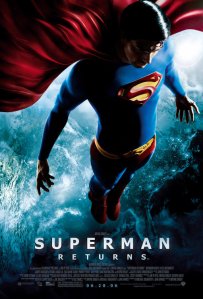 It’s been a total of 19 years since we saw Superman grace the silver screen in the mega-bomb Superman IV: The Quest for Peace. The big question is… did we miss him at all? I know a lot of people that say they just can?t get into Superman as a character. He’s always been a do-gooder, someone with infinite power but too great a sense of nobility to abuse it. Does the Man of Steel still hold relevancy in today’s more erratic, cynical, fearful world? Is it possible to make an indestructible alien relatable or empathetic? Director Bryan Singer is interested in finding out, and he brought nearly his whole X-Men 2 team with him. Instead of retooling the franchise Singer has adopted the idea of starting shortly after the events of 1980’s Superman II. (Yes, I know Richard Lester is credited with directing Superman II but it’s still contentious that Richard Donner, who helmed the first super outing, directed a majority of the sequel. From here on out, Donner will cited as the director of Superman and Superman II).
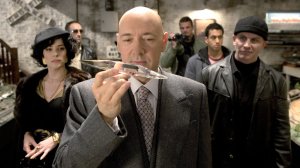
Superman (Brandon Routh) has been absent for five years trying to look for pieces of his home world, Krypton. Lex Luthor (Kevin Spacey) and his moll (a cheerfully batty Parker Posey) have got some big plans up their villainous sleeves. Using crystals from Superman’s home world, they plan on building a new continent of land to prosper with. He also has a nice supply of kryptonite to make his own fortress with. When Clark Kent does arrive back in town, coincidentally along the same time Superman rescues Lois Lane (Kate Bosworth) in a plane crash, he’s shaken by the changes that have taken place in his absence. Lois is engaged to Richard (James Marsden), nephew of The Daily Planet‘s editor in chief, Perry White (Frank Langella). She’s also won a Pulitzer Prize for her article, “Why the World Doesn’t Need Superman” (a kiss-off letter to a lover if ever there was one). To top it all off she also has a five-year-old son, which would put him within the realm of having a super dad (Lois and Supes took a roll in the hay at the Fortress of Solitude in Superman II). The Man of Steel has a lot on his plate, obviously.
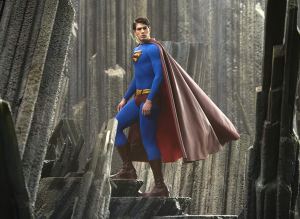 This is rumored to be the most expensive movie of all time, with budget predictions going as high as $260 million. If that?s true than Singer let’s you see every dollar onscreen. As a movie going experience, Superman Returns has little to no equals. The special effects are astounding and the imagery is simultaneously iconic and awe-inspiring. We now exist in a world where we can see a man in a red cape zoom through the sky and have it become believable. Singer, after two X-Men flicks, has a terrific eye for glistening visuals and boy does he know how to conduct Hollywood bombast with equal parts genuine character. His loss was considerably noticeable with X-Men 3, which wilts in direct comparison as unfair as it may be (it’s like the difference between a Van Gogh and a third grader’s imitation of a Van Gogh). The difference is that you can feel the respect the filmmakers had for superman; not so much with X-Men 3. But alas my countrymen, I come here to praise Superman not to bury X-Men 3. The sheer breathtaking visual artistry of Superman Returns demands to be seen on as big a screen as possible. Singer has crafted a wonderful tableau for the eyes and ears, filled with religious symbolism, opening the wonderful possibility of the movies just a little wider.
Singer’s film is a show-stopping pop spectacle, which is good, because the story itself, upon fresh perspective and distance, is good, but not great. The story doesn?t pursue character as strongly as last year?s fellow franchise reboot, Batman Begins, nor does it interlace themes as well. The characters in general are pained but left with little other expressions. Lex Luthor’s evil scheme is grand in cataclysmic scope but at the end of the day it’s still a real estate scam. It’s like if Donald Trump was human or less evil (he’s definitely got the same hair stylist as Luthor). How exactly is Luthor planning on keeping control of a new continent of land? I would think the world would have some way of establishing order. Once again a villain’s scheme is ruined by the less dastardly, more squeamish baddie in the entourage. In fact, the villains are on their own for a long while, embarking on their own tangential movie to play alongside the return of superman. The first hour is slower paced and the final climax could have used an additional boost, but these are quibbles. Superman Returns could have done a lot more with their characters, especially considering their take-off point is two films hence, but this movie is more about reassembling the pieces. To that end, Singer’s satisfying retread is forgivable for its shrift characterization.
 Do not let any misgivings about character and story betray how awesomely entertaining Superman Returns is when it turns on the magic. Even at a bladder-unfriendly 2 hours and 40 minutes in length, the film has little drag and a great sense of confidence of a crowd pleaser that knows how to play to an audience while respecting their intelligence. The movie is self-indulgent (how many slow-mo shots do we need of Superman in the air?) but it never falls short on thrills. Between plane crashes, bank robberies, sudden explosions, and spontaneous, cavernous land masses, you’ll likely be glued to your seat waiting for the outcome, which even with a nigh indestructible being isn’t always a given.
The action is grand in scale but Superman Returns also has the unmistakable stripes of a chick flick. Lois is jilted, moves on to a good man, and suddenly the man of her dreams, the one she thought was gone for good, reenters her life. The film’s sharpest plot point is the complication of its love triangle with Richard and a child in tow. The romantic yearning and interplay give the film its biggest emotional involvement. Even though the filmmakers are deliberately vague, the answer of who’s the father should be rather easy to deduce. Still, the audience has an increasing desire to know the paternal truth.
Singer’s louder, brighter Superman is a loving tribute to the Richard Donner Superman films, you know, before Richard Pryor, evil twins, and the rather rash, though very effective, decision of hurling the world’s supply of nuclear weapons into the sun (the less said about The Quest for Peace the better). It even exists in the same universe so we don’t have to go the origin tale route, though we do get flashbacks to Clark’s past. Marlon Brando’s original performance as Jor-El, father of Superman, is reused and John Williams’ theme gets a new polish. Even the opening title graphics, so horribly dated like a “cutting-edge” Atari game, are the same from the Donner era. There’s such reverence for nostalgia and a fondness for what makes Supes Superman, and that’s why it gets closer than even the Donner flicks, which are good but have weathered with age and can come across as too silly or cheesy.
Even Routh looks uncannily like Chistopher Reeve. Routh is an interesting choice; he’s chiseled, handsome, and questionably appealing. He comes across more like a being finding his place, like a kid fresh out of college, than a being of incalculable power protecting our blue planet. At any rate, Reeve played the comedy better, being both suave hero and clumsy earthling. I wish Superman Returns would go further exploring the perils and expectations of being Superman, a life devoted to servitude and always being an outsider. There’s a small scene where he orbits the Earth listening to 1000 overlapping voices crying for help before zeroing in on one. Otherwise, the movie doesn’t pay much notice to the burdens of Superman, which may unfortunately keep many at a distance.
 Bosworth is just too young for her role; she resembles Lois Lane’s baby sister, not the feisty Margot Kidder incarnation that left such an impression. This Lois Lane doesn’t so much bicker as she does harrumph. It’s like they took the role, dolled her up, muted her, and then told her to play Lois Lane as if she had stayed up all night binging on Sex and the City reruns. Bosworth is at the mercy of her character, a figure pressed into danger more than she is into emotion. There are some nice moments, like a midnight stroll through the atmosphere with her knight in blue tights. I just wish there were more.
But at least there’s two-time Oscar winner Spacey, who’s terrific as the infamous Lex Luthor. He’s got a funny quirkiness and a perfectly deadpan sarcasm. The opening that reveals how Luther earns back a sizeable fortune is hilarious and perfect to a T. Everyone else seems a bit dour but Spacey is having a ball; he’s even employed Kumar as part of his muscle (you’re a long way from White Castle, Kumar). However, Spacey’s spirited take is a lot more menacing than Gene Hackman’s version, which always came across as an oily used car salesman, more huckster than arch villain/evil genius. Spacey has a really strong disdain for the Man of Steel and his eyes sparkle at the opportunity to get vicious. I’m all for a darker, angrier, down-and-dirty villain to better torment Superman. Not to be out done, used car salesmen have their moments of intimidation.
The story may be good, not great, but Superman Returns is a first-rate cinematic spectacle. Singer and his X-Men 2 team have crafted a nostalgic, reverent movie that smartly addresses whether today’s world has outgrown a big blue Boy Scout. The action sequences and special effects are astounding, and, for the first time in a Superman movie, they are wholly believable. This helps when the main guy wears his underwear on the outside and shoots lasers from his bullet-proof eyeballs. The film stalls when it comes to characterization and the interplay of strong unified themes, but much is forgivable because Singer has worked his ass off getting a storied franchise back on its feet with dignity.
After three super hero films in a row, each with an escalating budget and running time, I’d say the man needs a break, perhaps a tiny independent movie to rejuvenate the batteries. But after watching Superman Returns, what I really want is for Singer to get right back to work as fast as possible. We’ve got this world back in order. Now it’s time for Superman to truly take flight.
Nate’s Grade: B+
Share this:

Alone in the Dark (2005)

Edward Camby (Christian Slater) is a paranormal investigator trying to rediscover what happened in his past. He was apart of 20 orphans taken by Fischer (Frank C. Turner), your basic mad scientist type. Camby was the only child to escape Fischer’s poking and prodding. The other orphans have become sleeper agents/zombies to assist him in opening a dimensional gate to another world, a world with bloodthirsty creatures that live in darkness. This world and its creatures were first discovered by an ancient Native American tribe who mysteriously vanished. But before doing so, they thoughtfully broke the dimensional key and hid the pieces all over North America. Aline Cedrac (Tara Reid) is a scientist/archeologist that specializes in this Native American tribe and its artifacts. She teams up with her old flame, Camby, to help stop the mad doctor. Monitoring the whole situation is Commander Burke (Stephen Dorff), the man in charge of the United States government’s bureau of the paranormal. He leads his no-nonsense super troopers to the location of the dimensional gateway, which just happens to be underneath Camby’s childhood orphanage.
Alone in the Dark is a good film for people that felt House of the Dead was too intellectual. It should be obvious after reading the plot synopsis, but Alone in the Dark is a movie of unparalleled stupidity. What was the point of making orphans sleeper agents/zombies? They’re very easily disposed of and not very effective. I don’t know whether or not this is because they didn’t have a mom and dad growing up. What does this mad doctor hope to achieve by opening the door to creepy crawly monsters? I guess he thinks the monsters will be grateful and give him some kind of bureaucratic job, instead of, you know, gutting him and drinking his blood. I’ll never understand why villains align themselves with creatures whose only purpose is killing. How does Camby end up having a childhood flashback from a perspective that isn’t his own? The plot of Alone in the Dark is a gigantic mess. What other film in recent memory fits together ancient Native American tribes, monsters from an alternate dimension, government agencies, orphanages, zombies, and Tara Reid? You know you’re in bad hands when they open the film with a ten paragraph scrawl to explain what the film, by itself, cannot. And then they add narration because they don’t trust their audience to read.
 The film is called Alone in the Dark and tells us that killer creatures lurk where we cannot see them. This is a fine platform to engineer some good scares; really stir the audience into fearing what they cannot see. As always, nothing will be scarier than a person’s mind at work. Boll doesn’t agree. He doesn’t even toy with the idea of hiding his creatures and building tension gradually. Boll prefers to show you his monsters immediately and often, therefore eliminating any attempts at suspense. Now the characters aren’t running away from what they can’t see; they’re running away from lame CGI rat/alligator creatures. The monsters look laughable and should have stayed in the shadows for as long as possible. It’s hard to spook an audience once they see what they’re supposed to be afraid of. Boll’s impatience for suspense and his love of cheesy special effects cripple Alone in the Dark.
Alone in the Dark has no pulse when it comes to action. Boll stages his action sequences like different stations on a gameshow. Characters (contestants) run from station to station, picking up weapons and shooting at whatever, and then advancing to another stage with a different weapon. Much of the action just comes out of nowhere and ends in its own confused way. Boll likes to season his poorly choreographed action sequences by cranking up loud rock music and mixing in excessive, gimmicky special effects. For no reason, Camby and Aline and the soldiers will be shooting and Boll just all of sudden decides this scene should be in a strobe light. Or he’ll shove in a cheap slow-mo follow-the-bullet effect. Boll likes testing out different effects that serve little purpose other than to call attention to itself. Boll has confused this with style.
Speaking of action coming out of nowhere, Boll manages to squeeze in an out-of-the-blue sex scene. Aline visits Camby in the morning, sees him sleeping, and decides on the spot to crawl into bed and have sex with him. Reid and Slater have no chemistry whatsoever. It’s like watching water buffalos go at it. Then the sex is never referred to again. This is just another pristine example of how carelessly Uwe Boll handles plot and characters. Rarely does Boll even bother with a transition scene to explain how a character got from Point A to Point B.
Boll’s direction is lazy and derivative. There are scenes that openly ape superior movies, like Alien, Raiders of the Lost Ark, Starship Troopers, and even Boll’s own House of the Dead for crissakes. The plot is a cut-and-paste job of the series finale of TV’s Buffy the Vampire Slayer. Both deal with an army of creatures living under an everyday school building and involve a special key to unlock the gateway. And like in Buffy, some noble individual sacrifices himself to destroy the gateway’s underground entrance. No, scratch that. The plot itself is virtually a copy of Super Mario Brothers, the first video game based movie. Both films involve some magical key needed to unlock two alternate dimensions of creatures. No, scratch that. This is one big rip-off of Darkness Falls, since both involve crazy creatures that can only attack from the dark. Whatever it is, Alone in the Dark is Boll’s opportunity to showcase his un-originality. That is, if you can pry him away from inserting more pointless slow-mo bullet effects.
 The acting is wildly all over the map. I wonder if Boll will ever be able to direct actors. The line delivery is terrible all around. Slater is subdued and permanently cranky. Maybe somewhere inside that Jack Nicholson grin he’s realized he’s slumming it. Reid acts like an irritable child. Dorff seems to be the only actor having any fun, though I don’t know how intimidating this diminutive actor comes across as a military man. The actors of Alone in the Dark confuse loud with emotional.
Let’s take some time out to spotlight Reid and her character. The way Alone in the Dark convinces us that Reid is a scientist is by giving her some black rimmed glasses and putting her hair in a pony tail. It’s just that easy, folks. Apparently being a scientist didn’t help Reid with her geography; she pronounces Newfoundland “New-FOUND-land” (the correct pronunciation is “New-fin-lan”).
The dialogue reeks of poorly concealed exposition. A chatty security guard serves as the writer’s sloppy conduit to establish back story: “You don’t know about the Indians? Let me explain,” “You don’t know who Aline Cedrac is? Let me explain,” “How’s your boooooyfriend, Aline Cedrac?” Alone in the Dark relies on gobs of thick exposition to cover up its insurmountable plot holes. The movie thinks it’s like a cool detective noir. It’s not. You never heard Sam Spade say, “Fear is what protects you from the things you don’t believe in.” Huh? Does that make any sense?
Alone in the Dark is symptomatic of all of Boll’s directorial flaws. He has no feel for tone, he has no control over actors, he makes bad stylistic decisions that detract from the film, and he has no time for subtlety. Boll spoils all of his surprise by showing the monsters up and front instead of letting the human mind fill in the blanks for terror. This is a brain-dead action film that doesn’t even trust its audience to read. Alone in the Dark is a film so incompetent, so ridiculous, so convoluted, and so moronic that it must bend the laws of space and time simply to exist. This makes House of the Dead look well thought out. If this is indicative of what Boll has in store for his video game adaptations, then you can expect many duds yet to come on Boll’s path to eventual audience oblivion. If anyone dared venture to a theater to see this movie, they’d find themselves alone in the dark all right. And shamed. Deeply, deeply shamed.
Nate’s Grade: F
Share this:

House of the Dead (2003)
 House of the Dead is Uwe Boll’s first foray into the video game-to-movie niche he’s carved himself. It’s based on a first-person-shooter by Sega that lets players blast their way through a haunted house and its undead tenants. There’s not much to the game. In interviews Boll has remarked at how he hated the film’s jokey script and rewrote much of it on the fly, trapping the film between the genres of horror and action. In the DVD jacket, executive producer/co-writer Mark A. Altman says, “House of the Dead is no Citizen Kane.” This may be the understatement of the millennium, comparable only to Napoleon saying Russia might be a tad cold.
Matt (Steve Byers), Greg (Will Sanderson), Simon (Tyron Leitso) are meeting with fellow college students Alicia (Ona Grauer), Karma (Enuka Okuma), and Cynthia (Sonya Salomaa). They’re ready to party at the rave of the century. This rave of raves takes place on the ominously named Isle del Muerte (The Island of the Dead). I suppose this proves that no one on the rave planning board speaks Spanish. The kids eventually hitch a ride to the island from Captain Kirk (Jurgen Prochnow) and his first mate (Clint Howard). Hot on Kirk’s heels is Casper (Ellie Kornell), a border agent after Kirk for gunrunning. Once they arrive at the island, the kids are shocked to find the rave site vacated, destroyed, and swarming with zombies. Everyone makes a run for it and regroups with some of the rave’s survivors, led by Rudy (Jonathon Cherry). The groups team up, armed by Kirk, and set out to shoot their way home. But there’s also a very evil figure roaming about that has more sinister plans for the island’s fresh meat.
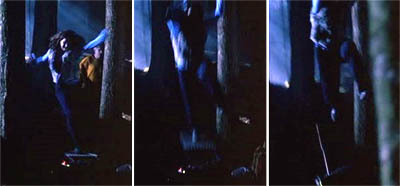 House of the Dead isn’t a horror movie at all. Boll has no idea how to stage scenes with tension. He has no feel for mood or atmosphere, which are the foundations of a good horror flick. So instead, House of the Dead is a riotously dumb action movie. But under Boll’s direction, it’s not even good at that. The action is repetitious and pedestrian. Boll’s big melee sequence becomes boring because it doesn’t progress. There’s just ten minutes of wall-to-wall shooting zombies, but there isn’t any order to it, no rhyme or reason. If you want a perfect example of Boll’s inept staging, skim to 47:20 into the DVD and watch. You’ll see a zombie leap onto a jumping platform and launch himself into the air. House of the Dead actually has scenes where we see exposed jumping pads and landing mats.
Boll gets drunk on special effects very easily. He loves the bullet time effect and throws it in at odd points. Every single character gets a tiresome slow-mo camera spin as they fire a gun. After the ninth and tenth time, the thing gets old. The characters don’t even have the same weapons in the shots before the slow-mo jazz. Boll doesn’t use flashy effects to benefit his narrative, unlike The Matrix. Boll actually thinks using clips from the actual video game is a good device to transition between scenes. There will be moments where screen shots of the game just pop up. Boll is a kid with toys and no clue when to put them back into the box.
This movie’s silliness is jaw dropping. The so-called rave of the century seems to be poorly attended, and the better for it since it takes place on the Island of the Dead (Isle del Muerte). Is that really the best place to host a social gathering? Perhaps everyone gets what they deserve for being stupid. Kirk, after shooting several zombies, limply remarks, “Now I know why they call this the Island of the Dead.” The line should be accompanied by a rim shot. The movie doesn’t even live up to the lofty ambitions of its title.
 By far the most ludicrous story element is the film’s villain, Castillo (David Palffy). It seems that before he stalked the island in a hooded cloak, looking like Robert DeNiro in Mary Shelley’s Frankenstein, he was a Spanish pirate/doctor. He tried to experiment on living tissue in order to unlock the secret of how to be immortal. He was imprisoned on a Spanish ship and was shipwrecked on the Island of the Dead (what are the odds?). He’s concocted a special Kool-Aid that will bring the dead back to life, though I don’t know why he’s still stuck on an island if he can’t drown. I guess he’s been biding his time and waiting for stupid college students so he can see some T&A.
The characters are made up of people interested in attending a rave, but when the action hits they’re all instantly adept at weaponry and kung-fu. That’s not the typical raver I know, and these people must be super ravers if they’re going to the rave of the century. Simon is described as “the biggest underwear model in America,” and for all I know underwear models encounter a lot of gunfire on the runway. The DVD jacket has character profiles where it lists their name, age, weapon of choice, and skill. After having watched House of the Dead, the skills are laughable at best. Simon the runway model’s skill is “tactical planning.” I also seriously question Rudy’s “leadership” skills since he gets everyone killed.
Of course everyone in the movie is profoundly stupid. While trapped in the island’s only house, Rudy says the kegs of gunpowder are useless without a charge, and then he walks past a series of lit candles. The whole house upon arrival is filled with lit candles (who has the time for that, by the way?). Alicia is convinced that the rave site being deserted, destroyed, and zombie-infested is all a practical joke, as if Ashton Kutcher is just around a tree poised to yell, “You suckas just got punk’d!” There are numerous moments where a character will wander into the dark and say, “[Insert name], is that you?” Kirk takes the last stick of dynamite and plans to sacrifice himself by blowing up some zombies good. He lights the stick, wanders outside their barricaded stronghold, and blows himself sky high. What Kirk failed to do was move far enough from the house, because he also blows the front door wide open and the zombies filter inside.
The acting doesn’t even rise to the level of camp. The actors feel unrestrained and marooned, typical of a Uwe Boll film. The man has no feel for actors and this explains why his films have some of the worst line readings I’ve ever heard (2000’s Dungeons and Dragons is still the worst). Casper acts like a crabby fitness instructor. The dialogue is bad as is, but when added with the poor line readings it turns every spoken sentence into something of unintentional hilarity. Take this nugget from Simon: “We got to the boat but it wasn’t there.” Well, then did you actually get to it?
House of the Dead can be enjoyed for the depths it plumbs. The dialogue is cheesy and leaden. The movie is bad enough that if you have some friends over, drink steadily, you’ll have a blast laughing and hurling popcorn at the screen. The movie does have a decent amount of blood and gore and the make-up effects are good but limited. You can enjoy House of the Dead in a fun derisive way, and it’s hard to argue with the price some retailers charge (I bought it on Amazon.com for 75 cents plus shipping). The DVD commentary is also good for a laugh, that is, if Boll’s self-flagellating remarks are serious. At one point he compares his zombie action movie to Schindler’s List. Boll also marvels at an actor’s ability to carry objects and make them seem heavy. I’m not sure if Boll is serious or just making fun of the movie like everyone else.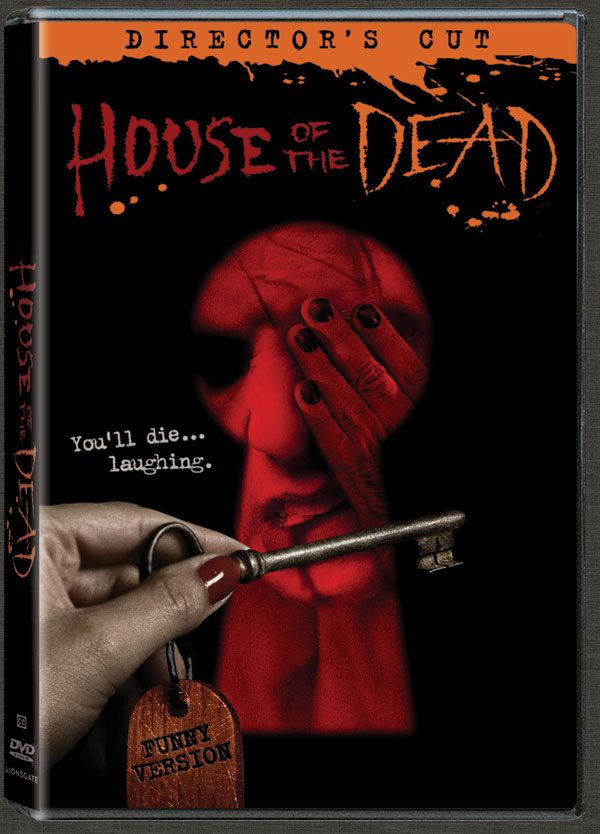
House of the Dead is a dull action movie within the framework of a horror flick. The characters are powerfully stupid, the action is redundant, the effects are chintzy and overused, and the direction is lackluster. Boll has added little in transitioning a game about poppin’ zombies onto the silver screen. The video game is flimsy and the movie based upon it manages to be even flimsier. House of the Dead is incredibly dumb entertainment and the fact that a sequel is well underway cannot be a good sign for human existence. I never thought I’d utter these words but . . . Clint Howard, you’re too good for this.
Nate’s Grade: D
Note: Boll re-released a recut House of the Dead as a comedy. I haven’t seen “the funny version” but I can’t imagine that it could possibly be any funnier than the original.
Share this:

X-Men: The Last Stand (2006)
 The story behind the making of X-Men: The Last Stand is more interesting than most. Bryan Singer had directed the first two X-Men films and had done a fine job establishing many loveable characters and the universe that housed them. Warner Brothers has been trying to get their Superman franchise flying for so long, going all the way back to 1996 when Kevin Smith wrote the script, Tim Burton was to direct, and Nicolas Cage was going to be the man in tights. Since then directors and drafts of screenplays have come and gone, including Brett Ratner, best known for directing both Rush Hour movies and a slate of mostly mediocre movies. Then Warner Brothers poached most of the X-Men 2 team to make Superman Returns, hiring Bryan Singer as director, plus X2‘s screenwriters, cinematographer, editor/composer, and maybe even the cat that licked Wolverine’s claws. Fox was left without a captain for X-Men 3. They daringly picked Matthew Vaughn (Layer Cake) but then he dropped out for family reasons. Then Fox went with their second choice … Brett Ratner. Both directors had essentially switched projects. Hollywood’s funny like that.
It’s been a few months since the events in X-Men 2. Scott “Cyclops” Summers (James Marsden) is still mourning the loss of his love, Jean Grey (Famke Jannsen), who sacrificed herself to save the rest of the X-Men. He’s tormented by her voice, whispering all around him and pleading with him to return to Alkali Lake, the site of her death. Miraculously, Jean returns from the dead but she’s much different. Her persona has broken and the Phoenix has taken over, a destructive killing force unparalleled on earth.
Magneto (Ian McKellen) has great use for such a force. There’s been news of a new drug that suppresses the gene that causes people to be born as mutants. This discovery has been dubbed a cure. The question persists, is should being different be curable and what would that even mean? Magneto sees the writing on the wall, knowing that any cure would only be voluntary for so long. He collects new mutant fighters along with his stalwarts the shape-shifting Mystique (Rebecca Romijn) and fire starter Pyro (Aaron Stanford), a former student at Xavier’s School for the Gifted.
 Over at Professor X’s (Patrick Stewart) school, the mutant students are each questioning life with a cure. Rogue (Anna Paquin) is considering it so she can finally touch her boyfriend, Bobby “Ice Man” Drake (Shawn Ashmore) without killing him. Plus, so he’ll stop spending so much time with Kitty “Shadowcat” Pryde (Ellen Page), a girl who can walk through matter. Storm (Halle Berry) and Wolverine (Hugh Jackman) are left to run the team after some disastrous setbacks. Henry “Beast” McCoy (Kelsey Grammer) is a man covered in blue fur and appointed as head of Mutant Relations for the president. He senses the growing danger and anxiety the administration has with mutants and joins the X-Men to do what he feels is right.
It feels like that in a rush to production that character development, subtlety, and subtext were chucked out the window to make time for more boom-boom action. The first two X-Men flicks juggled the characters and introductions but still managed to squeeze in one great moment for the characters we cared about. The plot moved at a mature pace, insightful and touching on elements of psychology, politics, and personal struggles to fit into a society that fears you. There was some sophisticated, relevant stuff bandied about this franchise in between the kick-ass action. But with X-Men 3, you basically have Halle Berry doing less with more. She’s got more screen time, in part to her demands, and now she can use that extra time onscreen to show us how perfectly bland her character is as the film’s most laughable moral ideologue. The idea of a cure for the mutant gene is vastly interesting with all kinds of great avenues for character introspection and socio-political debate. But X-Men 3 renders all of its debate to be merely superficial, another in a series of plot points to get the action moving quicker.
The X-Men franchise was already overpopulated with lots of characters vying for screen time, so I don’t understand the decision to add even more characters to the ensemble and cut down the running time to a brisk 100 minutes. As a result, certain characters sit out for long stretches of the film, are inactive during key moments, some are mostly forgotten, or some meet unjustifiably hasty ends. If I was still an ardent comic book fan, and a follower of the X-Men, I might view the third film as heresy. Why even bother bringing the character of Angel into the movie if he’s just going to be on for two minutes, including a forehead-smacking deus ex machine moment? The Dark Phoenix storyline is the most pivotal storyline in the comic’s history, so why even bother dragging it into X-Men 3 if it’s just going to be Zombie Jean Grey? It feels like Ratner is off screen with a pole poking Janssen whenever the story needs her to wake up and stir up some stuff.
 I hope comic fans enjoy the brief glimpses of some of their favorites, because X-Men 3 does a good job of throwing characters into a meat grinder. I had to check online to just to find out who they were, and even then my realization was followed by, “Her? Him? What?” And what the hell is up with Porcupine Face? That has got to be the worst mutant ability of all time. What’s he going to do to his enemies? “Hey, will you come a little closer. I have a secret to tell you. Closer … closer … closer still … that’s right, now please lean against my face.”
The movie trades character for action, so is the action even good? Ratner is a workmanlike director devoid of any personal style, which further brands X-Men 3 as ordinary. The action sequences aren’t anything extraordinary, there just happens to be more of them. The climax pits mutant against mutant in short-lived bursts. A battle between Ice Man and Pyro should be awesome, but Ratner stages the showdown like he was choreographing his neighbor’s kids. This battle lasts a whopping 45 seconds. The climactic end battle, the “war to end all wars,” is rather sloppy. Ratner keeps cutting back and forth between his pairing of Good mutant vs. Evil mutant (why do the two black girls seem forced to fight each other?), but his showdowns are all too quick to quicken the pulse. Wolverine’s brawls in the woods never rise up to the adrenaline-soaked fights in X-Men 2. The special effects and make-up are just as good; they’re just not being put to as good a use. If Ratner is going to dump character for action he has to make his action exceptional. The movie feels on autopilot.
Ratner is not fully to blame for the shortcomings of X-Men 3. Screenwriters Simon Kinberg and Zack Penn (Elektra) have crafted an overly rushed story that is more tailored for getting the job done than telling a good story. They present some big ideas and interesting elements, like a love triangle between Rogue-Ice Man-Shadowcat, but then most of the promise is either skipped over or dropped. They’re trying to juggle too many balls at once, and it just makes me miss Singer and the X2 screenwriters and how effective they were in defining character even in the smallest of moments. Some of the X-Men 3 dialogue is awfully stilted, like “You of all people know how fast the weather can change” and “Sometimes when you cage the beast, the beast gets angry.” There’s also a silly subplot about Storm teaching Wolverine what it means to be responsible. Try and count how many times you roll your eyes with that one. How many times are they going to have the president look blankly at a TV screen and gasp, “My god”? There’s some clever use of mutant powers during battles (mostly involving Shadowcat) but there’s just as many routine moments as well.
 The acting is all over the map. Jackman owns his role as Wolverine. McKellen and Stewart bring a needed dose of grandeur to the proceedings. The X-kids are enjoyable, and Ellen Page (knocking ’em dead in Hard Candy) makes a very nice addition to the fold. I’ve likely enjoyed Paquin the most in this series, next to Jackman of course, so it’s so frustrating that she just plays Jealous Girlfriend at Window. I think it’s criminal how little she’s examined in the movie, especially since the supposed cure has the most questions and ramifications for her. Grammer is essentially Frasier in blue fur, but that’s essentially what Beast is so it works. He has a very nice moment when he sees what life would be like minus his mutant likeness. It’s really hard to judge most of the performances because of how short they appear in the movie.
X-Men: The Last Stand is far from boring but it’s more serviceable than special, and lacks the maturity and imagination that its previous films held. This was a franchise full of limitless potential, so to see it drop to something ordinary is sad, especially if this is the rumored end of the franchise (a record opening gross over Memorial weekend says otherwise). This franchise feels dumbed down; yes it’s still entertaining on a mass market level but it doesn’t have the creativity and precision that Singer’s movies had. X-Men 3 is fast-paced and not without its great geek moments, but it’s also the least emotionally involving of the films. When the deaths and departures come you’ll probably shrug your shoulders because of how the film presents them. X-Men 3 is fine, but I expect better from this franchise.
Nate’s Grade: C+


You must be logged in to post a comment.