Blog Archives
Poseidon (2006)
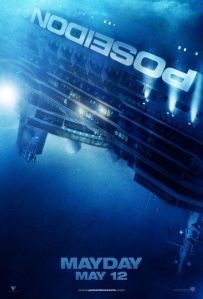 The Poseidon production design is rather fantastic and director Wolfgang Peterson (Troy) has a real handle on large-scale carnage, but Poseidon is a stripped down action flick that lacks the suspense and emotional involvement to bring strength to its attempts at harrowing survival. Some sequences, only some, are nail-biting, like a very claustrophobic escape through an air vent slowly filling with water. We’re presented a situation and then Peterson cranks up the tension and utilizes different characters working together. The sequence has the added benefit of utilizing the child to save them, unlike most films of this nature where irritating kids just become a liability to your own safety. The fact that this sequence, the film’s high point in my view, is also the least expensive of this $160 million dollar movie’s sequences is not lost on me. The film’s premise of working through the bowels of an underwater ship is filled with potential. The original Poseidon Adventure was cheesy, yes, but it was a lot of fun. This slick remake brings the action fairly early, having its “rouge wave” flip the ship at the 15-minute mark. Because of this decision the audience has no attachment to the film’s collection of characters, given fleeting seconds to establish some sense of personality. You really don’t care at all what happens to these people in the ensuing danger. The female characters add nothing to the story except to fall into the constant need of being rescued. Peterson paces his obstacles mercilessly right after the other, but he runs into the problem of killing off all his expendable (read: non-white) cast off too quickly. That lessens even the small amount of tension the film had going. Poseidon is way too big-budget and serious to go for camp. The special effects are above average and the pacing is swift. Frankly, you could do worse this summer for entertainment than spending 100 minutes watching this movie.
Nate’s Grade: C+
Share this:

Mission: Impossible III (2006)
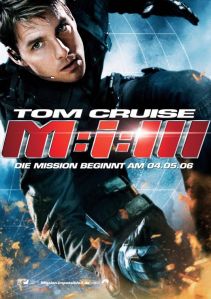 Few celebrities have had the intense flame-out Tom Cruise has experienced in a little over a year’s time. First there was the PDA-heavy relationship with Katie Holmes, never a wet tongue-kiss away from a camera. Then there was the couch aerobics on Oprah Winfrey’s set, bleating his over-the-top declarations of love like Roger Rabbit. This was followed by a series of testy interviews about his war of words on psychiatry and prescription drugs. Entertainment Weekly just ran a cover story asking, “Is Tom Cruise worth his paycheck?” He’s gone from Hollywood’s most bankable actor to a national punch line. To bring new life to Cruise’s spy series, he tapped TV mastermind J.J. Abrams to make his feature debut after Cruise churned through two seasons of spy series Alias DVDs. Abrams is a gifted franchise starter, first with Alias and then with Lost, and with Mission: Impossible III he does the best he can to erase the memory of Tom Cruise, daredevil of furniture.
Ethan Hunt (Cruise) is out of field work at the Impossible Mission Force, training recruits for the big time. He’s settled into a comfortable home life with Julia (Michelle Monaghan), a woman he’s blissfully engaged to be wed. Ethan’s happy home is disrupted when IMF needs his services. It seems one of his trainees (Keri Russell, Felicity goes badass) has been captured by an arms middleman Owen Davian (Phillip Seymour Hoffman), a man that will get any deadly force to the right bidder. Hunt reluctantly goes back into the field, assembling a team that includes Luther (Ving Rhames), Zhen (Maggie Q, quite fetching), and pilot Declan (Jonathan Rhys Meyers). Their mission goes badly and Hunt is reprimanded for his cavalier actions. He’s determined to snag Owen and get justice. This leads to an incredibly stuffed game of cat-and-mouse, each jockeying for leverage. There’s some super powerful device called the “rabbit’s foot” that everyone wants but it’s not really important. What is important is that Owen is eager to strike back at Ethan’s most vulnerable point — harming Julia.
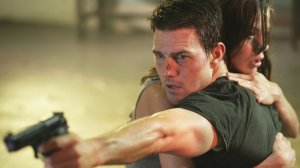 This movie is quite possibly one of the greatest TV adaptations of all time. No, not the Mission: Impossible series but Alias. Just like J.J. Abrams’ TV brainchild, this slick, propulsive caper puts a smart spin on familiar ground. We’ve got the flash-forward narrative trickery, the super gadgets, the undercover teamwork, the world-trotting sprawling vistas, and anchoring the whole thing with an emotional counterpoint, trying to lead a double, “normal” life and keeping your loved ones equally safe and in the dark. There’s a great scene in the middle of a mission where Ethan and Luther casually discuss the impossibilities of living a normal life given what they do. Luther warns that those close to you will only end up getting hurt, and by this point thanks to a startling, right-to-the-point opener with a gun to sweet Julia’s head, we know he’s right. That’s what makes the third go-round different: Abrams has injected some emotion into the darn thing. Ethan is pressed back into service and then becomes something of a knight in shining Kevlar, trying to save his beloved in the crossfire of international espionage. There are a handful of scenes between Cruise and Monaghan and they sell the emotional drama in tender quiet looks. As a result, the audience and Ethan are rooted to their seats beyond just the assembly line of pyrotechnics. Just like Alias (at least up until Season 3 when it jumped the shark with the long-lost sister). It’s like if True Lies was played straight and Tom Arnold was mercifully forgotten.
Ah, but what pyrotechnics they are. Things get heated with a trip to the Vatican and they literally do not let up, all the while raising the stakes by pulling Ethan’s home life closer to the danger of his job. You’ll be left breathless absorbing all the exhilarating action sequences, which to my best estimate are more than the first two flicks combined. The stunts are superbly death-defying. What makes action sequences so enjoyable, pay attention you Hollywood rubes, is when the stage is set and then we watch organic complications. Abrams has a tremendous feel for action and playfully extends virtuoso sequences of awesome carnage. An attack on a bridge is simply outstanding and gave me an overload of geeky joy. We’re given the tight, controlled setting, and then Abrams introduces the outside conflict and keeps developing it masterfully step by step. There’s air attacks, there’s running back and forth amongst the wreckage, there’s searching for guns while escaping attack, and then there’s flying leaps over gaping concrete holes. I was jumping in my seat with boyish glee. The slow-mo gun toss between Cruise and Russell? Awesome. The swing-shot jump off a gigantic skyscraper in Shanghai? Awesome. The use of Simon Pegg (Shaun of the Dead) as gadget guru? Awesome. Mission: Impossible III is, if nothing else, an incredible adrenaline rush orchestrated by a man with a finger directly on the pulse of his audience. By summer popcorn standards, Mission: Impossible III is everything you could hope for. Sure it’s highly implausible but it’s just so damn fun.
 Abrams has created quite a breakthrough for himself. Long regarded as a TV visionary for his tangled, engrossing pop-pulp like Alias and Lost, Abrams shows what he can do with a bazillion dollars and one of the world’s most recognized stars. Abrams intelligent, deft handling of his material, elevating tired genre devices with flash and reverence, reminds me of a young Steven Spielberg. This is a man that respects his material and respects his audience, but still knows how to bring home an entertaining movie. I’ve followed Abrams’ career since getting hooked on Alias in 2001, and I’m confident he will become the best friend a movie geek could ever have (Star Trek fans should be clicking their heels about Abrams’ rumored involvement). Even though Mission: Impossible III is Abrams’ film debut (and on record the most expensive ever for a first time film director) he already shows more command, more wit, and more hipness than most of Hollywood’s graying old guard.
Finally, this is the first Mission: Impossible film to utilize the team aspect of the TV show. Granted, Cruise still does most of the running, jumping, climbing trees, but thankfully this movie is more than the Tom Cruise Kicks Everyone in the Face Show a.k.a Mission: Impossible II. The supporting cast all have their one great moment and part of the fun is their interaction, seeing the pieces fit into place. Just like last summer’s Batman Begins I would like to see another movie immediately with everyone involved. Make it happen. This is the Mission: Impossible world I want to explore in greater detail.
Mission: Impossible III is not bulletproof. The movie seriously needed more time for its villain. Hoffman does a great job of bringing his bad man to grumpy life. He goes about business with a detached nonchalance, like a plumber fixing his 10,000th clog. It may sound silly but it works because Hoffman gives his character a lizardy, unscrupulous sense of ethics. He really will put a bullet between the eyes of anyone, possibly while reheating some food in his microwave. That’s the greatness of Hoffman’s villain, how ordinary he sees his line of work and what it calls him to do. Now, with such a terrific villain it would behoove Mission: Impossible III to give him plenty of screen time. Sadly, Hoffman has about three real scenes, and his end is anticlimactic and so is the film as a whole. And what does IMF have to do to curb moles? There’s been one in all three Mission: Impossible movies. Maybe they should offer better vacation plans.
Tom Cruise may have done a lot to wear out his welcome with the public but he knows to surround himself with good people. The decision to let J.J. Abrams helm Mission: Impossible III has finally given this franchise vision and sustained excitement. This movie is far more emotionally based than any other in the series and there’s a genuine emotional reason for all the fireworks this time. The team aspect is finally addressed and Hoffman makes a truly lecherous, scary villain. But the bread and butter of this flick are its breathless action sequences, brilliantly choreographed by Abrams, a name destined for even greater things. Abrams knows how to spin genre clichés into clever, loose, twisty, funny, thrilling, emotionally centered gold. I don’t care if Cruise abused a couch and the public’s good will; Mission: Impossible III is an extravagant popcorn movie and a great way to start the summer. If only they were all like this.
Nate’s Grade: B+
Share this:

V for Vendetta (2006)
 Legendary comics author Alan Moore has a particular disdain for Hollywood adaptations. They just haven’t gone so well for this scribble scribe. There was 2001’s From Hell (I may be the only one in the world that actually likes it, Heather Graham’s atrocious cockney accent aside) and 2003’s The League of Extraordinary Gentleman. Moore is even responsible for the creation of the John Constantine character, who had his own 2005 big screen venture. I suppose you could see why he has certain contempt for the movie versions of his much-heralded stories. Now comes V for Vendetta, based on Moore’s 1988 comic and adapted into a screenplay by the Wachoswki brothers. While I may have no idea how close V for Vendetta is to Moore’s graphic novel, I can say that the movie is a smart, superb thriller that dares you to think while you?re stuffing popcorn into your mouth.
“Remember, remember, the fifth of November, gunpowder treason and plot. I see no reason why the gunpowder treason should ever be forgot”
In the future, America has lost its super power status after overextending itself in war. Britain has turned into a hostile totalitarian government, led by chancellor Sutler (John Hurt). Evey (Natalie Portman) works for the state-controlled TV station. One night, while walking out past curfew, Evey is attacked by some undercover cops looking for a good time. A mysterious masked man named V (Hugo Weaving) comes to her rescue. His grinning, bearded mask resembles Guy Fawkes, a revolutionary that tried to blow up the British Parliament 400 years ago on November 5th. V starts taking out high profile government figures and then infiltrates the government airwaves, asking others to rise up against the corruption they see around them. He promises to blow up parliament one year to the day of this message. Finch (Stephen Rea, so expressive with his hangdog demeanor) is assigned to find out who this V is and how to deal with him. In reality, Finch discovers a lot more troubling information about his own government. Evey is linked with V and tracked down for interrogation and potential execution. As the date approaches, Evey must battle her own loyalties and strike out against what she feels is right and just.
 What makes V for Vendetta so exciting is its playground of ideas. This is a dynamically intelligent, complex movie but it never lets the smarts get in the way of a rousing good time. This is a very political movie that’s very relevant today, like the exchange of freedom for security and the use of fear mongering to serve an agenda. I love that the government’s leaders were a rogue?s gallery of corruptible figures; the Bill O’Riley-like TV pundit blowhard, the church leader who just happens to be a pedophile, the scientist whose good intentions justify the worst in human experimentation. V for Vendetta is a thinking man?s comic book movie, one that actually has actual respect for its audience and refuses to dumb down its message. The movie starts at a gallop and never lets up intellectually, and that’s so wonderfully refreshing from a film of any stripes. While I would not classify myself in the camp that views V for Vendetta as an anti-Bush administration screed, I’d have to say the movie does stir people out of a sense of apathy. I was even moved by the film’s hopeful conclusion, which is more than I can say about any other comic book movie (yes, even Elektra).
Director James McTeigue has previously served as the Wachoswki brothers’ assistant director. V for Vendetta is his debut as a director and what an auspicious debut it is. The movie is visually lush thanks to Aliens cinematographer Adrian Biddle (sadly, he died December 2005), but the smartest notion McTeigue accomplishes is putting story above special effects (ahem, George Lucas?). The command McTeigue has as a first-time director is impressive; how many people would be this restrained with all the fancy tools Hollywood has to offer? It’s his restraint and priorities that allow V for Vendetta to excel. And when the film does call for action, McTeigue judiciously uses visual trickery to enhance the scene. A late scene involving slow-mo V taking out a cadre of soldiers while they reload is amazing both in its “hey, look at this!” visual acuity and that it fits perfectly within the narrative. Nothing is self-consciously showy for the sake of wowing an audience, and every beat of action feels organic to the storyline. V for Vendetta is a terrific debut with some great set pieces.
Weaving is awesome as our hero. Since at no point does V ever take off his mask, it wouldn’t have been unheard of to simply hire a stunt guy to play the part and dub Weaving’s voice in later. But no, Weaving decided to be the part and adds so much to the character. He knows when to turn his head, nod, lean to a side, just like a silent film star interpreting the moment through action; it sounds ridiculous but it definitely helps paint a clearer picture of V. Then there’s Weaving’s incredible voice, making V sound like the world’s craziest, coolest Shakespearean lit professor.
Portman has finally made me appreciate her as an actress. She had a long winter between 1994’s The Professional and her 2004 one-two punch of Garden State and Closer, but I now finally see that Portman is a fine actress and not just a promising talent. She’s the heart of the film, the focal point for the audience to journey along, and she’s excellent at every point. I also give her props for having her head shaved on camera (I can only imagine what the eventual porn version will do with this scene).
 I’m left in the cold by this over inflated discussion on how “daring” V for Vendetta is by having the hero of a major Hollywood movie be a terrorist, one that says things like, “Violence can be used for good,” and, “Sometimes blowing up buildings can change the world.” Yeah, sure, but it’s a well-mannered, well-read, cultured terrorist versus a giant evil totalitarian government that kidnaps people, strips them of their rights, and enforces cruelty and prejudice. So exactly how daring is that? Of course audience sympathy is going to fall to the little guy, in this case a terrorist, which is the only hope of shaking things up and righting wrongs in the system. That doesn’t exactly strike me as subversive. This movie isn’t promoting terrorism any more than Munich was when Spielberg allowed the Palestinians to have a voice. The movie is anti-oppression if anything.
My only complaints are minor. The movie gets a bit repetitious in its windup to the climax (oh look, we’ve cut again to the Big Brother round table), and that somewhere along the middle V for Vendetta gets log-jammed with subplots. Everyone has a story to tell in V for Vendetta and we see every personal tale, and after a while it kind of grinds the flow of the story down. However, this problem is sidestepped after awhile and V for Vendetta gets back on track, driving full-force toward its conclusion like a runaway train.
What sounds on paper as something incredibly silly, including a kissing scene involving a motionless clay mask, V for Vendetta plays out with such excitement, visual prowess, and vibrant intelligence; this is a very political movie that?s very relevant today and I loved it all the more for it, but V never forgets to be entertaining at the same time. McTeigue has fashioned together a stirring and fascinating directorial debut, and even though the Wachowski brothers have their fingerprints all over this film, the pretension is kept to a minimum. V for Vendetta is exactly what the Matrix sequels should have been: a pulpy mix of brains and action, not a snore-fest that beats you down before putting on a show. It’s a shame Moore didn’t want his name attached to the finished product, because V for Vendetta is 2006’s first great movie of the year.
Nate’s Grade: A-
Share this:

16 Blocks (2006)
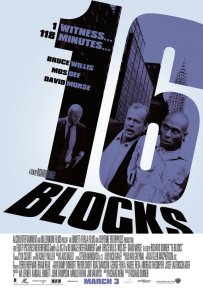 If you think you’ve heard of 16 Blocks before, you may just be correct. There was a 1977 Clint Eastwood movie called The Guantlet where he was transporting a prostitute/mob witness on a bus, and hordes of dirty cops and mob enforcers are trying to eliminate this witness. So the bus gets shot up beyond all imaginable repair and something of a standoff occurs. If you’d rather rent The Guantlet than pay full price for 16 Blocks I can understand that, but 16 Blocks is an adequately entertaining return to form for director Richard Donner (The Goonies, Lethal Weapon).
Officer Jack Mosley (Bruce Willis) is the kind of New York cop that, when stationed at a crime scene, raids a drug dealer?s cabinet and helps himself to some booze. Jack is like a walking zombie, trudging from assignment to assignment. He’s stuck with one more assignment, transporting Eddie (Mos Def), a key witness in a government trial just 16 blocks away. Everything seems so routine, but then Jack thwarts an attempt to murder Eddie. He reports the attack and takes a breather in a bar. Shortly after, he’s greeted by his old partner, Frank (David Morse), who is ominously familiarity with Eddie. Seems Eddie saw something he shouldn’t have, and now a whole slew of dirty cops are going to go down if he testifies. Frank would appreciate it if Jack stepped aside, gave up Eddie, and everything would be square again. All he has to do is make sure Eddie misses his testimony deadline in an hour, dead or alive. A sudden conscience gives Jack a new life, and he?s determined to escort Eddie to the courthouse, no matter the cost. Frank is willing to stop this, no matter the cost. Let the countdown begin.
 16 Blocks is a solid genre picture up until a bus standoff lets all the air out and kills the film’s jumpy momentum. Yes, it’s assembled out of worn clichés and plot elements from other flicks, but this cut-and-paste action flick is a cut above out of its determination. When 16 Blocks is cooking, and it does for stretches, the movie seems to be moving forward by sheer force of will. It’s somewhat admirable, and I’m convinced Donner is responsible for this as he settles into familiar territory. 16 Blocks successfully introduces obstacles and then lets our heroes find believable and entertaining ways to skirt past the danger and into the next obstacle. New York City really feels like its own integral character that’s central to the unfolding plot. 16 Blocks is nothing spectacular but it’s proficiently fun, that is, until that protracted bus standoff gums up the film’s flow. The contrivances become too glaring and 16 Blocks settles into an overly redemptive finish. 16 Blocks succeeds as long as it can, which is surprisingly longer than I would have estimated, but it eventually winds down with too much time left on the clock.
What the hell is up with Mos Def’s voice in this movie? I don’t know if he was trying to stretch his thespian wings, but going the entire film sounding like you’re a cartoon is not helpful (unless you’re Joey Lauren Adams). I seriously expected a tank of helium to be connected. It’s so mannered, so annoying, and so purposely “different” that you’re almost glad he may die in the film’s opening minutes. However, if this was Donner’s attempt to put the audience in Jack’s place, make us just as bedraggled and frustrated, then well done sire. It’s still not forgivable but at least I may understand.
Willis comes across perhaps a bit too realistic as a doughy, down-on-his-luck cop. It’s getting all too natural to see Willis wearing a badge, or at least holstering a weapon, so at least it’s nice to know he changes it up every once and a while. In 16 Blocks he’s overweight, over the hill, and even sports a limp; not exactly action star material unless you still consider your dad the Strongest Person in the World. It adds an interesting, gritty charm to the picture and Willis coasts on our goodwill. 16 Blocks tries to do too much with his character towards the end, encasing him in a crusade to better himself. There just isn’t that much substance there, folks.
I don’t understand why Jack or Eddie doesn’t phone the media as soon as they know the trigger-happy cops are gunning for them. Seriously, you’d think one call to the press and they’d be swarmed with TV cameras, and as a rule the more TV cameras pointed around you, the less likely someone is going to shoot you. This seems like a no brainier to me, as well as an opportunity to put the media in the cross hairs of danger; it’s win-win.
 There are some moments in 16 Blocks that are perfect indicators about how familiar a movie like this has become. First, the “gotcha” edit. We see two sequences of action, Group A in a fixed location and Group B quickly descending toward that location when “voila” we’ve been had. The film reveals Group A has already left. I usually enjoy this bit of action sleight-of-hand, but when a movie has to pull the “gotcha” edit twice, then it’s a little like the boy who cried wolf. There’s also some stupid character slips meant to squeeze in tension. At the film’s sleepy climax, Jack is surrounded by men with their guns trained on him. He says he has a key piece of evidence is tucked away inside his coat pocket… and then he reaches in to grab it. Now wouldn’t an astute individual, let alone an experienced man of the law, just ask someone to grab it from him instead of reaching inside and giving people a reason to shoot? 16 Blocks has moments like these because the characters are all stock, so what does it matter if they alternate between brainy one second and bone-headed the next?
16 Blocks is an enjoyably retro genre flick, pasted together with stock characters, contrivances, and cliches, and yet the entire project nearly makes it to the finish line by sheer force of will. Despite the well-worn territory, Donner’s precision and some clever obstacle/resolution conflict keeps 16 Blocks passably entertaining. Willis and Def lack any real camaraderie, and you may want to strangle Def after listening to five seconds of his cartoonish voice, but it doesn’t matter because this film is about the journey, not the journeymen. 16 Blocks loses its way when it forgets this, spending the last act focusing on character dreams, morals, and redemption. 16 Blocks is a redemption of sorts for Donner; the man can still make nervy action sequences and keep an audience entertained, if even for only two acts. That’s worth a walk to the movie theater for most.
Nate’s Grade: C+
Share this:

King Kong (2005)
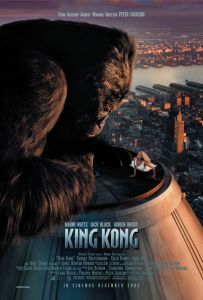 Has there been any movie this year that’s had a bigger hype machine than Peter Jackson’s King Kong? Coming after his Lord of the Rings trilogy, about two billion in revenue and a slew of Oscars in tow, Jackson decided to recreate the movie that captured his imagination as a child. It was King Kong that made Jackson want to become a filmmaker, so now he is returning the favor. Universal ponied up a staggering 200 million dollars for a budget and paid Jackson a record 20 million to sit in the director’s chair. Like his Rings series, this Kong clocks in at a gargantuan 3-hour running time. Will audiences share Jackson’s adoration with the story of a woman, a big ape, and a bigger building?
Carl Denham (Jack Black) is a filmmaker feeling studio pressure. The suits want to reel him in before he even starts shooting his next picture. Carl scrambles to get his crew and equipment onto a boat before the studio can shut him down. He?s on the prowl for a new lead actress and spots Ann Darrow (Naomi Watts), a hungry out of work vaudeville actress. He quickly convinces her to be apart of his movie and hurries her aboard, the selling point being that Jack Driscoll (Adrien Brody) has written the story. Carl practically kidnaps Jack and they all set a course for the mysterious Skull Island, a place only rumored to exist. The ship’s captain and crew are wary but sure enough their vessel washes ashore on an exotic island. But this is no sunny getaway, as the crew is immediately besieged by hostile natives and Ann is taken prisoner and offered as a sacrifice to Kong, a 25-foot gorilla. Jack leads an expedition to retrieve Ann, who begins to bond with her hairy captor (Stockholm syndrome, anybody?). Kong rescues Ann from dangers, be it bug or dinosaur, but flies into a vicious rage when she’s plucked away from him. Carl realizes an even bigger attraction: a giant ape to headline Broadway and line his own pockets. His schemes come true as Kong is knocked out and transported back to New York City. However, no stage is too great for Kong, as he busts free and looks all over for the love of his life, Ann.
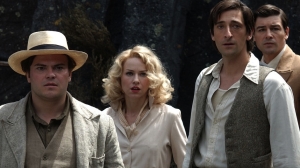 The sweet love story gives Jackson’s update a surprising emotional richness. In the 1933 original, Fay Wray never stopped shrieking until the big guy toppled off the Empire State building. She had no emotional connection to her furry captor and his unrequited love. In the 2005 King Kong, the strength of the movie is the relationship between Ann and Kong. Jackson of course stacks the deck of his story to all but guarantee an audience will fall in love with the big brute (he appreciates sunsets, how romantic!). There?s not much choice whether or not to sympathize with Kong, especially those moments where we stare into his soulful eyes welling up with emotion. King Kong has always been a tale of exploitation with man as the true monster. By administering time to fully develop a convincing relationship between beauty and beast, it makes the later scenes of exploitation have a larger sense of tragedy. Immense credit goes to Watts for selling this relationship and spurring our sympathy for Kong, instead of making their bond something for snickers and eye-rolling. Poor Adrien Brody though. It’s pretty bad in a romantic triangle when you’d rather pick a giant primate than Brody.
The performances go a long way to adding to the enjoyment of King Kong. Watts is a luminous actress and a natural beauty. It’s because of her that the second half of the movie has a beating heart and some kicks to the gut. Brody is ho-hum but given little to work with as a, wait for it, second banana. Black works wonders to make his villainous role so charismatic. Denham is a huckster that would step over his dying mother to make a buck, and yet Black’s charming and funny even at his most dastardly and cowardly. I don’t think King Kong would have worked the same with different actors; few could bring the heart and emotion Watts emotes, and few could bring Black’s comic virtuosity that makes it plausible why others would follow his showman character. Colin Hanks (also along side Black in Orange County), as Denham’s assistant, imparts a favorable impression. I’d like to see him paired up with Topher Grace sometime. Give it some consideration, Hollywood.
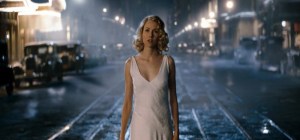 King Kong is a spectacular vision by one of cinema’s greatest visionaries. Jackson has lavishly recreated the excitement of his youth, bringing the story of Kong into the modern age with studly panache. The film is marvelously beautiful to take in and has plenty of moments that will reawaken the child within you, transporting you to an age when movies truly seemed larger than life. During the epic battle between Kong and the T. Rexes, I knew the exact curiosity and excitement Jackson felt when he saw the 1933 original. The action is intense and rarely lets up once our adventurers reach Skull Island. The special effects are some of the best movies have ever seen. Kong moves with expressive accuracy that goes a long way toward expressing his humanity, whether it is in a sigh or a tantrum. Andy Serkis has yet again brought life to another entirely CGI character. King Kong is well worth the price of admission just to sneak a peek at the Jackson’s limitless imagination.
With Jackson’s beefed-up recreation, he has also brought with him a terrible amount of bloat. This King Kong runs a frightful 3-hours plus, and most viewers will just feel exhausted by the time the lights go back up in their theater. Jackson’s love affair with his material is indisputable but it also seems to cloud his judgment as far as pacing is concerned. Numerous scenes seem to stretch longer than necessary and lose their point of interest, the first hour seems too drawn out and prosaic, and the movie haphazardly mixes in the serious with the soapy (Kong on ice?). Some scenes lose their sense of believability the longer they stretch on, even in a movie filled with giant monsters. Certain subplots have set-up but no follow-through, like all the added attention to Jimmy (Jamie Bell), the ship’s teen that wants to experience danger too. Jackson even makes sure we catch that he’s reading Heart of Darkness. So where does this character go? Nowhere and very slowly at that. The character has no bearing on anything that happens with the plot and is dropped entirely once they leave the island. There’s no point. Did something get cut from the inevitable 8-hour extended edition DVD that will prove how pivotal Jimmy really was? I doubt it.
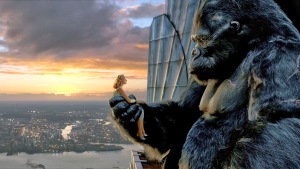 Some nipping and tucking and a comprehensive editing overhaul would certainly make King Kong a better movie, but it would lose its sense of spectacle. I can’t complain about length too much since Jackson packs such a wallop of entertainment like few others, so while King Kong certainly is a bloated and exhaustive film, it’s also an artistically bloated, exhaustive film. Jackson sure does have reverence for his source material (some lines and scenes are directly lifted), though he may have overlooked the 1933 King Kong‘s 100-minute running time.
Peter Jackson’s King Kong is an epic, epically grandiose, epically imaginative, epically action-packed, and epically bloated. The update is a bit exhausting but Jackson packs more entertainment per minute than few others in the film business, even if he has too many minutes to work with. Watts really sells her tender relationship with Kong and gives the film a surprising emotional heft absent from the 1933 original. Because of our emotional investment the film has a greater sense of sadness and tragedy as it plays out. King Kong was the 800-pound gorilla of the movie year and Jackson knows how to deliver a visual epic, even if he tiptoes into self-indulgence. While I can protest the length, pacing, and some subplots that go nowhere or strain credibility, it’s hard to argue that King Kong is the popcorn spectacle of the year. Your bladder may hate you by the end of it but you won’t want to miss a second.
Nate’s Grade: B
Share this:

The Chronicles of Narnia: The Lion, the Witch, and the Wardrobe (2005)
 I have never read one single word from C.S. Lewis’ classic children?s tales, The Chronicles of Narnia. I have never read one word from J.R.R. Tolkien’s Lord of the Rings tomes either. I read five pages in Dune and returned it to the library (50-page glossary of vernacular my ass!). I have also never read one word of any Harry Potter book, and I’m quite all right with that. I have several friends that were consumed by Lewis’ series in their childhoods and now are consumed by J.K. Rowling’s series. I don’t confess to be geek-free; I read the Shanara series by Terry Brooks when I was in junior high. I collected comic books, I watched cartoons, I still do both to an extent, but I suppose I left the fantasy genre with my appreciation for flannel all the way back in junior high (I also discovered women). Whenever I enter a fantasy film I bring with me no baggage. And so I strolled into The Chronicles of Narnia: The Lion, the Witch, and the Wardrobe ready to be entertained by a good story, whether Lewis, a big Christian theologian and author, was advancing some kind of Christian allegory or not. After seeing all 125 minutes, it’s safe to say I’ll be in line for any potential sequels.
In the heat of WWII, the Pevensie children are being transported out of London to live with a kindly professor (Jim Broadbent) on a safe rural farm. Peter (William Moseley) is the oldest and assumes the leader position vacated by their departed father. Susan (Anna Popplewell) is the brainiest, Edmund (Skandar Keynes) is the moodiest, and little Lucy (Georgie Henley) is the precocious true believer.
 One day during a game of hide and seek Lucy hides in an upstairs wardrobe. To her delight and amazement, she is transported to a magical, snow-covered realm known as Narnia. She encounters a faun, half man-half hoofed animal, named Mr. Tumnus (James McAvoy). He’s shocked to see a live human girl before his eyes and invites her for tea. There’s an old prophecy that says when two Sons of Adam and two Daughters of Eve arrive then the 100-year winter will end. The evil White Witch (Tilda Swinton), the one ruling Narnia with an icy fist, wants the humans captured and dead so she can rule forever. Lucy tells her siblings about her amazing adventures but they don?t believer her, that is, until they all tumble forth into the land of Narnia. The older kids mostly want to return home, but Edmund has sold them out by aligning with the White Witch. Now they’re on the run from her pack of wolves and the Pevensie children must seek out the powerful Aslan (voiced by Liam Neeson), a heroic lion who is all that stands in the way of the White Witch.
I declare my undying love for Tilda Swinton, truly the best character actress we have working today. Swinton already gave one bizarre yet outstanding performance this year as the androgynous angel Gabriel in Constantine (Swinton does androgyny better than anyone else; hell, she was convincing as a man and a woman in Orlando). In Narnia, Swinton exhumes a chilly command that could make you stand at attention. She’s such a hostile, icy, stone-faced villain, and Swinton has such calm confidence the whole time. She preens like a rock star and has the oversized ego to boot. She’s the kind of bad girl you could really fall in love with, especially if you have monstrous maternal issues.
The rest of the actors are mostly good. Henley steals every scene she’s in, and I’m not talking about the added attention of her suitable British choppers (my apologies to U.K. readership). Neeson seems a little bored with yet another wise teacher role just this year. I would be more interested in hearing the original voice of Aslan, the stupendous Brian Cox (Troy). McAvoy has a gentle sweetness to him.
Director Andrew Adamson integrates the flashy computer effects with surgical-like precision. Adamson?s experience as co-director for the Shrek films has given him the know-how to coordinate massive effects sight unseen and still coherently direct his live-action actors (ahem, George Lucas, ahem). The special effects in Narnia are outstanding. The characters move and behave with staggering authenticity (I know most of these creatures are mythical and have no comparison). The vistas and landscapes are beautiful, particularly the winter wonderland of Narnia. Adamson has a keen eye for visuals and lavishly recreates his visions; the climactic battle is bloodless but no less exciting.
 Most of the story flaws come from the source material. Narnia lacks the epic scope of the Lord of the Rings movies as well as the seriousness. As a result, no one feels very much in danger even during the more harrowing moments of battle. Lucy’s gift of “resurrection juice” kind of let’s the air out of the tension balloon. What suspense is there if a character has a magical healing elixir they can just whip out? The two girls are removed from the final battle and have little impact on its outcome. The White Witch’s tactic of freezing her enemies instead of killing them seems to be foolish, especially when they can be thawed at inopportune times. A major character’s sacrifice seems a tad superfluous if he can just reappear, lickity split like he had an extra life. Lots of secondary characters get the shrift when it comes to characterization, so you feel less than you should when something happens to them; this is even further hampered by Lucy’s Jesus Juice.
There’s a real genial sense of magic to Narnia. When little Lucy first transports to this magic realm, her face lights up in that adorable cherubic way, she wafts through the falling snow, catching it with her hands. Her moments with Mr. Tumnus are note-perfect from the dialogue, to the vocal inflections, to where the scene leads. Their relationship is very tender and provides some of the film’s best moments. Looking back, I can pick apart the movie, but while I was sitting in my theater I was deeply surprised how affected I was. I felt their fear, I felt their sorrow, and most of all I felt some sense of magic. The logic part of my brain was telling me how silly it was to see Santa Claus, let alone witness jolly ole Saint Nick handing out weapons for all the little good girls and boys (“Ho ho ho, kill ’em good for Santa.”). Yet while I watched I never questioned these things. The power of Narnia had taken full hold of me and I was swallowed whole by its tale.
Narnia is a good entry point for children in the world of fantasy. It’s suspenseful without being scary, and familiar without being too simplistic. Unlike Tolkien’s complicated worlds and heavy tales, Narnia is more a children’s story, what with the inclusion of unicorns, centaurs, fauns, and a menagerie of talking animals. There’s the suitable kid fantasy, like becoming king and fighting monsters, but there’s also a focus on family reconciliation and being accountable for your own actions. This isn’t a story that will overwhelm its audience but will leave them hungry for more adventures. The characters are mostly sketches (the leader who doesn’t want to be a leader, the overly logical one, the disaffected youth constrained by too much discipline, the little believer in the unknown), so it’s a testament to the filmmakers that the story and the characters have as much resonance as they do. The Lion, the Witch, and the Wardrobe sets up the parameters of the Narnia universe and its inhabitants and now future sequels can add meat to this bare skeleton. Narnia is a fantasy film the whole family can enjoy.
 The Christian allegories and metaphors mostly fly under the radar, with the exception of one extremely obvious scene that might make Mel Gibson wince. I even think Narnia is better enjoyed as a straight-up story than as an elaborate series of codes and messages harkening toward Christianity. If you view Narnia with the intent to break down its meaning and supplant connection to the Bible, then you’re really missing out on some great storytelling. And Narnia isn’t outwardly religious; it’s mostly a film preaching good values rather than simply good Christian values. Most of the lessons and values taught within Narnia are universally applicable to all people.
The Chronicles of Narnia: The Lion, the Witch, and the Wardrobe is a superbly entertaining retelling of C.S. Lewis’ classic children’s series. Adamson connects all the expected fantasy dots while seamlessly incorporating awe-inspiring special effects. The bountiful imagination up onscreen is the film’s biggest charm, rendering a divine touch of magic to the finished proceedings. Despite any better judgment pointing out the simplicity of the tale and characters, the production is first class and compelling. I was completely surprised how affecting I found the film and how immersed I became. This is great storytelling aided by gifted storytellers. Narnia is bigger than a family film, more accessible than a “Christian movie,” and more entertaining and endearing than most films released this year by Hollywood.
Nate’s Grade: B
Share this:

Sky High (2005)
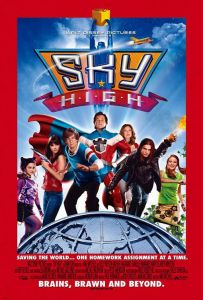 The film is pleasant, the acting overall is even pretty good, the humor is really peppy, but it’s not enough to overcome such a formulaic plot. Sky High feels exactly like a Disney afternoon movie; everything is there just fill in the blanks, Mad Libs style. Disney cranks these out like processed hamburgers. This time people have super powers and the budget is slightly bigger. There are some things I’ve seen so many times in teen movies. People still learn big lessons, people still go through social awkwardness, there’s another big house part where everyone is invited and someone has a misunderstanding, the best friend since childhood obviously has a crush on the lead that he cannot see, and the person the moves up the ranks of popularity becomes a self-centered jerk and shuns his true friends from the beginning. The best aspect is its comedic support cast including two members of Kids in the Hall, Bruce Campbell as a gym coach, Kevin Hefferman from the Broken Lizard troupe. This supporting cast should really be the focus of the story. A super hero high school is interesting but the staff of a super hero high school is even more interesting. Still, it has a nice sense of humor and is pleasant enough.
Nate’s Grade: B-
Share this:

Zathura (2005)
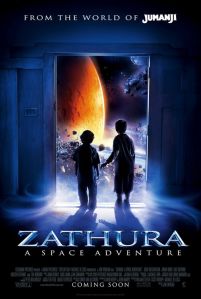 I’m kind of perturbed at how Zathura is being dismissed by the movie going public as, “Jumanji in space.” Seriously folks, does Jumanji hold that big of a place in our collective hearts as a nation? The only thing the two films have in common is that they’re both based on books by noted children’s author/illustrator Chris Van Allsburg (The Polar Express) and that they both involve board games coming to life. That?s it. Do we say that Titanic is ?Romeo and Juliet on a boat” because they both involve doomed lovers? Do we say that Jaws is “Moby Dick with a shark?” Or that Blade: Trinity is “The Hunger minus lesbians”? Or that The Island is “Parts: The Clonus Wars with a budget?” Okay, maybe the last one is accurate, but Zathura is a fabulous family film that has little comparison.
Danny (Jonah Bobo) and Walter (Josh Hutcherson) are brothers that have little in common. Ten-year-old Walter loves sports and isn’t too interested in the “kiddy” things his six-year-old brother likes. Danny himself is battling his own fears and feels left out by his older brother. Their big sister (Kristen Stewart) just wants both of them out of her hair. The family is visiting their dad’s (Tim Robbins) new house. While dad’s out to get some work done, Danny and Walter are antagonizing each other. Walter sends his little brother to the scary basement where Danny finds an old, dusty board game called Zathura. He sets up the tin game board beside his brother and starts playing. Small rockets on poles lurch across the board according to a spinning number. Then a card pops out and says, “Meteor showers,” and sure enough their living room is deluged with fiery meteors (Danny yells to take “erasive action”). Walter is shocked to open the front door and discover their house isn’t parked neatly in the neighborhood but orbiting through the vastness of space. To get back home the squabbling brothers must complete the game, and along the way they’ll encounter giant robots, a lost astronaut (Dax Shepard), and the Zorgons, a race of aliens hungry for some warmth and some fresh meat.
 The child acting is rather outstanding. The interaction between Bobo and Hutcherson (Kicking & Screaming) is great. Each really defines and shapes their character well, from Bobo’s whiny insecurity to Hutcherson’s disinterested anger and overt competitiveness. Stewart (Panic Room) leaves a very sizable impression as the agitated older sister. She has the looks and talent to explode in Hollywood in a few years, a la Rachel McAdams. Dax Shepard (Without a Paddle) is the biggest acting surprise. He gives a weighty and endearing performance as a father figure in the film, and he’s totally on the same wavelength with the movie’s tone.
Yes, Zathura gets a bit more conventional with its story as it draws toward the conclusion (trials of courage, learning from past mistakes, reconciliation), but there’s really only one kind of ending for this film. What did you expect from a 30-something page children’s book, half of which are drawings? Zathura may be predictable but it’s got a loose energy, a comedic zest, and a sense of wonder that elevate the familiar.
Smart family films are about as rare as they come. Zathura breaks the template of what “family film” means nowadays; it doesn’t go for cheap, tasteless jokes, it doesn’t hurl scattershot pop-culture references (seriously Shark Tale, are children going to be amused by a Scarface reference?). Refreshingly, the movie doesn’t have a single joke revolving around flatulence or someone getting hit in the nuts. This is a smart, good-natured family film that will thrill adults and children alike. John Favreau (Elf) is carving a really nice niche for himself directing these high quality family films that are in short supply. His direction is focused and his decisions are right on the money. He doesn’t overwhelm the film with an orgy of special effects. He gets the tone of this movie and never panders to his audience, but he keeps the pace bouncy and the tension racked. I was rapt in suspense during the Zorgon docking sequence, and yet Favreau can also illuminate the tensions of our childhood fears, like a dark basement. Favreau is proving himself to be a dynamite artist behind a lens.
 Isolating the action inside the house definitely helps build the film’s drama. Instead of unleashing the crazy world of the jungle and watching it wreck havoc, Zathura keeps everything bottled up. This decision does wonders for the film’s suspense by giving a claustrophobic overtone. This is a movie more concerned with storytelling than loud special effects. In short, Zathura is light years beyond Jumanji.
The family dynamic feels exceptionally realistic, and the film has a terrific sense of humor. Siblings do behave this way, and Zathura captures their everyday conflicts in a meaningful way. The dialogue has a real zest to it but never feels trite or inauthentic. Mark my words, “Get me a juice box, biyatch,” will be the best movie line you hear all year. Zathura really soars because of its rib-tickling sense of humor. This isn’t Man Drops Banana Peel followed by Man Falls Down. No I?m talking about a consistent tone that’s sly and whimsical, complete with comedic payoffs for even inanimate objects. The various story elements really come together nicely. Zathura is a blast that will hard to beat this holiday season and beyond.
Favreau has directed yet another family film destined to become a classic. The thrills are thrilling, the comedy is whimsical and smart, the storytelling is careful and focused, the special effects are great, the acting is superb, and even the score really soars. This is just a delightful movie of all stripes and should please adventure-seekers of all ages. I was laughing and cheering from beginning to end and so was my theater. It’s a family film that proudly and refreshingly reminds us the possibilities of family films. Zathura is tremendous fun and one adventure that will suck you in instead of just sucking.
Nate’s Grade: B+
Share this:

The Island (2005)
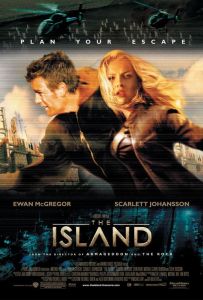 To many film critics, director Michael Bay is the devil. He’s the man behind such ADD-edited hits like Armageddon, both Bad Boys, and Pearl Harbor. Each film was more or less savaged by critics and each film was a hit. Bay has always said he makes popcorn movies for audiences and never listens to the critics. That would probably be a good thing since they don’t exactly have a lot of nice things to say about Bay and especially his editing techniques. But how would someone like Bay, who dreams about blowing stuff up with every night’s sleep, handle material a little more subtlety than, say, corpses filled with drugs being thrown at oncoming traffic (see: Bad Boys II or better yet, don’t)? The Island is Bay’s first film without uber-producer Jerry Bruckheimer and it’s also Bay’s first encounter with science fiction. Can he make The Island into another popcorn miracle or will his blockbuster tendencies get the better of him?
In the year 2020, the Earth has been contaminated by pollution. The survivors live in a series of isolated towers and are monitored, given strict diets and jobs, and even matching white jump suits. There is an upside to this life; every so often there is a lottery where the winning inhabitant gets a trip to The Island, the last uncontaminated spot on Earth. They’ll spend the rest of their days living it up in paradise, or so they think.
Lincoln Six Echo (Ewan McGregor) has been at the facility for three years. He has questions for the good doctor Merrick (Sean Bean, your go-to guy for villains when you can’t afford Al Pacino), the man in charge of the place. Lincoln questions his purpose and wonders why he keeps having recurring nightmares with images he can’t place. He’s also been having a very close friendship with Jordan Two Delta (Scarlett Johansson), though they?re not allowed intimate contact and the living quarters are separated by gender. One day Lincoln finds a butterfly on a different level of the facility and investigates the higher levels. In a few minutes time, Lincoln discovers the truth about the facility: it’s a station harvesting clones to keep rich people going when they need an organ or two. There is no Island but there is an operating room that you won’t return from. Lincoln escapes back into the facility’s population but springs into action when he learns Jordan has been selected to go to The Island. He fights the facility’s staff, grabs his girl, and the two are off to learn the truth of their world and to live.
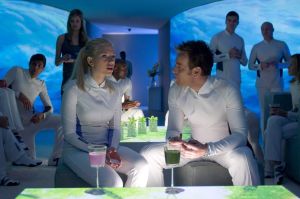 McGregor is on autopilot with this one but still manages to have some fun, especially when he’s playing two different versions of himself (“What’s with all the biting?”). Johansson looks more beautiful than ever but does little more than stare vacantly. It doesn’t help that a majority of the dialogue after the half-way mark consists of one-word shouts like, “Go!” and “Move!” and of course, “Lincoln!” The best actor by far in The Island is Michael Clarke Duncan who plays a clone who wakes up on the operating table. His mad rush of screaming, tears, confusion, horror, and betrayal may be some of the finest two minutes of acting from the year. Duncan’s cries will hit you square in the gut.
The fish out of water scenario does provide some fun moments of humor, like Lincoln being confused by the phrase “taking a dump.” The Island also asks how people who have never known sexuality deal with their expressions of sexuality (plus it doesn’t even come close to viewer discomfort of something like The Blue Lagoon). The always welcomed Steve Buscemi provides the biggest laughs in the movie as the wise-cracking outsider who helps the runaway clones.
It’s comforting to know that in the future product placement will be as large as ever. I?m normally not too offended by product placement in ads, but The Island seems like it’s contorting to show company names. In one scene, Jordan gazes at an image of herself in a perfume ad, and it’s a real ad Scarlett Johansson did. This got me thinking, what if The Island‘s villains were really today’s actual flesh-and-blood movie stars that wanted fresh parts. The real McGregor and Johansson would become the bad guys. Unfortunately, it seems a little too meta to pull off for a Bay film.
The Island is an intriguing sci-fi movie that doesn’t know what to do once it gets to the surface. As soon and our clones go on their Logan’s run, the movie devolves into a series of bloated, mediocre chase scenes. If the first half is Bay at his potential best, the second half is Bay at his lazy, expected self. The chase scenes aren’t too lively and, except for a late subplot involving McGregor playing dual roles, The Island wilts as soon as it turns into an action movie. There doesn’t seem to be enough plot for this overlong 140 minute movie. Bay’s requisite chaotic grandeur and spectacle has a ho-hum feeling and dulls the viewer right when they should be racing with excitement. Bay’s done this all before and better, and that’s why the first half is so exciting a change for him. It’s thoughtful, tense, interesting, well plotted and visually fun, and then we regrettably hit the second half and it all goes downhill from there.
 The movie limps to its over-extended climax and saps all the potential from the opening. The Island really is two disjointed movies slapped together. The first hour is a classic science fiction setup and we are given morsels of information like bread crumbs, which heighten the tension. The second half is an unimaginative, plodding thrill ride that never seems to take off. Sure, the first half may be derivative of a hundred other sci-fi films (most notably Parts: The Clonus Horror) but the second half is derivative of a thousand other action movies. I’ll take smart sci-fi over dumb action most days, even during the bombast of summer. It feels like The Island began as a scary sci-fi film and in order to make it to the big screen the studio had to piggyback a lifeless action movie on top of it. The Island‘s action sequences feel like Bay fell asleep at the wheel.
It may seem like I’m being over cruel about The Island, but the reason I lambaste the second half is because I was so thoroughly entertained by the first half. For many The Island will be enough to quench their summer thirst, but for me it only showed flashes of life in the first half. Once all the explosions, noise, and flying debris kicked in, The Island transforms into any other dumb action movie. Such promise, such vision, all quickly flushed down an embryonic feeding tube. Even if someone prefers the noisy second half they would still take issue with the first half, calling it slow and boring. Fans of Bad Boys II and Logan’s Run don’t exactly mix well. How can a movie possibly work this way?
Bay may be a master maestro of explosions and gunfire, but The Island flat lines when it transitions from thoughtful, eerie sci-fi parable to rote action flick. This feels like two very different movies slapped together, and most audiences are going to like one half stronger than the other so the film won’t work. The action sequences feel unimaginative and all of the film’s potential gets stranded by its about-face in tone. We’ve seen all of these things before, and that’s what’s most regrettable about where The Island leaves you after flashing an iota of glossy potential. Bay may not be the devil but he’s certainly losing his edge, and The Island would have been all the better for it.
Nate’s Grade: C+
Share this:

Batman Begins (2005)
 I have been a Batman fan since I was old enough to wear footy pajamas. I watched the campy Adam West TV show all the time, getting sucked into the lead balloon adventures. Tim Burton’s 1989 Batman was the first PG-13 film I ever saw, and I watched it so many times on video that I have practically worn out my copy. Batman Returns was my then most eagerly anticipated movie of my life, and even though it went overboard with the dark vision, I still loved it. Then things got dicey when Warner Brothers decided Batman needed to lighten up. I was only a teenager at the time, but I distinctly remember thinking, “You’re telling the Dark Knight to lighten up?” Director Joel Schumacher’s high-gloss, highly stupid turn with Batman Forever pushed the franchise in a different direction, and then effectively killed it with 1997’s abomination, Batman and Robin. I mean these films were more worried about one-liners and nipples on the Bat suits. Nipples on the Bat suits, people! Is Batman really going, “Man, you know, I’d really like to fight crime today but, whoooo, my nipples are so chaffed. I’m gonna sit this one out”?
For years Batman languished in development hell. Warner Bothers licked their wounds and tried restarting their franchise again and again, only to put it back down. Then around 2003 things got exciting. Writer/director Christopher Nolan was announced to direct. Nolan would also have creative control. Surely, Warner Brothers was looking at what happened when Columbia hired Sam Raimi (most known for low-budget splatterhouse horror) for Spider-Man and got out of his way. After Memento (My #1 movie of 2001) and Insomnia (My #5 movie of 2002), Nolan tackles the Dark Night and creates a Batman film that’s so brilliant that I’ve seen it three times and am itching to go again.
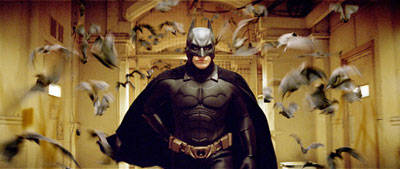 The film opens with a youthful Bruce Wayne (Christian Bale) in a Tibetan prison. He’s living amongst the criminal element searching for something within himself. Henri Ducard (Liam Neeson) offers Bruce the chance to be taught under the guidance of the mysterious Ra’s Al Ghul (Ken Watanabe), the leader of the equally mysterious warrior clan, The League of Shadows. Under Ducard’s direction, Bruce confronts his feelings of guilt and anger over his parents’ murder and his subsequent flee from his hometown, Gotham City. He masters his training and learns how to confront fear and turn it to his advantage. However, Bruce learns that the League of Shadows has its judicial eyes set on a crime ridden Gotham, with intentions to destroy the city for the betterment of the world. Bruce rebels and escapes the Tibetan camp and returns to Gotham with his own plans of saving his city.
With the help of his trusted butler Alfred (Michael Caine), Bruce sets out to regain his footing with his family’s company, Wayne Enterprises. The company is now under the lead of an ethically shady man (Rutger Hauer) with the intentions of turning the company public. Bruce befriends Lucius Fox (Morgan Freeman), the company’s gadget guru banished to the lower levels of the basement for raising his voice. Bruce gradually refines his crime fighting efforts and becomes the hero he’s been planning on since arriving home.
Gotham is in bad shape too. Rachel Dawes (Katie Holmes), a childhood friend to Bruce, is a prosecutor who can’t get anywhere when crime lords like Falcone (Tom Wilkinson) are controlling behind the scenes. Most of the police have been bought off, but Detective Gordon (Gary Oldman) is the possibly the city’s last honest cop, and he sees that Batman is a figure trying to help. Dr. Crane (Cillian Murphy) is a clinical psychologist in cahoots with Falcone. Together they’re bringing in drug shipments for a nefarious plot by The Scarecrow, a villain that uses a hallucinogen to paralyze his victims with vivid accounts of their own worst fears. Bruce is the only one who can unravel the pieces of this plot and save the people of Gotham City.
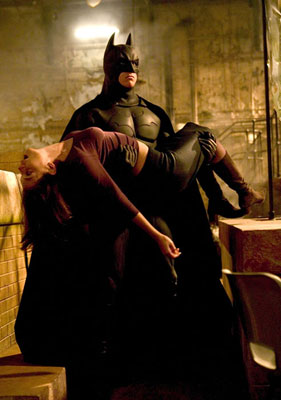 Nolan has done nothing short of resurrecting a franchise. Previous films never treated Batman as an extraordinary character; he was normal in an extraordinary world. Batman Begins places the character in a relatively normal environment. This is a brooding, intelligent approach that all but erases the atrocities of previous Batman incarnations. Nolan presents Bruce Wayne’s story in his typical nonlinear fashion, but really gets to the meat and bone of the character, opening up the hero to new insights and emotions, like his suffocating guilt over his parents murder.
Nolan and co-writer David S. Goyer (the Blade trilogy) really strip away the decadence of the character and present him as a troubled being riddled with guilt and anger. Batman Begins is a character piece first and an action movie second. The film is unique amongst comic book flicks for the amount of detail and attention it pays to characterization, even among the whole sprawling cast. Nolan has assembled an incredible cast and his direction is swimming in confidence. He’s a man that definitely knows what he’s doing, and boy oh boy, is he doing it right. Batman Begins is like a franchise colonic.
This is truly one of the finest casts ever assembled. Bale makes an excellent gloomy hero and really transforms into something almost monstrous when he’s taking out the bad guys. He’s got great presence but also a succinct intensity to nail the quieter moments where Bruce Wayne battles his inner demons. Caine (The Cider House Rules, The Quiet American) is incomparable and a joy to watch, and his scenes with the young Bruce actually had me close to tears. This is by far the first time a comic book movie even had me feeling something so raw and anything close to emotional. Neeson excels in another tough but fair mentor role, which he seems to be playing quite a lot of lately (Kingdom of Heaven, Star Wars Episode One). Freeman steals every scene he’s in as the affable trouble causer at Wayne Enterprises, and he also gets many of the film’s best lines. Oldman (The Fifth Element, Harry Potter and the Prisoner of Azkaban) disappears into his role as Gotham’s last good cop. If ever there was a chameleon (and their name wasn’t Benicio del Toro), it is Oldman. Holmes works to the best of her abilities, which means she’s “okay.”
The cast of villains are uniformly excellent, with Wilkinson’s (In the Bedroom) sardonic Chicagah accented mob boss, to Murphy’s (28 Days Later…) chilling scientific approach to villainy, to Watanabe’s (The Last Samurai) cold silent stares. Even Rutger Hauer (a man experiencing a career renaissance of his own) gives a great performance. Seriously, for a comic book movie this is one of the better acted films of the year. And that’s saying a lot.
Batman Begins is such a serious film that it almost seems a disservice to call it a “comic book movie.” There are no floating sound effects cards and no nipples on the Bat suits. Nolan really goes about answering the tricky question, “What kind of man would become a crime-fightin’ super hero?” Batman Begins answers all kinds of questions about the minutia of the Dark Knight in fascinating ways, yet the film remains grounded in reality. The Schumacher Batmans (and God save us from them) were one large, glitzy, empty-headed Las Vegas entertainment show. No explanation was given to characters or their abilities. Likewise, the Gothic and opulent Burton Batmans had their regrettable leaps of logic as well. It’s hard not to laugh at the end of Batman Returns when Oswald Cobblepot (a.k.a. The Penguin) gets a funeral march from actors in emperor penguin suits. March of the Penguins it ain’t. Nolan’s Batman is the dead-serious affair comic book lovers have been holding their breath for.
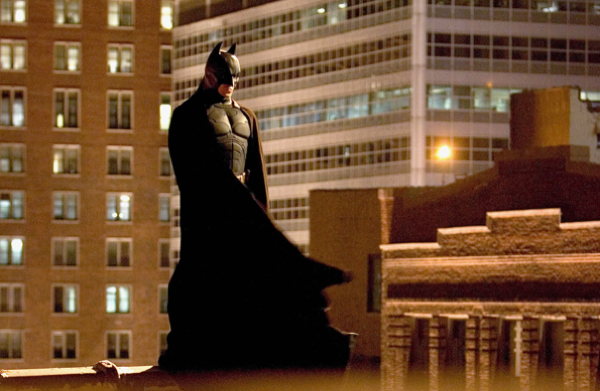 The action is secondary to the story, but Batman Begins still has some great action sequences. Most memorable is a chase sequence between Gotham police and the Batmobile which goes from rooftop to rooftop at one point. Nolan even punctuates the sequence with some fun humor from the police (“It’s a black … tank.”). The climactic action sequence between good guy and bad guy is dutifully thrilling and grandiose in scope. Nolan even squeezes in some horror elements into the film. Batman’s first emergence is played like a horror film, with the caped crusader always around another turn. The Scarecrow’s hallucinogen produces some creepy images, like a face covered in maggots or a demonic bat person.
There are only a handful of flaws that make Batman Begins short of being the best comic book movie ever. The action is too overly edited to see what’s happening. Whenever Batman gets into a fight all you can see are quick cuts of limbs flailing. My cousin Jennifer got so frustrated with the oblique action sequences that she just waited until they were over to see who won (“Oh, Batman won again. There you go.”). Nolan’s editing is usually one of his strong suits; much of Memento’s success was built around its airtight edits. He needs to pull the camera back and let the audience see what’s going on when Batman gets physical.
Another issue is how much plot Batman Begins has to establish. This is the first Batman film to focus solely on Batman and not some colorful villain. Batman doesn’t even show up well into an hour into the movie. As a result, Batman Begins perfects the tortured psychology of Bruce Wayne but leaves little time for villains. The film plays a shell game with its multiple villains, which is fun for awhile. The Scarecrow is really an intriguing character and played to gruesome effect by the brilliant Cillian Murphy. It’s a shame Batman Begins doesn’t have much time to develop and then play with such an intriguing bad guy.
Batman Begins is a reboot for the film franchise. Nolan digs deep at the tortured psyche of Bruce Wayne and come up with a treasure trove of fascinating, exciting, and genuinely engrossing characters. Nolan’s film has a handful of flaws, most notably its oblique editing and limited handling of villains, but Batman Begins excels in storytelling and crafts a superbly intelligent, satisfying, riveting comic book movie. The best bit of praise I can give Batman Begins is that I want everyone responsible to return immediately and start making a host of sequels. This is a franchise reborn and I cannot wait for more of it.
Nate’s Grade: A


You must be logged in to post a comment.