Blog Archives
Ghost Rider (2007)
 Nicolas Cage’s career has been flaming out, so what better role than a burning skeleton biker who serves as a bounty hunter for the Devil, in this case Peter Fonda. A cliché-riddled script, laughable performances, cheesy effects and dull villains doom any entertainment prospects this movie might have had. Cage, as the titular rider, gets to fight a group of escaped demons who all have one connection to an element; one has the power of fire, another the power of wind, etc., it’s like a hellish Captain Planet squad. But what’s the point when Ghost Rider simply vanquishes them so easily? It’s repetitive and goes nowhere. There’s one moment Sam Elliot “turns” into an older ghost rider/bounty hunter and rides along with Cage to save the day. But then he says, “Well, I could only do that once more, so good luck.” What? You could only turn into a flaming ass kicker one more time and you wasted it on riding a horsey through the desert? Eva Mendes is awful as her role of “girlfriend from past,” and why, if she and Cage grew up as childhood sweethearts, does he look over 15 years older than her in the present? I guess working for Satan can really take a lot out of you.
Nate’s Grade: D
Share this:

The Kingdom (2007)
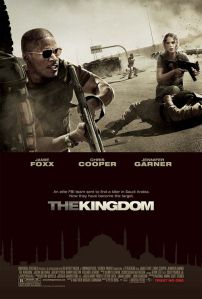 Now that summer is but a hazy memory, get ready for a roll out of serious minded movies Hollywood hopes vie for serious award attention. It may be five years into the current war, but the movies are now cranking out Iraq-themed dramas that will dominate the release schedule for the approaching months. Things are about to get heavy and somber. First out of the gate, though, is The Kingdom, a film about the nebulously termed War on Terror set within the confines of an action movie. Actor-turned-director Peter Berg (Friday Night Lights, The Rundown) knows how to create a stylized movie that feels organic to its genre, and The Kingdom is another example of his growing cinematic pedigree.
In Saudi Arabia, a housing enclosure of American contractors and their families is brutally attacked by terrorists that have infiltrated the Saudi security. Two hundred American lives are lost and FBI agent Ronald Fluery (Jamie Foxx) is intent on leading a team of experts (Chris Cooper, Jennifer Garner, Jason Bateman) to the soil of the Saudis, otherwise known as The Kingdom. The State Department refuses to authorize an investigation citing the jurisdiction of the Saudis as well as the danger of violent reprisals if agents are within reach of the perpetrators. Colonel Faris Al Ghazi (Ashraf Barhom) is assigned to baby-sit the American agents and keep them stuck in red tape during their five days allotted to them. Fluery refuses to take a subservient role and works with Al Ghaazi to get some answers.
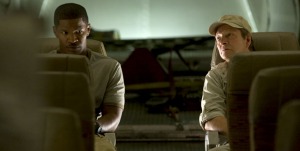 The animated opening credit crash course in Saudi history is fun and informative, however, it really doesn’t relate to The Kingdom even though the damn movie is set in that country. Curiously, the movie only makes cursory statements on the wary relationship between the Saudis and the United States, but otherwise this movie could have been dropped in any nondescript Muslim country in the Middle East. If The Kingdom was relocated to, say, Yemen, I doubt the script would need that much fine-tuning; snip some references to royalty here and there. This is a story about the balance between a moderate Middle East regime and radical elements within the country willing to buck Western influence by any destructive means necessary. I’m measurably disappointed that the movie didn’t tackle more about the unique and tenuous Saudi-U.S. relationship, but then I accepted the fact that The Kingdom wasn’t so much about a country but an ideology that knows no borders.
To that end, The Kingdom is one part CSI: Saudi Arabia, one part political thriller, and one part gung-ho Hollywood action extravaganza, and none of the parts seems to work well together as a whole. The film doesn’t work as a cohesive unit and perhaps tries to do too much. Now, this does not mean that any of those parts are not entertaining. The criminal investigating is rather interesting because of all the cultural barriers between the U.S. agents and the Saudi governing system (a miscast Jeremy Piven, as an ambassador, admonishes Janet, in a very Ari Gold way, to “dial down the boobies”). The central mystery of who is responsible is pretty thin and easy to solve, which may be why the film spends so much time finding obstacles to delay our FBI team from getting their hands on the evidence. The political thriller elements are expressed with the subtlety of a sledgehammer, and yet they feel like thoughtful counterpoints to any rah-rah jingoism that The Kingdom may instill in an American audience. The climax provides plenty of fist-pumping violence but it also ends on a note about the futility of violence as well as the durability of hate. I even appreciated devoting time to interdepartmental jockeying and watching agency heads seeing who will blink first in a public relations-dominated world. The Kingdom doesn’t have a desire to become Syriana 2: No Blood for Oil, but it does possess a greater deal of intelligence and relevance than most of what big budget Hollywood is spewing out (I refuse to believe the FBI would send an agent, with a personal family tie to Israel, into a Muslim country).
Strict action fans, however, are going to have a lot of downtime on their hands. The Kingdom opens with an action sequence and closes with an action sequence, and there’s a wide gap in between those bookends. The final 20 minutes are devoted to a nail-biting ambush and rescue that transforms our FBI agents into improbable action movie warriors. Berg’s restless camera isn’t as well honed as Paul Greengraas (The Bourne Ultimatum), and sometimes you just wish the jittery cameraman would allow you to see what’s going on. I don’t know if the docu-drama emphasis is fully needed, especially when the movie jumps between shots of just two people having a conversation. Berg is a terrific director and the action sequences hit hard; I just hope he doesn’t become trapped trying to fit himself into one style.
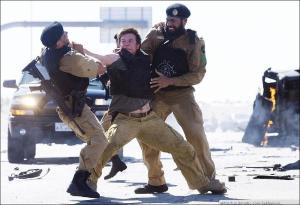
In truth, the most intriguing part of The Kingdom is the relationship between Fleury and Al Ghazi. They begin frustrated and fighting for control, but soon, in true buddy cop genre fashion, a mutual respect forms as they search for the bad guys. The script offers helpful examples of good Movie Arabs and bad Movie Arabs, and the audience is able to easily identify the two sides. The interplay between Fleury and Al Ghazi leads to some humorous exchnages as well as some reflective opportunities, like where the men recount their families and declare they do not care why such dastardly acts were done, they just want to inflict some punishment on the rightful parties.
The acting, like the film, is a bit all over the place. Foxx seems to be on autopilot. Foxx has bunkered into his acting troupes; intense, penetrating stare, whispery dialogue recitations, and a cocksure attitude. Cooper is cranky and incredulous older timer along for the ride. Garner does her best with a character that was written for the sole purpose of concocting culture squabbles over the role of the opposite sex. She does unleash a torrent of anger and power in one very hard-core and frighteningly extreme fight scene. Bateman is playing comic relief and does sarcastic quips with great ease, but his character also gets unexpectedly thrown into a very harrowing experience and Bateman makes you feel every drop of his fear. Barhom (Paradise Now) gives a convincing performance of a man torn apart by his moral compass and the path of his country. He feels a sense of duty to protect the innocent but at the same time he is scoffed at by colleagues for helping “them.”
The Kingdom is an action movie with more on its mind than blowing up the enemy real nice like, though that also plays a key component. The pieces don’t fully add up to a whole and the film’s politics are a little tricky to get a bearing on; is this a red state movie, a blue state movie, or something for both audiences? Berg’s ambition is admirable and his film never drags out a soapbox to preach. The Kingdom is a topical movie aimed at planting seeds of debate among a mainstream audience in between their handfuls of popcorn and gulps of soda.
Nate’s Grade: B-
Share this:

The Bourne Ultimatum (2007)
 I think the best aspect of the The Bourne Ultimatum, the third in the memory-troubled spy series, is how kinetically improvised it feels. Jason Bourne (Matt Damon) is a human weapon and he thinks constantly with his body, feeling the situation and his environment, and he comes up with improbable weapons, be them pens, magazines, or kicking ass with just a book (knowledge is power). Bourne doesn’t rely on fancy gadgets or a caustic wit; he just outsmarts the competition by reading his world and reacting instinctively, and that is thrilling to watch. The Bourne films have separated themselves from other spy series like James Bond and standout because of how viscerally realistic they play out. That said, Bourne still survives scrapes that would kill any mortal. At this point, we know just about all we need to know with most of the characters, so Ultimatum is one long, fantastic, and gripping series of chases between Bourne and the CIA operatives that want to rub him out. Ultimatum is Paul Greengrass’ (United 93) second film in the series and he enhances the excitement through his docu-drama style of shooting. The editing is constantly roving and perfectly channels the nervous wariness of a spy that is constantly looking over his shoulder. The action sequences are stellar and raft with suspense and top notch stunt work amongst exotic locales. Ultimatum tacks on some awkward political commentary (black hoods, secret CIA torture, breaking the law to “win” the battle against terror) and tries squeezing its story into a fight between Bourne and the dangerous and lawless elements of the American government that have flourished under President Bush’s watch. It doesn’t quite work in the context of a summer action movie, but thanks for trying. The Bourne Ultimatum is a spry and refreshing action movie that serves to cleanse the summer palate of huge special effects blockbusters.
Nate’s Grade: A-
Share this:

Live Free or Die Hard (2007)
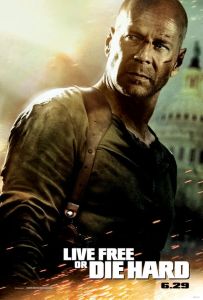 A lot has changed in the world and for Bruce Willis since last we saw John McClane in 1995’s Die Hard with a Vengeance a.k.a. Die Hard 3: Die Harder-er. Is a post 9/11 anxiety-ridden world, does someone like McClane feel quaint, like the remnant of a bygone era? Live Free or Die Hard, a.k.a. Die Hard 4, is Willis getting back to butt-kicking, wise-cracking basics. The film is a surprising and fun summer entry that could have been much much worse, and for that I am grateful.
McClane (Willis) is a pretty run down man thanks to the rigors of his job the heavy price being labeled a “hero.” He’s divorced, estranged from his teenage daughter (Mary Elizabeth Winstead), and retired from the force. He gets called to transport a hacker named Matt (Justin Long) from New Jersey to D.C. and into federal custody. Before he can leave Matt’s apartment, assassins start shooting at McClane and the hacker and the two go on the run for their lives. A former national security leader, Thomas Gabriel (Timothy Olyphant) has planned what is known as a Fire Sale, where the United States’ infrastructure is brought to a standstill by eliminating all power services, communications, and causing the nation to be consumed by chaos. Matt was one of the many that were contracted to unknowingly write code that would assist in Gabirels’ techno takedown. Now Gabriel is cleaning up his tracks and that involves removing an increasingly irritatable John McClane.
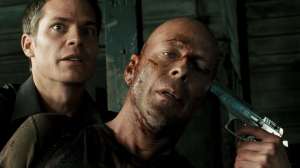 The film is nothing short of Bruce Willis trying to reclaim the action movie genre the way he sees it should be. Die Hard 4 is all about how computers and our complete reliance on modern technology put us all at risk if someone ever pulls the plug. Willis and the film are an efficient, and enjoyably retrograde Hollywood action flick that scoffs at kung fu, self-indulgent effects, and the gravity-defying acrobatics that have dominated action cinema since the rise of The Matrix. McClane shrugs and cannot understand this “kung fu shit” and mistrusts computers. Die Hard 4 puts most of its attention on good old-fashioned practical stunt work, not that the film’s sequences are practical, like when McClane is driving an 18-wheeler around a crumbling highway while being fired upon by a fighter jet. Live Free or Die Hard is crammed with gunfights, fistfights, and motor vehicles launched into the sky. People bounce around like pin balls. It pushes the boundaries of PG-13 action; the profanity of the previous films isn’t exactly missed, but it’s regrettable that cinema’s best catch phrase to ever use the term “yippee-ki-yay” has to be partially muffled by a sound effect to keep its more family-friendly rating.
Willis helps keep things grounded with an enjoyable acting style best be described as bemused crankiness. Throughout the long trip foes and intense obstacles beset McClane, and yet he remains the same grumpy Gus that can’t believe his own damn luck. Whenever he defeats a well armed opponent, or does something “so crazy it just might work,” and it does, he laughs to himself like he cannot believe his luck. He informs the bad guys that he is coming, and he will kill them, and they ask him how and even he doesn’t know and he doesn’t care. He’s a one-man wrecking crew, as he always has been, but there’s an added level of fun watching someone with an AARP card (who isn’t Clint Eastwood) kicking ass and taking cyber geek names.
 Director Len Wiseman cut his teeth on the terrible Underworld movies (I’m sorry, but if you got a movie about vampires vs. werewolves, you don’t give them leather and guns and call it a night), but he now has won me over with his work on Die Hard 4. His careening, deep-focus visuals are like a mix of Michael Bay with an extra dose of the fetish-loving Wachoswki brothers. There are a handful of visual scrapes that really pop onscreen like some very close encounters with high-speed cars.
But let’s not get too wrapped up in the fun of Live Free or Die Hard. It’s still an out-and-out action movie complete with plot holes, logic gaps, stock characters (the movie loses steam every time we have to cut back to the FBI agents), and some one-liner groaners. The villains are pretty standard, though very tech heavy in their approach. The movie never explains why a good portion of the henchmen are French. McClane’s daughter will obviously get crafty and bullish when under pressure, proving herself a chip off the old block. The banter between Willis and Long is overdone in an attempt to add more frantic feeling to a tale about the end of all reliance on technology.
Live Free or Die Hard is an efficient and satisfying retro, macho action movie. The action is frenetic and focused on hard-nosed stunt work that brings so much more excitement to the film. The movie works, and that in and of itself is something of a miracle. McClane rattles off a monologue about what it means to be a hero, and in the end he says it’s just about you being the guy willing to do his job no matter what. Well, as far as I’m concerned, the John McClane job is about providing solid action-packed crowd pleasers. I don’t care how old the man gets, because under the right direction he delivers.
Nate’s Grade: B
Share this:

Transformers (2007)
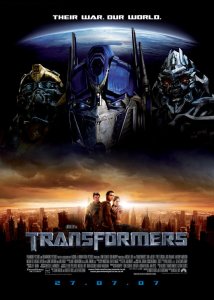 Once again Hollywood is quick to prove that if any television show emits some level of nostalgia, or merchandising potential, it is only a matter of time before it finds itself reconfigured as a big screen blockbuster movie. In all honesty, I was never a huge Transformers fan; I was more into Ghostbusters and then transitioned into Teenage Mutant Ninja Turtles. It may be sacrilegious, but I thought the knockoff cartoon/action figures, The Go Bots, were just as good. Steven Spielberg and critically derided director Michael Bay (Bad Boys II, Armageddon) have teamed up to bring the world a lengthy and noisy Transformers feature film. I can’t wait for the Go Bots to get their own equally pricey close-up.
Sam Witwicky (Shia LaBeouf) is your typical teenager obsessed with getting his own car. He can only afford an old Camaro at a used car lot, and his dreams of impressing the hot girl in school (Megan Fox). But Sam’s car isn’t just any old busted jalopy, no sir, it is really a robot in disguise from another planet. Sam’s car, codenamed Bumblebee, is apart of a robotic race known as the Autobots, led by their leader Optimus Prime (Peter Cullen returning to voice with gravitas). They can transform into vehicles that they scan with their optical sights. The Autobots are trying to save the planet from their evil counterparts, the Decepticons, who have already infiltrated our world in search of their fallen leader, Megatron. It seems Sam holds the key to the survival of Earth. His great grandfather was an Arctic explorer and happened upon the frozen sight of Megatron. He left behind an artifact that reveals the location of the chilled robot as well as a source of unparalleled power known as the Allspark. Needless to say, the military and the Secretary of Defense (John Voight) are a little aghast at how their weapons stack up to big bad robots.
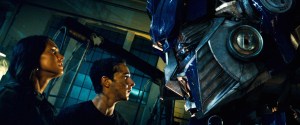 Michael Bay was born to direct a live-action, ultra expensive Transformers movie. The testosterone is through the roof and the film worships everything shiny, fast, and automotive. This is the kind of movie that fits exactly into the artistic parameters of Bay. The film is one gorgeous product placement orgy that is all about the eye candy; the cars are hot and desirable, the car chases are cool, the explosions are a lovely shade of orange, and Megan Fox is quite hot and desirable too (engaged to a 90210 actor? Why oh why, Megan?). The special effects are downright flawless and the action sequences are enormous. The scale of destruction is, like most aspects of Transformers, cranked to such a high degree that summer satisfaction can only ensue. Everything is bigger in Michael Bay world. Transformers is Bay’s best movie so far and it delivers the goods when it comes to hyper-kinetic action and plenty of thrills.
While the movie runs on silliness it also keeps its wits about it and delivers solid and exciting action with a breathless pace. What really surprised me about Transformers is how much humor they squeezed into 143 minutes of loud and hyper bombast. Screenwriters Alex Kurtzman and Roberto Orci (The Island, Mission: Impossible 3) have a great economy to their storytelling. They also have created a wacky teen comedy that just so happens to also be inhabited by giant robots. Much of the first hour is spent with Sam and his attempts to look cool with his new ride and impress the pretty girl. Sam is hocking his family wares on eBay and the Decepticons are on the hunt for… LadiesMan217. There’s a lengthy sequence where five Autobots have to duck and hide outside Sam’s house so he doesn’t get in trouble with his parents. Ma and Pa Witwicky look out the windows, and the robots dodge getting caught, and it’s like a classic bumbling slapstick comedy. A good action movie can become a great one when aided by well-timed humor, and Transformers has so many quips, sight gags, and goofy sidesteps (“Mountain Dew machine must destroy all humans!”) that is could be considered the most expensive comedy of all time (take a seat, Evan Almighty).
 There is, however, a price to be paid for all this comedy and that is that no one acts with any true sense of awe. They are witness to large walking and talking monsters of metal that are out to enslave the planet – there has got to be some wonder there, but the film doesn’t treat anything seriously. Its jokey nature keeps the film from being anything more than disposable, throwaway entertainment. I mean, I find it difficult to take any movie seriously that features a robot “relieve” itself on John Turturro.
Shia LaBeouf (Disturbia) carries the film on his sturdy shoulders. The shape of Transformers has more to do with his horny, smart allecky character than the robots that fight. Normally the only thing required in an effects-heavy action flick are some fast legs and a healthy set of lungs, but LeBeouf has charisma to spare. He has a young Tom Hanks everyman feel to him. The greatest compliment I can give him is that he is the most memorable figure in a movie with big brawling robots. Fox is pretty easy on the eyes. Voight is adept at playing government figures in times of national peril. If you need a guy to stare at something massive, or formative, or formatively massive, and utter, “My God,” then Voight is your man. Kevin Dunn and Julie White provide nice comic additions as Sam’s mother and father.
Transformers may be a perfect slice of summer thrills, but unlike its titular gigantic robots, it’s little more than meets the eye. The movie loses steam whenever it deters from its main story involving Sam. I understand that the filmmakers were trying to widen their story scope, but nothing is gained by the inclusion of such useless characters like the overweight super computer hacker who lives at home with his mom. There’s an elite team of national security analysts and they all happen to be scruffy multi-cultural hippies. We have a blond Aussie (with a nose ring, oh so rebellious) who discovers the Decepticon signal and then, well, she sits in a room for a long while and then mostly sits on her hands during the climax. The opening follows a band of soldiers in the Middle East (which the film reminds us is where Qatar is, because apparently it does not feel that your core Transformers fan has a basic grip on geography) who also must reach the bigwigs in Washington with important info on these killer robots. These dangling storylines could be lost and little momentum would be lost. None of these extra characters are given a lot of attention. Most of them will vanish for long stretches so that when they do reappear you’re reminded how much you did not miss their absence. You’re going to need stock roles, like military men and tech geeks, but Transformers has cast its lot with the simple story of a boy’s first car and his unyielding teenage hormones. Transformers could use a good pruning for balance.
 The robust action sequences are somewhat hampered by the typical Michael Bay ADD edits, but what really hurts the action sequences are the robots themselves. The original Transformers were designed smoothly, because in all reality they were animated toys and needed to function for kids. These 21st century Transformers have parts all over the place. There are gears and wheels and who knows what sticking out everywhere. They look far too cluttered, like a little kid’s art project where he keeps slathering on more junk. As a result of this robo design, when it comes to action you may not have a clue what’s actually happening. When the big robots wrestle you’ll be left trying to piece together in your mind which part is the robot mouth, the robot head, the robot fists/claws/drill/whatever. I suppose in a way this kind of demanding user activity is similar to watching scrambled porn; both involve trying to dissect the image into something workable and, thusly, satisfying to the senses. That’s right, I compared Transformers to scrambled porn, which is also quite more than meets the eye.
Obviously, with a film about powerful robots from space, there is going to be a stopgap of logic. If you can accept interstellar robots that arrived from a robotic planet, oh and by the way, they learned English from the Internet (it’s a wonder they speak in full sentences), then you should be able to shrug off any other shortfalls in logic. Transformers was never too deep a subject to being with; every episode of the cartoon revolved around the Autobots and the Decepticons battling over new energon cubes, and that was all the plot needed for a show about robots that fight.
There could be 20 minutes sliced out. Lots of ancillary characters are just dropped. There may be too much humor. The climax is way too long. The dialogue is corny. And yet with all its flaws considered, Transformers is an exhilarating entry into the world of summer smashups and blown eardrums. Michael Bay may never stretch his creative wings with a Victorian costume drama, but the man does what he does well. Transformers is a perfect match for Bay’s noisy and boisterous sense of action and his love of things fast and expensive. There isn’t much below the surface when it comes to Transformers, but it’s such a fun and exciting popcorn movie that it’s hard to argue with the results.
Nate’s Grade: B
Share this:

Pirates of the Caribbean: At World’s End (2007)
 Shiver me timbers Jerry Bruckheimer. The Pirates of the Caribbean movies are taking no prisoners when it comes to money and fans. Ten months after 2006’s Dead Man’s Chest comes the concluding chapter to the Pirates saga. At World’s End is longer, bigger, and more expensive, but it is also the first Pirates movie that felt like a ride I wanted to get off.
The British navy, at the command of Lord Beckett (Tom Hollander), is eliminating all piracy once and for all. He now controls the heart of Davey Jones (Bill Nighy) and so controls Jones and the crew of the Flying Dutchman, the most fearsome ship run by cursed barnacle-encrusted crewmen. As the very busy hangmen will attest, it’s not a friendly time to be a pirate. The Black Pearl has set out to Singapore to find support from Soa Feng (Chow Yun-Fat), one of the nine pirate lords. The Pearl is now commanded by Barbosa (Geoffrey Rush) who was brought back from the dead thanks to the witchy Tia Dalma (Naomie Harris). They travel to the ends of the earth to Davy Jones’ locker to rescue Jack Sparrow (Johnny Depp), who was last seen in the belly of a beast. Elisabeth (Keira Knightley) and Will (Orlando Bloom) are both aboard and still bickering about their stalled romance. Once Sparrow returns to the land of the living, the group meets with the other pirate lords from all across the globe in an effort to pull together and stand against Beckett.
 As it turns out, the fear that Pirates of the Caribbean: Dead Man’s Chest was a 150-minute trailer for this movie was unfounded. That’s because the third movie in the Pirates of the Caribbean series completely ignores or messes up the many intriguing setups from the second film. Character motivations from Dead Man’s Chest are mostly unresolved and revert to stock generalizations. Jack Sparrow feels like he’s been grafted onto an unrelated storyline. Most disappointingly is what happens to Davy Jones, the greatest addition to the Pirates landscape. This awesomely-realized villain was scary and fascinating and looked fantastic thanks to Oscar-winning special effects. At World’s End takes such an intriguing villain and turns him into an impotent tool to Beckett. He’s been transformed into a houseboy who might as well fill people’s teacups. Yes Davy Jones thankfully figures into the climax but why in the world’s end must an audience wait that long? Davy Jones reminds me a lot of the ghostly twins from 2003’s The Matrix Reloaded who were completely dropped from the second Matrix film to the third.
But not only does At World’s End fumble the hand-off from the previous sequel, the movie itself establishes many setups with poor or unsatisfying payoffs. So much is made about the pirate lords from all over the world, and we see a colorful collection of international pirating groups that is fitfully amusing, but the whole section has no point at all. Chow Yun-Fat’s character is a non-starter; in fact none of the new characters introduced in At World’s End play any importance on the overall plot. The film is building to a final all-out battle between the united pirate lords and the British navy. We witness the awesome sight of the sea filled with vast armadas of ships, and as an audience we are getting hungry for some epic nautical action. Then At World’s End pretends that none of the other ships matter and sets its entire battle as one ship versus one ship inside a whirlpool. While this is admittedly exciting it isn’t anywhere near as exciting as an entire war amongst hundreds of ships. The filmmakers have all the money in the world and they couldn’t give us a little something bigger in scope? The pirate lords could have just as easily been cut from the movie if they were just going to stand on the sidelines and wave a flag.
The pirate lords make a big deal about their apprehension with releasing the sea goddess Calysto from her earthly prison. The pirates trapped her into the body of a human in order for them to gain control of the seas. They reckon she’ll be one very bitter sea goddess and take out some apocalyptic wrath out on the pirates. So the pirates release her, cowering in fear at her powerful reprisals and,,, nothing. Calysto vanishes, causes some mildly inclement weather, and is never seen again. Talk about a lot of pointless hot air.
 I think perhaps the clearest example of how the movie screws up is with the monstrous Kraken. This slimy beast got a ton of attention in Dead Man’s Chest and was a ferocious terror on the high seas. Now, I would expect that such a creature that played an integral role in Dead Man’s Chest would be back for the next sequel. Ignoring its prominence in the plot, the thing just looked amazing onscreen. But with At World’s End the giant monster is killed off screen and in between the movies. I felt insulted when I saw the mighty carcass washed ashore like a pathetic beached whale. What is satisfying about that? Why would Beckett make Davy Jones kill such a powerful weapon he could use for his own unseemly gain? It makes no sense. The Kraken isn’t the only character done a disservice by a plot stuffed to the gills. Some are killed in terribly pointless incidents and it just becomes irritating.
At World’s End is missing the high-flying fun of the first two Pirates movies, and this venture just feels draggy, tiresome, and far too dreary. You know you’re headed for some morose subject matter when a movie hangs an eight-year-old before the opening credits. This latest film is crushed to death by the weight of excess plot and confusion. There’s a damn near 20-minute section of the movie that’s nothing but characters double-crossing, triple-crossing, quadruple-crossing each other; it literally requires a character to spell out what has just taken place and set the record straight. I don’t think At World’s End ever recovers from this absurdly confusing miscue.
The film seems more interested in talking over an audience than delivering something genuinely thrilling and stirring. There’s a curious lack of action and nothing new matches the imaginative action set pieces of the previous films, like the duel atop the roving water wheel. Excluding a large melee between the Black Pearl and the Flying Dutchman as the climax, the action pops in and out in shortly timed bursts. For a movie within a hair or running three hours, there needed to be more action. Instead of derring-do, At World’s End spends interminable periods of people talking, usually in personal quarters, and explaining the increasingly laborious plot to each other. All of the Pirates movies are filled with false endings and heaping helpings of extra plot, but this is the first time I really felt the real drag of its running time. Director Gore Verbinski still knows how to keep things looking good but he can’t save the film from its anchor of a maddening and convoluted plot.
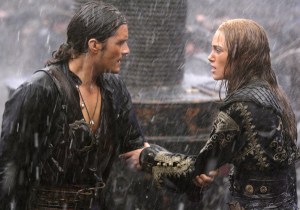 The movie is not without its due pleasures. Depp is always going to enchant with his now iconic character, but the true star of the film is Rush, who makes welcomed return. The special effects are still tops. The sequence rescuing Jack from the world of the dead provides many trippy moments that possess their own strange beauty, like when we watch the Black Pearl sail against the black, star-spotted sky. It’s fun seeing Keith Richards appear in cameo as Jack’s father and the stated inspiration for Depp’s performance. A small man and a large gun makes for one very funny sight gag. A Mexican standoff that actually involves an armed monkey is a comic high point. It’s just that all the fun or memorable moments seem to be the ones that matter the least. At World’s End still manages to do enough right to work, especially its Singapore opening. As far as a movie that upholds the quality of its franchise name, that’s a whole other matter.
Pirates of the Caribbean: At World’s End is a somewhat entertaining but heavily flawed final film to a trilogy. It’s the darkest and trippiest of the three movies, but it also makes the least amount of sense and has the least amount of action. That doesn’t seem like a good exchange in my book. There are not enough important events to justify the bloat. At World’s End has a hardcore case of butterfingers when it comes to handling plot and character setups from earlier films, and as a result almost nothing and no one ends in a satisfying fashion. The effects are still eye-popping and Depp will always be a comic treasure, but this lackluster movie feels like tripping at the end of a marathon. I had so much hope for At World’s End after how gratifying I found the other two movies but I cannot quell my disappointment. This is not a fitting conclusion. This feels more Matrix Revolutions than Return of the King. Of course it’ll make tremendous amounts of booty at the box-office, but will demand for a fourth be as rabid after this muddled and murky capper?
Nate’s Grade: B-
Share this:

Spider-Man 3 (2007)
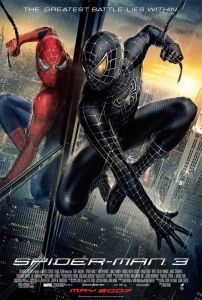 Who the hell are you Spider-Man 3 and what have you done with the franchise I loved? After the massive commercial success of first two Spider-Man chapters, my expectations had been raised fairly high. The more time that passes the more I reflect on how disappointing Spider-Man 3 sadly is. Part of my dashed hopes are because the 2004 Spider-Man sequel was a wonderful follow-up to a pretty swell introduction, and I placed that movie in my Top Ten list for the year and consider it one of the best comic book movies of all time. There’s some great popcorn entertainment to be had with Spider-Man 3, but man is this film just beside itself in wasted potential, a lack of focus, and some really poor choices.
Things are going pretty well for Peter Parker (Tobey Maguire). He plans on asking Mary Jane (Kirsten Dunst) to marry him and New York City is planning a parade out of appreciation for Spider-Man. But the good times can’t last long. Harry Osborn (James Franco) has accepted his fate and become a second generation Green Goblin villain, out to avenge his father’s death at the hands of Spider-Man. But Peter also has to be on the lookout for his job at the newspaper. Eddie Brock (Topher Grace) is an unscrupulous photographer out to replace Parker and nab a picture of Spider-Man caught in a bad light. An alien substance has also hitched a ride to Earth via meteorite and sought out Peter Parker. The black goo attaches itself to Peter and forms a black Spidey suit, one that gives him intoxicating power and a slimy menace. The new Peter cavalierly flirts with bouncy lab partner Gwen Stacy (Bryce Dallas Howard), hurts his friends, and loses his do-gooder ways.
Meanwhile Flint Marko (Thomas Haden Church) has escaped from prison. It seems the police got it wrong and now inform Peter that Marko confessed to being the one who killed Peter’s uncle. While on the run Marko happens to tumble into an open pit that is a science experiment and becomes fused at a molecular level with sand. He uses this new power to rob banks in order to save his sick daughter at home. Peter, with the power of the alien suit, hunts the Sandman to get his own slice of sticky vengeance.
 The film has way too much on its plate. There are too many characters, too many undeveloped storylines, too many coincidences, too many contrivances (Amnesia? Really? Really?), and too many aborted moments of drama. Spider-Man 3 is an undisciplined mess. The film practically stumbles from one scene to the next and lacks the coherency and intelligence of the earlier entries in the series. The third film tries to do too much and please too many interests, and as a result it may end up pleasing few fans. I had some trepidation when I learned that there was going to be upwards of three villains for this movie, but I swore that it could work since Batman Begins confidently worked around a trio of big bads. Three villains do not work in Spider-Man 3. Let me dissect this rogue’s gallery and where they fall short.
1) The Sandman is kind of a lame idea from the start. His power seems to limit his available locations, and I’m surprised that he wouldn’t stick to beach areas as a means of playing to his sandy strengths. Regardless, the character plays no part in almost anything that happens, and the Sandman is given one note to play. He’s got a sick daughter and he robs to try and pay for her medicine. That’s great on paper but it never really seems to give the character any sense of urgency or frustration. If he got special sand powers why not sneak into banks through cracks in walls instead of forming as a giant sand monster? Church attempts to imbue the character with a sad soul but he just comes across as being wooden. If he was really on the hunt for money to save his daughter then why does he just slouch around all the time? Wouldn’t it be easier to rob a city not patrolled by a web slinging super hero? How can he say he’s a misunderstood victim of luck just minutes after he tried killing Peter? He seems like a dull lunkhead. The Sandman is given a tiny wisp of character detail (sick kid!) and that’s it. He doesn’t get any other characterization and is kept on the run and pops up whenever the film needs him. He becomes a token character until the very end where Church is given 2 minutes to pour his heart out to Peter. Two minutes of character at the start, two minutes at the end, and a gaping center. The Sandman isn’t so much a character as the ideal of some issue that the filmmakers want to have Peter work through.
And what is that issue? Why vengeance and forgiveness. You see, Spider-Man 3 foolishly rewrites its own history and now it was the Sandman hat killed Peter’s Uncle Ben. This revision does not work at all and actually legitimately damages Spider-Man. Just like Bruce Wayne is tackling crime to alleviate his guilt, so too is Spider-Man, who can never shake the fact that he could have prevented his uncle’s death had he done the right thing moments before. By introducing a new killer it means that Peter has no responsibility for his uncle’s death. This completely strips away the character’s guilt and rationale for what compels him to swing from building to building to fight crime.
 2) Eddie Brock/Venom is wasted as well. Director Sam Raimi has said before he’s not a fan of Venom and doesn’t get the character, and I feel that his contempt carried over into the film. Venom and the black alien goo are given about the same abysmal care as other half-baked plot points. Eddie Brock has about three total scenes before he gets to transform into Venom thanks to the alien substance, and none of these scenes fully flesh out who the character is or justify his relationship with Peter Parker. When we do see Venom in the finale its all too rushed and hokey. The effects make him look less like alien and more like a wax figurine (I suppose there could be intelligent wax life amongst the stars). For whatever dumb reason the alien suit has to retreat so we can see Grace’s face while he taunts and mocks with bad vampire teeth that are meant to inspire what exactly? The character is rushed and underdeveloped and should have been saved for the next sequel instead of being given lip service in this one. Venom is supposed to be the evil doppelganger to Spider-Man, not some smart-alleck with frosted hair that gets about 15 minutes of screen time. I like Grace, I really like him a lot and envision him as his generation’s Tom Hanks, but he does not work in this movie. He could, but I get the sneaking suspicion that Raimi sabotaged the Venom role on purpose or at least subconsciously. The villain goes out with a whimper and it feels like a giant, foolish wasted opportunity that becomes more maddening the more I discuss it. The presence of Venom feels like a shallow attempt to placate a younger generation of comic fans and to sell more action figures.
The alien goo suit is supposed to tempt Peter and bring out his wicked wild side. So what does he do? He acts like he’s auditioning for the lead in The Mask. This embarrassing sequence is painfully goofy and will make you cringe and shield your eyes. Peter flirts with girls and dances at a jazz club, and this is supposed to be the dark side of Spider-Man? What the hell? I acknowledge that Peter has always been an unpopular dork and would be a dork even if he ventured to the dark side, but how does this square with the more serious and edgier tone the film is grasping for? Evil Peter seems more like a broody emo kid, with shocks of black hair in his eyes and traces of eyeliner. The dark side of Spider-Man, much like the rest of the film, is given little time or thought. Peter’s trials with the symbiotic suit last about a reel or two and then it’s abruptly finished.
 3) Harry should have been the main focus of this sequel and it?s a shame the filmmakers had to cram so much crap into a story already heavy with plot leftovers. Harry has the most obvious arc through the three movies and deserves better than to be knocked out of commission by amnesia. The conflict between Peter and Harry is where the film finds its emotional core and it would have been wise to expand this section and eliminate one of the other underutilized villains (my vote: both Venom and Sandman). Harry’s vow to avenge his father is far more interesting than what the other two villains have as motivation, and plus Harry requires no extra time-consuming setup to slow the pacing down. I’m glad the final battle encouraged Harry to come out and play; the film finally gives Franco the screen time he deserves, but it should have been more. The worst plot device in the film involves Harry’s all-knowing butler who has some vital information he most certainly should have shared years ago. So much time is spent on storylines that go absolutely nowhere, and the musical chairs of villains, that the film resorts to having a freakin’ butler tap someone on the shoulder and say, “Excuse me sir,” just to tie things up in the most awkwardly shrift way possible. And even if what the man says is true, how does his perspective add any clarity to the situation? Think about it. I have.
The romance between Peter and Mary Jane feels awfully trite and meandering. Spider-Man 3 lacks the tight focus of the second film. It throws contrivances to place a wedge in their relationship, like the fact that Mary Jane is fired from her Broadway gig but doesn’t tell Peter, or the fact that they never seem to answer the phone on time when the other person is apologetic. Gwen Stacy is less a character than simply a dimwitted blond tool to make Mary Jane jealous and sulk. The ups and downs in this relationship feel pretty forced and some moments defy all human understanding. At one point Mary Jane is forced by Harry to break up with Peter to spare both their lives. So she breaks the news in a park, and Peter is devastated, but why in the world does she never say anything again? Why would she not clear things up after time had passed to explain her actions? Spider-Man 2 ended with Peter finally getting the girl but also on a hint of doubt, and it was marvelous. Spider-Man 3 just sort of ends with everyone presumably in the same place they started.
Spider-Man 2 really succeeded on how focused it was and how it related its action with character. Spider-Man 3 has to resort to cheap and lazy devices to cover its storytelling pitfalls. Don’t even get me started on the fact that the film has to resort to a newscaster narrating our final battle where he actually asks, “Is this the end of Spider-Man?” This might be the end of the quality associated with Spider-Man.
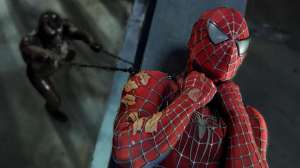 After having spent a whole slew of words detailing in length where the film goes wrong, allow me to illustrate some of what the film does right. Whenever it sticks to action, that’s when Spider-Man 3 works, and Raimi has cooked up some wonderful whiplash-inducing action sequences. The first battle between Peter and Harry is intense and sets the film on the right path, but the action as a whole isn’t as closely tied to Peter’s domestic life and emotional troubles as it was in the other films. A high-rise rescue from a crumbling office building will stir some 9/11 memories but it is awesome to behold. The effects have improved and the swinging shots through New York look the best they ever have. The greatest moment in the film is perhaps the birth of the Sandman as he rises grain by grain from a pile of sand and attempts to reform himself. Aided by some lovely music, the moment takes on a beautiful and unexpected poignancy. This is where Raimi and the CGI wizards hit it out of the park. Nothing rivals the train sequence in Spider-Man 2, though.
It might be dangerous to say, but I feel jilted from this film and either new blood needs to be brought in or the filmmakers need more time and control to make a Spider-Man sequel worthy of its name. This is the gold standard for super hero movies and its been tarnished and sullied. Spider-Man 3 has moments to dazzle and excite but it also feels battle fatigued from carrying the dead weight of extraneous characters and half-baked storylines. There are too many balls in the air for Raimi to juggle. This Spidey chapter squeezes too many ideas in too short a space. After obliterating box-office records, Sony has stated that they plan on three more Spider-Man sequels. If this film is the tipping point, then I’m afraid of what will be swinging down the pipe in years to come.
Nate’s Grade: C+
Share this:

Smokin’ Aces (2007)
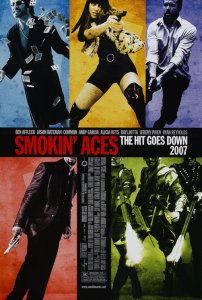 Writer/director Joe Carnahan (Narc) wants to impress an audience so bad with his muscular and macho gangster flick, but his Smokin’ Aces is vapid, nihilistic, and opines not to simply be a Tarantino rip-off, but a rip-off of a Tarantino rip-off. The premise seems ripe enough as we follow a rogue’s gallery of hitmen and killers trying to be the first to knock off a mob snitch/Vegas magician (Jeremy Piven) for a million dollar bounty. The colorful characters are introduced and some are quickly and unexpectedly taken out, but Carnahan never fully knows what to do with his bushel of baddies after he establishes their character quirks. The killers don’t really interact that much with one another and some of them hardly have any screen time at all; perhaps less would have been more in this jumbled stew. Carnahan throws out a few nifty visual tricks but it’s all superfluous and empty. Smokin’ Aces moves quickly, doesn’t make much sense in the beginning and end, and little to any of the characters have satisfying conclusions. So much of the writing feels like lame macho posturing without anything new or interesting to add to an overstuffed shoot-em-up. There are cops, robbers, plenty of gunfire, lesbians, and all sorts of convoluted twists, but it never holds together. Carnahan throws a lot of different elements together but they never extend beyond the elemental stage, so every storyline and character feels like an introduction that?s never capped off. The man has no idea what to do with what he’s started, and a karate kid on Ritalin is all the proof I need. Guy Ritchie did this territory far better service with the marvelously entertaining 2001 film Snatch. Rent that instead and save yourself the headache.
Nate’s Grade: D+
Share this:

Grindhouse (2007)
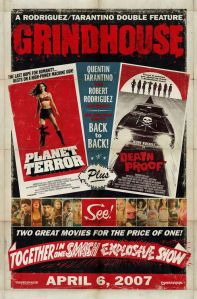 The movie going experience isn’t what it used to be, and Quentin Tarantino and Robert Rodriguez want to do something about it. There?s no denying that the joy of seeing a movie has been watered down a bit; there’s soaring ticket prices, floundering product, and let’s not forget the influx of teenagers with cell phones. Rodriguez and Tarantino grew up gorging upon the exploitation films at their neighborhood grindhouse, where they could see kung-fu, blaxploitation, gory Italian zombie movies, and nearly anything that promised to be titillating and shocking. These movies dealt in copious amounts of sex and violence on a shoestring budget and teenagers lapped it up. Grindhouse was designed to be a double feature with Rodriguez and Tarantino each writing and directing an 80-minute movie. This three-hour plus movie is stuffed to the gills with 70s reverence, right down to cheesy retro clips telling us the film rating via an animated cat. If Rodriguez and Tarantino could, they probably would make the floors stickier just to round out the experience. But that’s the marvelous thing about Grindhouse — it turns the filmgoing experience into an event once again.
First on the bill is Rodriguez’s Planet Terror. An outbreak is about to sweep across a small Texas town. A toxic green gas is causing people to break out in festering wounds that are spreading rapidly. Cherry Darling (Rose McGowan) is a go go dancer who runs into an old flame, Wray (Freddy Rodriguez), a badass drifter with a dark past. They get attacked by a group of “sickos” who take Cherry’s leg as a chew toy. At the hospital we’re introduced in rapid succession to Dr. Block (Mary Shelton) and her creepy husband (Josh Brolin) she plans on leaving for the lovingly massive cleavage of Fergie from the Black Eyed Peas (she gets eaten and can, one assumes, be described as being Fergilicious). The sheriff (Michael Biehn) has an unsettled score with Wray and refuses to trust him, even though the town is slowly being overrun by what appear to be zombies. The survivors take refuge at a Bar-B-Q joint, run by the sheriff’s brother J.T. (Jeff Fahey), located only two miles away from the military outpost that released the gas.
 Planet Terror is a great blast of fun, a perfect ode to schlocky B-movies. Rodriguez creates action movies closer to cartoons, and the more over-the-top and crazy things get the more joyous his films generally turn out. This is a gonzo world cranked up to a wonderfully weird wavelength, where Cherry can have a machine gun leg without any nagging question on how she even gets it to fire let alone why it would be more accurate. It doesn’t matter because this movie is all about 80-minutes of awesome, twisted, gloriously gory fun. Planet Terror isn’t the first zombie comedy, and its inspirations are quite plain, but the film establishes a wide-range of colorful characters effectively and then ramps up the chaos. Rodriguez amuses with even small touches, like a woman trying to operate a car with a anesthetized hands, a pair of skimpy babysitters who clobber a car with baseball bats, and a bio-chemical scientist (Naveen Andrews) that has a penchant for collecting and bottling the testicles of the men who fail him (hey, we all need hobbies). Even amongst an exaggerated canvas there’s still plenty of humor and adoration for the grindhouse experience, like when the beginning of a sex scene is interrupted with a “reel missing” sign. Rodriguez also intentionally downgrades the look of his film, adding hairs and scratches and pops in the film to look like it had been dragged across the floor. Planet Terror even has a dreadfully dated synth score to compliment the full-tilt celebration of splattery schlock.
Tarantino’s Death Proof is going to sharply divide audiences. The action in Planet Terror is relentlessly paced, which makes the adjustment to Tarantino?s half all the more hard. Rodriguez is all about genre relevance and making a film that would excel in the grindhouse era; Tarantino, on the other hand, is all about taking the genre and catapulting it into something ambitious and different and greater.
 Death Proof is Tarantino’s take on the slasher horror genre, with the unique twist being that Tarantino?s roving killer takes out his prey with his car. Stuntman Mike (Kurt Russell) is a stuntman of the old guard. The youth of the day have no idea of the TV shows he worked on or the celebrities he rubbed elbows with. The only lasting visages he has from those removed days are a long scar decorating the side of his face and his stunt car. The vehicle has been outfitted to be death proof, meaning that Stuntman Mike can get into any wreck and come out alive. A group of women are visiting Tennessee for a film shoot. Abernathy (Rosario Dawson) is a makeup artist, Lee (Mary Elizabeth Winstead) is an actress, and Zoe Bell (herself) and Kim (Tracie Thoms) are professional stunt women. The stunt ladies are interested in test-driving a Dodge Charger, the same iconic car used in Vanishing Point. Zoe wants to play a dangerous game known as “Ship’s Mast,” which entails strapping herself to the hood of the car as it speeds along. This is when Stuntman Mike comes roaring with his death proof material and plays an extreme game of chicken.
The narrative structure of Death Proof is deliberately slow. The focus is on a group of Texas girls (including Sydney Poitier’s daughter named, rather unoriginally, Sydney Poitier). They dance to jukebox jams and drink. And they talk, and talk, and talk, and talk. The dialogue is clever but you worry Tarantino has been hypnotized by his own pithy writing. The movie drags a bit but mostly because it follows a film that had the pace of a runaway train. The slow buildup is an intentional correlation to slasher films, which would spend their first half hour setting up characters for the eventual slaughter. I liked how Stuntman Mike was seen playing with his prey and interacting with them. The wait is worth it, though, but then Tarantino turns around and repeats this same setup with a new batch of girls. Many will grow impatient going through the same process all over again and become irritated that they have to endure another round of talky pop culture diatribes in order to get to some more vehicular manslaughter. And at this point, the only character the audience has any affinity for is Stuntman Mike, so it’s a little tough to wait so long for his reappearance. When he does appear, the movie takes some unexpected turns and transforms into a female revenge thriller that left my audience cheering by its conclusion. My wife loved it. I married the right woman.
The makeup work is outstanding. Most of the effect work gets its spotlight during Rodriguez’s half, and Greg Nicotero and KNB have created the most gut churning, sickeningly inventive makeup work since John Carpenter’s The Thing. Rodriguez’s Planet Terror is dripping in blood, and the gore is heightened to such an unrealistic, comical degree that it becomes more tolerable and, in the end, another element in the overall outrageous vibe of the film. Some memorable gore work includes makeup pioneer Tom Savini being ripped apart like a child’s jigsaw puzzle, soldiers whose faces undulate and bubble until they look like close relatives of the Elephant Man, and a truck smashing against bodies like they were made of paper and filled to the brim with Kool-Aid. This is the kind of movie where entire hoses of blood explode from single gun shot wounds. It is a gory, gruesome, sticky icky movie but that?s part of the fun.
 Whereas the makeup work shines in Planet Terror, the stunt work in Death Proof is stupendous. Bell was Uma Thurman’s stunt double in the Kill Bill tandem, so by writing a part specifically for her Tarantino knew he could get up close and personal during the scary moments. Seeing Bell struggling to stay atop the hood of a car zooming at 80 miles per hour is nerve-racking and exhilarating, and you know there isn’t any computer trickery given how Tarantino’s own characters bemoan how computers have blunted action cinema output. That really is Bell and even though it’s all a movie a part of you does think, “Oh my God, this woman is going to die for real.” This killer bumper-car sequence in Death Proof will have you holding your breath. It takes much longer for Tarantino to rev up his action, but when he does he puts the pedal to the mettle.
But don’t get up for pee breaks once Planet Terror is over, because you may miss some of the best parts of Grindhouse. In between the feature films are three fake trailers directed by friends of Tarantino and Rodriguez, who made a fake trailer himself for Machete, about a Federale (Danny Trejo) out for revenge. The Machete trailer gave me the everlasting gift of a line, “They f***ed with the wrong Mexican.”
The best trailer, hands down, is Shaun of the Dead director Edgar Wright?s trailer for Don’t, a Dario Argento style horror film where a narrator instructs the audience lots of items not to do (“If you are thinking about turning this door… DON’T! If you think about going into the basement… DON’T!”). What makes Don’t so wonderful is that the trailer builds a thick head of steam, to the point where all wee see are bizarre rapid-fire images and the announcing repeating the message, “DON’T!” The momentum builds to a great comic high that left me giggling.
Eli Roth, who gave us Hostel and Cabin Fever, one of my all-time favorite filmgoing experiences, runs a close second with his slasher trailer for Thanksgiving. The concept is rather straightforward, a person dressed as a Pilgrim picks off residents around Turkey Day, and a great showcase for Roth’s sense of tongue-in-cheek homage and his warped sense of humor. This trailer has some gasp-inducing moments, chiefly among them a topless cheerleader who performs the splits right onto a knife blade. Wow. Then there’s a guy humping a stuffed turkey with a human head attached. I’ve said it before and I’ll say it again, Roth is one sick bastard but he’s my kind of bastard.
 Rob Zombie’s trailer for Werewolf Women of the S.S. sounds better on paper than how it turns out. There’s a subgenre of Naziploitation films (did you know you could add “-sploitation” to damn near any word?), most famously popularized by Ilsa, She-Wolf of the S.S. Zombie’s trailer has got hairy wolf boobs, Nazis, shiny fetish outfits and S&M, but it feels too new and doesn’t work on the same vibe of Grindhouse. It feels too polished and too happy with itself; it spends more time telling you who’s in this fake movie than delivering anything juicy. The trailer is saved by a brilliant cameo by an actor whom I will not spoil, but suffice to say that I was left in stitches.
Honestly, I cannot say another movie released this year that provides more bang for your buck than Grindhouse. Tarantino and Rodriguez’s double bill will leave you giddy. This is the fastest 3 hours and 10 minutes of your life, folks. Unfortunately, the film hasn’t been doing as well at the box-office and this has caused the Weinsteins to contemplate splitting the films into two to make the most of their investment. I suppose Grindhouse was never going to have a 300-sized audience, since the idea of making a sloppy three-hour love letter to trashy cinema seems destined for a limited appeal. This is a high-art tribute to high camp, and you really do feel you get more than your money’s worth even if you pay, like I do, 10 bucks a pop for a show. I can’t imagine having a better time at the movies this year than the one I had during Grindhouse.
Nate’s Grade: A
Share this:

300 (2007)
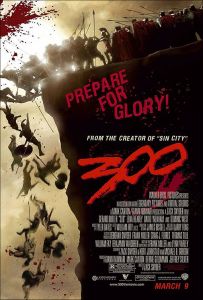 The story of the 300 is the story of the Battle of Thermopylae in 480 B.C, 150 years before Alexander the Great. Xerxes (Rodrigo Santiago) has deemed himself a “God king” and his Persian army has been conquering Asian nations and acquiring the most massive military force of its time. He sets his sights on conquering Greece, and to do so must go through the narrow passage of Thermopylae.
King Leonidis (Gerard Butler) assembles 300 of his finest Spartan warriors to thwart the Persian invasion. The Spartans were the super soldiers of their time, a society that valued brute strength and the honor of combat. Children born with imperfections were cast onto the rocks to perish; the society couldn’t afford a weak link in its protection. One day a Persian emissary rides into Sparta carrying the skulls of other kings and princes and a message from Xerxes: submit or you’re next. Well, after the emissary insults Queen Gorgo (Lena Headey), he refutes the message and kicks the emissary down a giant black pit in the middle of town (is this where they dump their garbage?). Thus, as they say, it is on. The Greek city-states have no sense of nationalism, so Leonidis commands little support to thwart the advancing Persian hordes. The Spartans have discipline and superior equipment, and because of these advantages they are able to hold back overwhelming numbers from the Persian army.
 Back at the home front, Queen Gorgo is wheeling and dealing behind the scenes to state her case to the Spartan assembly. She needs to shore support for more troops to help her husband. Theron (Dominic West) is a member of the priesthood that looks to sexually charged Oracles for guidance. However, he’s willing to drop his pacifist stance if the queen drops her robe and grins and bares it.
Xerxes is not a happy “God king.” He tries appealing to Leonidis, insisting that if he will simply bow down and relent than he will be spared. “Imagine what horrible fate awaits my enemies when I would gladly kill any of my own men for victory,” he threatens. Leonidas replies, “And I would die for any of mine.” The two men (well one man and one God king) go back to their corners ready for another round of this epic slugfest.
The action sequences are intense and director Zack Snyder (2004’s Dawn of the Dead) heightens their realities with surreal touches. He fondly gives life to the bloodshed and exaggerated combat popularized from Frank Miller?s graphic novel. The Sin City author has created another testosterone-soaked hyper-real adventure. The movie doesn’t even flirt with the notion of rigid historical accuracy (I doubt the Spartans fought rhinos, giant mutants, and were done in by a disgruntled hunchback); the film uses Miller’s artwork as a jumping point, which means that the Spartans fight in leather codpieces and red capes and that combat is more one-on-one even after we learn about the important of the phalanx. But quibbling over inaccuracies is a waste of time, because 300 is a pumped-up, super cool action movie that plays out in a vivid dreamscape. The movie was filmed with extensive green screen, much like Sin City was, and it feels like a direct transition of Miller’s pulpy comic book. Even the farewell sex between the King and Queen is stylized and seems to be snippets or panels from a comic book.
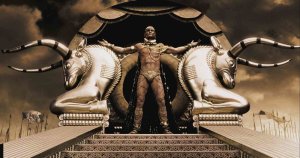
Let’s all be honest, there’s something undeniably homoerotic about 300. The movie worships the male form, with rippling abs and bulging biceps lovingly showcased in glowing, sweaty, fawning detail. The movie also focuses on manly men primarily spearing one another with phallic weaponry while the spurting blood dances across the camera in balletic CGI spasms. There?s a definite gay appeal to this film, not that there’s anything wrong with that. However, 300 also manages to curiously be homophobic at the same time (I swear this came to me independently, Phil). Xerxes is designed very as being very fey even at a massive height of eight feet. He lays his hands against Leonidis’ shoulders and asks for him to submit, and you can’t help but wonder what the teen boys in the audience are thinking. Xerxes also has a party tent filled with whores, the disfigured, transvestites, and the overall effeminate opposite of all those Greek macho muscle men the film postures as elite specimens.
 The acting is set to one tempo and that’s a mesmerizing use of yell-speak; it’s part guttural and part long-standing bellow that makes any piece of dialogue sound macho. King Leonidis growls, “SPAAAAAAAARTANS! TONIGHT WE DINE IN HELLLLLLLL!” After two hours of this primal style of speech, it becomes somewhat infectious and you want to try it in everyday situations in your life. Next time you’re out with friends at a fine dining establishment, I suggest asking for the salt thusly: “DINING PAAAARTNAAAAAH, COULD. YOOOOOOOOOU. PAAAAAAAAASS. THE SAAAAAAAAAAAALT?!” You’ll be guaranteed to get a reaction. It strains my throat even writing about the 300 yell-speak.
300 is a rousing movie going experience that plays out in a beautiful, pristine dreamscape that closely resembles our planet. The action is highly stylized and frenetic. It’s just that when the film stops to take a breath you start to look elsewhere, and when you do you realize there isn’t much below the blood-caked eye candy shell. 300 is grand spectacle that elicits thrills and chills, but the movie fails to touch on emotions beyond loyalty and courage. Both are essential for a soldier, and one as dedicated as a Spartan warrior, but the lack of substance keeps 300 from being anything other than a visually arresting, if ultimately disposable, two hours at the movies. There’s nothing wrong with a movie whose sole purpose is to quicken the pulse for a short supply of time, and 300 succeeds smashingly with this singular ambition. It is an ass-kicking history lesson that makes me wish I could learn more about Persian executioners with blades for hands at my local library.
Every culture has their own account of a last stand, a small group that heroically held off seemingly superior forces (remember the Alamo?). Snyder and Miller present an entertaining hack-and-slash primer through history that’s rarely dull and often enchanting to the senses. Deep down, there may not be much more to 300 than a lot of pretty pictures and a bunch of chiseled hunks, but that?s enough for most carnage fans with a free afternoon.
Nate?s Grade: B


You must be logged in to post a comment.