Blog Archives
Tag (2018)
 Tag is based on the true story of a group of grown men who continue to play a highly competitive game of tag for 30 years. There are even real clips of the real men before the end credits, raising the hope for a potential documentary on the subject. The Hollywood version is a sprightly ensemble comedy that’s not afraid to go silly or dark in its pursuit of laughs. Given the nature of its premise, there is a lot of slapstick to behold, but it was cleverly staged, routinely netting some big laughs from me. This is a definitely adults-only R-rated venture and the movie proudly wears this identity on its sleeve, finding strange and exciting comic detours that can walk a fine tonal line, like an ongoing bit about miscarriages that had me wincing as much as I was laughing. The main characters are all relatively familiar types; Ed Helms is the high-strung dweeb, Jake Johnson is a sarcastic stoner, Jon Hamm is a smarmy exec, Hannibal Buress is as laconic as his standup persona. There are a string of supporting characters (often female) that add very little, including a rekindled love triangle with Rashida Jones, a journalist who tags along on the game and adds nothing, and Isla Fisher as the grating, always-yelling, intense wife to Helms. Surprisingly, the funniest member of the movie is Jeremy Renner, an actor who heretofore had never shown much comic ability in movies. He’s a formidable opponent, and every time he went into his Sherlock Holmes-styled voice over detailing the steps and mistakes of his friends, I loved it. Also, strangely, Renner’s arms are actually CGI arms since he broke them days into filming. You would never be able to tell. I appreciated that Tag is directed as a comedy even during its action set pieces. It looks at action through the lens of comedy and taps into the absurdity. Overall, Tag is a fun, rambunctious comedy with some dark impulses yet it still finds room for sentiment that doesn’t feel entirely out of place. 2018 is shaping up to be the year of the hearty, enjoyable R-rated comedy with Tag joining the ranks of Blockers and Game Night. Catch it while you can if the prospect of men behaving like overgrown children appeals.
Nate’s Grade: B
Share this:

Incredibles 2 (2018)
 The prevailing problem with Pixar sequels (and prequels) lacking “Toy” in their title is that they never feel like stories needing to be told, tales that will enrich our understanding of the characters and their larger world. I would much more gladly like a Monster’s Inc. sequel where Adult Boo is visited by her old closet-dwelling friends rather than an inoffensively cute prequel explaining how characters became friends long ago. The Incredibles universe always seemed like the one most demanding of a real sequel. Writer/director Brad Bird created a rich retro-futuristic world with numerous possibilities. I’m happy to report that Incredibles 2, while not soaring to the exact heights of its predecessor, is still a very worthy sequel that even manages to outshine the original in select areas.
Taking place literally seconds after the conclusion of the 2004 film, the Parr family fights together against the Underminer. The city, however, is none too happy about the collateral damage. Superheroes are still illegal. There’s no more relocation either. The Parrs are stuck, until a pair of billionaire siblings (voiced by Bob Odenkirk, Catherine Keener) reaches out to try and repeal the superhero ban. They want to position Helen Parr a.k.a. Elastigirl (Holy Hunter) for the public relations campaign (she causes a lot less collateral damage than her husband). Bob Parr a.k.a. Mr. Incredible (Craig T. Nelson) encourages his wife to go out and save the day, though he’s barely holding back his jealousy. He takes on the domestic duties, helping Dash (Huck Milner), moody daughter Violet (Sarah Vowell), and the young baby, Jack-Jack (Eli Fucile, reprising the role of voicing a baby, for real). A villain known as the Screenslaver is terrorizing the city and hypnotizing citizens through hijacked broadcasts. Elastigirl tries to uncover the mystery of the Screenslaver while Mr. Incredible tries to juggle the realities of stay-at-home parenthood.
 Bird’s sense of visual inventiveness is still heartily alive and whimsically well in the medium of animation. Bird’s original film was an imaginative marvel with its intricate action sequences, some of which are the best in any medium, animated or live-action. He’s a choreographer of action that upholds the basic tenants of action, namely that if you have characters with special abilities, they should be utilized, along with attention toward geography and the purpose of the scene. It’s a genuine pleasure to watch well developed action sequences that go beyond flashy style, that account for mini-goals and organic complications. Take for instance Elastigirl’s motorcycle chase scene. It’s exciting as is but when the bike breaks apart, taking advantage of Elastigirl’s stretchy powers, that’s when it becomes even more gratifying and clever. There is a group of lesser super heroes that come out of the shadows thanks to Elastigirl’s heroics. At first they’re played for primarily comedic value, but Bird smartly turns them into a force to be reckoned with when they band together. I especially appreciate having a character with portal-manifesting powers and finding many opportunities to explore this unique power. When the film is humming with its visual energy and inventiveness, Incredibles 2 is a gloriously entertaining and satisfying action movie told by one of the best on the business.
The action is on par (no pun intended) with the first film even as the overall experience lacks the emotional stakes and depths of the first Incredibles. That should not be seen as some destabilizing deficiency as The Incredibles was a nearly flawless film (it’s my second favorite Pixar film after WALL-E). There were moments in the original film that transcended the superhero setting, where they Parr family felt like real people with real emotions and relatable stakes, like Mr. Incredible’s confession that he’s not strong enough to suffer the loss of his family. While Bird’s film made several homages to the James Bond cannon, there were real stakes. People could die. Many superheroes did, albeit mostly off-screen. This was Pixar’s first PG-rated film and that’s because it dealt with some heavy thematic issues in a mature manner. The bad guys weren’t like the movies, Helen Parr warned; they would kill children if given the chance. Incredibles 2 doesn’t have any real moments like that to cut through the whiz-bang.
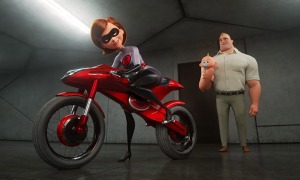 This time it’s Elastigirl enjoying the limelight, and there’s a notable feminist message of a woman finally getting her due. She relishes the adventure though is willing to sacrifice it for her family if needed, which her husband will refuse to allow her to do. Her success is his success, he reminds himself. The sooner she succeeds the sooner he can also get back out there to fight crime. I think one of the reasons the characterization isn’t as developed this time is because of the abbreviated time frame. We’re literally picking up seconds from the first movie and dealing with the immediate consequences. We’re only following the events of a few weeks, maybe months at most, and while the Parr family undergoes trials and disappointments, It feels like maybe there just wasn’t enough space for the characters to have succinct arcs and grow substantially. This is a quibble for an otherwise great movie. Incredibles 2 still stay true to the characters you love.
The exploration of Mr. Incredible’s descent into domestic life was my favorite part of the film, and I had been worried it would be outdated Mr. Mom-style jokes. The movie steers away from most of the tired gender tropes, moving past simply having an incompetent man performing household duties in hilariously incompetent ways. The jokes aren’t dependent upon a man doing them so much as someone who feels out of step and beleaguered, so parenthood in general. The first movie was about midlife identity crises and that has carried over into this sequel as well. Bob has a meaningful challenge with each one of his children, having to re-learn old concepts with his son and adapt to new ones, having to tackle the minefield of dating with his daughter and finding the right tone, and the increasingly the demands of a child with, let’s call them, special needs. The Jack-Jack segments are inspired pieces of old school Looney Tunes slapstick. Each new power provides another point of discovery for our characters that, remember, are initially clueless about Jack-Jack’s amazing abilities. Mr. Incredible is so eager to get back to being a super hero that forcing him to confront his own inadequacies as a parent is a smart way to better open him up as a three-dimensional character. I enjoyed the action of Elastigirl’s spotlight missions but I kept looking forward to returning to the other Parrs.
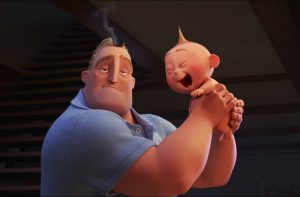 In a few areas I would even say Incredibles 2 has its original beat, especially in the realm of comedy and visual inventiveness. Part of that is simply the advancement of the technology allowing Bird more freedom to up the ante as well as showcase more intricate facial emotions. There are some areas that just cannot compare, which is not to say that they are bad on their own. The late twist of the villain’s identity should be more than obvious for anyone paying attention. The themes of this movie are much hazier this time around. There are a few that pop up, like police surveillance and body cams, then a general screed against the general social malaise brought on from technology, then breaking unjust laws to serve a more realized sense of justice, and then finally the movie settles on what seems like its true theme, the danger of being too dependent on, essentially, government assistance. If the superheroes represent the government, the villain’s plot is to shake people away from waiting for the superheroes to fix everything and growing over reliant on outside assistance (finally a summer blockbuster with a message even Paul Ryan could love). Bird has featured some Randian ideals in past films, The Incredibles a prime example. My pal Ben Bailey strongly believes that the first film’s villain had the right idea though wrong method. Superheroes are by design egotistical. The belief that there are people who are better and deserving of a elite, preferential status seems antithetical with the sequel’s major theme. Or maybe it’s the mutated evolution of Ayn Rand’s sense of political objectivism. Feel free to debate at the kitchen table with your own family.
If the major fault of Incredibles 2 (there is no “The;” look it up if you doubt me) is that it can’t quite live up to the dizzying heights of the original, then that’s hardly a damning fault. In the 14 ensuing years, the superhero movie has become the dominant Hollywood blockbuster, and Bird needed to think long and hard about how his return visit would distinguish itself from a cluttered landscape of super heroics. Bird finds meaningful and interesting stories for both the “normal” version of his family unit as well as their super selves. Fans of the original should find more than enough to entertain themselves with even if the depth and characterization aren’t as wonderfully realized. There’s great comedy, great action, and great fun to be had with Pixar’s best sequel not with “Toy” in its title.
Nate’s Grade: A-
Share this:

Solo: A Star Wars Story (2018)
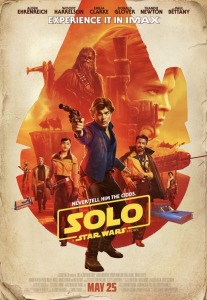 The notorious back-story behind Solo: A Star Wars Story has more than eclipsed whatever else this “young Han Solo” prequel appeared to offer. Directors Phil Lord and Chris Miller were responsible for a string of fast-paced, silly hits like The Lego Movie and the 21 Jump Street films, and when producer Kathleen Kennedy hired them, it felt like an inspired infusion of new blood to make a Star Wars movie different in tone and approach. Five months into shooting and mere weeks away from completing photography, Miller and Lord were fired. The on-set rumors and sources have relayed a badly conceived marriage between the directors, given to improv and irreverence, and Kennedy’s sense of what a Star Wars movie should include. Enter Ron Howard, no stranger to the world of George Lucas, and an extensive battalion of reshoots, and you’re left with Solo, which only lists Howard as director. With that as its genesis, it feels like this movie should be a train wreck. It’s not that. Instead, Solo is fitfully entertaining but underwhelming diversion weighed down by its untapped potential.
Years before that noisy Mos Eisley cantina, Han Solo (Alden Ehrenreich) is a low-level criminal trying to find a better life. He loses his girl, Qi’ra (Emilia Clarke), joins the Imperial Army, and defects, finding a partner in a big hairy wookie named Chewbacca (Joonas Suatamo). The two of them join a crew of thieves run by Beckett (Woody Harrelson), and after a job gone wrong, everyone is in grave danger and deep debt to the crime lord Dryden Vos (Paul Bettany). The crew must even the score and make things right, and they must navigate unreliable allies like Lando Calrissian (Donald Glover), his trusted robotic assistant L3-37 (Phoebe Waller-Bridge), and, most surprisingly, Qui’ra herself, working as one of Vos’ top criminal consultants.
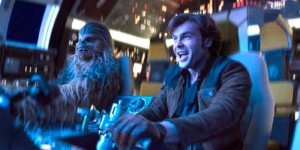 Solo is hard to justify except as an increasingly tedious appeasement to the greater altar of fan service. The movie reminded me of those young author biopics like Finding Neverland where everything is given the unspoken-though-heavily implied significance of dramatic irony, where the audience knows, “Oh, this will be where that comes from, or that’s the first time that happened, etc.” Solo provides further light on the Star Wars minutia that only a scant few will work up real excitement over. For every interesting revelation, like Han and Chewbacca first meeting and bonding, there are numerous others that could best be characterized as cataloging the story of Who Gives a Crap?: The Movie. Who cares how Han got his dice? On that note, did I just not remember this trinket being as heavily showcased in the original trilogy as these new films emphasize? Also, who cares about how Han gets the Millennium Falcon? Who cares how Han got into the smuggling business? Who cares why Han was on Tatooine to begin with? The film expects audiences to supply the significance for scenes that lack that on their own. Too much of the script by Lawerence and Jonathan Kasdan (In the Land of Women) coasts along on audience good will carried over from the original trilogy.
As far as being a heist movie, Solo doesn’t put much concentrated thought with its heist set pieces. Much of the plot hinges on a “job” to recover a large amount of fuel owed to the scary crime boss, so the job itself should be treated as important. Once topside, the characters stick to their ruse for about five minutes and things immediately go bad and then it’s just one messy, ongoing action sequence. I could understand carefully planning a scheme only for it to unexpectedly go wrong, but the appeal of heists are their intricacy, development, and complications, and Solo sadly snuffs this appeal out. The high-point of the film is an early Act Two heist that’s the sci-fi equivalent of a train robbery. Things start off promising with the space craft being able to rotate around its rail, which tickles the imagination for plenty of dire hangings on. We even get a few preparatory words for the plan, though even those are fairly general. And then things start and they immediately go bad and stay that way without satisfying complication. Part of the appeal of heists is seeing the curve balls, the unexpected complications, and how our team reacts and recovers. It’s a fun sequence with some thrilling visuals but it never rises beyond the sum of its action particulars, and so an important set piece is held back from going for greatness. The action throughout Solo is serviceable but rarely does it feel like what’s onscreen is the best version of what it could have been. Serviceable, sure.
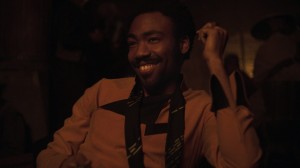 Which brings about the inevitable analysis over what can be gleaned from the final product that traces back to its original team of directors. There are a handful of comic asides that feel like the lasting touch of Miller and Lord. Beyond that, Solo feels very much like Howard’s movie, though much like Rogue One, the mind conjures the possibilities of the original version. One of the biggest changes is that Howard added Bettany’s gangster character. He’s on screen for really two sequences though his importance stretches over the entire film. Solo feels cohesively like one movie to the degree that if you had never heard about the headline-grabbing production tumult, you wouldn’t suspect anything had happened behind-the-scenes. However, the lasting impact seems deeper, namely that many of these sequences feel, to some degree, interchangeable by design. The execution and development feel lacking. It’s a lingering feeling that what you’ve been watching isn’t fully coming together. It’s not fully engaging the attention and making the most of its beloved characters. It feels less like a seminal moment in the story of Han, Chewie, and Lando and more like an extended episode of a television series. I was too detached and grew restless too often. I started waiting for it to be over rather than waiting to see what happened next.
Ehrenreich showed enormous promise with 2016’s Hail, Caesar! both with comedy chops and leading man appeal, so he seemed like a capable choice for a young Han Solo. After rumors of having to hire an emergency acting coach on set, I was expecting a poor performance. He’s decent, grinning through the indignities, stumbling along with a sardonic sensibility that still plays into a confident sense of optimism against the odds. Ehrenreich, much like most of the movie, is perfectly fine, entertaining at times, but far too often a passing blip. The real star of the movie is Glover (TV’s Atlanta) who is brimming with charisma. Plus Lando’s suave, pansexual nature and tendency toward shady scheming lends itself to a more fascinating glimpse at a character we know decidedly less about.
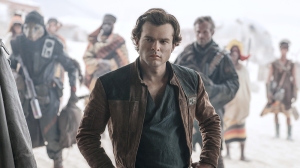 Clarke (HBO’s Game of Thrones) is saddled with a non-starter of a storyline as the old girlfriend who got away. Harrelson (Three Billboards) plays another cranky father figure role. Bettany (Avengers: Infinity War) is generally wasted as a villain lacking a stronger sense of identity or menace. His weapons of choice, two laser-edged knives, seem like where the depth of character creation ended with him. Oh, he also has scars over his face, so that’s about the same as a personality. The lone supporting player that leaves an impression is Waller-Bridge (Fleabag) as the android, L3-37. I could have used an entire movie with her and Lando. She becomes a political revolutionary by accident over the mistreatment of droids, and L3-37 does what the other supporting characters, and even what Ehrenreich to some extent, do not — leave you wanting more.
After its problematic history, it would be easy to look for ways to carve up Solo as a hodgepodge creation of studio interference but that’s too tidy an explanation. I’m not against the idea of a “young Han Solo” film franchise, though it needs to find the right stories to shed new and meaningful light on this classic rogue. Han Solo was, like, mid thirties at the oldest in 1977’s Star Wars and Ehrenreich’s early-to-mid 20s version doesn’t afford a great many differences (he was already a “young” character to start with). If you’ve bought into the Star Wars universe, there should be enough to at least be entertained by, and if you’re a nascent fan, then Solo might be an easily digestible fun adventure. The mitigated or underdeveloped potential nagged at me as I was watching. It’s got aliens and space heists and most of the time I was approaching boredom. I’ll label the movie with its own Scarlet F: it’s… “fine.” It’s the kind of movie you shrug your shoulders at afterwards, not necessarily regretting the experience but moving along. Perhaps we’re just at a natural point in the post-Disney-purchase of Star Wars, and now we’re facing less-than-ideal time-discharged product. I was hoping for more, either good or bad, but had to settle for a relatively lackluster prequel. I don’t know if there will be further escapades with the “young” Han Solo but I wish they choose them more wisely. Even the title feels bland.
Nate’s Grade: C+
Share this:

Deadpool 2 (2018)

It took the leaked release of the Deadpool test footage, and the ensuing enthusiastic fan response, before Fox finally decided to invest in a big screen, R-rated superhero movie. The result was 2016’s Deadpool, a huge smash and proof that a lucrative audience will turn out for more adult-oriented, outrageous, grisly versions of comic book movies. Because of Deadpool, we finally got an R-rated Logan that proved to be an outstanding swan song for Hugh Jackman’s iconic hero. Now Deadpool is getting the spotlight he has earned with a big, splashy summer release, but with success come expectations. Can it live up to the ever-increasing hype? In short: if you were a fan of the original, you’ll be happy enough, because Deadpool 2 isn’t much more than the sum of its zany parts.
Wade Wilson a.k.a. Deadpool (Ryan Reynolds) is killing bad guys for hire and considering starting a family with the love of his life, Vanessa (Morena Baccarin). Trouble emerges when Cable (Josh Brolin) travels from the future to kill a rebellious, troubled young mutant teenager, Russell (Julian Dennison), who will one day grow up to be a monstrous villain. Deadpool reaches out for help and forms an elite squad of determined heroes, notably the luck-assisted Domino (Zazie Beetz). Can Deadpool save the kid, save the day, save the future, and save himself from incessant fourth wall breaks?
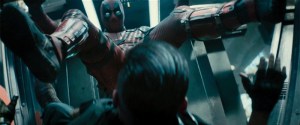
I was worried that a Deadpool sequel would fall into some of the same detractions that a Guardians of the Galaxy sequel did, and this is still applicable. Deadpool, much like the original 2014 Guardians film, was a breath of fresh air and a far looser, weirder, funkier super hero movie with a nose-thumbing, prankish attitude. We didn’t know what to expect from a Deadpool movie and now we do, and with that knowledge comes an anticipated formula of checklists to adhere to, and so any resulting sequel will invariably feel less fresh. It happened with Guardians of the Galaxy vol. 2 so to compensate James Gunn concentrated on fleshing out secondary characters into people you might shed a tear over. Deadpool 2 doesn’t bother because Deadpool 2 doesn’t take anything really seriously. That’s one of the hallmarks of the series and also one of the aspects that holds it back. There can never be a sense of stakes with a gleeful, fourth wall-breaking cartoon of a character who bounces back like Wile E. Coyote. The sequel introduces a sense of stakes with a startling turn in the first ten minutes of the movie, but by the end, even that will be corrected so that the Deadpool universe returns to stasis. The limitation of the Deadpool universe is that nothing feels meaningful or even ambitious. The movie wants to be a cheeky, transgressive good time and it achieves this single goal.
The appeal of Deadpool 2 is still its comedic voice and unpredictability. The laughs will be frequent and there are some subversive and unexpected directions that fully take advantage of the R-rating and the anarchic, nasty comic spirit of the franchise. The formation of the X-Force team and how their first big mission plays out had me howling with laughter. The meta humor commenting on the nature of super hero movies, as well as the film industry in general, begins with the very opening image (a nod to another successful R-rated super hero movie of last year) until the very last moment where Deadpool goes back in time to prevent some stinging cinematic grievances (there is no post-end credit scene, so you can skedaddle early). This is clearly the role Reynolds feels a spiritual kinship with, and his caddish, charming, persistent persona makes the perfect conduit for the film’s vulgar insanity. Whether it’s spitting insults, splashing in over-the-top violence, or making odd observations about the similarities between the songs from Frozen and Yentl, Deadpool 2 is first and foremost a bloody, depraved meta comedy.

Director David Leitch (Atomic Blonde) steps in for the departing original film’s director, Tim Miller, and continues his hot streak of stylish, action thrillers. Leitch has shown a propensity for staging intense action sequences to best showcase intricate choreography. With Deadpool 2, the most exciting moments are when the camera and editing allows the audience to fully appreciate the creativity of the choreography and stunt team. A shot of Cable leaping over the speeding caravan about to smash into him brings on a well-earned wow. Coming from that bruising world, I’m continually impressed with how Leitch approaches his action and finds organic points to develop and complicate matters. The prison caravan attack is the action peak with well-constructed, parallel lines of activity to follow and collaborate upon. It’s our first taste of Deadpool and X-Force versus the might of Cable. The characters enter the fray at different points and get separated from the runaway caravan, which keeps the momentum going. While the comedy is prioritized, Deadpool 2 can still unleash enough exciting, silly, and satisfying action.
The biggest additions to the sequel are an adversary and an ally, and both leave a favorable impression while still making you wish that Deadpool 2 had done more with them. Brolin (Avengers: Infinity War) bulked up considerably to play the gruff cyborg from the future, and his super serious, macho straight man provides a terrific comic foil for Deadpool, much like the stuffy Colossus in the first film. Brolin’s character is a capable fighter with a pretty streamlined back-story (shades of Looper abound) but it’s hard not to feel a little disappointment with how he’s ultimately utilized. He’s a great asset that feels put away for too long. Zazie Beetz (TV’s Atlanta) has a fun introduction especially as it relates to her mutant power, great luck. Deadpool scoffs at this as a power, and “being deeply un-cinematic,” but Domino proves otherwise as she’s able to dodge split-second danger in grand, complicated, Final Destination-like circumstances. Every time she’s onscreen, Domino brings a curiosity quality to the movie, and it’s usually something imaginative and fun. Beetz has an innate spunky energy, which makes it sad when the movie often asks her to be dour and dismissive. It’s taking such a lively character and constricting what makes her amusing and unique.

The biggest thing holding back the film, besides a general sense of “more of the same” or its inherent lack of stakes, is that the entire storyline is built around saving a mutant teen…. and I kind of hated the kid. My first impression was not good and it didn’t get much better from there. Part of it may be that Russell is meant to be an angry, obnoxious teenager, and maybe part of it is the generally grating performance from Dennison (Hunt for the Wilder People), but I could not care about this kid. Unfortunately, a lot of thematic emphasis is placed on saving the soul of this one annoying, wayward teenager. He’s supposed to be a point of redemption for Deadpool and a promise to be fulfilled, but my pal Ben Bailey came up with an instantly better revision. Instead of introducing this new teen character who will one day grow up into a super villain that slaughters Cable’s future family, why not have it be Negasonic Teenage Warhead (Brianna Hildebrand)? We already have an investment in her character and it would provide a better, more personal sense of stakes for the story. Plus, Hildebrand (Tragedy Girls) is actually a good actress.
If you were one of the many fans who enjoyed the irreverent antics of the first Deadpool, then you’ll enjoy Deadpool 2 as it’s more or less the same movie with a slightly limited freshness date. These movies are fun, funny, and ridiculous, but they’re also good for little else than a wicked good time, and that’s okay. There isn’t much ambition to be anything more than an irreverent satire on super heroes with edgy humor and explosive violence. The running theme of the sequel questions what Deadpool has to keep on going, and he’s told it’s one very specific F-word: “family.” I think it’s a different F-word, namely “franchise.” Fox (Disney?) will need the services of the merc with the mouth for an extended engagement as long as audiences do not tire of the same studio brand of naughtiness reheated with a few different ingredients added per revisit.
Nate’s Grade: B
Share this:

Avengers: Infinity War (2018)
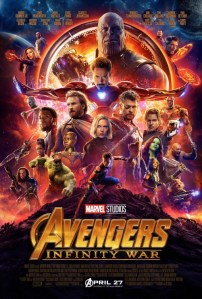 It’s hard to draw comparisons to the major commitment to long-form storytelling that the Marvel Cinematic Universe (MCU) has dabbled with over the course of ten record-shattering years of success. I can think of movie franchises that have been popular over long periods of time, like James Bond, but rarely do they keep to continuity. It’s been 18 movies and ten years since the caddish Robert Downey Jr. first stole our hearts in the original Iron Man, and its stable of heroes and villains has grown exponentially. Looking at the poster for Avengers: Infinity War, it’s hard to believe there’s even enough space just for all of the actors’ names. Infinity War feels like a massive, culminating years-in-the-making film event and it reminded me most of Peter Jackson’s concluding Lord of the Rings chapter, Return of the King. After so long, we’re privy to several separate story threads finally being braided as one and several dispirit characters finally coming together. This is a blockbuster a full decade in the making and it tends to feel overloaded and burdened with the responsibility of being everything to everyone. It’s an epic, entertaining, and enjoyable movie, but Infinity War can also leave you hanging.
Thanos (Josh Brolin) has finally come to collect the six infinity stones stashed around the universe. With their power, he will be able to achieve his ultimate goal of wiping out half of all life in the universe. Standing in his murderous way is a divided Avengers squad, with Tony Stark (Downey Jr.) still on the outs with a wanted-at-large Captain America (Chris Evans) and Black Widow (Scarlett Johansson). One of the in-demand infinity stones resides in the head of the Vision (Paul Bettany), who is in hiding with his romantic partner, Scarlet Witch (Elizabeth Olsen). They know Thanos will be coming for Vision eventually. On the other side are the Guardians of the Galaxy who have a few personal scores to settle with Thanos, the adopted father of Gomora (Zoe Saldana) and Nebula (Karen Gillan). Elsewhere, Thor (Chris Hemsworth) strikes out looking for the key to defeating the big purple menace. Thanos’ loyal lieutenants attack Earth to gather the remaining infinity stones, drawing the attention and push-back of Doctor Strange (Benedict Cumberbatch) and Peter Parker (Tom Holland). The various heroes of Earth and space unite to eliminate the greatest threat the universe has ever known.
 Avengers: Infinity War serves not as much a series of payoffs as it is climaxes, with climactic event right after another, and this time it’s for keeps (more on that below). There are moments that feel like major payoffs and moments that feel like shrug-worthy Last Jedi-style payoffs. Infinity War is the longest MCU movie yet at 149 minutes but it has no downtime. That’s because it has to find room for dozens of heroes across the cosmos. With the exception of three super heroes, everyone is in this movie, and I mean everyone. This is an overstuffed buffet of comic book spectacle, and whether it feels like overindulgence will be determined by the viewer’s prior investment with this cinematic universe. If this is your first trip to the MCU, I’d advise holding off until later. Any newcomer will be very lost. I’ve deduced the seven MCU movies that are the most essential to see to successfully comprehend the totality of the Infinity War dramatics, and they are Iron Man, The Avengers, Captain America: Winter Soldier, Guardians of the Galaxy, Captain America: Civil War, Doctor Strange, and Thor: Ragnarok. Naturally, being intimately familiar with the previous 18 movies will be best, but if you don’t have thirty hours to spare then please follow my seven-film lineup and you’ll be solid.
As far as the stakes, the MCU has been notoriously reluctant about killing off its characters, but Infinity War is completely different. I won’t spoil circumstances or names, of course, but the march of death happens shockingly early and carries on throughout. There are significant losses that will make fans equally gasp and cry. This is a summer blockbuster that leaves behind an impressive body count across the known universe and ends in a downbeat manner that will naturally trigger reflexive Empire Strikes Back comparisons. It’s hard to feel the full impact of the drastic decisions, and the grief over their losses because I know there is a Part Two coming summer 2019, and with that comes the almost certainty that several important events will be diminished or straight-out reversed. After all, in comics, nobody is ever really dead, though with movies the heroes have the nagging habit of aging. With that said, you better believe I was holding my breath during some standoffs, tearing up at some sudden goodbyes, and reflecting upon journeys shared.
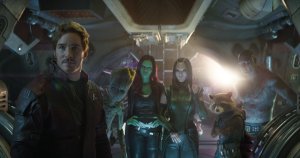 This is very much Thanos’ movie, which was one of the bigger surprises for me. Beforehand, our exposure to the big purple guy has been relatively minor, a brief moment here or a cameo there during a post-credit scene. Considering Thanos is supposed to be the universe’s biggest bad, it makes sense to finally give him his due, and that is what Infinity War does. Thanos gets the most screen time of any character and is given an honest-to-God character arc. He’s a villain who goes on an actual emotional journey as he follows a path that he feels compelled to even as it tests him personally. He finally opens up as a character rather than some malevolent force that is oft referred to in apocalyptic terms. We get his back-story and motivation, which is less a romantic appeal to Death like in the comics and more a prevention of the apocalypse reminiscent of the Reapers in the Mass Effect series. Thanos sees himself as a necessary corrective force and not as a villain. He’s never portrayed in a maniacal, gleeful sense of wickedness. Instead he seems to carry the heaviness of his mission and looks at the Avengers and other heroes sympathetically. He understands their struggle and defiance. Having an actor the caliber of Brolin (Deadpool 2) is a necessity to make this character work and effectively sell the emotions. Thanos is the most significant addition to the MCU appearing the latest, so there’s a lot of heavy lifting to do, and Infinity War fleshes him out as a worthy foe.
 As an action spectacle, however, Infinity War is good but not great. The action sequences are interesting enough but there’s nothing special and little development. There’s nothing that rivals the delirious nerdgasm of the airport battle in Civil War pitting hero-against-hero to dizzying degree. The characters are separated into units with their own goals leading to a final confrontation that feels more climactic conceptually than in execution. That’s because this is an Avengers film that falls into some of the trappings of the glut of super hero cinema, namely the army of faceless foot soldiers for easy slaughtering, the over exaggerated sense of scale of battle, the apocalyptic stakes that can feel a bit like a bell rung too many times, and even minor things like the lackluster supporting villains. Thanos’ team of lieutenants are all the same kind of sneering heavy with the exception of one, a sort of alien cleric heralding the honor of death from Thanos. Carrie Coon (HBO’s The Leftovers) is generally wasted providing the mo-cap for the Lady Lieutenant That Sounds Like a Band Fronted by Jared Leto, a.k.a. Proxima Midnight. There are far too many scenes where characters reluctantly strike a deal to give up an infinity stone if Thanos will spare the life of a beloved comrade. The film’s greatest point of entertainment isn’t with its action but the character dynamics. The fun is watching years-in-the-making character interactions and seeing the sparks fly. There’s more joy in watching Downey Jr. and Cumberbatch try and out smarm one another than with any CGI collision of a faceless army of monsters. There are so many characters that few are given fully defined arcs. Most are given beginnings and stopping places. Though the eventual sequel will have fewer characters needing to share precious screen time.
The standouts on screen are Hemsworth (12 Strong) carrying a large portion of the movie and not missing a beat of his well-honed comic rhythms from Ragnarok, Bettany (Solo) brings a sad soulfulness to Vision as a man who knows fate is likely unavoidable, and Dave Bautista (Blade Runner 2049) is perfectly deadpan as Drax and has the funniest lines in the movie followed closely by the exuberant Holland (Lost City of Z). To even say which characters deal with more complex emotions might be a spoiler in itself but there are several actors showing an emotive level unseen so far in the bustling MCU.
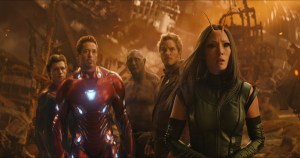 Avengers: Infinity War marks a significant concluding chapter for one of cinema’s most popular series, until at least the next movie possibly makes it feel less conclusive. I pity Marvel because expectations are going to be astronomical for this climactic showdown. There are so many characters, so many crossovers, and so much to still establish, like Thanos as a character more than a spooky force of annihilation, that it feels rather breathless even at nearly two-and-a-half hours. You may be feeling a rush of exhilaration on your way out or an equally compelling sense of exhaustion. Infinity War doesn’t have the imaginative highs of a Dcotor Strange, the funky personality and style of a Guardians of the Galaxy, the wonderfully thought-out structure of a Spider-Man: Homecoming, the adroit weirdness of a Thor: Ragnarok, or even the hero-against-hero catharsis of a Civil War (still my favorite). What it does have is a sense of long-gestating finality, of real stakes and dire consequences. It’s not all pervading doom and gloom; this is still a fun movie, buoyed by crackling character team-ups and interactions. While, Infinity War won’t be all things to all people, myself included, it will please many fans, casual and diehard alike.
Nate’s Grade: B
Share this:

Rampage (2018)
 Rampage is exactly as advertised, a big, dumb monster movie based upon a flimsy premise of an arcade smash-‘em-up, and it’s also just about everything you’d ask it to be. This movie is ridiculous, no question, but I walked away feeling like the filmmakers recognized this and embraced its ridiculousness.
Davis Okoye (Dwayne “The Rock” Johnson) is a primatologist at the San Diego Zoo. His prized primate, an albino gorilla named George, is undergoing very dramatic changes. A canister of secret genetic-altering gas has fallen from a scientific space station, landing in George’s gorilla pen, the hills of Montana, and in the Everglades. Separately, a wolf and a crocodile are rapidly growing in size, as is George, who is also becoming more aggressive and violent. Dr. Kate Caldwell (Naomie Harris) is a disgraced scientist who may know how to reverse the changes. The U.S. government, lead by Harvey Russell (Jeffrey Dean Morgan), relocates George to a government lab; however, he breaks loose midair. He and the other monstrous animals are heading to Chicago, lured by a signal intentionally staged to draw them in one very smashable location.
 It’s not exactly a winking, satirical statement on the monster movie genre, but I think Rampage is still self-aware. Take for instance what befalls The Rock. His character is literally shot in the gut (no exit wound) and miraculously recovers and runs through crumbling buildings, leaps over rubble, tussles with giant monsters, and even outruns them on the ground, and is thrown this way and that. This happens for the entirety of the last act while, and I don’t think I can stress this enough, A BULLET IS STILL LODGED INSIDE HIS CHEST CAVITY. However, he is The Rock, our modern equivalent to a living Superman, so the movie shrugs and asks us to just go along with it, and because I was entertained I did. There were several moments where I just shrugged and said, “Sure, let’s do that,” but usually these decisions were in the service of the blockbuster elements that I would want to see with this kind of premise. It’s silly and stupid and baffling at times, but Rampage knows what elements to pump up and what elements an audience won’t really care about. The villain’s plot is completely nonsensical and amounts to, “Step 1) lure the giant monsters to one central tower in Chicago, Step 2) ?, and Step 3) profit.” I have no idea what they were hoping to accomplish but their lamebrain thinking efficiently facilitated the monsters getting closer to peak smashing form.
You can look at three performances to get a sense of those who understand the big, dumb, fun movie they’re in, and those who have misjudged what kind of movie they’re in. Jeffrey Dean Morgan (TV’s Walking Dead) knows exactly what kind of movie he is starring in and has the time of his life as a scenery chewing, gun slinging, folksy quipping cartoon. Every scene he slides into, the man has a gleeful glint in his eye at what he gets to do. You almost expect like a musical motif to accompany him every time on screen. It’s enough that you think he might just strut off into another movie all his own. On the opposite end are the film’s villains, callous, rich, and almost bumbling in their sense of evil. To their credit, Malin Akerman (TV’s Billions) and Jake Lacy (TV’s I’m Dying Up Here) are mostly meant to verbalize their villainy for the audience. Whenever we cut back to them, the brother and sister are helpfully explaining the lengths of their scheme. Lacy is goofy dumb and relatively useless outside of deliverer of exposition. Akerman fares worse trying to be a no-nonsense bitch of business and is far too serious. When both of these actors are onscreen, the movie powers down, sapping its fun. When Morgan appears, it’s like Rampage can once again be the big, dumb, fun movie we crave.
 Unexpectedly, the best relationship in the movie is that of The Rock and a giant CGI albino ape, proving once again that Johnson’s charming bonafides know no limits. George the gorilla is given far more nuance than any of the other supporting characters, which isn’t saying much, yet Johnson’s charisma is able to lift all on screen partners. Their funny, warm-hearted relationship may actually stir some emotions in you come its heroic climax, and that by itself is astounding. Johnson’s character back-story is kept to a relative minimum as not to gum up the narrative expediency (he prefers animals over people, but not in… that way). He’s a reliable anchor for audience engagement that he can sell the most ridiculous, as detailed above. It’s been quite an ascent for Johnson over the course of the last ten years, and my pal Dan Nye observed that he’s now been playing actual characters rather than recognizable versions of himself. Davis Okoye is more or less The Rock: Zoologist, but it’s still a welcomed development. The Rock could star alongside an actual rock and glue your eyes to the screen.
The special effects are also quite good for this sort of brainless caper. George comes across as a genuine creature, not necessarily with the depths of say Andy Serkis’ Caesar, but what CGI-performance does? The computer effects do an excellent job of communicating actor Jason Liles’ (Death Note) mo-cap performance and make the big guy sympathetic even as he rages out. I enjoyed that, much like Alex Garland’s Annihilation, the animals are not necessarily demonized for behaving like nature intended. They’re creatures undergoing a change they cannot understand and acting accordingly like animals would. The crocodile is impressive for its evolutionary mutations and textured, especially when we see its gaping mouth open.
 As far as its stated mission, Rampage smashes things up but good. Director Brad Peyton showed with 2015’s San Andreas that he’s essentially the diet version of Roland Emmerich, and that’s okay. The action is fun above all else and Peyton prefers long visible shots. If we’re going to see a bunch of monsters, let’s actually see them (ahem, 2014 Godzilla). I felt like Peyton was far more invested in this movie and his shot selections finding interesting arrangements, like a slow-mo shot of jaws snapping together on a passing fighter plane. Peyton understands the significance of scale, letting the sheer size of the monsters communicate the immeasurable danger. There’s an early confrontation with the giant wolf in a Wyoming forest that’s chaotic, suspenseful, and demonstrates how freaking fast these creatures can be at their size. A prologue in space is genuinely thrilling and the zero gravity aerobatics provide an extra feeling of helplessness against a mutant attacker. By the end, when all three monsters descend on Chicago, Rampage becomes the popcorn movie experience that it has promised.
Nobody is going to label Rampage as a smart movie but it is aware of what it is. This is a big, dumb movie that aspires to merely be an awesome big, dumb movie, and that prioritized sense of fun pervades the relatively fast-paced film. The Rock is running around with his hulking ape-bro and wrecking havoc. This is the kind of movie where a giant gorilla mimes the universal physical symbol for sexual congress. This is the kind of movie where they feed a person to that giant gorilla. This is also the kind of movie where The Rock has a bullet lodged in his gut for the entire climax. This is a movie that has no airs about it and simply wants to entertain a mass audience. The Rock is a consistently charming and very capable action lead, and the relationship he has with his giant ape-bro is surprisingly chummy and sweet. If you’re looking for a monster movie that has no embarrassment about what it is, let alone being based on an arcade game, then Rampage is going to be a stupidly enjoyable time out at the movies.
Nate’s Grade: B-
Share this:

Pacific Rim: Uprising (2018)
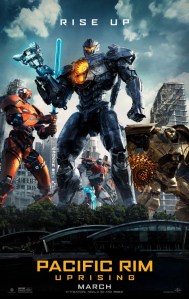 The original Pacific Rim brought out my inner child with its gee-whiz spectacle of giant robots fighting giant monsters, and under the artistic vision of Guillermo del Toro. I was eager for a sequel, as was my inner child. Thanks to China, a sequel was granted, though del Toro left to go win Best Director and Best Picture at the Oscars. The new director replacing del Toro, Steven S. DeKnight, came to fame on shows like Buffy the Vampire Slayer, Spartacus, and Netflix’s Daredevil. DeKnight acquits himself well in a world of big-budgets and big worlds, and while Pacific Rim Uprising is definitely lesser than the original, it’s still a whole lot of fun. John Boyega (The Last Jedi) leads the way as the son of Idris Elba’s character. It’s been ten years since the events of the first film and humanity is considering replacing Jaeger pilots with more cost-efficient drones. Then a rogue Jaeger starts attacking the remnants of the fleet, and Boyega and a scrappy pre-teen girl have to team up with a bunch of other Jaeger recruits to save the day. Where the first Pacific Rim rode the wave carefully to find a middle ground between cheese and awe, this time the movie swerves far more into cheese. Stuff gets silly, but if you can’t abide a little silliness then what are you doing watching this movie? The mythology and world building deepen, building off the last film, and they even supply a motivation for the aliens. It does feel at times like a pilot for a TV series, Jaeger Academy, and oddly the plot seems to follow Independence Day 2, Iron Man 2, Ender’s Game, and then ends right back with Independence Day 2’s closing sales pitch for a sequel that was never destined to be. Boyega has a fine reserve of charm and much is asked of him since the remaining characters are pretty slight. The action takes place almost entirely in daylight, a positive change from the original. The monsters don’t appear until the final act, which is not a positive change. It’s fun, goofy, and entertaining in the way that Saturday morning cartoons of your youth were entertaining. Uprising probably won’t be saved by China this time, but if you’re a fan of the first I have to think you’ll still enjoy the sequel.
Nate’s Grade: B-
Share this:

Ready Player One (2018)
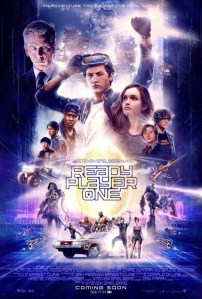 Ready Player One was a best-selling book that established a future world built upon the pop-culture artifacts of the 1980s, a future that celebrates and looks back to the past, to a halcyon childhood of classic and not-so-classic video games, movies, comics, and music. It was no surprise that author Ernest Cline’s novel would become a success, as we’ve been in a full-blown 80s nostalgic renaissance for quite some time now. When living legend Steven Spielberg got aboard as director, it seemed like fate. As a non-reader, my worry was could the big-budget, Hollywood version of this movie, lead by a Hollywood master, be more than the sum of its parts, more than the nostalgia and pop-culture references? I feared the finished product would be Avatar meets VH1’s I Love the 80s (“Hey, remember that thing? We do too.”). My fears were overblown, but then so is Ready Player One a bit, an entertaining vision that glides by with little else but vigor.
In the future, most of humanity spends their days living out fantasies and dreams in the Oasis, a virtual reality hub with different worlds, games, and features, allowing players to design their own avatars and their own adventures. The Oasis was created by Halliday (Mark Rylance), a reclusive genius who also programmed a contest upon his death. Whoever finds three hidden keys would win ownership of the Oasis. Wade (Tye Sheridan) is a regular kid living in Columbus, Ohio (woot, represent!) but when he’s in the VR world he’s Parzival, a more confident and assertive player. He’s fascinated and intimidated by Artemis (Olivia Cooke), a fierce competitor who brushes aside others. Together they team up to thwart the evil corporation IOI (Innovative Online Industries) run by Sorrento (Ben Mendelsohn). They want to own the Oasis, riddle it with ads and product placement, and restrict the freedoms to a lucrative caste system. Parzival and Artemis must find the keys, stay ahead of IOI and their team of super players, and hide their real-world identities before they can be unplugged one way or another.
 Ready Player One is a first-rate action spectacle from one of cinema’s masters of spectacle. Spielberg unleashes his incredible imagination with the full-force of a pretend world where any thrill-seeking adventure can happen. You can feel his genuine sense of joy at getting a chance to play in such a big world where anything is possible. This is best encapsulated with a race that challenges all laws of physics and good sense. The obstacles are extreme and as the cars careen into one another, King Kong trounces the track, and various nasty surprises await, it becomes a propulsive, thrilling, and ridiculously entertaining set piece. The last time I can recall a Spielberg film feeling this downright fun, first and foremost, was perhaps 2011’s Tin Tin, an underrated adventure. Spielberg has a delightful comic touch when it comes to constructing creative and satisfying action set pieces, laying the foundation for future payoffs and complications. There’s an extended sequence where the players have to infiltrate the Overlook hotel from Stanley Kubrick’s The Shining, and it’s glorious. It’s the most sustained pop-culture reference and nostalgia point, but it actually lines up cleverly with a mission goal. The overpowering flurry of pop-culture references I was worried about never come to much more than momentary visual signifiers (“Look, he’s driving the car from Back to the Future. Look, he’s got the Holy Hand Grenade.”). You don’t need the background to enjoy the film, and the references are just a bonus for those nostalgic aficionados in-the-know. It rises above the hefty anchor of nostalgia to tell its own story on its own epic terms.
With that being said, Ready Player One is also little more than its eye-catching spectacle. There’s very little substance here to be had. The film is 140 minutes long and feels breathless, allowing nary a moment to catch contemplate, deepen the characters, or explore the outside world in greater detail. The movie is packed with expository plot beats about the inner workings of the Oasis and every time it hops to a new level it resets and we have to learn more rules and surprises. It kept me entertained, don’t get me wrong, but when you come out the other end you can look back and see little. It’s a thrill ride first and foremost but one that feels entirely ephemeral. There’s so little to hold onto that generally matters. It’s the film equivalent of fast food, a tasty jaunt but something not exactly made from the best ingredients. It even takes that’s 80s pop-culture appreciation and transforms into feeling like an 80s movie, complete with an ending where even the bad guy gets his just deserts in a comical low-stakes way. We’re watching a bunch of teenagers fight against The Man taking control of their play space and corporatizing it. That feels like the VR equivalent of, “We gotta save the rec center from those evil land developers who just don’t get the communal power of art, man.”
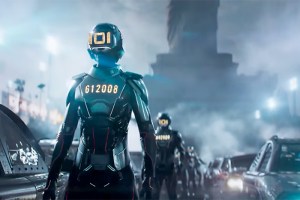 I didn’t really get a sense of any of the characters and it felt like the “be whoever you want to be” freedom of the Oasis could have been better employed. Take for instance Artemis, who in real life is Samantha and has a blotchy birthmark on her face. I understand that she’s self-conscious about the mark but she still looks like Olivia Cooke (a pretty girl with a birth mark still looks like a pretty girl). The romantic relationship between Parzival and Artemis feels like user projection, falling for the cool, kickass gamer girl. She rightly retorts, “You think you’re in love. You don’t know me, only what I show you.” This stand for female agency regrettably melts away and Artemis/Sam fall into that familiar dance of emotions. The side characters feel more like second or third tier team members on a spy mission, offering little variance. I didn’t really get a sense of any of the central characters from a personality standpoint except for their loving appreciation of pop-culture, which is then morphed into a pop-culture artifact itself. The larger mystery of Halliday’s past regrets is rather predictable and amounts to little more than “seize the day,” which is also a pretty 80s message if you think about it.
Another aspect hampering the impact is the dire lack of stakes. As far as I can tell, the biggest loss the players experience is their in-game credits and achievements. They may have spent months or years accumulating those, but if they were to disappear there’s no real larger harm to anyone. It’s a mere inconvenience, the same thing with dying in the game. I was waiting for another step where dying in the game would translate into the real world (“You die in the game, you die for real!”). They even introduce a fancy VR suit you can wear to literally feel the action of the game, though why anyone would want to feel the pain inflicted via a video game is beyond me (the pleasure I can understand). When we watch characters fight against incredible odds, the most that’s at stake is having to regenerate at a different location and get back into battle. It makes the struggle feel less realized and certainly less substantial. It plays into the already ephemeral spectacle. I heard from my seat neighbor, who had read Cline’s novel, that (book spoilers) one of the players is killed by the evil corporation by finding out where he lives and throwing him out a building. The movie needed a moment like that. Imagine, Sorrento being confronted by Parzival and friends, and he points to one and says, we know where you live, we’re breaking down the door now. The guy turns around, hearing the sounds coming from his real-life environment. Then Sorrento gets a radio call about breaching the room and a gun is placed against the character’s head. His scream is cut short as the sound of a gunshot echoes and his avatar disappears. Then Sorrento points to the remaining players and says we know where each of you live. That scene would have raised the stakes for the final act, not to mention be a sly nod to The Matrix. Unfortunately, even when the bad guys are trying to kill people, the stakes feel small.
 I think part of the lower stakes is also because we never get a clear sense of life outside the Oasis. If just about every human being is wired into this VR world, how is all that electricity being generated to power this experience? What is the economy of this world? What do people do to subsist in their homes? Is money related to in-game achievements? These loyalty pods, which are essentially a twenty-first century debtor’s prison that profits off virtual slave labor, how are they legal? What exactly is the legal system like in this world? Also, we see people running outdoors with their VR helmets on. Won’t they run into traffic or a building or some kind of obstruction? I never understood how this world operated. Perhaps that’s the reason Spielberg spent a solid 75 percent in the Oasis, keeping our minds occupied with shiny things before we can begin to question.
Sheridan (Mud) is a handsome and likeable leading man, though he just came from another movie where he wears a visor over his eyes (X-Men: Apocalypse). He leaves enough of a favorable impression to make you wish he had more going on. The same with Cooke (Me, Earl, and the Dying Girl) who plays the spunky, spiky love interest and experienced gamer girl. It’s a role that Cooke performs nonchalantly, evoking the ethos of being enviably cool and thus desirable to legions of gamer boys. Cooke is capable of much more, as evidenced recently by her phenominal performance in Thoroughbreds, but I’m happy that she’s getting a big platform and from Spielberg too. The other castmates add a needed sense of diversity to this future world, though I was wondering why the pop-culture references were almost entirely American. Surely Halliday would have been the kind of guy that was entranced by the gee-whiz cool artifacts of other cultures like Japan. The best actor is Mendelsohn (Rouge One) who seems to be carving out a fine career in Hollywood movies as an officious middle-manager villain. He’s the right kind of slimy while still being weak at his core that fits so perfectly for these kinds of roles. Sorrento also employs a fierce female enforcer (Killjoy’s Hannah John-Karmen) with some sharp bangs who reminded me of Luv from Blade Runner 2049. Even more 80s-ness!
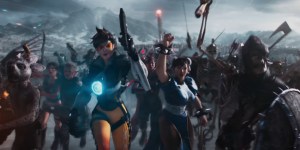 With Spielberg at the helm, it feels like he’s the perfect person to bring Ready Player One to the big screen considering he’s one of the biggest progenitors of our 80s nostalgia. It’s a loving homage to pop-culture without being suffocated by the cumulative artifacts of pop-culture. It’s a rousing, imaginative adventure with some terrific special effects and stunning action set pieces. It’s an enjoyable trifle of a movie, lacking larger substance, characterization, and sustainable stakes. It feels too light, but then maybe that’s another argument for its adherence to the feel of 80s movies, where problems could be solved with dance-offs or choice montages set to Jefferson Starship. Ready Player One should delight fans of the book and even those ignorant of all its myriad references. Whether audiences cherish this alongside those keepsakes of the past is another matter.
Nate’s Grade: B
Share this:

Tomb Raider (2018)
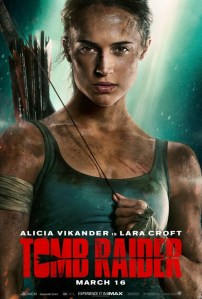
Lara Croft was best known for her exaggerated physical assets (rendered as Madonna-worthy pointed polygons) and short shorts than as any sort of character. She was realized on the big screen in 2001’s Tomb Raider as an elite physical specimen portrayed by Angelina Jolie, where the filmmakers went the added step of padding Jolie’s bosom to better reflect the source material’s image. The filmmakers literally thought this aspect would be make-or-break with fans, as if Jolie herself was not naturally vivacious enough. As you can imagine, Lara Croft was primarily seen as a sexy avatar, whether on the small screen or the big screen. This new Tomb Raider aims to better ground its story, tone, and central heroine, and it mostly succeeds. This is a solid, pleasantly enjoyable mid-tier action movie that might also qualify as the best video-game-to-film adaptation so far (sorry Uwe Boll).
Lara (Alicia Vikander) is struggling in the wake of her father’s (Dominic West) disappearance. It’s been years but she holds onto hope that dear old dad is still out there. One day, she discovers her father’s secret study and a video message he recorded confessing why he left. He’s seeking a fabled tomb on a hidden island off the coast of Japan, a tomb devoted to a powerful goddess of myth who sacrificed her admirers. Also looking for the tomb is Vogel (Walton Goggins) and a team of armed mercenaries. Lara must stay ahead of the mercenaries, find her father and the long-lost hidden tomb.

This is a Lara Croft stripped down and absent the male gaze, which has defined her travails just as much as the treasure hunting adventures. There’s not a single shot in the movie that seeks to ogle Vikander’s lean body. Even her outfit, as mentioned a staple of Croft’s early appeal, is a modest take top and khakis. The emphasis this time is on what she endures and overcomes rather than the curvature of her body. This is an attempt at an origin tale, rebooting Lara for a new generation of fans. She’s less the cool buxom sexpot with the twin pistols than a struggling young woman facing her fears. This is the first time Lara Croft has been envisioned as a character. There’s a level of broader realism that the movie holds onto, positioning this Croft as less the gun blazing super cool badass and more as a stealthy, plucky, and scrappy figure of moderate action. There are moments where she hides and moments where she runs, as they are the best recourse. She’s not imposing in her build and poise like a Gina Carano (Haywire) but Vikander’s got some serious moves. With all that in mind, let’s not get too carried away here. Lara Croft may have some extra dimensions but she’s not exactly a fully formed, three-dimensional character or boasting the kind of magnetic personality that drew us to Indiana Jones or even a Nathan Drake. She’s capable but also limited in interest and charisma.
The action is invigorating enough and given a clear scope of play. Norwegian director Roar Uthaug (The Wave) orchestrates the action in clean long shots and precise edits, allowing the audience a clear sense of what is happening. A frantic bicycle chase and foot chase in the first act are given extra vitality by a roaming camera that takes in the full view. There’s enough variety in the action and natural consequences to keep things interesting. This is a movie that doesn’t feel overpowered with CGI, even though I know it’s present. Uthaug makes a point of emphasizing practical effects and sets, which adds a further level of realism to the excitement. I’d call it a more pared down, realistic version of an action adventure but it still has outlandish set pieces like Lara finding refuge atop a crumbling WWII era bomber that just so happens to be wedged atop a rock face overlooking a steep waterfall. Even during these moments, and the last act takes place almost entirely within the ancient tomb and its traps, the movie keeps things relatively credible. It’s fun without being too flippant and serious enough without losing its sense of amusement. Tomb Raider reminded me a lot of a big-screen version of an Uncharted game, a rollicking adventure that also feels rooted in our own world, but with a hint of the supernatural creeping along the edges. The conclusion has a few nice surprises following this pattern even with the possibility of actual zombies emerging.
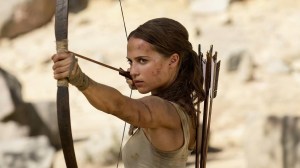
Vianker (The Danish Girl) acquits herself nicely in the realm of action-adventure. She gained twelve pounds of muscle and has a pretty impressive six-pack. Vikander is a smaller actress by nature but the filmmakers do a fine job of placing her in believable action scenarios that rely upon her athleticism. Her Lara is a stubbornly independent protagonist who refuses to give up, which makes her a winning force even when her personality fails to sufficiently light up the screen. Vikander hurls herself into the role, performing an impressive array of stunts, and yelping along to the genre demands.
There are some plot holes that are hard to ignore, mostly pertaining to motivations. In the first act, we learn tat Lara is heir to a vast fortune of money and a big company that owns many other subsidiaries. However, she refuses to essentially inherit the company because it means having to sign papers declaring her missing father as deceased. I understand the character’s rejection of wanting to accept her father’s death, but when taken to this extent it becomes almost comical. Lara is seen scraping by for enough money to survive on her own. She’s forced to pawn her heirlooms and work as a bicycle messenger. She’s struggling to get by and yet her pride is standing between her and a massive fortune. This is just stupid. What’s to stop Lara from signing the paperwork, inheriting the fortune, and using said fortune to continue the search for her father? There’s also the motivation of her absentee father, who left to thwart the bad guys from finding the special tomb. However, he inadvertently leads them there because he was tracked. Had he not even left, the bad guys would not have found the island’s location and he could have been in Lara’s life. This is transparent potting to simply move the pieces across a board. Another example is Lu Ren (Daniel Wu) a ship captain ally she picks up that serves no real purpose other than ferrying her to the island. One character that benefits from motivation is the villain, Vogel. He’s not some mustache-twirling rogue but rather a guy hired for a job that wants to go home and see his kids again. It’s a nice, empathetic touch that makes Vogel grounded and a better fit.
Tomb Raider is a smaller, leaner, and enjoyable little action movie of modest ambitions. That sounds very conditional, I’ll admit, but it’s a scaled-down version of an exaggerated character doing splashy, sexy, exaggerated action heroics. It’s a stripped down reboot that grounds the action while still finding enough ways to have fun. It does get a little caught up in the edicts of an origin tale, overpowering moments with “First” significance (First Adventure, First Kill, First Fight, etc.). There are also some head-scratching plot holes that get glossed over to keep things moving along. Vikander is one tough cookie, and the film celebrates her brains as well as her brawn and absent any ogling camerawork. Tomb Raider is a suitably exciting action film that gives some hope for future Croft adventures.
Nate’s Grade: B
Share this:

Black Panther (2018)
 Black Panther is unlike any other Marvel Cinematic Universe (MCU) film prior. It’s unlike any other super hero film prior. Yes, there have been African-American leading men in comic-based movies, notably Wesley Snipes’ half-vampire-all-badass Blade. However, this is the first movie I can think of with this kind of budget, this kind of backing, and with this kind of ownership over its cultural heritage and the heavy burdens it carries.
We last saw T’Challa (Chadwick Boseman) in Captain America: Civil War mourning the loss of his father, the king of the African nation of Wakanda. The outside world does not know that Wakanda sits on a vast supply of virbanium, the strongest and more durable metal in the world and the key to Wakanda’s impressive technology. Under a holographic cover, Wakanda is a thriving metropolis with flying cars, skyscrapers, and next gen weapons. T’Challa goes home and must earn the right to the throne. However, Erik Killmonger (Michael B. Jordan), a former top-level black ops solider, is looking for his own path into Wakanda and onto the throne. Killmonger teams up with arms dealer, Ulysses Klaue (Andy Serkis), to force Wakanda to deal with being cut off from the world.
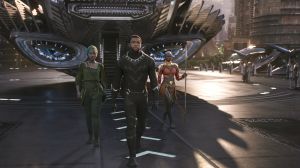 This is a movie populated almost entirely by black faces, notably black women (more on that later), and they are given a mainstream platform that celebrates its multitudinous African roots and traditions thanks to co-writer/director Ryan Coogler (Creed). This movie is proudly black, which will rankle some on the fringes of society, as if celebrating one’s own identity is somehow denigrating those who do not apply to that status. Black Panther is not an exclusionary movie because of its content and execution; this is a very accessible movie to a mass audience, even those who haven’t been paying attention to every nitty-gritty detail in the previous seventeen MCU entries. There are only two characters from other MCU films that appear, one as a post-credits cameo and the other an officious representative (Martin Freeman) of the outside’s clandestine organizations. This is a unique world isolated from the long shadow of colonialism. Wakanda has never known, to our knowledge, the depravity of the European and American slave trade. They have continued to develop uninterrupted by conquerors, slave traders, and the crippling aftereffects of racism. The Wakanda people could very easily be the conquerors themselves. They’re the most technologically advanced nation on the planet and hide as a “third-world nation,” utilizing the ignorance of the Western world to its security. The world of Wakanda is a fascinating, awe-inspiring, and defiantly independent nation.
The larger theme is over the responsibilities inherent to those with privilege. The nation of Wakanda is vastly successful by all conventional metrics. T’Challa must wrestle with whether to continue their exclusionary stance, ignore the plight of the larger world and say it’s none of their business or engage with the world, potentially putting his own kingdom’s peace and prosperity at risk. It’s a simple enough theme and yet it has tremendous weight to it especially when you account for those on the other end of the Wakanda borders. The character of Killmonger is a direct reflection of this. His experiences in Oakland are not the ideal pairing with the luxury of Wakanda. Killmonger sees Wakanda’s great influence as a way to protect beleaguered black citizens of the world and especially in the United States. It’s a way to prevent more senseless deaths from black citizens who were slain as a result of the fear of just being black (a powerful example was Coogler’s debut film, Fruitvale Station). It’s a pointed political statement that doesn’t get too heavy-handed (even though I would have preferred that). It questions the value of isolationism especially when suffering can be prevented. Killmonger works as a villain because you can understand his point of view. He goes beyond the need for vengeance. The wrongs he wants to right are larger and historical. Even Killmonger’s last line really attaches itself to this theme. T’Challa offers him a way out but with imprisonment. “No,” Killmonger declines, “My people were the ones who leaped over the sides of the slave ships. They knew death was better than bondage.” The emphasis is “his people,” not T’Challa’s, not Wakanda. His people were the ones who suffered from slavery. Could Wakanda have possibly prevented it?
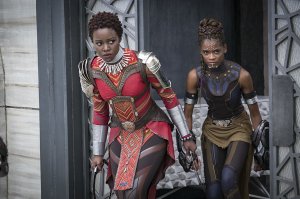 Another wonderful surprise of Black Panther is its incredible all-female ensemble that provides expert support to their king. T’Challa has the good fortune of four strong women, each of them having a different and vital relationship to him. The standout will be Danai Gurira (TV’s Walking Dead) as the fierce chief of security, Okoye. She has a swagger that vacillates between being intimidating and being brashly enjoyable. Okoye has many of the best lines and she throws herself into every fight. There’s also a sense of duty that transcends a single man that challenges her loyalty. Letitia Wright (TV’s Humans) plays Shuri, the Q of this world, the top scientist and creator of many a gadget. She’s T’Challa’s little sister and their interplay is very competitive and teasing. She’s looking to be more involved in the action and a highlight is when she teams up with her big bro. Lupita Nyong’o (The Jungle Book) is Nakia, a former flame of T’Challa’s who comes in and out of his life as an undercover spy. All three of these women have a powerful sense of agency and are integrated in important and essential ways. Even though Nakia may slide into that romantic interest role, she still has a vibrant life outside whatever feelings she may or may not have for the hero. Then there’s T’Challa’s mother, Ramonda (Angela Bassett), who radiates strength and fortitude. These women gave me some of the biggest moments of entertainment in the entire 135 minutes of movie.
Now some careful readers might note that I haven’t done much to emphasize the actual action of the super hero action movie, and that’s for a good reason. Black Panther stands stronger on theme and character than it does its actual action sequences. Coogler had a wonderful sense of scale and verisimilitude with 2015’s Creed, relying on long takes to put the audience in the heightened drama of the boxing ring. With Black Panther, the action sequences can lose a sense of immediacy. Many happen at night or are filmed and edited in ways that diminish some of their impact, like hand-to-hand combat in splashing water where the splashes obscure the activity. Other scenes felt like a video game CGI cut-scene. Speaking of video games, Black Panther’s suit has a crazy ability to absorb the kinetic energy of weapons, which means the stakes take a dip when our hero can merely just stand and allow himself to get shot repeatedly. The payoff for this absorption is a giant energy shockwave but it plays out like a fighting game’s special feature. It’s an aspect that’s not really utilized in a satisfying or unique way. The final showdown between Black Panther and Killmonger feels too weightless in execution. It’s meant to even the playing field by nullifying their extra abilities, but if they both have the same “Panther powers” isn’t the field already even? The third act, the usual punching bag for MCU critics, is the best part of the movie from an action standpoint. It utilizes the characters in significant ways and allows for organic complications while still maintaining its wider sense of spectacle. Plus it’s one of the few action sequences that allow all the pyrotechnics to be enjoyed during the visibility of day.

Boseman (Marshall) was an excellent choice for a stoic and too-cool-for-school character that can glide right on by. The ageless Boseman is at his best when he’s working off the other actors, especially his female posse. He has a couple of very effective emotional confrontations as he learns of his family’s secrets. As steady and soothing a presence as Boseman can be, this is Jordan’s movie. Michael B. Jordan (Creed) has been Coogler’s cinematic good luck charm and we’re still benefiting from that divine kinship. His character is at the heart of the central thematic question. While T’Challa is ultimately the one who has to decide, it is Killmonger who embodies that need for change and the desire to rectify the past. There’s a flashback with Jordan that got me to tear up, and this guy was the villain! It’s one of the film’s biggest mistakes sidelining Jordan for far too long. After his introduction, Killmonger is strangely absent for the next hour or so of the movie, ceding the spotlight to Serkis (War for the Planet of the Apes), a more antic and goofy scenery-chewing baddie who has a few regrettably “faux hip” lines of dialogue that land awkwardly. Serkis is having a blast but can feel like a holdover from a different film.
Much like last summer’s Wonder Woman, this is a movie that is going to mean a lot to a lot of people. It has a personal significance that I will not be able to fully tap into, no matter the expansive powers of empathy. Black Panther, as a long-awaited cultural moment, will have many ripples of inspiration. After my early screening, I sat back and watched an African-American boy, no older than seven or eight, walk out of the theater in a daze. His eyes were wide, his mouth agape, and he said in astonishment, “That was the best movie ever.” That kid has a hero he can call his own. That matters. Black Panther, as a work of art, is rich in topical themes and has a wide supporting net of exciting, robust, and capable women. I enjoyed how personal and relevant and political the movie could become, folding new and challenging ideas onto the MCU formula. Coogler is a marvelous director and storyteller showing rare acumen for being able to handle the rigors of a Hollywood blockbuster and deliver something hearty. The action has some issues and there are some structural hiccups that hold it from the MCU’s upper echelon (I enjoyed all of the 2017 MCU movies better). Black Panther is a winning movie when it features its sterling cast celebrating their virtues and solidarity and a still respectable enough action spectacle when called upon for big screen duty.
Nate’s Grade: B


 nathanzoebl
You must be logged in to post a comment.