Blog Archives
The Lego Movie 2: The Second Part (2019)
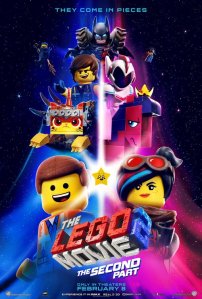 Everything might not be awesome but it’s still pretty great for this creative, heartfelt, and hyperactive family franchise that is better than it has any right to be thanks in part to returning writers Phil Lord and Chris Miller. It’s not quite as fresh and clever as the first go-round but it manages to better its predecessor in some key ways. Now that we know the colorful and zany antics of the animated Lego characters are also simultaneously the imaginative play of a real-world family, it provides a deeper thematic subtext with the unseen nature of siblings in conflict. I remember my own younger sister wanting to play with me and my toys, and me rebuffing her, and the film struck home some key emotional points about the inclusion of cooperative play. The different styles of play are on display as our characters are abducted by a shape-shifting space queen (voiced by Tiffany Haddish) who is determined to marry Batman and possibly rule the universe. A fantastic running joke is how transparently malevolent the queen is, which leads to an even better payoff. There are more songs and each is pretty well constructed, relevant to the story, and assuredly catchy, like “Catchy Song” used to brainwash people through pop, and a mournful version of “Everything’s Not Awesome” that becomes genuinely inspirational and uplifting by its climax. The life lessons are easily digestible and the sense of breezy fun is still alive and well. I was laughing throughout, sometimes quite hard, and the brother/sister subtext had me wondering if I owed my younger sister a decades-late apology for my behavior (sorry, Natalie). Lego Movie 2 is a worthy sequel that finds new and interesting ways to build off the irreverent original’s model. Bring on the Toy Story 3-style ending where our grown-up owner says goodbye to his childhood toys and friends. At this point, Lord and Miller can do anything and imbue it with wild wit, whimsy, and unparalleled mass entertainment (except Star Wars, I suppose).
Nate’s Grade: B+
Share this:

Polar (2019)
 Polar is such a thoroughly unpleasant film experience I was wondering if Lars von Trier had somehow made a comic book movie. I enjoy exploitation movies, I enjoy slick hitman spectacles, and I enjoy audaciously stylish indie films with their own lingering sense of cool, but Polar is gratuitous in every sense of the word and a chore to sit through.
Duncan (Mads Mikkelsen) is the top assassin in an organization filled with colorful personalities with guns. The head of the agency, Blut (Matt Lucas), has a surefire plan to pay off his debts. Rather than pay the assassins their pensions once they hit the mandatory retirement age of 50, he’ll just kill them. Brilliant. Duncan sets off to enjoy his last few days before his big birthday by settling down in a sleepy small town, getting to know his meek neighbor, Camille (Vanessa Hudgens). This quiet new life is interrupted by a team of crazy killers determined to eliminate their colleague and collect his riches.
 The tonal disparity with Polar never settles down, which makes it hard to find any sense of a baseline of what is acceptable reality. What is normal here? The film veers from grotesque, brutish, gory violence to cartoonish, grating, juvenile slapstick. The violence is far too gross and brutal for the light tone it wishes to maintain. It’s the kind of violence where every gunshot necessitates a lurid explosion of blood, and why stop at one gunshot when a dozen will do? There’s an extended torture montage that lasts a total of four days when it could have just been a single session if the point is to kill the hero. It’s close-ups of skin peeling and being penetrated, and I’m not averse to gore effects and exploitation elements but when it’s paired with this flippant, nasty tone it cheapens the violence. This is a film that wallows in the grotesque, tittering to itself and trying so damn hard to be so provocative that it becomes exhausting. It’s jam-packed with style-for-style’s-sake choices that further call attention to its overall emptiness. I started counting the number of shots that existed simply to highlight a woman’s butt, and mostly that of Ruby O. Fee (The Invisibles). I swear her entire role seems to be butt-centric. Then there’s one shot composed entirely of butts shaking in Katheryn Winnick’s (Vikings) face. She’s having a phone call and her face is squeezed between two strippers shaking butts just because. It’s hilariously and transparently gratuitous. So many edits, shots, and even scenes exist just to call attention to its supposed sense of cool. However, cool movies, just like people, don’t have to convince you that they’re cool, they just are.
Let’s take the evil assassins that chase after Duncan. They’re the kind of glib movie assassins that all seem defined by one or two quirks and costume styling guidelines. It’s a diverse group of ridiculous cartoon villains who seem reverse-engineered as toy figures. Why are they also working for an employer that plans on killing them all to escape paying them upon retirement? Why would you willfully work for someone who is so open about betraying you? It’s astoundingly shortsighted thinking. Regardless, other movies have utilized colorful criminals to better establish a sense of fun, particularly the early works of Guy Ritchie. These villains bounce from person-to-person tracking down their target, killing with callous indifference mixed with childish glee, but there’s no personality, no menace, so the bloodletting feels gratuitous and ugly. Scene after scene feels like the actors had large trunks of costumes and props and were told to dig around and grab anything they wanted before they began filming. It makes every one of their appearances feel annoying and trite, especially when one scene, again, exists simply to highlight Fee’s butt in jean shorts. The killers’ big plan is to shoot their target while receiving oral sex from Fee’s character. Then the others will bulrush and shoot some more. Or, and I’m not an expert here, they could simply break in while their target sleeps and shoot them in the back? This lame group of hired killers is the big threat… and then they’re taken out with half the movie left. They are removed with such haste that I was shocked. We had spent so much time with these antagonists and then they’re gone. It’s a fantastic waste of time for a group of characters that didn’t even merit one minute. There’s even one scene where Richard Dreyfuss (Jaws) shows up and is never seen again.
 The supreme villain is played by Matt Lucas (Doctor Who) and it just does not work. It’s like Toby Jones’ second cousin found the relics of Elton John’s closet and decided to try and play a Bond villain. I enjoy Lucas normally for his daft comedy roles and I think he’s trying to adopt a Goldfinger impersonation but it does not work. Once again it’s the entire tonal execution and narrative development at fault here. Blut is an officious dweeb prone to yelling at people and running away. He has no standout scene and poses no real threat once the hired guns and goons are taken care of. He cannot hold his own. This is why killing off the team of assassins with half the movie left relates to a dire misstep.
The only thing that does work in this movie is Mikkelsen (Rogue One), who is doing everything in his power to provide an anchor for the pitiable audience. He is way too good for Polar. He takes everything one hundred percent seriously and is genuinely emoting while everyone else is chewing whatever scenery isn’t nailed down. It very much feels like Mikkelsen is in some other different movie, or is pretending to be in a different, better movie. His interactions with Hudgens are a high point, taking her under his wing and showing small glimpses of sympathy and guilt. Their ultimate relationship is predictable, and she disappointingly becomes trapped as a damsel in distress for the final act. Mikkelsen does have a terrific brawl in a hallway (the location of all film fights now it seems) that is well choreographed and very physical without feeling like he’s superhuman. I wish I were watching the better movie Mads Mikkelsen thought he was in.
 Everything about Polar feels unnecessary. The sex scenes are gratuitous, the violence is gratuitous, the style is gratuitous, and when everything feels tacked on for cheap thrills, the movie becomes hollow, calculated, and lazy. The suspense sequences should be exciting or an example of our protagonist’s expertise but little feels clever. There are one or two moments, glimmers of what could have been had more attention been given to developing the sequences. As I was watching this two-hour cartoon I was strongly reminded of the 1990s Tarantino knock-off, The Big Hit, which was an exaggerated cartoon of tiresome depravity. It tried so hard to evoke a carefree hipness when it came to its criminals, their depraved acts, their comedic interactions, the debauched humor, that it all felt like two hours of collective flop sweat. Polar is very much in that same description, a movie that is trying too hard to be a fun, breezy, exploitation movie. Except it feels adrift and phony and unpleasant. Polar doesn’t deserve Mads Mikkelsen and it doesn’t deserve a minute of your time, butts and all.
Nate’s Grade: D+
Share this:

Glass (2019)
 M. Night Shyamalan has had a wildly fluctuating career, but after 2017’s killer hit Split he’s officially back on the upswing and the Shyamalan bandwagon is ready for more transplants. At the very end of Split it was revealed it had secretly existed in the same universe as Unbreakable, Shyamalan’s so-so 2000 movie about real-life superheroes. Fans of the original got excited and Shyamalan stated his next film was a direct sequel. Glass is the long-anticipated follow-up and many critics have met it with a chilly response. Shyamalan’s comeback is still cruising, and while Glass might not be as audacious and creepy clever as Split it’s still entertaining throughout its two-hour-plus run time.
It’s been 18 years since David Dunn (Bruce Willis) discovered his special abilities thanks to the brilliant but criminally insane Elijah Price (Samuel L. Jackson), a.k.a. “Mr. Glass.” David has been going on “walks” from his security day job to right wrongs as “The Overseer,” the rain slicker-wearing man who is incapable of being harmed (exception: water). He looks to stop David Wendell Crumb (James McAvoy), a.k.a. The Horde, a disturbed man inhabited by over dozens of personalities. David Dunn and Kevin are captured and placed in the same mental health facility as Elijah. The three are under the care of Dr. Ellie Staple (Sarah Paulson) who specializes in a specific form of mental illness with those who believe to be superheroes. She has only so many days to break through to these dangerous men or else more extreme and irrevocable measures might be taken.
 Shyamalan has a lot on his mind and spends much of the second half exploring the classical ideas of superheroes via Dr. Staple and her unorthodox therapy treatments. She’s trying to convince each man they are simply wounded individuals and not superior beings blessed with superior powers. Because the audience already knows the fantastic truth, I’m glad Shyamalan doesn’t belabor this angle and make the crux of the movie about her convincing them otherwise. The second act is something of a sleeping predator, much like the wheelchair-bound, brittle-bone Elijah Price. You’re waiting for the larger scheme to take shape and the snap of the surprise, and Shyamalan throws out plenty of red herrings to keep you guessing (I’ve never been more glad that convenient news footage of a new skyscraper opening meant absolutely nothing for the final act setting). Part of the enjoyment is watching the characters interact together and play off one another. The conversations are engaging and the actors are uniformly good, so even these “slow parts” are interesting to watch.
It’s fun to watch both Willis and Jackson to slip right into these old characters and conflicts, but it’s really McAvoy’s movie once more, to our immense benefit. Between a ho-hum character who has accepted his ho-hum city guardian role, and an intellectual elite playing possum, the narrative needs Kevin Wendell Crumb/The Horde to do its heavy lifting. McAvoy is phenomenal again and seamlessly transitions from one personality to another, aided by Dr. Staple’s magic personality-switching light machine. The command that McAvoy has and range he establishes for each character is impressive. He reserves different postures, different expressions, and different muscles for the different personas. I was genuinely surprised how significant Ana Taylor-Joy (Thoroughbreds) was as the returning character Casey, the heroine that escaped Kevin’s imprisonment in Split. She’s concerned for the well being of Kevin, the original personality who splintered into many as a means of protection from his mother’s horrifying abuse. I was worried the movie was setting her up to be a disciple of Kevin’s, looking to break him out having fallen under an extreme Stockholm syndrome. This is not the case. She actually has a character arc about healing that is important and the thing to save Kevin’s soul. There are in-Kevin personalities here with more character arcs than the other famous leads.
Shyamalan has been improving in his craft as a director with each movie, and stripping down to the basics for a contained thriller gave him a better feel for atmospherics and visual spacing with his frame. With Glass, the cinematography by Mike Gioulakis (It Follows, Us) smartly and elegantly uses color to help code the characters and the development of their psychological processes. The direction by Shyamalan feels a bit like he’s looking back for a sense of visual continuity from his long takes and pans from Unbreakable, which places greater importance on the performances and precise framing.
 I think the disappointment expressed in many of the mixed-to-negative critical reviews comes down to a departure in tone as well as the capitalization of being an Unbreakable sequel. Both of the previous movies in this trilogy were less action vehicles than psychological thrillers that emphasized darker human emotions and personal struggle. Shyamalan purposely grounded them, as much as one can, in a sense of vulnerable realism, which only made both of their endings stick out a little more. The movies weren’t about existing in a superhero universe but more so about unknown heroes and villains of comic-sized scale living amongst us every day. It was about the real world populated with super beings. Because of that tonal approach, Unbreakable was the epic tale of a security guard taking down one murderous home invader and surviving drowning. It was more the acceptance of the call, and part of that was getting an audience that had not been fed as much superhero mythos as today to also accept that secret reality hiding in plain sight. 18 years later, movie audiences have become highly accustomed to superheroes, their origins, and the tropes of the industry, so I was looking forward to Shyamalan’s stamp. I think our new cultural environment gave Shyamalan the room to expand, and Glass moves into a less realistic depiction of these elements. It’s not the gritty, understated, and more psychologically drawn dramas of his past. It’s more comfortable with larger, possibly sillier elements and shrugging along with them. There are moments where characters will just flat-out name the tropes happening on screen, with straight-laced exposition. It can lead to some chuckles. I think fans of the original might find a disconnect in tone between the three films, especially with this capper. They might ask themselves, “I waited 18 years for these characters to just become like other supers?”
And that refrain might be common as well, namely, “I waited 18 years for this?” While it’s inherently true that a filmmaker doesn’t owe fans anything beyond honest effort, an extended time between sequels does create the buildup of anticipation and the question of whether the final product was worth that excited expectation. Fans of Unbreakable might be somewhat disappointed by the fact that Glass feels like more of a sequel to Split. McAvoy is top-billed for a reason. Perhaps Shyamalan had more of a desire to foster the continuation from a recent hit than an 18-year-old movie. Whatever the rationale, David Dunn gets short shrift. After the opening segment, he’s being institutionalized but he’s not actively trying to escape. As a result, the attention focuses far more onto our two villains, and one of them doesn’t says a word until an hour into the movie. This further exacerbates the disproportionate emphasis on Kevin Wendell Crumb (and The Horde). As stated above, I think that’s where the emphasis should be because he has the most storytelling potential, and McAvoy is amazing. However, if you’ve been waiting 18 years for another face-off between Mr. Glass and the Unbreakable Man, then this might not seem like the special event you dreamt about. Shyamalan still has difficulty staging action sequences. The fights with David and The Beast are pretty lackluster and involve the same non-responsive choke hold moves. There are like half a dozen characters involved with the climactic showdown but half of them are bystanders waiting to be tapped in when the narrative needs them to console their fighter.
 I think the ending will also turn some people off for what it does and what it doesn’t do (I’ll avoid spoilers but will be speaking in vague terms this paragraph, so be warned, dear reader). The ending opens up a larger world that leaves you wanting more, even if it was only a passing scene acknowledging the resolution to the final actions. This holds true with an organization that you get only the smallest exposure to that adds to the deluge of questions seeking answers. It sets up a bigger picture with bigger possibilities that will ultimately be left unattended, especially if Shyamalan’s recent interviews are to be taken at face value. What Glass does not do is play with the implications of its ending and explore the newer developments. The ending we do get is indeed ballsy. I gasped. Shyamalan takes some big chances with the direction he chooses to take his story, and I can admire his vision and sense of closure. On the other end, I know that these same decisions will likely inflame the same contingent of disgruntled and disappointed fans.
Shyamalan’s third (and final?) film in his Unbreakable universe places the wider emphasis on the three main characters and their interactions. While McAvoy and Kevin get the light of the spotlight, there are strong moments with Elijah and David Dunn. There are some nifty twists and turns that do not feel cheap or easily telegraphed, which was also a Shyamalan staple of his past. It’s not nearly as good or unnerving as Split, the apex of the Shyamalanaissance, but it entertains by different means. If you were a fan of Unbreakable, you may like Glass, but if you were a fan of Split, I think you’ll be more likely to enjoy Glass. It might not have been worth 18 years but it’s worth two hours.
Nate’s Grade: B
Share this:

Bumblebee (2018)
 Why haven’t they been making these kind of Transformers movies from the beginning? Bumblebee is a scaled-down, character-driven family film where the bigger moments re about fitting in, finding your sense of self, and keeping your new alien robot friend hidden from your parents. Set in the late 80s, Hailee Steinfeld (Edge of Seventeen) plays a high school senior dreaming of a life beyond her neighborhood and family. The ticket out is a new car, which just happens to be an Autobot from another planet disguised as a VW beetle. Because Bumblbee had his memory wiped from a fight years earlier, he’s very childlike and endearing, and the interaction between the big robot and Steinfeld will rekindle more than a few memories for The Iron Giant, E.T., and other classic “boy and his dog” tales. There’s a real attention to the characters, big and small, that makes this the best Transformers movie. Not everything has to be about the next world-destroying cataclysm. There’s plenty of formidable drama in watching a teen girl navigate the world with an unconventional new friend. Director Travis Knight (Kubo and the Two Strings) graduates to the world of live-action with a terrific feel for the visual parameters and material. It helps that Knight gives his film a sense of scale without sacrificing coherency. The camera prefers wider shots and longer takes so the audience can follow the action. The movie also has a sly sense of humor it knows when it call upon, like a highly enjoyable John Cena who is baffled at his government’s open door policy to evil robot aliens: “They have Decepticon in their name. Is that not a red flag to anyone else?” This is a well-paced, sweetly heartfelt movie with good humor, good characters, and good action. If this is what happens when you strip Michael Bay from the franchise, then lock him up.
Nate’s Grade B+
Share this:

Aquaman (2018)

It’s hard not to talk about the fledgling DCU without grading on a curve. Wonder Woman was a great success and a definite step in the right direction but it still had clear Act Three problems. However, when your previous movies are the abysmal Suicide Squad and Batman vs. Superman, anything in the right direction is seen as enlightenment. There are currently no planned Superman films, no planned Batman films, and it looks like the teetering DCU is banking its future on the success of Wonder Woman and Aquaman. If you had told me that the future of an interconnected series of franchises would rest upon the shoulders of a man who talks to fish, I would have laughed. Enter director James Wan, best known for the Conjuring franchise and plugging into Furious 7 without missing a beat. Warner Bros. desperately wanted Wan’s stewardship to get a notoriously difficult comics property to float in the modern market. The early marketing was not encouraging but I held out a slim degree of hope that Wan would make it work. While Aquaman as a whole has its share of problems, Wan has done it. He’s made a big screen Aquaman movie that is fun, visually immersive, weird, and packed with great action. I was just as surprised as you, dear reader, but the smile on my face was evident.
Arthur Curry (Jason Momoa) is heir to the undersea throne of Atlantis. His mother (Nicole Kidman) fled her arranged marriage and had a son with a human lighthouse keeper. She retreated back into the ocean to prevent further harm to her shore side family. Arthur is approached by princess Meera (Amber Heard) to return to Atlantis and claim his birthright to the throne, currently occupied by Arthur’s half-brother, King Orm (Patrick Wilson). The reigning king is planning to unite the seven sea kingdoms to launch an attack against the surface-dwellers. Arthur must go back to the people who reportedly killed his mother and challenge his half-brother for supremacy. Along the way he’ll have to venture across the globe with Meera for a series of adventures to reclaim lost artifacts, while also dodging Black Manta (Yahya Abdul-Mateen II), a pirate gifted with underwater technology who swears vengeance against Arthur for letting his father die.

Make no mistake, there is definitely a ceiling capped for Aquaman. The characterization is pretty standard stuff with little added nuance. It’s a dash of Chosen One destined to bridge communities, a dash of Prodigal Son outcast trying to make amends and duty, and there’s the general pledged vengeance that reappears again and again for motivation. The plot is reminiscent of a video game, structured so that Arthur and Meera have to travel from one stage to another, finding an important artifact and then going to the next stage. Sometimes there are mini-bosses at these various video game stages. The antagonists are acceptable but without much in the way of depth or charisma. You might even find yourself agreeing with King Orm as far as his pre-emptive strike over mankind (the latent racism of “half-breeds” maybe not as much). The leads are also given little. Momoa (Justice League) is a naturally charismatic actor but his range is limited; he basically has two modes, off and on. This might have been one reason why the screenplay resolves to merely push him toward his “call to action,” which I thought was his Justice League arc. Still he’s an affable and handsome presence even with lesser material. Heard (London Fields) is struggling to find her character’s place in the story. She’s a romantic interest, quest cohort, and there are attempts to push through more feminist agency but it’s too murky. It feels like she’s trapped by her character and her giant Halloween store red wig. If you cannot get over these deficits, it’s going to feel like a relentless 143-minute video game.
And yet the movie works thanks to the talents of Wan and the overall abundant sense of exuberant fun. Wan has become a first-class chameleon, able to adapt his skill set to whatever genre he attaches himself to, be it high-octane car chase thriller, slow burn horror to grisly torture porn, or now splashy superhero blockbuster. Early on, I knew we were in good hands when Wan showcases a destructive fight scene between Kidman and a group of aqua storm troopers in long takes and wide angles, letting the choreography speak for itself and allowing the audience to fully take in every smash and crash. The action is consistently interesting and filmed in ways to highlight its best points. An underwater brotherly battle takes the movement within water into account, adapting fight choreography to add this new dimension. That’s what good action movies should be doing, applying their unique settings into the action development. There isn’t a boring action moment in the film. Even when we get to the big CGI armies duking it out, Wan instinctively knows to pull back to avoid overkill. Even the otherwise normal hand-to-hand combat is clever and consistently entertaining. The highlight of the movie is actually on land, an extended chase through the villas of Tuscany. Arthur and Meera are battling Black Manta but they’re also divided, and Wan’s camera will zoom back and forth between the two, connecting each on their parallel tracks. They jump from tiled roof to tiled roof, escaping danger. There’s one super aqua storm trooper who takes a more direct approach and just runs through room after room, and the camera follows him on this direct line of destruction. There’s even a payoff where Meera uses her powers in a wine shop to her great advantage. It’s moments like this where Wan is clearly having fun and demonstrating that he and his team have put good thought into their action.

The visuals are wildly immersive and amplify the sense of fun the film has to offer. There are plenty of cinematic reference points of influence here, from George Lucas to James Cameron, but Wan and his team do an excellent job of making this universe feel full. We visit many different undersea realms and people, including seahorse people, crab people, and just taking ownership of the weirdness without irony is refreshing. With the exception of Momoa’s need to undercut moments with quips, the film feels genuine and proud of its old-fashioned mentality, taking the ridiculousness and treating it with sincerity. That doesn’t mean there aren’t campy and absurd moments that are enjoyable precisely because of their camp and absurdity. There are people riding great white sharks and battling crab people to the death. How can that not be silly? There’s one group of creatures that feel plucked from Pitch Black, a band of feral monsters vulnerable to fire. There’s a fun and effective sequence where Arthur and Meera must dive to escape with their lit flare and we see the full totality of their situation, a literal sea of these monsters breaking apart just so as they dive. It’s a creepy moment made even better by Wan’s visual choices, which always seem to correspond to what’s best for the experience. The special effects are uniformly great and the attention to the undersea worlds is pristine.
Ultimately your view of Aquaman will come down to what you’re willing to forgive in the name of fun spectacle. Its best Marvel Cinematic Universe (MCU) equivalent are the pre-Ragnarok Thor films. There are definite deficits with the minimal characterization and the familiar hero’s journey plot arc, but the execution level and the sheer energetic entertainment are enough to rise above. The action sequences are routinely thrilling, eye-catching, and wonderfully alive and clever thanks to Wan. They’ve found a way to make Aquaman cool and fun, which is what rules the day when it comes to the film version. Aquaman is another step in the right direction for the notoriously gloomy DCU. If Wan was attached for a sequel, I’d genuinely be interested. This is nothing you haven’t seen before in any number of movies (just now underwater), it’s not exactly intellectually stimulating or emotionally involving, and yet the sheer success of the visuals, action orchestration, and the sense of fun override the rest of the detractions for me. It reminds me of the Fast and Furious franchise. I don’t care a lick for any non-Rock/Statham characters; I’m just there for the physics-defying stunts and set pieces. It provides the goods when it comes to action spectacle, and so does this movie. If you’re looking for a 90s throwback to big, fun action movies, then take the dive with Aquaman.
Nate’s Grade: B
Share this:

Mortal Engines (2018)
 Mortal Engines is a confusing movie. I mean what does the title even mean? I was all but certain somebody would explain what it meant during the two-hour-plus movie, but nope. My best guess is that it refers to the people operating the roaming cities of the future, the tiny instruments of flesh and blood that have become the gears to these monstrous mobile cities. That’s only the start and it’s simply the title. Mortal Engines is the latest in dystopian YA to make the leap to the big screen, but this time with the guidance of Oscar-winning blockbuster maestro, Peter Jackson. If anyone could elevate a YA novel into big screen eye candy, it has to be Jackson and company, right?
In the distant future, the world we know it was decimated by a war that took all of 60 seconds. In the ensuing years, cities have taken on a new life. They have become mobile and roam the land, swallowing and attacking other smaller cities, and the most notorious is London. Tom (Robert Sheehan) is living a blissfully ignorant existence on London until he runs into the scarred, feisty Hester Shaw (Hera Hilmer) who attempts to kill Valentine (Hugo Weaving), accusing the leader of London of killing her mother. Tom hears too much and Valentine tries to dispose of both of them while he can also assemble a weapon from the old world to gain total supremacy.
 I think the good slightly outweighs the bad when it comes to Mortal Engines, but this is definitely a sci-fi action blockbuster where the sum fails to weigh more than its moving parts. The world building on display is more imaginative and intriguing than I was expecting. I was expecting a PG-13 steampunk Mad Max and I got a larger, more developed, weirder and wilder world. Early on, the opening sequence gives a sense of the dangerous reality of predatory cities, and it’s thrilling and large-scale. Immediately you understand why Jackson and company wanted to tell this movie on a big canvas. From there, we get a better sense of how the world has rebuilt itself in the ashes of our civilization and how others have adapted. If London is the scourge of this new world, others have taken to hiding, eking out fragile lives on the fringes of this society. That leads to smaller moving buildings designed to hide. This leads to the skies being an escape from the earthbound cities. This leads to outer reaches where slave auctions occur. This also somehow includes zombie cyborgs, which I don’t quite follow how a world of giant cities that covets “old tech” somehow has conquered life and death, but hey. With each new location, the world got a little bit bigger, and it was already plenty big to begin with. That’s something that Mortal Engines has in spades – a sense of scale and scope. The visual grandeur of the film is expansive and richly detailed, pushing the outer boundaries just a little bit further. There’s a fun chase scene through a city as it’s sliced and diced into smaller parts by grinding gears and sparking saws. The budget was only $100 million but it looks like it could have easily been double that. Even at its worst, Mortal Engines is a visual treat that surprises with ingenuity and terrific special effects.
The good is drowned out by the messy, bombastic, ridiculousness that takes flight. This is a big, dumb movie that readily announces itself as big and dumb. The dialogue is often cheesy and occasionally painful, with characters spouting self-parody lines like, “I’m not going to tell you my sad story,” and then 30 minutes later, “So that’s my sad story.” It’s the kind of movie where every character seems to be angling for that movie quip. One character says, “I’m not known for subtlety,” which could have been the message of the movie as a whole. Another character says her name relates to her desire to have her ashes scattered by the wind upon her death. Guess what doesn’t happen at all? My friend Cat McAlpine wrote in her notes for the movie, “Why is the dialogue so bad?” four separate times. There’s one moment late where a character with a bowler hat is shown and it’s meant to be played like some big moment of leverage or betrayal (“Oh no, not Bowler Hat Man!”) but I don’t recall any scene establishing who this man was or his connection to the Mayor of London. It’s just like a man in a bowler hat appears and the movie treats it ludicrously seriously, and I wanted to laugh uproariously. It was not the only time I felt this impulse.
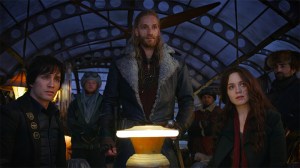 It’s never boring even when it’s being patently ridiculous and dumb. The main characters are powerfully bland, and they also give way to bland supporting friend characters who serve no purpose other than to be the eyes needed to oversee certain villainous revelations. The romance between Hester and Tom is nonexistent and painfully contrived. Much like the equally bonkers Jupiter Ascending, the main characters and their story are the least interesting parts of the world. Sheehan (TV’s Misfits) seems a bit too old to be playing a 16-year-old. Hilmar (DaVinci’s Demons) has little to work with but is very leaden and flat. There’s no spark of charisma between the two of them. Hugo Weaving (The Hobbit) is clearly enjoying himself as the hammy villain bent on bringing back old imperialism into this brave new world. The entire population of London is only seen cheering in reaction shots, which makes it harder to believe when characters talk about innocents amongst this throng of happy imperialist cheerleaders. I was happy to see Frankie Adams (TV’s The Expanse) as a do-nothing role as Revolutionary Fighter Pilot #3.
There is a massive plot hole in the second act that Mortal Engines cannot recover from (minor spoilers). The entire motivation for Hester is her vengeance against Valentine, enough so that she’s willing to risk her life by running out on her zombie Terminator surrogate father Shrike (Stephen Lang, in CGI mode) to see this through. But if Hester has a zombie Terminator surrogate father, why doesn’t she simply say, “Hey new dad, help me kill this one evil guy, and I’ll happily do whatever you want after”? In flashbacks, we see her open to the idea of transforming into some form of a robotic hybrid, shedding her humanity and losing the ability to feel any pain. It makes no sense why she wouldn’t use this new asset to her advantage, especially when the second act is mostly spent proving how formidable a threat he can be. This plot turn is further evidence at how sloppily the storytelling can get with character choices. Shrike is introduced as another antagonist to chase our heroes, but by introducing him at all, it makes me wonder about the better version of this movie, the Leon: The Professional version where a young girl teams up with a zombie Terminator father figure for vengeance. Don’t you, dear reader, want to see that movie too? It already sounds far more interesting and a better use of the unique story elements.
 Here’s another example of how confusing this movie is – the poster image. Go back to it in this review and study it, then ask yourself why the marketing team decided to put the visual emphasis on a woman’s face covered by a bandanna. It’s a movie about giant cities on wheels attacking each other and it also has a zombie Terminator… and the emphasis is on a bandana? If all you saw about the movie was the title and that key poster image, you would never suspect what kind of movie you were in store for, which seems like the exact opposite purpose of advertising. What’s the hook of this image? What’s underneath that bandanna (spoilers: a second smaller bandanna)? What about the tagline which talks about her scar? Did the marketing team actively try and hide the buzzier genre elements?
Mortal Engines feels assembled from the many scattered pieces of other, better movies. I wish we spent more time in this world and less time with the bland assembly of characters not played by Hugo Weaving. I wish we saw more about the intricacies of life on the move and the working infrastructure of these new environments. I wish we had more importance with the Anna Fang (Jihae) character where she didn’t feel like she just ported over from a Matrix sequel. I wish a lot of things were different about Mortal Engines and yet even when it’s bad, even when it’s dumb, and even when it’s insane, the movie is always worth watching and fairly entertaining, for a variety of reasons. I could see a select group of audiences enjoying this for ironic and non-ironic purposes. It’s a big shambling mess of a movie but it puts on a solid show.
Nate’s Grade: C+
Share this:

Spider-Man: Into the Spider-Verse (2018)
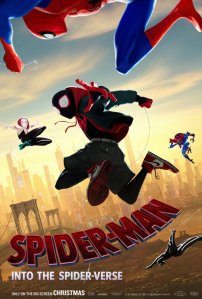 Walking out of Brad Bird’s hotly anticipated sequel to The Incredibles, I was convinced there wouldn’t be a better-animated film for the rest of the calendar year. Then I saw Ralph Wrecks the Internet and felt the same conclusion. What could top these two incredible movies from Disney? I wasn’t expecting a parallel world Spider-Man animated film to contend with that heralded echelon, but after watching Spider-Man: Into the Spider-Verse, I am now certain. This is the best-animated film of the year and one of the best films of the year, full stop. It’s rich, imaginative, exciting, satisfying, and way too much fun.
Miles Morales (voiced by Shameik Moore) is an ordinary teenager starting a new school he’s eager to leave. His police officer father, Jefferson Davis (voiced by Brian Tyree Henry), is pushing him and can be embarrassing. His cooler uncle Aaron (voiced by Mahershala Ali) encourages Miles to express himself through his graffiti art. One night, Miles encounters the famous Spider-Man, a particle collider, and a special spider from another dimension that bites him. He develops super powers and seeks out Peter Parker (voiced by Jake Johnson) as the only other person who might understand what he’s experiencing. Except there happens to be multiple Spider-laden heroes, including Spider Gwen, a.k.a. Gwen Stacy (voiced by Hailee Steinfeld), Spider-Pig (voiced by John Mulaney), Spider-Man Noir (voiced by Nicolas Cage), and an anime heroine Peni Parker with a giant spider robot friend. They’re all from alternate dimensions, dragged into Miles’ world thanks to Kingpin’s (voiced by Liev Schreiber) particle collider. If they don’t get back to their original worlds they’ll glitch out of existence, and Miles’ own world, and everyone inside it, is threatened by the instability of that collider.
 Into the Spider-Verse is bursting with color, imagination, kinetic energy, and a real celebration of the art form of animation and comics. Once that super spider bites Miles, the visual mechanics of the movie alter as well as him. Suddenly his thoughts are louder and appear in floating boxes (only we can see), in addition to thought bubbles, sound effects, and the occasional panel shifting transition device. It gets far closer than Ang Lee’s Hulk at recreating the experience of a living comic, and it’s joyous. The animation style too recreates the cross-shading effect of comic artists and the fluidity of the animation has purposely removed frames, giving it a slight stutter-step more often found in stop-motion animation. This distinct style might be off-putting to certain audience members accustomed to the smooth movements of modern animation mimicking real life, but for comic fans, it better approaches the captured stills of comic panels being connected into a whole. The different animation styles of the new Spider characters, Looney Tunes to anime to stark noir Frank Miller riffs, become reminders of separate universes with their own visual rules that keep things fun. The film is vibrantly colorful and gorgeous to watch on the big screen where a person can best luxuriate in that flamboyant palette. The finale feels like an explosion of splash pages and graphic designs merging together, even mimicking the sprawling graffiti art of Miles. It’s a spectacular visual feast that manages to be that rare treat of something new yet familiar.
The action of Into the Spider-Verse is delightful when it’s comedic and thrilling when it’s serious, but at every turn its fun, well developed, and wonderfully rendered. Early on, as Miles learns the tricks of his new and confusing abilities, the action is wildly funny. Take for instance a sequence where he becomes attached to an unconscious Peter Parker through the Spider-Man webbing. Soon after, the police approach Miles, and now he has to make a break for it while still attached to another body, forcing him into a series of comic escapes. It’s highly spirited and filled with enjoyable jokes. Later, as Miles gets more centrally involved in Kingpin’s scheme, the action becomes harsher, more violent, and dangerous. A battle between Miles and The Prowler gets more and more extreme, especially after some twists an audience may or may not see coming depending upon their source material knowledge (this is a parallel universe, after all). The action is frenetic, inventive, and visually engaging, easy to follow and filled with wonderful organic complications that allow each scene to feel vital and different from the last.
 Into the Spider-Verse is also brashly hilarious from beginning to end. Being co-written by the writers responsible for The Lego Movie and 22 Jump Street, I was expecting a combination of clever and antic, and that’s what they delivered and then some. There are brilliantly conceived and executed jokes but, and this is what separates the professionals, they do not distract from the larger work of the characterization. Often the humor is built through the characters, their personality and motivation differences, and the unique circumstances, so even when its zany it feels connected or grounded. There’s a silly joke about getting more bread from a waiter that works on multiple levels and they keep going back to it for further meaning, and it’s one example of many that shows the work put into their funny is meaningful and smart. After six movies and several animated series, audiences are well versed in the origin of Spider-Man, so Into the Spider-Verse even turns that knowledge into a source of humor itself, laying a formula for each new Spider character to introduce themselves with the same fill-in-the-blanks origin speech. The alternate universe Spider heroes do not overstay their welcome and, miraculously, even find themselves with some potent small character moments, which is an amazing feat given the 100-minute running time. The laboratory break-in with Peter Parker and Miles is a comic highlight with plenty of complications, and there’s a smart, sly joke about personal biases that just slides by nonchalantly that had me howling. The post-credit scene had me laughing so hard that I was crying. Please, I implore you, stick around for it and go out laughing with the biggest smile on your face.
Besides being a great comic book movie and a great action movie, Into the Spider-Verse is also just a great movie. The Spider-Man character is so familiar that the film easily could have gone on autopilot yet it puts in the work to build characters we care about, give them arcs, and provide setups and payoffs both big and small to maximize audience satisfaction. Miles is a terrific new character with a voice all his own, and his teenage foibles are both recognizable and refreshing. He’s a hero worth rooting for, and his more personal family issues can be just as compelling as the end-of-the-world adventures. That’s the core of what makes Spider-Man still an invigorating character 50 years later, and Into the Spider-Verse taps into that essential element even with an alternate universe Spider hero. It’s got the DNA of Stan Lee and Steve Ditko’s original creation and given a welcomed jolt of relevancy thanks to the onscreen racial diversity and youthful perspective.
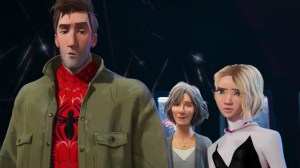 There are two relationships at the core: Miles and his father and Miles and Peter Parker. The latter is an unexpected mentor/pupil relationship that provides the enjoyment of watching both members grow through their bond, and the former allows a familial baseline to come back to and demonstrate how far we’ve come. The Peter Parker/Miles relationship has that big brother/little brother angst that keeps things sharp while still maintaining an undercurrent of emotional need. There were genuine moments where my eyes welled up. The film can be that affecting because it is so well structured and developed from a characterization standpoint. Even the chief villain, the Kingpin, has a motivation that is personal and effectively empathetic. Everyone involved gets careful consideration, even the bad guys.
Let me cite one prime example that showcases how great the storytelling can be (minor spoilers). At one point, Miles is bound and gagged by the other heroes to prevent him from joining them in a dangerous activity they do not believe he is ready for. They’re removing him from the team for his own good. Then, at this low point, his father comes to visit him and tries talking to him through the other side of his dormitory door. They’ve had some challenging moments between them and what Mr. Davis has to say is extra challenging. He’s trying to connect with a son he feels he’s losing touch with, and it’s a one-sided conversation where Miles is unable to respond to his father’s pleas, who eventually walks away knowing his son is there but not ready to talk. Right there, the screenwriters have gone from the fantastic to the personal, finding a way to bring Miles even lower but in an organic fashion that plays right into his ongoing communication problems. It’s a simple moment to start with, standard even, but then having it contribute to the father/son estrangement is beautiful and handled so well. The sparkling screenplay for Into the Spider-Verse is packed with moments like this.
The voice acting is perfectly suited for their roles. Moore (The Get Down) is an expressive and capable young actor that brings a terrific vulnerability to Miles, selling every emotion with authenticity. Johnson (Tag) is the absolute best choice for a slacker Spider-Man who has become jaded and self-indulgent. His laid back rhythms gel nicely with Moore’s eager breathlessness. Henry (Widows) is so paternal it hurts your heart. Steinfeld (Bumblebee) is poised and enjoyably spry. Cage (Mandy) is doing everything you’d want a Nicolas Cage-voiced crime fighter to be. Schreiber (Ray Donovan) can be threatening in his sleep with that velvety voice of his. Plus you get Katheryn Hahn as a villain, Zoe Kravitz as Mary Jane, and Lily Tomlin as Aunt May, and they’re all great.
 As the credits rolled for Spider-Man: Into the Spider-Verse, I tried searching my brain for any flaws, minor quibbles, anything that would hold the film back from an entertainment standpoint. The only thing I could think of is that animation style, but different people will either find that look appealing or irritating. This is a glorious and gloriously entertaining movie replete with humor, heart, surprises, payoffs, and a great creative energy that bursts from the big screen. This really is a movie to see on the big screen as well, to better feast on the eye-popping visuals and pop-art comic book aesthetics that leap from the page to the screen. It’s the second best Spidey movie, after 2017’s impeccably structured solo venture, Homecoming. The late addition of the other alternate universe Spider heroes keeps things silly even as it raises the stakes. The film is a wonderful blending of tones and styles, from the different characters and universes to the heartfelt emotions and vicarious thrills of being young and super powered. This is a movie that even Spider novices can climb aboard and fall in love with. Into the Spider-Verse is a film for fans of all ages and nothing short of the best animated film of 2018. It’s as good as advertised, folks.
Nate’s Grade: A
Share this:

Mowgli (2018)
 Sometimes second place might as well be last place in the film industry. Pity Andy Serkis and the years he spent making a live-action, mo-cap enhanced version of The Jungle Book only for Disney to scoop him years in advance and deliver a billion-dollar hit. It’s impossible not to compare the two and unfortunately Serkis’ passion project is found wanting in many areas. For starters, there’s far less Shere Khan (voiced by Benedict Cumberbatch), which is a shame. He’s really only in the film for very little. I think Cate Blanchett is miscast as the voice of the snake, Kaa, who acts like a grand keeper of the jungle’s history and future. I’m not sold on Serkis as Baloo, a grumpy paternal figure present from the beginning that trains the wolf pups so they can join the pack. The middle half-hour Mowgli spends in the company of man with a kindly poacher also feels like the movie is spinning its wheels. It keeps the rest of the jungle on hold. There are some rather dark asides that can be quite surprising, from wolf pups plummeting to their doom, bloody scars, cute severed heads to haunt your dreams, and three separate occasions where characters will watch the light vanish from a dying animal’s eye. It’s definitely a more brutish, cruel, and dangerous world, but at what greater expense? The characterization doesn’t add up to much. The character relationships are minimal. The CGI creatures and settings look unfinished. The whole enterprise feels rushed even though it’s been on the shelf for some time, which may be why the studio was eager to sell it to Netflix for a cool $90 million. You’ll watch Mowgli and nod, generally entertained, but questioning whether it’s 90-million worth.
Nate’s Grade: C+
Share this:

Fantastic Beasts: The Crimes of Grindelwald (2018)
 When they adjusted the Hobbit movies so there was going to be three instead of two, it required some very noticeable padding and filler material to meet out that requirement. The second Fantastic Beasts film (of a planned five film series, expanded from a trilogy) feels exactly that way, a mostly table-setting movie with more incidents than plot, a few pertinent revelations, and not much in the manner of resolution. The second Fantastic Beasts does improve on its predecessor in several regards. It introduces a formidable villain that’s well played by Johnny Depp. It introduces a compelling younger version of Albus Dumbledore that’s played by the dashing Jude Law. It also finds more purpose for its hero, the shy magical zookeeper Newt (Eddie Redmayne), as the series inches closer to a wizards-vs-wizards world war. Things take a turn for the darker; within the First Act, a baby is murdered. They didn’t even do that in the new Halloween. The larger world building of Beasts, written by author J.K. Rowling for the screen and directed by longtime stalwart David Yates, has been its biggest draw. The supporting characters are back, though not everyone has much to do. Rowling is improving as a screenwriter but she still has trouble executing exposition-heavy scenes, resorting to sequence after sequence of characters prattling on. Ultimately, it doesn’t feel like there’s much of consequence until the very end, so we endure characters running through underdeveloped and contrived storylines. One of these involves Katherine Waterston mistakenly believing Newt is engaged (his brother is) and somehow, despite having access to magic let alone other forms of media, never findings out the easy truth. It’s stuff like that that show me Rowling was struggling to find material for every character to push them forward on this now extended journey. Crimes of Gindelwald is an overall step in the right direction for the prequel series even if this individual movie has trouble standing on its own magical merits.
Nate’s Grade: B-
Share this:

Widows (2018)
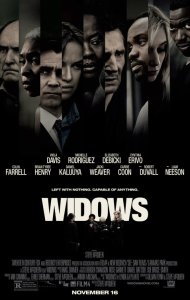 Widows has an all-star cast, an Oscar-nominated director, and a best-selling novelist-turned screenwriter, so my expectations might have been turned up a bit too high. It follows a team of titular widows (Viola Davis, Michelle Rodriguez, Elizabeth Dibecki) picking up the pieces in the wake of their husbands’ deaths. It seems their dearly departed spouses stole money from a local criminal who very much demands the sum returned. The women must enter into a criminal heist, using notes left behind by a dead hubby, to settle the debt and spare their lives. Widows is a higher caliber crime movie with notable texture given to a wide assortment of characters; even the villains are given small character touches to better flesh them out and feel more realized. There’s a concurrent election tying together different corrupt and criminal enterprises that widens the scope of the film into a grander scale. The characters and performances are the selling point of the movie and provide consistent entertainment. Davis (Fences) is the strong-willed linchpin of the group and I could watch her boss around people for hours. Dibecki (The Great Gatsby) has a nice turn as a trophy wife accustomed to being abused. The problem is that there might be too many characters. Rodriguez has far more significance in the first thirty minutes and then is put on ice. Likewise, Carrie Coon and Cynthia Erivo are hastily added when the plot requires something of them. That plot, adapted by Gillian Flynn (Gone Girl) and director Steve McQueen (12 Years a Slave), proves to be the film’s biggest hindrance by the end. The second half plot turns seem to come from a schlockier version of this story, not the classier version we had been treated to beforehand. There are character decisions that baffle credulity and personal safety. The quality of the characters deserved a movie that could refrain from the hacky genre twists. McQueen’s precise camerawork is still alive and well and highlights tension and also moments of social commentary, like when we watch a car travel mere blocks from a rundown inner city neighborhood to a fancy gated residence. There’s a lot to like with Widows, and plenty to get excited about, but I wanted to like even more.
Nate’s Grade: B


 nathanzoebl
You must be logged in to post a comment.