Jay and Silent Bob Strike Back (2001)
 Kevin Smith returns back to his comedy roots. No more movies with a message (Chasing Amy and Dogma) it’s back to good ole’ snowballing and stink palming. His latest, Jay and Silent Bob Strike Back, is like a giant thank-you card to all his fans that have made the man who he is today. It ties up the entire View Askew universe so Kevin can drift off into uncharted ventures of film making and not have to keep referencing the same damn characters. Plus there’s plenty of good-natured vulgarity to go around.
 The plot of Jay and Silent Bob is nothing too heavy but seems to keep the film on a continuous pace, unlike the sometimes stagnant feel Mallrats had (what, they’re in one location for 90 minutes). It seems that after getting a restraining order at the Quick Stop on them, Jay and Silent Bob learn that Miramax is making a movie from a comic book that is in fact based off of them. Learned of the riches they could make they seek out the comic’s author Holden McNeil (Ben Affleck’s first appearance in the film) and demand a piece of the pie. Holden tells them that he long ago sold his right to his partner Banky Edwards (Jason Lee, in his second appearance in the film) and that there’s nothing they can do to stop the film. Jay suddenly gets the idea that if they stop the movie from ever getting made then they don’t have to worry. So off go our stoner duo on a mission to sabotage and satirize Hollywood.
Along the way are a hitch-hiker (George Carlin) advising the best way to get a ride is to go down in your morals, a confused nun (Carrie Fisher), the cast of Scooby Doo offering a ride (which will be 100x funnier than the feature film coming out this summer), a beautiful band of international diamond thieves (Eliza Dusku, Ali Larter, Jennifer Swalbach-Smith, Shannon Elizabeth), a rescued chimpanzee, a dogged Wildlife agent (Will Ferrell), and a full barrage of hilarity once Hollywood is finally hit.
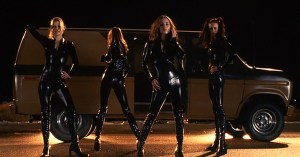 The best barbs are laid out by Ben Affleck and Matt Damon bickering about the other’s film choices on the set of Good Will Hunting 2: Hunting Season. This moment is truly inspired and full of great humor from Gus van Sant too busy counting his money to yell action to Damon turning into a vigilante hero. I almost fell on the floor laughing during this sequence.
When Jay and Silent Bob hit Hollywood is when the comedy starts hitting its stride as this Jersey Greek chorus interacts with the Hollywood life and encounters many a celebrity. The jokes are usually right on target except for Chris Rock’s performance of a racism obsessed film director. Rock’s portrayal becomes grating to the moviegoer far before it’s over, though he does get a few choice lines.
Smith as a director has finally elevated his visual art into something that can sustain itself instead of his earlier just-hold-the-camera-and-shoot movies. There are pans, zooms, quick cuts, cranes, action sequences, and even CGI. Smith is evolving as an artist but still staying his “dick and fart joke” self, and Jay and Silent Bob Strike Back is evidence. And that’s fine by me.
Nate’s Grade: B
Reviewed 20 years later as part of the “Reviews Re-View: 2001” article.
Share this:

Jeepers Creepers (2001)
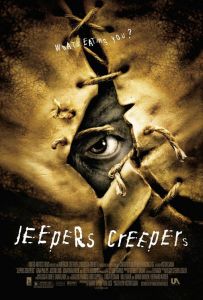 Victor Salva’s last picture was the overwrought Powder and now he follows it up with something the complete opposite of intellectual meditation –teen horror. With the Screams of the world drenching scares in irony and hipness it’s good to see an old fashioned horror flick that might actually generate real scares.
Jeepers Creepers starts off slow but methodical, with a slight nod to the old horror of the 70s where the mood was slowly and maturely built layer by layer. See brother and sister are traveling back home from their colleges together and have taken the long route across the nation’s empty plains and small towns. Their relationship is entertaining and, to a point, refreshing in how accurate they seem as siblings with their playful bickering. Upon their journey they almost get run off the road by a mad trucker driving what must have been the second car for the Munsters. After a moment to catch their breaths they begin once more driving. Further down the road they see the same truck parked at an abandoned church with a dark figure tossing something down a pipe – something awfully close to resembling a body. Some curious investigation reveals an entire church basement full of hundreds of mutilated corpses.
The two panic and run off to seek the authorities but now this figure, whatever it is, is on their trail. Of course the police just roll their eyes to their incoherent ramblings. Of course they gets hacked for their lack of faith. And of course there will be a babbling woman with some kind of psychic powers that tries to help the kids stop the monster. It pretty much gets textbook form here on out.
Jeepers Creepers is one-third a very interesting and genuinely scary movie, and then two thirds crap. It’s such a shame too because of the incredible promise the first 20 minutes showed. After that point the movie descends into the standard Boogeyman-chasing-teenagers flick. The “monster” of Creepers would have best been not shown than actually revealed. The film is spooky when all you see is a dark figure, but when the creature finally gets its close-up it’s nothing more than a patchwork Freddy Krueger with Spalding Grey’s hair.
Francis Ford Coppala produced this film so he must have saw something in it. But he likely only saw the first twenty minutes. Jeepers Creepers is for the most part a fun movie but it can’t help being a large disappointment. This is because the film could have been something so much greater than what it is, and even shows it in flashes but then takes the easy well-tread road instead.
Nate’s Grade: C+
Share this:

The Others (2001)
 Nicole Kidman has saved the summer of 2001 – it is now official. In what would have been deemed a pit of mediocrity and nightmares consisting of Angelina Jolie as some raider of tombs or Marky Mark making dough-eyes at attractive apes, has now been bookended by two terrific Kidman films. First Moulin Rouge ushered us in and now The Others is leading us the way out.
The Others is the tale of Grace (Kidman) trying to take care of her two ailing young children shortly after the end of World War II. Kidman is waiting for the return of her husband from the war and is all alone in a giant Gothic mansion. Her two children suffer from a rare allergy to sunlight that is so severe that if exposed long enough their bodies will develop markings and they will asphyxiate to death. To accommodate this illness the entire Kidman household is in the dark and grounded in stern rules. No door is to be unlocked without locking the last, like trapping water in compartments of a sinking ship.
 Grace discovers that she does need help and accepts three mysterious strangers that have said they were caretakers to this house once before. Before long the children start reporting odd events occurring that resemble ghosts; a door is opened when it shouldn’t be, someone is making noise where there is no one, and the children report having interaction with otherworldly spirits. Grace scoffs at any notion of the paranormal and goes back to instructing her children with the Bible and its accounts of penance and hell. The incidences begin to build further and further until The Others becomes a full-fledged ghost spectacle.
Spanish writer/director Alejandro Amenábar’s first English feature film is one of carefully textured craft and effective mood. The Others follows the points of ghost stories closely from dark hallways to the creepy and slightly dilapidated house closely. Every move, though, is so well in tune that they are highly effective in creating actual suspense and spookiness. One may have seen the same items numerous times before, however The Others utilizes them so gracefully that it achieves the full desired impact each can bring. Amenábar has created a ghost story that is genuinely creepy and at times scary.
Kidman shines as the dutiful and determined mother. Her performance is one of great dedication and she just consumes whole-heartedly the distress, confusion, and fear of this lonely mother. She is a true anchor for a film. Watching every moment of her on screen is amazing as well as invigorating. This role may lead to possible Oscar buzz come the end of the year but that is just speculation for now.
 The rest of the acting is very thorough and well handled by the few other cast members. James Bentley and Alakina Mann portray Kidman’s afflicted children and have much of the movie hinging on their performances. Not to worry, these two excel and give credence to being two of the more gifted child actors in a while. Their efforts greatly induce sympathy as well as great scares at key moments.
The story of The Others by Amenábar may seem simplistic, or even predictable, but the more I thought of the structure and the order of events the more well oiled and calculated it became. This is a delicate story told with great precision with a fantastic knockout ending that had me reworking everything. The Others is an example of why screenwriting is not yet dead in Hollywood.
The Others is a wonderfully brooding film with real scares and great performances, as well as terrific turns in writing and directing by Amenábar. Nicole Kidman has thankfully done it again, and if anyone dares doubt the power and newfound importance of her then see the rest of the summer of 2001’s offerings.
Nate’s Grade: A
Reviewed 20 years later as part of the “Reviews Re-View: 2001” article.
Share this:

O (2001)
 “I did what I did and that is all you know. From here on out I say nothing.”
The story behind O has become more infamous than the film itself. The film has had twelve different release dates and was actually finished in 1999. It had the dubious nature of having the themes of jealousy and violence set in high school around the time Columbine had polarized the nation. Miramax subsequently kept pushing the film back until it finally jettisoned it over to Lions Gate films, the same people who rescued ‘Dogma’ when Miramax felt it was too hot to handle for corporate parent Disney. Finally now O is getting the release it has waited for.
O is the modern update of Othello but is by no means in the same brethren of the bubbly Shakespeare ripped teen comedies proliferating the screen big and small. O is a serious tale told with earnestness in its portrayal, and with its conviction and refusal for exploitation, executes the best modern day transition of Shakespeare to date. What better setting for lust, jealousy, love, betrayal, murder and tragedy than a high school? It is almost chilling how well the tale translates to the high school setting, particularly with the notices of race and jealousy.
Odin James (Mekhi Phifer) is the only black student at an all white prep school in Charleston, South Carolina. Odin is the senior leader of the school’s basketball team and an all-star in the making. Odin, or “O” as the crowd chants at games, is dating Desi (Julia Stiles), the daughter of the dean. She’s a spitfire but they love one another with great intensity. Everything seems to be going well for Odin with school, his relationship, and his team entering into the state playoffs. His coach (Martin Sheen) proclaims his love for Odin like a son at a pep rally with the denizens in the stands cheering along. Everyone appears to be cheering for their popular hero, except for Hugo (Josh Hartnett).
 Hugo is the coach’s son and perennially looked over on the basketball team. He looks at Odin and is fueled with jealousy for the admiration and love his father would rather bestow on him than his own son. Dinner at home is a more a cold silence than a family activity. Hugo is jealous of all the things Odin has that he cannot have and some that he will never have. So he sets forth in motion a plan to bring the downfall of the popular kids he despises. Hugo enlists the aid of gullible Roger (Elden Henson) who’s picked on heavily from the same people Hugo wishes to topple. Hugo coaxes Mike (Andrew Keegan), ousted form the basketball team after a staged fight with Roger, that the best way to regain the good will of Odin and his father is to cozy up to Desi and convince her. He then plants the seeds of doubt in Odin with Desi. He draws Desi’s roommate Emily (Rain Phoenix) into the scheme by seducing her into stealing a rare handkerchief that Odin had given Desi as a show of love and commitment.
With every pawn somehow moving in the directions Hugo wishes the jealousy boils, love turns to heartbreak, and the game ultimately ends violently. It isn’t called “tragedy” for nothing folks.
Othello is, at its heart, the tale of a villain and his masterminding. The center figure is not on our hapless Moor or his lovely Desdemona, but on the treacherous Iago as he plots the tragedy of those around him with woeful precision. Shakespeare’s Othello has quite possibly the greatest villain in all of literature with Iago. He is a man who positions an elaborate staging of jealousy, insecurity, mistrust, and ultimately murder – and all this time he is given center stage to propel his masterwork. And it’s exciting, giving genuine evil a face, a name, and more importantly than anything else, a vicious intelligence to play out. This is why Othello transcends its problems in story staging and character turning points, because it is a tale told from the hands of its most essential leg: the villain.
Hartnett takes the reigns of the picture and gallops with them with great care. Though shot and filmed years before many of his latest pictures, O shows Hartnett in his most methodical and enticing acting turn. He portrays Hugo smoothly giving equal shades of bitterness and envy with his sullen performance. Harnett is so invigorating as the villain that one almost sides with him, but that is the attraction of evil. O decides to pump more motivation for its villain than Shakespeare had included, and it works in a startlingly believable way. A student plotting the demise of a more popular and athletic student and seeking the love of an inattentive father – maybe this is why Miramax shelved it for two years. The motivation in this setting is totally believable to a chilling point.
 Phifer is a charming presence and reflects the descent of Odin with good emotion. One can feel the rage just resonating from him during a slam dunk contest which he brings down the backboard and sternly glares at Desi in the stands. His final declaration with all the chaos that has swarmed around him is almost heart breaking. Stiles, on the other hand, is not given too much to work with but seems to make decent use out of her part. Sheen blusters about like the spawn of Bobby Knight, but shows a more frightening side in his ambivalent relationship to his son.
O is deftly directed by Tim Blake Nelson who might be more well known as the “other” chain gang member in O Brother where Art Thou? Nelson periodically adds little touches of great artistic exchanges that elevate O into something more than another teen film. It even achieves a certain level of poignancy and power as Hartnett is led away and speaking reflective about his deeds to the audience. The script from debut screenwriter Brad Kaaya drops Shakespeare’s prose but for the best. The film has a greater sense of realism and authenticity when the main characters aren’t talking in iambic pentameter.
The film isn’t perfect by certain means. Hugo’s plot seems a tad too elaborate and easily achieved, and Odin seems to fall for some questionable pieces of doubt. I mean, what else will an old hanky be used for in a modern film? But these faults can be blamed on Shakespeare as much as the principals involved behind the film. Despite these minor stumbles O is indeed a great film that deserves to be seen and thought over afterwards.
Nate’s Grade: B+
Share this:

Captain Corelli’s Mandolin (2001)
 We open on an island on the offshoot of Greece in the start of the 1940s. The waters are blue, the sand is white, the people are happily ethnic, and it’s basically a postcard. The island is overpopulated with idyllic beauties and friendly people and then evil evil war had to come and steal the innocence. Cruz plays a woman who has a first name that I have no clue of or remotely how to pronounce it, but I am certain it began with a P. Cruz is studying to be a doctor under the tutelage of her wise old customed father (John Hurt). She’s engaged to be wed to hunky fisherman Mandras (Christian Bale) until the war threatens their peaceful isolated world. Mandras feels the patriotic urge to go to war and thwart the advancing Italians and Cruz pines for his safe return writing letter after letter with no answer to only fear the worst.
 As the war continues the Italians do advance further and take occupation of the Greek island. Captain Antonio Corelli (Nicolas Cage) is amongst the divisions assembled to this Mediterranean isle. He is agreed to stay in Cruz’s home and, as always, begins to develop feelings for Cruz. She feels some as well but is torn on what her actions should be. Corelli, it turns out, is far more a singer than a fighter. He has a battalion of men he dubs his “opera” and they break into frequent song and an overall zeal for life. They run around drinking and singing on the beaches complete with topless women making this Italian occupation seem like summer camp.
The good times don’t last of course and the war rages closer and closer. Soon the Italian army surrenders and then the Germans come in to retake occupation of the Greek island. Corelli must decide to go home or help fight amongst the guerrillas and native people to keep their beautiful land away from Nazi hands.
Penelope Cruz seems to be heavily pushed on me by Hollywood. She is too mute at times and the emotions that we should see tearing her up are simply dampened by her staring downcast or biting her lip.
Cage is an Italian-American and yet his Italian accent is atrociously comical. His performance is like the Joker doing an Italian accent. He also kisses like he is trying to swallow poor Penelope’s tiny head. Somehow beyond my reasoning the talented Christian Bale got in this movie. He’s about as convincing as a Greek as Laurence Olivier was as a Moor. The rest of the cast is filled with Greek people portraying Greek people.
The love story of Captain Corelli’s Mandolin is a mishmash of un-involving war violence and a cloying romance that never gets into the proper gear. There are elements of guilt and affection, but they aren’t transcendent of any reality. The first time Corelli tells Cruz he loves her they have sex in a field that very moment. There is not enough groundwork laid to produce a decent romance. So the supposed “smolder” between Cruz and Cage is thematically unbelievable, and kind of a bit creepy.
 Corelli suffers from A.I. syndrome in that it desperately needed to end twenty minutes earlier than it did. The fact that Cage survives a machine gun execution because a SINGLE PERSON stood in front of him is bad, but it gets even worse for the inhabitants of the Greek island. Some get hung by their own people, some get shot in the face from Germans, and then everyone must suffer after the war by having an earthquake level half of their town. This stretch of film goes from pointless to comically absurd. It’s like John Madden fell asleep in his director’s chair and someone thought, “Well, let’s model the last act of the film after a Universal tram ride. Hey, can we have Jaws pop out of the water at some point?” Corelli has failed as a romance and during its end stretch it completely fails as any kind of cogent drama.
The direction is adequate by Madden but the script just doesn’t cut the mustard. In the end they rely on the old Hollywood principal of Nazis being pure evil, so much so they might as well have mustaches to twirl. I thought at one moment they were going to tie Cruz to a railroad track and would have preferred it if they had. This is a film caught between romance and war, and it does a disservice to both. The war is a naive afterthought and the romance lacks any credibility. The scenery sure looks nice though. In the end, Captain Corelli’s Mandolin is a film desperately out of tune.
Nate’s Grade: C-
Share this:

American Pie 2 (2001)
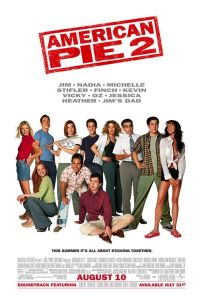 First and foremost I disliked the first American Pie movie. It just rang very transparent for me and I didn’t laugh once – a capitol crime with a comedy in my book. So I wasn’t exactly looking forward to another addition with the American Pie family, but ventured out with friends and found myself enjoying this second helping of raunch. And this time I genuinely laughed at several points and found it overall less insipid.
To American Pie 2‘s benefit all the characters have been introduced prior and are familiar to the audience, therefore no time is wasted on pointless set-up. The movie jumps right out to the familiar faces and decides to further the AP2 universe. Jim (Jason Biggs) and friends are returning back home after their first year of college. Jim has not had a sexual experience since his prom night with Michelle the band geek (Alyson Hannigan) and he is completely in doubt of his abilities in the bedroom. Complicating matters is the news that the Czech student of his fantasies Nadia (Shannon Elizabeth) is on her way back and is eagerly anticipating another tryst with Jim. Kevin (Thomas Ian Nicholas) is still hung up on his ex Vicky (Tara Reid) and worrying that his friends will grow apart and college will change everything. Oz (Chris Klein) seems to be doing fine with his monogamous relationship to Heather (Mena Suvari), despite the taunting of Stifler (Sean William Scott) that he needs to spread out. Finally Finch (Eddie Kaye Thomas) is still chasing after the only woman that ever caught his heart, Stifler’s mom.
 After the boys return back to their roots the police bust a party at Stifler’s pad, and they are without a place to party for the summer. Kevin brings to their attention the idea of renting a cabin on the beach for the summer. The place serves as a spot for the boys to enjoy their sunshine-y days away from school and stay together as friends, as well as attempt to get an abundance of tail. Hi-jinks ensue.
AP2 almost seems to follow the formula of the first one to the letter. The opening scene has Jim’s dad (the always hilarious Eugene Levy) walking in on an embarrassing moment for Jim (you think he’d learn that doors have locks at this point). Jim encounters a horrific sexual accident that he must discuss with his father afterwards. Stifler gets a not-so-nice encounter with a bodily fluid in the beginning party. And it all ends with a big party to end all parties with everyone hooking up with a partner for some post-coital spooning. The script was written by the same writer of the first yet he seems to be playing connect the dots with his own formula.
What American Pie 2 does to separate itself as more enjoyable than the first is give the interesting characters the majority of the time and leave the least interesting sputtering for air. The interesting ones follow: Jim is a nice guy full of the same insecurities that plague a teenager and intimacy, and Biggs plays him as an everyman who somehow always seems to come into sadistic moments of embarrassment. With Jim’s wish to be more sexually adept he visits the infamous band camp and finds Michelle once again who agrees to coach him on techniques and pointers. Hanigan is given an incredible amount more of screen time and she’s glowing in every second of it.
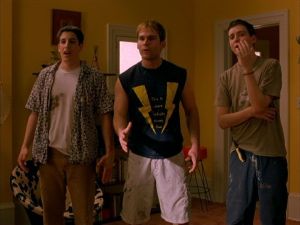 Also the man-you-love-to-hate Stifler has a larger role leading his group of lakeside roommates into encounters with lesbians and other sexual calamities. Scott may be playing Stifler as a jerk but he’s entertaining and genuinely funny, and at one point you can’t help but root for the crass frat boy. Finch has learned that Stifler’s mom will be paying a visit to their cabin at the end of the summer and spends his time studying up on Tantra and Zen to fully explore his inner sexual prowess.
The entire cast from the first American Pie romp does return, though not everyone has equal time. Mena Suvari (still looking so young) leaves in the beginning of the film and then comes back at the very end. The insatiably annoying Reid (who has eyes that I can’t tell where her whites end and irises begin) thankfully is only in the film for two short scenes which leads me to question was she even necessary in the first place? Natasha Lyonne is only in scenes alongside Reid, so her stint in the sequel is equally as brief. Elizabeth’s role might be central to Jim’s quest for sexual fulfillment, but she only pops up in the last eight minutes of the film – and doesn’t show her breasts this time. Now that I think about it Klein and Nicholas really weren’t in the film too much either except for standing in the background while another character talked.
The soundtrack is a collection of every pop “punk” band that’s been playing on MTV since May of that year. It’s like the producers just watched the channel for a week and would point to the ones they wanted.
The film still is a mishmash of gross out sexual humor and sentimentality, but for some reason it’s a lot easier to swallow the second time around. For all its bodily fluids and crudeness, American Pie 2 has a stickily sweet secretly conservative old-fashioned heart. Though the makers would never tell you so. In a summer almost bankrupt on entertainment value I’ll leisurely take a slice of American Pie 2.
Nate’s Grade: B-
Share this:

Planet of the Apes (2001)
 Taking a storied, and for the most part successful, franchise like Planet of the Apes and trying to rework it is frightfully difficult. You don’t want it to turn off the original’s fans but not be different enough to have its own voice. When I heard that Tim Burton was going to helm this reworking I became optimistic about the prospects of a Burton Planet of the Apes and began to eagerly anticipate its release. What I got, despite some stellar visuals, is a disappointing low point for many people involved, and that does include the man that gave us “Good Vibrations.”
Capt. Leo Davidson (Mark Wahlberg) is a trained pilot inhabiting a space station orbiting the rings of Saturn. The members inside are performing tests on the intelligence of apes (foreshadowing poking you in the eye) and seem to be coming back with optimistic results. A cosmic energy storm erupts near the station and Leo’s chimp is sent out into a pod to investigate. When the ape disappears (oh the foreshadowing is starting to hurt) Leo decides to venture out himself to save his monkey despite the instructions of his superiors. He gets pulled into the energy field and crashes on a distant planet where he discovers that apes are on top of the food chain and humans are the sport. Captured by the ape commander Attar (Michael Clark Duncan), he is taken to Ape City. He is sold into slavery but wins the attention of a human rights activist Ari (Helena Bonham Carter) who agrees to help him escape and get to his crashed vessel. General Thade (Tim Roth) still carries a torch for Ari but has an entirely different viewpoint when it comes to humans. At one moment he grabs Wahlberg and pulls apart his mouth to murkily inquire “Is there a soul in there?” When Thade begins to learn about Ari’s assistance to the human escape he mounts a full army to travel to the Forbidden Zone and annihilate the humans once and for all.
 Burton’s Apes remake, excuse me… “re-imagining,” lacks the social commentary, originality, and heck, even entertainment level that its predecessor possessed. Burton adds his usual great touches of style and the sets are vast and a wonder to see, but what movie is all set watching? This isn’t the simian Home and Garden channel. Burton dresses his players up nice thanks in part to Rick Baker’s fantastic makeup but the components in Apes redux are all dressed up with nowhere to go.
The script is credited to four writers but I wonder why anyone would want to take any credit for it. The story is not only half-baked it seems to never have come out of the oven. The tale is full of numerous incongruities that make this new Apes feel stagnant, especially during its middle portion. The story never gives us any real characters or an exciting line to follow. It’s more like a story pitch than a full story. There are many moments where dialogue is paraphrased from the original in an attempt at a humorous wink, but it’s worthy of more groans than applause.
Unlike the first Apes series, the humans of Burton’s ape world can speak… they just don’t have anything interesting to say. Estella Warren fills in as the good looking and useless heroine that spends her days frolicking about in ripped rags. She’s supposed to be the love interest for Mark but she fails at that (even though she’s the planet’s only attractive female) with Carter getting more googly eyes cast her way. There’s something weirdly natural seeing Kris Kristofferson as a scrubby post-apocalyptic dweller. It seems like he was made to lurk through caves and grunt. Wahlberg himself seems to sleepwalk through the entire film and speaks in only one monotonous tone.
Roth gets to huff and puff a lot and does quite a good menacing job. Every expression of his has a dominating glare of power and every piece of dialogue spoken in a gruff snarl. He has total capture of a great villain and serves his end well enough as the story provides. Carter gives a light touch as the sympathetic human defender but the long awkward moments where her and Mark gaze at each other gave way to great howls from my audience. Giamatti hams up his role with verve and provides some of the best moments of levity for this overwrought film.[
The original Planet of the Apes ending was one of the greatest twists of cinema. It was entirely logistical and packed a great punch. The ending of Burton’s “re-imagining” packs as much punch as a wet noodle. The ending is TOTALLY IMPOSSIBLE given the set-up of the events in the film. Not only is it a disappointing head-scratcher but ]it also manages to rip off the first film’s ending with no shame. It truly may be the worst ending possibly ever. I bet a room full of monkeys could have written a better ending, and I’m willing to put money on it.
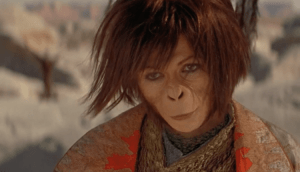 Let me explain why it’s impossible through the use of spoilers. So Mark is in the future. He follows his little monkey friend and crash lands on a separate planet IN THE FUTURE. On this planet, Mark’s space station has been looking for him and crash landed. Their monkey experiments get loose and bing, bang, zoom, we got fully evolved monkeys ruling the place (don’t even bother asking where the horses came from). Now, after learning all this, Mark takes a space pod and zooms his way back to present day Earth. He crash lands against the Lincoln Memorial steps only to discover that Lincoln has been replaced with General Thade and Earth is populated with highly evolved apes that still speak English. What? How? What? This cannot be because the film establishes a frame where Earth already has a long history of non-evolved monkey rule. Wahlberg crash landed on a DIFFERENT planet in THE FUTURE that should, therefore, have no bearing whatsoever on what happens to Earth or its past. The Apes remake rips off the most famous twist ending ever by serving up an incongruous version that makes no sense and cannot happen.
Planet of the Apes had all the right components for an exciting and sleek sci-fi ride but falls far short. Burton adds enough of his Gothic vision but this will likely go down as the weakest film on his resume. The usually reliable Danny Elfman’s score is nothing more than hyped up symphonic white noise. Burton may go home with a large check but I pray they don’t do a “re-imagining” of the next Apes picture. Marky Mark and the Furry Bunch are stuck in a hollow, head-scratching bore. Fans of the original series may find interest in comparing and contrasting, but if that’s cause enough to make a film then give me 100 bucks and I’ll make my own versions in my backyard. And they’ll at least make more sense than this monkey mess.
Nate’s Grade: C
Share this:

Jurassic Park III (2001)
 Jurassic Park 3 – or – How I Stopped Worrying About Plot and Started Loving Dinosaur Mayhem
As we last left Dr. Alan Grant (Sam Neill) he is still making the rounds to financially support his ailing archeological digs in Montana. A couple (William H. Macy and Téa Leoni) ask the good doctor to be their guide as they have chartered a plane to fly over the island of Isla Sorna (or Nublar, I forget which, they’re both really Hawaii anyway). Grant hesitates at first but when their checkbook comes out he begrudgingly accepts – proving again like the first two, that no matter what the danger, archeologists will do whatever for grants. The truth is that the couple is searching for their lost boy (Trevor Morgon) who was stranded on the island when he partook in an idiotic para-sailing sight seeing adventure by the island. Of course the plane gets destroyed and they must all fend for themselves.
Jurassic Park 3 makes no bones about what it really is – a dino thrill ride. There’s no opportunities to flesh out characters, there’s no time for set-up, it’s just straight to the island and constant running from peril from there. The pacing of the film and structure is like an amusement park; the people are on one ride that thrills, then they quickly move to another within minutes, and repeat for an afternoon of fun. To boil it down it’s dinos chase humans, stir, and bake for 90 minutes.
 It seems that in every Jurassic movie we have some kind of new scientific theory being explored and eventually vilified. In the first it was dinosaurs behaved more like birds and perhaps evolved into them, the second had something to do with maternal behavior and parenting. And now in Jurassic Park 3 the new scientific dig is that raptors could communicate verbally to one another – in essence talk. There’s even a sequence late into the flick where they basically “talk” straight for something like a minute. I was hoping Dr. Doolittle would waltz in at any moment and start singing, but, despite my best hopes and wishes, it was not to be.
The effects and animatronics have gotten better than ever, and they were stellar to begin with. There are moments of great thrills and fun, but too often then not, it all feels routine. What should be an awesome sight of dinosaurs roaming is now blasé. What should be fearsome coming face to face with the familiar predators like T. Rex and the raptors now seems, well… too familiar. The only true moment of great awe and freshness is when the group is walking along a rickety walkway only to discover they’re inside a giant aviary complete with hungry pterodactyls.
 Acting in a Jurassic Park film usually consists of a healthy scream and some fast legs. Everyone is okay by those standards, but Leoni’s character is just far too annoying. I would’ve enjoyed the flick more if she had been eaten. In another stroke of sure luck, all of the major Hollywood cast members survive yet all the extras or unknowns perish. Call it the Poseidon Adventure syndrome (Thank you Ebert for writing this first so that I might rip you off in the future).
Director Joe Johnston (The Rocketeer, Jumanji) inherited the dino franchise from master guru Spielberg and has done a fairly capable job with his efforts. The action is fast and there are a couple of particularly nice visual set-ups sprinkled through out the film. The marvel that was in Spielberg’s touch is the most missing however. The “script” (and I use this in a very loose sense) is actually co-credited to Alexander Payne, which is a rather interesting morsel. The most interesting one though has to be that the young Morgon has actually starred in another dinosaur picture before in his short career – Barney’s Great Adventure.
For action fans in this bleak summer release period Jurassic Park 3 will serve a fine dish at 90 minutes of fast dinosaur attacks and squeals. Hopefully though the ‘Jurassic Park’ franchise will be stopped before the wonder it used to have turns passé. Because right now it’s teetering on the brink.
Nate’s Grade: C+
Share this:

The Score (2001)
 Marlon Brando, Robert De Niro, Edward Norton, three of the greatest actors of three generations. This draw alone warrants a stroll to view The Score one would assume. But not so fast my friend. If you venture out to witness this movie chances are you will fall asleep within the first hour.
The plot runs through the all too familiar terrain of so many crime capers and heist flick predecessors. There’s the old pro who wants to retire (Robert De Niro) who gets pulled into a risky heist planned out by a young pup with some bite (Edward Norton). Will the old pro forgo his plans of retiring on a beach side with little umbrella drinks for one last shot at the big score? If you have to think about this question then you need to get out more. The scheme is to break into the Montreal Customs building and steal a scepter that could be worth as much as 30 million dollars. Stealing a scepter from French Canadians? Was this idea written on the back of a napkin at a bar?
This is in essence the plot of The Score. The characters are mere shells and never fleshed out. With any heist picture there should be the scenes where the characters engross themselves with the ins and outs of their scenario, the rehearsing and practicing, and finally the big move. The Score decides to lightly touch the first, skip the second, and barely give the audience much of the third. The film just isn’t playing by the rules it gives.
 The Score is muddily directed by famed puppeteer Frank Oz. He has directed comedies over the past few years but his first foray into drama, or action, or whatever you want to call it, is downright embarrassing. The entire film waddles in muggy darkness, as if they didn’t have enough money to light the damn picture. After so many scenes of watching the outlines of actors or making out just their faces it just becomes fruitless to even watch. Maybe some of the money should have been poached from the stars’ hefty salaries to make sure that they were adequately lighted.
The beginning hour of The Score may very well be the worst time I’ve had in a theater all year. It’s drawn out beyond its own bounds to establish a set-up that could have been done properly with only a few minutes. This half of the film is leaden and wallowing in boredom, and it feels like it’s never going to end. I think I was actually contemplating suicide at one point.
The structure of The Score is easy to diagram. The first half has to do with the superfluous set-up, then we have ten minutes of the actual heist sequence, and then… it’s done. The film actually ends about three minuets after the heist complete with the now requisite twist ending that anyone with a functional brain will see coming a mile away. What needed to be done is to consolidate that slow-as-a-glacier beginning into something like twenty minutes, then double the length of the heist sequence and actually give it tension. Finally then have the rest of the movie play as a cat-and-mouse game of who has the upper hand with their burgled prize. This would have played with the actors more and at least keep the audience guessing and awake. As it stands, The Score is an incredibly unsuccessful effort when it comes to story structuring. This could be a future classic example of how not to tell a story.
 Norton is the only real punch of intensity in the movie. When Norton reappears onscreen it’s as if The Score regains a sense of renewed life. He’s great to watch, either as the young ambitious hotheaded criminal or as his mentally retarded janitor cover. De Niro must be getting a good long distance plan because he phones in yet another performance. He plays his character too smooth that the audience can never fear that he is actually in any danger. Brando is basically for comic relief, that is, if you can understand him through his garbled mumbles. Did this man have a stroke or something? Angela Bassett is useless in this film and wasted. Her role is the frequently off camera girlfriend who urges her man to settle down and let this last one go.
The Score is a lousy heist picture and a lousier attempt at entertainment. It lacks tension, proper story structuring, and even basic movie fundamentals like proper lighting. The Score is a wasted ensemble of a great cast that could only echo the silly cartoon that was Con Air. See The Score if you dare, but make sure to take some NoDoz for the first half.
Nate’s Grade: C-
Share this:

Kiss of the Dragon (2001)
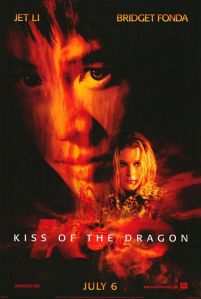 Jet Li is a man with fantastic martial arts skills and splendor. I have no doubt in my mind that if this man were given a proper American vehicle he could knock ’em dead. Romeo Must Die was too tired and the fight scenes were too cramped (not to mention the hilarious spine flashing kick at the end). Li takes off this time as a Chinese intelligent officer who travels to France to unwittingly become the center of corrupt cops’ ire. Li dispatches people in some unintentionally uproarious manners like the use of chopsticks or acupuncture. The story is meaningless and just a door to the action sequences to show off the muscle of Li.
The biggest detriment of Kiss of the Dragon happens to be in the area of why the audience is forking over their green – action. The action scenes in Dragon are horribly choreographed and edited together. Nothing astounds the eye or makes the pulse race; it only annoys and agitates. The audience is coming to see some awesome kung fu delivered by its maestro Li, but what they end up getting is dull fight sequences horrendously spliced together. No sense of time or geography comes from these edits, which means there might be stuff happening but you don’t know what and to whom. If you’re going to showcase Li at least give the man a workable stage for his talents.
The story of Dragon is laughably bad with some perfect forehead slapping moments, like when Li is running from the bad guys and ducks into a martial arts class where everyone then takes him on. Bridget Fonda hits a career low as a woman forced into prostitution so she can retrieve her little girl again. The entire supporting cast is about as animated and well put together at the atrocious fight sequences. Only true die-hard fans of Li or kung fu should go see Kiss of the Dragon. The rest of the public should just hide their chopsticks when Li comes for dinner.
Nate’s Grade: C-


 nathanzoebl
You must be logged in to post a comment.