The Man Who Wasn’t There (2001)
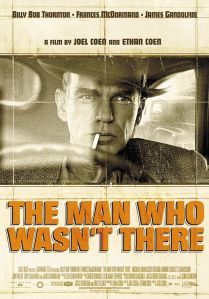 The Coen brothers dark, twisty entry to the world of film noir looks mind-blowing with its black and white lensing. And the story is great too. Billy Bob Thronton plays a barber who gives new definition to the word passive. One day a customer lets him in on an up-and-coming financial project and if Thronton were to provide some dough then surely he would rake it in. As with most film noir, the normal man is thus pulled into the web of intrigue and crime. The ball gets rolling after Thornton blackmails his wife’s tryst (James Gandolfini), who also happens to be her boss and his friend. Things get far more complicated from there and nothing seems to go right as Thornton makes one bad decision after another. The Man Who Wasn’t There is an engaging and smart drama with game bits of comedy strewn at key moments. The Coen brothers are a pair not very easily topped when it comes to excellence in films, and this latest entry is a wonderful addition to their resume.
Nate’s Grade: A-
Share this:

Monster’s Inc. (2001)
 Pixar are the animation titans who have been delivering first-rate pictures under the Disney banner for the last five/six years. The placement of their name is like a seal of quality, unlike the placement of the Disney name. Monsters Inc. is the latest and it’s crammed full of humorous jokes and lively imagination that can propel it forward despite the bad score by Randy Newman.
Monsters Inc. is a corporation in a monster universe that trains its workers to enter the bedrooms of sleeping children and derive scares for resources. Their monster world is powered by the screams of children and it seems times are getting tougher. Children are becoming harder to scare (blame CNN) and it seems an energy crisis is looming. The pressure is on for the big blue bear that is James P. “Sully” Sullivan (John Goodman). Sully is close to achieving the all-time scare record with the aid of his assistant Mike (Billy Crystal), a small one-eyed green guy. But their scare colleague Randall (Steve Buscemi), a bad tempered purple reptile, is nipping at Sully’s heels.
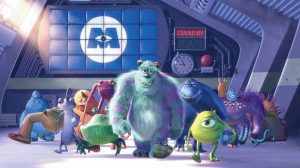 The clever twist of Monsters Inc. is that these frightful creatures, some with spikes and some as many eyes as Elizabeth Taylor ex-husbands, are as afraid of children as they are of them. Reportedly their touch is toxic and possibly fatal. A single sock getting stuck to one unfortunate monster on his return causes an entire decontamination unit to spring forward. The joke is both alarmingly timely but also a great visual gag as all the different shaped monsters fit into their suits.
One night Sully accidentally lets a small toddler enter their world. He fears what the ramifications of this outbreak might be and struggles to keep her presence under wraps with the help of Mike, but Boo (as Sully dubs her later) is more than an adorable handful. The pair get into a mess of trouble and constantly trying to keep Boo clear of contact.
John Goodman provides a great performance as the sweet and cuddly Sully. His demeanor is one that warms him to the audience. Crystal provides some good laughs and walks a very fine line of going overboard into his usual borsch belt humor. Buscemi has the menacing voice that gives Randall life. The real star is Boo, whose actual voice was provided by one of the animator’s own kids. Every coo, every laugh, every word she says is full of such glee that it’s uncontrollably cute. She’s almost an overpowering force of cuteness.
Late into the story it tries to go for something below the surface by having Sully see the consequences of his profession. His attachment to Boo is a bit far-fetched in the great speed it occurs and the groan-worthy happy ending is a miscue that could have been ripe with possibilities.
 The animation of Monsters Inc. is nothing short of flawless. Something Pixar does better than any studio is fluidity of movement. At times during Shrek the characters are a tad stiff or blocky in their movements, but with ‘Monsters Inc.’ every gesture, every wavering hair on Sully, it’s all wonderfully fluid. Pixar are marvels at what they can do with computers and Monsters Inc. is another impressive chink on their already impressive belt.
The film lacks the heart of a Toy Story but doesn’t lack in imagination. The whole concept is very inventive and reconfirming of the suspicion we all had as kids. A sequence late into the film where Randall chases Sully and Mike through a vast area with thousands of doors on rails is the true highlight. This scene is awe inspiring and a head rush by the majestic care put into it and the comic payoffs it has. It’s a chase scene that’s worth following.
Monsters Inc. is funny enough and creative enough to be well worth a viewing. It lacks the subtext and human emotion of the two Toy Storys, but is still entertaining in its own right. My grandma described it as the movie “with the talking M&M.”
Nate’s Grade: B+
Share this:

The Deep End (2001)
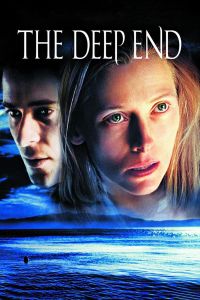 In the vast wasteland the summer has become of mediocrity and sub-mediocrity, go to your local art house. There you may very well see The Deep End, a dramatic thriller that burrows itself into the audience’s mind. The film is an absolute breath of fresh air in the stagnant summer finally winding down.
Tilda Swinton plays a normal mother living on the banks of Lake Tahoe. Her days usually consist of trying to ship her kids to school on time and handle the duties of the home in the long stretches her Naval officer husband is gone. She’s juggling responsibilities and chores when her first strike of maternal protection occurs. Her 17 year-old son is, to her great surprise, in a relationship with a sleazy man in his 30s. She discovered this when her son got into a serious car accident while this paramour was traveling with. The scene of the crash is replayed in flashbacks for Swinton as a motivational jump-start for her protection and love.
She tells the man she doesn’t want him seeing her son any longer, but of course he refuses to desist… unless the price is right. This revelation sends her son to a late night confrontation at home that ends in the accidental death of the sleaze. Mom sees her son rush back into the house in the middle of the night and decides to go out and investigate. On her stroll to her horror she finds the dead body of her son’s lover. From that moment on something in her clicks and she clumsily tries to hide the body and any evidence that could incriminate her own brood.
Just when she believes her headaches are over a dark and handsome stranger (Goran Visnjic) visits her one day. He has within his possession a videotape of her son having explicit sex with the dead lover. He threatens to turn the tape into the police and thus destroy the peace Swinton has created. The video can be hers, but she must pay him and his unseen partner the sum of $50,000.
 Tilda Swinton is best known as the gender-swapping title figure in Orlando based upon Virginia’s Woolfe’s story. The Scottish actress has a wonderfully pallid face and soulful eyes that express every moment the determination and fear she wrestles with. Swinton gives a remarkable performance of pure emotion. She is a mother determined to protect her son and family at every cost, no matter the means. She is constantly in over her head but refuses to relent. Swinton’s portrayal is a woman running on maternal instinct and she herself is the very gravity that makes The Deep End as great as it is.
Goran Visnjic currently plays a Croatian doc on E.R. but has a provocative presence in this flick. He’s got the smoldering good looks and his character opens up more and more as the tale progresses to strip away pretensions layer by layer.
The Deep End is directed, written, and produced by David Siegel and Scott McGehee, with only one other film to their credit all the way back in 1993. They inject their story with great moments of character and suspense but also have a terrific visual eye to create mood. The cinematography is lush and hypnotic with certain moments of exquisite beauty. Even the music adds to the feeling of the film unlike so many other accompanying scores. Every component of ‘The Deep End’ is just clicking.
The Deep End is a luminously tight thriller with remarkable performances. They story has a few implausible moments but outweighs them with heapings of great dramatic depth. Swinton better be one of the first choice on everyone’s lips when the name of Oscar rolls about, because I doubt I’ll see a performance more elegant and wonderful as hers this year.
Nate’s Grade: A
Share this:

Ghost World (2001)
 Thora Birch. Mmmhmm. I mean, an excellent showcase for the outsider in all of us, brilliantly tweaking our society and culture while fostering surprisingly poignant, deeply funny characters and situations as they interact with a world they barely understand and don’t wish to. And it’s got Thora Birch.
Nate’s Grade: A
Share this:

Haiku Tunnel (2001)
 Josh Kornbluth plays Josh Kornbluth, super temp in the world of office politics and incompetent corporate superiors. He’s a working man’s hero (well, a secretary’s hero) as a round ball of puffy passive-aggressive professionalism. When asked to go permanent for a tax attorney (“We’ll even cover your
psychotherapy”) is when Josh’s world begins to enter into comedic haywire. He’s more adept at creatively finding ways around work then at actually accomplishing it. Kornbluth is a terrific comedic and a truly memorable figure. He co-wrote and co-directed the film with his brother from their stage play. Haiku Tunnel often channels the spirit of the wicked satire Office Space (a film that only gets funnier every time I watch it), but has enough of a feel all its own to be distinguishable. The film has some great lines and some imaginative characters to boot. Haiku Tunnel is witty and often times hilarious, not to mention dead-on with its precision like satiric strikes. Kornbluth is a definite entertainment find and Haiku Tunnel is a gem of a film worth looking for.
Josh Kornbluth plays Josh Kornbluth, super temp in the world of office politics and incompetent corporate superiors. He’s a working man’s hero (well, a secretary’s hero) as a round ball of puffy passive-aggressive professionalism. When asked to go permanent for a tax attorney (“We’ll even cover your
psychotherapy”) is when Josh’s world begins to enter into comedic haywire. He’s more adept at creatively finding ways around work then at actually accomplishing it. Kornbluth is a terrific comedic and a truly memorable figure. He co-wrote and co-directed the film with his brother from their stage play. Haiku Tunnel often channels the spirit of the wicked satire Office Space (a film that only gets funnier every time I watch it), but has enough of a feel all its own to be distinguishable. The film has some great lines and some imaginative characters to boot. Haiku Tunnel is witty and often times hilarious, not to mention dead-on with its precision like satiric strikes. Kornbluth is a definite entertainment find and Haiku Tunnel is a gem of a film worth looking for.
Nate’s Grade: B+
Share this:

Mulholland Drive (2001)
 Mulholland Dr. has had a long and winding path to get to the state it is presented today. In the beginning it was 120 minutes of a pilot for ABC, though it was skimmed to 90 for the insertion of commercials. But ABC just didn’t seem to get it and declined to pick up David Lynch’s bizarre pilot. Contacted by the French producers of Lynch’s last film, The Straight Story, it was then financed to be a feature film. Lynch went about regathering his cast and filming an additional twenty minutes of material to be added to the 120-minute pilot. And now Mulholland Dr. has gone on to win the Best Director award at Cannes and Best Picture by the New York Film Critics Association.
Laura Harring plays a woman who survives a car crash one night. It appears just before a speeding car full of reckless teens collided into her limo she was intended to be bumped off. She stumbles across the dark streets of Hollywood and finds shelter in an empty apartment where she rests. Betty Elms (Naomi Watts) is a young girl that just got off the bus to sunny California with aspirations of being a big time movie star. She enters her aunt’s apartment to find a nude woman (Harring) in the shower. She tells Betty her name is Rita after glancing at a hanging poster of Rita Hayworth. Rita is suffering from amnesia and has no idea who she is, or for that fact, why her purse is full of thousands of dollars. Betty eagerly wants to help Rita discover who she is and they set off trying to unravel this mystery.
 Across town, young hotshot director Adam Kesher (Justin Theroux) is getting ready to go into production for his new film. He angers his mob producers by refusing to cast their chosen girl for his movie. After some harassment, threats, and a visit by an eyebrow-less cowboy assassin (God bless you David Lynch), he relents.
In the meanwhile, people are tracking the streets looking for Rita. Betty and Rita do some detective work and begin amassing clues to her true identify. As they plunge further into their investigation the two also plunge into the roles of lovers. Rita discovers a mysterious blue box and key in her possession. After a night out with Betty she decides to open it, and just when she does and the audience thinks it has a hold on the film, the camera zooms into the abyss of the box and our whole world is turned upside down.
David Lynch has made a meditation on dreams, for that is at the heart of Mulholland Dr. His direction is swift and careful and his writing is just as precise. The noir archetypes are doing battle with noir expectations. The lesbian love scenes could have been handled to look like late night Cinemax fluff, but instead Lynch’s finesse pays off in creating some truly erotic moments. Despite the population of espresso despising mobsters, wheelchair bound dwarfs, and role-reversal lesbians, the audience knows that it is in hands that they can trust. It’s Lynch back to his glorious incomprehensible roots.
Watts is the true breakthrough of Lynch’s casting and she will surely be seen in more films. Watts has to play many facets of possibly the same character, from starry-eyed perky Nancy Drew to a forceful and embittered lesbian lover.
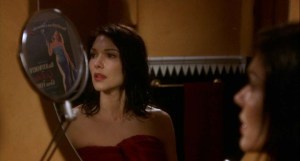 One scene stands out as a perfect example of the talent Watts possesses. Betty has just been shuffled off to an audition for a film and rehearsing with Rita all morning. She’s introduced to her leathery co-star and the directors await her to play out the audition scene of two kids and their forbidden love. As soon as the scene begins Betty vanishes and is totally inhabited by the spirit of her character. She speaks her lines in a breathy, yet whisper-like, voice running over with sensuality but also elements of power. In this moment the characters know, as the audience does, that Betty and Naomi Watts are born movie stars.
It’s not too difficult for a viewer to figure out what portions of the film are from the pilot and what were shot afterwards. I truly doubt if ABC’s standards and practices allows for lesbian sex. The pilot parts seem to have more sheen to them and simpler camera moves, nothing too fancy. The additional footage seems completely opposite and to great effect. Mulholland Dr. has many plot threads that go nowhere or are never touched upon again, most likely parts that were going to be reincorporated with the series.
The truly weirdest part of Mulholland Drive is that the film seems to be working best when it actually is still the pilot. The story is intriguing and one that earns its suspense, mystery, and humor that oozes from this noir heavy dreamscape. The additional twenty minutes of story could be successfully argued one of two ways. It could be said it’s there just to confound an audience and self-indulgent to the good story it abandons. It could also be argued that the ending is meticulously thought out and accentuates the 120 minutes before it with more thought and understanding.
Mulholland Dr. is a tale that would have made an intriguing ongoing television series complete with ripe characters and drama. However, as a movie it still exceeds in entertainment but seems more promising in a different venue.
Nate’s Grade: B
Reviewed 20 years later as part of the “Reviews Re-View: 2001” article.
Share this:

Hedwig and the Angry Inch (2001)
 John Cameron Mitchell directed, adapted from his stage play and stars as the sexually confused rock mega-star Hedwig. Hedwig was a boy trying to escape from the constraints of soviet occupied East Germany. His lucky ticket came in with a GI who agreed to marry Hedwig and take him out of the country with him, but Hedwig had to go under the knife and become a proper lady before their escape was to ensue. When the sex change operation is botched it leaves Hedwig with a single nub-like inch left causing gender confusion (“Six inches forward, five inches back”). Dumped by his GI Hedwig turns to song and befriends a lonely and confused boy Tommy Gnosis (Michael Pitt). Their courtship seems to be going fine until Gnosis steals all of Hedwig’s songs and uses them for his own superstardom on MTV. Hedwig’s defense is to pack up a traveling band and to perform at various salad bars and trucker diners in the same town Gnosis travels to. It’s during these performances that Hedwig dishes about her unusual life.
Unlike most plays turned into films, Hedwig has been adapted for the medium of cinema. Animations, clever camera tricks and sing-alongs follow our story, making it an exhilarating film going experience. Hedwig is excitingly original and spilling over with passionate energy that can’t help but transfer to the audience. Mitchell proves himself a born filmmaker, but also a rock star. Many of the songs of Hedwig are quite listenable and could be found on some music channels. Hedwig is a trans hero for all of us and Mitchell delivers a fresh and resoundingly funny, sad, and technical achievement of a movie.
Nate’s Grade: A
Share this:

Serendipity (2001)
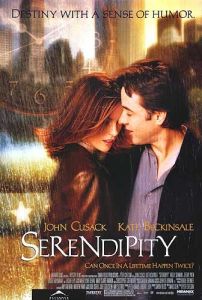 There’s a universe somewhere populated entirely with down-on-their-luck lovable sweethearts and good-hearted friendly buffoons operated under the physics of romantic comedies. In this universe there is no such thing as chance, even if one leaves it up to it, and in this place what would seem like frustratingly idiotic behavior seems romantic. So is Serendipity revolving in this universe. Kate Beckinsale is a gal that leaves everything to fate, possibly even her taxes, and John Cusack is the smitten man running all over the place trying to find this mad woman. In our world Beckinsale would seem foolish or even mean-spirited, but because the two will definitely end up in each other’s arms before the credits roll we allow her to continue her ridiculous behavior. She puts Cusack in a seemingly cruel obstacle course of chance to win her heart. These people operate outside of our known world. Eugene Levy has a brief and funny part in the movie but otherwise Serendipity takes itself as being much cuter and smarter than it is.
Nate’s Grade: C
Share this:

Glitter (2001)
 It must be seen to be believed. A new college crap-fest drinking game has begun. Begin the Glitter midnight shows! A new age is upon us! Here are a few handful of Glitter‘s bon-mots it serves up to its audience:
-Mariah Carrey is shown leaving her real mom at age 8 with her kitten. Somewhere through Glitter she has a fight with her boyfriend and takes her cat (yes the very same immortal cat that must have been pushing 20) and leaves.
-She has a fight with said boyfriend and they both try and write a love song to show their remorse. Except they BOTH come up with the EXACT same song word for word, note for note, and NO ONE thinks this is the creepiest thing ever.
-The movie freakin’ ends with Carrey’s boyfriend getting shot and killed. Yes, this is truly how the thing ends. Oh, like any of you cared about plot spoilers anyway.
-Da Brat is in it for “comic relief.”
-The movie is inexplicably set in the 1980s for no reason.
Anyone would have to be crazy thinking Glitter ever remotely resembled art. It’s so bad it’s awesome to watch. Bring some friends over, open up some alcohol, and let the fun times begin.
Nate’s Grade: F, like it matters though
Reviewed 20 years later as part of the “Reviews Re-View: 2001” article.
Share this:

Don’t Say a Word (2001)
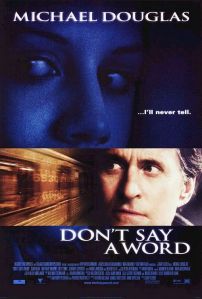 I don’t know about the marketers but something strange is taking place with the public recognition of Don’t Say a Word. At school, church, and home I hear it referred to often as the “I’ll never tell” movie. Which could be great for public awareness, what sinking that ending sing-songy whisper of Brittany Murphy into the populace’s mind, but what good is awareness if they think it’s a different movie?
Michael Douglas is the best child psychiatrist we have, but not only that, why he’s a loving dad as well. He gets called in to inspect a new patient Elisabeth Burrows (Brittany Murphy) who appears to be one loony nut to crack. But of course Douglas can because he’s the best. A team of foiled bank robbers kidnap Douglas’ child and order him to somehow dislodge a key sequence of six numbers stuck in the tortured head of Elisabeth. Can Douglas rescue his daughter and topple the bad bank robbers in the process and protect his disabled wife (Famke Janssen) in the process? Well of course. He’s the best damn child psychiatrist we have.
 Don’t Say a Word is the type of film that leaves nothing to chance for the audience. It’s a film that paints with broad strokes, forgetting its massive plot holes and frequent missteps with logic, and spells everything out for the audience – but still fowls this up. Word is so by-the-numbers and predictable that it hardly ever muscles up enough of a fight to keep an audience’s attention. A female detective (Jennifer Esposito) is on the case and following the clues to find Elisabeth. We simply know that her only purpose is to come from nowhere and save Douglas in a tense exchange. The bad guys aren’t all bad; some make peanut butter and marmalade sandwiches. In the beginning robbery we know that it’s the past, why? They talk about football and U2 plays over the robbery! Surely this must be the early 90s!
Douglas spends most of the film either scowling at people or trying to look sincere, which comes off looking like an impatient child that has to go the bathroom. This is essentially a Michael Douglas film and I guess Michael Douglas plays the role of Michael Douglas with ease. Too bad the rest of the movie is full of people that look like they don’t know what they’re doing in this mess.
Janssen is confined for the entire movie to her bed. The movie could have expertly veered into her paranoia and feelings of helplessness stuck in her house while her daughter has been taken from her. Instead she’s merely pretty window dressing. The only purpose she has with a broken leg and confined to a bed is that we know that some bad guy will come down and she’ll have to hide and fight for herself.
Bean makes an adequate bad guy (as he did in Golden Eye) but he doesn’t have much to do except mug on a cell phone or in a speeding car. The rest of his posse is basically a central casting call for gang members, from the motor mouth black guy to the biker to the computer whiz. And all of these people are fighting, killing, and destroying mass amount of public property for a ruby the size of a fingernail? And where did they get all this money to pull off a scheme like the one they perpetrate on Douglas’ family? It’s like the team took a trip to Circuit City and bought the store.
 Don’t Say a Word is really a thriller that doesn’t thrill, and one that causes you to smack yourself in the head at several eye-rolling moments. Douglas escorts his hospitalized and supposedly dangerous patient out of a hospital with nary a glance or tinge of trouble all because he pulled a fire alarm. Are we back in junior high or something? As well as the moment Douglas first spots Murphy he calls her out by dropping her arm but she supposedly had fooled a legion of trained medical professionals before? Word is a series of contrivances and mounting questions that never get answered.
Don’t Say a Word is so run-of-the-mill that its often times dull and void of life. The audience of Don’t Say a Word might come off thinking they have the power of Miss Cleo with all the predictions they’ll get right. It’s basically a recycling of everything you’ve seen many times before in better thrillers. Murphy’s performance lifts the bar occasionally but this is a dog that is in desperate need of being shot.
Nate’s Grade: C


 nathanzoebl
You must be logged in to post a comment.